AI Summary
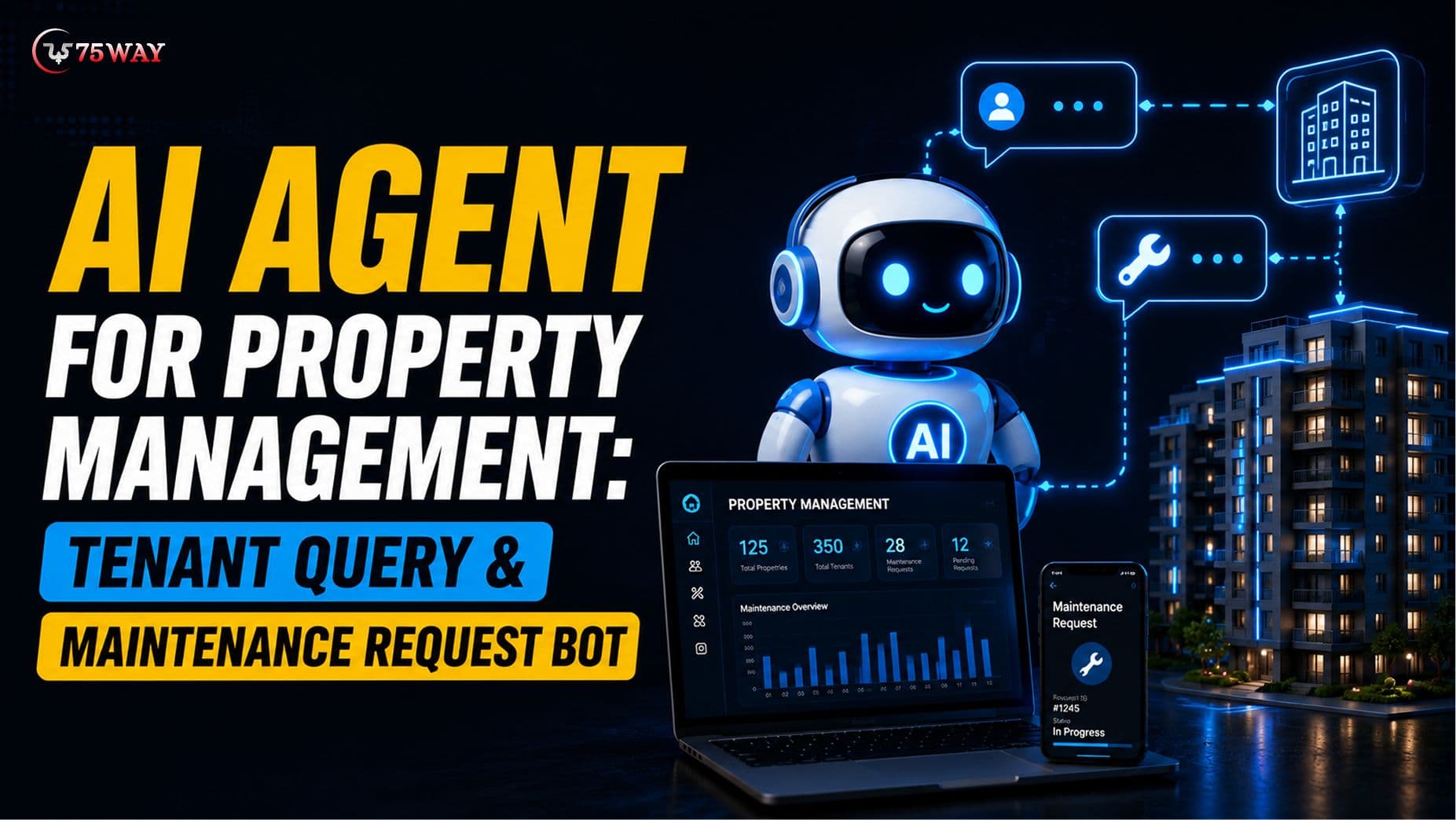
Property managers receive hundreds of routine requests every week. AI agents streamline those interactions around the clock. Tenant support becomes available anytime. Real estate businesses can reduce operational costs. This guide explains how intelligent automation transforms property operations.
Key Takeaways
- AI agents for property management automate tenant communication.
- Faster responses improve tenant satisfaction and operational productivity.
- Intelligent automation reduces repetitive property management workloads.
- Custom AI agents integrate seamlessly with existing property management software.
- AI-driven property management supports scalable and reliable business growth.
A tenant reports a leaking pipe at midnight. Another wants to know when the security deposit will be returned. Someone else needs a copy of the lease agreement. None of these requests are unusual, but answering them quickly, every single day, is a challenge for many property managers.
As portfolios grow, handling repetitive tenant conversations manually becomes slower, more expensive, and harder to scale. That is why property management companies are turning to AI agents for real estate.
Instead of waiting for office hours or relying entirely on support staff, tenants can receive instant answers to common questions, log maintenance requests, track repair progress, and stay updated through natural conversations. Property managers, in turn, spend less time on repetitive tasks and more time resolving issues that require human attention.
If you're planning to build an AI agent for property management, this guide explains how to develop a tenant query and maintenance request bot, the essential features it should include, the AI technologies behind it, the AI agent development process, and the estimated cost of building a custom AI agent for real estate in 2026.
What Is an AI Agent for Property Management?
Think about how much time a property management team spends answering the same questions every day.
- "When is my rent due?"
- "Has my maintenance request been assigned?"
- "Can I renew my lease?"
- "Who should I contact for parking access?"
While each question is simple, responding manually hundreds of times every week consumes valuable staff hours.
An AI agent for property management changes that. Instead of waiting for someone to respond, tenants interact with an intelligent virtual assistant that understands natural language, retrieves relevant information, completes tasks, and follows through until the request is resolved.
Unlike a basic chatbot that follows scripted conversations, a real estate AI agent can understand context, make decisions, and interact with multiple business systems. It doesn't simply answer questions. It performs actions.
For example, if a tenant reports that the air conditioner has stopped working, the AI agent doesn't just acknowledge the request. It collects the necessary details, checks the property's maintenance policies, creates a work order, assigns the task to the appropriate technician, schedules a visit based on availability, and keeps the tenant informed throughout the process.
How Is an AI Agent Different From a Traditional Property Chatbot?
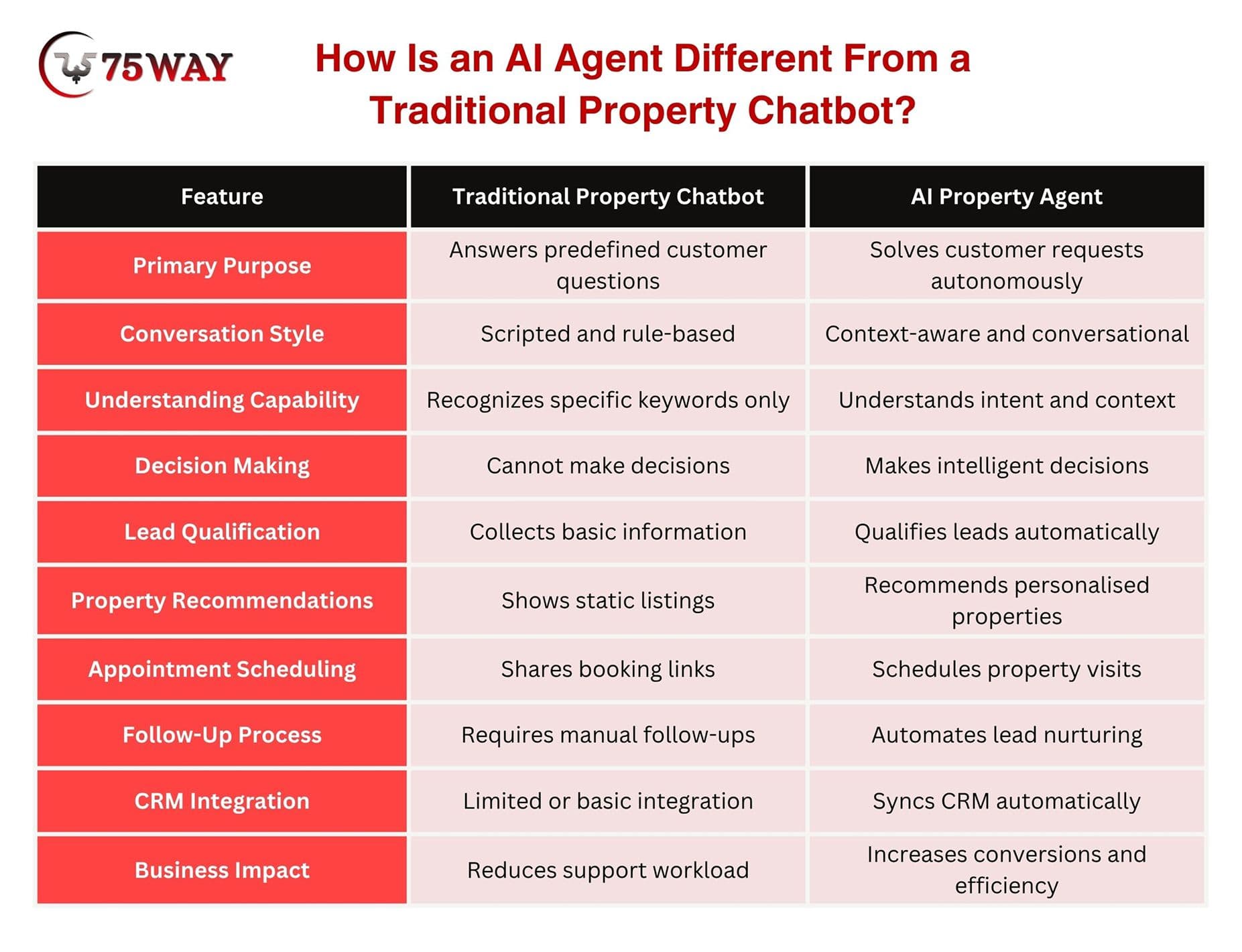
The biggest difference between an AI agent and a traditional chatbot for property management is that an AI agent understands goals, makes decisions, and completes tasks on behalf of users. Whereas a traditional property chatbot responds to questions. A conversational chatbot typically follows predefined rules and scripted responses.
If a customer asks something outside its programmed flow, the conversation often reaches a dead end. An AI agent, on the other hand, understands context, remembers previous interactions, and takes the next step without constant human intervention.
This difference becomes even more valuable in real estate. Instead of only answering questions about listings or office hours, an AI agent can qualify buyers, recommend suitable properties, schedule site visits, follow up with leads, collect required information, and even integrate with CRM systems to keep sales teams updated. In short, a chatbot talks, while an AI agent actively helps move deals forward. AI real estate agents increase property sales and conversions too.
In simple language, the difference becomes obvious during real interactions. A chatbot might reply:
"Please contact the property office for maintenance support."
An AI agent responds differently:
"I've created your maintenance request, assigned it to the HVAC technician, and scheduled the earliest available appointment for tomorrow at 9:00 AM. You'll receive updates automatically."
That's the difference between answering a question and solving a problem.
Why Property Management Companies Are Investing in AI Agents?
Property management has become more demanding than ever. Tenants expect immediate responses, maintenance teams juggle dozens of service requests, and property managers must coordinate multiple vendors while keeping operations running smoothly. Handling all of this manually doesn't scale. That's why real estate AI agents are quickly becoming part of modern property management strategies.
- Rising Tenant Expectations
Today's tenants are accustomed to instant service. They can order food, book transportation, or shop online within minutes. Naturally, they expect the same experience when interacting with property managers. Waiting until office hours for answers often leads to frustration.
An AI agent provides immediate assistance any time of the day, including weekends and holidays. Whether tenants need lease information, payment details, or maintenance updates, they receive timely responses without waiting for staff availability.
- Growing Maintenance Requests
Maintenance is one of the busiest areas of property management. A single apartment community may receive hundreds of requests every month. Tracking each issue manually increases the risk of delays, duplicate tickets, and missed follow-ups.
AI agents simplify the entire process by collecting issue details, categorizing requests, assigning priorities, notifying maintenance teams, and updating tenants automatically as work progresses. This keeps everyone informed while reducing administrative effort.
- Operational Costs Continue to Rise
Hiring additional support staff isn't always the most efficient solution.
Many routine interactions don't require human judgment. They simply involve answering repetitive questions or updating existing records.
By automating these repetitive tasks, AI agents allow property management teams to handle larger portfolios without proportionally increasing operational costs.
- Property Managers Need Better Visibility
Managing multiple residential or commercial properties often means working across different software platforms.
AI agents bring those systems together by retrieving information, updating records, and coordinating workflows through existing integrations.
Instead of switching between multiple dashboards, property managers receive organized, real-time information from a single intelligent assistant.
- Competitive Advantage Matters
Tenant experience has become an important differentiator in today's property market.
Faster responses, transparent maintenance updates, and consistent communication create a better resident experience while strengthening tenant retention.
Businesses that adopt AI-powered automation today are positioning themselves to deliver a higher level of service as tenant expectations continue to evolve.
How AI Tenant Query & Maintenance Request Bot Works?
Many people assume an AI agent simply answers tenant questions. In reality, that's only one small part of the process. A well-designed AI agent understands requests, gathers information, makes decisions, communicates with different systems, and keeps everyone updated until the task is complete. Let's see how it works through a real-world example.
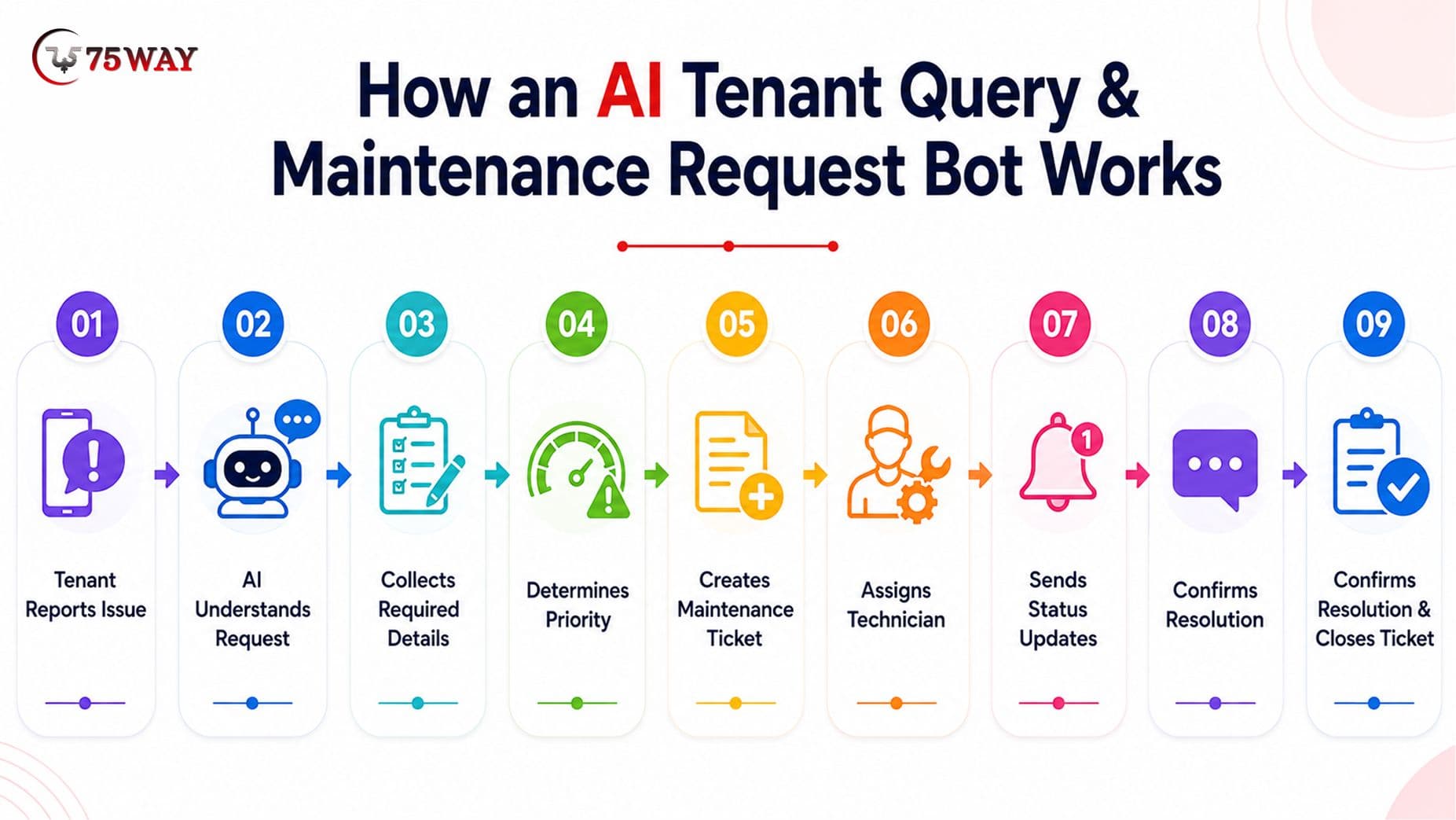
Step 1: The Tenant Reports an Issue
It starts with a simple conversation.
Imagine a tenant notices water leaking from the kitchen sink late in the evening. Instead of waiting until the leasing office opens, they open the property's website, mobile app, or WhatsApp chat and type:
"My kitchen sink is leaking. Water is collecting under the cabinet."
The AI agent immediately understands that this is a maintenance request rather than a general inquiry. Instead of sending a generic response, it begins collecting the information needed to resolve the problem.
Step 2: The AI Agent Collects Important Details
Before creating a maintenance request, the AI agent asks a few follow-up questions. For example, it may ask:
- Is the leak continuous or occasional?
- When did you first notice the problem?
- Can you upload a photo?
- Is water reaching electrical outlets?
- Is anyone currently home?
These questions help determine both the urgency and the type of technician required. Rather than asking every question at once, the conversation feels natural, almost like speaking with a property manager.
Step 3: The Request Is Prioritized Automatically
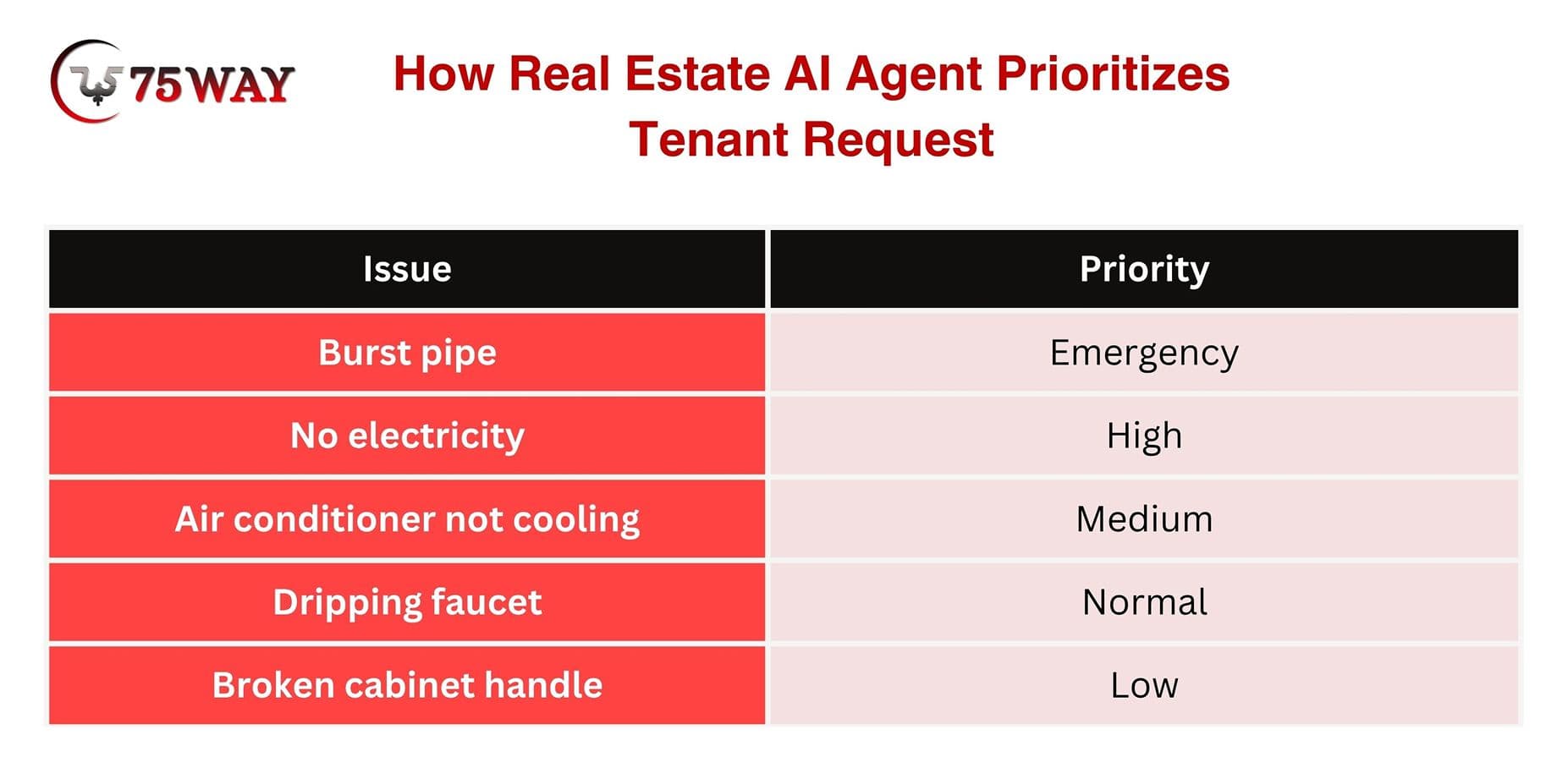
Not every maintenance issue requires the same response. A leaking faucet may need attention within a day. A burst pipe demands immediate action.
Using predefined business rules and AI reasoning, the agent evaluates the request and assigns the appropriate priority level. For example: This ensures urgent problems receive immediate attention while routine requests enter the standard maintenance queue.
Step 4: A Work Order Is Created
Once the issue has been assessed, the AI agent automatically creates a maintenance ticket inside the property management system.
The work order includes:
- Tenant information
- Property and unit number
- Issue description
- Uploaded photos
- Priority level
- Preferred visit time
Everything is documented automatically, reducing manual data entry and minimizing errors.
Step 5: The Right Technician Is Assigned
Finding the right technician often takes more time than creating the ticket itself. An AI agent can speed up this process by checking technician availability, required skills, location, workload, and even service history.
If an HVAC issue is reported, the request goes directly to an HVAC technician. If it's an electrical fault, the system assigns an electrician instead. This automation helps reduce delays while improving first-time resolution rates.
Step 6: Everyone Receives Real-Time Updates
One of the biggest frustrations for tenants is not knowing what happens after they submit a request. AI agents solve this communication gap by sending automatic updates throughout the maintenance process. For example, tenants receive notifications when:
- The request is received.
- A technician is assigned.
- The visit is scheduled.
- Repairs are completed.
- The ticket is closed.
Property managers also gain real-time visibility into every maintenance request without manually following up.
Step 7: The AI Agent Closes the Loop
The process doesn't end when the repair is complete. After the technician marks the work order as finished, the AI agent asks the tenant to confirm that the issue has been resolved.
If the tenant reports another problem, the request can be reopened automatically. If everything is working properly, the ticket is closed, and the interaction is stored for future reference.
This final step helps improve service quality while providing valuable feedback for property managers.
Why This Matters?
Without artificial intelligence, a maintenance request may pass through multiple emails, phone calls, spreadsheets, and manual updates before reaching the right person. With an AI agent, the same process becomes faster, more organized, and far less dependent on human intervention.
The result isn't just quicker issue resolution. It also improves tenant satisfaction, reduces administrative work, and gives property managers more time to focus on higher-value responsibilities rather than repetitive coordination.
Key Features Every Property Management AI Agent Should Have
Not every AI agent delivers the same value. Some only answer FAQs, while others can automate complete property management workflows. If you're planning to build an AI agent for property management, these are the features that make the biggest difference.
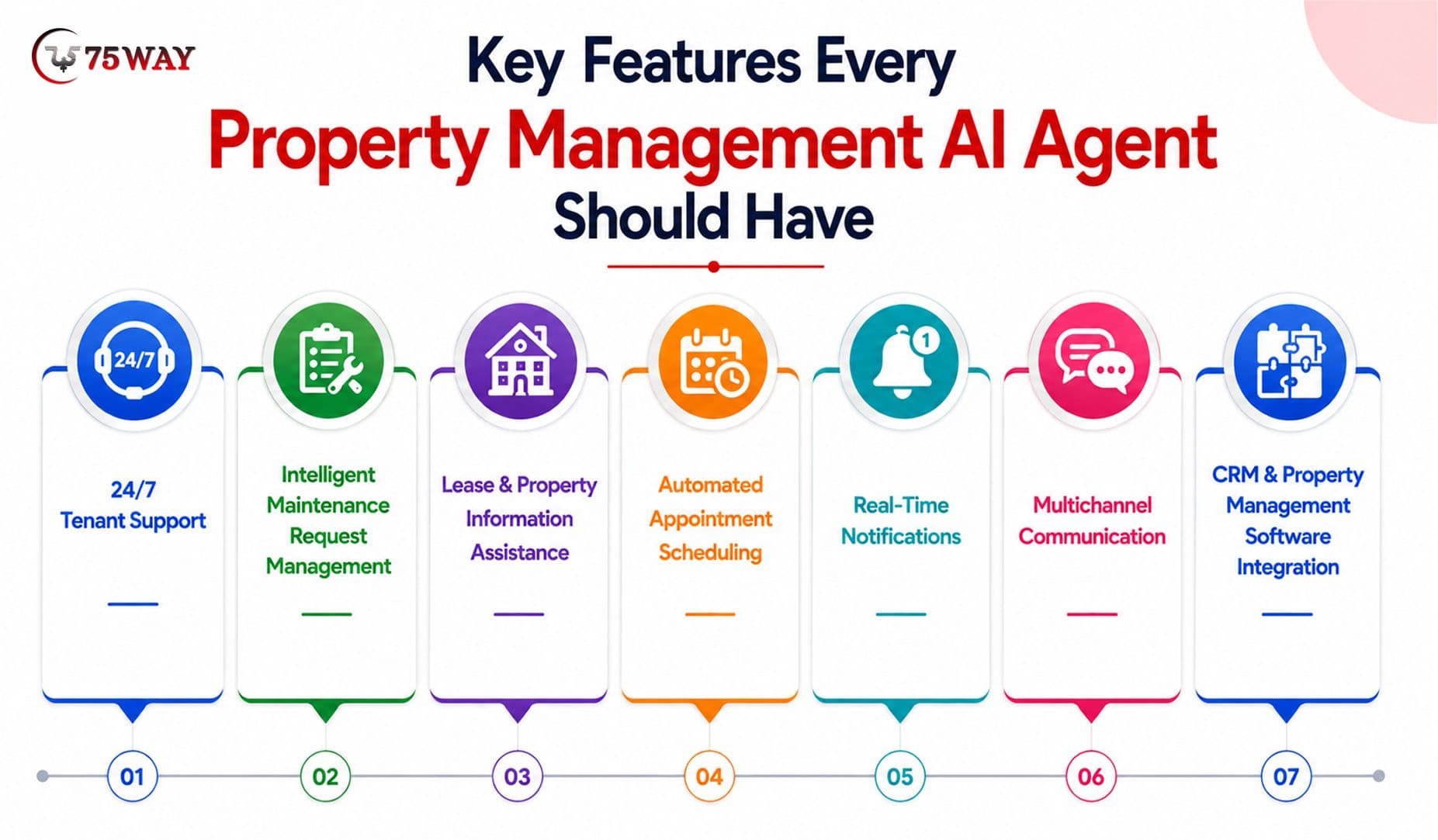
- 24/7 Tenant Support: Tenant questions don't stop after office hours. Someone may need parking information late at night, while another resident may report a maintenance issue early in the morning.
An AI agent provides instant responses anytime, whether it's midnight, a weekend, or a public holiday. Instead of waiting for the leasing office to open, tenants receive accurate information within seconds. For instance, a tenant asks, "When is my rent due?" The AI agent instantly retrieves the payment schedule and provides the correct due date.
- Intelligent Maintenance Request Management: Maintenance requests often involve multiple steps, from collecting issue details to assigning technicians and updating tenants. Handling each task manually takes time and increases the risk of delays. An AI agent automates the entire workflow.
It understands the issue, asks follow-up questions, creates a work order, assigns the right technician, and keeps everyone informed until the repair is complete. Instead of emailing the maintenance team, the AI agent creates a ticket and schedules the earliest available technician automatically.
- Lease and Property Information Assistance: Property managers receive countless questions about lease terms, move-in dates, pet policies, parking rules, and community amenities.
Rather than searching through documents or contacting the office, tenants can ask the AI agent and receive immediate answers based on the property's latest information. This reduces repetitive inquiries while improving the tenant experience.
- Automated Appointment Scheduling: Scheduling property inspections, maintenance visits, or lease meetings often involves several emails and phone calls.
An AI agent simplifies this process by checking availability, suggesting time slots, confirming appointments, and sending reminders to both tenants and staff. Everyone stays informed without manual coordination.
- Real-Time Notifications: Tenants appreciate knowing what's happening with their requests.
An AI agent automatically sends updates whenever the status changes, whether a maintenance request has been assigned, an inspection is scheduled, or a repair has been completed. This transparency reduces follow-up calls and builds trust.
- Multichannel Communication: Every tenant has a preferred way to communicate. Some use a mobile app, while others prefer email, SMS, WhatsApp, or the property website. A modern AI agent supports multiple communication channels without changing the overall experience.
Conversations remain consistent regardless of where tenants start them. This allows property managers to deliver faster support without managing separate communication systems.
- CRM and Property Management Software Integration: An AI agent becomes significantly more valuable when connected to existing business systems.
Instead of storing information separately, it retrieves tenant records, updates maintenance tickets, checks payment status, and synchronizes information across your property management platform. This keeps data accurate while eliminating duplicate work.
How Virtual AI Assistants Improve Property Management Operations: Know Benefits
The real value of an AI agent isn't measured by the number of conversations it handles. It's measured by the time it saves, the service it improves, and the operational efficiency it creates. Here's how businesses benefit after implementing AI-powered property management.
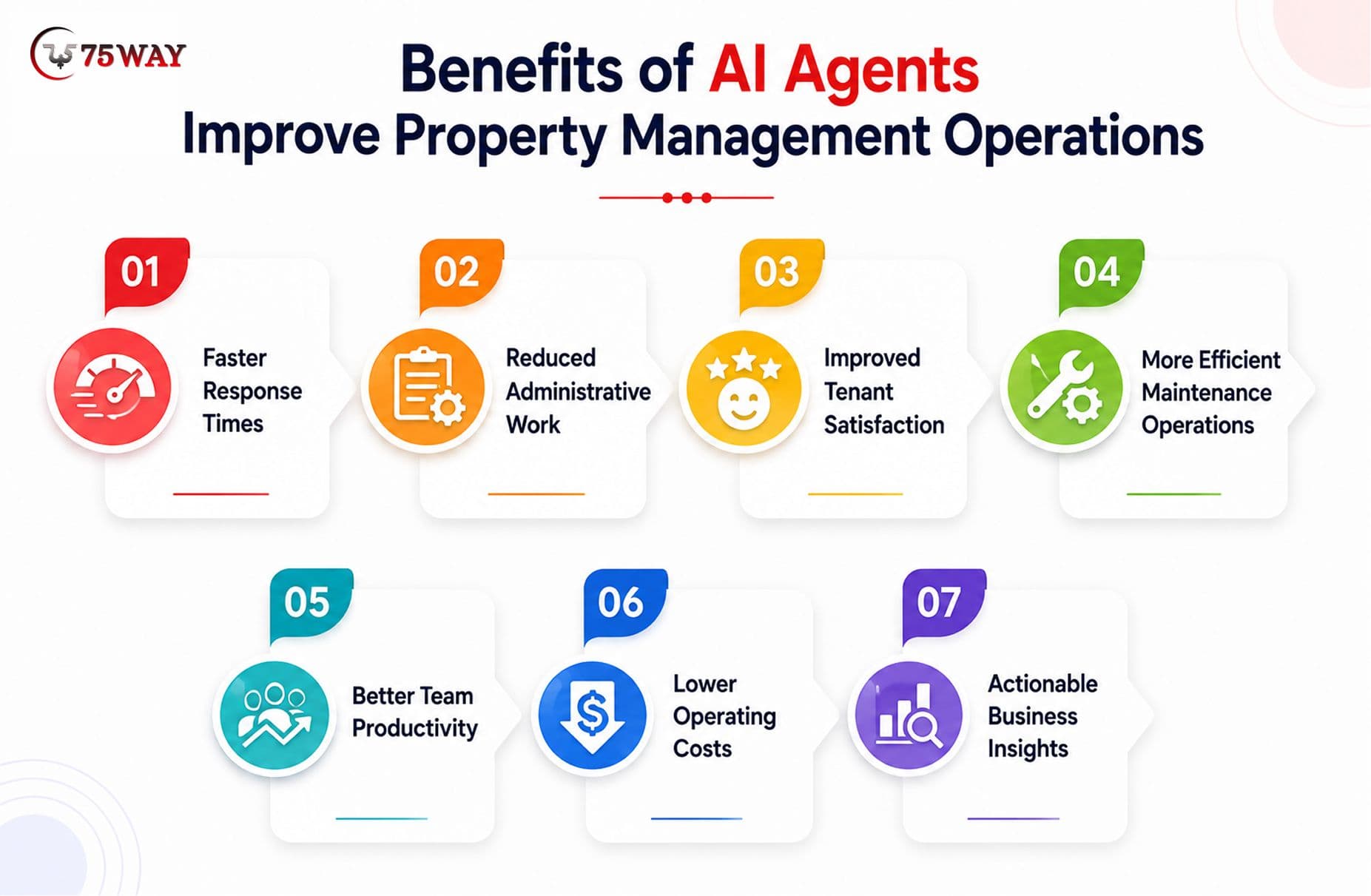
- Faster Response Times: Waiting hours for a simple answer creates frustration. An AI agent responds immediately, whether the tenant wants to check lease details, report a maintenance issue, or ask about community facilities.
- Reduced Administrative Work: Property managers spend a large part of their day answering repetitive questions and updating records. By automating these routine interactions, AI agents free staff to focus on leasing, inspections, vendor management, and tenant relationships.
- Improved Tenant Satisfaction: Quick communication plays a major role in tenant retention. When residents receive instant answers and regular maintenance updates, they feel supported throughout their tenancy. Better service often leads to stronger reviews, higher renewal rates, and fewer complaints.
- More Efficient Maintenance Operations: Maintenance delays usually happen because requests are incomplete or assigned too late. An AI agent gathers accurate information from the beginning, prioritizes requests, and routes them to the right technician without unnecessary back-and-forth. The result is faster repairs and better resource utilization.
- Better Team Productivity: AI doesn't replace property managers. It removes repetitive work from their daily schedule. Instead of spending hours responding to routine inquiries, staff can focus on strategic activities that require human expertise. As property portfolios grow, teams can manage more units without significantly increasing headcount.
- Lower Operating Costs: Hiring additional support staff isn't always sustainable. By automating common tenant interactions and maintenance workflows, AI agents reduce operational expenses while maintaining a high level of service. For growing property management companies, this creates a scalable operating model.
- Actionable Business Insights: Every tenant interaction generates useful data. AI agents can identify recurring maintenance problems, frequently asked questions, seasonal service trends, and response time patterns. These insights help property managers make informed decisions, allocate resources more effectively, and improve overall operations.
How to Build an AI Agent for Property Management?
A well-planned development process lays the foundation for an AI agent that can support tenants, automate routine operations, and improve response times. The following steps show how to build a property management AI agent ready for real-world use.
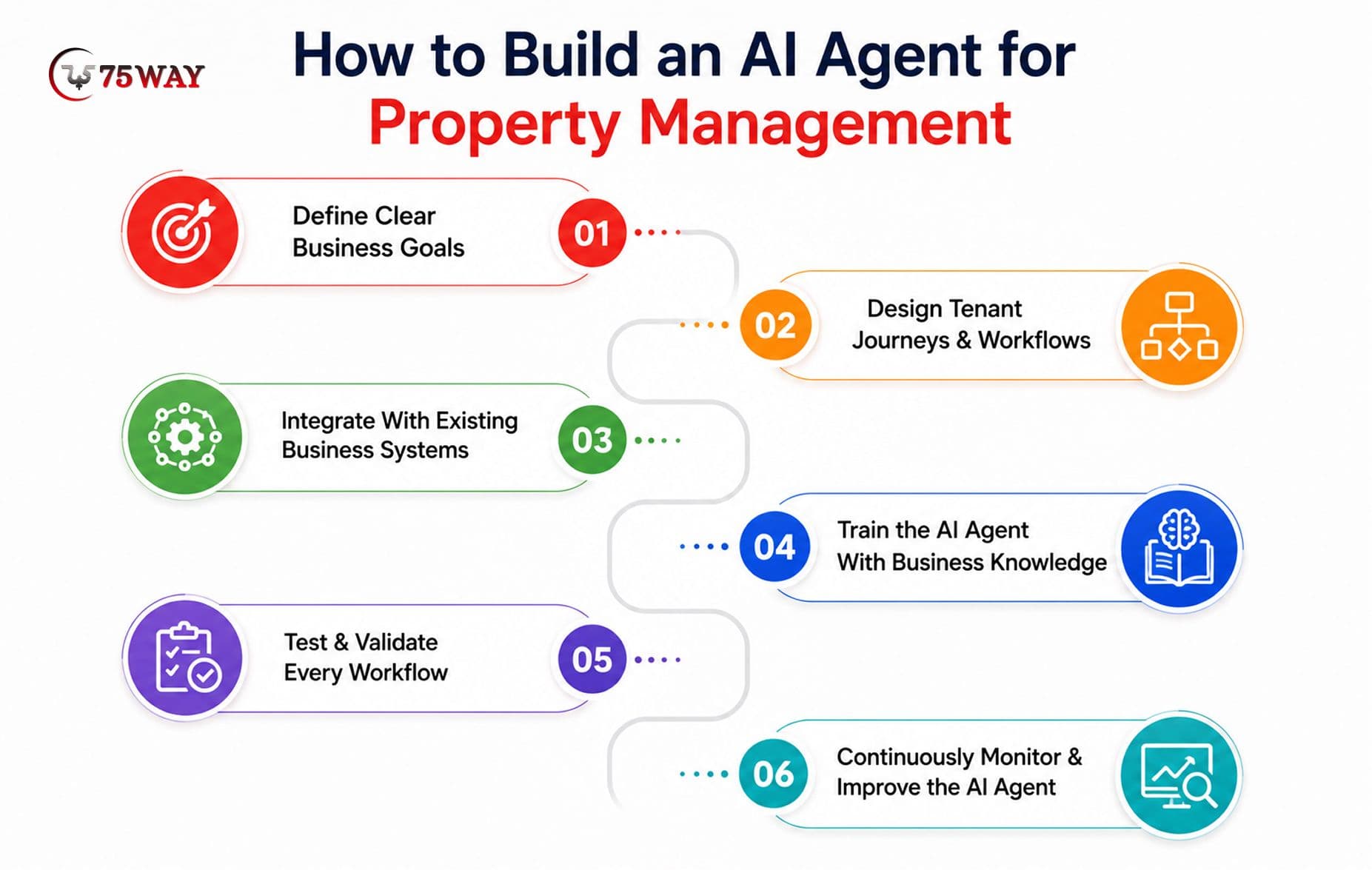
Step 1: Start With Business Goals, Not Technology
The biggest mistake companies make is choosing AI tools before defining the problem they want to solve. Successful projects begin by identifying the operational challenges that consume the most time and resources.
For some property management companies, the priority is reducing repetitive tenant inquiries. Others want to automate maintenance requests, simplify lease management, or improve communication across multiple properties. These business objectives shape every technical decision that follows, from workflow design to software integrations.
When the goals are clear from the beginning, the AI agent is built to solve real operational problems instead of becoming another disconnected technology project.
Step 2: Design Tenant Journeys and Business Workflows
Once the objectives are established, the next step is mapping how tenants and property managers interact throughout the entire process. Rather than focusing on individual conversations, developers design complete workflows that guide every request from submission to resolution.
Imagine a tenant reporting a leaking pipe. The AI agent should understand the issue, collect essential details, determine its urgency, create a maintenance ticket, notify the appropriate technician, keep the tenant informed during the repair, and finally confirm that the problem has been resolved. Designing these workflows early creates a smoother experience for both residents and property management teams while reducing unnecessary manual work later.
Step 3: Connect the AI Agent With Existing Business Systems
An AI agent becomes truly valuable when it can do more than answer questions. To automate everyday operations, it needs to communicate with the software property managers already use.
By integrating with property management platforms, CRM systems, maintenance applications, payment gateways, calendars, and communication tools, the AI agent can retrieve tenant information, create work orders, schedule appointments, update records, and send notifications automatically. These integrations transform the AI agent from a virtual assistant into an operational partner that supports the entire property management process.
Step 4: Train the AI Agent Using Business Knowledge
Even the most advanced AI model can only provide accurate answers when it has access to reliable information. Before deployment, the AI agent must learn how the business operates by connecting it with trusted internal knowledge.
Lease agreements, maintenance procedures, community guidelines, property policies, vendor directories, frequently asked questions, and internal documentation all become part of the agent's knowledge base. This enables the AI agent to deliver consistent responses that reflect the property's actual rules and processes instead of generating generic answers.
Step 5: Validate Every Workflow Before Going Live
Launching an AI agent without testing is like opening a building before inspecting its safety systems. Every conversation, workflow, and integration should be validated under real operating conditions before tenants begin using the solution.
Development teams typically simulate routine inquiries, emergency maintenance requests, incomplete submissions, unexpected user behaviour, software integration failures, and human escalation scenarios. This testing phase ensures the AI agent responds accurately, follows the correct workflows, and hands conversations to staff whenever human intervention is required.
Step 6: Improve the AI Agent Through Continuous Learning
Deployment marks the beginning of the AI agent's lifecycle, not the end. As tenant behaviour changes and business requirements evolve, the AI agent should continue improving through ongoing monitoring and optimization.
Property managers can analyse response accuracy, maintenance resolution times, tenant satisfaction, recurring service requests, and conversation trends to identify opportunities for improvement. Regular updates keep the AI agent aligned with changing policies while expanding its ability to automate more complex property management tasks over time.
Real-World Use Cases of Tenant Communication AI Agent
Every property has different operational challenges. A residential apartment complex handles different requests than a commercial office building or a student housing community. The advantage of AI agents is their flexibility. Here are some practical examples.
- Residential Apartment Communities: Instead of relying entirely on leasing staff, an AI agent for property management handles common tenant inquiries, creates maintenance tickets, shares community announcements, and provides real-time updates without human intervention.
- Commercial Property Management: Property management AI software keeps these interactions organized by routing service requests, coordinating vendors, scheduling inspections, and notifying the appropriate teams.
- Student Housing: With an AI-powered tenant support bot, students receive instant answers while housing teams focus on requests requiring personal attention. A first-year student messages, "I can't connect to the campus Wi-Fi." After verifying the student's residence, the assistant provides the correct setup instructions and troubleshooting steps in less than a minute.
- Vacation Rentals: A property management AI assistant provides round-the-clock support by sharing check-in instructions, digital access codes, local recommendations, and maintenance updates from a single conversation.
- Senior Living Communities: Intelligent property management automation helps organize these interactions by prioritizing requests, scheduling services, and notifying the appropriate staff members whenever action is required.
- Mixed-Use Developments: A custom AI agent for property management serves as a single point of contact, directing every inquiry to the appropriate department while keeping occupants informed throughout the process.
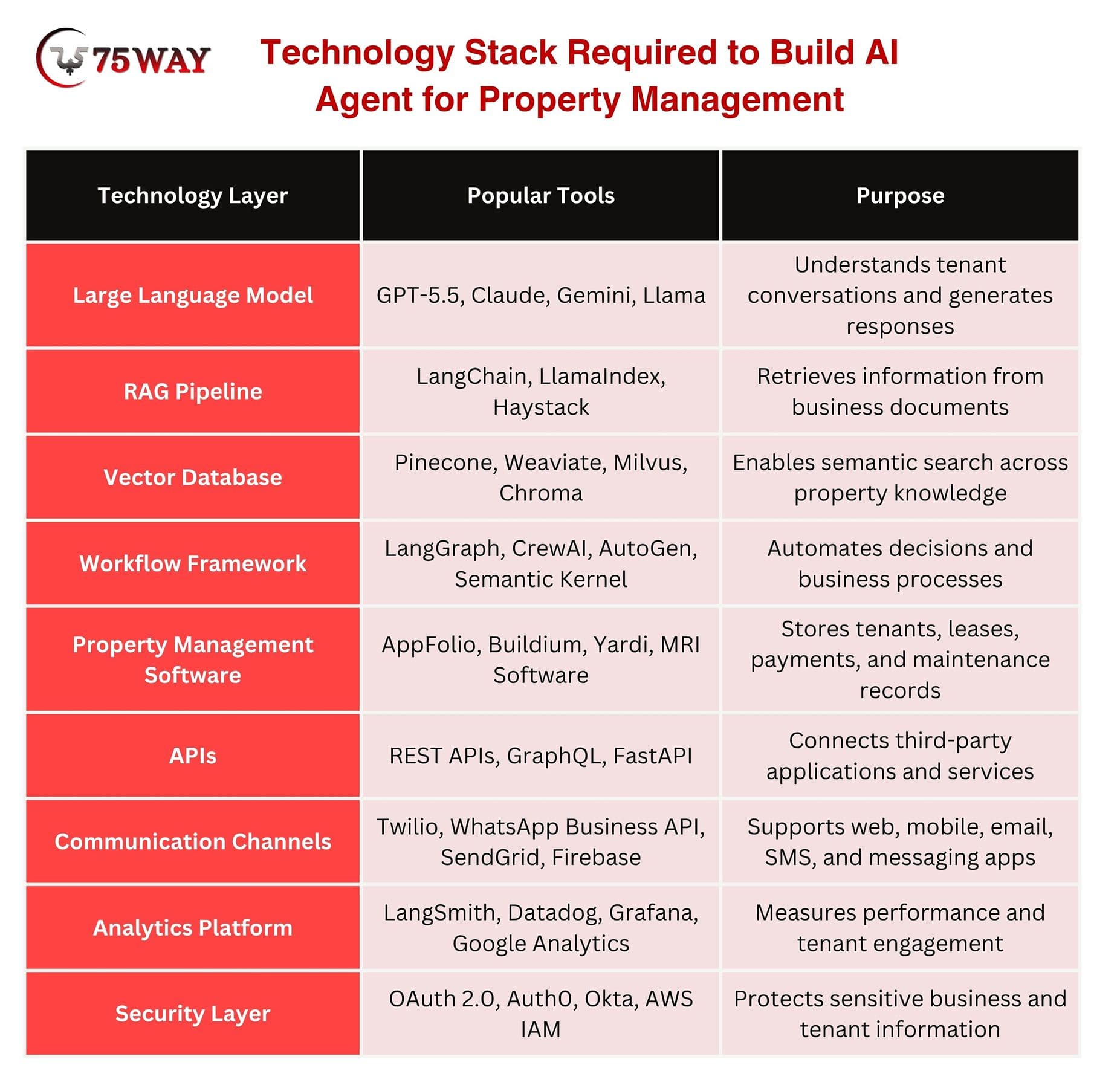
Technology Stack Required to Build Autonomous AI Agent for Property Management
The robust technology stack is just as important as designing the AI agent itself. Even the most intelligent assistant won't perform well if it can't access property data, communicate with business systems, or scale as your portfolio grows. A production-ready AI agent combines multiple technologies that work together seamlessly. Each layer plays a specific role in delivering fast, reliable, and secure tenant experiences.
How Much Does It Cost to Build an AI Agent for Property Management?
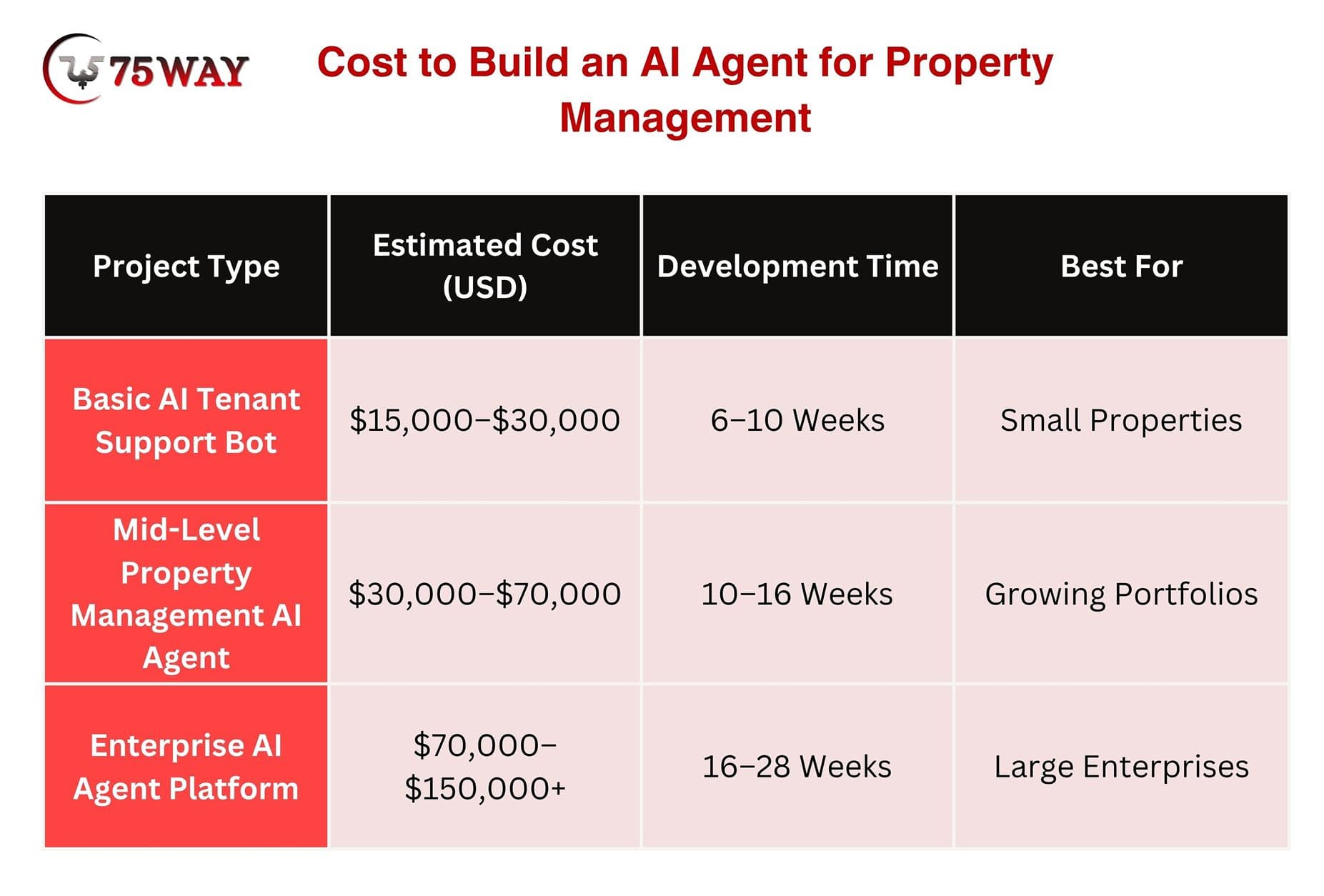
The cost of building an AI agent depends on several factors, including workflow complexity, AI capabilities, software integrations, deployment environment, and customization requirements. A simple tenant support assistant costs significantly less than an enterprise AI agent that automates maintenance requests, lease management, vendor coordination, and property operations.
Rather than asking, "How much does an AI agent cost?" the better question is, "What business problems should it solve?" The answer largely determines the investment required.
- Basic AI Tenant Support Bot: $15,000–$30,000
- Mid-Level Property Management AI Agent: $30,000–$70,000
- Enterprise AI Agent Platform: $70,000–$150,000+
What Influences Property Management AI Bot Development Costs?
Several factors affect the final investment.
- Number of AI-powered workflows
- Property management software integrations
- Custom dashboards and admin portals
- LLM selection and AI infrastructure
- Multi-channel support (Web, Mobile, WhatsApp, SMS)
- Security and compliance requirements
- Third-party API integrations
- Ongoing monitoring, optimization, and maintenance
Although enterprise AI solutions require a higher upfront investment, they often deliver long-term savings by reducing manual workloads, improving response times, and increasing operational efficiency across growing property portfolios.
Wrap Up
Property management becomes more challenging as portfolios grow, tenant expectations rise, and maintenance requests increase. An AI agent helps property managers automate routine communication, streamline maintenance workflows, and deliver faster, more consistent tenant support without increasing administrative overhead.
From answering lease questions to coordinating repairs and integrating with existing property management software, intelligent automation improves both operational efficiency and resident satisfaction.
The most successful implementations begin with clearly defined business goals and a scalable architecture. If you're planning to build a secure, production-ready solution, hire a custom AI agent development company that can design, integrate, and scale it successfully.
Frequently Asked Questions
Can an AI Agent Handle Emergency Maintenance Requests?
Yes. It can recognize emergency issues, collect essential details, prioritize the request, notify the appropriate maintenance team, and keep tenants informed until assistance arrives.
Does An AI Agent Replace Property Managers?
No. It automates repetitive tasks while property managers continue handling complex decisions, tenant relationships, negotiations, inspections, and situations requiring human judgment and empathy.
Can Tenants Communicate Through Multiple Channels?
Yes, a property management AI agent can support websites, mobile apps, WhatsApp, SMS, email, and other messaging platforms while maintaining conversation history across every channel.
Can the AI Agent Support Multiple Properties?
Yes. A single AI solution can manage multiple residential, commercial, or mixed-use properties while maintaining separate tenant records, workflows, and property-specific information securely.
How Does the AI Agent Protect Tenant Information?
Security measures include encrypted communication, role-based access controls, secure APIs, audit logs, and compliance practices that help safeguard sensitive tenant and property information.
Can Existing Property Management Software Be Integrated?
Yes. Most modern AI agents integrate with property management platforms, CRMs, payment gateways, maintenance systems, calendars, and document repositories through secure APIs.