AI Summary
Building a multi-chain DEX app like DEXCoinApp requires more than connecting blockchains. This guide explores essential features, cross-chain swap mechanisms, smart contract development, and security considerations. Discover development steps, technology choices, estimated costs, and monetization opportunities before launching.
Key Takeaways
- Multi-chain DEX apps enable users to trade digital assets across supported blockchains.
- Smart contracts automate swaps, enforce trading rules, and manage decentralized exchange transactions.
- Cross-chain bridges and protocols enable asset transfers between compatible blockchain networks.
- Development costs lie between $20,000–$280,000, depending on blockchain integrations, security audits, features, and architecture.
- Liquidity management, wallet connectivity, and security influence multi-chain DEX platform performance.
One blockchain may offer the tokens a trader wants, while another provides different liquidity pools or trading opportunities. A multi-chain DEX can bring these options together, helping users access multiple networks without treating each one as a separate trading experience.
An app like DEXCoinApp needs a solid foundation for crypto wallet connectivity, token pricing, swap execution, liquidity access, and blockchain-specific transactions. Cross-chain trading may also require bridges or specialized protocols, each introducing additional technical and security considerations.
For founders planning to enter the decentralized finance market, the challenge is building an exchange that feels simple to use while handling complex blockchain interactions behind the scenes. Here’s what to consider when planning your multi-chain DEX app, from core functionality to development investment.
What Is DEXCoinApp Clone?
DEXCoinApp is a crypto market app that helps users discover tokens, track price movements, compare market activity, and explore decentralized exchanges from one place. Instead of jumping between different platforms to check token performance or find trading opportunities, users can access useful market information through a single interface.
Features such as price charts, watchlists, gas fee tracking, and token risk alerts can make exploring decentralized finance more convenient.
DEXCoinApp At A Glance
- Platform: Android
- Category: Finance
- Core Purpose: Token screening, market monitoring, and decentralized exchange discovery
- Public Adoption: 100K+ Google Play downloads
- Listed Rating: Approximately 4.6 stars from around 2.7K reviews
A DEXCoinApp clone takes this concept further by giving businesses a foundation for creating their own multi-chain crypto application. You can customize it with supported blockchain networks, wallet connections, swap aggregation, portfolio tracking, and advanced market analytics based on your audience's needs.
The goal is not simply to copy an existing app, but to build a distinct product that makes navigating decentralized markets easier while giving you room to introduce new features as your user base grows.
How Does A Multi-Chain DEXCoinApp Platform Work?
Imagine a user who wants to compare a token on Ethereum with another asset on BNB Smart Chain. The user may need price information, liquidity data, a suitable swap route, and a way to authorize the transaction. A multi-chain DEX app brings these steps into one interface, even though the underlying operations may involve different services.
The application generally relies on five connected components:
- Blockchain Connectivity: RPC providers and blockchain APIs retrieve on-chain data and communicate with supported networks.
- Market Data Aggregation: Indexers and data providers collect token prices, trading activity, liquidity information, and historical data.
- Swap Routing: Integrated protocols or aggregators identify available exchange routes and prepare transaction details.
- Wallet Connectivity: Users connect compatible wallets and approve transactions through their wallet software.
- Transaction Monitoring: The application tracks transaction status and displays confirmations, errors, and relevant history.
Cross-chain swaps require additional infrastructure. A swap within one network is different from transferring assets between separate blockchains. Cross-chain transactions may depend on bridges, messaging protocols, or specialized liquidity providers, each introducing its own settlement and security considerations.
Advanced Features Required To Build An App Like DEXCoinApp
Crypto traders want more than basic token swaps when moving between different blockchain networks. Features like cross-chain routing, real-time liquidity analysis, and smart trade execution can make a DEX app more useful and competitive. Here are the advanced capabilities to consider when building an app like DEXCoinApp.
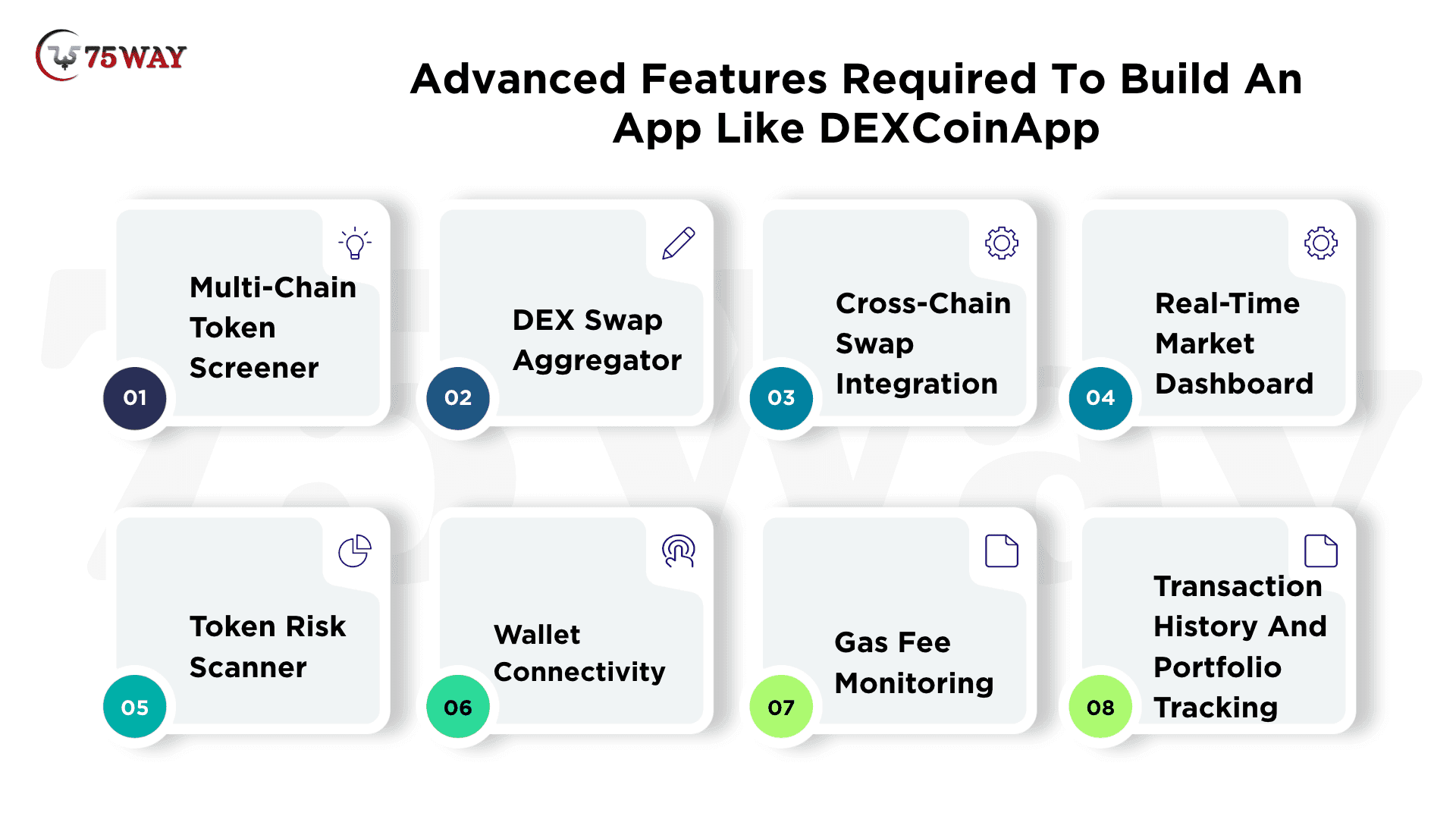
1. Multi-Chain Token Screener
A token screener allows users to discover assets across supported networks from one interface. Display token prices, trading volume, liquidity indicators, charts, and available market statistics. Filters for network, price movement, and trading activity can help users narrow their search.
Use reliable data sources and show timestamps where appropriate. Market information should not appear live if it is delayed or incomplete.
2. DEX Swap Aggregator
A swap aggregator compares available routes across integrated decentralized exchanges. Depending on liquidity, fees, and price impact, it can identify a suitable route for the requested transaction.
Display estimated output, network fees, slippage settings, and price impact before users approve a swap. Do not guarantee the lowest price in every case, because liquidity and market conditions can change before execution.
3. Cross-Chain Swap Integration
Cross-chain functionality allows users to exchange assets across supported blockchain networks through compatible infrastructure. It can simplify workflows that would otherwise require separate bridge and exchange interfaces.
However, cross-chain swaps can involve bridge vulnerabilities, delayed settlement, destination-chain liquidity limitations, and failed transactions. Select infrastructure based on its security record, supported networks, recovery processes, and transaction costs.
4. Real-Time Market Dashboard
A market dashboard combines token charts, liquidity indicators, trading volumes, and watchlists. Users can follow selected assets, compare price movements, and review market activity without searching for every token repeatedly.
Include readable charts, useful time ranges, and filters that work across supported networks. Clearly communicate data freshness and avoid presenting estimates as guaranteed values.
5. Token Risk Scanner
A risk scanner can flag suspicious contract permissions, unusual liquidity conditions, and known malicious-token indicators. It may also integrate third-party security services to assess available contract and market information.
No scanner can identify every scam or guarantee that a token is safe. Explain warnings in plain language and encourage users to verify contracts and transaction details before proceeding.
6. Wallet Connectivity
Wallet connectivity allows users to connect compatible external wallets and authorize transactions. The application can prepare a transaction, but signing should take place through the user's wallet.
Support should depend on audience demand and technical compatibility. Wallet connectivity does not automatically give the application custody of users' assets.
7. Gas Fee Monitoring
Gas monitoring displays estimated network transaction costs before users submit a swap. It can also show congestion indicators to help users understand why a transaction may cost more or take longer.
Because network conditions change, fee estimates should be presented as estimates rather than final charges.
8. Transaction History And Portfolio Tracking
A consolidated transaction history helps users review supported transactions across different networks. Portfolio tracking can add balances, historical valuations, and estimated profit-and-loss calculations when the underlying data is available.
Clearly explain whether figures come from wallet balances, on-chain activity, or external pricing feeds. Missing transactions and differences in token prices can affect portfolio calculations.
Step-by-Step Roadmap to Develop A Multi-Chain DEX App Like DEXCoinApp
A successful multi-chain DEX app needs more than multiple blockchain connections. Each development stage must support the next, from understanding user needs to choosing networks, building trading features, protecting transactions, and improving the product after launch. The following stages provide a practical path from an initial idea to a market-ready application.
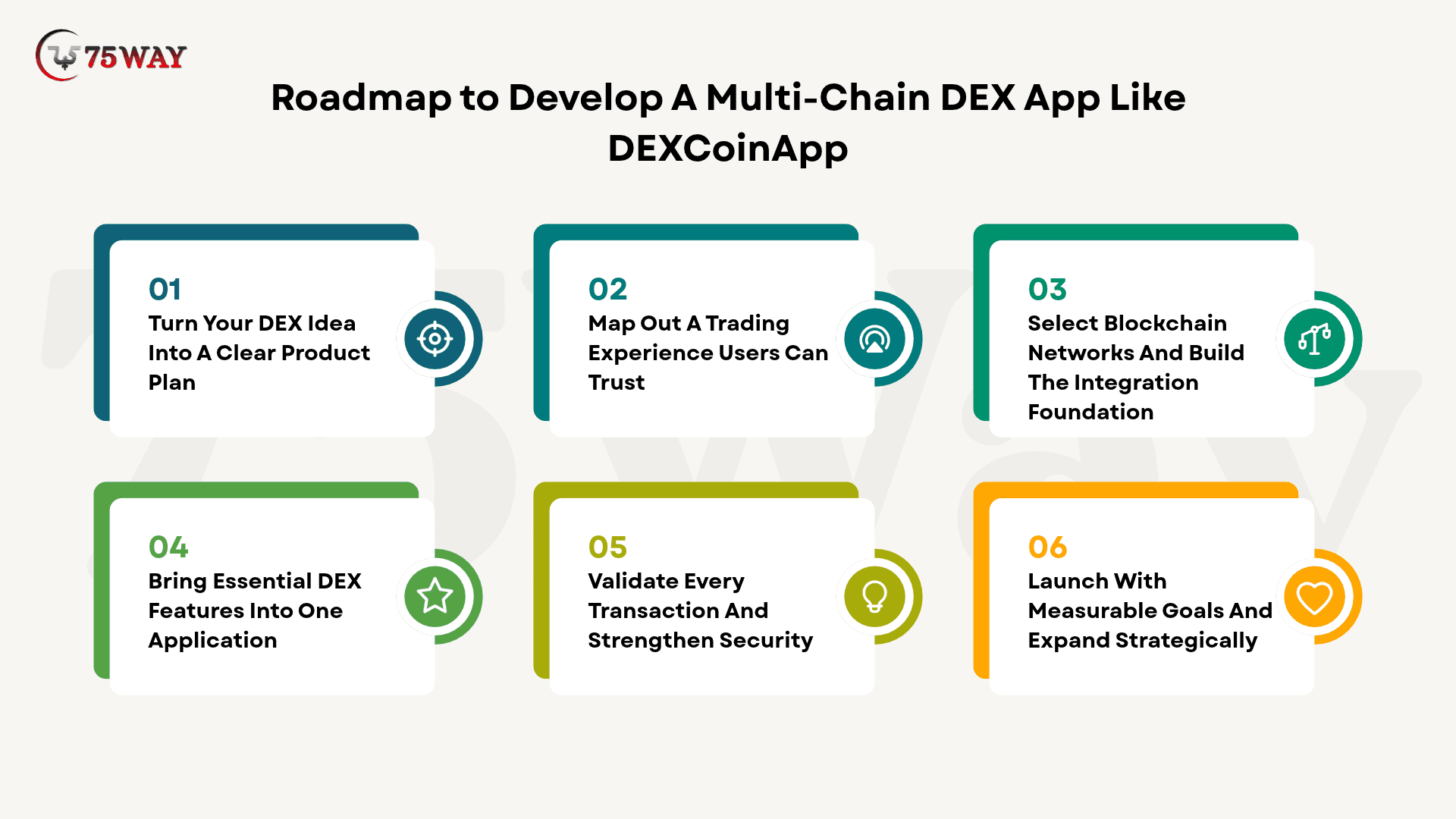
Step 1: Turn Your DEX Idea Into A Clear Product Plan
Your target audience determines which features deserve priority. Some users may need token screening and price alerts, while others may expect wallet connectivity, swap aggregation, or cross-chain trading.
Define your core audience, initial blockchain networks, essential DEX integrations, and the problem your app will solve. Clear launch goals, such as quote response times, successful transactions, and user retention, will also help shape the technical requirements and development budget.
Step 2: Map Out A Trading Experience Users Can Trust
With the product scope established, the next priority is a user journey that makes decentralized trading easier to understand. Plan how users will discover tokens, connect wallets, compare swap quotes, review fees, and approve transactions.
Interactive prototypes can reveal confusing navigation, unclear risk warnings, or unnecessary steps before development begins. A straightforward interface should explain slippage, estimated gas fees, and transaction status without overwhelming users with technical details.
Step 3: Select Blockchain Networks And Build The Integration Foundation
The user experience depends on reliable connections to the right blockchain networks and exchange protocols. Choose networks according to audience demand, transaction costs, available liquidity, ecosystem maturity, and developer support.
Integrate suitable RPC providers, blockchain indexers, market-data services, and DEX protocols. A shared integration layer for network-specific operations will make future expansion easier without requiring major changes to the entire application.
Step 4: Bring Essential DEX Features Into One Application
Once the technical foundation is ready, your development team can connect the features that make the product useful.
Core functionality may include token search, price charts, watchlists, wallet connectivity, swap quotes, fee estimates, and transaction tracking.
Cross-chain swaps can follow when the selected infrastructure, liquidity arrangements, and settlement mechanisms have been validated. Separate application interfaces from backend services so each component remains easier to maintain, monitor, and improve.
Step 5: Validate Every Transaction And Strengthen Security
As trading features come together, security testing becomes essential to protecting users and maintaining confidence in the application. Test wallet authorization, transaction preparation, failed swaps, incorrect token data, RPC outages, and network congestion.
Review API security, third-party dependencies, permissions, and custom smart contracts. Independent security audits are particularly important when custom contracts manage or move assets, although audits cannot guarantee complete protection against every vulnerability.
Step 6: Launch With Measurable Goals And Expand Strategically
A stable release gives you the opportunity to evaluate how people actually use the application. Track crashes, quote response times, transaction success rates, user retention, and support requests to identify areas that need attention.
User feedback and performance data should guide subsequent updates, whether they involve interface improvements, additional DEX integrations, or new blockchain networks. Gradual expansion helps your team prioritize genuine user demand instead of adding complexity before the existing product is ready.
Technology Stack Used in DEXCoinApp Clone Development
The technology stack behind a DEXCoinApp clone determines how smoothly users can explore tokens, compare market prices, connect wallets, and interact with supported blockchain networks.
Mobile frameworks such as React Native or Flutter can power the app interface, while backend technologies like Node.js manage API requests and application logic. Blockchain libraries, RPC providers, and market-data APIs connect the application to on-chain activity, token information, and decentralized exchange protocols.
Each technology should serve a specific purpose rather than simply add complexity to the project. PostgreSQL and Redis can support data storage and caching, while cloud infrastructure helps manage application workloads as usage grows.
Testing tools such as Hardhat and Foundry are valuable for validating smart contracts and blockchain interactions. The right combination depends on your target platforms, required features, security expectations, and plans for adding more networks over time.
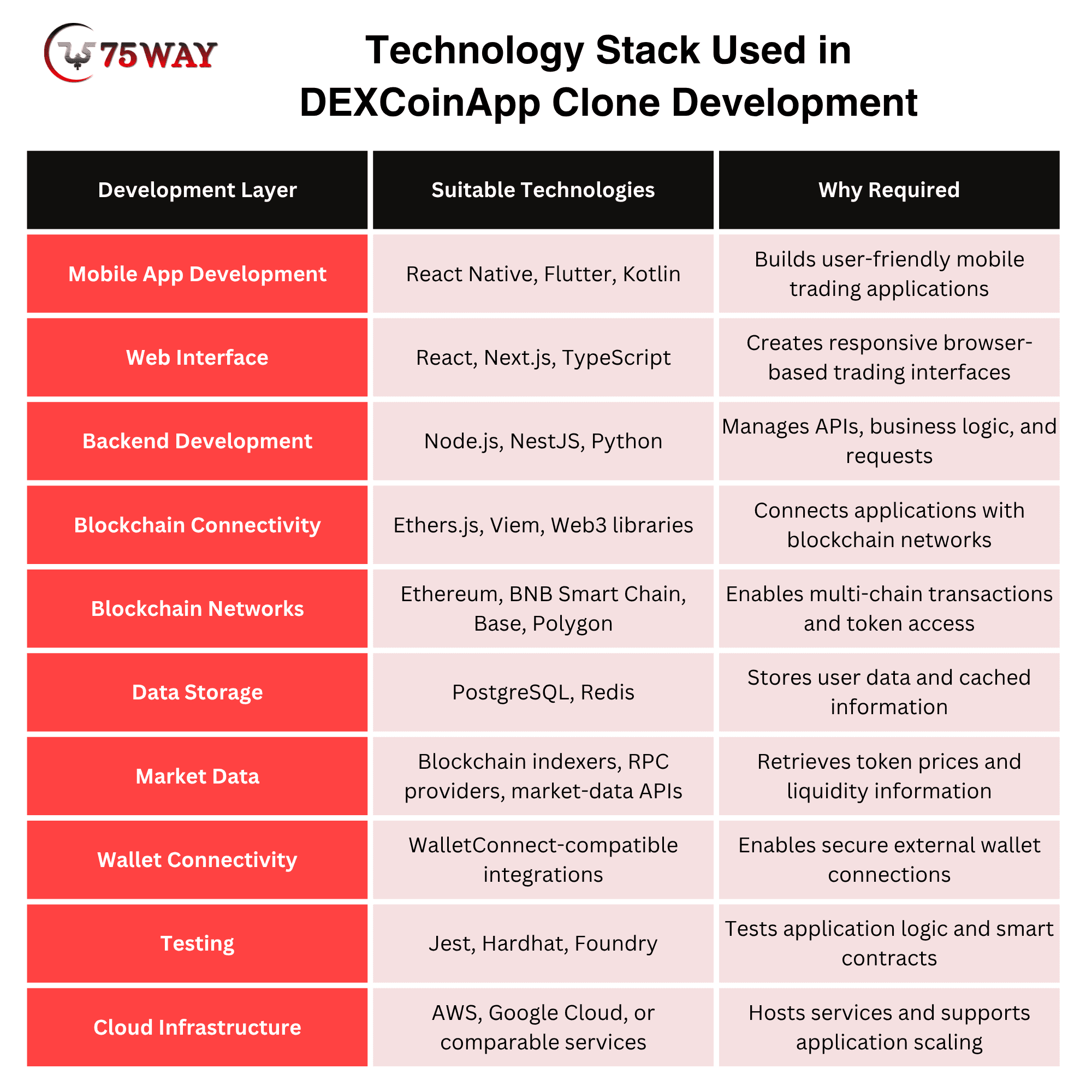
For a mobile-first product, React Native or Flutter can support development across mobile platforms. React or Next.js can be suitable for a browser-based application, while backend services coordinate market-data requests, caching, and transaction monitoring.
If you integrate existing DEX protocols, you may not need to develop custom swap contracts. However, transaction construction, protocol compatibility, and security validation still require careful engineering.
Blockchain Platforms Utilized To Create A DEXCoinApp Clone
Your DEXCoinApp clone needs the right blockchain foundation to handle token swaps, smart contracts, and liquidity interactions. Some networks offer mature DeFi ecosystems, while others appeal to developers through faster transactions or lower fees. Here are the blockchain platforms worth evaluating before deciding where your decentralized exchange will operate.
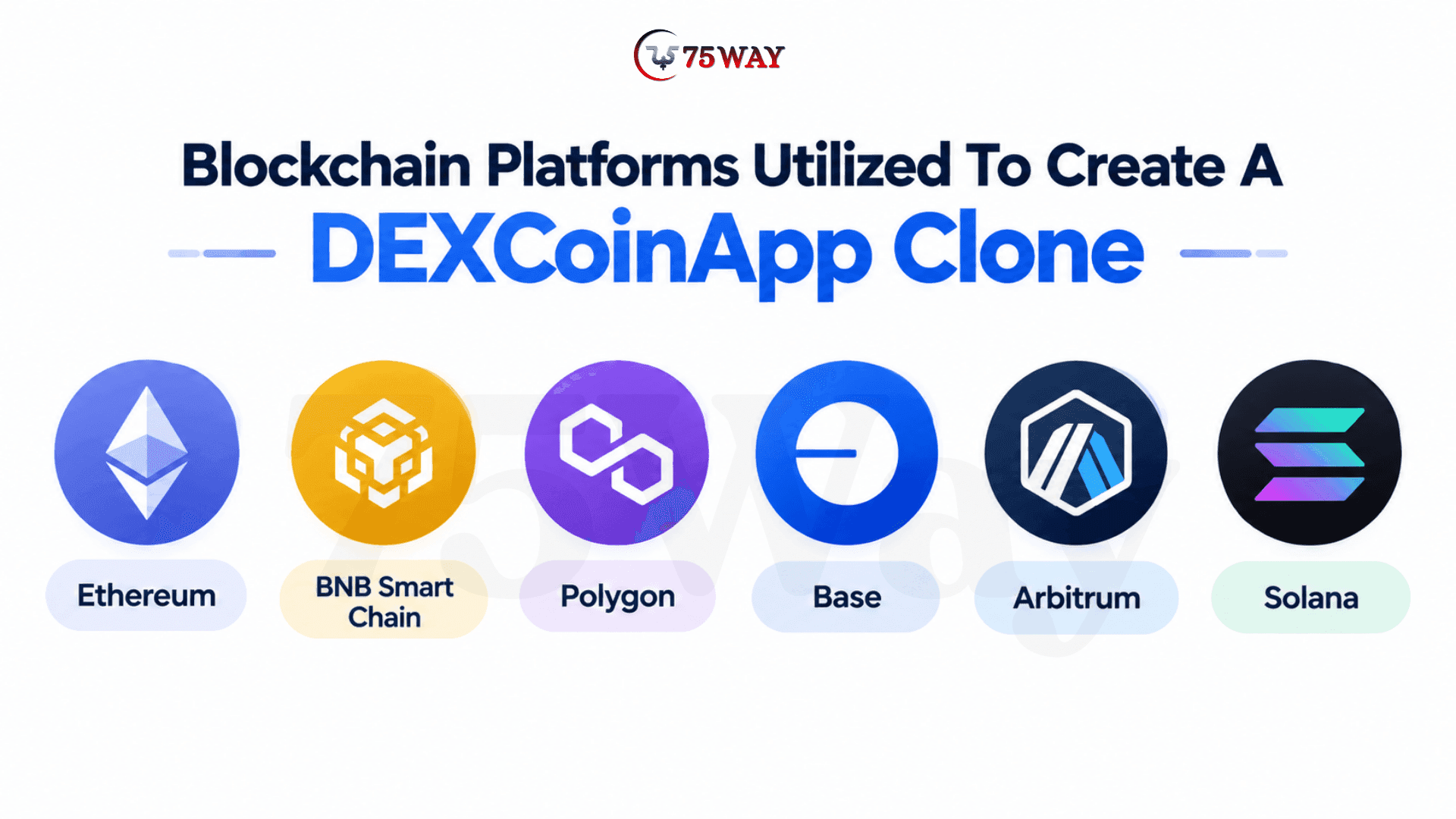
- Ethereum: Supports ERC-20 token discovery, market tracking, and integrations with decentralized finance protocols.
- BNB Smart Chain: Enables tracking BEP-20 tokens and accessing supported decentralized exchange ecosystems.
- Polygon: Supports token analytics and integrations with applications operating across the Polygon network.
- Base: Enables tracking supported tokens and connecting with decentralized applications in the Base ecosystem.
- Arbitrum: Supports market monitoring and integrations with decentralized finance protocols on an Ethereum Layer 2 network.
- Solana: Enables tracking SPL tokens and integrating with supported Solana-based market data and decentralized exchange services.
Selection Tip: Choose blockchain networks according to your target users, token coverage, data-provider support, and required integrations. A DEXCoinApp clone focused on market discovery and analytics may primarily need reliable blockchain data APIs, while swap execution requires additional wallet, liquidity, and transaction integrations.
Benefits of Building A DEX Exchange Platform Like DEXCoinApp
For crypto entrepreneurs, a DEX platform can offer more flexibility than building a centralized exchange with traditional account custody. Users can connect compatible wallets and trade through smart contracts, while multi-chain functionality can expand the platform’s reach. These benefits make DEXCoinApp-style development worth considering, provided security, liquidity, and user experience remain priorities.
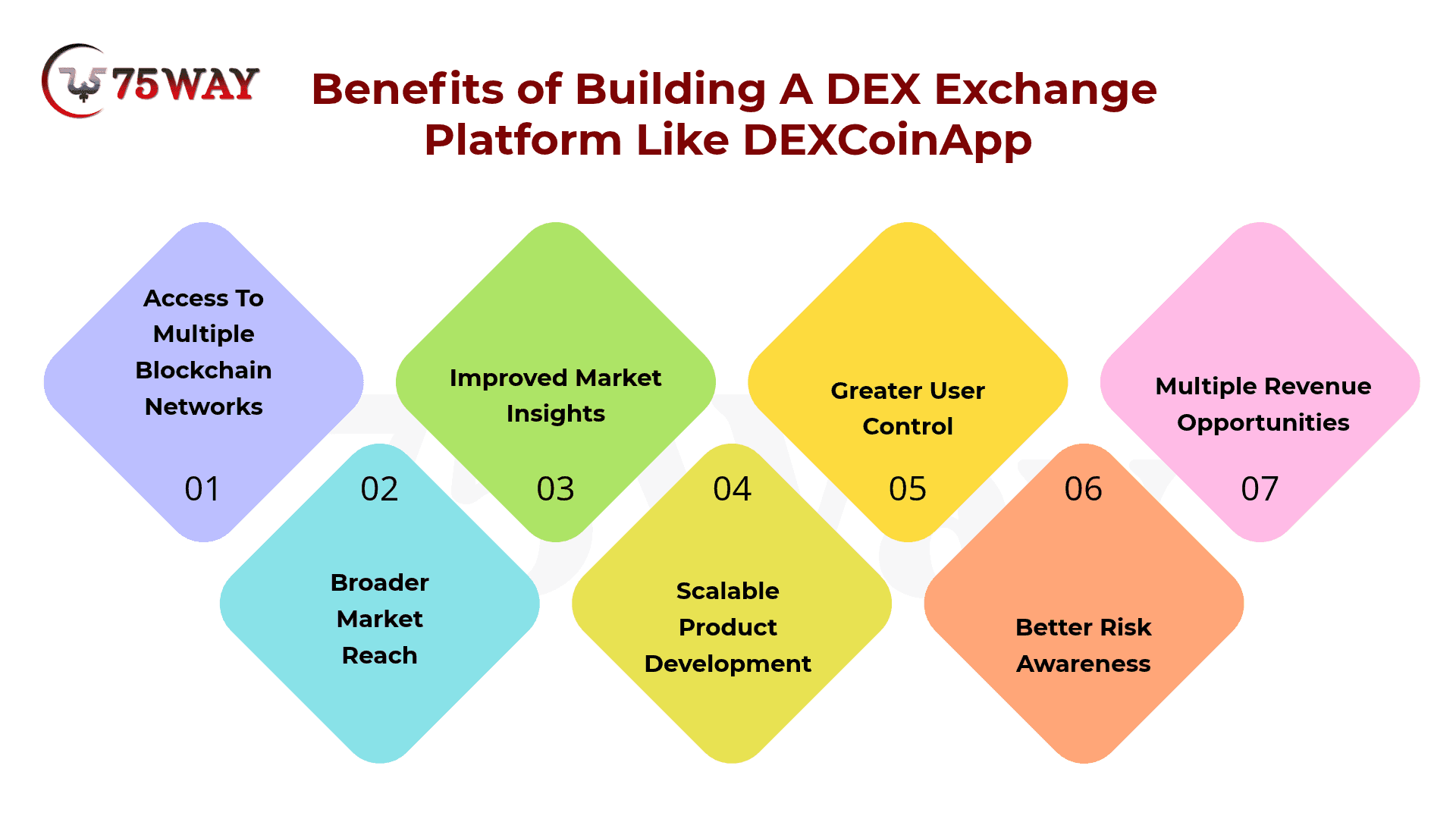
- Access To Multiple Blockchain Networks
A multi-chain DEX platform can help users explore tokens and market activity across supported blockchain networks through one interface.
- Improved Market Insights
Real-time price updates, token analytics, liquidity information, and market alerts can help users make better-informed research decisions.
- Greater User Control
Wallet connectivity allows users to interact with supported decentralized services while retaining control of their private keys, rather than relying on a platform-managed custodial wallet.
- Multiple Revenue Opportunities
Subscription plans, referral partnerships, premium analytics, and eligible swap integration fees can create different revenue streams based on the platform's features.
- Broader Market Reach
Supporting multiple blockchain ecosystems can help businesses serve users with different network preferences and expand their potential audience.
- Scalable Product Development
A modular architecture allows businesses to introduce additional networks, analytics tools, wallet integrations, and token discovery features as user needs evolve.
- Better Risk Awareness
Token screening, suspicious-activity alerts, and transaction monitoring can help users identify potential risks before interacting with unfamiliar assets, although these tools cannot guarantee safety.
How Much Does It Cost To Develop A DEX Mobile App Like DEXCoinApp?
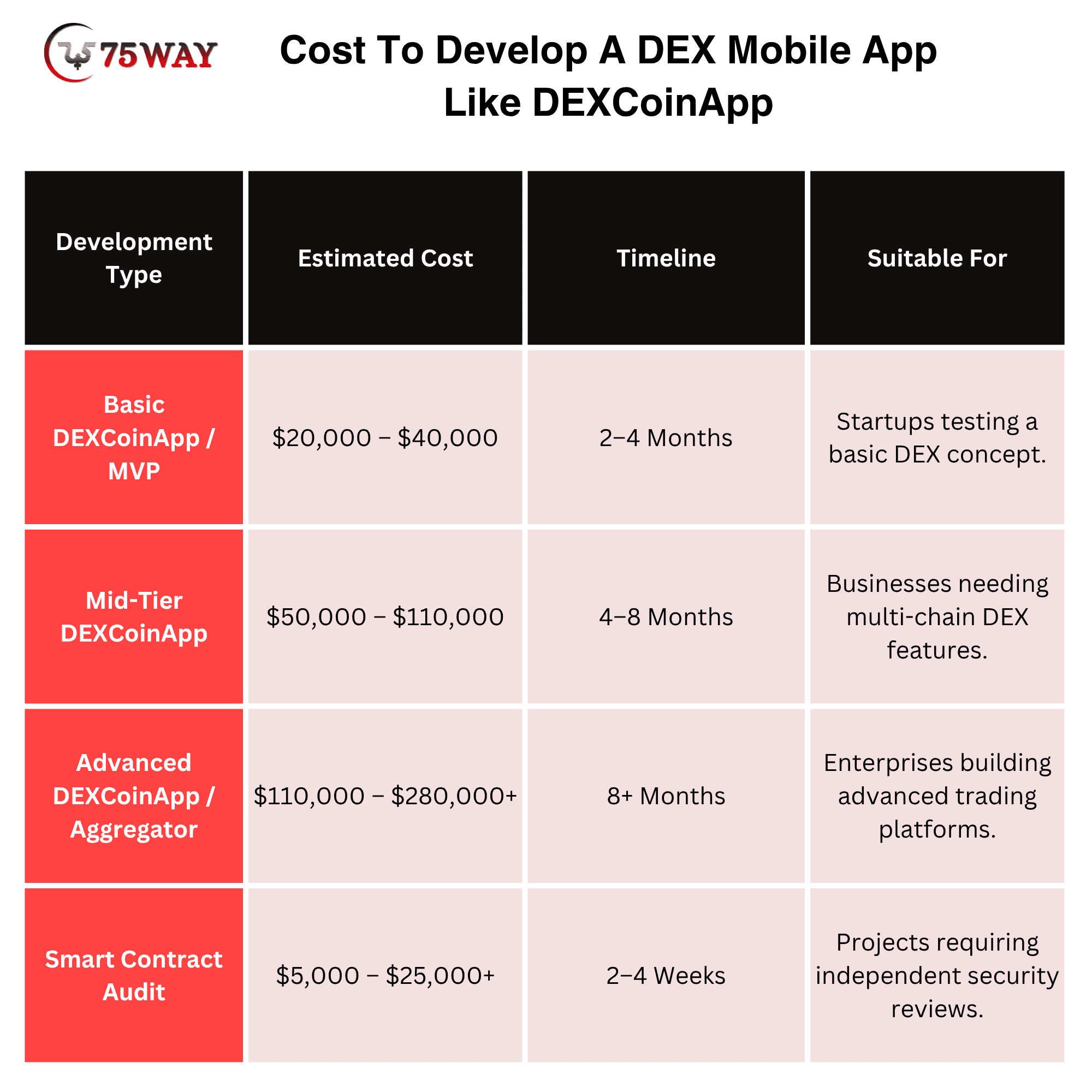
The cost of developing a DEX app depends on its trading architecture, blockchain coverage, security requirements, and the number of advanced features. On average, the cost to create DEXCoinApp ranges between $20,000–$280,000. A basic single-chain product costs less than a multi-chain application with liquidity pools, cross-chain swaps, and advanced transaction routing.
1. Basic DEXCoinApp / MVP: $20,000 – $40,000
- Single-chain support with essential token screening.
- Basic wallet connectivity and swap functionality.
- Simple interface with price charts and watchlists.
Timeline: 2–4 Months
2. Mid-Tier DEXCoinApp: $50,000 – $110,000
- Multi-chain support with integrated DEX protocols.
- Liquidity tracking, portfolio insights, and staking.
- Advanced charts, alerts, and transaction history.
Timeline: 4–8 Months
3. Advanced DEXCoinApp/Aggregator: $110,000 – $280,000+
- Multi-protocol routing with optimized swap quotes.
- Cross-chain swaps and advanced transaction protection.
- Native mobile apps with advanced analytics.
Timeline: 8+ Months
4. Smart Contract Audit: $5,000 – $25,000+
- Independent review of custom smart contracts.
- Vulnerability testing for swaps and liquidity pools.
- Security recommendations with remediation verification.
Timeline: 2–4 Weeks
Monetization Models: How DEXCoinApp Style App Generates Profit
A multi-chain DEX can earn revenue every time users trade, swap tokens, or access premium services on the platform. The challenge is finding a balance between earning from transactions and keeping fees attractive enough for traders to return. Here are the monetization models to consider when building an app like DEXCoinApp.
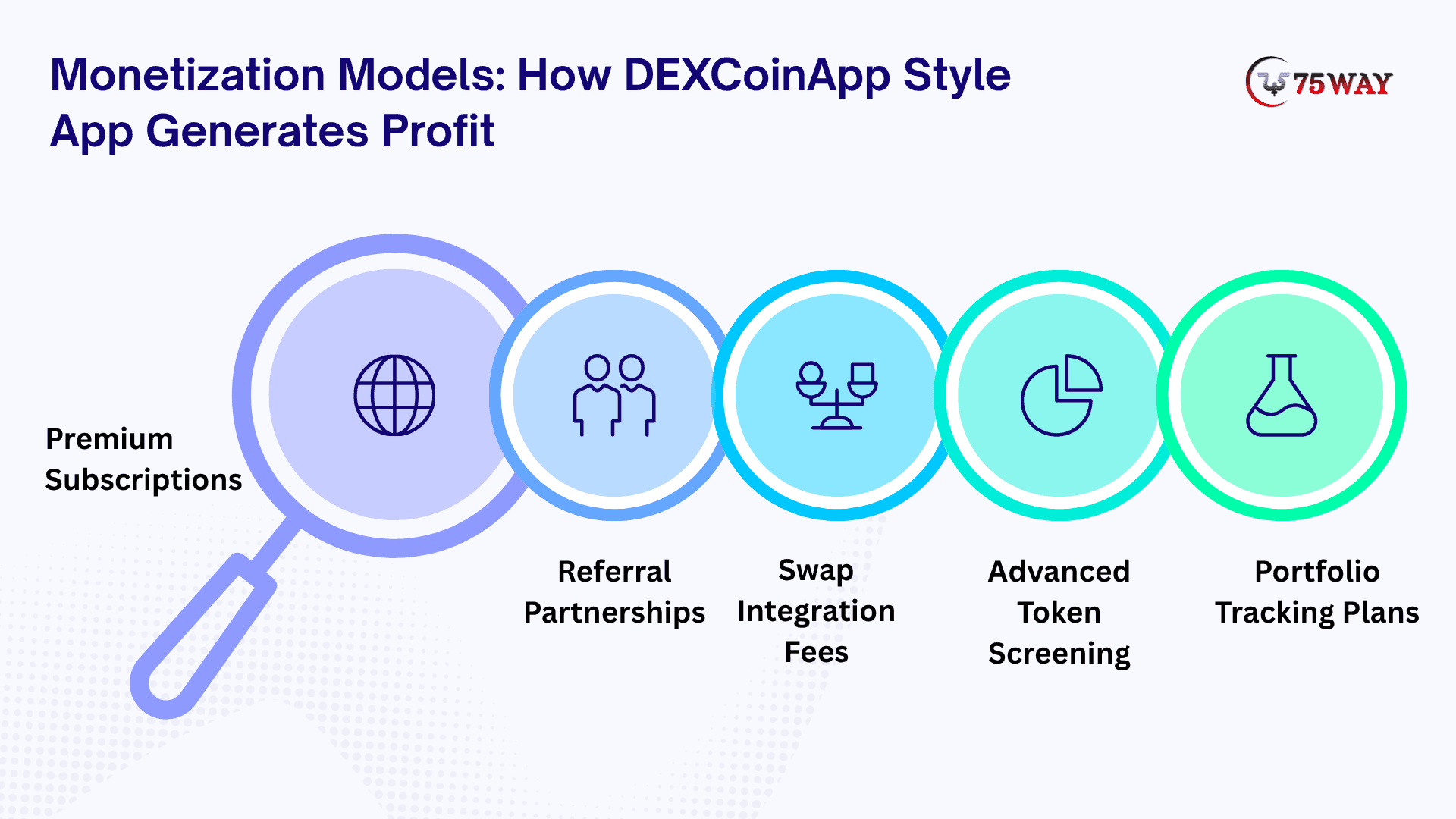
- Premium Subscriptions: Users can pay for advanced token charts, custom price alerts, and detailed market analytics. This model creates recurring revenue by offering additional value to frequent crypto market users.
- Referral Partnerships: A DEXCoinApp-like platform can earn commissions by referring users to supported wallets, DEX services, or relevant crypto platforms. Clear disclosures and partner agreements help maintain transparency.
- Swap Integration Fees: The platform can generate revenue through transparent fees on eligible swap transactions, where its architecture and applicable regulations permit. Users should see all applicable charges before confirming a transaction.
- Advanced Token Screening: Premium plans can provide advanced filters, token risk indicators, and detailed market activity insights. These tools help users research assets while clearly communicating that risk assessments cannot guarantee token safety.
- Portfolio Tracking Plans: Paid plans can include cross-chain asset tracking, detailed transaction summaries, and advanced portfolio analytics. These features give active users a more comprehensive view of their tracked crypto holdings.
Not every model suits every application. Transaction fees, referral arrangements, token promotions, and other financial features can introduce regulatory or conflict-of-interest concerns. Obtain qualified legal advice before implementing them.
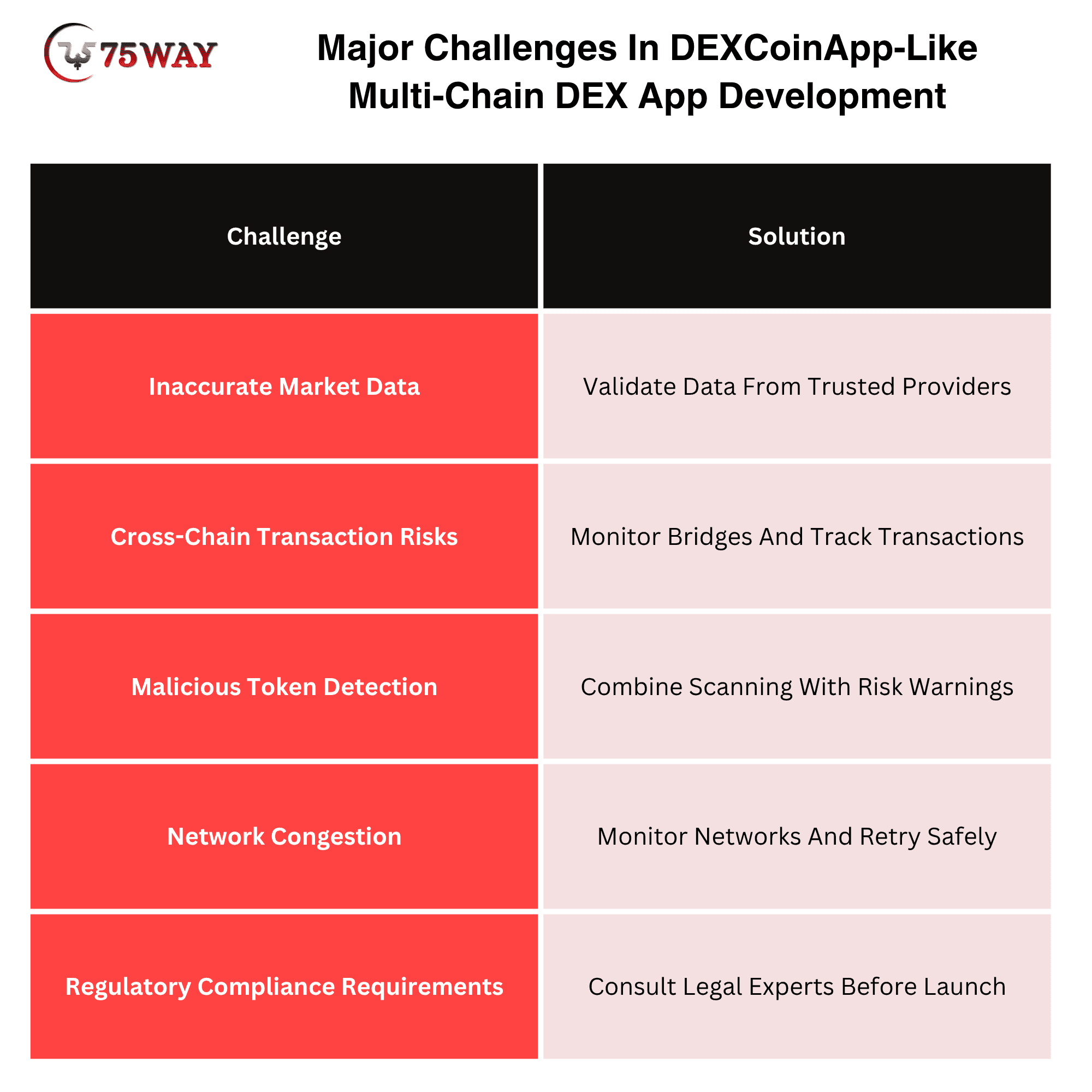
Major Challenges In DEXCoinApp-Like Multi-Chain DEX App Development
A multi-chain DEX may look simple to traders, but connecting different blockchains behind the scenes is rarely straightforward. Liquidity gaps, bridge vulnerabilities, network congestion, and smart contract bugs can all create problems for developers and users. Understanding these challenges early can help you build an app like DEXCoinApp with greater security and reliability.
1. Maintaining Accurate Market Data
Different providers can return different prices, liquidity figures, and token metadata. Use suitable validation, timestamps, caching policies, and monitoring to identify stale or inconsistent results.
Solution: Integrate reliable data providers, validate incoming information, and monitor timestamps to identify outdated or inconsistent market data.
2. Managing Cross-Chain Risks
Cross-chain transactions may depend on third-party bridges, messaging protocols, or liquidity providers. A failure in one part of the route can affect settlement, so transaction tracking and recovery procedures require careful planning.
Solution: Evaluate bridge security, track transaction progress across networks, and establish recovery procedures for failed or delayed transfers.
3. Protecting Users From Malicious Tokens
Automated scanners can flag suspicious activity, but they cannot guarantee that a token is legitimate. Explain the limits of risk detection and avoid presenting a security score as proof of safety.
Solution: Combine automated token screening with security alerts, transparent risk disclosures, and clear warnings about detection limitations.
4. Handling Network Congestion
Gas fees, RPC latency, and confirmation times can change quickly. Support transaction monitoring, useful error messages, and appropriate retry behavior without accidentally submitting duplicate transactions.
Solution: Monitor network conditions, display updated gas estimates, and implement transaction tracking with safe retry mechanisms.
5. Meeting Compliance Requirements
Requirements vary according to the jurisdictions served and the services offered. Custody, transaction routing, fee collection, and financial promotions may have different legal implications. Seek qualified guidance before launch.
Solution: Consult qualified legal professionals to assess applicable regulations and align platform features, operational policies, and disclosures with relevant requirements.
Final Thoughts
To wrap up, a successful multi-chain DEX app development like DEXCoinApp starts with solving real user problems, from finding tokens across networks to accessing reliable market data and understanding transaction risks.
Your development plan should prioritize essential features, secure blockchain integrations, and a smooth user experience before expanding into advanced trading capabilities. With the right architecture and a realistic budget, you can build a platform that adapts to changing market needs and supports future growth.
To build your multi-chain DEX app similar to DEXCoinApp, you can consult a professional blockchain development team to discuss your idea, development costs, and project roadmap.
Frequently Asked Questions (FAQs)
How Long Does It Take To Develop A Multi-Chain DEX App?
A basic DEX MVP may take 2–4 months, while a mid-tier application can require 4–8 months. Advanced aggregators with complex routing, cross-chain features, and native mobile apps may take eight months or longer.
What Is The Minimum Budget For A DEX App?
The illustrative budget for a basic DEX MVP is $30,000–$50,000. The actual cost depends on blockchain support, swap functionality, wallet integrations, design, testing, and security requirements.
Does A Multi-Chain DEX App Need Custom Smart Contracts?
Not always. An application that integrates existing decentralized exchange protocols may not need custom swap contracts. Specialized functionality may require new contracts, which introduce additional development, testing, and audit requirements.
Is Cross-Chain Swap Functionality Necessary At Launch?
No. You can begin with token screening, wallet connectivity, and selected single-chain swap integrations. Add cross-chain functionality once you have validated user demand and assessed the associated infrastructure and security risks.
Is A Smart Contract Audit Necessary Before Launch?
Independent security audits are strongly recommended for custom contracts that manage or move assets. An audit helps identify vulnerabilities, but it cannot guarantee that a system is completely secure.