AI Summary
Running a Shopify store involves managing products, pricing, inventory, customers, orders, and marketing activities every day. AI automation for Shopify store operations helps businesses simplify these tasks through intelligent workflows and data-driven decisions. This guide explains the key features, benefits, and real-world use cases of AI automation for Shopify, including pricing optimization and operational improvements.
Key Takeaways
- AI automation for Shopify store operations simplifies daily all the management tasks.
- Smart pricing tools improve Shopify revenue decisions and competitiveness.
- AI helps personalize customer experiences across Shopify stores.
- Automated workflows reduce manual effort and operational errors.
- Shopify businesses use AI for scalable growth strategies.
If your Shopify dashboard feels busier every month, that usually means your business is growing. It also means your operations are becoming more complex, with more orders to process, more inventory to manage, and more customer conversations to handle.
We have seen many ecommerce businesses reach this stage. The challenge is not attracting customers anymore. It is keeping daily operations running smoothly without increasing costs at the same pace.
AI automation for ecommerce helps solve that operational bottleneck. It works quietly in the background by handling repetitive tasks, connecting workflows, and reducing the amount of manual work your team deals with every day.
In this guide, you will learn where AI fits into Shopify operations, what you should automate, the benefits businesses are seeing, and how to build an automation strategy that actually supports growth.
What Is AI Automation For Shopify Store Operations?
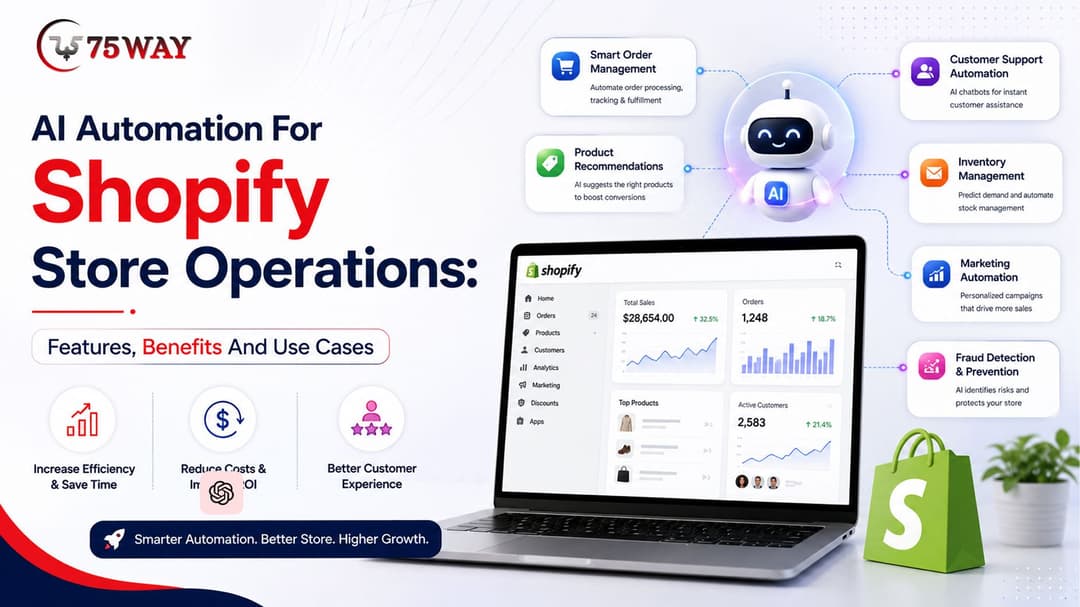
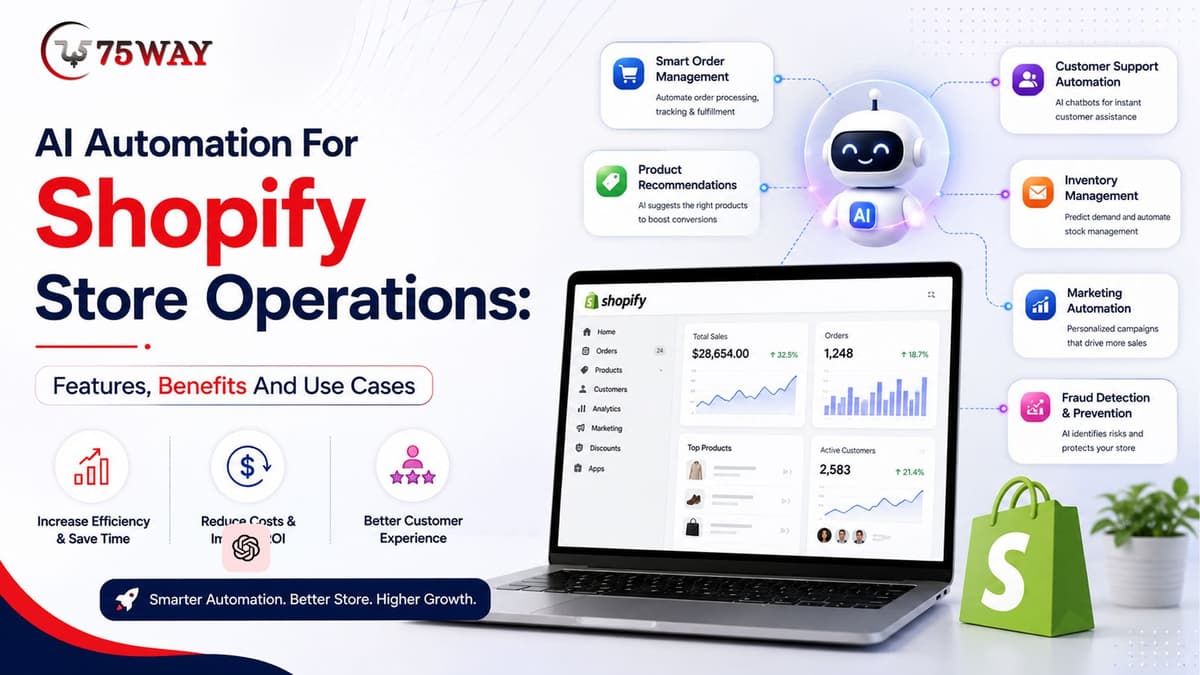
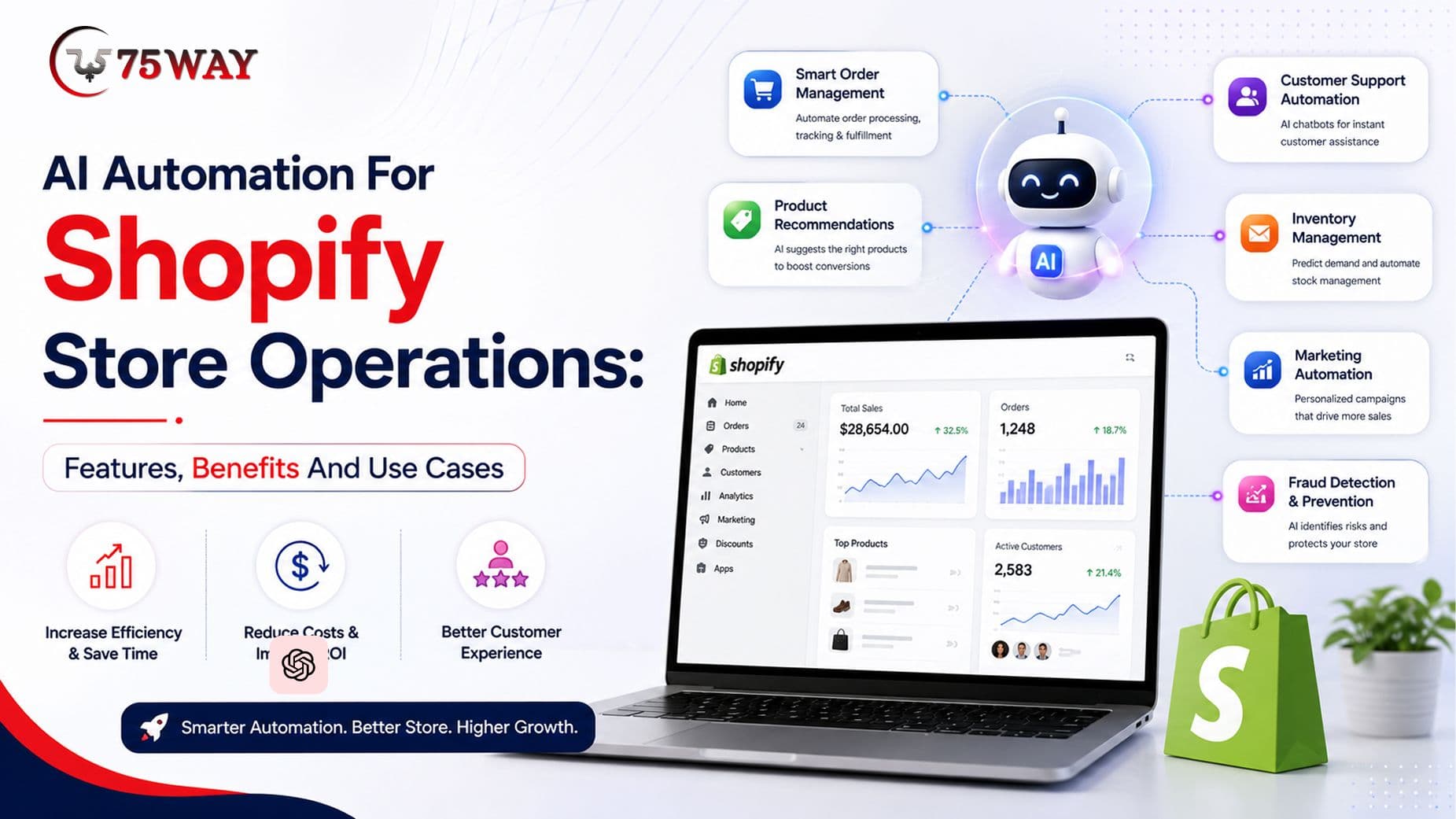
AI automation for Shopify store operations uses artificial intelligence to automate repetitive tasks, analyze business data, and improve daily operations. Instead of relying on manual processes, AI can make recommendations, trigger actions, and support business decisions based on real-time information.
Unlike traditional automation that follows fixed rules, AI solutions can recognize patterns, predict trends, and adapt to changing business conditions. This makes store operations more efficient and helps teams focus on growth instead of routine work.
For example, an AI-powered Shopify workflow can:
- Update product prices based on competitor activity and demand.
- Monitor inventory levels and prevent stock shortages.
- Respond to common customer inquiries instantly.
- Recommend products based on customer shopping behavior.
- Detect unusual order activity to reduce fraud risks.
The goal is not to replace your team. It is to remove repetitive work so employees can focus on strategy, customer relationships, and business growth.
How Does AI Automation Work In A Shopify Store?
Think of AI automation as an operations team that works continuously behind your Shopify store. It monitors business activities, identifies what needs attention, and completes repetitive tasks without waiting for manual input. The following stages show how AI automation processes information and executes actions across your ecommerce operations.
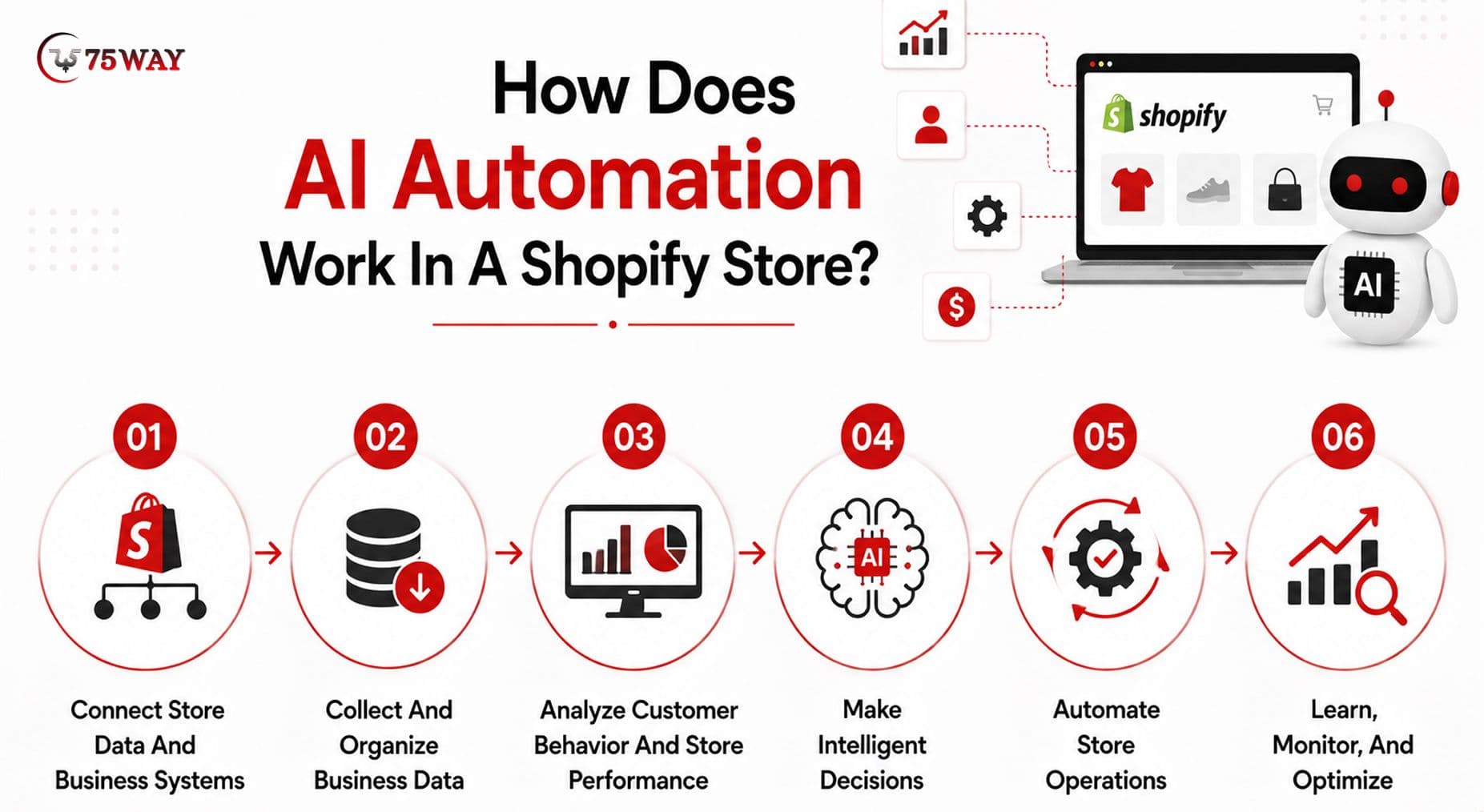
Phase 1: Connect Store Data And Business Systems
The process begins by connecting your Shopify store with the tools that power daily operations. This may include payment gateways, inventory management software, CRM platforms, marketing tools, shipping providers, helpdesk systems, and analytics platforms. Bringing this information together gives AI a complete view of how the business operates.
Phase 2: Collect And Organize Business Data
After the integrations are complete, AI starts collecting data from different sources. It gathers information such as customer behavior, product performance, order history, inventory levels, pricing, website activity, and marketing campaigns. The system then organizes this data into a structured format, creating a reliable foundation for automation and decision-making.
Phase 3: Analyze Customer Behavior And Store Performance
With organized data available, AI looks for patterns that are difficult to identify manually. It can detect which products are becoming popular, identify customers who are likely to purchase again, predict inventory shortages, recognize abandoned cart trends, and highlight opportunities to increase sales or improve operations.
Phase 4: Make Intelligent Decisions
Instead of relying only on predefined rules, AI evaluates the available information before deciding what action should be taken. For example, it may recommend adjusting product prices, prioritizing high-value customers, offering personalized discounts, or increasing stock levels for products experiencing rising demand.
Phase 5: Automate Store Operations
Once decisions are made, the workflow automatically performs the required actions. It can send personalized emails, update product prices, manage inventory, process customer support requests, recover abandoned carts, assign tasks to team members, or trigger marketing campaigns without requiring constant manual involvement.
Phase 6: Learn, Monitor, And Optimize Continuously
AI automation does not stop after completing a task. The system continuously monitors business performance, measures the results of automated actions, and learns from new customer interactions and sales data. As more information becomes available, recommendations become more accurate, workflows become smarter, and the Shopify store continues improving without requiring major process changes.
Key Features To Integrate During AI Automation For Shopify Store
The value of AI automation goes beyond saving time. The right AI solution can automate routine work while giving store owners better visibility into their business. Here are some of the most valuable features.
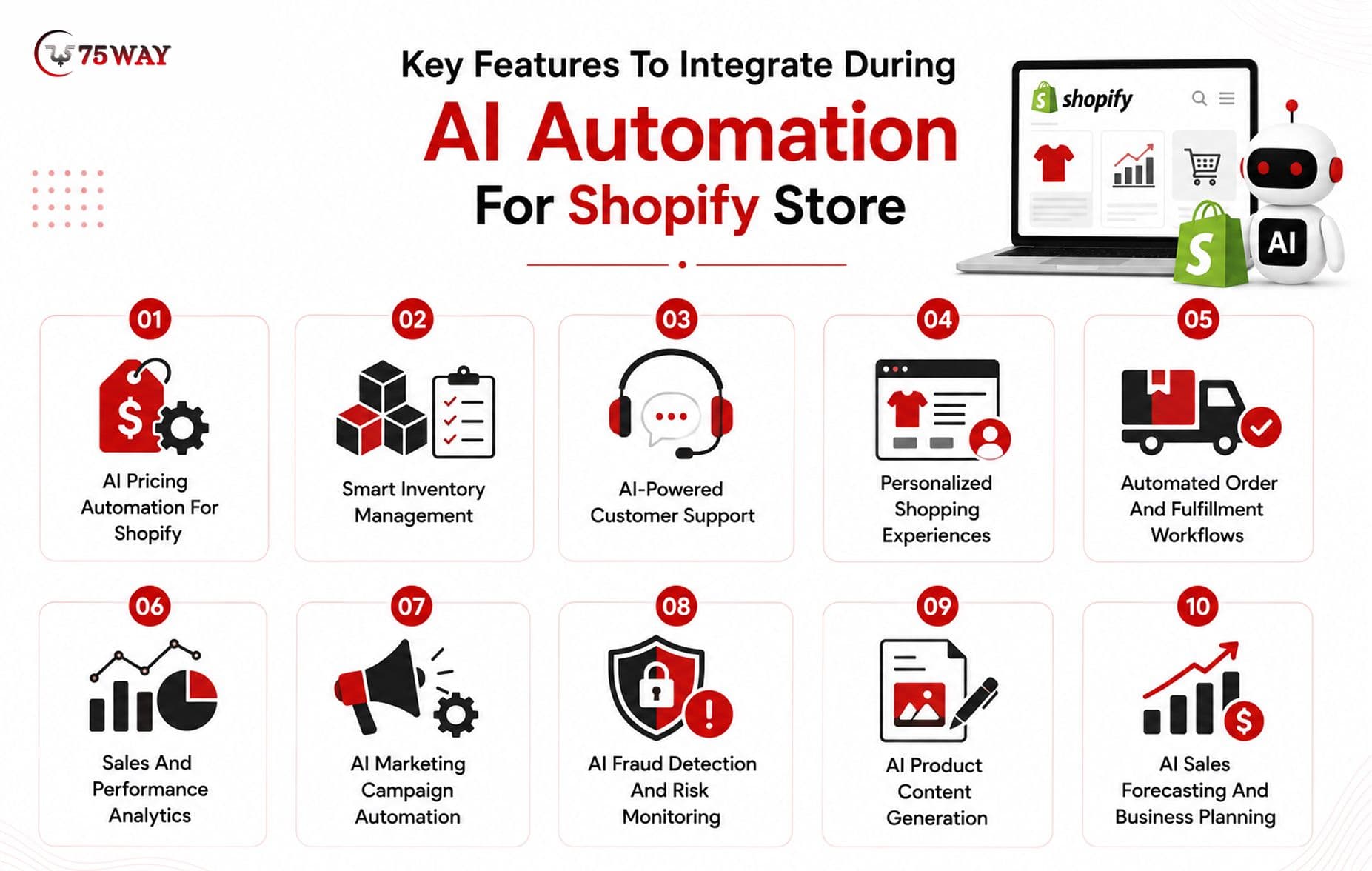
1. AI Pricing Automation For Shopify
Pricing products manually becomes difficult as your catalog grows and market conditions change. AI pricing automation for Shopify analyzes factors such as demand, competitor pricing, inventory levels, and sales trends to recommend or apply pricing changes automatically.
This helps businesses stay competitive without constantly monitoring prices. Key capabilities include:
- Dynamic product pricing
- Competitor price monitoring
- Promotional price recommendations
- Margin protection
2. Smart Inventory Management
Inventory problems can lead to missed sales or unnecessary storage costs. AI in ecommerce monitors stock movement and predicts future demand using historical sales data and buying patterns.
Businesses can maintain better inventory levels while reducing stockouts and overstock situations. Key capabilities include:
- Demand forecasting
- Low-stock alerts
- Inventory replenishment recommendations
- Seasonal inventory planning
3. AI-Powered Customer Support
Customers expect quick responses regardless of the time of day. AI-powered support helps answer common questions, provide order updates, and guide customers through the buying process.
Support teams can then focus on more complex customer requests.
4. Personalized Shopping Experiences
Every customer shops differently. AI agents in ecommerce study browsing behavior, purchase history, and preferences to create personalized shopping experiences. This can improve customer engagement and encourage repeat purchases. Common personalization features include:
- Product recommendations
- Personalized offers
- Cross-selling suggestions
- Upselling opportunities
5. Automated Order And Fulfillment Workflows
As order volume increases, manual processing becomes slower and more prone to errors. AI automation helps streamline order management by reducing repetitive administrative work. Businesses can automate tasks such as:
- Order verification
- Shipping updates
- Fulfillment notifications
- Return request management
6. Sales And Performance Analytics
AI helps businesses understand what is happening inside their Shopify store without manually reviewing reports. Instead of simply displaying numbers, AI identifies trends, highlights opportunities, and provides actionable insights that support better business decisions. Store owners can monitor:
- Best-selling products
- Customer purchasing patterns
- Revenue trends
- Marketing performance
- Product demand changes
7. AI Marketing Campaign Automation
Running successful marketing campaigns requires constant testing, audience targeting, and performance tracking. AI automates many of these tasks by analyzing customer behavior and campaign data.
Instead of manually creating every campaign, businesses can deliver more relevant marketing messages at the right time. Key capabilities include:
- Automated email campaigns
- Audience segmentation
- Product promotion suggestions
- Campaign performance optimization
8. AI Fraud Detection And Risk Monitoring
Fraudulent orders can lead to financial losses and chargebacks. AI continuously monitors transactions and identifies unusual buying patterns before orders are processed.
This allows businesses to review suspicious activity quickly while protecting genuine customers from unnecessary delays.
- Suspicious order detection
- Payment risk analysis
- Unusual purchase monitoring
- Chargeback risk reduction
9. AI Product Content Generation
Managing hundreds of product pages can take significant time. AI helps generate product titles, descriptions, SEO metadata, and content suggestions while maintaining consistency across the store.
This allows businesses to launch products faster and improve search visibility. Key capabilities include:
- Product description generation
- SEO title optimization
- Meta description creation
- Product attribute suggestions
10. AI Sales Forecasting And Business Planning
Planning inventory and marketing budgets becomes easier when businesses understand future demand. AI analyzes historical sales, seasonal trends, and customer purchasing behavior to forecast future performance.
These insights help store owners make more confident business decisions. Key capabilities include:
- Revenue forecasting
- Sales trend prediction
- Seasonal demand analysis
- Business growth planning
How To Implement AI Automation For Shopify Store Operations
AI automation works best when it is built around your store’s actual challenges instead of adding technology without a clear purpose. The implementation process below explains how businesses can identify automation opportunities, choose the right solutions, and integrate AI into daily Shopify operations.
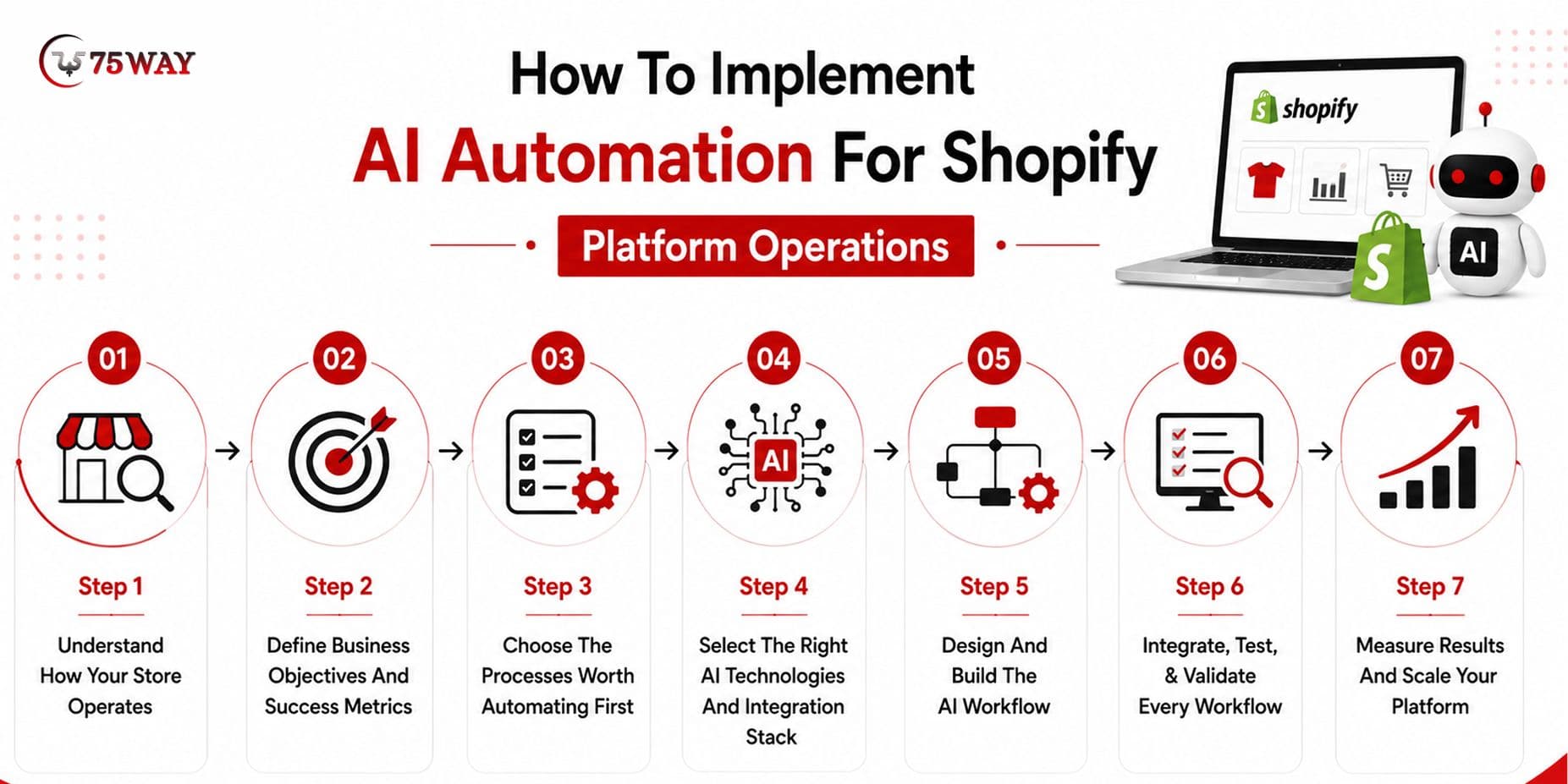
Step 1: Understand How Your Store Operates
Every successful implementation begins with a detailed operational review. Examine how orders move through your store, how inventory is managed, how customer inquiries are handled, and where employees spend the most time completing repetitive tasks. Questions such as:
Which tasks consume the most time?
Where do delays occur?
Which activities frequently cause manual errors?
often reveal the best automation opportunities. This assessment also helps distinguish processes that truly require AI from those that only need standard automation.
A complete operational audit usually covers order management, inventory control, customer support, pricing, marketing campaigns, returns processing, and reporting activities. The findings from this stage become the foundation for every decision that follows.
Step 2: Define Business Objectives And Success Metrics
Technology should support business goals, not the other way around. Before selecting any AI solution, define exactly what you want automation to achieve.
Your objective may involve reducing customer response times, improving inventory accuracy, increasing average order value, recovering abandoned carts, or lowering operational costs. Clear goals prevent unnecessary development and help teams stay focused throughout implementation.
At the same time, establish measurable KPIs that will be used after deployment. Common metrics include conversion rate, order processing time, customer satisfaction score (CSAT), inventory accuracy, repeat purchase rate, support resolution time, and overall revenue growth.
Step 3: Choose The Processes Worth Automating First
After defining the goals, determine which workflows should be automated first. Launching every automation at once often increases complexity and delays implementation.
Instead, rank workflows based on business impact, implementation effort, and expected return on investment. High-value workflows usually provide faster results while creating confidence for future automation projects.
For a Shopify store, the first phase often includes:
- AI-powered customer support
- Intelligent product recommendations
- Inventory forecasting
- Dynamic pricing
- Abandoned cart recovery
- Marketing campaign personalization
- Order routing and fulfillment automation
Starting with one or two workflows also makes testing and optimization much easier.
Step 4: Select The Right AI Technologies And Integration Stack
Choosing the right technology is just as important as choosing the right workflow. Every Shopify business has different requirements depending on its size, product catalog, customer base, and existing software ecosystem.
The implementation team evaluates which AI models, automation platforms, APIs, and cloud services best fit the project. Compatibility with Shopify, CRM platforms, ERP software, payment gateways, shipping providers, inventory systems, analytics platforms, and marketing tools should also be verified before development begins.
Selecting technologies that support future expansion reduces redevelopment costs as business requirements evolve.
Step 5: Design And Build The AI Workflow
Once the technology stack is finalized, developers create the workflow architecture. This stage defines how information enters the workflow, how AI processes that information, what decisions are made, and which actions are performed automatically.
Consider an abandoned cart workflow as an example. Customer activity triggers the workflow, AI analyzes shopping behavior, determines the most effective recovery strategy, generates a personalized offer, and sends it through the preferred communication channel. If the customer completes the purchase, the system automatically updates Shopify, CRM records, and marketing analytics.
Every workflow should include exception handling, approval logic where required, and fallback processes to maintain reliability even when unexpected situations occur.
Step 6: Integrate, Test, & Validate Every Workflow
Integration connects the AI workflow with your existing business environment. Customer information, inventory updates, payment status, shipping data, and marketing insights should move automatically between connected systems without requiring manual intervention.
Testing should cover much more than technical functionality. Every workflow needs validation under real business scenarios to ensure accurate recommendations, reliable automation, proper data synchronization, and consistent customer experiences.
Performance testing, security testing, API validation, workflow accuracy, and user acceptance testing all play an important role before deployment. Addressing issues during this stage prevents expensive operational problems later.
Step 7: Measure Results And Scale Your Platform
Deployment marks the beginning of the optimization phase rather than the end of the project. Business conditions, customer behavior, and purchasing trends continue to evolve, making continuous improvement essential.
Performance dashboards should track operational KPIs, automation accuracy, customer engagement, conversion rates, inventory turnover, support efficiency, and overall business impact. Regular reviews help identify workflows that require refinement or expansion.
As confidence in the system grows, additional AI capabilities can be introduced across merchandising, supply chain management, fraud detection, customer retention, demand forecasting, and personalized shopping experiences. This phased approach allows Shopify businesses to build an intelligent automation ecosystem without disrupting day-to-day operations
How Ecommerce AI Automation Improves Shopify Store Operations
AI automation helps simplify these operations by reducing manual work and improving decision-making across different business functions. Here are the key benefits businesses can expect.
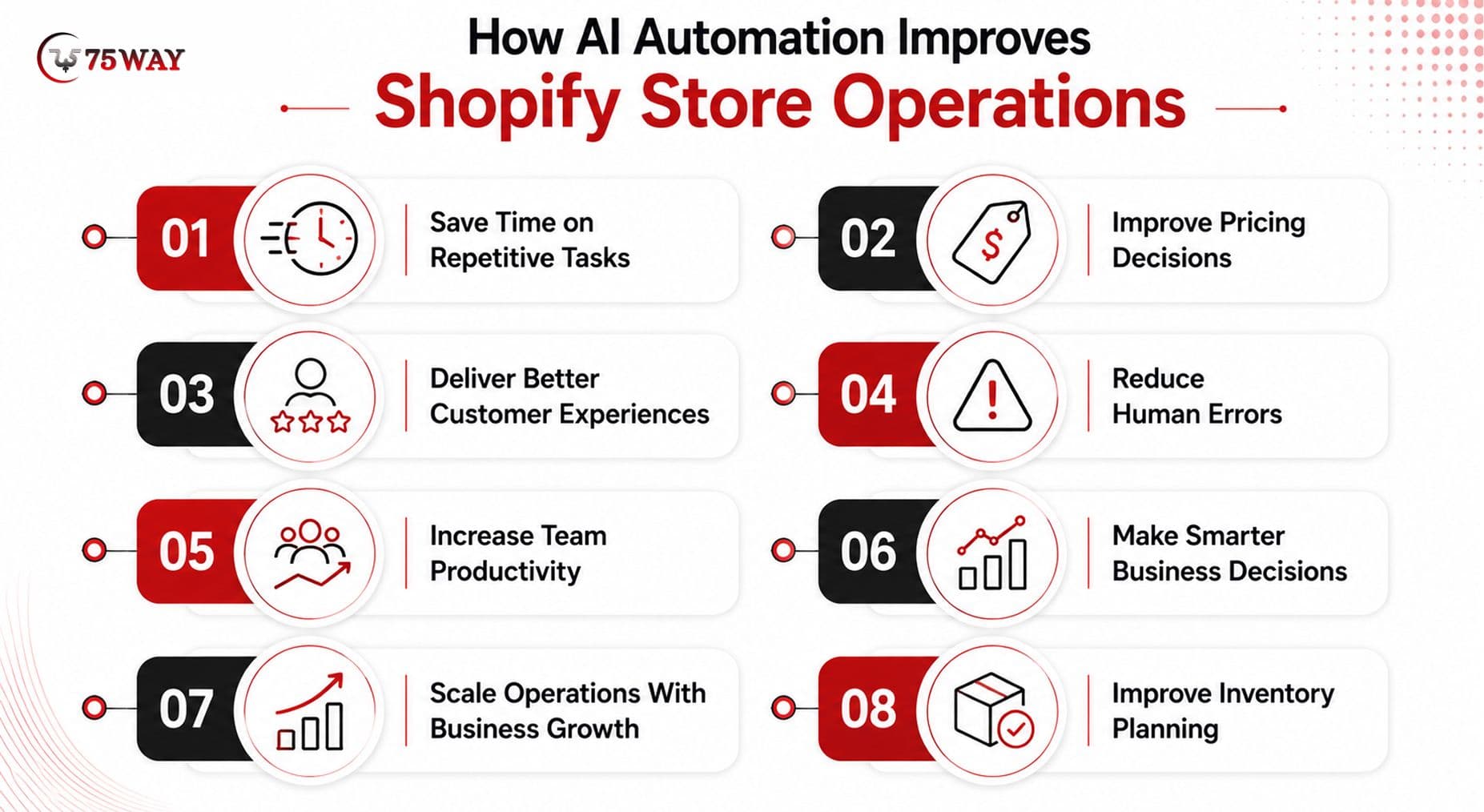
- Save Time On Repetitive Tasks
Many daily store activities follow the same process. Updating prices, tracking inventory, sending order notifications, and responding to common customer questions can consume valuable time.
AI automation handles these repetitive tasks automatically, allowing your team to focus on business growth instead of routine work.
- Improve Pricing Decisions
Product pricing changes constantly due to demand, competition, and market conditions. Managing prices manually becomes difficult as your product catalog expands.
AI pricing automation for Shopify analyzes business data and market trends to recommend better pricing strategies. This helps businesses remain competitive while protecting profit margins.
- Deliver Better Customer Experiences
Customers expect quick responses and personalized shopping experiences.
AI automation in ecommerce helps businesses provide instant support, recommend relevant products, and deliver personalized offers based on browsing behavior and purchase history. This creates a smoother shopping journey from product discovery to checkout.
- Reduce Human Errors
Manual data entry, inventory updates, and order processing can lead to mistakes that affect customers and business operations.
AI automation for Shopify reduces these errors by following consistent workflows and handling repetitive processes with greater accuracy.
- Increase Team Productivity
When employees spend less time on routine administrative work, they can focus on activities that create more value for the business.
Teams can dedicate more time to customer relationships, product development, marketing strategies, and business expansion instead of repetitive operational tasks.
- Make Smarter Business Decisions
AI automation for Shopify platforms continuously analyzes sales data, customer behavior, inventory movement, and store performance.
Instead of manually reviewing reports, businesses receive actionable insights that help improve pricing, inventory planning, marketing campaigns, and operational efficiency.
- Scale Operations With Business Growth
As order volume increases, manual processes become difficult to manage.
AI automation allows Shopify businesses to handle higher sales volumes without increasing operational complexity. Workflows continue running efficiently as the business expands.
- Improve Inventory Planning
Maintaining the right inventory levels is essential for customer satisfaction and profitability.
AI predicts future demand using historical sales patterns and buying trends. Businesses can reduce stock shortages, avoid excess inventory, and improve purchasing decisions throughout the year.
Industries Transforming Operations With AI-Powered Shopify Platforms
AI-powered Shopify platforms are valuable for almost every Shopify business, but some industries see even greater operational improvements due to high order volumes, changing customer demand, and large product catalogs. It is especially beneficial for:
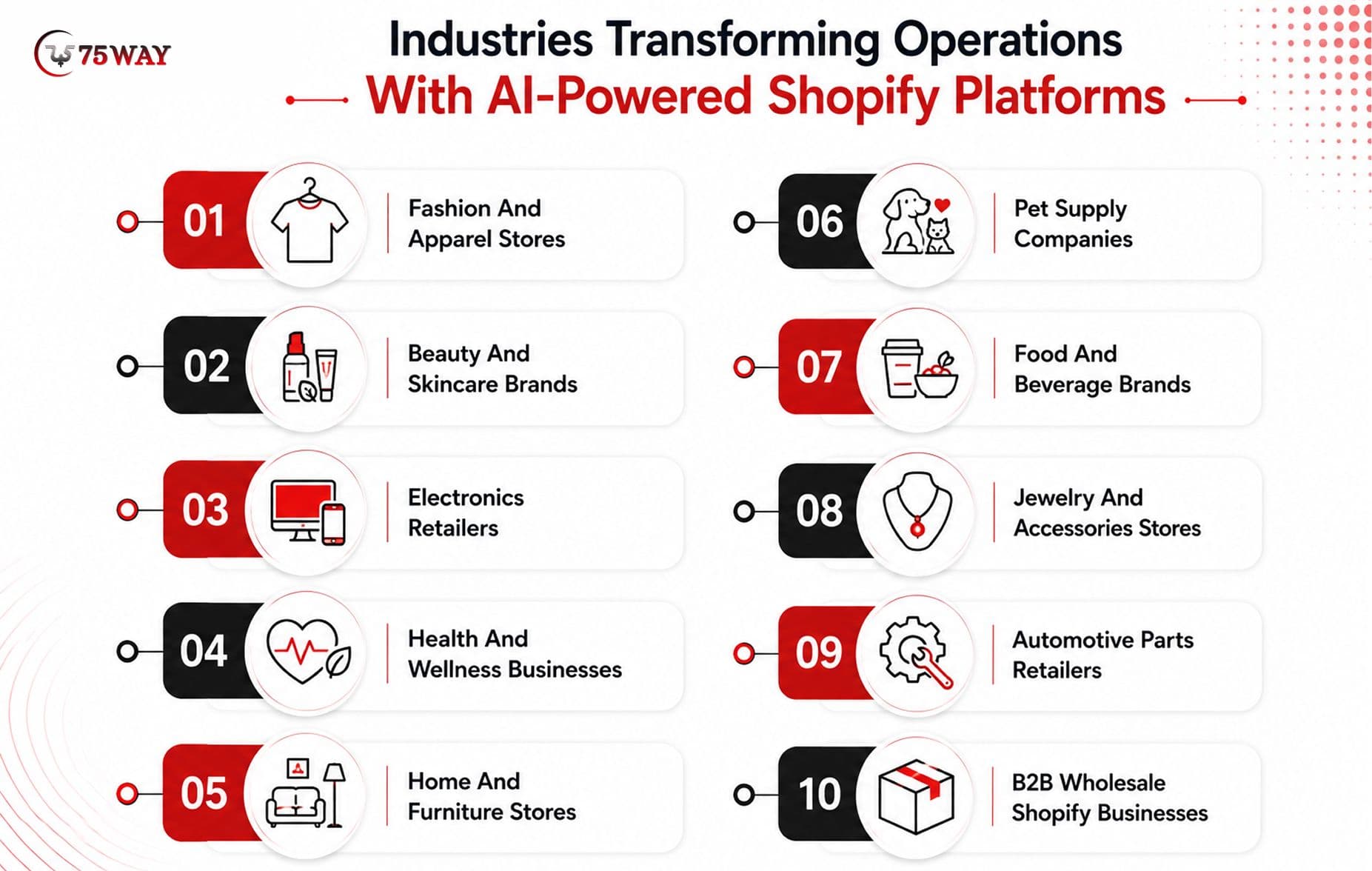
- Fashion And Apparel Stores: AI-powered Shopify platforms help fashion brands respond to changing trends faster. From forecasting seasonal demand to optimizing pricing and recommending relevant products, automation keeps collections aligned with customer preferences.
- Beauty And Skincare Brands: Personalized shopping has become a major competitive advantage. AI automation in Shopify stores recommends products based on customer preferences, manages stock efficiently, and supports targeted marketing campaigns that drive repeat purchases.
- Electronics Retailers: Fast-moving inventories require quick decisions. AI automation for Shopify analyzes buying patterns, suggests related accessories, updates pricing, and helps retailers maintain the right stock at the right time.
- Health And Wellness Businesses: Subscription-based products and repeat orders become easier to manage with Shopify AI automation. Businesses can automate renewals, recommend complementary products, and improve customer retention through personalized experiences.
- Home And Furniture Stores: Large product catalogs often overwhelm shoppers. AI-powered automation for Shopify makes product discovery easier by recommending matching furniture, forecasting demand, and improving inventory planning.
- Pet Supply Companies: Regular purchases such as pet food and healthcare products create ideal automation opportunities. AI-driven Shopify workflows predict replenishment cycles, automate recurring orders, and personalize recommendations for every pet owner.
- Food And Beverage Brands: Managing perishable inventory requires accurate forecasting. Shopify AI solutions help businesses reduce waste by predicting demand, automating promotional campaigns, and improving order fulfillment.
- Jewelry And Accessories Stores: Every purchase is influenced by personal taste. AI automation for Shopify stores delivers tailored recommendations, supports dynamic pricing strategies, and helps increase the average order value.
- Automotive Parts Retailers: Customers need confidence that they're buying compatible products. AI-enabled Shopify systems match the right parts, synchronize inventory, reduce ordering mistakes, and simplify the buying experience.
- B2B Wholesale Shopify Businesses: Wholesale operations involve custom pricing and large-volume orders. AI-powered Shopify automation streamlines quotations, personalizes pricing, manages business accounts, and accelerates the entire purchasing process.
Real-World Use Cases of AI Automation For Shopify Every Business Should Know
Many Shopify stores already use AI without realizing how broadly it can support their operations. Here are practical examples of how businesses automate routine workflows, improve customer experiences, and streamline day-to-day store management. Here are some practical use cases.
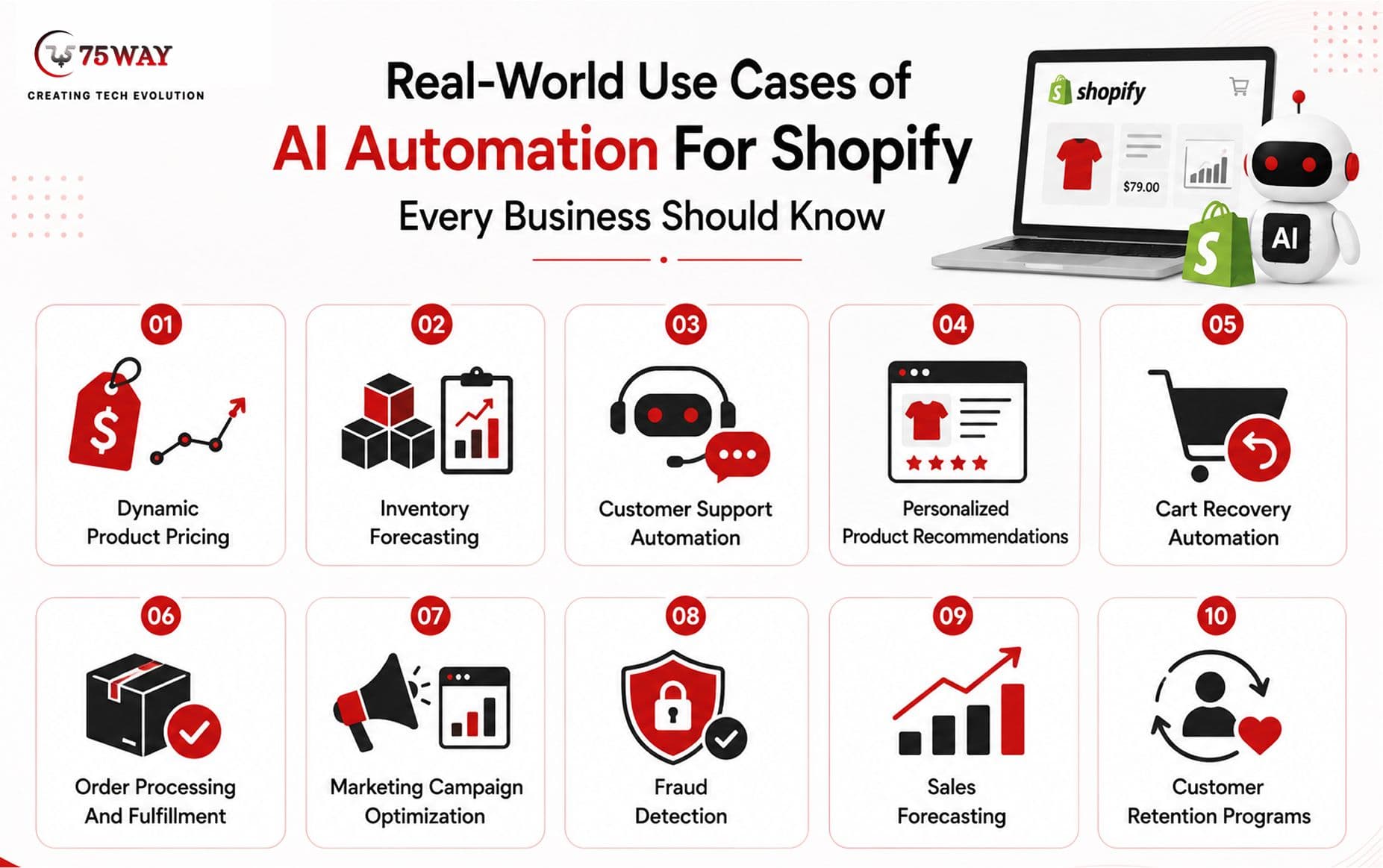
- Dynamic Product Pricing
Product prices often change because of market demand, competitor activity, and inventory levels. AI pricing automation for Shopify monitors these factors and recommends or applies pricing changes. This helps businesses remain competitive while protecting profit margins.
- Inventory Forecasting
Running out of stock can lead to missed sales, while excess inventory increases storage costs. AI analyzes historical sales, seasonal demand, and purchasing patterns to predict future inventory requirements and improve stock planning.
- Customer Support Automation
AI-powered customer support assistants answer common customer questions, provide order updates, process return requests, and route complex issues to support teams. Customers receive faster responses without increasing support costs.
- Personalized Product Recommendations
AI shopping assistant studies customer behavior, browsing history, and previous purchases to recommend products that match individual interests. Relevant recommendations often improve customer engagement and increase average order value.
- Cart Recovery Automation
Many shoppers leave products in their carts before completing a purchase. AI ecommerce agents identify abandoned carts and automatically send personalized reminders, discounts, or product recommendations that encourage customers to return and complete checkout.
- Order Processing And Fulfillment
AI order procurement assistants in Shopify platforms automate order verification, shipping updates, warehouse notifications, and fulfillment workflows. This reduces manual effort while helping businesses process larger order volumes.
- Marketing Campaign Optimization
AI-powered marketing agents analyze campaign performance, customer behavior, and purchase history to improve marketing decisions. Businesses can automatically target the right audience with personalized emails, promotions, and product recommendations.
- Fraud Detection
AI automation in Shopify continuously monitors transactions for unusual buying behavior, payment risks, and suspicious activity. Potentially fraudulent orders can be flagged for manual review before fulfillment.
- Sales Forecasting
AI evaluates historical sales data, seasonal trends, and customer demand to forecast future revenue. These insights help businesses plan inventory purchases, marketing budgets, and business growth strategies.
- Customer Retention Programs
AI automation in retail identifies repeat buyers, inactive customers, and loyalty opportunities using purchasing behavior. Businesses can automatically launch personalized rewards, offers, and engagement campaigns that encourage long-term customer relationships.
Why Choose 75way For AI Automation For Shopify Store Operations?
Every Shopify store runs differently, so the same automation strategy rarely works for every business. Some stores struggle with inventory planning, while others lose time managing customer support, pricing updates, or order processing.
At 75way Technologies, we start by understanding how your store operates before recommending any AI-powered ecommerce solution. This helps us build automation that fits naturally into your existing workflow instead of forcing you to change the way your business works.
Our team designs and develops custom AI automation for Shopify stores based on your goals, not generic templates. Whether you want AI pricing automation for Shopify, smarter inventory forecasting, personalized shopping experiences, automated customer support, or intelligent order management, every workflow is built to work with your current Shopify setup and the business tools you already use. The result is a solution that saves time, reduces manual work, and scales as your store grows.
One example comes from a Shopify Plus fashion retailer that found it difficult to keep up during seasonal sales. Frequent price changes, fast-moving inventory, and a surge in customer inquiries created unnecessary pressure on the team.
We introduced AI-powered Shopify automation to handle dynamic pricing, predict inventory requirements, and automate routine customer support requests. Within weeks, the retailer spent less time on repetitive operational work, maintained better stock availability, handled customer inquiries more quickly, and managed peak-season demand with greater confidence.
For us, AI automation is not about replacing people. It is about removing repetitive work, so your team can focus on growing the business. That practical approach is why brands choose 75way to build reliable, scalable, and business-focused AI automation for Shopify store operations.
Conclusion
To summarize, AI automation is changing how Shopify businesses manage their daily operations. Instead of spending hours on repetitive tasks, store owners can automate pricing, inventory, customer support, marketing, and order management while making faster, data-driven decisions. The right AI workflows improve efficiency, reduce operational costs, and create better shopping experiences that support long-term growth. Whether you run a growing Shopify store or an established ecommerce brand, investing in AI automation can help you scale with confidence. Partner with a reliable AI-powered ecommerce development company to implement custom AI automation for Shopify store operations and build intelligent workflows that drive measurable business results.
Frequently Asked Questions (FAQs)
Can AI Automation Work For Small Shopify Stores?
Yes, AI automation benefits businesses of every size by reducing repetitive work and improving daily operations. Small stores can automate essential processes without making significant operational changes.
Does AI Automation Replace Manual Store Management?
No, AI supports your team by handling repetitive tasks while employees focus on strategy and customer relationships. Business owners still control decisions and workflow settings.
Can AI Automation Handle Seasonal Sales Spikes?
Yes, AI helps businesses prepare for increased demand by forecasting inventory, automating workflows, and managing customer interactions. This improves operational efficiency during peak shopping periods.
Is AI Pricing Automation Suitable For Every Shopify Store?
Most Shopify businesses can benefit from AI pricing automation when product pricing changes frequently. It helps maintain competitive pricing while protecting profit margins.
Can AI Automation Improve Customer Retention?
Yes, AI analyzes customer behavior and automates personalized recommendations, loyalty campaigns, and follow-up communication. These workflows encourage repeat purchases and long-term customer relationships.
Does AI Automation Require Replacing Existing Shopify Apps?
No, AI automation usually works alongside your existing Shopify apps and business software. Most workflows integrate with existing systems rather than replacing them entirely.
Can AI Automation Support Multi-Store Shopify Businesses?
Yes, AI workflows can manage operations across multiple Shopify stores from a centralized process. This improves consistency, reporting, and operational efficiency for growing businesses.
How Do I Get Started With AI Automation For Shopify?
Start by identifying repetitive operational tasks that consume the most time every day. An experienced AI automation partner can recommend workflows that deliver the highest business impact.