AI Summary
AI sales agents can qualify leads by engaging prospects, asking relevant questions, analyzing responses, checking customer data, and identifying buying intent. This guide explains how automated qualification works, which technologies support it, and how businesses can improve their sales pipeline.
Key Takeaways
- AI sales agents qualify leads through conversations, data, intent, and predefined criteria.
- Automated questions help sales teams collect relevant qualification information faster.
- CRM integrations keep lead records updated throughout qualification workflows.
- AI agents can identify buying signals and route qualified prospects automatically.
- Human sales teams remain important for complex deals and high-value opportunities.
Not every lead deserves the same sales effort, but manually separating promising prospects from casual inquiries can consume valuable time. AI sales agents can automate this early screening by interacting with prospects, gathering information, and determining how closely each lead matches the business's requirements.
For businesses, automated qualification can create a cleaner handoff between marketing and sales. The sales AI agent development solution can capture conversation details, identify buying signals, apply qualification rules, and pass stronger prospects to sales representatives while routine or low-intent inquiries follow a different path.
A successful setup requires more than adding an AI chatbot to a website or messaging channel. This guide defines how AI sales agents qualify leads automatically and how businesses can connect that process with their broader sales operation.
What Is AI Sales Agent For Lead Qualification?
An AI sales agent for lead qualification is an AI-powered system that interacts with potential customers, asks relevant questions, analyzes their responses and business data, evaluates buying intent, and determines whether they meet predefined sales criteria.
Unlike a basic chatbot, it can take actions during the qualification process, such as updating CRM records, enriching lead information, assigning lead status, scheduling sales meetings, and routing qualified prospects to the right sales representative.
For example, a B2B software company might configure an AI sales agent to check a prospect’s company size, industry, business need, budget, decision-making role, and purchase timeline. Based on the collected information and predefined qualification rules, the agent can identify sales-ready prospects while directing less-ready leads toward nurturing workflows.
AI Sales Agents vs. Traditional Lead Qualification: Complete Comparison
Traditional qualification often depends on forms, predefined scoring models, manual research, and sales representatives reviewing incoming leads. These methods can still be useful, but they may require prospects to complete forms and sales teams to spend time interpreting information before deciding what to do next.
An AI sales agent introduces a conversational layer into the process. It can ask a question, interpret the answer, identify missing information, and determine the next relevant question rather than following one fixed sequence.
For instance, if a prospect says they are already using a competing platform and want to migrate within three months, the agent can recognize that the conversation requires different follow-up questions than a prospect who is only researching available options.
The objective is not simply to generate an AI-based score. The broader goal is to create a qualification workflow that gathers useful information and moves each prospect toward the appropriate next step.

How AI Sales Agents Automate Lead Qualification And Scoring
AI sales agents can turn an unstructured lead conversation into a clearer assessment of buying potential. They evaluate the information shared by prospects against predefined qualification rules and assign scores based on the signals that matter to the business. The process below shows how AI moves a lead from initial interaction to a sales-ready score.
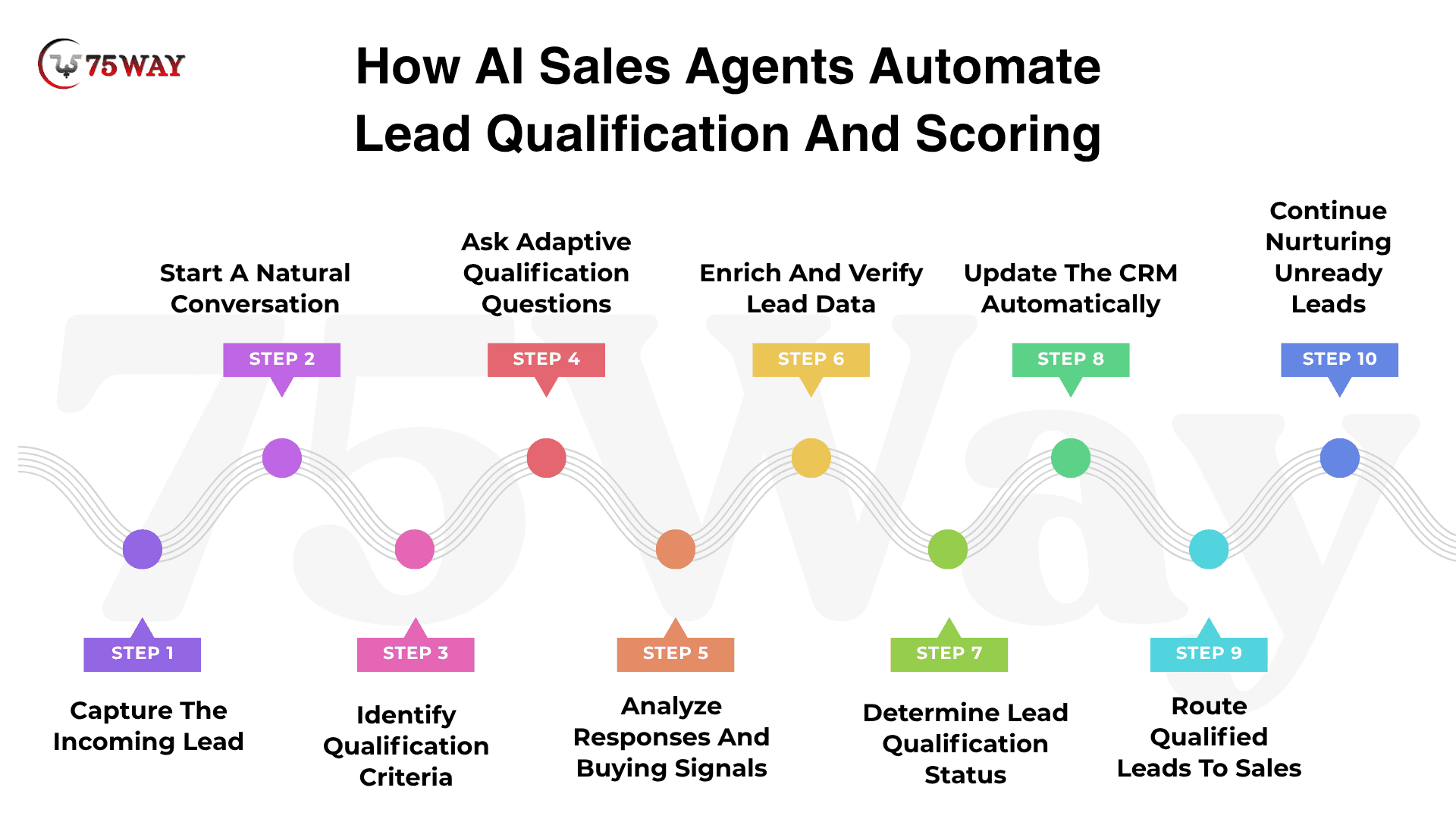
Step 1: Capture The Incoming Lead
The qualification process begins when a prospect interacts with a business through a connected channel. This could happen after someone submits a website form, starts a conversation with a sales agent, responds to an email, or engages through another supported touchpoint.
The AI sales agent receives the available lead information and establishes the context for the conversation. Depending on the integration, this may include information such as the prospect's name, company, role, source, requested product, or previous interactions.
At this stage, the system should avoid treating every lead identically. The available information can determine which qualification flow is relevant and what additional information needs to be collected.
Step 2: Start A Natural Conversation
Once the interaction begins, the AI sales agent engages the prospect conversationally rather than immediately presenting a long qualification form.
The agent can explain products, answer basic questions, and ask relevant questions based on the prospect's responses. This creates an adaptive conversation where the next question depends on what the prospect has already shared.
For example, a prospect asking about enterprise software may first need questions about company size, current systems, business requirements, implementation expectations, and purchasing authority. A smaller business looking for a standard product may require a much shorter qualification path.
The agent can therefore adjust the conversation according to the available context and predefined business rules.
Step 3: Identify Qualification Criteria
Every business needs its own definition of a qualified lead. AI sales agents do not automatically know what makes a prospect valuable to a particular organization.
Sales teams must establish the criteria that the agent should evaluate. These criteria can include factors such as industry, company size, business need, budget range, purchase timeline, location, existing technology, decision-making authority, or product fit.
For a B2B software company, qualification may depend heavily on whether the prospect has a relevant use case and sufficient organizational requirements. For an ecommerce business, qualification could instead focus on product interest, purchase intent, order requirements, or customer eligibility.
The quality of automated qualification therefore depends partly on how clearly the business defines its sales requirements.
Step 4: Ask Adaptive Qualification Questions
After establishing the relevant criteria, the AI sales agent gathers missing information through targeted questions.
Instead of asking every prospect identical questions, the agent can use the conversation context to determine what information is still needed. If a prospect has already explained their company size, the agent does not need to ask the same question again.
This makes the interaction more conversational while helping the business collect structured qualification data.
A well-designed workflow also controls how many questions the agent asks. Asking unnecessary questions can create friction, while asking too few may leave sales teams without enough information to determine whether an opportunity deserves attention.
Step 5: Analyze Responses And Buying Signals
The agent then interprets the prospect's responses to identify information relevant to qualification.
This can involve structured data, conversational context, behavioral signals, and business rules. A prospect mentioning an urgent implementation deadline may provide a stronger buying signal than someone simply asking for general product information.
Similarly, statements about budget, procurement processes, existing problems, decision-makers, or implementation plans can provide useful context for determining sales readiness.
Natural language processing and large language models can help interpret conversational responses, while deterministic business rules can control important qualification decisions.
This combination is particularly useful because not every qualification factor can be represented effectively through simple keyword matching.
Step 6: Enrich And Verify Lead Data
AI sales agents can also work with lead enrichment systems to add relevant business information to a prospect's record.
Depending on the tools and permissions available, enrichment may provide information such as company details, industry classification, organization size, or other commercially relevant attributes.
However, enrichment should not be treated as automatically accurate. External information can become outdated, incomplete, or incorrectly matched. Businesses should therefore establish appropriate validation rules before allowing enriched information to influence important sales decisions.
The agent can combine verified business data with information directly provided by the prospect to create a more complete qualification profile.
Step 7: Determine Lead Qualification Status
Once enough information has been collected, the AI sales agent applies the organization's qualification logic.
The result could be a qualified lead, a lead requiring additional information, a prospect better suited for nurturing, or a lead that does not currently meet the organization's criteria.
The important point is that qualification should be based on explicit criteria rather than an unexplained AI judgment. Sales teams should be able to understand why a prospect was classified in a particular way.
For example, a CRM record might indicate that the prospect matches the target industry, has the required use case, expects implementation within the defined timeframe, and has confirmed decision-making involvement.
This creates a more useful handoff than simply labeling the prospect as “high quality.”
Step 8: Update The CRM Automatically
After qualification, the AI sales agent can update the connected CRM with the information collected during the conversation.
The record may include qualification responses, conversation summaries, lead status, relevant customer requirements, contact details, and the recommended next action.
Automation can reduce the need for sales representatives to manually copy information from conversations into CRM fields. More importantly, structured records allow sales teams to understand why a lead was routed to them.
CRM synchronization should include safeguards against duplicate records, incorrect field updates, unauthorized changes, and incomplete information.
Step 9: Route Qualified Leads To Sales
Qualified leads can then be routed according to business-defined workflows.
A company may route leads based on territory, product line, account size, industry, sales representative availability, or other operational rules.
For example, an enterprise prospect may be directed to an enterprise account executive, while a smaller opportunity could enter an inside-sales workflow.
The AI agent can also schedule meetings when the workflow allows it. Instead of transferring a prospect without context, the system can provide the sales representative with a summary of the prospect's requirements and qualification information.
Step 10: Continue Nurturing Unready Leads
Not every prospect is ready for a sales conversation immediately.
An AI sales agent can identify situations where a prospect has genuine interest but lacks an immediate purchase timeline, sufficient information, or another qualification requirement.
Rather than treating such prospects as failed leads, the business can place them into an appropriate nurturing workflow.
The agent may continue answering questions, provide relevant information, monitor future interactions, or trigger follow-up activities based on approved workflows.
This creates a distinction between “not qualified” and “not ready yet,” which can be important for businesses with longer sales cycles.
What Data Does An AI Lead Management Agent Use For Qualification?
AI lead management agents can use several categories of information when qualifying prospects, depending on the business workflow and available integrations.
First-party information provided directly by the prospect is often particularly useful because it comes from the person participating in the conversation. This can include business requirements, budget expectations, timelines, current solutions, purchasing needs, and implementation plans.
The agent can also use information already stored in CRM systems, marketing automation platforms, customer databases, and other authorized business applications.
Website behavior may provide additional context where appropriate, such as the pages a prospect viewed or the product information they requested.
External enrichment data can supplement these sources, but businesses should validate data quality and ensure their collection and processing practices comply with applicable privacy requirements.
The agent should use only the information necessary for the qualification task and should operate within the access permissions established by the business.
How Sales AI Agents Score And Prioritize Leads?
AI sales agents score and prioritize leads by combining prospect data, behavioral signals, conversation details, and predefined business criteria. The process helps identify which leads need immediate sales attention while separating prospects that require further nurturing.

1. Define Qualification Criteria: Establish the characteristics that determine whether a lead matches your ideal customer profile and sales requirements.
2. Collect Lead Data: Gather information from forms, conversations, CRM records, website interactions, and authorized enrichment sources.
3. Analyze Buying Signals: Evaluate responses and behaviors to identify indicators such as purchase intent, urgency, budget, requirements, and timeline.
4. Assign Lead Scores: Apply predefined scoring rules or AI-supported analysis to assign values based on relevant lead characteristics and signals.
5. Prioritize Sales Opportunities: Organize leads according to qualification results, helping sales teams identify prospects requiring timely attention.
6. Route Leads Automatically: Send qualified or high-priority leads to appropriate sales representatives based on business rules and routing criteria.
7. Monitor Qualification Results: Compare AI classifications with actual sales outcomes and refine criteria when recurring inaccuracies or gaps appear.
Essential Integrations For AI Lead Qualification Agents
An automated lead qualification agent needs reliable integrations to access prospect information, understand interactions, update records, and trigger sales workflows. Connecting the right systems allows the agent to move qualified leads from initial engagement to sales handoff without creating disconnected processes.
- CRM Integration: A CRM integration gives the AI sales agent access to relevant prospect and customer records.
It can update lead status, qualification details, conversation summaries, and other approved fields automatically. This keeps sales teams informed without requiring repetitive manual data entry.
- Marketing Automation: Marketing automation platforms provide information about campaigns, lead sources, engagement, and nurturing activities.
The AI marketing agent can use this context when evaluating a prospect's interest and qualification status. It can also trigger appropriate nurturing workflows when a lead is not ready for sales.
- Lead Enrichment: Lead enrichment integrations supplement prospect records with relevant business information from authorized data providers. The AI lead enrichment agent can use details such as company size, industry, location, or other available attributes during qualification.
Businesses should validate enriched information because external data may be incomplete or outdated.
- Calendar Integration: Calendar integrations allow AI sales agents to schedule meetings with qualified prospects based on available appointment slots.
The agent can coordinate suitable times without requiring lengthy back-and-forth communication. This creates a direct connection between qualification and sales representative availability.
- Communication Channels: Integrations with websites, email, messaging platforms, and other supported channels allow agents to qualify prospects where conversations already occur.
The agent can maintain relevant context while collecting information across connected interactions. Businesses can therefore create a broader qualification workflow without limiting prospects to one communication channel.
- Analytics Integration: Analytics integrations capture information about qualification conversations, lead outcomes, routing decisions, and sales progression.
Businesses can use this data to identify qualification gaps and monitor workflow performance. These insights also help teams refine qualification criteria and determine where human intervention remains necessary.
Benefits of Automating Lead Qualification With AI Sales Agent
AI-powered lead qualification can reduce repetitive sales work while helping businesses respond to prospects, collect useful information, and organize opportunities through predefined workflows. When implemented around clear qualification criteria, automation can support sales teams without removing human involvement where judgment is required.

- Faster Lead Response: AI sales agents can engage incoming prospects immediately after they initiate an interaction.
This reduces delays between lead generation and initial qualification. Faster engagement can help businesses capture relevant information while the prospect is actively interested.
- Reduced Manual Work: AI agents can handle repetitive qualification questions and information collection automatically.
Sales representatives spend less time reviewing basic inquiries or gathering standard details. This allows teams to dedicate more attention to conversations requiring human expertise.
- Higher-Volume Qualification: An AI sales agent can manage multiple conversations simultaneously through supported channels.
Businesses can therefore handle larger volumes of initial inquiries without making every qualification interaction dependent on individual representatives. The actual capacity depends on the system architecture, integrations, and conversation complexity.
- Better Data Collection: AI agents can collect structured information during natural conversations.
They can capture requirements, budgets, timelines, company details, and other qualification fields according to configured workflows. This gives sales representatives more context when reviewing an opportunity.
- Automated Lead Routing: Qualified prospects can be routed automatically according to predefined business rules.
Routing can consider factors such as product interest, territory, company size, or lead type. This helps connect opportunities with the appropriate sales workflow without relying entirely on manual assignment.
- Continuous Availability: AI sales agents can interact with prospects beyond standard sales-team working hours.
This allows qualification workflows to remain available when representatives are unavailable. Human sales teams can then follow up when their involvement becomes appropriate.
- Personalized Qualification: AI agents can adapt questions based on information provided during conversations.
A prospect does not necessarily need to answer irrelevant questions designed for another customer segment. This can create a more relevant qualification experience while still collecting required information.
- Improved Sales Prioritization: Automated qualification can organize leads according to predefined criteria and available buying signals.
Sales teams can review relevant qualification information before deciding where to focus their attention. This supports more structured pipeline management without treating an AI score as the only decision factor.
How 75way Can Help Build AI Sales Agents
Building an AI sales agent requires more than connecting a language model to a chat interface. The solution needs a clear qualification workflow, reliable integrations, controlled access to business data, appropriate escalation logic, and measurable outcomes.
75way can help businesses design and develop custom AI sales agents around their existing sales processes. The development approach can cover conversational experiences, CRM integration, lead qualification workflows, data handling, automation, analytics, and human handoff.
The right architecture depends on the organization's sales model, technology stack, qualification criteria, and automation requirements. A discovery-led approach can help identify which sales activities should be automated and where human involvement should remain part of the workflow.
Final Thoughts
AI sales agents can automate much of the repetitive work involved in lead qualification, but successful implementation depends on more than conversational AI. Businesses need clearly defined qualification criteria, reliable customer data, connected systems, controlled automation, human escalation, and ongoing measurement.
When these components work together, an AI sales agent can turn an initial inquiry into a structured qualification process, provide sales teams with useful context, and route opportunities according to documented business requirements.
The objective is not to automate every sales interaction. It is to automate the right qualification activities while giving sales representatives better information for the conversations that require human expertise.
To automate lead qualification around your sales workflow, partner with a trusted AI agent development company to build an AI sales agent tailored to your business.
Frequently Asked Questions (FAQs)
Can AI Sales Agents Recognize Returning Prospects?
Yes, AI sales agents can recognize returning prospects when connected systems retain authorized interaction and customer records. This helps conversations continue with relevant context instead of restarting.
How Do AI Sales Agents Handle Duplicate Leads?
AI sales agents can identify potential duplicates by comparing available contact and company information. Businesses can then apply matching rules before creating or updating CRM records.
Can AI Sales Agents Detect Fake or Spam Leads?
AI sales agents can identify suspicious patterns using submitted information, conversation behavior, and predefined validation rules. Questionable leads can be flagged for review rather than automatically routed.
Can AI Sales Agents Qualify Leads From Voice Conversations?
Yes, AI sales agents can support voice-based qualification when speech recognition and conversational systems are integrated. They can capture responses and transfer structured information into connected workflows.
How Do AI Sales Agents Handle Prospects Who Stop Responding?
An AI sales agent can trigger approved follow-up workflows when prospects become inactive. Timing, frequency, and communication channels can be controlled through predefined business rules.
Can AI Sales Agents Work With Existing Lead Scoring Systems?
Yes, AI sales agents can complement existing scoring systems by supplying conversational information and verified qualification details. Businesses can combine both approaches within their sales workflows.
Can AI Sales Agents Qualify Leads Before Sales Representatives See Them?
Yes, an AI sales agent can collect and evaluate required information before routing prospects to representatives. Sales teams can then receive conversations with relevant qualification context.