Summary
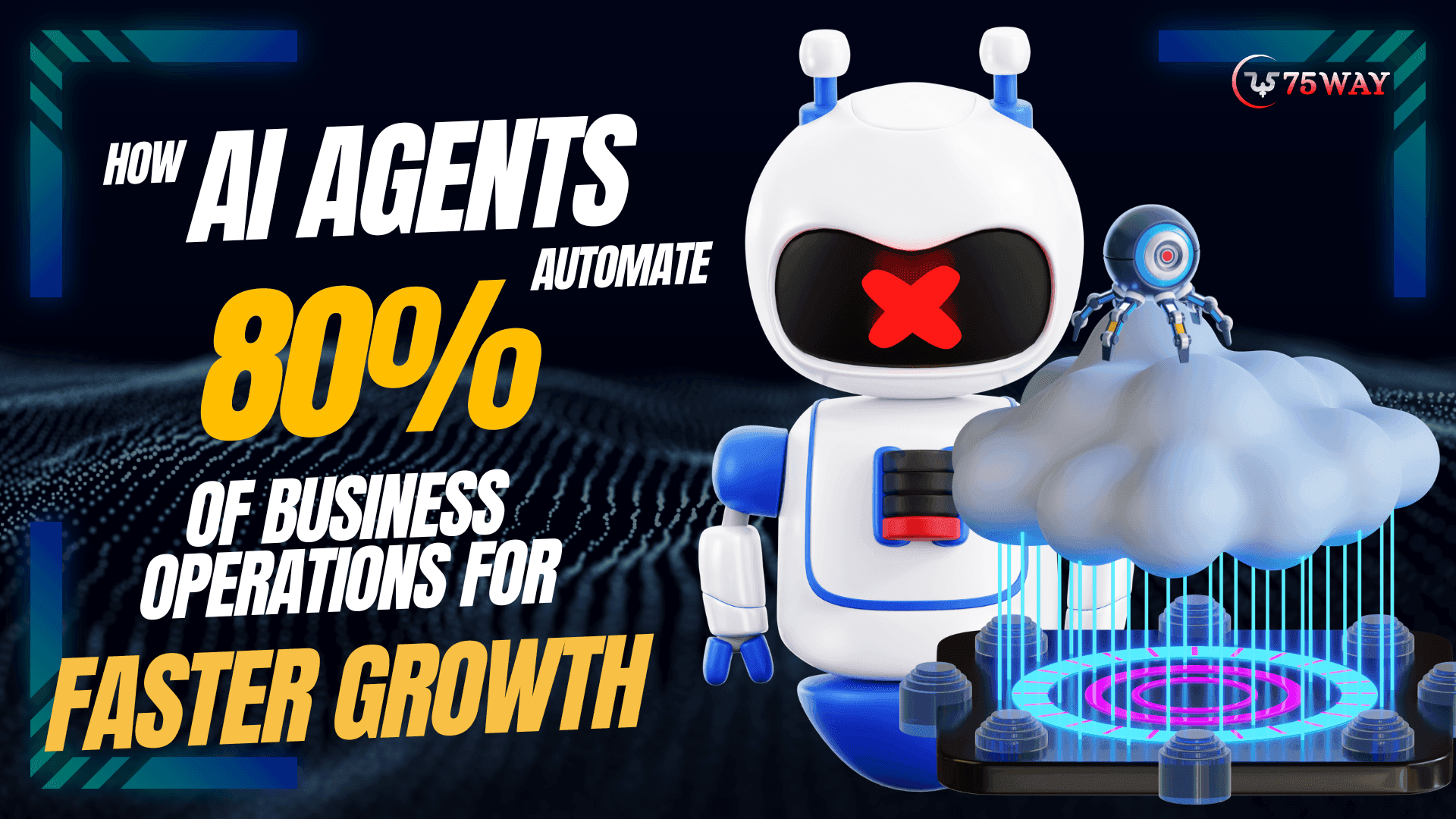
AI agents help businesses enhance operations by automating up to 80% of repetitive workflows. This guide explains how enterprises can use intelligent automation to reduce manual effort, improve decision speed, and scale faster. It covers real-world applications, architecture, and benefits of AI-driven systems that power modern business growth.
Quick Overview
- AI agents automate repetitive enterprise workflows at scale.
- Businesses reduce operational costs through intelligent automation systems.
- Decision-making becomes faster and more data-driven.
- Operational efficiency improves across departments.
- AI systems enable scalable, long-term business growth.
From managing data entry and handling customer queries to processing reports and coordinating workflows, a large portion of enterprise activity still depends on manual execution. However, research and enterprise observations indicate that nearly 80% of business operations involve repetitive, rule-based tasks that do not require complex human judgment. Yet these tasks consume time, resources, and decision bandwidth that could be used for growth.
This is where AI agent development solutions are fundamentally changing the way modern businesses operate.
Instead of simply automating isolated tasks, AI agents are designed to operate as intelligent digital systems that can understand context, make decisions, and execute actions across multiple tools and platforms. They don’t just assist workflows. They run them.
For founders, CTOs, and enterprise leaders, this shift is not incremental. It is structural. Businesses are moving from human-dependent operations to system-driven execution models where AI solutions handle the majority of operational workload. This blog explains how AI agents automate up to 80% of business operations, what systems enable this, and how enterprises are using them to achieve faster growth.
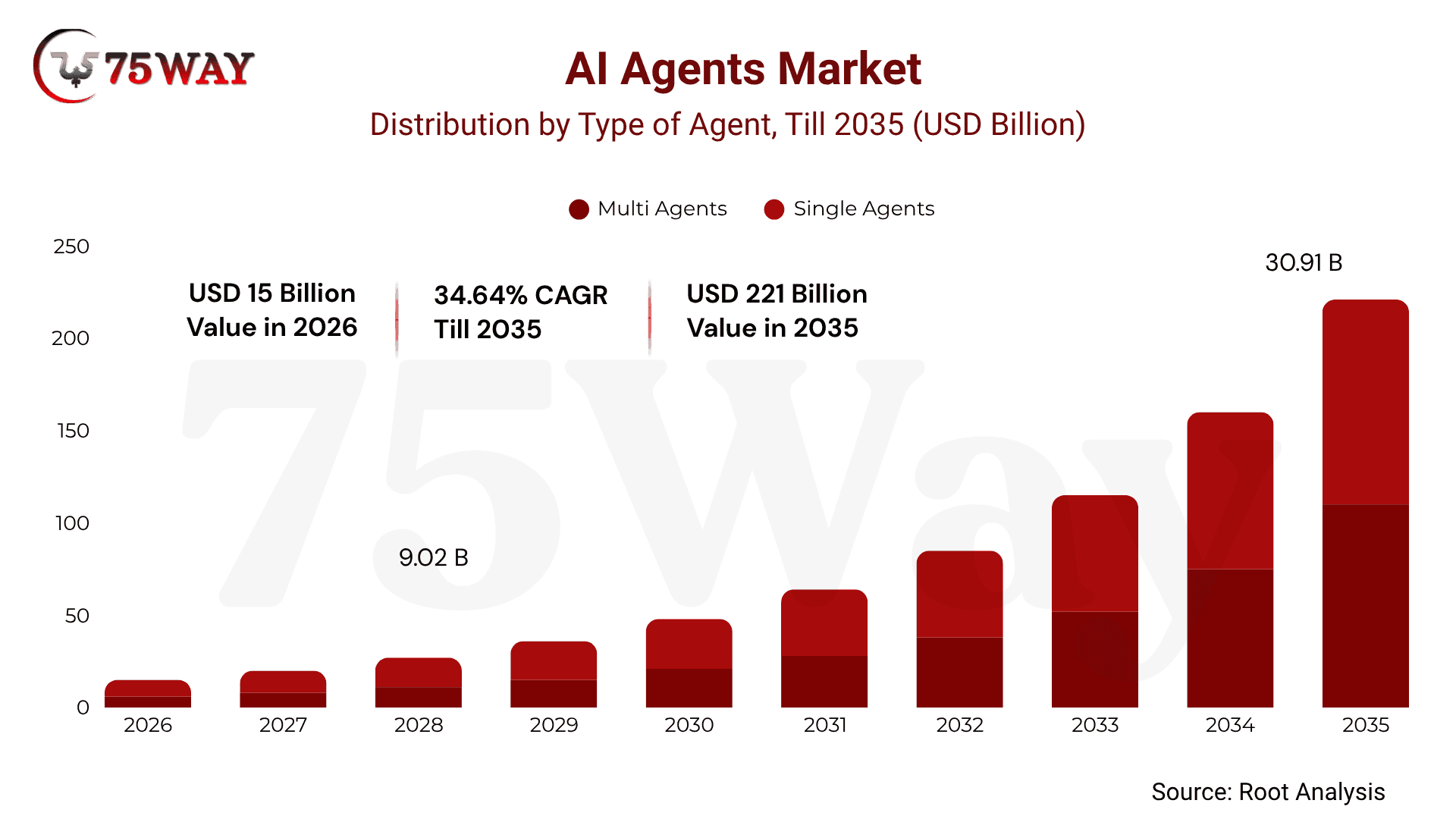
How AI Agents Automate 80% of Business Operations?
When we say AI agents automate 80% of business operations, it refers to the elimination of repetitive, structured, and rule-based tasks that traditionally require human involvement.
These include tasks such as:
- Data processing and reporting
- Customer support responses
- Workflow coordination
- Scheduling and reminders
- Lead qualification
- System updates
AI agents take over these responsibilities by continuously operating in the background, processing inputs, and executing actions without manual intervention.
This does not mean replacing human strategy or leadership. Instead, it means removing operational friction so teams can focus on high-value decisions, innovation, and growth.
Why Businesses Are Moving Toward AI Agent Automation?
Modern enterprises face three major challenges:
- Operational Overload: Teams spend too much time on repetitive tasks instead of strategic work.
- Scaling Complexity: As businesses grow, manual workflows become harder to manage efficiently.
- Decision Delays: Fragmented systems slow down access to insights and actions.
AI agents solve these challenges by creating a unified execution layer that automates repetitive processes and connects enterprise systems.
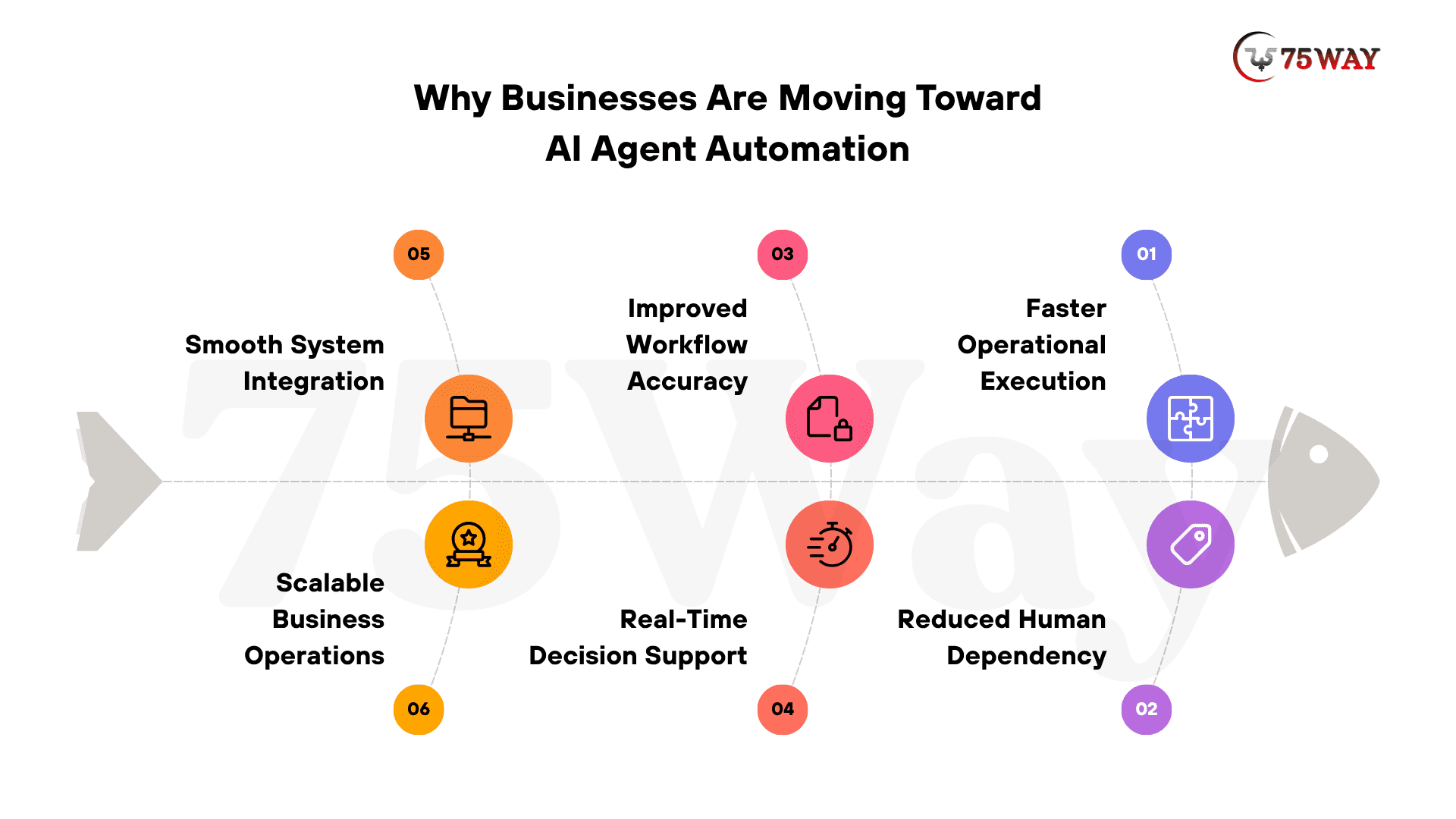
- Faster Operational Execution: AI agents reduce the time required to complete repetitive workflows by automating tasks across systems in real time. This allows businesses to execute daily operations faster without waiting for manual approvals or coordination between multiple teams.
- Reduced Human Dependency: Organizations are shifting toward AI agent automation to minimize reliance on large manual teams. Routine tasks like data entry, reporting, and follow-ups are handled automatically, allowing employees to focus on higher-value strategic responsibilities.
- Improved Workflow Accuracy: Manual processes often lead to errors due to fatigue or inconsistent execution. AI agents follow structured logic and data-driven rules, ensuring higher accuracy, consistency, and reliability across business operations and enterprise systems.
- Real-Time Decision Support: AI agents process and analyze data continuously, giving businesses instant insights instead of delayed reports. This helps leaders make faster, more informed decisions based on real-time operational and market conditions.
- Smooth System Integration: Modern enterprises use multiple disconnected tools, which slows down operations. AI agents integrate these systems into a unified workflow, enabling smooth communication between CRM, ERP, and other enterprise platforms.
- Scalable Business Operations: As companies grow, manual systems struggle to keep up with increasing workload. AI agent automation allows businesses to scale operations efficiently without proportional increases in workforce or infrastructure costs.
How AI Agents Work To Automate Business Operations?
AI agents operate through a continuous cycle of intelligence and execution, collecting data, understanding context, making decisions, executing actions, and continuously learning. This enables seamless automation of complex enterprise workflows at scale.
- Data Collection
Agentic AI solutions gather structured and unstructured information from CRM systems, emails, databases, APIs, and user interactions. This ensures AI agents always have real-time, relevant, and complete business data for accurate processing and decision-making across multiple enterprise environments.
- Context Understanding
Using advanced AI models, agents interpret collected data in a meaningful business context. They analyze relationships, patterns, and intent behind information to ensure every input is properly understood before moving toward decision-making or workflow execution stages.
- Decision Making
Based on predefined goals, learned behavior, and contextual understanding, AI agents evaluate multiple possible actions. They select the most effective response that aligns with business objectives, ensuring accurate, efficient, and optimized decision-making across enterprise operations and workflows.
- Action Execution
Building AI agents allows you to execute real-time tasks such as updating records, sending alerts, generating reports, or triggering automated workflows. This execution layer transforms insights into immediate operational actions without human intervention, significantly improving speed and consistency in business processes.
- Continuous Learning
AI agents continuously improve by analyzing outcomes, feedback, and performance results from previous actions. This learning loop helps refine accuracy, optimize decision-making, and adapt behavior over time, making the system more intelligent and efficient with each interaction.
Core Areas Where AI Agents Replace Manual Work
AI agents are not limited to one department. They operate across the entire enterprise.
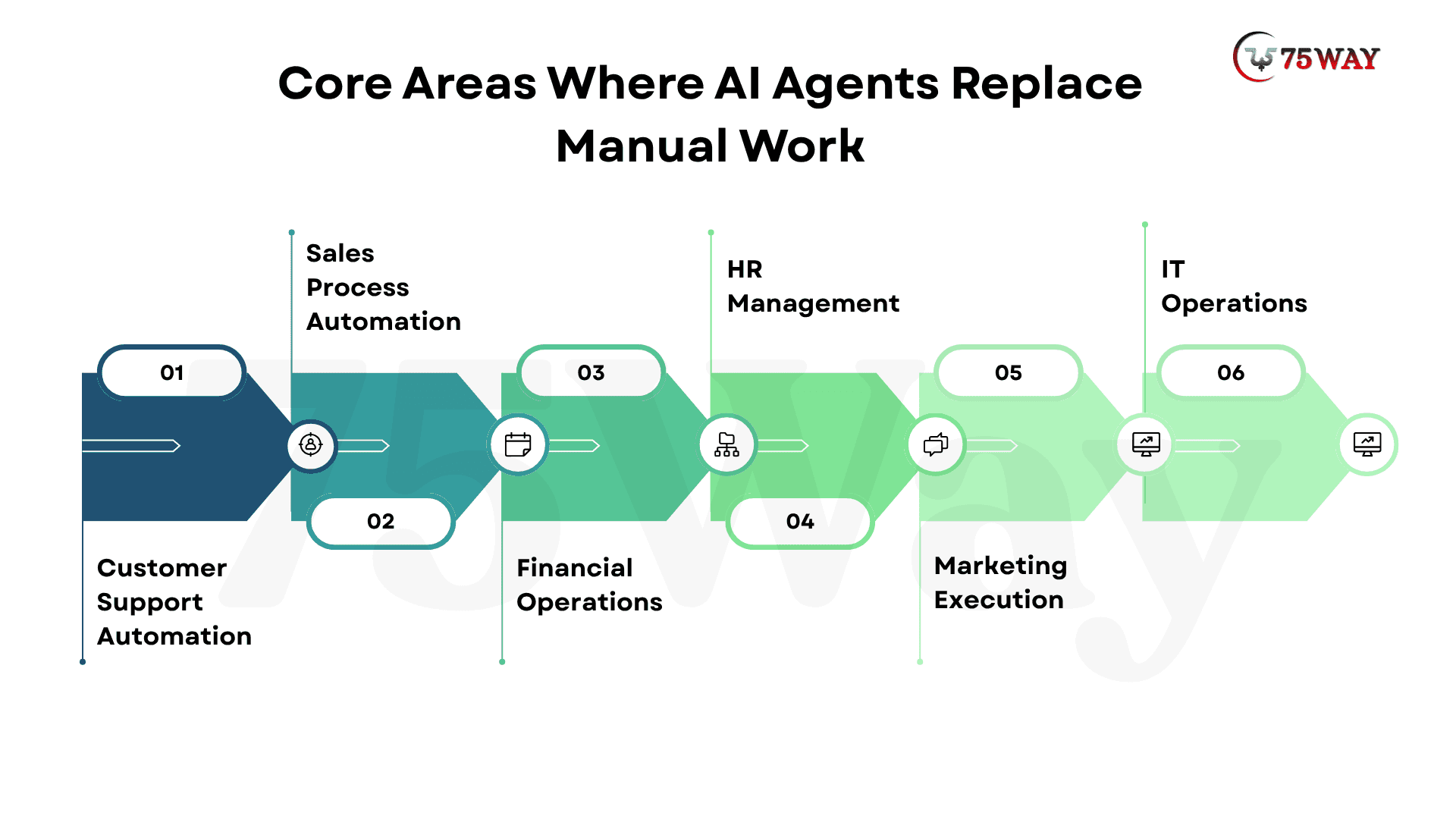
- Customer Support Automation: AI agents handle queries across chat, email, and voice systems instantly, reducing response time and improving service quality.
- Sales Process Automation: They manage lead tracking, follow-ups, and CRM updates, helping sales teams close deals faster.
- Financial Operations: AI agents generate reports, track transactions, and assist in forecasting with real-time accuracy.
- HR Management: They automate onboarding, document processing, and employee communication workflows.
- Marketing Execution: Campaigns, targeting, and performance tracking are managed through automated systems.
- IT Operations: System monitoring, alerts, and issue resolution are handled without manual intervention.
AI Agents Driving Faster and Smarter Business Expansion
The real value of AI agents is not just automation but accelerating business growth by improving speed, efficiency, and decision-making across all enterprise operations and workflows.
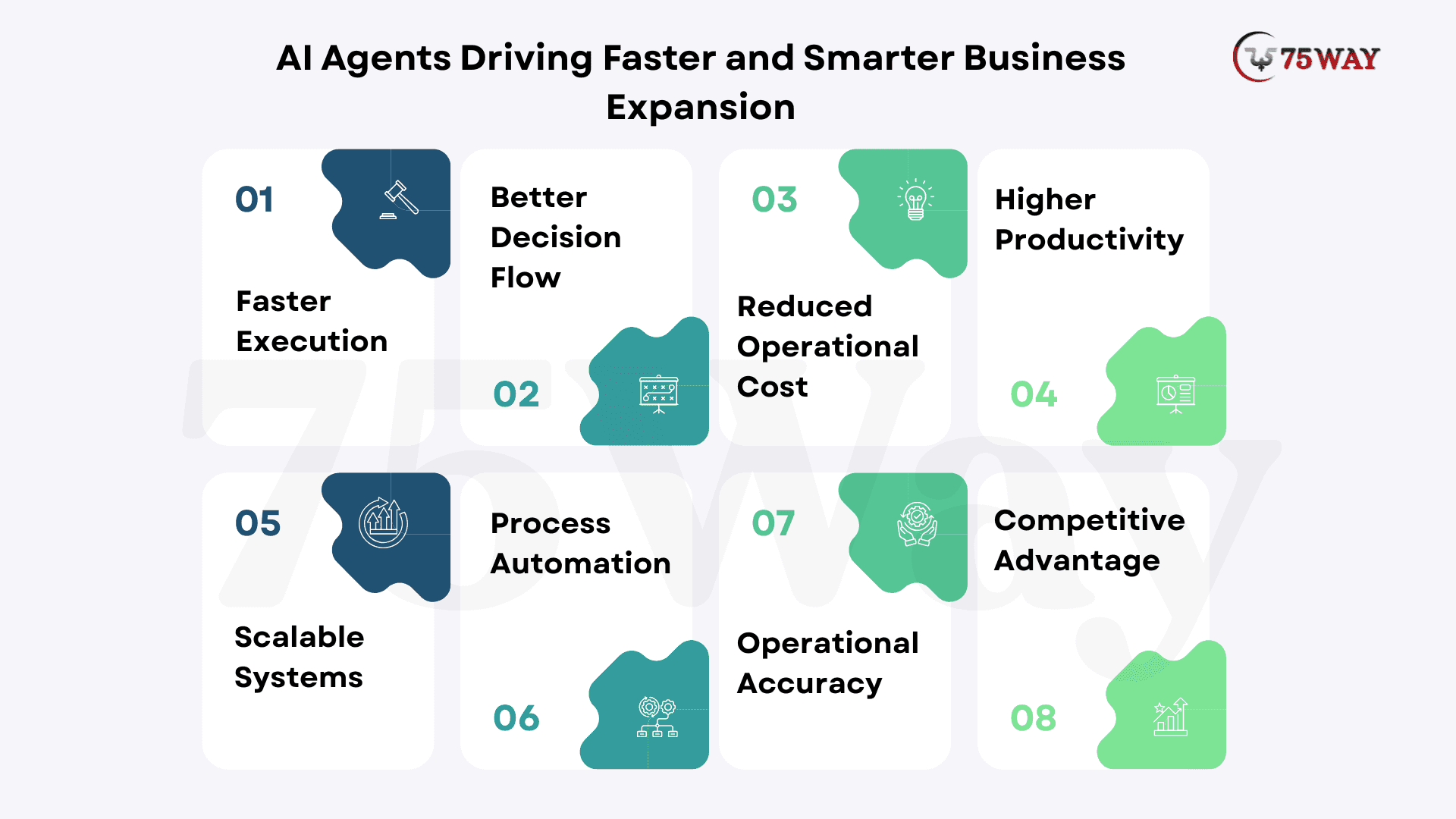
- Faster Execution
AI agents complete tasks in seconds that traditionally required hours or even days of manual effort. This dramatically improves operational speed and reduces business delays. As a result, teams can execute workflows continuously without waiting for human intervention.
- Better Decision Flow
Real-time data processing enables faster access to actionable insights across enterprise systems. AI agents eliminate delays caused by manual reporting and fragmented tools. This allows leaders to make quicker, more informed, and more confident business decisions consistently.
- Reduced Operational Cost
AI agents significantly reduce the need for large manual teams handling repetitive tasks. This lowers ongoing payroll and operational expenses for businesses. Over time, organizations achieve higher profitability while maintaining efficient and scalable business operations.
- Higher Productivity
Employees are freed from repetitive administrative work and can focus on strategic priorities. AI agents handle routine tasks automatically in the background. This shift improves overall workforce productivity and enhances the quality of business output.
- Scalable Systems
AI agent systems expand seamlessly as business operations grow without requiring proportional resource increases. They handle higher workloads efficiently without performance loss. This ensures businesses can scale operations rapidly while maintaining consistent system reliability and efficiency.
- Process Automation
Repetitive business workflows such as data entry, reporting, and communication are fully automated by AI agents. This reduces manual dependency and improves operational consistency. Businesses benefit from smoother execution and fewer human errors across processes.
- Operational Accuracy
AI agents minimize human errors by executing tasks based on structured logic and real-time data analysis. This improves accuracy in reporting, decision-making, and workflow execution. Businesses achieve more reliable outcomes across critical operational functions.
- Competitive Advantage
Businesses using AI agents respond faster to market changes and customer demands. This agility helps them outperform competitors relying on traditional systems. Faster execution and smarter operations create a strong, long-term competitive edge in dynamic markets.
Real Impact of AI Agent Automation in Enterprises
Organizations implementing AI agent automation experience a significant change in how daily operations are managed and executed. By automating repetitive, time-consuming tasks, enterprises can reduce operational workload across departments. This allows teams to focus more on strategic initiatives rather than on routine execution.
One of the most visible improvements is the speed and quality of customer interactions. AI agents enable faster response cycles by handling queries instantly across multiple channels. Alongside this, workflows become more consistent and structured, ensuring that processes are followed accurately without variation or dependency on manual coordination.
Over time, businesses also benefit from lower execution errors and stronger collaboration between teams. AI agents help synchronize information flow across systems, improving coordination and reducing miscommunication. The result is not just operational efficiency, but a complete transformation in how enterprises function and scale.
Challenges Businesses Must Address
Despite its benefits, AI agent adoption requires careful planning:
- Data security and governance
- Integration with legacy systems
- Model accuracy and reliability
- System monitoring requirements
- Infrastructure scaling costs
Enterprises that address these early achieve smoother adoption and better ROI.
The Next Phase of Autonomous Enterprise Systems
The future of AI agent-driven operations is moving steadily toward fully autonomous enterprise ecosystems where systems no longer wait for human instructions but continuously operate, optimize, and evolve on their own. Businesses are transitioning from reactive workflows to intelligent environments where processes run in the background with minimal intervention, improving both speed and reliability.
In this next phase, AI agents will collaborate across departments, share contextual intelligence, and execute decisions in real time based on predictive insights. Operational systems will become self-optimizing, automatically refining performance based on outcomes and feedback loops. This shift will fundamentally redefine enterprise scalability, enabling organizations to grow faster, operate smarter, and compete at a global level with higher efficiency.
Final Thoughts
AI agents are changing business operations by automating nearly 80% of repetitive workflows. This development goes beyond efficiency and focuses on improving how work is structured across enterprises. Companies are moving away from manual-heavy systems toward intelligent automation models that continuously operate and improve with data-driven execution. As market competition increases, organizations adopting AI agent automation gain advantages in speed, productivity, and responsiveness. This approach is becoming a core part of modern enterprise operations and long-term business growth strategy. Businesses looking to implement these systems can hire a trusted AI agent development company to build agentic AI solutions and launch ready-made AI agents.
Frequently Asked Questions (FAQs)
How Do AI Agents Handle Complex Multi-Step Workflows?
AI agents break complex workflows into smaller, logical actions, execute them step-by-step, and coordinate across systems via integrations. They maintain context throughout the process, ensuring each step is completed accurately before moving to the next stage.
What Infrastructure Is Required To Deploy AI Agent Systems?
Deployment typically requires cloud-based infrastructure, API connectivity, secure data storage, and integration with enterprise tools. Most modern systems are built to work with existing tech stacks without requiring full infrastructure replacement.
Can AI Agents Operate Across Different Departments Simultaneously?
Yes, AI agents are designed to function across multiple departments at the same time. They can manage sales, operations, HR, and support workflows concurrently by interacting with different systems through unified logic layers.
How Do AI Agents Maintain Accuracy In Business Operations?
Accuracy is maintained through structured logic models, continuous feedback loops, and validation checkpoints. AI agents refine their outputs over time by learning from past actions and correcting deviations in workflow execution.
What Level Of Customization Is Possible In AI Agent Systems?
AI agent systems can be highly customized based on business rules, workflows, data sources, and operational goals. Enterprises can define how agents behave, what actions they perform, and how they integrate with internal tools.
How Do AI Agents Impact Employee Roles In Organizations?
AI agents reduce workload related to repetitive tasks, allowing employees to focus on analysis, strategy, and decision-making. This leads to role enhancement rather than replacement, improving overall workforce productivity.