AI Summary
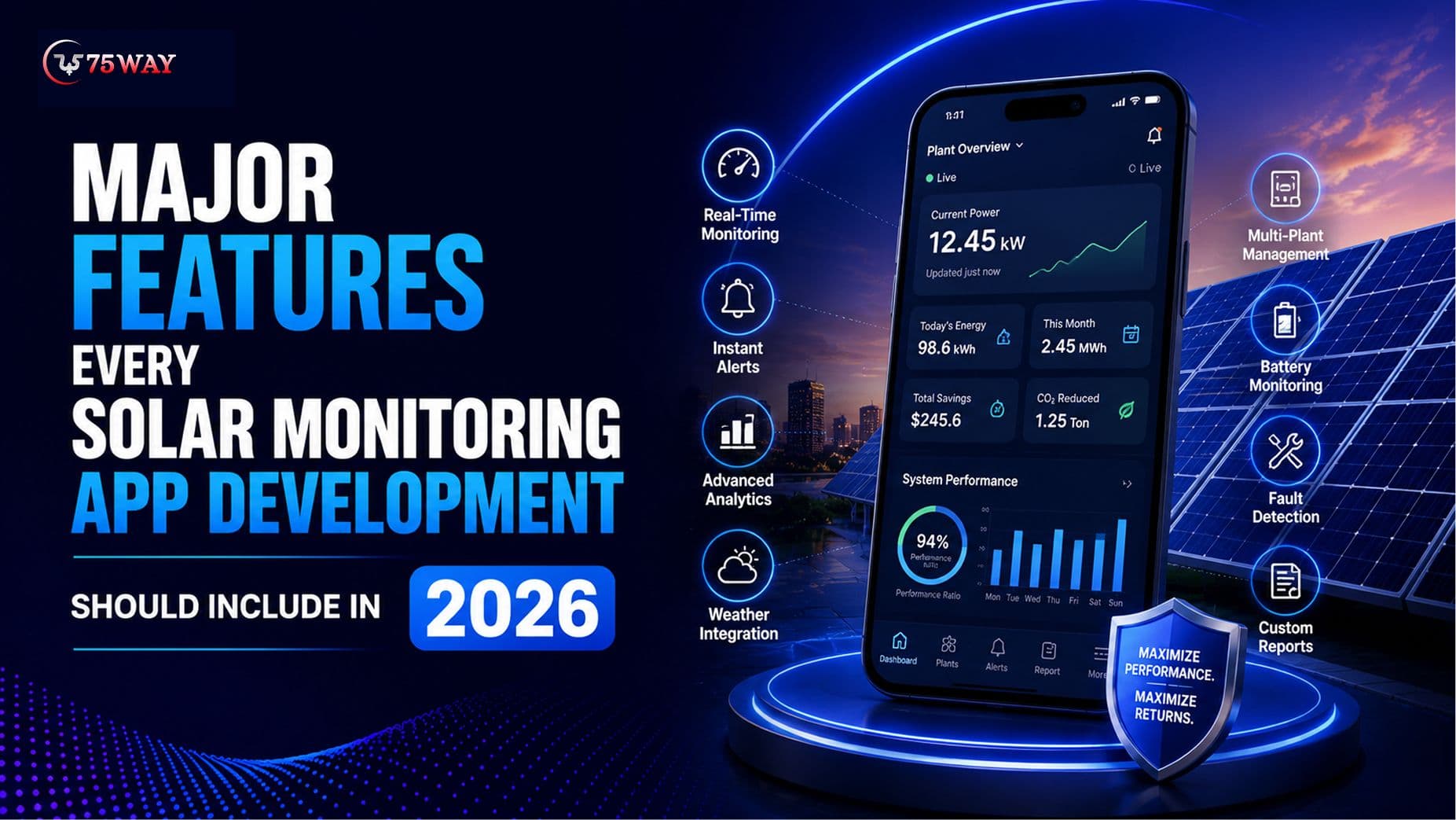
Modern solar monitoring apps do far more than display energy production. This guide explores must-have features, AI innovations, and practical capabilities businesses should prioritize to build intelligent, scalable, and future-ready solar monitoring applications that maximize operational efficiency.
Key Takeaways
- Real-time insights improve solar system operational efficiency.
- AI transforms monitoring into intelligent decision-making platforms.
- Predictive analytics reduce equipment failures and maintenance costs.
- User-focused features increase engagement and long-term platform adoption.
- Scalable architecture supports future renewable energy innovations.
“We are like tenant farmers chopping down the fence around our house for fuel when we should be using nature's inexhaustible sources of energy.” — Thomas A. Edison
More than a century later, that idea has become reality as solar energy powers homes, businesses, and industries worldwide. However, generating clean energy is only part of the equation. Owners also expect to monitor production, detect faults instantly, track savings, and optimise system performance from a single mobile app.
Businesses planning to build a solar monitoring app in 2026 must focus on more than attractive dashboards. The right feature set determines how effectively users can monitor energy generation, receive maintenance alerts, analyse system performance, and manage multiple solar installations without unnecessary complexity.
That is why modern solar monitoring mobile apps have evolved far beyond displaying basic energy data. The features below define how users monitor solar assets, receive real-time insights, manage system health, and maximise energy efficiency in 2026.
Why Modern Solar Monitoring Apps Need Smarter Features?
Energy production isn't enough anymore. Solar system owners want to know why output changes, how to improve efficiency, and when something needs attention. That's why modern solar monitoring apps are evolving from simple dashboards into intelligent energy management platforms. Smarter features help users reduce energy waste, maximize savings, and make better decisions without constantly monitoring the system themselves.
A basic app can display numbers, but numbers alone don't solve problems. Users expect real-time alerts, AI-powered insights, predictive maintenance, weather-based forecasts, and personalized recommendations that explain what's happening and what to do next. The goal is no longer just monitoring energy generation; it's optimizing every kilowatt produced.
Think about it for a moment. If your solar panels stop performing at their best, would you rather discover the issue after receiving a high electricity bill or get notified before it affects your savings?
That's the difference smarter features make. They transform a passive monitoring app into a proactive energy assistant that helps users protect their investment and get the most from their solar system every single day.
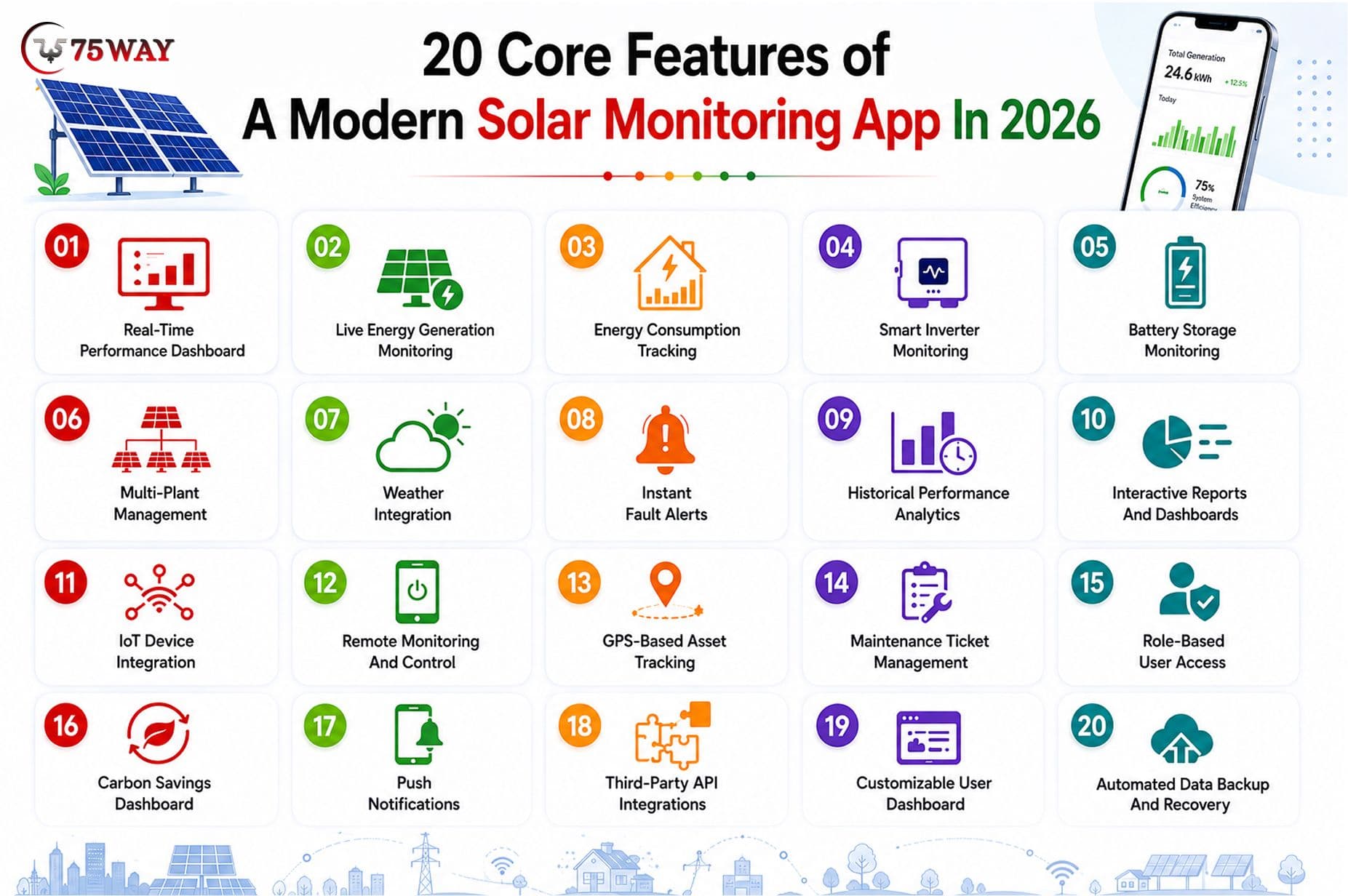
20 Core Features of A Modern Solar Monitoring App In 2026
A solar monitoring app is only as valuable as the features it offers to its users. The 20 features below help businesses deliver accurate performance tracking, proactive maintenance, and a better overall experience for residential and commercial solar system owners.
1. Real-Time Performance Dashboard
Picture starting your morning only to discover your largest solar plant lost energy production overnight. The frustrating part? Nobody noticed until the daily report arrived. By then, valuable energy and revenue were already gone.
A real-time performance dashboard eliminates those blind spots. Instead of waiting for reports, it gives operators an instant snapshot of every panel, inverter, and connected device. The moment something changes, the dashboard highlights it, allowing teams to investigate issues before they affect overall system performance.
Key Capabilities
- Displays live performance across every connected solar asset.
- Highlights underperforming equipment with visual status indicators.
- Shows critical metrics through intuitive interactive dashboards.
- Supports customized views for different business teams.
- Refreshes operational data without manual system updates.
- Simplifies complex energy insights for faster decisions.
2. Live Energy Generation Monitoring
Solar production rarely stays the same throughout the day. Passing clouds, rising temperatures, equipment issues, or unexpected shading can reduce energy output within minutes. Without continuous monitoring, those small losses often remain unnoticed until they become expensive.
Live energy generation monitoring keeps users connected to their systems every second. Instead of guessing whether a solar plant is performing efficiently, operators can compare current output with expected production and immediately recognize when something needs attention.
Key Capabilities
- Tracks electricity generation with continuous live system updates.
- Compares actual output against projected energy production.
- Detects unexpected generation drops before significant losses.
- Visualizes production trends using interactive performance graphs.
- Supports monitoring across distributed solar installations simultaneously.
- Improves operational visibility through real-time energy insights.
3. Energy Consumption Tracking
Generating solar power is only half the story. The bigger question is where that energy actually goes. Many businesses produce enough electricity but still face higher utility bills because they cannot clearly see when and where energy is being consumed.
Energy consumption tracking bridges that gap by comparing production with usage in real time. Instead of relying on assumptions, users gain actionable insights that help reduce waste, optimise consumption patterns, and maximise every kilowatt their solar system generates.
Key Capabilities
- Tracks electricity usage across connected energy systems.
- Compares consumption with real-time solar energy production.
- Identifies unnecessary energy waste during peak periods.
- Displays hourly, daily, and monthly usage analytics clearly.
- Supports informed energy-saving decisions through accurate insights.
- Improves operational efficiency with detailed consumption reports.
4. Smart Inverter Monitoring
An inverter is the heart of every solar power system. When it underperforms, energy production quietly declines, often without obvious warning signs. Waiting until a complete failure occurs can result in unnecessary downtime and expensive repairs.
Smart inverter monitoring continuously evaluates inverter performance, efficiency, operating temperature, and fault conditions. Instead of reacting after problems occur, operators receive timely insights that help maintain peak system performance and extend equipment lifespan.
Key Capabilities
- Monitors inverter health through continuous performance tracking.
- Detects overheating before equipment performance significantly declines.
- Reports fault codes with actionable maintenance recommendations.
- Measures conversion efficiency across multiple connected inverters.
- Sends instant alerts for abnormal operational behaviour.
- Supports preventive maintenance through continuous health monitoring.
5. Battery Storage Monitoring
Solar energy doesn't stop being valuable when the sun goes down. Batteries ensure that excess power remains available whenever it's needed, but only if they operate efficiently. Without proper monitoring, declining battery health can reduce backup capacity and overall system reliability.
Battery storage monitoring gives users complete visibility into charging cycles, discharge rates, remaining capacity, and long-term battery health. These insights help businesses maximise storage efficiency while planning maintenance or replacements before performance begins affecting operations.
Key Capabilities
- Tracks charging and discharging cycles continuously.
- Displays battery health with accurate performance indicators.
- Monitors remaining storage capacity in real time.
- Detects abnormal battery behaviour before critical failures.
- Supports efficient energy storage and power distribution.
- Extends battery lifespan through proactive health monitoring.
6. Multi-Plant Management
Managing one solar installation is straightforward. Managing dozens across different cities or states quickly becomes overwhelming without a unified platform. Switching between separate dashboards wastes valuable time and makes identifying operational issues much harder.
Multi-plant management centralises every solar installation into a single interface. Operators can compare site performance, monitor equipment health, and oversee energy production across all locations without juggling multiple monitoring systems.
Key Capabilities
- Manages multiple solar plants from one dashboard.
- Compares site performance using unified operational metrics.
- Monitors distributed assets through centralized system controls.
- Simplifies reporting across geographically separated installations.
- Supports scalable operations for growing solar businesses.
- Improves management efficiency with consolidated monitoring insights.
7. Weather Integration
The weather influences solar production every single day. Cloud cover, temperature, rainfall, dust, and wind all affect how efficiently panels generate electricity. Ignoring these conditions often leads to inaccurate performance expectations and delayed operational decisions.
Weather integration combines live environmental data with system performance to explain production changes more accurately. This helps operators distinguish between weather-related fluctuations and genuine equipment issues, leading to faster and more informed decision-making.
Key Capabilities
- Integrates live weather with solar performance analytics.
- Predicts generation changes using environmental conditions accurately.
- Correlates weather events with energy production trends.
- Supports proactive operational planning during changing conditions.
- Improves forecasting through location-specific weather intelligence.
- Helps distinguish faults from normal weather impacts.
8. Instant Fault Alerts
Not every equipment issue causes an immediate shutdown. Many faults begin as minor performance irregularities that gradually reduce energy production over time. Detecting those problems early can prevent expensive repairs and prolonged operational losses.
Instant fault alerts notify operators the moment abnormal behaviour is detected. Whether it's an inverter malfunction, communication failure, or unexpected production drop, teams can investigate immediately instead of waiting for scheduled inspections.
Key Capabilities
- Detects equipment abnormalities through continuous system monitoring.
- Sends instant notifications when faults are identified.
- Prioritises critical issues requiring immediate operational attention.
- Reduces downtime through faster maintenance response times.
- Supports alerts across mobile and desktop platforms.
- Improves reliability with proactive fault management systems.
9. Historical Performance Analytics
One bad day doesn't reveal much, but months of performance data can uncover trends that would otherwise go unnoticed. A gradual decline in energy generation, for example, often signals maintenance issues long before equipment fails.
Historical performance analytics transforms past data into meaningful insights. Users can compare production across days, seasons, or years, helping them identify recurring patterns, evaluate system efficiency, and make smarter operational decisions.
Key Capabilities
- Compares historical energy production across custom timeframes.
- Identifies long-term performance trends through visual analytics.
- Detects recurring operational issues before major failures.
- Supports data-driven maintenance planning with historical insights.
- Benchmarks current efficiency against previous system performance.
- Generates detailed reports for long-term performance evaluation.
10. Interactive Reports And Dashboards
Different stakeholders need different information. Plant managers monitor operational efficiency, executives focus on return on investment, while maintenance teams look for equipment health. A single static report cannot meet every requirement.
Interactive reporting allows users to customize dashboards, filter important metrics, and generate reports tailored to their responsibilities. Instead of searching through unnecessary information, everyone sees the data that matters most.
Key Capabilities
- Creates customizable reports for diverse business requirements.
- Visualizes complex energy data through interactive dashboards.
- Filters performance metrics using flexible reporting options.
- Exports reports into multiple business-friendly file formats.
- Supports executive summaries with visual operational insights.
- Simplifies decision-making through personalized reporting experiences.
11. IoT Device Integration
A solar monitoring app becomes significantly more valuable when it communicates with every connected device. Instead of operating independently, sensors, meters, inverters, and batteries work together to provide a complete operational picture.
IoT integration connects the entire solar ecosystem into one intelligent platform. This seamless communication improves monitoring accuracy, automates data collection, and eliminates the need for manual system updates.
Key Capabilities
- Connects sensors with centralized monitoring infrastructure.
- Integrates smart devices through secure communication protocols.
- Synchronizes operational data across connected energy equipment.
- Supports scalable Internet of Things device ecosystems.
- Automates device communication without manual user intervention.
- Improves monitoring accuracy through connected system intelligence.
12. Remote Monitoring And Control
Imagine receiving an alert while traveling and resolving the issue without visiting the site. Modern businesses expect that level of flexibility because every unnecessary trip increases operational costs and delays maintenance.
Remote monitoring and control allow operators to access plant performance, review equipment status, and manage selected system functions from anywhere. This capability improves response times while reducing field visits.
Key Capabilities
- Monitors solar systems from virtually any location.
- Provides secure remote access through cloud connectivity.
- Controls supported equipment using centralized management tools.
- Reduces unnecessary onsite maintenance visits significantly.
- Improves response times during unexpected operational incidents.
- Supports continuous monitoring across distributed solar installations.
13. GPS-Based Asset Tracking
Large commercial and utility-scale solar projects often include thousands of distributed assets. Locating specific panels, inverters, or equipment manually can waste valuable maintenance time, especially across expansive sites.
GPS-based asset tracking maps every critical component within the monitoring platform. Maintenance teams can locate equipment quickly, streamline inspections, and reduce delays during repair activities.
Key Capabilities
- Maps solar assets using precise GPS locations.
- Locates equipment quickly during maintenance activities.
- Improves field operations through intelligent asset mapping.
- Supports distributed solar installations across multiple locations.
- Reduces maintenance delays using location-based equipment tracking.
- Simplifies large-scale solar asset management significantly.
14. Maintenance Ticket Management
A problem detection in a solar panel is only the beginning. Without a structured maintenance workflow, faults may remain unresolved for days, causing unnecessary downtime and reducing energy production.
A built-in maintenance ticket system transforms alerts into actionable tasks. Teams can assign responsibilities, monitor repair progress, and maintain complete service records without relying on disconnected communication tools.
Key Capabilities
- Creates maintenance tickets directly from detected system alerts.
- Assigns repair tasks to responsible maintenance teams.
- Tracks service progress through centralized workflow management.
- Maintains detailed maintenance history for every asset.
- Improves collaboration between operations and field technicians.
- Reduces equipment downtime through organized repair processes.
15. Role-Based User Access
Every user interacts with a solar monitoring platform differently. While executives review business performance, technicians require equipment diagnostics, and customers simply want to view energy generation.
Role-based access ensures every user sees only the information relevant to their responsibilities. This improves security, simplifies navigation, and prevents unauthorized access to sensitive operational data.
Key Capabilities
- Assigns permissions based on organizational user responsibilities.
- Protects sensitive operational information through secure access.
- Creates customized dashboards for different user roles.
- Restricts unauthorized system modifications using permissions controls.
- Improves platform security across multiple business teams.
- Simplifies navigation through personalized user experiences.
16. Carbon Savings Dashboard
Solar investments deliver more than financial returns. They also contribute to sustainability goals. Businesses increasingly need measurable environmental data to support ESG initiatives and demonstrate their commitment to renewable energy.
A carbon savings dashboard converts energy generation into meaningful environmental metrics. Users can visualize carbon emissions avoided, sustainability achievements, and long-term environmental impact through easy-to-understand reports.
Key Capabilities
- Calculates avoided carbon emissions using production data.
- Displays sustainability achievements through visual environmental metrics.
- Supports ESG reporting with measurable environmental insights.
- Tracks long-term renewable energy environmental contributions accurately.
- Generates sustainability reports for business stakeholders automatically.
- Demonstrates measurable environmental impact using interactive dashboards.
17. Push Notifications
No one wants to monitor a dashboard all day waiting for something to happen. Critical updates should reach users instantly, whether they're managing one installation or an entire network of solar plants.
Push notifications keep operators informed about equipment faults, maintenance reminders, production changes, and operational milestones. Timely communication allows faster action and prevents small issues from escalating.
Key Capabilities
- Delivers instant alerts for critical operational events.
- Notifies users about scheduled maintenance requirements promptly.
- Sends performance updates through mobile push notifications.
- Supports customizable notification preferences for different users.
- Improves operational awareness with real-time communication tools.
- Reduces response delays during unexpected system incidents.
18. Third-Party API Integrations
Solar businesses rarely operate with standalone software. Customer management, billing, analytics, and enterprise systems all need access to operational data for efficient business processes.
Third-party API integrations enable the monitoring platform to securely exchange information with external applications. This improves automation, reduces manual data entry, and creates a connected digital ecosystem.
Key Capabilities
- Connects external platforms using secure application interfaces.
- Synchronizes operational data across integrated business systems.
- Supports CRM, ERP, and analytics software integration.
- Automates workflows through connected software ecosystems.
- Reduces manual data duplication across multiple platforms.
- Enhances scalability using flexible integration capabilities.
19. Customizable User Dashboard
No two users analyze solar data the same way. A maintenance engineer prioritizes equipment health, while a business owner focuses on energy savings and return on investment. Showing everyone the same dashboard often creates unnecessary clutter.
A customizable dashboard allows users to arrange widgets, prioritize metrics, and personalize their workspace. This flexibility improves productivity because every stakeholder immediately sees the information most relevant to their daily responsibilities.
Key Capabilities
- Personalizes dashboards based on individual user preferences.
- Rearranges widgets for improved workflow efficiency daily.
- Highlights important metrics using customizable display options.
- Supports multiple dashboard layouts across different teams.
- Simplifies navigation with personalized operational workspaces.
- Enhances productivity through user-specific dashboard experiences.
20. Automated Data Backup And Recovery
Solar monitoring platforms collect years of operational data that support reporting, maintenance, compliance, and performance optimization. Losing that information because of hardware failure or cyber threats can disrupt business operations and decision-making.
Automated backup and recovery protect valuable system data without requiring manual intervention. If unexpected issues occur, businesses can quickly restore critical information and continue operations with minimal disruption.
Key Capabilities
- Automatically backs up critical operational system information daily.
- Restores lost data through secure recovery processes.
- Protects historical records from unexpected system failures.
- Supports cloud-based backup for improved business continuity.
- Reduces operational risks using automated recovery mechanisms.
- Safeguards valuable energy data against cyber threats.
Quick Read:Key Benefits of Solar Monitoring Apps In 2026: Why Businesses Are Investing
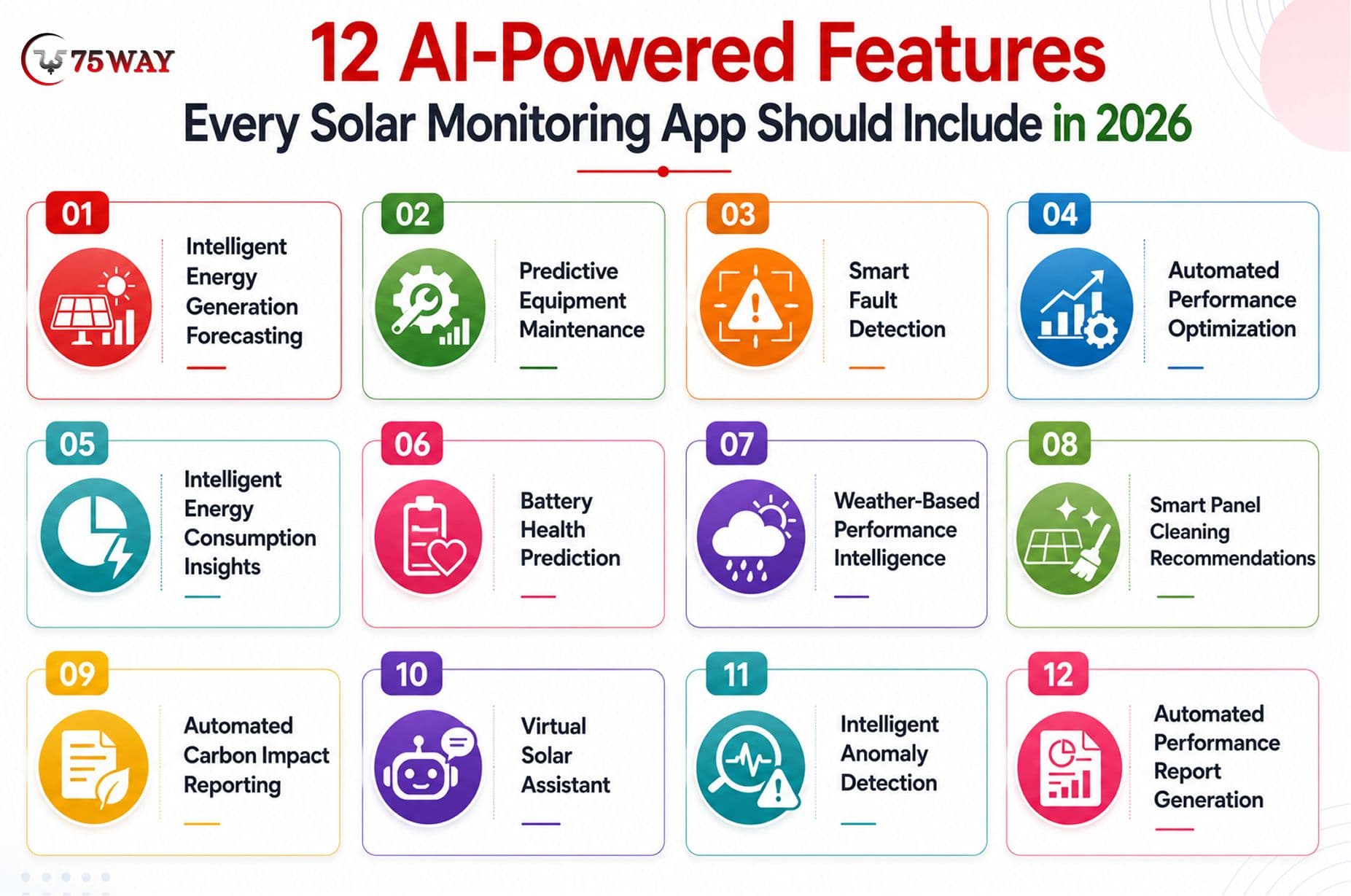
12 AI-Powered Features Required To Create Solar Panel Monitoring
A modern solar monitoring app delivers greater value when AI works behind the scenes to analyse performance, predict faults, and automate routine monitoring tasks. The following AI-powered features define what users and businesses expect from solar applications in 2026.
1. Intelligent Energy Generation Forecasting
Solar production changes throughout the day, but businesses shouldn't have to rely on estimates alone. Intelligent forecasting combines historical production, weather conditions, and seasonal trends to predict future energy generation, helping operators plan resources and make more informed business decisions.
2. Predictive Equipment Maintenance
Maintenance works best when it's planned, not rushed. By recognizing subtle signs of wear before equipment fails, predictive maintenance reduces unexpected downtime, lowers repair costs, and extends the lifespan of valuable solar assets.
3. Smart Fault Detection
Some system issues develop gradually and remain hidden for weeks. Smart fault detection continuously analyzes equipment behavior, identifies unusual performance patterns, and alerts operators before minor irregularities become major operational problems.
4. Automated Performance Optimization
Even high-performing solar plants have room for improvement. Automated optimization evaluates operational data continuously and recommends adjustments that increase efficiency, reduce energy losses, and maximize overall system output.
5. Intelligent Energy Consumption Insights
Producing renewable energy is only part of the equation. Intelligent consumption analysis identifies how, when, and where electricity is being used, enabling businesses to reduce waste and improve overall energy efficiency.
6. Battery Health Prediction
Battery performance naturally declines over time, but unexpected failures don't have to. Advanced analytics monitor charging behavior, temperature, and usage patterns to predict battery health and recommend maintenance before performance deteriorates.
7. Weather-Based Performance Intelligence
Changing weather doesn't always tell the full story behind fluctuating energy production. Intelligent weather analysis distinguishes environmental impacts from equipment-related issues, giving operators greater confidence when evaluating system performance.
8. Smart Panel Cleaning Recommendations
Solar panels lose efficiency as dirt, dust, and debris accumulate. Instead of following fixed cleaning schedules, intelligent recommendations identify the ideal cleaning time based on environmental conditions and actual performance trends.
9. Automated Carbon Impact Reporting
Sustainability reporting has become an important business priority. Automated carbon reporting calculates emissions reductions, renewable energy contributions, and environmental impact instantly, simplifying ESG reporting for organizations of every size.
10. Virtual Solar Assistant
Searching through dashboards for answers wastes valuable time. A virtual assistant allows users to ask natural questions about production, equipment health, or system performance and receive clear, data-driven answers within seconds.
11. Intelligent Anomaly Detection
Not every operational issue triggers a fault alarm immediately. Intelligent anomaly detection learns normal equipment behavior, recognizes unexpected deviations, and helps operators investigate hidden performance issues before they affect energy generation.
12. Automated Performance Report Generation
Creating monthly performance reports manually can consume hours of valuable work. Automated reporting transforms operational data into professional summaries with production trends, maintenance insights, and actionable recommendations, allowing teams to focus on improving system performance rather than preparing spreadsheets.
How To Prioritize Features For An MVP Vs. Enterprise Solar Monitoring App
Not every solar monitoring app needs every feature on day one. Startups often succeed by launching an MVP that solves a few critical problems exceptionally well, while enterprise platforms require advanced capabilities to manage large-scale operations. Prioritizing features based on your business goals helps reduce development costs, accelerate time to market, and create a scalable product roadmap.
Think about your users before adding new functionality. A homeowner usually wants real-time energy tracking, performance alerts, and simple reports. A utility provider or commercial solar operator, however, may need fleet management, AI-powered analytics, predictive maintenance, role-based access, and integration with multiple systems. Building everything upfront only increases costs and delays your launch without guaranteeing better adoption.
The smartest approach is to solve today's problems while preparing for tomorrow's growth. Launch with features that deliver immediate value, gather feedback from real users, and expand the platform based on actual demand instead of assumptions. This strategy helps you validate your product faster, improve user satisfaction, and invest development resources where they generate the greatest return.
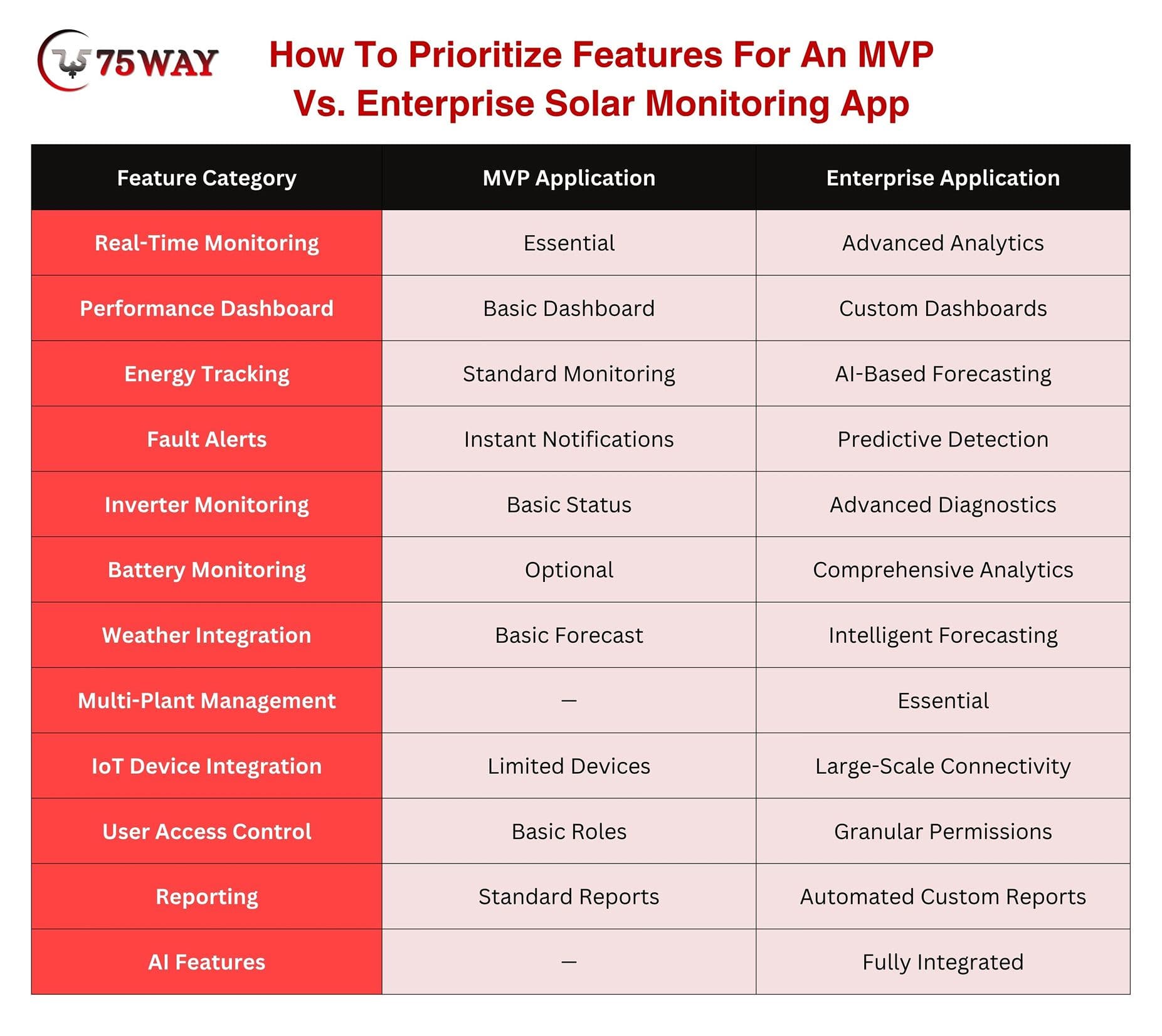
The selection of an accurate feature set isn't about adding every capability at once. It's about delivering immediate value while leaving room for future innovation. A phased development approach enables businesses to launch faster, validate user needs, and introduce advanced functionality as their customer base and operational requirements evolve.
Conclusion
The future of solar monitoring belongs to platforms that do more than display data. They deliver intelligence. By combining real-time monitoring, IoT connectivity, predictive analytics, and AI-powered automation, businesses can improve system performance, reduce operational costs, and create exceptional user experiences.
Whether you're launching a new platform or upgrading an existing solution, choosing the right features today will determine your competitive advantage tomorrow. Partner with a trusted solar monitoring app development company to build an innovative, scalable, and AI-powered solution that keeps your business ahead in the evolving clean energy landscape.
Frequently Asked Questions (FAQs)
Can A Solar Monitoring App Work With Existing Solar Installations?
Yes, most applications can integrate with existing solar systems using compatible inverters, IoT devices, and communication protocols. Integration requirements depend on the installed hardware and software ecosystem.
How Frequently Should A Solar Monitoring App Refresh System Data?
The ideal refresh interval depends on operational requirements and network connectivity. Most modern applications provide updates every few seconds or minutes for accurate performance monitoring.
Can Solar Monitoring Apps Support Both Residential And Commercial Projects?
Yes, a well-designed platform can manage residential rooftops, commercial facilities, and utility-scale solar farms. Scalable architecture allows businesses to support different project sizes through one application.
How Do Push Notifications Improve Solar Plant Operations?
Push notifications instantly alert operators about equipment faults, maintenance reminders, and production changes. Faster responses help minimize downtime and improve overall system reliability.
Can Users Access A Solar Monitoring App From Multiple Devices?
Yes, cloud-based applications allow secure access from smartphones, tablets, laptops, and desktop computers. User progress and operational data remain synchronized across supported devices.
Why Is Cloud Infrastructure Important For Solar Monitoring Apps?
Cloud infrastructure enables real-time data synchronization, secure storage, and scalable system performance. It also simplifies remote monitoring, software updates, and long-term business growth.