AI Summary
Building a solar monitoring app requires the right technology and strategy. This guide covers essential features, AI integration, technology stacks, development costs, and security. It also explores monetization strategies and future trends for building scalable, reliable solar monitoring applications.
Quick Overview
- The global solar AI market is projected to reach $18.43 billion by 2030
- AI solar monitoring app development requires strategic planning, scalable architecture
- Real-time monitoring improves solar performance through continuous system visibility.
- AI-powered analytics predict equipment issues before failures impact energy production.
- IoT connectivity captures real-time data from inverters, sensors, batteries, and smart meters.
- The cost of building a solar panel monitoring app ranges from $30,000 to $250,000+.
Did you know that the global solar panel market size is valued at approximately $407.0 billion in 2026 and is expected to surpass $830 billion by 2033; however, installing solar panels is only the first step. The real value comes from knowing how your system performs every day.
That is why solar monitoring apps have become a significant part of modern solar energy systems. Whether you are a homeowner tracking daily power generation or a business managing hundreds of installations, these apps provide real-time insights, automated alerts, performance analytics, and AI-powered predictions from a single dashboard.
But building a reliable solar panel monitoring app involves much more than creating graphs and dashboards. The process of building a mobile app for monitoring solar panels requires IoT and AI integration, secure cloud infrastructure, real-time data processing, and an intuitive user experience.
In this guide, we will walk you through everything you need to know about building a scalable solar monitoring app in 2026, from features and technology stack to development process, costs, and future trends.
Solar Monitoring App Market Size & Growth
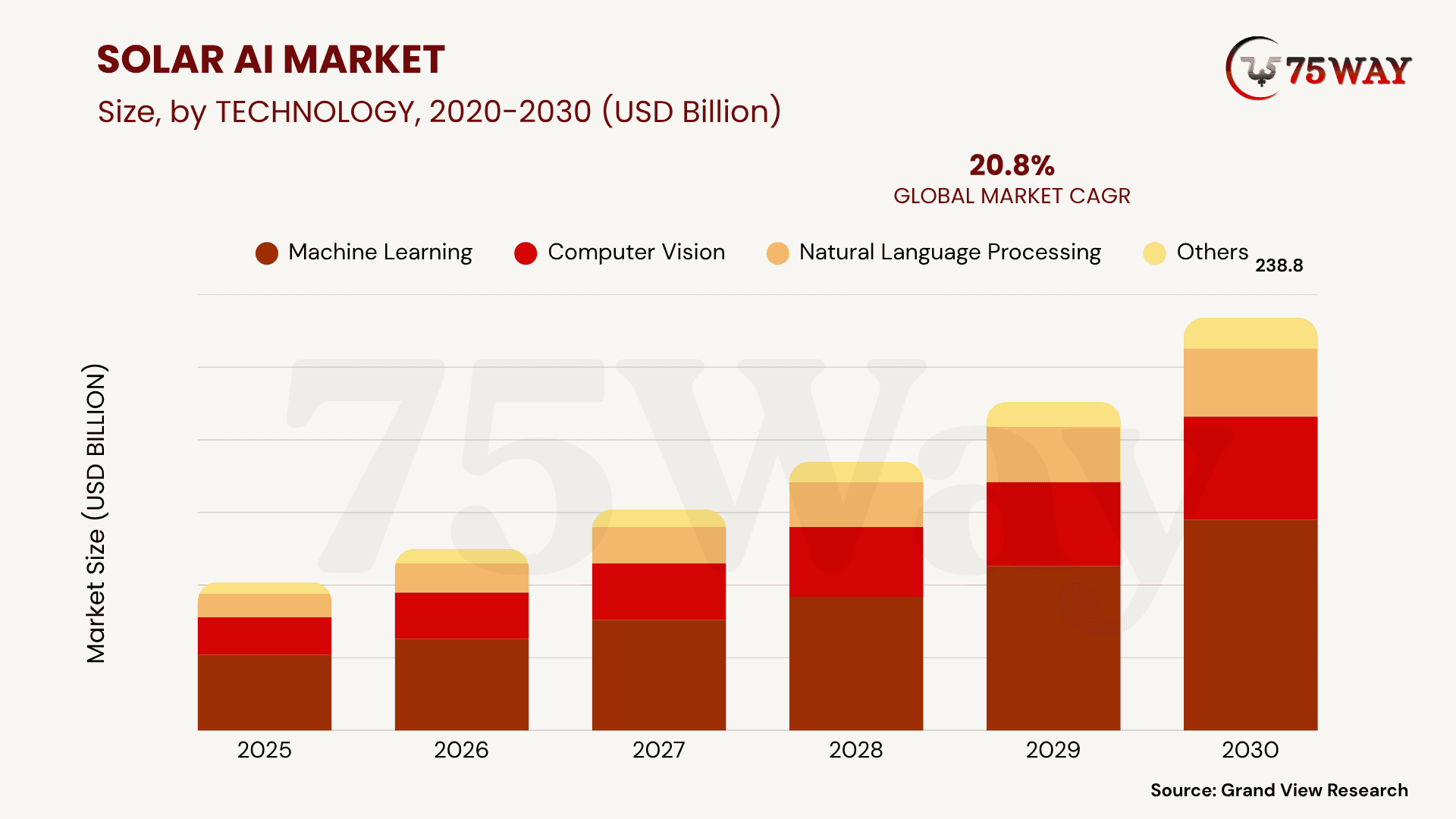
- The global solar AI market is projected to reach $18.43 billion by 2030, growing at a 20.8% CAGR.
- North America leads the solar AI market, accounting for 36.8% of the global share.
- In the U.S., solar capacity has expanded at CAGR of 28% over the past decade, with around 9% of homes now using solar energy.
- The solar monitoring app market is expected to grow from $3.11 billion in 2025 to $10.5 billion by 2035.
Why Solar Monitoring Apps Matter More Than Ever in 2026?
The renewable energy industry has totally changed and entered a new phase of AI and automation. Businesses now want better visibility into energy production, equipment performance, and operational efficiency. Data has become just as valuable as the electricity generated.
A solar energy monitoring app helps them to convert raw data into meaningful information. Instead of manually checking individual devices or reviewing spreadsheets, you can receive real-time updates through interactive dashboards. You can immediately identify underperforming panels, monitor battery storage, compare daily energy output, and receive alerts whenever the system behaves unexpectedly.
In commercial installations, this visibility is a direct contributor to profitability. A small inverter problem or a bad panel can shut down production of energy for weeks before anyone realizes it. Continuous monitoring allows maintenance teams to respond much earlier, cutting production losses and extending the lifetime of equipment.
Another major reason these applications are gaining momentum is the rapid growth of connected devices. Modern solar ecosystems include smart inverters, IoT sensors, batteries, weather stations, EV chargers, and intelligent meters.
A single mobile application can bring all these data sources together, giving users one complete picture of their energy ecosystem instead of forcing them to switch between multiple platforms.
Artificial intelligence is changing the industry too. Beyond reporting current performance, AI-powered systems analyze historical production, weather forecasts, equipment behavior, and environmental conditions to predict future output and identify maintenance risks before failures occur.
Companies investing in solar monitoring app development must consider that the value is not just about operational efficiency. As organizations scale up their renewable energy portfolios, centralized monitoring is no longer a choice but a necessity.
Types of Solar Monitoring Apps Businesses Can Develop
Not every solar monitoring app is built for the same purpose. Different types of applications serve different users, industries, and operational needs, as explained below.
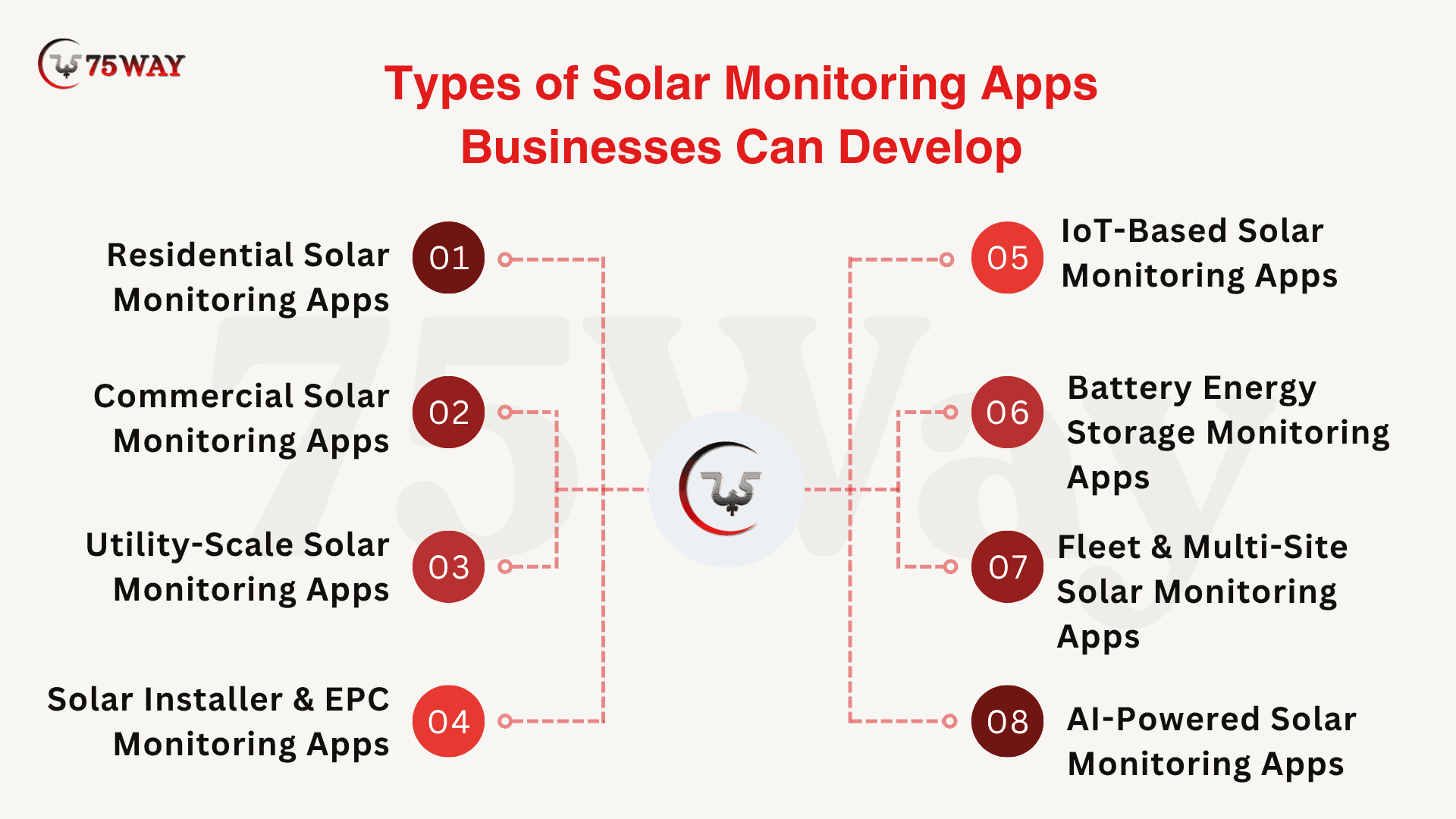
1. Residential Solar Monitoring Apps
Residential solar monitoring apps are a simple way for homeowners to keep an eye on their solar systems. Users can monitor energy generation, battery levels, electricity consumption, savings, and system health on their smartphones instead of manually checking equipment. The interface is simple, so anyone can understand their solar performance.
2. Commercial Solar Monitoring Apps
Commercial solar monitoring services are aimed at enterprise clients and work with distributed photovoltaic installations such as office buildings, factories, warehouses, and shopping malls. These apps provide capabilities such as a central dashboard, real-time performance monitoring, and early alerts for maintenance and support operations and maintenance
3. Utility-Scale Solar Monitoring Apps
Utility-scale tools such as Utility-Scale Solar Monitoring Apps are adapted for large-scale photovoltaic power stations. Capable of processing massive volumes of data, monitoring thousands of panels, and interfacing with SCADA systems, these tools far exceed the capabilities of basic monitoring tools.
4. Solar Installer & EPC Monitoring Apps
These apps are built for solar installation companies and EPC contractors that continue supporting customers after installation. Along with monitoring system performance, they simplify maintenance scheduling, warranty tracking, service requests, inspections, and customer management from one centralized platform.
5. IoT-Based Solar Monitoring Apps
IoT-based solar monitoring apps connect directly with smart inverters, batteries, weather stations, energy meters, and other connected devices. The continuous flow of information provides users with the ability to oversee their systems remotely, receive instant alerts, and respond quickly to performance issues before they turn into major problems.
6. Battery Energy Storage Monitoring Apps
In modern solar systems, battery storage is an integral part, and specific monitoring apps are available to help users to keep an eye on charging cycles, battery health, backup power availability, storage capacity, and energy usage. This insight extends battery life and makes more efficient use of stored energy.
7. Fleet & Multi-Site Solar Monitoring Apps
Businesses with solar across multiple sites require more than just individual dashboards. Bring all your installations together on one platform with fleet and multi-site monitoring apps that enable users to compare performance, organize assets, monitor locations, and manage hundreds of systems.
8. AI-Powered Solar Monitoring Apps
AI-powered solar monitoring apps do more than show live data. They use data from historical performance, weather conditions, equipment behavior, and energy consumption patterns to predict system failures, predict energy generation, and recommend maintenance. These apps deliver actionable insights to boost overall operational performance.
Must-Have Features That Keep Users Opening Your Solar App Every Day
Many competitor articles list 20 or 30 features without explaining which ones truly matter. In reality, users return to a solar monitoring app because it helps them answer important questions in seconds, not because it offers every possible feature. Different kinds of features used to build an app for solar panel monitoring are defined below.
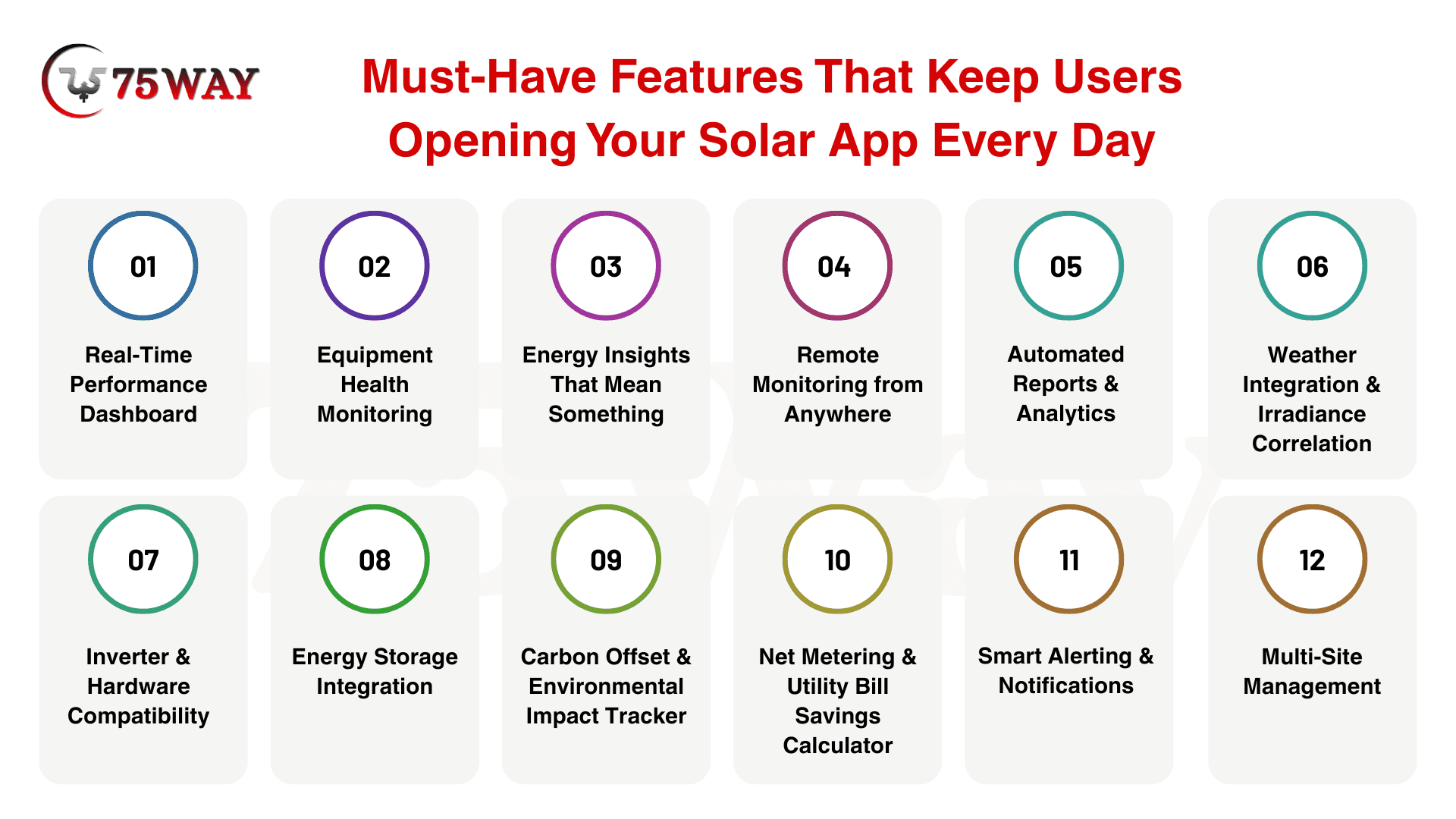
1. A Real-Time Performance Dashboard
The dashboard is the first screen users see, and it often determines whether they'll continue using the app.
Your app should focus on what people actually care about in the moment, not bombard them with dozens of technical metrics. You should immediately see current power generation, today’s energy production, battery percentage, electricity consumption, financial savings, and carbon reduction.
For businesses managing multiple locations, the dashboard should also highlight underperforming sites without requiring users to search through individual installations.
If something isn't working as expected, the dashboard should make that obvious within seconds.
Intelligent Alerts Instead Of Constant Notifications
Nobody wants an app that sends notifications every hour. The valuable alerts are the ones that tell users something worth acting on.
For example:
- One inverter suddenly stops responding.
- Battery temperature exceeds the recommended range.
- Energy production drops well below historical averages despite clear weather.
- A communication device goes offline.
- Scheduled maintenance is approaching.
By prioritizing meaningful alerts, the application becomes helpful instead of distracting.
2. Equipment Health Monitoring
A solar system is made up of many connected components, including panels, inverters, batteries, meters, communication gateways, and sensors.
When users can monitor the health of each component from one interface, diagnosing issues becomes much faster.
Instead of displaying only a warning icon, explain the likely cause, its impact on energy production, and the recommended next step. Small usability improvements like these reduce support requests while helping users make informed decisions.
3. Energy Insights That Mean Something
Raw production numbers don't always help users understand whether their system is performing well. Imagine seeing 28.4 kWh generated today.
- Is that good?
- Average?
- Below expectations?
Without context, the number has limited value.
A better solar energy monitoring app compares today's performance with yesterday's, last week's, seasonal averages, and weather conditions. It explains why production changed instead of leaving users to interpret the data themselves.
That additional layer of insight transforms data into decisions.
4. Remote Monitoring From Anywhere
Another reason businesses invest in a solar monitoring app is the ability to manage installations without being physically present.
Whether someone oversees five residential systems or five hundred commercial projects, remote access dramatically reduces inspection time and operational costs.
With secure cloud connectivity, users can monitor energy production, review historical performance, acknowledge alerts, generate reports, and check equipment status from virtually anywhere.
For service teams, this often means identifying the probable issue before traveling to the site, saving both time and maintenance expenses.
5. Reports That People Don't Have To Build Manually
Reporting may not sound exciting, but it's one of the most frequently used features in commercial environments.
Operations managers, facility owners, and utility companies regularly need monthly performance summaries, maintenance records, financial reports, and sustainability metrics.
Rather than asking users to export spreadsheets every week, the application should generate scheduled reports automatically. Better yet, allow reports to be customized based on the audience. A finance team doesn't need the same level of technical detail as a maintenance engineer.
Small conveniences like automated reporting often deliver more long-term value than adding another dashboard.
6. Weather Integration and Irradiance Correlation
Integrating weather APIs, such as OpenWeatherMap, Tomorrow.io, or the National Solar Radiation Database (NSRDB) maintained by the National Renewable Energy Laboratory, allows the app to contextualize performance data against solar irradiance conditions.
When users see that today's output is 12% below average, they need to know whether that's because of cloud cover or because a panel string has failed. Irradiance correlation makes that distinction automatically.
7. Inverter and Hardware Compatibility
Supporting multiple inverter brands increases market reach but adds significant development and testing costs, as each hardware integration requires protocol understanding, data mapping, and validation.
In the US market, the dominant inverter brands include Enphase, SolarEdge, SMA America, Fronius, and Generac.
Supporting all five from day one is ambitious, but building an abstraction layer that makes adding new inverter integrations straightforward is a non-negotiable architectural decision.
8. Energy Storage Integration
As battery storage adoption grows alongside solar in the US, particularly with Tesla Powerwall, Enphase IQ Battery, and LG RESU systems, monitoring apps need to display battery state of charge, charge/discharge cycles, and time-of-use optimization performance.
Users with storage-plus-solar systems expect to see the full energy flow picture: solar generation, battery charging, home consumption, and grid interaction on a single screen.
9. Carbon Offset and Environmental Impact Tracker
US solar owners are motivated by both financial savings and environmental impact.
An environmental impact module that translates kilowatt-hours of solar generation into equivalent trees planted, pounds of CO2 avoided, and miles of gasoline-powered driving offset adds meaningful emotional engagement.
These metrics also serve as shareable social content, which drives organic referrals, a cost-free acquisition channel.
10. Net Metering and Utility Bill Savings Calculator
Net metering policies vary by state in the US; California's NEM 3.0, for example, significantly changed the economics of residential solar.
The app should pull local utility rate data and net metering credits to calculate actual monthly bill savings in real dollars, not just kilowatt-hours. This feature directly ties app engagement to financial value, making churn far less likely.
11. Smart Alerting and Notifications
Alerts for the energy output monitoring scenario must adhere to the low-noise, smart principle. A flood of invalid alerts will distract users and lead them to ignore all notifications. It is required to distinguish between the two categories of anomalies (weather-related and equipment-related), cover the three distribution channels of push notifications, SMS, and email, and set configurable alarm thresholds for different user roles.
12. Multi-Site Management
Commercial and enterprise users have to be able to look at the performance across multiple installations from a portfolio perspective. This includes site comparison tools, flags for underperforming sites, and aggregate reporting across the portfolio. The role-based access control should enable property managers to see high-level summaries, while field technicians can drill into detailed equipment diagnostics
Step-by-Step Development Process To Build A Solar Monitoring App
Not every solar monitoring app is built for the same purpose. Different types of applications serve different users, industries, and operational needs, as explained below.
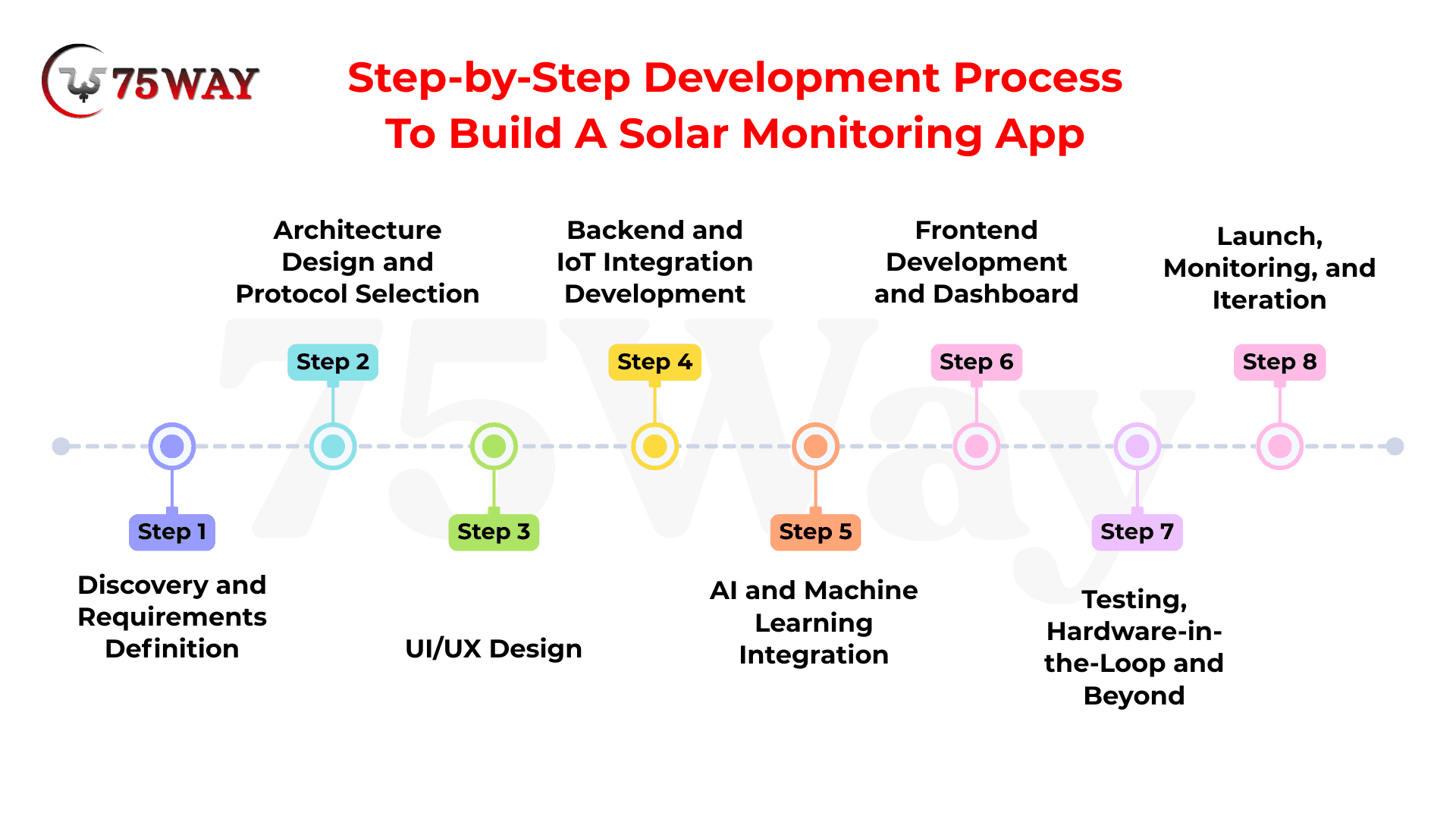
Step 1: Discovery and Requirements Definition
The discovery phase is where development decisions are made or broken. Conduct stakeholder interviews with the target user types, residential homeowners, commercial facility managers, or O&M technicians, to understand their core jobs-to-be-done.
You must map the hardware ecosystem your app will need to support: which inverter brands, which battery systems, which smart meters. Define the regulatory requirements for your primary US markets: California, Texas, and Florida have distinct net metering and interconnection requirements.
Deliverables from this phase include a feature priority matrix, a hardware compatibility list, a data flow diagram, and a regulatory compliance checklist. Skipping this phase is the single most common reason solar monitoring app projects fail to reach production.
Step 2: Architecture Design and Protocol Selection
This stage focuses on designing the system before writing any code. First, define the core requirements and understand how data will flow through the system. Once that is clear, the architecture is planned to ensure scalability, performance, and reliability for real-time solar monitoring.
Next comes IoT protocol selection. MQTT over TLS is a widely used approach for secure and lightweight communication between devices and cloud systems as of 2026. Then, the cloud infrastructure is chosen from AWS IoT Core, Google Cloud IoT, and Azure IoT Hub based on the deployment needs.
Then the database structure is defined. For sensor data, time series databases such as InfluxDB or TimescaleDB are employed. For application and user-related data, PostgreSQL is used. Finally, API design is defined. REST APIs control the usual actions, and WebSockets or Server-Sent Events handle the real-time dashboard updates.
Step 3: UI/UX Design
Solar monitoring interfaces need to balance data density and usability. Power users want to see data at the equipment level and in granular charts. If homeowners want a summary, they can get it in 10 seconds. The answer is progressive disclosure, a clean top-level dashboard that surfaces the most important metrics immediately, with the ability to drill down for users who want more.
You can use the same color-coded status indicators. Green is normal, yellow is a warning, and red is a fault. Dark mode is becoming an expectation for energy apps because a lot of people look at their systems in the evening.
Design with mobile-first in mind. The majority of residential solar users will check their app on a smartphone, not a desktop browser. Touch targets, loading performance on 4G connections, and offline state handling all need to be explicitly designed and not left as afterthoughts.
Step 4: Backend and IoT Integration Development
The backend is the most complex part of a solar monitoring app because it is responsible for handling everything that happens behind the scenes in real time. It starts with the IoT ingestion layer, where sensor data from solar devices is continuously received, validated, and stored in a time-series database so that nothing gets lost or delayed.
On top of that, an alert engine is built to monitor incoming data and instantly trigger notifications whenever performance drops or predefined thresholds are exceeded. This is what helps users detect issues early instead of discovering them after energy losses occur.
Build the analytics computation layer that runs aggregations, hourly totals, daily performance ratios, and monthly yield summaries on a scheduled basis and caches results for fast dashboard retrieval. Raw time-series queries against months of sensor data are expensive; pre-computed aggregates are what make dashboards load in under two seconds.
Step 5: AI and Machine Learning Integration
That’s the layer where the 2026 generation of solar monitoring apps is really starting to diverge from their predecessors. The top 3 AI capabilities with the best value-to-cost ratio are:
- Anomaly detection uses statistical models trained on historical performance data to flag when a panel string, inverter, or meter is behaving outside its expected range, accounting for weather conditions and time of day. Models based on Isolation Forest or LSTM neural networks work well for this application.
- Predictive maintenance predicts equipment degradation trajectories by looking at performance trends over weeks and months. “Your inverter efficiency has declined 8% over the last 90 days and may need service in 60 days” offers dramatically more value than one that simply reports current status.
- Energy yield forecasting uses weather forecast data combined with historical panel performance to predict tomorrow's or next week's energy generation. This is particularly valuable for commercial users managing time-of-use electricity contracts or demand response programs.
Step 6: Frontend Development and Dashboard Build
The frontend is the part where users interact with your solar monitoring app, so it's one of the most important stages of development. The goal is always the same: to deliver a fast, intuitive, and responsive experience, whether you build a native iOS or Android app, use cross-platform frameworks like Flutter or React Native, or develop a progressive web app (PWA).
The dashboard should be capable of displaying live system performance as new data comes from connected devices. This is usually achieved by using WebSocket connections that keep the dashboard updated in real-time, without the user needing to refresh the screen. For things like energy production, battery status, and historical trends, charting libraries such as Apache ECharts, Victory Native, and Recharts are popular choices, as they are optimized for time-series data.
The performance of any solar panel monitoring is foremost in the user experience. A slow-loading dashboard can quickly reduce user trust, especially when monitoring real-time energy generation. Techniques such as skeleton loading screens, intelligent caching, and lazy loading help ensure charts, reports, and dashboards remain fast and responsive even as data continues to grow.
Step 7: Testing, Hardware-in-the-Loop and Beyond
Testing a solar monitoring app is a mix of regular software testing and hardware-specific validation.
- Business logic unit tests, performance ratio calculations, alert threshold calculations, aggregation formulas.
- Integration tests verify that inverter API integrations return correct data for different equipment states.
- End-to-end tests simulate the full data path from the device emulator, through the ingestion pipeline, to a rendered dashboard value.
- Hardware-in-the-loop testing is the process of connecting real inverters or IoT simulators to the test environment to ensure the app handles the behavior of real devices, including firmware differences, connectivity failures, and corner cases such as negative power readings while exporting to the grid.
Before launch, there will be a need to do some load testing. A residential app serving 500 households at the same time must be able to handle 500 concurrent WebSocket connections and several thousand data points per minute without degrading the dashboard response times.
Step 8: Launch, Monitoring, and Iteration
When the platform is live, it must be monitored as closely as the solar systems it manages.
Application Performance Monitoring (APM) tools like Datadog or New Relic allow teams to see API response times, database performance, and error rates, so they can find and fix problems before users are affected. Automated backend alerts ensure the platform is stable and reliable.
At the same time, it is required to track the right product metrics for long-term success. For the app’s performance, we can evaluate it not only technically but also from the user’s perspective. Indicators such as daily active users, dashboard load time, alert delivery latency, and monthly churn rate are considered.
Because users use solar monitoring apps on a daily basis, they can quickly spot even minor problems. In-app feedback in the first 90 days and constant iteration on the experience improve usability, build user trust, and, over time, create a more reliable platform.
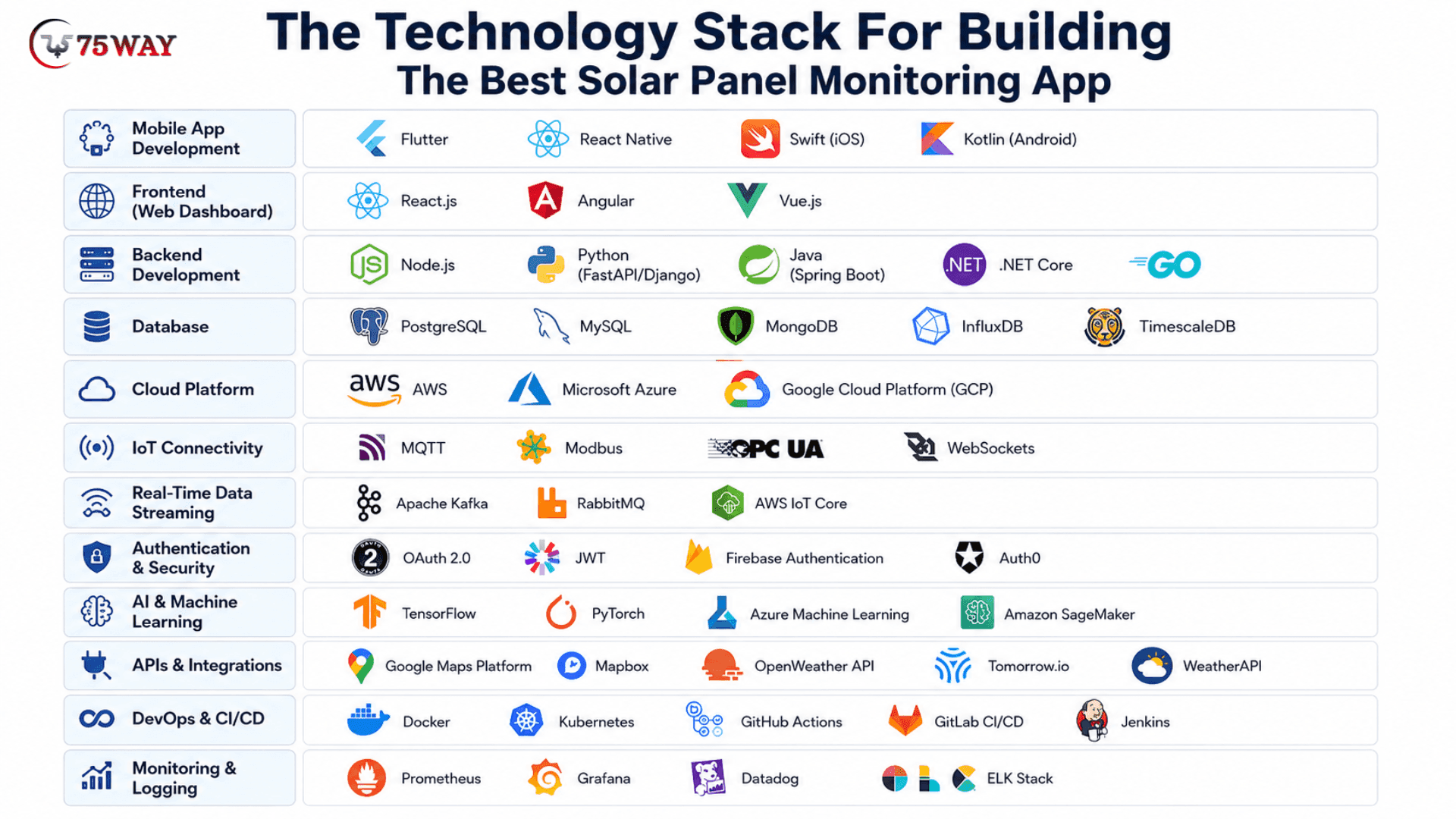
The Technology Stack For Building The Best Solar Panel Monitoring App
Ask ten development teams which technologies they would choose for a solar monitoring app development project, and you'll probably hear ten different answers. That's because there isn't a single "perfect" tech stack. The right choice depends on the scale of the platform, the amount of data it will process, the hardware it connects with, and the business goals behind the product.
Rather than chasing the latest framework, successful products are built on technologies that solve real operational challenges. Let's break down the architecture layer by layer.
1. Mobile Application: The mobile app is where users spend most of their time, so it needs to feel fast and reliable. Every tap, chart update, and notification shapes the overall experience.
Businesses that want to attract Android and iOS audiences can use cross-platform frameworks like Flutter and React Native. It reduces the time of development and still keeps a consistent interface.
Native development may still be the preferred route if deep hardware integration, advanced animations or platform-specific capabilities are important.
Regardless of the framework, the goal remains the same: deliver information instantly without making users wait for every screen to refresh.
2. Backend Infrastructure: If the mobile app is the face of the product, the backend is its brain.
Every second, connected devices send streams of operational data that must be received, processed, validated, and stored without interruption.
As the number of connected solar systems grows, this infrastructure should expand without slowing down. A cloud-native architecture makes that growth much easier than relying on traditional on-premise servers.
3. Database Selection: Not all data behaves the same way. User profiles, subscriptions, and account settings fit comfortably inside relational databases. Sensor readings arriving every few seconds tell a different story.
A large commercial installation can generate millions of data points over time. Choosing a database designed for time-series information allows historical trends to be retrieved much faster while keeping storage costs under control.
This decision often becomes more important after launch than during initial development because historical performance data continues growing year after year.
4. Cloud Services: Modern solar monitoring software rarely operates from a single physical server. Cloud infrastructure supports automatic scaling, secure storage, backups, global accessibility, and continuous availability.
More importantly, it allows businesses to grow without rebuilding their infrastructure every time new customers come on board.
For example, if an energy company expands from monitoring 500 systems to 50,000 systems, cloud resources can increase alongside demand rather than requiring a complete platform redesign.
That flexibility becomes invaluable as renewable energy adoption accelerates.
5. APIs & Third-Party Integrations: Very few applications operate in isolation. Most successful platforms exchange information with external systems every day. A solar monitoring app may integrate with:
- Weather forecasting services
- Smart inverters
- Utility providers
- Battery management systems
- GIS mapping platforms
- Payment gateways
- CRM software
- ERP platforms
- Customer support systems
Connecting Solar Hardware To Your Solar Panel Monitoring Mobile App
One of the biggest differences between building a social media app and developing a solar energy monitoring app is that software is only half of the solution. The application depends entirely on the quality of the data coming from physical devices.
When the communication between the hardware and the software is not reliable, users quickly lose confidence in the platform, even if the app itself is beautifully designed. That’s why device integration warrants as much attention as interface design.
1. Smart Inverters: The inverter acts as the control center of most solar installations. Besides converting DC electricity into usable AC power, modern smart inverters continuously report operational information such as voltage, current, output, efficiency, temperature, and fault conditions.
Connecting directly with supported inverter manufacturers allows users to view live performance without additional manual input.
2. IoT Sensors: Sensors provide much deeper visibility than solar panels alone. Depending on the installation, they may monitor:
- Panel temperature
- Ambient temperature
- Solar irradiance
- Wind speed
- Humidity
- Equipment vibration
- Battery conditions
- Electrical load
Each additional sensor helps explain why energy production changes throughout the day instead of simply showing that it changed.
3. Smart Energy Meters: Monitoring production tells only half the story. Businesses also need to understand where electricity is being consumed.
Smart meters bridge that gap by tracking energy usage across homes, commercial buildings, factories, or utility networks.
Combining production and consumption data allows users to identify opportunities for improving efficiency while reducing dependence on the electrical grid.
4. Battery Storage Systems: Battery storage is becoming a standard part of modern renewable energy installations. Monitoring batteries requires more than displaying the remaining charge.
Users often want visibility into:
- Charge and discharge cycles
- Backup duration
- Battery health
- Temperature
- Charging efficiency
- Remaining capacity
- Lifetime performance
These insights help maximize battery lifespan while reducing replacement costs.
AI Is Changing Solar Monitoring From Reactive To Predictive
Traditional monitoring platforms answer one question: "What's happening right now?"
Artificial intelligence answers a far more valuable question: "What is likely to happen next?"
That difference changes the way businesses manage renewable energy assets. Instead of waiting for equipment to fail, AI analyzes thousands of operational signals looking for patterns that humans would rarely notice.
Imagine an inverter that has been operating normally for years. Its output begins declining by only a small percentage each week. No alarm is triggered because production remains within acceptable limits.
A human operator might overlook that gradual change. An AI model won't. It compares current behavior with historical performance, weather conditions, nearby installations, and seasonal trends. If something looks unusual, it recommends an inspection long before the issue becomes a costly outage.
That's the real value of artificial intelligence, not replacing technicians, but helping them prioritize attention where it's needed most.
Practical AI Features Worth Building in Solar Monitoring Mobile App
Not every AI feature adds business value. The most useful capabilities solve everyday operational problems.
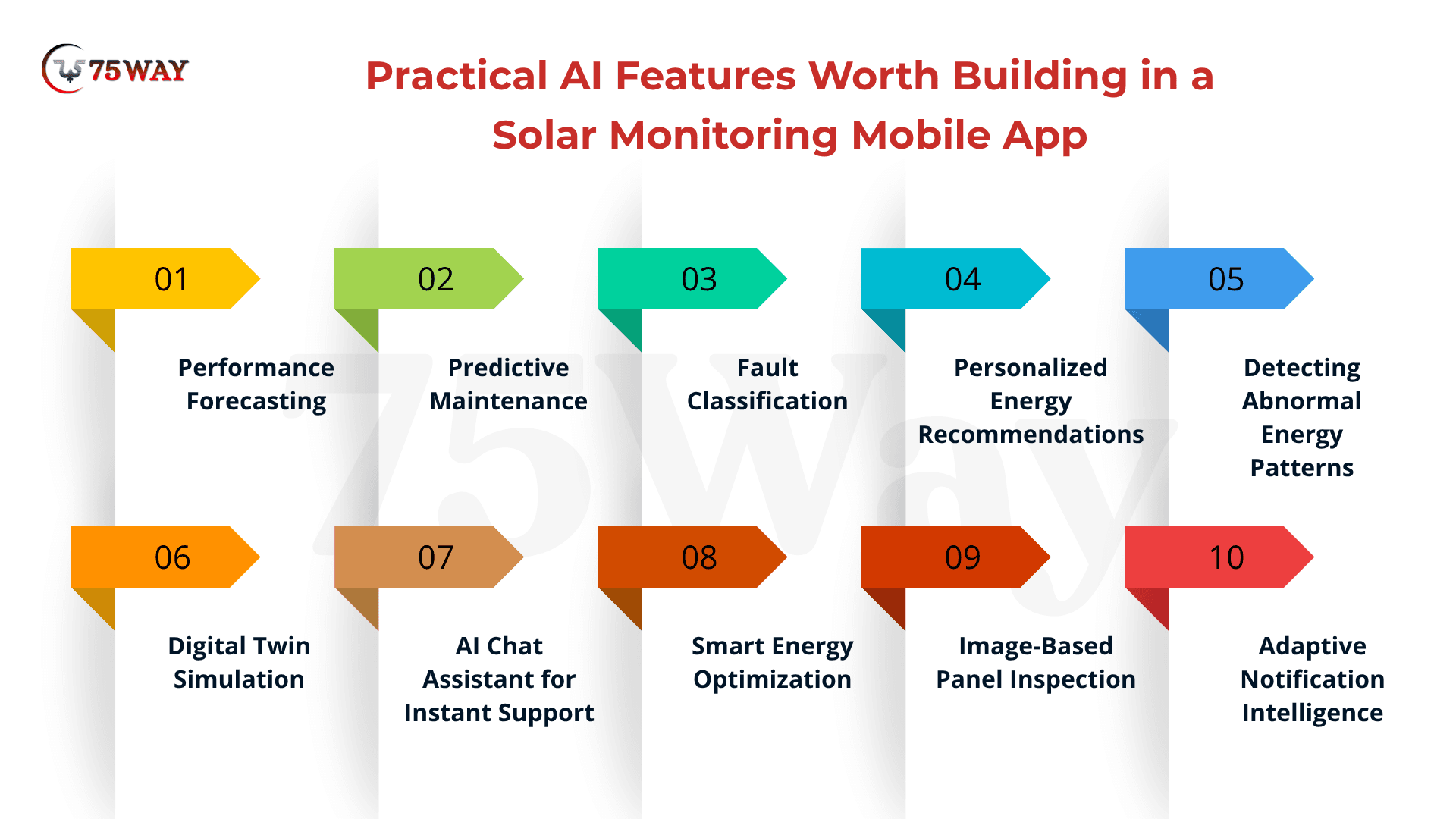
- Performance Forecasting: Users often ask a simple question: "How much energy should my system produce tomorrow?"
By combining historical production with weather forecasts and seasonal patterns, AI can generate realistic energy predictions that support operational planning.
- Predictive Maintenance: Rather than waiting for failure alerts, AI identifies equipment showing early warning signs. This reduces emergency repairs while helping maintenance teams schedule inspections before production losses increase.
- Fault Classification: Instead of displaying generic error codes, AI can group faults into categories such as communication issues, inverter abnormalities, shading problems, sensor failures, or battery degradation. That additional context helps technicians diagnose problems much faster.
- Personalized Energy Recommendations: Every installation behaves differently. Some users consume most electricity during the evening, while others generate excess power during business hours.
AI can study these patterns and recommend practical actions, such as adjusting battery charging schedules or shifting high-energy activities to periods of peak solar generation. These recommendations turn the app from a monitoring tool into a decision-support platform.
- Detecting Abnormal Energy Patterns: Sometimes the biggest warning sign isn't a hardware failure but unusual behavior. If one site suddenly begins consuming significantly more electricity than similar locations under comparable conditions, the application should highlight the anomaly automatically rather than expecting users to discover it manually. That's where AI delivers value beyond traditional dashboards.
- Digital Twin Simulation: Imagine planning maintenance without touching the actual solar installation. A digital twin creates a virtual replica of the solar system using real-time operational data.
Before replacing equipment, changing battery settings, or modifying energy distribution, operators can simulate different scenarios and understand their potential impact. For large commercial projects, this reduces guesswork and supports better operational planning.
- AI Chat Assistant For Instant Support: Most users don't understand technical terms like inverter faults, voltage fluctuations, or communication errors. When something goes wrong, they simply want a clear explanation.
An AI assistant built into the solar monitoring app can answer common questions, explain alerts in plain language, guide users through troubleshooting steps, and recommend whether an issue requires immediate service or simple observation. Instead of searching manuals, users receive contextual guidance within seconds.
- Smart Energy Optimization: Producing more electricity isn't always the best way to reduce energy costs. The real value comes from using that electricity at the right time.
AI studies energy generation, consumption habits, battery capacity, electricity tariffs, and weather forecasts to recommend smarter energy usage. It may suggest charging batteries before cloudy weather, running high-power equipment during peak solar production, or exporting excess electricity when utility rates are highest.
These recommendations help users improve energy efficiency without constantly monitoring the system themselves.
- Image-Based Panel Inspection: Routine inspections traditionally require technicians to visit the site and visually examine solar panels for cracks, dirt, bird droppings, shading, or physical damage.
By combining AI with drone or mobile camera images, the application can automatically identify visible defects and highlight panels that need attention. This significantly reduces inspection time, particularly for commercial rooftops and utility-scale solar farms where manual inspections can take days.
- Adaptive Notification Intelligence: Sending every alert to every user quickly leads to notification fatigue. Over time, people begin ignoring messages, including the important ones.
Compliance and Regulatory Requirements To Create a Solar App
Building for the US market means navigating an energy regulatory landscape that is more complex than most app categories.
- NEC (National Electrical Code) Awareness: While the app itself doesn't need NEC compliance, the hardware integration layer must account for NEC-compliant system configurations. Data from rapid shutdown systems, arc-fault circuit interrupters, and ground fault protection devices should be captured and surfaced in the monitoring interface.
- Net Metering Policy Integration: Net metering rules differ significantly by state and utility. California's NEM 3.0, Arizona's net billing tariff, and Texas's non-standard utility policies all affect how the savings calculation module should work. Building a policy database with state-level net metering rules and updating it as policies change is a sustained operational responsibility for any US-focused solar monitoring app.
- NERC CIP for Utility-Scale Deployments: Solar facilities connected to the bulk electric system and exceeding certain capacity thresholds fall under NERC CIP standards. Applications targeting this market segment must have documented programs for access control, cyber asset identification, incident response plans, and security patch management.
- Data Privacy: Most residential solar customers would fall under the CCPA, which applies to apps that collect data from California residents. With the expansion of categories of personal information by CCPA, energy consumption data is now considered sensitive personal information. This means that you need to have workflows for explicit consent, handling data access requests, and handling deletion requests.
What’s The Cost for Solar Monitoring App Development?
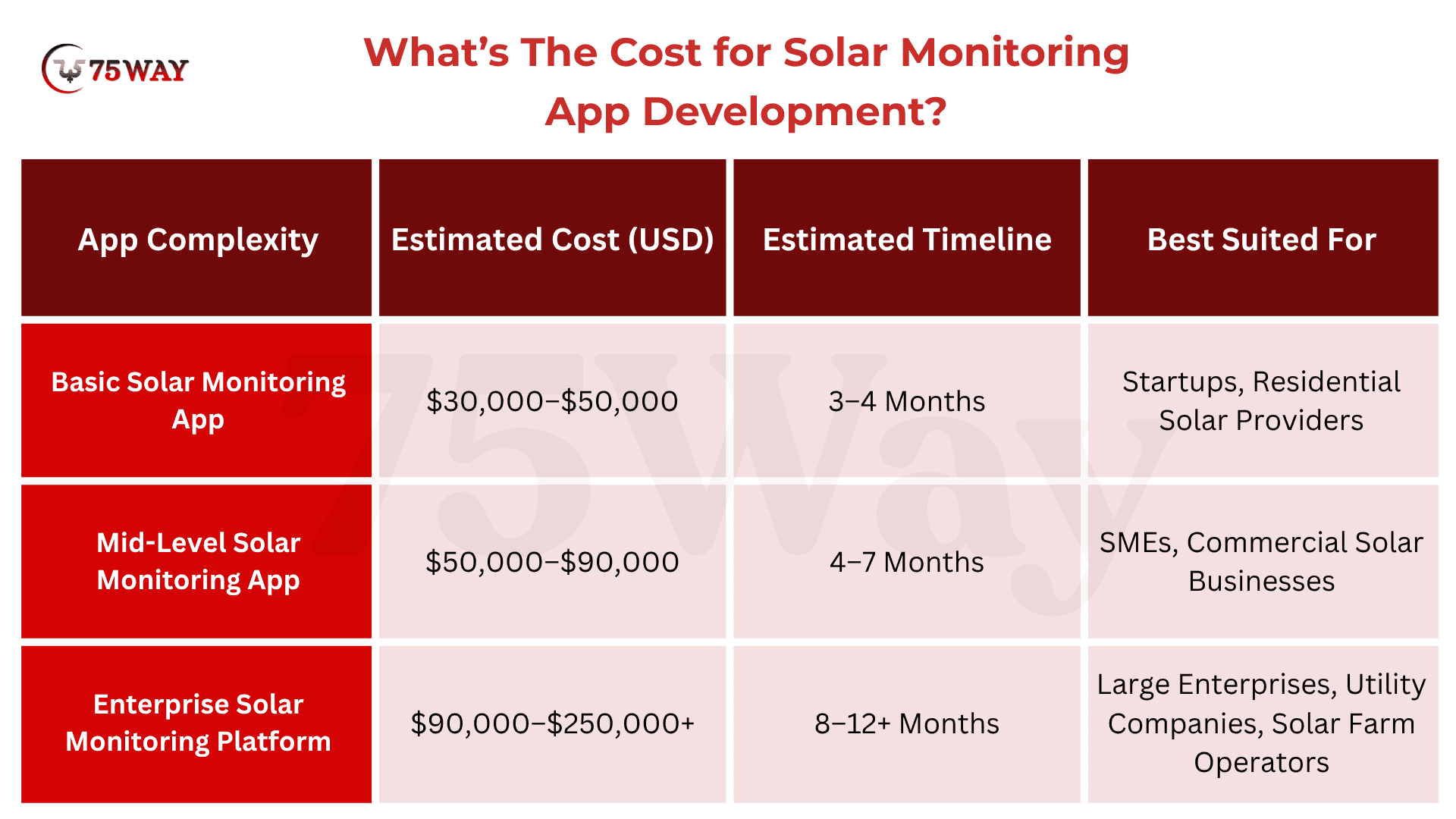
For businesses, the average price to build a solar monitoring app is from $30,000 to $250,000+. The last investment depends on development hours, architecture complexity, security layers, and whether you build for iOS, Android, or both platforms.
- A simple monitoring app with simple dashboards can cost you between $30,000 and $50,000.
- A mid-range application with IoT integration and real-time alerts can cost between $50,000 and $90,000.
- A sophisticated platform with AI analytics, predictive insights and enterprise capabilities can run $90,000 to $250,000 or more.
Cost to Build Solar Panel Monitoring App Based on Development Stages
- Discovery and Architecture Design: $8,000 – $15,000. This phase is often underinvested and overcut, which directly causes expensive rework later.
- UI/UX Design: $10,000 – $25,000 depending on the number of user roles, screen complexity, and number of design iterations.
- IoT Integration and Backend Development: $20,000 – $60,000. This is typically the largest cost center, driven by the number of inverter integrations and the complexity of the real-time data pipeline.
- Mobile App Development (iOS + Android): $15,000 – $40,000 for React Native cross-platform development; more for native development on both platforms.
- AI/ML Feature Development: $10,000 – $30,000 for anomaly detection and predictive models, depending on data availability and model complexity.
- QA Testing and Hardware Validation: $8,000 – $20,000.
- Launch, DevOps Setup, and Infrastructure: $5,000 – $15,000.
- Ongoing Maintenance (Annual): 15-20% of initial development cost per year, covering bug fixes, inverter API updates, OS compatibility updates, and feature additions.
How to Monetize a Solar Monitoring App in 2026? Revenue Models
So, how do solar monitoring apps actually make money? The answer depends on who your users are and the value your platform provides. Several proven monetization strategies that can help you build recurring revenue are discussed below.
- Freemium with Premium Analytics: Provide basic monitoring for free, daily generation totals, basic charts, basic alerts, and charge for advanced analytics, extended data history, export features, and AI-powered insights. This model is a good fit for residential applications where the hardware manufacturer subsidizes basic monitoring, and the software company cross-sells premium features.
- Subscription by Asset Size: Commercial and industrial users pay monthly or annual fees according to the number of monitored systems, installed capacity in kilowatts, or the number of data points per month. This scales revenue naturally with customer growth.
- White-Label Licensing: Solar installers and O&M companies pay a platform licensing fee to offer a branded monitoring app to their customers. This B2B2C model delivers predictable recurring revenue and reduces the customer acquisition cost of reaching end users.
- Data and Insights Services: Large-scale solar operators and utilities will pay for aggregated, anonymized performance benchmarking data, grid forecasting integrations, and market intelligence reports. This requires scale to execute but carries very high margins.
The Future of Solar Monitoring Apps: 2026 and Beyond
Several technology trends are reshaping what solar monitoring apps can do within the next 24 months.
Digital twin architectures and machine learning inference at the edge are compressing fault-response cycles from hours to seconds. A digital twin of a solar installation, a continuously updated virtual model of every panel, inverter, and meter, allows the app to simulate "what-if" scenarios, test maintenance interventions virtually, and generate more accurate predictive maintenance timelines.
The main trend in the solar software market is the integration of AI, ML, & LLMs into system design and energy forecasting, turning monitoring platforms from passive reporting tools into proactive decision-making engines.
5G connectivity is beginning to enable direct device-to-cloud communication for utility-scale installations without requiring intermediate gateway hardware, reducing deployment complexity and cost.
Meanwhile, virtual power plant (VPP) integrations, where a monitoring app connects a homeowner's solar-plus-storage system to a utility demand response program, are creating new revenue streams for app operators and new value for users simultaneously.
The apps that succeed in this market over the next three to five years will be the ones built with intelligence at their core from day one, not bolted on after the fact.
Conclusion
Building a solar monitoring app in 2026 is both a significant technical undertaking and a compelling business opportunity. With the solar panel monitoring system market on track to reach $16.36 billion by 2035 at a 14.60% CAGR, the window for establishing a strong product position is open, but it won't stay open indefinitely as the market consolidates around the platforms that get the user experience and technical architecture right.
Successful companies in this space follow a similar playbook. They invest in discovery to deeply understand your target users, build a hardware abstraction layer, treat IoT architecture and security as first-class requirements rather than implementation details, and integrate AI capabilities that transform raw sensor data into decisions users can act on.
Whether you're a solar installer looking to add AI to your service offering or an enterprise building a solar monitoring app, the blueprint is clear. You can partner with a reliable mobile app development company.
Frequently Asked Questions (FAQs)
Can A Solar Monitoring App Work With Any Inverter Brand?
Most production-grade solar monitoring apps support multiple inverter brands through a protocol abstraction layer. Common inverter APIs from SolarEdge, Enphase, SMA, and Fronius use different data formats, so the app requires brand-specific integration modules that normalize data into a unified schema. Building this abstraction layer early allows new inverter brands to be added without rewriting core application logic. Expect each additional inverter integration to add 2–4 weeks of development time.
Is Offline Functionality Possible In A Solar Monitoring App?
Yes, we offer offline capability with local data caching and edge computing. In case of an internet connection interruption, the IoT gateway device can store the sensor readings locally and sync the cached data to the cloud when the connection is restored.
What Database Is Best Suited For Storing Solar Sensor Data At Scale?
Time-series databases are the standard for solar monitoring applications. As of 2026, the most adopted options are InfluxDB and TimescaleDB. Both are optimized for high-frequency write operations, efficient time range queries, and automatic data downsampling, compressing older data into hourly or daily aggregates to manage storage costs.
Do Solar Monitoring Apps Require Cybersecurity Certification for U.S. Deployments?
Yes, certification requirements depend on the scale and grid connectivity of the solar installations being monitored. Utility-scale solar farms connected to the bulk electric system fall under NERC CIP standards, which mandate documented security controls, access logging, and vulnerability management.
What Is The Difference Between A Solar Monitoring App And SCADA Software?
SCADA systems are designed for industrial-scale control operations. hey can send commands back to equipment, not just monitor it. Solar monitoring apps are typically read-only visibility tools designed for user-friendly consumption of performance data. Enterprise-grade solar monitoring platforms are increasingly blurring this line by incorporating remote control capabilities for inverters and battery systems, but the core user experience remains monitoring-first rather than control-first.
Which US States Have The Highest Demand For Solar Monitoring Apps?
California, Texas, Florida, Arizona, and New Jersey lead in residential solar installations and therefore represent the largest addressable markets for monitoring applications. California is particularly significant because NEM 3.0 policy changes have made real-time monitoring of energy export timing much more financially important for homeowners. Texas's deregulated electricity market creates additional demand for apps that help solar owners optimize time-of-use billing and demand charge management.