Summary
Plugshare-like EV charging station app development includes real-time charger discovery, navigation, payment systems, IoT connectivity, and cloud infrastructure to support growing electric mobility ecosystems. Modern platforms deliver route optimization, charger availability tracking, reservation systems, and predictive analytics. These apps improve charging accessibility, user convenience, operational visibility, and scalable revenue opportunities.
Quick Overview
- Real-time charger availability improves user trust and charging station accessibility significantly.
- OCPP integration supports seamless communication between charging hardware and mobile applications.
- AI-powered route optimization improves long-distance EV travel planning experiences considerably.
- Cloud infrastructure enables scalable EV charging analytics and multi-device synchronization globally.
- Secure payment gateways simplify charging session billing and digital wallet management.
- Subscription and partnership models generate recurring revenue for EV charging platforms.
Rising fuel prices, global energy uncertainty, and growing environmental concerns are pushing countries toward faster electric vehicle adoption. Governments and automotive companies are heavily investing in EV infrastructure as consumers increasingly shift away from fuel-dependent transportation systems. But here’s the real challenge.
As EV ownership grows rapidly, drivers now expect much more than just charging access. They want real-time charging station availability, accurate route planning, and live charging from their smartphones.
This growing demand is exactly why EV charging station apps like PlugShare, ChargePoint, Blink, and ABRP have become essential parts of the modern EV ecosystem. Among all, PlugShare in particular gained massive popularity for its crowdsourced station visibility and real-time charging information.
At the same time, businesses find huge opportunities in EV mobility infrastructure. EV charging applications evolve into complete e-mobility solutions powered by Internet of Things (IoT) connectivity, predictive analytics, and intelligent navigation systems.
So, what does it actually take to build an EV charging station app like PlugShare in 2026? How does OCPP integration work? What technologies power real-time charging systems? And how much does development really cost? In this complete guide, we’ll break down everything you need to know about building an EV charging station app like PlugShare.
What Is EV Charging Station App?
EV charging station applications help electric vehicle drivers locate, access, manage, and pay for charging services through smartphones and connected devices. These platforms aggregate charging station information from public networks, private operators, IoT-enabled chargers, and crowdsourced databases into unified mobility ecosystems. Modern EV charging applications support:
- Charger discovery
- Real-time availability tracking
- Route planning
- Slot reservation
- Charging session monitoring
- Digital payments
- Connector compatibility filtering
- Community reviews
- Fleet charging management
Advanced EV platforms also use artificial intelligence and predictive analytics to optimize charging experiences, reduce waiting times, and improve infrastructure utilization.
Why EV Charging Apps Are Growing Rapidly in 2026?
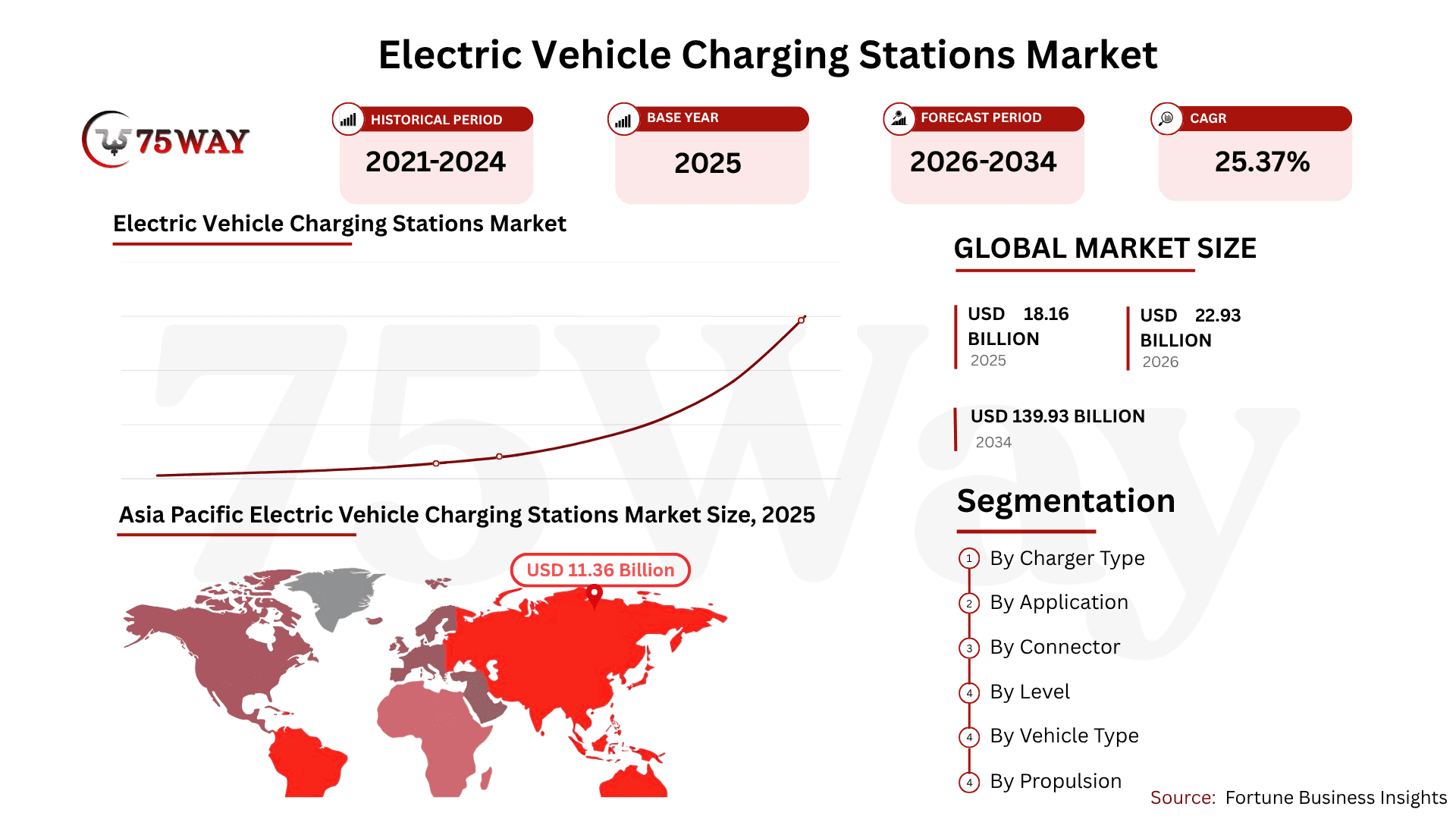
Rising EV adoption and expanding public charging infrastructure are accelerating demand for intelligent charging applications worldwide. The EV charging station market is projected to reach $139.93 billion by 2034, growing rapidly at 25.37% CAGR.
- Rising EV Adoption: Electric vehicle sales continue increasing globally because of environmental concerns, fuel cost optimization, and government incentives. This growth directly increases demand for accessible charging infrastructure and intelligent charging applications.
- Expansion of Charging Networks: Public and private charging networks are expanding rapidly across highways, urban areas, parking facilities, workplaces, and residential communities. EV applications simplify charger discovery and navigation for drivers.
- Smart Mobility Ecosystems: Modern EV charging apps are becoming part of larger smart mobility ecosystems, integrating navigation, fleet management, energy optimization, and connected transportation services.
- Demand For Real-Time Information: Drivers increasingly expect live charger availability, wait-time estimation, pricing visibility, and charging status updates before arriving at charging stations.
- Growth of Fleet Electrification: Commercial fleet operators require centralized charging management platforms for logistics, ride-sharing, and delivery operations.
A Roadmap For Plushare-Like EV Charging App Development
Building a PlugShare-style EV charging application requires a structured development approach where each stage directly connects to the next. From understanding market demand to launching a fully scalable platform, every step plays a critical role in ensuring reliability, performance, and real-world usability in fast-growing EV ecosystems.
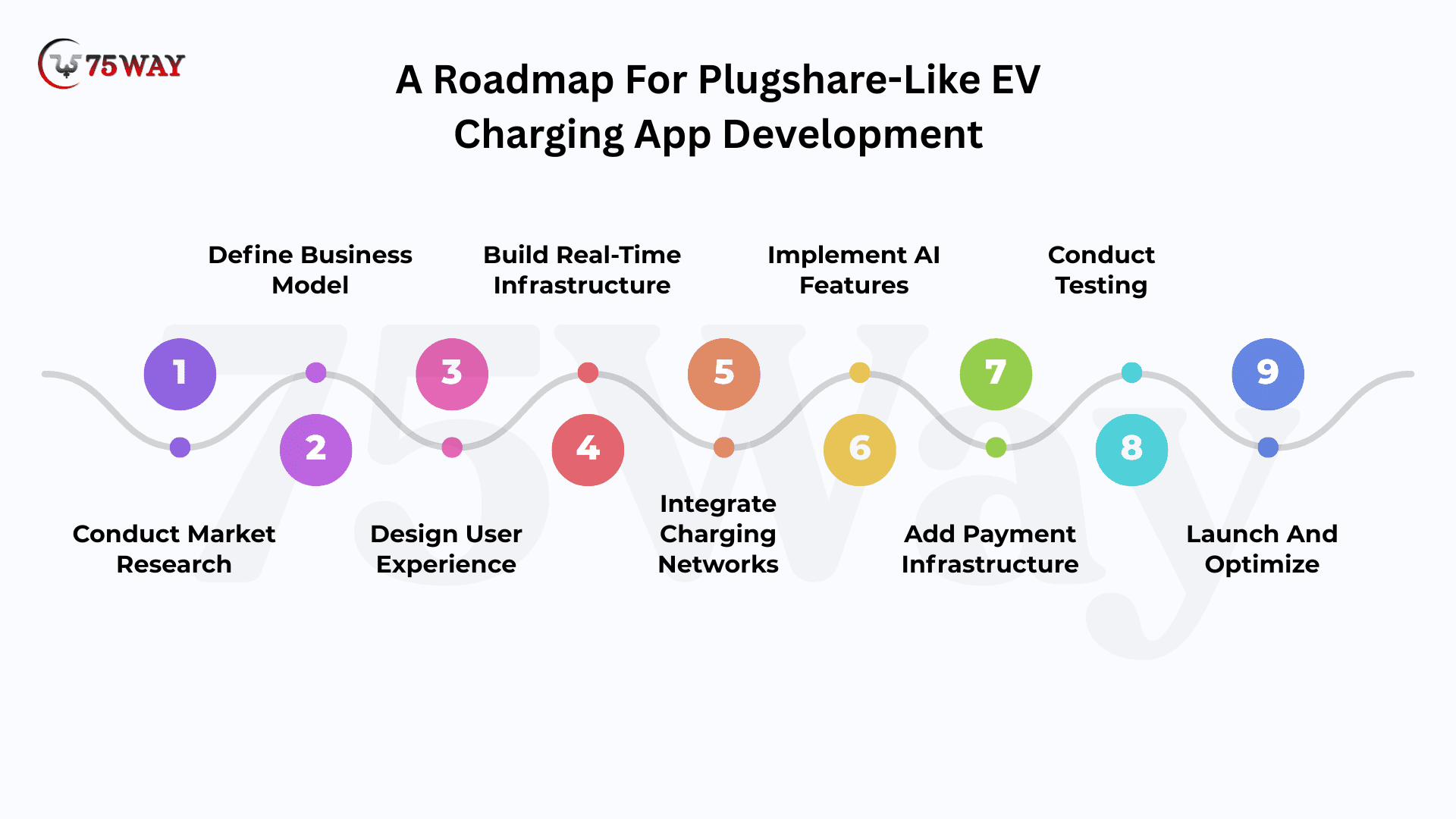
Step 1: Conduct Market Research
Before building anything, it is important to understand how the EV charging ecosystem is evolving and where real gaps exist. This step helps identify user expectations, competitor limitations, regional infrastructure gaps, and untapped opportunities that can shape a strong product foundation. You must analyze:
- EV adoption trends
- Competitor platforms
- Charging network gaps
- Regional infrastructure
- User pain points
Research helps identify underserved charging ecosystems and monetization opportunities.
Step 2: Define Business Model
Once market understanding is clear, the next step is selecting a sustainable business model that aligns with long-term growth goals. This ensures the platform is not only technically strong but also financially viable in different market conditions and user segments. Possible business models include:
- Charger aggregation platforms
- Fleet charging systems
- Subscription-based charging services
- Enterprise charging solutions
- White-label charging platforms
Step 3: Design User Experience
After defining the business direction, focus shifts toward designing a simple and distraction-free user experience. Since EV users often interact while traveling, the interface must be fast, intuitive, and optimized for quick decision-making in real-time conditions. UI/UX design priorities include:
- Dark mode support
- Clear navigation
- Large map visibility
- Fast charger filtering
- Minimal interaction complexity
Step 4: Build Real-Time Infrastructure
At this stage, the system architecture is developed to handle real-time data exchange between users, charging stations, and backend systems. This layer ensures continuous synchronization of charging availability, payments, and live session updates. Real-time architecture should support:
- Live charger status
- Session synchronization
- Payment processing
- Reservation systems
- IoT communication
Step 5: Integrate Charging Networks
Once the core system is ready, integration with external charging networks becomes essential to expand coverage and improve usability. This step ensures users can access multiple charging providers from a single unified platform. Applications may integrate:
- Open Charge Map
- ChargePoint APIs
- Proprietary charging networks
- OCPP-based infrastructure
Reliable integration determines platform usability.
Step 6: Implement AI Features
After core connectivity is established, AI capabilities are introduced to make the platform smarter and more predictive. These systems help optimize routes, improve charger recommendations, and manage energy usage more. AI systems improve:
- Route planning
- Charger recommendations
- Occupancy forecasting
- Energy optimization
Step 7: Add Payment Infrastructure
At this stage, secure and flexible payment systems are integrated to handle charging transactions smoothly. This includes support for multiple payment methods, subscriptions, and wallet-based systems to improve user convenience. Secure payment integration supports:
- Digital wallets
- Subscription billing
- Membership plans
- Session-based charging payments
Step 8: Conduct Testing
Before launch, rigorous testing ensures that all systems work reliably under real-world conditions. This includes validating real-time updates, GPS accuracy, payment security, and performance across different devices and usage scenarios.
Testing includes:
- Real-time synchronization testing
- GPS accuracy testing
- Battery optimization
- Payment security validation
- Cross-device compatibility
Step 9: Launch And Optimize
After deployment, continuous optimization ensures the platform scales effectively with user demand. This phase focuses on improving performance, enhancing user retention, and expanding charging network coverage based on real-time analytics.
Post-launch optimization focuses on:
- User retention
- Infrastructure scaling
- AI retraining
- Analytics monitoring
- Network expansion
Core Features Required In Building Plugshare-Like EV Charging Station App
Modern EV charging applications require intelligent features that simplify charging accessibility, route planning, payment processing, and real-time charger coordination. Businesses developing EV charging platforms must prioritize convenience, charging visibility, navigation accuracy, and seamless user experiences to support rapidly growing electric mobility ecosystems.
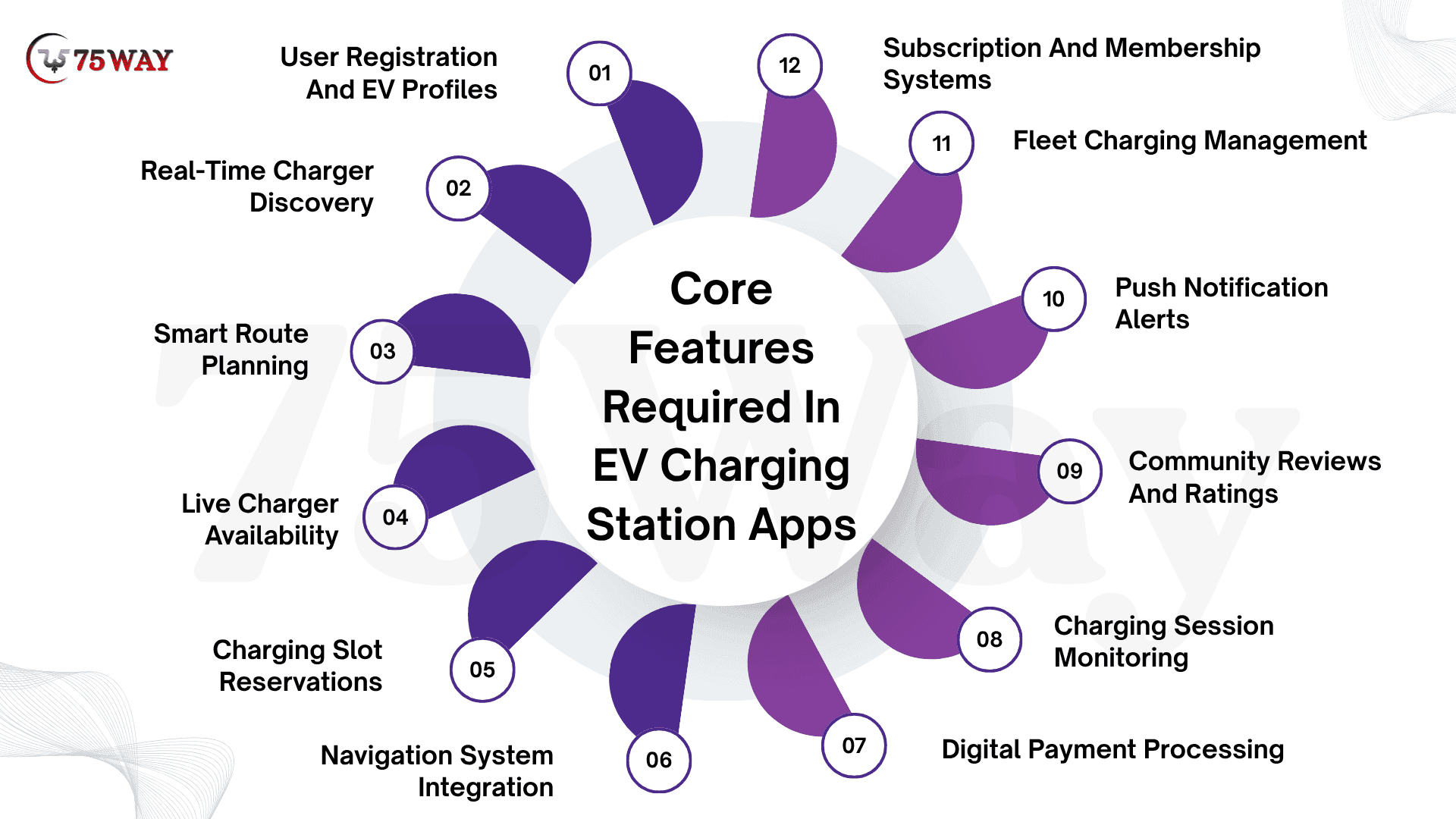
- User Registration And EV Profiles: Users create personalized EV profiles containing vehicle details, connector preferences, charging history, and payment methods. Customized profiles improve charging recommendations and travel planning accuracy.
- Real-Time Charger Discovery: Interactive maps display nearby charging stations with live availability, charger types, pricing details, and compatibility information. Real-time discovery simplifies charging access during travel.
- Smart Route Planning: Route planning systems identify charging stops based on battery levels, travel distance, and charger compatibility. Intelligent routing reduces range anxiety during long-distance journeys.
- Live Charger Availability: Applications display occupied chargers, offline stations, estimated waiting periods, and active charging sessions. Availability visibility improves user trust and charging convenience.
- Charging Slot Reservations: Reservation functionality allows drivers to secure charging slots before arriving at charging locations. Advance booking reduces waiting queues and operational congestion.
- Navigation System Integration: Applications integrate with Google Maps, Apple Maps, Waze, and in-app navigation systems for seamless routing. Integrated navigation improves charging accessibility across unfamiliar locations.
- Digital Payment Processing: EV charging apps support digital payments for charging sessions, subscriptions, and wallet management securely. Multiple payment options simplify transactions for diverse users.
- Charging Session Monitoring: Users track charging progress, battery percentage, charging duration, and energy consumption directly through mobile applications. Live monitoring improves operational transparency and charging visibility.
- Community Reviews And Ratings: Drivers share charger reviews, photos, maintenance updates, and reliability feedback within the platform. Community-generated insights help users evaluate charging station quality faster.
- Push Notification Alerts: Smart notifications inform users about charging completion, reservations, battery warnings, and nearby charger availability. Timely alerts improve charging coordination and engagement levels.
- Fleet Charging Management: Fleet-focused systems manage multiple vehicles, charging analytics, driver activity, and operational reporting within centralized dashboards. Fleet coordination simplifies enterprise EV charging operations.
- Subscription And Membership Systems: Membership systems provide charging packages, loyalty benefits, subscription plans, and premium charging access for frequent EV users. Subscription models create recurring revenue opportunities.
Advanced Features For Plugshare Clone App Development In 2026
Advanced EV charging applications now integrate artificial intelligence, predictive analytics, IoT infrastructure, and automation technologies to improve charging coordination, operational intelligence, and energy optimization. These advanced capabilities help businesses build scalable EV ecosystems supporting future mobility infrastructure and intelligent transportation experiences.
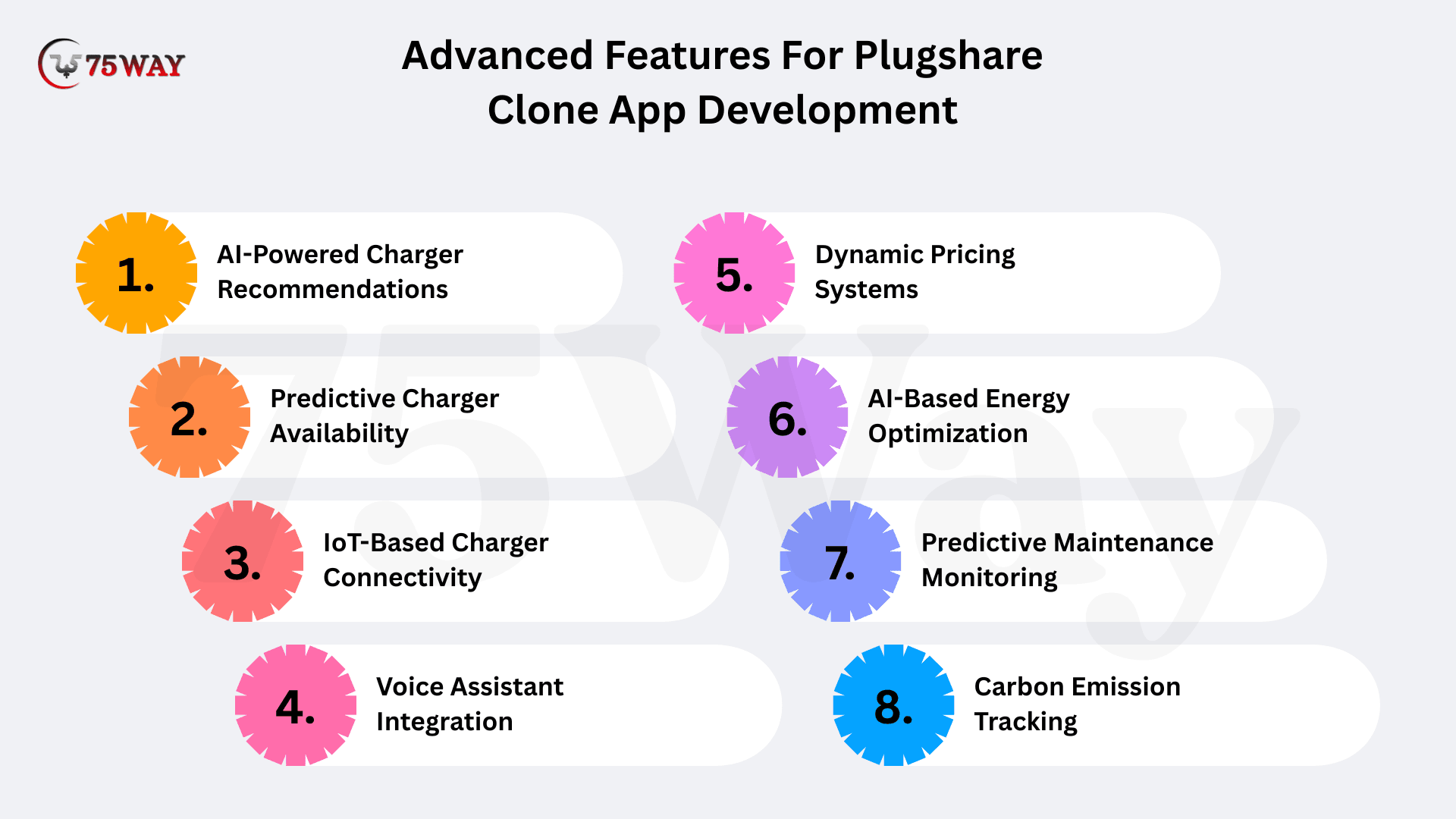
- AI-Powered Charger Recommendations: Artificial intelligence recommends suitable charging stations using battery levels, user behavior, traffic patterns, and travel history analysis.
- Predictive Charger Availability: Machine learning forecasts charger occupancy, waiting times, and station demand using historical charging behavior and live usage patterns.
- IoT-Based Charger Connectivity: IoT infrastructure connects charging hardware with applications for remote diagnostics, synchronization, and real-time charger monitoring capabilities.
- Voice Assistant Integration: Voice-enabled functionality allows hands-free charger search, route updates, charging control, and navigation interactions during driving sessions.
- Dynamic Pricing Systems: Dynamic pricing adjusts charging costs according to demand fluctuations, occupancy levels, electricity consumption, and charging durations.
- AI-Based Energy Optimization: Intelligent energy systems distribute charging loads efficiently to reduce electricity pressure during high-demand charging periods.
- Predictive Maintenance Monitoring: AI monitoring systems detect charger abnormalities early through performance analysis, reducing downtime and hardware failure risks.
- Carbon Emission Tracking: Sustainability dashboards calculate charging-related carbon savings and energy consumption patterns for environmentally conscious EV drivers and enterprises.
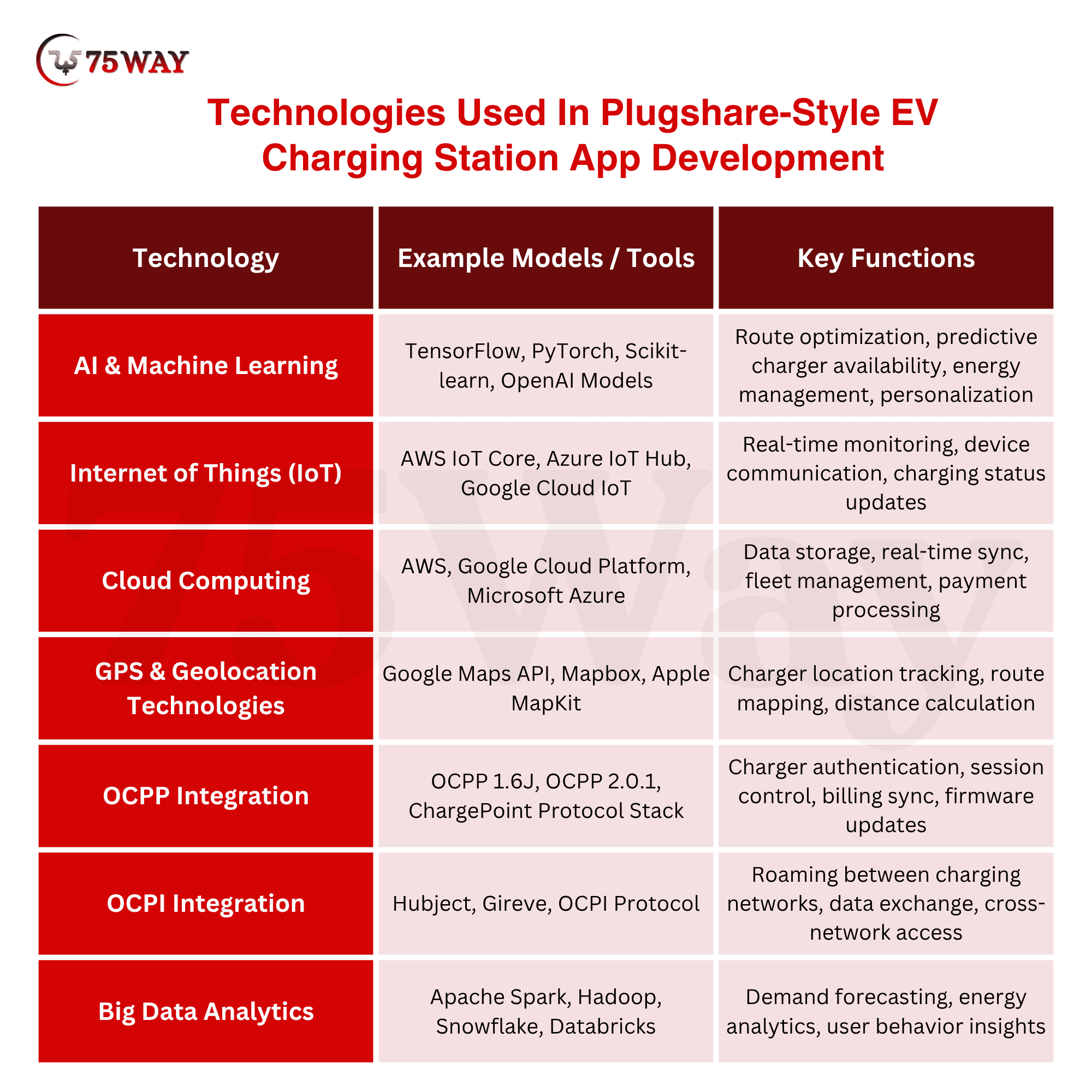
Technologies Used In Plugshare-Style EV Charging Station App Development
EV charging station app development requires multiple technologies working together to manage real-time charging operations, navigation, payments, IoT connectivity, and cloud infrastructure. Selecting the right technology stack directly impacts application scalability, charging synchronization, performance stability, and long-term operational reliability.
1. AI & And Machine Learning: AI technologies optimize route planning, charger recommendations, predictive availability analysis, and energy management systems using real-time behavioral and charging data.
2. Internet of Things (IoT): IoT frameworks connect EV chargers, charging stations, and mobile applications for continuous real-time monitoring and operational synchronization.
3. Cloud Computing: Cloud infrastructure supports:
- Real-time charger updates
- Data synchronization
- Scalability
- Payment processing
- Fleet analytics
4. GPS And Geolocation Technologies: Geolocation services enable:
- Charger mapping
- Navigation
- Distance calculation
- Real-time positioning
5. OCPP Integration: Open Charge Point Protocol (OCPP) enables communication between EV charging hardware and central management systems. OCPP supports:
- Charger authentication
- Session management
- Firmware updates
- Billing synchronization
6. OCPI Integration: Open Charge Point Interface (OCPI) enables interoperability between charging networks and roaming platforms.
7. Big Data Analytics: Big data systems process extensive charging information to identify:
- Charging trends
- Peak usage patterns
- Energy demand
- User behavior
How Does OCPP Integration Work in EV Charging Station Finding App Like Plushare?
OCPP (Open Charge Point Protocol) integration works as a standard communication bridge between EV charging stations and a central management system (backend platform). In simple terms, it allows your app to “talk” to chargers, no matter which manufacturer built them. Let’s break it down in a practical way.
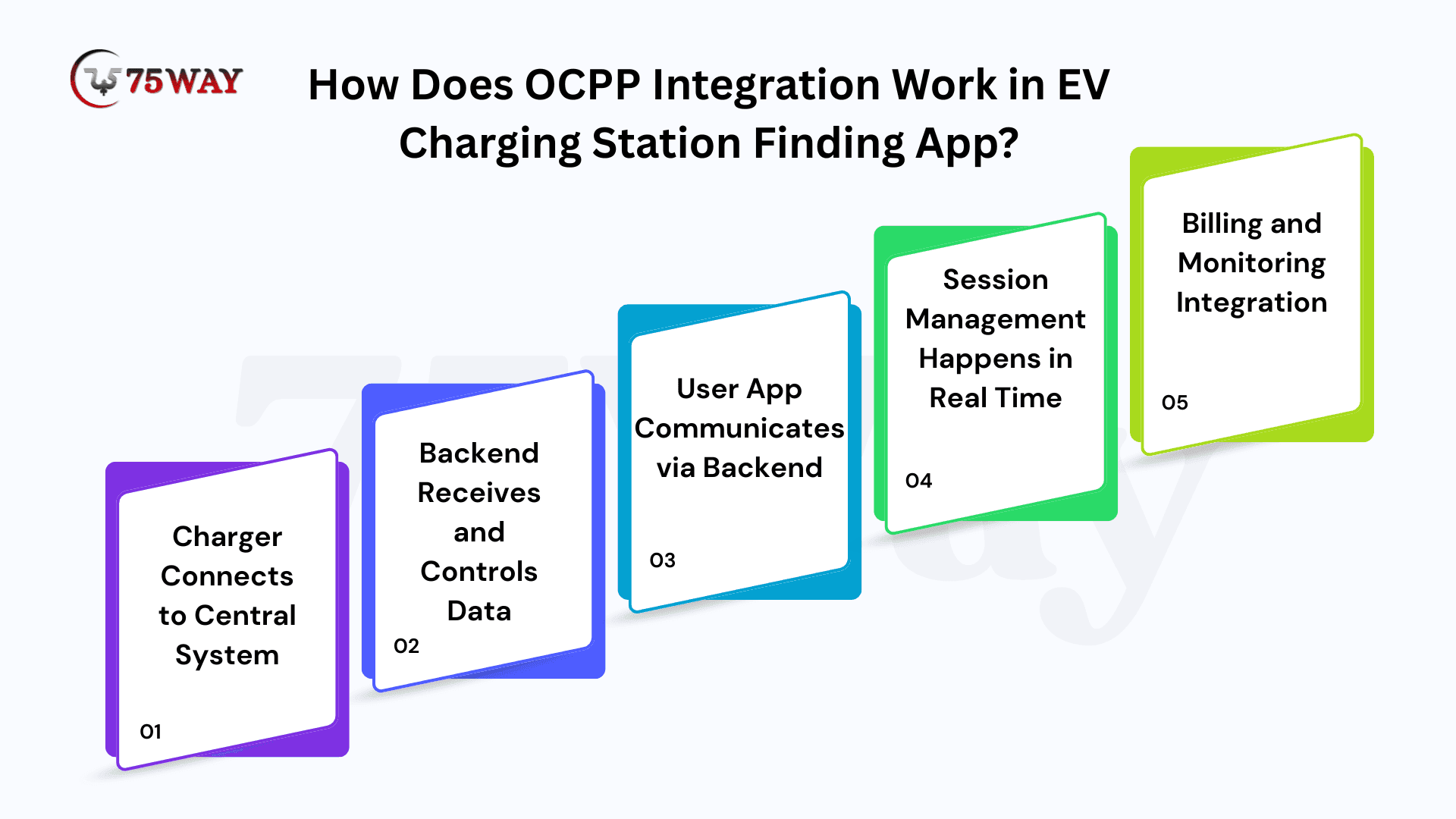
1. Charger Connects to Central System
Every EV charger (also called a charge point) connects to a central server using OCPP. This connection is usually made over the internet through secure WebSocket communication. Once connected, the charger continuously shares status updates like:
- Available or occupied
- Charging session started or stopped
- Fault or maintenance alerts
2. Backend Receives and Controls Data
Your backend system acts as the “brain” of the entire network. It receives real-time data from chargers and also sends instructions back. For example:
- Start charging session
- Stop charging session
- Authorize user access
- Monitor energy usage
This two-way communication is what makes OCPP powerful.
3. User App Communicates via Backend
The mobile app never talks directly to the charger. Instead, it communicates with the backend, which then interacts with OCPP-connected chargers.So the flow looks like this:
User App → Backend System → OCPP Protocol → Charging Station
This structure keeps the system secure and scalable.
4. Session Management Happens in Real Time
When a user plugs in their EV, OCPP manages the entire charging session lifecycle:
- Authentication of user/vehicle
- Session start and stop
- Energy consumption tracking
- Billing data generation
Everything is updated in real time.
5. Billing and Monitoring Integration
OCPP also helps collect charging data like:
- kWh consumed
- Charging duration
- Session cost
This data is then used by payment systems and dashboards for billing and analytics.
Tech Stack Used To Create EV Charging App Similar to PlugShare
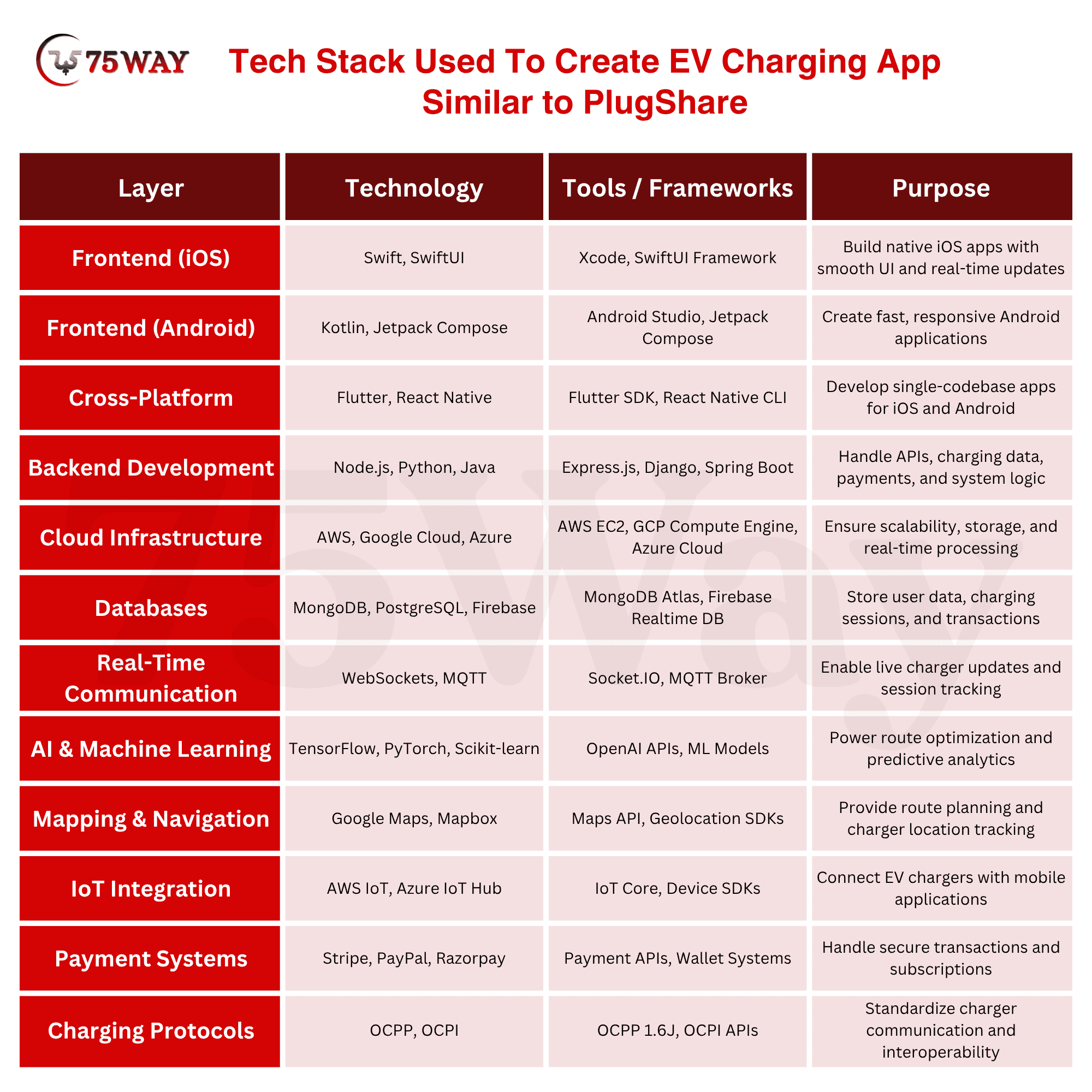
Building a plugshare-style EV charging application requires a carefully selected tech stack that supports real-time data processing, GPS tracking, payment integration, IoT communication, and scalable cloud infrastructure. A strong frontend, backend, and cross-platform strategy ensures smooth user experience, faster deployment, and long-term maintainability across Android, iOS, and web environments.
1. Frontend Development Stack
- iOS Development (Swift, SwiftUI): Use Swift and SwiftUI to build high-performance native iOS applications with smooth UI transitions and real-time charging station updates.
- Android Development: Build Android applications using Kotlin and Jetpack Compose to deliver responsive interfaces for EV users.
- Cross-Platform Frameworks: Leverage Flutter and React Native to develop cross-platform EV apps with a single codebase for Android and iOS.
2. Backend & Cloud Stack
Use Node.js, Python, and Java to build scalable backend systems that handle real-time charging data, user requests, and payment processing. These technologies ensure high-speed performance and reliable API communication across multiple services.
3. Cloud Infrastructure: Deploy EV charging applications on AWS, Google Cloud, or Microsoft Azure to ensure scalability, high availability, and secure data storage. Cloud platforms support real-time synchronization, fleet analytics, and global expansion capabilities.
4. Database & Real-Time Systems: Use MongoDB, PostgreSQL, and Firebase to manage structured and unstructured charging data. These databases support real-time updates for charger availability, user activity, and transaction history.
5. Real-Time Communication: Implement WebSockets and MQTT protocols for instant communication between charging stations and mobile applications. This ensures live updates on charging status, availability, and session monitoring without delays.
6. Payment & Integration Layer: Integrate Stripe, PayPal, and Razorpay to enable secure digital payments for charging sessions, subscriptions, and wallet transactions. These gateways ensure fast and encrypted financial operations.
7. Navigation APIs: Combine Google Maps API and Mapbox for real-time navigation, route optimization, and charger location tracking. These tools help users find nearby charging stations with accurate distance and availability data.
Monetization Strategies: How To Drive Revenue from Plugshare-Like App?
EV charging applications generate revenue through multiple scalable models designed around subscriptions, transactions, enterprise services, and data-driven insights. These monetization strategies help platform owners build sustainable income streams while supporting EV ecosystem growth, infrastructure expansion, and long-term operational scalability across global mobility networks.
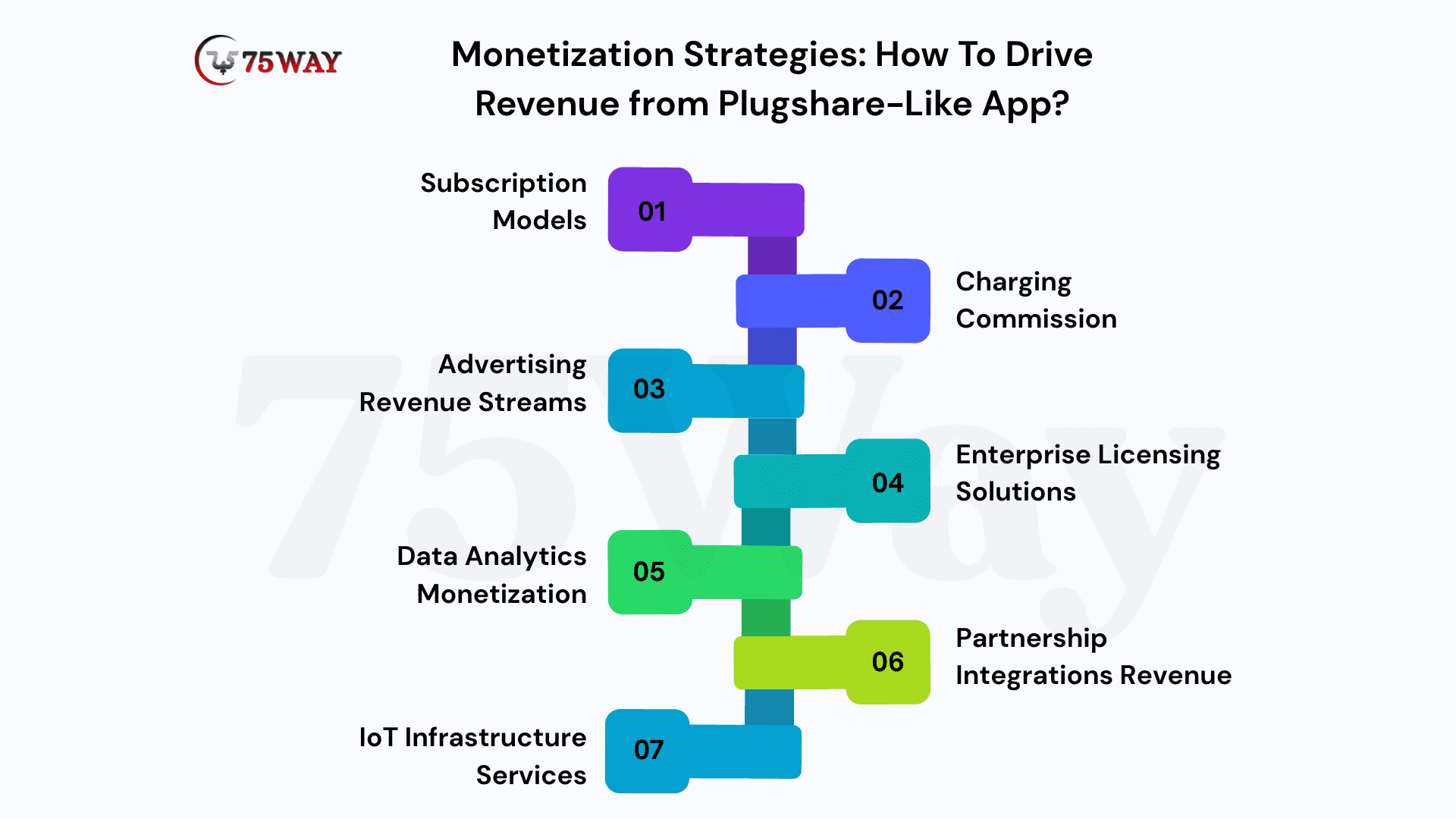
- Subscription Models: Premium subscription plans offer advanced route planning, real-time analytics, fleet management tools, and exclusive charging reservation access for frequent EV users and enterprises.
- Charging Commission: Platforms earn transaction-based commission fees whenever users complete charging sessions through integrated payment systems. This model scales revenue directly with platform usage growth.
- Advertising Revenue Streams: EV brands, automotive companies, and charging network providers place targeted advertisements within apps to reach high-intent electric vehicle users.
- Enterprise Licensing Solutions: Charging platforms provide white-label licensing systems for fleet operators and enterprises to manage large-scale EV charging operations.
- Data Analytics Monetization: Aggregated charging data is sold as insights for urban planning, fleet optimization, energy forecasting, and infrastructure development strategies.
- Partnership Integrations Revenue: Revenue is generated through strategic partnerships with charging networks, payment providers, and mobility service companies integrated into the platform.
- IoT Infrastructure Services: Platforms monetize connected charging hardware management, remote diagnostics, and real-time monitoring services for charging station operators.
Development Cost of EV Charging Station App Like Plugshare
The average cost of building an EV charging station app starts from around $25,000 for a basic MVP, where core features like charger discovery, map integration, and user reviews are included. As the platform scales to include real-time data, payments, and cross-platform apps, the cost typically moves into the $50,000–$120,000 range. Enterprise-grade solutions with AI-driven insights, fleet tools, and predictive systems can exceed $300,000 depending on complexity and infrastructure needs.
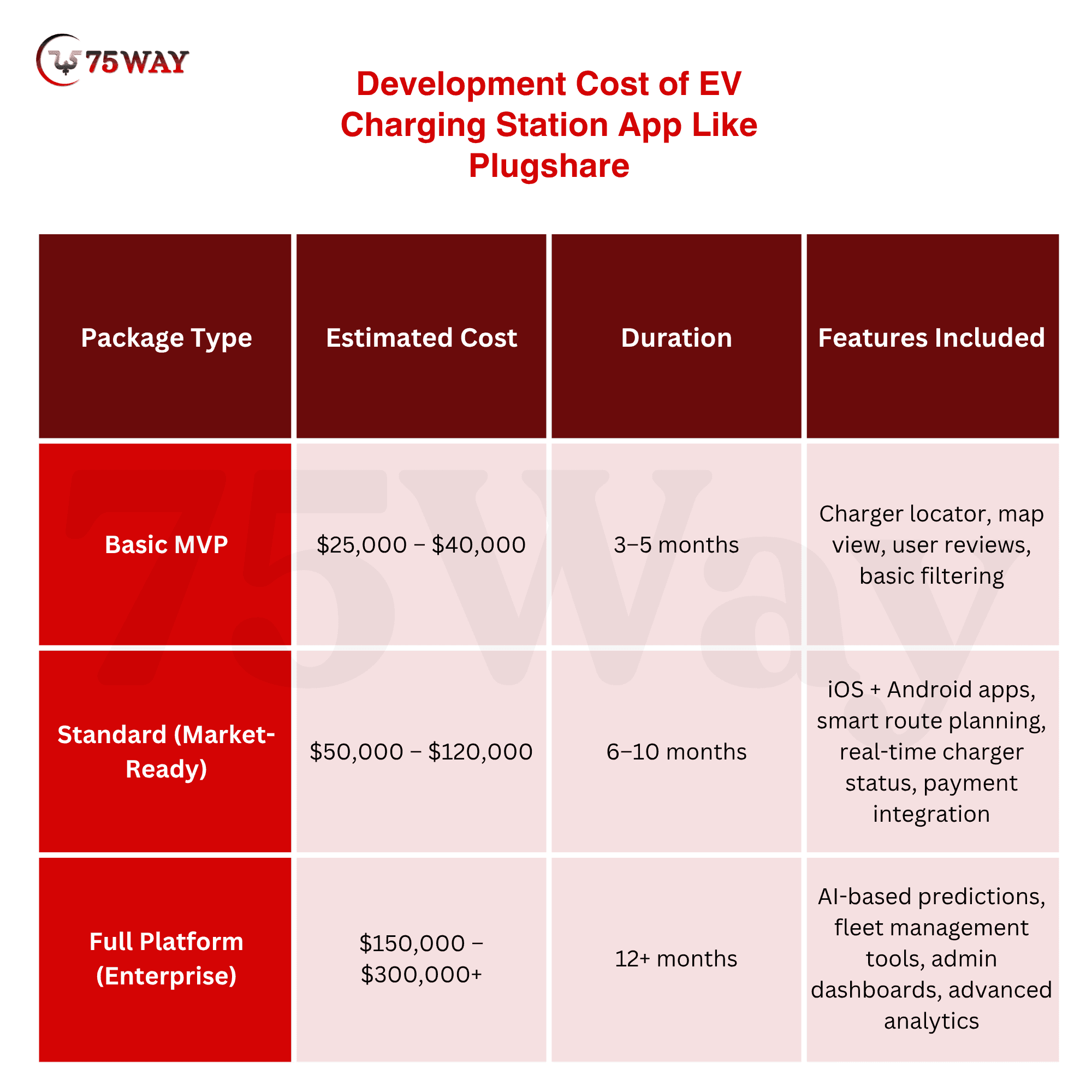
Industry estimates also show EV charging application development costs rise significantly when adding AI-driven recommendations, hardware integrations, reservation systems, and enterprise fleet capabilities.
Common Challenges In Building Plushare-Style EV App
EV charging app development comes with several technical and operational challenges because it depends on real-time data, hardware networks, financial systems, and rapidly growing user demand. These complexities make system reliability, scalability, and data consistency critical for long-term platform success.
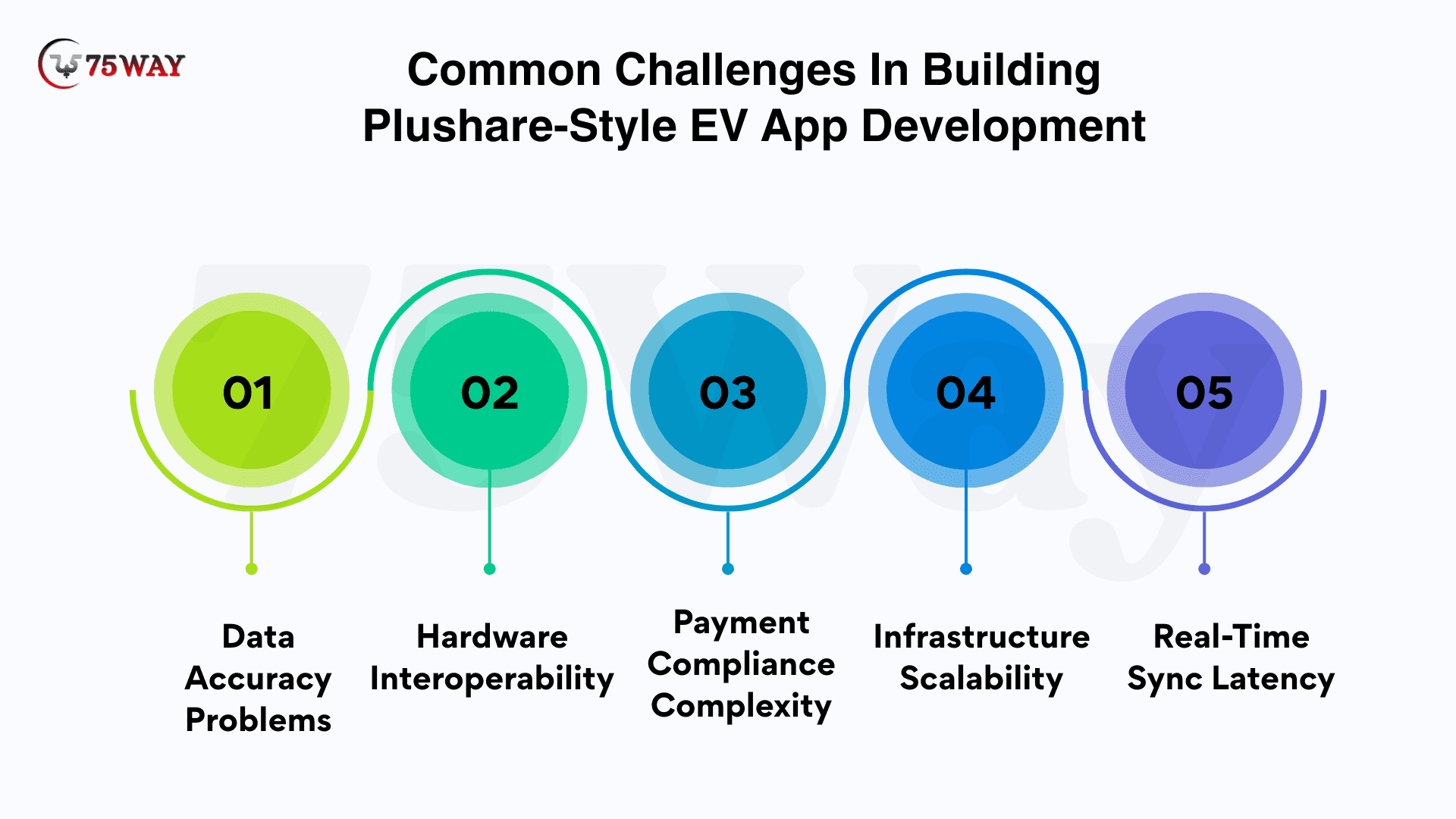
- Data Accuracy Problems: Real-time charger availability often becomes inconsistent due to network latency, hardware failures, and API synchronization gaps across charging networks and providers.
- Hardware Interoperability: Different EV charger manufacturers use diverse communication protocols and APIs, making unified integration across multiple charging networks technically complex and time-consuming.
- Payment Compliance Complexity: EV charging platforms must comply with global standards like PCI DSS and GDPR, along with regional financial regulations for secure digital transactions.
- Infrastructure Scalability: Increasing EV adoption places heavy load on backend systems, requiring scalable cloud architecture capable of handling high-volume real-time data and charging requests.
- Real-Time Sync Latency: Delays in updating charging session status, availability data, and energy usage can create mismatches between actual charger conditions and app-reported information, affecting user trust.
Conclusion
EV charging station apps are now essential in the global EV ecosystem, enabling smart charger discovery, route planning, and optimized travel experiences. Building an EV charging station app like PlugShare in 2026 requires far more than simple charger mapping functionality. Successful platforms combine AI-powered analytics, IoT infrastructure, cloud computing, OCPP integrations, real-time synchronization, predictive charging intelligence, and seamless user experiences to support scalable EV ecosystems. To launch a scalable EV charging platform like Plugshare with AI integration, Partner with a trusted app development company for revenue growth and long-term industry leadership.
Frequently Asked Questions (FAQs)
Can EV Charging Apps Work Without Internet Connectivity?
Many EV charging applications provide limited offline functionality, including saved routes, recently viewed charging stations, and cached navigation information. However, live charger availability, reservation systems, payment processing, and real-time synchronization typically require internet connectivity for accurate operational updates and seamless charging experiences.
Why Is OCPP Important For EV Charging Applications?
OCPP standardizes communication between charging hardware and management systems, helping applications support charger monitoring, billing synchronization, firmware updates, and remote session control. This interoperability improves compatibility across multiple charger manufacturers and simplifies large-scale EV charging infrastructure management significantly.
Which Connector Types Should EV Charging Apps Support?
Modern EV applications should support major connector standards including CCS, CHAdeMO, Type 2, Tesla Supercharger compatibility, and regional charging variations. Supporting multiple connector filters improves usability while helping drivers quickly identify compatible charging stations based on their vehicle specifications.
Can EV Charging Apps Support Fleet Management Systems?
Yes, enterprise-focused EV charging applications often include fleet management capabilities such as multi-vehicle monitoring, charging analytics, and centralized charging controls. Fleet charging management is becoming increasingly important for logistics, ride-sharing, and delivery businesses globally.
Why Do EV Charging Apps Need Cloud Infrastructure?
Cloud infrastructure enables scalable charger synchronization, real-time session monitoring, payment processing, analytics management, and multi-device accessibility. EV platforms continuously process extensive charging information from users, charging stations, and IoT systems for long-term operational performance and growth.
Are AI Features Necessary In EV Charging Applications?
AI features significantly improve route optimization, charger recommendations, predictive availability forecasting, and charging behavior analysis. While basic charger locator apps can function without artificial intelligence, AI-powered capabilities improve personalization, reduce waiting times, and create stronger user engagement.