AI Summary
AR/VR app development helps businesses create immersive customer experiences, improve product visualization, strengthen engagement, support training, and unlock growth opportunities. This blog explores key benefits, industry applications, ROI considerations, business use cases, and practical implementation value.
Key Takeaways
- AR/VR creates immersive experiences that can increase customer engagement and interaction.
- Businesses use AR/VR to improve visualization, training, conversions, and retention.
- AR helps customers interact with products before making important purchase decisions.
- VR enables immersive training, simulations, collaboration, and realistic customer experiences.
- Strategic AR/VR investments can create differentiation, efficiency, revenue, and growth.
For a business leader, investing in AR/VR app development makes little sense if the result is simply an impressive demo that customers try once and forget. But when customers can see how a sofa looks in their living room, explore a property before visiting, or try a product virtually, the experience can make the buying decision feel very different.
That is where AR and VR stop being “cool technology” and start becoming useful business tools. The commercial possibilities go beyond attracting attention, too. AR/VR applications can support product visualization, customer decision-making, employee training, remote assistance, brand experiences, and service delivery while giving businesses new ways to stand apart from competitors.
So, the question is no longer whether AR/VR looks impressive. The more useful question is what it can actually change inside your business. The opportunity depends on choosing the right problem rather than forcing AR/VR into the business, and this guide breaks down the major benefits of AR/VR app development and where these technologies can deliver practical business value.
Why Are Businesses Investing In AR/VR App Development?
AR and VR are moving from experimental technologies into practical digital business tools. Companies can use them to make digital interactions more visual, interactive, and experience-driven.
Traditional applications generally require users to interpret information through screens, menus, images, videos, and text. AR and VR can provide another layer of interaction by allowing users to visualize products, environments, processes, or experiences more naturally.
For businesses, this can create opportunities across the customer lifecycle.
A retailer may help shoppers visualize products before purchasing. A real estate company can provide virtual property tours. A healthcare organization can use immersive environments for education or training. A manufacturer can simulate equipment operation or workplace scenarios.
The opportunity is therefore broader than entertainment.
AR/VR app development can support marketing, sales, customer experience, employee training, product demonstration, education, collaboration, and operational workflows when the application is designed around a clear business objective.
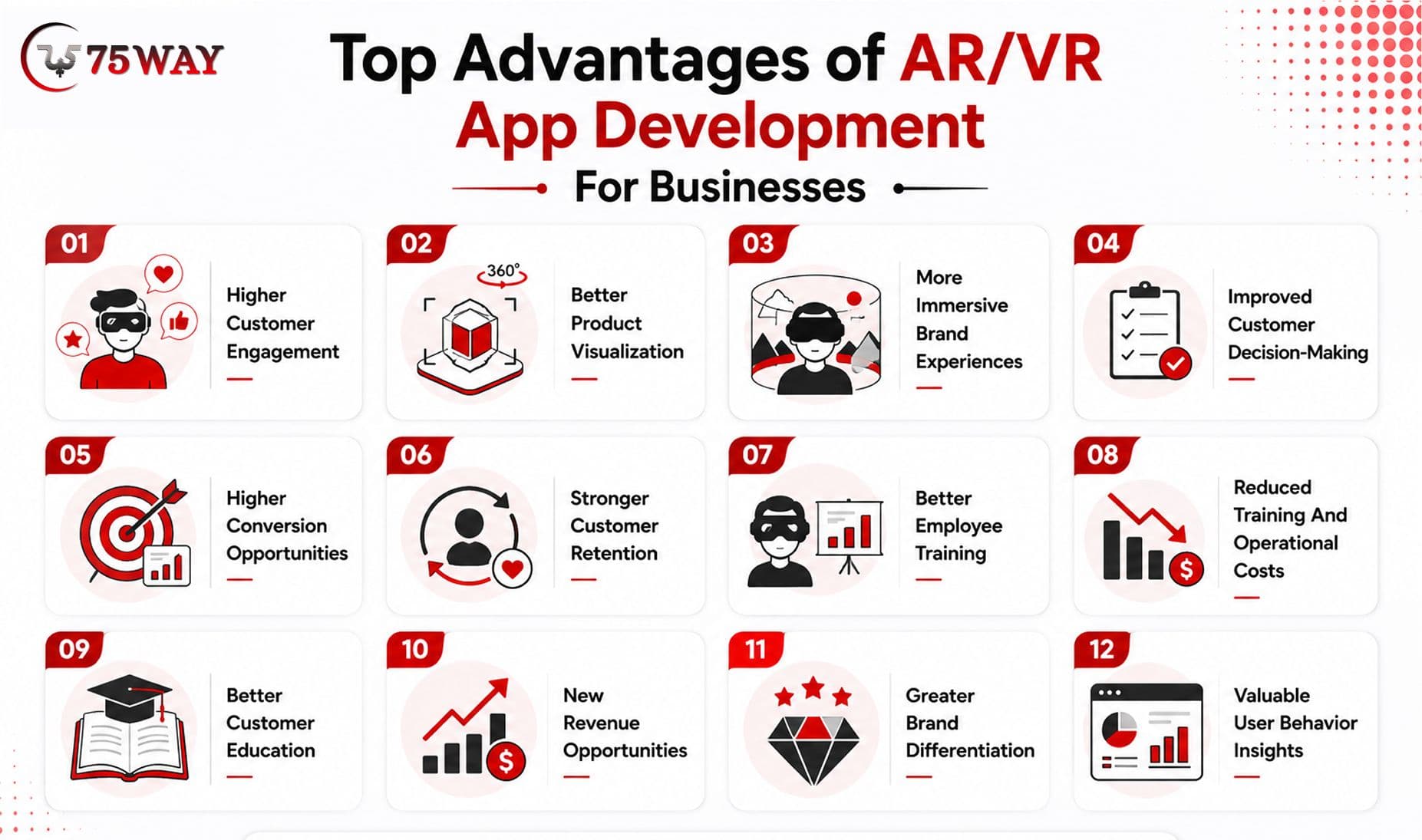
Top Advantages of AR/VR App Development For Businesses
A well-planned AR/VR application can do more than make a brand look innovative. It can help customers visualize before they buy, employees practice before they perform, and businesses deliver experiences that are difficult to recreate through traditional digital channels. The biggest advantages become clearer when you look at these practical business outcomes.
1. Higher Customer Engagement
One of the most important benefits of AR/VR app development is the ability to create more interactive customer experiences.
A conventional digital experience may allow users to view a product, read specifications, watch videos, or browse images. AR and VR can make the interaction more active.
Instead of simply viewing a product, customers may be able to:
- Place it inside their environment
- Explore it from different angles
- Customize visual elements
- Interact with virtual objects
- Experience a simulated environment
- Test different configurations
This additional interaction can make the customer journey more memorable.
For businesses, the objective should not be to maximize immersion simply for entertainment. The experience should help customers understand the product, make decisions, or interact with the brand in a more meaningful way.
2. Better Product Visualization
Product visualization is one of the strongest commercial applications of AR.
Customers often hesitate when they cannot accurately understand how a product will look, fit, or function in their environment.
AR can help reduce that uncertainty.
For example, a home furnishing company can let customers visualize furniture within their own rooms. A fashion retailer can provide virtual try-on experiences. An automotive business can allow customers to explore vehicle configurations digitally.
This can help transform a product page from a passive information source into an interactive decision-making experience.
The business advantage is particularly relevant for products where size, appearance, fit, configuration, or environment influence purchasing decisions.
3. More Immersive Brand Experiences
Customers encounter countless digital advertisements, product pages, social posts, and promotional campaigns every day.
AR/VR can give businesses another way to create memorable interactions.
A brand could create an AR campaign that lets users interact with a product through their phones. Another company could create a VR experience that allows customers to explore a destination, property, facility, or product environment virtually.
The goal is not simply to appear technologically advanced.
A successful immersive campaign connects the technology with a recognizable brand message and gives users a reason to participate.
When designed well, AR/VR can become part of the brand experience instead of functioning as another disconnected digital feature.
4. Improved Customer Decision-Making
Customers often need more information before committing to a purchase.
Images and descriptions may not always answer questions about scale, appearance, functionality, or real-world use.
AR and VR can provide a more experiential form of product information.
For instance, a customer considering a home appliance could potentially use AR to understand how the product fits within a kitchen layout. A prospective property buyer could explore a virtual representation of a property before scheduling an in-person visit.
This does not eliminate the need for traditional product information.
Instead, immersive experiences can complement product specifications, reviews, photographs, videos, and other decision-making resources.
5. Higher Conversion Opportunities
AR/VR can contribute to conversions by addressing uncertainty during the buying process.
When customers can better understand a product or experience before purchasing, businesses have an opportunity to make the decision process more informative.
Consider an online furniture store.
A customer may like a sofa but hesitate because they are unsure whether it will look appropriate in their living room. An AR visualization feature can help the customer answer that question before completing the purchase.
The AR feature does not guarantee a sale.
Its value lies in removing one potential barrier to purchase.
This distinction matters when businesses measure the performance of AR/VR applications. Instead of assuming that immersive technology automatically increases sales, companies should monitor relevant metrics such as product interaction, feature adoption, conversion rates, engagement duration, qualified leads, and customer feedback.
6. Stronger Customer Retention
Customer retention depends heavily on the experience customers have with a brand.
AR/VR can provide additional ways for customers to interact with products and services after the initial purchase.
For example, an AR application could provide interactive product instructions, setup assistance, maintenance guidance, or educational content.
A VR application could offer immersive learning, product demonstrations, or ongoing experiences associated with a service.
This creates opportunities for businesses to make their applications useful beyond the initial transaction.
The more relevant the experience remains over time, the greater its potential contribution to ongoing customer relationships.
7. Better Employee Training
AR/VR is not limited to customer-facing applications.
Employee training is another major area where immersive technology can provide practical value.
Traditional training may depend on presentations, manuals, videos, demonstrations, or supervised practice. VR can create simulated environments where employees can practice specific tasks within a controlled digital setting.
This can be particularly useful for:
- Manufacturing
- Healthcare
- Aviation
- Automotive
- Construction
- Logistics
- Retail
- Field services
- Workplace safety
Employees can potentially repeat scenarios and become familiar with processes before performing them in real environments.
For businesses, this can make training more interactive while supporting standardized learning experiences.
8. Reduced Training And Operational Costs
AR/VR can also create opportunities to reduce certain recurring operational expenses.
Consider a business that repeatedly trains employees on complex equipment. Bringing trainers, employees, equipment, and facilities together for every session can require significant resources.
A well-designed VR training environment can supplement existing training programs and provide repeatable simulations.
Similarly, AR applications can provide contextual instructions to field workers, technicians, or employees.
For example, an AR application could display digital guidance while a technician works with equipment.
The actual savings will vary significantly by business, implementation quality, workforce size, and use case. Therefore, companies should calculate expected ROI using their own training, travel, support, equipment, and operational costs rather than relying on generic industry percentages.
9. Better Customer Education
Some products and services are difficult to understand through text or static images alone.
AR/VR can make complex information easier to explore visually.
A healthcare organization can use immersive experiences to explain procedures or anatomy. A manufacturer can demonstrate how machinery operates. An educational platform can create interactive learning environments.
The benefit comes from converting abstract information into something users can observe and interact with.
This can be particularly valuable when the customer's understanding directly affects purchasing, training, adoption, or safe product usage.
10. New Revenue Opportunities
AR/VR can also support entirely new business models.
Companies can explore opportunities such as:
- Premium immersive experiences
- Virtual events
- Digital product experiences
- Subscription-based virtual environments
- AR-powered commerce
- Virtual training programs
- Interactive educational products
- Digital property experiences
- Immersive advertising
- Virtual product customization
Not every business needs to create a separate revenue stream.
In many cases, the better opportunity is using AR/VR to strengthen an existing business model.
For example, an ecommerce company may use AR to support product sales rather than charging users for the AR feature itself.
The right monetization strategy depends on the company's audience, product, market, and customer journey.
11. Greater Brand Differentiation
Competing products can sometimes appear similar when customers compare them through conventional websites or mobile applications.
An immersive experience can give a business another way to demonstrate its value.
This can be especially useful in competitive industries where customer experience is becoming an important differentiator.
However, technology alone does not create differentiation.
A poorly designed AR/VR application can become a novelty that users try once and abandon.
A strategically designed experience should provide a clear reason for customers to return, purchase, learn, explore, or interact with the business.
12. Valuable User Behavior Insights
Digital products can generate useful information about how users interact with experiences. AR/VR applications can potentially provide insights into:
- Frequently viewed products
- Interaction patterns
- Feature usage
- Session behavior
- Content preferences
- Virtual product configurations
- Training performance
- User navigation patterns
These insights can help product and marketing teams understand which experiences attract attention and where users encounter friction.
Businesses must, however, design analytics around appropriate privacy, consent, security, and data-governance requirements.
The objective should be to collect information that genuinely supports business or user outcomes rather than gathering unnecessary data.
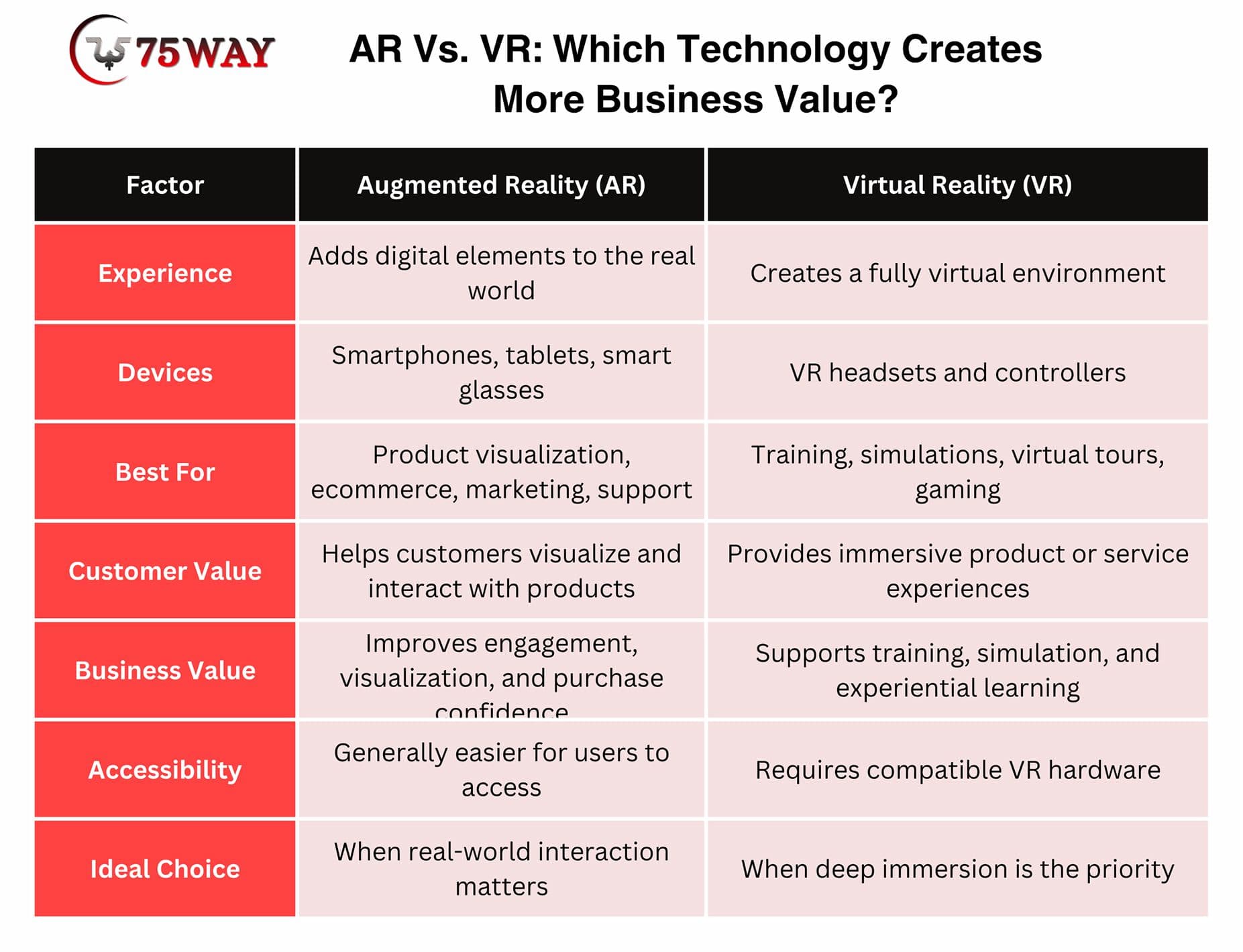
AR Vs. VR: Which Technology Creates More Business Value?
AR and VR provide different experiences, so the better choice depends on the business problem.
Augmented Reality (AR)
AR overlays digital content onto the user's physical environment. Customers typically interact with AR through smartphones, tablets, smart glasses, or other compatible devices.
AR can be particularly valuable when businesses want customers to interact with digital information while remaining connected to the real world. AR can be particularly valuable when businesses want customers to interact with digital information while remaining connected to the real world. Tools like Predis.ai for advertising content can also help businesses create engaging content for social media.
Common examples include:
- Virtual product placement
- Furniture visualization
- Virtual try-ons
- Interactive packaging
- Navigation assistance
- Product demonstrations
- Educational experiences
- Maintenance guidance
- Interactive advertising
For consumer-facing businesses, AR can reduce the gap between seeing a product online and understanding how it might fit into real life.
Virtual Reality (VR)
VR creates a simulated environment that users can experience through compatible headsets and controllers.
VR is particularly useful when businesses need controlled, immersive environments for training, simulation, visualization, or experiential applications.
Common examples include:
- Employee training simulations
- Virtual property tours
- Industrial simulations
- Healthcare training
- Virtual events
- Safety training
- Product demonstrations
- Entertainment experiences
- Remote collaboration
The important point is that AR is not automatically better than VR, and VR is not automatically more valuable than AR.
The appropriate technology depends on the audience, use case, hardware availability, development requirements, business objectives, and expected user behavior.
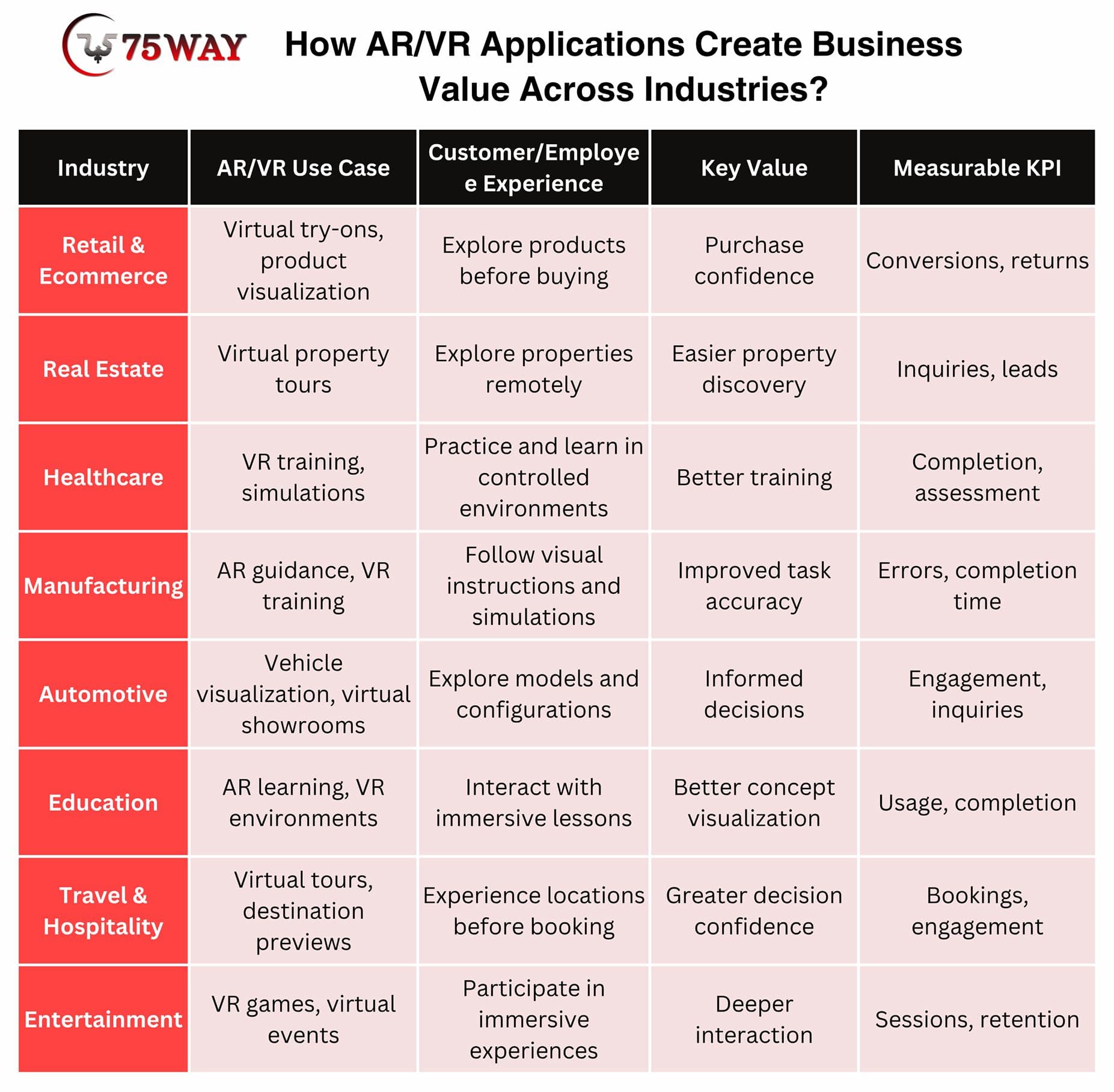
How AR/VR Applications Create Business Value Across Industries?
A virtual showroom, a simulated training environment, and an AR product preview may look completely different, but they can solve the same underlying problem: making experiences easier to understand and act on. Different industries are applying AR/VR in their own ways to achieve this. Let’s explore where these applications are creating measurable business value.
- Retail And Ecommerce
Retailers can use AR for virtual try-ons, product visualization, room placement, interactive catalogs, and product demonstrations.
The central business opportunity is reducing uncertainty before purchase.
- Real Estate
Real estate companies can provide virtual property tours, immersive property presentations, and digital representations of spaces that customers cannot immediately visit.
This can make property discovery more accessible for remote buyers and prospects.
- Healthcare
Healthcare organizations can explore VR for professional training, simulations, patient education, rehabilitation experiences, and other controlled environments.
AR/VR applications must be designed with appropriate safety, privacy, regulatory, and clinical considerations.
- Manufacturing
Manufacturers can use AR/VR for equipment visualization, employee training, assembly guidance, maintenance assistance, product design, and simulated operational environments.
The value often comes from improving understanding and reducing dependence on physical prototypes or repeated in-person training.
- Automotive
Automotive businesses can use immersive technology for vehicle visualization, configuration, virtual showrooms, training, and interactive product experiences.
Customers can explore different options before visiting a physical dealership.
- Education
Educational organizations can use VR to create simulated environments and AR to add interactive digital information to physical learning materials.
This can make certain concepts easier to visualize and explore.
- Travel And Hospitality
Hotels, tourism companies, and travel platforms can provide virtual destination previews, property tours, interactive experiences, and immersive promotional campaigns.
These experiences can help potential customers better understand what they are considering before booking.
- Entertainment
Entertainment remains one of the most recognizable applications of VR.
Businesses can develop immersive games, virtual events, interactive storytelling, experiences, and digital environments.
The commercial opportunity depends heavily on content quality, audience retention, distribution, and monetization.
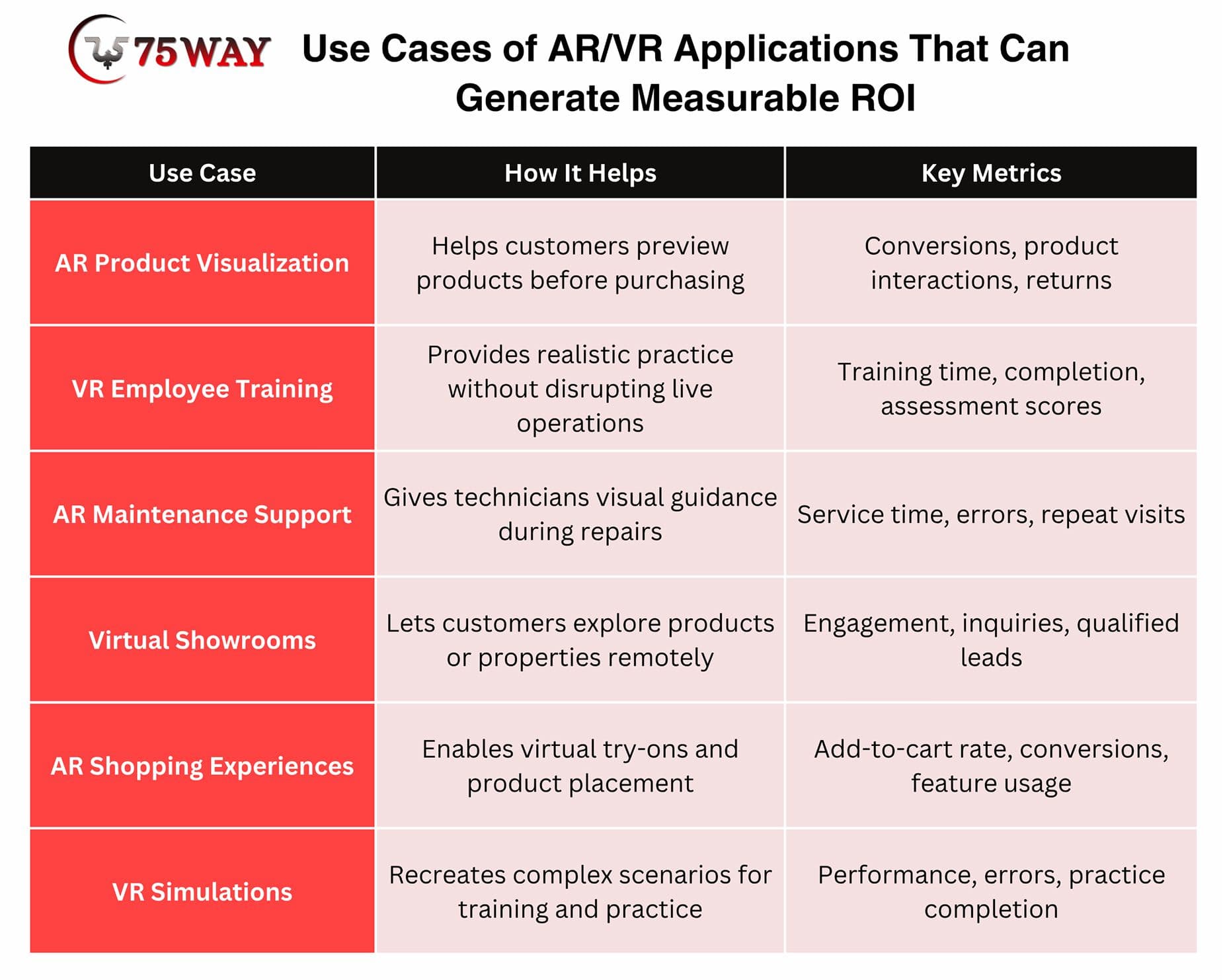
Use Cases of AR/VR Applications That Can Generate Measurable ROI
The strongest AR/VR projects connect technology with measurable business objectives. Here are several use cases worth evaluating:
AR/VR delivers stronger commercial value when each application addresses a specific goal, such as improving sales, reducing training expenses, increasing productivity, or attracting qualified leads. Here are practical use cases where results can be tracked.
- AR Product Visualization
Retailers can let customers see products within their own surroundings before purchasing. This works especially well for furniture, home appliances, fashion, and automotive products where size, appearance, and fit influence purchase decisions.
- VR Employee Training
Companies can create simulated environments where employees practice procedures, equipment handling, safety situations, and customer interactions. Results can be evaluated through completion rates, assessment scores, training duration, and employee performance.
- AR Maintenance Support
Technicians can use AR applications to access visual instructions while inspecting or repairing equipment. This can help shorten troubleshooting time, reduce mistakes, and support faster service completion.
- Virtual Showrooms
Brands can create virtual spaces where customers explore products, properties, vehicles, or facilities remotely. Useful metrics include visitor engagement, inquiries, demonstrations, qualified leads, and sales opportunities.
- AR-Powered Shopping Experiences
Retail apps can use AR to help shoppers virtually try products, compare options, or visualize items within their surroundings. Teams can monitor product interactions, add-to-cart activity, conversions, and feature adoption.
- VR Simulations
Organizations in manufacturing, healthcare, construction, and aviation can recreate complex scenarios through VR without requiring a complete physical setup. Training performance, practice frequency, errors, and readiness can help measure outcomes.
- Immersive Marketing Campaigns
Brands can create interactive AR experiences, virtual environments, and immersive campaigns that encourage active participation. Engagement rates, participation, leads, and campaign-driven conversions can indicate whether the experience is delivering value.
- AR-Guided Field Operations
Field teams can use AR to access contextual information during installation, inspection, repair, or servicing tasks. Completion time, task accuracy, repeat visits, and support requests can help measure the results.
The important word is potential.
AR/VR should be evaluated using business-specific KPIs rather than generic promises about guaranteed revenue growth.
Before development begins, define what success means.
For example:
“We want to increase product engagement.”
is weaker than:
“We want customers to use interactive product visualization and measure whether those interactions improve qualified product engagement and purchase completion.”
The second objective gives the development team something measurable to build toward.
How AR/VR Mobile App Development Improves The Customer Journey?
AR/VR mobile apps can make the customer journey more interactive by turning ordinary touchpoints into experiences customers can explore, visualize, and engage with. From discovering a product to using it after purchase, immersive features can add value at multiple stages.
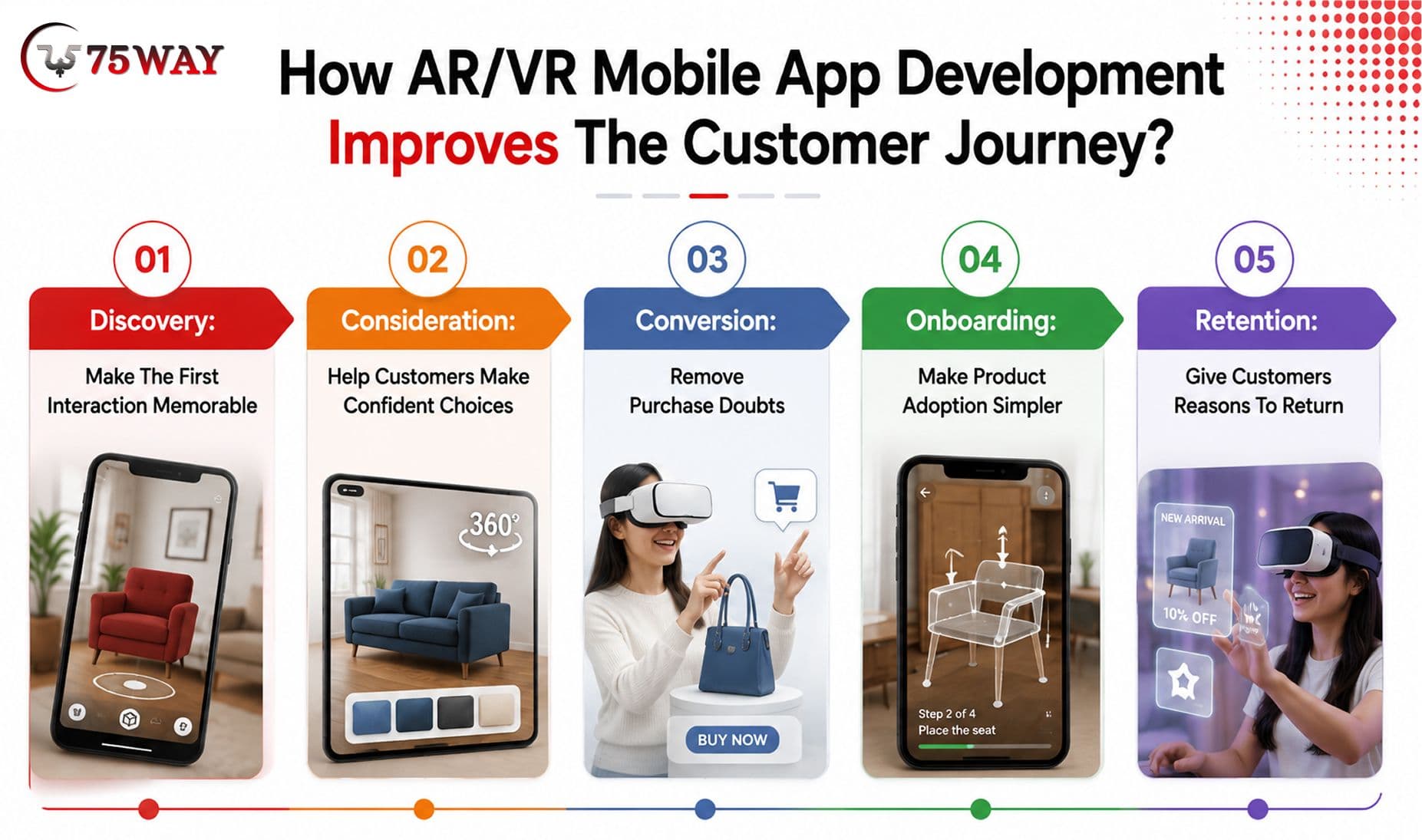
1. Discovery: Make the First Interaction Memorable
- Explore Before Clicking: Let customers interact with products, spaces, or experiences instead of simply viewing static images.
- Interactive Brand Experiences: Use AR filters, 3D elements, or immersive previews to encourage customers to engage with your brand.
2. Consideration: Help Customers Make Confident Choices
- Visualize Products: Allow shoppers to place products in their surroundings or explore them from different angles.
- Experience Before Buying: Use VR demonstrations to help customers understand how a product, service, or destination feels before making a decision.
3. Conversion: Remove Purchase Doubts
- Try Before You Buy: Enable virtual try-ons, product placement, or interactive demonstrations to address common buying concerns.
- Make Comparison Easier: Let customers explore different sizes, designs, configurations, or features within the app.
4. Onboarding: Make Product Adoption Simpler
- Interactive Setup: Use AR-guided instructions to show customers how to assemble, install, or configure products.
- Learn By Doing: Create immersive tutorials that help users understand features through practical interaction.
5. Retention: Give Customers Reasons to Return
- Post-Purchase Experiences: Offer AR product guides, interactive support, tutorials, or personalized content after purchase.
- Fresh Immersive Content: Introduce new experiences, features, challenges, or virtual interactions that keep the app useful over time.
The strongest applications therefore do not treat AR/VR as a standalone feature. They connect it with the broader customer experience.
Benefits of Building AR/VR Platform for Startups Vs. Established Businesses
The business case can look different depending on the organization's size and maturity.
For Startups
Startups can use AR/VR to differentiate new products, create innovative customer experiences, validate new concepts, and attract early adopters.
For a startup, however, building an expensive immersive application without validating demand can create unnecessary risk.
An MVP can help test a specific use case before expanding the product.
For example, rather than building a complete AR commerce platform, a startup could initially test product visualization for a limited product category.
This provides an opportunity to learn from real users before increasing development scope.
- Stand Out From Competitors: Create distinctive product experiences that give customers a stronger reason to notice, explore, and remember your offering.
- Validate Ideas With an MVP: Test one focused AR/VR use case, collect user feedback, and understand demand before committing to a larger product.
- Attract Early Adopters: Offer interactive experiences that appeal to technology-focused audiences and create opportunities to build initial traction.
- Explore New Revenue Models: Experiment with virtual experiences, immersive services, premium features, subscriptions, or AR-powered commerce to discover viable monetization opportunities.
For Established Businesses
Established companies may have more opportunities to integrate AR/VR with existing ecommerce platforms, CRM systems, customer applications, training systems, product databases, and enterprise workflows.
Their advantage may come from existing customers, data, distribution channels, and operational infrastructure.
For these businesses, the question is often not whether AR/VR is technically possible.
It is whether the technology can improve an existing process or customer experience enough to justify the investment.
- Enhance Existing Experiences: Add immersive features to ecommerce platforms, mobile apps, customer portals, product demonstrations, and digital services.
- Connect Existing Technology: Integrate AR/VR with CRM platforms, product databases, ecommerce systems, training tools, and internal workflows.
- Improve Training And Operations: Use immersive applications for employee training, equipment guidance, simulations, maintenance support, and field operations.
- Expand Digital Opportunities: Introduce new customer experiences, strengthen product engagement, and explore additional digital channels without starting the entire ecosystem from scratch.
What Determines The ROI of An AR/VR App?
AR/VR ROI depends on more than the development cost. Several factors can influence the business case.
1. Development Scope
A basic AR product visualization experience is very different from a sophisticated multi-user VR platform with real-time communication, 3D environments, analytics, and enterprise integrations.
2. Target Audience
The expected adoption rate depends partly on whether the target audience already has access to compatible devices and is comfortable using immersive applications.
3. Business Model
An AR feature supporting ecommerce sales has a different ROI model from a paid VR training platform.
4. User Adoption
Even a technically advanced application creates limited business value if customers or employees rarely use it.
5. Integration Requirements
Integration with ecommerce platforms, CRM systems, payment gateways, databases, IoT devices, or enterprise software can increase development complexity.
6. 3D Content Requirements
High-quality 3D assets, environments, animations, simulations, and interactive elements can represent a significant portion of project investment.
7. Maintenance And Updates
AR/VR applications require ongoing improvements, compatibility updates, content changes, bug fixes, analytics monitoring, and security maintenance.
For this reason, businesses should evaluate AR/VR investments using a broader equation:
AR/VR ROI = Business Gains + Cost Savings + New Revenue Opportunities − Total Technology Investment
The equation is simple, but the inputs should come from the company's actual business model. For example, a retail company investing in an AR product visualization feature can estimate ROI by comparing additional sales influenced by the feature and potential savings from fewer product returns against development, integration, maintenance, and 3D asset costs.
If the AR feature contributes $80,000 in additional revenue and $20,000 in cost savings, while the total investment is $50,000, the estimated ROI value would be:
ROI: $80,000 + $20,000 − $50,000 = $50,000
This example is illustrative; actual results depend on user adoption, implementation costs, and measurable performance.
When Should A Business Invest In AR/VR App Development?
AR/VR may be worth exploring when a business has a clear problem that immersive technology can address better than conventional digital experiences.
Strong indicators include:
- Customers struggle to visualize products.
- Products require demonstrations before purchase.
- Employees need repeated practical training.
- Physical simulations are expensive or difficult.
- Customers are distributed across different locations.
- The company competes heavily on customer experience.
- The business wants to introduce a new digital revenue channel.
- Existing digital experiences do not adequately communicate complex products.
- The organization has measurable objectives for an immersive experience.
On the other hand, AR/VR may not be the right investment when the only objective is to “use emerging technology.”
A business should first identify the problem, audience, expected outcome, and success metrics. Technology should follow the business strategy, not replace it.
Final Thoughts
The biggest benefit of AR/VR app development is not simply creating an immersive digital experience. It is using immersive technology to solve a meaningful customer or operational problem.
AR can help customers visualize, explore, compare, and interact with products in their surroundings, while VR can create controlled environments for training, simulation, education, collaboration, entertainment, and product demonstrations.
The real opportunity extends beyond engagement. A well-planned AR/VR solution can support stronger customer experiences, better decision-making, improved training, operational improvements, and new revenue opportunities.
The strongest AR/VR applications connect technology with a clear business objective. Instead of asking, “How can we use AR or VR?” companies should ask:
“What customer or operational problem could become easier, clearer, faster, or more valuable through an immersive experience?” That answer provides a stronger foundation for deciding whether AR/VR app development is worth the investment.
Ready to turn an AR/VR concept into a practical digital solution? Partner with 75way to plan, build, and scale an immersive application around your specific goals.
Frequently Asked Questions (FAQs)
What Are The Main Benefits of AR/VR App Development?
The main benefits include higher engagement, better product visualization, immersive customer experiences, improved training, stronger brand differentiation, customer education, operational support, and new revenue opportunities.
Is AR or VR Better For Business Applications?
Neither is universally better. AR works well when users need digital information within their physical environment, while VR is useful for immersive simulations, training, virtual environments, and controlled experiences.
How Can AR Increase Ecommerce Sales?
AR can help customers visualize products in their surroundings or experience virtual try-ons, potentially reducing purchase uncertainty and helping them make more informed buying decisions.
Can AR/VR Help Reduce Business Costs?
Yes. Depending on the use case, AR/VR can support training, remote assistance, product demonstrations, simulations, and operational guidance, which may reduce certain recurring costs.
Which Industries Benefit Most From AR/VR?
Retail, ecommerce, real estate, healthcare, manufacturing, automotive, education, travel, hospitality, entertainment, and training-heavy industries can all benefit from appropriate AR/VR applications.
Does AR/VR App Development Guarantee Higher Revenue?
No. AR/VR does not automatically generate revenue. Results depend on the use case, user adoption, application quality, business model, implementation, and how well the experience addresses a genuine customer or operational need.
How Can A Business Measure AR/VR App Performance?
Businesses can measure metrics such as engagement, feature adoption, conversion rates, qualified leads, training completion, session duration, customer feedback, support volume, and revenue contribution based on the application's objective.
Is AR/VR Suitable For Startups?
Yes, but startups should validate the business case before committing to a large-scale product. An MVP focused on one high-value use case can help test demand and user behavior.