Summary
AI solutions empower businesses to automate processes, enhance decision-making, and deliver personalized experiences at scale. By understanding types, use cases, benefits, and implementation strategies, organizations can unlock real value. Success depends on clear goals, quality data, and the right execution approach. With a structured plan, businesses can overcome challenges and turn AI into a powerful growth driver.
Key Takeaways
- AI solutions streamline operations, improve efficiency, and enable smarter data-driven business decisions.
- Choosing the right AI approach depends on clear goals and defined business challenges.
- High-quality data plays a critical role in ensuring accurate insights and reliable outcomes.
- Starting with pilot projects helps reduce risks and validate AI implementation effectively.
- Continuous optimization ensures AI systems evolve with business needs and market demands.
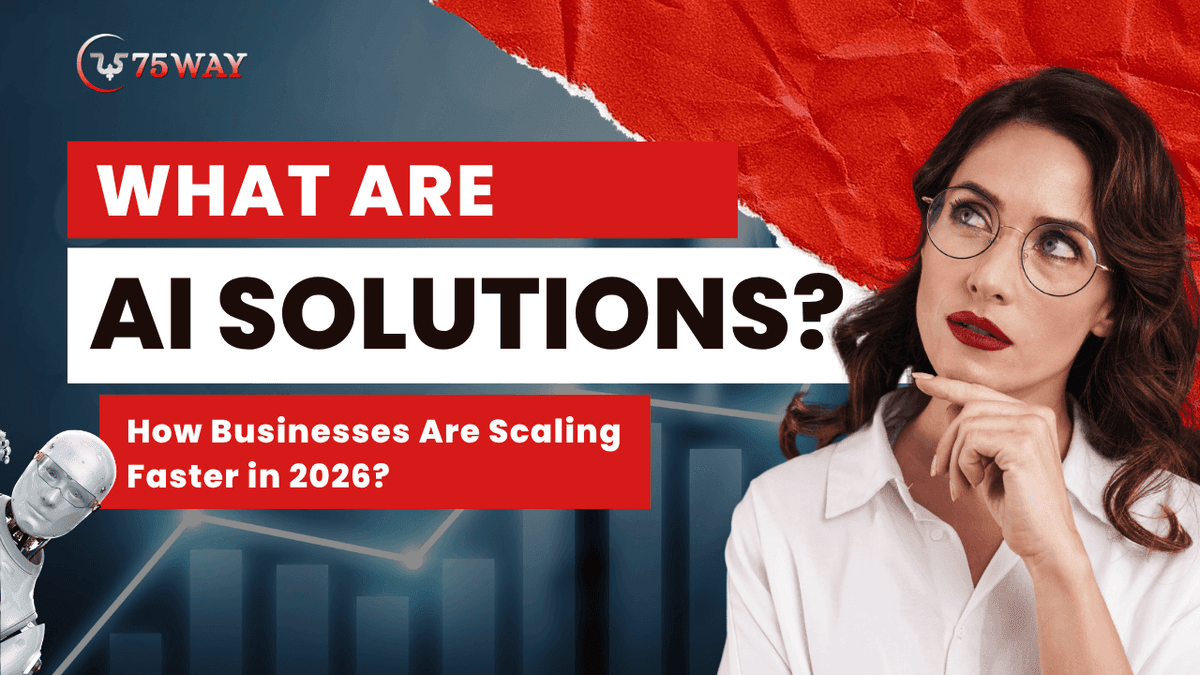
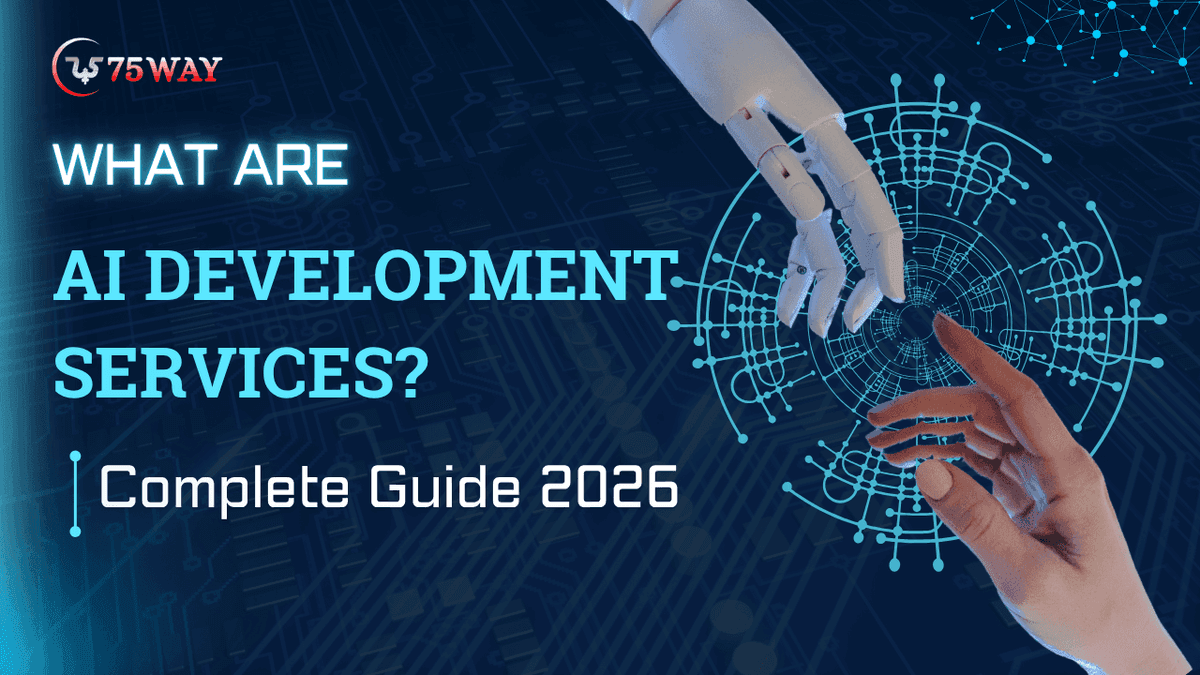
Artificial Intelligence (AI) solutions are no longer futuristic concepts. They are practical, results-driven technologies reshaping how modern businesses operate. From automating repetitive processes to delivering predictive insights and personalized customer experiences, AI development is becoming a core driver of efficiency, innovation, and competitive advantage. Startups and enterprises alike are leveraging AI to streamline operations, reduce costs, and unlock smarter decision-making at scale.
But what exactly are AI development services, and how can your business use them effectively? In this guide, we break down the concept in simple terms, explore real-world examples across industries, and highlight practical use cases you can implement today. You will also discover how AI drives revenue and growth, and how to choose the right AI solution tailored to your business goals.
What Are AI Solutions?
AI solutions are software systems or tools that use artificial intelligence technologies, such as machine learning, natural language processing, and computer vision, to automate tasks, analyze data, and make intelligent decisions with minimal human intervention.
They are designed to replicate human intelligence in specific scenarios, enabling systems to learn from data, recognize patterns, and continuously improve performance over time. This allows businesses to move from reactive processes to proactive, data-driven strategies that enhance accuracy, speed, and overall efficiency.
For example, when you get personalized recommendations on Netflix or use voice commands through Google Assistant, you’re already experiencing AI software solutions in your daily life. Even spam filters in your email or navigation apps, suggesting faster routes are powered by AI development working behind the scenes.
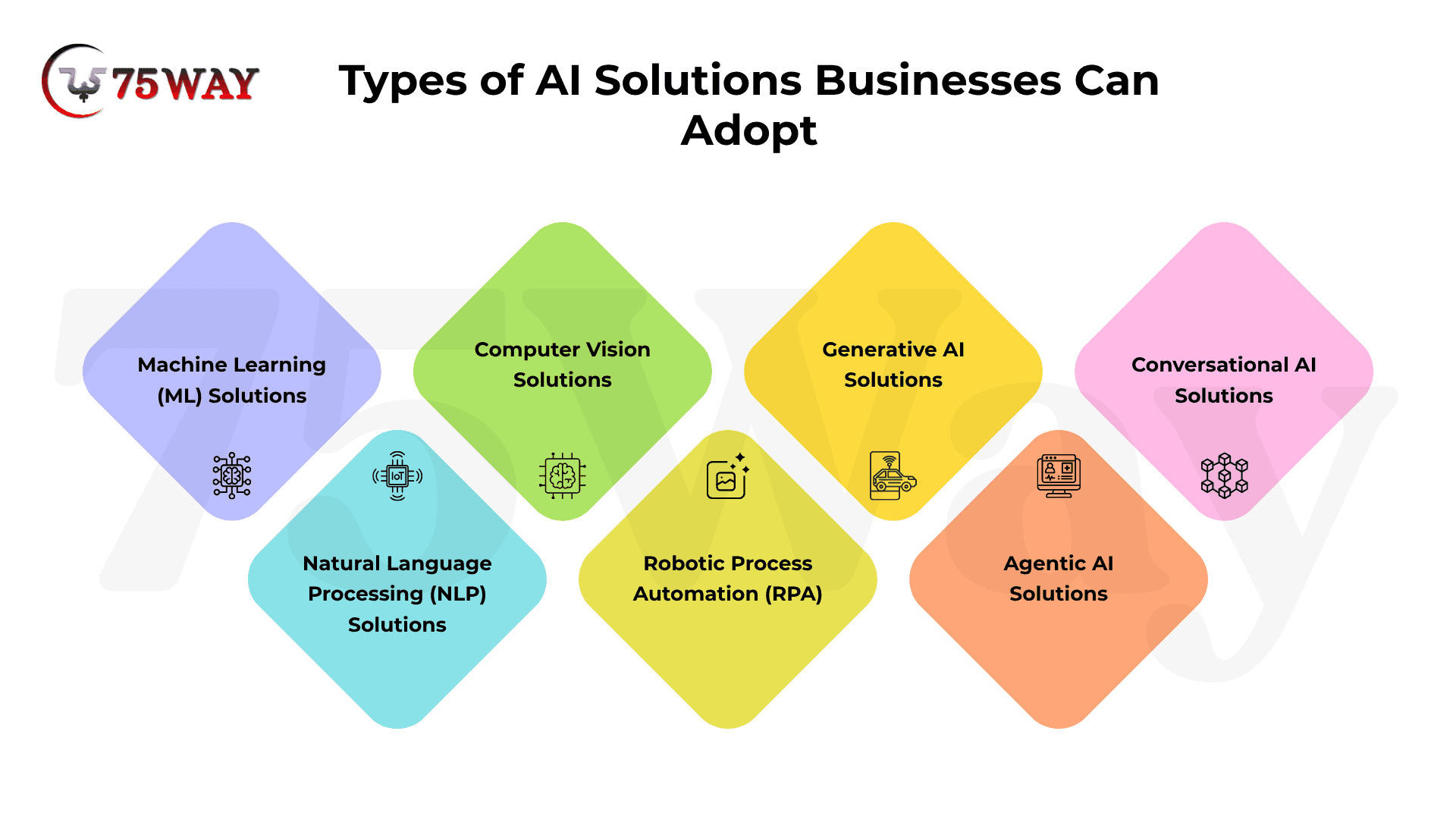
Types of AI Solutions Businesses Can Adopt
Understanding different types of AI development solutions helps you choose the right technology based on your business needs, goals, and operational challenges.
Machine Learning (ML) Solutions
Machine Learning solutions use algorithms that learn from historical data to identify patterns and make predictions without being explicitly programmed. These systems continuously improve their accuracy as more data becomes available, making them ideal for data-driven decision-making. Businesses commonly use ML for sales forecasting, fraud detection, recommendation engines, and demand prediction.
- Predictive Analytics Modeling Systems
- Customer Behavior Analysis Tools
- Fraud Detection Monitoring Systems
- Recommendation Engine AI Platforms
- Demand Forecasting Intelligence Tools
- Data Pattern Recognition Systems
Natural Language Processing (NLP) Solutions
Natural Language Processing solutions enable machines to understand, interpret, and respond to human language in both text and speech formats. This allows businesses to automate communication and extract meaningful insights from large volumes of unstructured data. Common applications include chatbots, email automation, sentiment analysis tools, and virtual assistants.
- AI-Powered Chatbot Systems
- Text Analysis Processing Tools
- Sentiment Analysis Intelligence Platforms
- Email Automation AI Systems
- Language Translation Processing Tools
- Speech Recognition AI Systems
Computer Vision Solutions
Computer vision solutions allow machines to analyze and interpret visual information from images and videos. By recognizing patterns, objects, and features, these systems can make decisions based on visual data. Businesses use computer vision for facial recognition, quality inspection in manufacturing, surveillance systems, and medical imaging analysis.
- Image Recognition Processing Systems
- Video Analysis Intelligence Tools
- Facial Recognition AI Systems
- Object Detection Vision Platforms
- Visual Quality Inspection Tools
- Medical Imaging Analysis Systems
Robotic Process Automation (RPA)
Robotic process automation focuses on automating repetitive, rule-based tasks that typically require manual effort. RPA bots can mimic human actions such as data entry, form processing, and workflow management, improving speed and accuracy while reducing operational costs. Common use cases include invoice processing, HR onboarding workflows, and back-office automation.
- Automated Data Entry Systems
- Invoice Processing Automation Tools
- AI Workflow Automation Platforms
- HR Onboarding Process Systems
- Rule-Based Task Automation Bots
- Back-Office Operations Automation Tools
Generative AI Solutions
Generative AI solutions are designed to create new content such as text, images, code, audio, or even video. These systems are powered by advanced models that can generate human-like outputs based on input prompts. Businesses use generative AI for content creation, design automation, marketing copy generation, and AI-powered code assistants.
- AI Content Generation Tools
- Image Creation AI Systems
- Code Generation Assistant Platforms
- Audio Synthesis AI Tools
- Marketing Copywriting AI Systems
- Design Automation AI Platforms
Agentic AI Solutions
Agentic AI solutions are advanced systems designed to act autonomously, make decisions, and perform multi-step tasks with minimal human input. Unlike traditional AI, these solutions can plan, reason, and execute actions based on goals, often interacting with multiple tools or systems. Businesses use agentic AI for workflow automation, intelligent task management, autonomous research, and end-to-end process execution across departments.
- Autonomous AI Agent Solutions
- Multi-Step Workflow Automation Tools
- Intelligent Decision-Making Agents
- Cross-Platform Integration AI Systems
- Goal-Driven Planning AI Agents
- Self-Learning Adaptive AI Systems
Conversational AI Solutions
Conversational AI solutions enable real-time, human-like interactions between users and machines through text or voice interfaces. These systems combine natural language processing with contextual understanding to deliver accurate and personalized responses. Common use cases include AI chatbots, virtual assistants, customer support automation, and voice-based service systems that enhance user experience and engagement.
- AI-Powered Chatbot Systems
- Voice Assistant Interaction Tools
- Customer Support Automation Platforms
- Context-Aware Conversation Engines
- Omnichannel Communication AI Platforms
- Speech-To-Text Processing Systems
Benefits of AI Development Solutions for Businesses
AI solutions are transforming how businesses operate by improving efficiency, reducing costs, and enabling smarter decision-making. By integrating AI into daily operations, organizations can streamline processes, enhance productivity, and stay competitive in an increasingly data-driven and fast-paced digital landscape.
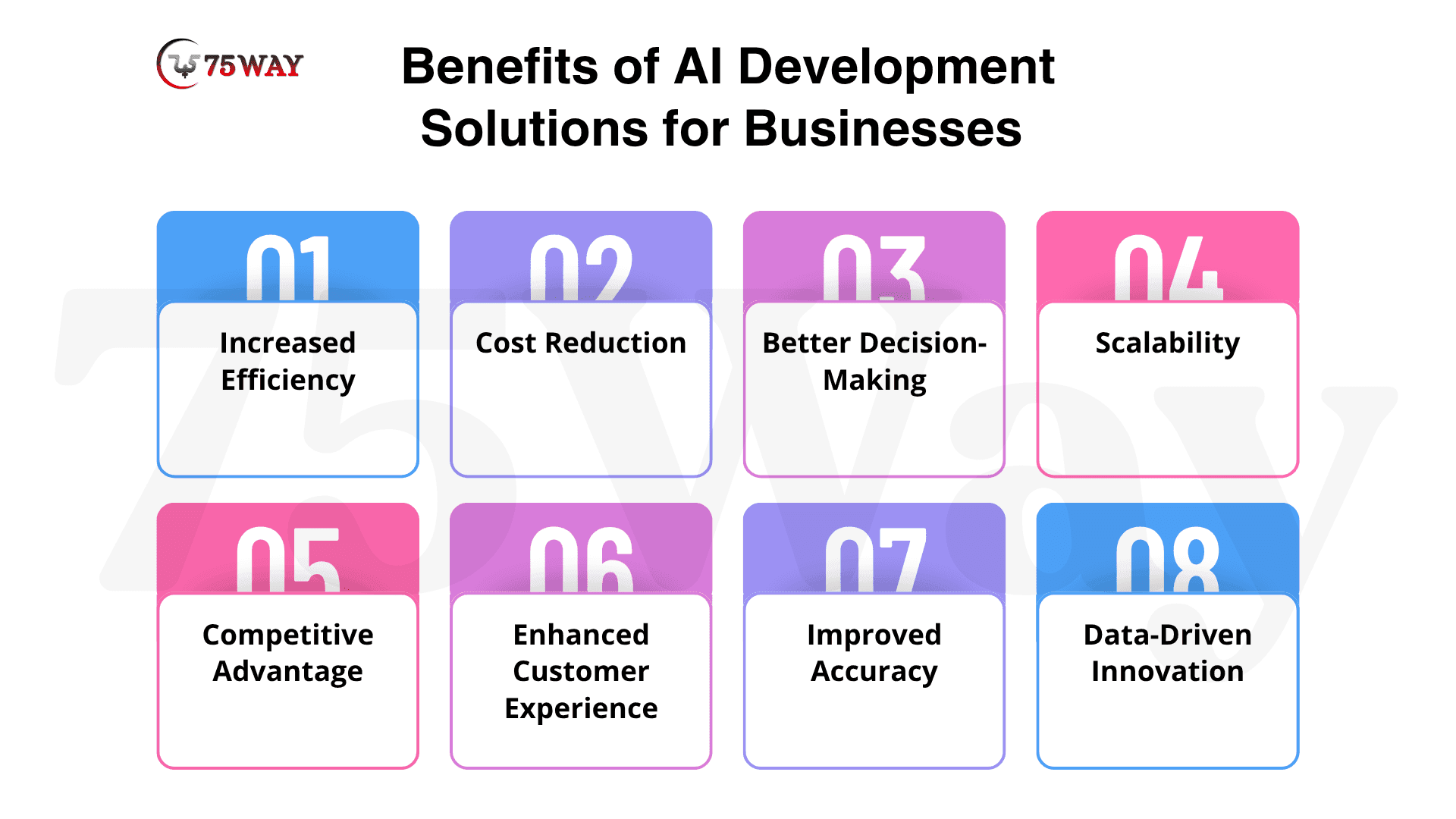
Increased Efficiency: AI solutions streamline repetitive and time-consuming tasks by automating workflows, reducing manual intervention, and improving process speed. This allows teams to focus on strategic activities, enhances productivity, minimizes errors, and ensures consistent performance across business operations without delays or inefficiencies.
Cost Reduction: By automating routine tasks and optimizing resource utilization, AI significantly reduces operational costs and dependency on manual labor. Businesses can lower overhead expenses, minimize errors that lead to losses, and achieve better ROI through efficient processes and smarter allocation of financial resources.
Better Decision-Making: AI analyzes vast amounts of data in real time to deliver accurate, actionable insights. This empowers businesses to make informed decisions, identify trends, predict outcomes, and reduce risks, ultimately improving strategic planning and ensuring more reliable and effective business outcomes.
Scalability: AI solutions enable businesses to scale operations without proportionally increasing workforce or infrastructure. Automated systems can handle higher workloads, manage growing data volumes, and support business expansion efficiently, ensuring consistent performance and service quality even during rapid growth phases or demand spikes.
Competitive Advantage: Organizations leveraging AI gain a significant edge by improving efficiency, innovation, and customer experiences. AI enables faster decision-making, personalized services, and optimized operations, helping businesses outperform competitors, adapt quickly to market changes, and establish a stronger, more sustainable market position.
Enhanced Customer Experience: AI-powered tools deliver personalized interactions, faster response times, and consistent support across channels. By analyzing customer behavior and preferences, businesses can tailor experiences, improve engagement, resolve issues quickly, and build stronger relationships that increase customer satisfaction, loyalty, and long-term retention rates.
Improved Accuracy: These solutions minimizes human errors by executing tasks with precision and consistency across processes. From data analysis to automation, AI ensures reliable outputs, reduces costly mistakes, enhances quality control, and supports better outcomes in critical business functions where accuracy and consistency are essential for success.
Data-Driven Innovation: AI enables businesses to uncover hidden insights and opportunities within large datasets, driving innovation and new product development. By identifying patterns and market trends, organizations can create smarter solutions, optimize offerings, and continuously evolve strategies to meet changing customer demands and industry expectations.
Top AI Use Cases for Startups & Businesses
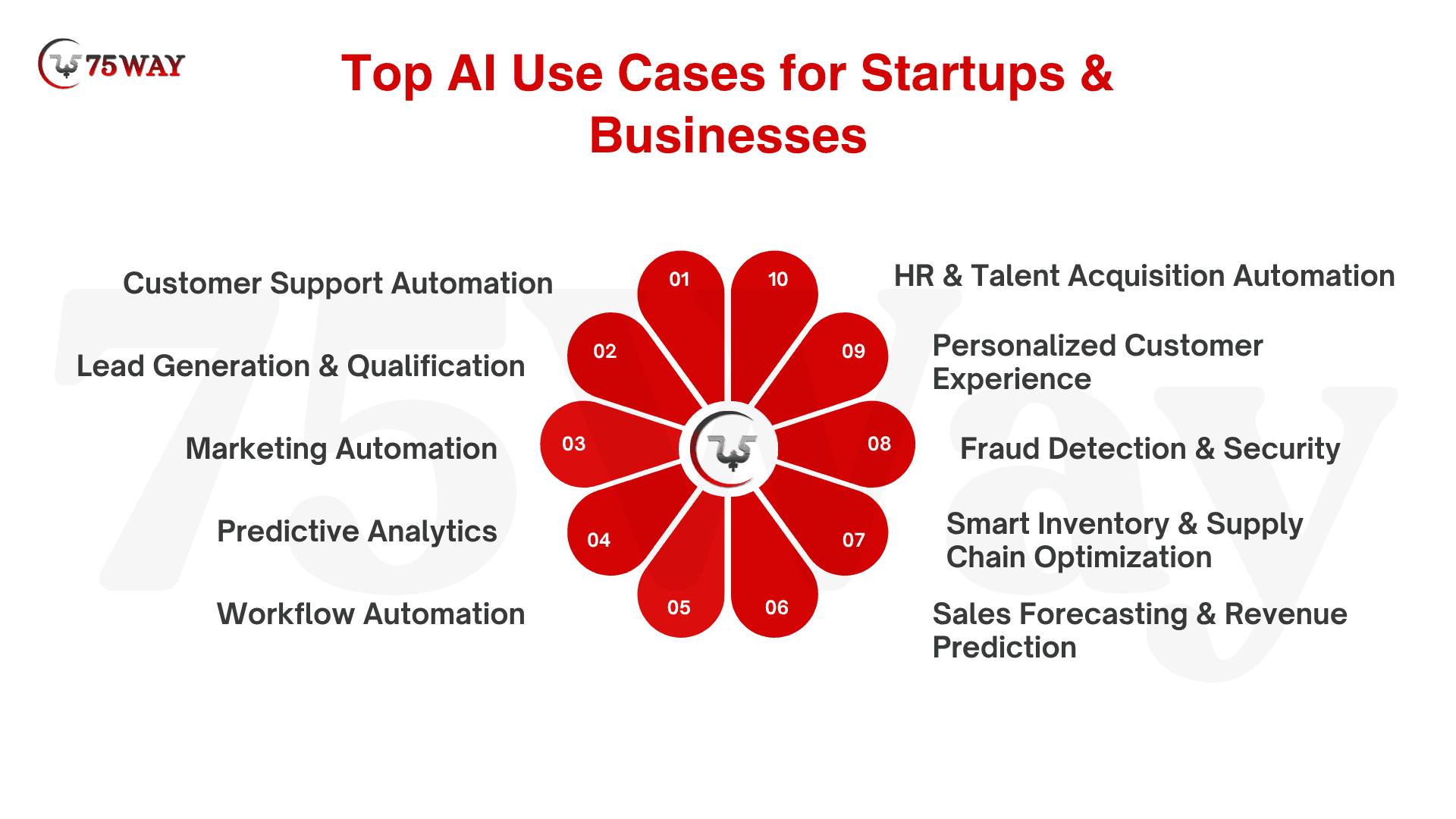
If you’re a founder or business owner, these high-impact use cases can help you unlock efficiency, drive growth, and stay ahead in a competitive market. Each use case connects directly to measurable business outcomes, making adoption both practical and valuable.
Customer Support Automation
Customer support automation streamlines how businesses handle queries by using chatbots and virtual assistants for instant, round-the-clock responses. This reduces support workload, improves response time, and ensures consistent, high-quality customer interactions across every touchpoint.
Lead Generation & Qualification
Lead generation becomes more effective when systems analyze user behavior and engagement signals to identify high-intent prospects. This allows sales teams to focus on qualified leads, reduce manual effort, and improve overall conversion rates efficiently.
Marketing Automation
Marketing automation enhances campaign performance by continuously analyzing data and optimizing targeting, timing, and messaging. As a result, businesses achieve better ROI, deliver personalized experiences, and maintain stronger engagement with their target audience.
Predictive Analytics
Predictive analytics enables businesses to anticipate future trends by leveraging historical and real-time data. This forward-looking approach supports smarter decision-making, minimizes risks, and helps organizations build more accurate and effective strategies.
Workflow Automation
Workflow automation improves operational efficiency by eliminating repetitive, rule-based tasks across departments. This not only reduces human error but also allows teams to focus on strategic initiatives that contribute directly to business growth.
Sales Forecasting & Revenue Prediction
Sales forecasting becomes more accurate with data-driven insights that analyze past performance and market trends. This helps businesses plan resources effectively, set realistic targets, and make confident financial and strategic decisions.
Fraud Detection & Security
Fraud detection systems strengthen business security by continuously monitoring transactions and identifying unusual patterns. This proactive approach helps prevent financial losses, safeguard sensitive data, and maintain trust with customers and stakeholders.
Smart Inventory & Supply Chain Optimization
Inventory and supply chain processes become more efficient when systems predict demand and optimize stock levels. This reduces waste, prevents stock shortages, and ensures smoother operations across logistics and distribution networks.
Personalized Customer Experience & Recommendation Systems
Personalization enhances customer engagement by analyzing preferences, behavior, and interactions to deliver relevant recommendations. This creates more meaningful experiences, increases satisfaction, and drives higher conversion and retention rates over time.
HR & Talent Acquisition Automation
HR processes become faster and more efficient by automating resume screening, candidate matching, and hiring workflows. This enables teams to reduce manual effort, eliminate bias, and make better hiring decisions based on data-driven insights.
How to Select the Best AI Solution for Your Business Needs?
Choosing the right solution is not about jumping straight into technology. It’s about following a structured journey where each step builds logically on the previous one. This ensures your investment delivers measurable, long-term business value.
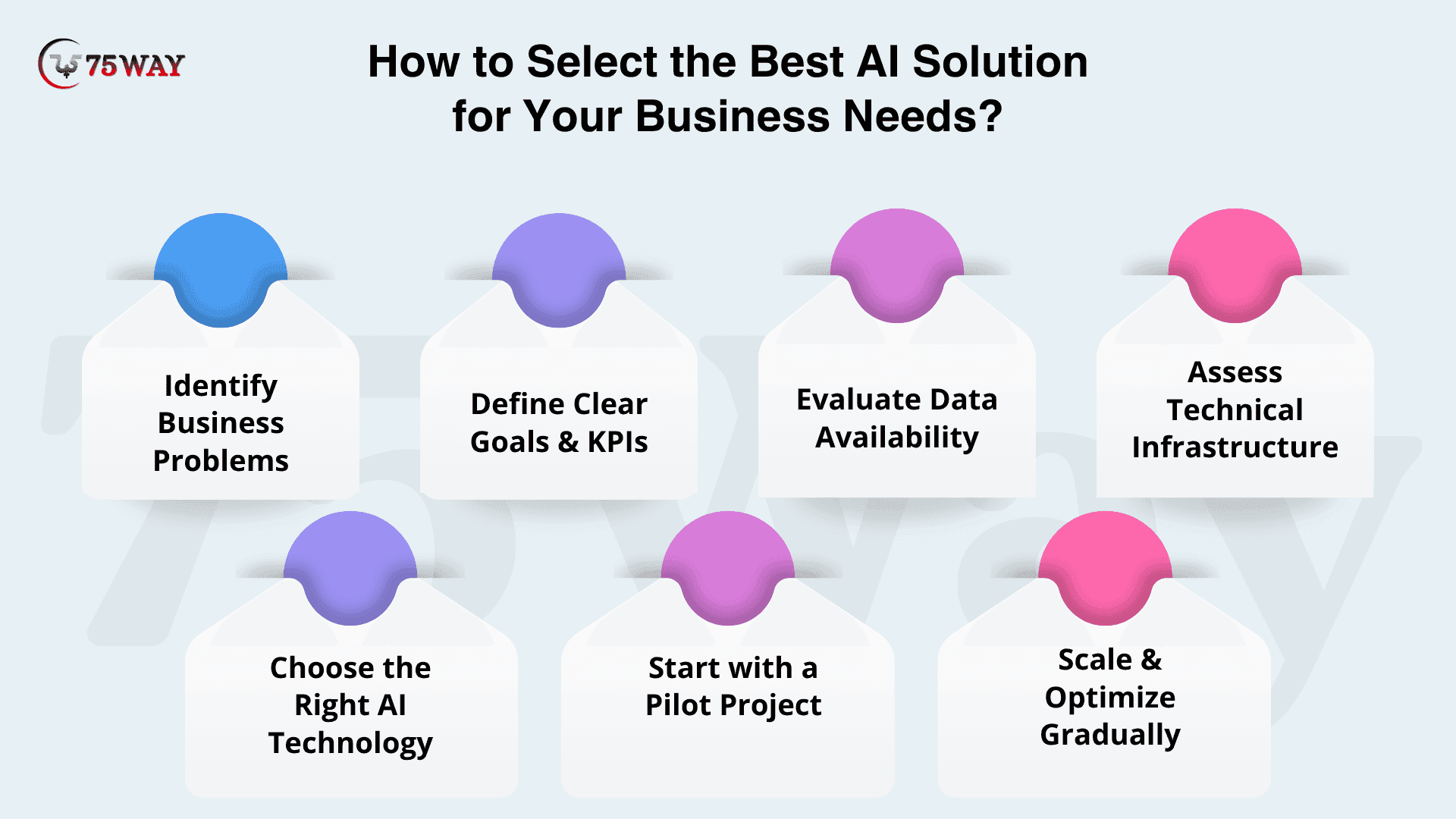
Step 1: Identify Business Problems
Every successful journey begins with clarity. Start by identifying the exact challenges that are limiting your business performance, such as inefficiencies, customer experience gaps, or operational delays. These issues should be specific and measurable rather than broad assumptions.
This step sets the direction for everything that follows. When problems are clearly defined, it becomes easier to align solutions with real needs, ensuring your investment focuses on impact rather than unnecessary or misaligned implementations.
Step 2: Define Clear Goals & KPIs
Once your challenges are identified, the next step is to define clear goals that outline what success looks like. These goals could include increasing revenue, improving efficiency, or enhancing customer engagement across channels.
By establishing measurable KPIs, you create a direct link between problems and outcomes. This clarity helps guide decision-making, ensuring that every solution you evaluate contributes meaningfully toward achieving your defined business objectives.
Step 3: Evaluate Data Availability
With goals in place, it becomes essential to assess whether your data can support them. Review the quality, structure, and accessibility of your existing data to determine if it is ready for implementation.
Since data drives performance, any gaps can limit effectiveness. Addressing these gaps early ensures smoother execution later, allowing your solution to deliver accurate insights and reliable outcomes aligned with your business goals.
Step 4: Assess Technical Infrastructure
After confirming data readiness, the next step is to evaluate your current technical infrastructure. This includes your software systems, platforms, and integration capabilities that will support the implementation.
A strong infrastructure ensures seamless deployment and scalability. It also prevents compatibility issues, helping you move forward confidently while reducing the risk of disruptions or additional costs during implementation.
Step 5: Choose the Right AI Technology
With a clear understanding of problems, goals, data, and infrastructure, you are now ready to select the most suitable technology. The focus should be on choosing solutions that directly address your business needs.
Avoid overcomplicating the process with unnecessary features. Instead, prioritize technologies that are scalable, adaptable, and aligned with your objectives, ensuring long-term value and easier integration into existing workflows.
Step 6: Start with a Pilot Project
Before full-scale implementation, it is important to test your chosen solution through a pilot project. This allows you to evaluate its performance in a controlled environment and identify potential challenges early.
A pilot provides valuable insights and reduces risks. It helps validate your approach, refine processes, and build confidence among stakeholders before moving toward broader deployment across the organization.
Step 7: Scale & Optimize Gradually
Once the pilot delivers successful results, the next step is to scale the solution across relevant areas of your business. Expanding gradually ensures smoother adoption and better control over implementation.
Continuous optimization is essential for long-term success. By monitoring performance, gathering feedback, and making improvements over time, you ensure the solution evolves with your business and consistently delivers value.
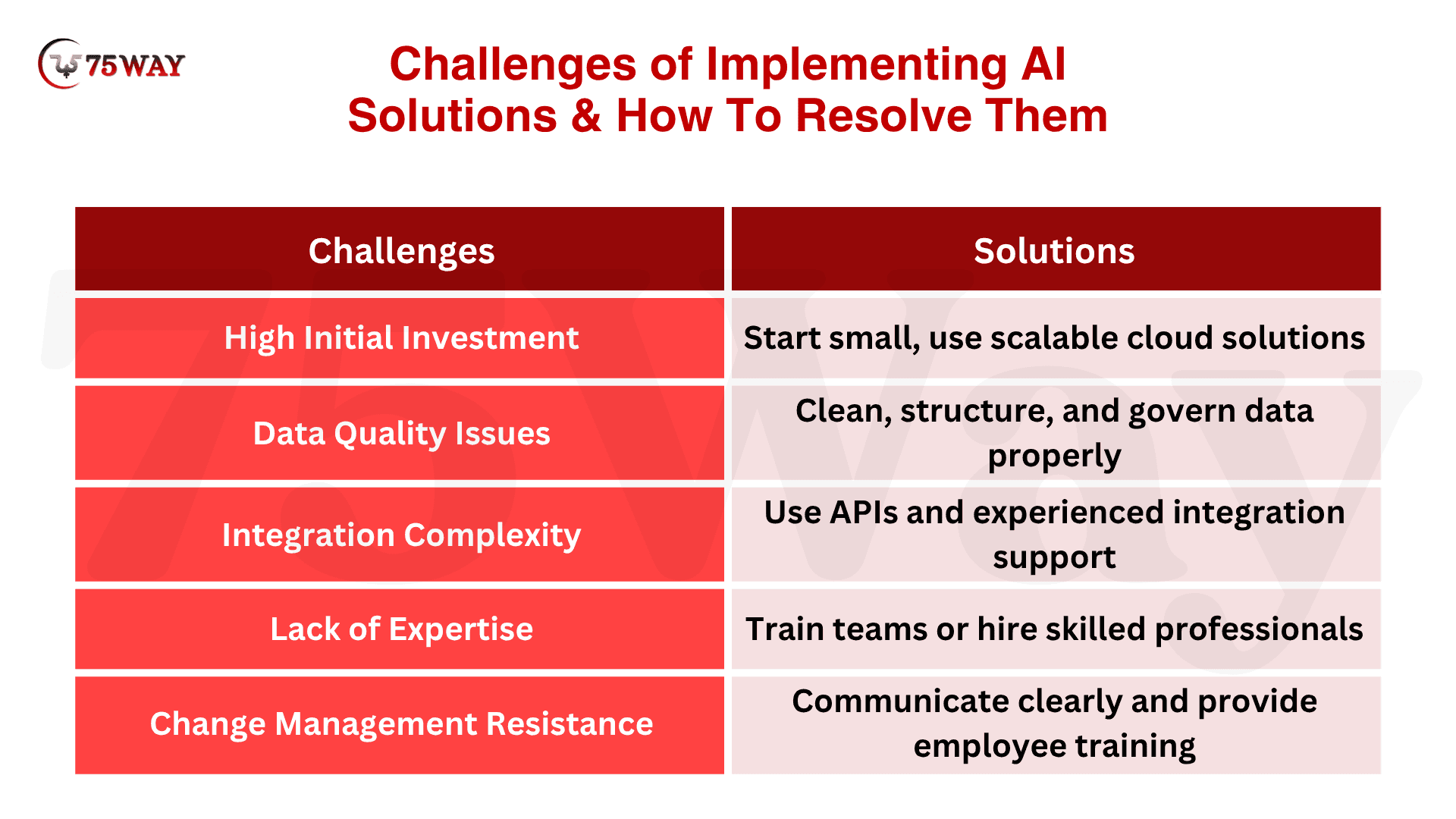
Challenges of Implementing AI Solutions & How To Resolve Them
Implementing advanced solutions can unlock significant value, but the journey is not without obstacles. From financial constraints to technical limitations, businesses must navigate multiple challenges carefully to ensure successful adoption and long-term impact.
High Initial Investment: High upfront investment often becomes a major barrier when adopting advanced solutions, as costs related to infrastructure, tools, and skilled talent can quickly add up. A phased approach with pilot projects, along with cloud-based and scalable pricing models, helps reduce financial pressure while gradually validating long-term return on investment.
Data Quality Issues: Poor data quality, including incomplete, inconsistent, or unstructured datasets, directly affects the accuracy and reliability of outcomes, limiting the overall effectiveness of implementation. Strong data governance, regular cleaning processes, and structured data management practices ensure better performance and more dependable insights over time.
Integration Complexity: Complex integration with existing systems and workflows can create operational disruptions, delays, and compatibility challenges during implementation. Flexible, API-driven architectures combined with careful planning and experienced technical support enable smoother integration while maintaining continuity across business processes.
Lack of Expertise: Limited access to skilled professionals with relevant technical knowledge often slows down adoption and impacts implementation success. Strategic partnerships, team training, and leveraging external experts or managed services help bridge this gap and ensure efficient deployment and ongoing optimization.
Change Management Resistance: Resistance to change within teams can slow down adoption, as employees may hesitate to trust or adapt to new technologies. Clear communication, proper training, and involving stakeholders early in the process help build confidence, encourage adoption, and ensure a smoother transition across the organization.
AI Solutions of Tomorrow: What’s Coming Next?
AI is evolving rapidly, transforming how businesses operate, innovate, and compete in a data-driven world. As technology advances, several key trends are shaping the future of intelligent solutions across industries.
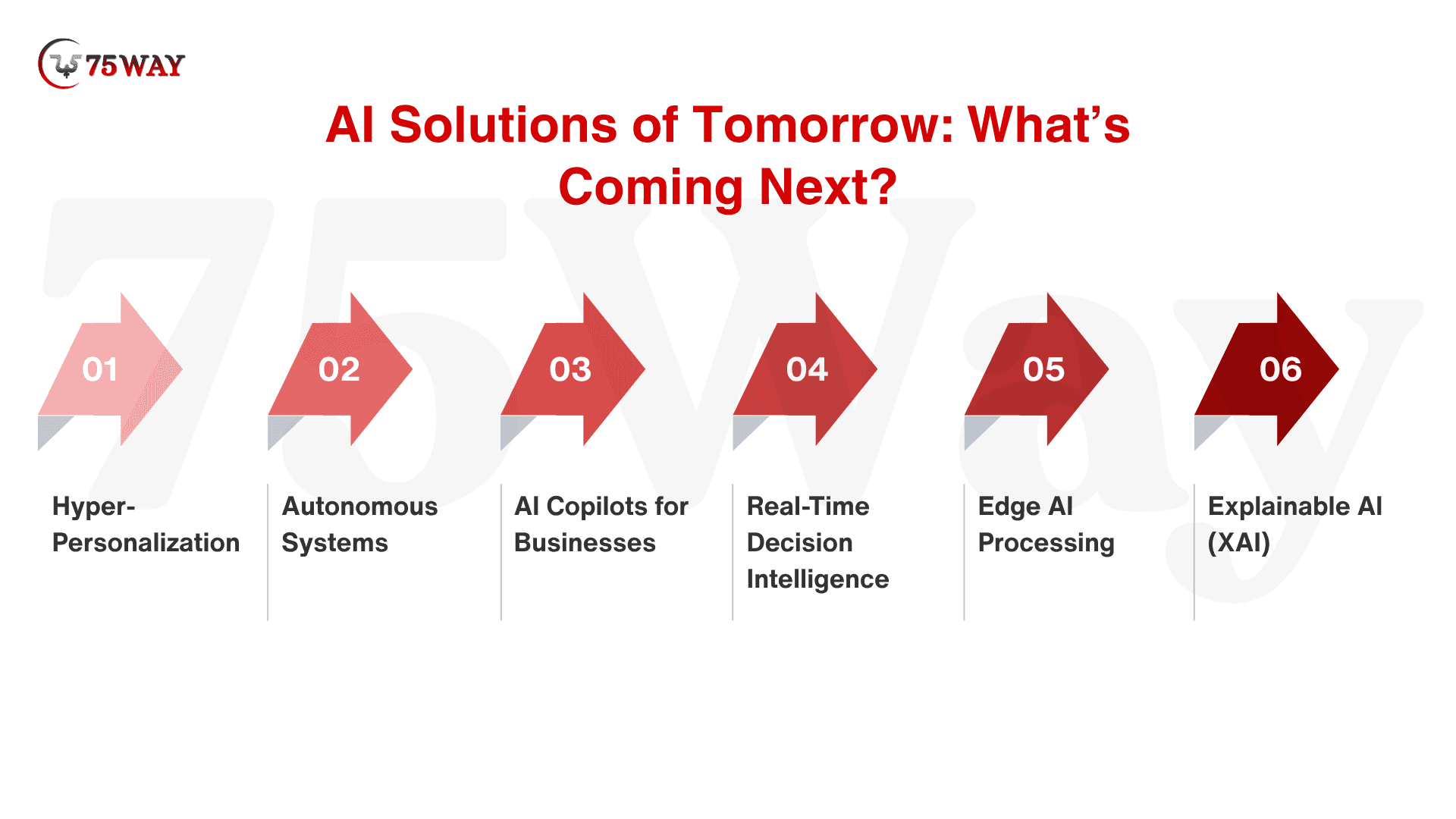
Hyper-Personalization: Advanced data analysis enables businesses to deliver highly tailored experiences based on individual behavior, preferences, and context, significantly improving engagement, customer satisfaction, and conversion rates across digital platforms and customer touchpoints.
Autonomous Systems: Independent decision-making capabilities allow systems to perform tasks with minimal human involvement, streamlining operations across logistics, manufacturing, and workflows while improving efficiency, reducing errors, and enhancing overall productivity.
AI Copilots for Businesses: Intelligent assistants support professionals by offering real-time insights, automating routine tasks, and enhancing productivity across functions like development, marketing, and customer support, enabling faster execution and more informed decision-making.
Real-Time Decision Intelligence: Continuous data processing delivers instant insights and actionable recommendations, helping businesses respond quickly to changing conditions, optimize performance, and make timely, data-driven decisions in dynamic environments.
Edge AI Processing: Local data processing on devices reduces dependency on centralized systems, enabling faster response times, lower latency, and improved efficiency in applications such as IoT, smart devices, and real-time monitoring systems.
Explainable AI (XAI): Greater transparency in decision-making helps organizations understand system outputs, build trust, ensure regulatory compliance, and confidently apply intelligent solutions in sensitive industries where accountability and clarity are essential.
Why Most Businesses Fail with AI Solutions?
This is where most businesses struggle, not because the technology lacks potential, but because the approach lacks clarity, alignment, and execution discipline. Understanding these common mistakes can help you avoid costly setbacks and unlock real value.
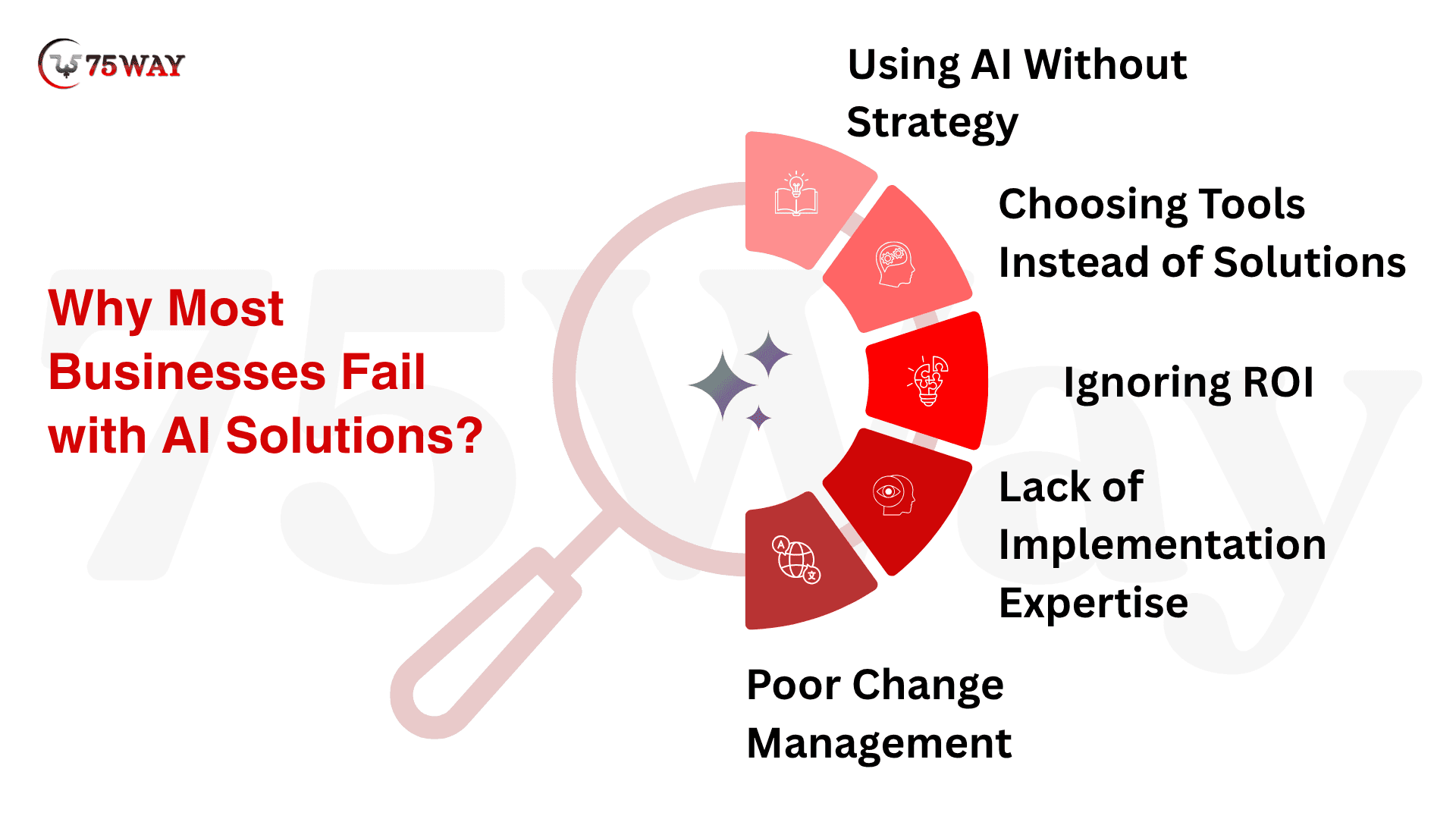
Using AI Without Strategy: Many businesses adopt AI without a clear strategy, driven by trends rather than real needs. Without defined objectives, implementations become scattered and ineffective. A structured roadmap aligned with business goals ensures focused execution, better resource utilization, and measurable outcomes that directly contribute to long-term growth and operational success.
Choosing Tools Instead of Solutions: Focusing on tools instead of solving actual business problems often leads to misalignment and wasted investment. Businesses may adopt advanced technologies without understanding their purpose. A solution-first mindset ensures that technology directly addresses specific challenges, delivering practical value and integrating seamlessly into existing workflows for better efficiency and impact.
Ignoring ROI: Overlooking return on investment leads to uncertainty in measuring success and justifying costs. Without clear ROI tracking, businesses struggle to evaluate effectiveness or scale implementations. Defining measurable KPIs and continuously monitoring performance ensures that investments generate tangible value, support decision-making, and contribute to sustainable business growth over time.
Lack of Implementation Expertise: Limited technical knowledge and experience can result in poor execution, delays, and underperforming systems. Without the right expertise, even well-planned initiatives may fail. Collaborating with experienced professionals, investing in training, or partnering with specialists ensures smoother implementation, reduces risks, and maximizes the effectiveness of deployed solutions.
Poor Change Management: Resistance from employees and a lack of proper change management can slow adoption and reduce effectiveness. Without clear communication and training, teams may hesitate to embrace new systems. Engaging stakeholders early, providing support, and fostering a culture of innovation ensure smoother transitions and better long-term success.
How Do We Help Businesses Implement AI Solutions?
Most businesses don’t just need tools. They need a strategic, end-to-end AI development lifecycle and implementation approach that turns AI into real business value. At 75way Technologies, we help organizations move from idea to impact by aligning technology with clear goals, seamless execution, and scalable growth strategies.
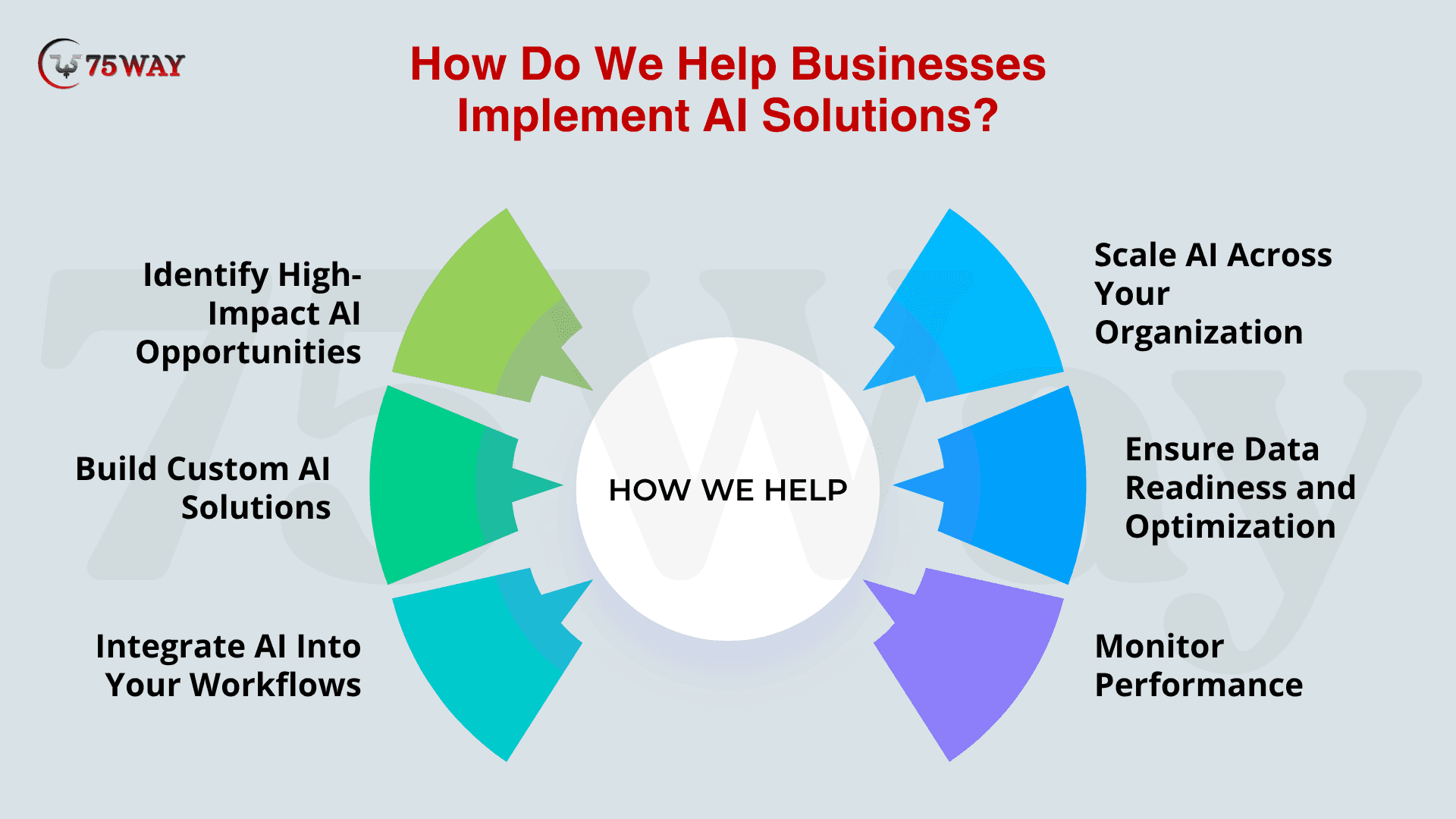
Identify High-Impact AI Opportunities
We analyze your business processes, challenges, and goals to uncover areas where AI can deliver maximum value, ensuring every initiative is aligned with measurable outcomes and real business impact.
Build Custom AI Solutions
We design and develop tailored AI solutions based on your specific needs, ensuring scalability, flexibility, and seamless alignment with your business objectives, workflows, and long-term growth strategy.
Integrate AI Into Your Workflows
We seamlessly integrate AI solutions into your existing systems and processes, ensuring minimal disruption, improved efficiency, and smooth adoption across teams and departments for maximum operational impact.
Scale AI Across Your Organization
We help expand successful AI implementations across departments, ensuring consistent performance, optimized processes, and scalable infrastructure that supports long-term growth and evolving business requirements effectively.
Ensure Data Readiness and Optimization
We prepare, clean, and structure your data to ensure it is accurate, reliable, and ready for AI implementation, enabling better performance, insights, and decision-making across your organization.
Monitor Performance and Continuously Improve Systems
We continuously track performance, analyze outcomes, and optimize systems to ensure your AI solutions evolve with your business needs, delivering consistent value, improved efficiency, and long-term success.
Wrap Up
AI solutions are essential for businesses looking to scale efficiently, innovate faster, and stay competitive in today’s digital landscape. From automation and predictive insights to personalized experiences, the right approach can unlock measurable growth and long-term value. However, success depends on choosing the right strategy, aligning solutions with business goals, and executing with clarity and expertise. By understanding use cases, challenges, and implementation steps, businesses can confidently move from experimentation to real impact. If you’re ready to turn AI into a growth engine, connect with a leading AI development company to start building smarter, scalable solutions today.
Frequently Asked Questions (FAQs)
What Industries Use AI Solutions?
AI solutions are widely used across industries such as healthcare, finance, retail, manufacturing, logistics, and education, helping businesses optimize processes, improve accuracy, and drive innovation.
Are AI Solutions Expensive To Implement?
Initial costs can be high, but starting with pilot projects and using scalable cloud-based solutions helps reduce investment risks while ensuring long-term return on investment and measurable business value.
How Long Does It Take To Implement AI Solutions?
Implementation timelines vary depending on complexity, data availability, and business requirements. Small projects may take weeks, while large-scale implementations can take several months for full deployment.
What Is The Difference Between AI And Machine Learning?
AI is a broader concept that enables machines to mimic human intelligence, while machine learning is a subset of AI that focuses on learning from data and improving performance over time.
Do Small Businesses Need AI Solutions?
Small businesses can benefit significantly by automating tasks, improving customer engagement, and making better decisions, helping them compete effectively with larger organizations in a cost-efficient manner.
What Data Is Required For AI Solutions?
High-quality, structured, and relevant data is essential for accurate outcomes. Businesses need clean datasets, proper labeling, and consistent data collection practices to ensure effective implementation.
Can AI Solutions Replace Human Jobs?
AI solutions are designed to assist rather than replace humans by automating repetitive tasks, allowing employees to focus on strategic, creative, and high-value activities that drive business growth.