AI Summary
This guide compares AI automation companies serving South Korea. It covers capabilities, specialties, costs, and founding years for vendor selection. Discover providers suited to startups, enterprises, manufacturers, and businesses.
Key Takeaways
- Compare leading South Korean AI automation companies by capabilities, specialties, industries, and business fit.
- Understand estimated project costs before shortlisting potential AI automation development partners.
- Identify enterprise and global business automation providers matching specific requirements.
- Evaluate AI agents, workflow automation, integrations, and implementation capabilities.
- Choose automation partners based on proven capabilities, requirements, and outcomes.
Finding leading AI automation agencies in South Korea is not difficult. But finding one that can connect AI with real business processes, existing systems, data, and measurable outcomes is much harder.
For a founder, startup, or business owner evaluating a Korean AI workflow automation consulting agency and AI automation vendor, the decision should go beyond company size or a long list of AI buzzwords.
You need to know what each South Korean AI automation provider actually automates, which businesses it serves, how deeply it works with enterprise systems, and whether its capabilities match your automation goals.
This guide evaluates notable AI automation companies in South Korea with a practical, buyer-focused approach.
Quick Answer: Which Are the Top AI Automation Agencies in South Korea?
The strongest options depend on your project requirements rather than a universal ranking. Large Korean technology providers such as LG CNS, 75way, Samsung SDS, SK AX, and POSCO DX have substantial enterprise AI and automation capabilities, while specialized firms focus more narrowly on AI agents, industrial AI, or workflow automation. Our practical shortlist includes:
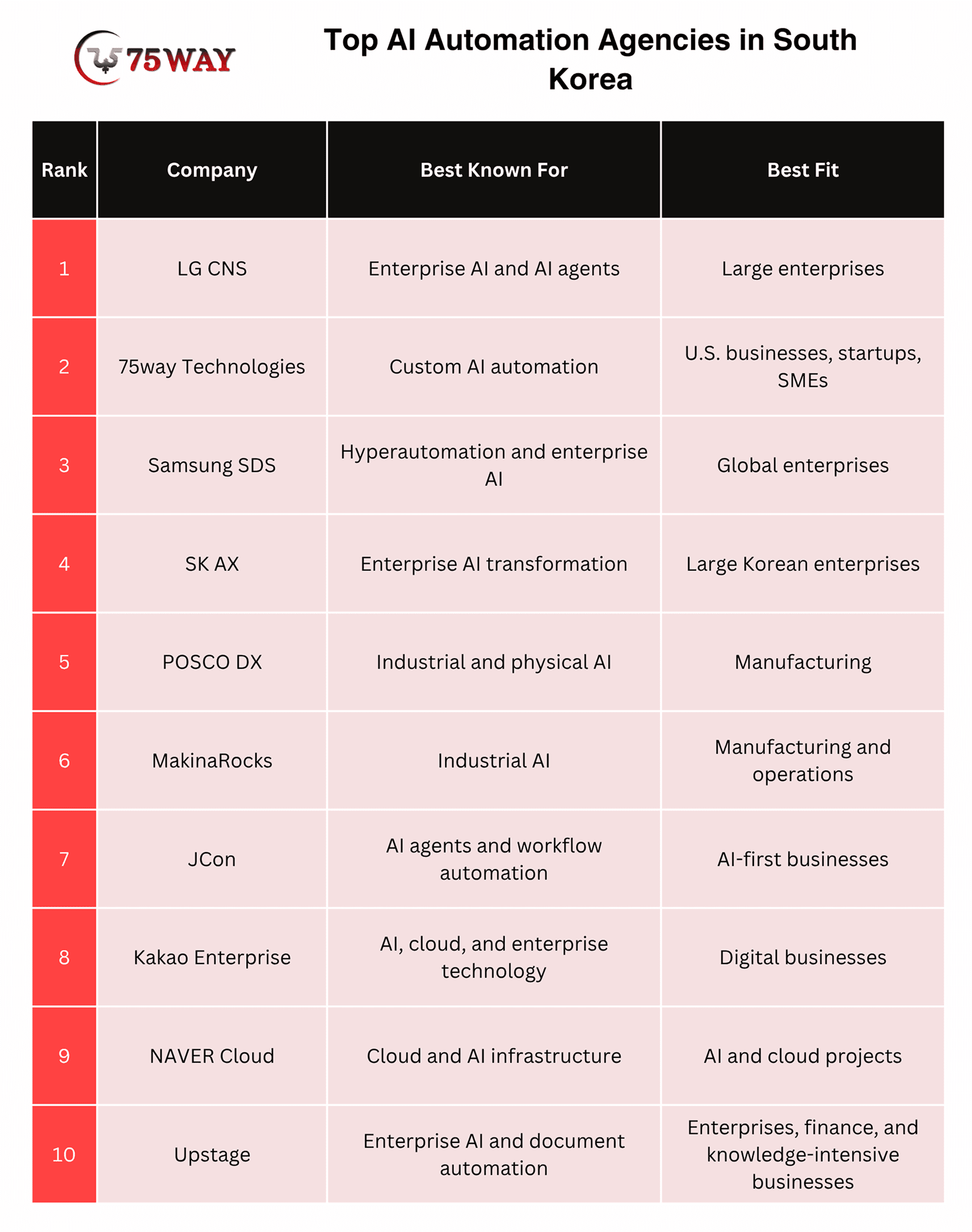
Note: This is an editorial shortlist, not an official industry ranking. Companies are included based on publicly documented AI, automation, agentic AI, enterprise AI transformation, or workflow capabilities.
South Korea’s Leading AI Automation Companies: Complete Ranking List
The right AI automation partner can do much more than add AI to existing business software. South Korea has companies building automation solutions for customer service, operations, data, workflows, and other real business needs. This list brings together the leading AI automation vendors that businesses can consider for their next AI project.
1. LG CNS
Established Year: 1987
Min. Project Size: $50,000+
Team: 7,000+ professionals
Technologies: AI agents, cloud, big data, generative AI, automation
LG CNS is one of the most significant enterprise technology companies to consider when evaluating AI automation capabilities in South Korea.
Services They Provide:
- Enterprise AI transformation solutions
- AI agent development and orchestration
- Intelligent workflow automation services
- Cloud migration and modernization
- Smart factory automation solutions
Its scale makes it particularly relevant for organizations that need enterprise-grade implementation rather than a standalone AI chatbot.
Best For: Large enterprises, manufacturing companies, financial organizations, government projects, and businesses with complex IT environments.
2. 75way Technologies
Established Year: 2015
Min. Project Size: $5,000+
Team: 150+ developers
Technologies: Machine learning, generative AI, RPA, NLP, computer vision, agents
75way Technologies is a trusted AI agency that deserves consideration alongside Korean providers when businesses are comparing offshore and global AI automation partners.
75way's AI automation services cover workflow consulting, process analysis, custom AI automation development, workflow implementation, system integration, AI-powered content automation, and data-processing automation.
Leva Clinic is one of the AI-focused projects associated with 75way Technologies, demonstrating its experience in developing technology solutions for healthcare-oriented business needs. They have also worked with recognized brands, including Lakmé, LG, and L'Oréal, adding broader enterprise and brand experience to their technology portfolio.
Services They Provide:
- AI workflow consulting and strategy
- Custom AI automation development
- AI workflow implementation services
- Cross-platform system integration
- Data processing automation solutions
Why businesses may consider 75way
For businesses seeking a custom AI automation development partner, 75way can be evaluated based on its ability to build and integrate the required solution rather than geographic location alone.
Best for: Startups, SMEs, enterprises, government projects, and businesses seeking custom AI workflow automation.
3. Samsung SDS
Established Year: 1985
Min. Project Size: $50,000+
Team: 26000+ professionals
Technologies: Enterprise AI, AI agents, cloud, RPA, generative AI
Samsung SDS is another major name for businesses evaluating AI automation in South Korea.
Its Brity Automation platform supports the automation lifecycle from identifying suitable tasks through development and operations. The platform also includes AI-powered process design, document processing, OCR, orchestration, and generative AI capabilities.
Services They Provide:
- Enterprise AI transformation services
- AI agent platform implementation
- Hyperautomation and RPA solutions
- AI cloud infrastructure services
- Intelligent logistics automation solutions
Samsung SDS also positions AI agents around practical enterprise applications, including manufacturing, logistics, customer service, market intelligence, software development, and internal business processes.
Best For: Large enterprises requiring secure automation, RPA, AI agents, enterprise integration, and large-scale digital transformation.
4. SK AX
Established Year: 1990s
Min. Project Size: $40,000+
Team: 5,000+ professionals
Technologies: Generative AI, AI agents, cloud, automation, analytics
SK AX has repositioned itself around AI transformation, or AX, with services covering enterprise AI, AI agents, automation, cloud, software engineering, and industry-specific solutions.
Services They Provide:
- Enterprise AI transformation services
- AI workforce implementation solutions
- Generative AI development services
- Digital manufacturing automation solutions
- Multi-cloud transformation and security
Its AI Workforce offering targets repetitive administrative work, knowledge retrieval, meeting documentation, scheduling, and department-specific AI assistants.
Best For: Large organizations looking for enterprise AI transformation, AI workforce solutions, workflow automation, and governed AI deployment.
5. POSCO DX
Established Year: 1989
Min. Project Size: $50,000+
Team: 2,061 professionals
Technologies: AI agents, robotics, big data, digital twins, industrial AI
POSCO DX is particularly relevant if your automation project involves manufacturing or physical operations.
The company has developed an AI Workforce approach that separates AI Employees for office work from AI Operators for manufacturing environments. Its Agentee platform is designed to create, manage, collaborate with, and evaluate AI agents.
Services They Provide:
- Industrial AI automation solutions
- AI workforce implementation services
- Smart factory transformation solutions
- Industrial robotics integration services
- Digital twin and analytics solutions
POSCO DX has also announced a strategic focus on Physical AI and Agentic AI, particularly for industrial environments.
Best For: Manufacturers, industrial organizations, smart factories, production environments, and businesses combining AI with robotics or operational technology.
6. MakinaRocks
Established Year: 2017
Min. Project Size: $30,000+
Team: 70%+ engineering workforce
Technologies: Specialized AI, Physical AI, industrial ML, AI OS
MakinaRocks is a more specialized name than the large enterprise IT providers.
This makes the company particularly interesting for organizations where automation extends beyond office workflows into physical processes.
Services They Provide:
- Industrial AI model development
- Predictive maintenance automation solutions
- Manufacturing process optimization
- AI-powered production intelligence
- Enterprise AI OS implementation
Best For: Manufacturing, industrial operations, predictive systems, and Physical AI initiatives.
7. JCon
Established Year: Not publicly verified
Min. Project Size: $15,000+
Team: Founder-led AI and systems team
Technologies: AI agents, LLMs, local LLMs, ERP, automation
JCon represents a more specialized AI-agent approach.
Its public platform describes an internal AX operating model built around AI agents, automation scripts, automated testing, knowledge bases, and AI operations. JCon states that it uses these systems within its own operations rather than presenting automation only as an external consulting concept.
Services They Provide:
- AI agent development and deployment
- Enterprise workflow automation solutions
- ERP conversational AI development
- Local LLM implementation services
- AI operating model consulting
That distinction can matter to buyers because using automation internally can provide evidence of practical implementation experience, although buyers should still request client-specific references and performance evidence before selecting a provider.
Best For: Companies looking for AI-agent systems, internal knowledge automation, and workflow orchestration.
8. Kakao Enterprise
Established Year: 2019
Min. Project Size: $30,000+
Team: Not publicly verified
Technologies: AI, cloud, data, search, enterprise platforms
Kakao Enterprise combines AI, cloud, search, and enterprise technology as part of its digital transformation offering.
The company originated from Kakao's internal AI Lab and positions itself as an enterprise IT partner focused on digital innovation using AI, cloud, and related technologies.
Services They Provide:
- Enterprise AI solution development
- Cloud infrastructure and services
- AI-powered business transformation
- Enterprise data and search solutions
- Digital workplace technology solutions
For companies already considering Korean cloud and AI ecosystems, Kakao Enterprise can be relevant when automation requirements overlap with broader enterprise technology modernization.
Best For: Digital businesses, enterprises, cloud-based AI initiatives, and organizations evaluating Korean enterprise technology ecosystems.
9. NAVER Cloud
Established Year: 2019
Min. Project Size: $10,000+
Team: Not publicly verified
Technologies: AI agents, LLMs, APIs, NLP, multilingual AI
NAVER Cloud is another major Korean technology name worth evaluating when an AI automation project depends heavily on cloud infrastructure, AI models, data, and scalable deployment.
For buyers, the distinction is important: a cloud and AI platform provider is not necessarily the same thing as a custom automation agency.
Services They Provide:
- Enterprise cloud infrastructure services
- AI platform development and deployment
- Generative AI implementation solutions
- Data analytics and processing
- Cloud-based AI integration services
Best For: Organizations requiring AI infrastructure, cloud capabilities, Korean-language AI capabilities, and scalable AI deployments.
10. Upstage
Established Year: 2020
Min. Project Size: $25,000+
Team: 150–250 professionals
Technologies: Large language models, NLP, OCR, generative AI, document AI, AI agents
Upstage is one of South Korea's notable AI companies, particularly for enterprise LLM and document-intelligence applications. Its Solar LLM and Document AI capabilities make it relevant for businesses looking to automate document-heavy and knowledge-intensive processes.
Services They Provide:
- Enterprise LLM development
- Document AI automation solutions
- Generative AI implementation
- Intelligent document processing
- Custom AI agent development
In 2026, Upstage also partnered with AXZ and FuriosaAI to deploy a Korean full-stack sovereign AI system combining its Solar model with FuriosaAI's NPU technology.
Best For: Enterprises needing LLM, document automation, knowledge processing, and custom generative AI solutions.
How We Selected These AI Automation Service Providers in South Korea
A “top AI automation agency in South Korea” list becomes weak when companies are selected only because they appear on other listicles. For this guide, the more useful question is:
Can this South Korea-based AI automation firm help a business identify, build, integrate, deploy, and operate AI-powered automation?
We considered the following factors:
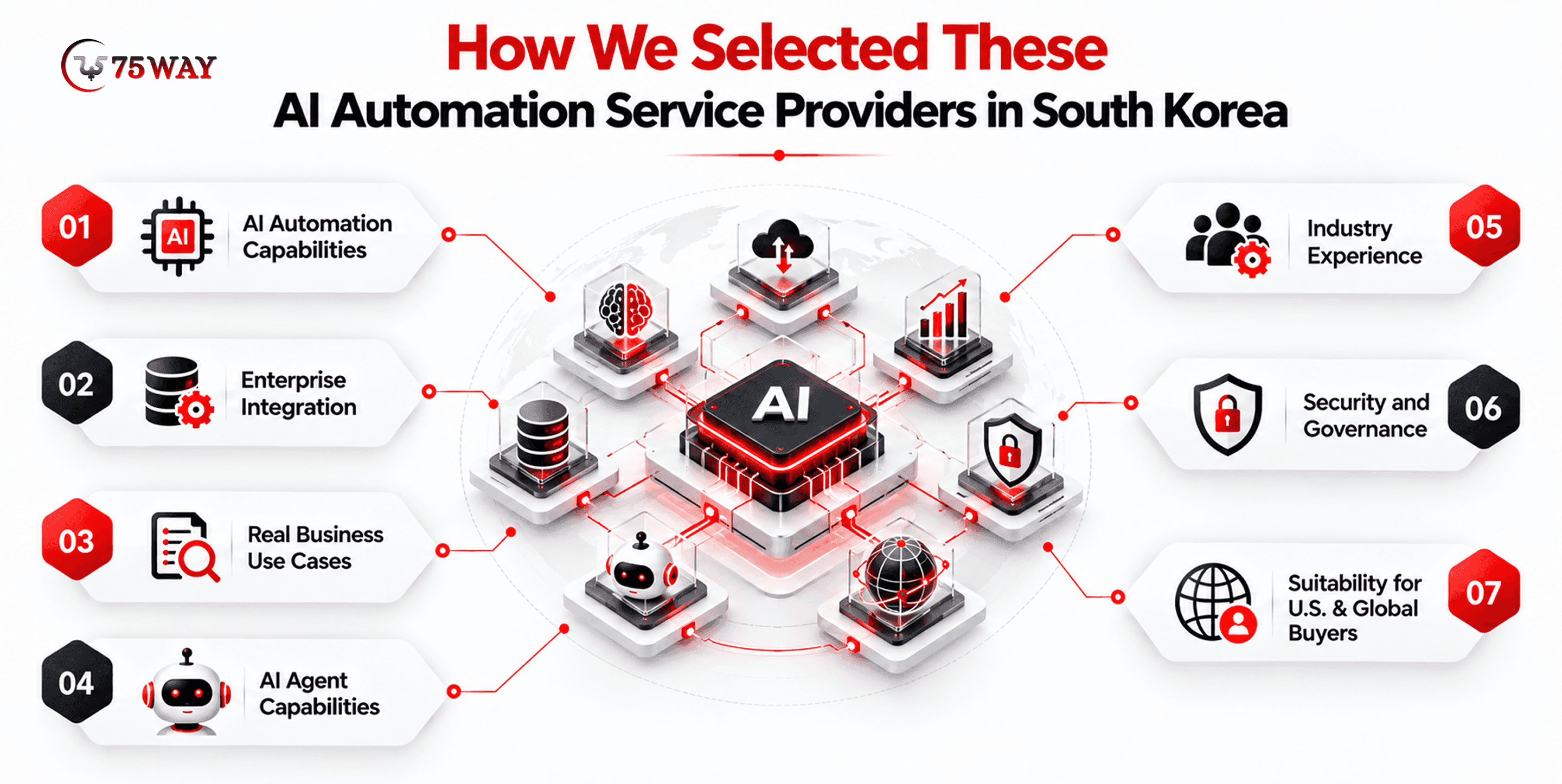
1. AI Automation Capabilities
The provider should offer workflow automation, AI agents, RPA, intelligent document processing, AI-powered decision systems, or related solutions.
2. Enterprise Integration
Strong integration capabilities allow solutions to connect with ERP, CRM, databases, cloud platforms, internal knowledge bases, and other business systems.
3. Real Business Use Cases
Proven applications across customer service, manufacturing, finance, logistics, HR, document processing, and internal operations demonstrate practical automation experience.
4. AI Agent Capabilities
Advanced AI agents can understand information, make decisions, interact with software, and complete multi-step business tasks with limited human intervention.
5. Industry Experience
Relevant industry expertise helps providers understand specific operational challenges, workflows, regulations, and technology requirements within different business environments.
6. Security and Governance
Enterprise deployments require appropriate access controls, data protection, monitoring, human oversight, security measures, and AI governance throughout the implementation.
7. Suitability for U.S. & Global Buyers
International collaboration, custom development, system integration, communication, scalability, and business-focused implementation are important considerations for U.S. and global companies.
AI Automation Agencies vs. AI Technology Companies: What Is the Difference?
This is one of the most important distinctions when researching South Korean AI automation firms. Not every company described as an “AI automation company” operates as an agency.
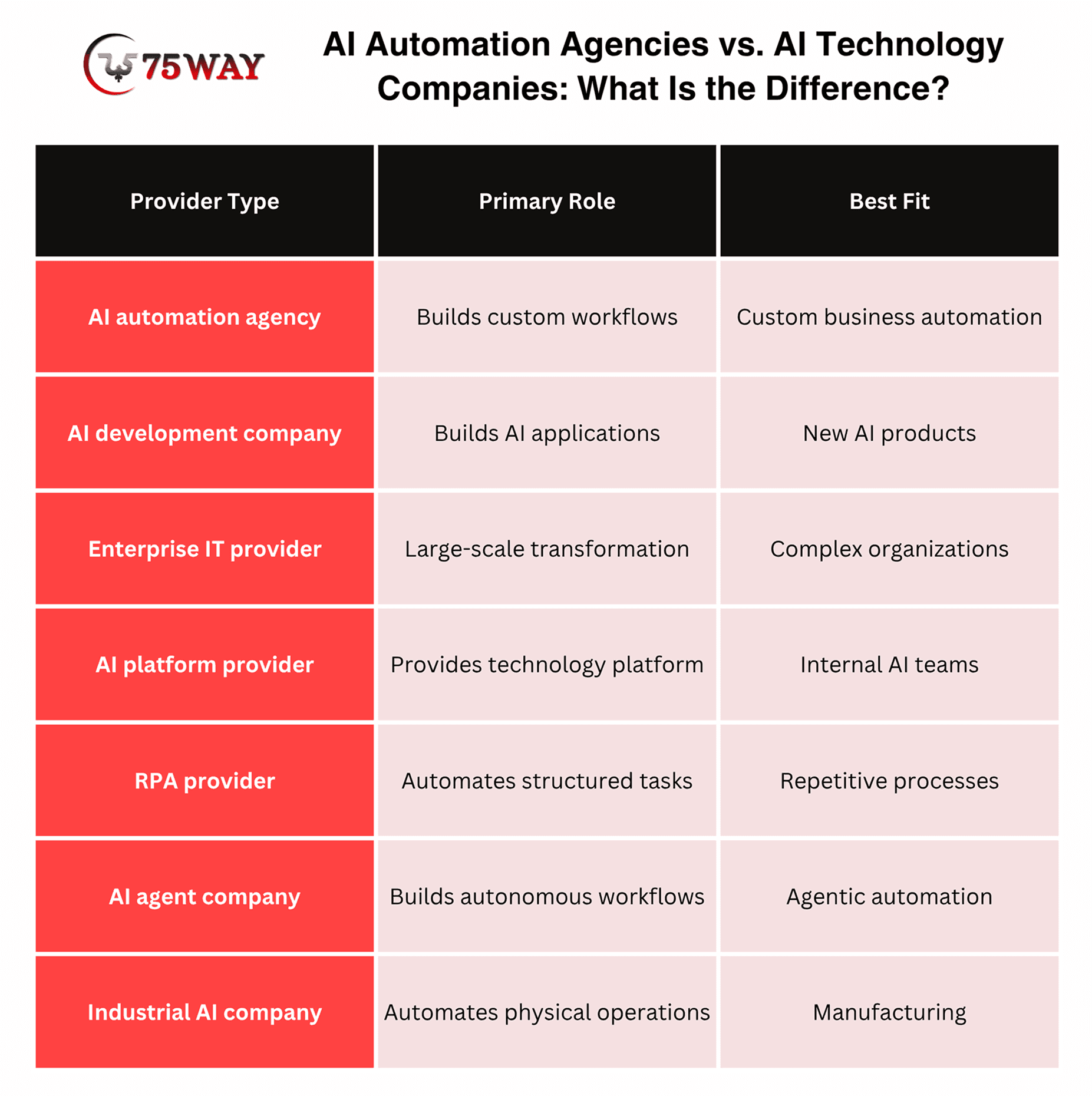
This distinction can save a buyer from choosing a technically impressive AI provider that does not actually deliver the implementation model they need.
What Can AI Automation Vendors Actually Automate?
AI automation is no longer limited to simple repetitive tasks. A modern automation project can combine LLMs, AI agents, APIs, RPA, databases, business rules, analytics, and human approval steps.
- Sales Automation
Lead qualification, CRM updates, follow-ups, routing, and sales reporting.
- Customer Support Automation
Ticket classification, response generation, escalation, knowledge retrieval, and customer-service workflows.
- Finance Automation
Invoice extraction, validation, reconciliation, approval routing, and financial reporting.
- HR Automation
Candidate screening, employee onboarding, document collection, internal HR support, and employee workflows.
- Document Automation
Document classification, OCR, information extraction, validation, summarization, and routing.
- Marketing Automation
Content workflows, campaign analysis, personalization, reporting, and lead nurturing.
- Manufacturing Automation
Quality inspection, predictive maintenance, production monitoring, process optimization, and AI-assisted decision-making.
- Knowledge Automation
Internal search, enterprise knowledge assistants, document Q&A, research, and AI-powered information retrieval.
How to Choose the Right Korea AI Workflow Automation Consulting Agency
The wrong AI automation partner can leave you with expensive tools that solve very little. A suitable agency should understand your business problem first, recommend practical AI solutions, and have the technical ability to integrate them into your existing operations. A few important checks can make the choice much easier. A shortlist is only useful if you know how to evaluate it.
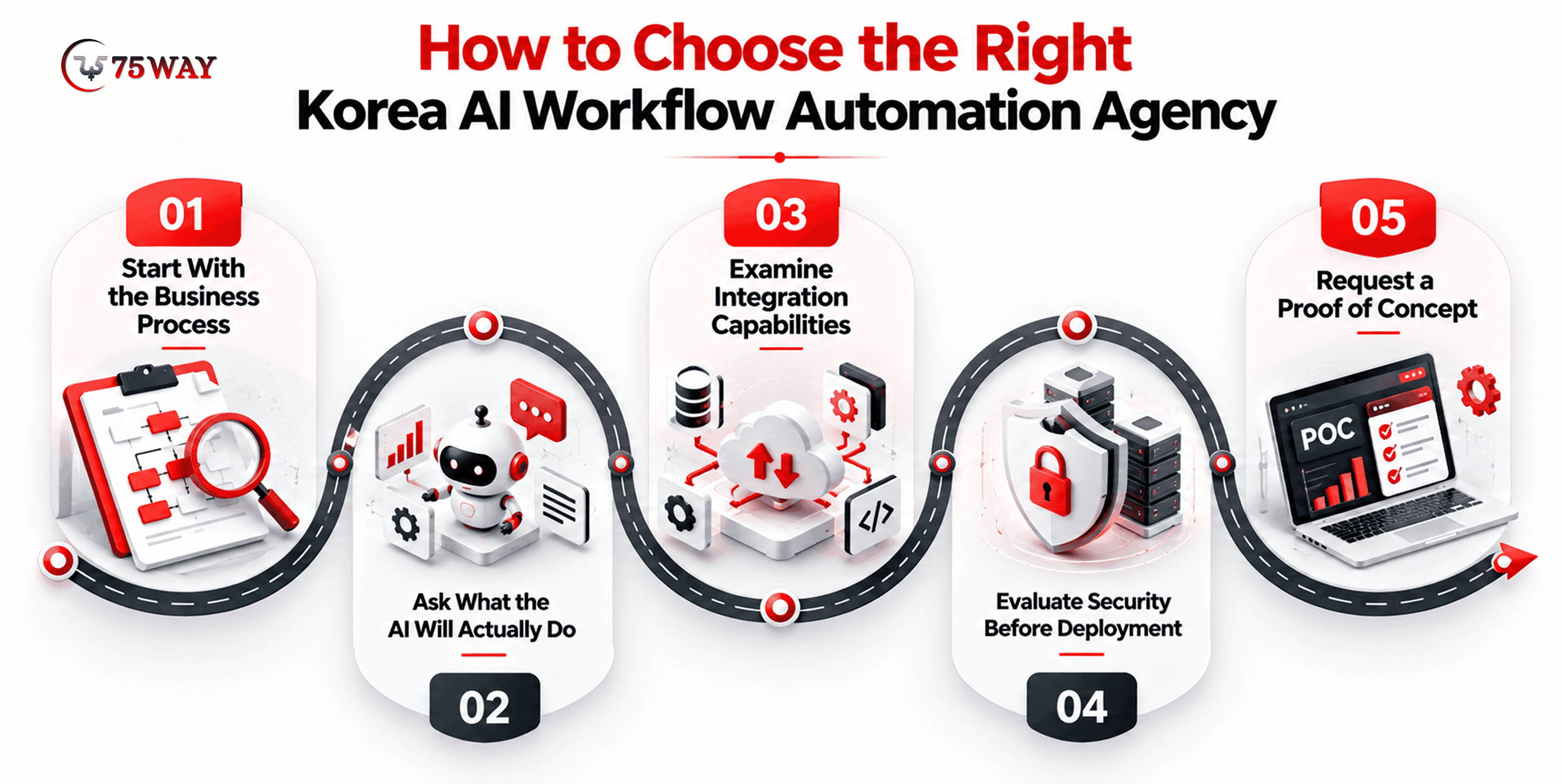
1. Start With the Business Process
Do not begin with:
“Which AI model should we use?”
Start with:
“Which business process is costing us the most time, money, or capacity?”
That process becomes your automation candidate.
2. Ask What the AI Will Actually Do
A vendor saying “we use AI” tells you very little.
Ask:
- What decisions will AI make?
- What systems will it access?
- What actions can it execute?
- When does a human approve an action?
- What happens when the AI is uncertain?
- How are errors monitored?
3. Examine Integration Capabilities
Your automation may need to connect with:
- Salesforce
- HubSpot
- SAP
- Microsoft 365
- Google Workspace
- ERP systems
- CRM systems
- Databases
- APIs
- Internal knowledge bases
- Cloud infrastructure
Integration capability can matter more than the AI model itself.
4. Evaluate Security Before Deployment
Enterprise automation can interact with sensitive business information.
Ask about:
- Data access
- Authentication
- Authorization
- Encryption
- Logging
- Monitoring
- Model governance
- Human approval
- Data retention
- Compliance requirements
5. Request a Proof of Concept
A strong AI automation partner should be able to explain how it would validate the idea before a full-scale deployment.
A practical PoC should establish:
Process → Data → AI capability → Integration → Human oversight → KPI → ROI
South Korean AI Automation Firm Vs. U.S. or Global Partner: What To Choose
The right decision depends on what you are buying.
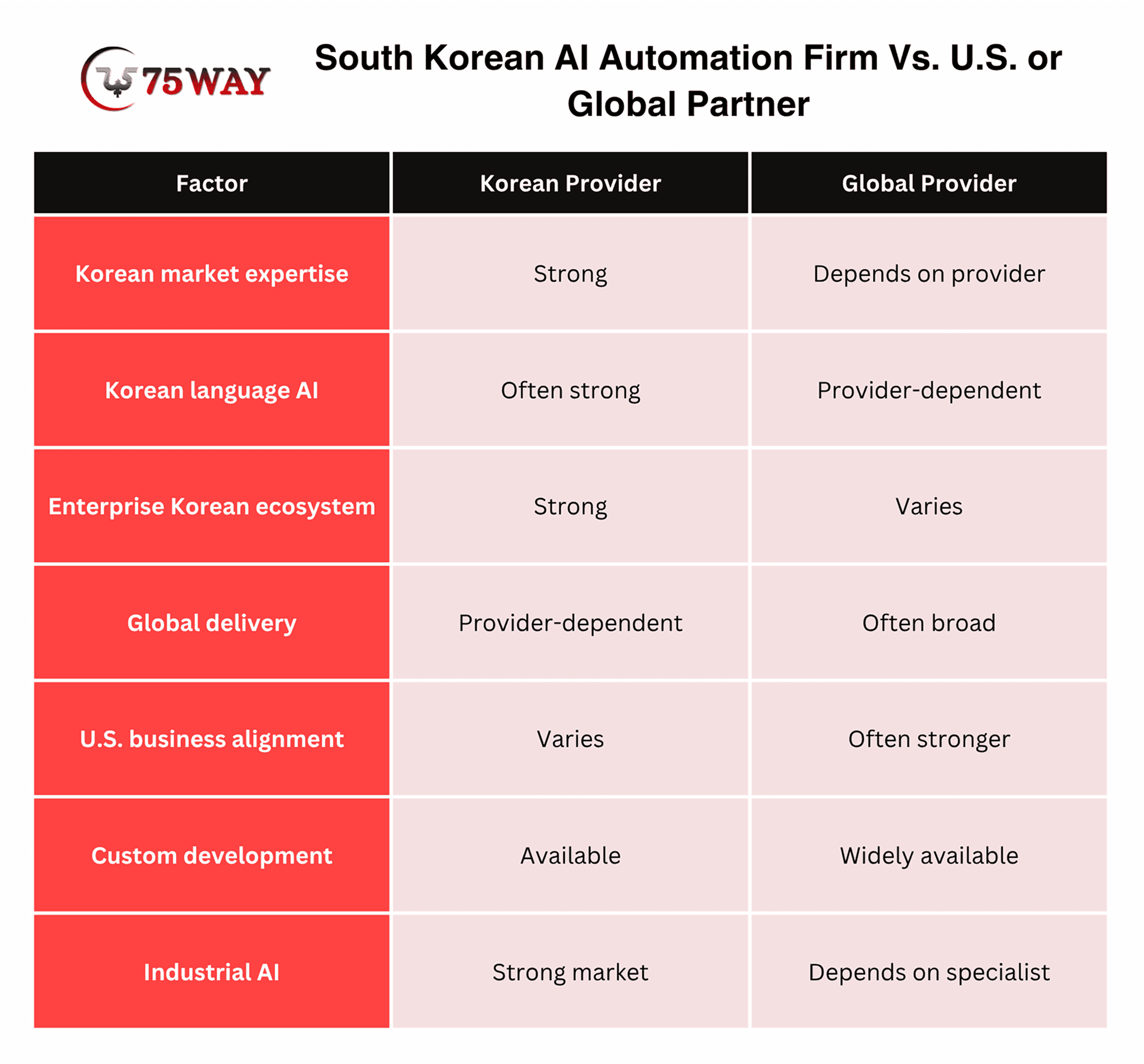
For a company operating in South Korea, local ecosystem knowledge may carry significant value.
For a startup seeking a custom AI automation product, technical capability, communication, integration experience, security, development model, and post-launch support may matter more than headquarters location.
What Should You Ask Before Hiring an AI Automation Development Partner in South Korea?
Before signing an agreement, ask these questions:
1. Business Questions
- Which process would you automate first?
- What measurable KPI will improve?
- How will you calculate ROI?
- What human tasks remain?
2. Technical Questions
- Which AI models will you use?
- Will the system use AI agents?
- How will it connect to our existing systems?
- Can the architecture support future workflows?
3. Security Questions
- Where will our data be processed?
- Who can access it?
- How are permissions controlled?
- How are AI outputs monitored?
4. Delivery Questions
- Can you provide a PoC?
- Who owns the source code?
- What happens after deployment?
- How will the system be maintained?
5. Commercial Questions
- What is included in the initial estimate?
- What costs are recurring?
- Are AI model/API costs separate?
- What happens when usage increases?
Which South Korea-Based AI Automation Agency Is Right for Your Business?
There is no universal winner.
- 75way Technologies is worth considering when a business wants a global custom-development partner for AI automation
- LG CNS is compelling for large enterprise AI transformation.
- Samsung SDS stands out when hyperautomation, RPA, AI agents, and enterprise systems need to work together.
The best choice ultimately depends on your workflow, data, integrations, security requirements, budget, and desired business outcome.
Final Takeaway
South Korea has a mature and rapidly evolving AI ecosystem, but the right automation partner is not necessarily the largest company or the one with the longest AI service list. The stronger buying decision comes from matching your workflow, integrations, data environment, security requirements, and business KPI with the provider's demonstrated capabilities.
For large Korean enterprises, companies such as LG CNS, 75way, and POSCO DX deserve close evaluation, while specialized providers can make more sense for focused AI-agent or industrial automation initiatives. Comparing these factors helps startups, enterprises, and business owners identify an automation partner aligned with their goals and long-term growth.
Frequently Asked Questions (FAQs)
Should A Startup Hire A Large AI Automation Company?
Not necessarily. Startups may benefit from a specialized development partner that can build a focused PoC and scale it gradually, while large enterprises may require deeper security, governance, infrastructure, and integration capabilities.
What Does An AI Automation Agency Do?
An AI automation agency identifies repetitive business processes and builds AI-powered workflows, agents, integrations, and systems that reduce manual work and improve operational performance.
Which AI Automation Company Is Best For Startups?
Startups often benefit from specialized providers that offer focused development, flexible engagement models, rapid PoCs, and scalable solutions without the complexity of large enterprise transformation projects.
What Should Businesses Look For In An AI Automation Agency?
Businesses should evaluate AI expertise, integration capabilities, security practices, industry experience, development processes, scalability, support, and the provider's ability to connect automation with measurable business goals.
Can AI Automation Agencies Build Custom AI Agents?
Yes. Qualified AI automation providers can build custom agents that retrieve information, make decisions, interact with business systems, execute tasks, and escalate complex situations to human teams.
What Business Processes Can AI Automation Agencies Automate?
Common opportunities include customer support, lead management, document processing, invoice workflows, employee onboarding, reporting, data synchronization, order management, marketing operations, and internal knowledge management.
Is AI Automation Suitable For Small Businesses?
Yes. Small businesses can automate repetitive, time-consuming processes without adopting large enterprise systems, making focused workflows, AI assistants, and task-specific agents practical starting points.