AI Summary
TikTok clone app development combines short-form video, social interaction, personalization, and scalable infrastructure into one product. This guide explores development costs, essential features, technology choices, development stages, and monetization. It also examines business models for sustainable growth.
Key Takeaways
- TikTok clone development requires video infrastructure, social features, personalization, and scalability.
- Development costs can range from $7,000 to $450,000+.
- A structured development process helps validate ideas before expensive engineering begins.
- Short video market size may reach $3.37 billion by 2031.
- Multiple business models can monetize creators, viewers, advertisers, and subscriptions.
A TikTok-like app can become a scalable digital business when short-form video, personalized discovery, creator participation, and monetization are designed around a clear market opportunity.
The global short video market is projected to reach $3.37 billion by 2031, growing at a 9.21% CAGR from 2026 to 2031, according to Mordor Intelligence.
For startups and businesses, however, building a TikTok clone is not simply about recreating vertical scrolling videos. The real challenge involves designing a recommendation engine, video-processing infrastructure, creator ecosystem, and scalable backend that can support growing user activity.
This guide explains the TikTok clone app development cost, development process, essential features, technology stack, monetization strategies, business models, and key considerations for launching a competitive short-video platform.
What Is a TikTok Clone App?
A TikTok clone app is a short-form video platform that replicates the fundamental user experience of TikTok while allowing businesses to introduce their own branding, features, audience strategy, monetization model, and product differentiation.
A typical platform allows users to:
- Create and upload short videos
- Edit videos with music, filters, and effects
- Scroll through personalized video feeds
- Like, comment, share, and save content
- Follow creators and other users
- Discover trending videos and hashtags
- Send notifications and messages
- Livestream content
- Monetize creator activity
- Purchase digital items or subscriptions
The objective should not be a pixel-for-pixel copy of TikTok. Instead, businesses can use the familiar short-video interaction model as a foundation while building a product around a specific audience, industry, geography, or community.
Why Build TikTok Clone: Market Size & Revenue Growth in USA & Globally
Short-form video has become a significant digital content format, supported by mobile-first consumption, recommendation algorithms, and social interaction. For entrepreneurs, the opportunity comes from combining video consumption with a focused business model.
- Build a Niche Community
A general-purpose platform competes for broad attention, while a niche platform can concentrate on a specific audience. Possible niches include education, fitness, travel, food, fashion, gaming, professional knowledge, local entertainment, or business content.
- Create Creator-Centric Experiences
Creators can become the supply engine of a short-video platform. Dedicated creator dashboards, analytics, monetization tools, content discovery, and collaboration features can help attract and retain valuable contributors.
- Develop Multiple Revenue Channels
Short-video platforms can generate revenue through advertising, subscriptions, creator commissions, virtual goods, premium content, commerce, sponsorships, and partnerships.
- Own Your Product Ecosystem
A proprietary platform gives businesses greater control over user experience, first-party analytics, monetization, product experimentation, and community rules.
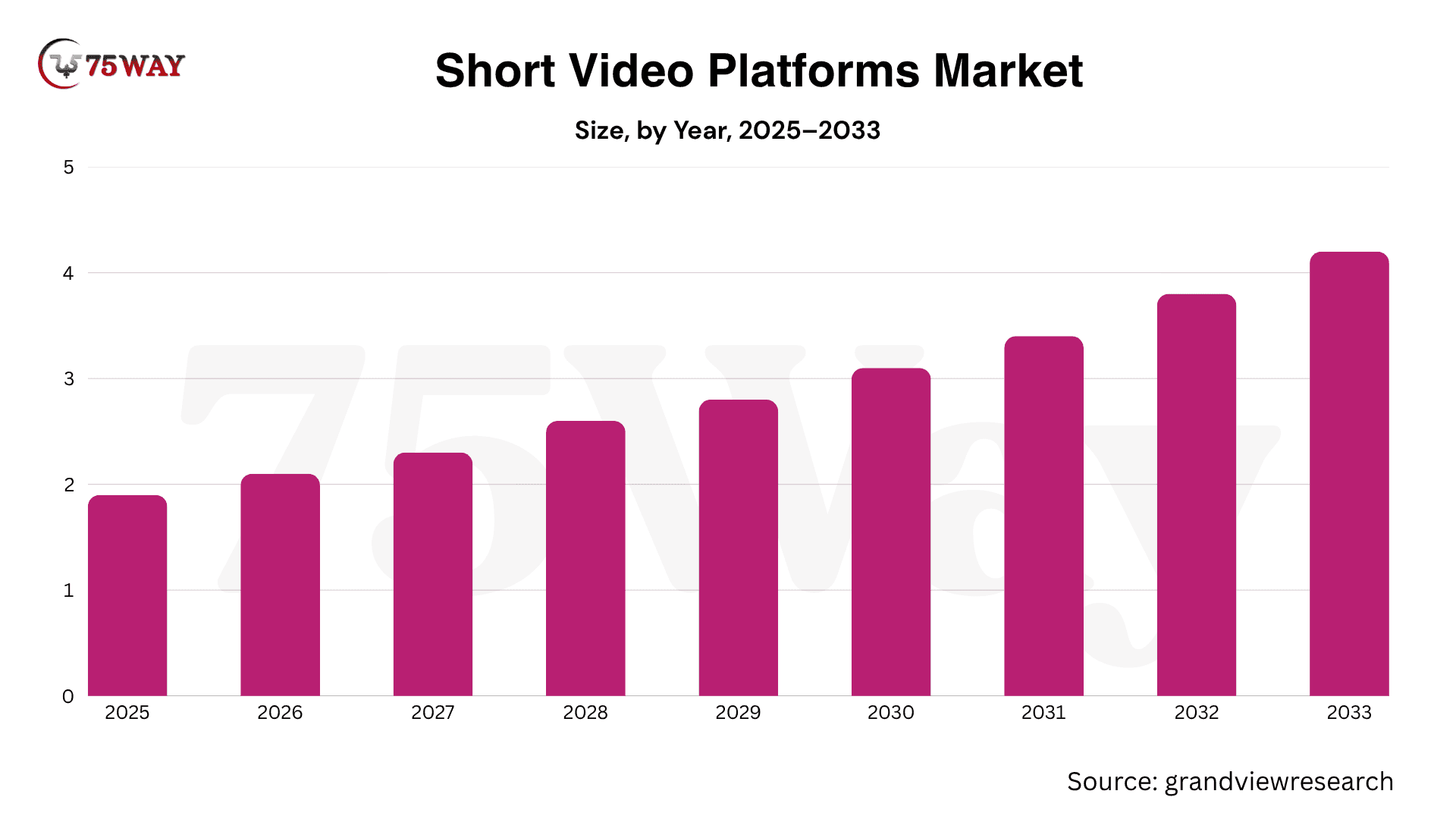
Let’s analyze the market size and revenue growth opportunities in USA & global markets
- TikTok generated an estimated $23 billion in revenue in 2024, reflecting a 42.8%–67% year-over-year increase, depending on the reporting methodology.
- TikTok had approximately 1.6 billion monthly active users (MAUs) worldwide, with projections indicating growth to around 2.35 billion by 2029.
- Douyin, TikTok’s Chinese counterpart, recorded approximately 766 million active users.
- The global short video platforms market is projected to expand from $2.1 billion in 2026 to $4.2 billion by 2033, registering a 10.2% CAGR.
- The media and entertainment segment accounted for the largest market share, contributing approximately 47.5% of total revenue.
- Mobile applications dominated the short video market, accounting for 90.60% of the total market share.
- iOS dominated the platform segment with a revenue share exceeding 42.0%.
How Does a TikTok Clone App Work?
The user experience begins when someone opens the application and receives a personalized stream of videos. Behind that simple interface, multiple systems work together to process content, understand user behavior, rank videos, deliver media, and update recommendations.
A simplified workflow looks like this:
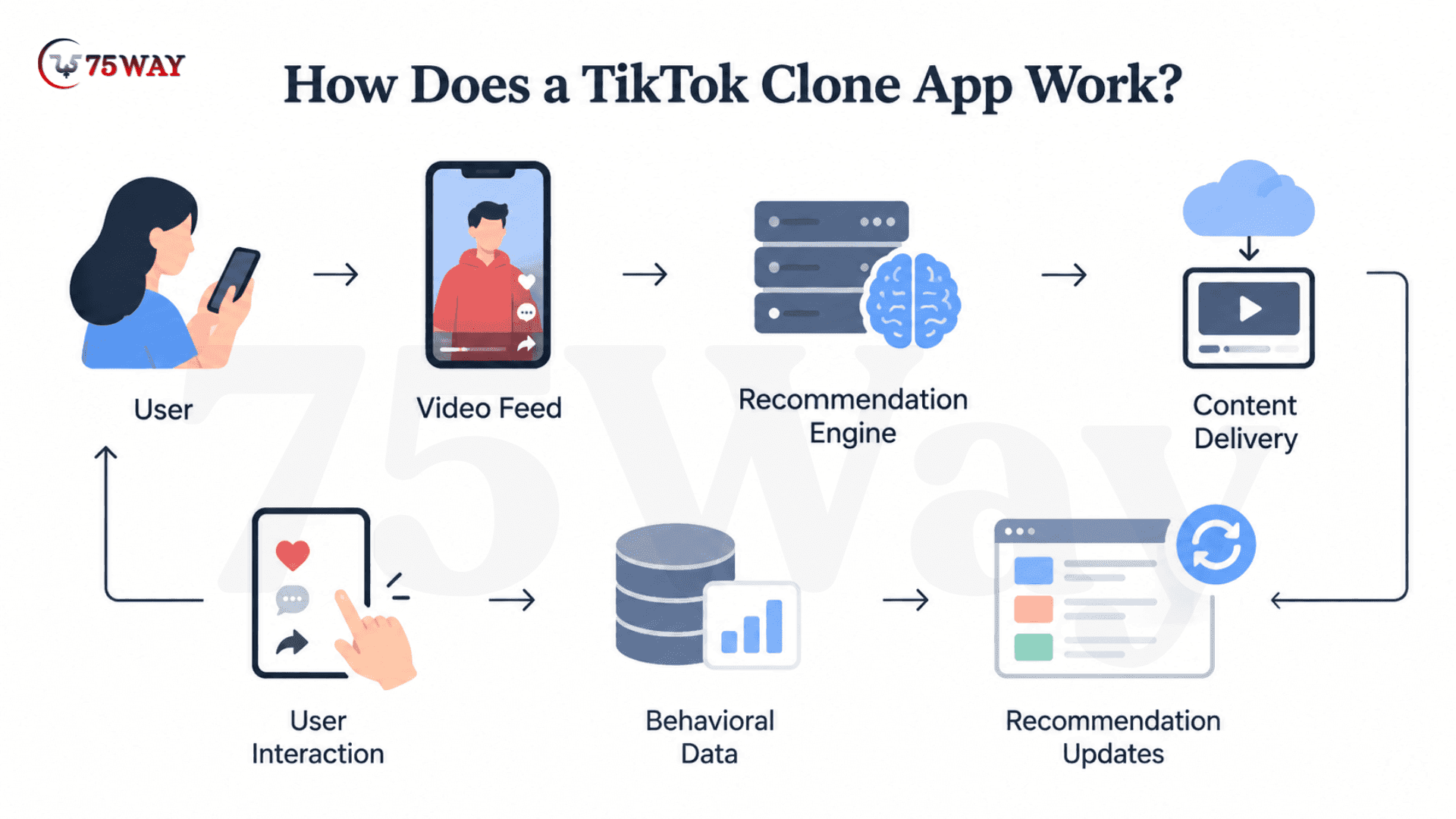
- User: Views personalized videos based on individual preferences daily.
- Video Feed: Displays recommended videos in a personalized scrolling interface.
- Recommendation Engine: Analyzes user signals to select relevant content dynamically.
- Content Delivery: Delivers selected videos quickly across supported user devices.
- User Interaction: Captures likes, shares, comments, skips, and viewing behavior.
- Behavioral Data: Records interactions that reveal evolving user preferences over time.
- Recommendation Updates: Refines recommendations using newly collected behavioral signals continuously.
How To Build An App-like TikTok: A Complete Process
The idea of building an app like TikTok may sound straightforward until the technical requirements start taking shape. A functional product needs a structured development roadmap. These strategic stages decide how a TikTok clone app creation process moves from an initial concept toward a production-ready product.
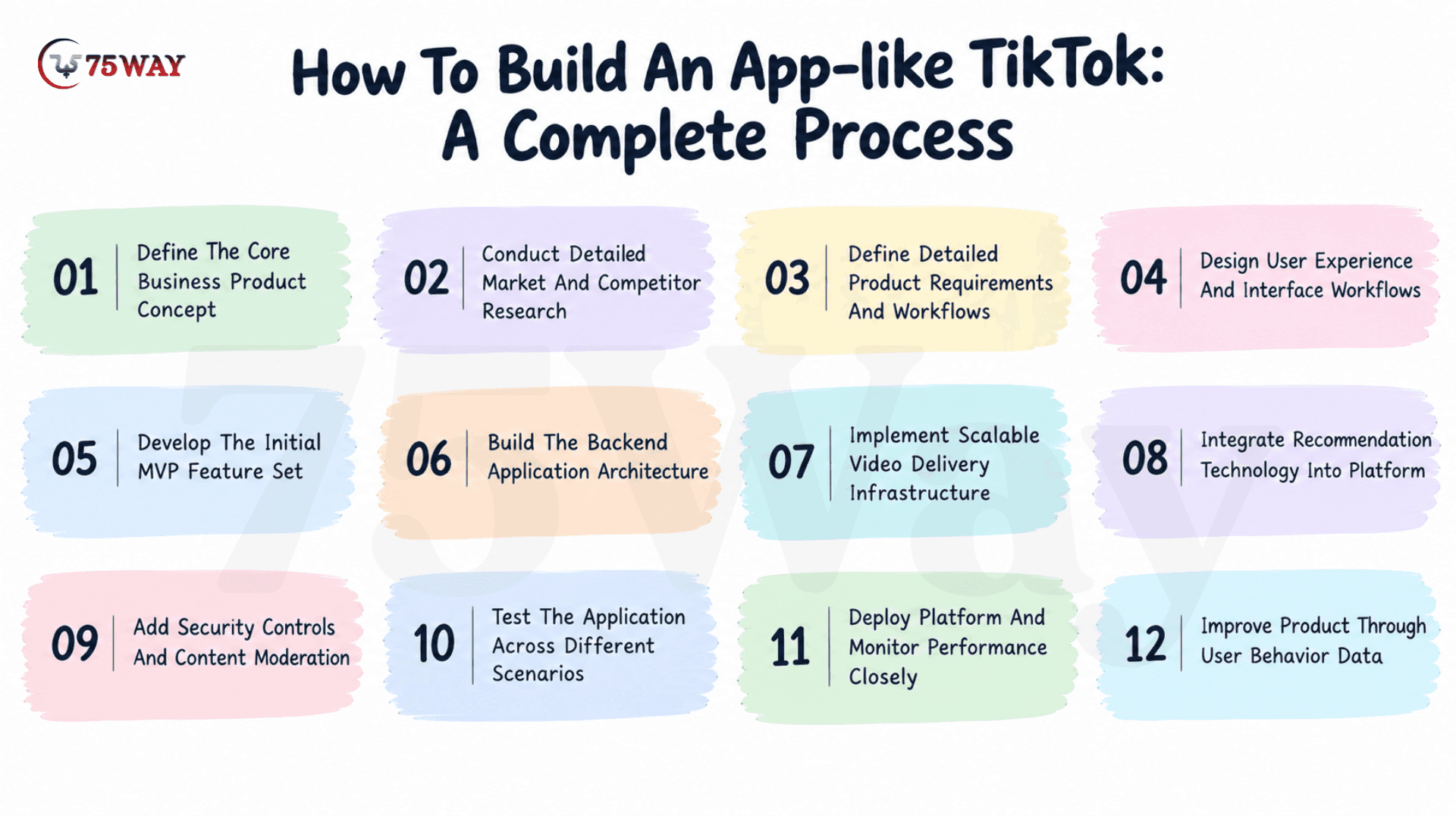
1. Define The Core Business Product Concept
The first stage establishes who the platform serves and why users would choose it over existing short-video applications.
The team defines the target audience, content category, geographic market, competitive positioning, monetization strategy, creator strategy, and primary business objectives.
2. Conduct Detailed Market And Competitor Research
Research helps identify existing products, user expectations, underserved niches, monetization approaches, and potential differentiation.
Competitor analysis should examine onboarding, content discovery, creator tools, engagement mechanisms, advertising, subscription models, moderation, and retention strategies.
3. Define Detailed Product Requirements And Workflows
Business requirements are translated into functional and technical specifications.
The product team identifies user roles, workflows, content rules, payment requirements, integrations, analytics requirements, administrative controls, security expectations, and scalability requirements.
4. Design User Experience And Interface Workflows
UX designers create user flows and wireframes before moving into high-fidelity interface design.
The focus should remain on fast content discovery, simple creation, intuitive navigation, accessible controls, and minimal friction between opening the application and consuming or creating content.
5. Develop The Initial MVP Feature Set
An MVP should contain the smallest practical feature set required to validate the business model.
A typical MVP may include registration, profiles, video upload, video feed, basic editing, likes, comments, follows, search, notifications, moderation, and an admin dashboard.
Advanced features such as livestreaming, sophisticated AI recommendations, virtual gifts, and complex creator monetization can be introduced after validating user demand.
6. Build The Backend Application Architecture
The backend manages authentication, user profiles, content metadata, social relationships, notifications, payments, analytics, moderation, and application logic.
For a video-heavy platform, backend architecture must also account for media storage, encoding, content delivery, caching, bandwidth, and traffic spikes.
7. Implement Scalable Video Delivery Infrastructure
Video infrastructure is one of the most important technical components of a TikTok-like application.
Uploaded videos typically need processing into appropriate formats and resolutions before delivery through a content delivery network. Adaptive streaming, caching, compression, thumbnails, storage lifecycle policies, and bandwidth management can help control performance and infrastructure expenses.
8. Integrate Recommendation Technology Into Platform
The recommendation system can begin with relatively simple rules before becoming more sophisticated.
Early signals may include user interests, video categories, viewing behavior, engagement, and freshness. As sufficient behavioral data becomes available, machine-learning models can support more personalized ranking.
9. Add Security Controls And Content Moderation
Security should be incorporated throughout development rather than added immediately before launch.
The application should protect accounts, APIs, personal data, payment information, uploaded media, administrative functions, and internal services. Content reporting, automated moderation, human review, and enforcement workflows should also be established.
10. Test TikTok Clone App Across Different Scenarios
Testing should cover functional workflows, video playback, upload reliability, device compatibility, API performance, security, payments, notifications, moderation, and recommendation behavior.
Load testing becomes particularly important because video applications can experience significant bandwidth and concurrent-user demands.
11. Deploy Platform And Monitor Performance Closely
After testing, the application can be deployed through the relevant app stores and cloud infrastructure.
Monitoring should track crashes, API latency, video playback failures, storage consumption, bandwidth usage, server performance, engagement, retention, and monetization metrics.
12. Improve TikTok Clone Through User Behavior Data
Launch should be treated as the beginning of product development rather than the final milestone.
Analytics can reveal where users drop off, which content performs well, which creators retain audiences, and which monetization methods generate sustainable revenue. These insights should guide subsequent releases.
Core Features To Include In TikTok Clone Script Development
A successful short-video application needs more than video uploading and scrolling. The product should connect creation, discovery, engagement, moderation, analytics, and monetization into one ecosystem.
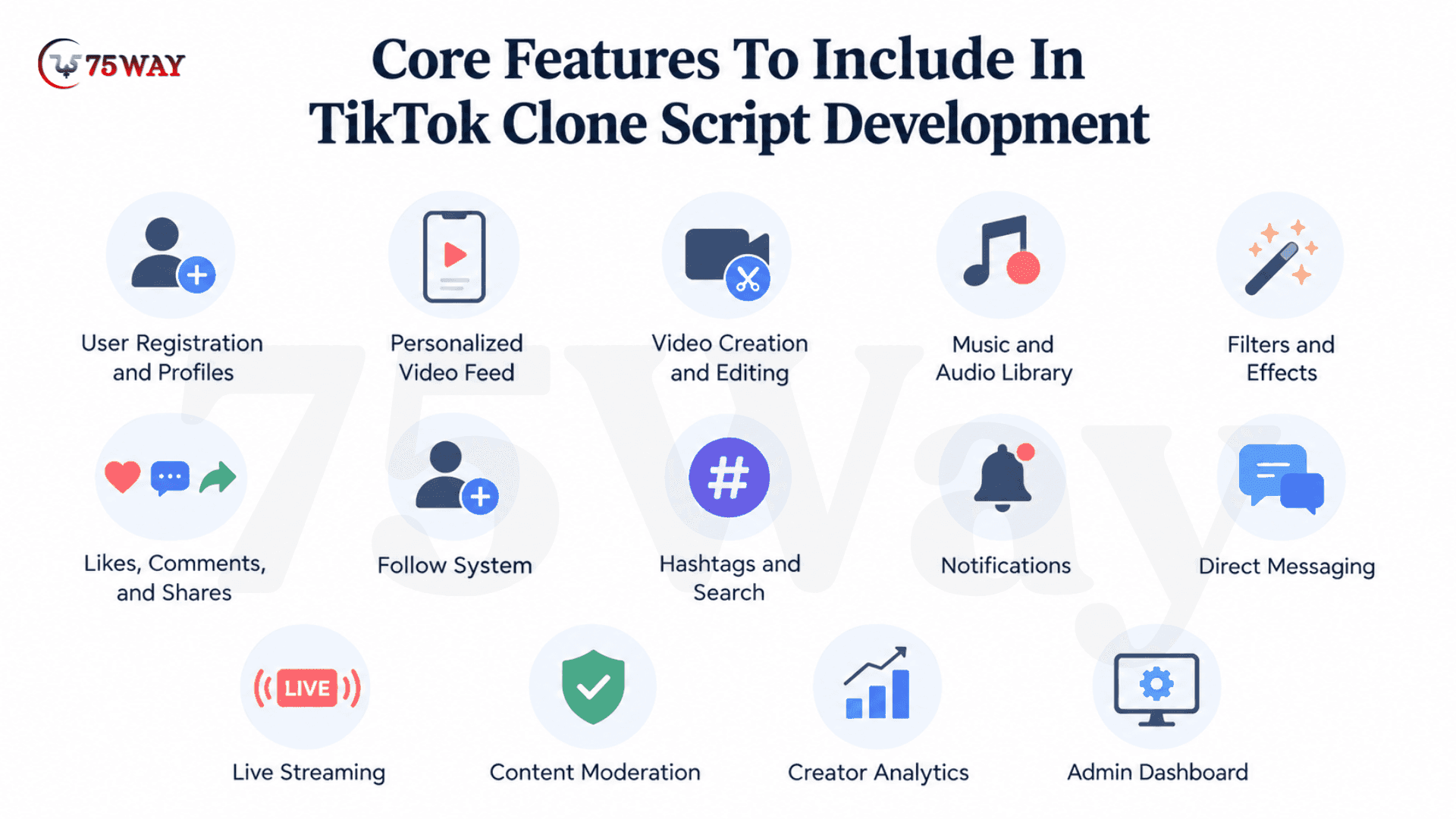
- User Registration and Profiles
Users should be able to create accounts using email, phone numbers, social sign-in, or other supported authentication methods. Profiles can include profile photos, biographies, follower counts, following lists, uploaded videos, liked content, and creator information.
- Personalized Video Feed
The feed represents the central product experience. Content ranking can consider watch duration, completion rate, likes, shares, comments, follows, previous viewing patterns, content categories, and other behavioral signals.
- Video Creation and Editing
Creators should be able to record, upload, trim, merge, resize, filter, caption, and edit videos directly within the application.
- Music and Audio Library
A sound library can allow users to add music, voice effects, audio clips, and other licensed content to their videos. Licensing requirements should be addressed before launching commercial music functionality.
- Filters and Effects
AR effects, visual filters, stickers, transitions, text overlays, and other creative tools can increase content variety and creator participation.
- Likes, Comments, and Shares
Social engagement tools allow viewers to react to content and distribute videos through internal and external sharing channels.
- Follow System
Users can follow creators and receive content based on their interests and relationships.
- Hashtags and Search
Search functionality should support users, videos, hashtags, sounds, topics, and potentially locations or categories depending on the product strategy.
- Notifications
Push and in-app notifications can inform users about likes, comments, followers, messages, mentions, livestreams, recommendations, and platform activity.
- Direct Messaging
Private messaging can create another engagement layer, allowing users to communicate individually or through group conversations.
- Live Streaming
Live video can introduce real-time interaction, creator monetization, virtual gifts, audience participation, and event-based engagement.
- Content Moderation
Moderation tools should identify prohibited content, spam, abusive behavior, copyright concerns, impersonation, and other policy violations.
- Creator Analytics
Creator dashboards can display views, watch time, engagement, follower growth, audience characteristics, content performance, and revenue-related metrics.
- Admin Dashboard
Administrators need centralized controls for users, videos, reports, creators, advertisements, payments, categories, moderation, analytics, and platform settings.
AI Features Required to Build An App-like TikTok
A TikTok-like app development solution can have thousands of videos and still feel empty if users keep seeing content they do not care about. AI changes that equation by turning every interaction into useful context for discovery, moderation, personalisation, and creator support. The AI capabilities that can turn a large video library into a more relevant user experience deserve careful consideration during development.
- AI-Powered Recommendations
Machine learning models can analyze viewing patterns, interactions, content characteristics, and user preferences to rank videos for individual users.
- Automated Content Moderation
AI-based moderation can help detect potentially harmful or restricted content before or after publication, with human review used for ambiguous cases.
- AI Video Enhancement
Automated tools can improve video quality through functions such as background removal, noise reduction, image enhancement, captions, and smart editing.
- AI Caption Generation
Speech-to-text models can automatically generate captions, improving accessibility and reducing creator editing time.
- Personalized Hashtag Suggestions
AI can analyze video content and suggest relevant hashtags, categories, or keywords to help creators organize their content.
- AI Content Recommendations For Creators
The platform can analyze creator performance and suggest content topics, posting opportunities, formats, or audience trends.
- AI-Based Spam Detection
Behavioral models can identify suspicious accounts, automated activity, engagement manipulation, and coordinated spam patterns.
Tools And Technology Stack Used To Build Tik Tok Duplicate App
A TikTok-like app needs a strong technical foundation before its first video reaches a user’s screen. The choice of app architecture, development technologies, database structure, video infrastructure, APIs, and third-party services can directly affect how the final product performs as usage grows. These development considerations provide the foundation for turning a short-video concept into a working application.
- Mobile App: Flutter, React Native, Swift, and Kotlin
Supports native and cross-platform applications across different mobile devices and operating systems.
- Backend: Node.js, Python, Java, and Go
Manages application logic, APIs, authentication, data processing, and server-side platform operations.
- Database: PostgreSQL, MySQL, and MongoDB
Stores user profiles, video metadata, interactions, relationships, and platform records securely.
- Cache: Redis
Stores frequently accessed information, reducing database queries and improving application response times.
- Cloud: AWS, Google Cloud, Azure
Provides computing resources, hosting infrastructure, storage, monitoring, and scalable deployment capabilities.
- Video Storage: Amazon S3, Google Cloud Storage
Stores uploaded videos securely while supporting reliable retrieval and large-scale content management.
- CDN: CloudFront, Cloud CDN, Cloudflare
Delivers video content quickly by serving media from geographically distributed network locations.
- Video Processing: FFmpeg, cloud video services
Encodes, compresses, converts, and prepares uploaded videos for different playback requirements.
- Real-Time Features: WebSockets, Firebase
Enables messaging, live updates, notifications, and other real-time user interactions.
- AI/ML: Python, TensorFlow, PyTorch
Supports personalized recommendations, content analysis, automated moderation, and predictive platform capabilities.
- Search: Elasticsearch, OpenSearch
Enables fast discovery across videos, users, hashtags, categories, and searchable content.
- Notifications: Firebase Cloud Messaging, APNs
Delivers push notifications for messages, interactions, recommendations, updates, and account activity.
- Analytics: Mixpanel, Firebase Analytics, custom analytics
Tracks engagement, retention, conversions, user behavior, and overall platform performance.
The final architecture should be selected according to the product's actual requirements instead of following a fixed technology checklist.
How Much Does It Cost To Build App Like TikTok?
The estimated TikTok clone app development cost can range from $7,000 to $450,000+, depending on the product's complexity, development approach, platforms, integrations, AI capabilities, infrastructure requirements, and development team location.
1. Basic MVP TikTok Clone Cost: $7,000 – $45,000
- Includes sign-up, video uploads, playback, feeds, likes, comments.
- Suitable for validating core concepts before larger development investments.
Timeline: 3–5 months
2. Mid-Level TikTok Clone Cost: $70,000 – $150,000
- Adds recommendations, duets, stitches, chat, analytics, and moderation.
- Suitable for platforms requiring stronger engagement and personalization capabilities.
Timeline: 5–8 months
3. Advanced / Full-Scale TikTok Clone Cost: $250,000 – $450,000+
- Includes livestreaming, machine learning, AR filters, monetization, administration.
- Suitable for platforms targeting large-scale audiences and operations.
Timeline: 9–15 months
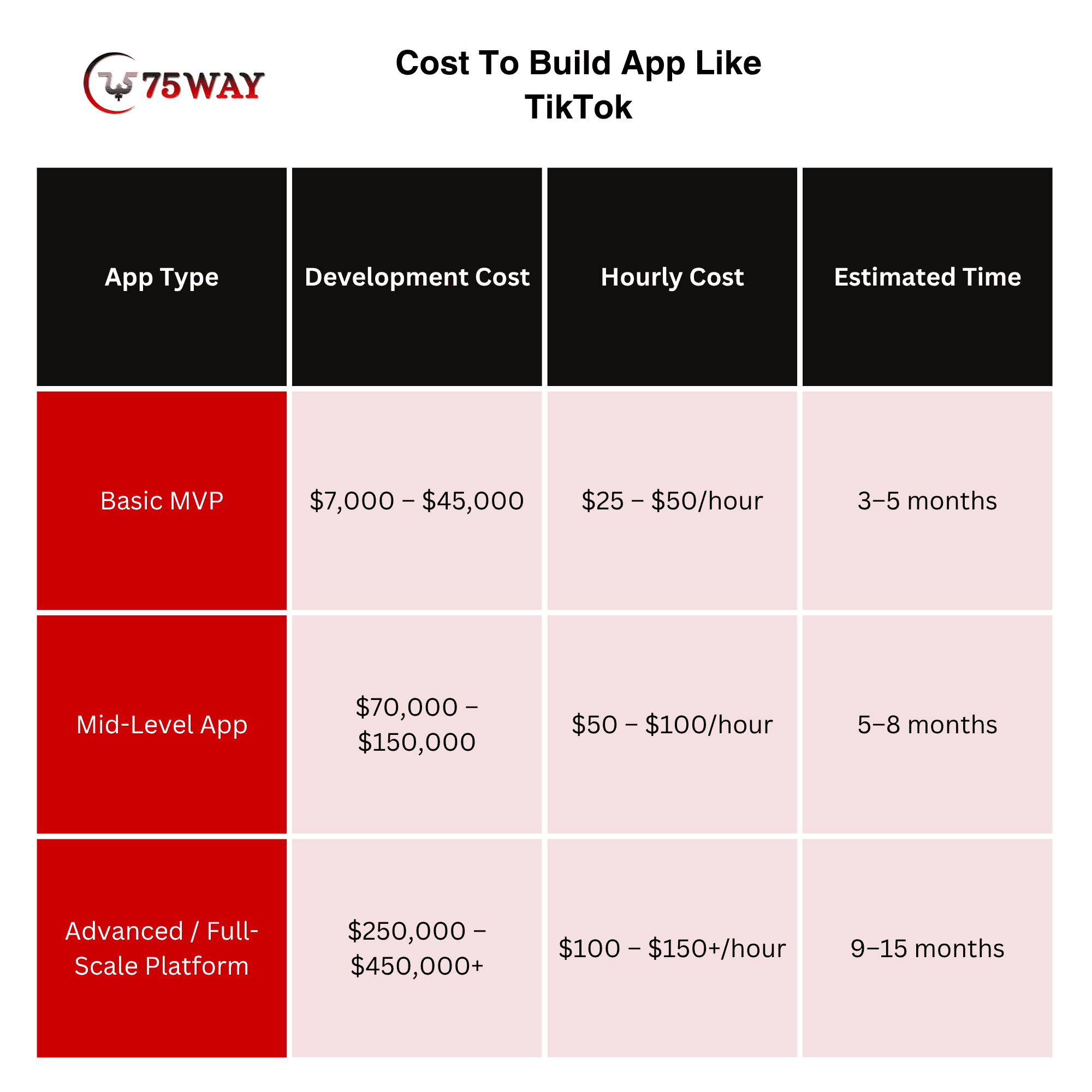
These cost factors are planning estimates rather than fixed development quotes. A platform with advanced recommendation algorithms, livestreaming, creator monetization, AI moderation, high-scale video infrastructure, and sophisticated analytics will require substantially more engineering than a basic MVP.
Cost To Build A Tiktok Clone App Based on Stages
A TikTok clone app can start with a manageable budget, but costs rise as the product moves from basic screens to advanced video, social, and backend capabilities. The final investment depends on how much functionality you need at each development stage, along with technology, team size, integrations, and scalability requirements. A stage-wise cost breakdown makes it easier to understand where your app budget goes and what each development phase adds to the product.
1. UI/UX Design: 10–15%
- Creates wireframes for intuitive vertical video navigation.
- Builds prototypes for smooth, engaging user experiences.
Average Cost: $5,000–$15,000
Timeline: 2–4 weeks
2. Frontend Development: 25–30%
- Builds video playback interfaces for mobile platforms.
- Supports native or cross-platform application development requirements.
Average Cost: $20,000–$50,000
Timeline: 2–4 months
3. Backend and API: 30–35%
- Handles video storage, databases, authentication, and streaming.
- Supports APIs, real-time features, and server operations.
Average Cost: $25,000–$60,000
Timeline: 3–5 months
4. Testing and QA: 15–20%
- Tests compatibility across devices, platforms, and operating systems.
- Verifies performance, functionality, security, and app approvals.
Average Cost: $10,000–$25,000
Timeline: 3–6 weeks
5. Ongoing Maintenance & Cloud Hosting
- Updates typically require 10–20% of initial costs.
- Hosting expenses increase with users and bandwidth.
Average Cost: $500–$5,000+ monthly
Timeline: Ongoing
6. Hidden Costs
- Music licensing can increase integration budget significantly.
- Third-party services may add additional recurring expenses.
Average Cost: 15–20% additional integration budget
Timeline: Depends on licensing and integrations
Cost To Hire Tiktok Clone App Developer
Hiring a developer for a TikTok clone app can look like a simple staffing expense until the project requires video infrastructure, recommendation logic, social features, and scalable backend systems. Developer experience, location, engagement model, technical scope, and project duration can all change the amount you need to budget. A closer look at these cost factors helps businesses understand what they may actually spend when hiring the right development talent.
1. India / South Asia: $20 – $40/hr
Project Cost: $15,000 – $80,000
2. Eastern Europe ($40 – $80/hr)
Project Cost: $60,000 – $150,000
3. United Kingdom / Western Europe: $80 – $150/hr
Project Cost: $100,000 – $200,000
4. United States: $100 – $200+/hr
Project Cost: $120,000 – $250,000+
Factors Affecting TikTok Clone Development Cost
- Feature Complexity: More advanced functionality requires additional design, engineering, testing, and maintenance.
- Platform Selection: Developing separate native applications for iOS and Android can increase development requirements compared with a cross-platform approach.
- UI/UX Design: Custom interfaces, animation, video interactions, creator dashboards, and advanced editing experiences require additional design effort.
- Backend Architecture: High-volume video applications need more sophisticated infrastructure than conventional content applications.
- AI Integration: Recommendation engines, moderation, personalization, computer vision, and generative features can increase development and infrastructure expenses.
- Third-Party Integrations: Payment gateways, analytics platforms, cloud services, communication APIs, music services, and advertising systems affect the overall budget.
- Security Requirements: Strong authentication, encryption, access control, monitoring, compliance, and audit requirements add engineering work.
- Testing Requirements: Device testing, performance testing, security testing, video testing, and load testing become increasingly important as the platform grows.
- Development Team: Agency, in-house, freelance, and geographical models can produce different development costs.
Buy A TikTok Clone Or Build A Custom App Like TikTok: What To Consider
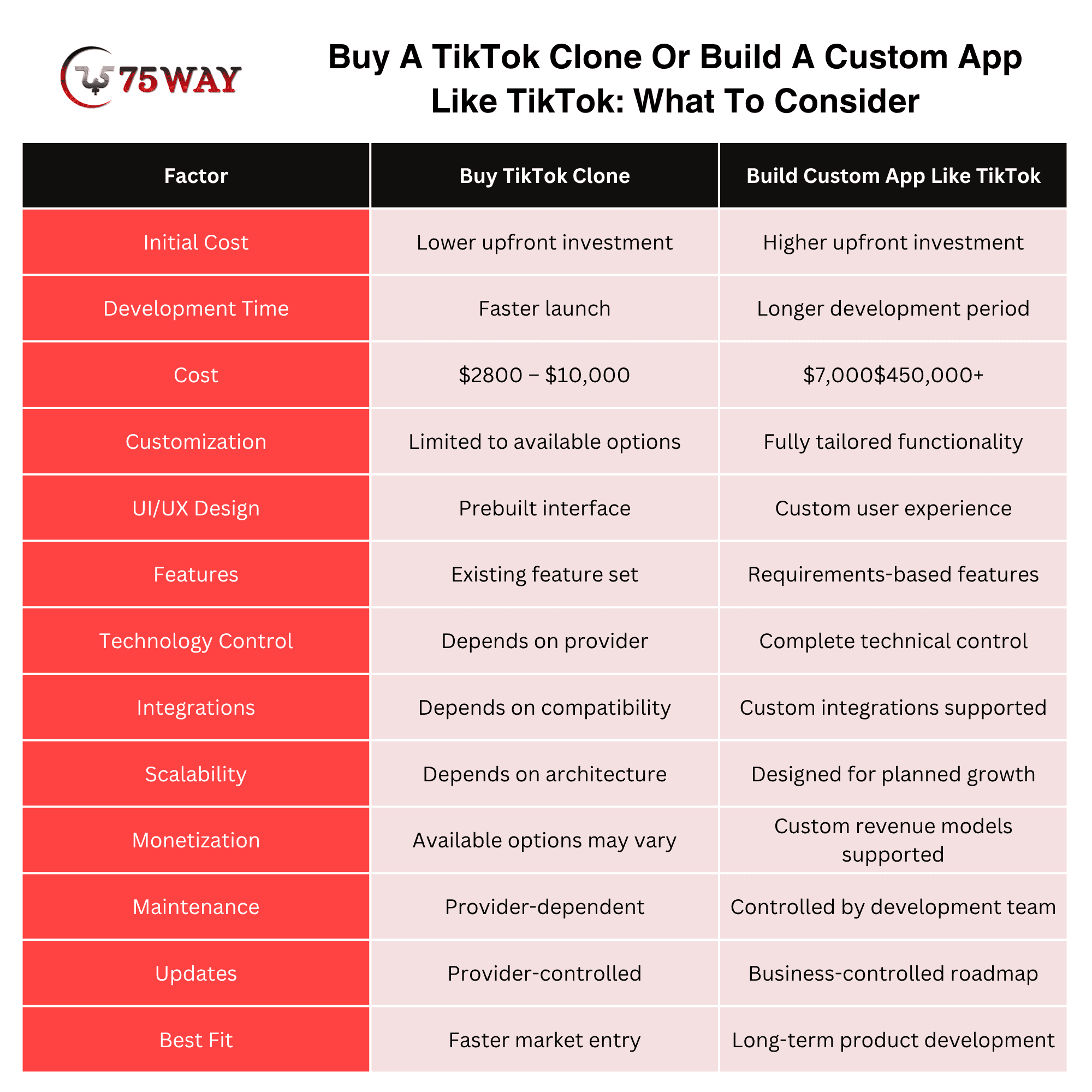
Buying a TikTok clone provides a ready-made foundation with prebuilt features such as user profiles, video uploads, feeds, likes, comments, and basic administration. It can reduce initial development time and investment, making it suitable for businesses that want to launch quickly with standard functionality. However, customization depends on the clone’s existing architecture, available features, and provider capabilities.
Building a custom app like TikTok offers greater control over product design, functionality, technology, integrations, recommendation systems, monetization, and future enhancements. Although custom development generally requires more time and upfront investment, it allows the platform to be designed around specific business requirements instead of adapting existing functionality to fit the intended product.
Business Models for a TikTok Clone Development Solutions
The right business model depends on the target audience, creator ecosystem, content category, and user behavior.
1. Advertising-Based Model
Advertising can generate revenue by placing sponsored content within the video discovery experience.
Potential formats include:
- In-feed video ads
- Sponsored content
- Native advertisements
- Branded challenges
- Creator-led campaigns
- Display placements
- Sponsored effects
TikTok itself offers advertising products including in-feed ads, TopView, branded effects, branded missions, and Spark Ads, demonstrating how short-video platforms can integrate commercial content into the user experience.
2. Subscription Model
Premium subscriptions can provide users with benefits such as:
- Ad-free viewing
- Exclusive content
- Premium creator channels
- Advanced editing tools
- Special effects
- Higher upload limits
- Exclusive communities
3. Creator Commission Model
The platform can take a percentage of transactions generated through creator monetization, including premium content, virtual goods, subscriptions, or other paid interactions.
4. Virtual Gifts
Users can purchase digital credits and send virtual gifts to creators during videos or livestreams. The platform can retain a percentage of the transaction.
5. Brand Partnerships
Brands can pay creators or the platform for sponsored campaigns, branded challenges, product integrations, and promotional content.
6. E-Commerce Model
A short-video platform can connect discovery with shopping by allowing creators or brands to promote products directly through video content.
7. Affiliate Revenue
Creators can promote products through affiliate links, with the platform receiving a commission depending on the commercial arrangement.
How To Choose A TikTok Clone App Development Company?
The development partner should be evaluated beyond hourly rates.
Consider the company's:
- Short-video application experience
- Backend engineering capabilities
- Cloud infrastructure expertise
- Video-processing knowledge
- AI and machine-learning experience
- UI/UX capabilities
- Security practices
- Testing methodology
- Post-launch support
- Previous product work
- Communication process
- Development methodology
- Ownership and IP terms
Ask prospective development partners to explain how they would handle video storage, encoding, CDN delivery, feed ranking, moderation, analytics, scalability, and infrastructure costs.
A technically credible partner should be able to discuss these areas in practical terms rather than focusing only on interface development.
Future Trends In TikTok-Like Short-Video App Development
The short-video ecosystem is moving beyond simple entertainment feeds. AI-powered creation, personalization, livestreaming, social commerce, creator monetization, and interactive content are increasingly becoming part of the broader product landscape.
- AI-Assisted Content Creation
AI can help creators generate captions, edit footage, enhance video quality, create effects, and develop content ideas.
- Personalized Feeds
Recommendation systems will continue becoming more context-aware, using increasingly diverse behavioral and content signals.
- Social Commerce
Video discovery can increasingly connect directly with product discovery, creator recommendations, and purchasing journeys.
- Creator Monetization
Platforms can provide creators with multiple ways to earn rather than relying exclusively on advertising revenue.
- Interactive Video
Livestreaming, polls, challenges, virtual gifts, comments, and real-time interactions can make video consumption more participatory.
Final Thoughts
TikTok clone app development can create a strong digital product opportunity when the business combines short-form video with a focused audience, differentiated experience, scalable infrastructure, creator incentives, and sustainable monetization.
However, the strongest starting point is not copying every TikTok feature. It is identifying a specific audience, defining a clear product proposition, launching a focused MVP, measuring real user behavior, and progressively investing in recommendation technology, creator tools, monetization, and infrastructure.
Planning to launch your own TikTok-like platform? Partner with an experienced app development team to turn your short-video business idea into a scalable product.
Frequently Asked Questions (FAQs)
How long does it take to build a TikTok clone app?
A basic MVP may take around 3–5 months, while an advanced short-video platform can require 6–12 months or longer, depending on scope and technical complexity.
Can I build a TikTok clone app with AI?
Yes. AI can support recommendations, content moderation, captions, video enhancement, personalization, search, creator assistance, and spam detection.
What is the most important feature of a TikTok clone?
The personalized video discovery experience is central because it connects content supply, user engagement, retention, and recommendation intelligence.
Can I launch a TikTok clone as an MVP?
Yes. An MVP can focus on registration, profiles, video creation, uploads, personalized feeds, engagement, search, notifications, moderation, and administration before advanced capabilities are introduced.
How can a TikTok clone app make money?
Potential revenue streams include advertising, subscriptions, virtual gifts, creator commissions, brand partnerships, affiliate revenue, premium content, and social commerce.
Is TikTok clone app development legal?
Developing a short-video application is possible, but businesses should avoid copying protected branding, proprietary assets, copyrighted content, trade dress, or proprietary technology. Legal requirements can vary based on jurisdiction, content, licensing, privacy practices, and business operations.
What technology is used to develop a TikTok-like app?
Common technologies include Flutter or React Native for cross-platform development, Swift or Kotlin for native applications, Node.js, Python, Java, or Go for backend systems, cloud infrastructure, databases, CDNs, video-processing tools, and AI/ML frameworks.