AI Summary
Building an AI-powered tow truck app? Discover the complete 2026 guide to roadside assistance app development, including costs, features, dispatch software, integrations, business models, and scalability. These insights help founders plan scalable roadside assistance solutions for growth.
Key Takeaways
- Roadside assistance app development connects drivers, providers, dispatchers, and businesses digitally.
- Essential features include booking, GPS tracking, dispatch, payments, notifications, and invoices.
- Development costs typically range from $15,000 to $250,000+ depending on complexity.
- Intelligent dispatch and integrations can strengthen roadside service operations and scalability.
- Market growth creates $39.7B opportunities for scalable roadside assistance platforms by 2034.
A roadside assistance business does not get many chances to make a good first impression. When someone is stuck on the side of the road, every extra step between requesting help and seeing a technician arrive can affect customer trust.
That is why the strongest vehicle roadside assistance platforms focus on the entire service journey rather than simply adding an “Emergency Assistance” button.
Customers need quick requests and accurate ETAs from roadside assistance app development solutions, while businesses need dispatch visibility, technician availability, service tracking, pricing control, and reliable payment collection.
The opportunity goes beyond helping individual drivers. Towing and roadside businesses can use mobile platforms to manage memberships, fleet accounts, insurance partnerships, recurring services, and larger technician networks.
But how do you build a roadside assistance app that can handle these demands? What does tow truck app development cost, and which features actually deserve investment?
This guide brings those business and technology considerations together, covering the features, architecture, development process, cost factors, monetization strategies, and other decisions involved in launching a roadside assistance app in 2026.
What Is Roadside Assistance App Development?
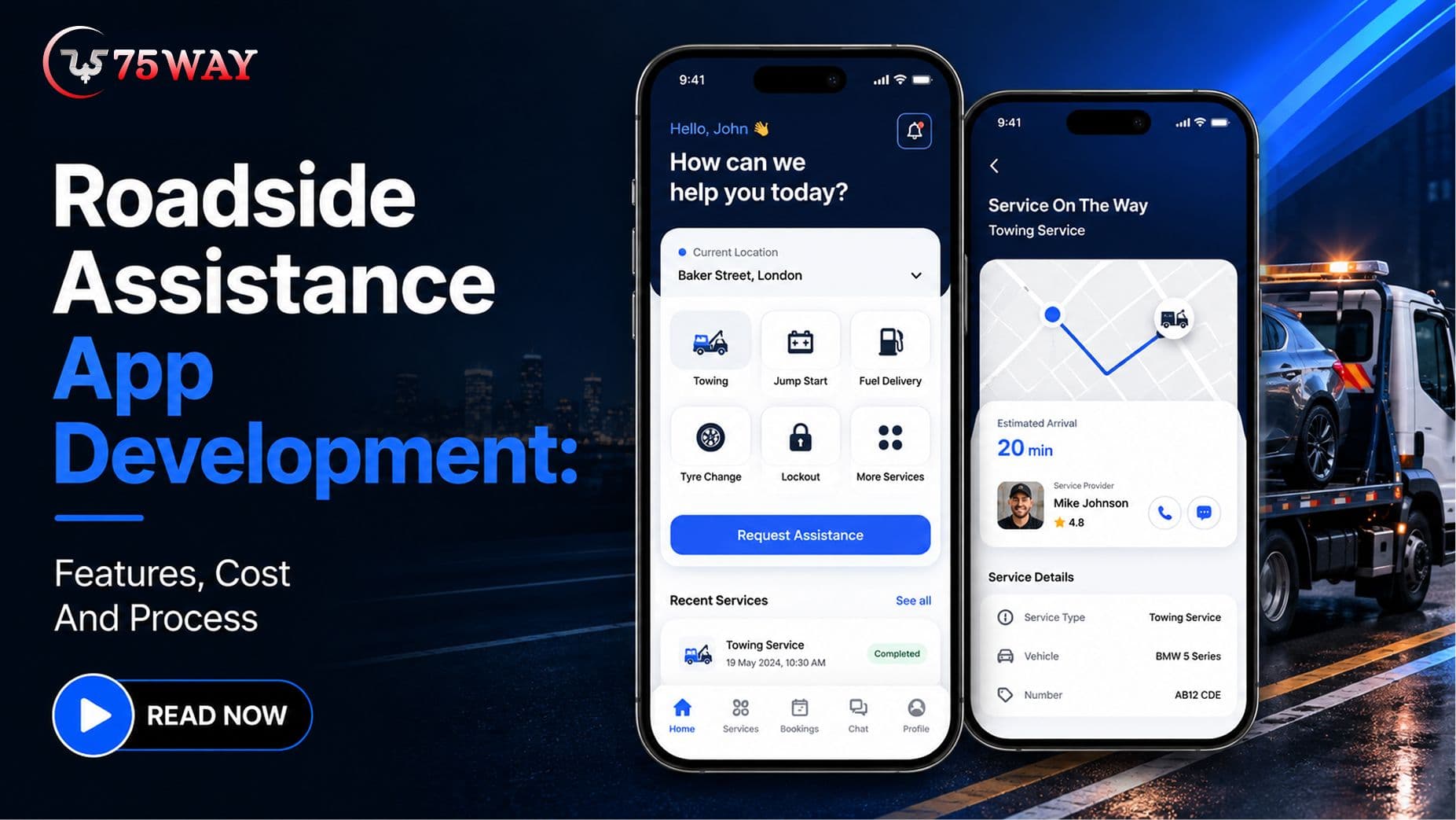
In roadside assistance app development, a digital tow truck platform is created that connects drivers with towing and roadside service providers for on-demand vehicle assistance. The platform can manage service requests, GPS locations, provider matching, dispatching, real-time tracking, payments, invoices, notifications, and customer support from a centralized system.
Unlike a basic towing application that only allows customers to request a tow, a complete roadside assistance app solution can support the entire service lifecycle. It can connect customers, tow operators, dispatchers, administrators, fleet managers, and business partners through dedicated interfaces.
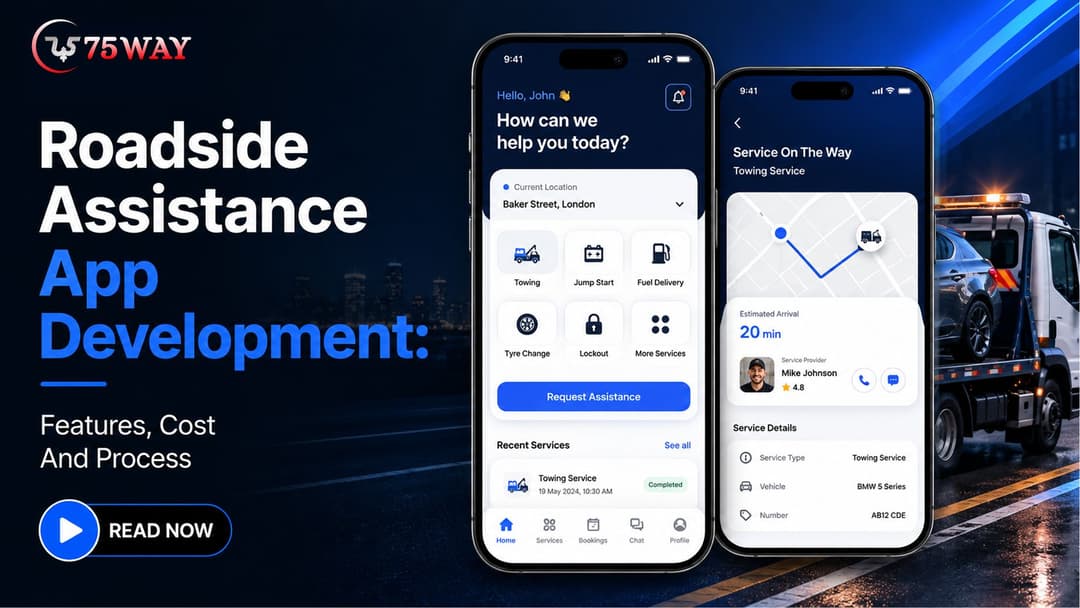
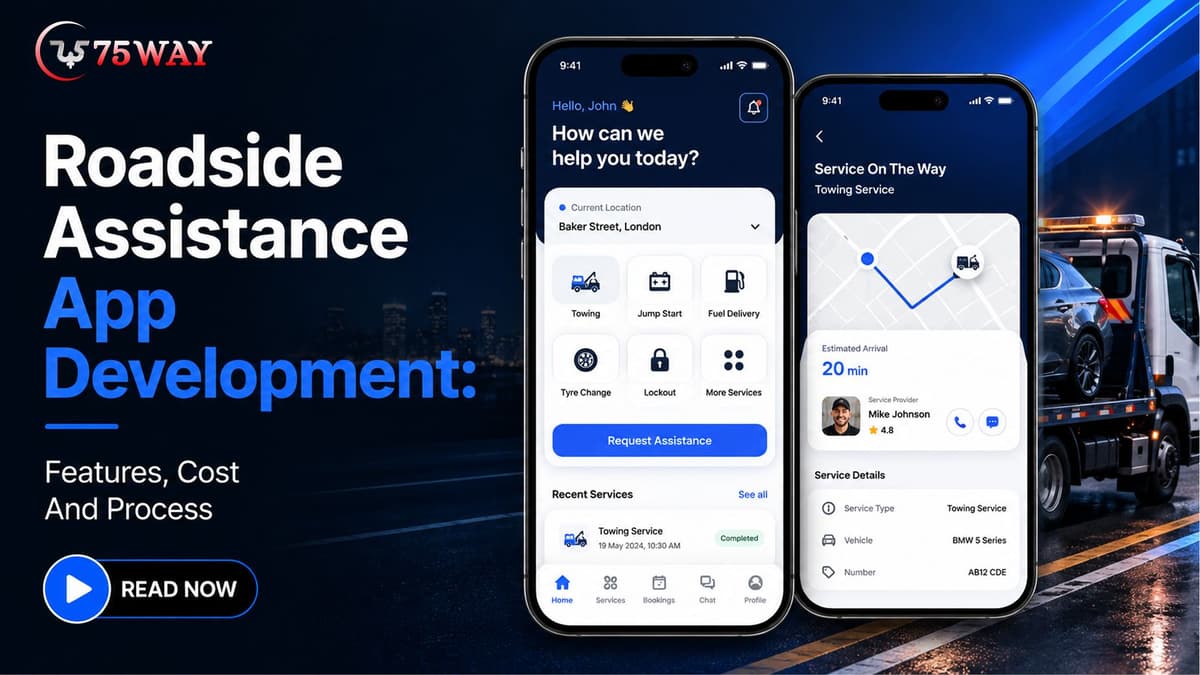
A typical platform may include three core applications:
- Customer App: Let drivers request towing, jump-starts, tire changes, fuel delivery, lockout assistance, battery services, and other roadside help.
- Provider App: Allow tow truck drivers and roadside technicians to receive jobs, navigate to customers, update service status, upload proof of service, and manage earnings.
- Admin or Dispatcher Panel: Give businesses visibility into bookings, provider availability, locations, pricing, payments, assignments, and completed services.
For towing companies, startups, fleet businesses, and roadside assistance providers, the goal is not simply to replace phone-based bookings. The larger objective is to create a connected operational system that makes service fulfillment easier to manage while giving customers a more transparent way to request and monitor assistance.
What Can A Towing App Manage?
A roadside assistance app can manage emergency towing, breakdown assistance, flat-tire help, battery jump-starts, fuel delivery, vehicle lockouts, battery replacement, winching, recovery, vehicle transportation, and scheduled towing. It can also support fleet roadside assistance, provider dispatch, digital invoices, online payments, customer communication, and service history.
Businesses can start with a focused MVP covering essential roadside services and gradually add advanced capabilities as booking volume, provider coverage, and operational needs increase. This approach helps control initial development costs while allowing the platform to scale with business growth.
Vehicle Roadside Assistance App Market Size & Insights in USA
The U.S. roadside assistance market is already worth billions, creating room for businesses that can make emergency vehicle support faster and easier to access. The market size and growth signals below put this opportunity into perspective.
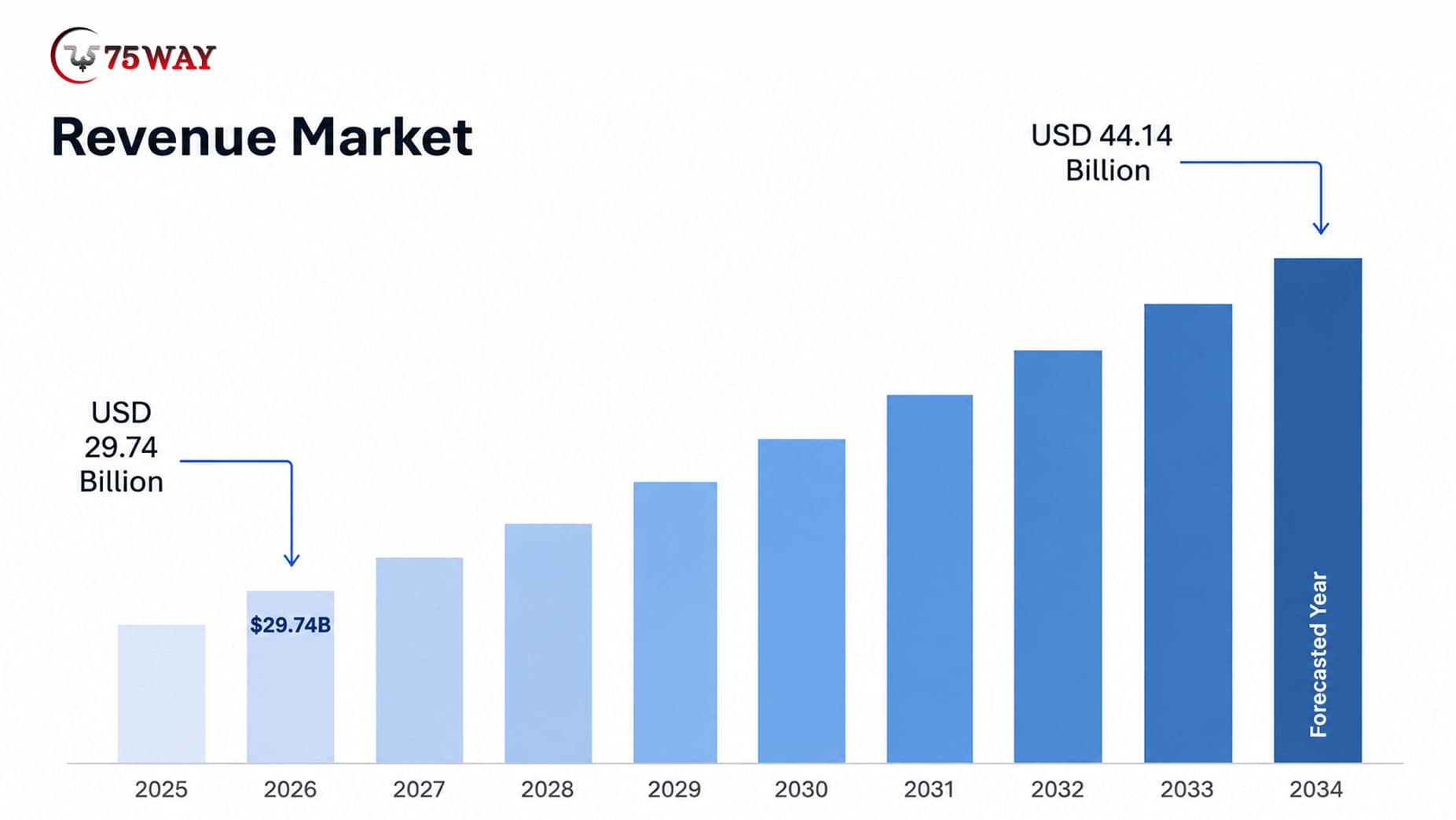
- The global roadside assistance market is projected to grow from $29.74 billion in 2026 to $44.14 billion by 2034, at a CAGR of 5.06%.
- Towing services hold the largest share of the roadside assistance market at 28.5%.
- The global tow truck market is expected to expand from $5.99 billion in 2026 to $8.08 billion by 2035, registering a CAGR of 3.8%.
- Mobile bookings account for approximately 55% of U.S. towing volume, highlighting the growing role of digital platforms.
- Towing services dominate the service-type segment with a 40.2% share, driven by demand for emergency vehicle recovery.
Why Invest In Building White Label Roadside Assistance App In 2026?
The biggest advantage of a white-label roadside assistance app may be the time it gives a business to compete rather than build endlessly. A ready technology foundation can help owners enter the market sooner while retaining room for branding, customization, and expansion. The commercial benefits behind the investment in a white-label roadside assistance app are examined below.
1. Growing Roadside Assistance Market
The vehicle roadside assistance market represents a substantial business opportunity, supported by demand for towing, breakdown recovery, battery assistance, tire services, fuel delivery, and other emergency vehicle services.
Businesses entering this space can use digital platforms to create new service channels while expanding their reach across targeted geographic markets.
For context, one current market forecast projects the global vehicle roadside assistance market to reach $44.32 billion by 2034, growing from $27.14 billion in 2025 at a 5.6% CAGR. Market estimates vary by research methodology and geographic scope, so businesses should validate figures before using them in investment materials.
2. Faster Digital Service Booking
Drivers experiencing a breakdown may not want to search for a provider, make multiple calls, explain their location repeatedly, and wait for manual confirmation.
A towing app can allow customers to select a service, share their location, provide vehicle details, review available options, and submit a request digitally.
This creates a more direct booking journey while giving businesses structured information before dispatch begins.
3. Better Tow Truck Dispatch Management
Manual dispatching can become difficult when a business manages several drivers, service areas, vehicle types, and simultaneous requests.
Tow truck dispatch software can give dispatchers a centralized view of incoming jobs, available providers, active assignments, locations, and service statuses.
Depending on the platform's rules, dispatchers can assign jobs manually or use automated matching based on factors such as distance, availability, service capability, and vehicle requirements.
4. Wider Provider Coverage
A multi-provider towing application can connect customers with independent towing companies and roadside technicians across defined service areas.
This can help startups expand beyond the capacity of their own fleet without purchasing every vehicle required to fulfill customer demand.
For marketplace operators, provider availability becomes an important growth factor because customer demand cannot be converted into completed bookings without sufficient service capacity.
5. More Transparent Customer Experience
Roadside emergencies create uncertainty for customers. They want to know whether their request was received, who is coming, where the provider is located, and when help is expected to arrive.
Features such as booking confirmations, provider profiles, status notifications, GPS tracking, and ETA updates can make the service journey more transparent.
6. Multiple Revenue Opportunities
A roadside assistance platform does not need to depend on a single revenue stream. Depending on the business model, companies can generate revenue through:
- Per-booking commissions
- Customer service fees
- Provider subscriptions
- Enterprise contracts
- Fleet accounts
- White-label licensing
- Membership plans
- Partner programs
The most suitable model depends on whether the business owns its service fleet, operates a marketplace, or provides technology to other roadside companies.
7. Stronger Business Intelligence
A digital roadside platform creates structured operational data that can help businesses understand how their services perform.
For example, management can analyze booking volumes, response times, provider acceptance rates, cancellations, revenue by service, geographic demand, and repeat bookings.
These insights can help identify where additional providers, new service categories, pricing changes, or marketing investment may be needed.
8. Opportunity for White-Label Expansion
A white-label roadside assistance app can allow a technology provider to offer the same underlying platform to different businesses with customized branding and configurable workflows.
This can create a software-based revenue opportunity alongside traditional roadside service operations.
However, the architecture should be designed for configuration from the beginning. Branding, pricing, service categories, geographic areas, provider rules, and business settings should not require rebuilding the application for every client.
9. Better Support for Fleet and Enterprise Customers
Consumer bookings are only one use case. A roadside assistance app can also support fleet operators and business accounts that need centralized service requests, vehicle records, authorization workflows, invoices, and reporting.
This opens opportunities for B2B roadside assistance services where the platform becomes part of a company's broader fleet or mobility operations.
10. Scalable On-Demand Service Operations
A well-architected platform can make it easier to expand from a local towing business into additional cities, service categories, provider networks, or enterprise accounts. The key is to build for scalability without overcomplicating the initial MVP.
A focused on-demand tow truck app development strategy can launch essential booking and dispatch capabilities first, then introduce advanced automation, analytics, fleet management, and enterprise integrations based on actual business requirements.
How Does A Tow Truck Dispatch App Work?
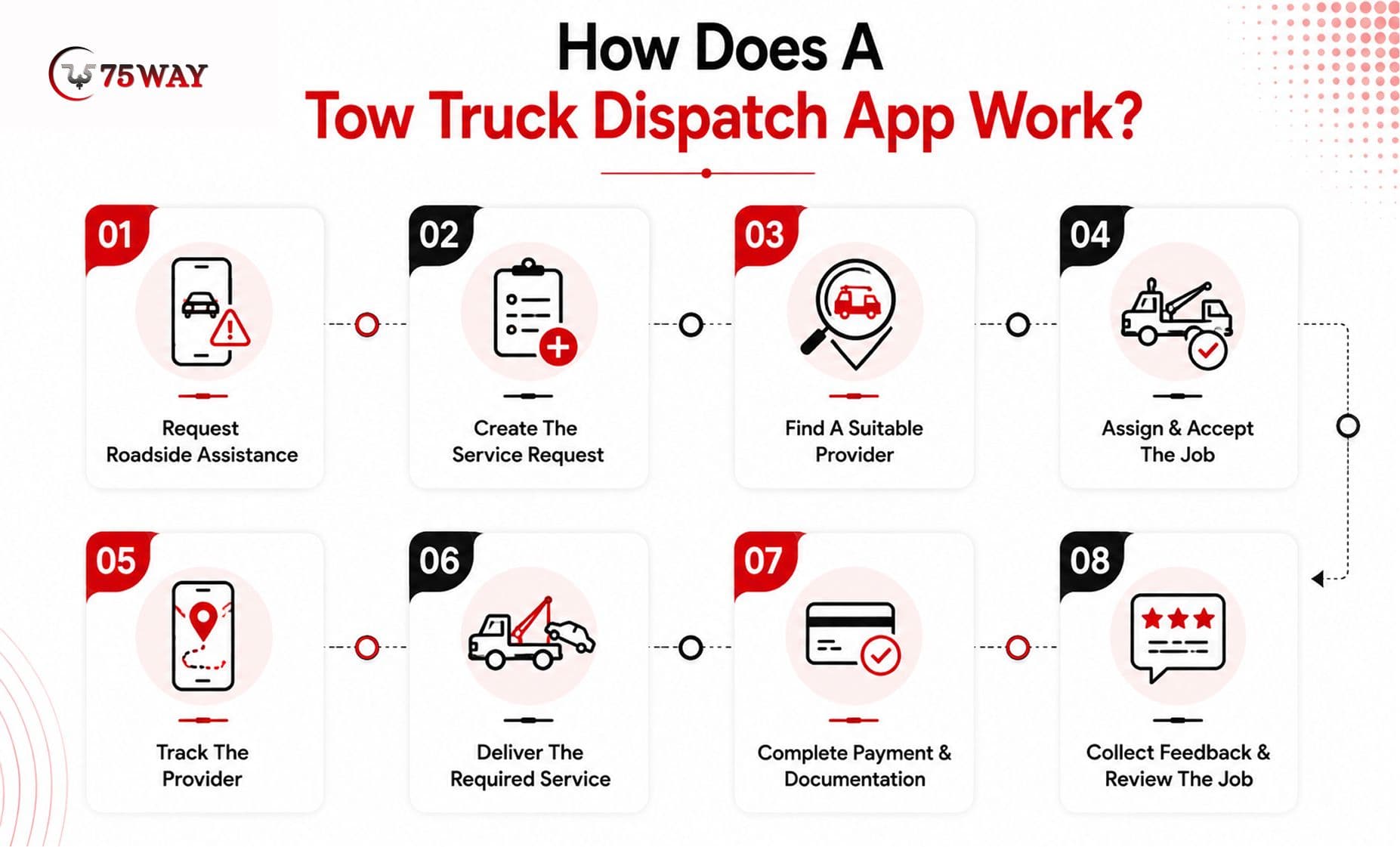
A tow truck dispatch app works by connecting a driver’s service request with an available roadside provider, then coordinating dispatch, navigation, service completion, payment, and follow-up digitally.
1. Request Roadside Assistance
The journey starts when a driver selects the help needed, such as towing, a jump-start, tire assistance, fuel delivery, or vehicle recovery. The app uses GPS to identify the location and can collect basic vehicle details to understand the situation.
2. Create The Service Request
Once the driver confirms the request, the platform turns the information into a service order. Details such as location, vehicle type, service category, destination, and customer requirements are shared with the systems handling the job.
3. Find A Suitable Provider
The platform checks nearby providers and looks for someone who can handle the request. Availability, distance, service capability, equipment, and current workload can all influence the match.
4. Assign & Accept The Job
The request can go directly to a suitable provider or through a dispatcher first. The provider reviews the job details and accepts it through the service provider app.
5. Track The Provider
Once the job is accepted, the customer can see useful updates such as the provider's name, estimated arrival time, and location. GPS and mapping services help the driver follow the journey while the provider heads to the roadside location.
6. Deliver The Required Service
The provider arrives and handles the customer's problem. The job could involve towing a vehicle, changing a tire, delivering fuel, unlocking a car, or jump-starting a battery. Service notes, photos, or customer confirmation can also be recorded through the app.
7. Complete Payment & Documentation
After the job is finished, the platform calculates the final service amount. The customer can pay digitally, while businesses or fleet accounts may receive an invoice. A digital receipt can then be stored with the completed service record.
8. Collect Feedback & Review The Job
The customer can rate the service and share feedback after assistance is completed. Business owners can review response time, service duration, provider performance, revenue, cancellations, and customer ratings to improve future operations.
Business Models For Roadside Assistance Apps For Providers
A roadside assistance app can support far more than one-off towing requests, giving providers several ways to build recurring and diversified revenue. The right model depends on your customers, service network, and growth strategy. The most practical models for providers are explored below.
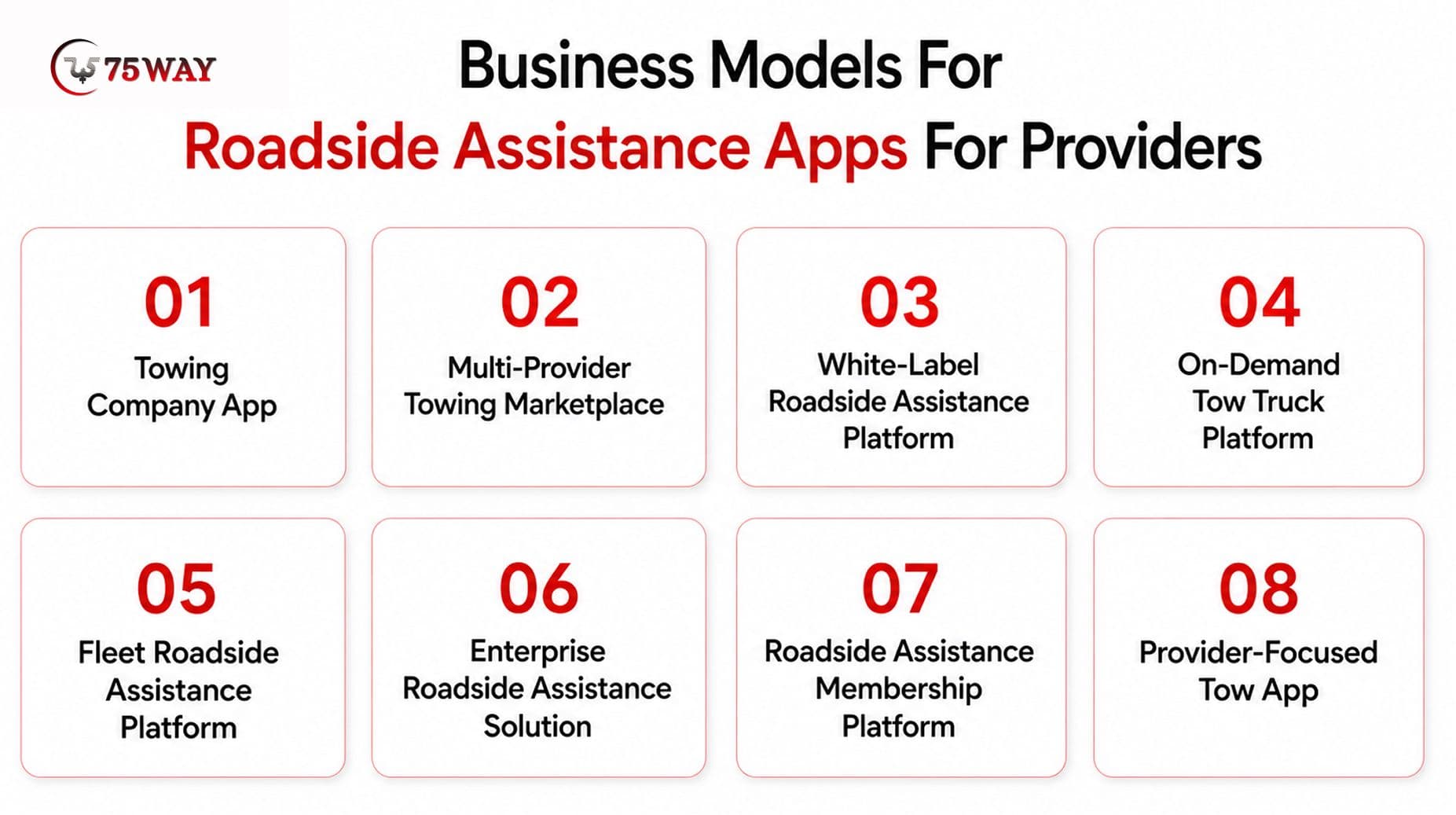
1. Towing Company App
A towing company does not always need to build a marketplace to go digital. It can launch its own branded app where customers request a tow, share their location, track the assigned driver, pay online, and access service records.
Behind the scenes, the company can manage its fleet, dispatch jobs, send updates, and handle invoices from one system. This is a practical option for established towing businesses that already have trucks and drivers but want more direct control over customer bookings.
2. Multi-Provider Towing Marketplace
A multi-provider towing marketplace works more like a digital network than a traditional towing business. Customers submit a request, and the platform connects them with available towing or roadside providers in their area.
The business can earn from commissions or service fees while providers gain access to new jobs. Features such as provider onboarding, automated matching, ratings, payments, and dispute handling become important as the network grows. The real challenge is building enough reliable provider coverage to meet demand.
3. White-Label Roadside Assistance Platform
A white-label roadside assistance platform is useful when the goal is to sell the technology to multiple businesses. Instead of rebuilding the application for every client, the core platform can be reused while each business gets its own branding, services, pricing, coverage areas, payment options, and business rules.
This creates a scalable software model for companies that want to turn roadside assistance technology into a recurring revenue product.
4. On-Demand Tow Truck Platform
An on-demand tow truck platform brings the convenience of digital booking to an industry that has traditionally relied heavily on phone calls. A driver can request a tow, share their location and vehicle details, and receive updates while the platform handles provider matching and dispatch.
Startups can build revenue through booking fees, service charges, provider commissions, memberships, or a combination of these options. The model is particularly attractive for businesses targeting drivers who expect fast, app-based service.
5. Fleet Roadside Assistance Platform
For a company operating dozens or thousands of vehicles, a roadside problem is more than an individual driver's inconvenience. Fleet managers need to know which vehicle needs help, where it is, who approved the service, what it costs, and whether the issue has been resolved.
A fleet roadside assistance platform brings these details into one place through vehicle profiles, driver management, service authorization, centralized billing, location tracking, service history, and reporting.
6. Enterprise Roadside Assistance Solution
Large organizations often need more than a simple towing booking app. Automotive companies, rental businesses, insurers, and mobility providers may need to coordinate roadside requests between customers, service providers, internal teams, and business partners.
An enterprise roadside assistance solution can support these complex workflows through API integrations, account-specific pricing, service authorization, invoicing, reporting, security controls, and customized business rules.
7. Roadside Assistance Membership Platform
Not every roadside assistance business has to depend on one-time bookings. A membership platform can give customers ongoing access to defined roadside benefits in exchange for a monthly or annual fee.
The app can handle membership status, renewals, eligible services, usage history, and new assistance requests. For the business, this model can create recurring revenue and encourage customers to stay connected with the brand beyond a single roadside emergency.
8. Provider-Focused Tow App
There is also an opportunity to build a towing app specifically for the people fulfilling the jobs. A provider-focused platform can give towing companies one place to receive requests, manage driver availability, navigate to customers, document completed work, create invoices, track earnings, and review job history.
This model is especially relevant for a tow truck dispatch software or SaaS product sold directly to towing and roadside service businesses.
Which Roadside Assistance Business Model Should You Choose?
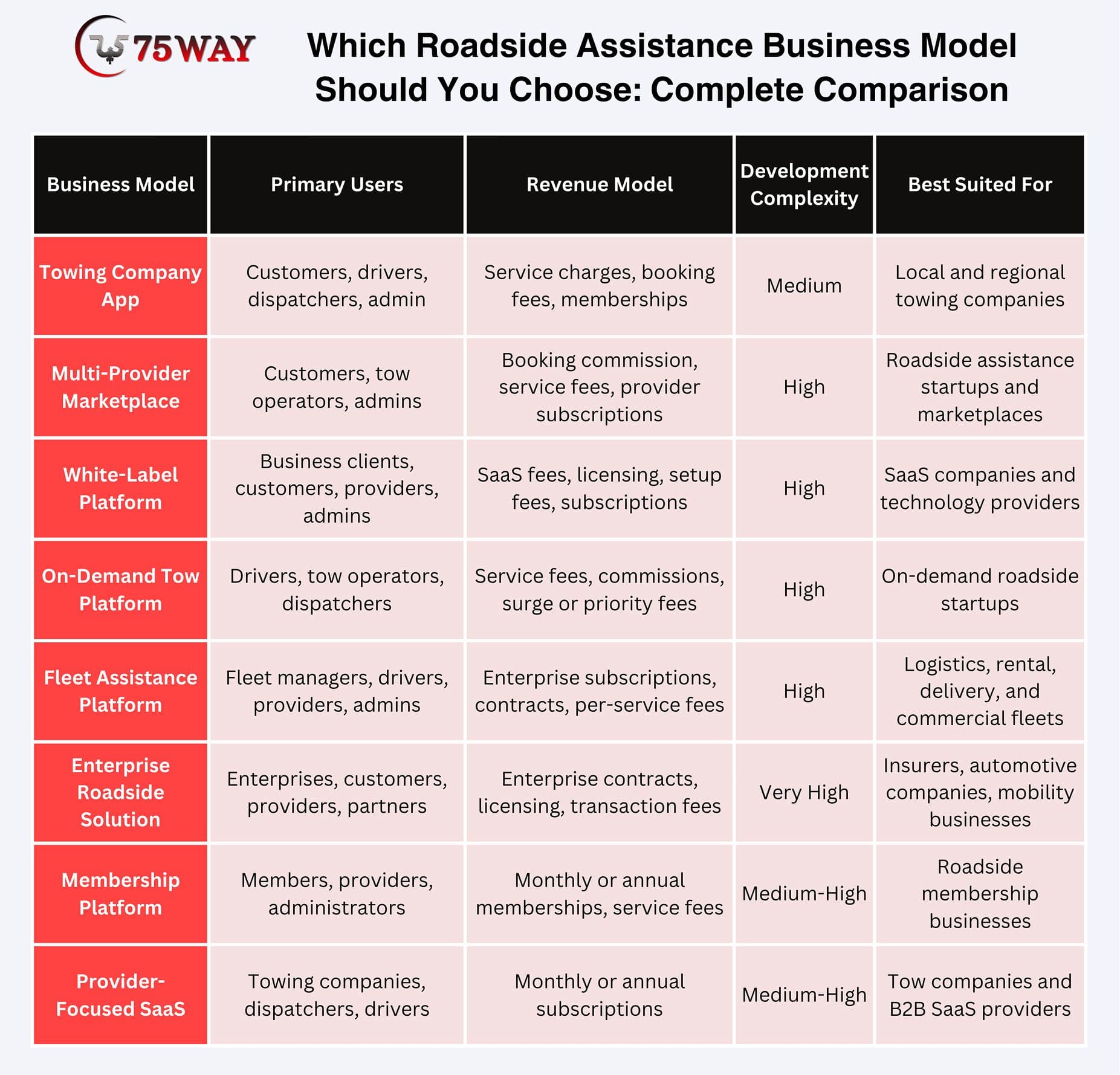
The best model depends on your existing assets, target customers, geographic coverage, provider network, and revenue strategy.
A towing company with its own fleet may not need a marketplace. A startup without its own trucks may benefit more from a multi-provider towing marketplace. A technology company planning to serve several towing businesses could consider a white-label roadside assistance app or provider-focused SaaS model.
For enterprise businesses, the development scope becomes broader because the platform may need to connect with existing CRM, fleet, insurance, accounting, payment, or partner systems.
Before development begins, define these five factors:
- Who pays? Customer, provider, fleet, enterprise partner, or member.
- Who fulfills the service? Your own drivers, contracted providers, or both.
- Where does revenue come from? Service charges, commissions, subscriptions, licensing, or contracts.
- How is each job dispatched? Manually, automatically, or through a hybrid model.
- What needs to integrate? Maps, payments, CRM, fleet systems, accounting, insurance, or enterprise APIs.
These decisions determine whether you need a basic tow app, a full tow truck dispatch app, a marketplace, or an enterprise-grade roadside assistance platform.
How To Build Roadside Assistance App: A Complete Development Process
A successful roadside assistance app starts with the service workflow, not the mobile screens. Every decision, from dispatch logic and GPS tracking to technician management and customer payments, needs to reflect how roadside businesses operate. The journey from business idea to launch becomes much clearer when the following tow truck app development stages are tackled in the right order.
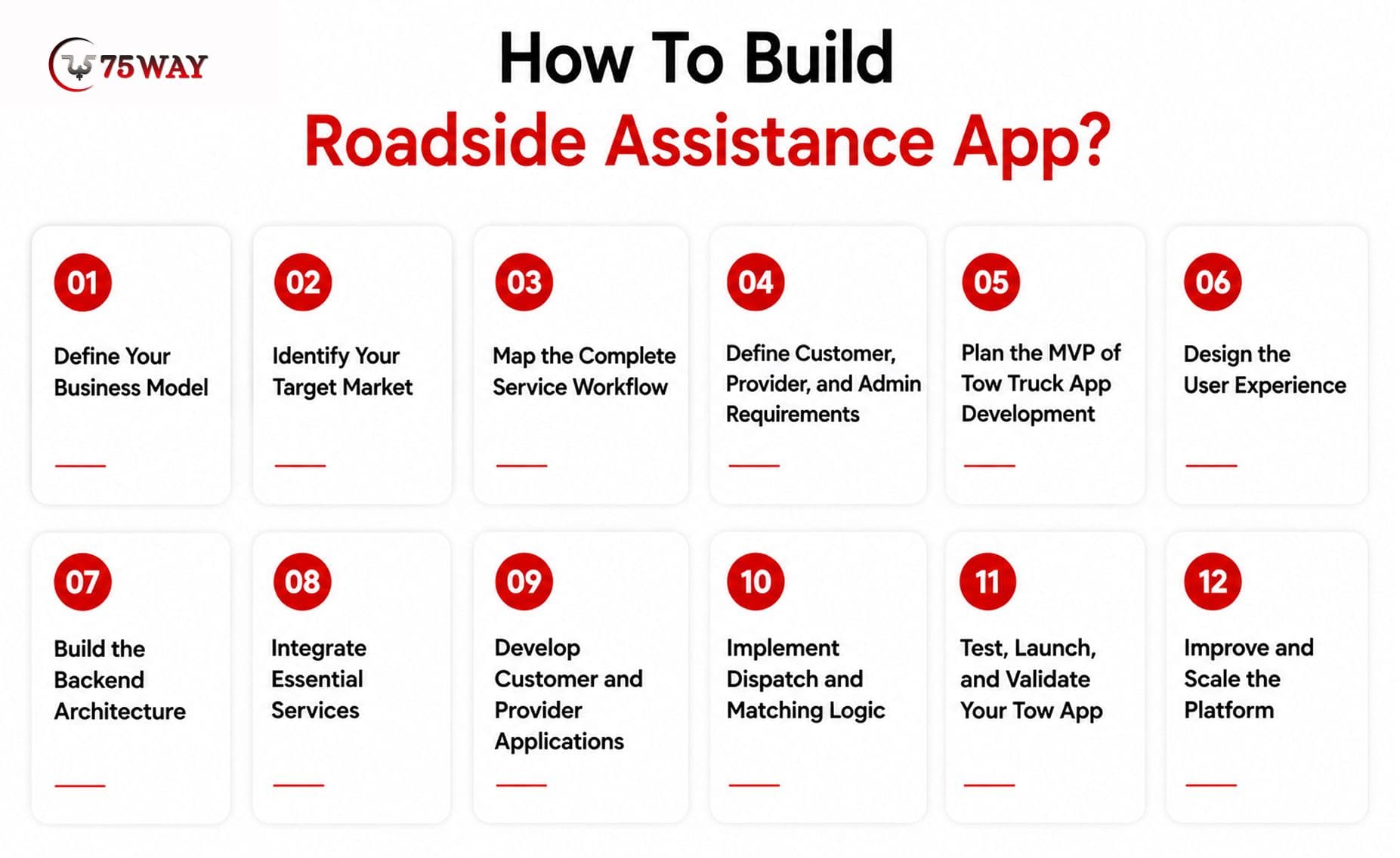
Phase 1: Define Your Business Model
Start by deciding what role your roadside assistance platform will play in the market. You might operate your own tow trucks, partner with independent providers, connect customers through a marketplace, serve commercial fleets, offer roadside memberships, sell white-label software, or provide services to enterprise clients.
This decision will shape almost everything that follows, including who uses the platform, how providers receive jobs, how customers are charged, and how the business earns revenue. It also helps determine the right user roles, pricing rules, dispatch workflows, integrations, and technology architecture before development begins.
Phase 2: Identify Your Target Market
Choose your target customers and launch area before development. A focused market helps you validate demand, provider availability, pricing, and service workflows before expanding into additional locations or customer segments.
- Individual Vehicle Owners: Drivers needing quick roadside help nearby
- Commercial Fleets: Businesses managing roadside needs across vehicles
- Rental Companies: Rental operators coordinating vehicle assistance requests
- Dealerships: Dealerships arranging roadside support for customers
- Insurance Partners: Insurers connecting policyholders with roadside providers
Phase 3: Map the Complete Service Workflow
Before designing screens or writing code, map the entire roadside service journey. Start with the customer's request and follow it through provider matching, dispatch, arrival, service completion, payment, and job closure. This gives your development team a clear picture of how the platform should work in real situations.
Do not map only the ideal scenario. A real roadside request can change quickly when a provider rejects the job, the customer cancels, the driver cannot find the vehicle, required equipment is unavailable, or the tow destination changes. Your workflow should show what the platform does at each of these moments.
Also define what happens when a payment fails, multiple providers are required, or a dispatcher needs to manually reassign the job. These decisions may seem small during planning, but they can create major operational problems after launch. A well-mapped workflow becomes the foundation for your product requirements, dispatch logic, notifications, and backend architecture.
Phase 4: Define Customer, Provider, and Admin Requirements
A roadside platform normally involves several user types.
- Customers need simple booking, location sharing, provider tracking, payments, and support.
- Providers need job alerts, navigation, customer information, service updates, documentation, and earnings management.
- Dispatchers and administrators need booking visibility, provider management, assignment controls, pricing, reporting, payments, and operational oversight.
Separating these requirements early prevents important operational features from being overlooked.
Phase 5: Plan the MVP of Tow Truck App Development
Do not attempt to build every possible feature during the first release. You can build an MVP at first. A tow truck app MVP development should solve the core roadside assistance problem with enough functionality to test customer demand, provider participation, and operational feasibility before larger investments.
- Prioritize Core Needs: Select features directly supporting the essential roadside service journey first.
- Remove Nice-To-Haves: Delay advanced capabilities that do not directly validate the business model.
- Define User Roles: Identify essential permissions for customers, providers, dispatchers, and administrators.
- Set Release Goals: Establish measurable outcomes the MVP should achieve after its launch.
- Control Development Scope: Keep features, integrations, and workflows manageable within initial resources.
- Plan Future Features: Create a roadmap for advanced capabilities based on validated requirements.
Advanced capabilities such as predictive dispatch, sophisticated pricing engines, enterprise APIs, and advanced analytics can be introduced after validating the core model.
Phase 6: Design the User Experience
Once the MVP scope is clear, the next focus should be designing experiences around how each user actually interacts with the platform.
Roadside assistance involves customers needing quick help, providers working under time pressure, and dispatchers coordinating multiple jobs, so every interface should reduce unnecessary steps and confusion.
- Customer Experience: Keep emergency booking simple, with clear service options, location sharing, vehicle details, pricing, and request confirmation.
- Provider Experience: Surface essential job information immediately, including customer location, service requirements, navigation, communication, and status controls.
- Dispatcher Experience: Provide centralized visibility into active jobs, provider locations, availability, ETAs, assignments, and urgent service requests.
- Connected Workflows: Ensure actions across customer, provider, and dispatcher interfaces update instantly throughout the service journey.
Phase 7: Build the Backend Architecture
With the user experience defined, the backend becomes the layer that connects every action across the roadside platform. It manages bookings, providers, locations, payments, pricing, notifications, user roles, and operational data.
A strong architecture should support real-time location updates, multiple providers, concurrent bookings, API integrations, analytics, and changing business rules. These capabilities become increasingly important as the platform moves beyond its initial service area.
The bigger goal is scalability. Building only for today's booking volume can create expensive limitations later, so the backend should leave room for more users, providers, transactions, locations, and integrations as the business grows.
Phase 8: Integrate Essential Services
Once the backend foundation is ready, connect the external services that support everyday roadside operations. The right integrations keep location tracking, payments, communication, customer management, and business operations connected throughout the service journey.
The exact requirements depend on your business model, service area, and operational complexity. A smaller towing app may need only essential services, while an enterprise roadside platform may require deeper CRM, accounting, fleet, analytics, and communication integrations.
- Mapping and navigation services for accurate routes
- Payment gateways for secure customer transaction processing
- Push notifications for timely booking and status updates
- SMS and email services for customer communication
- Voice communication tools for direct roadside assistance
- Customer support systems for resolving service issues
- Analytics platforms for monitoring application and business performance
- CRM systems for managing customer relationships and records
Phase 9: Develop Customer and Provider Applications
The development team can build the mobile experiences for customers and roadside providers alongside the administrative web platform.
For an on-demand tow truck app development project, real-time communication between these applications and the backend is particularly important.
When a booking changes status, the relevant users should receive the correct information without requiring manual refreshes.
Phase 10: Implement Dispatch and Matching Logic
Dispatch becomes the operational core of a roadside assistance platform, connecting incoming service requests with providers capable of handling each job. A practical matching system combines automated rules with dispatcher oversight, allowing faster assignments while retaining human control when situations become complex.
- Define Matching Rules: Establish provider selection criteria around distance, availability, service type, equipment, and workload.
- Capture Provider Status: Maintain current information about provider availability, location, active jobs, and service capabilities.
- Rank Suitable Providers: Prioritize eligible providers using configurable business rules instead of relying solely on proximity.
- Automate Job Assignment: Route requests to qualified providers automatically when predefined matching conditions are satisfied.
- Enable Dispatcher Override: Give dispatchers control to reassign jobs when providers reject requests, become unavailable, or face unexpected issues.
- Monitor Dispatch Performance: Track assignment times, acceptance rates, response times, cancellations, and reassignment patterns for continuous improvement.
Phase 11: Test, Launch, and Validate Your Tow App
Before taking a roadside assistance app to a wider market, validate both its technical reliability and real-world operational performance.
Testing should cover situations such as weak GPS signals, poor connectivity, incorrect locations, provider rejection, customer cancellations, duplicate bookings, payment failures, delayed providers, reassignment, simultaneous jobs, long-distance towing, and sudden demand spikes.
Once the platform performs reliably, launch it within a defined service area instead of expanding everywhere at once. Early operations can reveal whether your provider network, dispatch process, pricing, and customer experience work as expected.
Track booking volume, provider availability, dispatch time, response time, cancellations, job completion, customer satisfaction, and revenue per booking. These insights can guide improvements before expanding into additional markets.
Phase 12: Improve and Scale the Platform
After launch, use real customer, provider, and operational data to decide what deserves investment next. Scaling should focus on removing bottlenecks, improving service performance, expanding revenue opportunities, and preparing the platform for larger transaction volumes.
- Review Performance Data: Identify booking, dispatch, response, cancellation, and revenue patterns after launch.
- Fix Operational Bottlenecks: Address recurring issues affecting providers, customers, dispatchers, or service completion.
- Prioritize Proven Features: Invest in capabilities supported by actual customer demand and business requirements.
- Expand Service Coverage: Add providers, services, and geographic markets when operational capacity is ready.
- Strengthen Platform Infrastructure: Prepare databases, APIs, security, monitoring, and cloud resources for higher usage.
Who Can Use a Roadside Assistance App?
A roadside assistance platform can be developed for different business models, including:
- Towing Companies: Digitize customer bookings, dispatch operations, driver communication, payments, and job management.
- Roadside Assistance Startups: Build a marketplace that connects customers with independent towing and roadside service providers.
- Fleet Operators: Give fleet managers a centralized way to request and monitor roadside services for commercial vehicles.
- Insurance and Motor Club Businesses: Connect members with approved service providers while managing authorization, service records, and billing workflows.
- Automotive Businesses: Offer roadside assistance as an additional digital service for customers, vehicle owners, or dealership networks.
- Roadside Service Providers: Use a dedicated tow app to receive jobs, manage availability, navigate to service locations, and maintain digital service records.
Therefore, roadside assistance app development can range from a simple tow truck booking app for one local business to a multi-provider platform capable of supporting large geographic service networks.
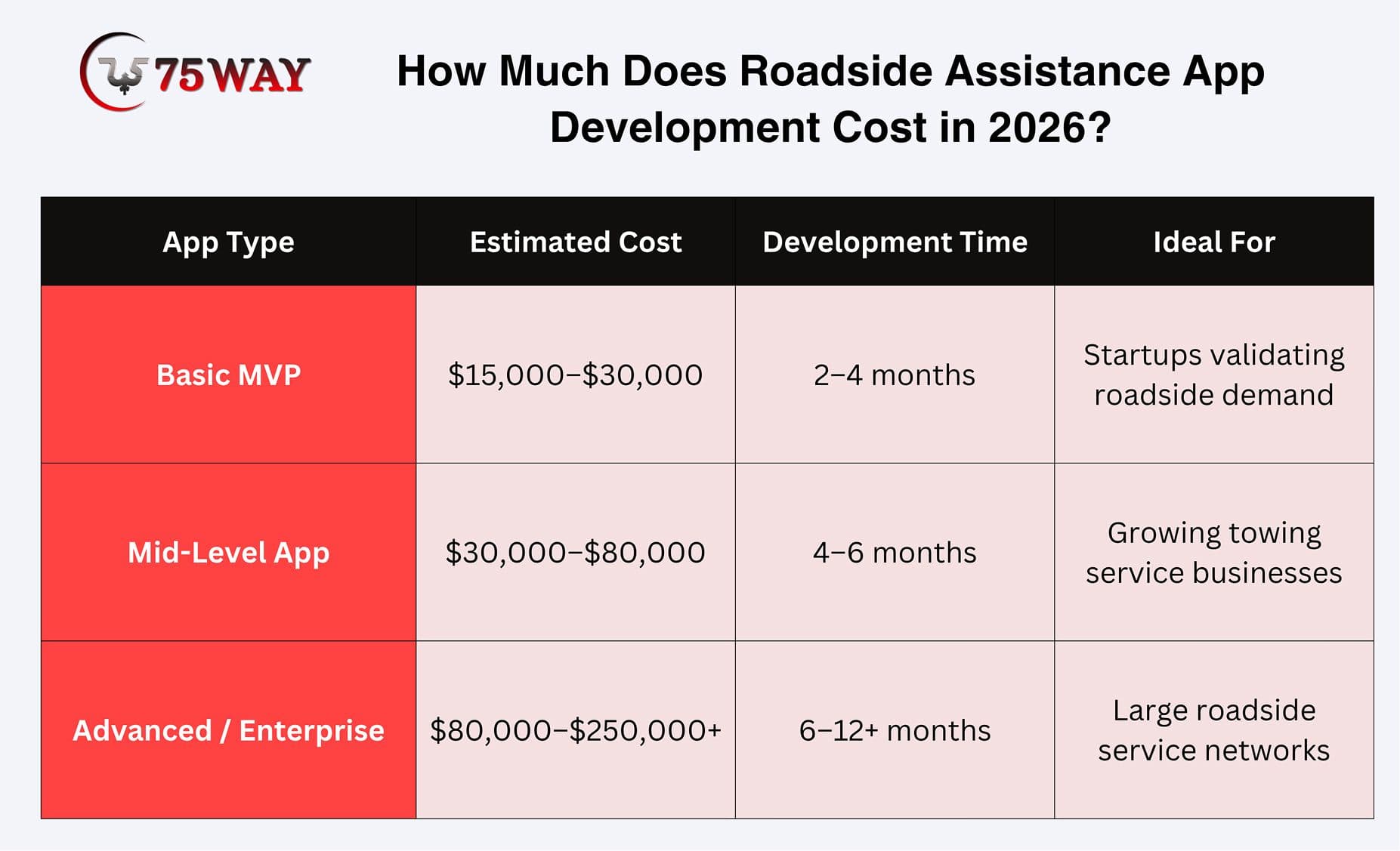
How Much Does Roadside Assistance App Development Cost in 2026?
Roadside assistance app development typically costs $15,000–$250,000+, depending on the app's complexity, features, platforms, integrations, dispatch logic, and development team.
A simple MVP with service booking and basic GPS tracking can stay near the lower end, while a multi-provider or enterprise platform with automated dispatch, real-time tracking, analytics, and integrations can move well beyond $100,000.
Basic MVP: $15,000–$30,000
A basic MVP validates the concept with registration, service selection, booking, GPS, notifications, and simple admin controls.
Mid-Level App: $30,000–$80,000
A mid-level platform adds provider tracking, separate customer and driver apps, payments, provider management, and stronger dispatch capabilities.
Advanced/Enterprise App: $80,000–$250,000+
An advanced platform supports larger networks with multi-provider operations, intelligent dispatch, analytics, complex pricing, integrations, fleet management, and scalable infrastructure.
Stage-Wise Cost of On-Demand Tow Truck App Development
The total budget is not spent on coding alone. A production-ready roadside assistance platform requires research, UX design, backend development, mobile applications, integrations, testing, deployment, and post-launch support.
1. Discovery & Planning: $3,000–$7,000
This phase establishes the product and technical foundation before development begins.
A strong discovery phase can prevent expensive scope changes later because customer, provider, dispatcher, and administrator workflows are defined before development starts.
2. UI/UX Design: $4,000–$10,000
Roadside applications require interfaces that remain clear when customers are dealing with an urgent vehicle problem.
The cost increases when the product requires multiple user roles, highly customized interfaces, complex dispatch dashboards, or extensive prototyping.
3. Core Development: $12,000–$45,000+
Development usually represents the largest portion of the initial budget.
The final amount depends heavily on whether the project requires one mobile application or separate customer and provider applications, as well as how advanced the backend and dispatch system needs to be.
4. Testing & Quality Assurance: $4,000–$10,000
Testing ensures that the application works reliably across devices, operating systems, network conditions, and user workflows.
Roadside platforms require additional attention to GPS accuracy, real-time updates, payment failures, provider reassignment, poor connectivity, concurrent bookings, security, and performance under high demand.
5. Deployment & Launch: $2,000–$5,000
Deployment covers preparing the production environment and releasing the applications.
The exact cost depends on the number of platforms, cloud architecture, integrations, and deployment requirements.
6. Post-Launch Maintenance: $5,000–$15,000+ Per Year
Launching the application does not end development costs. Some providers estimate ongoing maintenance at a percentage of the original development cost rather than using a fixed annual fee.
One current industry estimate places maintenance around 15–20% of initial development costs annually, although actual support budgets vary by product and service agreement.
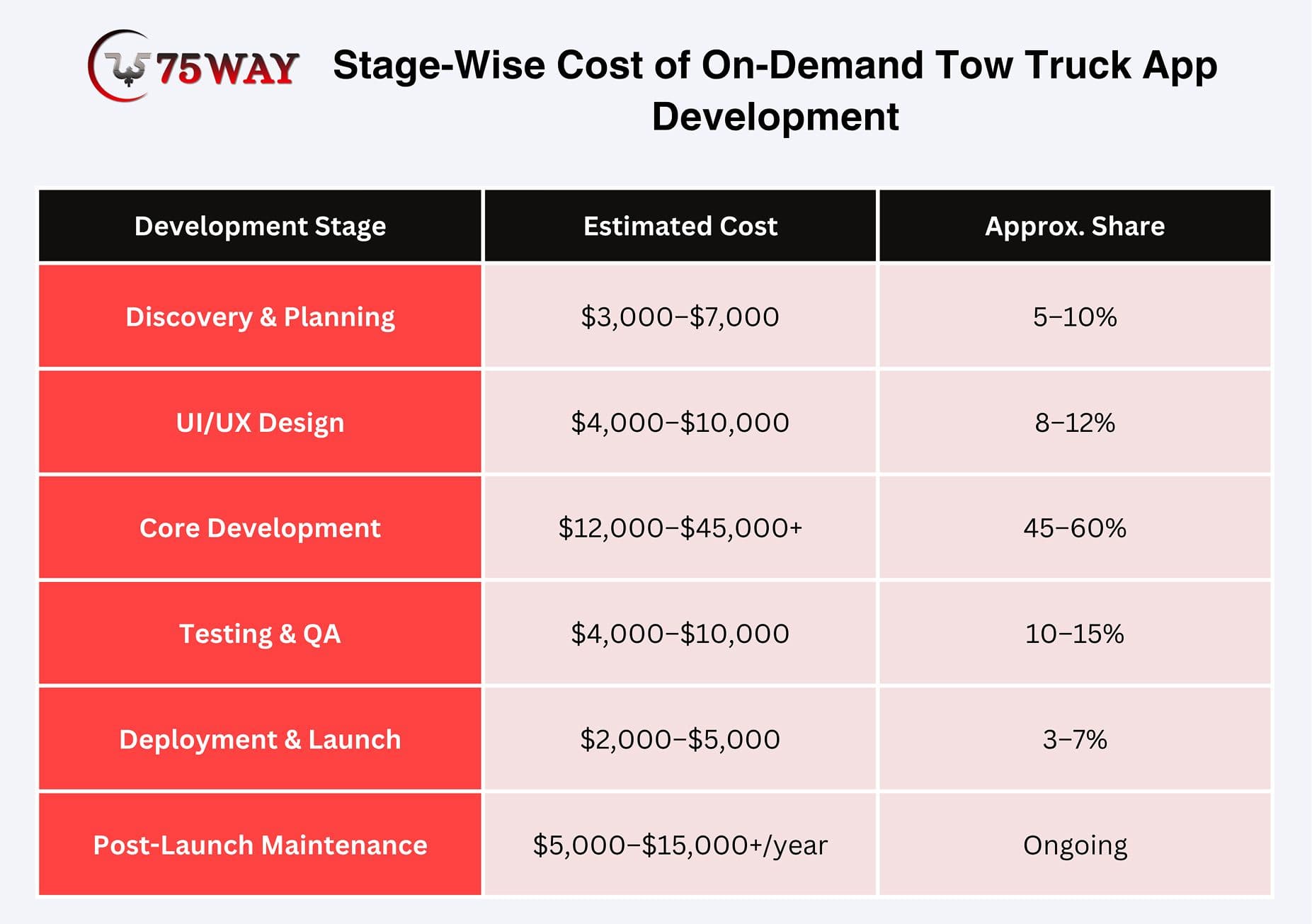
Note: Percentages are indicative rather than additive fixed allocations. Actual percentages change according to project scope. For example, a complex dispatch engine may increase the development share, while a heavily customized enterprise UX may increase the design budget.
Cost To Hire Roadside Assistance Mobile App Developers
The location of the development team can significantly affect the hourly rate and therefore the total project budget. However, location should not be used as the only basis for selecting a development partner.
- United States and Canada: Development rates commonly fall around $100–$250+ per hour for custom software teams.
A mid-level roadside platform can therefore reach approximately $70,000–$200,000+, depending on scope, team composition, and project duration.
- Western Europe and Australia: Rates commonly range from approximately $75–$160+ per hour.
A mid-level roadside application may fall around $50,000–$150,000, although enterprise requirements can push the budget higher.
- Eastern Europe: Development rates can commonly fall around $40–$90 per hour, making a mid-level project potentially fall within the $30,000–$70,000 range depending on the team and feature set.
- India and Southeast Asia: Rates can commonly range from approximately $20–$50 per hour for many development engagements.
A mid-level application may therefore fall around $15,000–$40,000, although senior specialists, advanced architecture, and enterprise requirements can increase the cost.
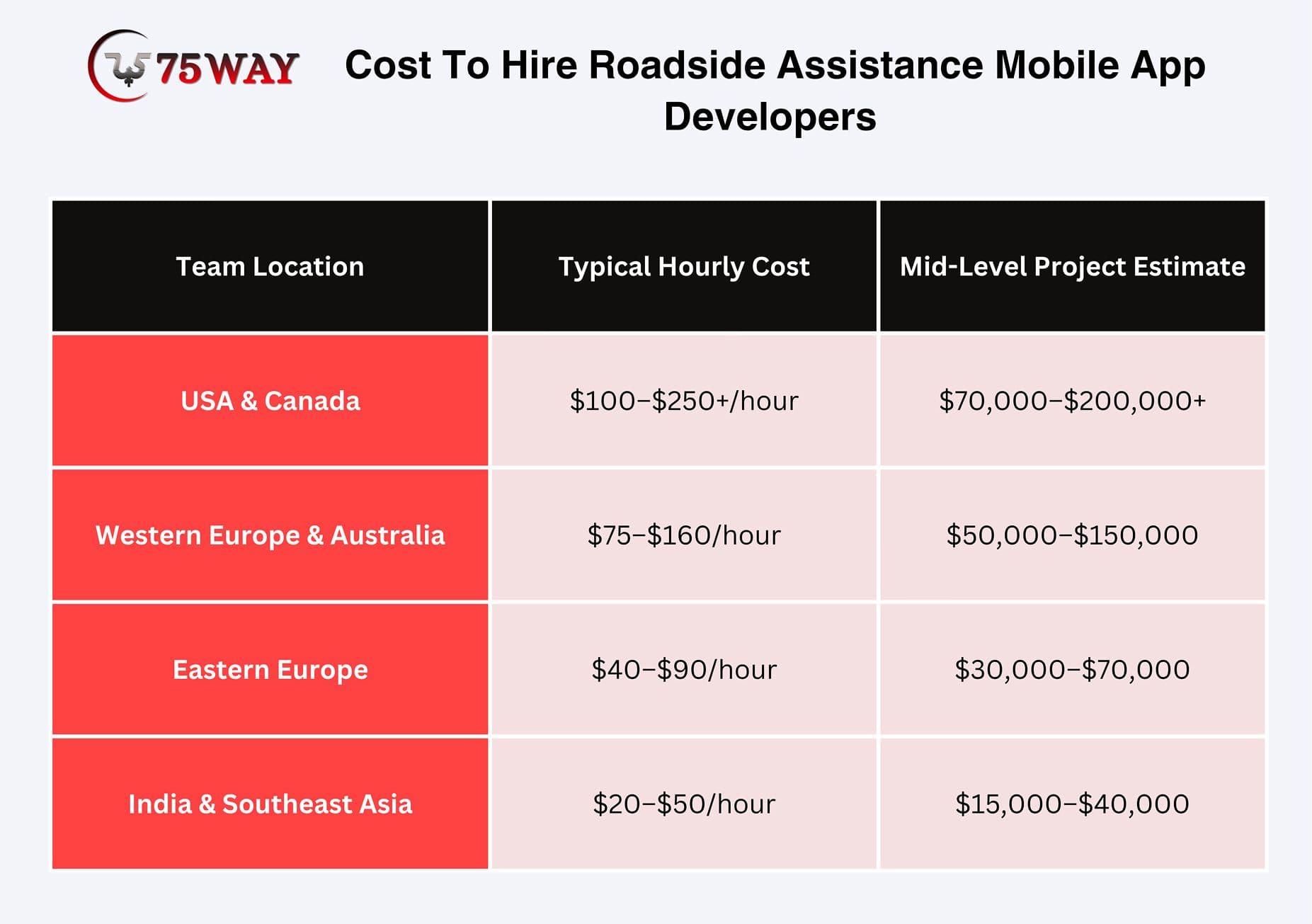
The project-based estimate can differ substantially from the hourly calculation because development teams may use different staffing models, frameworks, project methodologies, and delivery schedules.
What Factors Affect Roadside Assistance App Development Cost?
Several technical and business decisions can move a project from the MVP range toward enterprise-level development.
- Number of Platforms: Building separate native iOS and Android applications generally requires more development and testing than launching on a single platform or using a cross-platform approach.
- Number of User Roles: A customer-only application is less complex than a platform with separate customer, driver, dispatcher, provider, fleet manager, and administrator experiences.
- Real-Time GPS Tracking: Live location sharing requires location services, background processing, mapping APIs, real-time communication, and additional testing.
- Dispatch Automation: A basic manual dispatch system costs less than an advanced matching engine that evaluates location, provider availability, vehicle type, equipment, workload, service area, and job priority.
- Payment Architecture: Simple online payment collection is less complex than wallets, refunds, split payments, provider payouts, subscriptions, enterprise billing, or complex invoicing.
- Third-Party Integrations: Maps, payment gateways, SMS, voice, CRM, accounting, fleet management, insurance, and enterprise APIs can all add development and recurring usage costs.
- Multi-Provider Support: A marketplace requires provider onboarding, verification, availability management, job matching, commissions, ratings, payouts, disputes, and provider performance management.
- AI and Advanced Analytics: AI-assisted dispatching, predictive demand analysis, automated customer support, dynamic pricing, and advanced business intelligence require additional data infrastructure, development, testing, and ongoing optimization.
Additional Costs of Tow Truck Booking App Development To Budget For
The development quote is not necessarily the complete cost of operating the platform. Businesses should also account for:
- Cloud hosting
- Map and location API usage
- SMS and voice charges
- Payment processing fees
- App-store fees
- Analytics platforms
- Customer support tools
- Security monitoring
- Domain and infrastructure
- Ongoing maintenance
- Marketing and customer acquisition
For example, current roadside-app cost guidance identifies cloud hosting, third-party API usage, app-store fees, and marketing as expenses that can sit outside the initial development budget.
How to Reduce Roadside Assistance App Development Costs?
The goal should not be to build the cheapest possible application. It should be to reduce unnecessary upfront scope without creating an architecture that becomes expensive to replace later.
Start with the core service workflow. Build booking, provider management, dispatch, GPS, notifications, payments, and essential administration first.
Validate the model in a defined market, then invest in advanced automation and enterprise capabilities when usage data demonstrates the need.
A white-label or pre-built solution can also reduce upfront development requirements for businesses that prioritize faster market entry over complete customization.
However, businesses should evaluate customization limits, source-code ownership, integrations, scalability, security, and long-term support before choosing this route. Current market offerings show that white-label roadside solutions can be available at substantially lower upfront prices than fully custom platforms.
Essential Features To Create Roadside Assistance Mobile App
The exact feature set depends on whether you are building a single-company towing app, marketplace, fleet platform, or enterprise roadside solution. Instead of adding every possible feature to the first release, prioritize capabilities that directly support booking, dispatch, location, communication, service fulfillment, payment, and administration.
1. Customer App Features
The customer application should minimize the steps required to request roadside help.
- Service Selection: Customers should be able to choose from services such as towing, jump-starts, flat-tire assistance, fuel delivery, lockout service, battery replacement, and vehicle recovery.
- Quick Booking: A streamlined booking flow should allow customers to submit their request with essential information without navigating through unnecessary screens.
- GPS Location: The app can automatically detect the customer's current location or allow them to enter another pickup point manually.
- Vehicle Profile: Customers can save vehicle information such as make, model, year, type, license plate, and other relevant details to speed up future requests.
- Problem Description: Customers can describe the issue and upload photographs when additional information may help the provider understand the service requirement.
- Tow Destination: For towing requests, customers should be able to specify the destination, such as a repair shop, dealership, residence, or other permitted location.
- Provider Tracking: Once a provider accepts the request, customers can view relevant status updates and, where supported, the provider's live location.
- ETA Updates: Estimated arrival information helps customers understand when assistance is expected.
- In-App Communication: Calling or messaging capabilities allow customers to communicate with the assigned provider without manually searching for contact information.
- Digital Payments: Customers can pay for eligible services through supported payment methods and receive digital transaction records.
- Service History: The application can maintain previous requests, invoices, receipts, and service details for future reference.
- Ratings and Reviews: Customers can rate completed services and provide feedback about their experience.
2. Service Provider App Features
The provider application is central to fulfilling roadside requests.
- Provider Registration: Tow companies and individual service providers can create accounts and submit required business, driver, and vehicle information.
- Availability Management: Providers can indicate whether they are available, busy, offline, or unavailable for new jobs.
- Job Alerts: Providers receive notifications when suitable service requests become available.
- Job Acceptance: Drivers can review relevant job information and accept or decline requests based on platform rules.
- Route Navigation: Integrated navigation can help providers reach customers and towing destinations.
- Customer Information: Providers can access the information necessary to complete the assigned service while following appropriate privacy and access controls.
- Job Status Updates: Drivers can update statuses such as Accepted → En Route → Arrived → Service Started → Completed. These updates can automatically synchronize with the customer and dispatcher interfaces.
- Service Documentation: Providers can upload photographs, service notes, signatures, or other required proof of service.
- Earnings Management: Providers can view completed jobs, earnings, commissions, payouts, and transaction history where applicable.
- Digital Invoices: Providers can generate or access service invoices and receipts through the application.
3. Dispatcher and Admin Features
For businesses operating multiple trucks or providers, the administrative system becomes the operational center of the platform.
- Dispatch Management: Dispatchers can view incoming requests, available providers, active jobs, and completed services from a centralized dashboard.
- Provider Assignment: Jobs can be assigned manually or through automated matching rules.
- Live Map: A map-based dashboard can display customer locations, provider positions, active jobs, and service areas.
- Provider Management: Administrators can manage provider profiles, documents, vehicles, availability, service capabilities, and account status.
- Pricing Management: Businesses can configure service prices, distance-based charges, additional fees, commissions, or other pricing rules.
- Service Area Management: Administrators can define where services are available and control geographic expansion.
- Customer Management: The dashboard can provide access to customer profiles, booking history, service records, payments, and support requests.
- Payment and Refund Management: Administrators can monitor transactions, refunds, failed payments, provider payouts, and outstanding invoices.
- Reporting and Analytics: Business owners can monitor booking volume, revenue, cancellations, response times, provider performance, and customer behavior.
- Role-Based Access: Different employees can receive different permissions depending on their responsibilities.
Must-Have Features for an MVP of Tow Truck App Development
If budget is limited, the first release does not need every advanced capability. A practical MVP can include:
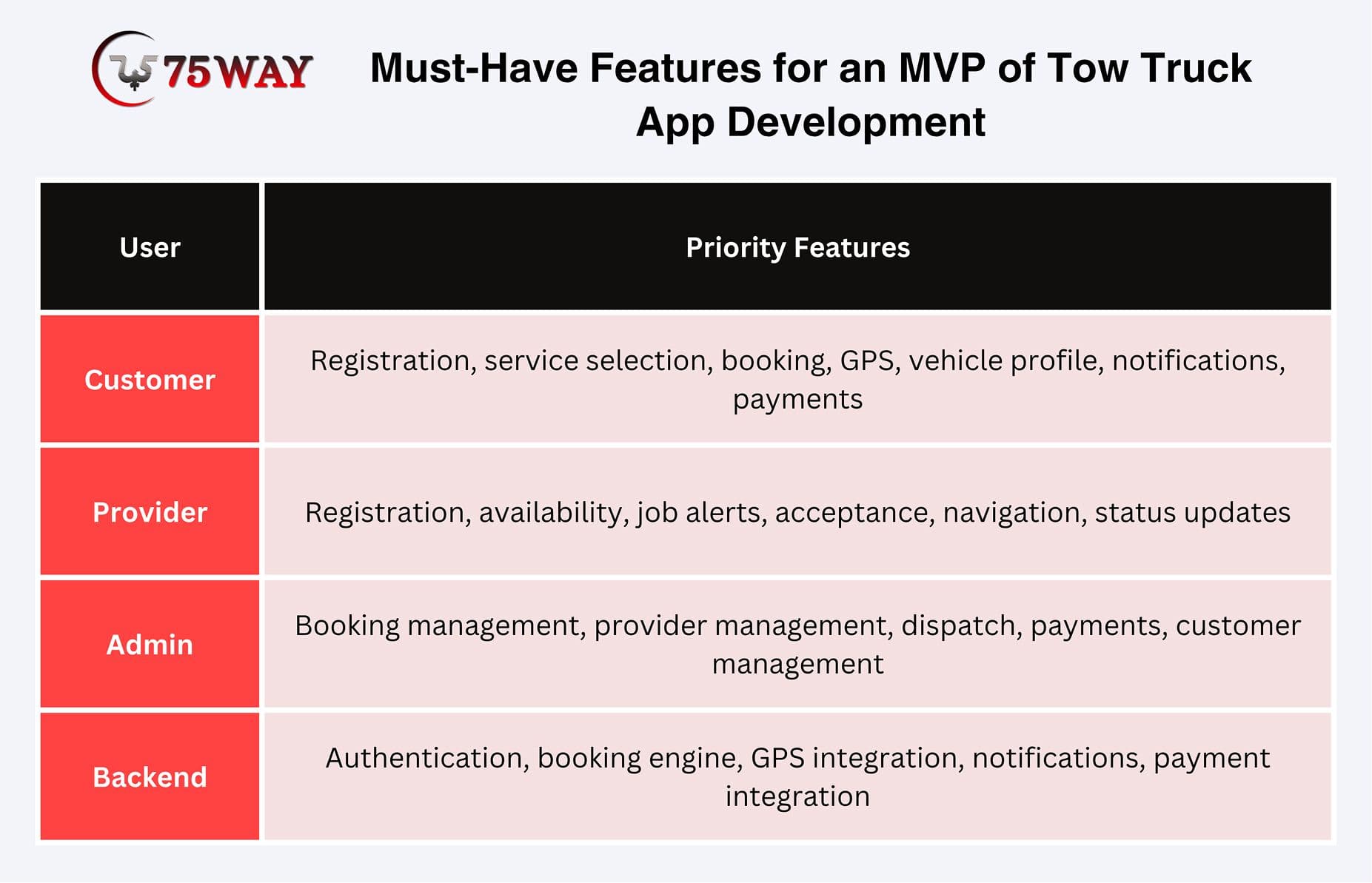
Once the MVP generates real usage data, businesses can introduce more sophisticated capabilities such as automated dispatch, dynamic pricing, fleet management, enterprise integrations, AI-assisted operations, and advanced analytics.
Advanced Features To Develop Scalable Towing Application
For a larger tow truck dispatch app or marketplace, advanced capabilities can help businesses manage growing provider networks, higher booking volumes, complex operations, and multiple service locations.
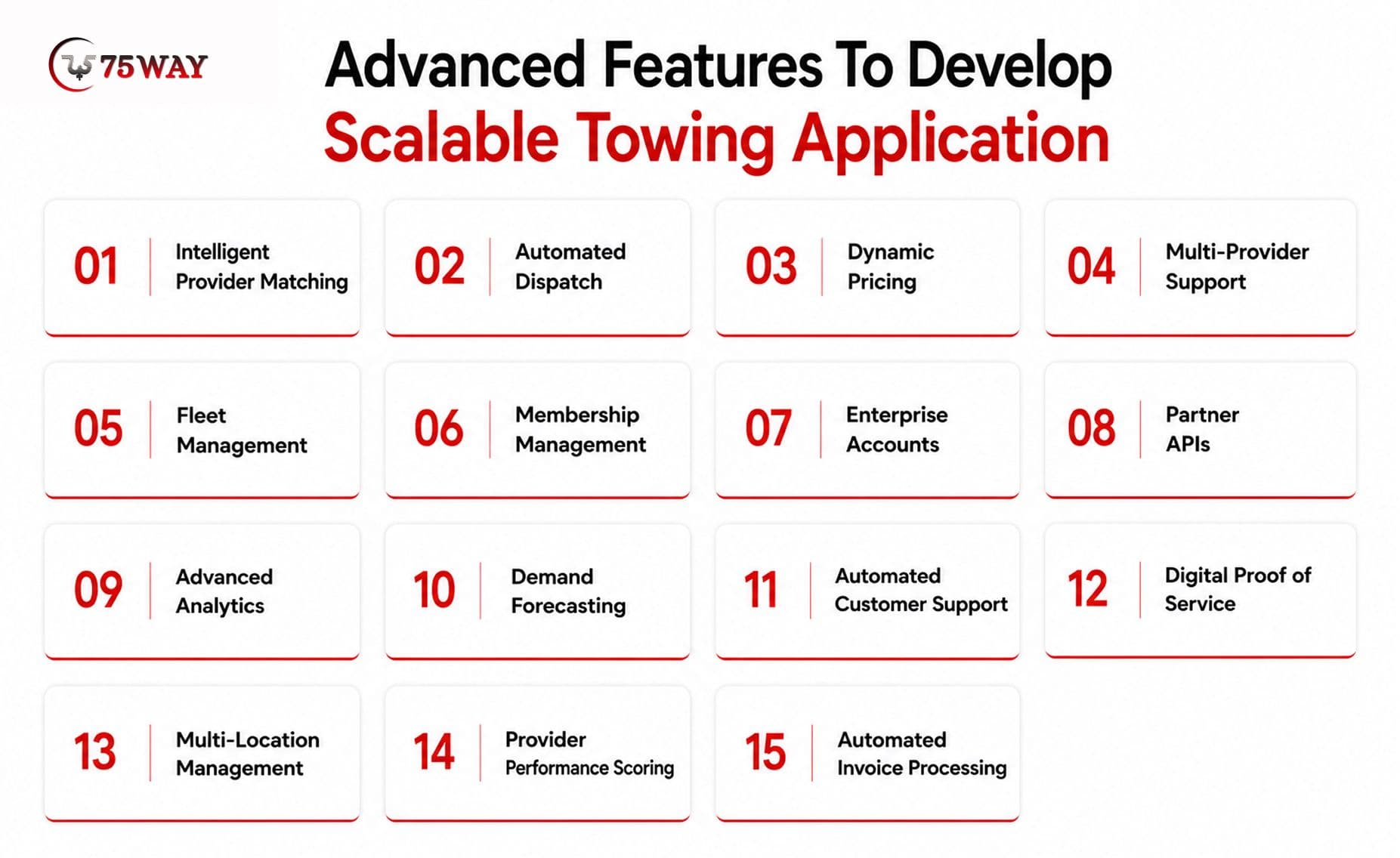
- Intelligent Provider Matching: Matching logic can consider distance, availability, service type, equipment, workload, and provider performance.
- Automated Dispatch: Automated assignment can route suitable service requests to eligible providers based on configured business rules.
- Dynamic Pricing: Flexible pricing rules can adjust charges based on service type, distance, demand, timing, or other factors.
- Multi-Provider Support: Multiple providers can operate within the same platform while businesses manage availability, services, coverage, and assignments.
- Fleet Management: Fleet tools can track vehicles, drivers, equipment, availability, maintenance information, and service history.
- Membership Management: Membership capabilities can manage plans, eligibility, renewals, benefits, usage limits, and customer service requests.
- Enterprise Accounts: Enterprise functionality can support account-level permissions, contracted pricing, billing, reporting, and service authorization.
- Partner APIs: APIs can connect the platform with insurers, motor clubs, fleets, dealerships, rental companies, and other business systems.
- Advanced Analytics: Detailed analytics can provide insights into bookings, revenue, response times, cancellations, provider performance, and customer behavior.
- Demand Forecasting: Historical and operational data can help estimate demand patterns across services, locations, and time periods.
- Automated Customer Support: Automated support can handle common questions, booking updates, service status requests, and routine customer interactions.
- Digital Proof of Service: Digital records can capture photographs, signatures, timestamps, service notes, and other completion evidence.
- Multi-Location Management: Centralized controls can help businesses manage different branches, service areas, providers, pricing, and operational rules.
- Provider Performance Scoring: Performance metrics can evaluate acceptance rates, response times, completion rates, cancellations, ratings, and other operational indicators.
- Automated Invoice Processing: Automated workflows can generate, organize, validate, and route invoices for customers, providers, and business accounts.
Which Advanced Features Should You Build First?
Not every business needs every advanced capability from day one. A sensible roadmap is:
- MVP: Booking + GPS + Provider Management + Dispatch + Payments
- Growth Stage: Live Tracking + Automated Matching + Analytics + Digital Invoices
- Scale Stage: Dynamic Pricing + Fleet Management + Enterprise Accounts + APIs
- Enterprise Stage: AI-Assisted Dispatch + Demand Forecasting + Advanced Automation + Multi-Tenant White Label
The right roadmap depends on actual operational requirements. Advanced technology should solve a measurable business problem rather than increase the feature count simply for competitive comparison.
Technology Stack To Develop Vehicle Roadside Assistance App
The technology stack for vehicle roadside assistance app development should support real-time location and seamless communication between customers, providers, and administrators. The right technologies depend on the application's scale, target platforms, integration requirements, development budget, and expected booking volume. A typical roadside assistance platform can use the following technology layers:
1. Mobile App Development
- Native iOS: Swift can be used to build applications specifically for Apple's ecosystem.
- Native Android: Kotlin is commonly used for Android applications.
- Cross-Platform: Flutter or React Native can allow businesses to develop applications for multiple platforms from a shared codebase.
The choice depends on performance requirements, device-specific functionality, development resources, and long-term maintenance plans.
2. Frontend Development: The administrative and dispatcher interfaces can use modern web technologies such as React, Next.js, Angular and Vue.js.
A web-based dashboard is particularly useful for dispatch teams because large screens can provide better visibility into maps, active jobs, provider locations, and operational metrics.
3. Backend Development: The backend can use technologies such as Node.js, Python, Java and .NET.
4. Database: Common database technologies can include PostgreSQL, MySQL and MongoDB.
5. Cloud Infrastructure: Common cloud platforms can include Amazon Web Services, Google Cloud and Microsoft Azure.
6. Maps and Location Services: Mapping technologies can support: GPS positioning, geocoding, reverse geocoding, route calculation, distance estimation, navigation, ETA calculation and location sharing.
7. Real-Time Communication: Technologies such as WebSockets and managed real-time communication services can support: provider location updates, job status changes, dispatch notifications, booking updates and live tracking.
8. Payment Technology: Payment infrastructure can support: card payments, digital wallets, refunds, payment authorization, provider payouts, recurring memberships and digital receipts.
9. Push Notifications and Messaging: Common communication technologies can include: Firebase Cloud Messaging, Apple Push Notification service, SMS APIs and email services.
10. Analytics and Monitoring: Analytics and monitoring tools can track: booking conversion, provider acceptance, dispatch time, response time, cancellation, revenue, repeat bookings, provider utilization and geographic demand.
11. Security Layer: Important security controls can include: secure authentication, role-based access control, API authorization, encryption, secure payment processing, audit logs, secure data storage, session management, backup and recovery and vulnerability testing.
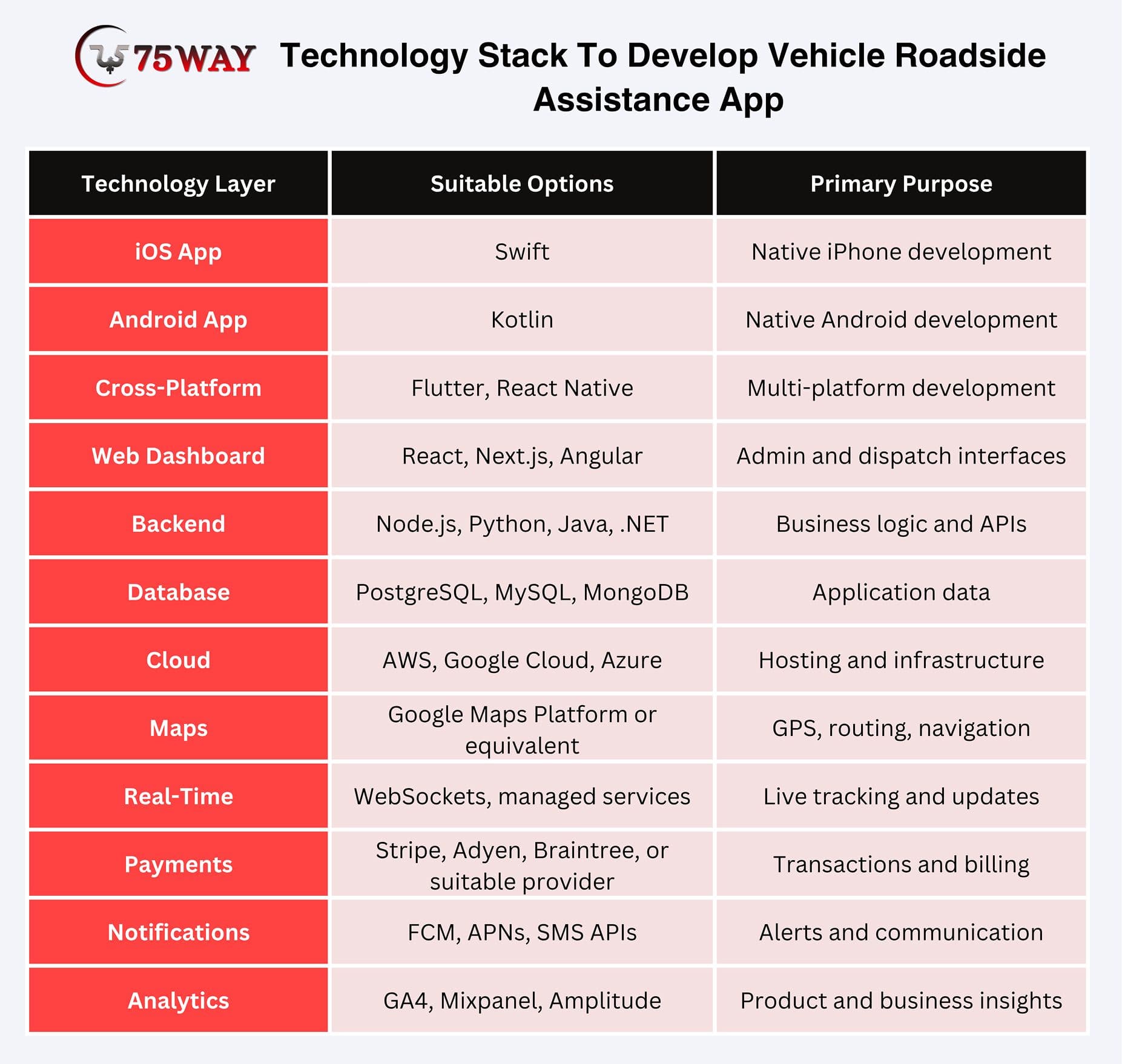
The stack should ultimately be selected according to the application's requirements rather than treated as a fixed technology checklist. A local towing company launching a focused MVP may need a much simpler architecture than a nationwide marketplace handling thousands of providers and real-time jobs.
How to Monetize Your AI-Powered Roadside Assistance App?
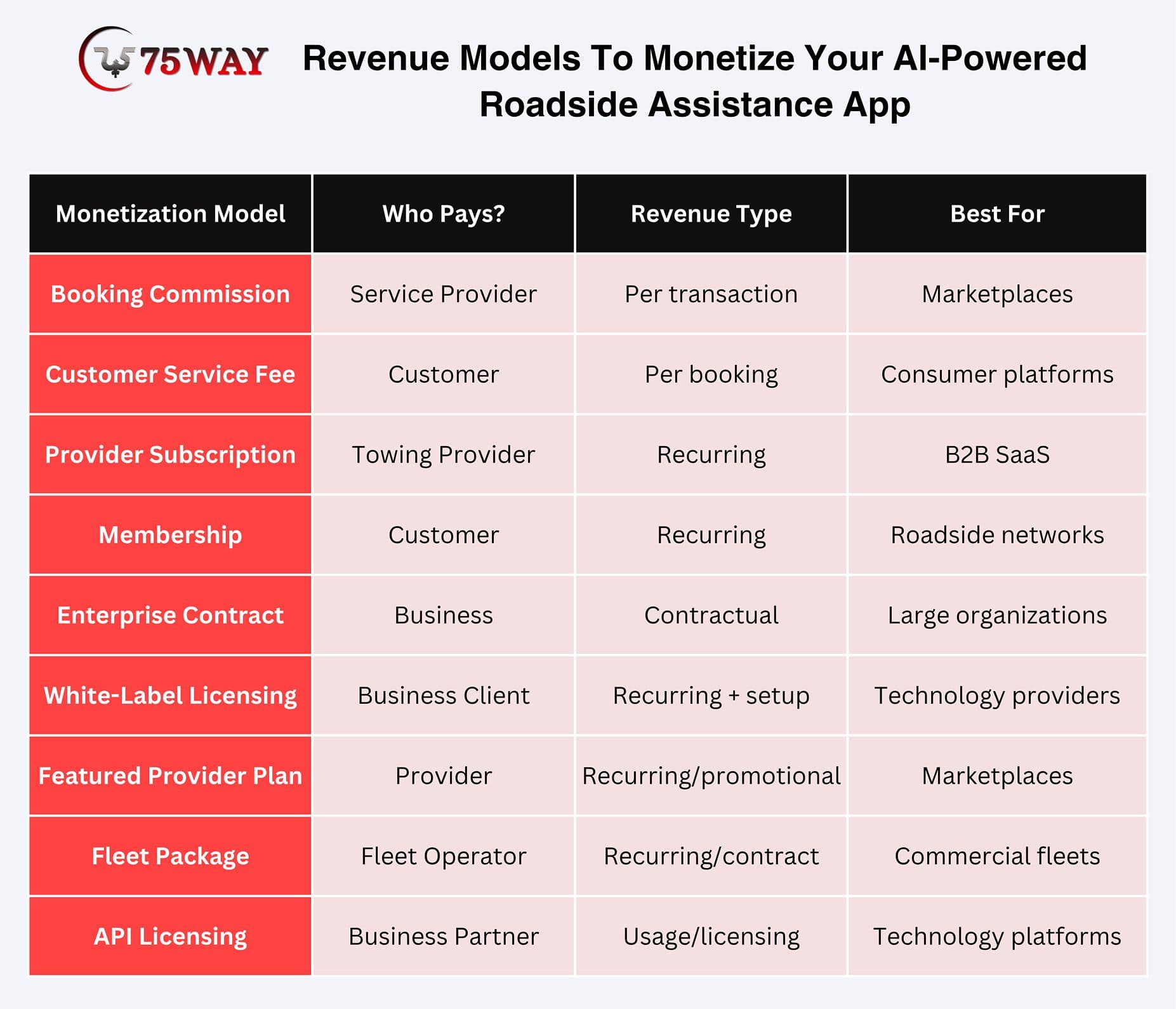
A roadside assistance app can generate revenue through service commissions, booking fees, subscriptions, memberships, provider plans, enterprise contracts, and white-label licensing. The right monetization strategy depends on whether you operate your own towing fleet, run a marketplace, sell roadside software, or serve enterprise customers.
Rather than relying on one revenue stream, businesses can combine complementary models as the platform grows.
1. Commission Per Booking
A marketplace can charge a percentage or fixed commission on completed roadside service bookings.
For example, when a customer books a tow through the platform, the provider receives the service payment minus the platform's agreed commission or fee.
This model works well when the platform connects independent providers with customers.
2. Customer Service Fee
The platform can charge customers a separate booking, technology, or convenience fee in addition to the underlying roadside service cost.
The fee should be clearly communicated before the customer confirms the request.
3. Provider Subscription Plans
Towing companies and roadside providers can pay a recurring subscription to access the platform. Different plans could provide different capabilities, such as:
- Basic job management
- Advanced dispatch
- Analytics
- Fleet tools
- Priority support
- Additional users
- Reporting
This model can provide recurring software revenue for a provider-focused roadside platform.
4. Customer Membership Plans
Businesses can offer monthly or annual roadside memberships that provide defined assistance benefits according to the plan terms.
A membership platform can generate recurring revenue while encouraging customers to remain connected to the service.
The application can manage membership status, renewals, eligible services, service usage, and account information.
5. Enterprise Contracts
Large businesses may pay under contractual arrangements for roadside assistance technology and service fulfillment. Potential enterprise customers include:
- Fleet operators
- Rental companies
- Automotive businesses
- Mobility companies
- Insurance partners
- Motor clubs
Enterprise pricing can be based on usage, subscription agreements, service volume, licensing, or negotiated contracts.
6. White-Label Licensing
A company can license its underlying roadside assistance platform to other businesses.
Each client can operate under its own brand while using the same core technology.
Revenue can come from:
- Initial setup fees
- Monthly licensing
- Annual contracts
- Customization charges
- Support packages
- Additional integration fees
This model can be particularly attractive for technology businesses targeting multiple towing or automotive companies.
7. Featured Provider Plans
A marketplace may offer providers paid visibility or enhanced profile capabilities, provided the model does not compromise customer trust or service quality.
Potential paid features can include enhanced business profiles, additional analytics, or promotional placement.
Any ranking or visibility system should remain transparent to users.
8. Fleet Service Packages
A roadside assistance platform can offer specialized packages to commercial fleets.
Businesses may pay recurring fees for access to centralized service requests, fleet vehicle management, reporting, invoices, and roadside coordination.
This creates a B2B revenue stream beyond individual consumer bookings.
9. API and Technology Licensing
A mature roadside assistance platform can expose selected capabilities through APIs for approved partners.
Businesses may pay for access to specific technology services such as provider availability, booking management, service status, or roadside dispatch functionality.
This approach requires careful API security, authentication, usage controls, documentation, and pricing.
Which Revenue Model Should You Choose?
The monetization strategy should follow the operating model.
A local towing company can generate revenue directly through service bookings and memberships. A towing marketplace can combine customer fees with provider commissions. A provider-focused tow truck dispatch software business can use subscriptions. A white-label roadside assistance platform can combine licensing, setup, customization, and recurring support fees.
For enterprise businesses, negotiated contracts may be more appropriate than standard consumer pricing. The strongest approach is to validate one primary revenue stream first, then introduce additional monetization options after the platform has established customer demand and provider participation.
Challenges In Tow Truck Dispatch Software Development
Tow truck dispatch software creation involves more than building booking screens because the platform must coordinate customers, providers, vehicles, locations, payments, and urgent service requests in real time. These operational dependencies create challenges that founders should address during product planning rather than after launch.
- GPS Accuracy: Roadside customers may request assistance from highways, parking lots, rural roads, or unfamiliar locations, making accurate location detection essential for successful dispatch.
- Provider Availability: The platform must continuously track provider availability, service areas, truck types, equipment, and current jobs to prevent unsuitable assignments.
- Real-Time Dispatch: A reliable dispatch system must match requests with suitable providers while considering distance, availability, service capability, workload, and business rules.
- Live Status Updates: Customers, providers, and dispatchers need synchronized booking statuses, provider locations, and ETAs throughout the service journey.
- Poor Connectivity: Roadside services can occur in areas with weak networks, requiring the app to handle temporary connectivity issues without losing important job information.
- Booking Conflicts: Multiple simultaneous requests can create duplicate assignments, outdated availability, or double bookings unless the backend includes proper synchronization and safeguards.
- Pricing Complexity: Towing charges may depend on service type, distance, vehicle category, equipment, waiting time, location, or additional services, requiring configurable pricing logic.
- Data Security: Customer locations, vehicle details, payment information, provider records, and business data require appropriate authentication, authorization, encryption, and access controls.
- Third-Party Dependencies: Maps, payments, SMS, analytics, CRM, and fleet integrations introduce additional considerations around API reliability, pricing, authentication, and data synchronization.
How to Overcome Roadside Assistance App Development Challenges
The most effective approach is to address operational risks before development begins. Start by documenting the complete service workflow, defining provider and dispatcher responsibilities, establishing clear business rules, selecting dependable third-party services, and designing the backend around real-time operations.
Before a full-scale launch, test the platform using realistic scenarios such as poor GPS, weak connectivity, provider rejection, customer cancellation, payment failure, simultaneous bookings, reassignment, and high-demand periods.
This approach helps turn a basic towing application into a dependable roadside service platform capable of supporting real-world operations.
Roadside Assistance App Development: Launch and Growth Strategy
A successful launch is only the starting point for a roadside assistance platform. Customer acquisition, technician availability, response times, service coverage, and repeat usage will determine whether the app becomes a viable business. The key growth decisions for building that momentum are outlined below.
- Start With a Defined Service Area: Launch in one city or region where you can establish enough provider coverage, monitor operations, and understand customer demand before expanding.
- Build Provider Supply First: Recruit qualified towing and roadside providers before marketing heavily so customers can receive reliable service when they submit requests.
- Launch With Core Services: Begin with high-demand services such as towing, jump-starts, tire assistance, fuel delivery, and lockout services before introducing specialized offerings.
- Create a Local Acquisition Strategy: Use local SEO, paid search, partnerships, automotive businesses, fleet relationships, and referral programs to generate initial customer demand.
- Optimize Local Search Visibility: Create location-specific service pages and business profiles targeting searches related to towing, roadside assistance, emergency towing, and nearby vehicle recovery services.
- Establish Provider Performance Standards: Track response times, acceptance rates, cancellations, customer ratings, service completion, and complaints to maintain service quality across the provider network.
- Monitor Core Business Metrics: Measure booking conversion, completed jobs, customer acquisition cost, average order value, repeat bookings, provider utilization, cancellation rates, and revenue.
- Improve Based on Real Usage: Use customer feedback, provider feedback, analytics, and support requests to identify friction points and prioritize product improvements.
- Expand Service Coverage Gradually: Add new cities or regions only when existing operations demonstrate sufficient provider capacity, customer demand, service quality, and sustainable unit economics.
- Introduce Advanced Features After Validation: Add automated dispatch, dynamic pricing, fleet management, AI-assisted analytics, memberships, and enterprise integrations after the core business model has demonstrated demand.
Trends To Follow for Building Tow Truck Mobile App in 2026 & Beyond
A modern tow truck app needs to solve problems that traditional dispatch systems often leave untouched, from unpredictable demand to technician utilization. Emerging technology can make those operations more responsive and data-driven. The trends worth watching before planning your next tow truck app are covered below.
- AI-Assisted Dispatch: AI can analyze provider availability, location, service requirements, and historical patterns to recommend better dispatch decisions and reduce manual workload.
- Predictive Roadside Assistance: Connected vehicle and historical service data can help identify potential roadside problems and support proactive assistance before a breakdown becomes more disruptive.
- Real-Time Location Intelligence: Advanced location technology can provide more accurate ETAs, route information, provider positioning, and service-area visibility for customers and dispatch teams.
- Connected Vehicle Integrations: Vehicle data can increasingly support roadside workflows by providing relevant information about vehicle condition, location, diagnostics, or potential service requirements when available.
- Automated Customer Support: AI-powered assistants can handle common questions, booking updates, service-status requests, and basic support interactions while escalating complex issues to human agents.
- Digital Proof of Service: Photos, signatures, timestamps, service notes, and digital documentation can create clearer records for customers, providers, insurers, and enterprise partners.
- Dynamic Pricing: Configurable pricing engines can adjust service estimates according to distance, service type, demand, equipment requirements, location, and business-specific rules.
- Fleet-Centric Platforms: More businesses are using roadside technology to connect vehicle fleets, drivers, dispatchers, service providers, billing teams, and maintenance workflows through centralized platforms.
- Embedded Roadside Services: Automotive, insurance, mobility, and fleet platforms can integrate roadside assistance directly into their existing digital experiences through APIs and partner integrations.
- Advanced Operational Analytics: Businesses can use real-time dashboards and historical data to monitor demand, response times, provider utilization, revenue, cancellations, and geographic performance.
- White-Label Expansion: White-label roadside assistance platforms can allow technology providers to support multiple brands using configurable workflows, service areas, pricing, branding, and provider networks.
- Smarter Self-Service Booking: Customers increasingly expect short booking flows, automatic location detection, saved vehicle details, digital payments, and clear provider ETAs without unnecessary interaction.
Why Choose 75way As Trusted Roadside Assistance App Development Services Provider?
75way Technologies, as a leading roadside assistance app development company, combines app development expertise with a practical understanding of on-demand service workflows, helping businesses build roadside assistance platforms around real operational requirements.
From customer booking and GPS tracking to provider management, tow truck dispatch, digital payments, notifications, invoicing, and admin dashboards, our team can develop solutions tailored to your business model, target market, and growth plans.
We focus on building scalable roadside assistance app solutions that can evolve from an MVP into a larger marketplace, fleet platform, or enterprise system. Our development approach covers discovery, UI/UX, mobile and backend development, third-party integrations, testing, deployment, and post-launch support, giving founders and businesses a structured path from idea validation to market expansion.
Final Thoughts
Roadside assistance app development can help towing companies, startups, fleet operators, and enterprise businesses create faster, more connected service experiences. From customer booking and GPS tracking to provider dispatch, payments, invoicing, analytics, and automation, the right platform can simplify roadside operations while creating new revenue opportunities. However, successful development requires more than a strong feature list.
Your business model, target market, provider network, technology stack, security, scalability, and launch strategy should shape every development decision. To build your roadside assistance app, you can partner with a trusted app development firm to turn your idea into a scalable solution.
Frequently Asked Questions (FAQs)
Can A Roadside Assistance App Support Multiple Service Areas?
Yes, the platform can support multiple cities, states, or regions with configurable coverage rules. Businesses can gradually expand service availability without rebuilding the entire application.
How Can Roadside Apps Improve Customer Retention?
Retention can improve through reliable service, transparent communication, saved vehicle information, service history, memberships, and personalized offers. A smoother experience encourages customers to return when assistance becomes necessary.
What Type Of Businesses Can Launch A Towing App?
Local towing companies, roadside startups, automotive groups, fleet businesses, and technology companies can launch towing applications. The platform structure should reflect their specific customers and operational model.
Can Roadside Assistance Apps Connect With Existing Business Software?
Yes, roadside platforms can connect with existing CRM, accounting, fleet, insurance, payment, and customer-support systems. API-based integrations can reduce duplicate data entry across business operations.
How Can A Towing Business Get Customers Through Its App?
Businesses can combine local SEO, paid search, partnerships, referrals, fleet relationships, and customer retention campaigns. App-based convenience can then encourage customers to choose the business repeatedly.