Summary
Planning an MVP in the USA? Discover the real MVP development cost breakdown ($10K–$250K+), what investors expect before writing a check, and how to build an investor-ready MVP in 2026. Strategic budgeting prevents wasted resources and accelerates learning. A focused MVP improves funding readiness.
Quick Overview
- MVP development costs typically range from $10,000 to $250,000+ nationwide.
- Cross-platform development reduces costs while accelerating market validation.
- AI integrations increase MVP budgets through infrastructure and testing.
- Compliance requirements impact development costs in regulated industries.
- Post-launch maintenance requires 20% annual budget allocation.
You have got a startup idea. You have done your research. Now you are ready to build an MVP. But before you hire an MVP development team, two questions keep coming up:
- "How much will this MVP development actually cost?"
- "Will investors fund it?"
These two questions are more connected than most founders realize. The wrong MVP budget, too little or too much, can kill your funding chances before you ever walk into a pitch meeting.
This guide answers both questions with hard numbers, real investor expectations, and a clear framework to build an MVP that attracts capital in the USA in 2026.
What Is an MVP (and What It Is NOT in 2026)?
A Minimum Viable Product (MVP) is the simplest, leanest version of your app that still delivers real value to real users and generates real learning. But the definition has evolved. In 2026, an MVP is not:
- A prototype or clickable mockup
- A demo with fake data
- A half-built app with bugs everywhere
- A product stuffed with every feature you dreamed of
Today's MVP app development must be production-grade, focused, and fast. Users in 2026 compare your app to Uber, Stripe, and Airbnb from day one. A broken experience doesn't generate trust. It generates churn. The goal of an MVP is simple: validate your riskiest business assumption with the least amount of money.
How Much Does MVP App Development Cost in the USA? (2026 Breakdown)
Let's get to the numbers. MVP development cost in the USA depends on complexity, platform, team location, and feature set. Here is the realistic cost landscape for 2026:
1. Cost to Build an MVP By Complexity Level
Most startups spend between $40,000 and $80,000 to build a market-ready MVP that can validate demand and attract early investor interest.
- Simple MVP: $10,000 – $50,000
- Medium Complexity MVP: $50,000 – $100,000
- High Complexity MVP: $100,000 – $250,000+
- AI-Powered MVP: $150,000 – $300,000+
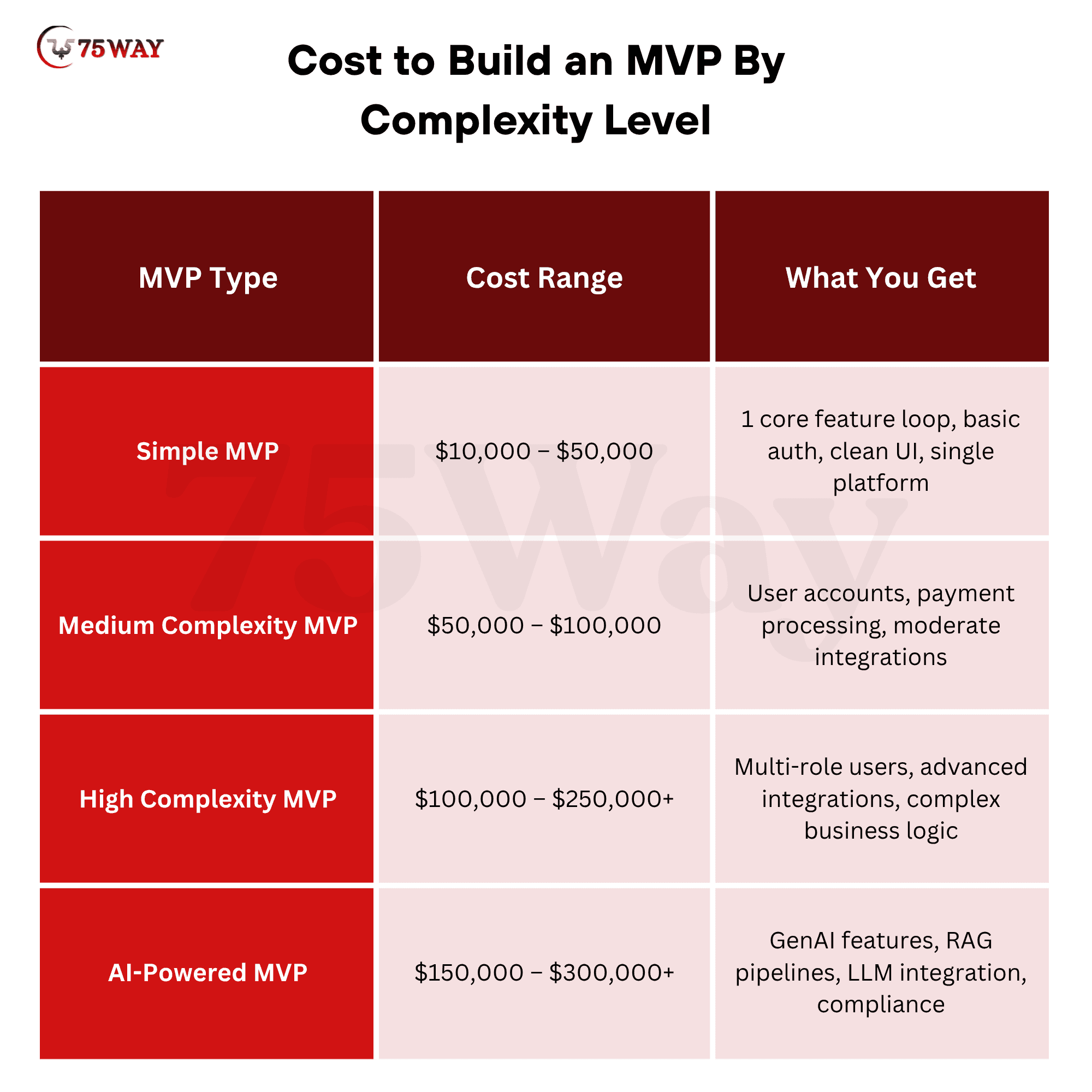
The sweet spot for most US startups: $40,000 – $80,000, enough to build something real users can validate, without burning all your runway before you've learned anything.
2. MVP Development Cost By Platform Type
Web applications are generally the most affordable, while multi-platform and native mobile solutions require larger budgets due to additional development and testing efforts.
- Web App MVP: $20,000 – $60,000
- Cross-Platform Mobile (Flutter/React Native): $30,000 – $80,000
- Native iOS + Android: $60,000 – $150,000+
- Web + Mobile MVP: $50,000 – $120,000+
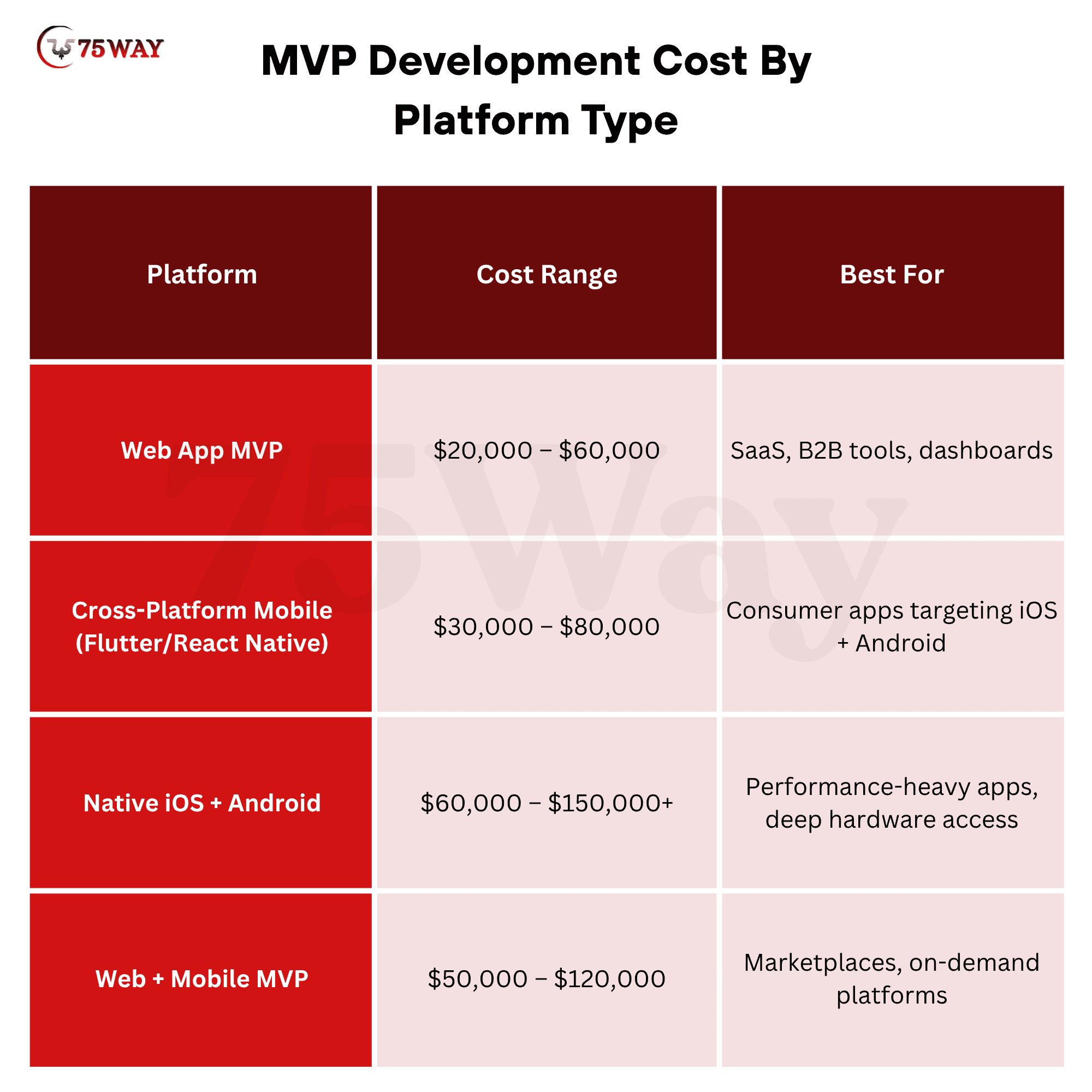
For most MVPs, cross-platform mobile using Flutter or React Native is the smart choice. It covers both iOS and Android from one codebase, cutting costs by 40–60% versus building native apps separately.
3. Cost for Developing A Minimum Viable Product (MVP) By Team Location (Hourly Rates 2026)
Hourly rates vary significantly across regions, but expertise, communication quality, and product understanding often impact project costs more than rates alone.
- USA / Canada: $100 – $250 per hour
- Western Europe: $80 – $150 per hour
- Eastern Europe: $40 – $80 per hour
- Latin America: $30 – $70 per hour
- India / South Asia: $20 – $50 per hour
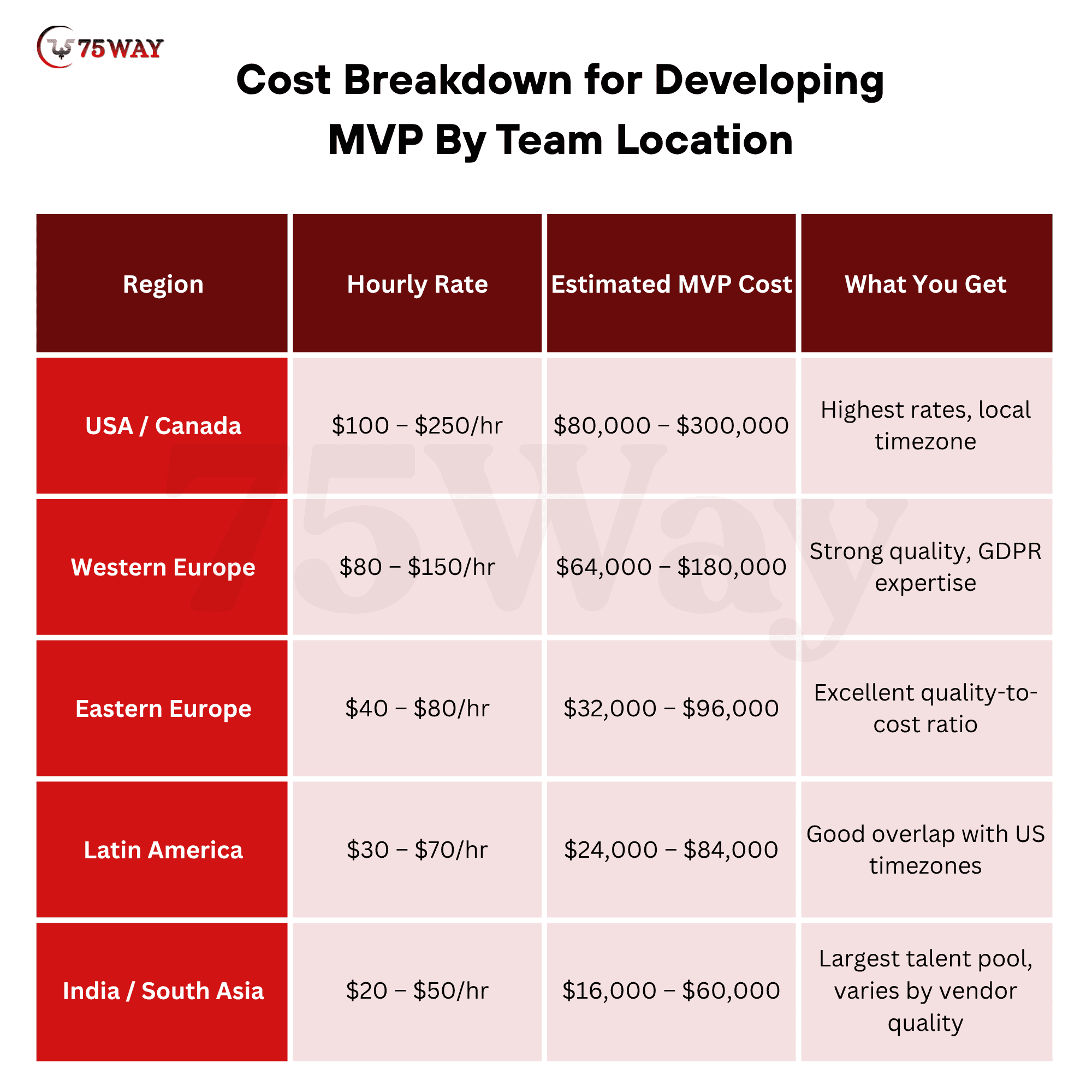
The hourly rate is the least important number. A $20/hour team that misunderstands your product costs more than a $70/hour team that ships the right thing in half the time. Judge by portfolio, process, and communication — not rate alone.
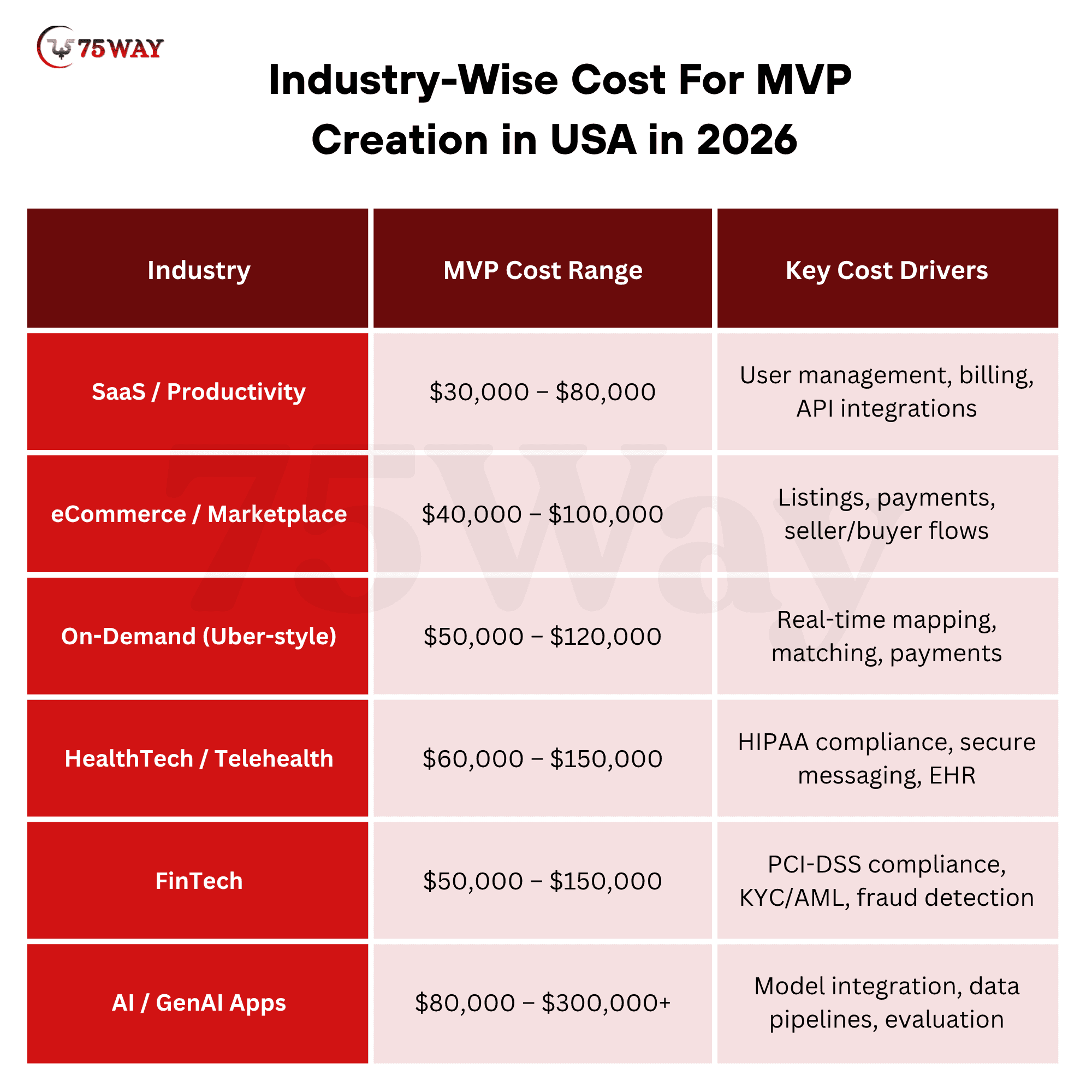
4. Industry-Wise Cost For MVP Creation in USA in 2026
MVP app development costs vary significantly by industry due to differences in compliance requirements, integrations, security standards, real-time functionality, and AI capabilities. Regulated sectors such as healthcare and fintech typically require larger budgets than standard SaaS products.
What Drives MVP App Development Cost Up: The Hidden Factors
Most founders budget for development. Few budget for everything else. Here are the cost factors that catch startups off guard:
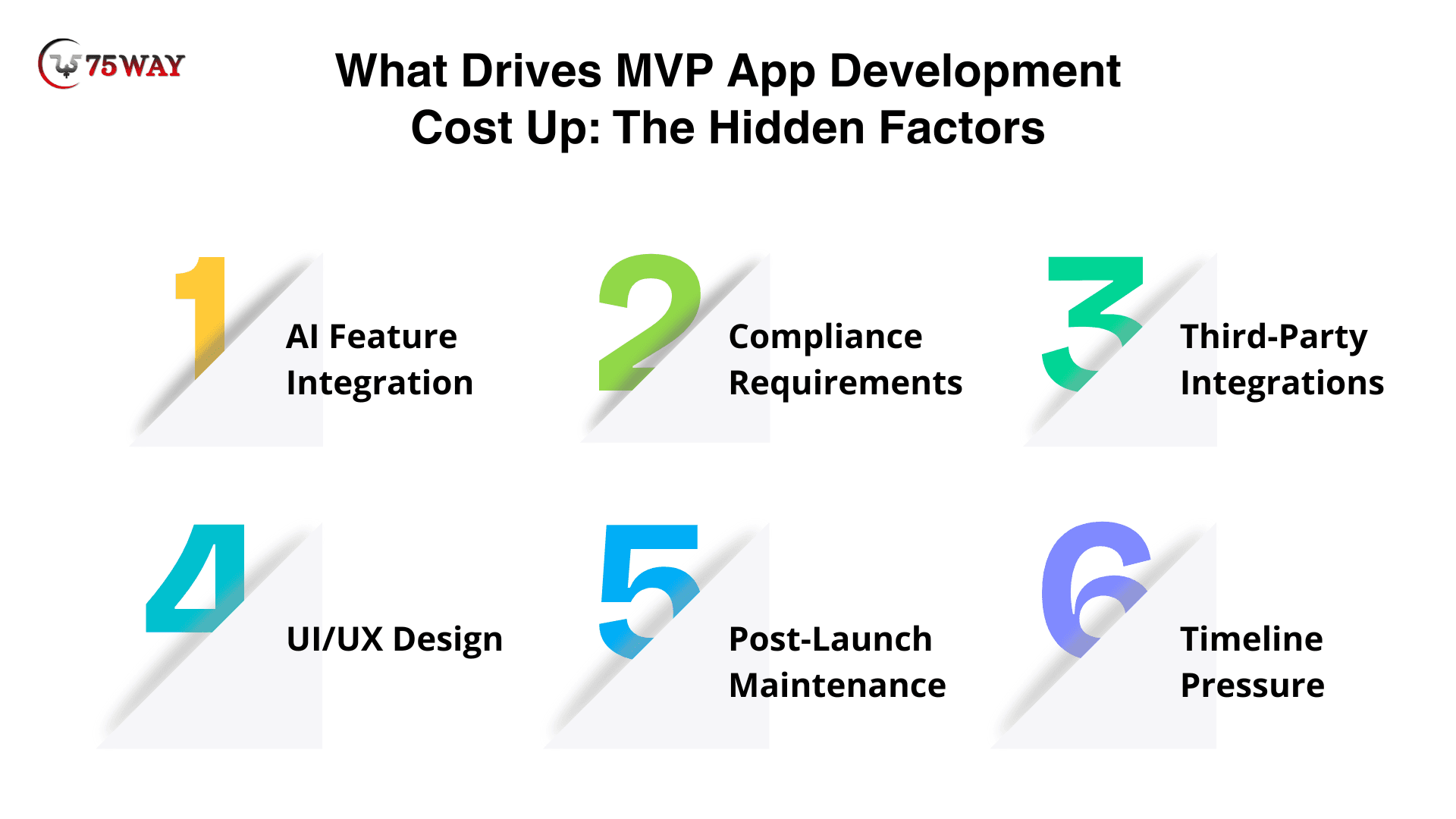
1. AI Feature Integration
Adding generative AI features, AI chatbots, recommendation engines, smart search, and AI assistant adds 15–30% to your base MVP budget in 2026. Why? Data preparation, model evaluation, safety guardrails, and API costs all add up before a single user logs in.
2. Compliance Requirements
Healthcare apps need HIPAA. FinTech apps need PCI-DSS. Apps serving EU users need GDPR. Compliance isn't optional. It's the price of admission in regulated industries, and it adds real cost from day one.
3. Third-Party Integrations
Payment processors (Stripe, Braintree), mapping APIs (Google Maps), email services (SendGrid), analytics tools- each integration adds development time and ongoing API costs.
4. UI/UX Design
In 2026, users expect polish. Founders building what's called a "Minimum Lovable Product" (MLP), same core MVP functionality but with 20–30% more investment in UI/UX design, are seeing better early traction and investor reception.
5. Post-Launch Maintenance
Ongoing maintenance typically costs about 20% of your original MVP development budget per year. Server fees, third-party API subscriptions, bug fixes, and security patches are not optional.
6. Timeline Pressure
Rush deadlines mean larger teams or overtime, both of which increase cost. A 4-month timeline for a medium-complexity MVP may inflate the budget by 20–30% compared to a well-paced 6-month build.
What Investors Actually Expect From Your MVP in 2026
This is where most founders get blindsided. The funding environment in 2026 has changed dramatically.
"In 2026, seed investors demand more than promising ideas."
The "fund the vision" era is over. Post-2023, investor expectations have shifted hard toward proof over promise. Here is what US investors actually expect when you show up with an MVP:
1. A Working Product, Not a Demo
Over 85% of early-stage investors now require a functional MVP with real usage metrics before committing capital. A prototype or clickable Figma mockup no longer gets you a serious meeting at the seed stage.
2. Real User Traction
Investors examine early user behavior to gauge traction. The metrics they look for:
- DAU/MAU Ratio: How often do users return?
- 30/60/90-Day Retention Cohorts: Do users stick around?
- Activation Rate: What % of signups actually use the core feature?
- NPS or Qualitative Feedback — Do users love it or tolerate it?
Even small numbers are acceptable, but upward trends matter more than vanity metrics. 100 engaged users who return weekly is worth more than 10,000 downloads with 95% churn.
3. Revenue Signals (or Strong Proxies)
For SaaS startups at the seed stage in 2026, many investors expect $20,000 – $50,000 MRR at minimum, with 15–20%+ month-over-month growth. For consumer apps, strong user growth and retention curves can substitute for revenue.
Pre-revenue isn't necessarily a dealbreaker, but pre-validation is.
4. Unit Economics Awareness
Investors no longer accept "we'll figure out monetization later." You must demonstrate understanding of:
- CAC: Customer Acquisition Cost
- LTV: Lifetime Value of a customer
- Burn Rate: How long does your runway last?
- Payback Period: How long to recover CAC?
You don't need perfect numbers at the MVP stage, but you need a credible thesis for why your unit economics will work at scale.
5. Learning Velocity
The concept of "learning velocity" has become a core investor evaluation criterion in 2026. Investors don't just want to see what you've built. They want to see evidence that your team identifies what's wrong, iterates fast, and improves. An MVP that has gone through 3 iterations based on real user feedback is far more fundable than one built in isolation over 12 months.
6. A Credible Technical Foundation
Investors increasingly evaluate whether the architecture of your MVP can scale. Red flags include: monolithic spaghetti code, no test coverage, hard-coded configurations, and no CI/CD pipeline. You don't need enterprise-grade infrastructure at the MVP stage, but you can't rebuild from scratch after raising $3M.
What Funding Stage Is Your MVP Targeting?
Different funding stages have different expectations. Here's the 2026 breakdown:
1. Pre-Seed ($500K – $1M)
- What investors fund: The idea + early prototype/MVP
- What they expect: Founder-market fit, strong team, early user validation signals (waitlist signups, interviews, LOIs)
- Typical MVP cost at this stage: $15,000 – $50,000
- Key metric: Can this team build and ship?
2. Seed ($3M – $5M, median $3.1M in 2026)
- What investors fund: Go-to-market validation
- What they expect: Working MVP + real users + early traction + unit economics understanding
- Median pre-money valuation: $16M (up to $24M per Carta Q3 2026 data)
- Key metric: $20K–$50K MRR (SaaS) or strong user growth (consumer)
Series A ($10M – $15M)
- What investors fund: Scaling a proven model
- What they expect: Strong product-market fit, $100K–$500K ARR, low churn, repeatable growth
- Key metric: Proven unit economics and a clear path to $1M ARR
The average time from founding to seed round has increased from 8 months in 2021 to 19 months in 2025. Build your MVP with enough runway to reach real traction milestones, not just the launch date.
The 75way Framework: Building an Investor-Ready MVP
At 75way Technologies, we've helped US startups build MVPs that get funded. Here is the framework we follow:
- Simple MVP: $5,000 – $30,000
- Medium Complexity MVP: $30,000 – $60,000
- High Complexity MVP: $60,000 – $90,000+
- AI-Powered MVP: $900,000 – $150,000+
Cost of MVP Development Based on Stages
Phase 1: Discovery & Validation (2–3 Weeks): $3,000–$8,000
Before writing a single line of code, we validate:
- Is there a real market for this problem?
- What is the single most important user hypothesis to test?
- What is the minimum feature set to test that hypothesis?
This phase prevents the #1 budget killer: building features nobody needs.
Deliverables: User research synthesis, feature prioritization matrix, technical feasibility assessment, cost estimate.
Phase 2: Design & Prototyping (2–3 Weeks): $5,000–$15,000
Teams that spend at least 20% of their MVP budget on pre-development work are 3x more likely to build a successful product.
Deliverables: User flows, wireframes, high-fidelity UI designs, interactive prototype for stakeholder review.
Phase 3: Core Development (8–16 Weeks): $20,000–$150,000+
We build the single core feature loop first. The thing users come back for. Everything else is secondary. Technology stack for most 2026 MVPs:
- Frontend: React.js / Next.js (web), React Native / Flutter (mobile)
- Backend: Node.js, Django, or Ruby on Rails
- Database: PostgreSQL (relational), MongoDB (document), Firebase (real-time)
- Cloud: AWS, GCP, or Azure — whichever the team knows best
- AI/ML: OpenAI API, Anthropic Claude API, Google Vertex AI (depending on use case)
Phase 4: QA, Launch & Analytics (2–3 Weeks): $3,000–$10,000
We conduct performance testing, security audits, cross-device testing, and critically instrument analytics from day one. You cannot show investors traction you never measured.
Tools: Mixpanel, Amplitude, PostHog for product analytics; Sentry for error monitoring; Hotjar for session recording.
Phase 5: Post-Launch Iteration (Ongoing)
The MVP launch is not the finish line. It's the starting gun. Post-launch iteration based on real user data is what turns an MVP into a fundable company. Budget for at least 3–6 months of post-launch development before approaching investors for a seed round.
Real MVP Development Cost Examples Based on Industries
Example 1: On-Demand Service App (Uber-style)
- Core Features: User registration, service booking, real-time GPS tracking, in-app payments, push notifications, driver/provider portal, admin dashboard
- Platform: iOS + Android (React Native)
- Timeline: 14–18 weeks
- Estimated Cost: $60,000 – $100,000
Example 2: SaaS Productivity Tool (B2B)
- Core Features: User auth, workspace management, core workflow feature, Stripe billing, basic analytics, onboarding flow
- Platform: Web (Next.js)
- Timeline: 10–14 weeks
- Estimated Cost: $35,000 – $65,000
Example 3: AI-Powered Healthcare App
- Core features: Patient registration, HIPAA-compliant messaging, AI symptom checker (GPT-4 integration), appointment booking, provider portal
- Platform: Web + iOS
- Timeline: 16–22 weeks
- Estimated Cost: $90,000 – $160,000
Example 4: FinTech Wallet MVP
- Core features: KYC/AML verification, wallet creation, P2P transfers, transaction history, push notifications, PCI-DSS-compliant payment infrastructure
- Platform: iOS + Android (Flutter)
- Timeline: 14–20 weeks
- Estimated Cost: $70,000 – $140,000
7 Mistakes That Kill MVP Funding Chances
1. Building Too Many Features
The #1 budget killer is building features nobody asked for. Scope ruthlessly. If a feature doesn't directly test your core hypothesis, cut it.
2. Skipping Analytics
You cannot prove traction with screenshots. Instrument product analytics from day one, before a single real user touches your app.
3. Choosing the Cheapest Team
A $15/hour offshore team that builds the wrong thing costs more than a $60/hour team that nails the scope in half the time.
4. Not Planning for Post-Launch
Most founders spend everything on the build. Investors want to see 3–6 months of post-launch data. Budget for iteration, not just launch.
5. Targeting the Wrong Funding Stage
Showing up to a seed meeting with only a prototype and no users is a mismatch. Know which stage your traction puts you in before you start pitching.
6. Ignoring Unit Economics
"We'll figure out monetization later" is not an answer in 2026. Have a credible LTV/CAC thesis, even if your numbers are early projections.
7. Not Building for Scalability
Architecture choices made in MVP development follow you to Series A. Avoid technical debt that would require a complete rebuild to scale.
How to Choose the Right MVP Development Partner in the USA
When evaluating a development company for your MVP, ask these questions:
- Do they have case studies in your industry? Generic app dev experience is not the same as FinTech or HealthTech experience.
- Do they lead with discovery? Any team that starts coding without understanding your user is a red flag.
- What does their QA process look like? Bugs at demo time kill investor interest fast.
- Do they help you instrument analytics? If not, you'll have nothing to show investors post-launch.
- What happens after launch? Post-launch iteration support is as important as the initial build.
- Can they work within US time zones? Communication gaps add weeks of delay to any project.
Why Choose 75way for Cost-Effective MVP Development?
75way is a US-focused AI, blockchain, and app development company that has helped startups across New York, Los Angeles, Chicago, San Francisco, and Miami build investor-ready MVPs.
What we bring to your MVP:
- Full discovery and user research before development begins
- Cross-platform mobile (React Native, Flutter) and web (Next.js) expertise
- AI integration capabilities using OpenAI, Claude, and Google Vertex AI
- HIPAA, PCI-DSS, and SOC2-ready development practices
- Product analytics instrumentation built into every project
- Post-launch iteration and growth support
We understand that an MVP isn't just code. It's a fundraising instrument. Every architectural decision, UX choice, and feature we build or cut is made with your investor pitch in mind. Get a Free MVP Consultation now.
Conclusion
Building an MVP in the USA in 2026 requires navigating two parallel challenges: building the right product for your users, and building the right evidence base for your investors.
The cost, anywhere from $10,000 to $250,000+ depending on your context, is less important than whether your MVP answers the right question for the right audience at the right time.
Investors are no longer funding ideas. They're funding proof. A lean, focused MVP with real user traction, measurable retention, and early revenue signals is worth 10x more in a pitch meeting than a beautifully designed demo with zero users.
If you're planning an MVP for a US market launch in 2026, the smartest investment you can make is in a development partner who understands both the technology and the fundraising landscape.
Ready to build an investor-ready MVP? Partner with a reliable MVP development company now.
Frequently Asked Questions (FAQ)
How Much Does MVP App Development Cost In The USA in 2026?
MVP app development in the USA typically costs between $10,000 and $250,000+, depending on complexity. Simple MVPs with one core feature loop range from $10,000–$50,000. Medium complexity MVPs cost $50,000–$100,000. AI-powered or compliance-heavy MVPs can reach $150,000–$300,000 or more. The sweet spot for most US startups is $40,000–$80,000.
How Long Does It Take To Build An MVP?
Most MVPs take 10–20 weeks from kickoff to launch. Simple single-feature MVPs can ship in 8–10 weeks. Complex builds with compliance requirements or AI integrations may take 18–24 weeks. Rushing timelines typically increases both cost and bug risk.
Do Investors Fund MVPs Before They Have Users?
At the pre-seed stage, investors sometimes fund the development of an MVP — particularly for founders with strong domain expertise or repeat founder track records. However, in 2026, even pre-seed investors increasingly expect early user validation signals: waitlist signups, signed LOIs, or at minimum, evidence of customer discovery. For seed-stage funding, a working MVP with real user traction is now the baseline expectation.
What Metrics Do Investors Want To See From An MVP?
Key metrics investors examine in 2026 include: DAU/MAU ratio, 30/60/90-day retention cohorts, activation rate, NPS or qualitative user feedback, MRR (for SaaS), user growth rate, and early signals of willingness to pay. They also evaluate your team's learning velocity — evidence that you identify problems quickly and iterate based on real data.
What Is The Difference Between An MVP And A Prototype?
A prototype is a demonstration, typically a clickable design that simulates user flows without real functionality. An MVP is a working product with real code, real data, and real users who can actually complete tasks and generate learning. Investors in 2026 distinguish clearly between the two and expect an MVP, not a prototype, for seed funding.
How Much Should I Budget For Post-Launch MVP Maintenance?
Plan for ongoing maintenance costs of approximately 20% of your original MVP development budget per year. This covers server fees ($50–$500/month), third-party API subscriptions ($100–$1,000/month), bug fixes, security patches, and ongoing feature iterations based on user feedback.
Should I Build an MVP for iOS, Android, or Web First?
For most B2B SaaS products, start with a web MVP. It's faster and cheaper to build and easier to iterate on. For consumer apps, cross-platform mobile using React Native or Flutter is the best balance of cost and coverage. Building separate native apps for iOS and Android is rarely the right call for an MVP unless your use case specifically requires deep hardware integration.
Can AI Help Reduce MVP Development Costs?
Yes, AI-assisted development tools (GitHub Copilot, Cursor, and similar) are reducing dev hours by 10–20% in well-managed projects. However, adding AI features to your product (chatbots, recommendation engines, smart search) still adds 15–30% to your MVP budget due to data preparation, model integration, and evaluation overhead.