Summary
Ecommerce mobile apps in 2026 redefine digital shopping through intelligent personalization, frictionless payments, immersive product experiences, and predictive analytics. Modern businesses gain stronger customer loyalty, higher conversion rates, and scalable revenue systems powered by AI-driven automation, voice commerce, and advanced security layers across mobile-first ecosystems shaping global retail transformation.
Quick Overview
- AI personalization reshapes ecommerce journeys with deeply relevant product suggestions
- Mobile-first checkout systems reduce friction and significantly improve conversion rates
- Voice commerce enables hands-free shopping experiences across modern devices globally
- AR product visualization increases buyer confidence and reduces return rates significantly
- Predictive analytics empowers smarter inventory and customer behavior forecasting models
Want to build an ecommerce app but unsure which features matter actually and which ones are just “nice to have”? That confusion is exactly where most businesses get stuck in 2026. They start with a long feature list, spend months building an ecommerce app, and still end up with an app that users do not fully engage with.
The reality is simple. Successful ecommerce apps are not defined by how many features they have, but by how well those features improve discovery, trust, and conversion. From AI-powered recommendations to seamless checkout experiences, every feature needs to directly reduce friction and make shopping feel effortless for the user.
That is why choosing the right ecommerce mobile app development features has become one of the most critical decisions for any business entering this space. In this guide, we will break down the most important features every ecommerce app needs in 2026 so you can build an ecommerce platform or app that actually performs, not just exists.
Evolution of Ecommerce Mobile Apps in 2026
Ecommerce applications have evolved from static product catalogs into intelligent commerce ecosystems. Earlier apps focused on listing products and processing orders. Today, they function as data-driven platforms that analyze user behavior in real time and respond with tailored experiences. Key shifts shaping 2026 ecommerce apps include:
- Transition from browsing to predictive shopping
- Rise of AI-powered decision support systems
- Increased reliance on mobile-first purchasing behavior
- Integration of immersive technologies like AR and VR
- Expansion of voice-based and conversational commerce
Businesses adopting these innovations gain stronger engagement and improved customer lifetime value.
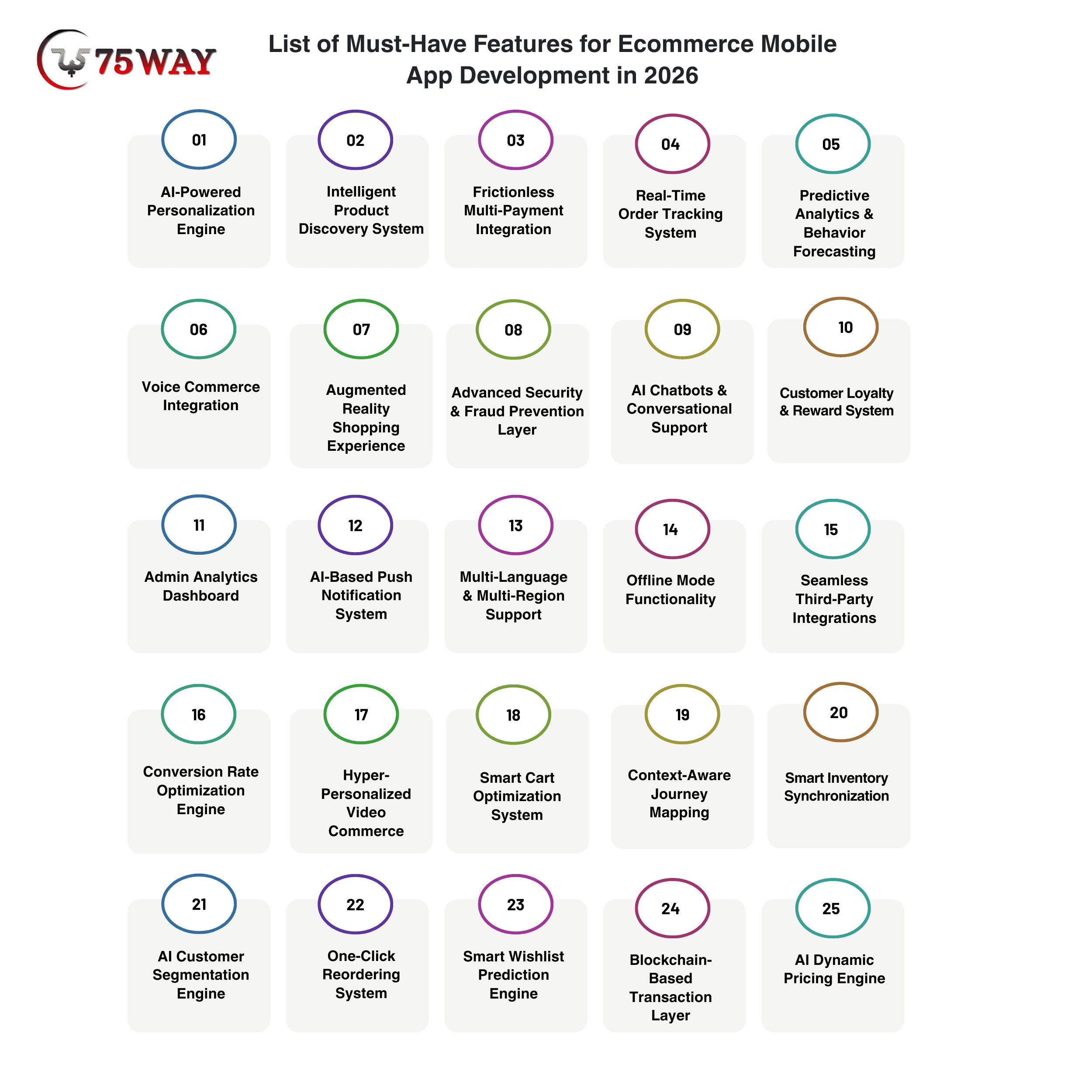
List of Must-Have Features for Ecommerce Mobile App Development in 2026
Ecommerce mobile apps in 2026 demand advanced capabilities that go beyond basic shopping experiences. Businesses now focus on intelligent automation, personalization, and seamless transactions to improve engagement, increase conversions, and build long-term customer loyalty across competitive digital marketplaces.
1. AI-Powered Personalization Engine
Artificial intelligence transforms ecommerce apps into highly adaptive shopping ecosystems. It studies user behavior, purchase history, and interaction patterns to deliver personalized journeys that feel unique for every customer. This feature enhances relevance and strengthens long-term engagement across mobile commerce platforms.
Smart personalization impact gains
- Improves product relevance across user journeys
- Increases conversion rates through tailored suggestions
- Enhances engagement with dynamic experiences
- Builds stronger customer retention over time
- Boosts average order value significantly
2. Intelligent Product Discovery System
Modern ecommerce applications rely on intelligent discovery systems instead of traditional search filters. These systems understand intent through semantic analysis and visual inputs, helping users find products faster. The experience becomes more intuitive, reducing browsing effort and improving satisfaction levels.
- Reduces search effort for customers
- Improves product visibility accuracy
- Boosts purchase probability significantly
- Enhances browsing speed and efficiency
- Delivers intent-based product results
3. Frictionless Multi-Payment Integration
Payment systems in ecommerce apps now support multiple global methods including wallets, cards, and BNPL options. This flexibility reduces checkout friction and ensures users can complete purchases quickly. The system prioritizes speed, security, and accessibility across different markets and devices.
- Reduces cart abandonment rates
- Speeds up checkout completion
- Expands global buyer accessibility
- Improves transaction success rates
- Enhances payment flexibility options
4. Real-Time Order Tracking System
Order tracking systems provide live visibility into delivery progress using GPS and logistics integrations. Customers can monitor shipments from dispatch to doorstep. This transparency improves trust, reduces uncertainty, and enhances overall post-purchase experience within ecommerce mobile applications.
- Builds customer trust instantly
- Reduces support queries
- Improves delivery experience clarity
- Enhances order visibility updates
- Increases post-purchase satisfaction
5. Predictive Analytics & Behavior Forecasting
Predictive analytics systems evaluate user behavior, market trends, and engagement signals to forecast future actions. Ecommerce apps use this intelligence to optimize inventory, identify customer intent, and anticipate demand patterns, leading to smarter business decisions and improved operational efficiency.
- Improves inventory planning accuracy
- Identifies high-value customers
- Reduces business uncertainty levels
- Enhances demand prediction capability
- Strengthens strategic decision-making
6. Voice Commerce Integration
Voice commerce allows users to interact with ecommerce apps using natural speech commands for searching products, placing orders, and managing shopping tasks. It enhances accessibility and reduces dependency on manual navigation, making the shopping experience faster, more intuitive, and highly modern for mobile-first users.
- Enables a hands-free shopping experience
- Improves accessibility for all users
- Speeds up product search process
- Enhances user interaction convenience
- Reduces navigation effort
7. Augmented Reality Shopping Experience
Augmented reality enables customers to visualize products in real-world environments before purchase. This immersive feature bridges the gap between physical and digital shopping, helping users make more confident decisions while reducing uncertainty and improving satisfaction across mobile commerce platforms.
- Reduces product return rates
- Improves purchase confidence
- Enhances user engagement levels
- Enables real-world product preview
- Strengthens buying decision
8. Advanced Security & Fraud Prevention Layer
Security systems protect ecommerce transactions using AI-based fraud detection, encryption technologies, and biometric authentication. These safeguards ensure safe payments, secure user data, and reliable platform trust, which are essential for scaling digital commerce businesses globally in competitive markets.
- Strong digital trust protection systems
- Protects sensitive user data effectively
- Reduces fraud risk significantly
- Enhances secure payment processing
- Strengthens platform trustworthiness
- Prevents unauthorized access attempts
9. AI Chatbots & Conversational Support
AI chatbots provide instant customer assistance across ecommerce journeys, handling queries, order tracking, and product recommendations. This automation improves response times, reduces dependency on human agents, and ensures users receive consistent support throughout their shopping experience.
- Instant support automation
- Reduces customer response time
- Improves satisfaction through instant replies
- Lowers operational support costs
- Enhances user experience consistency
- Provides 24 hour assistance availability
10. Customer Loyalty & Reward System
Loyalty systems encourage repeat purchases by offering rewards, points, and personalized incentives. These systems strengthen long-term relationships between brands and customers, improving retention rates and increasing overall customer lifetime value in competitive ecommerce environments.
- Encourages repeat purchase behavior
- Builds stronger brand loyalty
- Increases customer lifetime value
- Enhances user engagement consistency
- Drives higher retention rates
11. Admin Analytics Dashboard
Admin dashboards provide real-time insights into sales performance, user activity, and operational metrics. These insights help businesses make informed decisions, optimize marketing strategies, and track growth effectively within ecommerce mobile applications.
- Supports data-driven decisions
- Improves sales strategy planning
- Tracks business performance clearly
- Enhances operational visibility
- Strengthens growth forecasting accuracy
12. AI-Based Push Notification System
Push notification systems use AI to deliver personalized alerts based on user behavior, preferences, and engagement history. These messages improve re-engagement rates and encourage users to return to the app for purchases and interactions.
- Improves user re-engagement rates
- Increases conversion opportunities effectively
- Reduces app abandonment rates
- Delivers personalized marketing messages
- Enhances customer retention outcomes
13. Multi-Language & Multi-Region Support
This feature enables ecommerce apps to support multiple languages, currencies, and regional preferences. It allows businesses to expand globally while offering localized experiences that improve accessibility and customer satisfaction across different markets.
- Expands international business reach
- Improves user accessibility globally
- Supports localized shopping experience
- Enhances regional user engagement
- Enables multi currency transactions
14. Offline Mode Functionality
Offline mode allows users to browse previously loaded content, view products, and access saved data without internet connectivity. This feature enhances usability in low-network regions and ensures uninterrupted engagement with ecommerce applications.
- Improves usability without internet
- Enhances user retention rates
- Supports low connectivity environments
- Enables cached content access
- Maintains browsing continuity experience
15. Seamless Third-Party Integrations
Ecommerce apps integrate with CRM, ERP, logistics, and marketing platforms to streamline operations. This creates a unified system that improves automation, reduces manual work, and enhances business efficiency across all operational layers.
- Improves operational efficiency significantly
- Reduces manual workload dependency
- Enhances system automation levels
- Strengthens business process integration
- Supports scalable architecture growth
16. Conversion Rate Optimization Engine
CRO systems use A/B testing, behavioral analysis, and UI optimization tools to improve conversion performance. These systems refine user journeys and identify high-performing design and content variations within ecommerce mobile applications.
- Revenue optimization performance gains
- Increases overall conversion rates
- Improves user journey flow
- Reduces bounce rates effectively
- Enhances landing page performance
- Optimizes customer decision paths
17. Hyper-Personalized Video Commerce
This feature delivers interactive shoppable video experiences tailored to user preferences. It transforms static browsing into engaging visual storytelling that increases emotional connection and purchase intent within ecommerce platforms.
- Boosts product engagement time
- Enhances emotional purchase triggers
- Increases conversion performance
- Improves product understanding clarity
- Strengthens brand storytelling impact
18. Smart Cart Optimization System
Smart cart systems analyze user behavior in real time to suggest bundles, discounts, and complementary products. This reduces abandonment and increases order value through intelligent purchase optimization strategies.
- Reduces cart abandonment significantly
- Increases average order value
- Improves checkout completion rates
- Suggests relevant product bundles
- Enhances purchase decision flow
19. Context-Aware Journey Mapping
This system adapts user experience based on real-time context such as location, device, and browsing behavior. It ensures personalized navigation paths that align with user intent throughout the ecommerce journey.
- Improves content relevance accuracy
- Enhances user journey flow
- Reduces navigation friction points
- Increases engagement duration
- Strengthens conversion probability
20. Smart Inventory Synchronization
Inventory synchronization ensures real-time stock updates across platforms and warehouses. It prevents overselling and maintains accurate product availability data across ecommerce systems.
- Prevents overselling issues
- Improves stock accuracy levels
- Enhances operational reliability
- Reduces order cancellation risks
- Strengthens supply chain control
21. AI Customer Segmentation Engine
AI segmentation groups users based on behavior, purchase history, and engagement levels. This enables targeted marketing strategies that improve relevance and campaign performance across ecommerce platforms.
- Improves marketing campaign accuracy
- Increases return on investment
- Enhances audience targeting efficiency
- Strengthens engagement personalization
- Boosts conversion performance
22. One-Click Reordering System
This feature allows users to instantly reorder previously purchased products through a single action. It simplifies repeat purchases and improves convenience for frequently used or consumable items.
- Speeds up checkout process
- Improves customer convenience levels
- Increases repeat purchase frequency
- Reduces user effort significantly
- Enhances buying experience speed
23. Smart Wishlist Prediction Engine
This system predicts items users are likely to save or purchase based on behavior analysis. It improves discovery and enhances engagement by proactively suggesting relevant products.
- Improves product discovery accuracy
- Increases wishlist interactions
- Boosts conversion likelihood
- Enhances personalization depth
- Strengthens engagement retention
24. Blockchain-Based Transaction Layer
Blockchain integration ensures transparent and secure transaction records. It improves trust by providing tamper-proof financial data and enhances security across ecommerce payment systems.
- Enhances payment security levels
- Builds strong user trust
- Prevents transaction tampering risks
- Improves financial transparency
- Strengthens audit reliability
25. AI Dynamic Pricing Engine
Dynamic pricing systems adjust product prices in real time based on demand, competition, and user behavior. This helps businesses maximize revenue and stay competitive in fast-changing markets.
- Maximizes revenue generation potential
- Improves competitive market positioning
- Optimizes pricing strategies dynamically
- Enhances demand response
- Increases profitability margins
Why Businesses Need an Ecommerce App Development Partner?
In 2026, ecommerce success depends on more than just having a mobile app. Building a high-performing ecommerce application now requires deep technical expertise, strategic product thinking, and continuous optimization across multiple systems. An experienced ecommerce app development company like 75way Technology brings the necessary combination of engineering skill, design intelligence, and market understanding to transform a basic idea into a scalable digital commerce platform.
1. Deep Technical Expertise Across Modern Tech Stack
Ecommerce apps today require advanced technologies such as AI personalization engines, cloud-native infrastructure, real-time analytics, and secure payment gateways. A professional development partner brings hands-on experience with scalable architectures, reducing technical risks and ensuring high-performance applications that can handle growing user demand.
2. Faster Time-to-Market with Structured Development Process
Speed plays a critical role in ecommerce success. Development partners follow proven workflows including discovery, UI/UX design, agile development, testing, and deployment. This structured process significantly reduces development time while ensuring quality delivery, helping businesses launch faster and capture market opportunities early.
3. Scalable Architecture for Long-Term Growth
Ecommerce platforms must support increasing traffic, product catalogs, and transactions over time. A skilled development partner builds scalable architectures using microservices, cloud infrastructure, and modular systems that allow seamless expansion without performance degradation or costly rebuilds.
4. Strong Focus on Security and Compliance Standards
Handling sensitive customer data and payment information requires strict security implementation. Development partners integrate encryption, secure authentication, fraud detection systems, and compliance with standards like PCI DSS and GDPR, ensuring trust and reducing legal and financial risks for the business.
5. Cost Optimization and Reduced Development Risks
Building an ecommerce app without expert guidance often leads to budget overruns, technical debt, and rework. A professional partner helps optimize resource allocation, choose the right technologies, and avoid unnecessary development mistakes, ultimately reducing long-term costs and improving ROI.
6. Continuous Support, Optimization, and Feature Upgrades
Ecommerce apps require ongoing improvements to stay competitive. Development partners provide post-launch support, including performance optimization, bug fixing, feature enhancements, and integration of new technologies like AI tools or automation systems, ensuring the app evolves with market demands.
Final Thoughts
Ecommerce in 2026 is driven by intelligence, speed, personalization, and a seamless user experience. Businesses that invest in advanced mobile applications gain a significant competitive advantage through higher conversions, stronger customer retention, and improved operational efficiency. However, achieving this level of performance requires more than basic development. It demands strategic engineering, scalable architecture, and continuous optimization aligned with evolving market expectations.
Partnering with a reliable ecommerce development company ensures that every element of the ecommerce platform, from design to deployment, is built with precision and future growth in mind. This approach not only enhances user satisfaction but also strengthens long-term business sustainability in an increasingly competitive digital landscape.
Frequently Asked Questions (FAQs)
How Do AI Improve Product Recommendations In Ecommerce Apps?
AI analyzes user behavior, browsing patterns, and purchase history to predict relevant products. It continuously learns from interactions to refine suggestions. This improves engagement, conversion rates, and overall shopping satisfaction across mobile ecommerce platforms.
Why Is Visual Search Becoming Important In Ecommerce Mobile Apps?
Visual search allows users to upload images and find similar products instantly. It removes dependency on keywords and improves discovery accuracy. This feature significantly enhances user convenience and shortens the product search journey.
How Does One-Tap Checkout Improve Mobile Shopping Experience?
One-tap checkout removes multiple steps from the payment process, reducing friction during purchase. It stores secure payment credentials for faster transactions. This leads to higher conversions and significantly lower cart abandonment rates.
What Makes Voice Shopping Useful In Modern Ecommerce Apps?
Voice shopping enables users to search and buy products using spoken commands. It improves accessibility and speeds up navigation. This feature is especially useful for multitasking users and hands-free shopping environments.
How Do Ecommerce Apps Handle High Traffic During Sales Events?
Ecommerce apps use scalable cloud infrastructure and load-balanced servers to manage traffic spikes. They distribute requests efficiently across systems. This ensures stable performance, preventing crashes during high-demand sales periods or promotional events.
Why Is Product Filtering Important In Ecommerce Mobile App?
Product filtering helps users narrow down choices based on preferences like price, category, and features. It reduces browsing time and improves decision-making. This leads to a better user experience and higher purchase completion rates.
How Do Ecommerce Apps Support International Customers?
Ecommerce apps support global users through multi-currency pricing, language localization, and region-specific catalogs. These features make shopping more accessible. They also help businesses expand into new international markets with ease.
What Role Does Real-Time Data Play In Ecommerce App Functionality?
Real-time data helps apps update pricing, availability, and recommendations instantly. It ensures users always see accurate information. This improves trust, reduces errors, and enhances the overall shopping experience in fast-moving ecommerce environments.