Summary
Startup founders accelerate product launch cycles through structured 30-day MVP development frameworks. Focused execution, feature prioritization, lean design, and rapid testing help validate ideas quickly. This guide explains structured planning, development sprints, technology choices, launch preparation, and feedback cycles, enabling faster market entry and reduced investment risk for early-stage digital products.
Quick Overview
- MVP development in 30 days requires strict feature prioritization discipline.
- Rapid validation reduces startup failure risk and unnecessary investment losses.
- Lean development cycles help accelerate the product-market fit discovery process.
- Early user feedback shapes stronger product direction and scalability decisions.
- Sprint-based execution improves development speed and cross-team collaboration.
- Proper planning ensures MVP launch without compromising product quality.
Launching a startup without validating the business idea often leads to wasted resources and failed digital products. Investors, users, and markets expect rapid execution, continuous iteration, and early value delivery instead of long development cycles.
So, building a minimum viable product (MVP) within 30 days has become a practical strategy for modern startups aiming to validate ideas quickly. This approach focuses on launching a functional product, whether a mobile app or an AI solution, with only essential features that solve a specific user problem.
The 30-day MVP development methodology is widely adopted in fast-moving industries such as SaaS, fintech, food delivery, healthcare, logistics, and AI-powered applications. Successful global companies initially followed similar rapid validation cycles before scaling into full-fledged platforms.
This guide provides a complete execution framework for building an MVP in 30 days, including planning strategies, feature prioritization, and sprint-based development. It also highlights real-world startup practices and common mistakes that slow down MVP delivery.
By the end of this guide, startup founders, product managers, and developers will understand how to convert ideas into market-ready MVPs within a strict 30-day timeline while maintaining usability, scalability, and user focus.
What Is the 30-Day MVP Development Methodology?
A 30-day MVP model is a compressed product development approach designed for rapid validation. It focuses on building only the core functionalities required to test a business idea in real market conditions. This approach works best for startups operating under uncertainty where market response is unknown. Unlike traditional development cycles that last 3–12 months, this model prioritizes:
- Speed over perfection
- Validation of completeness
- User feedback over assumptions
- Core functionality over feature richness
Why Startups Adopt A Quick MVP Launch Strategy in 2026?
A 30-day MVP approach helps startups quickly turn ideas into real products without wasting time on unnecessary development. It focuses on speed, validation, and learning from real users instead of building perfect solutions from the start.
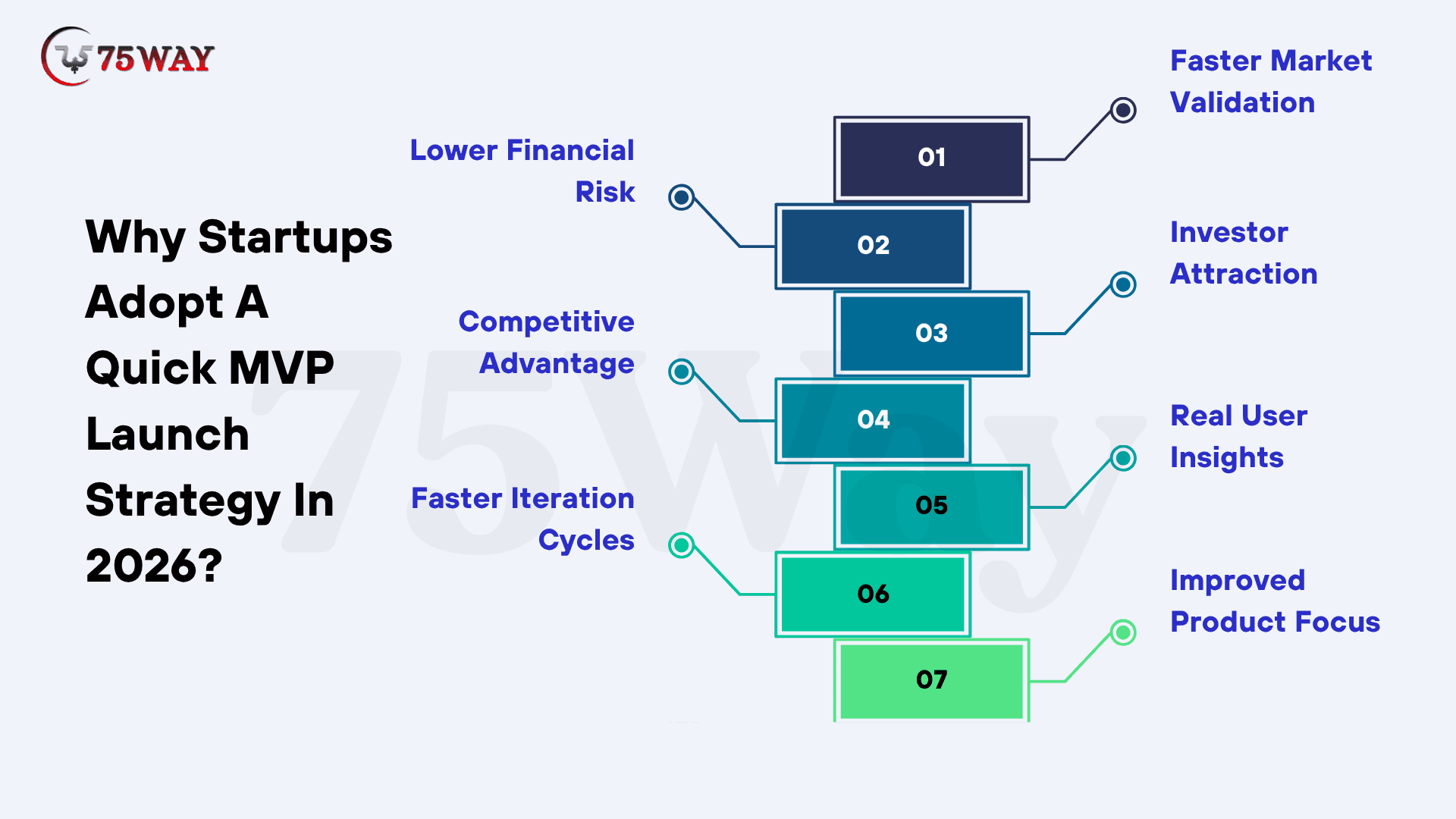
- Faster Market Validation: Startups quickly test whether their idea actually solves a real customer problem. Early user feedback helps validate demand, refine features, and confirm product direction before investing in full-scale development cycles.
- Lower Financial Risk: Short development cycles significantly reduce overall MVP building costs and resource wastage. Startups avoid heavy upfront investment, ensuring money is spent only on validated features that provide real market value.
- Investor Attraction: Early traction signals help startups attract investors more easily during fundraising stages. Demonstrated user interest, engagement, and growth metrics increase credibility and improve chances of securing funding for scaling operations.
- Competitive Advantage: Launching faster allows startups to enter the market before competitors. Early presence helps capture user attention, build brand recognition, and establish a stronger position in emerging or rapidly growing industries.
- Real User Insights: Actual user behavior provides accurate insights compared to assumptions or theoretical planning. Startups refine their product based on real interactions, improving usability, engagement, and long-term product-market alignment.
- Faster Iteration Cycles: Rapid development cycles allow startups to continuously improve their MVP based on real feedback. Frequent updates help fix issues quickly, enhance features, and align the product closely with user expectations.
- Improved Product Focus: This approach forces teams to prioritize only core features that truly matter. This prevents feature overload, reduces distractions, and ensures the product stays focused on solving the main customer problem.
Strategic Roadmap For Building MVP In 30 Days And Successful Launch
Building an MVP in 30 days is not about rushing the product, it is about following a focused, structured roadmap that prioritizes clarity, validation, and execution speed. When startups work with a disciplined plan, they can move from idea to launch quickly while still ensuring the product is functional, market-ready, and aligned with real user needs.
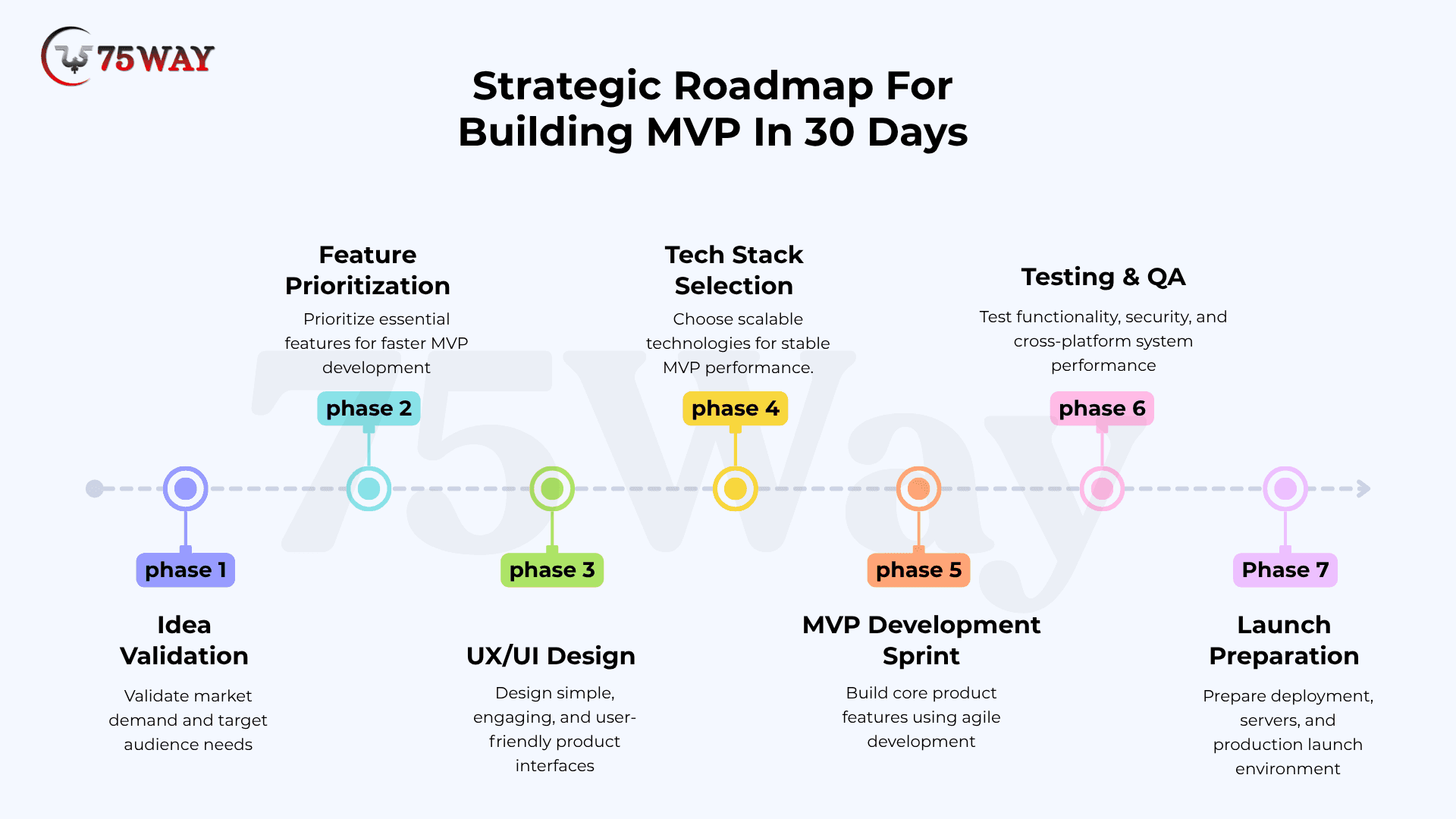
Phase 1: Idea Validation (Day 1–3)
Idea validation is the foundation of a successful MVP development journey. In this phase, startups focus on understanding whether the idea solves a real customer problem. Market research is conducted to identify demand trends and gaps. Competitor analysis helps understand existing solutions and their weaknesses. The target audience is clearly defined for better product alignment. Finally, a strong value proposition is created to guide development decisions.
Phase 2: Feature Prioritization (Day 4–6)
Feature prioritization ensures the MVP includes only essential functionalities needed for launch. Teams separate features into must-have, should-have, and future enhancements. Frameworks like MoSCoW, RICE, and the Kano Model help in decision-making. This step prevents unnecessary complexity during early development stages. It also helps reduce cost and development time significantly. The focus remains on solving core user problems effectively.
Phase 3: UX/UI Design (Day 7–10)
UX/UI design converts ideas into structured and interactive user experiences. Wireframes are created to define the layout and flow of the application. User journeys are mapped to ensure smooth navigation and usability. UI mockups provide a visual representation of the final product. The focus remains on clarity rather than visual perfection at this stage. Every design decision aims to improve user understanding and engagement.
Phase 4: Tech Stack Selection (Day 11–12)
Selecting the right technology stack ensures long-term scalability and performance stability. Frontend, backend, database, and cloud technologies are evaluated carefully. Popular options include React, Flutter, Node.js, Django, and Laravel. Databases like PostgreSQL, MongoDB, and Firebase support different use cases. Cloud platforms such as AWS and Google Cloud ensure reliable infrastructure. The choice depends on scalability goals and project complexity.
Phase 5: MVP Development Sprint (Day 13–24)
The development sprint is the core execution phase of MVP building. Developers build frontend interfaces, backend systems, APIs, and databases. Authentication and payment systems are integrated if required. Agile methodology ensures continuous progress and faster delivery cycles. Regular testing during development helps identify and fix issues early. The goal is to create a functional and scalable MVP efficiently.
Phase 6: Testing & QA (Day 25–27)
Testing and QA ensure the MVP delivers a stable user experience. Functional testing checks whether features work as intended. UI testing ensures design consistency across devices and screens. Performance testing evaluates speed and responsiveness under load conditions. Security testing protects user data and system integrity. Cross-device testing ensures compatibility across multiple platforms and environments.
Phase 7: Launch Preparation (Day 28–30)
Launch preparation focuses on making the MVP ready for real users. Deployment includes server setup, domain configuration, and environment optimization. Analytics tools are integrated to track user behavior and performance. Bug fixing ensures a smooth and stable product experience. Beta launch strategies are planned to reduce market risks. This phase ensures a controlled and successful product release.
Common Mistakes To Ignore While Building An MVP & Solutions
Building an MVP within 30 days requires strict focus, disciplined execution, and clear priorities. However, many startups fail because they either overcomplicate the product or ignore foundational planning. These mistakes slow down development, reduce product quality, and negatively impact market validation results.
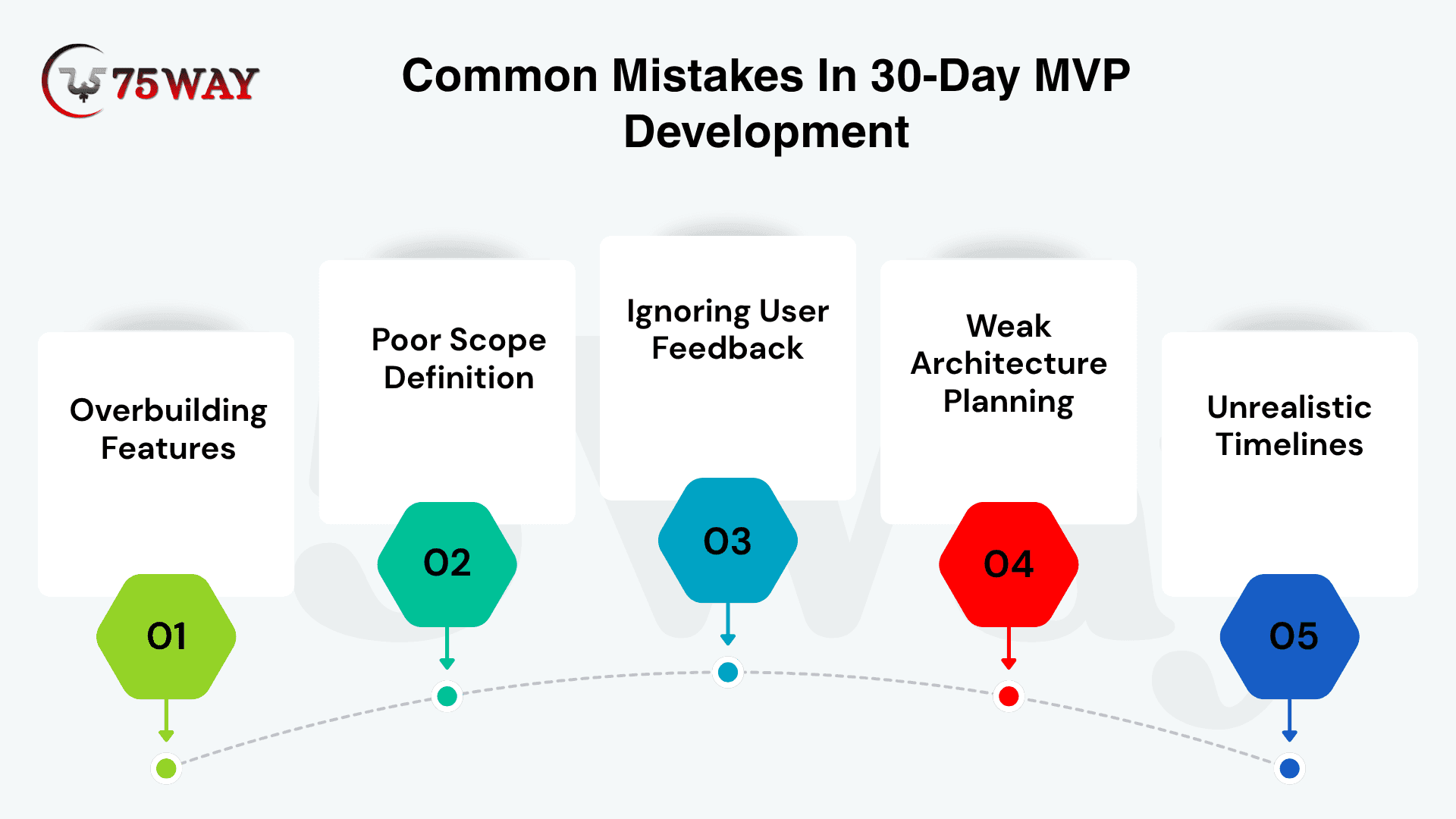
- Overbuilding Features
Unnecessary functionality beyond the core MVP scope increases complexity and slows down product launch. This also leads to higher development costs and confusion during execution. Focus only on essential features that directly solve the primary user problem and validate the idea quickly.
- Poor Scope Definition
Lack of clear boundaries about what to build creates confusion and misalignment among teams. It often results in wasted effort and unclear development direction. Define clear goals, feature limits, and expectations before starting the development process.
- Ignoring User Feedback
Building without considering real user responses leads to products that fail to meet market needs. This reduces engagement and long-term retention significantly. Collect feedback continuously and improve the product based on actual user behavior and insights.
- Weak Architecture Planning
Poor system design creates scalability and performance issues when the product starts growing. This often results in expensive redevelopment later. Build a flexible and modular architecture that supports future expansion and integrations.
- Unrealistic Timelines
Rushed development due to tight deadlines leads to poor-quality MVP output and missed requirements. Teams struggle to maintain quality under pressure. Use agile sprints with realistic timelines to ensure steady and controlled progress.
Best Technologies Used To Create MVP in 30 Days
Building an MVP within 30 days requires fast, reliable, and easy-to-scale technologies. The goal is not to use the most complex tools, but to choose lightweight stacks that help you develop quickly, deploy faster, and make changes without delays. These combinations reduce development effort while still supporting scalability for future growth.
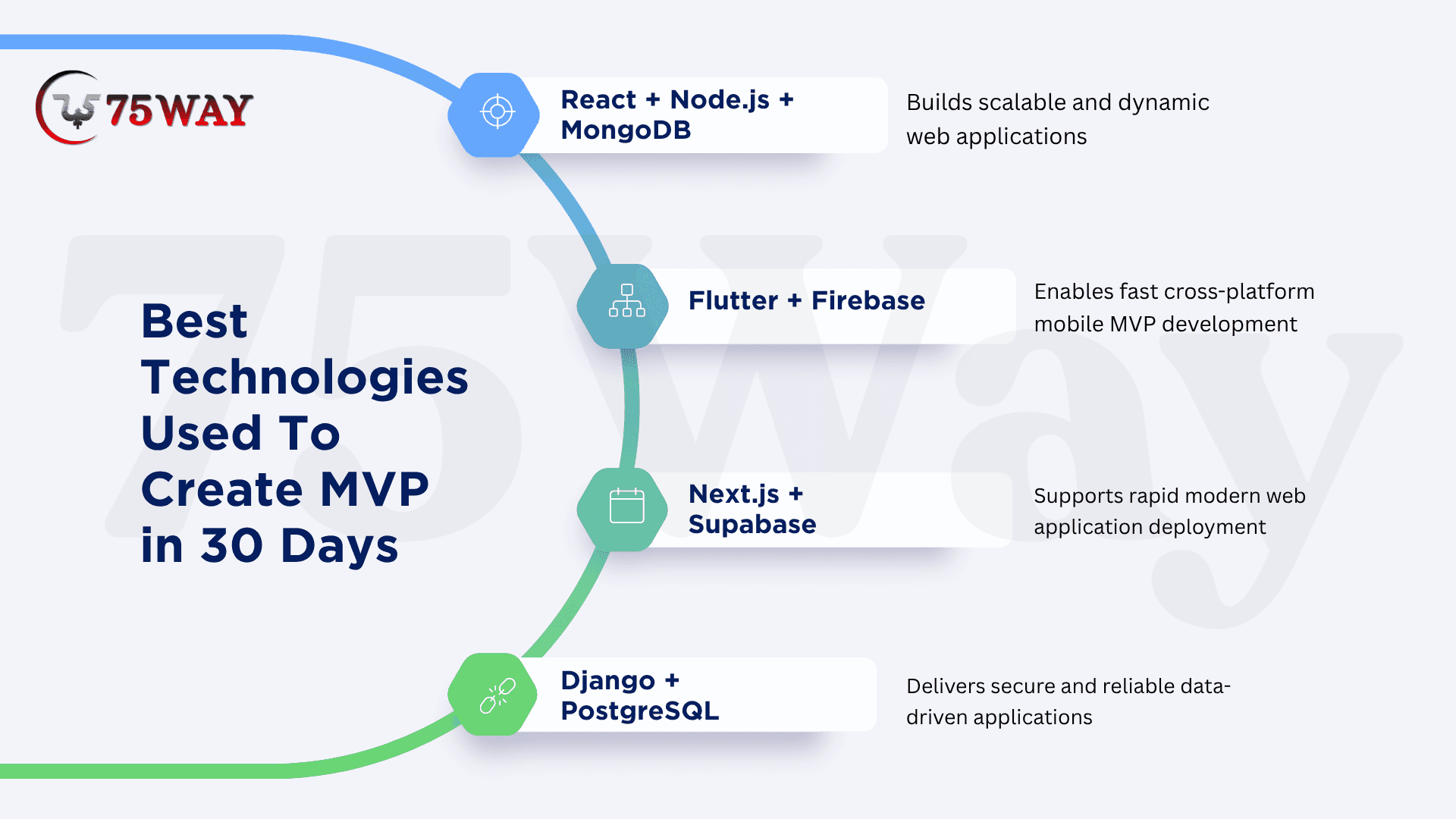
- React + Node.js + MongoDB
This stack is widely used for fast web application development. React handles the user interface, Node.js manages backend logic, and MongoDB stores data in a flexible format. It is ideal for building scalable MVPs with dynamic features.
- Flutter + Firebase
This combination is perfect for mobile MVPs that need quick development and real-time functionality. Flutter builds cross-platform apps, while Firebase handles database, authentication, and backend services without complex setup. It significantly reduces development time.
- Next.js + Supabase
This stack is great for startups wanting modern web apps with speed and simplicity. Next.js improves performance and SEO, while Supabase provides backend services like authentication and databases. It allows rapid MVP deployment with minimal configuration.
- Django + PostgreSQL
This is a strong choice for secure and data-heavy applications. Django provides a robust backend framework, and PostgreSQL ensures reliable data management. It is suitable for MVPs that require structured data, security, and long-term scalability.
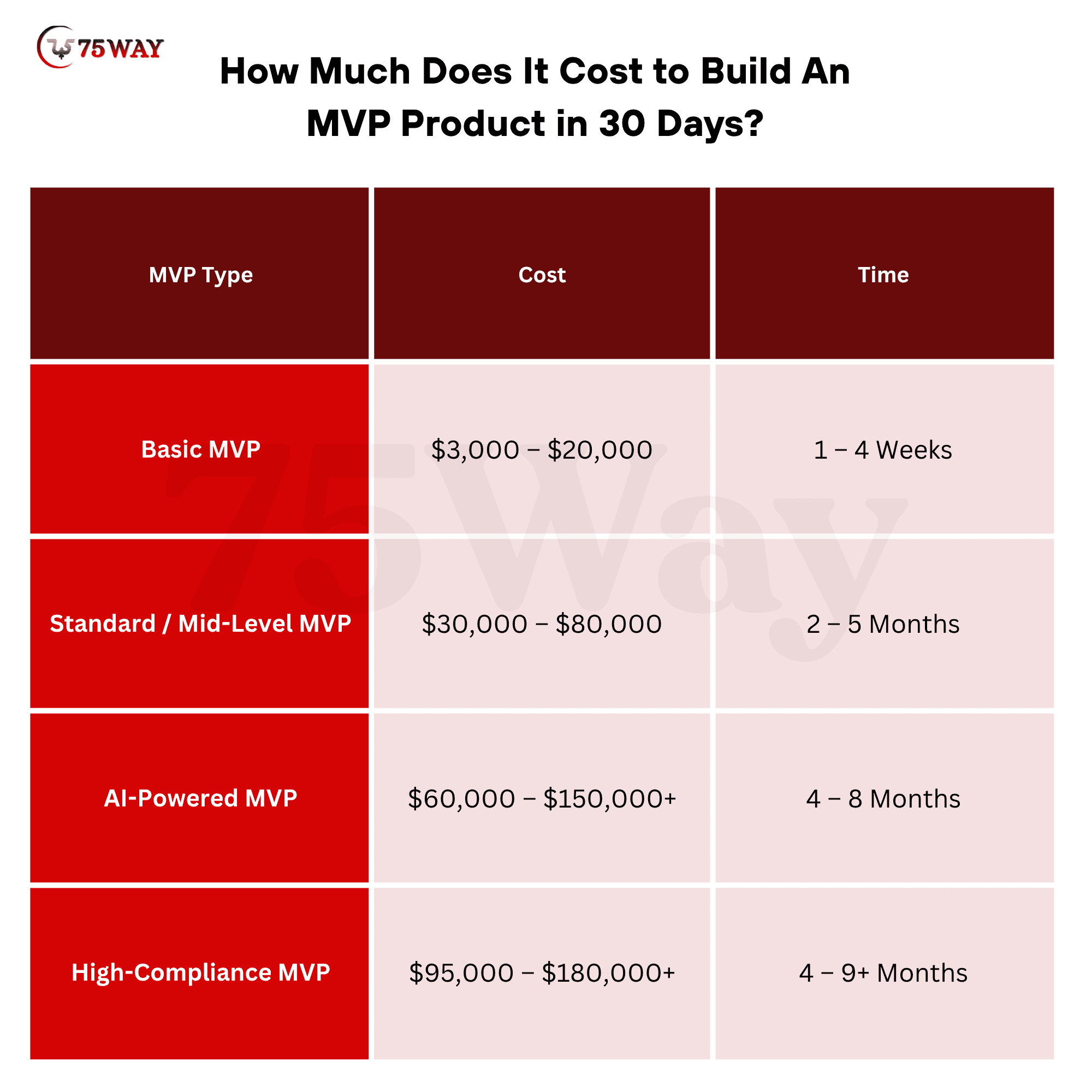
How Much Does It Cost to Build An MVP Product in 30 Days?
The average cost to build an MVP ranges from $3,000 to $180,000+, depending on complexity, features, technology stack, design requirements, and scalability needs. Simple MVPs are cheaper and faster, while AI-driven and compliance-heavy products require higher investment and longer development time.
Fast-Growing Industries Best Suited For 30-Day MVP
A 30-day MVP approach works best for industries where user demand can be tested quickly and feedback cycles are fast. These sectors allow startups to validate ideas with minimal features before scaling into full-fledged platforms. Below are the industries best suited for rapid MVP development.
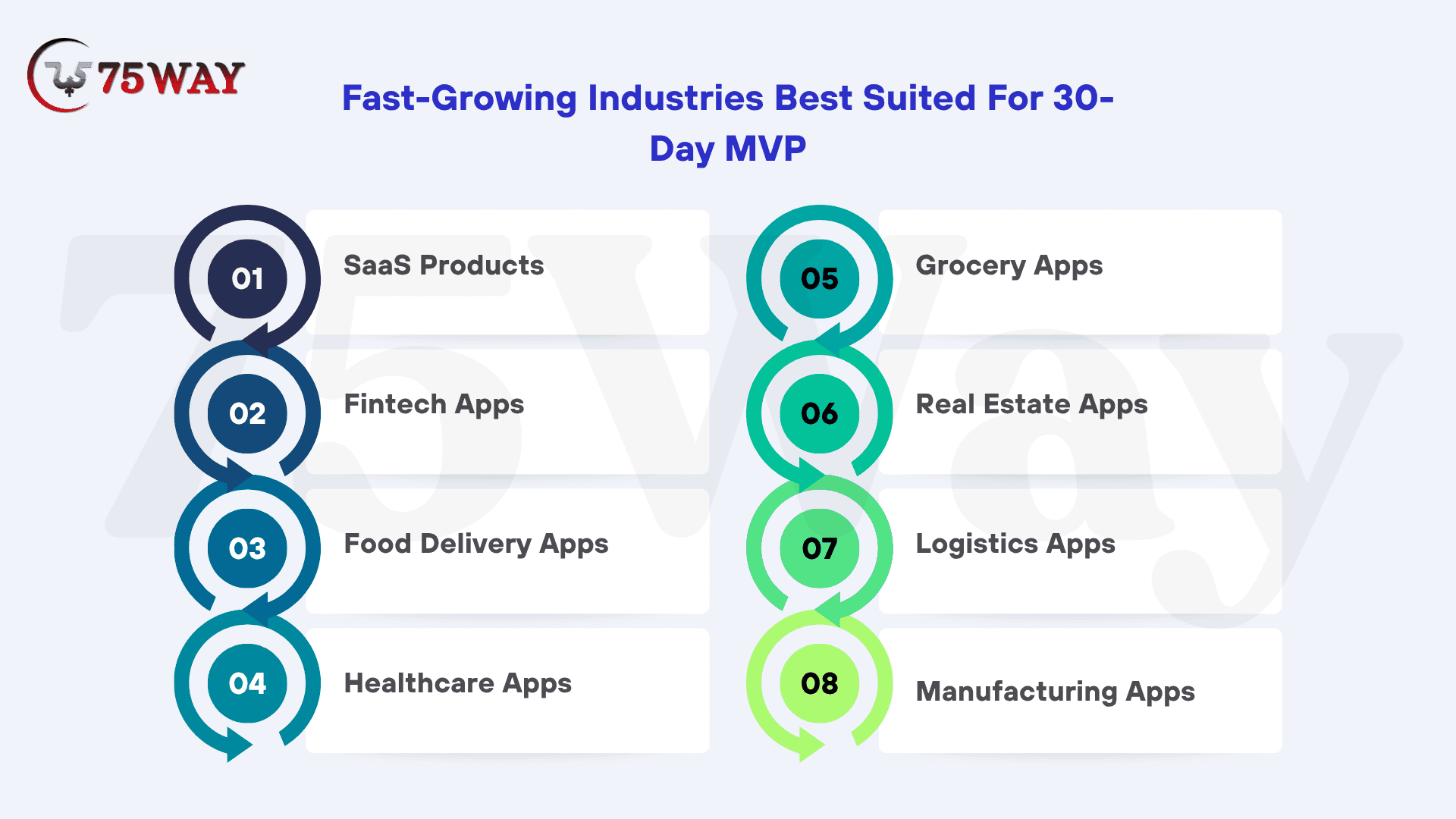
- SaaS Products: SaaS products are ideal for 30-day MVPs because subscription-based models can be tested quickly with real users. Startups can launch simple dashboards or tools to validate demand before building advanced features or enterprise-level functionality later.
- Fintech Apps: Fintech apps benefit from fast MVP cycles since payment behavior and user trust can be validated early. Basic wallet systems, payment flows, or budgeting tools help test adoption before adding complex banking or compliance features.
- Food Delivery Apps: Food delivery apps’ MVPs can quickly validate demand using limited geographic areas or restaurant partnerships. Even a simple ordering system helps understand user preferences, delivery expectations, and operational challenges before scaling the platform.
- Healthcare Apps: MVPs for healthcare apps with appointment booking or telehealth systems can be tested quickly with real users. Early validation helps refine patient experience, improve scheduling systems, and ensure smooth digital healthcare service delivery.
- Grocery Apps: MVPs for grocery delivery apps work well in local markets where demand can be measured instantly. Basic inventory, ordering, and delivery features help validate customer behavior before expanding into larger supply chain systems.
- Real Estate Apps: MVPs for real estate apps allow quick validation through property listings and lead generation features. Users can browse, inquire, and connect with agents, helping startups test demand before building advanced search or virtual tour systems.
- Logistics Apps: Logistics MVPs focus on tracking and delivery coordination, which can be tested with limited fleets. Early versions help validate route efficiency, shipment tracking, and operational workflows before scaling nationwide logistics networks.
- Manufacturing Apps: Manufacturing MVPs help streamline production tracking and supply chain visibility in early stages. Simple dashboards or process monitoring tools validate operational efficiency before investing in full-scale automation systems and industrial integrations.
Post-Launch Strategies to Optimize Your MVP Product
After launching an MVP, the real work begins because success depends on how effectively you improve and optimize the product. Post-launch strategy focuses on understanding user behavior, fixing gaps, and enhancing performance based on real-world data. This phase determines whether your MVP evolves into a scalable and successful product.
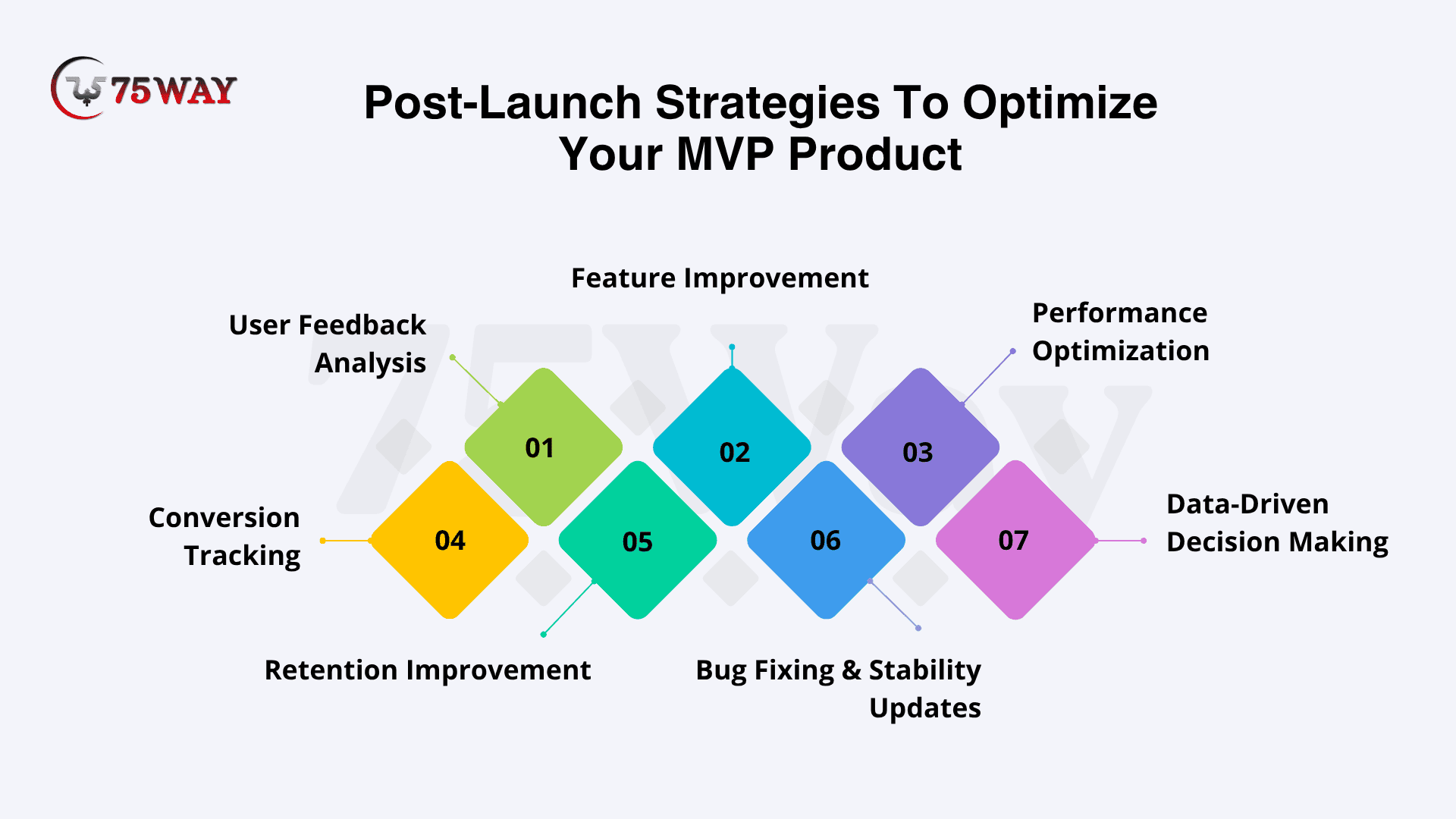
- User Feedback Analysis: Insights collected from users reveal what works well and what creates friction in the product experience. Feedback can come from surveys, reviews, or in-app behavior tracking. These insights help refine features and improve overall usability.
- Feature Improvement: Enhancing existing features ensures the product stays relevant to real user needs. Improvements should be prioritized based on usage data and customer pain points. This keeps the MVP evolving in the right direction without unnecessary complexity.
- Performance Optimization: System speed and stability directly impact user satisfaction and retention. Optimizing loading time, fixing bugs, and improving responsiveness create a smoother experience. A high-performing product encourages users to stay longer and engage more.
- Conversion Tracking: Monitoring user actions helps understand how effectively the product drives desired outcomes. Tracking signups, purchases, or other key events reveals weak points in the user journey. This data helps improve conversions and revenue performance.
- Retention Improvement: Keeping users active over time is more valuable than acquiring new ones. Engagement strategies like personalized content and notifications help bring users back. Strong retention ensures sustainable product growth and business stability.
- Bug Fixing & Stability Updates: Post-launch issues can affect trust if not addressed quickly. Regular debugging and updates ensure smooth functionality across all devices. A stable product builds user confidence and reduces churn.
- Data-Driven Decision Making: Product improvements become more effective when based on real analytics instead of assumptions. Usage data highlights what users actually prefer and avoid. This leads to smarter decisions and continuous product enhancement.
Why Most Startups Fail After MVP: Know The Reasons
Many startups assume that launching an MVP is the finish line, but in reality, it is just the beginning of a much more challenging journey. Even after a successful launch, products can fail if they do not evolve based on real user behavior, market response, and business fundamentals. Long-term success depends on continuous improvement, not just initial validation.
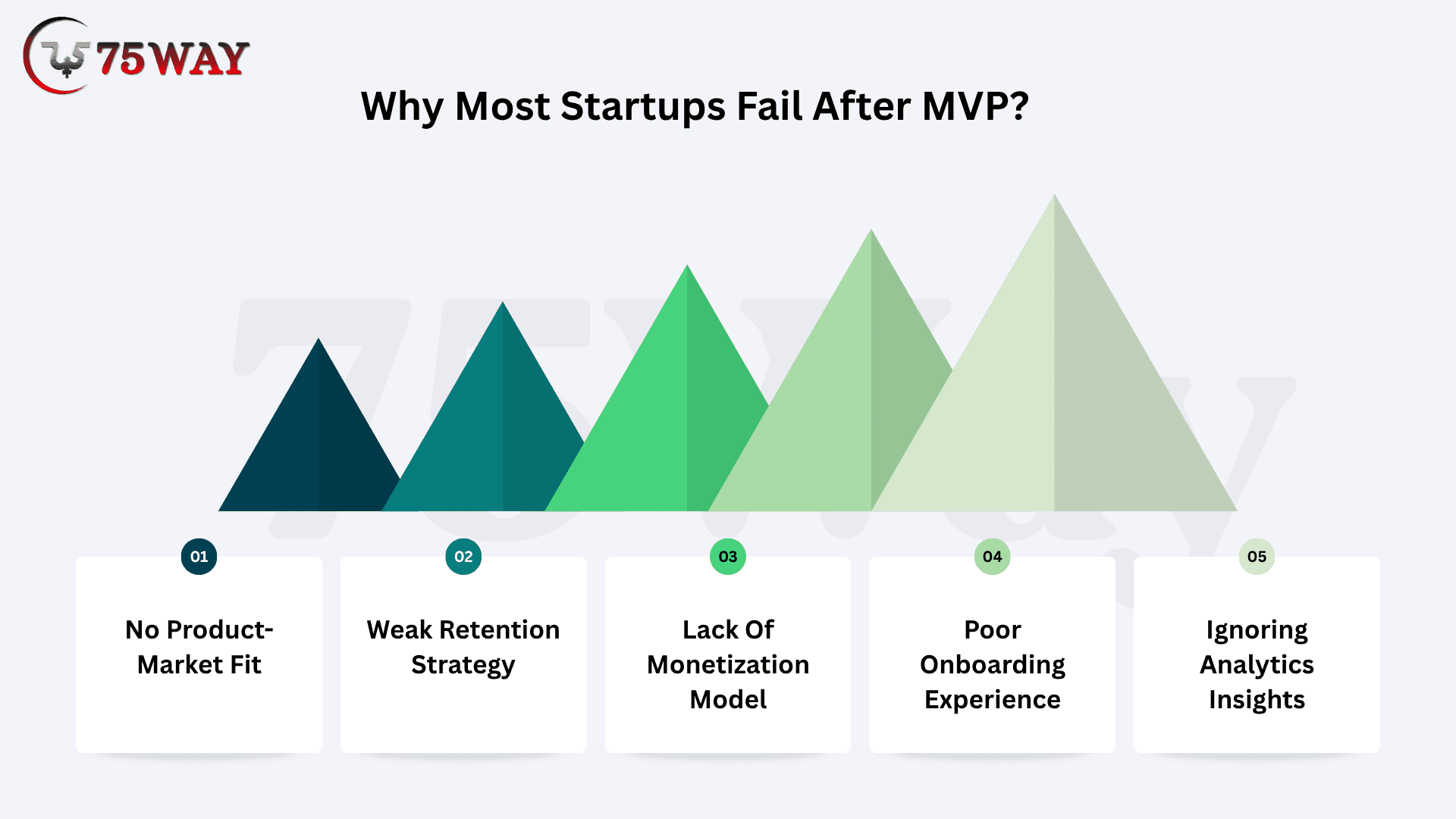
- No Product-Market Fit
Failure often happens when the product does not truly solve a strong market need. Users may try it once, but do not find enough value to return. Without a clear product-market fit, growth remains unstable and short-lived.
- Weak Retention Strategy
Acquiring users is not enough if they do not stay engaged. Many startups fail because they focus only on downloads or signups. Without strong retention strategies, users quickly stop using the product.
- Lack of Monetization Model
A product without a clear revenue strategy cannot survive long-term. Even if users like it, the business becomes unsustainable without monetization. Startups must define how the product will generate consistent income early.
- Poor Onboarding Experience
First impressions matter, and confusing onboarding often leads to user drop-offs. If users cannot understand the product quickly, they leave. A smooth onboarding flow is essential for keeping users engaged from day one.
- Ignoring Analytics Insights
Ignoring data means ignoring what users actually want. Many startups fail because they do not analyze user behavior or product performance. Analytics should guide every improvement and feature decision.
Strategic Approaches For Scaling After MVP Validation
After MVP validation, scaling becomes the most critical stage for turning a tested product into a sustainable business. At this point, decisions must be driven by real user data and demand signals. Careful expansion ensures growth without breaking product stability or user experience.
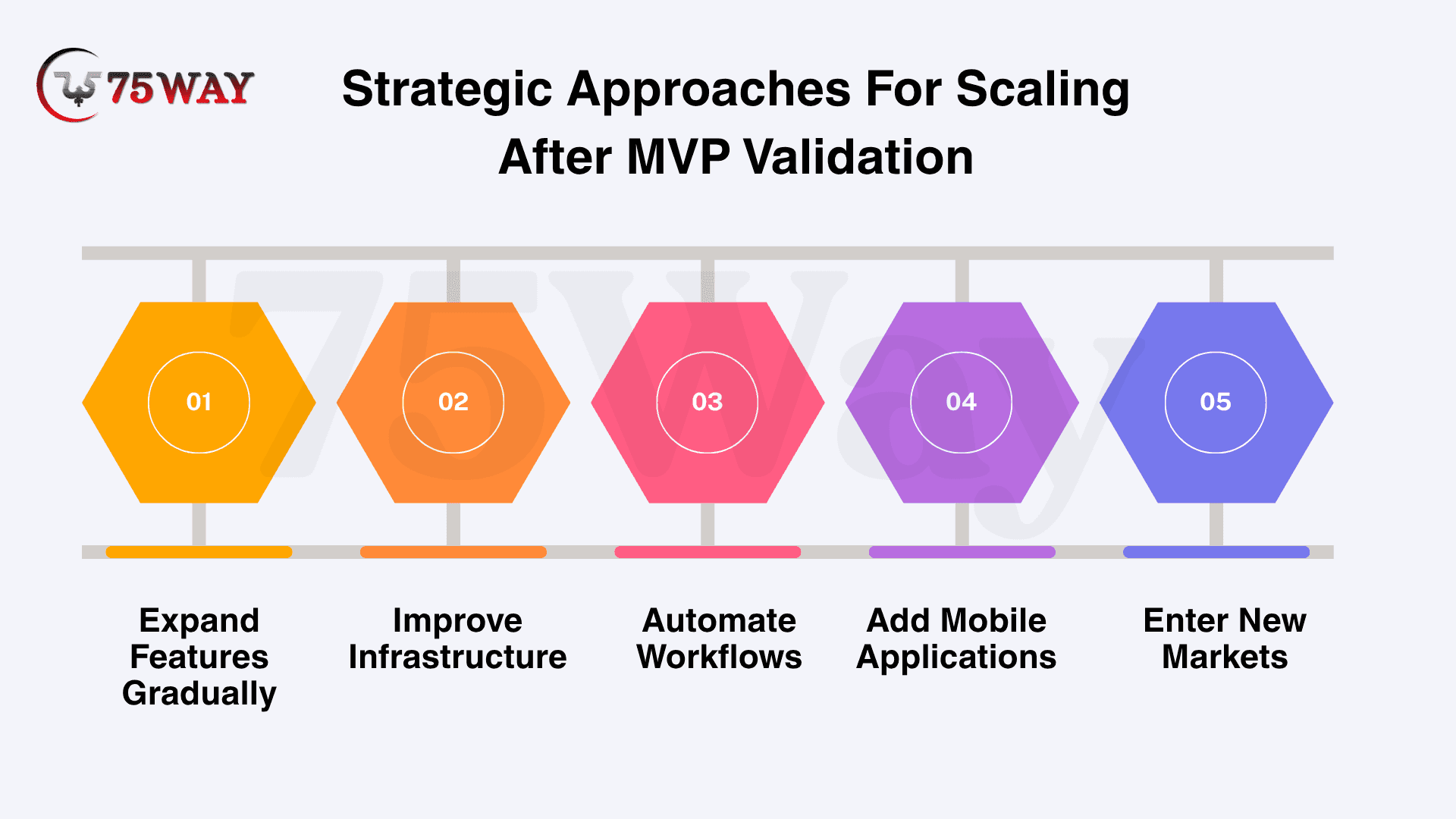
- Expand Features Gradually: Adding features step by step ensures the product evolves based on real user needs instead of assumptions. Each new feature should solve a validated problem. This approach reduces complexity, improves usability, and ensures stable product growth over time.
- Improve Infrastructure: As users increase, system performance must be strengthened to handle higher traffic and data loads. Upgrading servers, databases, and cloud resources ensures smooth performance. Strong infrastructure prevents downtime and maintains a consistent user experience during scaling.
- Automate Workflows:AI automation reduces manual effort and improves operational efficiency as the product grows. Tasks like onboarding, notifications, and reporting can be automated. This helps teams focus more on innovation and less on repetitive operational work.
- Add Mobile Applications: Expanding to mobile platforms increases accessibility and user engagement significantly. Mobile apps allow users to interact with the product anytime and anywhere. This helps improve retention, reach, and overall market penetration.
- Enter New Markets: Once validated, expanding into new geographic or customer segments increases growth opportunities. Market expansion should be data-driven and gradual. Understanding local needs ensures better adoption and reduces entry risks in new regions.
Final Remarks
To wrap up, building a minimum viable product in 30 days is no longer an unrealistic startup goal. With structured planning, disciplined execution, and lean development practices, startups can rapidly validate ideas, reduce financial risks, and enter the market with confidence. The 30-day MVP framework prioritizes speed, user validation, and strategic focus over unnecessary complexity. Startups that execute MVPs within strict timelines gain stronger competitive positioning, faster investor interest, and clearer product direction. In 2026, speed combined with validation defines startup success more than large-scale initial investment. If you want to transform your startup idea into a high-performing MVP within 30 days, partner with a trusted MVP development company that builds investor-ready apps, software, and AI solutions.
Frequently Asked Questions (FAQs)
What Is The Fastest Way To Build An MVP In 30 Days?
The fastest method involves strict feature prioritization, sprint-based development, and lean technology stacks. Teams focus only on core functionalities that solve primary user problems. Avoiding unnecessary features and maintaining continuous feedback loops significantly reduces development time while improving product-market validation during early stages.
Can A Startup Really Launch A Quality Product In 30 Days?
Yes, a startup can launch a functional and stable product in 30 days using disciplined planning and agile execution. Quality depends on scope control, not development time. Many successful startups initially launched simplified versions before scaling features based on real user feedback and performance data.
Do Startups Need A Full Development Team For MVP?
Not necessarily. A lean team consisting of developers, designers, and a product manager is sufficient. Many startups also outsource MVP development to specialized agencies. This reduces hiring costs and accelerates execution while maintaining technical quality and structured development workflows during early product stages.
What Is The Biggest Risk In MVP Development?
The biggest risk is overbuilding unnecessary features instead of focusing on core functionality. This leads to delays, increased costs, and unclear product direction. Another major risk is ignoring user feedback, which prevents startups from aligning the product with real market needs and expectations.
How Important Is User Feedback After MVP Launch?
User feedback is extremely important after MVP launch because it determines product direction. It helps identify usability issues, feature gaps, and market demand patterns. Startups that actively analyze feedback can improve retention, enhance features, and move faster toward achieving product-market fit.
Can MVP Development Help In Raising Funding?
Yes, MVP development plays a crucial role in attracting investors. A working product with real user data demonstrates market validation, reducing perceived risk. Investors prefer startups with traction metrics, user engagement data, and early revenue signals, all of which are generated through MVP launches.