Summary
Liquor store MVP development focuses on building a lean on-demand alcohol delivery platform with essential features for rapid market validation. Startups prioritize compliance, user experience, delivery logistics, and payment systems. This guide explains planning, design, development, testing, launch strategy, scalability, and a real-world execution framework for building successful liquor delivery startups.
Quick Overview
- Liquor MVP success depends on compliance, logistics, and fast delivery systems.
- Feature selection reduces development time and boosts the market validation phase.
- Liquor store MVP development costs range from $10,000 to $150,000+.
- Legal regulations influence liquor delivery app architecture and deployment strategy.
- Lean MVP development reduces startup risk while testing real market demand.
The on-demand delivery economy has transformed how consumers access essential and convenience-driven services. Among these evolving markets, liquor delivery platforms have gained significant traction in urban and semi-urban regions. However, building a full-scale alcohol delivery platform without validation often leads to compliance risks, operational inefficiencies, and wasted investment.
A minimum viable product (MVP) for a liquor store application allows startups to enter the market quickly with only essential features required to test demand, validate logistics, and ensure regulatory feasibility. Instead of building a scalable mobile app from day one, businesses can launch a simplified version focusing on core ordering, delivery, and compliance mechanisms.
Liquor delivery applications operate in a highly regulated environment, making early validation even more critical. Each region follows different legal frameworks, licensing requirements, and delivery restrictions. An MVP approach helps startups test business feasibility before committing to large-scale infrastructure.
This guide explains how to build a liquor store MVP product step-by-step, covering ideation, compliance planning, feature selection, UI/UX design, technology stack, development process, testing, launch strategy, and scaling roadmap.
What Is Liquor Store MVP Product?
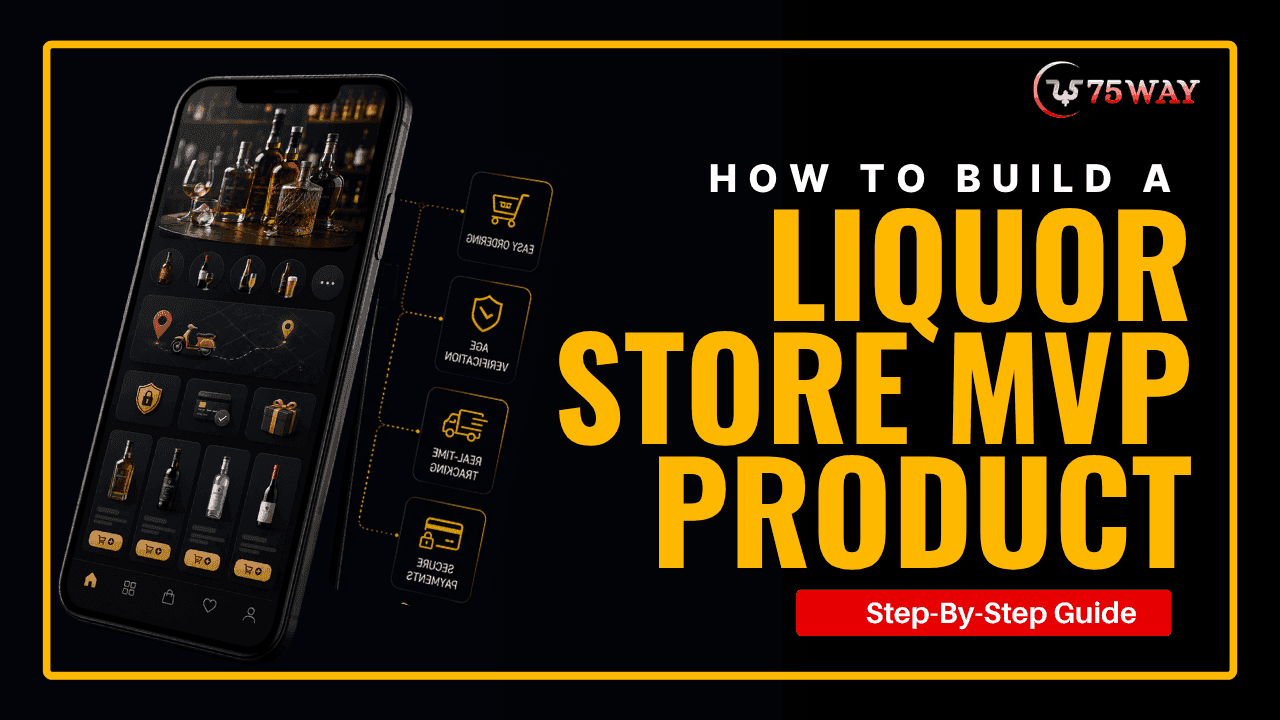
A liquor store MVP is a simplified version of an alcohol delivery application designed to validate customer demand and operational feasibility with minimal features. Unlike full-scale platforms, MVP versions focus only on:
- Product listing
- Age verification
- Order placement
- Delivery tracking
- Payment integration
The primary goal is to test whether customers are willing to order alcohol online while ensuring compliance with local regulations.
Market Overview: Liquor Delivery Industry in 2026
The global on-demand delivery market continues to expand, with alcohol delivery becoming one of the fastest-growing segments.
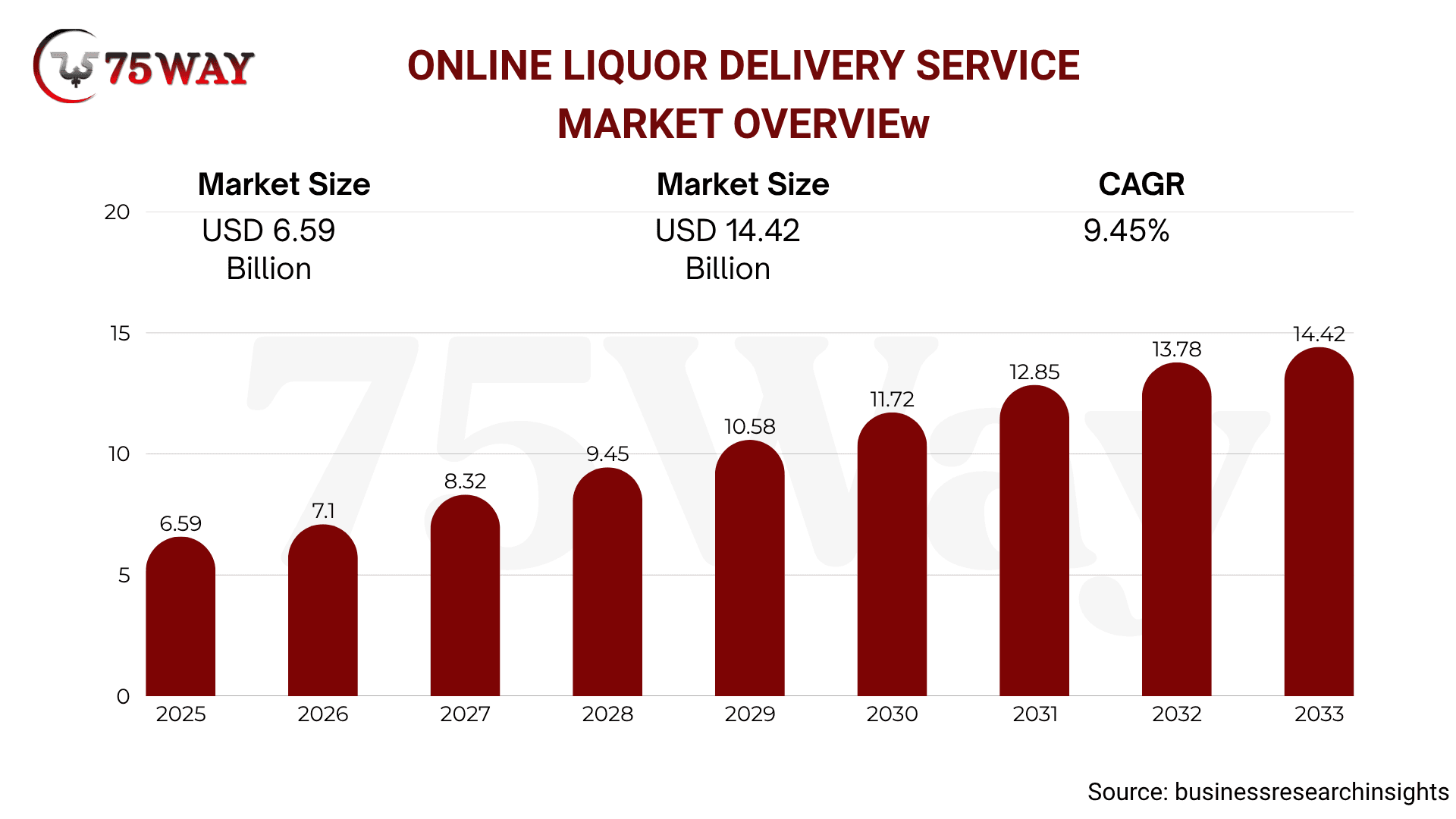
- The global online alcohol delivery service market is projected to grow from USD 6.59 billion in 2026 to USD 14.42 billion by 2035, registering a CAGR of 9.45% during the forecast period.
- The on-demand delivery market is expected to surpass $42 billion, with broader industry estimates projecting growth up to $67 billion by 2029.
- The number of U.S. liquor stores listed on online marketplaces like DoorDash has increased by more than 60%.
Why Liquor Delivery Businesses Build MVP At First?
Liquor delivery businesses build an MVP first to test real market demand before investing in heavy operations, licenses, and delivery infrastructure. Since alcohol delivery involves strict regulations, age verification, and logistics challenges, launching a full-scale platform too early can create high financial and legal risks. An MVP helps validate whether customers actually want the service in a specific location.
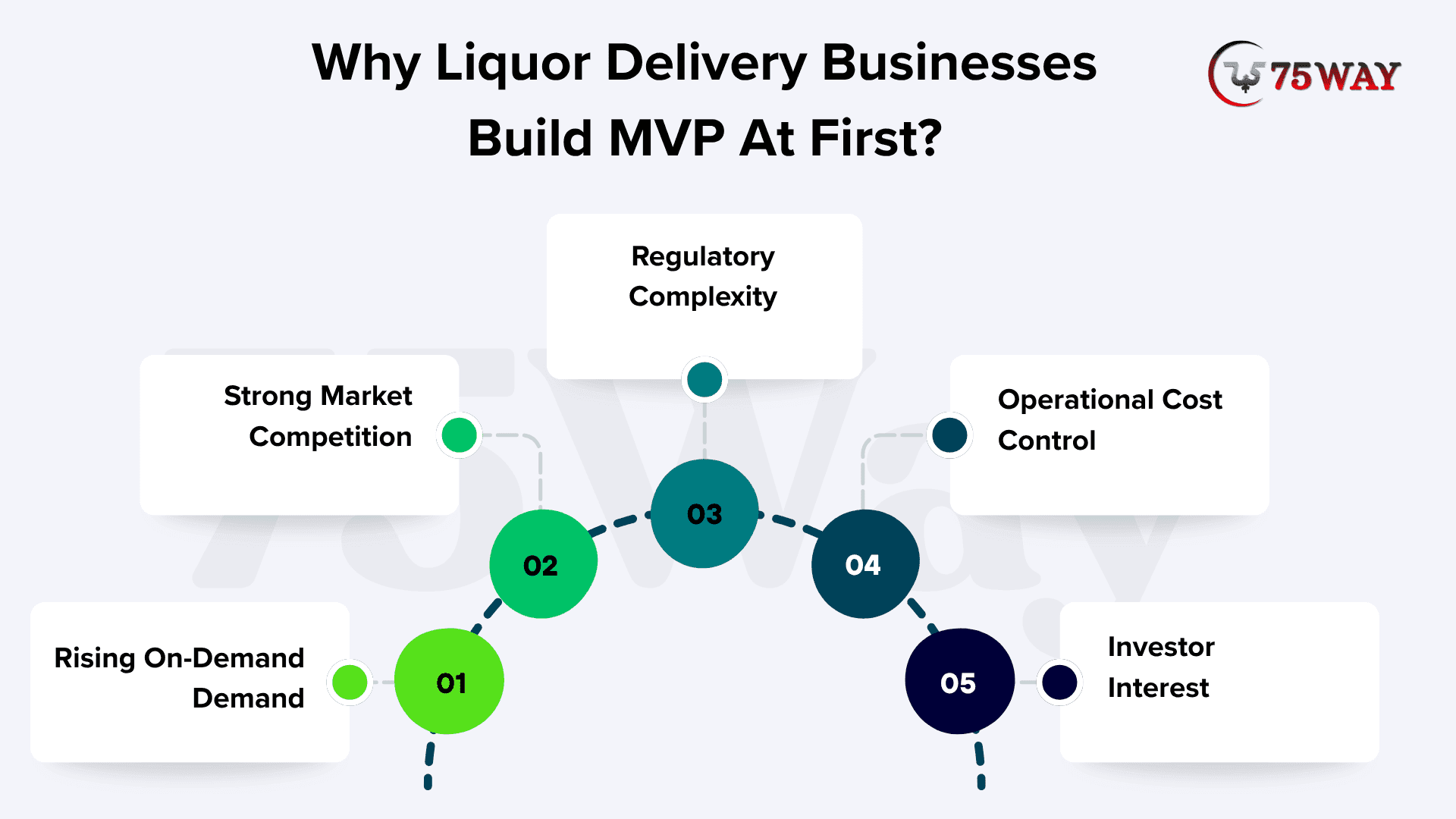
- Rising On-Demand Demand: Customers increasingly prefer quick doorstep delivery for convenience and privacy. This trend is driving strong adoption of on-demand alcohol delivery services. MVPs help validate whether this demand exists in specific regions.
- Strong Market Competition: The alcohol delivery space already has established players and platforms. New startups need faster innovation to compete effectively. MVPs allow quick market entry and testing of unique value propositions.
- Regulatory Complexity: Alcohol delivery involves strict legal rules, licensing, and age verification requirements. These regulations vary across regions and can be complex. MVPs help test compliance feasibility before large-scale investment.
- Operational Cost Control: Full-scale delivery systems require high investment in logistics and infrastructure. MVPs reduce initial costs by focusing only on core functionality. This helps startups operate efficiently while validating the business model.
- Investor Interest: Investors are more likely to fund startups with proven traction and validation. MVPs demonstrate real user demand and early adoption. This increases credibility and improves funding opportunities.
Step-By-Step Methodology To Build An MVP For Liquor Store
Building an MVP for a liquor store business requires a structured approach focused on compliance, customer demand validation, and efficient delivery operations. The goal is to test market viability quickly while minimizing legal, operational, and financial risks before scaling into a full-fledged alcohol delivery platform. Below, we define each stage of the development process.
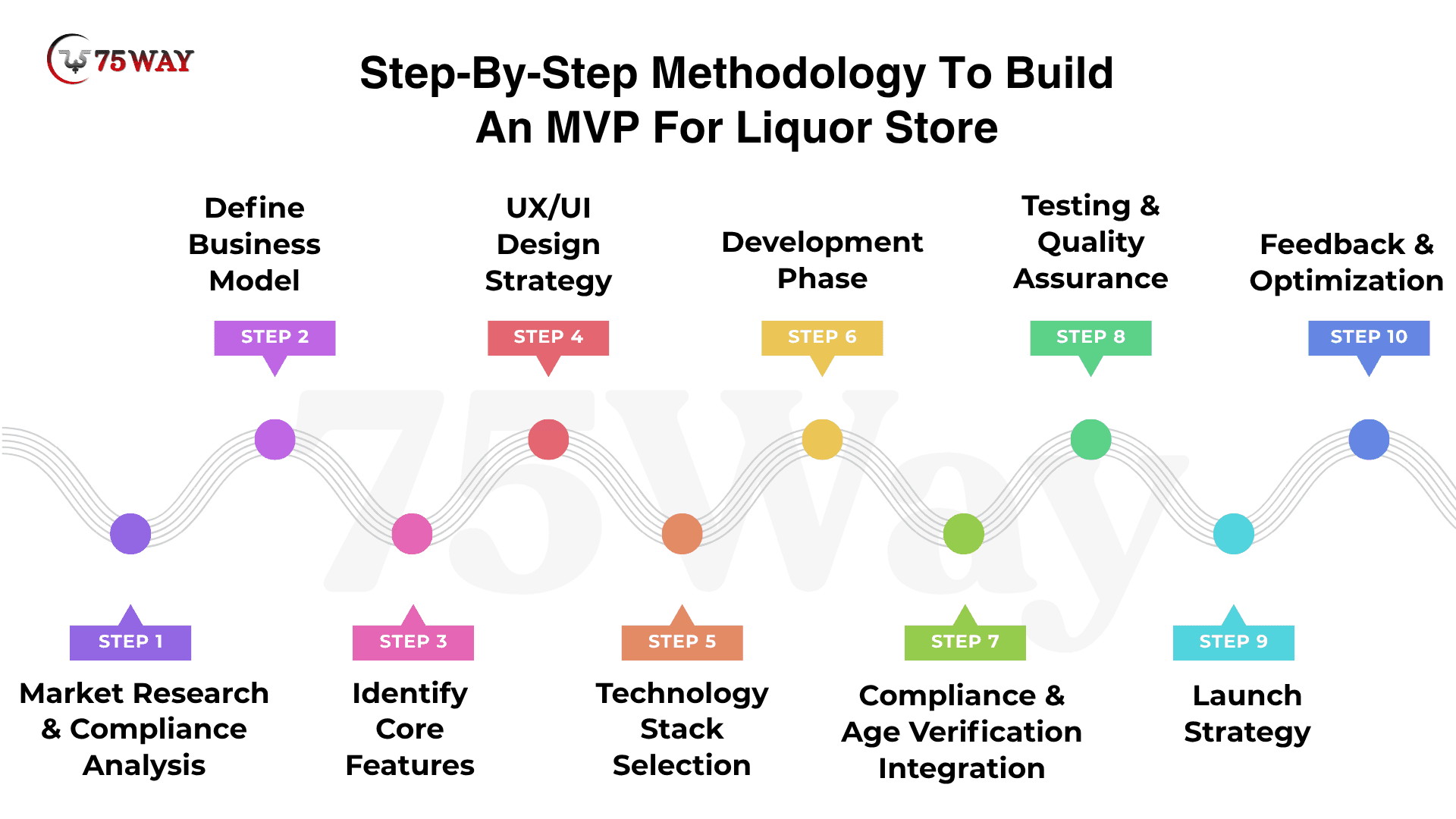
Step 1: Market Research & Compliance Analysis
This is the foundation stage where businesses understand whether the liquor delivery model is legally and commercially viable in a target region. Since alcohol delivery is heavily regulated, skipping this step can lead to serious legal issues, financial losses, or even a business shutdown. Proper research ensures the MVP is built within safe and compliant boundaries. Key research areas:
- Local alcohol laws
- Licensing requirements
- Delivery restrictions
- Age verification rules
- Operating hours limitations
- Tax regulations
Failure to understand compliance leads to legal risks.
Step 2: Define Business Model
At this stage, startups decide how the liquor delivery MVP will generate revenue and sustain operations. A clear monetization model helps guide pricing, features, and long-term scalability. It also ensures the MVP is built with business viability in mind from the start.
- Commission-Based Model: Businesses earn a percentage from each order placed through the platform. This model works well when partnering with multiple liquor stores. It scales easily as transaction volume increases over time.
- Delivery Fee Model: Revenue is generated by charging customers a fixed or variable fee for each delivery. This approach is simple and easy to implement. It works best in early MVP stages with limited operational complexity.
- Subscription Model: Customers pay a recurring fee for benefits like free delivery or priority service. This model helps create predictable and stable revenue streams. It also improves customer retention and long-term engagement.
- Retail Markup Model: Products are sold at a higher price than the base store rate. This model generates direct profit on each item sold. It requires careful pricing to remain competitive in the market.
Step 3: Identify Core Features for Liquor Store MVP
At this stage, startups define the exact feature set that will be included in the MVP. The focus is on keeping only essential functionalities that allow users to place orders, make payments, and receive deliveries smoothly. This prevents feature overload and ensures faster development and launch.
- User Registration
- Age Verification System
- Product Catalog (Beer, Wine, Spirits)
- Cart & Checkout System
- Payment Gateway Integration
- Order Tracking System
- Delivery Partner Dashboard
- Ratings & Reviews
- Push Notifications
- Promo Codes
- Order History
Step 4: UX/UI Design Strategy
At this stage, the focus shifts to creating a user-friendly and trustworthy interface that makes ordering alcohol simple and quick. Since liquor delivery involves sensitive verification and fast decision-making, the design must reduce confusion and build user confidence from the very first interaction. Key design principles are:
- Easy navigation
- Minimal checkout steps
- Clear age verification prompts
- Fast product browsing
- Mobile-first experience
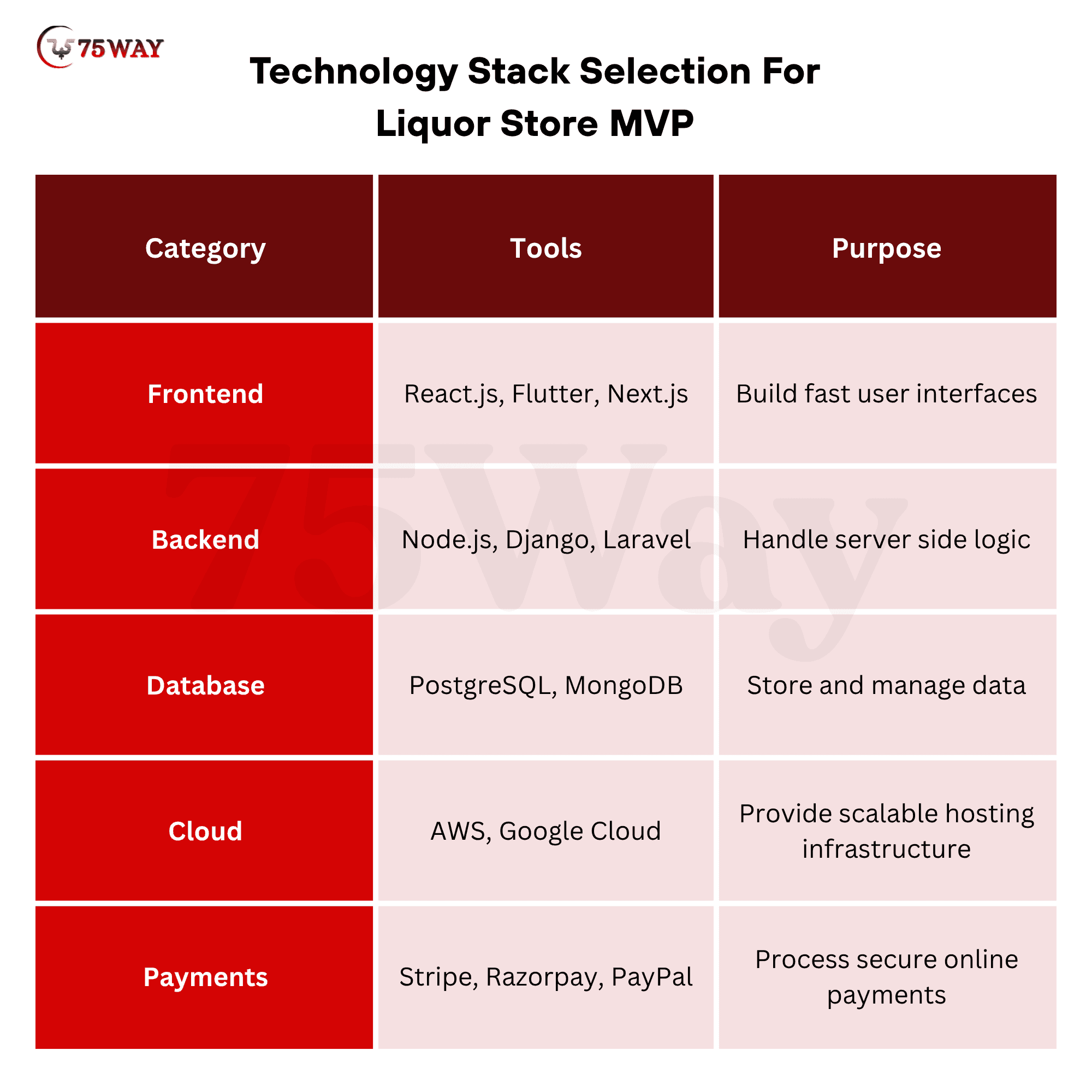
Step 5: Technology Stack Selection
At this stage, startups choose the right technology stack that ensures speed, scalability, and security for the liquor delivery MVP. The selected tools must support real-time ordering, secure payments, age verification, and smooth delivery operations without performance issues.
- Frontend: React.js builds fast web interfaces, Flutter creates cross-platform mobile apps, and Next.js improves performance and SEO for scalable delivery platforms.
- Backend: Node.js supports real-time processing, Django offers secure and structured development, and Laravel provides rapid backend development with clean architecture.
- Database: PostgreSQL handles structured data efficiently, while MongoDB supports flexible and scalable data storage for dynamic product and user information.
- Cloud: AWS delivers highly scalable infrastructure, and Google Cloud provides reliable hosting and advanced data management services for growing applications.
- Payments: Stripe enables secure global payments, Razorpay supports smooth Indian transactions, and PayPal offers trusted international payment processing.
Step 6: Development Phase (Core Build)
This stage focuses on converting the MVP design and planning into a fully functional product ready for real users. Developers build essential modules that support ordering, payments, and delivery operations smoothly. The goal is to create a working system with only core features. Each component is developed and tested in small cycles for better control. Agile sprint methodology ensures faster delivery and continuous improvement during development.
- User Authentication System: This module allows users to register, log in, and securely access the platform. It also ensures identity verification and protects user data. Strong authentication builds trust and platform security.
- Product Inventory System: This system manages all available liquor products, categories, and stock updates. It ensures users see accurate availability in real time. Proper inventory control avoids order errors and improves user experience.
- Order Management System: This module handles order placement, processing, and status updates. It ensures smooth coordination between users and delivery partners. Efficient order management improves the speed and accuracy of deliveries.
- Delivery Tracking Integration: This feature allows users to track their orders in real time. It improves transparency and reduces delivery-related uncertainty. GPS integration helps optimize delivery routes and timing.
- Payment Processing System: This system enables secure online payments through multiple gateways. It ensures fast and reliable transaction processing. Strong payment integration improves customer trust and conversion rates.
Step 7: Compliance & Age Verification Integration
This stage ensures the liquor delivery MVP follows all legal requirements and prevents underage access. Since alcohol distribution is highly regulated, strong compliance systems are essential to avoid legal risks and protect business credibility. Verification methods must be fast, accurate, and user-friendly.
- ID Upload Verification: Users upload government-issued ID for validation
- AI-Based Age Detection:Artificial intelligence analyzes a face to estimate the user's age
- OTP-Based Confirmation: Mobile OTP verifies user identity securely
- Manual Verification (Fallback): Human review confirms unclear submissions when needed
Step 8: Testing & Quality Assurance
This stage ensures the MVP is fully stable, secure, and ready for real users before launch. Every feature is tested carefully to identify bugs, performance issues, and security gaps. Since liquor delivery involves payments and sensitive data, even small errors can impact user trust and business reliability.
- Functional testing checks if all features work correctly as intended
- Security testing ensures that user data and transactions are protected properly
- Payment testing verifies a smooth and error-free transaction processing flow
- UI testing confirms design works across all devices and screens
- Load testing evaluates performance under high user traffic conditions
Reliability is crucial for transaction-based apps.
Step 9: Launch Strategy
This stage focuses on releasing the MVP in a controlled and strategic manner to minimize operational risks. Instead of launching everywhere at once, startups test performance in limited regions or user groups. This helps identify issues early, improve system stability, and ensure smoother scaling in later stages.
- City-Wise Rollout: Launch the MVP in selected cities to test demand, operations, and logistics performance gradually in real market conditions effectively.
- Beta Testing Groups: Invite selected users to test the platform early and provide valuable feedback for improving functionality, usability, and performance.
- Invite-Only Access: Restrict access to selected users to control traffic, monitor behavior, and identify system issues before full public launch.
- Limited Delivery Zones: Operate in small geographical areas initially to manage delivery efficiency, reduce risks, and improve operational accuracy during the testing phase.
Step 10: Feedback & Optimization
After launching the MVP, continuous feedback collection becomes essential for improving product performance and user satisfaction. This stage focuses on understanding how real users interact with the platform and identifying gaps that impact growth. Regular optimization ensures the product evolves based on actual market behavior instead of assumptions.
- Order volume shows overall business demand and customer adoption levels
- Customer retention measures how many users return and continue using the platform
- Delivery time tracks operational efficiency and logistics performance accuracy
- App performance evaluates speed, stability, and user experience quality
- Conversion rate indicates how effectively users complete purchases or actions
User Personas for Liquor Delivery Platform MVP
Understanding user personas helps improve product design, feature planning, and retention strategies by aligning the MVP with real customer behavior patterns in the market.
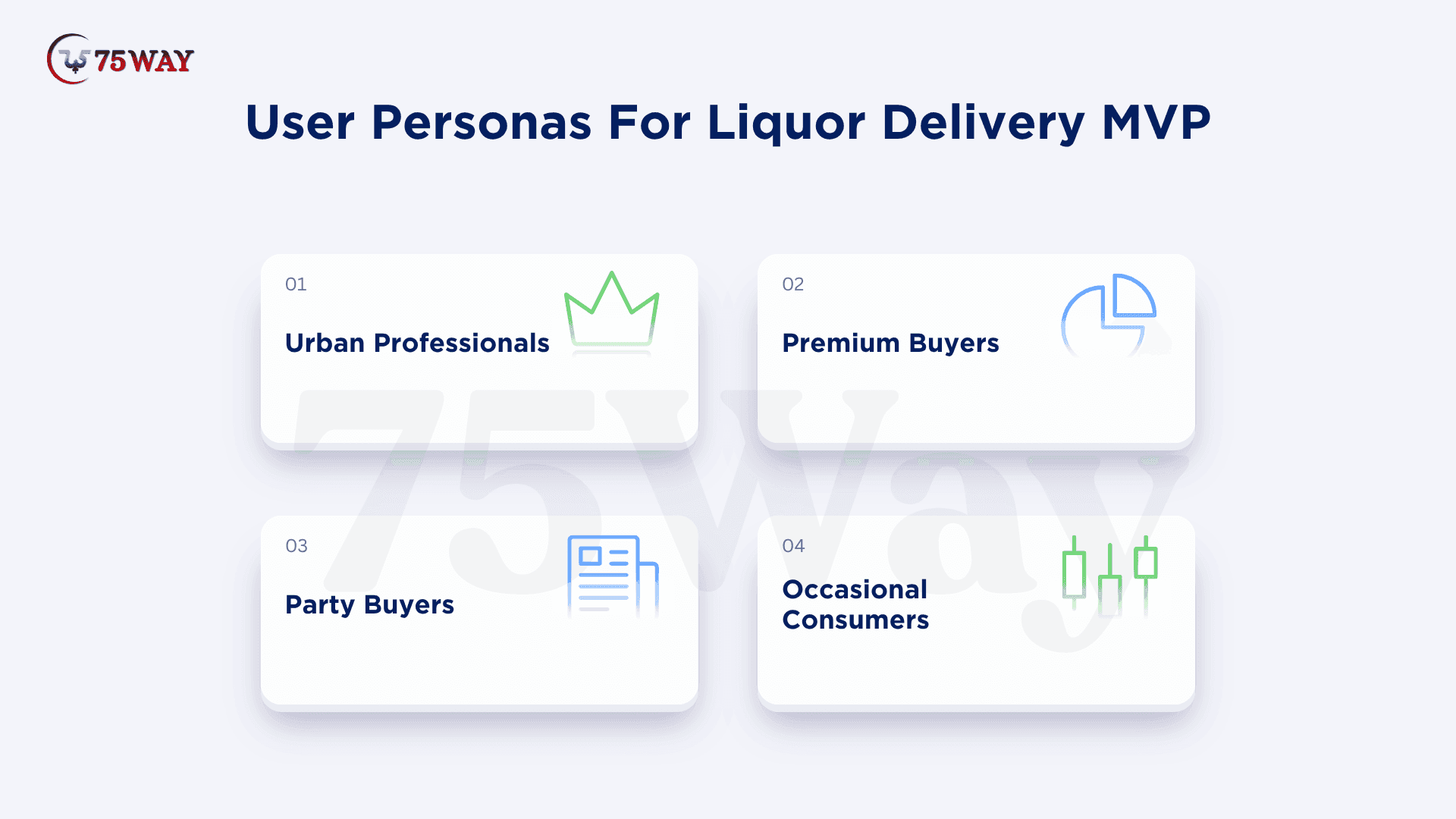
- Urban Professionals: Urban professionals prefer quick delivery and high convenience for their busy lifestyles. They often have high disposable income and value time-saving solutions. Their purchasing decisions are driven by speed, ease of use, and reliable service.
- Party Buyers: Party buyers focus on bulk alcohol purchases for events and gatherings. Their orders are often time-sensitive and larger in volume. They are highly price-conscious and look for discounts or combo deals.
- Premium Buyers: Premium buyers prefer high-quality spirits, wines, and curated selections. They expect personalized recommendations and a premium shopping experience. Their behavior is driven by brand value and product exclusivity.
- Occasional Consumers: Occasional consumers purchase alcohol infrequently and mainly during special occasions. They are highly sensitive to promotions and discounts. Their engagement increases when attractive offers or seasonal deals are available.
Core Features Required in Building Liquor Store MVP
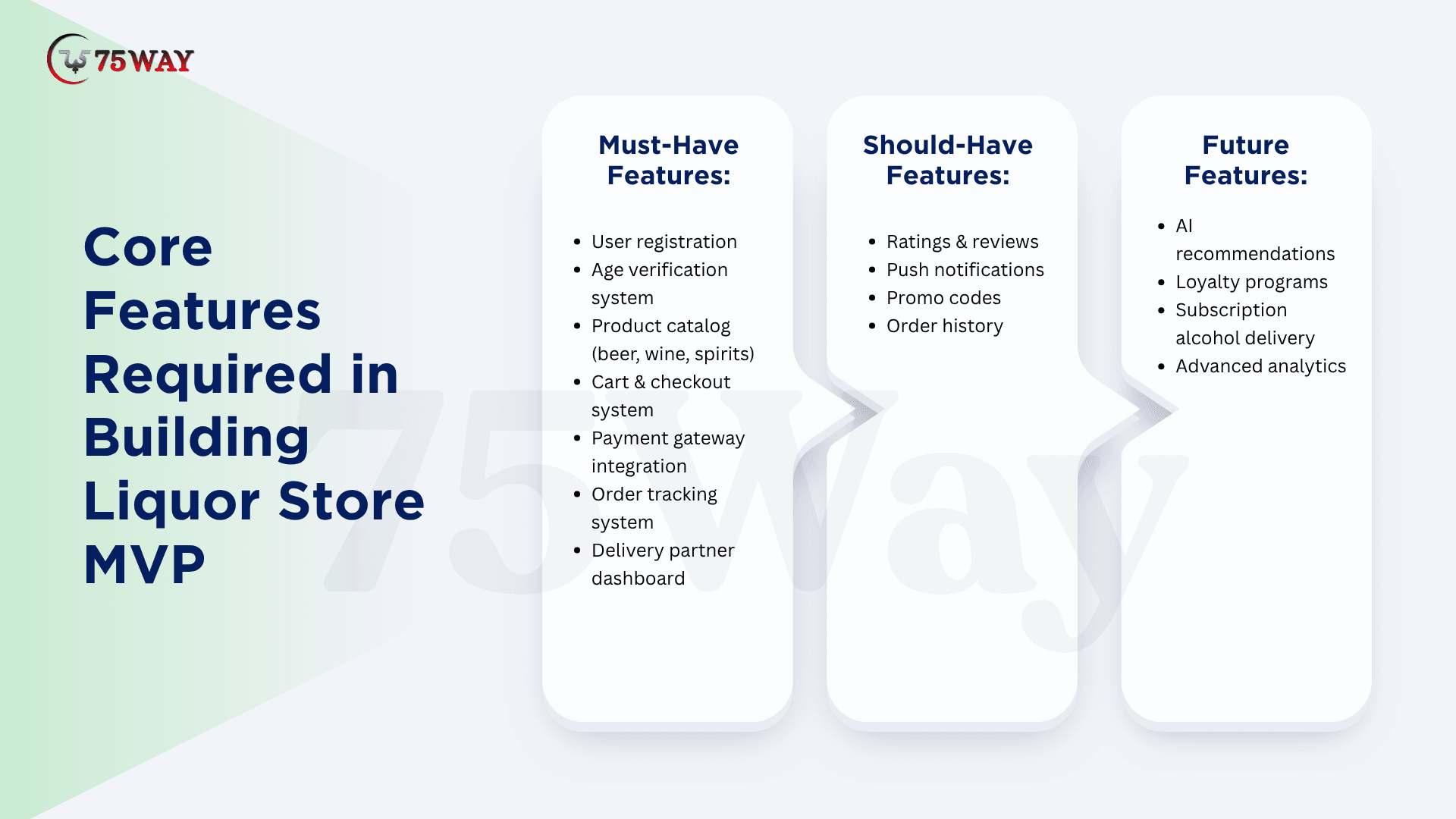
A liquor store MVP must include essential features that ensure safe ordering, compliance, smooth payments, and efficient delivery operations. The focus should remain on core functionalities first, while supporting and advanced features can be added after validating user demand and market performance.
1. Must-Have Features
- User Registration & Login: Enable secure account creation, login access, and user identity management for safe platform usage.
- Age Verification System: Confirm user eligibility through ID checks and prevent underage access to alcohol products.
- Product Catalog: Display available liquor items with categories, pricing, and detailed product information for easy browsing.
- Search & Filters: Help users quickly find products using filters like brand, type, price, and availability options.
- Cart & Checkout: Allow users to add items, review orders, and complete purchases smoothly in one flow.
- Payment Gateway Integration: Enable secure online transactions using multiple payment options for a seamless order completion experience.
- Order Tracking: Provide real-time updates on delivery status from processing to final doorstep delivery confirmation.
- Delivery Partner Module: Support delivery agents with order management, navigation, and delivery status update functionalities.
2. Supporting Features
- Push Notifications: Send real-time alerts for order updates, offers, and delivery status changes to users instantly.
- Promo Codes: Enable discounts and offers to attract users and increase platform engagement and sales conversion rates.
- Order History: Store previous purchases for easy reordering and tracking user buying patterns over time efficiently.
- Ratings & Reviews: Allow users to share feedback on products and delivery experience for quality improvement insights.
3. Advanced Features
- AI-Based Recommendations: Suggest personalized products based on user behavior, preferences, and purchase history for better engagement.
- Subscription Alcohol Delivery: Offer recurring delivery plans for regular customers seeking convenience and consistent product availability service.
- Loyalty Programs: Reward frequent customers with points, discounts, and exclusive benefits to increase retention and engagement.
- Smart Inventory Forecasting: Use data analytics to predict demand trends and optimize stock management efficiently for businesses.
Challenges in Building Liquor Store MVP & How To Solve Them
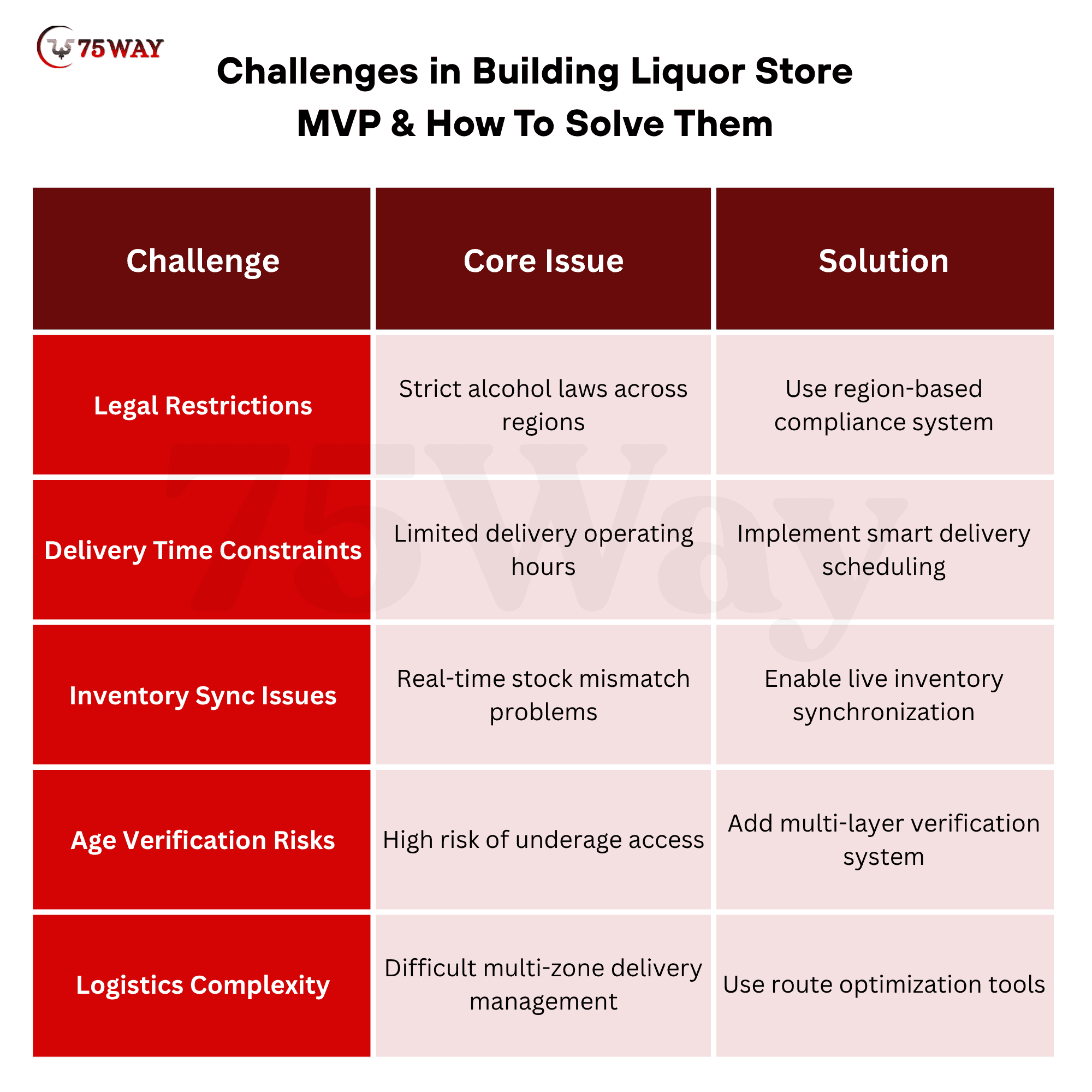
Liquor MVP development comes with strict regulations, operational limitations, and high compliance responsibilities. These challenges can directly impact launch speed, scalability, and user experience. However, with the right planning and technology, each challenge can be managed.
- Legal Restrictions: Different regions have strict alcohol laws that vary by state or country. This creates complexity in launching a unified platform. Use local compliance modules and a region-specific rules engine to ensure legal alignment and avoid violations.
- Delivery Time Constraints: Limited delivery hours reduce the flexibility and scalability of operations. This can impact customer satisfaction during peak demand. Implement smart scheduling and location-based delivery slots to optimize timing efficiency.
- Inventory Sync Issues: Real-time stock mismatch can lead to failed orders and customer dissatisfaction. This becomes critical in fast-moving liquor sales. Use live inventory APIs and automated stock synchronization to maintain accurate product availability.
- Age Verification Risks: Ensuring only eligible users access alcohol products is a major compliance requirement. Any failure can lead to legal penalties. Integrate AI-based verification, OTP checks, and manual review fallback systems for strong validation.
- Logistics Complexity: Managing multiple delivery zones, partners, and time-sensitive orders increases operational difficulty. It can affect delivery speed and reliability. Use route optimization, GPS tracking, and hyperlocal delivery systems to improve coordination and efficiency.
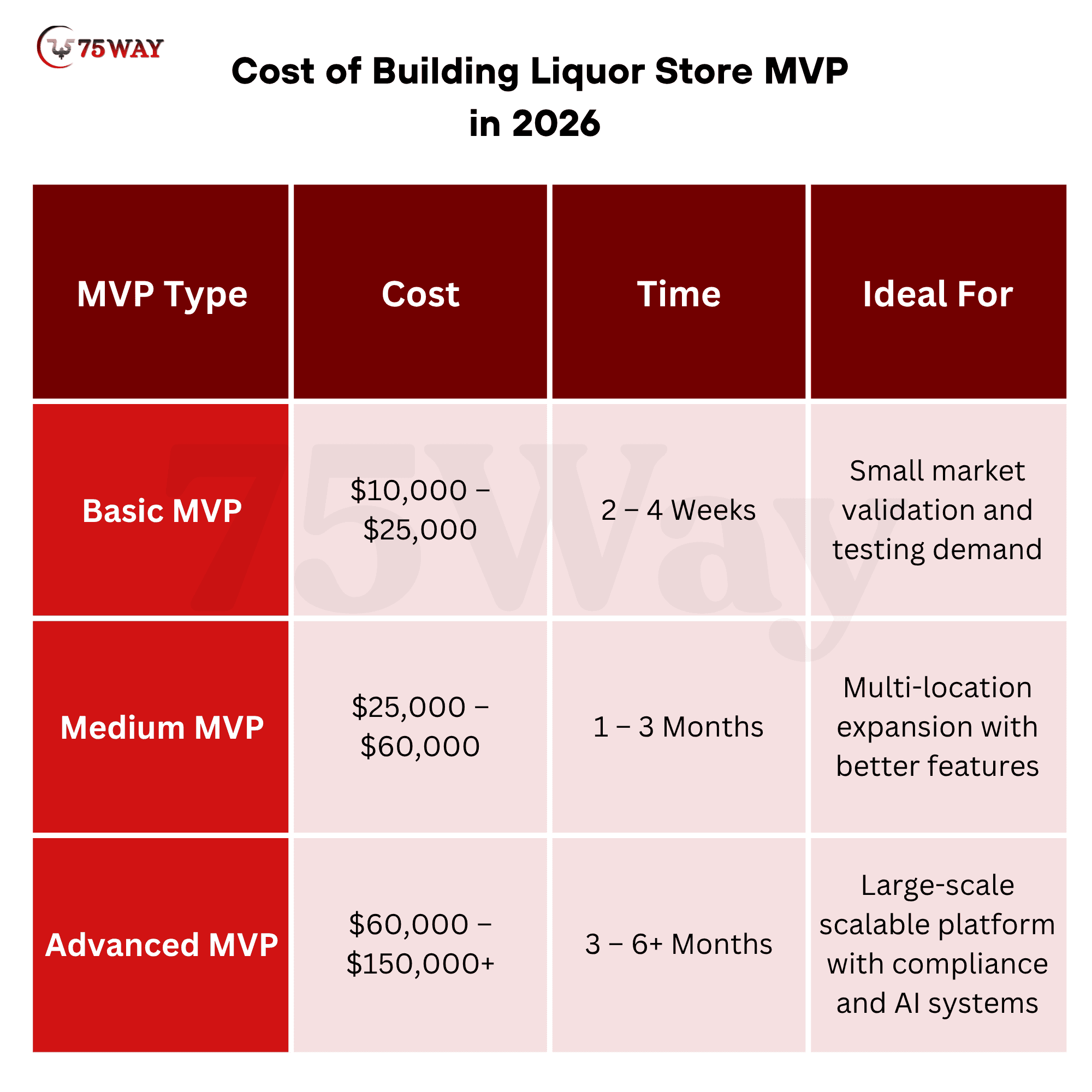
What’s The Cost of Building Liquor Store MVP in 2026?
The average cost of building a liquor store MVP ranges between $10,000 and $150,000+, depending on features, compliance requirements, technology stack, and scalability needs. Simple MVPs are more affordable, while advanced platforms with automation, AI, and strict compliance systems require higher investment.
- Basic Liquor Store MVP: A simple liquor delivery MVP costs $10,000–$25,000 with essential ordering and payment features.
- Medium Liquor Store MVP: Cost ranges $25,000–$60,000 with tracking, inventory, verification, notifications, and improved user experience.
- Advanced Liquor Store MVP: Cost ranges $60,000–$150,000+ with AI verification, analytics, logistics, security, and scalable multi-city infrastructure.
Scaling Strategy After Validating Liquor Store App MVP
Once the MVP shows strong user demand and positive performance metrics, the focus shifts toward structured scaling. This stage is about expanding reach, improving operational efficiency, and adding advanced systems that support long-term growth. Every step should be driven by real usage data, not assumptions.
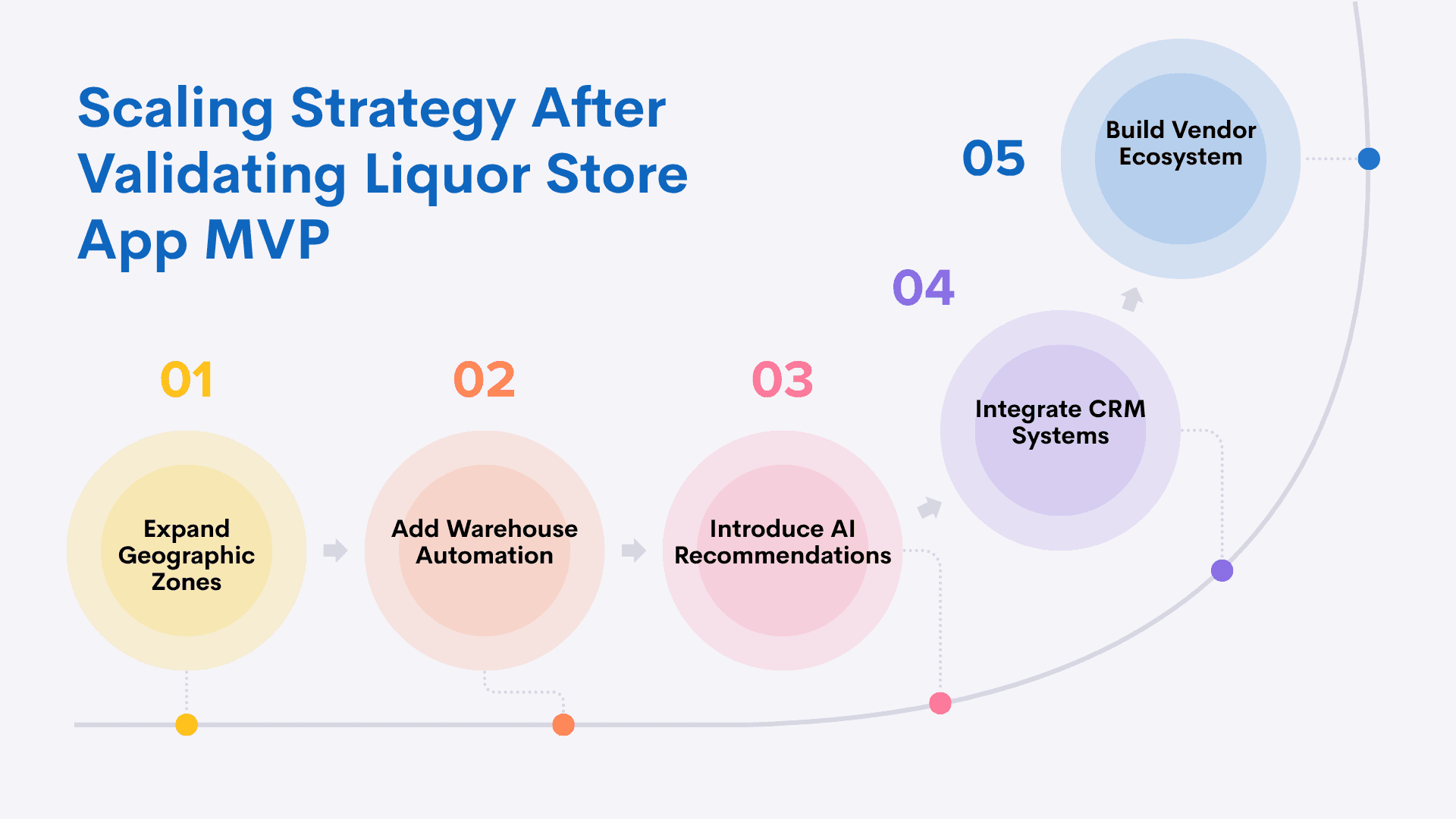
- Expand Geographic Zones
Growth starts by entering new cities or regions where demand already exists. Expansion should be gradual to maintain service quality and operational control. This approach helps reduce risks while increasing the user base.
- Add Warehouse Automation
Automation improves speed, accuracy, and inventory handling efficiency. Smart systems reduce manual work in stock management and order processing. This leads to faster deliveries and lower operational costs at scale.
- Introduce AI Recommendations
AI systems help suggest products based on user behavior and purchase history. This improves user engagement and increases average order value. Personalized experiences lead to higher retention and repeat purchases.
- Integrate CRM Systems
CRM tools help manage customer data, support requests, and engagement activities. They improve communication between businesses and users. This leads to better customer retention and long-term relationship building.
- Build Vendor Ecosystem
Expanding partnerships with multiple vendors increases product availability and pricing flexibility. It ensures better supply chain stability across regions. A strong vendor network supports faster scaling and better customer satisfaction.
Final Remarks
Liquor store MVP product development in 2026 represents a structured business validation approach rather than a simple technical build process. Strong outcomes emerge when startups prioritize compliance, user experience, and lean feature planning, reducing market entry risks while validating real demand in regulated alcohol delivery ecosystems. A well-designed MVP enables deeper understanding of customer behavior, improved delivery operations, and refined monetization strategies before full-scale expansion. Ultimately, long-term success depends on speed, validated learning, and continuous iteration guided by real user insights and market feedback. For this, you can partner with a trusted on-demand delivery app development company to launch your MVP faster and dominate your market in 2026.
Frequently Asked Questions (FAQs)
What Makes Liquor Store MVP Different From Other Delivery Apps?
Liquor store MVPs require strict legal compliance, age verification systems, and regulated delivery timing. Unlike food delivery apps, alcohol platforms must follow government restrictions, licensing laws, and geographic limitations. These requirements make architecture, verification, and logistics significantly more complex than standard on-demand delivery applications.
How Long Does It Take To Build A Liquor Delivery MVP?
A liquor delivery MVP typically takes 30 to 90 days based on complexity, features, and compliance requirements. Simple versions with basic ordering and delivery systems are faster, while advanced platforms with AI verification and logistics automation require more development time and regulatory integration.
Is Liquor Delivery App Development Legally Complex?
Yes, liquor delivery apps operate under strict regulations that vary by region. Businesses must follow licensing laws, delivery time restrictions, and age verification policies. Legal consultation is often required during development to ensure compliance and avoid penalties or operational shutdown risks.
Can Liquor Store MVP Generate Revenue Quickly?
Yes, MVPs can generate early revenue through delivery fees, product markup, or commission models. However, success depends on market demand, logistics efficiency, and customer acquisition strategy. Early validation helps refine pricing models and improve profitability over time.
Do Liquor Delivery Apps Require Age Verification?
Yes, age verification is mandatory in most regions. Apps typically use ID uploads, OTP validation, or AI-based verification systems to ensure legal compliance. Failure to implement proper verification can result in legal consequences.
Can A Liquor MVP Scale Into A Full Platform?
Yes, if built with scalable architecture, a liquor MVP can evolve into a full enterprise-grade platform. Proper backend design, modular coding, and cloud infrastructure allow seamless expansion into multiple regions and feature-rich ecosystems.