AI Summary
Building a food delivery app like Toing requires more than restaurant listings and online ordering. This guide explores the platform model, essential features, technology, development process, monetization, integrations, and costs. It also explains how to scale after launch.
Key Takeaways
- Build separate experiences for customers, restaurants, riders, and administrators.
- Toing-like platforms require ordering, payments, delivery, tracking, and management workflows.
- Real-time tracking and automated dispatch improve visibility across delivery operations.
- Global online food delivery revenue could reach $2.05T by 2031.
- Toing-like app development costs $15,000 – $250,000+, depending on complexity.
A food delivery app can have thousands of restaurants and still lose customers if the final bill feels too expensive. However, Swiggy’s Toing app takes a different approach by putting affordable meals, transparent pricing, simple discovery, and convenient delivery at the center of the experience.
Its current app positioning highlights low-priced dishes, zero platform and packaging charges, real-time tracking, multiple payment options, and restaurant pricing designed to match offline menus.
That makes Toing an interesting food delivery app development solution to study for founders planning a new food delivery business in India and global markets.
However, building an app similar to Toing is not about copying screens or adding a restaurant listing module. You need to recreate the underlying marketplace, ordering, restaurant, delivery, payment, pricing, and operational workflows while developing your own competitive advantage.
This guide explains how to build an app like Toing, including its business model, essential features, technology architecture, development process, integrations, monetization options, development timeline, and cost.
What Is Toing App And Why Is Its Model Worth Studying?
Toing is Swiggy’s standalone affordable food-delivery platform, created as a separate brand rather than simply adding another low-price section inside the main Swiggy app. Swiggy launched Toing in Pune in September 2025 as a platform experiment aimed at price-conscious customers, particularly students and early-jobbers.
The important thing for a founder is not simply that Toing offers inexpensive food.
It is that pricing transparency itself becomes part of the product experience.
Traditional food delivery platforms can add several charges to an order, making the final checkout amount noticeably higher than the restaurant's menu price. A Toing-like product can compete by reducing that perceived gap and targeting customers who order frequently but remain highly price-sensitive.
That creates a different product strategy:
Affordable food → transparent pricing → frequent ordering → high order volume → sustainable marketplace economics.
If you want to build a similar platform, this business logic should influence the technology and feature decisions from the beginning.
Market Size & User Growth To Build An App Like Toing
Before investing in an app like Toing, one question matters: is there enough demand to turn the idea into a scalable business? Market expansion and rising user adoption can create attractive opportunities, but the numbers need to support that assumption. The market size and user growth data provide useful insight into the commercial potential of this app model.
1. Toing’s Market Traction
- 33M weekly active users in September 2026.
- Toing reached 96% of Zomato’s weekly active user base.
- Added 1.8M weekly active users.
- 2 in 3 Toing users are either new customers or returning users.
2. Food Delivery Market Opportunity
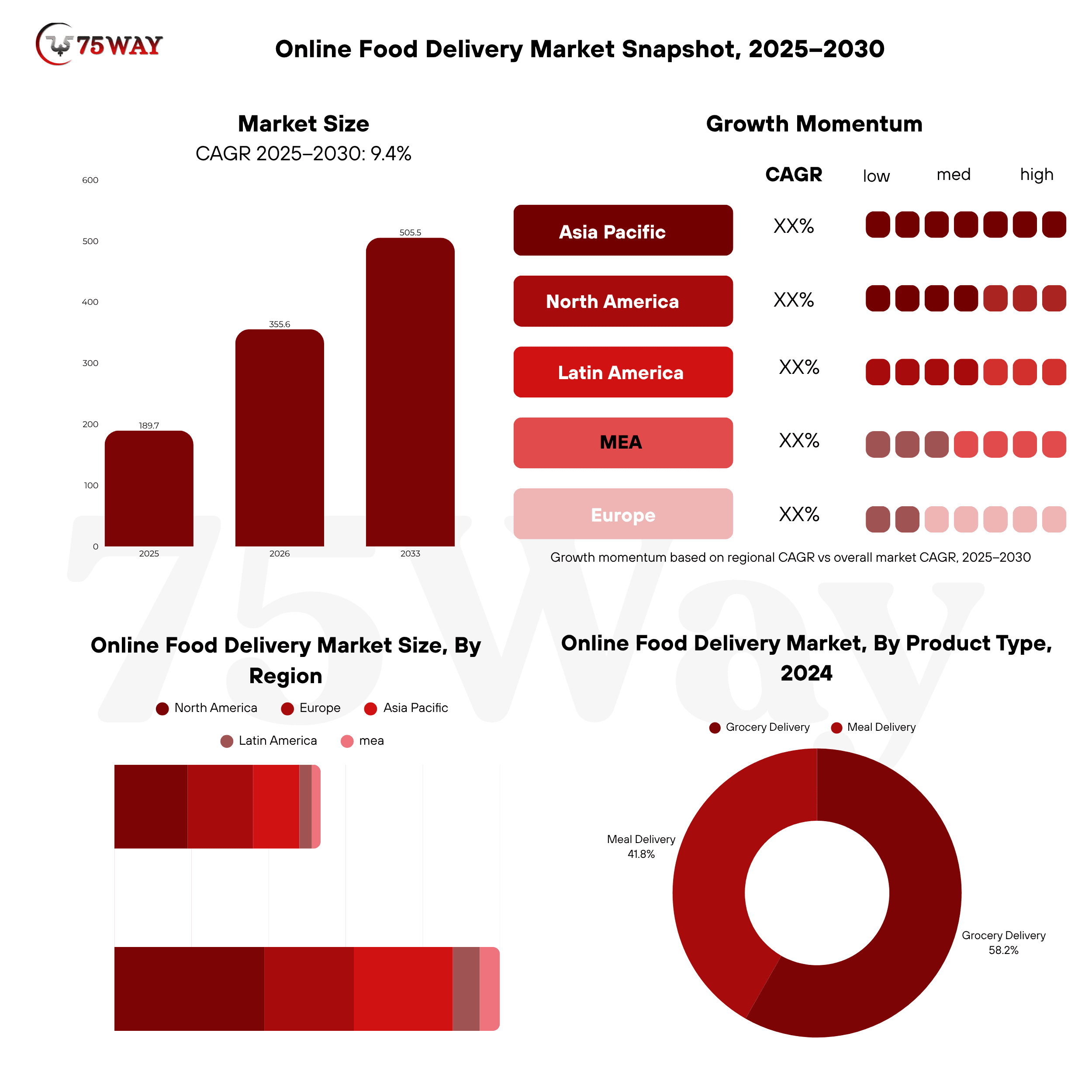
- Global online food delivery market: $355.6B in 2026 to $505.5B by 2030.
- Market growth: 9.4% CAGR from 2025–2030.
- Online Food Delivery revenue: $1.51T in 2026 to $2.05T by 2031.
3. Consumer & Revenue Potential
- Grocery Delivery ARPB: US$553.52 in 2026.
- Meal Delivery buyers: 2.6B by 2031.
How Does A Toing-Like Food Delivery App Work?
A Toing-like platform typically connects four major participants: customer, restaurant, delivery partner, and platform admin.
The customer discovers restaurants and food, places an order, and completes payment.
The restaurant receives the order, accepts it, prepares the food, and marks it ready.
The delivery partner receives the assignment, collects the order, navigates to the customer, and completes delivery.
The admin platform coordinates the marketplace, pricing, restaurants, orders, payments, delivery operations, disputes, promotions, and analytics.
The critical point is that these are connected workflows, not four independent applications.
For example:
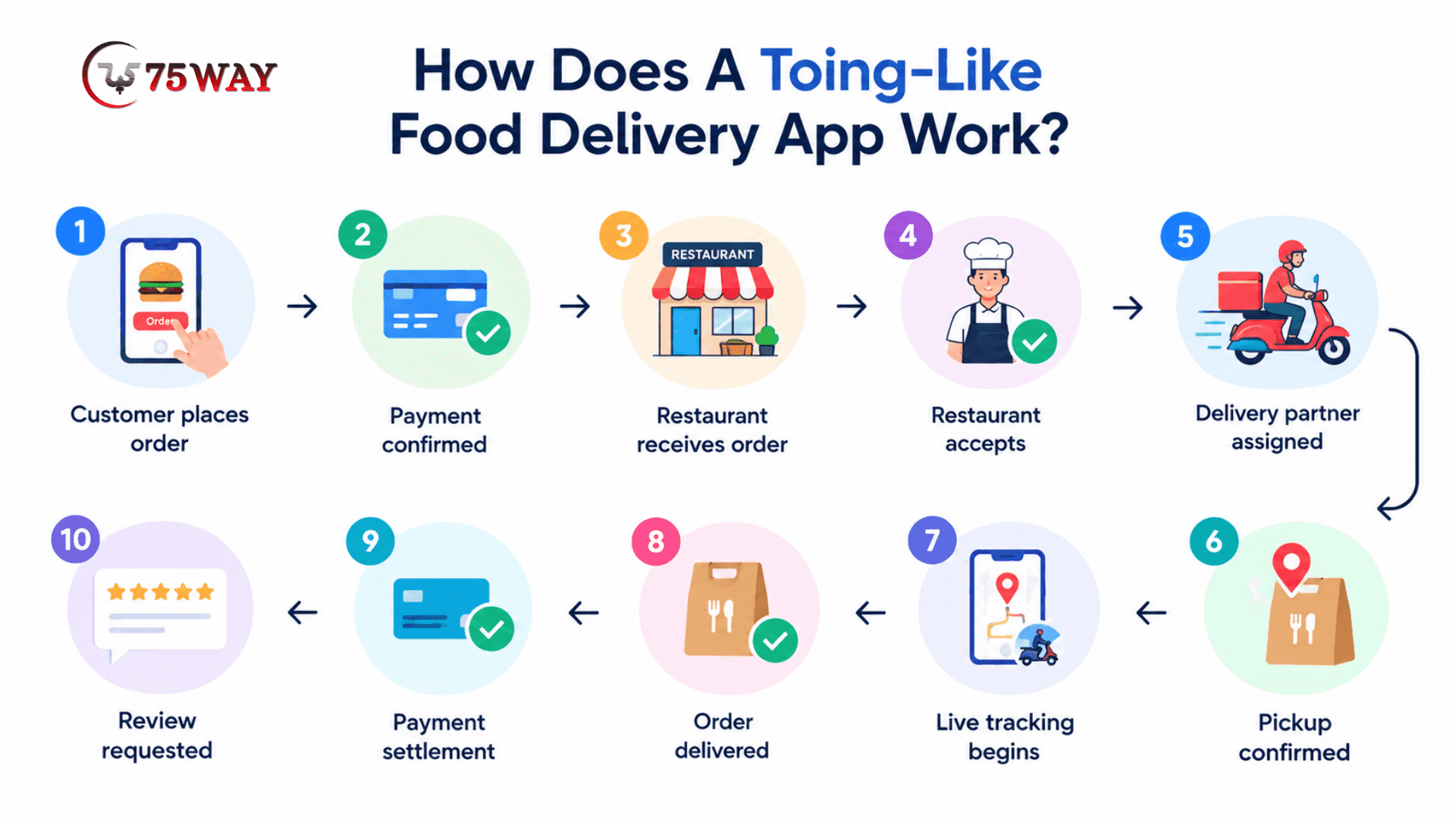
Every transition needs a reliable backend event. That is where much of the actual engineering complexity sits.
Step-By-Step Process To Build A Food Delivery App Like Toing
A food delivery app can look simple from the customer’s side, but restaurants, delivery partners, orders, payments, and live tracking all have to work together behind the scenes. A strong development approach keeps these moving parts connected while leaving room for future growth. The step-by-step process shows how to turn the idea into a functional food delivery platform.
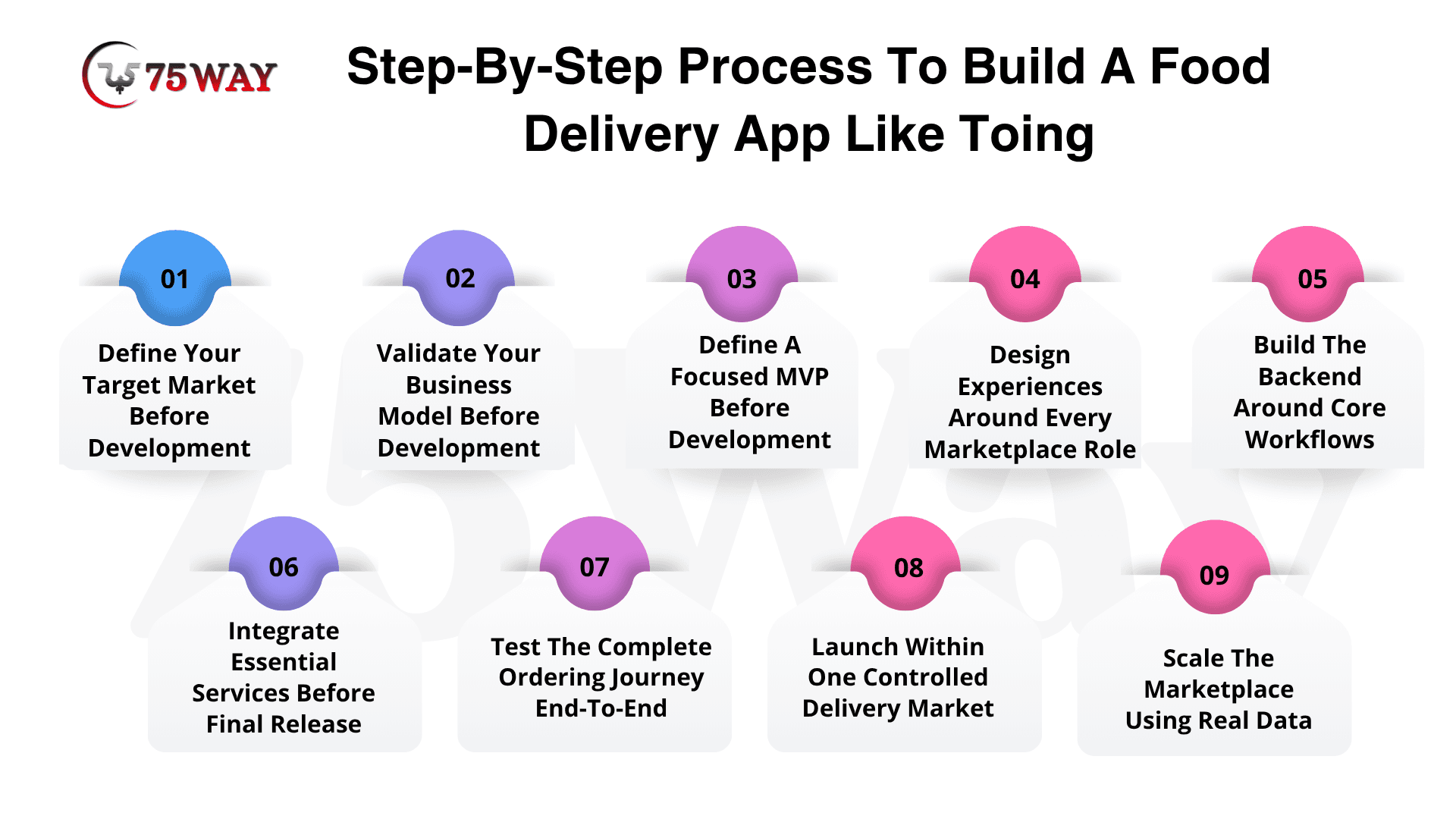
1. Define Your Target Market Before Development
Before writing code, identify the market you actually want to win. Define customers, geography, restaurant types, order values, delivery model, differentiation, and revenue approach. A focused audience makes positioning sharper. It also gives your product a clearer direction from the beginning.
2. Validate Your Business Model Before Development
Once the market is clear, test whether the economics can support it. Talk with restaurants, observe customer demand, and estimate acquisition, order, commission, delivery, margin, and retention metrics. Strong demand means little if every order loses money. This validation determines whether your initial concept deserves investment.
3. Define A Focused MVP Before Development
With the business model validated, narrow development to the workflows customers cannot complete without. Build the core journey from discovery through ordering, preparation, assignment, delivery, payment, and review. Keep advanced recommendations, loyalty programs, and complex automation outside the first release. A focused MVP gives you something practical to test with real users.
4. Design Experiences Around Every Marketplace Role
Now turn those essential workflows into experiences people can understand without much guidance. Create separate interfaces for customers, restaurants, riders, and administrators, because each role has different priorities. Keep navigation simple and make important actions easy to find. Good UX should reduce hesitation rather than make users learn how the marketplace works.
5. Build The Backend Around Core Workflows
Once the user journeys are mapped, build the backend that keeps those experiences connected. Develop authentication, user management, restaurants, menus, orders, payments, delivery, notifications, reviews, and administration. These services need to exchange information accurately as orders move through different stages. A reliable backend keeps customer, restaurant, rider, and admin actions synchronized.
6. Integrate Essential Services Before Final Release
With the core system working, connect the external services required for everyday operations. Integrate maps, payments, notifications, SMS, and analytics according to the workflows already defined. Test these connections early instead of waiting until launch preparation. Early integration helps uncover technical dependencies before they become operational problems.
7. Test The Complete Ordering Journey End-To-End
After integrations are connected, test the entire ordering journey from the customer's first action to final settlement. Check payments, restaurant acceptance, rider assignment, pickup, tracking, delivery, and order completion under realistic conditions. Then deliberately introduce failures such as cancellations, delays, offline riders, address changes, refunds, and GPS interruptions. These tests show whether your marketplace can handle real situations, not just successful demos.
8. Launch Within One Controlled Delivery Market
Once testing exposes and fixes major weaknesses, launch within one tightly controlled delivery area. Choose a market where restaurants, customers, and riders can generate enough activity to make the marketplace useful. Watch order volumes, delivery times, cancellations, customer feedback, restaurant participation, and unit economics closely. These early signals will show what needs improvement before you expand.
9. Scale The Marketplace Using Real Data
When the first market demonstrates healthy economics, use those results to guide expansion. Add restaurants, delivery zones, customer segments, cities, promotions, and new capabilities in measured stages. Avoid expanding simply because early demand looks promising, especially when operations are still developing. Data from each market should determine what you improve, replicate, or change next.
What Makes A Toing-Like Food Delivery App Different?
A conventional food delivery app may compete through restaurant selection, convenience, promotions, or delivery speed.
A Toing-like model can compete through value perception.
Toing's current public product information highlights categories such as affordable meals, free-delivery selections, and low-priced dishes, while emphasizing transparent pricing and real-time delivery tracking.
For a new business, this creates several possible positioning strategies:
- Budget-focused food delivery
- Local restaurant marketplace
- Student-focused delivery
- Neighborhood food delivery
- No-hidden-fee delivery
- Small-restaurant marketplace
- Hyperlocal affordable meals
- Value-focused quick delivery
You do not need to copy Toing's positioning exactly.
Instead, identify the customer segment where price, frequency, and convenience intersect and build the platform around that demand.
Business Model Working Behind Toing-Style App Development Solution
Before development begins, determine how your marketplace will make money. A Toing-like platform can potentially generate revenue through several channels.
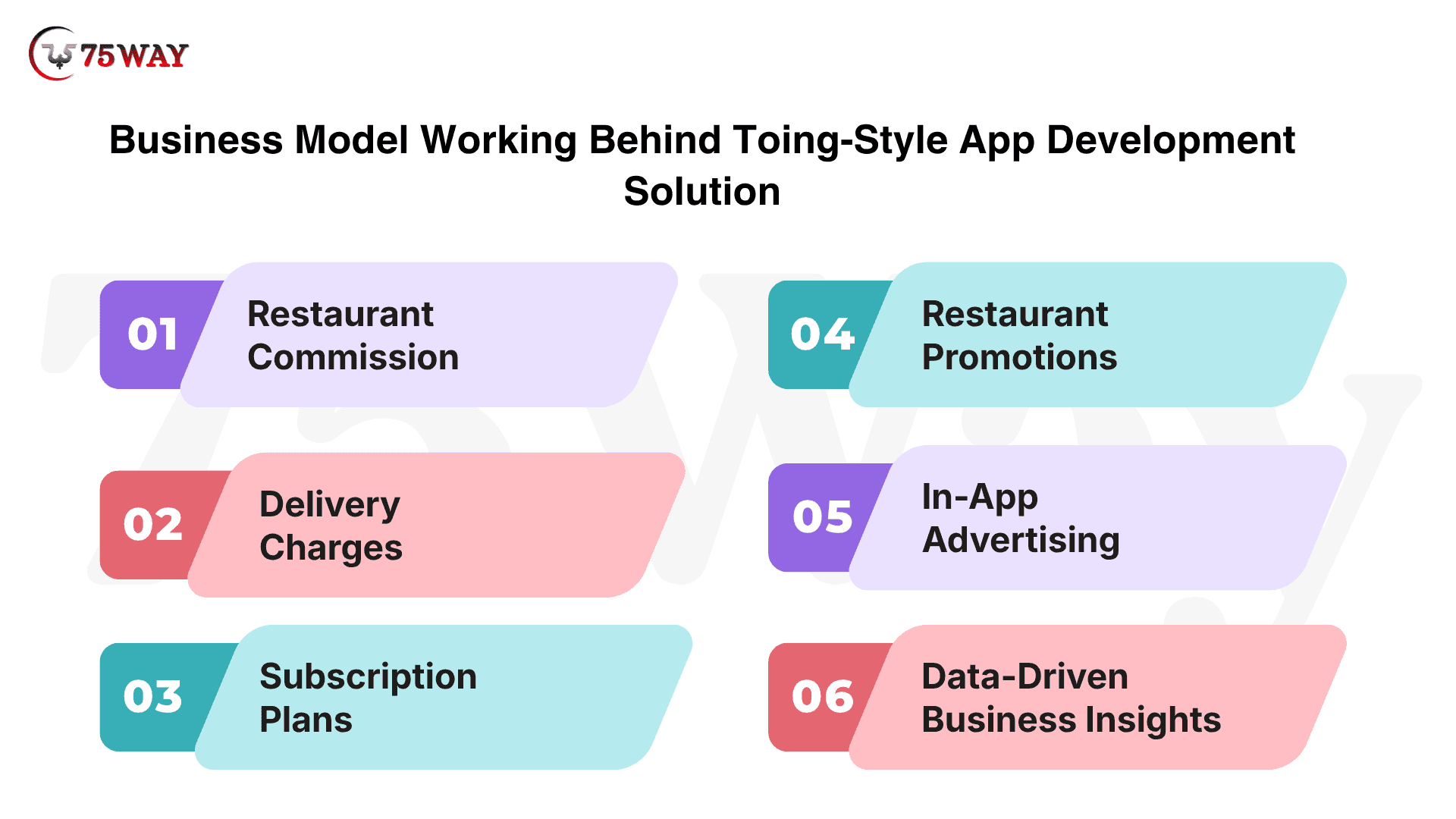
1. Restaurant Commission
Restaurants can pay a percentage of every completed order.
For a price-sensitive marketplace, the commission strategy matters because restaurants need enough margin to remain active on the platform.
Your commission can vary according to:
- Restaurant category
- Order volume
- Delivery arrangement
- Promotional participation
- Restaurant size
- Contract terms
2. Delivery Charges
You can charge customers for delivery under specific conditions.
For example, the platform could offer free delivery above a certain order value while charging a small fee for lower-value orders.
This can encourage larger baskets without eliminating delivery revenue entirely.
3. Subscription Plans
Frequent customers can receive benefits through a monthly or annual membership. Possible benefits include:
- Free delivery
- Exclusive offers
- Member-only restaurants
- Early promotions
- Reduced service fees
4. Restaurant Promotions
Restaurants can pay for promotional visibility. Examples include:
- Featured restaurants
- Sponsored listings
- Category promotions
- Homepage placements
- Local campaigns
5. In-App Advertising
Food brands, beverage companies, local businesses, and restaurant chains can purchase advertising placements once the platform reaches meaningful traffic.
6. Data-Driven Business Insights
At scale, aggregated operational analytics can help restaurants understand ordering patterns, peak periods, popular menu categories, and customer behavior.
However, any commercialization of user data must follow applicable privacy requirements and your disclosed data practices.
Complete Feature Suite for Developing A Mobile App Like Toing
An app like Toing needs more than a polished interface to keep users engaged after the first download. Profiles, discovery, communication, matching, notifications, privacy, and moderation all shape how people experience the platform. The complete feature suite shows which capabilities can turn the concept into a useful, engaging, and scalable mobile app.
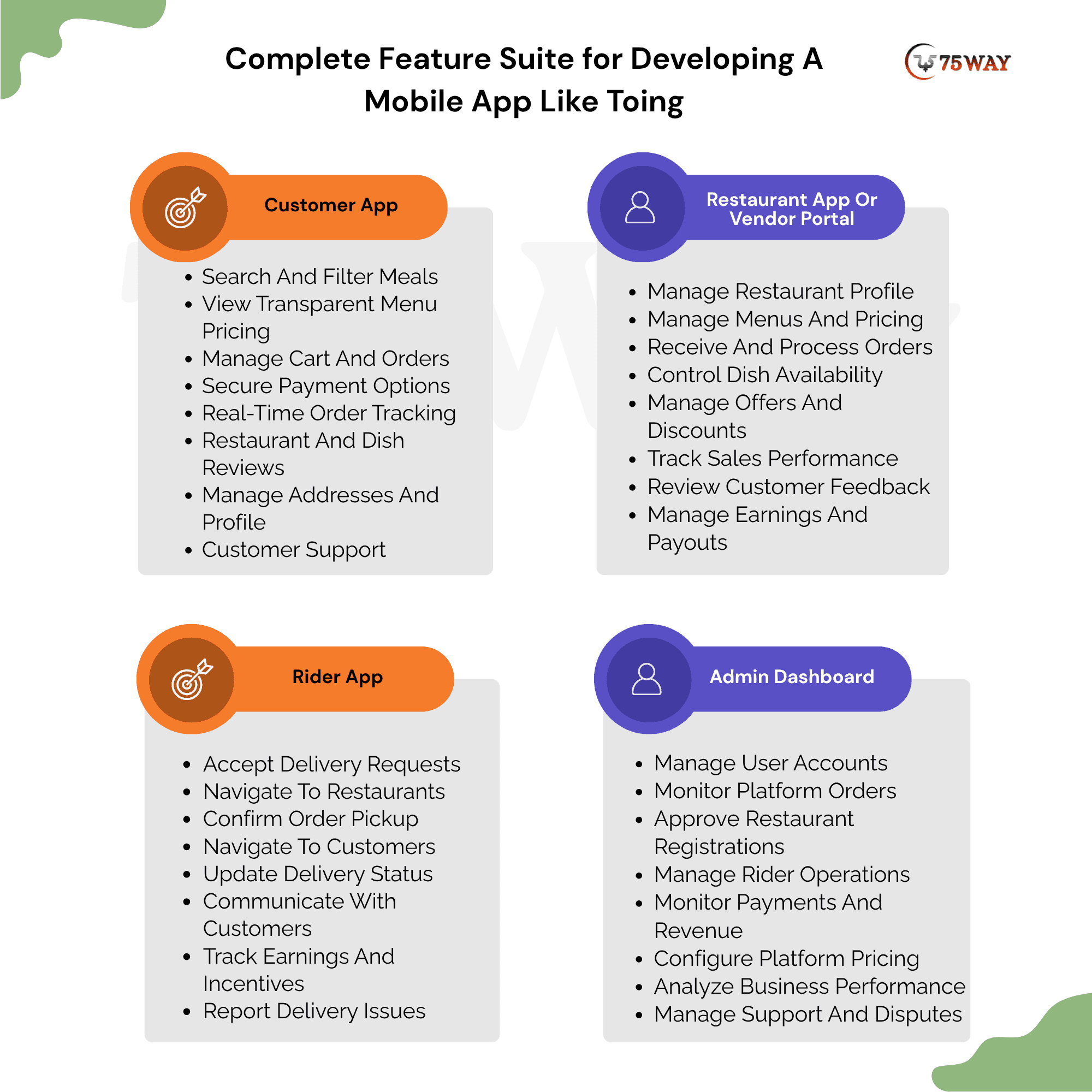
Module 1: Customer App
The customer app should make affordable food discovery, ordering, payment, and delivery tracking simple. Its experience should keep pricing transparent while helping users find suitable meals quickly.
- Search And Filter Meals: Find restaurants and dishes, then filter results by cuisine, price, ratings, distance, and availability.
- Transparent Menu Pricing: Show restaurant prices clearly, display applicable charges, and help customers understand their final payable amount.
- Cart And Orders: Add dishes, adjust quantities, apply offers, review selected items, and confirm orders before checkout.
- Secure Payment Options: Support multiple payment methods, process transactions securely, and provide immediate confirmation after successful payments.
- Real-Time Order Tracking: Track rider locations, monitor delivery progress, view estimated arrival times, and receive timely order updates.
- Restaurant And Dish Reviews: Rate restaurants and dishes, share feedback, and help other customers make informed ordering decisions.
- Addresses And Profile: Save delivery addresses, update personal details, manage preferences, and access previous orders from one account.
- Customer Support: Report order problems, request assistance, and communicate with support teams when issues require resolution.
Module 2: Restaurant App Or Vendor Portal
The restaurant portal should give vendors direct control over menus, orders, pricing, availability, and earnings. It should simplify daily order management while keeping restaurant operations connected with customers and riders.
- Restaurant Profile Management: Update restaurant information, operating hours, contact details, location, and other customer-facing business information.
- Menu Management: Add dishes, update prices, upload images, organize categories, and maintain accurate menu information.
- Order Management: Accept incoming orders, confirm preparation, update order statuses, and coordinate readiness with delivery riders.
- Inventory Availability Control: Mark unavailable dishes, manage stock-sensitive items, and prevent customers from ordering unavailable menu selections.
- Promotional Management: Create promotional offers, configure discount rules, and control eligible dishes or customer segments.
- Performance Analytics: Monitor orders, sales, cancellations, preparation times, ratings, and other restaurant performance indicators.
- Customer Feedback Management: Read customer ratings, respond to feedback, identify recurring concerns, and improve service based on reviews.
- Payout Management: View completed orders, track commissions, monitor earnings, and review detailed transaction and payout records
Module 3: Rider App
The rider app should connect delivery partners with restaurants and customers throughout every delivery. It should provide clear assignments, navigation, order updates, communication, and earnings visibility.
- Delivery Request Management: Review available requests, check order details, and accept suitable deliveries based on location and availability.
- Restaurant Navigation: Follow integrated maps, receive accurate directions, and reach restaurant locations using optimized delivery routes.
- Pickup Confirmation: Verify order details, collect prepared food, and confirm successful pickup before starting customer delivery.
- Customer Navigation: Follow accurate addresses, review delivery instructions, and choose suitable routes for reaching customers.
- Delivery Status Updates: Update pickup, transit, arrival, and completion stages so customers and restaurants receive timely information.
- Customer Communication: Contact customers through controlled calling or messaging when delivery instructions need additional clarification.
- Earnings Management: View completed deliveries, earnings, incentives, bonuses, deductions, and payout history from one dashboard.
- Issue Reporting: Report incorrect addresses, unavailable customers, damaged orders, restaurant delays, and other delivery-related problems.
Module 4: Admin Dashboard
The admin dashboard should give operators centralized control over customers, restaurants, riders, payments, orders, and marketplace performance. It should provide the visibility needed to manage daily operations and resolve issues quickly.
- User Account Management: Review customer, restaurant, and rider accounts, manage permissions, verify profiles, and handle account-related actions.
- Order Monitoring: Track orders across locations, monitor statuses, identify delays, and investigate operational issues from one dashboard.
- Restaurant Approval Management: Review restaurant applications, verify business information, approve listings, and manage onboarding requirements centrally.
- Rider Operations Management: Verify rider profiles, monitor availability, review performance, and manage delivery partner-related issues.
- Financial Monitoring: Track transactions, commissions, refunds, settlements, failed payments, and overall marketplace revenue.
- Pricing Configuration: Manage delivery charges, commissions, promotional rules, service areas, and other marketplace pricing parameters.
- Business Performance Analytics: Review orders, revenue, customer activity, restaurant performance, rider metrics, cancellations, and marketplace trends.
- Support And Dispute Management: Handle customer complaints, restaurant disputes, refund requests, delivery issues, and support tickets through centralized workflows
Advanced Features For Toing Clone App Development
Once a food delivery app handles basic orders well, the bigger opportunity lies in making the experience smarter. The innovative and AI-powered features can make a Toing clone feel more intelligent and useful as order volumes grow.
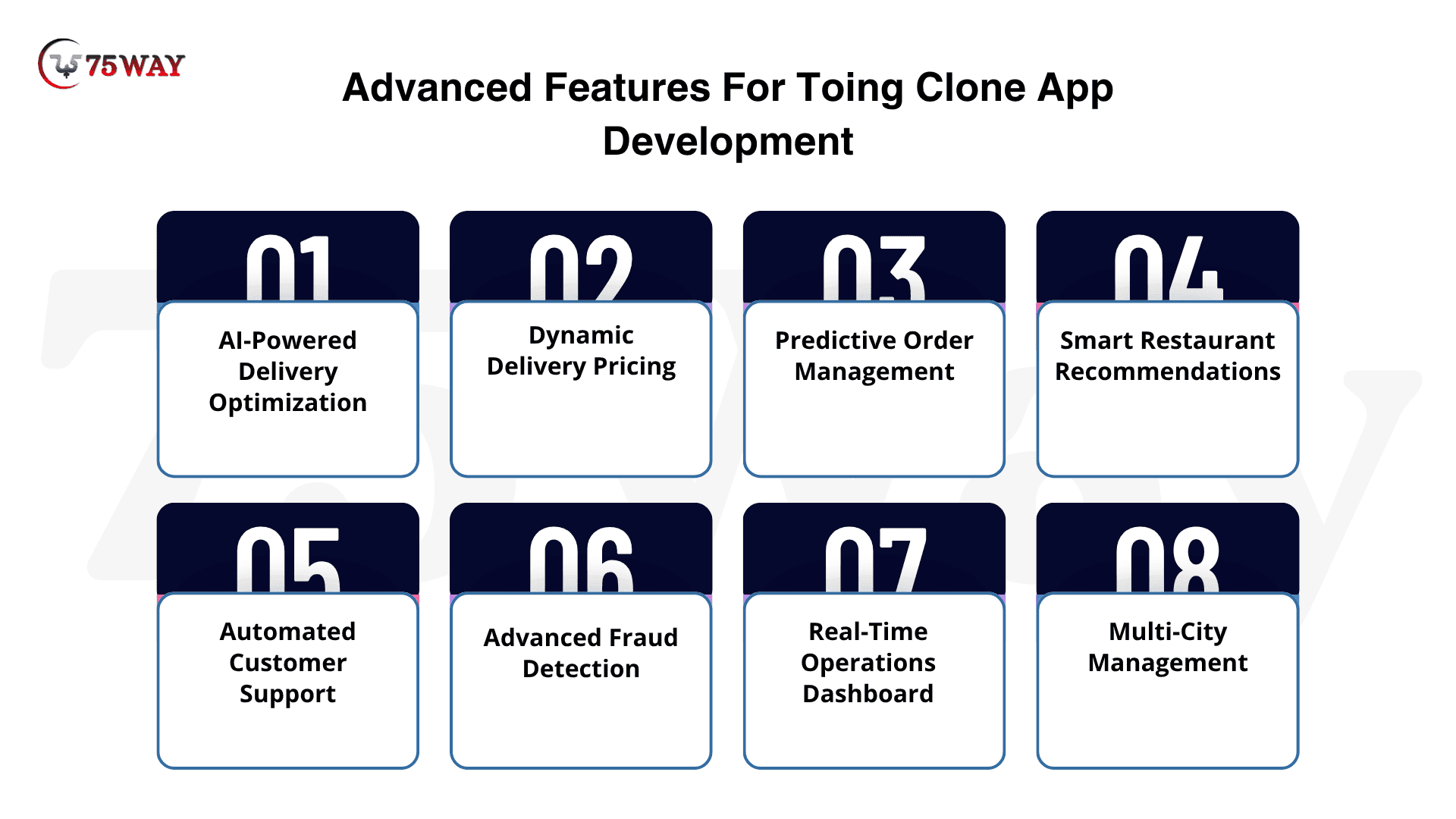
- AI-Powered Delivery Optimization
AI can analyze order volume, rider availability, traffic, and delivery locations to improve assignment decisions. This can help reduce delays while making better use of available delivery partners.
- Dynamic Delivery Pricing
Pricing can adjust based on factors such as distance, demand, traffic, and delivery conditions. This gives the platform flexibility to manage busy periods without relying on fixed delivery charges.
- Predictive Order Management
Predictive analytics can identify expected order volumes using historical and real-time data. Restaurants and operations teams can use these insights to prepare staffing, inventory, and delivery capacity.
- Smart Restaurant Recommendations
Recommendation algorithms can personalize restaurant and food suggestions based on previous orders, preferences, location, and browsing behavior. Relevant recommendations can make it easier for customers to discover suitable options.
- Automated Customer Support
AI-powered support can handle common questions about orders, payments, refunds, and delivery status. More complex issues can be transferred to human support agents when required.
- Advanced Fraud Detection
Fraud detection systems can monitor unusual payment activity, repeated cancellations, suspicious accounts, and abnormal ordering patterns. Automated alerts can help operations teams investigate potentially risky activity before losses increase.
- Real-Time Operations Dashboard
An advanced dashboard can bring orders, riders, restaurants, delivery times, cancellations, and active issues into one view. Operations teams can use these insights to respond quickly when delivery problems occur.
- Multi-City Management
Multi-city support allows businesses to manage restaurants, riders, delivery zones, pricing, and operational rules across different locations. Separate city-level controls can make expansion easier while keeping local requirements manageable.
Technology Stack For Building A Toing-Like Food Delivery App
A Toing-like food delivery app needs a technology stack that can keep up with everyday actions, from placing an order to assigning a rider and updating delivery status. Flutter or React Native can work well for customer and rider apps when you want one codebase, while Swift and Kotlin are better choices for fully native iOS and Android experiences. On the backend, Node.js, Python, or Java can handle orders, users, restaurants, payments, and delivery workflows, with PostgreSQL or MySQL storing the core data and Redis helping speed up frequently requested information.
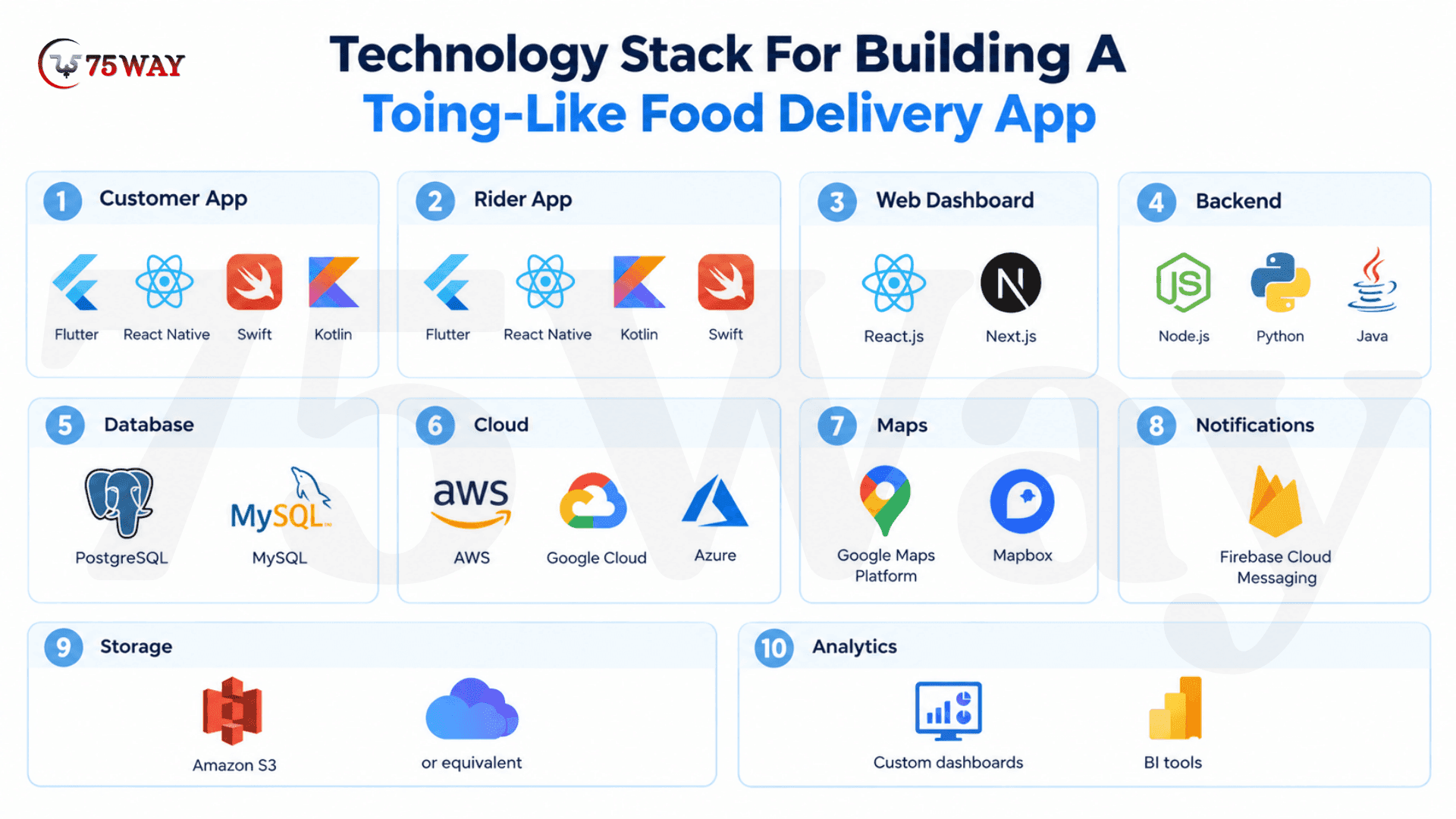
Things get more interesting when the app starts handling live deliveries. WebSockets can push real-time order and rider updates, while Google Maps Platform or Mapbox can handle locations, routes, and navigation. AWS, Google Cloud, or Azure can provide the infrastructure, Amazon S3 can store files and media, and Firebase Cloud Messaging can send order notifications. The final stack should depend on how you plan to launch, how many users and orders you expect, and which features you actually need at the beginning.
For an MVP, cross-platform development can reduce duplicated mobile development work.
For a high-scale product, however, the choice should be made based on actual performance requirements rather than assuming native or cross-platform is universally better.
How Much Does It Cost To Build A Food Delivery App Like Toing?
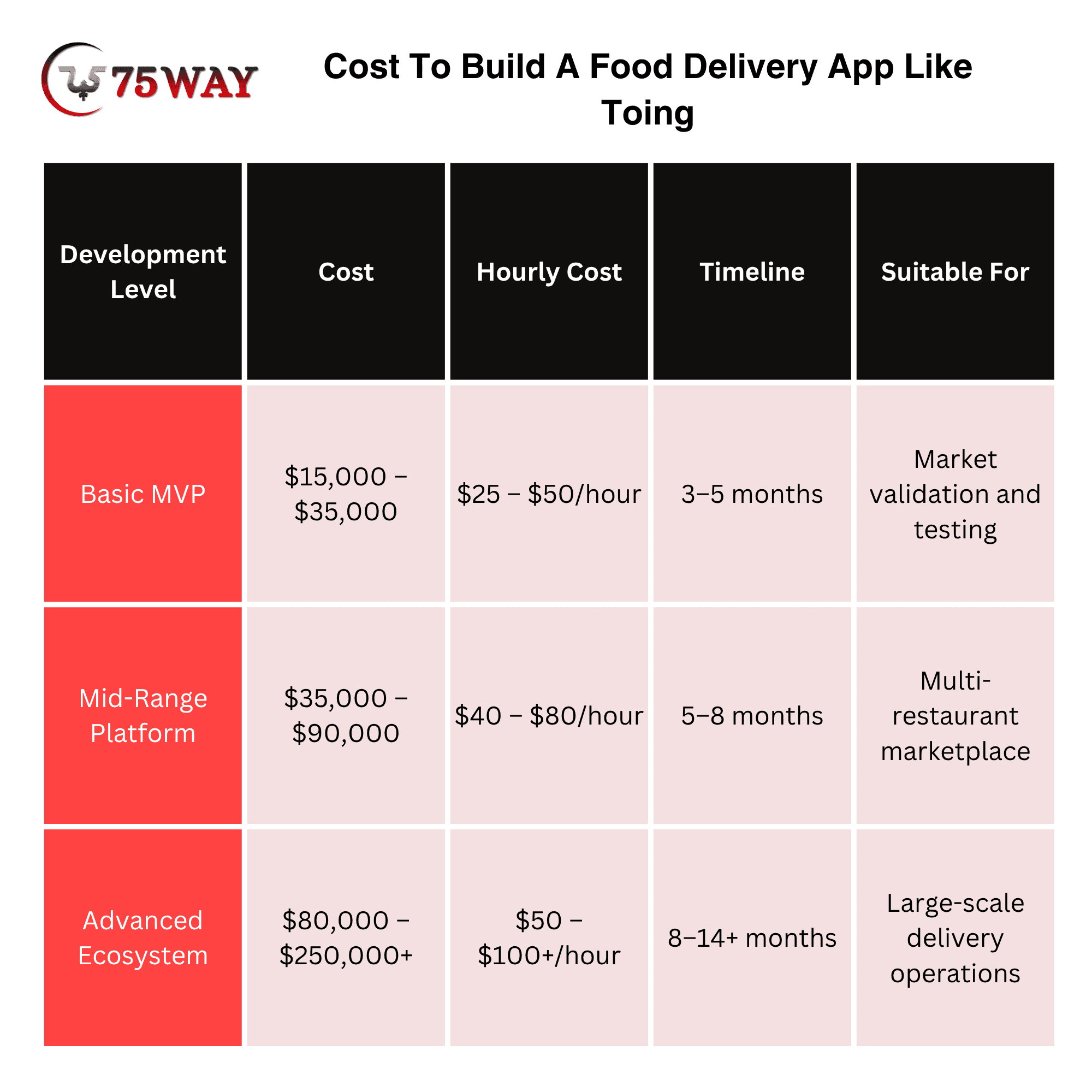
The food delivery app development cost can range from $15,000 to $250,000+, depending on whether you are building a focused MVP, a multi-role marketplace, or a full-scale ecosystem. The final development budget depends on the number of applications, design complexity, integrations, real-time requirements, payment architecture, delivery automation, backend infrastructure, testing, and scalability requirements.
1. Basic MVP Toing-Like App Cost: $15,000 – $35,000
Timeline: 3–5 months
The basic MVP is designed to test whether customers, restaurants, and the business model actually work before making a larger technology investment.
You can launch in one city or a limited service area, measure order frequency, restaurant adoption, average order value, customer retention, and delivery performance, then decide what to build next.
2. Mid-Range Platform / Multi-Restaurant Cost: $35,000 – $90,000
Timeline: 5–8 months
This version turns the MVP into a more complete marketplace.
This is a stronger starting point if you intend to operate a genuine multi-restaurant delivery marketplace rather than simply test an ordering concept.
3. Advanced / Full-Scale Ecosystem Cost: $80,000 – $250,000+
Timeline: 8–14+ months
A full-scale platform requires substantially more than four basic interfaces.
At this stage, you are no longer building only an app. You are building a food delivery technology ecosystem.
What Determines The Cost of Developing Toing Clone App?
The development budget can change substantially based on several factors.
1. Number of Applications
A basic MVP might need a customer application, restaurant portal, and admin panel.
Every additional interface increases design, development, testing, and maintenance requirements.
2. Real-Time Tracking
Real-time tracking requires more than connecting a map.
The backend must process location updates, associate them with active orders, manage driver states, update the customer interface, and handle unreliable network conditions.
3. Payment Infrastructure
Payment requirements may include cards, digital wallets, bank payments, refunds, payment verification, failed transactions, partial refunds, restaurant settlements, and delivery-partner payments.
The more complicated your marketplace settlement model becomes, the more sophisticated your payment architecture needs to be.
4. Restaurant Management
A restaurant needs more than a simple order notification.
The portal may need menu management, pricing, availability, operating hours, order acceptance, preparation time, order history, sales reports, promotions, and settlement information.
5. Delivery Operations
Delivery is often one of the most complicated parts of the platform.
You need to manage rider availability, order assignment, pickup, navigation, delivery zones, delivery status, failed delivery, cancellation, reassignment, and customer communication.
6. Scaling Options
A system serving 500 customers in one neighborhood is architecturally different from a platform handling thousands of concurrent orders across multiple cities.
Designing for scale too early can increase costs unnecessarily, but ignoring future scale can force expensive redevelopment.
How To Monetize A Food Delivery App Like Toing?
A food delivery platform has several ways to turn its growing order volume into revenue, but charging users for everything can quickly hurt adoption. A balanced model can combine restaurant commissions, delivery fees, advertising, premium plans, and promotional services. These revenue streams can help a Toing-like app build a healthier business model around everyday food orders.
1. Restaurant Commission
Charge restaurants a percentage of each completed order placed through the platform. The commission can vary based on restaurant category, order volume, location, and partnership terms.
2. Delivery Charges
Customers can pay a delivery fee based on distance, location, order value, or delivery conditions. Different pricing tiers can help the platform manage delivery costs while generating additional revenue.
3. Subscription Plans
Offer customers monthly or annual plans with benefits such as free deliveries, exclusive offers, or reduced service fees. Recurring subscriptions can create a more predictable revenue stream.
4. Sponsored Restaurant Listings
Restaurants can pay to receive higher visibility in search results, recommendation areas, or promotional sections. Sponsored placements can become more valuable as the platform attracts more customers.
5. Surge Pricing
Additional delivery charges can apply during periods of unusually high demand or limited rider availability. This model can help offset higher operational costs during busy periods.
6. Brand Advertising
Food brands, beverage companies, and other relevant businesses can pay to promote products through banners, offers, featured campaigns, or targeted advertisements. Revenue can be based on impressions, clicks, campaigns, or agreed promotional fees.
Should You Build A Toing-Like App From Scratch Or Use A White-Label Solution?
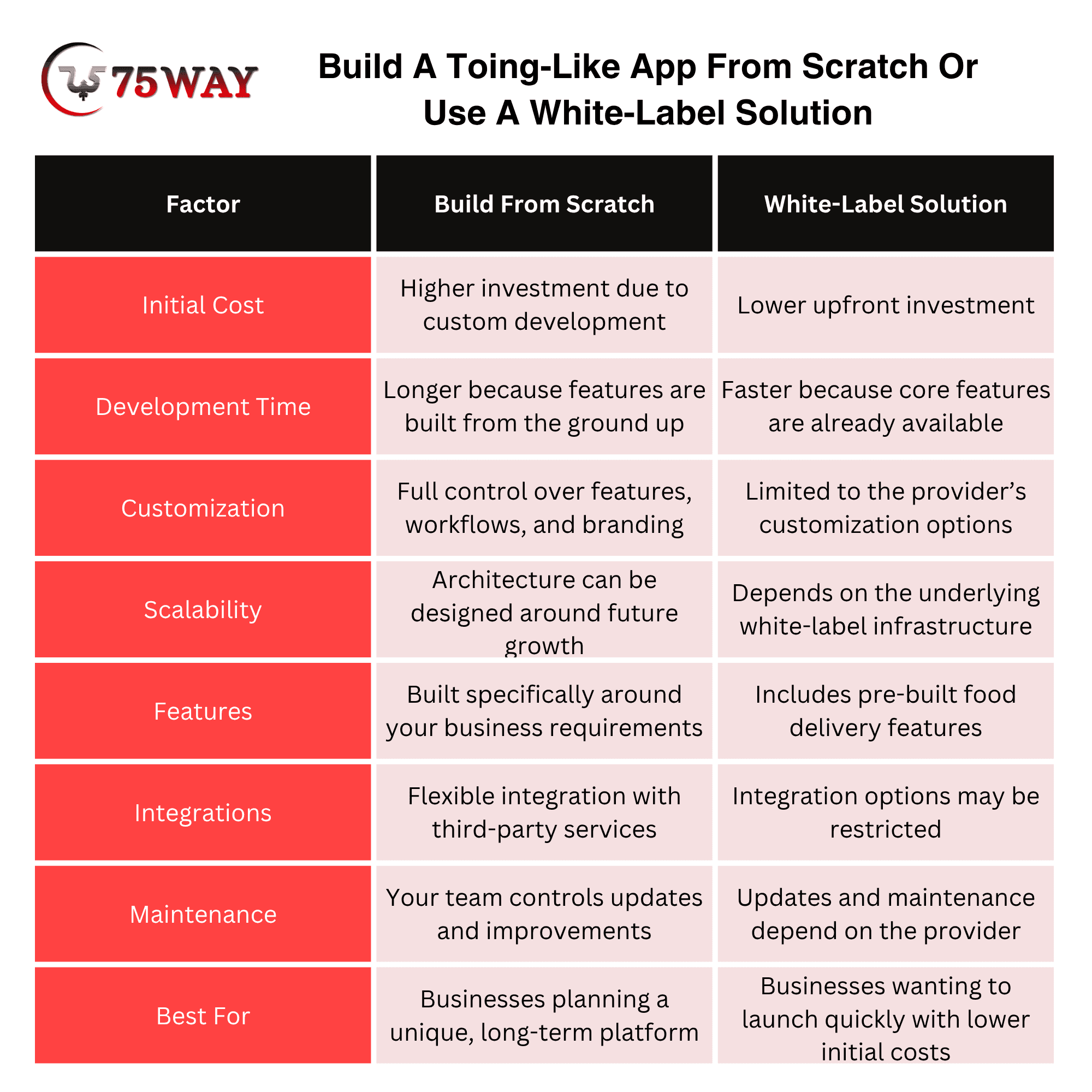
A white-label solution can help you launch faster, but it may restrict how deeply you can customize pricing, dispatch, restaurant workflows, analytics, and integrations.
A Toing-like app development from scratch gives you greater control over features, workflows, branding, integrations, and future expansion. You can design the customer, restaurant, rider, and admin experiences around your exact business model, but custom development requires more time, technical planning, testing, and investment before launch.
A white-label solution offers a faster and more affordable route to market by providing ready-made food delivery features that can be branded for your business. However, customization may be limited, especially when you need unique delivery workflows, advanced automation, or specialized integrations, making it important to compare flexibility, ownership, scalability, and long-term costs before choosing.
Final Takeaway
Building a food delivery app like Toing requires more than replicating its customer interface. You need to design a complete marketplace connecting customers, restaurants, riders, payments, delivery operations, and administration while creating a pricing or service proposition that customers genuinely value.
The smartest approach is to validate the business model in a controlled market, build the core ordering and delivery loop first, measure unit economics, and then invest in advanced technology.
The opportunity is large, with online food delivery revenue projected to reach $2.05 trillion by 2031, but the winners will not necessarily be the platforms with the most features.
They will be the ones that give customers, restaurants, and delivery partners a better economic reason to participate. To build an app like Toing, you can hire a skilled on demand app development team.
Frequently Asked Questions (FAQs)
How Much Does It Cost To Build A Food Delivery App Like Toing?
A Toing-like food delivery app can cost $15,000 – $250,000+, depending on the number of applications, features, integrations, real-time tracking, payment requirements, delivery automation, and scalability.
How Long Does It Take To Build A Food Delivery App Like Toing?
A basic MVP can take around 3–5 months, a mid-range platform around 5–8 months, and an advanced ecosystem around 8–14+ months, depending on scope and development resources.
Do I Need A Separate Rider App For Food Delivery?
A separate rider application becomes important when your platform manages its own delivery workforce. It can handle availability, order assignments, navigation, pickup, delivery confirmation, and earnings.
Can I Build A Food Delivery App Like Toing With A Small Budget?
Yes. A focused MVP costing $15,000 – $35,000 can validate the concept with core customer ordering, a simple restaurant portal, payments, and basic administration before advanced functionality is added.
How Can I Make A Toing-Like App Different From Competitors?
Focus on a specific competitive advantage, such as transparent pricing, affordable meals, local restaurants, faster neighborhood delivery, better restaurant economics, or a specialized customer segment.