AI Summary
Fleet management software can turn scattered vehicle, driver, maintenance, and operational data into actionable decisions. This guide explains what to build fleet management software, how development works, essential integrations, realistic costs, and scalability considerations. It also covers ROI and build-versus-buy decisions.
Key Takeaways
- Fleet software connects vehicles, drivers, maintenance, dispatch, compliance, and business data.
- Development costs range from $5,000 – $250,000+ based on complexity.
- Successful platforms require telematics, GPS, APIs, dashboards, security, and scalability.
- Custom development makes sense when standard fleet tools limit operations.
- Market demand could reach $47.81 billion globally by 2034.
If your fleet still depends on spreadsheets, disconnected GPS tools, manual maintenance records, or multiple systems that do not share data, the real problem is not a lack of software. It is the lack of one operational system that turns fleet data into decisions.
That distinction matters when you are deciding whether to buy an existing platform or invest in custom fleet management software development. A basic tracking dashboard is relatively straightforward.
A production-grade logistics platform must connect vehicles, drivers, dispatch, maintenance, fuel, compliance, telematics, reporting, and business systems without creating another data silo.
This guide takes a business-first and engineering-focused approach to fleet management software development.
You will learn what the software needs to solve, which modules belong in an MVP, where GPS and telematics fit into the architecture, what U.S. compliance considerations can affect the product, how much development can cost, and when building custom software is actually worth the investment.
Quick Answer: How To Develop AI-Powered Fleet Management Software?
Fleet management software development helps businesses manage vehicles, drivers, maintenance, routes, compliance, and operational data from one platform. A well-built solution can reduce manual work, improve fleet visibility, control operating costs, and support better business decisions.
However, developing a reliable fleet platform requires more than adding GPS tracking and dashboards. This guide covers the key features, development process, technology considerations, integrations, costs, and business decisions involved in building fleet management software.
What Is Fleet Management Software Development?
Fleet management software development is the process of designing and building a digital platform that helps businesses manage vehicles, drivers, maintenance, routes, fuel, compliance, assets, and operational performance through connected workflows.
A modern platform can combine:
- Web-based fleet management dashboards
- Driver and manager mobile applications
- GPS and location services
- Telematics and vehicle data
- Maintenance and work-order management
- Fuel tracking
- Route and dispatch management
- Digital inspections
- Compliance records
- Analytics and reporting
- Alerts and notifications
- Third-party integrations
The important point is that these are not isolated features.
For example, a driver completes a vehicle inspection. A failed brake inspection should not simply become a notification. The event can create a vehicle issue, change vehicle status, notify the fleet manager, generate a maintenance work order, and eventually update the vehicle's maintenance history.
That connected workflow is where the real value of custom fleet management software appears.
Fleet Management Software Market Size in USA & Worldwide
If you are considering building or investing in fleet management software, market potential matters before you commit serious money. Growing fleets, rising operating costs, and demand for real-time visibility are pushing more businesses toward digital fleet solutions. The market size and growth insights indicate whether this opportunity is worth pursuing in the USA and worldwide.
1. Market Size
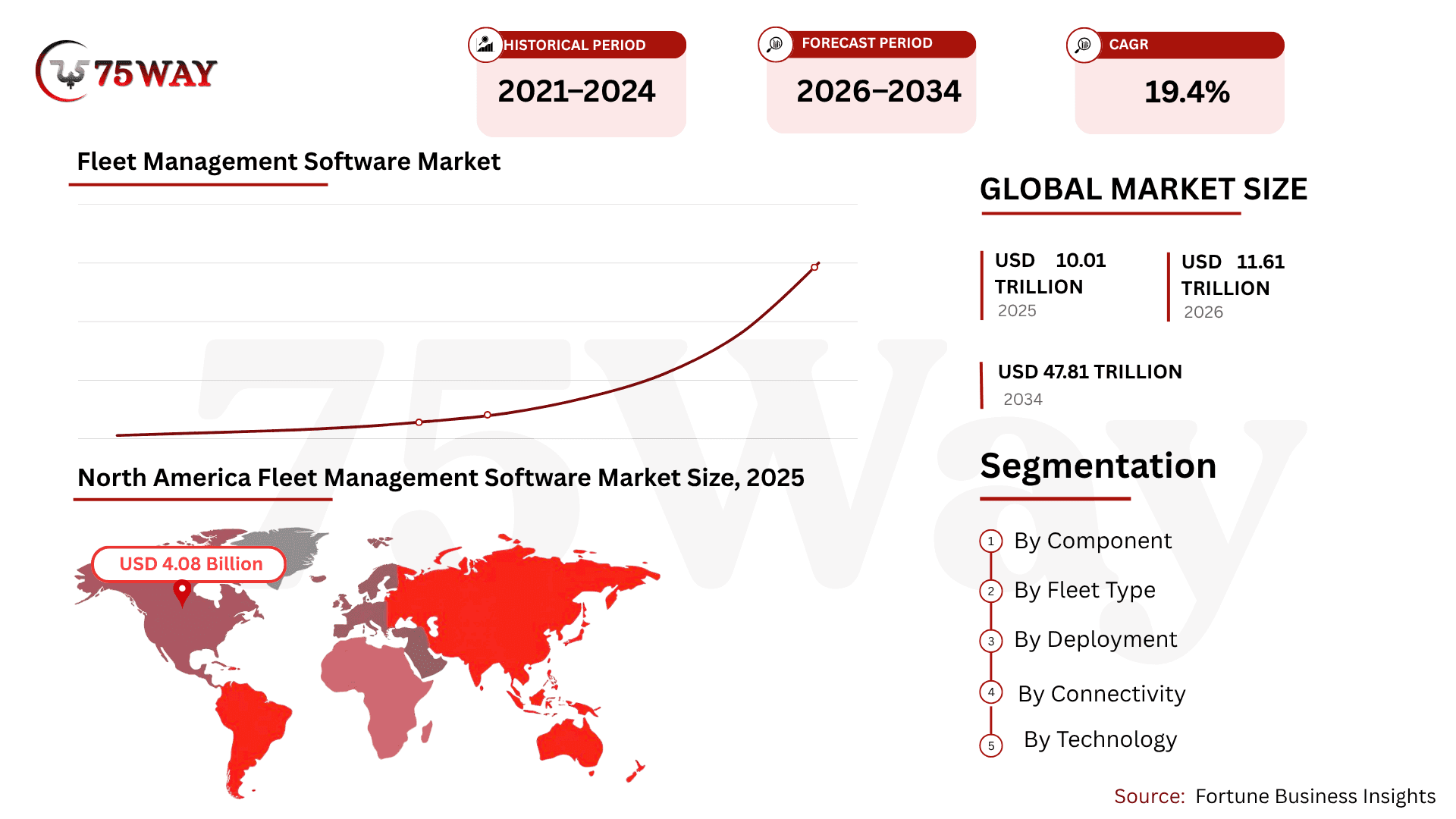
- The global fleet management software market is projected to grow from $11.61 billion in 2026 to $47.81 billion by 2034, registering a 19.4% CAGR.
- The global AMR/AGV fleet management software market is forecast to reach $5.23 billion by 2032, expanding at an 18.7% CAGR.
2. Market Share & Revenue
- North America held the leading position, accounting for 40.76% of the global fleet management software market.
- Cloud-based Software-as-a-Service (SaaS) solutions captured 63% of revenue in 2024, while hybrid solutions are projected to grow at a 20.4% CAGR through 2030.
3. Technology & Platform Trends
- Multi-vendor fleet platforms are expected to record the fastest growth, with a 20.9% CAGR.
- OEM-embedded telematics is experiencing rapid growth, with a 3.2% CAGR.
- AI and advanced analytics in fleet software are projected to expand at a 23.4% CAGR.
Businesses That Can Build A Fleet Management System
Your business does not need a massive fleet to have a fleet management problem. Once vehicles become an important part of deliveries, transportation, field services, rentals, or logistics, better visibility can directly support daily operations and costs. Different business types can use fleet management systems in very different ways, depending on how their vehicles are used.
Potential users include:
- Logistics and transportation companies
- Last-mile delivery businesses
- Field service companies
- Construction companies
- Utility operators
- Equipment rental companies
- Healthcare transportation providers
- Municipal fleets
- Food and cold-chain businesses
- Regional delivery companies
- Companies operating internal vehicle fleets
The right product strategy depends heavily on the fleet's operating model.
A 15-vehicle HVAC company does not need the same platform as a 500-vehicle logistics operator. Likewise, a refrigerated transportation business may require temperature monitoring, while a construction company may care more about equipment utilization and asset location.
The first development decision, therefore, should not be “Which features should we add?” It should be “Which operational decisions should this software improve?”
Operational Problems Addressed By Custom Fleet Management Software
Before discussing technology, define the business problems. A fleet platform should reduce friction around the activities that consume money, time, and management attention.
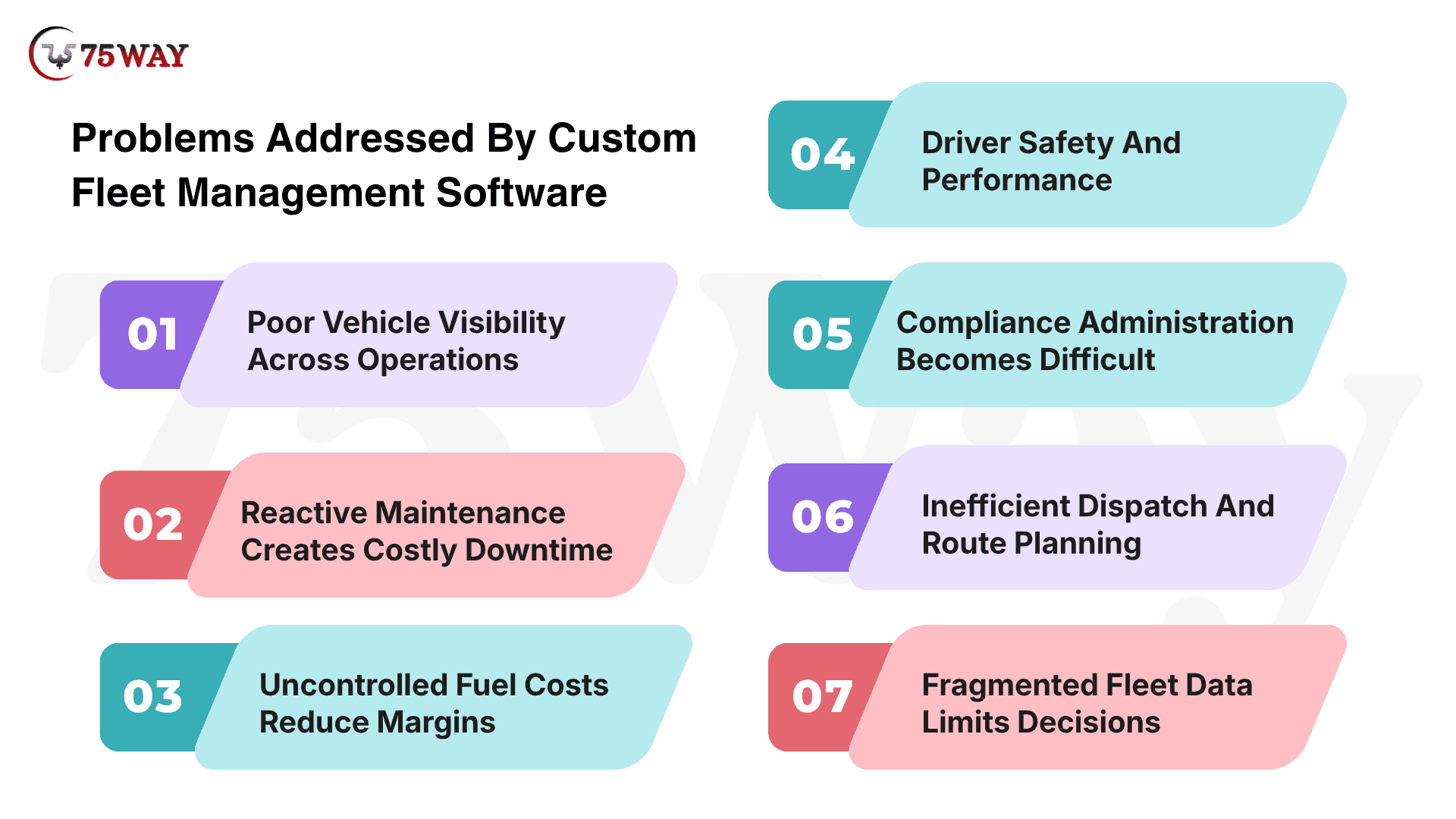
1. Poor Vehicle Visibility Across Operations
Without reliable location data, dispatchers may not know where vehicles are, whether routes are progressing as expected, or whether a vehicle has deviated from its planned route.
GPS tracking provides the foundation for real-time visibility, but the product becomes more useful when location data connects with dispatch, customer updates, geofencing, and reporting.
2. Reactive Maintenance Creates Costly Downtime
A vehicle that breaks down unexpectedly creates more than a repair bill.
It can cause:
- Missed deliveries
- Driver downtime
- Replacement vehicle costs
- Customer dissatisfaction
- Schedule disruptions
- Lost revenue
Fleet software should connect mileage, engine data, inspection results, service intervals, and work orders so maintenance becomes a managed workflow rather than a calendar reminder.
3. Uncontrolled Fuel Costs Reduce Margins
Fuel data becomes much more useful when it is associated with individual vehicles, drivers, routes, mileage, and operating conditions.
Instead of asking, “Why did fuel spending increase this month?” a fleet manager should be able to identify which vehicles or operating patterns contributed to the increase.
4. Driver Safety And Performance
Speeding, harsh braking, excessive idling, route deviations, and other driving events can be captured through compatible telematics and vehicle systems.
The goal should not simply be to collect these events.
The software should turn them into actionable workflows, such as driver coaching, alerts, safety reports, or performance trends.
5. Compliance Administration Becomes Difficult
Fleet operators may need to manage inspections, driver records, maintenance documentation, vehicle certifications, and electronic logging requirements.
For commercial operations subject to the federal ELD rule, FMCSA states that ELDs are required for commercial drivers who must maintain records of duty status, with specific technical and certification requirements.
That means compliance requirements should be considered during product discovery rather than added after development.
6. Inefficient Dispatch And Route Planning
Manual dispatching can make it difficult to assign vehicles, respond to delays, accommodate urgent jobs, and adjust routes when operating conditions change.
Fleet software can connect vehicle locations, driver availability, customer requirements, traffic conditions, and delivery priorities to help dispatchers make faster routing decisions.
7. Fragmented Fleet Data Limits Decisions
When vehicle, driver, maintenance, fuel, and route information sits across separate spreadsheets and systems, managers struggle to see the complete operational picture.
A centralized platform can connect these datasets, create unified reporting, and help decision-makers identify cost trends, utilization problems, recurring issues, and operational opportunities.
How To Build Fleet Management Software: Complete Roadmap
A fleet management idea can sound straightforward until you start connecting vehicle tracking, driver activity, maintenance, fuel, reporting, and live operational data. Each part affects how the software performs, scales, and supports real fleet decisions. The development roadmap brings these requirements together, from the initial planning stage through launch and future growth.
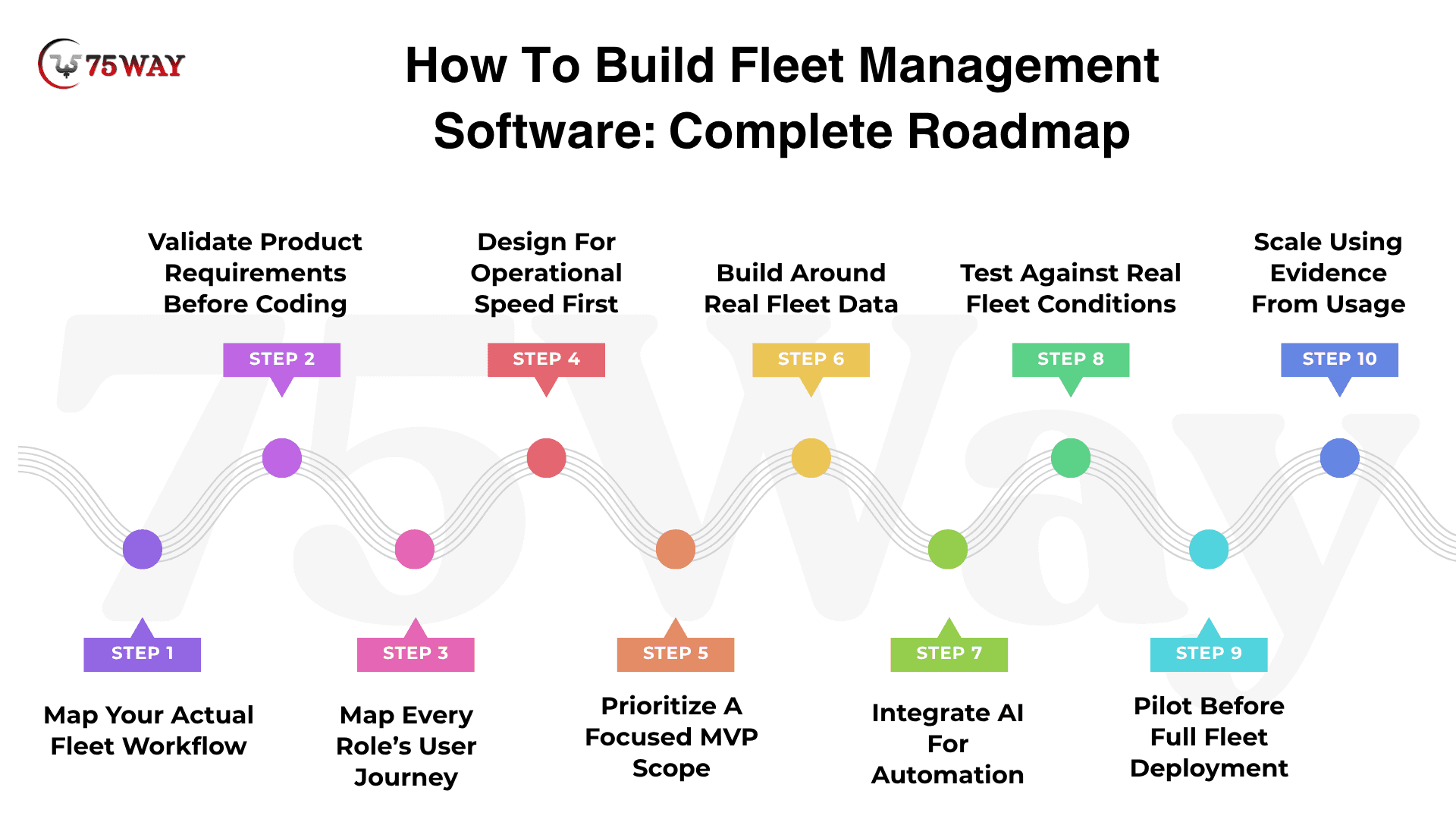
1. Map Your Actual Fleet Workflow
Your first priority should be understanding how fleet operations actually work today. A workflow map should show how dispatchers assign vehicles, how drivers complete jobs, how inspections create maintenance requests, and how managers respond to exceptions.
Your discovery should capture:
- Current operational bottlenecks
- Manual tasks worth automating
- Existing data sources
- Driver and vehicle workflows
- Common operational exceptions
- Current performance metrics
This map becomes the foundation for deciding where software and AI can create measurable value.
2. Validate Product Requirements Before Coding
Your product requirements should connect directly to the problems identified during workflow mapping. A clear PRD can define user roles, business rules, integrations, AI requirements, compliance needs, and measurable success criteria before development begins.
Your requirements should answer questions such as:
- Which fleet problems require automation?
- Which decisions need AI assistance?
- Which data sources are available?
- Which features belong in the MVP?
- Which integrations are mandatory?
A clear scope also prevents expensive features from entering development without a strong business case.
3. Map Every Role’s User Journey
Each user interacts with fleet software differently, so one generic user journey rarely works well. A dispatcher may need live vehicle visibility, while a driver needs fast mobile workflows and a fleet manager needs financial and operational insights.
Important journeys can include:
- Dispatcher → assignment → tracking → exception handling
- Driver → inspection → job → completion
- Mechanic → defect → diagnosis → repair
- Manager → dashboard → analysis → decision
AI interactions should also have a clear place in these journeys instead of appearing as disconnected tools.
4. Design For Operational Speed First
Fleet software is used during busy, time-sensitive operations, so complicated interfaces can quickly become a productivity problem. Your dispatcher dashboard, driver application, mechanic workflow, and management dashboard should each reflect the user's actual working environment.
A practical design approach includes:
- Fast access to critical actions
- Clear alert prioritization
- Mobile-first driver workflows
- Map views without unnecessary clutter
- Simple AI recommendations
- Offline support where required
The interface should help users make decisions quickly rather than make them search for information.
5. Prioritize A Focused MVP Scope
A strong MVP should solve one meaningful fleet problem rather than contain every feature competitors offer. Your first release might combine GPS tracking, dispatch, digital inspections, maintenance workflows, and one carefully selected AI capability.
A focused AI MVP could include:
- Predictive maintenance
- Route recommendations
- Driver-risk detection
- Fuel anomaly detection
- AI-powered fleet reporting
The right choice depends on available data and the business outcome you want to improve.
6. Build Around Real Fleet Data
Reliable AI depends on reliable fleet data. Your architecture should connect GPS devices, telematics providers, ELD systems, fuel platforms, maintenance records, driver activity, and other relevant sources without creating disconnected data silos.
Your technical foundation may require:
- API integrations
- Real-time telemetry pipelines
- Location and time-series storage
- Event processing
- Role-based access
- Audit logs
- Tenant isolation
Data quality also matters because inaccurate, duplicated, delayed, or incomplete records can produce unreliable AI recommendations.
7. Integrate AI Where It Matters
AI becomes valuable when its output leads to a practical fleet decision. A predictive maintenance model, for example, should identify a potential failure risk and connect that insight to an alert, maintenance task, or work order.
Different AI capabilities can support different decisions:
- Predictive models: Identify potential vehicle failures.
- Optimization models: Recommend better routes and assignments.
- Anomaly detection: Surface unusual fuel or vehicle behavior.
- Computer vision: Identify predefined driving risks.
- Natural-language analytics: Answer operational questions from fleet data.
A single measurable AI use case is usually a stronger starting point than several unfinished models.
8. Test Against Real Fleet Conditions
Testing should go beyond checking whether buttons and screens work. Fleet environments produce delayed GPS signals, duplicate telemetry, weak connectivity, device failures, incorrect data, concurrent updates, and unexpected operational conditions.
AI testing also needs attention to:
- Prediction accuracy
- False alerts
- Missing data
- Model response time
- Recommendation quality
- Data drift
- Human override handling
Realistic scenarios can expose problems that ordinary functional testing may completely miss.
9. Pilot Before Full Fleet Deployment
A controlled pilot gives you evidence before the platform reaches the entire fleet. A smaller vehicle group can reveal whether drivers actually use the application, whether telemetry is reliable, and whether AI recommendations improve the intended workflow.
Your pilot should measure:
- Feature adoption
- Data accuracy
- Alert relevance
- Driver feedback
- Operational time savings
- Maintenance or fuel improvements
A successful pilot provides the evidence needed to refine the product before broader deployment.
10. Scale Using Evidence From Usage
Your post-launch roadmap should follow actual fleet behavior rather than assumptions about what users might want next. Usage analytics, customer feedback, AI performance, infrastructure costs, and business outcomes can show which capabilities deserve further investment.
The next development phase might involve:
- More advanced predictive models
- Additional telematics integrations
- Larger fleet support
- Advanced route optimization
- AI-powered forecasting
- Automated exception management
A measured approach keeps the platform commercially useful while allowing its AI capabilities to mature alongside real fleet data.
Different Fleet Management Software Solutions For Modern Businesses
A logistics company, field service provider, rental business, and public transport operator can all manage fleets, but their software needs can be completely different. The right solution depends on the vehicles involved, daily workflows, business goals, and level of operational control required. These different solution types highlight where each approach fits best.
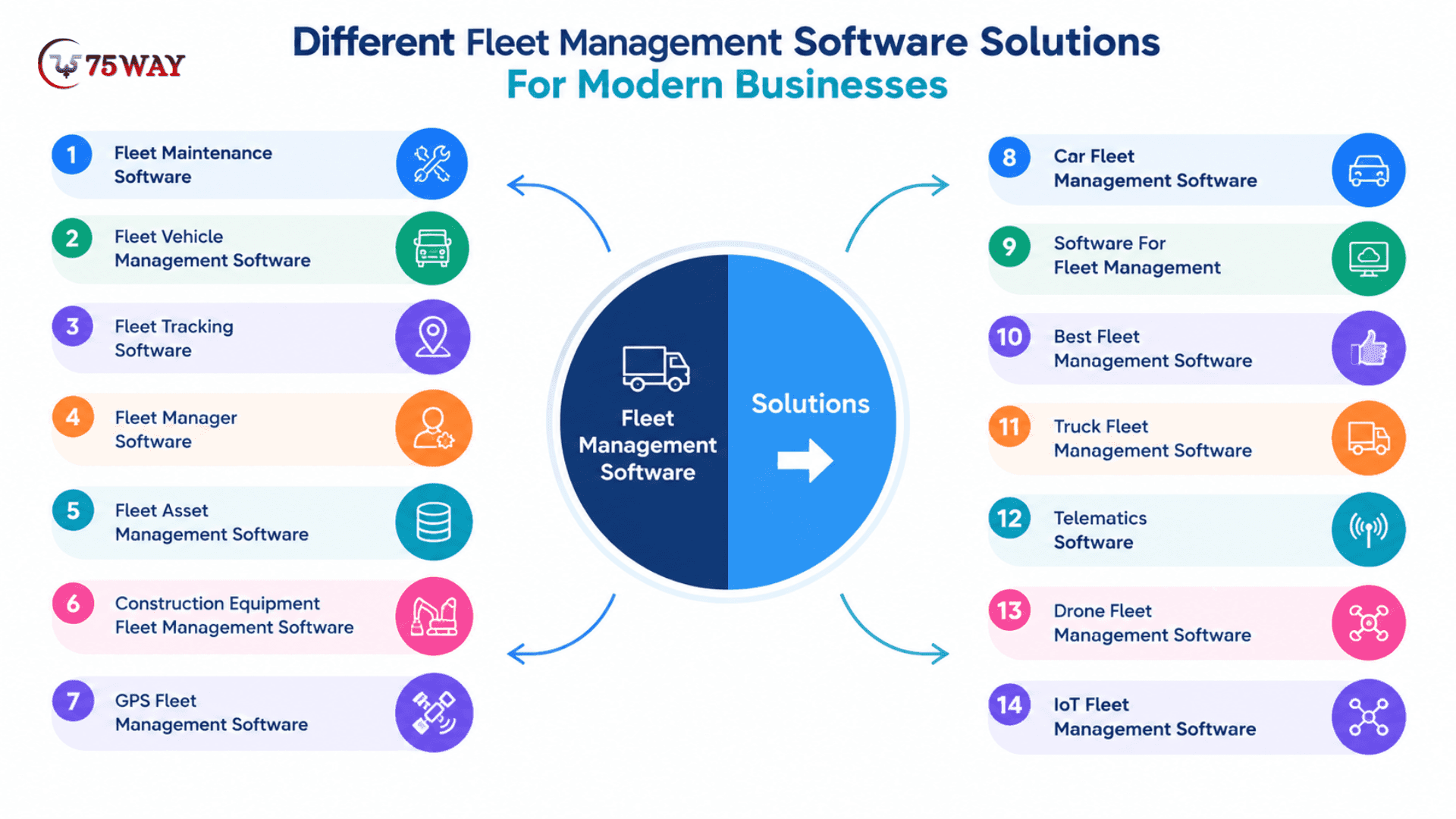
- Fleet Maintenance Software
Unexpected breakdowns can quickly turn a manageable maintenance budget into lost working hours, missed jobs, and expensive repairs.
Fleet maintenance software brings inspections, servicing, repairs, parts, and work orders together, helping teams spot upcoming maintenance needs before vehicles become unavailable. AI can go a step further by studying mileage, diagnostics, and repair history to flag vehicles showing early signs of trouble.
Estimated Cost: $20,000 – $100,000+
- Fleet Vehicle Management Software
Managing dozens or hundreds of vehicles through spreadsheets becomes difficult when assignments, documents, servicing, and expenses keep changing.
A centralized platform gives managers a clearer picture of vehicle availability, utilization, operating costs, maintenance schedules, and ownership records. AI can highlight unusual expenses, underused vehicles, and other patterns that may otherwise take hours to discover manually.
Estimated Cost: $25,000 – $120,000+
- Fleet Tracking Software
Knowing where every vehicle is can make a major difference when dispatchers are handling delays, urgent jobs, or customer updates.
Fleet tracking software provides live locations alongside route history, stops, idle periods, geofences, and route deviations. AI can analyze historical movement to identify recurring delays, inefficient routes, and unusual vehicle activity.
Estimated Cost: $15,000 – $80,000+
- Fleet Manager Software
Fleet managers often spend too much time switching between systems just to understand what is happening across their operation.
A dedicated platform brings vehicles, drivers, maintenance, fuel, expenses, compliance, and operational reports into one workspace. AI-powered dashboards can then prioritize important exceptions, helping managers focus on decisions instead of searching through data.
Estimated Cost: $25,000 – $140,000+
- Fleet Asset Management Software
Vehicles are not the only assets that businesses need to keep track of across multiple locations and teams.
Fleet asset management software can monitor equipment location, assignments, utilization, maintenance, operating condition, and replacement requirements throughout each asset’s lifecycle. Connected IoT and telematics data can provide even deeper visibility into how those assets are being used.
Estimated Cost: $30,000 – $150,000+
- Construction Equipment Fleet Management Software
Construction companies can lose money when expensive equipment sits idle at one site while another project needs the same machinery.
A dedicated platform can track excavators, loaders, cranes, trucks, generators, and other equipment across job sites while monitoring utilization, fuel, operating hours, maintenance, and assignments. IoT sensors and AI can reveal underused equipment, unusual usage, and potential maintenance problems before they disrupt projects.
Estimated Cost: $35,000 – $160,000+
- GPS Fleet Management Software
A GPS signal becomes far more valuable when businesses can turn location data into operational decisions.
GPS fleet management software can combine live tracking with route history, geofencing, stop monitoring, dispatch workflows, and driver visibility. AI can study location patterns to uncover inefficient routes, recurring congestion points, unexpected stops, and other opportunities to improve fleet movement.
Estimated Cost: $20,000 – $100,000+
- Car Fleet Management Software
Company cars and service vehicles still create plenty of administrative work when assignments, maintenance, fuel, inspections, and driver records are handled separately.
A car fleet management platform keeps those activities connected while giving managers a clearer view of vehicle availability and operating costs. AI can identify unusual driving patterns, rising expenses, and maintenance risks that deserve closer attention.
Estimated Cost: $20,000 – $100,000+
- Software For Fleet Management
Businesses looking for one platform instead of several disconnected fleet tools can build a system around their complete operational workflow.
Tracking, dispatch, maintenance, fuel, driver management, compliance, reporting, and third-party integrations can all work together within the same environment. AI can then be introduced where it solves a measurable problem, such as predicting failures, detecting anomalies, or improving route decisions.
Estimated Cost: $30,000 – $180,000+
- Best Fleet Management Software
A long feature list does not automatically make fleet software the right choice for a business. The better solution depends on fleet size, operating model, required integrations, workflows, and the decisions managers need to make every day.
Custom development becomes particularly valuable when standard products cannot support important processes or the business wants deeper automation and AI capabilities.
Estimated Cost: $30,000 – $200,000+
- Truck Fleet Management Software
Every unnecessary mile, idle hour, breakdown, or poorly planned trip can add pressure to a trucking operation’s margins.
Truck fleet management software connects tracking, route planning, driver management, inspections, maintenance, fuel monitoring, and ELD-related workflows to give operators better control over daily operations. AI can support predictive maintenance, route recommendations, driver-risk analysis, and demand forecasting as the platform matures.
Estimated Cost: $30,000 – $180,000+
- Telematics Software
Modern vehicles generate a constant stream of information, but raw vehicle data has little value if businesses cannot turn it into useful decisions. Telematics software collects information such as GPS location, mileage, engine diagnostics, fuel usage, and driving events and makes it accessible through dashboards, alerts, and integrations.
AI can analyze these data streams to detect anomalies, predict vehicle issues, and uncover patterns across the fleet.
Estimated Cost: $40,000 – $200,000+
- Drone Fleet Management Software
Managing a few drone missions manually may work at first, but larger commercial operations quickly need better coordination between aircraft, pilots, missions, batteries, and maintenance.
Drone fleet management software brings these activities together while supporting flight scheduling, telemetry, mission planning, and operational records. AI can add capabilities such as automated route planning, image analysis, anomaly detection, and predictive maintenance.
Estimated Cost: $40,000 – $200,000+
- IoT Fleet Management Software
Sensors can tell a fleet manager much more than where a vehicle is. IoT fleet management software can collect real-time information about temperature, fuel levels, engine conditions, equipment usage, location, and other operating conditions, creating a richer picture of fleet performance.
AI can process these continuous data streams to identify anomalies, predict maintenance needs, and trigger alerts when something requires attention.
Estimated Cost: $40,000 – $200,000+
Core Features Required For Fleet Vehicle Management Software Development
A map showing where your vehicles are is useful, but it is hardly enough to manage a real fleet. Managers also need timely information about vehicle health, fuel usage, driver activity, routes, documents, and operating costs. The capabilities built into the software determine how much control businesses actually gain from their fleet management investment.
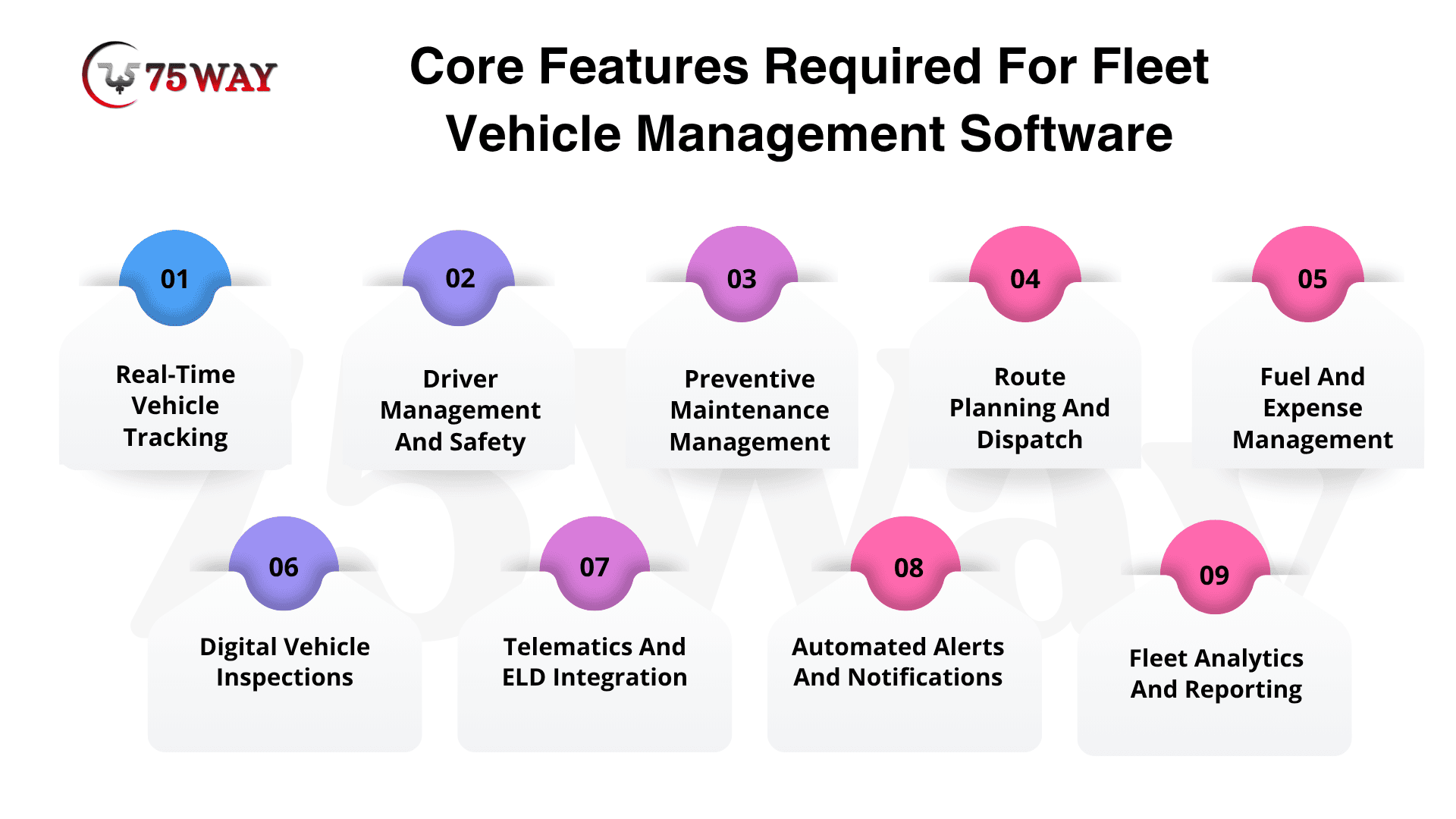
- Real-Time Vehicle Tracking
Vehicle tracking gives fleet managers a live view of where vehicles are and how they are moving throughout the day. Instead of calling drivers for updates, dispatchers can monitor routes, stops, idle periods, and unexpected deviations from a centralized dashboard.
Historical location data can then help businesses review routes, investigate delays, and understand how vehicles are being utilized.
- Driver Management And Safety
Driver management brings licenses, assignments, certifications, safety records, and performance information into one accessible profile.
When connected with telematics, the system can also identify speeding, harsh braking, excessive idling, and other driving events that may require attention. Managers can use these insights to coach drivers, recognize safer driving patterns, and build a stronger fleet safety program.
- Preventive Maintenance Management
Maintenance software helps fleet teams move from fixing vehicles after breakdowns to planning service before problems become expensive. Managers can schedule maintenance based on mileage, engine hours, inspection results, manufacturer recommendations, or other business rules.
A connected maintenance workflow can turn a reported defect into a work order, assign it to a technician, record the repair, and update the vehicle's service history.
- Route Planning And Dispatch
Route planning helps dispatchers assign the right vehicle and driver to each job while accounting for operational requirements.
Depending on the platform, routing can consider traffic, delivery windows, vehicle capacity, driver availability, and customer priorities. Once vehicles are on the road, dispatchers can monitor progress and adjust assignments when unexpected delays or new jobs appear.
- Fuel And Expense Management
Fuel costs can quickly become one of the largest recurring expenses for a fleet, making visibility essential for controlling margins.
Fleet software can connect fuel transactions with vehicles, drivers, mileage, routes, and operating conditions to reveal unusual consumption or spending patterns. Managers can then compare vehicle performance, investigate anomalies, and understand the real operating cost of their fleet.
- Digital Vehicle Inspections
Digital inspections replace paper forms with structured workflows that drivers and technicians can complete from mobile devices.
A driver can record defects, attach photographs, add notes, and submit an inspection without returning to the office. If a safety or maintenance issue is identified, the platform can automatically route it to the appropriate person for review and corrective action.
- Telematics And ELD Integration
Telematics integration allows fleet software to collect data directly from compatible vehicle devices instead of relying entirely on manual updates.
Depending on the provider, this can include GPS location, mileage, engine diagnostics, fuel information, driving events, and other vehicle data. ELD integrations can also support applicable hours-of-service workflows, making third-party connectivity an important consideration for commercial fleet platforms.
- Automated Alerts And Notifications
Fleet managers cannot watch every vehicle, driver, maintenance task, and compliance deadline throughout the day.
Automated alerts bring important exceptions to their attention when predefined conditions occur, such as speeding, route deviations, geofence events, maintenance requirements, or inspection problems.
The value comes from connecting each alert to an action, rather than simply generating another notification for users to ignore.
- Fleet Analytics And Reporting
Fleet analytics turns thousands of individual operational events into information business owners can actually use. Instead of reviewing separate spreadsheets for fuel, maintenance, vehicles, and drivers, managers can see performance trends through centralized dashboards and reports.
These insights can reveal underused vehicles, rising maintenance expenses, inefficient routes, excessive downtime, and other opportunities to improve fleet profitability.
Innovative Features of AI-Powered Fleet Management Software Development
Vehicle tracking tells you where your fleet is, but advanced software can tell you what may happen next. Predictive maintenance, AI-powered insights, fuel analysis, driver scoring, and intelligent route planning can help managers spot problems before they become expensive. The advanced capabilities that make this possible can give fleet businesses a much deeper level of operational visibility.
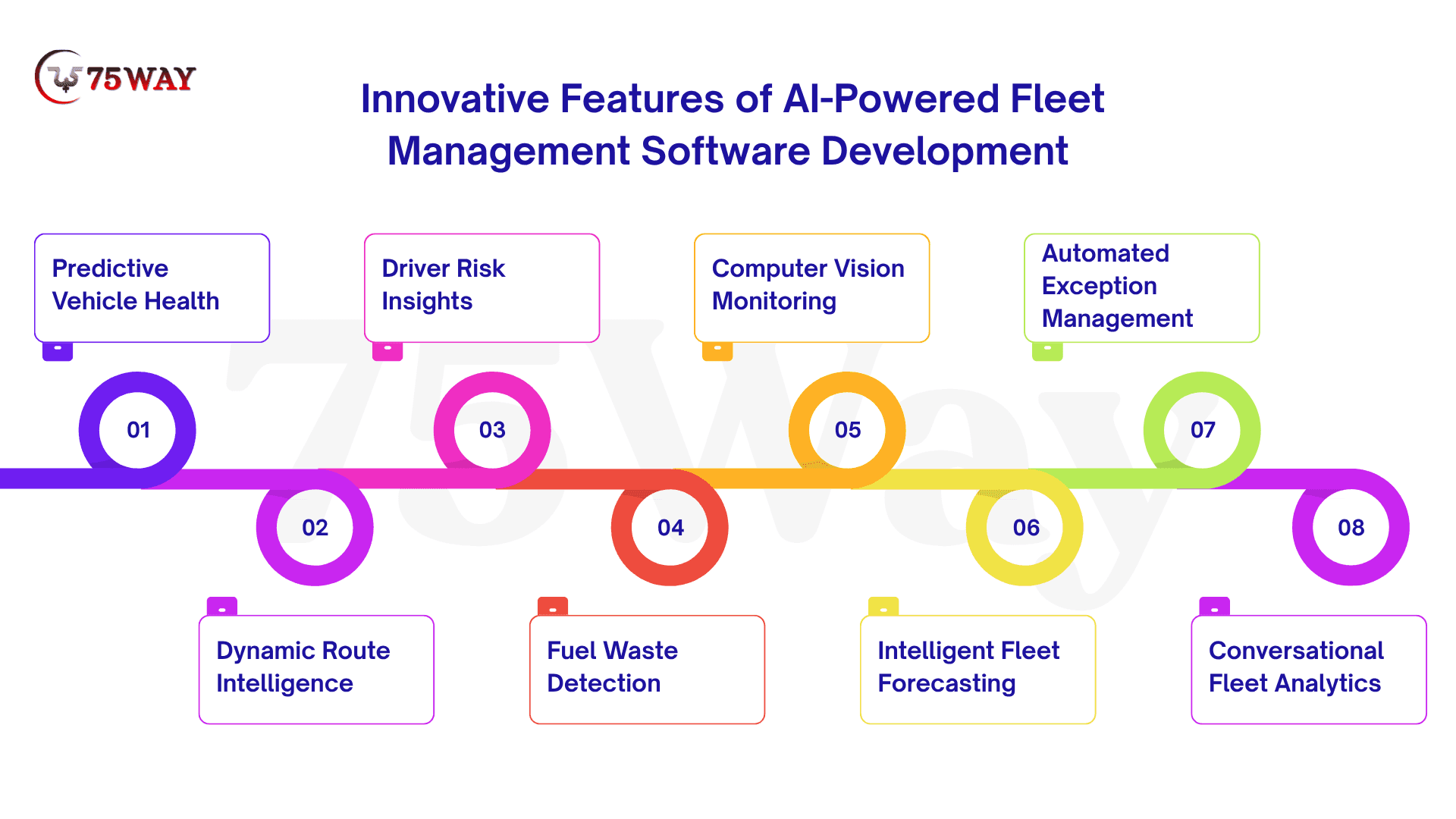
- Predictive Vehicle Health
Instead of waiting for a vehicle to fail, predictive models can examine diagnostic codes, mileage, service history, and sensor patterns for early warning signals. The platform can flag vehicles that may need attention and explain which factors contributed to the risk.
- Dynamic Route Intelligence
Routes can change quickly when traffic builds, deliveries are added, vehicles become unavailable, or customers change requirements. Intelligent routing can continuously evaluate these variables and recommend practical alternatives instead of relying on one route created at the start of the day.
- Driver Risk Insights
A single speeding event rarely tells the whole story about a driver's behavior. By examining patterns across speed, braking, acceleration, idling, and trip history, the software can highlight recurring risks and help managers focus coaching where it matters.
- Fuel Waste Detection
Fuel analytics becomes more powerful when software can recognize unusual consumption rather than simply display fuel figures. The system can compare fuel behavior against mileage, routes, vehicle condition, and driving patterns to surface potential waste or anomalies.
- Computer Vision Monitoring
Cameras and computer vision can help identify events such as distracted driving, unsafe following distances, lane-related behavior, or other predefined visual risks. Instead of requiring managers to manually review hours of footage, the system can prioritize potentially important incidents.
- Intelligent Fleet Forecasting
Fleet demand rarely remains constant throughout the year, making capacity planning difficult for growing operations. Predictive models can analyze historical jobs, seasonal demand, locations, and utilization to help businesses anticipate vehicle requirements before demand peaks.
- Automated Exception Management
Fleet managers cannot manually investigate every delayed route, idle vehicle, maintenance warning, or unusual transaction. Intelligent rules can identify significant exceptions, rank them by urgency, and trigger the appropriate workflow so teams spend time solving problems rather than searching for them.
- Conversational Fleet Analytics
Business owners should not need a data analyst to answer simple operational questions. A natural-language interface can let users ask questions such as “Which vehicles had the highest maintenance costs this quarter?” and return relevant data, comparisons, and trends.
Cost To Develop A Fleet Management Software: Pricing Details
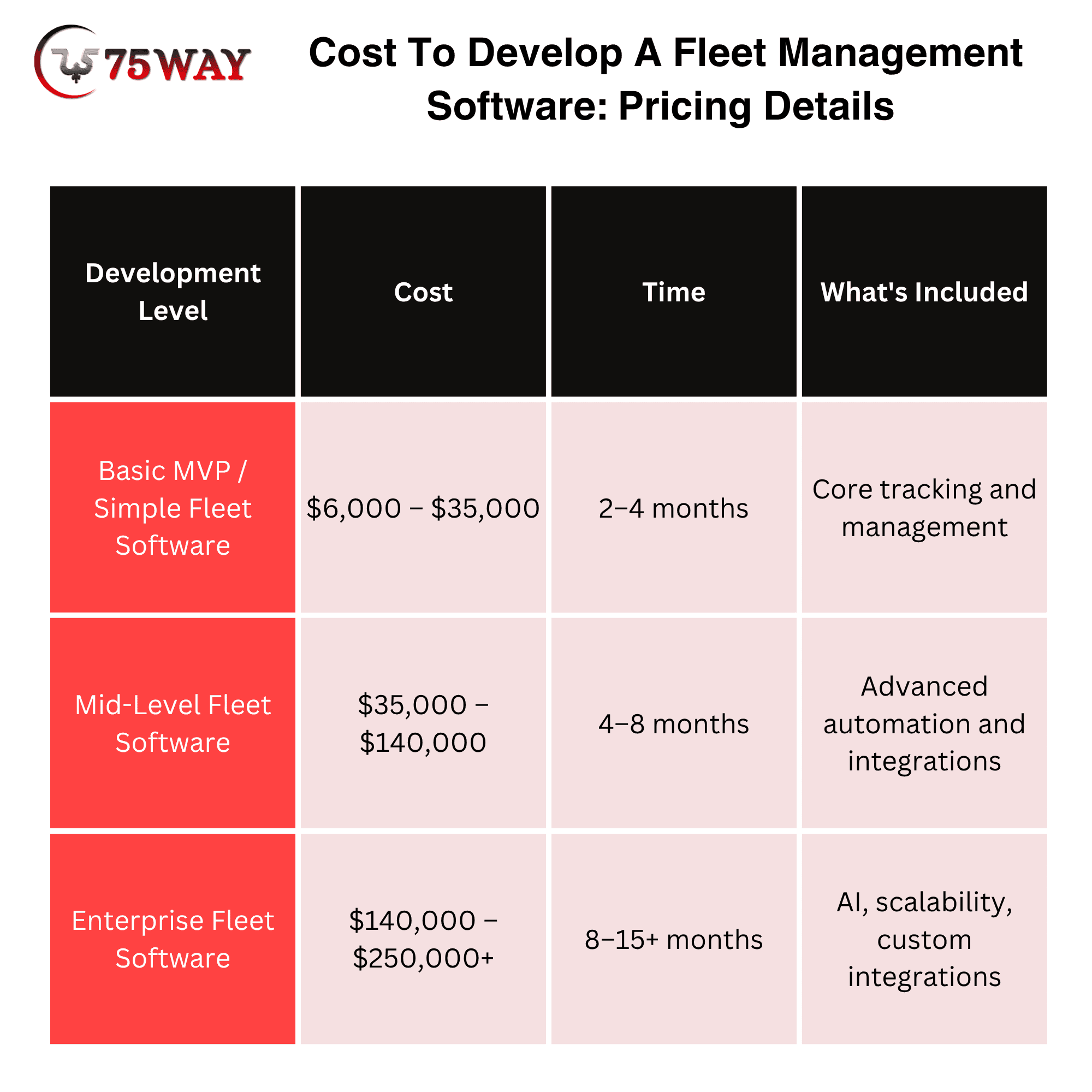
There is no single development price because fleet software can range from a focused internal MVP to a large, multi-platform enterprise system. There is no single development price because fleet software can range from a focused internal MVP to a large, multi-platform enterprise system. Across different project scopes, a practical overall planning range is $5,000–$250,000+. The final cost depends on the functionality, integrations, platforms, architecture, data volume, security requirements, and development team.
1. Basic MVP / Simple Fleet Software: $6,000 – $35,000
Suitable for startups validating a fleet software idea with essential tracking, driver, and vehicle management capabilities.
- GPS tracking, vehicle profiles, basic driver management
- Simple dashboards, alerts, and fleet reporting
- Limited integrations with essential third-party systems
Timeline: 2–4 months
2. Mid-Level Fleet Software: $35,000 – $140,000
Designed for growing fleets requiring broader automation, integrations, analytics, and more sophisticated operational workflows.
- Advanced dispatch, maintenance, fuel, and route management
- Multiple integrations with telematics and business systems
- AI-powered insights, automation, and predictive capabilities
Timeline: 4–8 months
3. Enterprise Fleet Software Cost: $140,000 – $250,000+
Built for large fleets needing highly scalable infrastructure, complex integrations, advanced AI, and customized workflows.
- Multi-tenant architecture with advanced access controls
- Real-time telemetry, analytics, automation, and AI
- Custom integrations, compliance workflows, enterprise-grade security
Timeline: 8–15+ months
Factors Affecting Custom Fleet Management Software Development Cost
- Number of Platforms: Web-only development costs less than a web dashboard plus driver and manager mobile applications.
- GPS and Telematics: Device integrations introduce additional API, data-processing, testing, and infrastructure requirements.
- Integrations: Every third-party integration can add discovery, development, authentication, testing, and maintenance work.
- Real-Time Data: High-frequency location and telemetry data require more sophisticated infrastructure than standard business records.
- Compliance: Regulatory workflows can require specialized requirements analysis, auditability, permissions, and data retention.
- AI and Predictive Analytics: AI becomes more expensive when it requires data pipelines, model development, monitoring, and continuous improvement.
- Security: Enterprise authentication, permissions, auditing, encryption, and infrastructure requirements increase development scope.
- Scale: Supporting 20 vehicles and supporting thousands of vehicles are very different engineering problems.
Cost to Hire Fleet Management Software Developers Based on Location
Hiring fleet management software developers can cost very different amounts depending on where your development team is based. Developer rates vary across countries and regions because of differences in experience, technical expertise, market demand, and operating costs. Location-based rates give you a clearer idea of how much you may need to budget for the right development team.
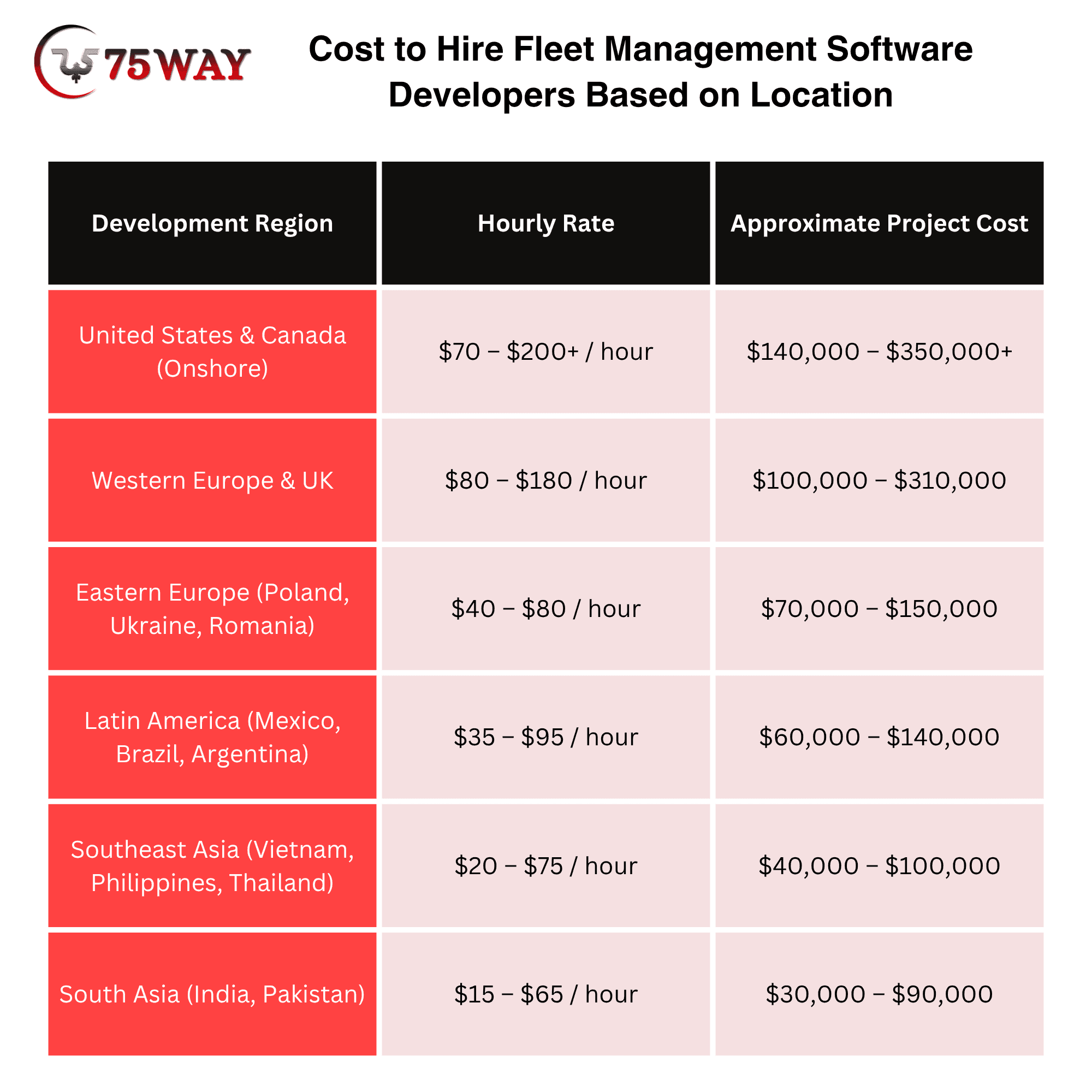
A lower hourly rate does not automatically produce a lower total cost. Architecture quality, project management, domain knowledge, communication, integration experience, and rework can materially affect the final budget.
How to Keep Fleet Software Development Costs Under Control
The smartest cost strategy is not simply choosing the cheapest development team. It is reducing unnecessary scope.
1. Start With One Operational Problem
Instead of building “a complete fleet platform,” start with a specific business objective.
For example: reduce vehicle downtime by connecting inspections, maintenance alerts, and work orders. That creates a measurable product direction.
2. Build an MVP
Avoid implementing every advanced feature at launch. Start with the workflows users need every day.
3. Integrate Instead of Rebuilding
If an established provider already supplies GPS, mapping, payments, or telematics functionality, evaluate integration before developing an equivalent system internally.
4. Design for Expansion
Your MVP should not become throwaway code. Use an architecture that allows future modules to be added without rewriting the entire platform.
5. Validate With Real Users
Testing with actual fleet managers, dispatchers, drivers, and mechanics can prevent expensive development decisions based on assumptions.
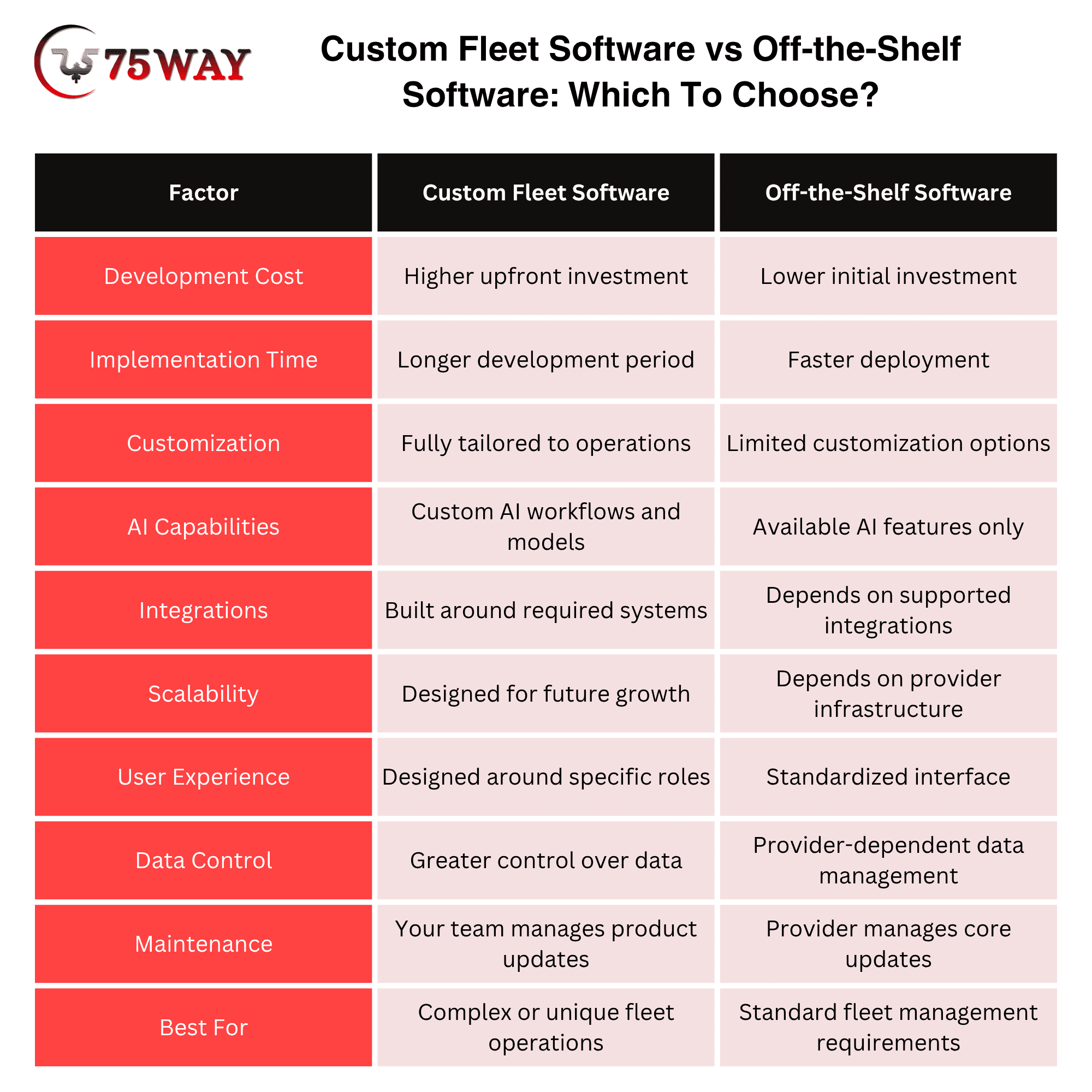
Custom Fleet Software vs Off-the-Shelf Software: Which To Choose?
Custom fleet software is built around your company’s specific workflows, data, integrations, and growth plans, while off-the-shelf software offers predefined features designed for broader fleet requirements. Custom development gives you greater control over AI capabilities, automation, user roles, reporting, and integrations, but requires a higher upfront investment and longer development timeline.
Off-the-shelf software can be faster and more affordable to deploy, making it suitable when your operational requirements closely match the available features. However, customization may be limited, and adding specialized workflows or advanced AI capabilities can become difficult as your fleet grows, so the better choice depends on your operational complexity and long-term goals.
When Custom Fleep Management Software Development Makes Sense
Custom development is worth considering when:
- Your workflows are highly specialized.
- Existing software cannot support important processes.
- You need deep integrations.
- Fleet data is central to your competitive advantage.
- You need control over product direction.
- You expect significant fleet growth.
- You want to commercialize the software as SaaS.
- Existing subscription costs become difficult to justify at scale.
When Buying Fleet Management Software May Be Better
An off-the-shelf product can make more sense when:
- Your fleet is relatively small.
- Your requirements are standard.
- You need software quickly.
- You do not have internal technical resources.
- Standard GPS, maintenance, reporting, and driver features are enough.
Custom development should not be treated as automatically superior.
If an existing product solves 90% of your operational problem at a reasonable cost, building from scratch may create unnecessary risk.
How to Choose a Fleet Management Software Development Company
Do not evaluate vendors only by their portfolio screenshots. Ask how they would solve your actual fleet architecture. A capable development partner should be able to discuss:
- GPS data ingestion
- Telematics APIs
- Mobile workflows
- Real-time dashboards
- Data architecture
- Fleet-specific integrations
- Security
- Compliance requirements
- Testing strategy
- Scalability
- Post-launch support
Ask prospective custom fleet management software development development partners:
- Have you built software involving GPS or telematics data?
- How would you handle high-frequency vehicle location events?
- Which parts of the platform should be real-time?
- How would you design offline mobile workflows?
- How would you integrate an ELD or telematics provider?
- How would you separate fleet-manager and driver permissions?
- How would you test the system under fleet-scale load?
- What should be included in the MVP?
- Which integrations could create project risk?
- How would the architecture support future growth?
The quality of these answers tells you more than a generic claim of “years of experience.”
Final Takeaway
Fleet management software development is not primarily about building another GPS tracking application. The real product is the operational layer that connects vehicles, drivers, maintenance, dispatch, compliance, telematics, and business intelligence into workflows people can actually use.
For a small fleet with standard requirements, buying existing software may be the smarter decision. For businesses with specialized workflows, complex integrations, significant fleet growth, or a plan to commercialize a fleet platform, custom development can provide substantially more control.
The strongest development strategy is to start with the operational problem, define a focused MVP, validate it with real users, build the architecture around actual data requirements, and expand only when the business case supports it.
If you want to invest in a fleet management platform, start with a discovery-led MVP and contact a professional logistics software development firm.
Frequently Asked Questions (FAQs)
What Is Fleet Management Software Development?
Fleet management software development is the process of building software that manages vehicles, drivers, routes, maintenance, fuel, compliance, telematics, and operational data through connected digital workflows.
How Much Does Fleet Management Software Development Cost?
Fleet management software development can range from $5,000 – $250,000+, depending on features, integrations, platforms, data volume, security requirements, architecture, and development complexity.
What Is The Cost of A Fleet Management MVP?
A basic MVP or simple fleet management software project can cost approximately $6,000 – $35,000, depending on the required workflows and integrations.
How Long Does It Take To Build Fleet Management Software?
Development time depends on product scope, integrations, mobile requirements, testing, and architecture. A focused MVP generally takes substantially less time than an enterprise platform with telematics, AI, and complex integrations.
Should I Build Custom Fleet Management Software Or Buy SaaS?
Custom software makes more sense when your workflows, integrations, compliance requirements, or scalability needs are not well served by existing products. Standard fleets may benefit more from ready-made SaaS.
Does Fleet Management Software Need GPS Tracking?
Not every fleet platform requires GPS, but GPS is valuable for businesses that need vehicle visibility, route monitoring, geofencing, dispatch support, or location-based analytics.
What Makes Fleet Management Software Different From A GPS Tracking App?
GPS tracking focuses primarily on location. Fleet management software connects location with maintenance, drivers, inspections, fuel, routing, compliance, reporting, and broader operational workflows.