AI Summary
Hiring the right full stack developers can determine whether your logistics platform scales or struggles. This guide covers essential features, architecture, integrations, costs, timelines, and technical skills. You will also learn practical hiring considerations. Use these insights before development begins.
Key Takeaways
- Hire developers experienced in logistics workflows, fleet technology, and scalable platforms.
- Prioritize dispatch, tracking, routing, drivers, vehicles, and customer workflows first.
- Evaluate GPS, telematics, ELD, mapping, payment, and enterprise integration experience.
- Compare development costs according to platform complexity, integrations, and requirements.
- Build your hiring strategy around scalability, security, architecture, and business goals.
If your logistics business still depends on disconnected systems, manual dispatching, spreadsheets, or delayed fleet visibility, scaling operations becomes harder and more expensive.
Hiring full-stack developers for logistics and fleet management platforms can help you bring orders, drivers, vehicles, routes, dispatch, customers, and operational data into one connected ecosystem.
But hiring developers for logistics software is different from hiring a general-purpose web development team. Your developers need to understand real-time data, transportation workflows, GPS tracking, mobile operations, third-party APIs, scalability, and the business rules behind fleet operations.
This guide explains what full-stack developers can build, which capabilities to evaluate, what a logistics platform should include, expected development considerations, and how to choose the right logistics platform development team.
Why Hire Full-Stack Logistics Software Developers To Build Fleet Management Platforms?
Fleet software rarely stays limited to vehicle tracking once a business starts adding dispatch, delivery, driver, customer, and reporting requirements. A developer who can handle both the product interface and server-side functionality can reduce the handoffs involved in building these connected experiences. The business value of hiring full-stack expertise becomes clearer through the discussion below.
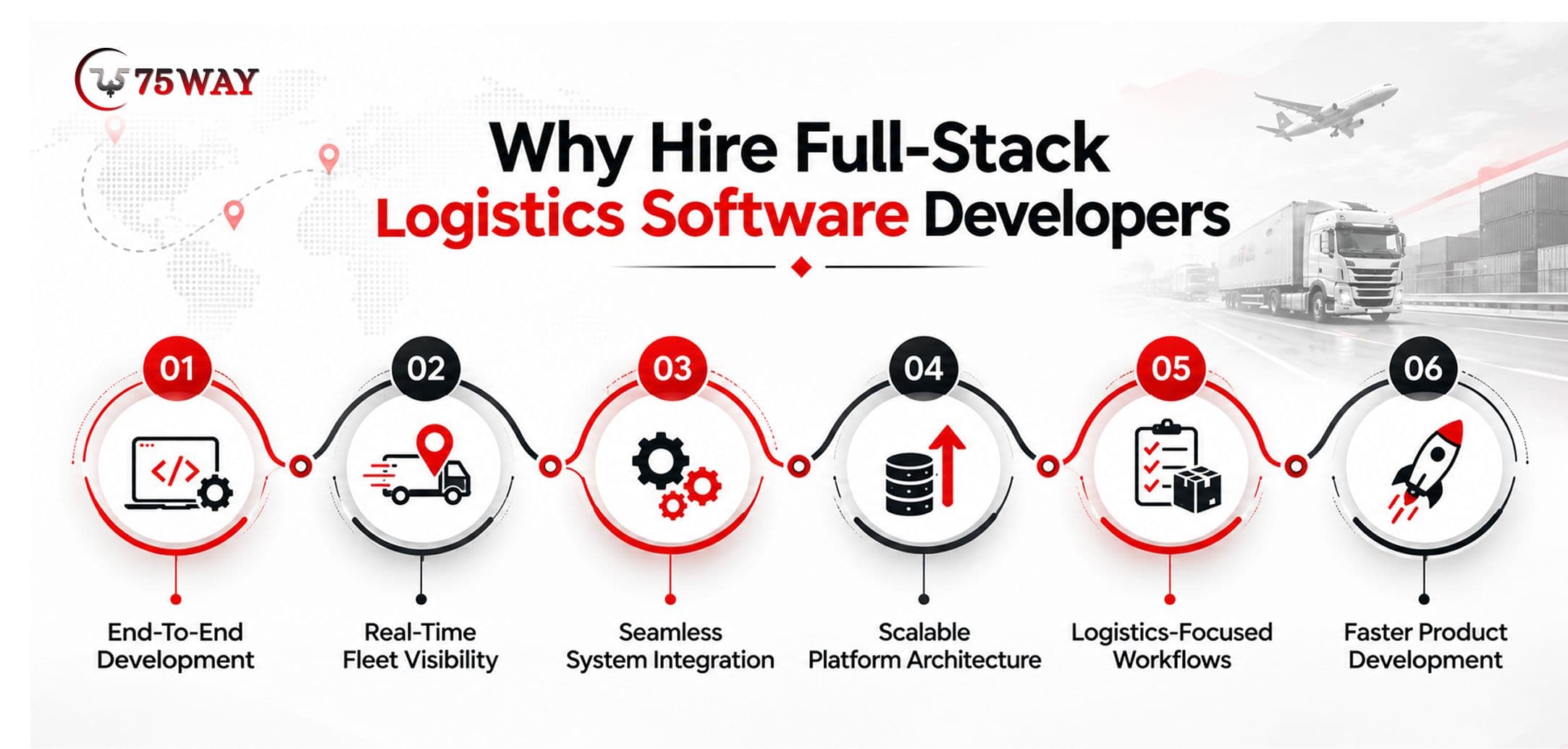
- End-To-End Development: Full-stack developers can build your logistics platform across frontend, backend, databases, APIs, and connected applications.
This creates better coordination between dispatchers, drivers, customers, and fleet managers without relying on disconnected development teams. It also makes it easier to maintain and expand the platform as your operational needs grow.
- Real-Time Fleet Visibility: Developers can connect GPS, telematics, mapping, and location services to provide current vehicle and shipment information.
Dispatchers can monitor fleet movement, delivery progress, delays, and exceptions from a centralized platform. Better visibility helps teams respond to operational changes before they create larger disruptions.
- Seamless System Integration: Logistics businesses often depend on TMS, ELD, ERP, payment, accounting, mapping, and communication systems.
Full-stack engineers can connect these systems through APIs while managing authentication, data synchronization, webhooks, and integration failures. This reduces duplicate data entry and helps information move between systems more reliably.
- Scalable Platform Architecture: Full stack developers can design your platform around expected growth in vehicles, users, shipments, transactions, and real-time data.
They can structure databases, APIs, caching, and infrastructure to support increasing workloads. Planning scalability early can reduce the need for expensive architectural changes as your platform expands.
- Logistics-Focused Workflows: Developers with transportation experience can build workflows around dispatching, route planning, driver assignments, deliveries, vehicle maintenance, and shipment tracking.
They can translate operational requirements into practical software instead of forcing your business into generic workflows. This helps the platform fit how your teams actually work.
- Faster Product Development: Full-stack developers can contribute across frontend interfaces, backend services, APIs, databases, and integrations within the same project.
Fewer handoffs can simplify communication when requirements change or technical issues cross multiple layers. This can help startups and growing businesses move from concept to a usable logistics product more smoothly.
What Can Full-Stack Engineers Build For A Logistics Platform?
One logistics business may need a driver application, while another may require an entire fleet management ecosystem. Full-stack logistics engineers can build the interfaces, backend logic, databases, and integrations needed to support these different operational models. The range of platforms they can develop becomes clearer in the discussion below.
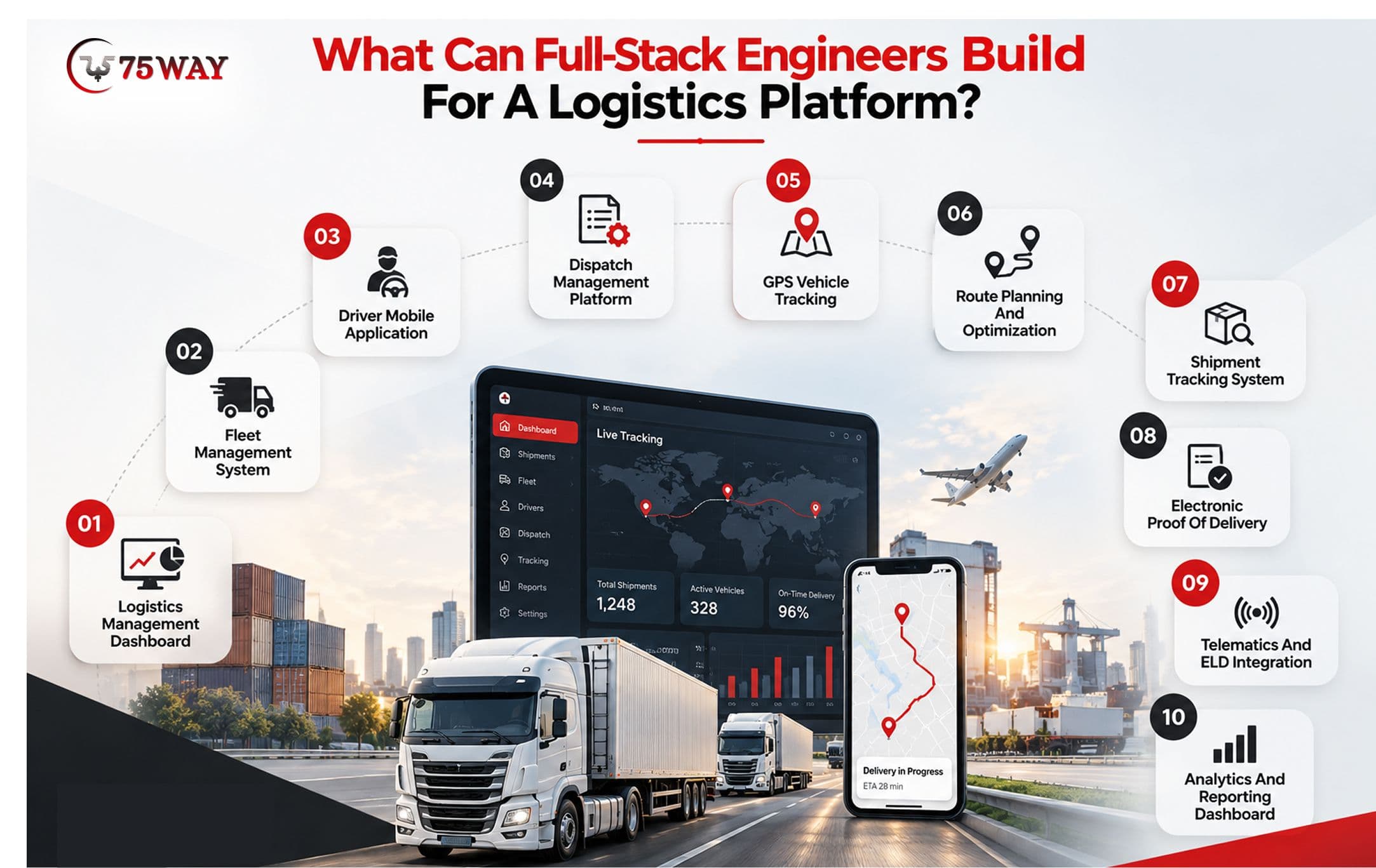
1. Logistics Management Dashboard
A centralized dashboard can bring orders, shipments, drivers, vehicles, and delivery activity into one operational view. Managers can quickly identify delays, pending tasks, and exceptions without switching between multiple systems. Real-time updates also help teams make faster decisions as conditions change.
2. Fleet Management System
Skileed logistics software developers can create a fleet management system for monitoring vehicles, assignments, mileage, maintenance, fuel records, and service history. Managers gain a structured view of fleet operations instead of depending on spreadsheets and disconnected records. Automated reminders can also help teams stay ahead of upcoming maintenance activities.
3. Driver Mobile Application
A dedicated logistics driver app can provide job assignments, navigation, delivery instructions, status updates, documents, and proof of delivery. Drivers can communicate important delivery information directly from the field instead of relying on manual reporting. Offline capabilities can help preserve essential workflows when network connectivity becomes unreliable.
4. Dispatch Management Platform
A dispatch platform can help teams assign orders, drivers, vehicles, routes, and delivery schedules from one interface. Dispatchers can respond to cancellations, delays, priority shipments, and driver availability without rebuilding plans manually. Connected workflows can automatically communicate assignment changes to relevant drivers and customers.
5. GPS Vehicle Tracking
Full-stack developers can integrate GPS services to display vehicle locations and movement within the logistics platform. Dispatchers can monitor active vehicles, review route progress, and identify unexpected stops or delays. Location data can also support customer updates and operational reporting.
6. Route Planning And Optimization
Developers can integrate mapping and routing technologies to help plan routes around stops, distances, delivery windows, vehicle capacity, and operational constraints. The system can provide dispatchers with practical route information instead of requiring manual planning for every shipment. As order volumes increase, automated routing can reduce the burden of coordinating complex delivery schedules.
7. Shipment Tracking System
A shipment tracking module can maintain the status of orders from pickup through final delivery. Customers and internal teams can receive relevant updates without repeatedly contacting dispatchers for basic information. Centralized tracking also creates a clearer operational history for reviewing completed and delayed shipments.
8. Electronic Proof Of Delivery
Developers can build digital proof-of-delivery workflows using signatures, photographs, timestamps, notes, and delivery documents. Drivers can submit confirmation directly through their mobile application after completing a delivery. Operations teams can then access delivery evidence without waiting for physical paperwork or manual uploads.
9. Telematics And ELD Integration
Full-stack logistics platform developers can connect telematics and applicable ELD systems with your existing logistics platform. This can bring relevant vehicle and driver information into workflows used by fleet and operations teams. Proper integration also requires attention to authentication, synchronization, API limitations, data handling, and provider reliability.
10. Analytics And Reporting Dashboard
A reporting dashboard can turn operational data into insights about fleet utilization, delivery performance, routes, drivers, costs, and exceptions. Business owners can use these reports to identify patterns that are difficult to spot across separate spreadsheets or systems. Custom dashboards can also be designed around the KPIs that matter most to your logistics business.
Technical Skills Required For Full-Stack Logistics Platform Engineers
For a logistics platform, technical expertise has to extend beyond writing frontend or backend code. The engineering team needs to work comfortably with the connected systems behind fleet operations, real-time data, mobile workflows, and business-critical logistics software. The core technical skills required for full-stack logistics platform engineers are covered below.
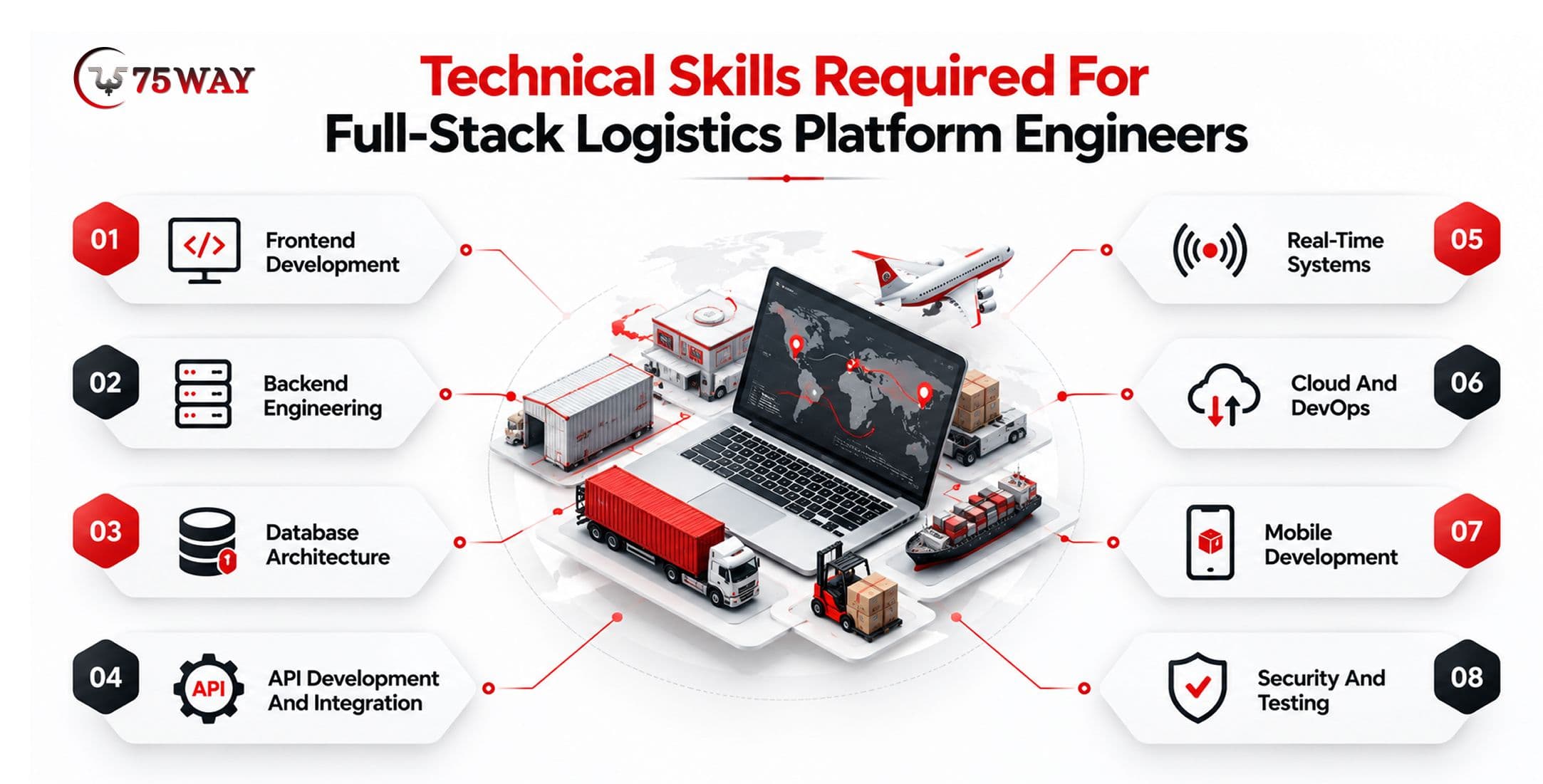
- Frontend Development: Full-stack engineers should build responsive dashboards and interfaces using frameworks such as React, Next.js, or Angular. They must create intuitive experiences for dispatchers, fleet managers, administrators, and customers across different devices.
- Backend Engineering: Strong backend skills are essential for developing business logic, APIs, authentication, and logistics workflows. Engineers should work confidently with technologies such as Node.js, Python, Java, or .NET while designing maintainable server-side systems.
- Database Architecture: Logistics platforms handle interconnected data involving vehicles, drivers, orders, routes, shipments, customers, and transactions. Engineers should understand relational and NoSQL databases, indexing, query optimization, data modeling, and strategies for handling growing datasets.
- API Development And Integration: Developers need to build reliable APIs and connect external services such as GPS, mapping, telematics, payment, ELD, ERP, and accounting platforms. They should understand authentication, webhooks, rate limits, error handling, retries, and data synchronization.
- Real-Time Systems: Fleet platforms often require near-real-time updates for vehicle locations, delivery statuses, alerts, and dispatch changes. Engineers should understand WebSockets, event-driven architecture, message queues, caching, and efficient event processing for high-volume data.
- Cloud And DevOps: Engineers should know how to deploy, monitor, secure, and scale logistics applications using cloud environments such as AWS, Azure, or Google Cloud. Experience with containers, CI/CD, infrastructure management, logging, backups, and monitoring helps maintain reliable production systems.
- Mobile Development: Driver-facing applications require knowledge of mobile development, GPS permissions, push notifications, device capabilities, and offline synchronization. Engineers should understand how field applications behave when drivers experience limited connectivity, background restrictions, or changing device conditions.
- Security And Testing: Logistics platforms can handle sensitive business, customer, driver, vehicle, and transaction information, making security an important engineering responsibility. Developers should apply secure authentication, authorization, encryption, testing, vulnerability management, and audit logging throughout the application lifecycle.
What Should You Look For When Hiring Full Stack Logistics Developers?
The first developer who says, “Yes, we can build it,” may not be the person you want handling a platform that manages vehicles, deliveries, drivers, and business data. A stronger hiring decision comes from examining technical depth, relevant project experience, communication, and the developer’s ability to work around changing requirements. The details worth checking before you hire are explained below.
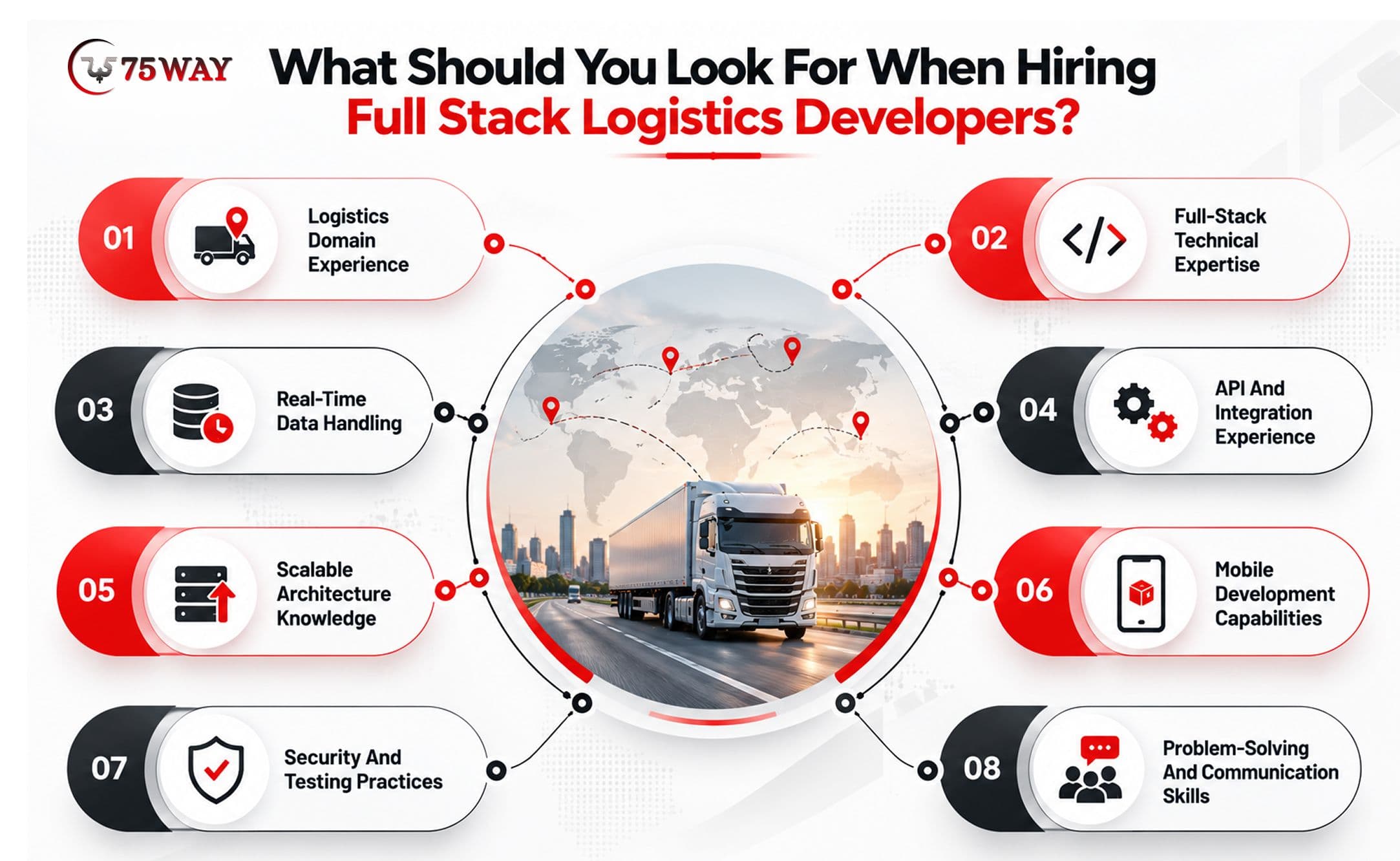
- Logistics Domain Experience
Logistics developers with logistics experience understand dispatching, shipment tracking, fleet operations, routing, and delivery workflows.
This domain knowledge helps them translate operational requirements into practical platform features. It can also reduce misunderstandings during development and improve product decisions.
- Full-Stack Technical Expertise
Look for developers who can work across frontend interfaces, backend services, databases, APIs, and application architecture.
This allows them to understand how different platform components interact rather than treating each layer separately. Strong full-stack knowledge is especially valuable when building interconnected logistics workflows.
- Real-Time Data Handling
Fleet platforms often process continuous location, vehicle, shipment, and status updates. Developers should understand event-driven systems, WebSockets, queues, caching, and data processing for responsive experiences.
Their approach should also account for temporary connectivity issues and delayed data.
- API And Integration Experience
Logistics platforms commonly connect with mapping, GPS, telematics, ELD, payment, ERP, and accounting systems.
They should know how to manage authentication, webhooks, rate limits, retries, and synchronization across external services. Strong integration skills help prevent third-party dependencies from becoming platform bottlenecks.
- Scalable Architecture Knowledge
Your platform should accommodate growth in users, vehicles, shipments, transactions, and real-time events.
Developers should understand database design, caching, cloud infrastructure, load management, and modular architecture. Planning for growth early can minimize expensive technical restructuring later.
- Mobile Development Capabilities
Driver applications require specialized knowledge of GPS, device permissions, notifications, background processes, and offline functionality.
Developers should understand how mobile applications operate under varying network and device conditions. This helps create reliable field workflows for drivers working throughout different locations.
- Security And Testing Practices
Developers should protect platform data through authentication, authorization, encryption, secure APIs, and appropriate access controls.
They should also use functional, integration, performance, and security testing throughout development. Strong testing practices help identify problems before they affect dispatchers, drivers, customers, or operations.
- Problem-Solving And Communication Skills
Logistics platforms involve changing requirements, operational exceptions, integrations, and complex business rules. Developers should explain technical decisions clearly and identify potential issues before implementation becomes costly.
Strong communication also helps business stakeholders and technical teams stay aligned throughout development.
How To Evaluate Full Stack Fleet Developers To Create Logistics Software
A logistics platform puts developers in situations where a delayed update, broken integration, or poorly handled data flow can affect an entire operation. That makes a technical interview alone insufficient for judging whether someone can handle the project. The key areas to examine when evaluating full-stack fleet developers are covered below.
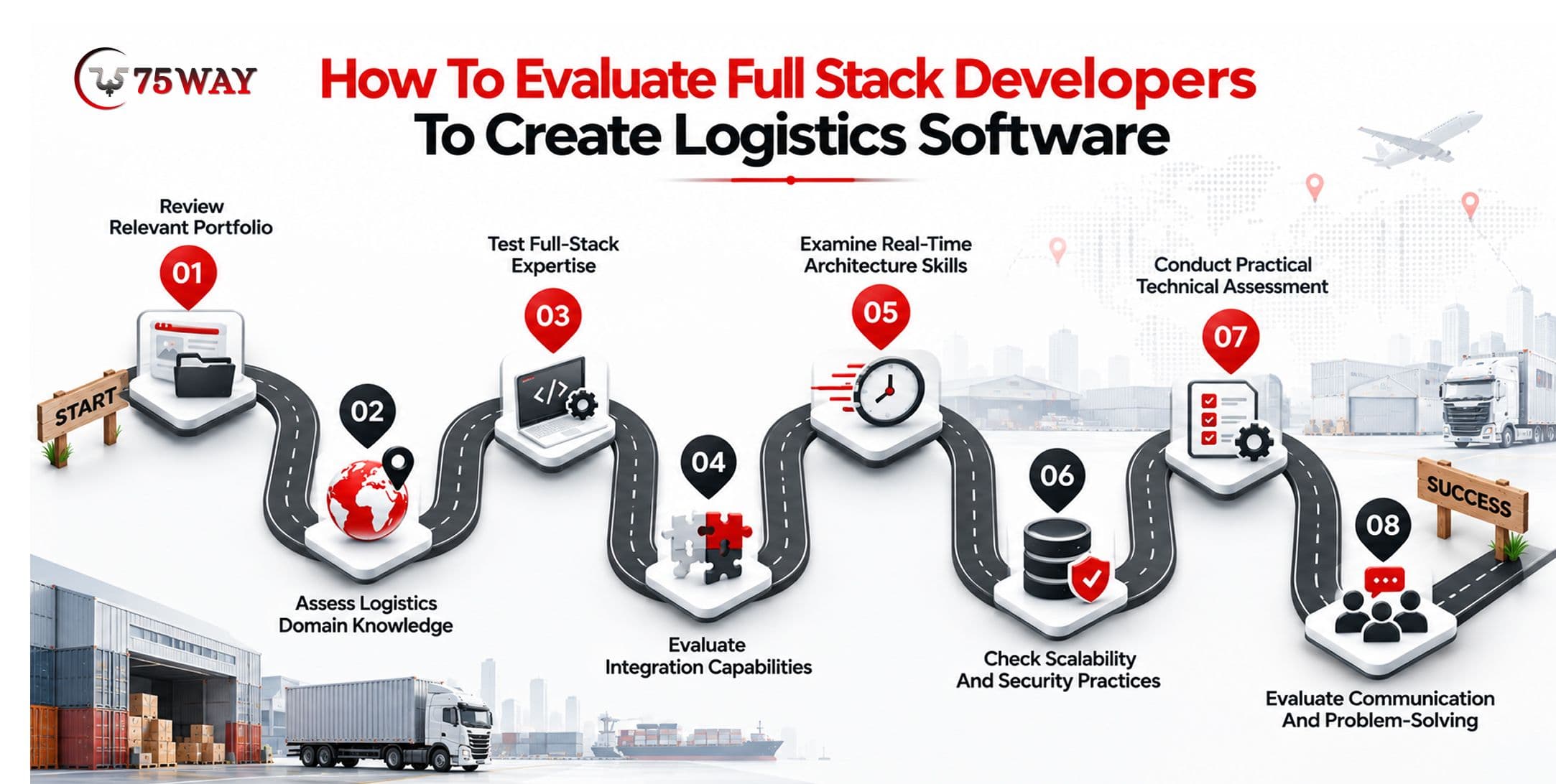
- Review Relevant Portfolio
Examine previous logistics, transportation, fleet, or supply chain platforms they have developed. Look for features such as dispatching, GPS tracking, route planning, driver applications, and shipment management. A relevant portfolio provides practical evidence that developers can handle similar business requirements.
- Assess Logistics Domain Knowledge
Developers should understand how dispatchers, fleet managers, drivers, and customers interact with logistics software. Ask how they would handle real-world scenarios such as delivery delays, vehicle breakdowns, route changes, and driver availability. Strong domain knowledge helps turn operational requirements into useful software workflows.
- Test Full-Stack Expertise
Evaluate their ability to work across frontend, backend, databases, APIs, and application architecture. Ask about the technologies they would choose for dashboards, mobile applications, data processing, and backend services. Their answers should demonstrate how different technical layers work together within one logistics platform.
- Evaluate Integration Capabilities
Ask about their experience integrating GPS, mapping, telematics, ELD, payment, ERP, accounting, and communication systems. They should understand authentication, webhooks, data synchronization, API limitations, error handling, and retries. This reveals whether they can connect your logistics platform with the tools your business already uses.
- Examine Real-Time Architecture Skills
Fleet software depends on timely vehicle locations, shipment updates, driver statuses, alerts, and dispatch changes. Ask developers how they would process frequent data updates without creating performance problems. Their approach should address event processing, WebSockets, queues, caching, and temporary connectivity issues.
Give candidates an operational situation rather than only a coding exercise.
For example: “A vehicle stops sending location data for 15 minutes. How should the platform handle the last known location, notify the dispatcher, and recover when updates resume?”
This tests practical engineering judgment in a way that a generic programming test may not.
- Check Scalability And Security Practices
Evaluate how developers plan to support increasing vehicles, users, shipments, transactions, and real-time events. Discuss database architecture, cloud infrastructure, access controls, encryption, monitoring, and backup strategies. This helps determine whether the platform can grow without compromising performance or data protection.
- Conduct Practical Technical Assessment
Give developers a realistic logistics scenario instead of relying only on resumes or technical interviews. Ask them to explain how they would design a dispatch workflow, track vehicles, or handle failed API responses. Their solution can reveal technical reasoning, architecture knowledge, and familiarity with real operational challenges.
- Evaluate Communication And Problem-Solving
Logistics software projects often involve changing requirements, complex workflows, and unexpected integration issues. Assess whether developers can explain technical decisions clearly and propose practical solutions when requirements change. Strong communication makes collaboration easier between developers, business teams, and logistics stakeholders.
Development Team You Need To Create A Logistics & Fleet Platform
A logistics platform is rarely a one-developer job once it needs driver apps, dispatch tools, live tracking, payments, and operational dashboards working together. The team behind the product needs to cover different technical and product responsibilities without creating gaps between them. The development roles typically needed for a logistics and fleet platform are explained below.
- Product Manager: Defines the platform’s business goals, priorities, core features, and development roadmap. They keep product decisions aligned with customer needs, operational requirements, and commercial objectives.
- Solution Architect: Designs the overall technical architecture, infrastructure, integrations, and data flow for the platform. They ensure different components work together while supporting security, performance, and future expansion.
- Full-Stack Developers: Build the platform’s frontend, backend, APIs, databases, and core logistics workflows. They connect different system components to create a functional and scalable product.
- Mobile Developer: Develops mobile applications that help drivers manage assignments, navigation, status updates, and delivery activities. They also handle GPS, notifications, device features, and offline capabilities where required.
- UI/UX Designer: Creates intuitive interfaces and user journeys for dispatchers, drivers, fleet managers, and customers. Their designs make complex logistics information easier to understand and actions simpler to complete.
- QA Engineer: Tests platform features, workflows, integrations, and user experiences to identify functional issues before release. They also perform regression testing to ensure new updates do not disrupt existing functionality.
- DevOps Engineer: Manages cloud infrastructure, deployments, environments, monitoring, backups, and application reliability. They establish development and release processes that support secure, stable platform operations.
- Domain Specialist: Brings practical knowledge of transportation, fleet operations, dispatching, deliveries, and logistics workflows. They validate product requirements and help ensure the software reflects real-world operational needs.
For an MVP, some responsibilities can be combined.
For example, experienced full-stack developers may handle both frontend and backend work while DevOps and product management support the project on a part-time basis.
As the product grows, specialist roles can be added around the areas creating the greatest technical or operational demands.
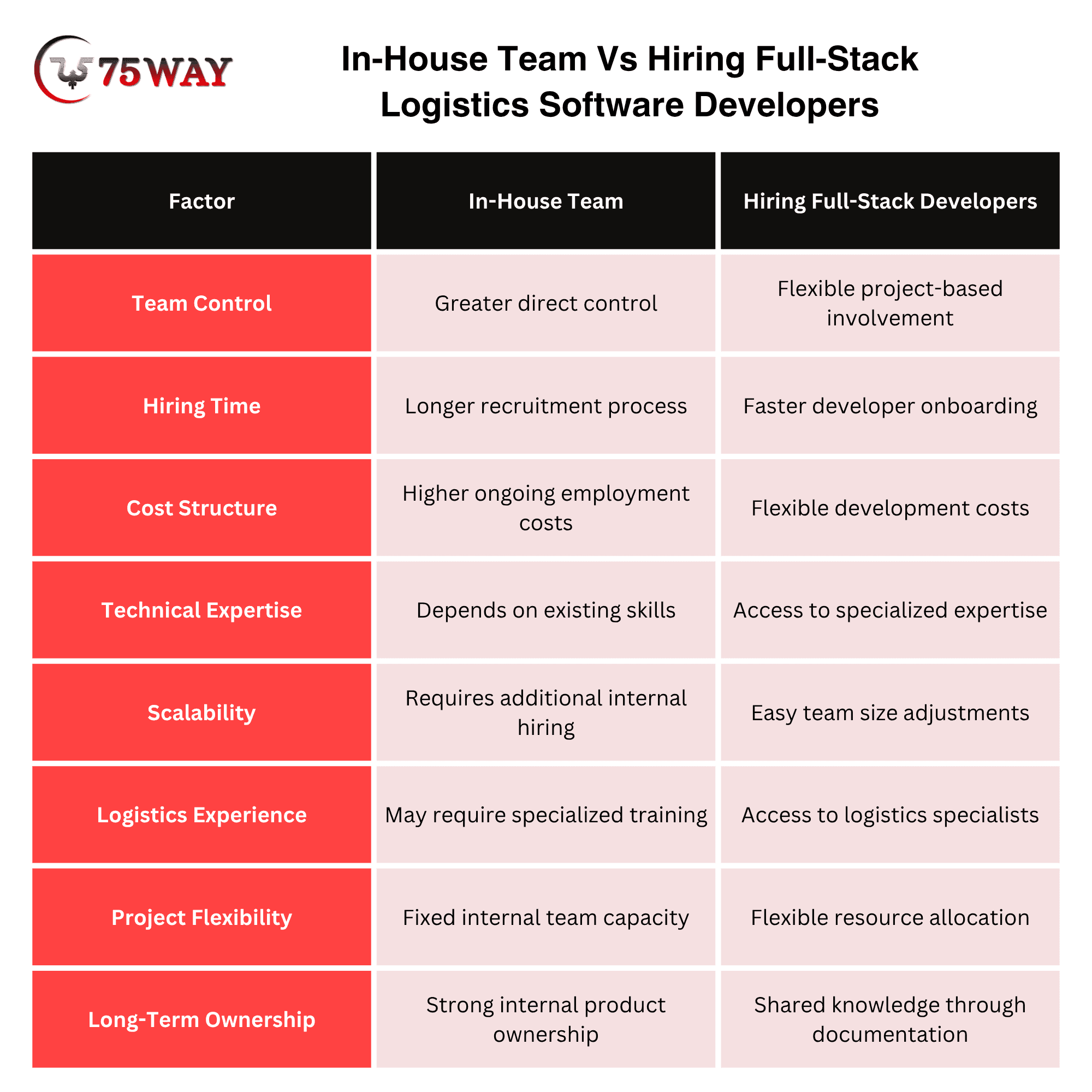
In-House Team Vs Hiring Full-Stack Logistics Software Developers
The key difference between an in-house team and hired full-stack logistics software developers is control versus flexibility. An in-house logistics software team offers closer oversight, direct collaboration, and long-term internal ownership, while external developers provide specialized expertise, faster team scaling, and lower hiring overhead.
An in-house setup may suit companies with ongoing development requirements and established technical resources. Hiring full-stack developers can be practical for startups and businesses seeking logistics expertise without maintaining a large permanent engineering team.
How To Hire Full Stack Developers For Your Logistics Platform
A resume may show years of full stack experience, but it cannot tell you whether a developer understands dispatch logic, fleet data, real-time updates, or logistics integrations. Your hiring process needs to uncover practical problem-solving ability alongside technical depth. The key steps for hiring full-stack developers for a logistics platform are explained below.
1. Define Your Platform Requirements: Clearly outline your logistics workflows, target users, core features, integrations, and business objectives. A well-defined scope helps you identify developers with the right experience and technical capabilities.
2. Identify Required Technical Skills: Determine the frontend, backend, database, cloud, mobile, API, and real-time development skills your platform requires. Matching these requirements with developer expertise prevents skill gaps during development.
3. Review Relevant Development Portfolios: Examine previous projects involving logistics, fleet management, transportation, tracking, or similar complex platforms. Look for practical evidence of scalable architecture, integrations, dashboards, and mobile applications.
4. Verify Logistics Domain Experience: Prioritize developers who understand dispatching, route planning, fleet operations, shipment tracking, and delivery workflows. Their industry knowledge can help translate operational requirements into practical software features.
5. Assess Integration Capabilities: Check their experience connecting GPS, mapping, telematics, ELD, payment, ERP, accounting, and communication systems. Strong API integration skills are important for keeping your logistics ecosystem connected.
6. Conduct Technical Interviews: Use scenario-based questions to understand how developers approach architecture, scalability, security, real-time data, and technical challenges. Practical discussions provide deeper insight than reviewing resumes alone.
7. Evaluate Communication & Collaboration: Assess how clearly developers explain technical concepts, discuss challenges, and respond to changing requirements. Strong collaboration helps keep business, design, and development teams aligned throughout the project.
8. Discuss Cost, Timeline, & Engagement Model: Clarify development rates, estimated timelines, team structure, deliverables, and engagement terms before starting. Transparent expectations help you plan your investment and avoid misunderstandings during development.
Cost To Hire Full-Stack Developer To Create Logistics & Fleet Management Software
The cost to hire full-stack developers depends on their experience, location, engagement model, technical expertise, and the complexity of your logistics platform. Junior developers may handle defined modules, while senior and lead developers are typically needed for architecture, integrations, scalability, and complex fleet workflows.
- Junior Full-Stack Developer: A junior full-stack developer typically costs $20–$40 per hour and can handle basic frontend, backend, and feature-level development tasks.
- Mid-Level Full-Stack Developer: A mid-level developer generally charges $40–$70 per hour and can manage core modules, APIs, databases, and standard integrations.
- Senior Full-Stack Developer: A senior developer may cost $70–$120 per hour, bringing expertise in complex workflows, system architecture, scalability, and advanced integrations.
- Lead Full-Stack Developer: A lead developer typically charges $100–$160 per hour and oversees technical direction, architecture decisions, development standards, and complex implementation.
- Full-Stack Development Team: A dedicated full-stack development team may cost $80–$180+ per hour, depending on team composition, expertise, project complexity, and engagement scope.
Final Thoughts
A logistics platform succeeds when technology connects every critical operational workflow, from orders and dispatch to drivers, vehicles, customers, and delivery data. Hiring full-stack developers with logistics experience can help you turn those workflows into scalable software while reducing technical gaps between business requirements and implementation.
Before hiring, evaluate domain knowledge, architecture thinking, integration experience, development practices, communication, and long-term ownership. To start with a focused product scope, you can hire a trusted logistics app development partner to plan, build, and scale your next transportation platform with confidence.
Frequently Asked Questions
Can developers migrate data from existing logistics software?
Yes, developers can plan structured data migration from legacy systems, spreadsheets, or databases. The process usually includes mapping, cleansing, validation, testing, and controlled transfer.
Who owns the source code after development?
Ownership depends on your contract and development arrangement. Clearly define intellectual property, source code access, documentation ownership, and repository permissions before development begins.
Can a logistics platform support multiple business models?
Yes, the platform can be designed around different workflows, including carriers, brokers, shippers, delivery companies, and fleet operators. Architecture should anticipate these variations early.
How should logistics software requirements be documented?
Document users, workflows, business rules, exceptions, integrations, permissions, and expected outcomes. Clear requirements help developers estimate work accurately and reduce misunderstandings during implementation.
Can the platform evolve after the MVP launches?
Yes, a well-planned MVP can provide a foundation for future capabilities. Your architecture should leave room for additional users, workflows, integrations, reporting, and automation.
How can businesses avoid vendor lock-in during development?
Maintain ownership of repositories, documentation, credentials, infrastructure accounts, and technical assets. Contractual clarity and documented architecture also make future team transitions easier.
What should happen after the logistics platform goes live?
Post-launch work typically includes monitoring, bug fixes, performance improvements, security updates, analytics review, and feature enhancements. Support requirements should be defined before launch.
How can stakeholders stay involved during development?
Use regular demonstrations, milestone reviews, shared documentation, and clear approval processes. Frequent feedback helps identify workflow or usability issues before they become expensive changes.