AI Summary
Medical billing involves countless workflows that AI agents can automate beyond basic chatbots. This guide explains how to build agents for claims, eligibility, denials, prior authorization, and insurance processing. It covers architecture, integrations, HIPAA, costs, testing, and ROI.
Key Takeaways
- A practical roadmap from billing workflow discovery through production-ready AI agents.
- The architecture behind secure agents that connect billing and insurance systems.
- Real automation opportunities across claims, denials, eligibility, and prior authorization workflows.
- Critical HIPAA, security, human oversight, and auditability considerations for healthcare.
- The costs, timelines, challenges, and performance measures shaping successful implementations.
A claim gets denied, an eligibility check sits unfinished, and suddenly the billing team has another case to chase. Multiply that across hundreds or thousands of claims, and the administrative workload becomes a serious business cost, exactly where AI agent development solutions can step in and take over repetitive work.
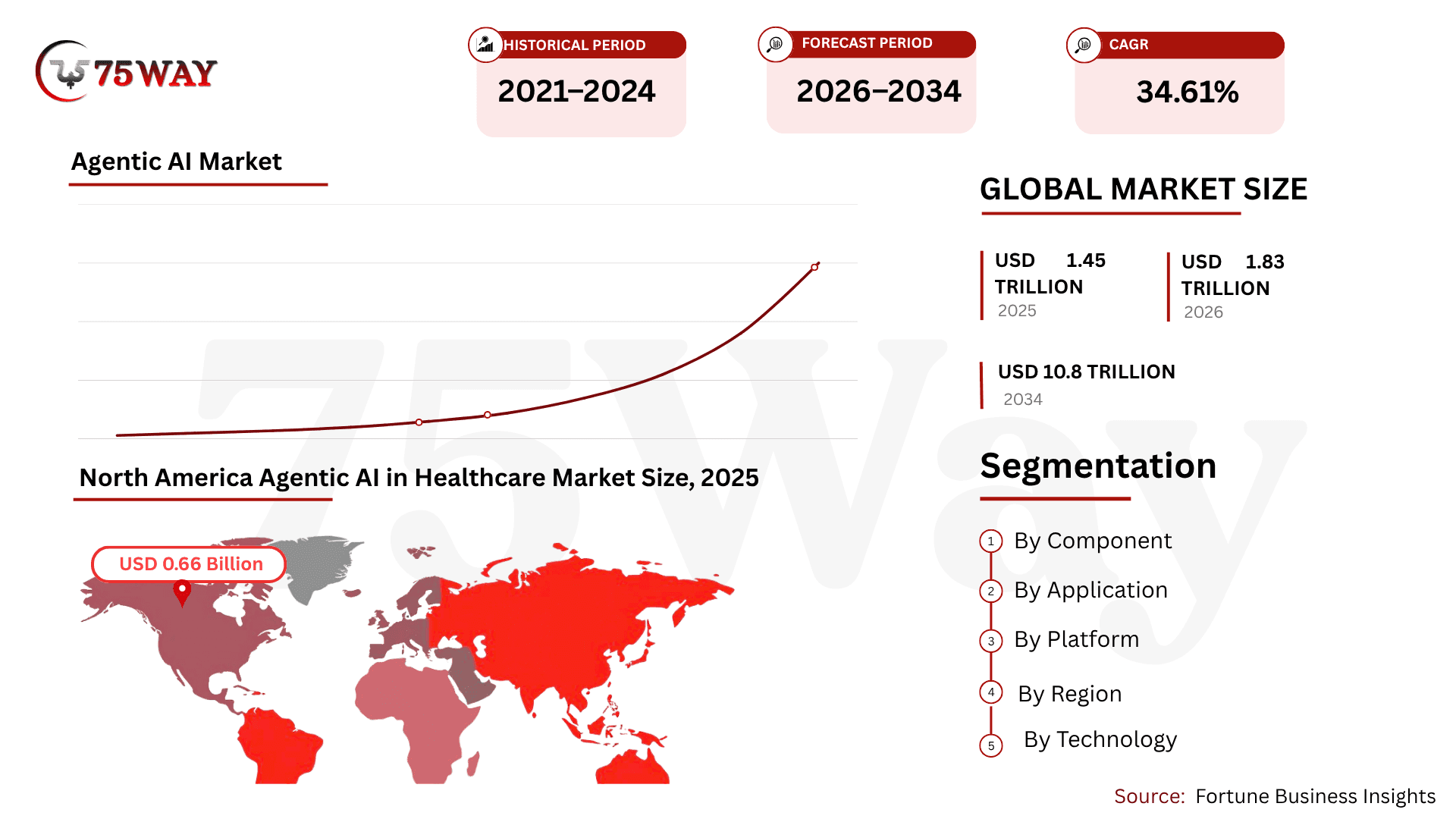
The opportunity is growing alongside that pressure. Recent insights project the global agentic AI in healthcare market to rise from $1.83 billion in 2026 to $19.71 billion by 2034, reflecting a 34.61% CAGR.
For healthcare organizations, medical billing companies, healthtech startups, and RCM providers, the opportunity is therefore not simply to “add AI model.” It is to build an agentic AI revenue-cycle system that can execute defined workflows safely, explain its actions, and escalate exceptions to people.
This guide walks through how to build an AI-powered medical billing agent, how to integrate payer and EHR data, what HIPAA considerations matter, what implementation can cost, and how to measure business value.
What Are AI Agents For Medical Billing And Insurance Processing?
AI agents for medical billing are software systems that can interpret information, make decisions within predefined boundaries, use connected tools, and execute specific revenue-cycle tasks.
Unlike a conventional chatbot that primarily responds to prompts, an AI billing agent for hospitals can follow a workflow.
The medical revenue cycle AI agent does not need to independently control every stage. In fact, high-risk healthcare workflows should generally use bounded autonomy, where the agent can perform routine actions but routes ambiguous or consequential cases to trained staff.
A practical medical billing agent may:
- Read patient and insurance information.
- Verify eligibility and benefits.
- Extract information from clinical documents.
- Identify missing claim information.
- Assist with coding workflows.
- Validate claims before submission.
- Prepare or route claims for submission.
- Monitor claim status.
- Classify denial reasons.
- Recommend next actions.
- Draft appeals or payer correspondence.
- Track outstanding payments.
- Support prior authorization workflows.
- Maintain an audit trail of agent activity.
This distinction matters because healthcare organizations are not buying an AI conversation layer. They are buying workflow automation connected to their existing revenue-cycle infrastructure.
Why Build AI Agents For Medical Billing?
Medical billing rarely slows down because there is nothing to do; it slows down because there is too much repetitive work competing for attention. An AI agent can monitor billing workflows, take defined actions, and escalate unusual cases instead of treating every task as a manual assignment. The reasons businesses are exploring this approach become clearer when its impact on billing operations is examined.
1. Reduce Manual Billing Work
Billing teams spend significant time on tasks that follow recognizable patterns, including eligibility checks, document review, claim validation, status checks, and work-queue management.
A healthcare billing AI agent can take over these repetitive steps while keeping employees involved where judgment is required. This allows billing specialists to spend more time on exceptions, complex accounts, and cases that require direct intervention.
2. Catch Claim Issues Earlier
A rejected claim can create another cycle of investigation, correction, and resubmission. Finding the underlying issue before submission can prevent that avoidable work.
A medical claims agent can review available information for missing fields, inconsistent data, documentation gaps, or workflow requirements before a claim moves forward. When something falls outside its defined rules, it can flag the case instead of making an unsupported decision.
3. Turn Denial Management Into A Guided Workflow
Denial management often requires more than identifying a denial code. Staff may need to review the claim, locate supporting records, understand the reason, determine the appropriate next step, and prepare documentation.
A denial-management agent can connect these activities. It can classify the denial, retrieve relevant claim information, identify potential gaps, and prepare a recommended action or draft for human review.
The important distinction is assistance rather than unrestricted decision-making. Complex or high-impact cases can remain under employee control.
4. Simplify Prior Authorization Work
Prior authorization can involve collecting patient information, checking payer requirements, gathering documentation, submitting requests, and tracking responses.
An AI agent can coordinate these administrative steps and identify what is still missing. Where electronic workflows are available, integrations can also help move information between systems rather than requiring staff to repeatedly enter the same data.
CMS has been advancing electronic prior authorization and interoperability requirements, including API-based processes for impacted payers. Several provisions from the CMS Interoperability and Prior Authorization Final Rule began taking effect in 2026, with certain API requirements beginning in 2027.
5. Prioritize The Work That Matters Most
Not every account carries the same urgency, value, or recovery opportunity. An AI agent can evaluate factors such as claim value, filing deadlines, denial risk, missing documentation, payer requirements, A/R aging, and potential recovery to organize billing queues around business priorities.
This gives RCM teams a clearer view of where human attention can have the greatest impact. Instead of spending equal time across every account, staff can focus on cases requiring judgment, intervention, or follow-up while the agent continues handling routine monitoring and prioritization.
Which Medical Billing Processes Can AI Agents Automate?
Not every billing activity should receive the same level of autonomy. A useful implementation strategy divides workflows into low-risk automation, assisted decision-making, and human-controlled actions.
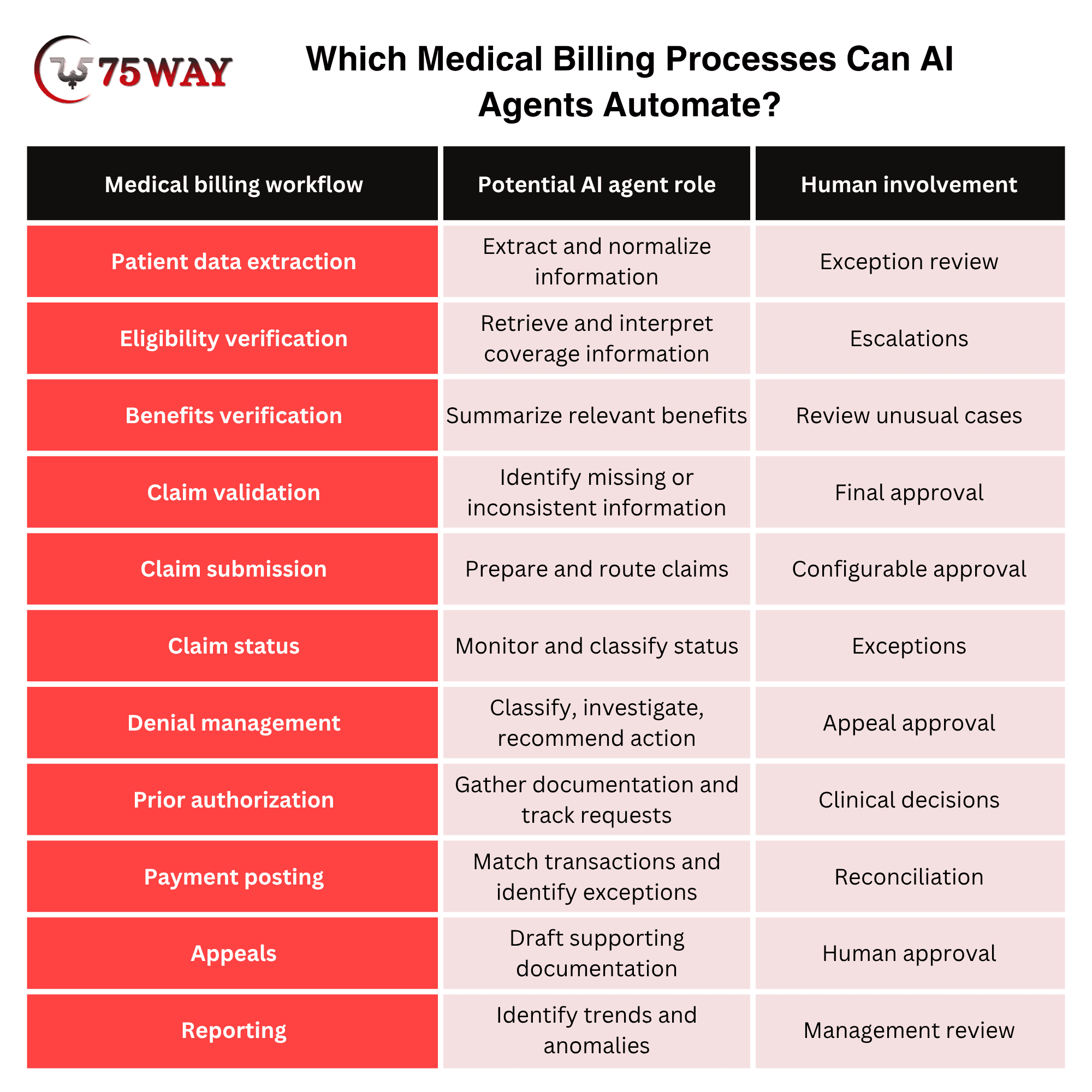
This model is important because automation should follow risk, not hype. A billing organization may allow an agent to automatically classify a routine denial while requiring a human reviewer to approve an appeal involving complex medical necessity or disputed clinical information.
Complete Process To Develop AI Agent For Medical Billing And Insurance Processing
An AI billing agent is not simply a chatbot placed on top of billing software. It needs to understand what information is available, determine what action is appropriate, interact with connected systems, and know when a case needs human attention. The complete development approach for building this kind of agent is explained below.
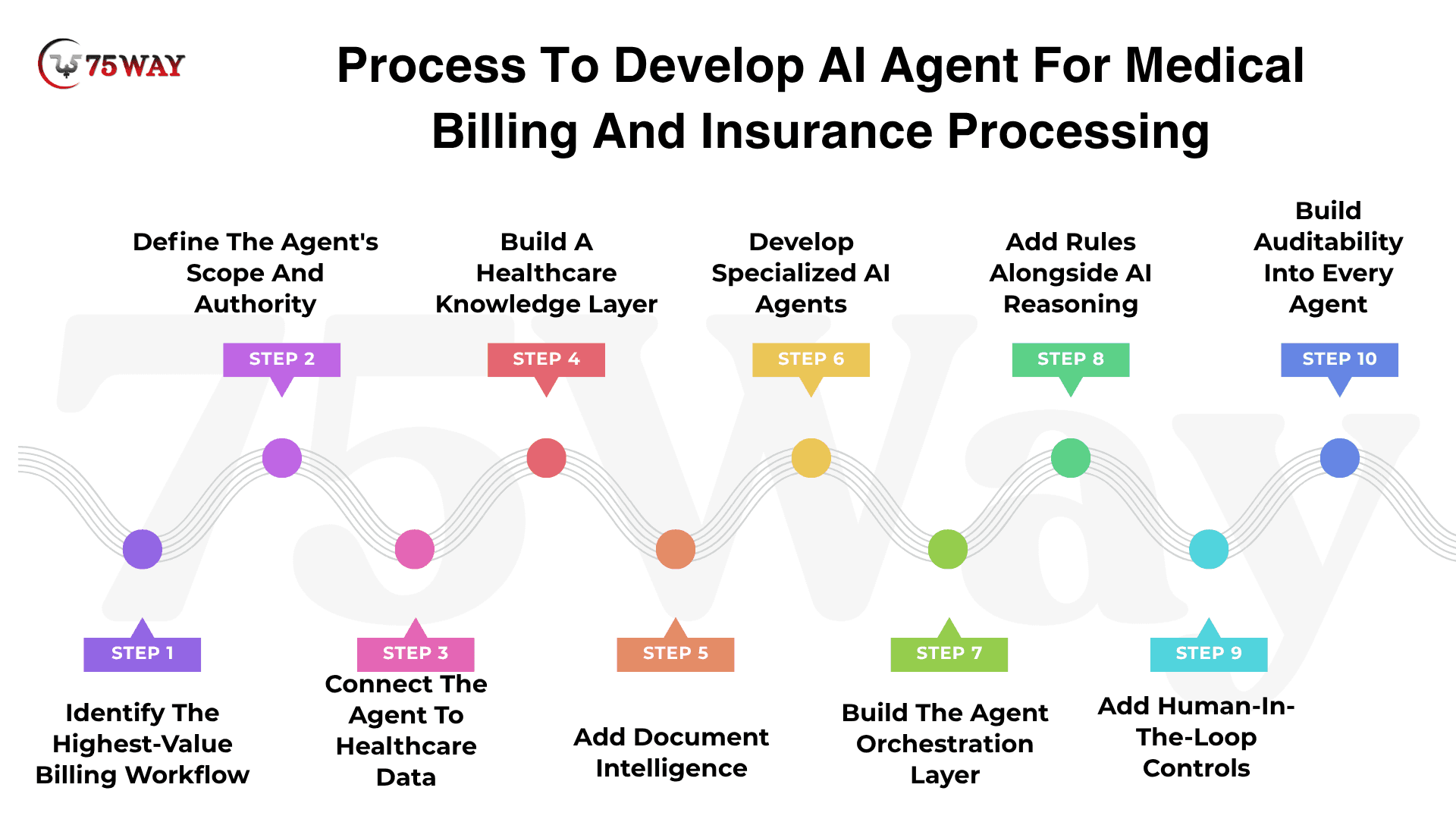
Step 1: Identify The Highest-Value Billing Workflow
Start with one billing workflow where automation can address a measurable operational problem. Map the people, systems, documents, decisions, manual tasks, exceptions, payer requirements, compliance needs, processing time, errors, and revenue impact involved.
For example, a denial workflow begins when a denial is received, then moves through classification, claim review, documentation retrieval, root-cause analysis, recommended action, human approval, submission, and follow-up. This gives developers a defined workflow instead of an overly broad goal to “automate medical billing.”
Step 2: Define The Agent's Scope And Authority
Before selecting an AI model, establish exactly what the agent can read, recommend, prepare, and execute. A practical model separates capabilities into observe, assist, and execute, with stronger controls applied as the agent receives more authority.
For example, an agent may automatically verify eligibility but only recommend an appeal strategy for employee approval. Defining these boundaries prevents unrestricted automation and creates a controlled human-in-the-loop workflow.
Step 3: Connect The Agent To Healthcare Data
An AI agent becomes useful when it can securely access the systems where billing information resides. Depending on the workflow, integrations may include EHRs, practice management platforms, RCM systems, clearinghouses, payer APIs, eligibility systems, claims platforms, and document repositories.
The agent should not depend on information stored inside an LLM. Instead, it should retrieve current information from authoritative systems when needed, using secure APIs and interoperability standards such as FHIR where supported. CMS has also been advancing standardized electronic prior authorization and interoperability requirements.
Step 4: Build A Healthcare Knowledge Layer
The AI medical claims processing needs access to the policies and operational information required for its assigned workflow. This may include payer policies, eligibility rules, benefits, claim requirements, authorization requirements, denial codes, internal SOPs, appeal guidelines, and documentation requirements.
A retrieval-augmented architecture allows the agent to retrieve relevant information when completing a task rather than relying entirely on its pretrained knowledge. This also makes policy updates easier to manage as payer requirements and internal procedures change.
Step 5: Add Document Intelligence
Medical billing information often arrives through PDFs, scanned forms, clinical notes, EOBs, denial letters, authorization documents, faxed records, and other unstructured sources. These documents can contain information that traditional structured integrations cannot capture directly.
A document-intelligence layer can extract, classify, normalize, and validate information before storing it in a structured format. The resulting information can then be passed to the appropriate agent, such as a denial-management or prior-authorization workflow.
Step 6: Develop Specialized AI Agents
Rather than creating one broad medical billing agent, divide responsibilities across specialized agents. Depending on the business model, these can include eligibility, claims, coding support, prior authorization, denial management, appeals, payment posting, and follow-up agents.
A supervisor or orchestration agent can coordinate these specialized workflows, apply business rules, and route exceptions. Narrow responsibilities make permissions easier to control and performance easier to measure.
Step 7: Build The Agent Orchestration Layer
The orchestration layer controls how agents work together and determines which agent receives a task, what information it can access, which tools it can use, and when approval is required. It also manages failures, handoffs, escalations, and workflow state.
A typical architecture moves from user input and access control into orchestration, specialized agents, healthcare tools, validation, human review, and final action. Every important activity can then be recorded through the audit layer.
Step 8: Add Rules Alongside AI Reasoning
An LLM should not be responsible for every decision in a medical billing workflow. Deterministic requirements should remain within rules engines or workflow logic, while AI handles tasks involving interpretation, classification, summarization, or information retrieval.
For example, software can enforce that a required field must exist, while an AI agent can determine whether supporting documentation contains relevant information. Combining LLMs, rules, APIs, retrieval, workflow engines, and human review creates stronger operational controls.
Step 9: Add Human-In-The-Loop Controls
Human oversight should be designed into the workflow before production deployment. Define situations that automatically require review, such as conflicting information, unclear payer requirements, low-confidence outputs, unusual cases, high financial impact, unavailable sources, or actions outside the agent's permissions.
When escalation occurs, the employee should see what the agent found, which information it used, what action it recommends, and why human intervention is required. This makes review faster and gives staff meaningful control over consequential decisions.
Step 10: Build Auditability Into Every Agent
Every important agent action should leave an auditable record, including the input, information sources, retrieved rules, decision, tool calls, action taken, approval, exception, outcome, timestamp, and relevant model version.
These records help teams investigate errors, monitor performance, improve workflows, and understand how automation operates over time. NIST's AI Risk Management Framework emphasizes areas including validity, reliability, safety, security, accountability, transparency, explainability, privacy, and fairness.
HIPAA Compliance: What Should Healthcare AI Agents Include?
HIPAA compliance should be treated as an architecture and governance requirement, not a checkbox added after healthcare AI agents development.
The HIPAA Security Rule requires covered entities and business associates to implement administrative, physical, and technical safeguards protecting electronic protected health information.
Depending on the implementation, an AI agent handling ePHI may require controls such as:
- Access Control
Use role-based permissions and least-privilege access so agents only access information required for their assigned workflow.
- Encryption
Protect data in transit and at rest using appropriate security controls.
- Authentication
Require strong authentication for employees, administrators, services, and connected systems.
- Audit Logging
Record relevant data access, agent actions, approvals, and system events.
- Data Minimization
Only provide an agent with the information necessary to complete its task.
- Retention Controls
Define how long information, prompts, outputs, and logs are retained.
- Vendor Governance
Evaluate third-party AI, cloud, OCR, API, and infrastructure providers before allowing them to handle ePHI.
- Business Associate Agreements
If a cloud service provider creates, receives, maintains, or transmits ePHI on behalf of a covered entity or business associate, HHS states that a HIPAA-compliant business associate agreement is required.
Technology Stack To Build Healthcare Billing AI Agents
The technology stack depends on the workflow and existing healthcare infrastructure, but an enterprise implementation may include:
- Frontend: React, Next.js, Angular
Support responsive interfaces for billing dashboards, queues, and workflow management.
- Backend: Python, FastAPI, Node.js, Java
Power business logic, agent workflows, APIs, and healthcare system communication.
- AI Models: Enterprise LLMs, domain-specific models
Handle medical billing interpretation, classification, summarization, and decision support.
- Agent Framework: LangGraph, LangChain, custom orchestration
Coordinate specialized agents, tools, workflows, approvals, and task execution.
- Retrieval: Vector databases, hybrid search, RAG
Retrieve relevant payer policies, billing rules, documents, and organizational knowledge.
- Document AI: OCR, document classification, extraction models
Convert EOBs, denial letters, forms, and scanned records into structured data.
- Healthcare Interoperability: HL7, FHIR, healthcare APIs
Connect agents with EHRs, clinical systems, payer platforms, and healthcare data.
- Claims Processing: X12-based transaction workflows, where applicable
Support standardized electronic claim submission, response handling, and transaction processing.
- Databases: PostgreSQL, SQL Server, cloud databases
Store billing records, workflow states, audit data, configurations, and operational information.
- Cloud Infrastructure: AWS, Azure, Google Cloud
Provide scalable infrastructure for deploying, managing, and monitoring AI billing systems.
- Security: IAM, encryption, secrets management, audit logging
Protect sensitive healthcare data and control access across applications and integrations.
- Monitoring: Application monitoring, model evaluation, workflow analytics
Track system performance, agent behavior, errors, latency, and workflow outcomes.
- System Integrations: EHR, practice management, RCM, clearinghouse, payer systems
Connect AI agents with the systems required to complete billing and insurance workflows.
The technology stack should be selected around the healthcare workflow rather than forcing the workflow into a preferred AI framework.
How Much Does It Cost To Build AI Agents For Medical Billing?
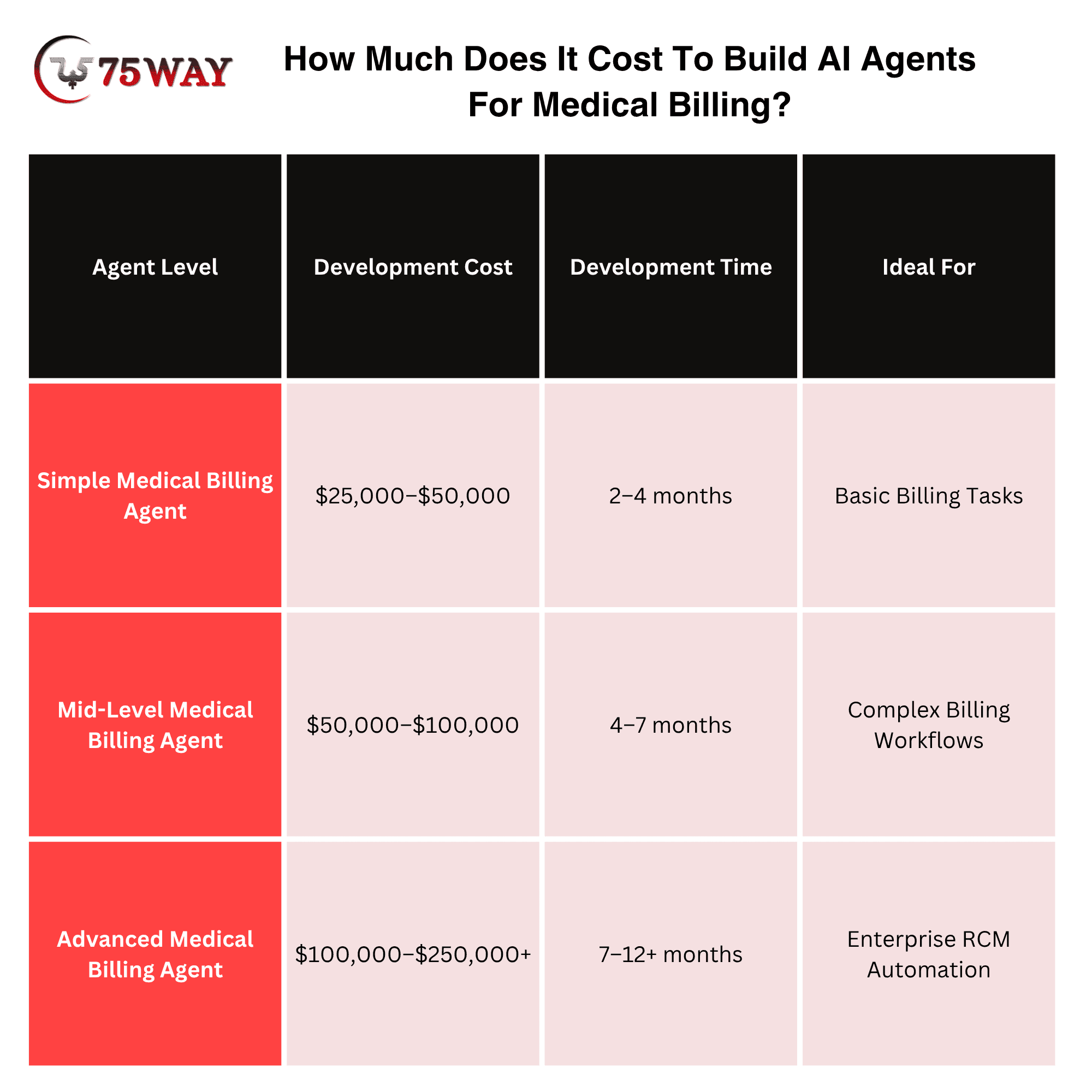
A medical billing AI agent is not priced by the chatbot interface alone, with development costs typically ranging from $25,000 to $250,000+ for custom solutions. A system that checks eligibility or organizes billing information can require far less work than an agent that processes claims, communicates with payer systems, and manages exceptions. The following breakdown gives you a clearer view of where the development budget goes.
- Simple Medical Billing Agent Cost: $25,000–$50,000
Ideal for: Basic billing assistance, document extraction, eligibility checks, and workflow recommendations.
- Mid-Level Medical Billing Agent Cost: $50,000–$100,000
Designed for: Multi-step workflows, EHR and clearinghouse integrations, denial management, prior authorization, and human approvals.
- Advanced Medical Billing Agent Cost: $100,000–$250,000+
Built for: Multi-agent systems, complex payer workflows, extensive integrations, advanced document intelligence, and autonomous task execution.
Cost To Develop AI-Powered Medical Billing Agent Based On Complexity
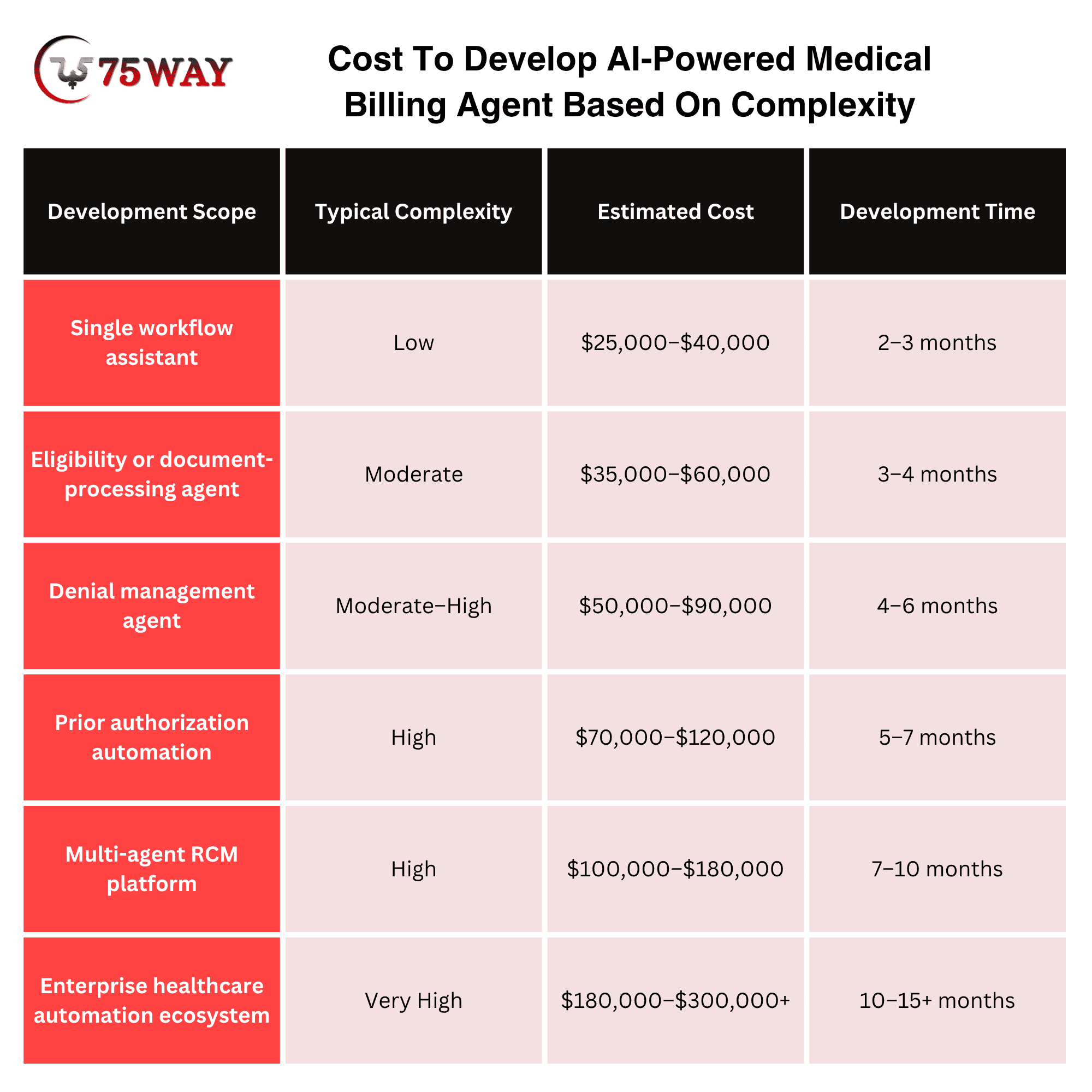
Not every medical billing AI agent needs to understand the entire revenue cycle. A narrowly scoped agent can be built around a specific task, while a more advanced system may coordinate several workflows and connected platforms. The complexity-wise cost breakdown below shows how the scope of responsibility can affect your development investment.
How To Make AI Medical Billing Automation System More Reliable?
A production system should not rely on one model response. Use multiple layers of validation.
Layer 1: Retrieval
Retrieve authoritative information from approved sources.
Layer 2: Reasoning
Allow the agent to interpret the retrieved information.
Layer 3: Rules
Apply deterministic business and compliance rules.
Layer 4: Verification
Check whether the proposed action satisfies required conditions.
Layer 5: Human Review
Escalate high-risk or uncertain cases.
Layer 6: Audit
Record the complete decision path.
This approach creates a more controlled system than simply prompting an LLM to “process the claim.”
AI Agents For Electronic Prior Authorization: What Changes In 2026–2027?
Prior authorization creates a predictable bottleneck for providers because staff must determine payer requirements, collect supporting records, prepare requests, follow up on decisions, and update internal systems. For healthcare businesses, that makes the workflow a practical candidate for agent-based automation.
CMS estimates that providers spend $20–$50 per hour on prior authorization work and an average of 13 hours each week handling these requests. These administrative demands create an opportunity for AI agents to take over information-heavy tasks while allowing staff to handle exceptions and decisions requiring professional judgment.
The timing also matters. Under CMS's Interoperability and Prior Authorization Final Rule (CMS-0057-F), certain requirements affecting impacted payers began in 2026. For certain CMS-regulated health plans, the Prior Authorization API requirements begin on January 1, 2027.
For an AI development project, this means prior authorization should not be designed as an isolated chatbot workflow. The agent needs to work across the systems involved in the authorization process and retrieve the information required at each stage.
The healthcare billing AI agent can handle the repetitive coordination involved in this process, but the organization should define clear boundaries around what the system can approve, submit, modify, or escalate.
For example, an agent could identify that supporting documentation is missing and notify the billing team automatically. It could also assemble the available records into a draft authorization package. However, a decision involving clinical judgment should remain under appropriate human control.
For healthcare startups and RCM companies, the larger opportunity is to connect prior authorization automation with the broader revenue-cycle workflow rather than building another standalone AI assistant.
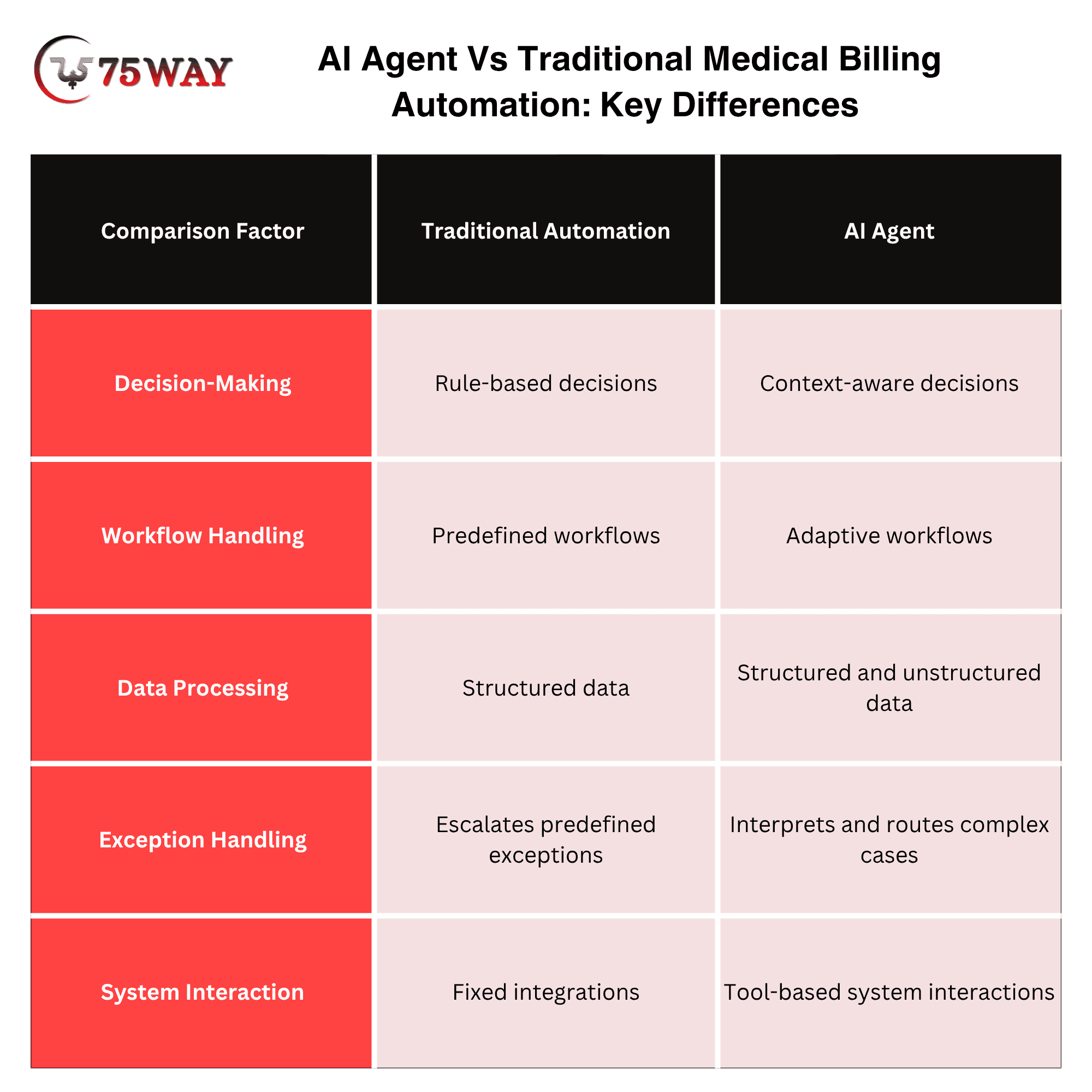
AI Agent Vs Traditional Medical Billing Automation: Key Differences
Traditional medical billing automation follows predefined rules, workflows, and triggers to handle repetitive tasks. It works well for structured processes, such as claim submission, payment posting, eligibility checks, and basic data validation, but usually requires predefined conditions for each scenario.
AI agents can handle more dynamic billing workflows by interpreting documents, understanding context, retrieving relevant information, using connected systems, and deciding the next permitted action. With human approval for sensitive decisions, agents can support complex processes such as denial management, prior authorization, claim follow-up, and exception handling.
What Should An Enterprise Medical Billing AI Architecture Look Like?
A mature implementation can be organized into six layers:
1. Experience Layer
Billing dashboards, work queues, alerts, approvals, reports, and administrative interfaces.
2. Agent Layer
Eligibility, claims, denial, authorization, appeals, payment, and follow-up agents.
3. Intelligence Layer
LLMs, retrieval, document intelligence, classification, extraction, and reasoning.
4. Workflow Layer
Rules engine, orchestration, approvals, escalation, task management, and state management.
5. Integration Layer
EHR, PM, RCM, clearinghouse, payer APIs, FHIR interfaces, and other healthcare systems.
6. Security Layer
Identity, authorization, encryption, audit logs, monitoring, data governance, and compliance controls.
This layered architecture makes it easier to scale from one automation use case to an enterprise revenue-cycle platform.
When Should A Healthcare Business Build AI Agents Instead of Buying Software?
Building may make sense when your organization needs:
- Proprietary workflows
- Custom payer logic
- Existing enterprise integrations
- A differentiated healthcare product
- Multi-tenant SaaS capabilities
- Custom agent orchestration
- Proprietary data workflows
- Greater control over the technology stack
Buying or integrating existing software may be more appropriate when the workflow is standardized and customization is limited.
For startups, the decision should also consider whether the AI agent is itself the product or whether AI is simply an internal automation layer.
Final Thoughts
To conclude, medical billing and insurance processing are moving toward intelligent, connected workflows where AI agents can reduce repetitive work, improve claim handling, and support faster revenue-cycle operations. The right approach combines specialized agents, secure integrations, healthcare data controls, human oversight, and continuous performance monitoring.
Businesses can start with one high-value workflow before expanding into broader automation across billing and insurance operations. If building from scratch is not your priority, you can adopt a ready-to-deploy AI billing agent from online AI marketplaces like 75AI Agent Store to accelerate implementation. Partner with a reliable AI agent development company to turn your billing workflow into scalable automation.
Frequently Asked Questions (FAQs)
Can AI Agents Automate Medical Billing?
Yes, AI agents can automate eligibility checks, claims preparation, denial workflows, documentation, and follow-ups. Human reviewers can handle exceptions, approvals, and complex billing decisions.
What Is The Difference Between An AI Agent And A Medical Billing Chatbot?
A chatbot primarily answers questions, while an AI agent can retrieve information, use connected systems, and execute defined workflows. Agents can also monitor tasks and escalate exceptions.
Can AI Agents Work With EHR Systems?
Yes, AI agents can connect with EHR systems through APIs, FHIR interfaces, and approved integration methods. This allows agents to retrieve relevant patient and billing information securely.
Are AI Agents For Medical Billing HIPAA Compliant?
AI agents can be designed to support HIPAA requirements through access controls, encryption, audit logs, and secure data handling. Compliance also depends on implementation, vendors, policies, and safeguards.
Can AI Agents Handle Insurance Denials?
Yes, denial agents can classify reasons, retrieve supporting information, identify potential causes, and recommend corrective actions. Staff can review complex cases and approve appeals before submission.
Can AI Agents Automate Prior Authorization?
AI agents can collect required information, organize documentation, prepare requests, monitor statuses, and notify staff about updates. Human oversight remains important for clinical or high-risk authorization decisions.
What Technologies Are Used To Build Medical Billing AI Agents?
Medical billing agents can combine LLMs, APIs, RAG, OCR, databases, workflow engines, FHIR, and X12-based integrations. Cloud infrastructure, monitoring, security controls, and audit systems support production deployment.
How Do You Measure Whether A Billing AI Agent Is Successful?
Measure processing time, automation rate, accuracy, denial rates, clean claims, A/R performance, and human intervention. Revenue recovery, labor savings, and exception rates provide additional business-level performance indicators.