AI Summary
Metaverse 3D space development turns business ideas into immersive virtual environments where users can interact, explore, collaborate, and transact. This guide covers development essentials, technologies, features, costs, and timelines. It also explores monetization strategies and practical business opportunities.
Key Takeaways
- Metaverse 3D space development costs $20,000 – $350,000+, depending on project complexity.
- The metaverse market is expected to grow to $507.8bn by 2030.
- Immersive 3D spaces combine environments, avatars, interactions, audio, and real-time capabilities.
- Development involves strategy, design, 3D modeling, coding, testing, deployment, and scaling.
- Businesses can monetize virtual spaces through commerce, events, subscriptions, sponsorships, and memberships.
A physical showroom can serve visitors in one location, but a 3D virtual space can let a brand create an experience that customers access from anywhere.
Samsung demonstrated this with 837X, an immersive virtual experience modeled after its New York flagship and built on Decentraland, where visitors could explore branded spaces, attend experiences, and interact with digital content.
For businesses, metaverse development is therefore less about creating a visually impressive virtual world and more about building a space with a clear commercial purpose. Product showcases, virtual events, customer engagement, digital commerce, branded experiences, and community-building can all become part of a well-planned 3D environment.
The challenge is turning that concept into a functional product that users actually want to explore, and businesses can justify investing in. This complete guide covers metaverse 3D space development, including its development process, technologies, features, costs, use cases, and the strategic decisions involved in launching a virtual space.
What Is A Metaverse 3D Space?
A metaverse 3D space is an interactive digital environment where users can enter, move through a virtual setting, communicate with other participants, interact with digital objects, and perform activities designed around a specific experience.
Unlike a conventional 2D website, users do not simply navigate between pages. They navigate through a spatial environment.
For example, a company could create:
- A virtual showroom where customers explore products
- A conference venue for immersive events
- A training campus for employee learning
- A virtual retail store
- A collaborative enterprise workspace
- A digital twin of a physical facility
- A gaming environment
- A virtual real estate experience
- A social community space
- An educational campus
The metaverse therefore should not be treated as one specific application. It is better understood as a collection of immersive digital experiences supported by technologies such as 3D graphics, extended reality, cloud computing, real-time networking, AI, and sometimes blockchain.
Metaverse 3D Space Market Size, Trends And Growth Potential
A virtual space is no longer limited to entertainment when brands can use immersive environments to sell, host events, train teams, showcase products, and engage customers. The global metaverse market is estimated to reach USD 2,609.5 billion by 2034, growing at a 34.53% CAGR from 2026 to 2034, according to one recent market estimate. The market trends and growth potential behind this rapid expansion are discussed below.
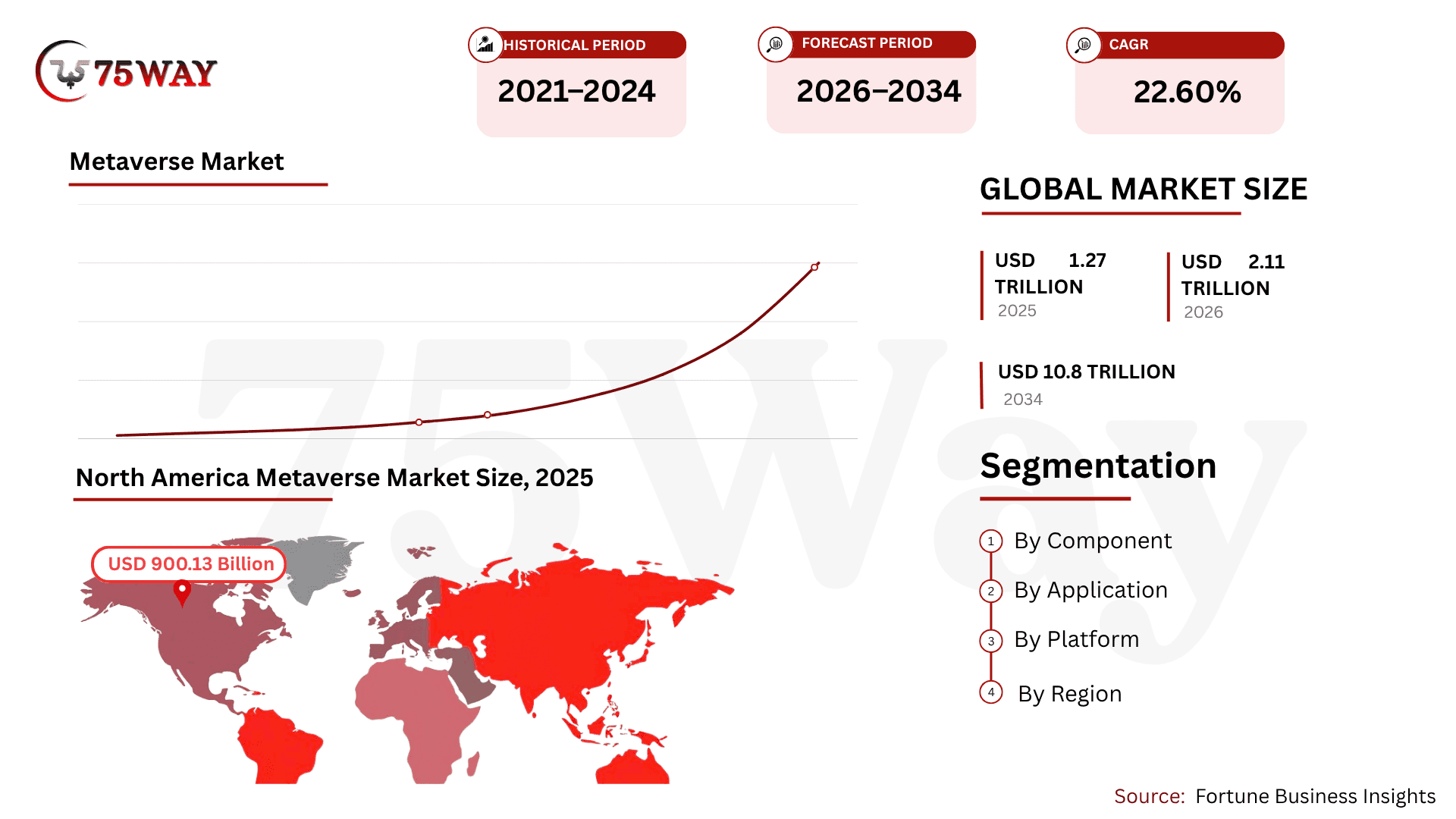
- The global metaverse market will grow from $2,114.25 billion in 2026 to $10,808.57 billion by 2034, reflecting a 22.60% CAGR.
- The United States is expected to generate the highest metaverse market value, reaching a projected $46.5 billion.
- By 2030, the global metaverse user base is forecast to reach 2.6 billion.
- User penetration is expected to rise to 39.7% by 2030, with projected ARPU of US$109.0.
- North America held the largest regional share of the metaverse market at 70.70%.
- Roblox Corporation collaborated with Gucci through Gucci Garden, helping the luxury brand engage younger audiences and build brand awareness virtually.
- Nike partnered with Roblox to launch Nikeland, a virtual world where users can customize avatars with Nike-branded sneakers and apparel.
How Does A 3D Metaverse Virtual Space Work?
At a high level, a user enters the virtual environment through a compatible device. The system authenticates the user, loads the 3D environment, creates or retrieves the user's avatar, connects them to the appropriate virtual session, and enables real-time interactions.
A simplified flow looks like this:
User → Authentication → Virtual World → Avatar → Real-Time Session → Interaction → Data & Analytics
Behind that experience, multiple technical components work together.
1. 3D Environment
The environment contains buildings, rooms, landscapes, objects, lighting, textures, animations, and other digital assets.
2. Metaverse Avatar
Users can be represented through customizable digital characters or other visual identities.
3. Real-Time Networking
Networking allows multiple users to occupy the same environment and see relevant actions or changes.
4. Interaction Engine
Users can interact with objects, interfaces, characters, products, or other participants.
5. Backend Infrastructure
The backend manages identity, profiles, sessions, permissions, user data, transactions, content, and other application logic.
6. Cloud Infrastructure
Cloud services can provide the computing, storage, content delivery, monitoring, and scaling infrastructure required for the platform.
The complexity increases significantly when hundreds or thousands of users need to interact within the same environment simultaneously.
Why Are Businesses Investing In 3D Metaverse Spaces?
A traditional digital presence can show customers what a brand sells, but a 3D metaverse space can let them experience the brand in an interactive environment. For businesses, that creates new possibilities for product discovery, virtual events, customer engagement, and immersive marketing. The key commercial reasons behind this investment are explained below.
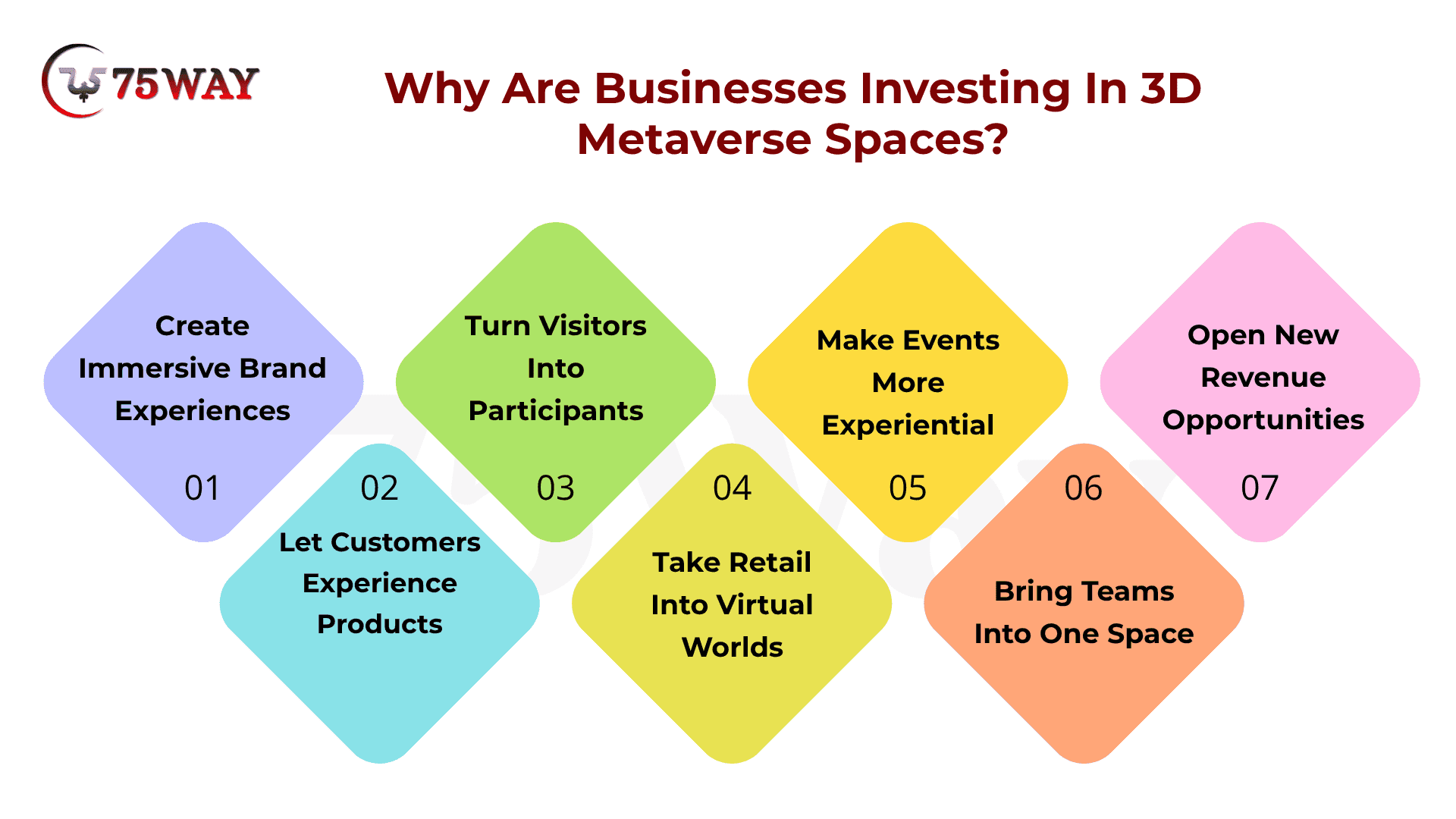
1. Create Immersive Brand Experiences
A 3D metaverse space gives businesses a chance to put customers inside their brand story. Instead of scrolling through another webpage, visitors can explore a virtual environment, interact with elements, and experience what the brand stands for. This creates a more memorable touchpoint that traditional digital marketing may not offer.
2. Let Customers Experience Products
Why only show customers a product when they can actually explore it virtually? Businesses can create 3D showrooms where users examine products, explore different features, and understand how they might look or work in real-life settings. This can make product discovery more engaging and informative.
3. Turn Visitors Into Participants
A virtual space becomes more interesting when customers can do something inside it. Businesses can add games, interactive challenges, social activities, product experiences, or personalized journeys that encourage visitors to spend more time with the brand. Every interaction can become another opportunity to build customer interest.
4. Take Retail Into Virtual Worlds
A 3D store can give ecommerce a completely different feel. Customers can walk through virtual aisles, discover collections, explore products, and interact with the shopping environment instead of simply moving between product pages. Businesses can use these experiences to experiment with new ways of presenting and selling products.
5. Make Events More Experiential
Product launches, exhibitions, conferences, and brand events do not always have to happen in physical venues. A metaverse space can recreate the feeling of attending an event while adding interactive elements that would be difficult to deliver offline. Businesses can also bring geographically separated audiences together in one shared environment.
6. Bring Teams Into One Space
Remote collaboration can feel more engaging when people have a shared environment rather than another video-call screen. Businesses can create virtual meeting rooms, training areas, product demonstrations, or collaborative spaces where teams and clients interact around digital objects. This can be especially useful for industries that depend heavily on visualization.
7. Open New Revenue Opportunities
A 3D metaverse space can become more than a marketing experiment when businesses connect it to a clear revenue strategy. Virtual products, memberships, sponsored experiences, paid events, and digital services can create additional commercial possibilities. The opportunity ultimately depends on whether the experience solves a genuine customer or business need.
How To Develop A Metaverse 3D Space: Complete Process
A virtual world may look simple on the surface, but its development involves multiple connected layers working behind the scenes. The business concept, 3D environment, user interactions, real-time systems, integrations, and technical infrastructure all need to come together as one product. The development journey is outlined below, from the first planning decisions through launch.
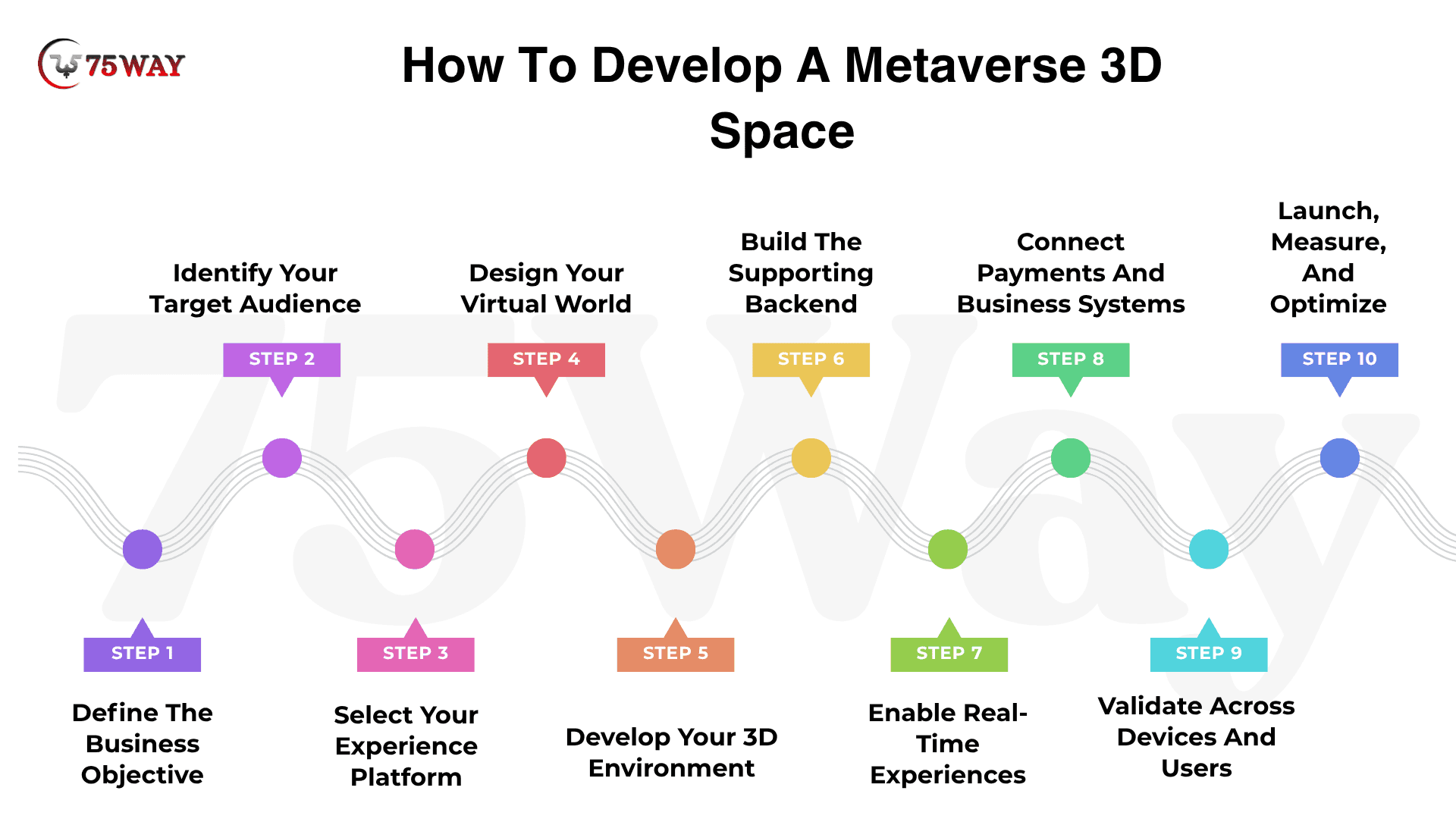
Step 1: Define The Business Objective
Before creating virtual spaces, establish what the experience needs to achieve for the business. A clear objective keeps design, technology, and investment decisions connected to measurable outcomes.
Possible objectives include:
- Increase product engagement
- Create a new sales channel
- Deliver immersive training
- Host virtual events
- Improve customer experiences
- Support remote collaboration
- Build a digital community
- Create an entertainment platform
Without a defined objective, teams can spend heavily on impressive visual elements without solving a meaningful business problem.
Step 2: Identify Your Target Audience
The people entering your virtual environment should influence how the experience is designed, accessed, and navigated. For example:
- Retail: Customers, sales representatives, and product specialists
- Enterprise: Employees, managers, trainers, and administrators
- Education: Students, teachers, administrators, and visitors
- Events: Attendees, speakers, sponsors, and organizers
Different audiences may require different interfaces, permissions, communication tools, and experiences. Defining these groups early helps prevent unnecessary features and creates a more focused user journey.
Step 3: Select Your Experience Platform
Your choice of platform determines how users will access and experience the virtual environment.
A browser-based experience offers easier access because users can enter without downloading specialized software. This approach can work well when reaching a broad audience is more important than maximum immersion.
Mobile and desktop experiences can provide greater control over performance and interaction. VR and AR can deliver deeper immersion, but they may require compatible devices and additional development considerations.
For a wider audience, cross-platform development can provide access across multiple devices. The final choice should reflect user behavior, experience requirements, technical complexity, and accessibility goals.
Step 4: Design Your Virtual World
The virtual environment should make the intended user journey feel natural, intuitive, and purposeful.
- Spatial Layout: Organize virtual areas according to user tasks and movement patterns.
- Visual Identity: Incorporate brand elements that make the environment recognizable and memorable.
- 3D Assets: Create optimized models that balance visual quality with application performance.
- Lighting Design: Use lighting to establish atmosphere, visibility, focus, and visual hierarchy.
- Navigation System: Provide intuitive movement and clear pathways between important areas.
- Interaction Zones: Place interactive elements where users naturally expect to find and use them.
A beautiful environment is not enough if visitors struggle to find products, attend events, access information, or complete important actions.
Step 5: Develop Your 3D Environment
Once the experience has been designed, 3D artists and developers can turn the concept into an interactive digital environment.
The development process can include modeling, texturing, animation, lighting, physics, interaction programming, and environment optimization. Depending on the project's requirements, teams may use engines such as Unity or Unreal Engine alongside specialized 3D creation tools.
Performance needs to remain a priority throughout development. Excessively detailed assets, large environments, and complex effects can increase loading times and hardware requirements, particularly for users on mobile devices or slower networks.
Step 6: Build The Supporting Backend
The visual world is only one part of a functional metaverse product. Behind it, a backend needs to manage the accounts, data, permissions, and activities that make the environment work.
It can handle authentication, user profiles, permissions, sessions, content, inventory, purchases, events, analytics, notifications, and moderation.
A scalable backend also becomes important when the platform expands from one virtual environment to multiple spaces, experiences, or large user communities.
Step 7: Enable Real-Time Experiences
Real-time infrastructure allows users to experience changes and interactions as they happen inside the virtual environment.
This can support player movement, voice communication, object interactions, multiplayer activities, collaborative actions, and live events.
The infrastructure should be planned around expected concurrent users, interaction frequency, network conditions, and the complexity of real-time synchronization rather than simply the total number of registered accounts.
Step 8: Connect Payments And Business Systems
A commercial metaverse experience may need to connect with the systems already supporting your business.
Common integrations include:
- Payment gateways
- CRM systems
- E-commerce platforms
- Identity systems
- Event platforms
- Customer support tools
- Analytics platforms
- Enterprise software
For example, a virtual showroom could connect product interactions with an existing ecommerce system, allowing visitors to move from product exploration toward a purchase without creating a disconnected customer journey.
These integrations should be selected according to the business workflow rather than added simply to increase the platform's technical complexity.
Step 9: Validate Across Devices And Users
A 3D application needs testing across different devices, networks, and user scenarios before reaching a wider audience.
Test the following:
- Performance: Check frame rates, loading times, memory usage, and overall responsiveness.
- Compatibility: Validate the experience across supported browsers, smartphones, computers, VR devices, and operating systems.
- Multiplayer: Test synchronization, movement, communication, and shared interactions under realistic user loads.
- Usability: Observe whether new users can enter, navigate, understand, and complete important actions without confusion.
Testing with real users can reveal navigation problems, confusing interactions, performance bottlenecks, and accessibility issues that may not appear during internal development.
Step 10: Launch, Measure, And Optimize
Launching the virtual environment is the beginning of the optimization cycle, not the final development milestone.
Track meaningful metrics such as visitor activity, session duration, popular areas, interactions, event participation, product engagement, and conversion actions.
If visitors enter a virtual showroom but rarely explore product information or reach checkout, the experience may need changes to navigation, placement, messaging, or interaction design.
The goal is to improve the complete user journey based on actual behavior, rather than continuously adding visual complexity without measurable value.
Metaverse 3D Space Use Cases Across Modern Business Industries
The same 3D environment can serve completely different commercial purposes across industries. A university can turn it into a virtual campus, a manufacturer can use it for training, and a hospitality brand can create an immersive destination experience for prospective guests. The industry-specific applications below highlight where businesses can put metaverse spaces to work.
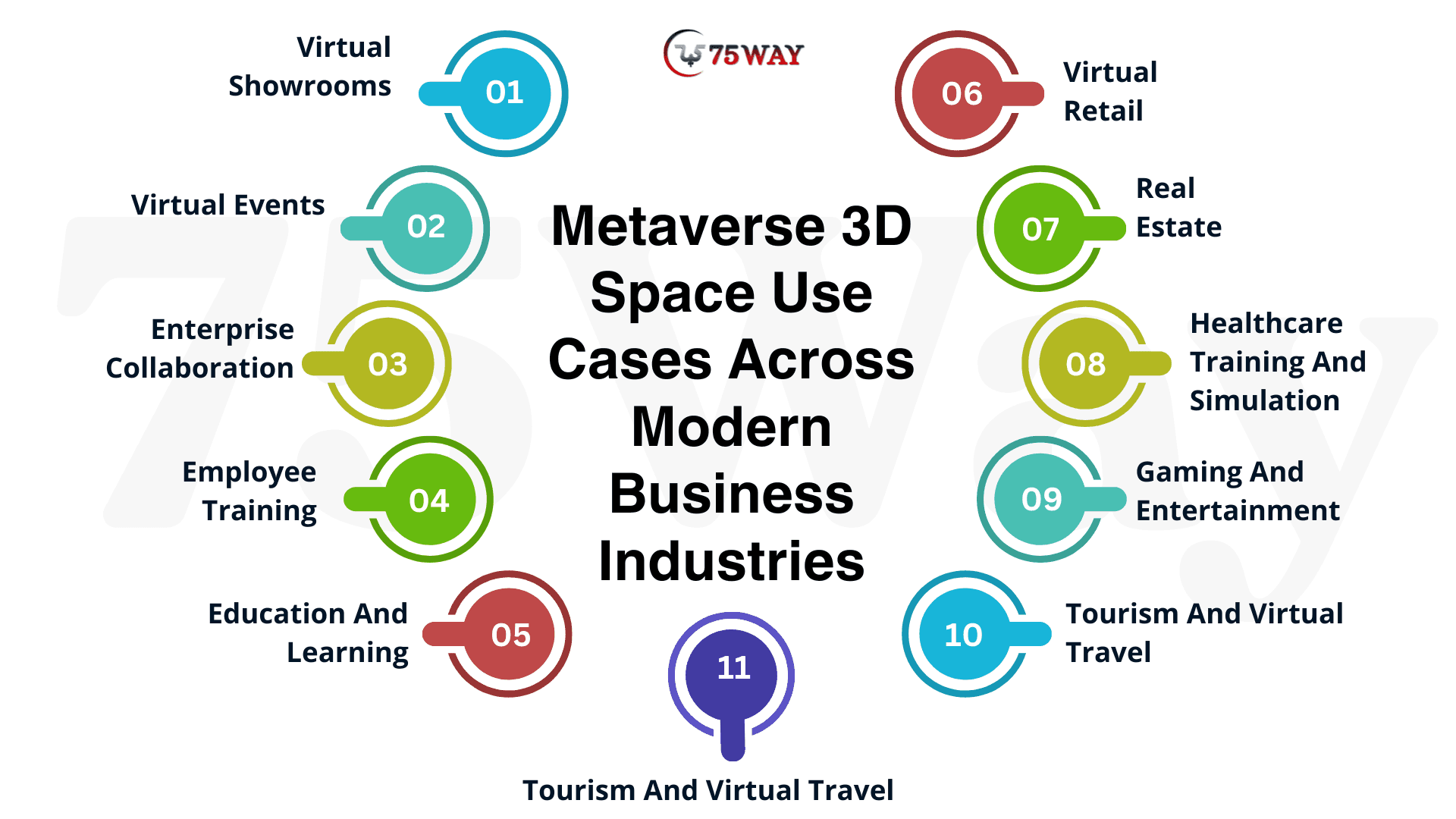
- Virtual Showrooms
A virtual showroom brings products into an interactive 3D environment, allowing visitors to examine designs, explore features, compare variants, and understand products more realistically.
Automotive, furniture, fashion, electronics, and luxury brands can use these spaces to recreate product experiences that would otherwise require a physical showroom visit.
- Automotive Sales And Experiences
Virtual automotive spaces can let customers explore vehicle models, customize colors and interiors, inspect features, and experience different configurations before visiting a dealership.
Interactive test-drive simulations and digital showrooms can also help prospective buyers understand vehicle capabilities and compare available options from anywhere. For example, BMW has explored virtual and immersive experiences that allow audiences to interact with its vehicles and brand digitally.
- Virtual Events
Conferences, exhibitions, product launches, networking sessions, concerts, and private gatherings can take place inside interactive digital venues.
Attendees can move between spaces, visit virtual booths, join presentations, interact with other participants, and engage with branded activities instead of simply watching a livestream.
- Enterprise Collaboration
Shared virtual workspaces can make remote collaboration more visual and interactive, particularly when teams need to discuss designs, models, presentations, or complex concepts.
Participants can meet in the same digital environment, review virtual objects together, exchange ideas, and collaborate without depending entirely on traditional video meetings.
- Employee Training
Real-world situations can be recreated inside controlled virtual environments for practical learning and simulation.
Employees can practice equipment handling, safety procedures, operational workflows, customer interactions, and emergency responses without interrupting live operations or requiring access to physical training environments.
- Education And Learning
Immersive classrooms can turn lessons into experiences where students explore rather than simply read or watch.
Virtual laboratories, historical locations, digital campuses, scientific simulations, and interactive models can make difficult concepts easier to visualize and provide learning opportunities beyond the traditional classroom.
- Virtual Retail
A digital store can recreate the discovery experience of physical shopping while adding interactive capabilities that conventional ecommerce cannot easily provide.
Visitors can explore collections, inspect products, watch demonstrations, discover promotions, interact with other shoppers, and potentially complete purchases within the same environment.
- Real Estate
Property discovery becomes more immersive when potential buyers can virtually walk through homes, apartments, commercial spaces, or entire developments.
Interactive tours can showcase floor plans, room layouts, interiors, furnishings, neighborhood environments, and different design configurations before a physical property visit.
- Healthcare Training And Simulation
Immersive 3D environments can support selected healthcare education and simulation scenarios where appropriate safeguards and professional requirements are maintained.
Virtual spaces can help learners explore anatomy, practice procedures, understand medical equipment, and rehearse specific situations within controlled training environments.
- Gaming And Entertainment
Interactive virtual worlds can combine gameplay, social interaction, events, exploration, and digital experiences within one persistent environment.
Users can participate in multiplayer activities, attend virtual events, interact with communities, explore creator-led experiences, and engage with digital collectibles or merchandise where relevant.
- Tourism And Virtual Travel
Virtual environments can recreate destinations, attractions, museums, resorts, and cultural landmarks for people who cannot visit them physically.
Interactive tours can help travelers preview destinations, explore attractions, experience cultural environments, and make more informed decisions before planning an actual trip.
Key Features Required For Metaverse 3D Platform Development
The right feature set depends on your business model. A virtual training platform does not require exactly the same capabilities as a virtual retail world. However, most commercial metaverse platforms can include the following.
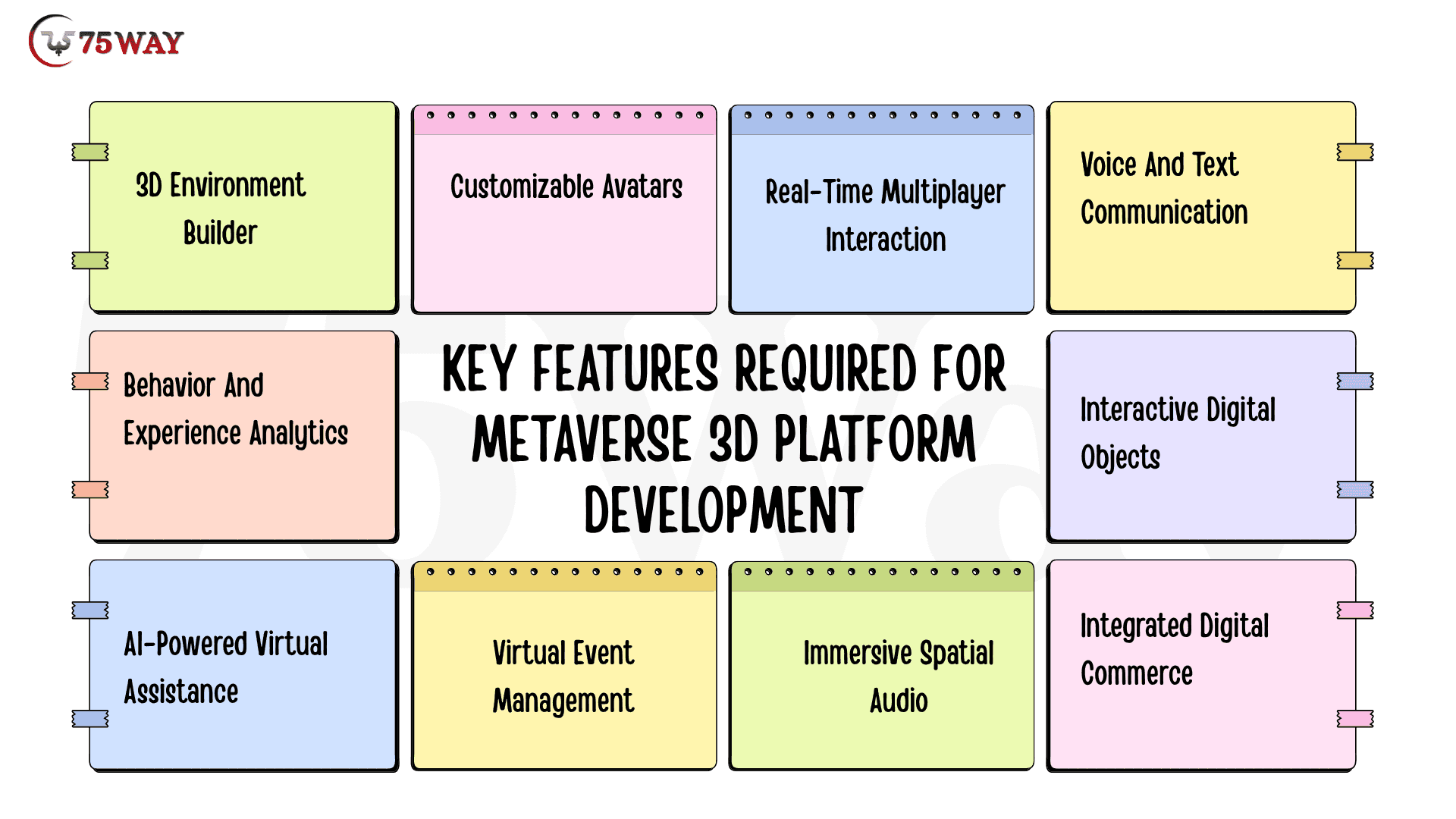
1. 3D Environment Builder
The foundation of any metaverse experience is the world users actually enter and explore. A 3D environment builder lets teams create branded stores, offices, campuses, event venues, training facilities, or entirely original spaces. It also makes it possible to change layouts, add new experiences, and expand the virtual world as the platform grows.
2. Customizable Avatars
Users need more than a username when they are meeting and interacting inside a virtual world. Customizable avatars allow them to choose appearances, outfits, accessories, and other visual elements that represent their digital identity. For social, gaming, retail, and community-focused platforms, this personalization can make users feel more connected to the experience.
3. Real-Time Multiplayer Interaction
A metaverse space becomes significantly more engaging when people can experience it together. Real-time multiplayer capabilities allow users to meet, move through environments, participate in activities, and interact with digital objects simultaneously. This creates the foundation for virtual events, social communities, collaborative workspaces, and multiplayer experiences.
4. Voice And Text Communication
Walking into a virtual environment should not mean losing the ability to communicate naturally. Voice and text tools can support private conversations, group discussions, customer assistance, networking, and team collaboration. Proximity-based audio can also make conversations feel more contextual by allowing nearby users to hear one another.
5. Interactive Digital Objects
Static 3D models can look impressive, but interactive objects give users a reason to explore further. Products can be opened, machines can be operated, displays can reveal information, and virtual environments can respond to user actions. These interactions can turn a visually appealing space into an experience with a clear purpose.
6. Integrated Digital Commerce
A virtual experience can lead directly to a commercial action when commerce is built into the environment. Users might purchase a physical product, book a service, register for an event, subscribe to an offering, or acquire digital goods. Connecting the space with ecommerce and payment infrastructure can shorten the journey between discovery and conversion.
7. Immersive Spatial Audio
Sound can guide attention just as strongly as visual design. Spatial audio makes conversations, announcements, music, and environmental sounds respond to the user's location within the virtual space. This can make crowded events, collaborative environments, games, and social experiences feel considerably more realistic.
8. Virtual Event Management
From product launches to conferences, scheduled experiences need more than a digital room. Event management capabilities can handle registrations, access controls, session schedules, virtual stages, exhibitor areas, speakers, and attendee interactions. These tools give administrators greater control over large-scale experiences and help create structured journeys for participants.
9. AI-Powered Virtual Assistance
An AI assistant can act as a digital guide when users need help navigating an unfamiliar virtual environment. It can answer questions, recommend products or spaces, explain information, and direct visitors toward relevant experiences. In commercial environments, this can also support customer service and product discovery without requiring human assistance for every interaction.
10. Behavior And Experience Analytics
Understanding what users do inside a 3D world is essential for improving its business value. Analytics can reveal which spaces attract attention, where users spend time, which objects they interact with, and where they leave the experience. These insights can help teams refine layouts, content, campaigns, and conversion journeys based on actual user behavior.
Technology Stack Utilized For Custom Metaverse 3D Space Development
A virtual space may depend on dozens of technical components that users never see but immediately notice when something feels slow or unstable. Rendering engines, programming frameworks, databases, cloud infrastructure, communication tools, and other technologies each serve a specific role in the final experience. The technology stack behind custom metaverse 3D space development is outlined below.
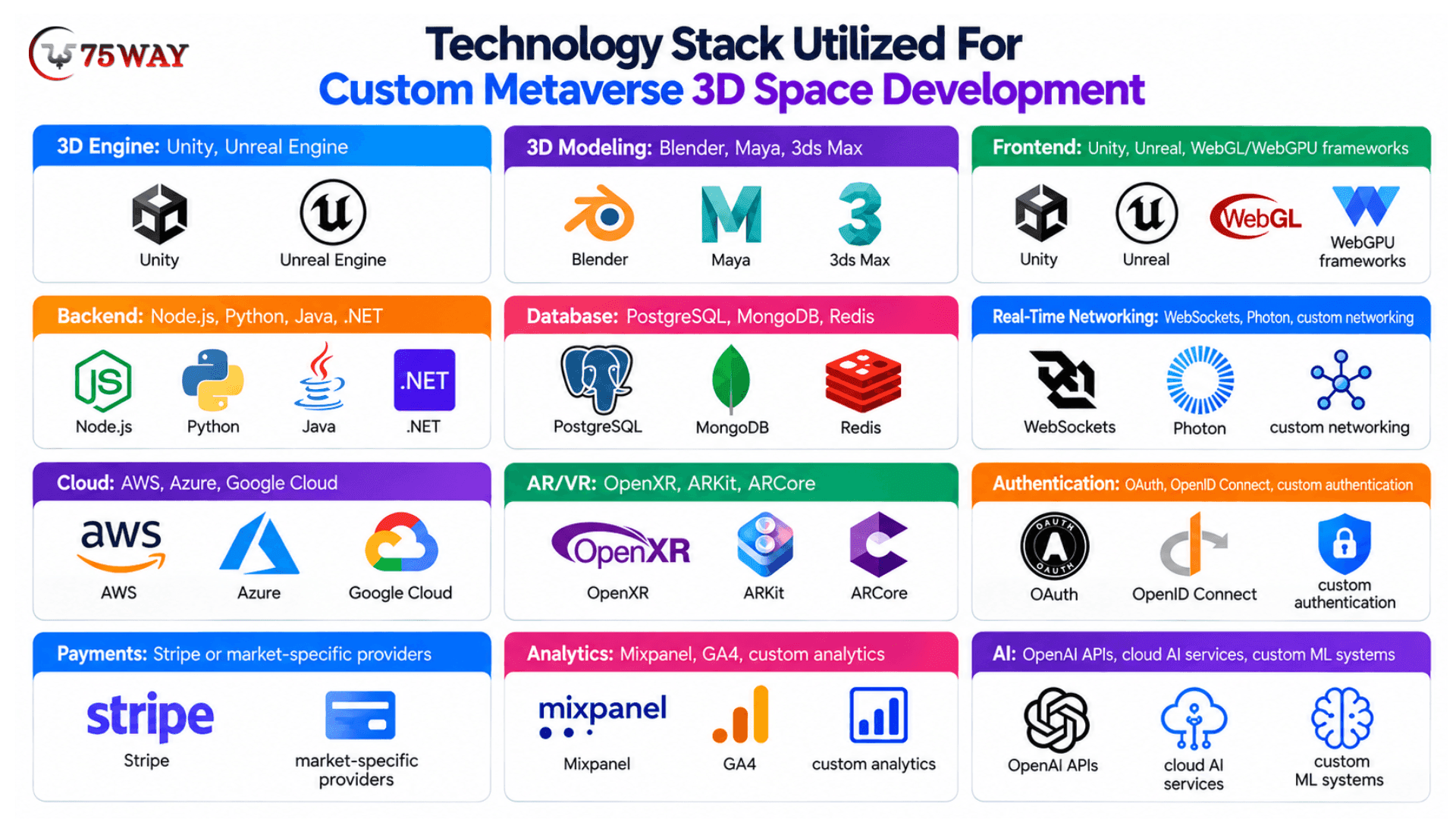
- 3D Development Engine: Unity and Unreal Engine power immersive environments, realistic graphics, animations, physics, and interactive virtual experiences.
- 3D Modeling Tools: Blender, Autodesk Maya, and 3ds Max help create characters, buildings, products, environments, and other virtual assets.
- Frontend Development: React, Three.js, Babylon.js, or similar frameworks support browser-based interfaces and interactive 3D experiences.
- Backend Technology: Node.js, Python, Java, or similar technologies manage users, sessions, profiles, virtual spaces, transactions, and application logic.
- Database: PostgreSQL, MongoDB, or other databases store user profiles, digital assets, activity records, marketplace data, and platform configurations.
- Real-Time Communication: WebSockets, WebRTC, and related technologies enable live movement, multiplayer interactions, voice communication, and collaborative experiences.
- Cloud Infrastructure: AWS, Google Cloud, or Microsoft Azure provide scalable computing, storage, networking, content delivery, and deployment infrastructure.
- AR/VR Development: OpenXR, ARKit, ARCore, and compatible SDKs support immersive experiences across virtual reality and augmented reality devices.
- AI Technologies: AI models can power virtual assistants, intelligent NPCs, personalized recommendations, automated support, and adaptive user experiences.
- Blockchain And Digital Assets: Blockchain technologies can support digital ownership, tokenized assets, wallets, and marketplace functionality where the business model requires them.
- Payment Integration: Stripe, PayPal, or regional payment gateways enable purchases, subscriptions, event tickets, virtual goods, and other transactions.
- Analytics & Monitoring: Analytics platforms and cloud monitoring tools track engagement, user behavior, performance, conversions, and technical issues to guide optimization.
The right stack depends on the project. For high-fidelity 3D environments, Unreal Engine may be appropriate. For cross-platform interactive experiences, Unity can be a practical choice. For browser-based experiences, WebGL/WebGPU technologies can reduce installation requirements.
Business Benefits of AI-Powered Metaverse 3D Spaces Development
A 3D metaverse space can give businesses a digital environment where customers do more than browse. They can explore, interact, participate, and experience the brand. That added layer of interaction can create new commercial opportunities beyond conventional websites and apps. The key business benefits of metaverse 3D space development are explained below.
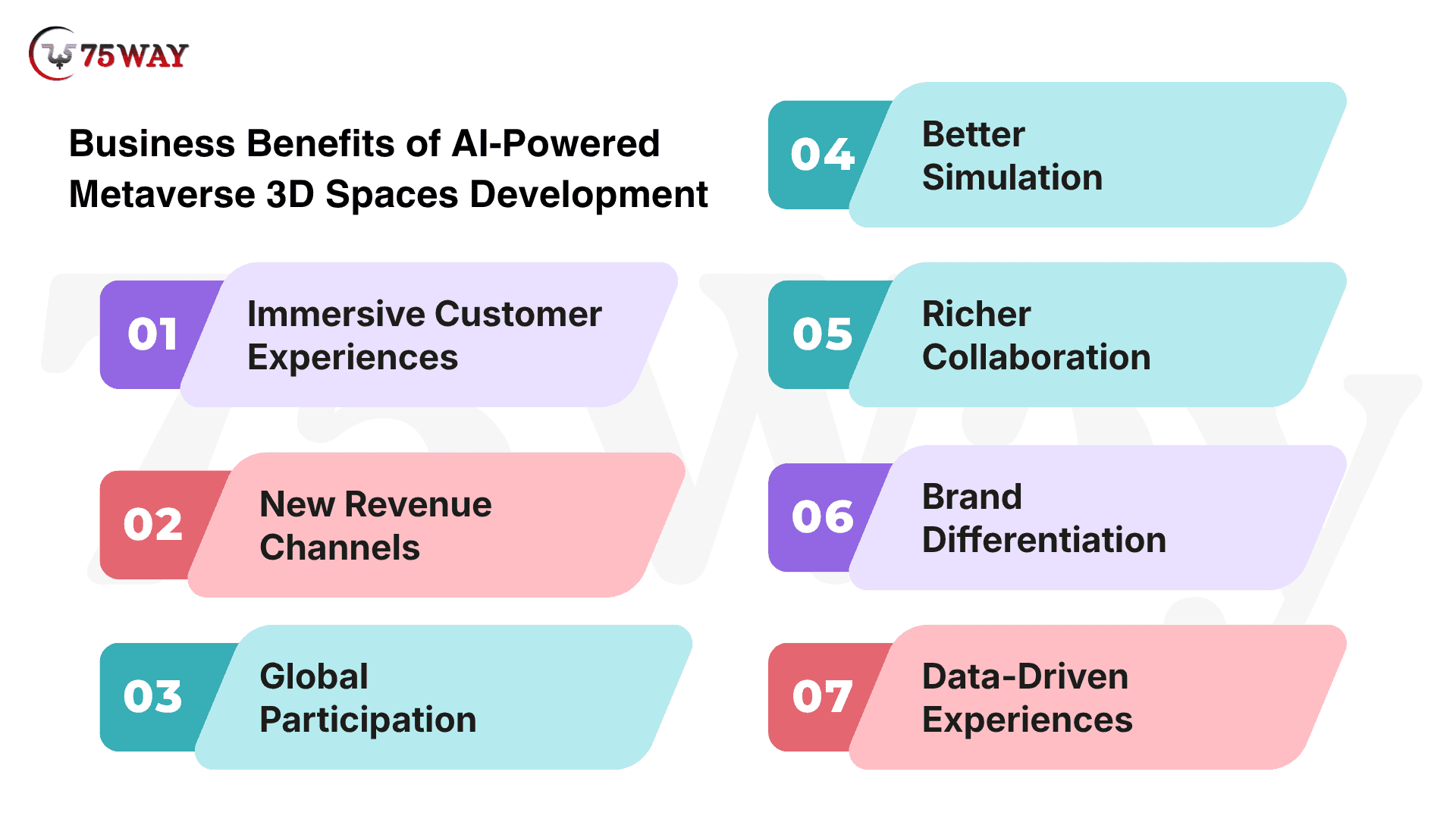
- Immersive Customer Experiences
A 3D environment turns passive browsing into active discovery. Customers can walk through virtual stores, examine products from different angles, interact with features, and experience a brand in ways that traditional screens may not fully capture.
- New Revenue Channels
A virtual space can become more than a branding exercise; it can support actual monetization. Businesses can sell digital products, offer memberships, host paid experiences, promote sponsorships, enable virtual bookings, or connect immersive journeys with physical purchases.
- Global Participation
Geography becomes less restrictive when an experience exists digitally. Customers, employees, students, partners, and event attendees can enter the same virtual environment from different locations, expanding reach without requiring everyone to be physically present.
- Better Simulation
Complex or expensive real-world scenarios can be recreated digitally for controlled experimentation. Training teams, demonstrating equipment, teaching concepts, or testing workflows in a simulated environment can reduce practical limitations before moving into real-world execution.
- Richer Collaboration
Virtual collaboration adds a sense of space that conventional video calls cannot always provide. Teams can meet around 3D models, examine digital objects, conduct presentations, and interact within shared environments while working from different locations.
- Brand Differentiation
A thoughtfully designed virtual environment can become a memorable extension of the brand. Instead of competing only through websites and conventional campaigns, companies can create distinctive digital spaces that communicate their identity through design, interaction, storytelling, and experience.
- Data-Driven Experiences
Every interaction inside a virtual space can reveal useful behavioral patterns, such as where users spend time, what they explore, and which experiences attract attention. These insights can help refine layouts, content, product journeys, and future customer experiences.
Metaverse 3D Space Development Cost: A Detailed Pricing Breakdown
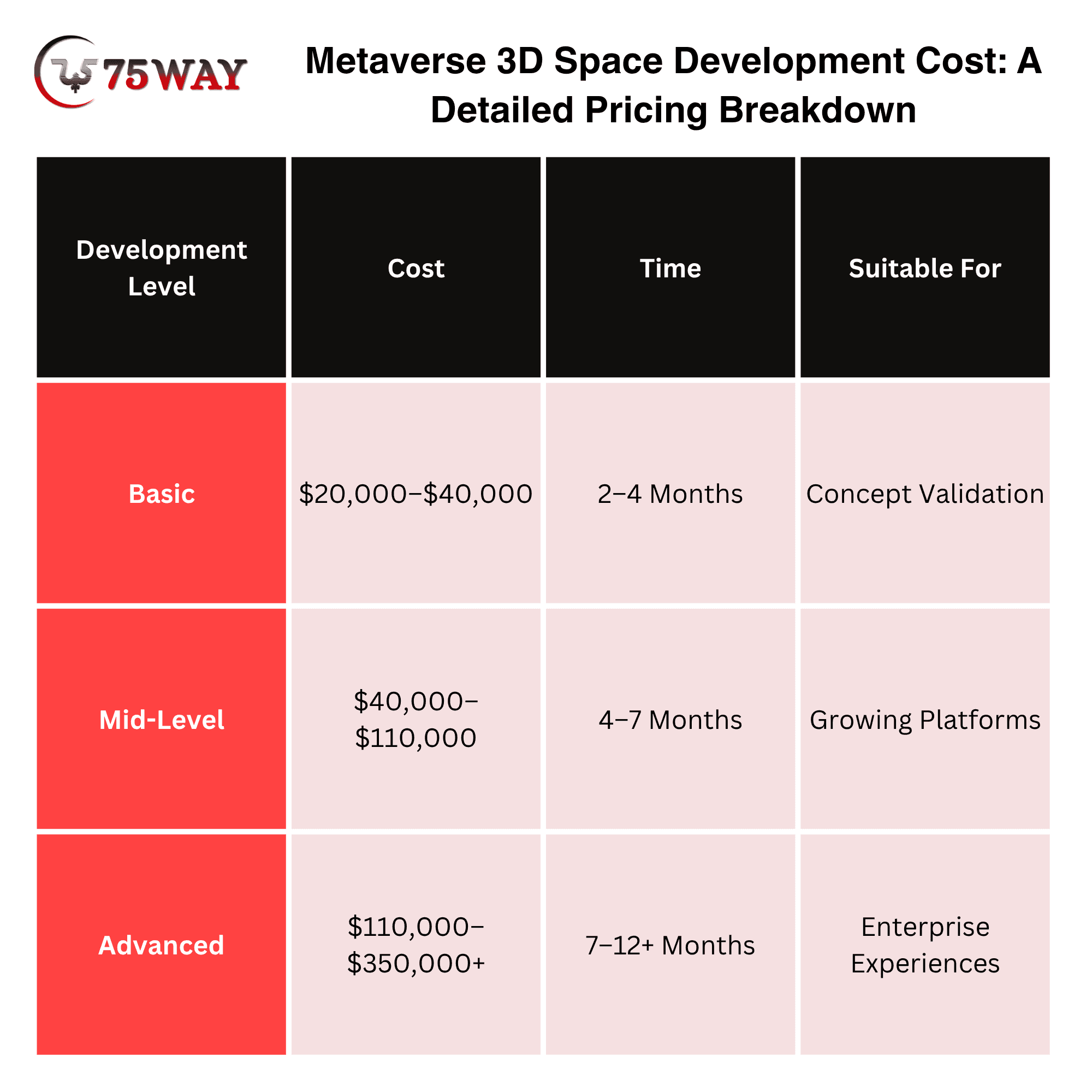
The cost of metaverse 3D space development can range from approximately $20,000 to $350,000+, depending on the complexity of the environment, supported platforms, number of users, 3D asset quality, real-time capabilities, integrations, security requirements, and backend architecture. A practical planning model is:
- Basic Metaverse 3D Space: $20,000–$40,000
Ideal for smaller virtual environments with essential interactions, navigation, user accounts, and lightweight 3D assets.
- Mid-Level Metaverse 3D Space: $40,000–$110,000
Supports customized environments, avatars, multiplayer interaction, chat, analytics, integrations, and stronger backend infrastructure.
- Advanced Metaverse 3D Space: $110,000–$350,000+
Combines high-fidelity environments, scalable multiplayer, commerce, AI, spatial audio, and complex backend infrastructure.
Major Cost Components In Immersive Metaverse 3D Space Development
The overall budget depends on the complexity of your virtual world, number of users, integrations, and technical requirements.
- 3D Environment & Assets: $6,000–$40,000
Covers virtual spaces, buildings, textures, objects, characters, and customized 3D assets.
- Multiplayer Networking: $5,000–$40,000
Enables real-time user synchronization, shared interactions, movement, and multiplayer communication.
- UI/UX Design: $3,000–$15,000
Covers intuitive interfaces, navigation, menus, dashboards, and immersive user interaction flows.
- Backend Development: $8,000–$35,000
Handles databases, authentication, APIs, user accounts, sessions, and core platform functionality.
- AR/VR Integration: $5,000–$30,000
Adds headset support, motion controls, augmented reality, and immersive device interactions.
- Voice & Chat: $3,000–$15,000
Supports text messaging, voice communication, proximity chat, and user moderation.
- Payment & Commerce: $3,000–$20,000
Enables subscriptions, virtual goods, bookings, payments, and digital marketplace transactions.
- AI Integration: $5,000–$30,000
Adds AI assistants, recommendations, intelligent characters, and automated virtual interactions.
- Infrastructure & Hosting: $1,000–$10,000/month
Covers cloud computing, storage, CDN services, databases, monitoring, and scalability.
- Security & Testing: $4,000–$20,000
Contains security audits, compatibility checks, performance testing, and quality assurance.
- Maintenance & Updates: 15%–25% annually
Covers bug fixes, security patches, infrastructure management, monitoring, and ongoing feature improvements.
Note: These are planning ranges rather than fixed development quotes. The final cost depends on what you are actually building.
A single interactive virtual showroom is fundamentally different from a persistent multi-user virtual world with commerce, avatars, AI, digital assets, voice communication, multiple environments, and enterprise integrations.
Major Factors Impacting The Cost of 3D Metaverse Development
If you’re budgeting for a metaverse project, the initial development quote rarely tells the full story. A basic virtual environment can cost far less than an interactive platform with real-time communication, AI, digital assets, commerce, and large-scale user access. The major cost considerations behind metaverse development are explained below.
- 3D Asset Complexity: Detailed environments require more modeling, texturing, animation, optimization, and testing, increasing overall development costs.
- Platform Support: Supporting browsers, mobile devices, desktops, and VR hardware can increase development and quality assurance requirements.
- Multiplayer Scale: Supporting more concurrent users requires stronger real-time architecture, server capacity, synchronization, and infrastructure.
- Avatar Complexity: Basic avatars require fewer resources than highly customizable, animated, and realistic digital characters.
- AI Integration: AI-powered assistants, NPCs, recommendations, personalization, and content generation can increase engineering and infrastructure expenses.
- Blockchain: Wallets, smart contracts, digital assets, transaction handling, and compliance requirements can add development costs when blockchain is necessary.
- Commerce: Virtual stores, payments, subscriptions, tickets, digital products, and physical checkout add backend and integration requirements.
- Security: Identity, payments, user-generated content, communication, moderation, and enterprise data require appropriate security controls.
- Infrastructure: Persistent worlds and multiplayer environments can generate significant cloud, storage, bandwidth, and monitoring costs.
How Long Does It Take To Build A Metaverse 3D Space?
A basic 3D virtual environment may take around 3–5 months, while a complex commercial metaverse platform can require 8–18 months or more. A typical roadmap can include:
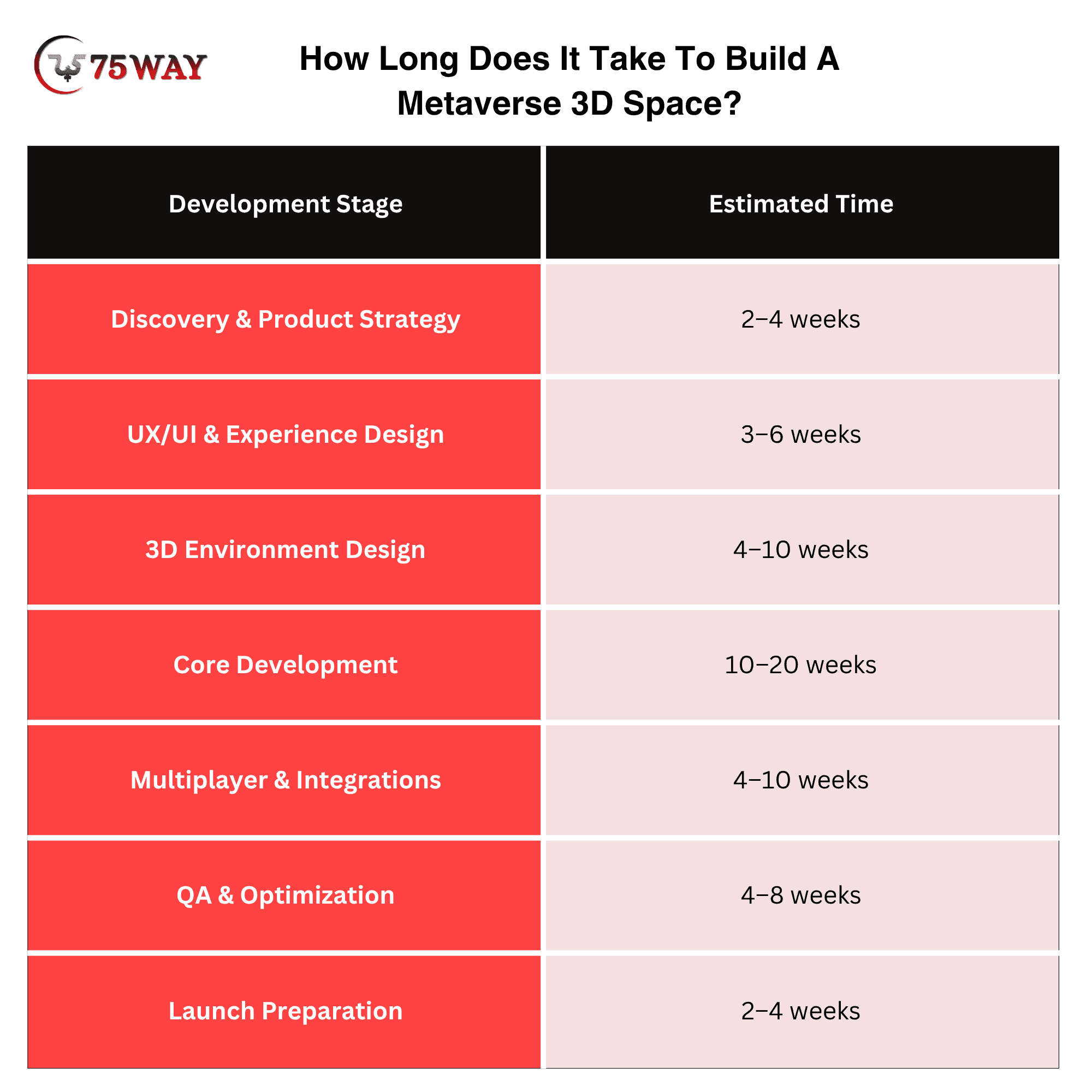
Several activities can run in parallel, so the timeline duration will vary according to team size and project scope.
Key Challenges In Building Metaverse 3D Platforms And Solutions
A 3D metaverse space needs to deliver more than striking visuals if it is expected to support real business use. The experience must remain usable, responsive, and scalable while users interact with digital environments and services. A closer look at the practical solutions makes the path to a stronger 3D space clearer.
1. Hardware Accessibility Barriers: VR-first experiences can exclude users without compatible hardware. Offering multiple access options helps make immersive experiences available to a broader audience.
How To Resolve: Support browsers, desktops, and mobile devices alongside optional VR access.
2. High Performance Requirements: Large 3D environments can strain devices and require substantial bandwidth. Poor optimization can lead to slow loading, lag, and reduced user engagement.
How To Resolve: Optimize 3D assets, rendering, loading times, and network performance for different device capabilities.
3. Low User Adoption: A visually impressive virtual environment does not guarantee regular usage. The experience must provide practical value and engaging interactions that encourage users to return.
How To Resolve: Build purposeful features, meaningful interactions, and experiences around clear user needs.
4. Rising Development Costs: High-quality 3D assets, multiplayer functionality, and specialized engineering can quickly increase project expenses. Without proper planning, additional features can push development beyond the initial budget.
How To Resolve: Prioritize essential features and introduce advanced capabilities through phased development.
5. Complex Content Moderation: Social virtual environments can encounter harassment, abuse, inappropriate content, and other community risks. Without proper controls, these issues can negatively affect user safety and platform trust.
How To Resolve: Combine reporting tools, automated detection, human moderation, access controls, and clear community guidelines.
6. Data Privacy Concerns: Metaverse platforms can collect identity, behavioral, communication, and spatial information. Handling this data requires privacy-focused architecture and appropriate security measures.
How To Resolve: Implement consent management, encryption, access controls, secure storage, and data-minimization practices.
7. Limited Platform Interoperability: Transferring digital assets, identities, and experiences across platforms can involve technical and commercial limitations. Planning for compatibility early can reduce integration difficulties later.
How To Resolve: Use standardized formats, APIs, and interoperability requirements during platform architecture planning.
How To Make A Virtual 3D Space Successful
The strongest metaverse projects do not begin with: “What cool virtual world can we build?”
They begin with:
“What experience can only become significantly better through a 3D environment?”
That distinction matters.
If a standard website can deliver the same outcome more easily, a metaverse environment may not be justified.
But when spatial interaction adds genuine value—such as virtual training, product visualization, collaborative simulation, immersive events, or interactive communities—the technology can become commercially meaningful.
Before development, define:
- Business objective
- Target users
- Core experience
- Supported devices
- Monetization model
- User acquisition strategy
- Content strategy
- Security requirements
- Analytics framework
- Scalability requirements
This turns the project from a technology experiment into a product strategy.
Final Remarks
Metaverse 3D space development is no longer simply about creating a visually impressive virtual world. The strongest business cases connect immersive environments to a specific outcome, selling products, training employees, hosting events, educating users, enabling collaboration, or creating new digital experiences.
For planning purposes, metaverse 3D space development can cost $20,000–$350,000+, while the timeline can range from a few months for a focused environment to more than a year for a sophisticated multi-user platform.
Have a metaverse idea in mind? Contact a reliable blockchain development company to define the right 3D experience, technology stack, development roadmap, and investment for your business.
Frequently Asked Questions (FAQs)
What Is Metaverse 3D Space Development?
Metaverse 3D space development is the process of creating interactive virtual environments where users can explore, communicate, collaborate, interact with objects, attend events, or conduct transactions.
How Much Does It Cost To Develop A Metaverse 3D Space?
Metaverse 3D space development can cost approximately $20,000 to $350,000+, depending on 3D complexity, platforms, multiplayer capabilities, integrations, infrastructure, security, and advanced features.
What Technologies Are Used For Metaverse 3D Development?
Common technologies include Unity, Unreal Engine, Blender, Maya, WebGL/WebGPU, cloud platforms, real-time networking frameworks, databases, AR/VR frameworks, and backend technologies.
Do I Need Blockchain To Build A Metaverse?
No. Blockchain is optional and should be used only when features such as decentralized ownership, digital assets, tokenized transactions, or smart contracts provide genuine product value.
Can A Metaverse 3D Space Work Without VR Headsets?
Yes. Metaverse experiences can be designed for browsers, desktops, smartphones, tablets, and other devices. VR can be added when deeper immersion is required.
Can AI Be Integrated Into A Metaverse Environment?
Yes. AI can support virtual assistants, intelligent NPCs, personalization, recommendations, moderation, natural-language interaction, content generation, and analytics.
How Do Metaverse Platforms Make Money?
Potential models include virtual commerce, subscriptions, memberships, enterprise licensing, virtual events, sponsorships, advertising, digital goods, and SaaS offerings.