AI Summary
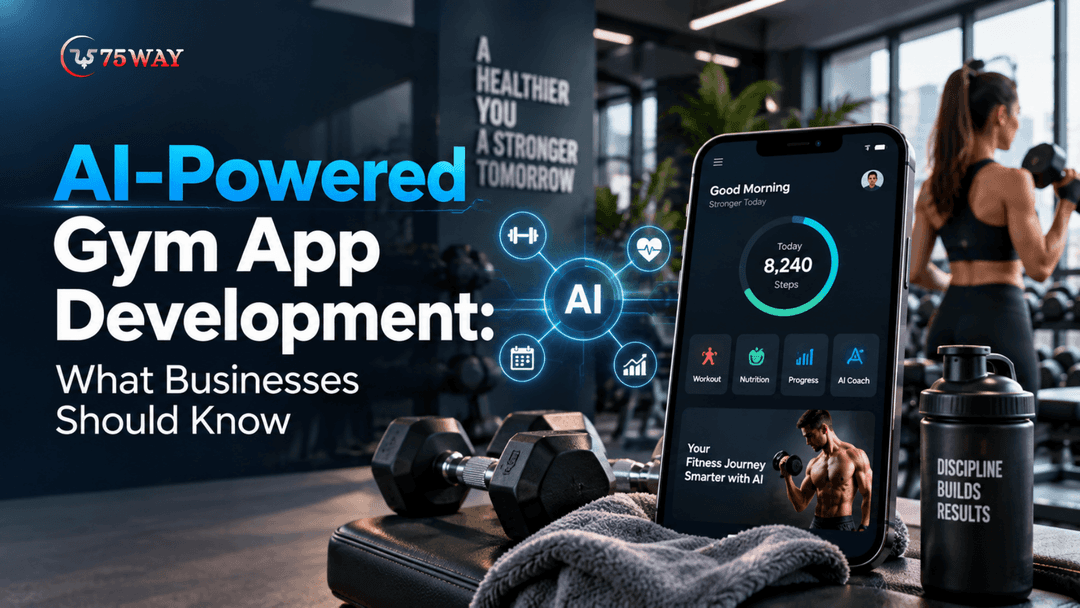
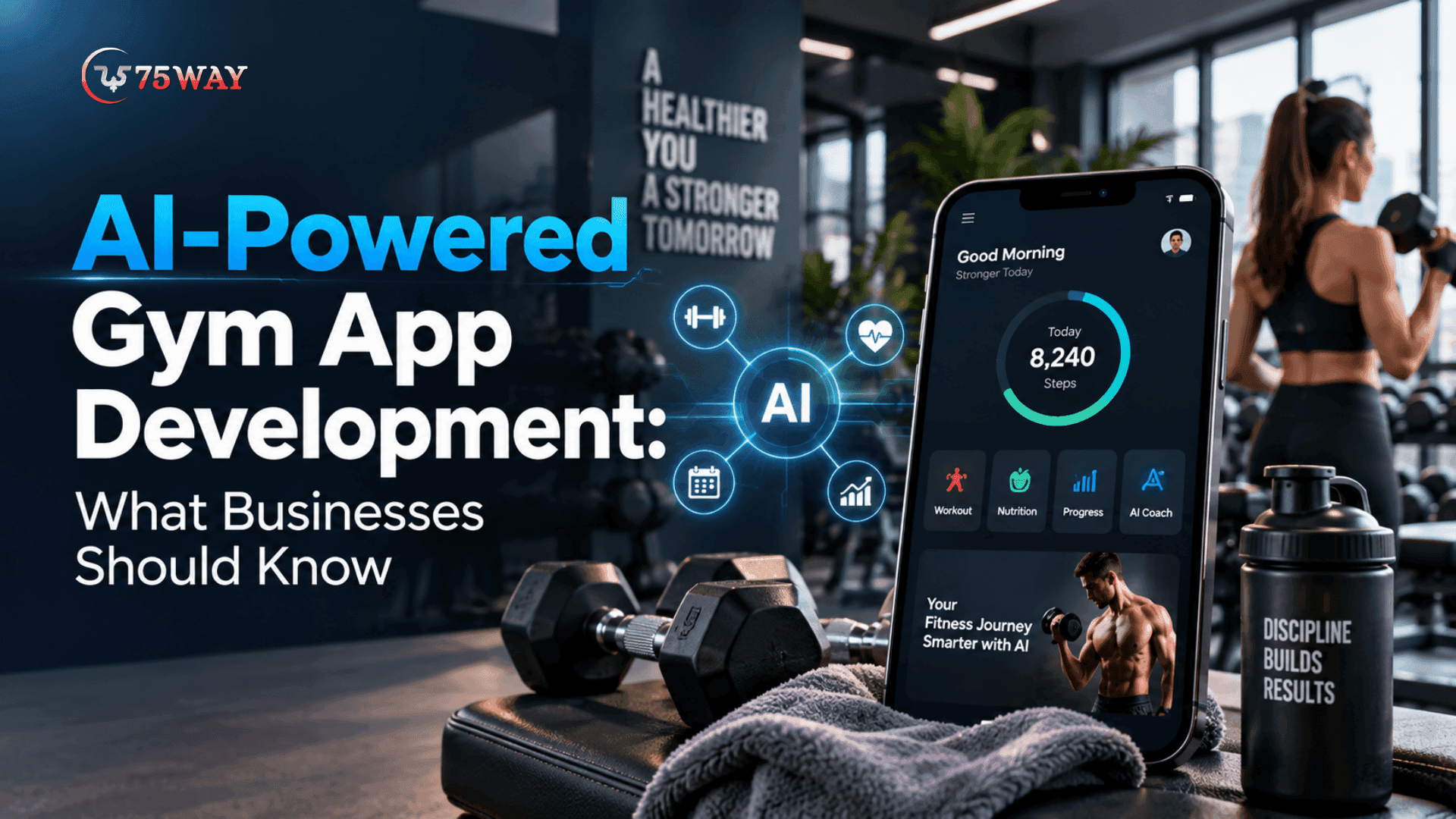
AI-powered gym apps are becoming strategic products for fitness businesses seeking personalization, retention, and scalable revenue. This guide explores the technology, features, costs, monetization models, and gym app development considerations shaping these apps in 2027. It also explains how businesses can plan smarter investments.
Key Takeaways
- AI gym apps can personalize workouts, coaching, recommendations, and user experiences at scale.
- Development costs can range from $15,000 to $400,000+, depending on scope.
- Successful apps require more than AI; integrations, UX, security, and scalability matter.
- Businesses can monetize through subscriptions, memberships, premium coaching, partnerships, and in-app purchases.
- Fitness app revenue could reach $15.45 billion by 2031, signaling strong market potential.
- Strategic planning helps fitness businesses build useful AI products without unnecessary development spending.
A member who stops opening your gym app for three weeks may not have cancelled yet, but the warning sign is already there. An AI-powered gym app can turn these behavioral signals into useful insights, helping gyms understand when members are losing interest, personalize their experience, and create timely reasons to come back.
That makes AI valuable far beyond automated workout suggestions. A smarter gym workout mobile app development solution can learn from how members train, interact, progress, and respond to recommendations, giving gyms new ways to support retention while reducing the amount of routine work handled manually by trainers and staff. The result is an app that does not simply sit on a member’s phone. It becomes an active part of the relationship between the gym and its members.
For businesses considering this approach, the bigger question is not whether AI can be added to a gym app, but where it can produce measurable value. This guide explains how to build an AI-powered gym app, which capabilities are worth developing, how the fitness app development process works, what the project can cost, and what it takes to turn the concept into a useful product.
What Is An AI-Powered Gym App?
An AI-powered gym app is a fitness application that uses artificial intelligence to analyze user information, generate personalized recommendations, automate selected interactions, or support business decisions.
A conventional gym app might allow a member to book classes, view workouts, manage payments, and track progress. An AI-enabled version can go further.
It may recommend a workout based on previous performance, adjust a training plan after missed sessions, answer fitness-related questions, identify exercise-form issues through computer vision, or surface engagement patterns for gym operators.
The important distinction is adaptation.
Traditional software generally follows predefined rules. AI can interpret larger amounts of information and generate recommendations based on patterns within that information.
For businesses, that creates an opportunity to build a product that responds to individual members rather than giving every user the same digital experience.
Fitness & Gym App Market Size & Growth in USA
A fitness app is no longer limited to tracking steps or counting calories; it can become part of how people discover workouts, follow training plans, monitor progress, and engage with fitness businesses. The American fitness app market is projected to grow at around 12% annually from 2026 to 2033, reaching more than $10.3 billion by 2033. The market opportunity, growth outlook, and trends behind this expansion are covered below.
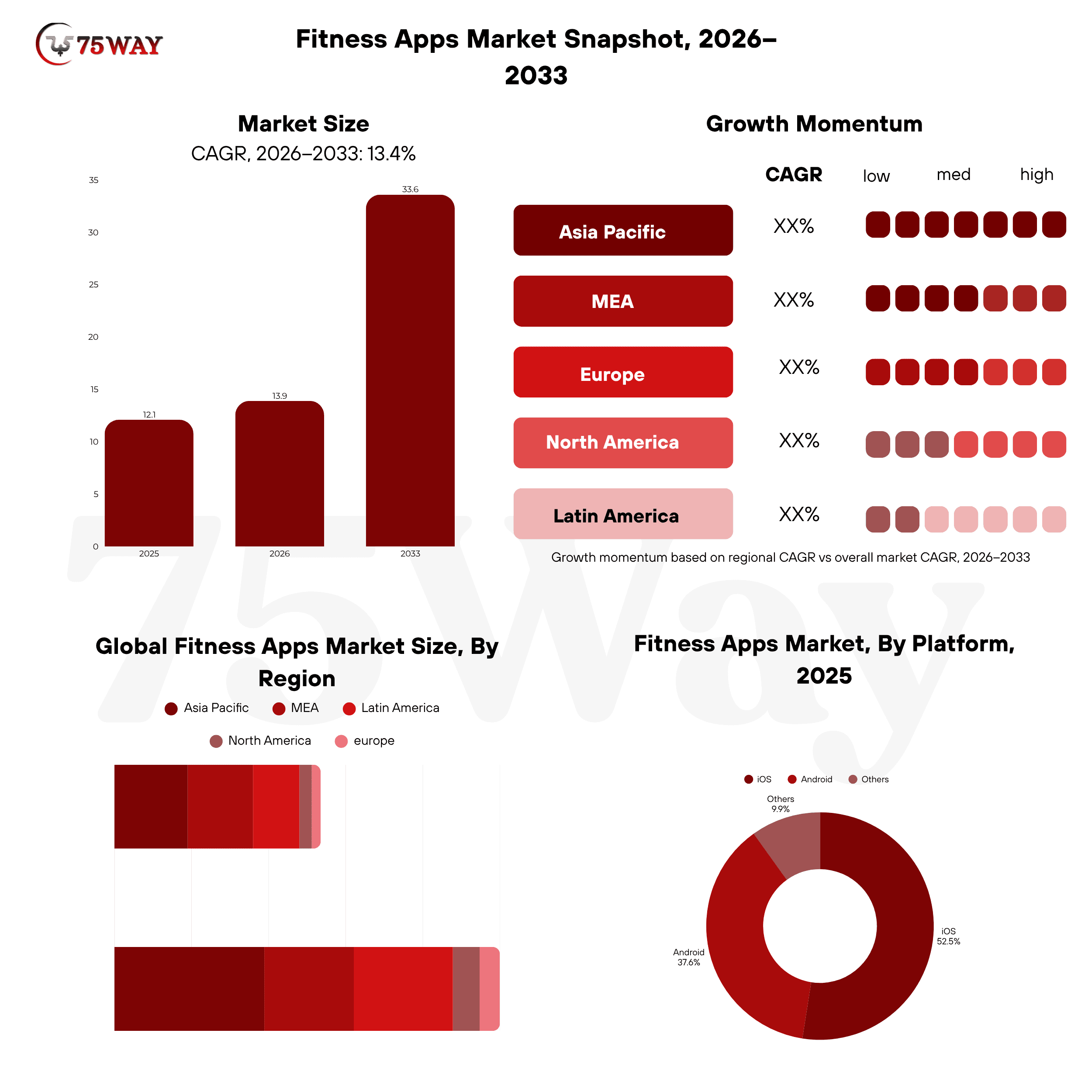
- The global fitness apps market is projected to grow from $13.9 billion in 2026 to $33.6 billion by 2033, at a 13.4% CAGR from 2026 to 2033, according to Grand View Research.
- North America dominated the market, accounting for a 39.8% revenue share.
- The workout & exercise apps segment led the market with a 45.38% share.
- Revenue in the fitness apps market is projected to reach $9.12 billion in 2026, according to Statista.
- Revenue is expected to grow at a CAGR of 11.12% from 2026 to 2031, reaching a projected market volume of $15.45 billion by 2031.
- User penetration is projected to reach 26.00% in 2026 and increase to 43.06% by 2031.
- The average revenue per user (ARPU) is expected to reach US$4.45.
Why Businesses Should Invest In Gym Workout App Development In 2027?
The gym experience no longer begins when a member walks through the reception door or ends when the workout is over. A well-built workout app can extend that relationship into the member’s daily routine and give the business a stronger digital presence between visits. The business case for investing in gym workout app development in 2027 is covered below.
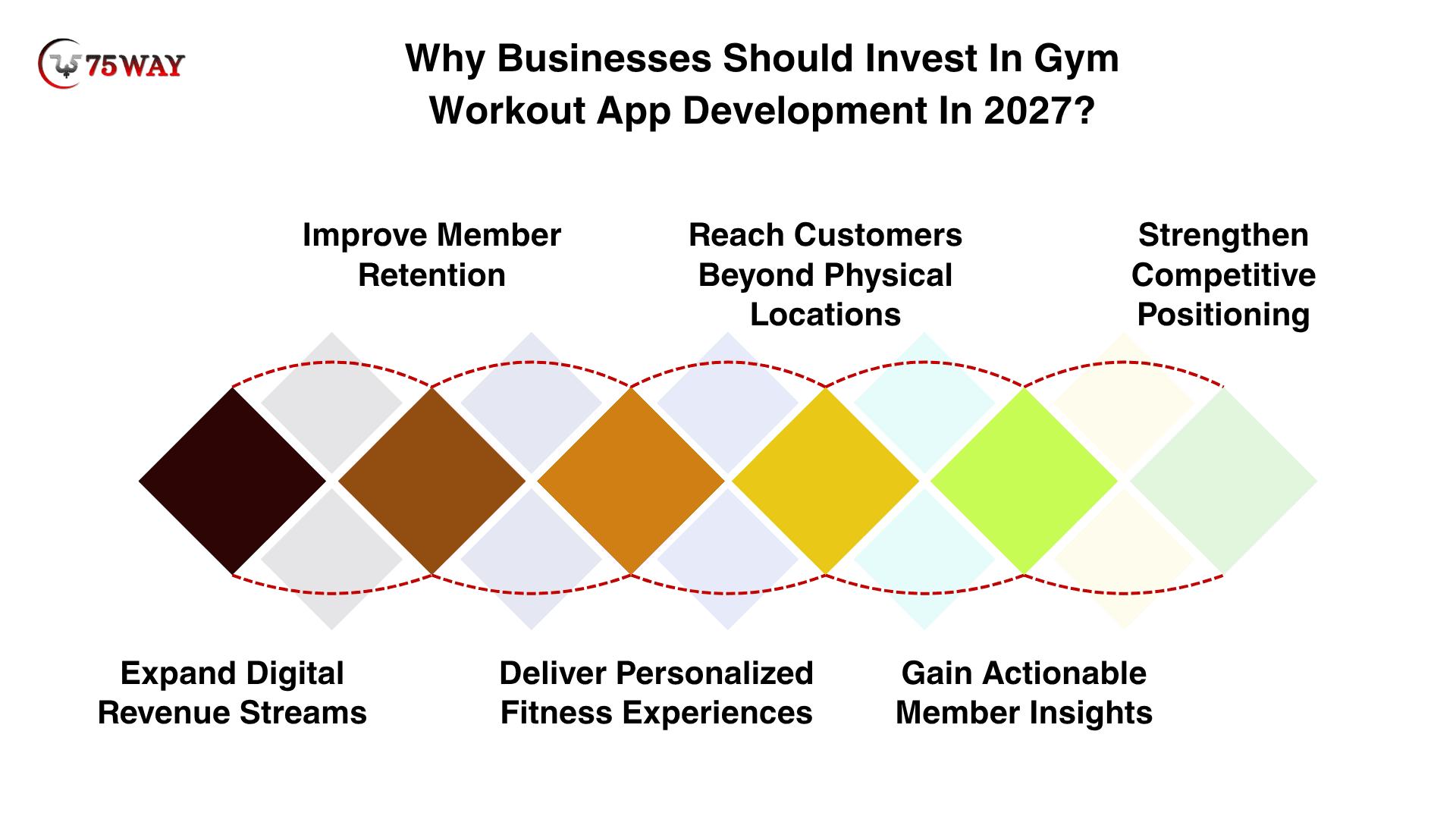
- Expand Digital Revenue Streams: A gym workout app creates revenue beyond physical memberships through subscriptions, premium plans, virtual coaching, and personalized services.
Businesses can serve customers digitally while creating additional opportunities for recurring revenue.
- Improve Member Retention: Personalized workouts and timely engagement can give members stronger reasons to continue using a gym’s services.
A useful app keeps the brand connected with customers between visits, supporting longer-term membership relationships.
- Deliver Personalized Fitness Experiences: AI can analyze goals, preferences, workout history, and performance information to generate more relevant fitness recommendations.
This personalization can make digital experiences feel more useful while helping businesses differentiate their offerings.
- Reach Customers Beyond Physical Locations: A mobile workout platform allows fitness businesses to engage customers outside their gyms and local markets.
Digital programs can support remote members, online subscriptions, and broader customer acquisition without requiring additional physical locations.
- Gain Actionable Member Insights: Gym workout apps can collect valuable information about engagement, workout activity, preferences, and feature usage.
Businesses can analyze these insights to understand customer behavior, improve services, and make more informed product decisions.
- Strengthen Competitive Positioning: An intelligently designed workout app can help fitness businesses differentiate themselves in an increasingly digital market.
Combining convenient mobile experiences with personalization, coaching, and connected services can create a stronger overall customer proposition.
How Can AI Be Used In Building A Custom Gymnasium App?
A custom gymnasium app becomes far more useful when it can understand what each member needs rather than treating every user the same. AI can help the app interpret activity and interactions to deliver more relevant experiences while supporting trainers and gym operators behind the scenes. The most valuable AI applications for gymnasium app development are covered below.
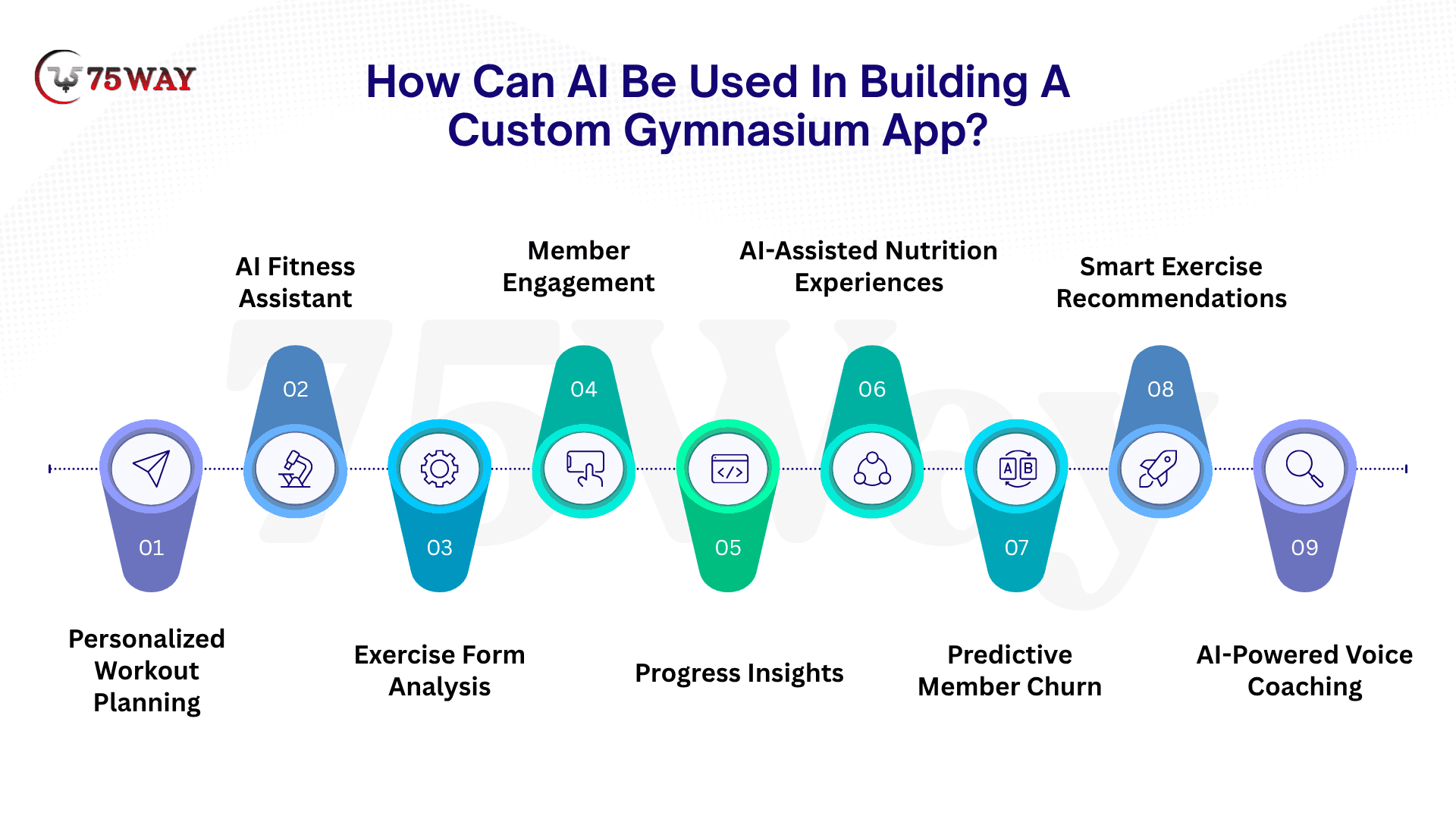
- Personalized Workout Planning
The app can use goals, experience level, previous sessions, available equipment, preferences, and performance data to create or adjust training recommendations.
For example, someone training for general fitness should not necessarily receive the same program as a user preparing for a strength-focused goal.
The value comes from making recommendations more relevant without requiring a trainer to manually configure every digital interaction.
- AI Fitness Assistant
A conversational assistant can help users navigate the app and answer common questions.
It could explain an exercise, suggest alternatives when equipment is unavailable, help users understand their training schedule, or direct them toward relevant app features.
Businesses should define clear boundaries, particularly around health and medical advice. An AI assistant should not present itself as a medical professional or make unsupported health claims.
- Exercise Form Analysis
Computer vision can be used to analyze movement captured through a smartphone camera.
Depending on the use case, the system may identify aspects of movement such as body positioning, repetition patterns, or technique deviations.
This feature can be valuable, but it requires considerably more planning than adding a text-based AI assistant. Camera access, model accuracy, device performance, lighting conditions, and user privacy all affect the experience.
- Member Engagement
AI can help determine which members are becoming less active and support more relevant engagement.
Instead of sending identical reminders to everyone, a system could use activity patterns to determine when a particular type of message, recommendation, or offer is more appropriate.
The objective should be useful engagement rather than simply increasing notification volume.
- Progress Insights
AI can turn scattered activity information into easier-to-understand progress summaries.
Members might see changes in training frequency, completed workouts, performance trends, or goal progress.
For gym operators, aggregated insights can also reveal which programs, classes, or features are receiving sustained engagement.
- AI-Assisted Nutrition Experiences
Nutrition can become another layer of personalization, provided businesses handle health-related information responsibly.
An app might support meal tracking, preference-based suggestions, food logging, or general nutrition guidance.
Businesses should avoid presenting generic AI-generated recommendations as individualized medical or clinical advice.
- Predictive Member Churn
AI sales agents for gyms can analyze attendance, workout frequency, engagement, and subscription behavior to identify members showing potential churn signals.
Businesses can use these insights to trigger timely retention campaigns, personalized offers, or trainer outreach before disengagement becomes permanent.
- Smart Exercise Recommendations
AI can recommend exercise alternatives based on equipment availability, previous performance, workout goals, and training preferences.
This helps members maintain their routines when circumstances change while giving the app a more responsive and personalized experience.
- AI-Powered Voice Coaching
Voice-enabled AI can provide hands-free instructions, workout cues, timing prompts, and exercise guidance during training sessions.
This can make workouts easier to follow while allowing members to interact with the app without repeatedly touching their devices.
Features An AI-Powered Gym App Development Solution Must Include In 2027
The feature set should depend on the business model. A premium fitness startup, multi-location gym chain, and independent gym do not necessarily need the same application. A practical feature architecture includes 3 modules: customer or member app, trainer app, and admin panel. Each module consists of different features that are defined below.
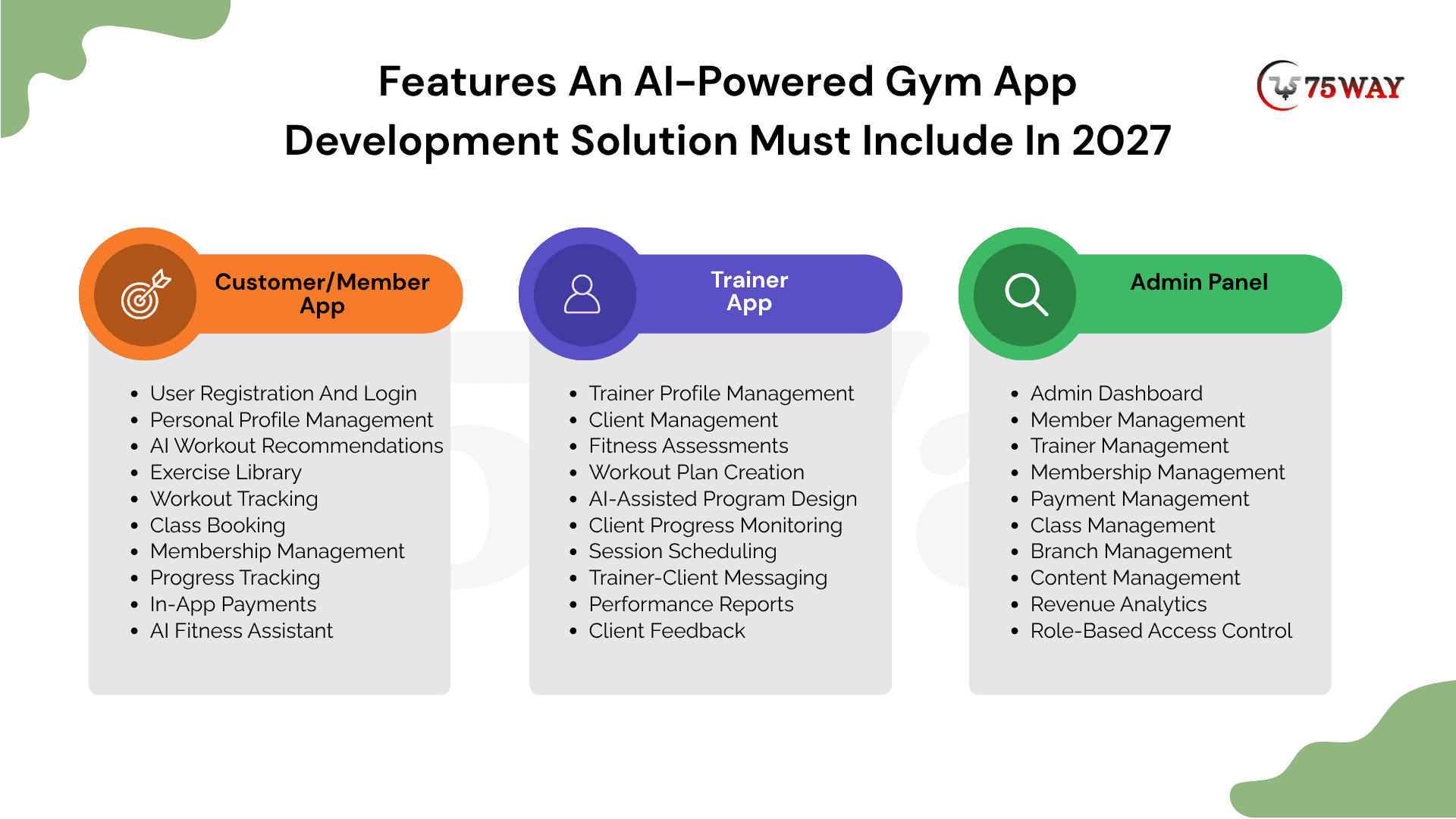
1. Customer/Member App
This is the digital interface through which gym members interact with the business and manage their fitness journey. It connects members with the gym’s services, programs, trainers, and overall fitness ecosystem.
- User Registration And Login: Allows members to securely create accounts, sign in, recover passwords, and manage authentication preferences.
- Personal Profile Management: Lets members update personal information, fitness goals, preferences, measurements, and other relevant account details.
- AI Workout Recommendations: Generates personalized workout suggestions using member goals, fitness history, preferences, performance, and available equipment.
- Exercise Library: Provides organized exercise videos, instructions, muscle-group information, difficulty levels, and alternative movement options.
- Workout Tracking: Enables members to record exercises, repetitions, sets, weights, duration, and completed training sessions.
- Class Booking: Allows members to discover available classes, check schedules, reserve spots, cancel bookings, and receive reminders.
- Membership Management: Helps members view membership details, renewal dates, benefits, plans, upgrades, cancellations, and subscription status.
- Progress Tracking: Displays workout history, performance trends, body measurements, achievements, and goal progress through understandable visual summaries.
- In-App Payments: Supports secure payments for memberships, subscriptions, personal training, classes, and other fitness-related purchases.
- AI Fitness Assistant: Provides conversational assistance for workout questions, exercise guidance, app navigation, recommendations, and general fitness support.
2. Trainer App
This is the workspace through which trainers manage their professional relationship with gym members. The trainer platform of a gym app development solution connects coaches with assigned clients and supports the delivery and supervision of personalized training services.
- Trainer Profile Management: Allows trainers to manage professional profiles, specialties, availability, qualifications, contact information, and service offerings.
- Client Management: Gives trainers centralized access to client profiles, goals, assessments, workout history, preferences, and progress.
- Fitness Assessments: Enables trainers to record client fitness information, measurements, capabilities, goals, limitations, and assessment results.
- Workout Plan Creation: Helps trainers create customized workout programs based on client objectives, experience, schedules, equipment, and performance.
- AI-Assisted Program Design: Supports trainers with AI-generated program suggestions that can be reviewed, modified, and personalized before assignment.
- Client Progress Monitoring: Enables trainers to review workout completion, performance changes, attendance, measurements, achievements, and client activity.
- Session Scheduling: Allows trainers to schedule personal training sessions, manage availability, reschedule appointments, and receive upcoming-session reminders.
- Trainer-Client Messaging: Provides direct communication between trainers and members for questions, feedback, instructions, updates, and ongoing support.
- Performance Reports: Generates understandable reports showing client training activity, performance trends, completed sessions, progress, and relevant milestones.
- Client Feedback: Lets trainers provide workout feedback, recommendations, encouragement, corrections, and personalized guidance based on member performance.
3. Admin Panel
This is the central control system for gym owners and management teams. It connects the business side of the gym with its members, trainers, services, and day-to-day operations.
- Admin Dashboard: Provides administrators with centralized visibility into members, trainers, memberships, revenue, bookings, engagement, and platform activity.
- Member Management: Enables administrators to create, update, search, categorize, suspend, and manage member accounts across the platform.
- Trainer Management: Helps administrators manage trainer profiles, availability, assignments, performance information, permissions, and professional account details.
- Membership Management: Allows businesses to create, modify, monitor, renew, upgrade, downgrade, and cancel different membership plans.
- Payment Management: Centralizes transaction monitoring, payment status, refunds, invoices, subscription billing, and revenue-related financial information.
- Class Management: Enables administrators to create classes, assign trainers, manage schedules, control capacity, and monitor reservations.
- Branch Management: Helps multi-location businesses manage gym branches, facilities, staff, memberships, schedules, and location-specific operational information.
- Content Management: Allows administrators to manage workout content, exercise resources, educational materials, announcements, promotional content, and digital programs.
- Revenue Analytics: Provides insights into membership revenue, subscriptions, purchases, cancellations, upgrades, and other important financial performance indicators.
- Role-Based Access Control: Restricts platform access according to responsibilities, ensuring administrators, trainers, staff, and other users see appropriate information.
AI Features Required In iOS & Android Gym App Development
An AI-powered gym app needs more than basic automation to feel genuinely useful on both iOS and Android. The intelligence built into the experience should make interactions more relevant while supporting the way members train and businesses manage their services. The AI features worth considering for iOS and Android gym app development are explained below.
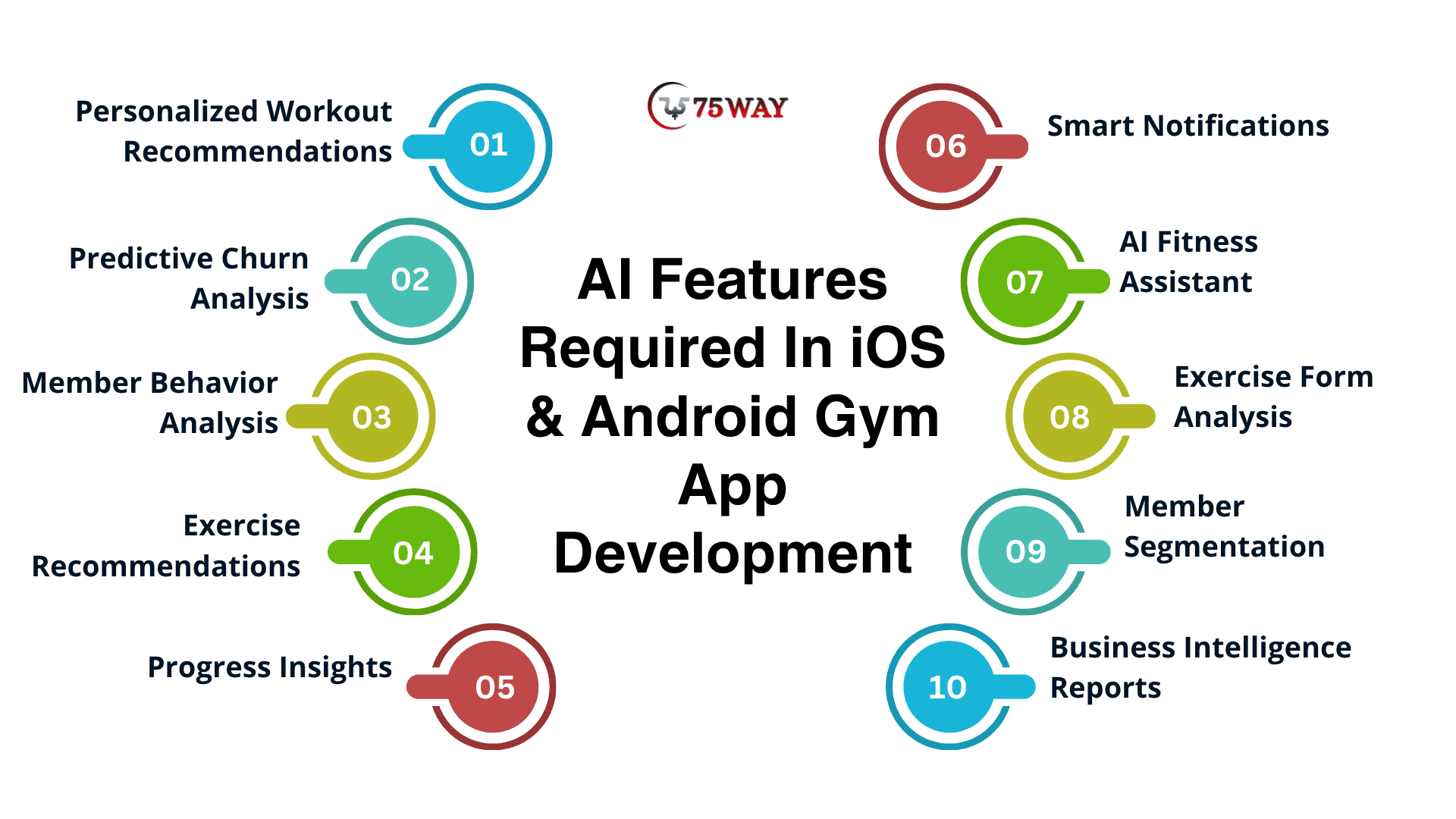
- Personalized Workout Recommendations: Analyzes member information and activity patterns to suggest workouts aligned with individual goals, preferences, and performance.
- Predictive Churn Analysis: Identifies behavioral patterns that may indicate declining engagement, helping businesses recognize members who could potentially cancel.
- Member Behavior Analysis: Examines activity, attendance, feature usage, and engagement patterns to help businesses understand member behavior.
- Exercise Recommendations: Suggests suitable exercises or alternatives based on member goals, previous workouts, equipment availability, and performance.
- Progress Insights: Converts workout and performance data into understandable insights showing trends, achievements, changes, and potential improvement areas.
- Smart Notifications: Uses member activity and preferences to support more relevant reminders, recommendations, updates, and engagement messages.
- AI Fitness Assistant: Provides automated conversational support for common fitness questions, workout guidance, recommendations, and application-related assistance.
- Exercise Form Analysis: Uses computer vision to analyze recorded movements and provide feedback on selected aspects of exercise technique.
- Member Segmentation: Groups members according to behaviors, goals, engagement levels, preferences, and other relevant characteristics for targeted strategies.
- Business Intelligence Reports: Combines operational and member data to provide insights supporting decisions around engagement, retention, revenue, and growth.
How To Develop Gym App: A Comprehensive Process
The hardest part of building a gym app is rarely getting the first screen to work. The real challenge is turning different gym operations and member needs into one application that remains easy to use as the business grows. This comprehensive process walks through how a gym app is developed from concept to a production-ready product.
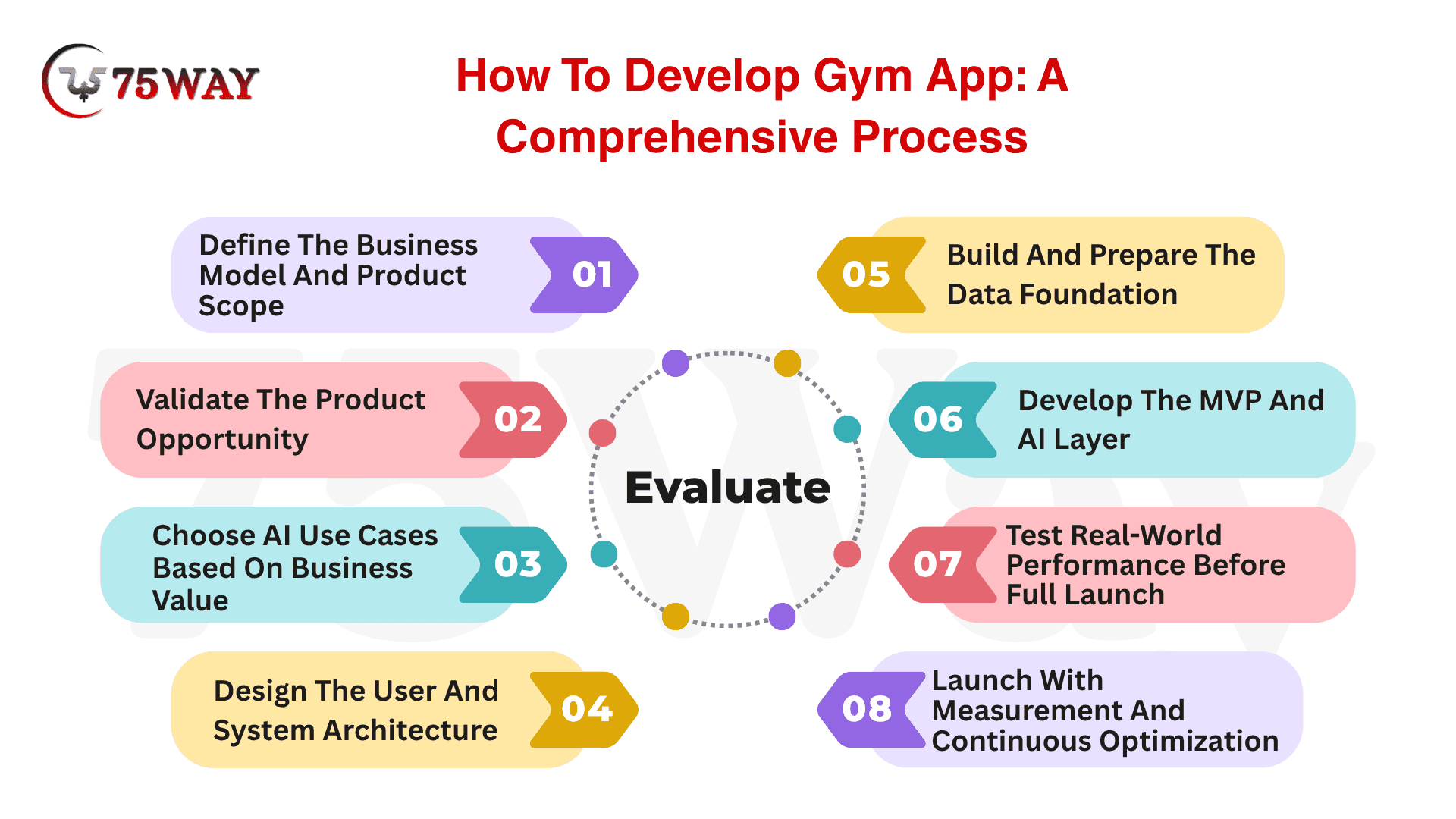
1. Define The Business Model And Product Scope
The business model determines what the application needs to accomplish and which users should be served first. A gym chain, fitness startup, personal-training platform, and digital fitness brand can require very different products.
Key decisions include:
- Define whether the app supports an existing gym or operates as a standalone product.
- Select the primary revenue model, such as memberships, subscriptions, coaching, or B2B licensing.
- Identify the primary users: members, trainers, gym managers, or independent fitness customers.
- Establish measurable targets for retention, acquisition, revenue, engagement, or trainer productivity.
- Decide which services should remain physical and which should move into the digital experience.
2. Validate The Product Opportunity
Market validation helps determine whether the proposed application solves a problem customers are willing to pay to solve. This stage should produce evidence for the product concept before significant development spending begins.
Validation activities include:
- Interview prospective members about existing fitness-app frustrations.
- Analyze competing applications and identify underserved use cases.
- Test proposed AI experiences through clickable prototypes or concept demos.
- Validate pricing through early customer or market feedback.
- Identify the features customers consider essential versus optional.
- Define the clearest product differentiator before development begins.
3. Choose AI Use Cases Based On Business Value
AI selection should follow the product strategy rather than drive it. Each proposed AI capability should have a clear purpose, appropriate data source, measurable outcome, and realistic implementation path.
Evaluate each use case for:
- Business Outcome: Identify a clear business goal, such as improving retention, increasing engagement, or generating additional revenue.
- User Outcome: Make the fitness experience more useful, convenient, personalized, or engaging for members.
- Data Requirement: Determine the member, workout, performance, or behavioral information required to support the AI capability.
- AI Approach: Select the AI technology that best matches the feature, complexity, data requirements, and expected results.
- Human Involvement: Define where trainers or staff need to review, adjust, or approve AI-generated recommendations.
- Measurement: Track relevant business and user metrics to evaluate the feature’s performance and actual value.
4. Design The User And System Architecture
The architecture defines how members, trainers, administrators, AI services, and external systems interact with the platform. Early architectural decisions can affect scalability, security, integration costs, and future AI expansion.
Architecture planning should define:
- Member app and trainer app responsibilities
- Admin-panel workflows
- Backend services and APIs
- Database structure
- AI service layer
- Authentication and authorization
- Payment infrastructure
- Wearable and third-party integrations
- Cloud environment
- Data flow between application components
5. Build And Prepare The Data Foundation
AI functionality is only as useful as the information available to support it. Businesses should establish a reliable data foundation before expecting advanced personalization or predictive capabilities.
The development team should establish:
- Which member information the product genuinely needs.
- How workout and performance data will be captured.
- How wearable information enters the platform.
- Which data belongs in structured databases.
- How consent and permissions are recorded.
- How sensitive information is protected.
- How long different categories of information should be retained.
- Which datasets can support future AI model improvements.
6. Develop The MVP And AI Layer
The MVP should turn the validated product concept into a usable application without attempting to build the entire long-term vision immediately. AI capabilities should be introduced according to their priority and technical readiness.
The MVP development can cover:
- Member-facing application
- Trainer application or portal
- Administrative dashboard
- Core backend and APIs
- Authentication
- Membership and payment workflows
- Initial AI functionality
- Essential analytics
- Selected third-party integrations
A practical rollout might begin with personalized workout recommendations and later introduce predictive churn, computer vision, or advanced conversational capabilities.
7. Test Real-World Performance Before Full Launch
AI applications require testing beyond conventional software quality assurance. The system must produce useful outputs across different users, scenarios, devices, and data conditions.
Testing should verify:
- AI recommendations against predefined quality criteria.
- Incorrect, incomplete, or unexpected AI responses.
- Workout recommendations across different fitness goals.
- Performance when limited or inconsistent user data is available.
- API failures and third-party service interruptions.
- Application performance under expected user loads.
- Data access restrictions between members, trainers, and administrators.
- Privacy and security controls.
- Mobile usability across supported devices.
8. Launch With Measurement And Continuous Optimization
The first release provides the behavioral evidence needed to determine whether the product is delivering its intended value. Product teams should use this information to prioritize improvements instead of relying solely on assumptions made before launch.
Post-launch measurement should connect directly to business goals:
- Retention: Track whether members continue using the gym app and remain active over longer periods.
- Engagement: Measure how frequently users return to the app and complete workouts or activities.
- Monetization: Monitor whether users upgrade, renew memberships, or purchase additional paid services.
- AI Adoption: Measure how many members use AI-powered features and how frequently they return to them.
- Trainer Productivity: Evaluate whether the platform reduces repetitive administrative tasks and gives trainers more time for clients.
- Churn: Identify whether early disengagement signals help teams take action before members leave.
- Customer Satisfaction: Assess whether members consider the app useful, convenient, personalized, and valuable.
- Unit Economics: Compare revenue generated by the app with AI, infrastructure, maintenance, and operating costs.
What Technology Stack Does A Branded Gym App Development Need?
There is no universal technology stack for every AI gym application. A typical architecture may contain:
- Mobile layer: Native iOS/Android development or a cross-platform framework.
- Backend: APIs, authentication, business logic, user management, and application services.
- Database: Structured storage for profiles, workouts, subscriptions, activity, and operational information.
- AI layer: Recommendation engines, machine-learning models, natural-language systems, computer vision, or third-party AI APIs.
- Cloud infrastructure: Hosting, storage, monitoring, scaling, backups, and security controls.
- Integration layer: APIs connecting wearables, payment providers, gym-management platforms, calendars, and other services.
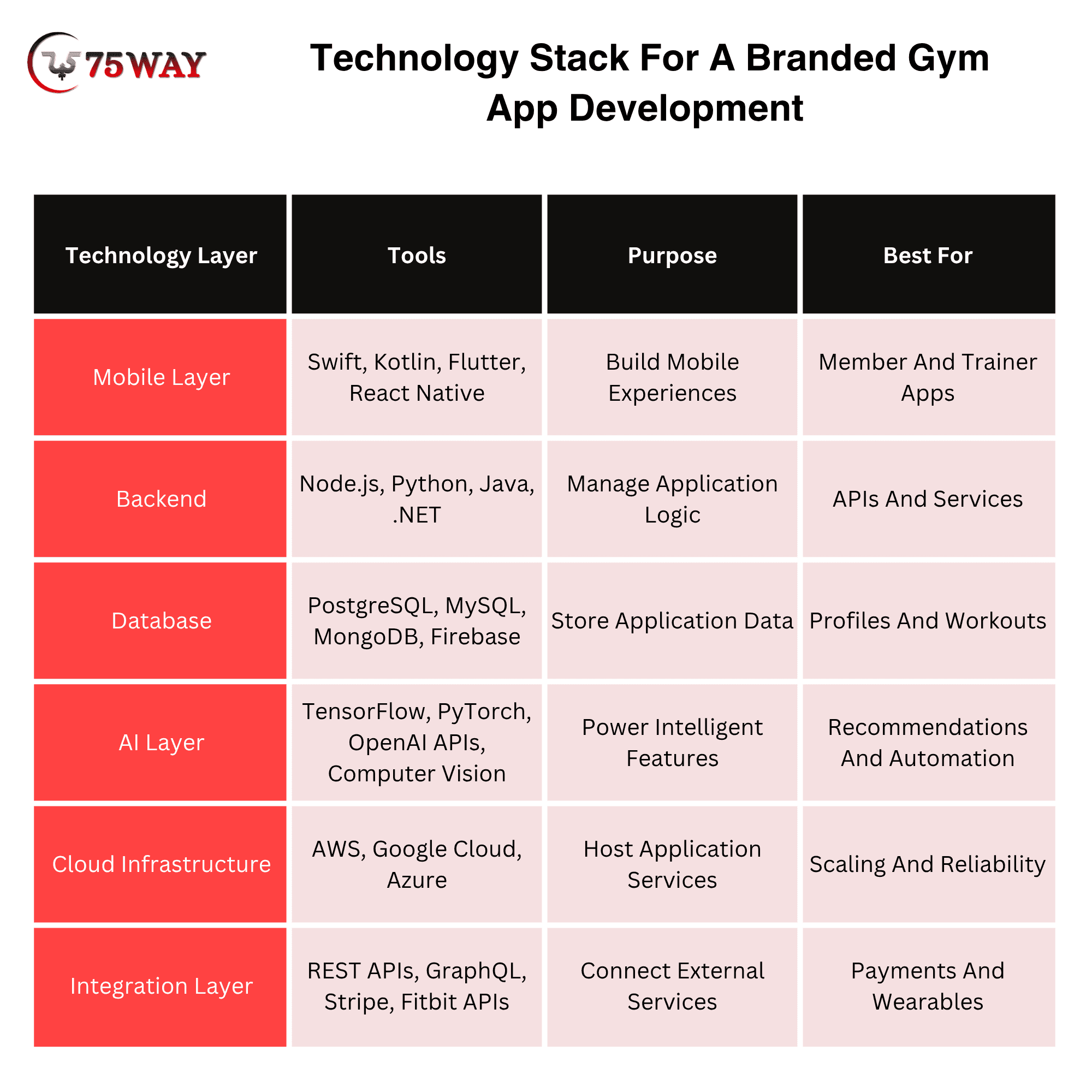
The right stack should be selected after the product requirements are defined. Choosing technology first and trying to fit the business around it can create unnecessary complexity.
What’s The Custom Gym App Development Cost: Pricing Breakdown
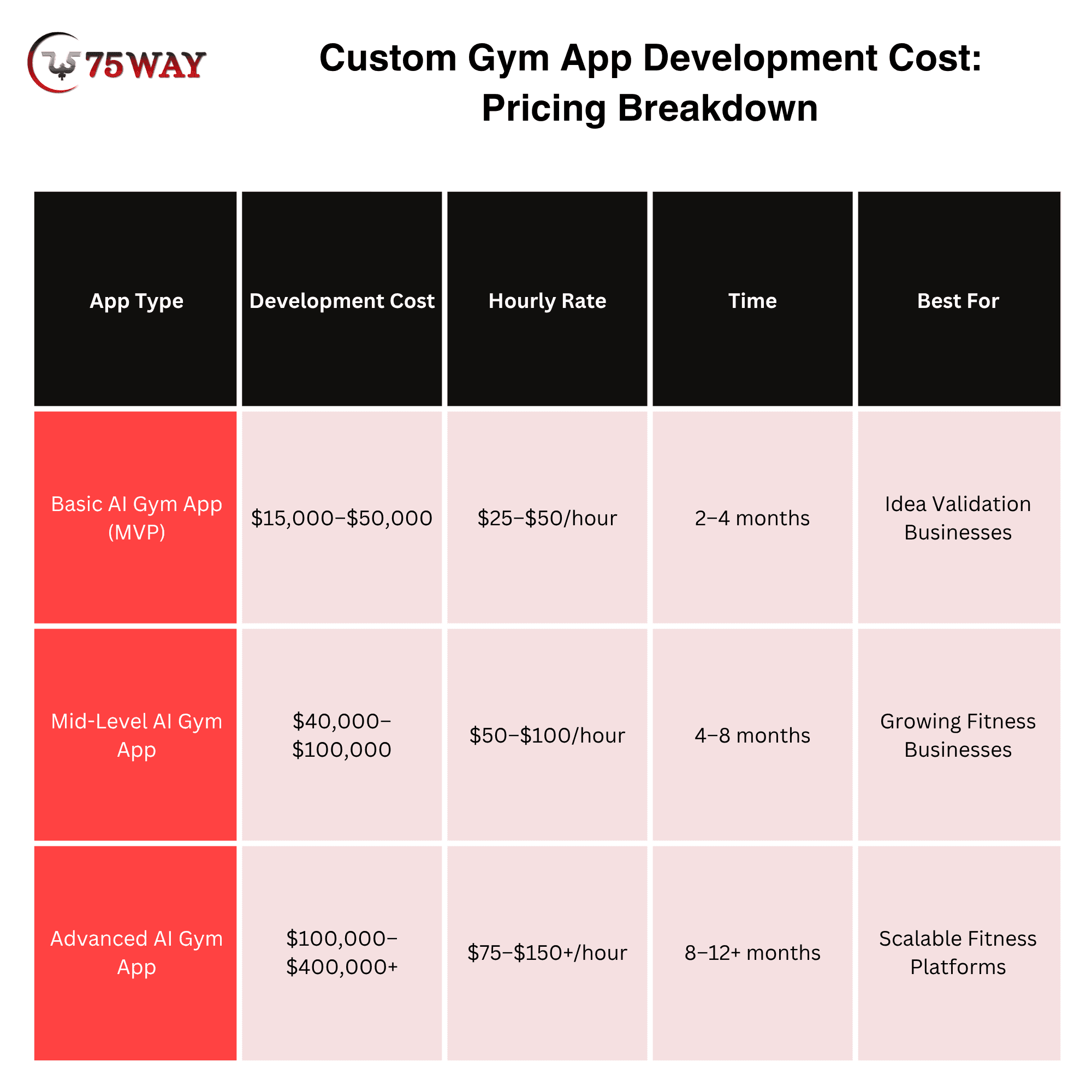
A custom gym app can start around $15,000 and exceed $400,000 when the product becomes more advanced. The gap is significant because a gym app built for one location has very different requirements from a scalable platform designed for thousands of members and complex business operations. The detailed pricing breakdown below shows what you are paying for at different levels of development.
- Basic AI Gym App (MVP): $15,000–$50,000
Suitable for businesses validating an idea with core profiles, workout tracking, manual logs, and limited AI functionality.
- Mid-Level AI Gym App: $40,000–$100,000
Ideal for businesses needing custom workout plans, notifications, payments, member management, and selected AI-powered capabilities.
- Advanced AI Gym App: $100,000–$400,000+
Suitable for larger platforms requiring wearable integrations, AI coaching, computer vision, live streaming, social features, advanced analytics, and scalable infrastructure.
Cost To Create Gym Application Based on Development Stages
A gym app budget does not get spent all at once; different stages consume different portions of the investment as the product moves from an idea to a working application. Early planning may require less capital than engineering, testing, and launch preparation, especially when the app has complex requirements. The stage-wise cost of creating a gym application is broken down below.
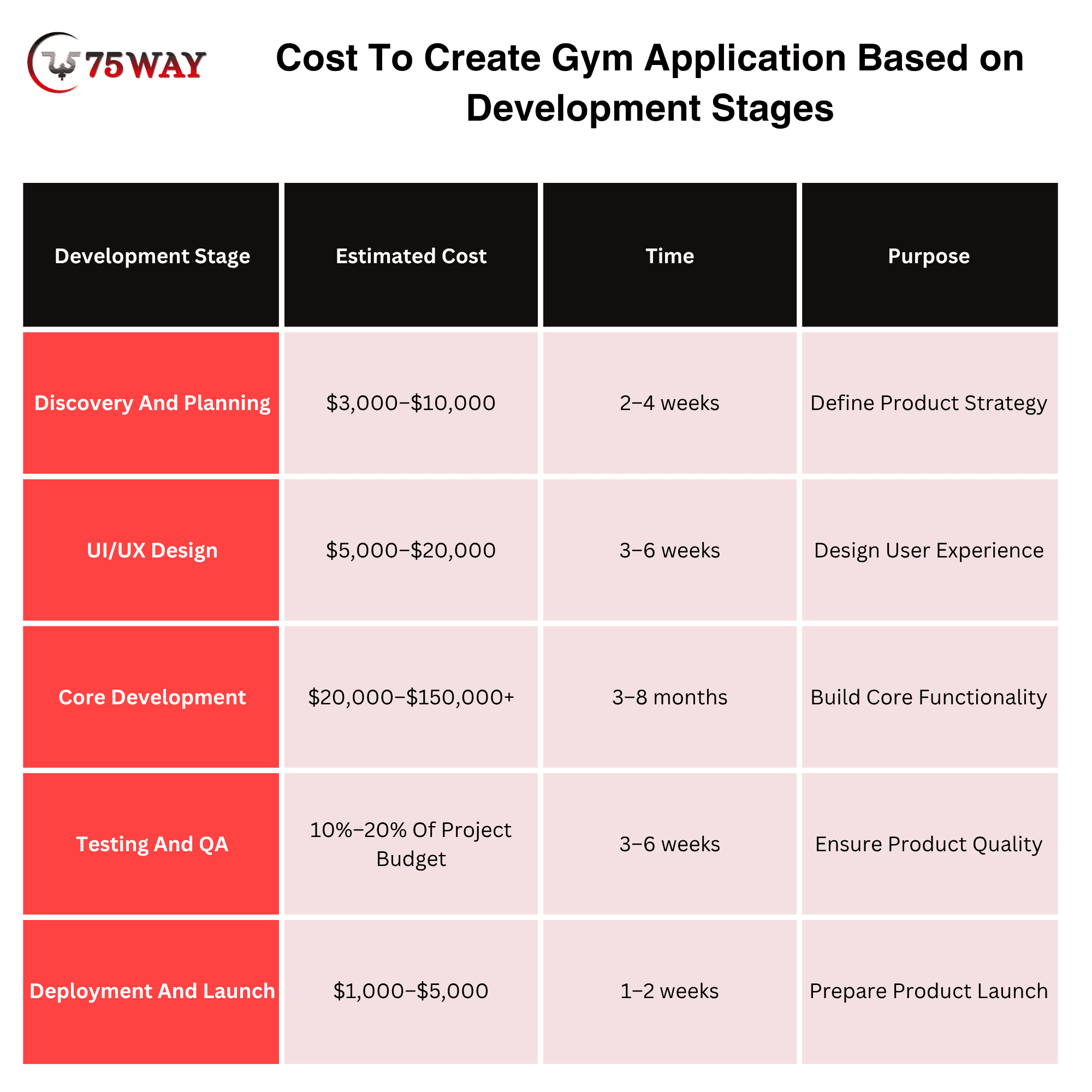
- Discovery And Planning: $3,000–$10,000
Covers business objectives, user research, technical requirements, product scope, feature priorities, and the development roadmap.
- UI/UX Design: $5,000–$20,000
Covers user flows, wireframes, interface design, prototypes, and usability decisions for member, trainer, and administrative experiences.
- Core Development: $20,000–$150,000+
Covers mobile applications, backend systems, databases, APIs, authentication, payments, AI integrations, and core platform functionality.
- Testing And Quality Assurance: 10%–20% of Project Budget
Covers functional testing, device compatibility, performance checks, security validation, integration testing, and fixing issues before launch.
- Deployment And Launch: $1,000–$5,000
Covers production configuration, app-store submission, deployment activities, release preparation, and initial monitoring after launch.
How To Earn Profit From Cross-Platform Gym App Development?
The profitability of a cross-platform gym app depends on what happens after users download it. A strong product can create multiple opportunities to generate income while extending the gym’s relationship with members beyond the physical facility. The ways businesses can turn cross-platform gym app development into a profitable model are discussed below.
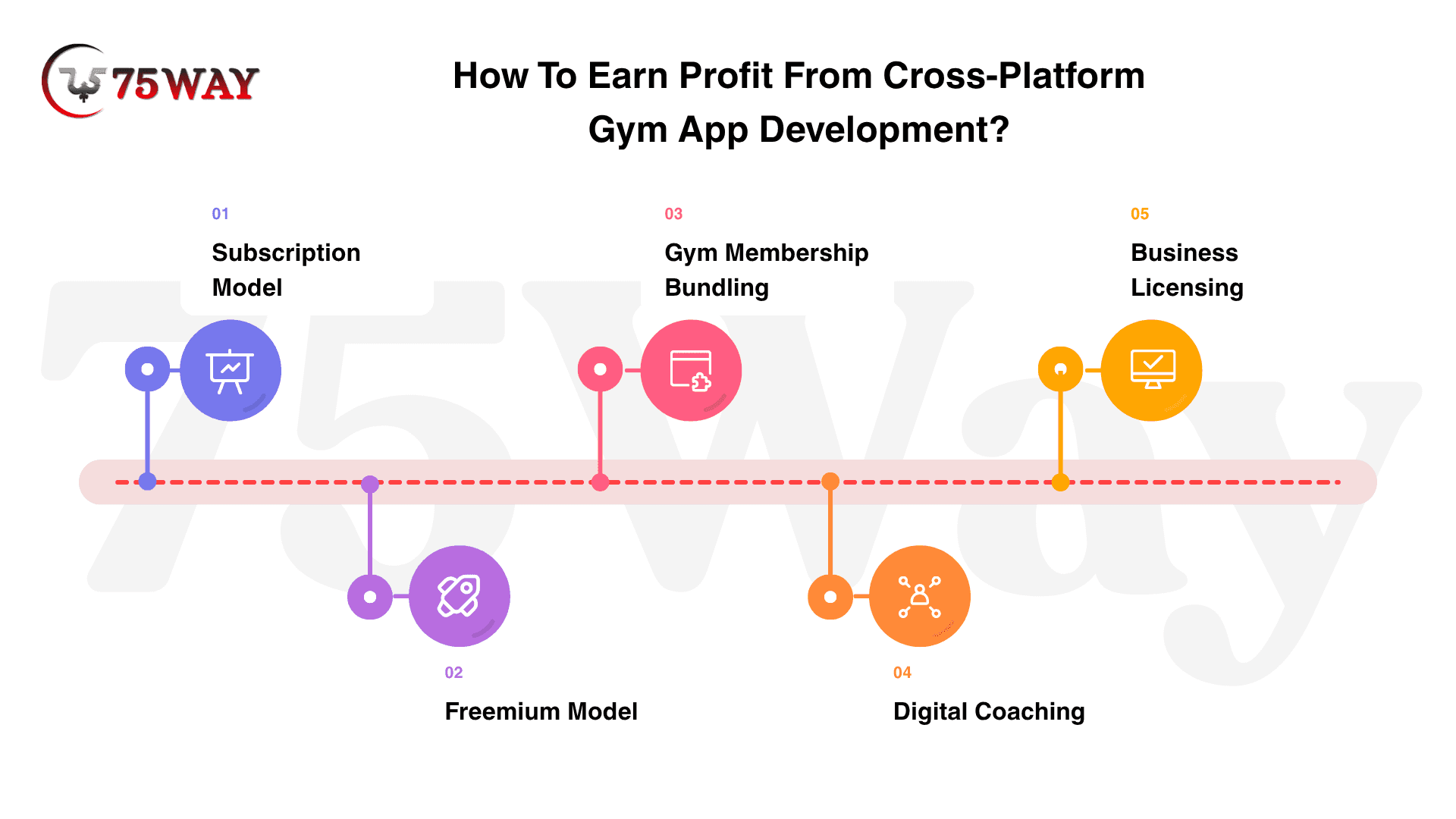
1. Subscription Model
Users pay monthly or annually for premium access to AI-powered features. For example, a business could charge $9.99 per month or $79.99 annually, depending on the depth of personalization, coaching, and analytics offered. A gym app with 10,000 paying users at $9.99 monthly could generate nearly $100,000 in monthly recurring revenue before operating costs.
2. Freemium Model
Basic functionality remains free, while advanced AI capabilities require payment. A business might offer workout tracking and basic plans at no cost, then convert 5%–10% of active users to a premium plan priced around $10–$20 per month. This approach can support user acquisition while creating a clear path toward paid upgrades.
3. Gym Membership Bundling
Physical gyms can include app access within premium membership packages. For instance, a gym could add $5–$15 per month to selected membership tiers for AI workout planning, progress tracking, and digital coaching features. If 2,000 members upgrade by an additional $10 monthly, the gym could generate $20,000 in additional monthly revenue.
4. Digital Coaching
Businesses can combine AI-assisted programming with access to human trainers. A premium package could cost $50–$150 per month, with AI handling routine planning while trainers provide personalized guidance and adjustments. This hybrid model can increase average customer value without requiring the business to depend entirely on trainer availability.
5. Business Licensing
A fitness technology company can license its platform to gyms, studios, trainers, or franchises. For example, a provider could charge $500–$5,000 per month per business location, depending on users, integrations, AI capabilities, and administrative requirements. Multi-location contracts can create substantial recurring B2B revenue as the platform expands across franchises.
Security & Privacy Measures Businesses Should Consider In Gym Workout Tracker App Development
AI-powered gym and workout tracker apps can process information that deserves careful handling.
- Use multi-factor authentication for sensitive account access.
- Encrypt personal and fitness data during transmission.
- Apply role-based permissions across members, trainers, and administrators.
- Validate every API request before processing data.
- Maintain audit logs for important security activities.
- Collect only information required for core functionality.
- Obtain clear consent before using personal data.
- Define retention periods for stored member information.
- Review security practices of third-party service providers.
- Explain AI data usage through clear privacy notices.
- Allow users to manage connected wearable permissions.
- Regularly test systems for security vulnerabilities.
Security therefore needs to be part of the architecture from the beginning. Privacy expectations also need to be communicated clearly.
If an AI system uses member information to generate recommendations, users should understand what information is being used and why.
This becomes particularly important as AI systems become more capable of generating highly personalized outputs.
Challenges That Affect Smartphone Gym App Development & Solutions
The biggest risks are not always technical. Product decisions, data quality, AI reliability, privacy, integrations, and feature scope can directly affect development costs, adoption, and long-term performance.
1. Poor Product-Market Fit
A technically impressive app can still fail if members do not have a strong reason to return.
Solution: Validate the core problem before development, test prototypes with target users, and prioritize features connected to measurable member or business needs.
2. Insufficient Data
Advanced personalization requires useful data, while a new product may initially have limited information for generating sophisticated recommendations.
Solution: Start with practical AI use cases that work with available data, collect information with user consent, and improve personalization as the dataset grows.
3. AI Reliability
AI output can be incorrect, inconsistent, or unsuitable for certain users.
Solution: Define quality standards, test recommendations across different user scenarios, introduce human review where appropriate, and provide clear limitations instead of presenting AI output as professional judgment.
4. Privacy Concerns
Users may hesitate to share sensitive information if the app does not clearly explain how their data is collected, stored, and used.
Solution: Minimize unnecessary data collection, apply strong access controls and encryption, obtain appropriate consent, and communicate privacy practices clearly within the product.
5. Integration Complexity
Wearables, payment platforms, gym-management systems, calendars, and external APIs can introduce dependencies that affect development and maintenance.
Solution: Identify critical integrations during architecture planning, verify API capabilities early, and design fallback workflows for services that may become unavailable.
6. Feature Overload
Trying to launch every possible AI capability can increase costs while making the user experience harder to understand.
Solution: Build a focused MVP around the highest-value workflows, measure adoption after launch, and introduce additional AI capabilities only when they solve validated user or business needs.
A focused product with a clear value proposition is often a stronger starting point. The goal is not to add AI everywhere, but to apply it where it can create measurable value for members and the business.
What Should Businesses Know Before Building An AI Gym App In 2027?
Businesses entering the AI fitness market should approach development with five priorities:
- Start with a business problem, not an AI feature.
- Build personalization around useful and reliable member data.
- Keep privacy, security, and responsible AI practices in the product architecture.
- Launch a focused MVP before investing in advanced capabilities.
- Choose technology and development partners based on long-term product requirements.
The opportunity is significant, but simply adding AI will not create a successful gym app. The strongest products will combine useful personalization, thoughtful UX, sound technology, responsible data practices, and a business model that gives customers a reason to keep using the platform.
Why 75way Is The Best Custom Gym App Development Company?
75way Technologies can help businesses turn an AI gym app concept into a structured, scalable digital product. Its approach can cover the product journey from defining core requirements and AI use cases to designing the application, developing backend infrastructure, integrating third-party services, testing, and supporting future enhancements.
For businesses, the value should go beyond simply adding AI features. The app development process can focus on connecting each capability with a practical objective, such as personalized workout experiences, member engagement, digital subscriptions, trainer support, advanced analytics, or operational automation.
Depending on the product scope, the application can incorporate AI assistants, personalized recommendations, workout tracking, wearable integrations, payment functionality, dashboards, and other fitness-focused capabilities. A modular approach can also allow businesses to launch an MVP first and expand the platform as user requirements and business opportunities become clearer.
For a business planning an AI-powered gym app for 2027, the right development partner should understand both software engineering and the commercial purpose behind the product. That combination can help reduce unnecessary features, control development investment, and create an application designed for long-term growth.
Final Thoughts
AI-powered gym apps can give fitness businesses new ways to personalize member experiences, strengthen engagement, create digital revenue streams, and support smarter operations. However, successful development depends on choosing practical AI use cases rather than adding technology simply because it is trending.
Businesses should define their audience, business objectives, MVP scope, data strategy, security requirements, integrations, and monetization model before development begins. A scalable architecture also makes it easier to introduce advanced capabilities as customer expectations evolve. If you are planning an AI-powered gym app for 2027, partnering with a reliable on-demand app development company can help turn your concept into a scalable, market-ready product.
Frequently Asked Questions (FAQs)
How Much Does It Cost To Build An AI-Powered Gym App?
AI-powered gym app development can cost about $15,000 to $400,000+, depending on features, AI complexity, integrations, platforms, security, and scalability requirements.
What AI Features Can A Gym App Include?
Common capabilities include personalized workout recommendations, AI assistants, progress analysis, exercise-form analysis, engagement personalization, and AI-assisted nutrition experiences.
How Long Does It Take To Develop An AI Gym App?
A focused MVP may take several months, while advanced platforms can require considerably longer because of AI development, integrations, testing, security, and scalability requirements.
Can AI Replace Personal Trainers In A Gym App?
AI can automate certain coaching and personalization tasks, but it should not automatically be positioned as a replacement for qualified human trainers, particularly for complex or health-related situations.
Can An AI Gym App Connect With Wearable Devices?
Yes. Fitness apps can integrate with compatible wearable platforms to collect relevant activity and performance information, subject to platform capabilities, permissions, and privacy requirements.
What Is The Best Monetization Model For An AI Gym App?
The appropriate model depends on the target market. Subscription plans, freemium access, premium coaching, gym membership bundles, and B2B licensing can all support different business strategies.
Should A Business Build An AI Gym App From Scratch?
A custom build can make sense when the business requires proprietary workflows, personalization, integrations, or differentiation that off-the-shelf fitness software cannot provide.
How Can A Business Start AI Gym App Development?
Start by defining the target users, business objective, core workflows, AI use cases, MVP scope, data requirements, integrations, budget, and success metrics before development begins.