AI Summary
Rex is transforming real estate technology while heading toward £300 billion in property sales. Building a similar platform requires more than property listings. This guide breaks down $10,000–$450,000+ development costs. It also explains features, integrations, timelines, and scaling considerations.
Key Takeaways
- Rex is nearing £300 billion in property sales, reflecting the substantial scale and activity across its platform.
- Developing a Rex-like app can cost $10,000–$450,000+, depending on complexity.
- MLS integrations, CRM features, AI, and automation significantly influence development costs.
- A focused MVP can validate demand before larger platform investments begin.
- Development timelines vary according to features, integrations, platforms, security, and scalability.
A real estate agency may start with a simple mobile CRM, then realize agents also need listing management, lead tracking, follow-ups, portal publishing, and real-time data access. And the Rex-like real estate platform seems the best option.
At that point, the question becomes: how much does it cost to develop an app like Rex real estate? So, the answer is quite simple. If you want to build a real estate app like Rex, the cost may lie between $10,000 and $450,000+ in the US.
However, that cost may vary depending on the product scope, MLS/IDX integrations, CRM capabilities, AI features, platforms, security requirements, and administrative tools. A focused MVP can start around $10,000 – $40,000, while a production-ready real estate platform with mobile apps, CRM, MLS integrations, automation, analytics, and AI can move beyond $400,000+.
For a property business planning a similar product, the development budget should therefore be based on business workflows, integrations, data requirements, user roles, automation, and scalability, not the number of app screens.
This guide breaks down the cost, features, development stages, timeline, technology requirements, ongoing expenses, and factors that can increase or reduce the investment.
Cost To Build An App Like Rex Real Estate: Quick Answer
The average cost to build an app like Rex Real Estate is around $10,000 to $450,000+, with the final investment changing based on the functionality and scale you want to achieve. A focused product can stay closer to the lower end, while a more advanced platform can require substantially more development work. The breakdown below gives you a clearer view of how this cost range is distributed.
1. Simple Rex-Like App Cost: $10,000 – $40,000
- Basic listings, accounts, search, filters, and property details included.
- Users browse properties, save options, and submit enquiries.
Suitable For: Startups testing a focused real estate concept.
Development Timeline: 2 to 4 months.
2. Mid-Level Rex-Like App Cost: $40,000 – $90,000
- Mobile apps, agent profiles, notifications, payments, and integrations included.
- Buyers search properties while agents manage connected workflows.
Suitable For: Growing businesses seeking broader functionality across platforms.
Development Timeline: 3 to 6 months.
3. Advanced Rex-Like App Cost: $90,000 – $250,000
- CRM, analytics, automation, synchronization, and advanced backend capabilities included.
- Property and customer data flows across automated business processes.
Suitable For: Established companies requiring sophisticated workflows and reporting.
Development Timeline: 6 to 12 months.
4. Enterprise Rex-Like App Cost: $250,000 – $450,000+
- MLS, AI, enterprise CRM, APIs, security, and scalability included.
- Multiple teams manage complex operations through centralized connected systems.
Suitable For: Large brokerages building comprehensive real estate ecosystems.
Development Timeline: 12 to 18+ months.
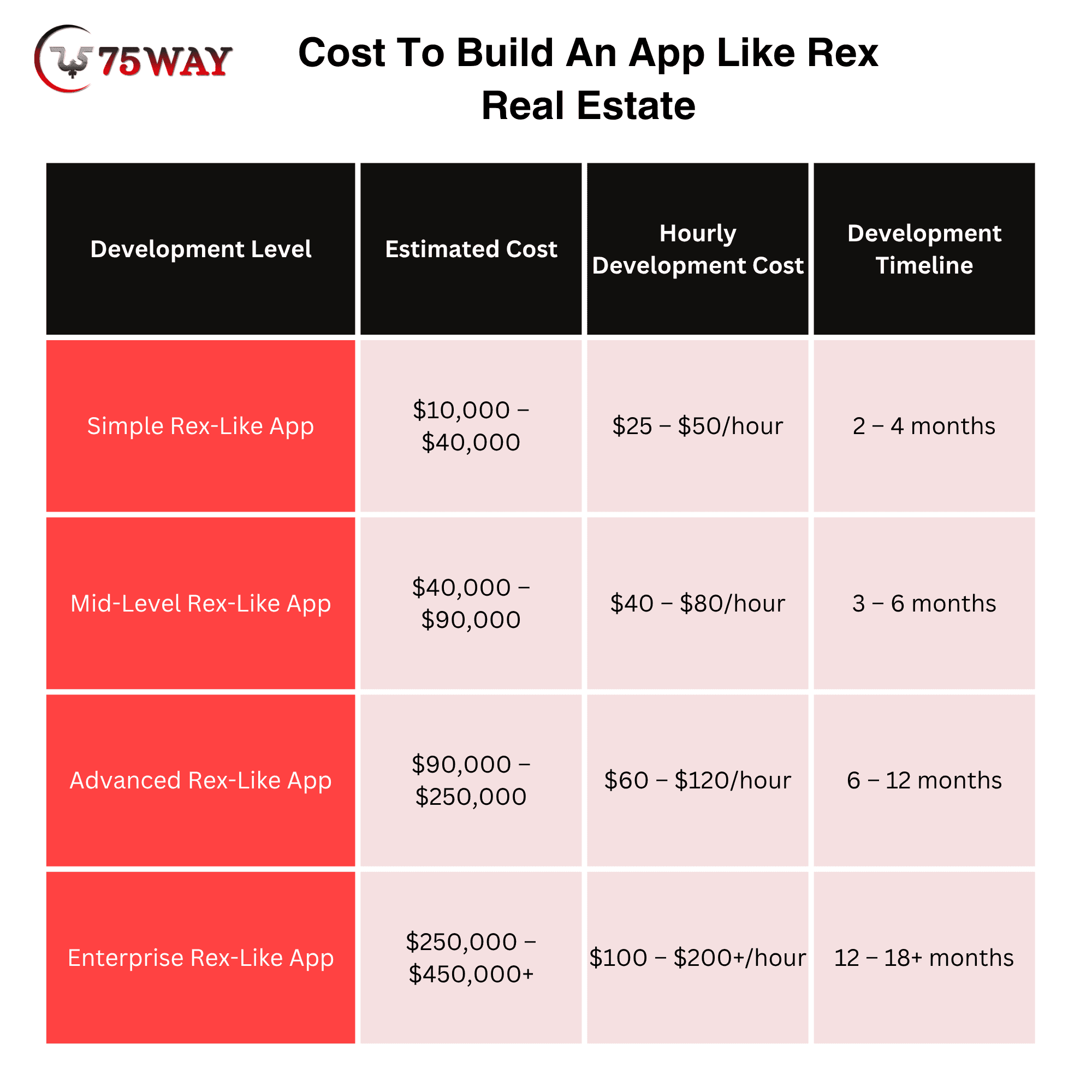
These are planning estimates rather than published Rex development prices. Actual costs vary based on the product requirements, development team, integrations, security model, third-party services, and geographic scope.
👉 Explore More:How To Choose A Real Estate App Development Company For Your Business?
Market Size & Growth Opportunities To Build A Software Like Rex in USA
Before we move further, let’s see where the market for real estate software like Rex stands. Demand for digital platforms that bring property operations and customer management together continues to create opportunities for software businesses. The market size and growth outlook below put that opportunity into perspective.
- Rex is approaching £300 billion in property sales through its platform.
- Rex’s real estate platform supports 10,000+ real estate professionals globally.
- Its CRM ecosystem has facilitated more than $511 billion in property sales worldwide.
- Rex’s mobile adoption is strong, with top-performing agents spending 3+ hours daily on the mobile app and making 500,000+ calls annually.
- Following its $45 million Series C funding, Rex recorded 300% year-over-year growth across Southern California and New York.
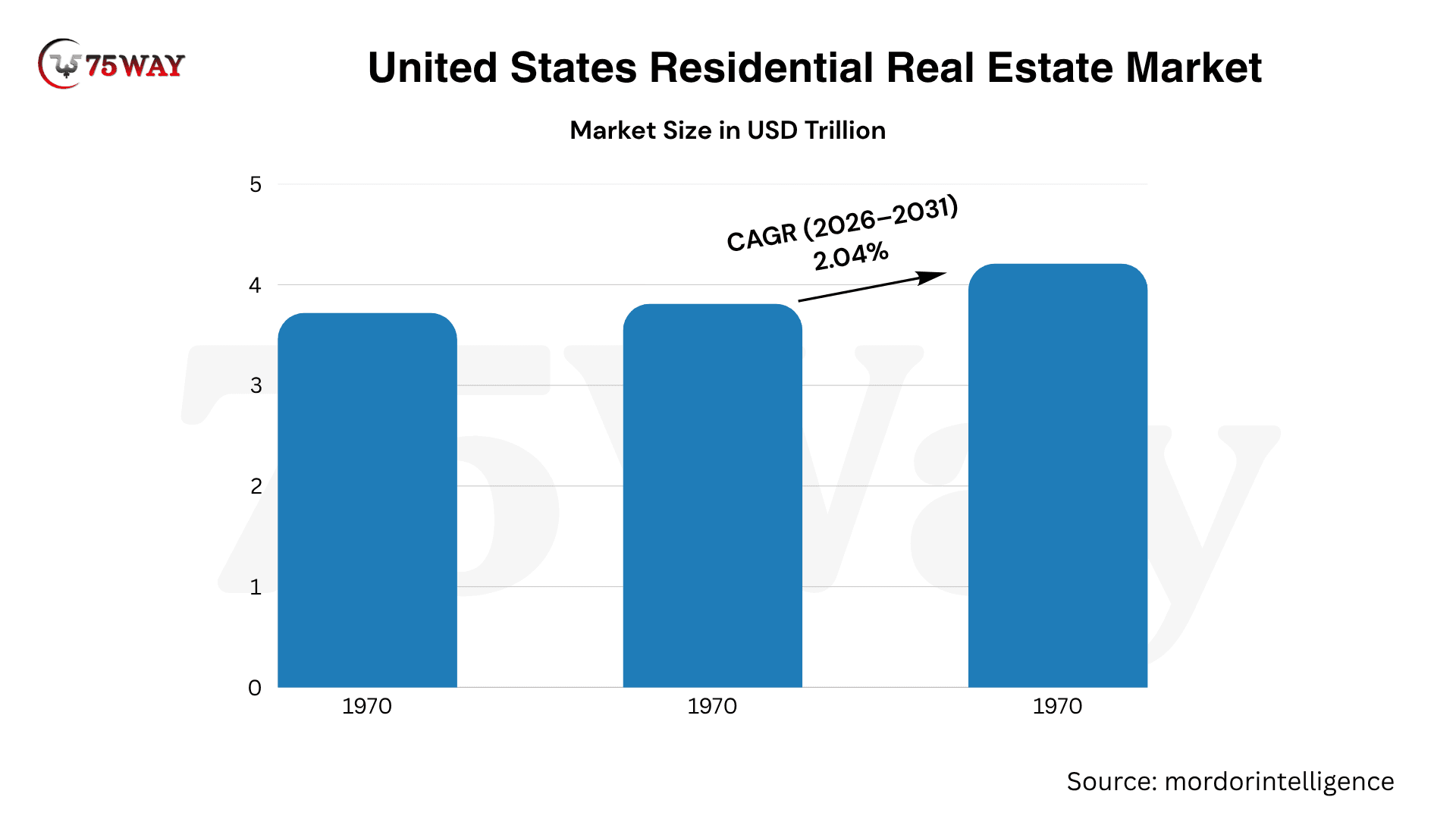
- The U.S. residential real estate market is estimated at $3.81 trillion in 2026 and projected to reach $4.21 trillion by 2031, reflecting a 2.04% CAGR.
- Apartments and condominiums accounted for 81.50% of the U.S. residential real estate market in 2025 and are forecast to grow at a 2.13% CAGR through 2031.
Stage-Wise Cost To Build A Real Estate App-Like Rex
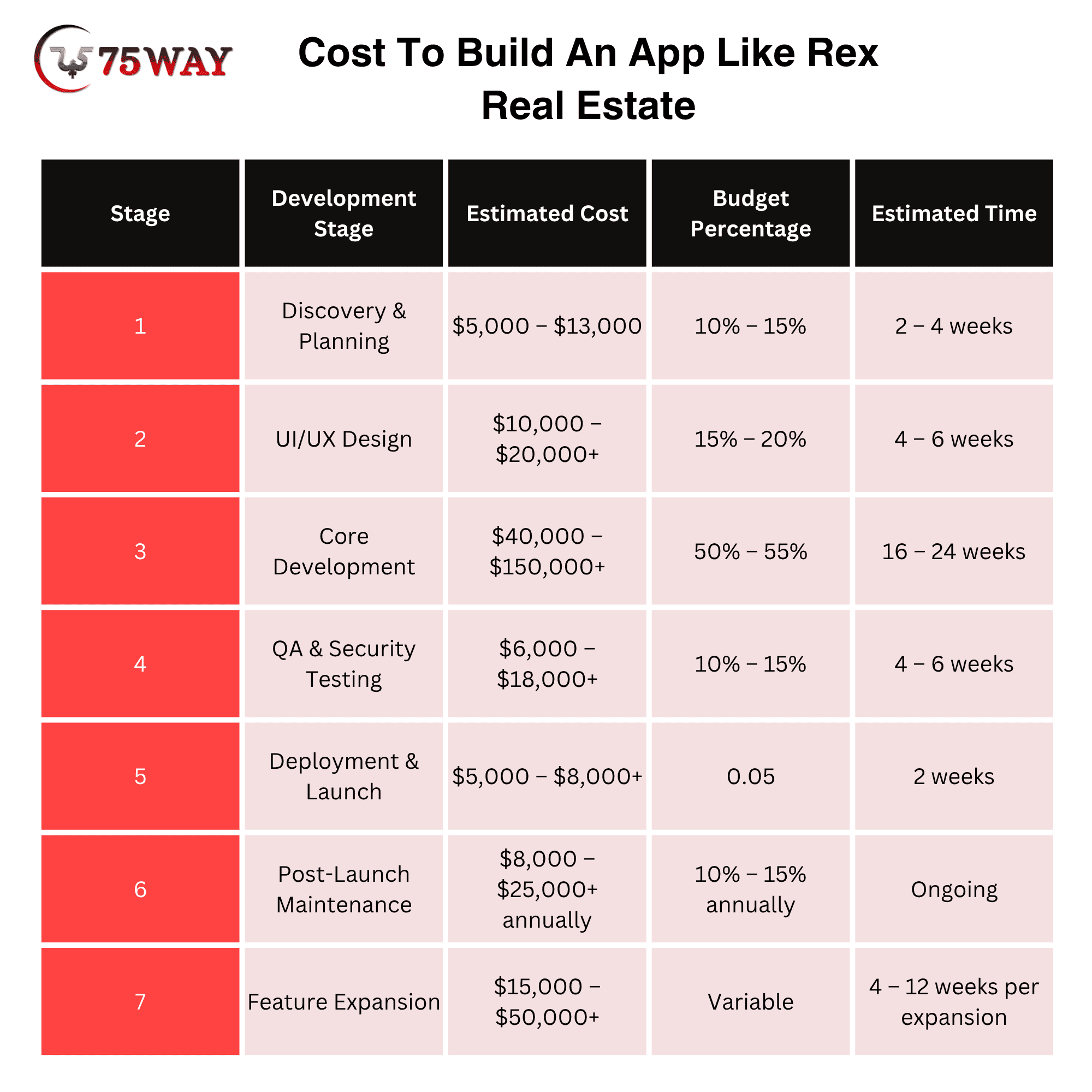
A real estate app can look straightforward on the surface, but the development work behind each stage can add significantly to the final budget. Early planning may require less investment than building, testing, integrating, and preparing a platform for real users. The breakdown below explains how the cost can build across each development stage.
Stage 1 - Discovery & Planning:$5,000 – $13,000
The team defines product requirements, user workflows, technical architecture, and development priorities.
Estimated Time: 2 – 4 weeks
Stage 2 - UI/UX Design:$10,000 – $20,000+
Designers create intuitive interfaces, interactive prototypes, and agent-focused workflows for every user journey.
Estimated Time: 4 – 6 weeks
Stage 3 - Core Development: $40,000 – $150,000+
Developers build frontend, backend, MLS/IDX integrations, CRM functionality, APIs, and essential platform capabilities.
Estimated Time: 16 – 24 weeks
Stage 4 - QA & Security Testing: $6,000 – $18,000+
Testing teams validate functionality, security, synchronization, performance, compatibility, and overall application reliability.
Estimated Time: 4 – 6 weeks
Stage 5 - Deployment & Launch: $5,000 – $8,000+
The team configures servers, prepares production environments, and completes App Store and Google Play submissions.
Estimated Time: 2 weeks
Stage 6 - Post-Launch Maintenance: $8,000 – $25,000+ annually
Ongoing support addresses bugs, platform updates, security patches, performance improvements, and evolving business requirements.
Estimated Time: Ongoing
Stage 7 - Feature Expansion: $15,000 – $50,000+
New integrations, AI capabilities, automation, analytics, and advanced workflows are introduced as requirements evolve.
Estimated Time: 4 – 12 weeks per expansion
Rex-Like Real Estate App Development Cost By Feature
A feature that looks simple on the screen can require substantial backend work once it needs to process real estate data, connect with other systems, or support multiple users. That is why two apps with similar interfaces can have very different development budgets. The feature-wise cost breakdown below shows where the investment can increase.
- User Registration & Profiles: $5,000–$12,000
- Property Listings & Search: $12,000–$25,000
- Advanced Filters: $6,000–$15,000
- Map & Geolocation: $8,000–$20,000
- Favorites & Saved Searches: $5,000–$10,000
- Agent Profiles: $6,000–$12,000
- Lead Management: $12,000–$25,000
- CRM: $20,000–$50,000
- MLS/IDX Integration: $20,000–$60,000+
- Messaging: $10,000–$25,000
- Email/SMS Automation: $8,000–$20,000
- Appointment Scheduling: $6,000–$15,000
- Document Management: $10,000–$25,000
- Analytics Dashboard: $12,000–$30,000
- Admin Dashboard: $15,000–$35,000
- AI Functionality: $25,000–$100,000+
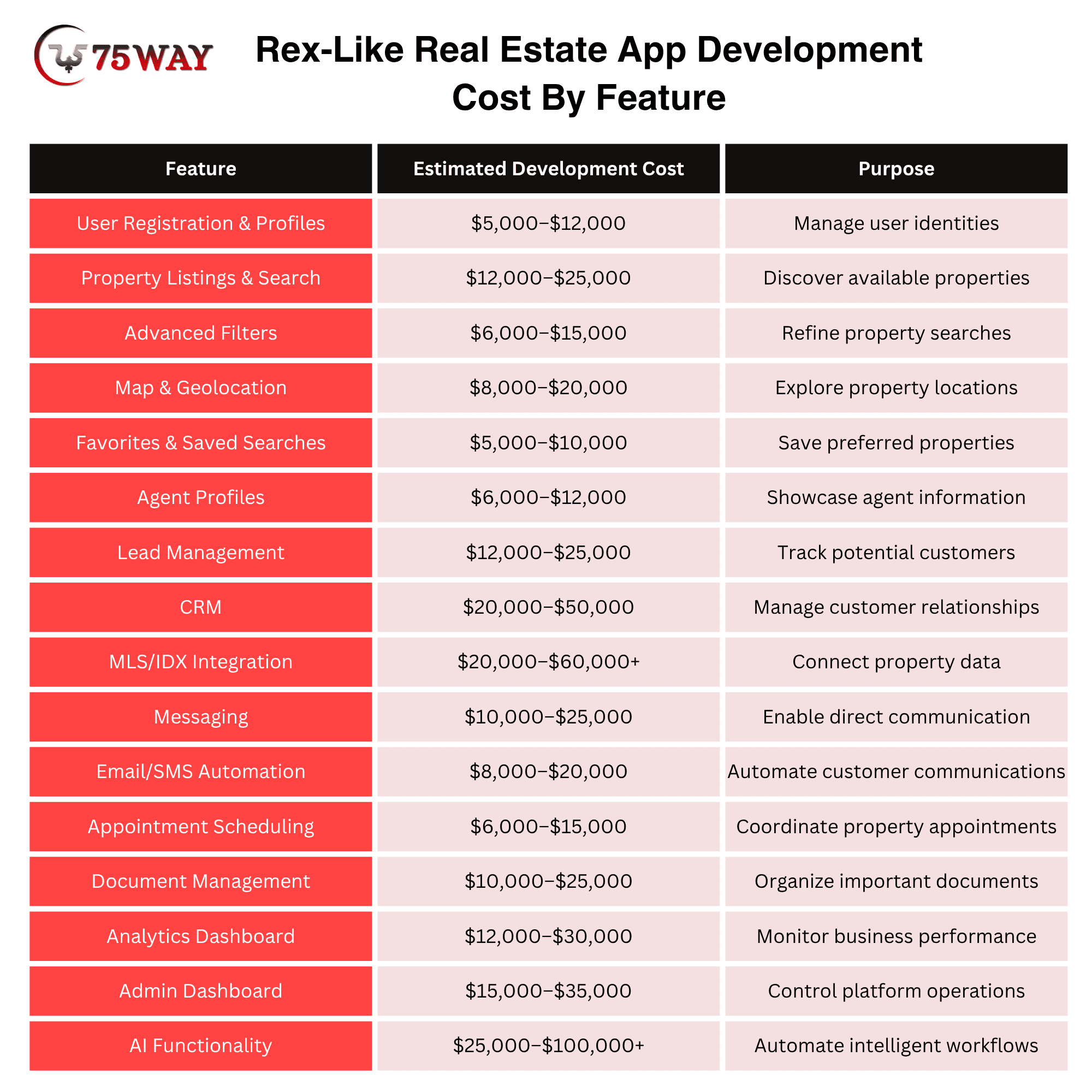
These prices should be treated as scope-planning ranges, not fixed vendor quotes. The important point is that features interact with each other.
For example, adding MLS data does not simply mean adding one API. It can affect search, property records, listing synchronization, permissions, data mapping, caching, compliance, and backend architecture.
Factors Affecting The Cost To Create Real Estate App Similar to Rex
The biggest cost difference does not come from how many screens your real estate app has. It comes from what happens behind those screens. A platform expected to sync listings, capture leads, automate follow-ups, and add AI requires considerably more engineering than a basic property management app. The details that can push your development budget higher or lower are outlined below.
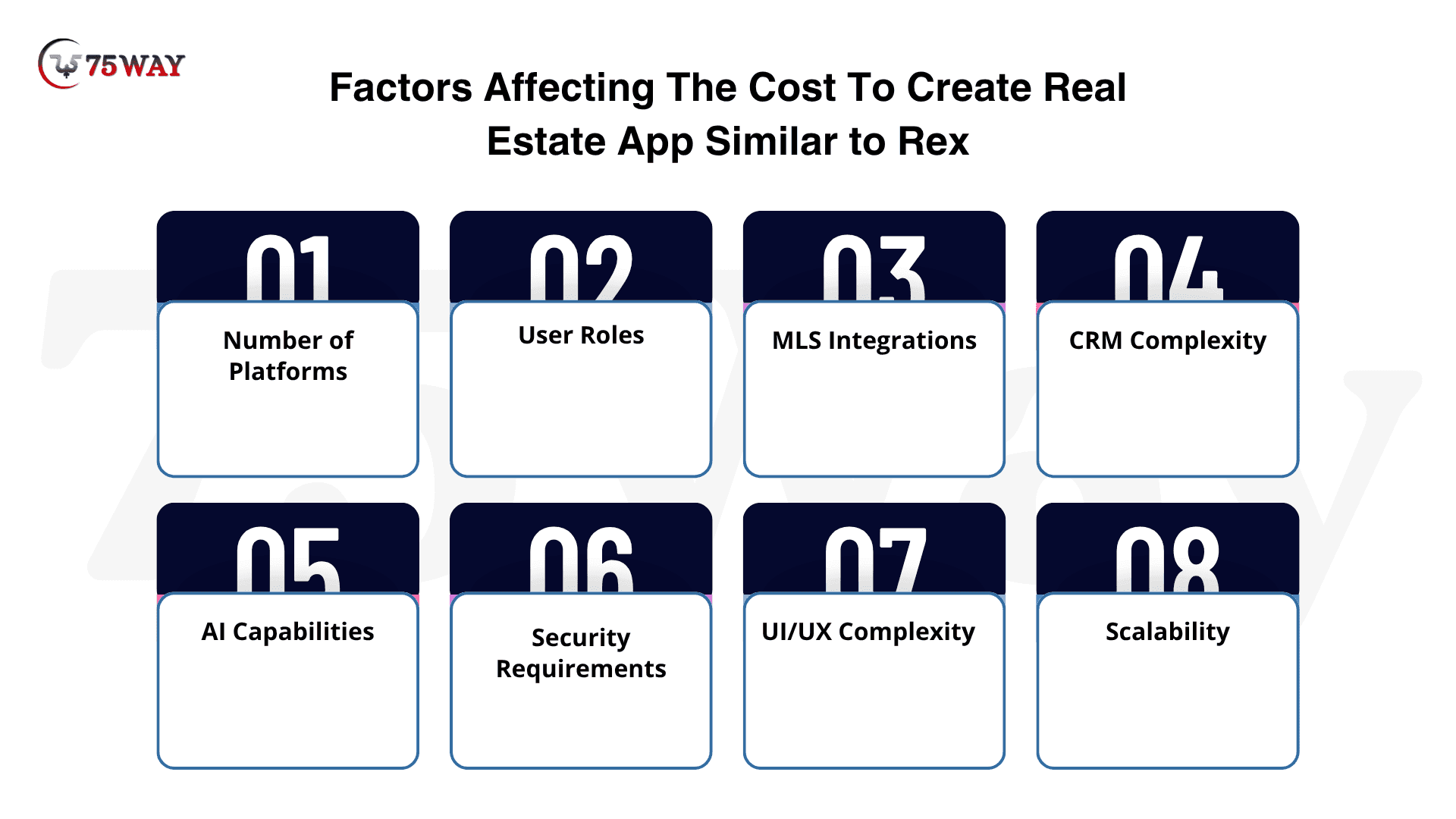
1. Number of Platforms: 10–15%
Building for iOS, Android, and web requires additional development and testing.
A cross-platform approach can reduce duplication, while native applications may be appropriate when platform-specific functionality is important.
2. User Roles: 5–10%
A platform supporting buyers, sellers, agents, brokers, admins, managers, and enterprise users requires more complex permissions and workflows.
3. MLS Integrations: 15–25%
The number and type of MLS connections can significantly influence architecture, integration work, data mapping, and ongoing maintenance.
4. CRM Complexity: 10–20%
A basic contact database costs much less than a full CRM with automation, relationship history, reporting, workflows, and integrations.
5. AI Capabilities: 10–20%
AI search and text generation are different from building predictive valuation, lead scoring, recommendation engines, or intelligent agents.
6. Security Requirements: 5–10%
Real estate platforms can process personal information, communications, documents, financial information, and business data. Security architecture therefore needs to be planned from the beginning.
7. UI/UX Complexity: 10–15%
Advanced dashboards, maps, property discovery interfaces, agent workflows, and mobile interactions require more UX research and design work.
8. Scalability: 5–10%
A product designed for 500 agents has different infrastructure requirements from a platform expected to support tens of thousands of users.
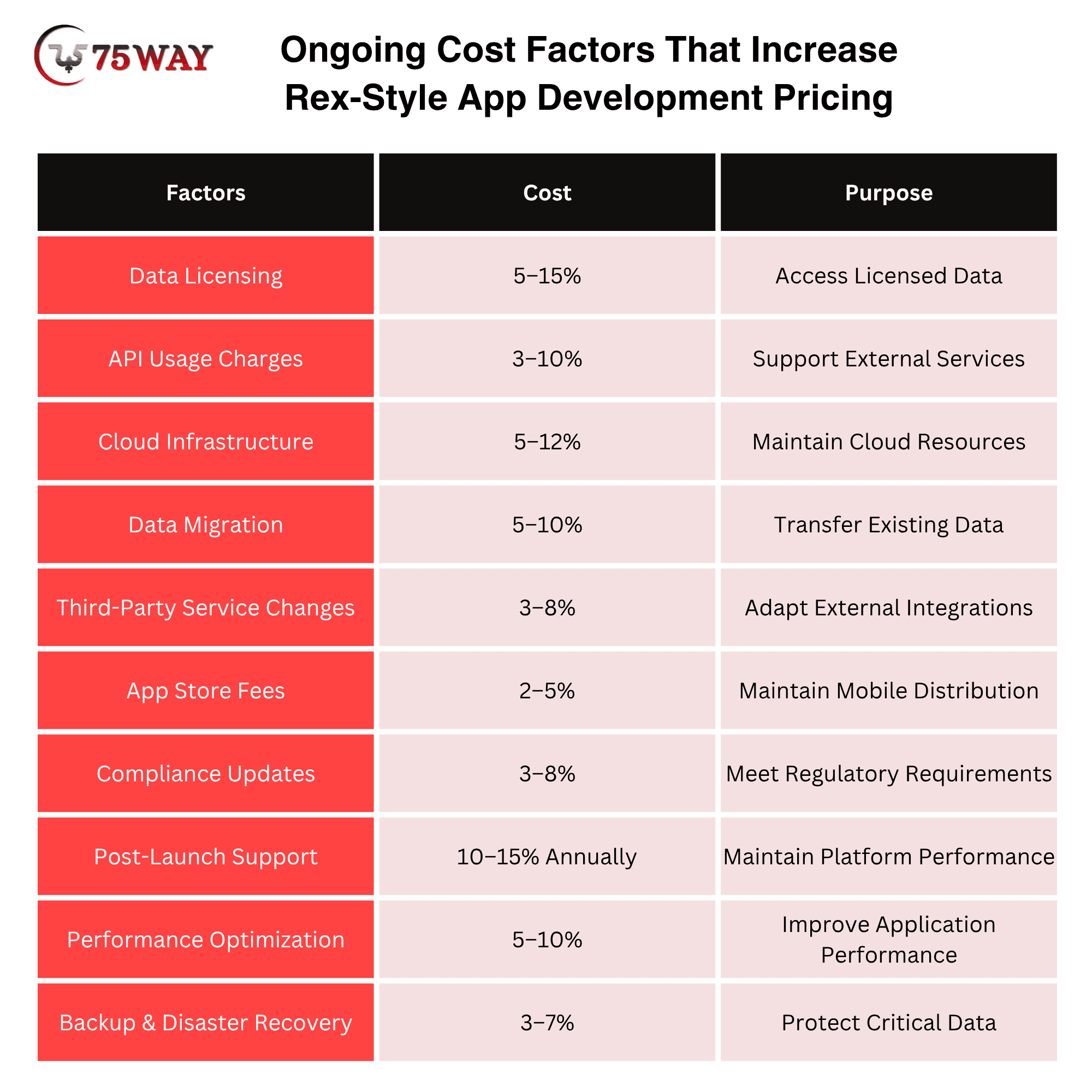
Ongoing Cost Factors That Increase Rex-Style App Development Pricing
Some expenses may not appear in the initial development quote but can increase the overall investment as the project progresses. These hidden costs are worth considering early when planning a Rex-style real estate application.
1. Data Licensing: 5–15%
MLS, property, demographic, mapping, and other third-party data may involve licensing fees that vary by provider and usage. These charges can become significant as the platform expands into additional markets or handles larger data volumes.
2. API Usage Charges: 3–10%
Maps, geocoding, messaging, email, AI, property data, and other APIs can create recurring costs based on usage volume. Higher user activity and transaction volumes can increase these expenses after the application goes live.
3. Cloud Infrastructure: 5–12%
Higher traffic, property images, documents, databases, backups, storage, and monitoring can increase monthly infrastructure expenses. Infrastructure costs may also rise as the application adds users, listings, and data-intensive functionality.
4. Data Migration: 5–10%
Moving existing contacts, listings, documents, communications, and historical records into the new platform can require additional development work. The complexity depends on the quality, volume, structure, and source systems of the existing data.
5. Third-Party Service Changes: 3–8%
Changes to external APIs, authentication services, MLS connections, or platform policies may require unexpected development updates. These changes can create additional testing, integration, and maintenance work during the product lifecycle.
6. App Store Fees: 2–5%
Publishing and maintaining mobile applications can involve platform account fees, transaction charges, and compliance-related requirements. Additional costs may arise when applications need changes to meet updated marketplace guidelines.
7. Compliance Updates: 3–8%
Privacy requirements, data-handling policies, accessibility expectations, and industry-specific rules may require ongoing technical changes. Keeping the application aligned with applicable requirements can therefore create costs beyond the initial development phase.
8. Post-Launch Support: 10–15% Annually
Bug fixes, security patches, API updates, performance improvements, and compatibility changes can create recurring costs after launch. A growing real estate platform may also require regular technical support as its users and integrations increase.
9. Performance Optimization: 5–10%
Large property databases, image-heavy listings, maps, searches, and multiple concurrent users can place additional demands on application performance. Optimizing queries, caching, APIs, and infrastructure later may require extra engineering time.
10. Backup & Disaster Recovery: 3–7%
A real estate platform may need reliable backups and recovery systems to protect listings, customer records, documents, and other business data. Implementing automated backups, recovery procedures, monitoring, and redundancy can add both setup and recurring infrastructure costs.
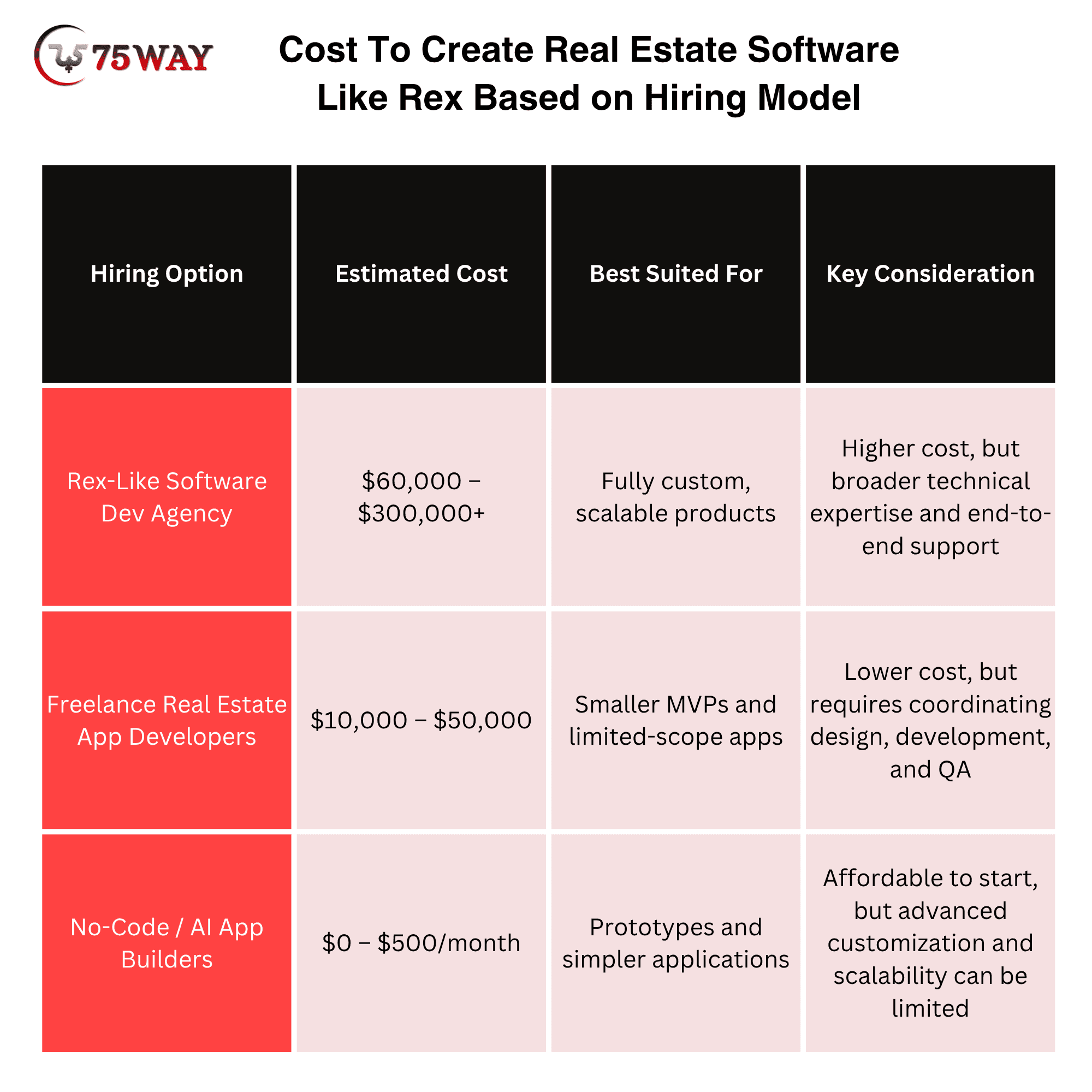
Cost To Create Real Estate Software Like Rex Based on Hiring Model
The development partner you choose can significantly change the upfront cost, level of customization, and amount of project management required. A Rex-style real estate platform can be developed through a software agency, freelance developers, or no-code and AI app-building platforms, depending on your product goals.
- Rex-Like Software Dev Agency: $10,000 – $450,000+
A software agency is suitable for businesses that need a fully custom, scalable real estate platform with complex integrations, dedicated design, development, QA, security, and ongoing support. The higher cost reflects the broader team and end-to-end development responsibilities.
- Freelance Real Estate App Developers: $8,000 – $45,000+
Freelancers can reduce initial development costs, particularly for smaller MVPs with limited functionality. However, businesses may need to coordinate separate professionals for design, development, testing, integrations, and project management.
- No-Code/AI App Builders: $0 – $500/month
No-code and AI app builders can help founders create prototypes or simpler real estate applications with lower upfront investment. They may become less suitable when the product requires advanced MLS integrations, custom CRM workflows, complex automation, or extensive scalability.
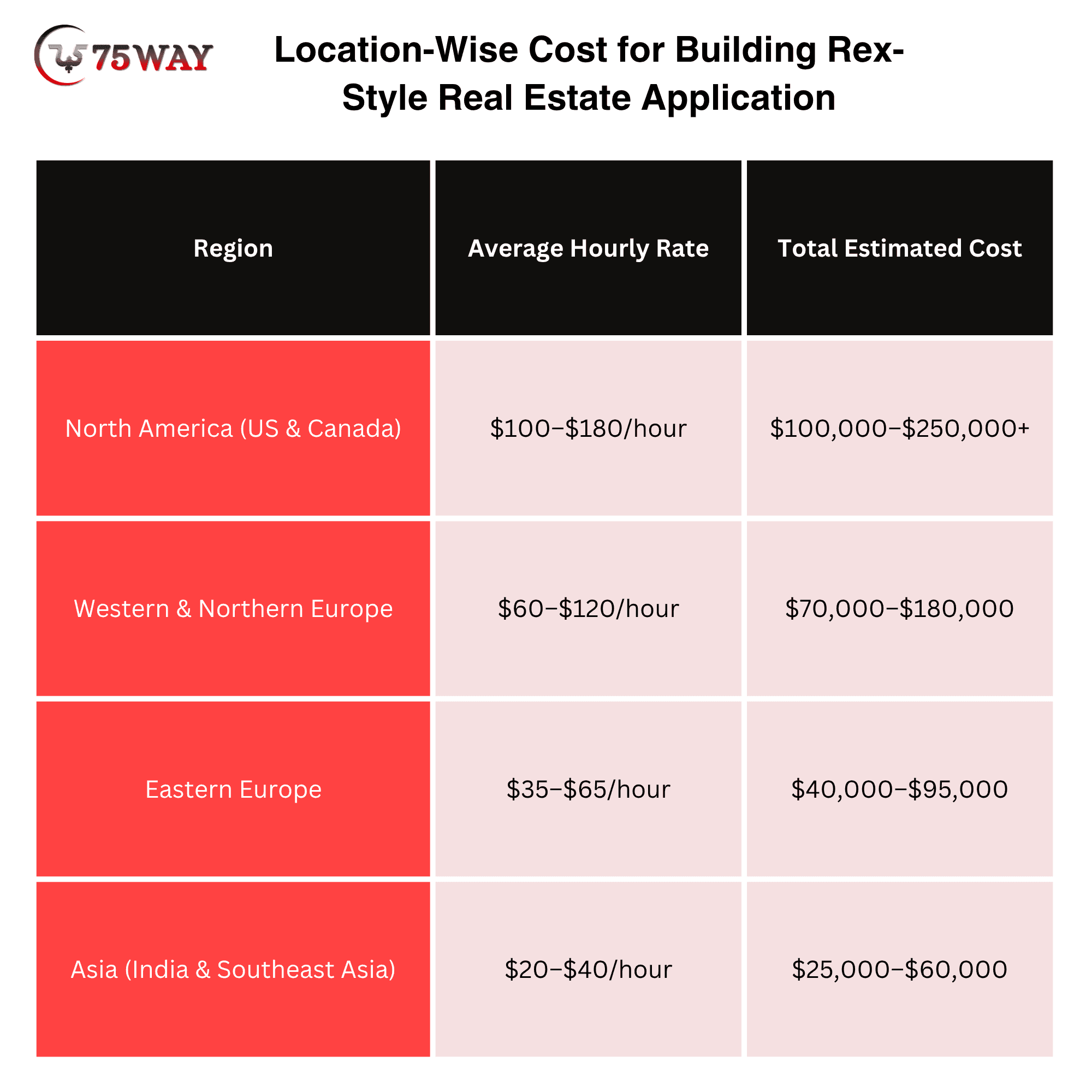
Location-Wise Cost for Building Rex-Style Real Estate Application
The development team's location can significantly affect the cost of building a Rex-style real estate app. Hourly rates vary across regions based on developer expertise, market demand, project complexity, and the type of development partner you choose.
1. North America (US & Canada): $100–$180/hour
Development teams in North America generally charge higher rates, but working with them can simplify communication, working-hour overlap, and alignment with local real estate requirements.
2. Western & Northern Europe (UK, Germany, Scandinavia): $60–$120/hour
Teams in these markets typically offer strong technical capabilities and experience with data privacy requirements. This can make the region suitable for projects involving sensitive customer and business information.
3. Eastern Europe (Poland, Ukraine, Romania): $35–$65/hour
Eastern European development teams can provide access to experienced technical talent at lower hourly rates than North American teams. Communication and technical collaboration can also be practical for long-term development projects.
4. Asia (India, Southeast Asia): $20–$40/hour
Asian development teams generally offer lower hourly rates, making the region attractive for startups managing tighter budgets. However, project owners should establish clear communication processes, documentation, milestones, and oversight from the beginning.
Cost To Hire Real Estate App Developer for Rex-Like App
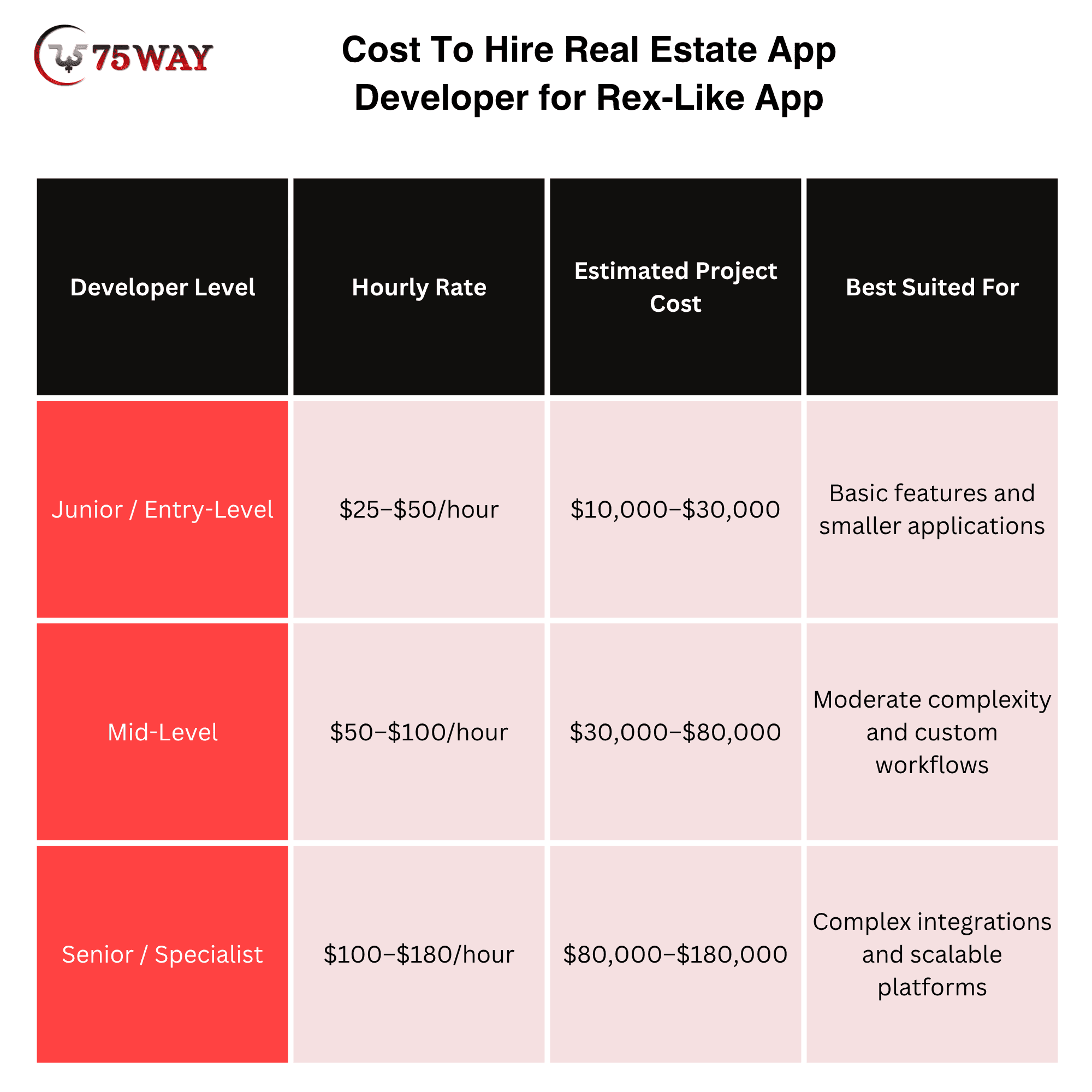
Hiring a developer for a basic property app is one thing; hiring someone to build a Rex-like platform is a much larger technical commitment. The cost of hiring the right real estate app developer depends on the expertise and scope your project demands.
- Junior / Entry-Level: $25–$50/hour
Best suited for basic features, straightforward workflows, and smaller real estate application projects.
- Mid-Level: $50–$100/hour
Suitable for moderate complexity, third-party integrations, custom workflows, and growing real estate platforms.
- Senior / Specialist: $100–$180/hour
Ideal for complex architecture, MLS integrations, advanced CRM systems, AI capabilities, and scalability requirements.
How To Estimate The Cost Of Developing An App Like Rex Real Estate?
A practical way to estimate the cost of a Rex-style real estate app is to calculate the development hours required for each major work area and multiply them by the team's hourly rate. You should also account for integrations, testing, infrastructure, security, and post-launch requirements rather than estimating the entire project from features alone.
Cost Estimation Formula:
Total Development Cost = Estimated Development Hours × Hourly Rate + Third-Party Costs + Infrastructure Costs
For a more detailed estimate, you can break the project into individual components:
Component Cost = Estimated Hours × Hourly Rate
Example
Suppose your Rex-style real estate app requires:
- UI/UX Design: 400 hours
- Frontend Development: 1,000 hours
- Backend Development: 1,200 hours
- MLS/IDX Integration: 400 hours
- CRM Development: 500 hours
- QA & Testing: 400 hours
- Project Management: 200 hours
That gives you 4,100 estimated development hours.
If your development team charges $75 per hour:
4,100 × $75 = $307,500
Now add estimated third-party services, infrastructure, security, and other project expenses of $25,000:
Estimated Total Cost = $307,500 + $25,000 = $332,500
So, based on these assumptions, the project would require an estimated budget of around $330,000–$335,000.
The actual figure will depend on the number of platforms, MLS markets, CRM depth, AI functionality, user roles, integrations, security requirements, and scalability expectations.
Why MLS And IDX Integration Can Increase Development Cost of Rex-Like Software
If you are building a real estate app for the US market, MLS and IDX integration can have a major impact on both development effort and budget. The reason is that your platform needs to work with property data, access rules, technical requirements, and policies set by MLS organizations.
The Real Estate Standards Organization (RESO) provides standards for exchanging real estate data through its Web API. However, RESO does not supply MLS data or access credentials. Developers generally need to work with the relevant MLS or an authorized data provider to obtain access.
RESO also reports that more than 90% of MLS systems have RESO-certified Web API services. Even so, the US real estate market includes hundreds of MLS organizations, so integration requirements can differ from one market to another.
Depending on your product scope, the development team may need to manage:
- MLS authentication and access
- API credentials and permissions
- Property data synchronization
- Different property data fields
- Listing photos and media
- Listing status changes
- Data updates and refreshes
- Pagination and large datasets
- Data caching
- Property search performance
- User access controls
- Data licensing requirements
- Individual MLS policies
IDX adds another consideration because it governs how eligible MLS participants can electronically display listing information. The exact requirements can depend on the applicable MLS rules and IDX policy.
For this reason, MLS integration should not be added to a development estimate as a single line item. The actual effort depends on the MLS markets you plan to support, the data you need, how frequently information must be updated, and the permissions attached to that data.
If you plan to launch across multiple US markets, define the MLS and IDX strategy during the discovery phase. Doing this early can give your development team a clearer understanding of integration requirements, technical work, licensing considerations, and the overall project budget.
How Much Does It Cost To Develop A Rex-Like App In The US?
The development team's location, experience, and engagement model can significantly affect the overall cost of building a Rex-like real estate application.
A US-based real estate app development team may charge higher hourly rates, while an offshore or hybrid team can offer lower development rates. However, comparing vendors only by their hourly price can give you an incomplete picture of the actual project investment.
For a US startup, a more practical way to estimate the budget is:
Total project cost = Product scope + UX/UI + Engineering + Integrations + QA + Infrastructure + Security + Project management + Post-launch maintenance
For example, imagine two development teams quote different hourly rates for the same real estate platform. Team A charges $60 per hour, while Team B charges $100 per hour.
If Team A requires 4,000 hours to complete the project and Team B completes it in 2,500 hours because of stronger experience with MLS integrations and real estate CRM architecture, the lower hourly rate does not necessarily produce the lower total cost.
Team A would cost approximately $240,000, while Team B would cost around $250,000. The difference is only $10,000, despite a $40 difference in hourly rates.
This is why founders should compare the total scope, estimated hours, technical expertise, integrations, delivery process, and post-launch support, rather than choosing a vendor based only on the lowest hourly rate.
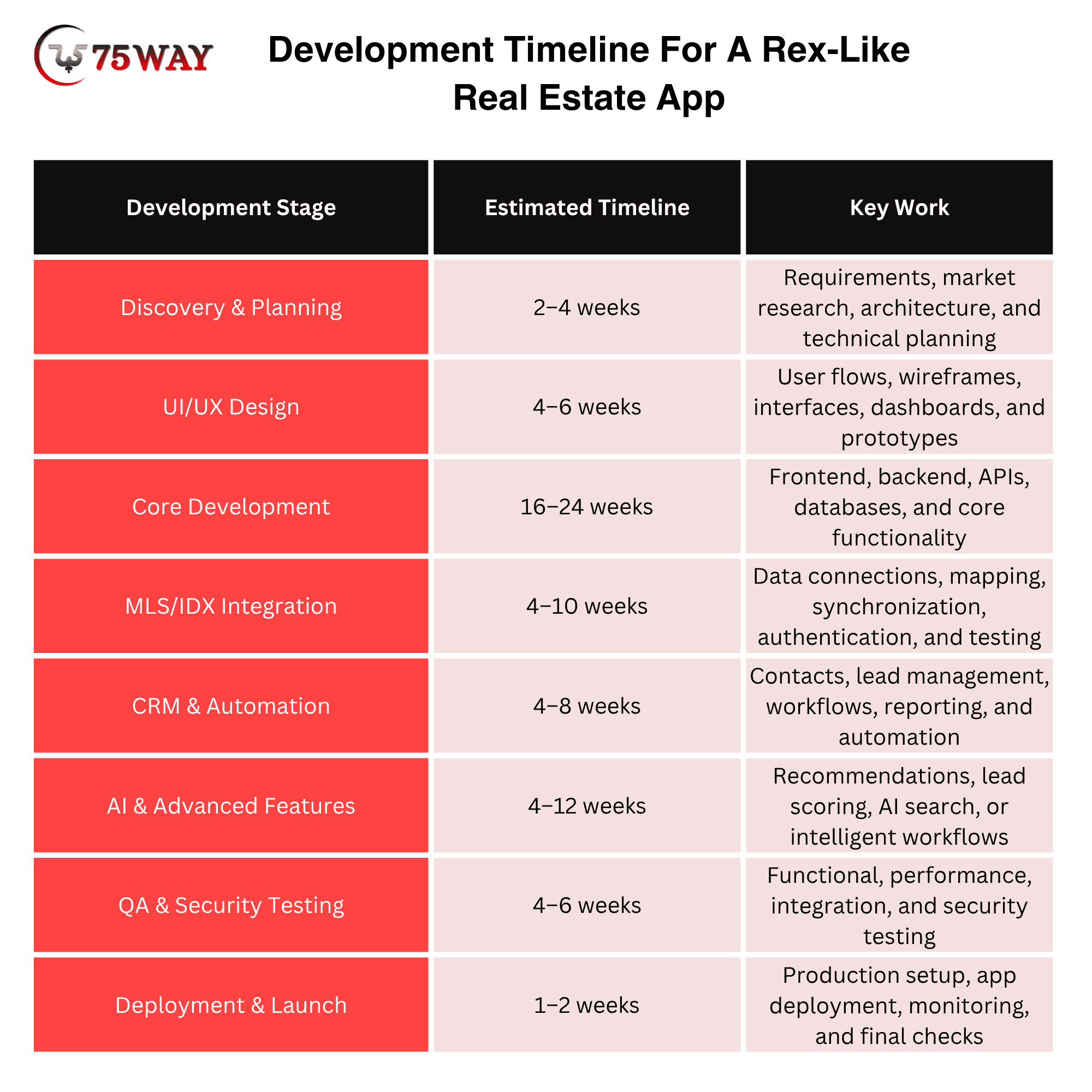
Development Timeline For A Rex-Like Real Estate App
A property app may reach its first usable version quickly, but a Rex-style platform has a much longer road once CRM workflows, mobile functionality, integrations, automation, and real estate data synchronization enter the scope. The timeline breakdown below gives you a clearer view of the expected development duration.
How To Reduce Rex-Like Real Estate Software Development Costs
The fastest way to lessen a real estate app budget is to build a complete ecosystem before knowing which parts agents will actually use. A focused first release can validate the product while leaving room to add deeper automation, integrations, and advanced capabilities as demand becomes clearer. The given cost-effective strategies show where you can control costs while keeping the foundation ready for future expansion.
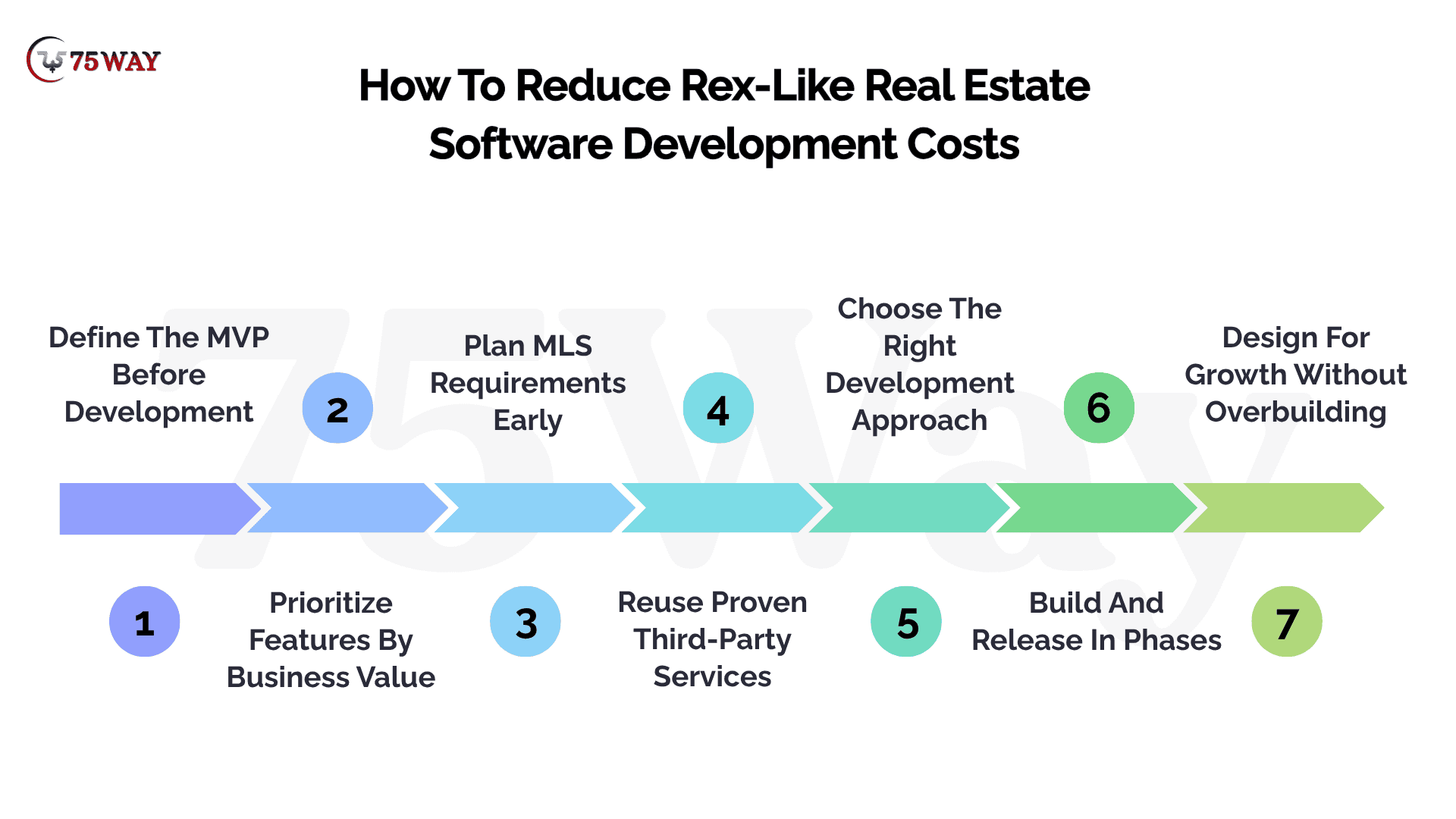
1. Define The MVP Before Development
Start by identifying the workflows your first users genuinely need, such as property discovery, listings, accounts, enquiries, and basic lead management. Defining these requirements before development prevents spending on features that may not be necessary for the initial launch.
2. Prioritize Features By Business Value Not every Rex-style capability needs to be available on day one. Separate essential launch functionality from advanced CRM automation, AI features, analytics, and other enhancements, then schedule lower-priority capabilities for later releases.
3. Plan MLS Requirements Early
MLS integration can involve data access, licensing, authentication, mapping, synchronization, and market-specific requirements. Defining which MLS markets and property fields you need before development helps reduce architectural changes and unexpected integration work.
4. Reuse Proven Third-Party Services
Building every supporting service internally can increase both development time and maintenance requirements. Established services for maps, geocoding, authentication, communications, analytics, and cloud infrastructure can handle specific requirements without requiring equivalent systems to be built from scratch.
5. Choose The Right Development Approach
The technology approach should match the product's actual requirements. For example, cross-platform development may reduce duplicated mobile development work when platform-specific functionality is limited, while native development may make more sense when advanced device capabilities are central to the product.
6. Build And Release In Phases
Instead of developing the complete platform before launch, divide development into manageable releases. An initial version can validate user demand and workflows, while later releases can introduce advanced CRM features, AI, automation, analytics, and additional integrations based on real product requirements.
7. Design For Growth Without Overbuilding
Your architecture should allow the application to scale, but that does not mean paying for every enterprise-level capability from the beginning. Build a sound foundation for databases, APIs, security, and cloud infrastructure, then increase capacity and complexity as user numbers and business requirements grow.
How To Generate Revenue From A Real Estate App Like Rex
The strongest revenue opportunity may come from selling the software itself to agencies that rely on it every day. Once a Rex-like platform becomes embedded in an agency’s operations, recurring subscriptions and paid capabilities can create a more predictable commercial model. The revenue opportunities and monetization strategies for this type of real estate app are outlined below.
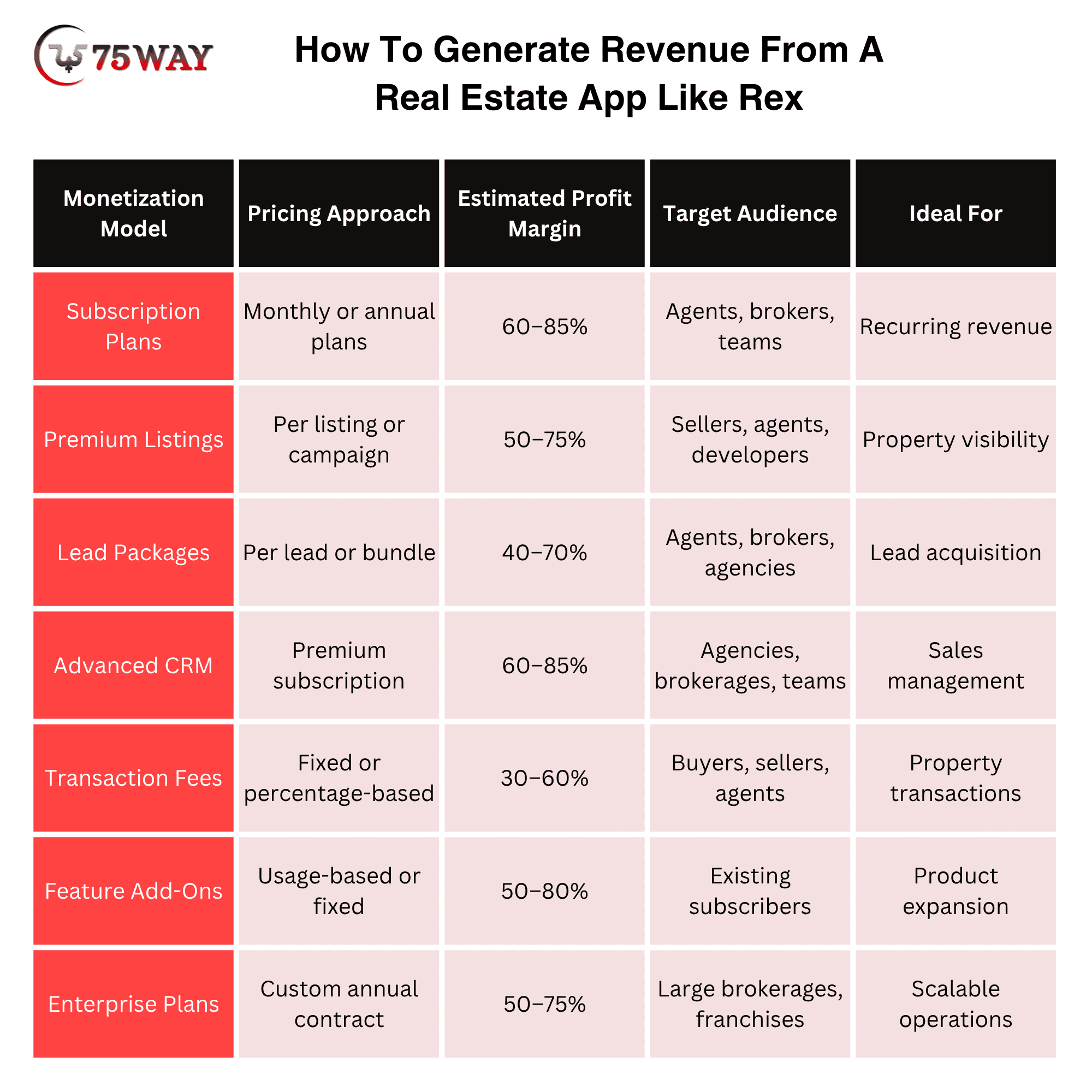
1. Tiered Subscription Plans
Recurring subscription plans can give agents and brokerages access to different levels of listings, contacts, CRM capabilities, automation, analytics, and team features. Multiple tiers also let smaller teams start affordably while larger organizations pay for broader functionality.
2. Premium Property VisibilityFeatured listings can create a direct revenue channel for agents, brokers, and property businesses seeking greater exposure. Paid placements may include promoted search positions, featured sections, enhanced listing presentation, or targeted visibility within relevant property searches.
3. Qualified Lead Packages
Lead generation can become a valuable paid service when the platform connects property professionals with relevant buyers or sellers. Pricing can follow a per-lead model, prepaid lead packages, or recurring plans with defined enquiry limits.
4. Advanced CRM Subscriptions
Advanced CRM functionality creates opportunities for higher-value subscription tiers. Features such as workflow automation, reporting, lead tracking, communication history, team management, and customer segmentation can justify additional pricing for growing real estate businesses.
5. Transaction-Based Revenue
Transaction fees can provide revenue when the platform directly supports eligible property transactions or related services. Depending on the business model, charges may use a fixed amount or percentage structure, subject to applicable contractual, regulatory, and marketplace requirements.
6. Paid Feature Add-Ons
Optional upgrades can increase revenue without forcing customers into larger subscription plans. Additional users, storage, automation capacity, analytics, integrations, reporting, and communication allowances can work as usage-based or fixed-price add-ons.
7. Enterprise Real Estate Plans
Large brokerages often require functionality beyond standard agent accounts, including advanced permissions, multiple teams, custom integrations, higher usage limits, security controls, and dedicated support. Enterprise pricing can therefore be customized according to users, locations, integrations, and service requirements.
How 75way Helps You Build A Cost-Effective Rex-Like Real Estate App?
75way Technologies serves businesses with affordable real estate app development solutions like Rex. Their experts focus on the product scope around essential workflows, scalable architecture, and business priorities. Its development approach can cover core capabilities such as property listings, advanced search, user management, CRM workflows, MLS/IDX integrations, dashboards, automation, and mobile experiences without adding unnecessary functionality to the initial release.
A phased development strategy also helps businesses launch a focused Rex-like real estate app first and expand it as user requirements become clearer. By planning integrations, technology choices, testing, security, and future scalability during the early stages, 75way can help reduce avoidable rework while keeping the development roadmap aligned with the available budget and long-term product goals.
Final Remarks
To conclude, the cost to develop an app like Rex Real Estate is approximately $10,000–$450,000+, but the right budget depends on whether you are building a focused MVP, a full real estate CRM, or an enterprise property technology platform.
For a startup, the practical route is to launch with a focused MVP around listings, leads, CRM, agent workflows, and essential integrations, then expand based on actual user behavior and revenue.
For a brokerage or enterprise, the planning process should begin with data architecture, MLS requirements, workflow mapping, security, integrations, and scalability before development estimates are finalized.
To build a scalable real estate app, you can partner with a reliable real estate app development firm to define your MVP and get a scope-based development estimate.
Frequently Asked Questions (FAQs)
How Much Does It Cost To Develop An App Like Rex Real Estate?
A Rex-like real estate platform can cost approximately $10,000–$450,000+, depending on features, MLS/IDX integrations, CRM complexity, AI, platforms, security, and scalability requirements.
How Much Does A Basic Real Estate App Cost?
A focused real estate MVP can cost around $10,000–$40,000 when it includes core property listings, search, user accounts, lead capture, notifications, and basic administration.
How Long Does It Take To Build An App Like Rex?
A production-ready real estate application can take approximately 5–12 months, while enterprise platforms with extensive integrations and advanced AI may require longer.
Can I Build a Rex-Like App With AI?
Yes. AI can support CRM search, lead prioritization, property descriptions, communication drafting, recommendations, data entry, summaries, and workflow automation.
What Is The Most Expensive Part of A Real Estate App?
There is no single universal cost driver. For a sophisticated platform, MLS/data integrations, CRM workflows, backend architecture, AI, security, and enterprise functionality can each contribute substantially to the total budget.
Should I Build iOS and Android Separately?
Not necessarily. Cross-platform development can be appropriate for an MVP or many production applications, while native development can make sense when platform-specific performance or capabilities are central to the product.
How Can I Reduce Real Estate App Development Costs?
Start with a focused MVP, prioritize revenue-critical workflows, use established third-party services where appropriate, and defer advanced AI and enterprise features until the product validates demand.