AI Summary
Building aviation software helps airlines connect operations, automate repetitive workflows, improve passenger experiences, and turn operational data into actionable insights. This guide explores practical business benefits, software types, customization, security, scalability, and strategies for maximizing technology investments across aviation operations.
Key Takeaways
- Aviation software connects fragmented airline workflows through centralized operational data and real-time visibility.
- Automated aviation workflows can reduce repetitive administrative work and operational overhead.
- Analytics helps airline teams make faster, data-driven operational and commercial decisions.
- Custom aviation platforms improve passenger experiences while supporting specialized airline workflows.
- Scalable aviation software supports growing fleets, routes, passengers, integrations, and digital services.
A flight disruption can trigger a chain of operational problems involving aircraft, crews, schedules, airport resources, and passengers. An aviation software development solution gives airline businesses a way to connect these moving parts and make critical information easier to access when quick decisions matter.
Airlines are already increasing their technology investments, with SITA reporting that 72% of airlines increased IT spending in 2025 and 67% expected that growth to continue in 2026. The focus is increasingly tied to operational reliability, data-driven decision-making, and modernizing flight operations systems.
For business leaders, that investment needs to translate into more than new software. The benefits of a custom aviation software development solution become clearer when its impact on operations, costs, passenger experiences, workforce coordination, and long-term scalability is examined.
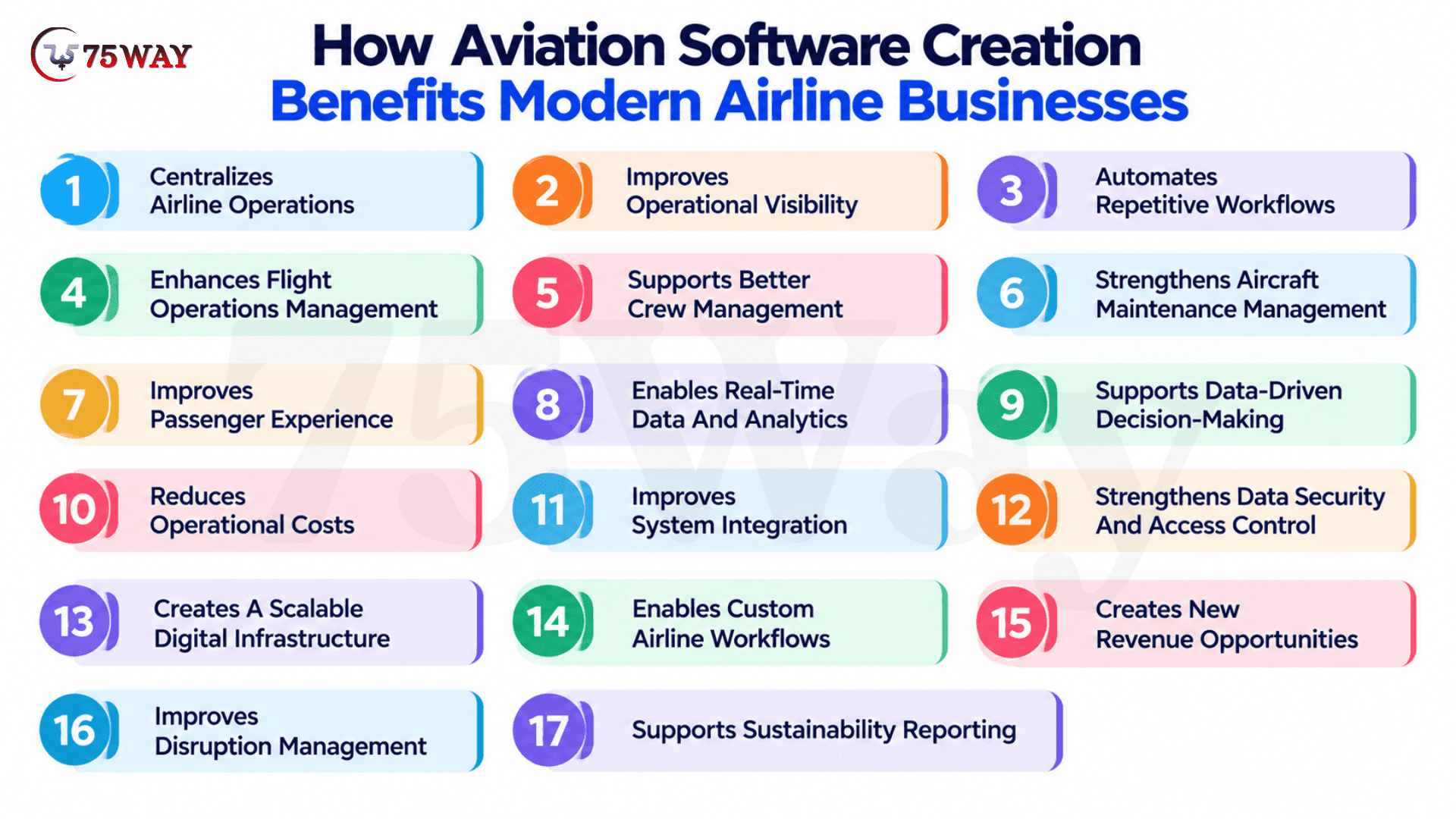
How Aviation Software Creation Benefits Modern Airline Businesses in 2027
An airline’s technology infrastructure can directly affect how smoothly passengers, employees, aircraft, and operational teams interact with one another. Custom aviation software gives businesses greater scope to connect these moving parts and build technology around their specific operating model. The key benefits shaping aviation software adoption among modern airlines in 2027 are outlined below.
1. Centralizes Airline Operations
Airlines manage interconnected activities across flight operations, aircraft, crews, airports, passengers, maintenance, scheduling, and revenue management.
When these processes operate through disconnected systems, teams may spend significant time moving information between platforms or reconciling data.
Purpose-built aviation software can bring relevant operational information into a centralized environment.
Depending on the product scope, this can connect:
- Flight schedules
- Aircraft information
- Crew assignments
- Passenger information
- Airport operations
- Maintenance records
- Flight status
- Operational alerts
- Revenue information
- Performance analytics
A centralized system gives authorized teams a shared operational view while reducing dependence on fragmented workflows.
2. Improves Operational Visibility
Airline operations change continuously.
Flight delays, aircraft availability, crew constraints, weather conditions, airport disruptions, and maintenance requirements can affect multiple downstream processes.
Aviation software can bring these data points together through operational dashboards.
For example, an operations team could monitor:
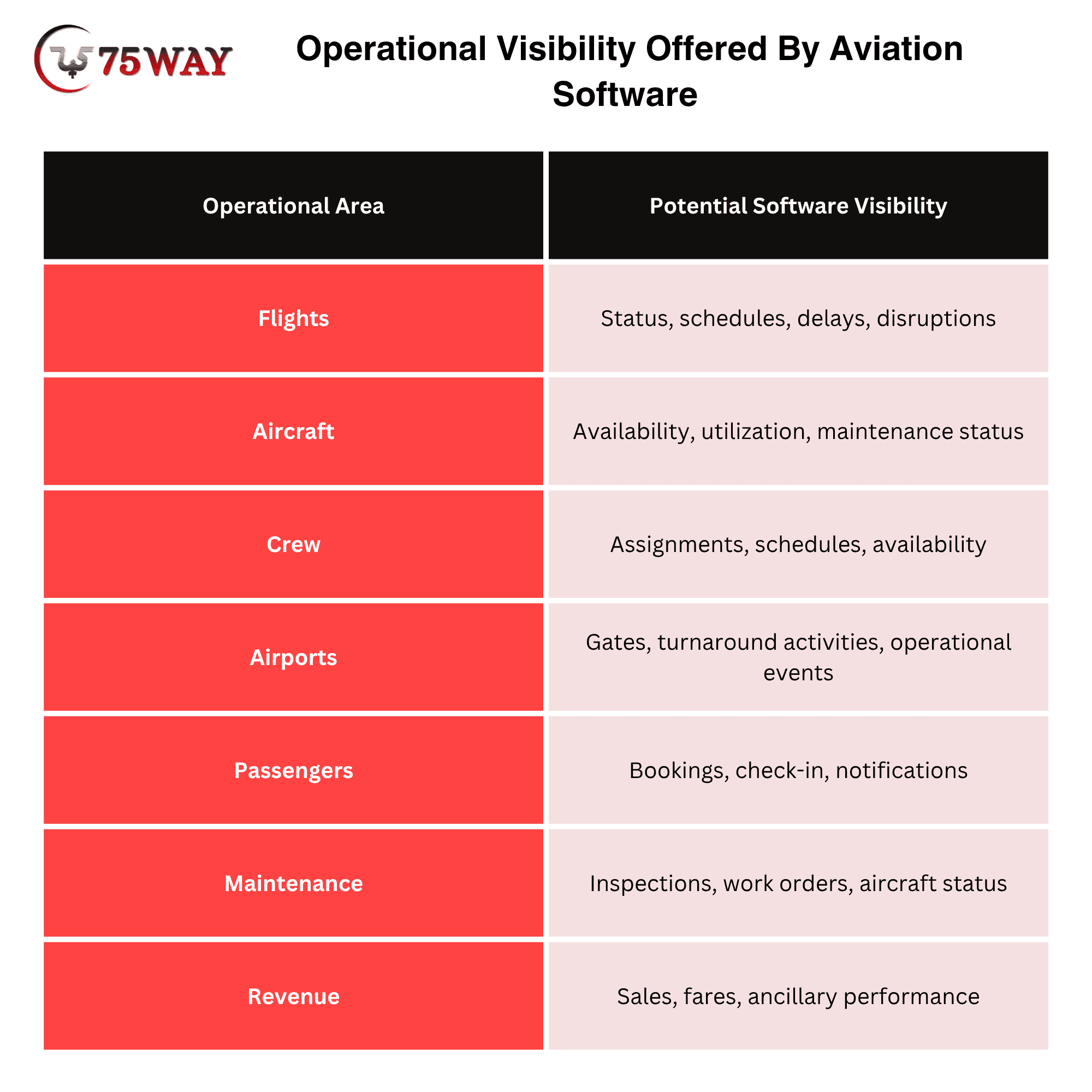
This visibility can help teams identify operational exceptions earlier and coordinate appropriate responses.
3. Automates Repetitive Workflows
Airline businesses perform many repetitive processes that can be digitized. Examples include:
- Schedule updates
- Crew notifications
- Passenger alerts
- Document processing
- Maintenance reminders
- Report generation
- Data synchronization
- Booking confirmations
- Operational notifications
- Internal approvals
Automation can reduce manual data entry and allow employees to focus on activities requiring human judgment.
The important consideration is to automate workflows with clear rules and measurable outcomes rather than adding automation simply for its own sake.
4. Enhances Flight Operations Management
Flight operations require coordination between multiple teams. A dedicated aviation platform can provide functionality for:
- Flight scheduling
- Dispatch workflows
- Flight tracking
- Crew coordination
- Operational alerts
- Airport information
- Disruption management
- Flight documentation
- Performance monitoring
For airlines, even small operational disruptions can create downstream effects across aircraft, crews, passengers, and airport resources.
Software that provides timely information can help teams coordinate these dependencies more effectively.
5. Supports Better Crew Management
Crew management is another area where aviation software can deliver significant operational value. Depending on the airline's requirements, software can support:
- Crew scheduling
- Crew availability
- Duty tracking
- Leave management
- Assignment workflows
- Qualification records
- Notifications
- Crew communication
- Schedule changes
Crew-related functionality should account for applicable airline procedures and regulatory requirements rather than relying on generic workforce scheduling logic.
6. Strengthens Aircraft Maintenance Management
Aircraft maintenance requires detailed records, scheduled activities, inspections, work orders, and coordination between operational teams.
Aviation software can centralize maintenance-related information and provide:
- Maintenance schedules
- Inspection reminders
- Work orders
- Aircraft history
- Parts information
- Maintenance status
- Technician workflows
- Maintenance alerts
- Digital documentation
This can improve visibility into aircraft availability and help maintenance teams coordinate upcoming requirements.
Software should complement established maintenance procedures and regulatory controls rather than attempting to replace required professional oversight.
7. Improves Passenger Experience
Passenger expectations increasingly extend beyond booking a flight. Travelers expect timely information throughout their journey. Aviation software can support passenger-facing services such as:
- Online booking
- Digital check-in
- Boarding information
- Flight status
- Baggage updates
- Push notifications
- Schedule-change alerts
- Loyalty programs
- Customer support
- Personalized offers
For airlines, this creates opportunities to connect operational information with customer-facing experiences.
For example, when a flight status changes, the platform can trigger relevant passenger communications rather than requiring employees to manage every notification manually.
8. Enables Real-Time Data And Analytics
Airline businesses generate large volumes of operational and commercial data.
Aviation software can turn this information into dashboards and analytical workflows.
Decision-makers can monitor metrics such as:
- On-time performance
- Aircraft utilization
- Flight disruptions
- Passenger volumes
- Revenue performance
- Booking trends
- Ancillary sales
- Crew utilization
- Maintenance activity
- Customer engagement
Analytics becomes more useful when it is connected to operational decisions.
Instead of simply displaying historical information, an aviation platform can help teams identify exceptions, investigate causes, and evaluate operational patterns.
9. Supports Data-Driven Decision-Making
Airline executives often need to make decisions involving capacity, routes, aircraft utilization, staffing, pricing, customer experience, and operational costs.
A centralized software environment can provide the data needed to evaluate these decisions.
For example, leadership could analyze: route, passenger demand, capacity, revenue, operational cost, and performance.
Connecting these datasets can provide a broader view than examining each department separately.
The exact analytical capabilities will depend on the quality, availability, and integration of the underlying data.
10. Reduces Operational Costs
Custom aviation software does not automatically reduce costs. Its financial value comes from the workflows it improves.
Potential cost areas include:
- Manual administration
- Duplicate data entry
- Paper-based processes
- Operational delays
- Inefficient resource allocation
- Unnecessary system switching
- Manual reporting
- Communication overhead
- Preventable workflow errors
Airlines should therefore define measurable cost objectives before development.
For example:
Current Process → Manual Time → Software Automation → Time Saved → Business Impact
This makes the business case easier to evaluate after implementation.
11. Improves System Integration
Airlines rarely operate through one application. An aviation software platform may need to communicate with:
- Reservation systems
- Payment systems
- Airport systems
- Flight tracking platforms
- Customer relationship management systems
- Accounting software
- Maintenance systems
- Crew management systems
- Identity platforms
- Government or regulatory systems
API-based architecture can allow systems to exchange information without forcing employees to manually transfer data between applications.
Integration requirements should be defined during discovery because they can significantly affect development cost and architecture.
12. Strengthens Data Security And Access Control
Aviation software can handle sensitive operational, employee, passenger, financial, and business information.
Security therefore needs to be incorporated into the architecture from the beginning.
Important controls can include:
- Role-based access
- Multi-factor authentication
- Encryption
- Secure APIs
- Audit logs
- Access monitoring
- Backup procedures
- Data retention policies
- Session management
- Vulnerability testing
Different employees should receive access based on their responsibilities.
For example, a passenger should not have access to internal operational information, while a maintenance employee should not automatically receive access to commercial financial data.
13. Creates A Scalable Digital Infrastructure
An airline's technology requirements can change as the business grows.
Expansion may involve:
- More aircraft
- More routes
- More passengers
- Additional airports
- New operational teams
- New digital services
- More integrations
A scalable architecture can accommodate increasing workloads without requiring the entire platform to be rebuilt.
This is particularly important when aviation software is being developed as a commercial SaaS platform for multiple airline or aviation customers.
14. Enables Custom Airline Workflows
Off-the-shelf aviation platforms can provide broad functionality, but they may not match every organization's internal processes.
Custom software allows an airline to design workflows around its specific operating model.
For example, an airline could build customized workflows for:
- Internal approvals
- Operational alerts
- Fleet reporting
- Crew communication
- Passenger notifications
- Maintenance coordination
- Executive dashboards
- Partner integrations
Customization becomes particularly valuable when software is intended to support a differentiated operational process.
15. Creates New Revenue Opportunities
Aviation software can also support commercial growth.
Potential opportunities include:
- Ancillary services
- Personalized offers
- Loyalty programs
- Premium services
- Travel add-ons
- Dynamic promotions
- Partner services
- Digital customer channels
For example, passenger data and booking workflows can support relevant offers for baggage, seat selection, upgrades, travel services, or other ancillary products.
Any personalization strategy should account for applicable privacy, consent, and data-governance requirements.
16. Improves Disruption Management
Disruptions are a major operational challenge for airlines. A software platform can centralize relevant information during events such as:
- Flight delays
- Cancellations
- Aircraft changes
- Crew disruptions
- Airport closures
- Baggage issues
- Schedule changes
The platform can help teams coordinate communication and track affected passengers or operational tasks.
The objective is not to predict every disruption perfectly. It is to give teams better information and structured workflows when disruptions occur.
17. Supports Sustainability Reporting
Airlines are under increasing pressure to understand and report operational and environmental performance.
Depending on the scope of the platform, aviation software can consolidate data related to:
- Fuel consumption
- Flight activity
- Aircraft utilization
- Operational efficiency
- Emissions reporting
- Ground operations
The quality of these insights depends on the underlying data sources and calculation methodology.
For businesses building sustainability functionality, the software should clearly document how metrics are calculated and where source data originates.
Why Should Airlines Invest In Aviation Software?
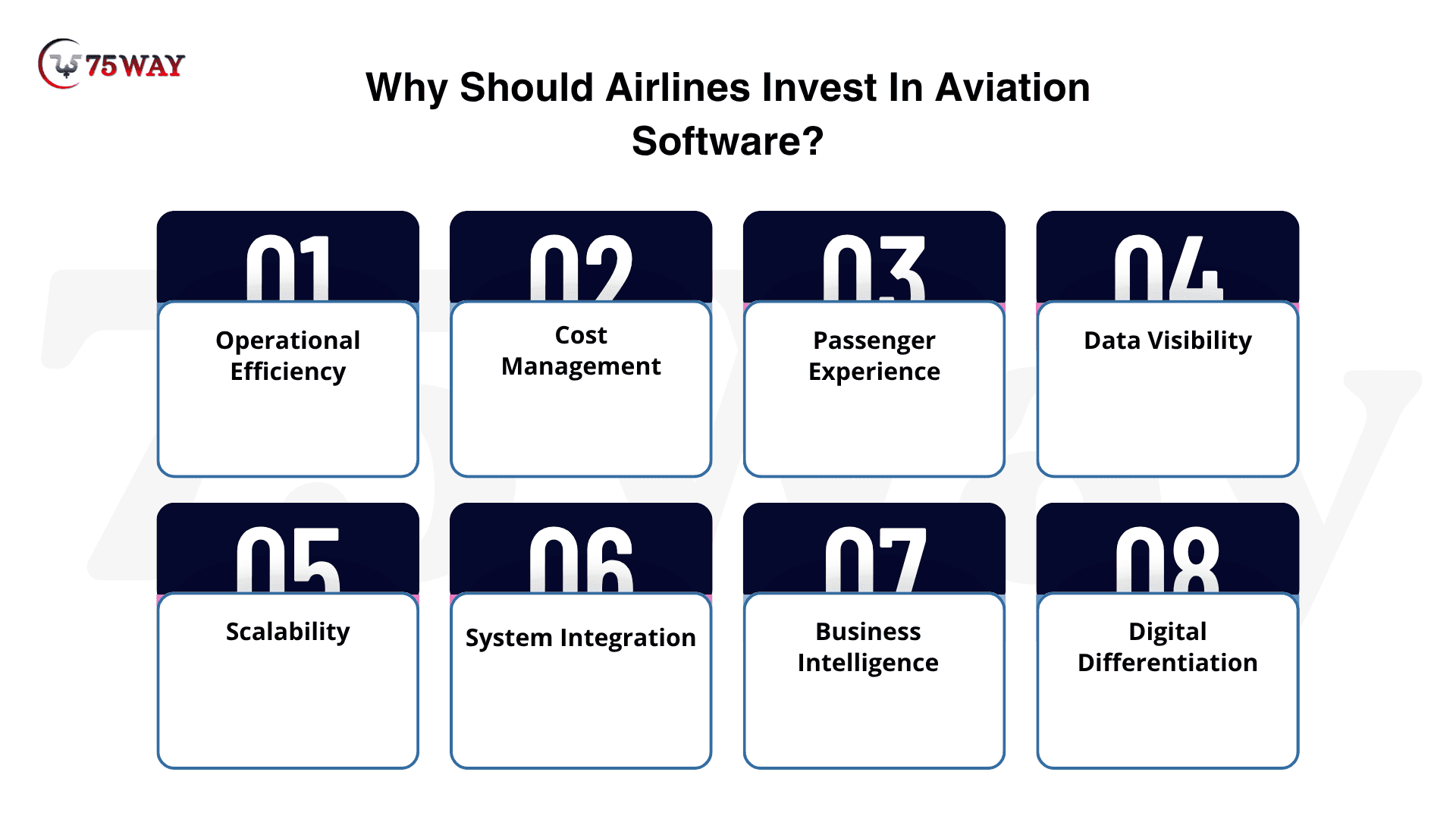
An airline can lose money when a small operational delay spreads across aircraft, crews, schedules, and passengers. Aviation software gives businesses greater visibility across these connected workflows, helping teams respond faster and make better-informed operational decisions. SITA reports that airlines spent $36 billion on IT in 2025, with 72% increasing their IT spending, showing how central technology has become to airline operations.
- Operational Efficiency
Automating repetitive tasks can reduce manual coordination, simplify workflows, and allow airline teams to focus on higher-value operational responsibilities.
- Cost Management
Connected workflows can help identify process inefficiencies, reduce administrative overhead, and improve the utilization of aircraft, crews, and other resources.
- Passenger Experience
Digital booking, check-in, notifications, self-service tools, and personalized services can create more convenient experiences throughout the passenger journey.
- Data Visibility
Centralized dashboards can bring flight, passenger, crew, maintenance, and revenue information together for better operational awareness.
- Scalability
Scalable aviation software can support growing fleets, additional routes, increasing passenger volumes, new locations, and expanding digital services.
- System Integration
API-based integrations can connect reservations, payments, maintenance, accounting, CRM, airport systems, and other technology platforms.
- Business Intelligence
Real-time analytics and historical data can help airline leaders identify trends, monitor performance, and make informed operational and commercial decisions.
- Digital Differentiation
Custom software allows airlines to develop specialized workflows and digital capabilities that may not be available through standard off-the-shelf platforms.
How To Maximize The Potential of Custom Airline Software Solution
A custom airline software solution should solve more than the immediate problem that triggered its development. Stronger returns come when the platform continues supporting changing operational requirements, connected systems, and business priorities after launch. The practical ways to get greater value from custom airline software are covered below.
Step 1: Identify Operational Bottlenecks
Document where teams lose time, information, or visibility.
Step 2: Map Existing Workflows
Understand how information moves between departments and systems.
Step 3: Define Measurable KPIs
Choose metrics such as processing time, operational delays, adoption, revenue, or administrative workload.
Step 4: Prioritize The MVP
Develop the workflows with the clearest business value first.
Step 5: Design Integrations Early
Identify existing systems that the platform must communicate with.
Step 6: Build Security Into Architecture
Define authentication, authorization, data protection, logging, and governance requirements before development.
Step 7: Test With Operational Users
Involve actual users from relevant departments before a full-scale rollout.
Step 8: Measure Post-Launch Results
Compare performance against the baseline established before implementation.
Final Thoughts
The benefits of building aviation software extend beyond digitizing individual airline tasks. A well-designed platform can connect operational data, automate workflows, improve passenger services, strengthen decision-making, and provide the scalable infrastructure needed for changing aviation operations.
The business case becomes stronger when each feature is connected to a specific operational problem and measurable KPI. Whether the goal is improving flight operations, crew management, maintenance, passenger experience, analytics, or revenue processes, the right software strategy starts with the workflow, not the technology.
To build aviation software, you can contact with a prominent AI-powered software development firm to discuss your product requirements, workflows, integrations, and development roadmap.
Frequently Asked Questions (FAQs)
What Is Aviation Software Used For?
Aviation software supports airline and aviation workflows such as flight operations, crew management, maintenance, reservations, passenger services, analytics, and asset management.
How Does Aviation Software Improve Airline Operations?
It can connect operational information, automate routine workflows, provide real-time dashboards, coordinate teams, and help employees respond to operational changes with better information.
Can Aviation Software Improve The Passenger Experience?
Yes. Features such as digital booking, check-in, flight-status updates, notifications, self-service tools, loyalty programs, and personalized services can improve the digital passenger journey.
How Does Aviation Software Reduce Airline Operating Costs?
Software can reduce costs by automating repetitive tasks, minimizing duplicate data entry, improving resource visibility, streamlining reporting, and identifying operational inefficiencies.
Is Aviation Software Secure?
Aviation software should incorporate security controls such as role-based access, encryption, authentication, audit logging, secure APIs, monitoring, backups, and regular security testing.
How Can Airlines Measure The ROI of Aviation Software?
Airlines can compare pre- and post-implementation metrics such as processing time, administrative workload, operational performance, digital adoption, customer engagement, resource utilization, and revenue-related indicators.