AI Summary
Before hiring a real estate app development company, know what separates a reliable partner from a risky choice. Explore essential factors, questions, costs, and red flags. This guide explains what businesses should evaluate before hiring. Discover how to compare providers, uncover risks, and select the right technology partner confidently.
Key Takeaways
- Evaluate real estate expertise, portfolio quality, technology capabilities, and relevant development experience.
- Compare companies across integrations, security, scalability, pricing, communication, and ongoing support.
- Ask targeted questions to assess technical expertise, processes, ownership, and capabilities.
- Spot common red flags before hiring to avoid costly development mistakes.
- Choose a development partner aligned with business goals, users, and roadmap.
A proptech app can become an expensive liability when the real estate app development partner gets the fundamentals wrong. Poor architecture, weak security, unreliable integrations, or missed requirements can lead to costly rework long after the initial development budget has been spent.
For real estate businesses, the right agency should understand property workflows, listings, lead management, payments, agent operations, and the expectations of modern property buyers and sellers. Technical skills of real estate app developers matter, but industry understanding and proven delivery experience matter just as much.
Before signing a development contract to build a real estate application, businesses need to evaluate expertise, portfolio quality, technology capabilities, communication, security practices, pricing, and post-launch support. This guide covers the factors businesses should assess before choosing a real estate app development company.
How To Evaluate A Real Estate App Provider's Experience
Industry experience matters because real estate applications have workflows and integrations that differ from many other consumer apps.
A real estate app team that understands the industry is more likely to recognize the requirements around property listings, agents, brokers, buyers, sellers, landlords, tenants, property managers, leads, location data, and transaction-related workflows.
However, don't accept “real estate experience” as a marketing claim. Verify it.
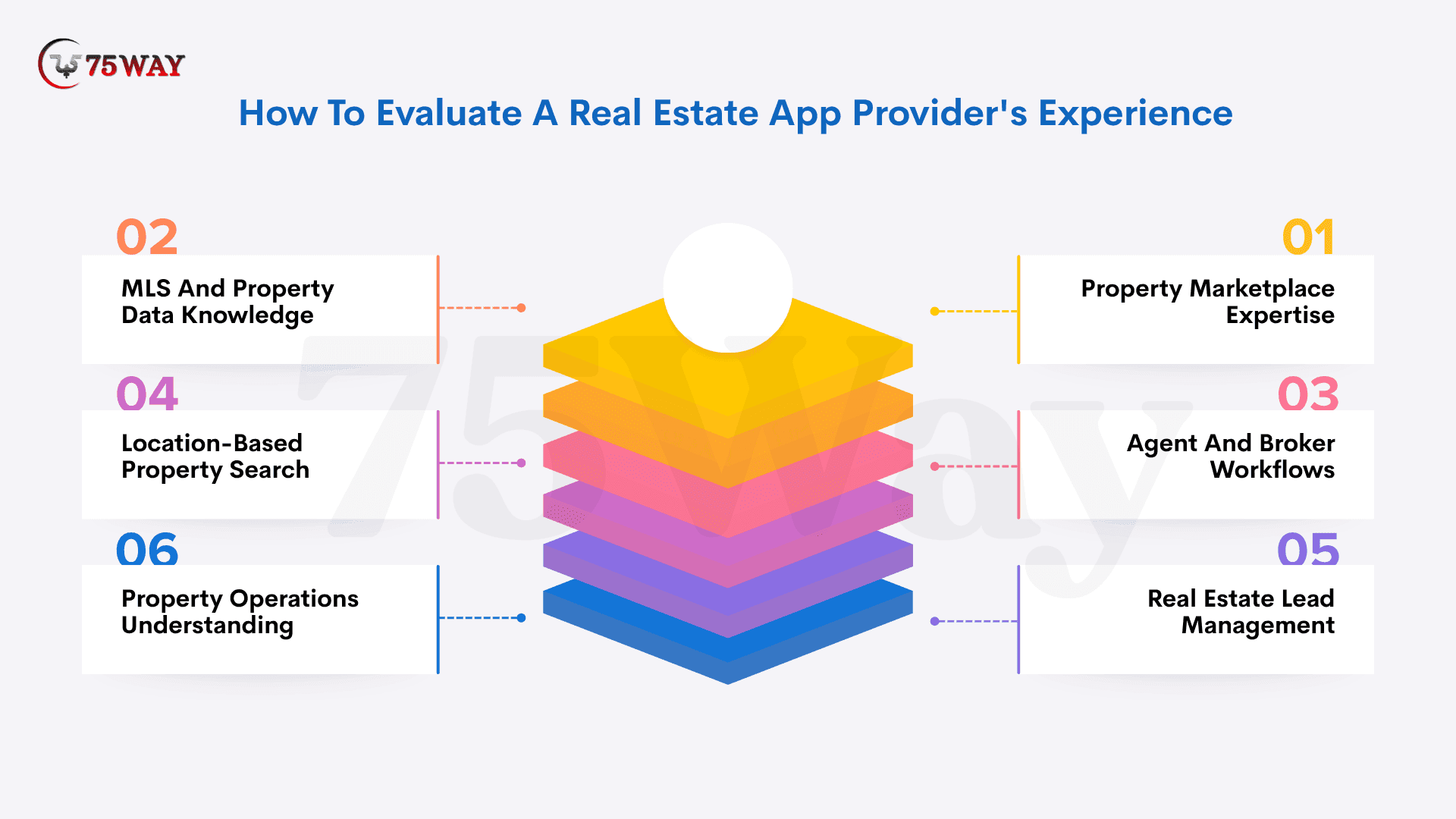
- Property Marketplace Expertise
Check whether the company has built platforms that connect buyers, sellers, agents, landlords, or tenants.
Experience with listing creation, property discovery, advanced filters, saved searches, inquiries, agent profiles, and lead routing indicates a better understanding of marketplace-driven real estate products.
- MLS And Property Data Knowledge
Ask whether the team has worked with MLS, IDX, property feeds, or similar real estate data sources.
Beyond integration experience, they should understand listing synchronization, data mapping, API limitations, update frequency, access requirements, and how external property data affects your application's functionality.
- Agent And Broker Workflows
A real estate agency app often needs more than customer-facing property search.
Check whether the development company understands agent and broker workflows, including lead assignment, client management, property recommendations, appointment scheduling, communication, listing management, activity tracking, and performance reporting.
- Location-Based Property Search
Location is central to property discovery, so evaluate the company's experience with maps and geolocation functionality.
Look for experience implementing map-based searches, property pins, address lookup, distance-based filtering, neighborhood discovery, directions, and location-aware recommendations without compromising application performance.
- Real Estate Lead Management
Ask how previous projects handled inquiries generated from property listings.
A strong development partner should understand lead capture, qualification, routing, follow-ups, notifications, agent assignment, CRM synchronization, and conversion tracking so your app supports the sales process rather than simply displaying properties.
- Property Operations Understanding
Look for experience beyond listing applications if your product involves rentals, property management, or investment workflows.
Relevant capabilities may include tenant management, rent collection, maintenance requests, lease documentation, owner portals, property records, financial reporting, and communication between different stakeholders.
What Should You Look For In A Real Estate App Building Company?
A polished portfolio does not always show how a company will handle your real estate project. The harder questions appear when your app needs complex property workflows, integrations, security, and room to grow. What deserves closer attention before making that decision is explained below.
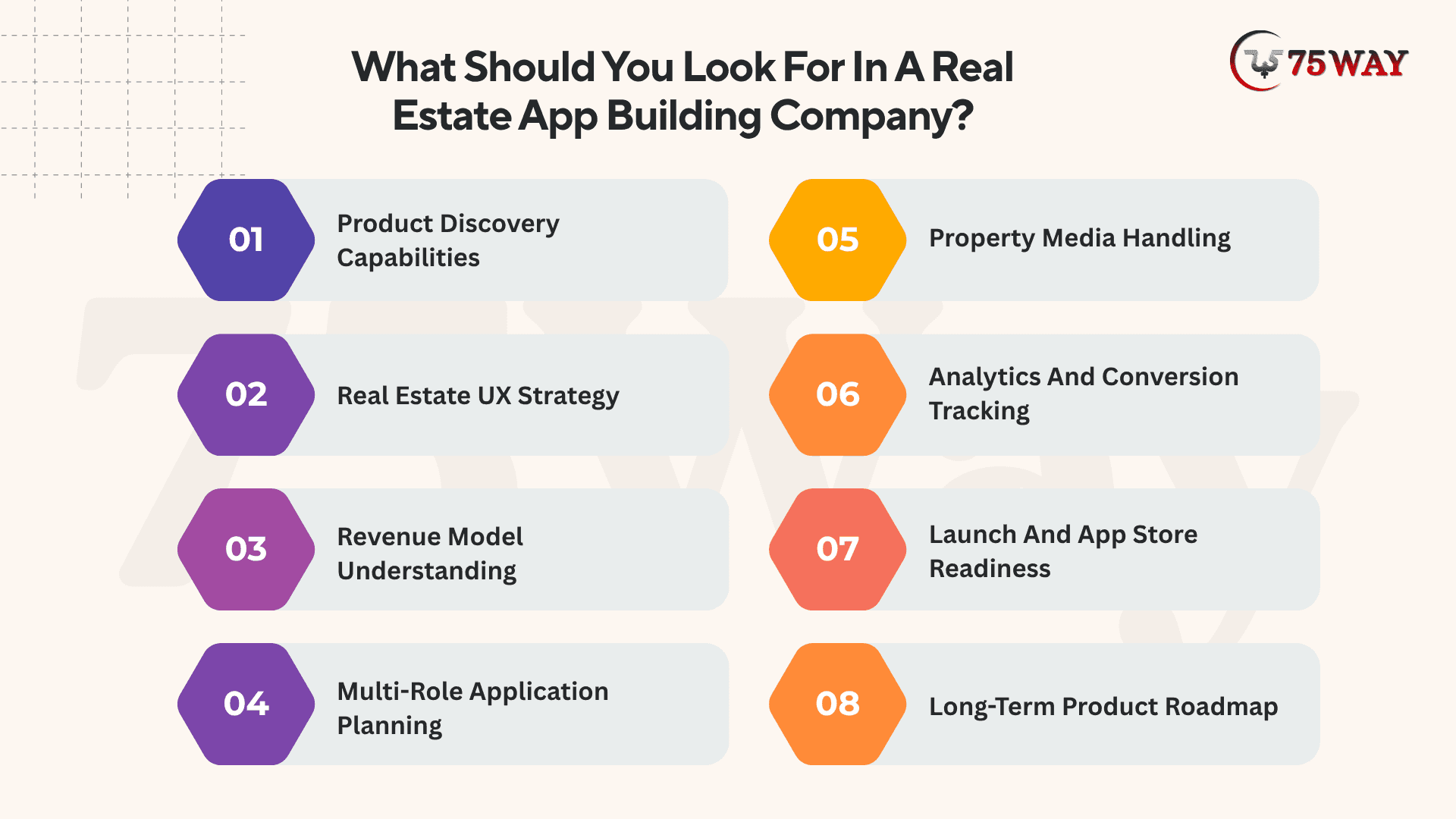
1. Product Discovery Capabilities
A good development company should first understand your business model, target users, operational challenges, and product goals before recommending features or technology.
This discovery stage helps define the MVP, prioritize essential functionality, identify technical requirements, and create a development roadmap aligned with your business objectives.
2. Real Estate UX Strategy
Real estate apps involve extensive browsing, searching, filtering, comparing, and contacting. Your development partner should understand how to make these journeys intuitive across different user types.
The UX strategy should reduce unnecessary steps and help users quickly find properties, review relevant information, save options, and take meaningful actions.
3. Revenue Model Understanding
Your development partner should understand how the application will make money, whether through commissions, subscriptions, listing fees, advertisements, premium placements, or lead-generation services.
This understanding allows the team to build monetization features into the product architecture instead of treating revenue functionality as an afterthought.
4. Multi-Role Application Planning
Real estate platforms can serve buyers, sellers, agents, brokers, landlords, tenants, property managers, and administrators, with each role requiring different functionality.
A capable company should plan role-based permissions, dashboards, workflows, and access levels so every user receives the functionality relevant to their responsibilities.
5. Property Media Handling
Property applications often contain large volumes of photographs, videos, virtual tours, floor plans, and property documents. Poor media management can negatively affect performance and user experience.
Ask how the company will handle media storage, compression, delivery, caching, and scalability while maintaining suitable quality across different devices and connection speeds.
6. Analytics And Conversion Tracking
Your app should help you understand what users do after entering the platform. Look for analytics capabilities that track searches, property views, saved listings, inquiries, calls, bookings, and other important actions.
These insights can reveal where users drop off and which features contribute to business results, helping your team make better product and marketing decisions after launch.
7. Launch And App Store Readiness
Building the application is only part of getting your product to customers. Your development partner should understand production deployment, app configuration, release preparation, monitoring, and mobile platform requirements.
Ask whether launch support includes final testing, deployment assistance, crash monitoring, analytics configuration, and resolving technical issues that appear during the initial release.
8. Long-Term Product Roadmap
Your first release should support today's business needs without limiting tomorrow's opportunities. Choose a development company that can accommodate future features, integrations, markets, and changing customer expectations.
A long-term partner can continue improving the product through new functionality, performance enhancements, technology upgrades, security updates, and data-driven product improvements.
Evaluating Real Estate Business Model And Workflow Understanding
This is one of the most overlooked selection criteria. A real estate app is not a single product category. Your requirements can change significantly depending on whether you are building a marketplace, brokerage platform, rental application, property management system, investment platform, or PropTech product.
- Real Estate Marketplace: A marketplace may require multiple user types, property listings, search, location services, agent profiles, lead generation, messaging, reviews, notifications, and administrative controls.
- Brokerage App: A brokerage-focused product may prioritize agent productivity, lead management, property discovery, client communication, scheduling, CRM integration, and brokerage-level reporting.
- Rental Platform: A rental application may require property discovery, applications, tenant screening integrations, lease management, rent payments, maintenance requests, and notifications.
- Property Management App: Property managers may need dashboards for properties, tenants, owners, maintenance, payments, documents, communication, and financial reporting.
- Real Estate Investment Platform: An investment-focused product can require property analysis, investment opportunities, investor accounts, financial information, reporting, document management, and secure transactions.
A capable development partner should understand these differences before recommending features or technology.
How To Select Right Real Estate App Development Agency?
The right real estate app development agency should fit your project, not force your project into its usual way of working. That distinction can save considerable time, money, and frustration during development. The right selection approach is discussed below.
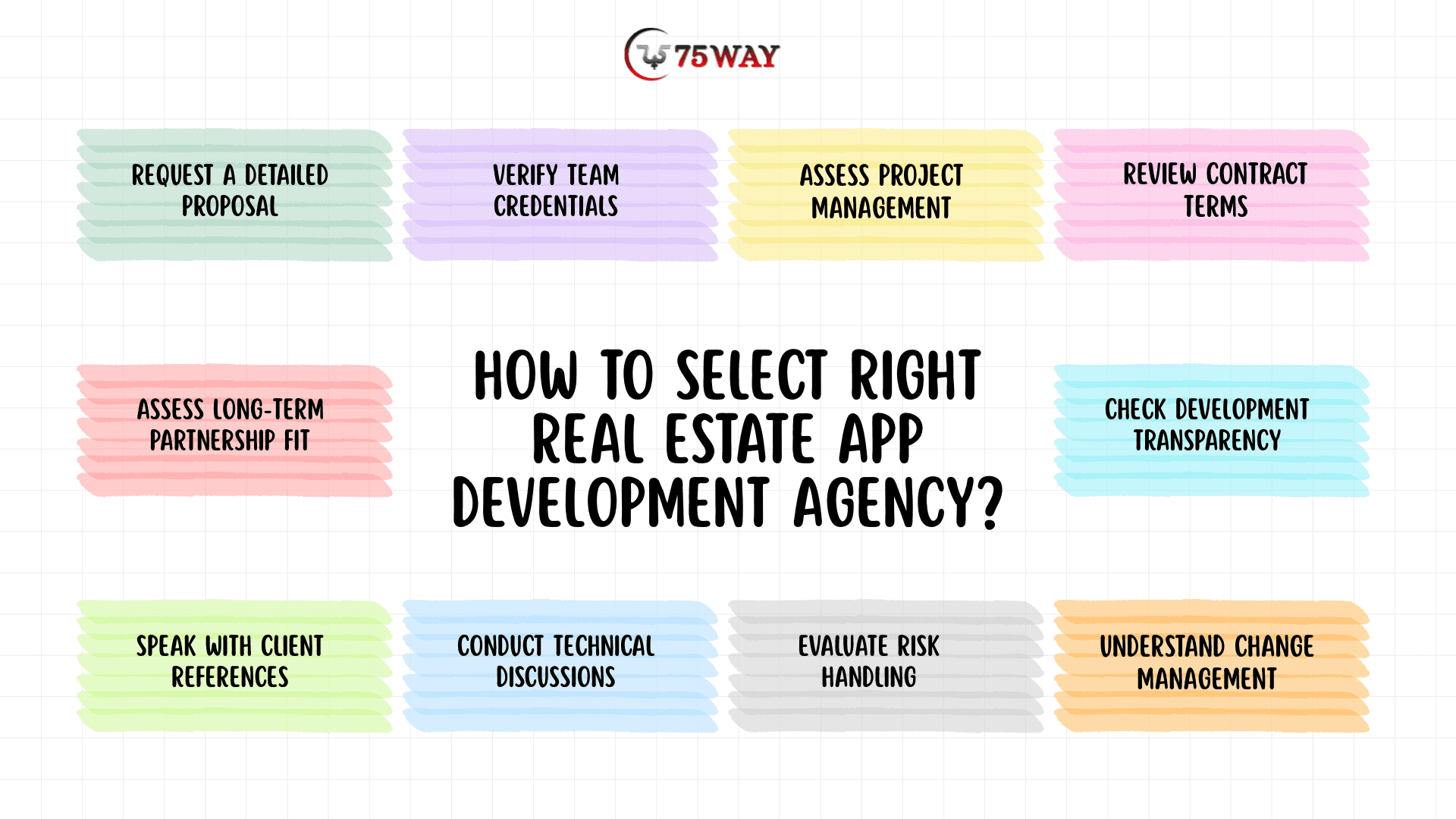
1. Request A Detailed Proposal
A detailed proposal shows how the company understands your requirements, expected deliverables, timeline, technology approach, and project scope.
Clear documentation also makes it easier to compare vendors and identify missing requirements before development begins.
2. Verify Team Credentials
The people assigned to your project matter as much as the company’s overall portfolio. Their experience can influence technical decisions, communication, and delivery quality.
Team profiles, relevant certifications, previous projects, and specific responsibilities can give you a clearer picture of who will build your app.
3. Assess Project Management
Strong project management keeps requirements, timelines, responsibilities, and communication organized throughout development. The process should give you visibility without requiring constant supervision.
A defined project manager, reporting structure, meeting schedule, and collaboration process can make the engagement easier to manage.
4. Review Contract Terms
Contract terms should clearly cover scope, payment milestones, ownership, confidentiality, warranties, maintenance, and responsibilities for both parties.
A well-defined agreement reduces misunderstandings and gives your business greater clarity when project requirements or circumstances change.
5. Check Development Transparency
Transparency gives you visibility into project progress, completed work, upcoming tasks, and potential delays. Regular updates should provide meaningful information rather than generic status reports.
Access to project management tools, demos, documentation, and development updates can help you remain informed throughout the engagement.
6. Understand Change Management
Real estate app requirements can evolve as users, regulations, integrations, or business priorities change. A clear change-management process explains how additional requirements will affect cost and timelines.
Defined procedures for reviewing, approving, and pricing changes can prevent scope disagreements during development.
7. Evaluate Risk Handling
Every software project can face technical, integration, security, or timeline risks. A capable company should identify important risks early and explain how those issues will be addressed.
Their response to potential problems can reveal how prepared the team is for the complexities of a real estate platform.
8. Conduct Technical Discussions
Technical discussions can help you understand whether the proposed architecture and development approach actually fit your product requirements. These conversations also reveal how clearly the team explains complex decisions.
Your internal technical knowledge does not need to be extensive; practical explanations should still make the reasoning understandable.
9. Speak With Client References
Previous clients can provide insights that portfolios and sales presentations cannot. Their experiences can help you understand communication, reliability, problem-solving, delivery, and post-launch support.
Relevant references from real estate or similar technology projects can provide stronger evidence of the company’s capabilities.
10. Assess Long-Term Partnership Fit
Your app may require new features, integrations, improvements, security updates, and technical support after launch. The development company should have the capacity to remain involved as those needs emerge.
A suitable long-term partner understands your roadmap and can support the product beyond its initial release.
What's The Role of Technical Expertise In A Real Estate App Partner?
A smooth app experience often depends on technical decisions users never see. The wrong choices can slow performance, complicate integrations, and limit future growth. The role technical expertise plays in a real estate app partnership is covered below.
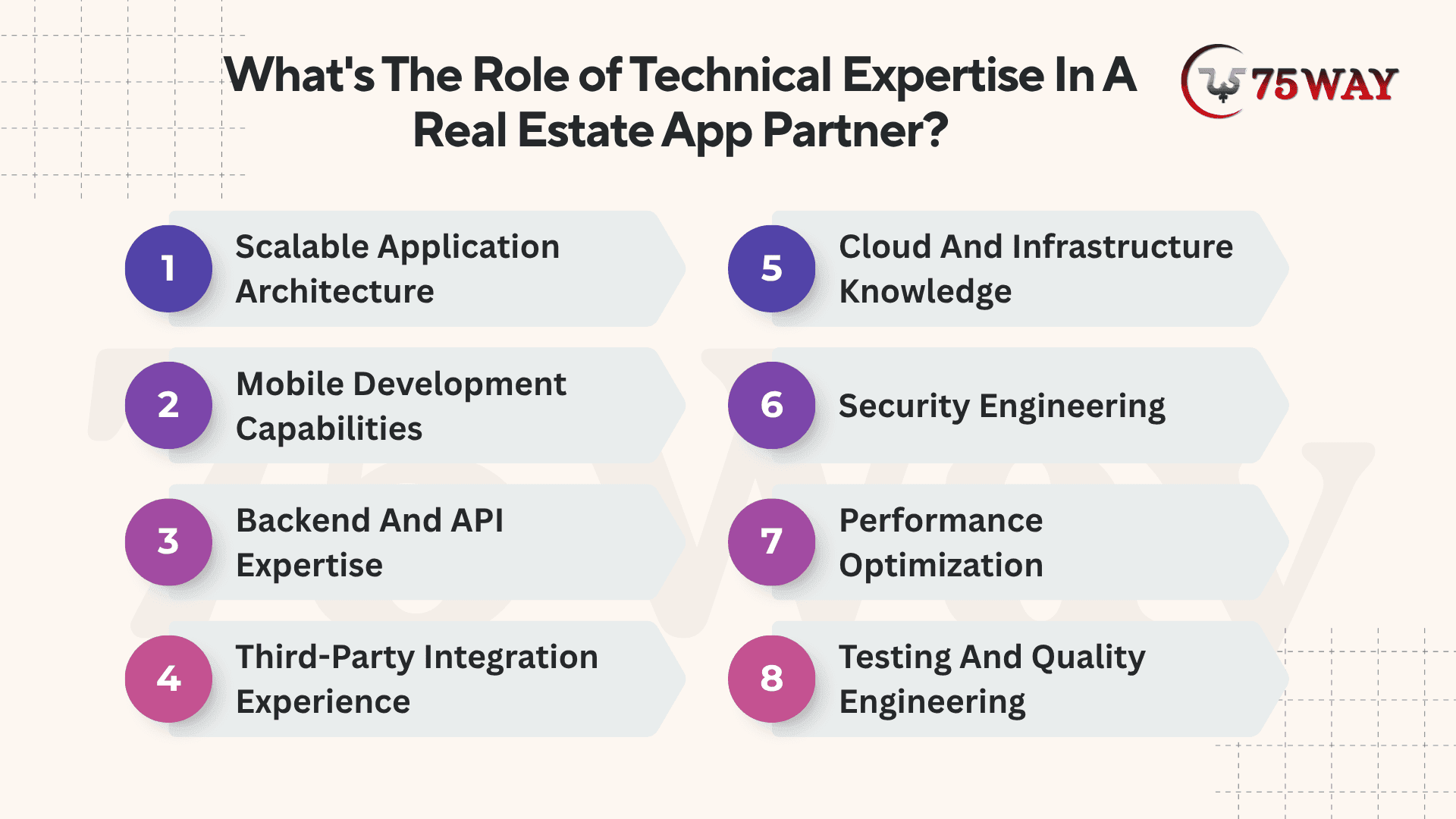
1. Scalable Application Architecture
Think beyond your launch-day user count. A successful real estate platform can accumulate thousands of listings, growing user accounts, frequent searches, media files, and API requests as the business expands.
The architecture should leave room for that growth without forcing you into a complete rebuild. Ask prospective partners how their approach would accommodate more users, new property markets, additional features, and larger datasets over time.
2. Mobile Development Capabilities
Your customers may browse properties during a commute, schedule a viewing from a neighborhood, or contact an agent while standing outside a property. That makes a smooth mobile experience particularly important.
Check how the company approaches iOS and Android development, device compatibility, push notifications, location access, image-heavy screens, and app performance. A strong mobile team should understand the small details that make property browsing feel effortless.
3. Backend And API Expertise
The visible app is only the front door. Behind every property search, saved listing, inquiry, notification, and user account sits a backend responsible for processing information and connecting different parts of the platform.
Your development partner's backend decisions can directly affect speed, reliability, security, and future development costs. A technical discussion should therefore cover databases, APIs, authentication, business logic, permissions, and how the system will evolve as your requirements change.
4. Third-Party Integration Experience
Property applications often rely on services outside the core app. MLS or IDX data, mapping services, CRM systems, payment providers, messaging tools, analytics platforms, and other APIs may all become part of your technology ecosystem.
Previous integration experience can make a major difference here. Find out how the company handles API authentication, data synchronization, rate limits, failed requests, changing endpoints, and other dependencies that could affect your application.
5. Cloud And Infrastructure Knowledge
Property listings can contain large images, videos, floor plans, documents, and other media. Add frequent searches and growing traffic to that mix, and infrastructure decisions can quickly affect both user experience and operating costs.
A development partner should be able to explain where your application will run, how data and media will be stored, how backups will work, and how traffic will be monitored. You should also know what happens when usage suddenly increases.
6. Security Engineering
Trust is particularly important when your app collects personal details, account information, messages, documents, or payment-related data. Security cannot be treated as a final checklist before the application goes live.
Look for specific answers around authentication, authorization, encryption, API protection, role-based access, vulnerability testing, and data handling. Generic statements about having a “secure application” tell you very little about how your particular product will be protected.
7. Performance Optimization
A user waiting for a property search to load may simply leave and try another platform. Large images, map searches, complex filters, database queries, and external APIs can all contribute to slow experiences.
Performance planning should therefore begin during architecture and development. Ask how the team measures response times and handles image optimization, caching, database performance, API speed, and increasing traffic.
8. Testing And Quality Engineering
A property app can work perfectly during a basic demonstration and still fail when real users start putting it through different scenarios. A listing feed might stop responding, a notification could fail, a map could behave differently across devices, or a user role could expose the wrong information.
A serious QA process should cover the workflows that matter to your business. Look for functional, integration, device, usability, performance, security, and regression testing, along with a clear process for documenting and fixing issues before release.
Ways To Evaluate The Company's UI/UX & Integration Capabilities
A few taps can determine whether someone continues using your real estate app or closes it. Behind those taps, integrations must also move data between systems without disrupting the user journey. The areas worth checking in a company’s UI/UX and integration work are covered below.
- Real Estate UX Experience: A strong UI/UX team should understand property-focused user journeys. Buyers, sellers, agents, and tenants need different interfaces. Navigation should feel intuitive across key workflows. Previous real estate designs can demonstrate that capability.
- Search & Discovery Design: Property search requires more than attractive screens. Filters, maps, sorting, saved searches, and listing details should work together naturally. The interface should reduce friction during property discovery. Relevant prototypes can reveal the team's approach.
- Multi-Platform Interface Design: Your app may serve users across different devices and operating systems. Layouts should remain usable across varying screen sizes. Accessibility should also receive proper attention. Consistent interactions can strengthen the overall product experience.
- Integration Architecture: A capable team should know how integrations fit into the application architecture. MLS/IDX feeds, maps, CRMs, payments, and communication tools may require different approaches. Data accuracy and synchronization deserve careful consideration.
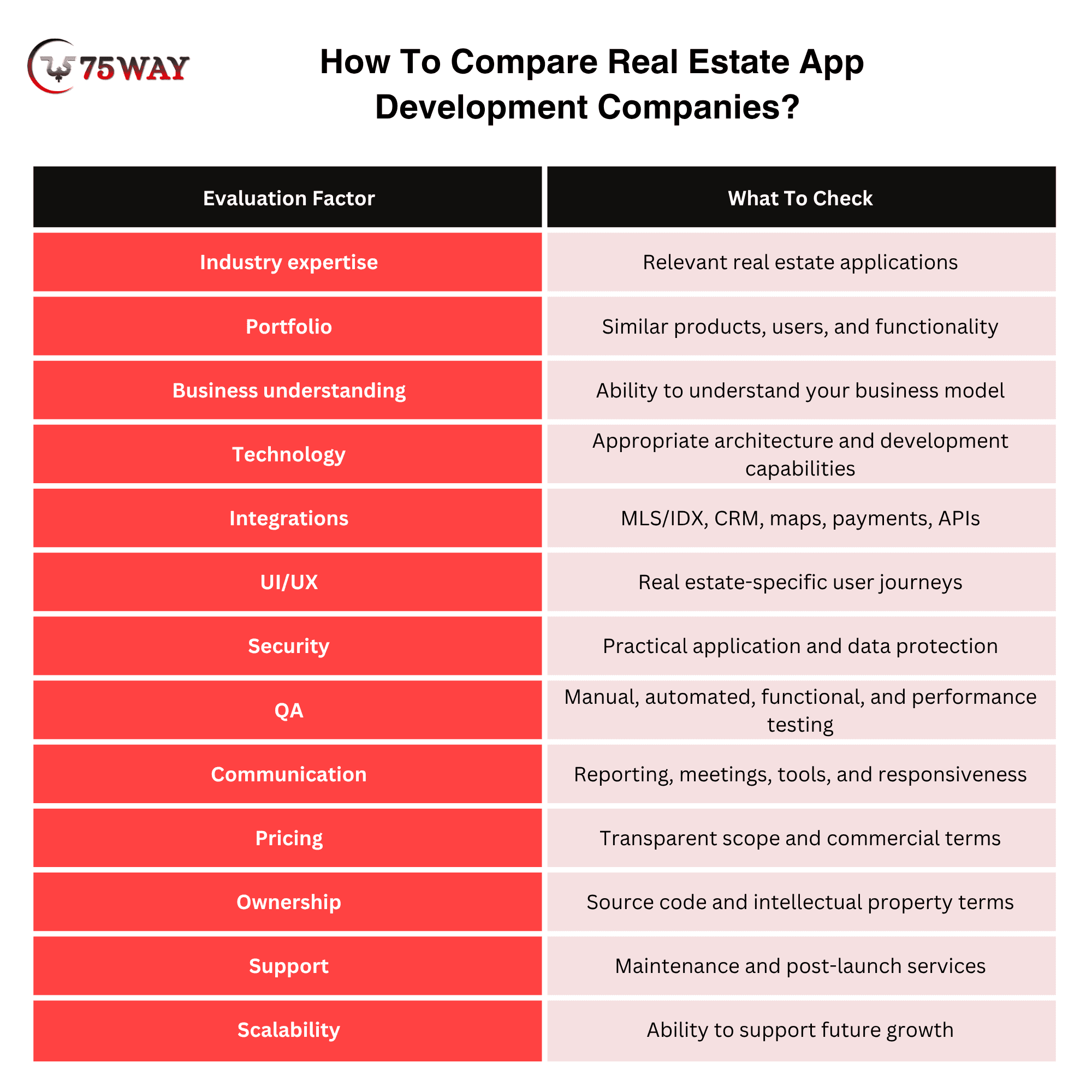
How To Compare Real Estate App Development Companies?
When you have several potential vendors, a side-by-side comparison gives you a clearer basis for making the final decision. Their real estate experience, technical expertise, integration capabilities, development process, pricing, security practices, and support deserve equal consideration.
The lowest quote or strongest sales presentation should not automatically determine your choice. A company that understands your business goals, identifies potential risks, communicates clearly, and offers reliable post-launch support can provide greater long-term value.
Should You Hire A Freelancer, Real Estate App Development Company, Or In-House Team?
A development company is usually the strongest choice for a real estate app when you need specialized expertise, faster execution, and support beyond launch. Freelancers can suit smaller projects, while an in-house team offers greater control but requires higher hiring and operational investment.
A freelancer may work well for a focused MVP, simple application, or limited feature set. A development company brings broader capabilities across product strategy, UI/UX, mobile development, backend systems, integrations, testing, security, and maintenance, making it better suited to complex real estate platforms.
An in-house team makes more sense when software development is a long-term core capability, and the business can support dedicated technical roles. The right option ultimately depends on your budget, project complexity, internal resources, timeline, and expectations for future product growth.
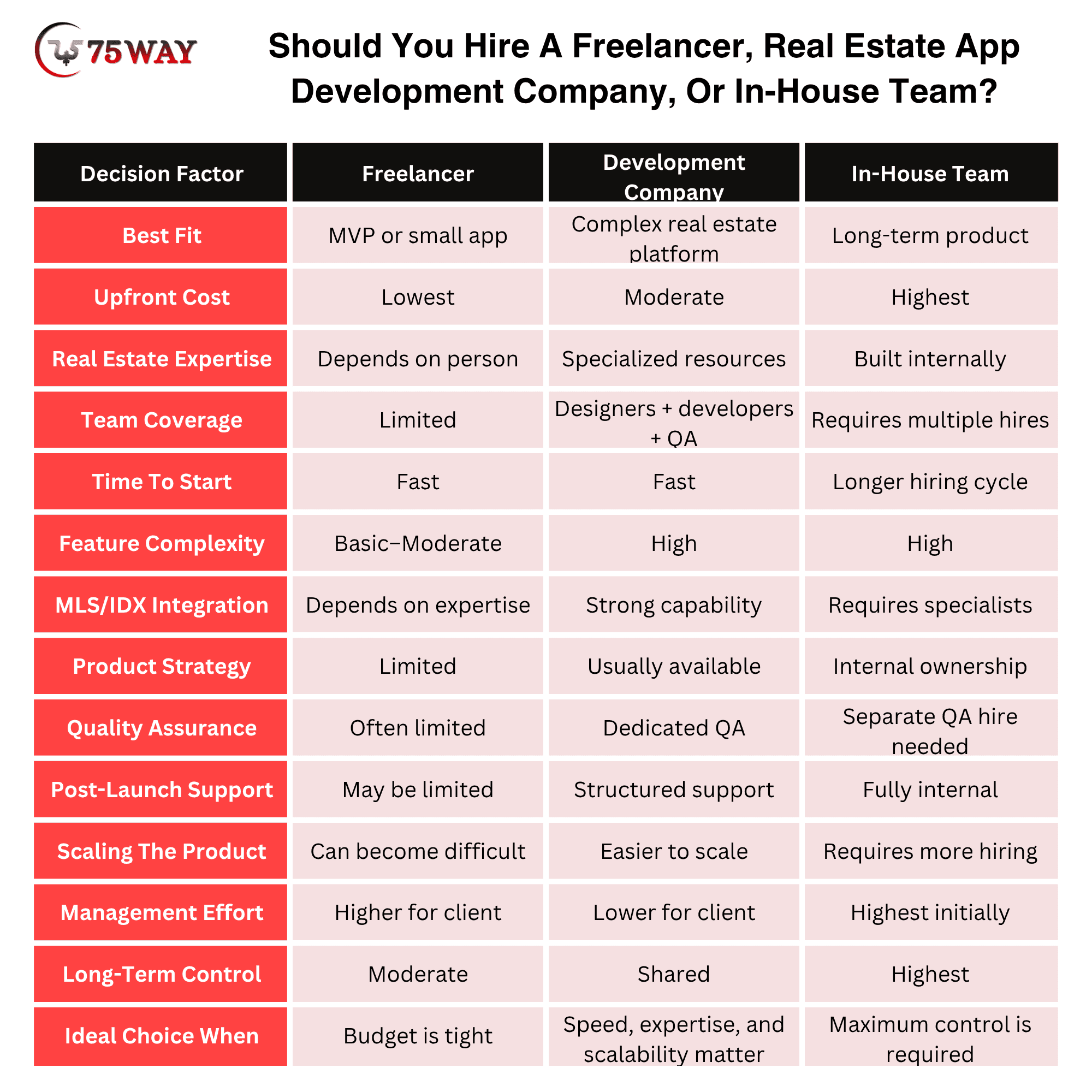
The right hiring model depends on more than development cost. A freelancer may suit a focused MVP, while a development company is better positioned for complex real estate platforms requiring multiple specialists.
An in-house team becomes more practical when software development is a long-term business priority with the budget and resources to support dedicated talent.
Final Advice
The right real estate app development company gives your business a stronger foundation for building a scalable, secure, and user-focused product. By evaluating industry experience, relevant portfolios, technical capabilities, integrations, security, pricing, communication, and post-launch support, you can reduce development risks and make a more informed investment.
The right partner can turn your business requirements into a practical app that supports users today while leaving room for future growth, new features, and changing market needs. Most importantly, you gain a development team aligned with your goals, not simply a vendor delivering code. To build your real estate app, partner with a trusted real estate app development company to turn your idea into a scalable digital product.
Frequently Asked Questions (FAQs)
What Should Be Included In A Real Estate App Development Contract?
A contract should define deliverables, milestones, payment terms, responsibilities, warranties, ownership, confidentiality, and dispute procedures. Clear documentation helps prevent misunderstandings and protects both parties throughout development.
How Can I Verify A Development Company's Client References?
Ask for references from clients with comparable projects, then discuss communication, reliability, problem-solving, and overall experience. Independent feedback can reveal practical strengths that portfolios cannot demonstrate.
What Should A Real Estate App Development Proposal Include?
A strong proposal should explain scope, deliverables, timeline, assumptions, technology approach, milestones, costs, dependencies, and acceptance criteria. This makes competing proposals easier to evaluate fairly.
How Involved Should Founders Be During Real Estate App Development?
Founders should remain involved in major product decisions, priorities, feedback, and milestone reviews without managing every technical task. Regular involvement keeps development aligned with commercial objectives and customer needs.
How Can I Protect My Real Estate App Idea Before Development?
Use appropriate confidentiality agreements and clearly document intellectual property ownership before sharing sensitive product information. Your development contract should specify rights to code, designs, documentation, and project assets.
What Happens If A Real Estate App Development Project Falls Behind Schedule?
Your agreement should establish milestone tracking, reporting procedures, escalation paths, and responsibilities for delays. Regular progress reviews can identify problems early and allow both parties to adjust plans.
Can A Development Company Help Define My Real Estate App MVP?
Yes, an experienced partner can analyze business goals, user needs, and technical requirements to prioritize essential functionality. This helps launch a focused MVP without spending prematurely on unnecessary features.
How Should I Measure A Real Estate App Development Project's Success?
Define measurable outcomes before development, such as adoption, engagement, lead generation, retention, conversions, or operational improvements. These metrics provide a practical basis for evaluating product performance after launch.