AI Summary
Agricultural software development helps farming businesses make smarter decisions, control costs, and improve productivity. This investment guide explores practical benefits, essential business opportunities, and ways technology supports modern farm operations. Discover how the right software can deliver long-term value.
Key Takeaways
- Agricultural software helps farmers make informed decisions using real-time operational data.
- Automated farm operations reduce manual workloads and improve daily productivity.
- Precision agriculture supports better resource allocation and reduces unnecessary input expenses.
- Crop monitoring tools help identify potential problems before losses increase.
- Inventory management improves tracking of seeds, fertilizers, equipment, and supplies.
- Weather insights help farmers prepare for changing environmental conditions.
- Data analytics supports better crop planning and yield forecasting.
Agricultural businesses can lose money through unpredictable weather, rising input costs, poor inventory control, and delayed decisions. An agriculture software development solution helps you address these challenges with better planning, connected operations, and timely insights.
Whether you manage a family farm, operate a large agricultural enterprise, or provide services to growers, the right software can help you make better use of land, labor, equipment, and financial resources. The real value goes beyond digitizing paperwork; it lies in improving daily decisions and identifying opportunities for business growth.
From precision farming and crop monitoring to financial management and supply chain visibility, agricultural software offers several practical benefits. Understanding these advantages can help you decide where technology fits into your operations and whether the investment makes business sense.
Major Benefits of Custom Agriculture Software Solutions
If your agricultural business still depends on spreadsheets, paperwork, or disconnected tools, tracking costs and managing daily operations can become difficult as you grow. Custom agriculture software can match your workflows, connect important data, and give your team better visibility into farm activities. The key benefits reveal why a tailored solution can be a worthwhile investment for modern agribusinesses.
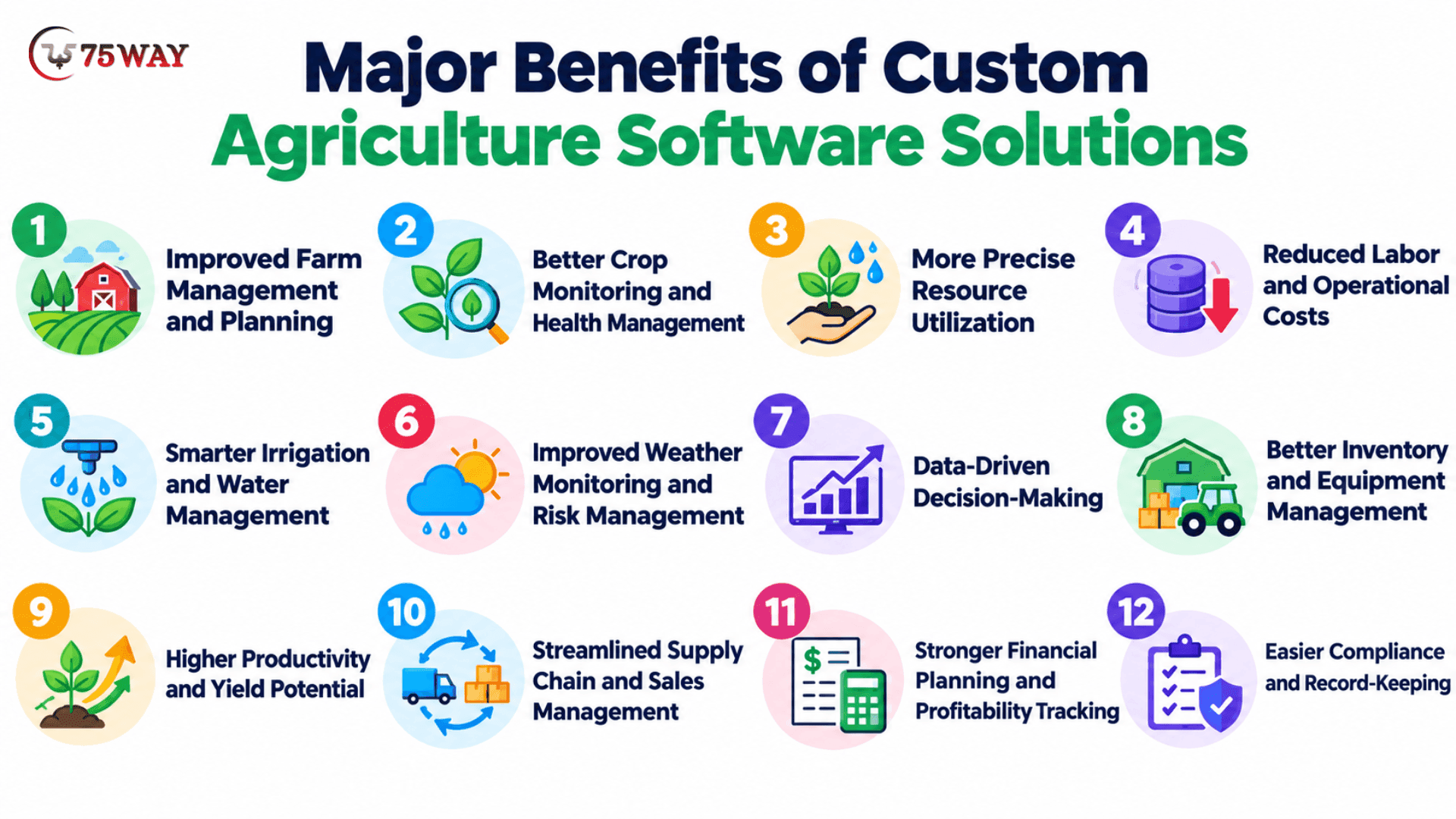
1. Improved Farm Management and Planning
Managing a farm involves coordinating several activities, including planting, irrigation, fertilization, harvesting, equipment maintenance, and labor allocation. Agricultural management software brings these activities into one system, allowing you to track schedules, assign tasks, and monitor progress without relying on scattered records or manual updates.
Better planning helps you identify scheduling conflicts, organize seasonal work, and use available resources more carefully. For agricultural businesses managing multiple fields, farms, or teams, centralized information also makes it easier to maintain operational visibility and respond to unexpected changes.
2. Better Crop Monitoring and Health Management
Crop monitoring software helps you track crop conditions throughout the growing season. Depending on the solution, you can use satellite imagery, drone images, field sensors, and manual observations to monitor plant health, soil conditions, moisture levels, and potential signs of disease.
Earlier visibility into crop problems allows you to investigate issues before they spread across larger areas. Timely intervention can reduce avoidable crop losses, improve treatment decisions, and help you determine which fields need immediate attention rather than treating every field in the same way.
3. More Precise Resource Utilization
Seeds, fertilizers, pesticides, water, fuel, and electricity represent significant agricultural expenses. Agricultural software helps you record resource usage, compare requirements across fields, and identify areas where inputs may be excessive or insufficient. Precision agriculture solutions can also use location-specific data to guide field operations.
This approach supports more targeted resource allocation instead of applying identical quantities everywhere. Over time, better input management can reduce unnecessary spending, limit waste, and support more responsible farming practices while maintaining crop requirements and production goals.
4. Reduced Labor and Operational Costs
Manual farm administration often involves repetitive activities such as maintaining records, preparing schedules, tracking equipment, calculating expenses, and coordinating workers. Agricultural software can automate selected tasks, generate reports, and organize operational information in a centralized workspace.
The resulting time savings allow farm managers and employees to focus more on fieldwork, crop management, and important business decisions. Although automation requires an initial investment and ongoing maintenance, reducing repetitive administrative work can improve labor utilization and help control operating expenses.
5. Smarter Irrigation and Water Management
Water availability can directly affect crop performance, operating costs, and seasonal planning. Irrigation management software can combine soil moisture readings, weather information, crop requirements, and irrigation schedules to help farmers determine when and where watering may be necessary.
With suitable sensors and automated irrigation equipment, the system can support more targeted watering and reduce unnecessary water use. This is particularly valuable for farms facing water shortages, rising pumping costs, or uneven irrigation requirements across fields. Actual savings depend on existing practices, equipment, and local conditions.
6. Improved Weather Monitoring and Risk Management
Unpredictable rainfall, extreme temperatures, droughts, and storms can disrupt agricultural operations. Weather-integrated farm software provides forecasts, alerts, and historical weather information that help managers plan activities around changing conditions.
These insights can support decisions about planting, spraying, irrigation, harvesting, and protecting vulnerable crops. While software cannot eliminate weather-related risks, timely information helps you prepare alternative plans, adjust field schedules, and respond sooner when conditions threaten productivity or crop quality.
7. Data-Driven Decision-Making
Agricultural businesses generate valuable information through field activities, crop yields, input purchases, equipment usage, weather conditions, and sales. Farm management software organizes these records and presents useful reports, comparisons, and performance indicators that support informed decision-making.
Instead of relying entirely on memory or assumptions, you can compare seasonal results, identify underperforming fields, evaluate input costs, and assess the outcomes of different farming practices. Better visibility into historical and current performance also helps you make more informed decisions about future production and resource allocation.
8. Better Inventory and Equipment Management
Agricultural operations depend on the availability of seeds, fertilizers, pesticides, spare parts, fuel, machinery, and other essential supplies. Inventory management software helps you track stock levels, purchase records, consumption, and replenishment requirements, reducing the risk of unexpected shortages or excessive purchasing.
Equipment management features can also maintain service schedules, operating hours, maintenance histories, and repair records. These capabilities help you plan maintenance before avoidable breakdowns disrupt fieldwork, improve equipment utilization, and maintain a clearer understanding of inventory and machinery-related expenses.
9. Higher Productivity and Yield Potential
Productivity depends on several interconnected factors, including planting schedules, soil conditions, crop health, irrigation, pest management, and timely field operations. Agricultural software helps you coordinate these activities and identify problems that may interfere with crop development or operational performance.
By combining field records, crop monitoring, and historical production data, farmers can identify practices associated with better results and apply those insights to future seasons. Software cannot guarantee higher yields, but it can improve the information available for managing crops and addressing avoidable production challenges.
10. Streamlined Supply Chain and Sales Management
Agricultural businesses must coordinate harvesting, storage, transportation, distribution, and sales to protect product quality and meet buyer requirements. Supply chain software can help track inventory movement, manage orders, record deliveries, and improve communication among farmers, suppliers, distributors, and buyers.
Greater visibility across these activities helps businesses identify delivery delays, organize shipments, and reduce confusion around stock availability. For commercial farms and agricultural distributors, better coordination can support product traceability, more reliable order fulfillment, and improved management of post-harvest operations.
11. Stronger Financial Planning and Profitability Tracking
Farm profitability depends on more than the quantity of crops produced. Land preparation, seeds, fertilizers, labor, fuel, irrigation, equipment maintenance, storage, and transportation all influence the final financial outcome. Agricultural financial management software helps record these expenses alongside sales, budgets, and other income.
With organized financial information, you can compare costs across crops, fields, and seasons, identify overspending, and estimate expected returns. These insights support more realistic budgets and investment decisions, helping you understand which activities generate value and where operational changes may improve financial performance.
12. Easier Compliance and Record-Keeping
Agricultural businesses may need to maintain records covering chemical applications, fertilizer usage, crop treatments, equipment maintenance, purchases, sales, certifications, and product traceability. Agricultural software can organize these records in a searchable system, making it easier to retrieve relevant information when required.
Digital documentation can reduce paperwork, improve record accuracy, and support reporting requirements when the software is configured for applicable regulations and business needs. For farms supplying retailers, food processors, exporters, or certified markets, reliable records can also strengthen traceability and simplify communication with buyers and auditors.
Why Is Custom Agriculture Software Development Worth the Investment?
Agricultural software development is worth considering when manual processes, unpredictable costs, and scattered farm data start affecting business decisions. A tailored digital solution can help you monitor operations, manage resources, reduce avoidable waste, and plan with better information. The real investment value becomes clearer when you consider its long-term impact on productivity, cost control, and business growth.
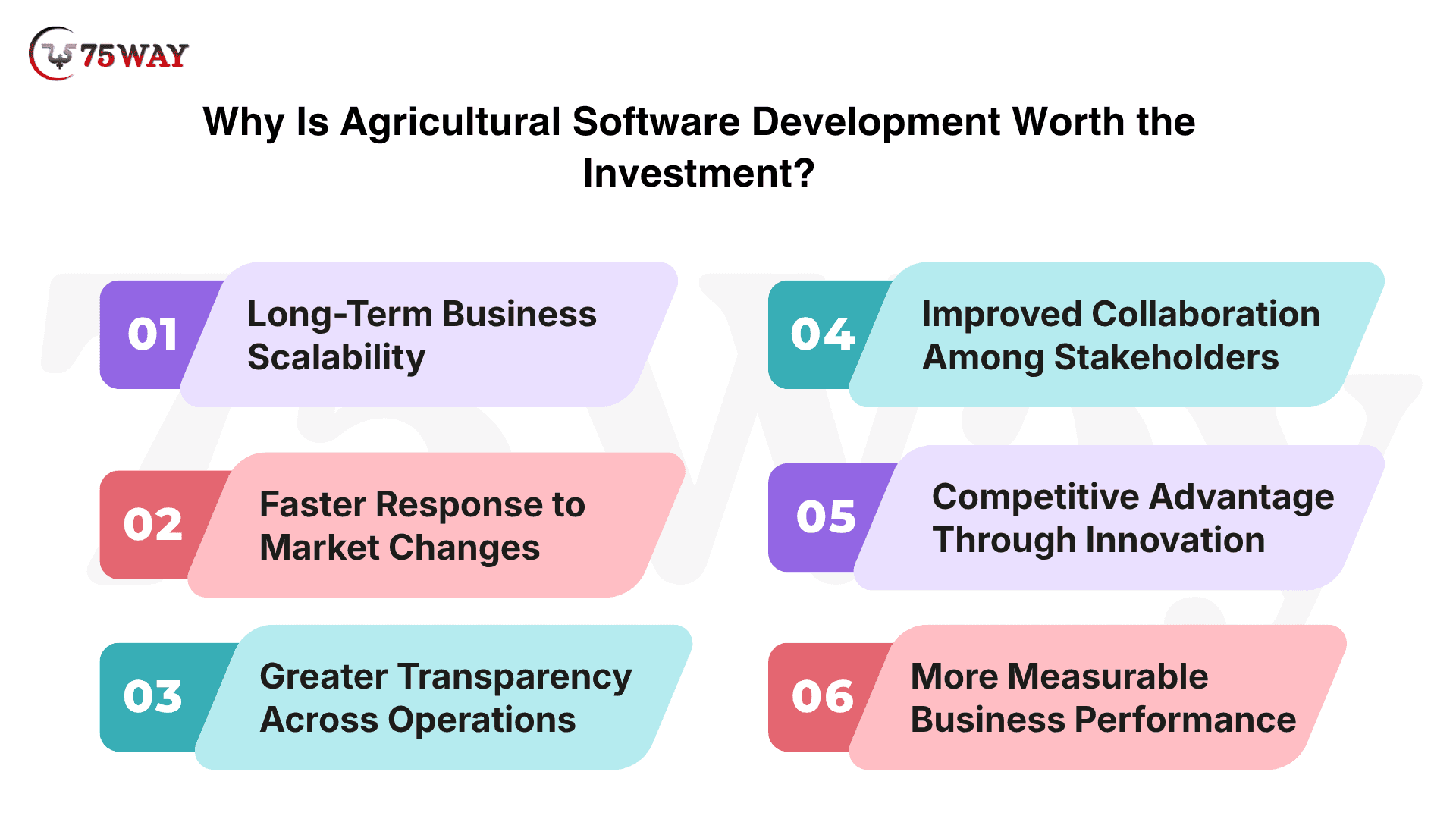
- Long-Term Business Scalability
Your agricultural business may start with a few farms or clients, but growth brings new demands and more complex workflows. Custom software gives you the flexibility to expand services, add users, and support new operations without replacing your entire system.
- Faster Response to Market Changes
Agricultural markets can change quickly due to fluctuating prices, shifting buyer demand, and changing supply conditions. With timely market information, your business can identify emerging opportunities and adjust its plans before competitors gain an advantage.
- Greater Transparency Across Operations
When farming activities, supplier transactions, and distribution records sit in separate systems, important details can easily get overlooked. Agricultural software brings relevant information together, helping you trace activities, review transactions, and identify gaps with greater clarity.
- Improved Collaboration Among Stakeholders
Farmers, suppliers, distributors, and buyers often depend on one another, yet disconnected communication can delay important decisions. A connected agricultural platform gives stakeholders a shared place to exchange updates, coordinate responsibilities, and keep business activities moving.
- Competitive Advantage Through Innovation
Traditional agricultural businesses may struggle to stand out when competitors offer similar products and services. Digital solutions can help you introduce differentiated services, improve customer experiences, and respond to changing expectations across the agricultural market.
- More Measurable Business Performance
Without clear performance indicators, it can be difficult to determine whether a technology investment is delivering meaningful business value. Custom dashboards help you track relevant outcomes, compare results against targets, and identify where future improvements could produce stronger returns.
Conclusion
Agricultural software development offers practical benefits for businesses seeking better farm management, resource utilization, crop monitoring, financial visibility, and supply chain coordination. From reducing repetitive work to supporting more informed production decisions, the right solution can address operational challenges that affect long-term profitability.
The key is to select or develop software around your farming model, business goals, available resources, and budget. A carefully planned investment can help you improve existing processes today while preparing your agricultural operations for future requirements.
If you want to launch conversion-driven agriculture software for your business, you can contact a renowned app development firm to identify your requirements, prioritize the right features, and build a solution aligned with your operational goals.
Frequently Asked Questions (FAQs)
How Much Does Agricultural Software Development Cost?
The cost depends on the application's complexity, required features, integrations, platforms, and the development team's rates. A basic farm management application generally costs less than a custom platform with IoT sensors, predictive analytics, satellite imagery, and multi-farm management capabilities. A detailed requirements assessment provides a more reliable estimate.
How Long Does It Take To Develop Agricultural Software?
A basic agricultural application may take approximately three to five months, while a more complex platform can require six to twelve months or longer. The actual timeline depends on the scope, integrations, data requirements, testing, and deployment needs.
Is Custom Agricultural Software Better Than Ready-Made Software?
Custom agricultural software is useful when your business needs specialized workflows, integrations, or reporting capabilities. Ready-made software may be more suitable when its existing features meet your requirements, and you want to avoid the cost and time associated with custom development.
Can Agricultural Software Help Reduce Farming Costs?
Yes. Agricultural software can help identify excessive input usage, improve labor planning, track equipment maintenance, and organize purchasing. Actual savings depend on the problems addressed, the accuracy of available data, and how effectively teams use the system.
Which Features Should Agricultural Software Include?
Common features include crop management, field mapping, weather monitoring, irrigation scheduling, inventory tracking, equipment maintenance, financial reporting, and task management. Advanced solutions may also include IoT integration, satellite monitoring, predictive analytics, and supply chain management.
How Do I Measure The ROI of Agricultural Software?
Measure return on investment by comparing implementation and ongoing costs against measurable improvements in labor expenses, input consumption, crop losses, equipment downtime, administrative time, and revenue. Track these indicators before and after implementation over an appropriate period to assess the results.