
Over 2.2 billion Apple devices are active worldwide, which makes Siri one of the most used virtual assistants at present. Yet, compared to AI tools like ChatGPT and Google’s Gemini, Siri struggles in conversational abilities and contextual understanding. But that's no longer a big deal. Apple is now changing that scenario. Now, Apple is revamping Siri into a generative AI chatbot that will be integrated across iPhone, iPad, and Mac.
Its partnership with Google's Gemini is not just a feature upgrade, but a strategic move. All Apple users will experience the future of intelligent, voice-driven AI interactions. This article provides detailed information on Apple’s plans, the new features in Siri, and the latest trends in AI chatbot development in January 2026. So, waiting for what? Let’s dive in!
Why Apple Is Turning Siri Into A Feature-Rich AI Chatbot
Siri’s limitations have become more noticeable in an era dominated by generative AI and Agentic AI. Many of us now use Artificial Intelligence tools like ChatGPT, Google Gemini, and Microsoft Copilot daily as they offer conversational interactions. On the contrary, Apple's Siri still relies on scripted responses. So, Apple has decided to offer a more personalized, interactive experience for users.
The Siri chatbot, internally codenamed as “Campos,” responds to voice and text queries. Apple's senior vice president Craig Federighi mentions that he did not want Siri to be a chatbot, and as he wanted Apple’s AI options to be integrated so they’re there within reach whenever you need them.
However, privacy remains the key aspect of Apple’s strategy. It cannot compromise user data while implementing an AI chatbot that learns and adapts. Moreover, OpenAI and Google are creating undeniable competitive pressure. Thus, Apple now designs its Siri to address both user expectations and market dynamics. This advancement positions Siri among the most advanced AI assistants.
What Makes Apple’s Next-Gen Siri a Big Upgrade
Apple’s upcoming Siri will operate as a fully built-in AI chatbot. It will be able to understand and respond in natural language. This AI assistant will handle multi-turn conversations, maintain context, and assist across devices. The integration with iOS 27 and macOS makes it a seamless part of the Apple ecosystem that enables faster, smarter, and more personal interactions.
Siri Becomes a Built-In AI Chatbot
Unlike previous upgrades, Siri will interact like a human assistant. Apple users can ask follow-up questions without repeating themselves, and Siri will remember context across conversations. This makes daily tasks, like scheduling meetings or drafting messages, more intuitive. The built-in chatbot also reduces reliance on third-party apps, centralizing productivity within Apple devices.
Powered by Google Gemini Models
Apple is partnering with Google to leverage Gemini’s AI models for Siri’s generative capabilities. This allows Siri to process complex queries, provide accurate, intelligent responses, and maintain Apple’s privacy-first approach. By using Gemini, Apple benefits from a mature AI architecture without compromising its ecosystem control.
Deep iOS 27 & macOS Integration
Siri’s integration into iOS 27 and macOS ensures system-wide access. Users can interact with Siri across messages, emails, calendars, files, and apps without switching tools. This OS-level integration elevates Siri from a voice assistant to a centralized AI productivity hub and gives Apple a competitive edge in the AI landscape.
Key AI Chatbot Features Apple Is Implementing in Siri
Apple's Siri, powered by an AI chatbot, introduces advanced features designed for intelligent, adaptive, and context-aware interactions. These improvements make Siri go from a basic assistant to a sophisticated AI platform to cater to personal and professional needs.
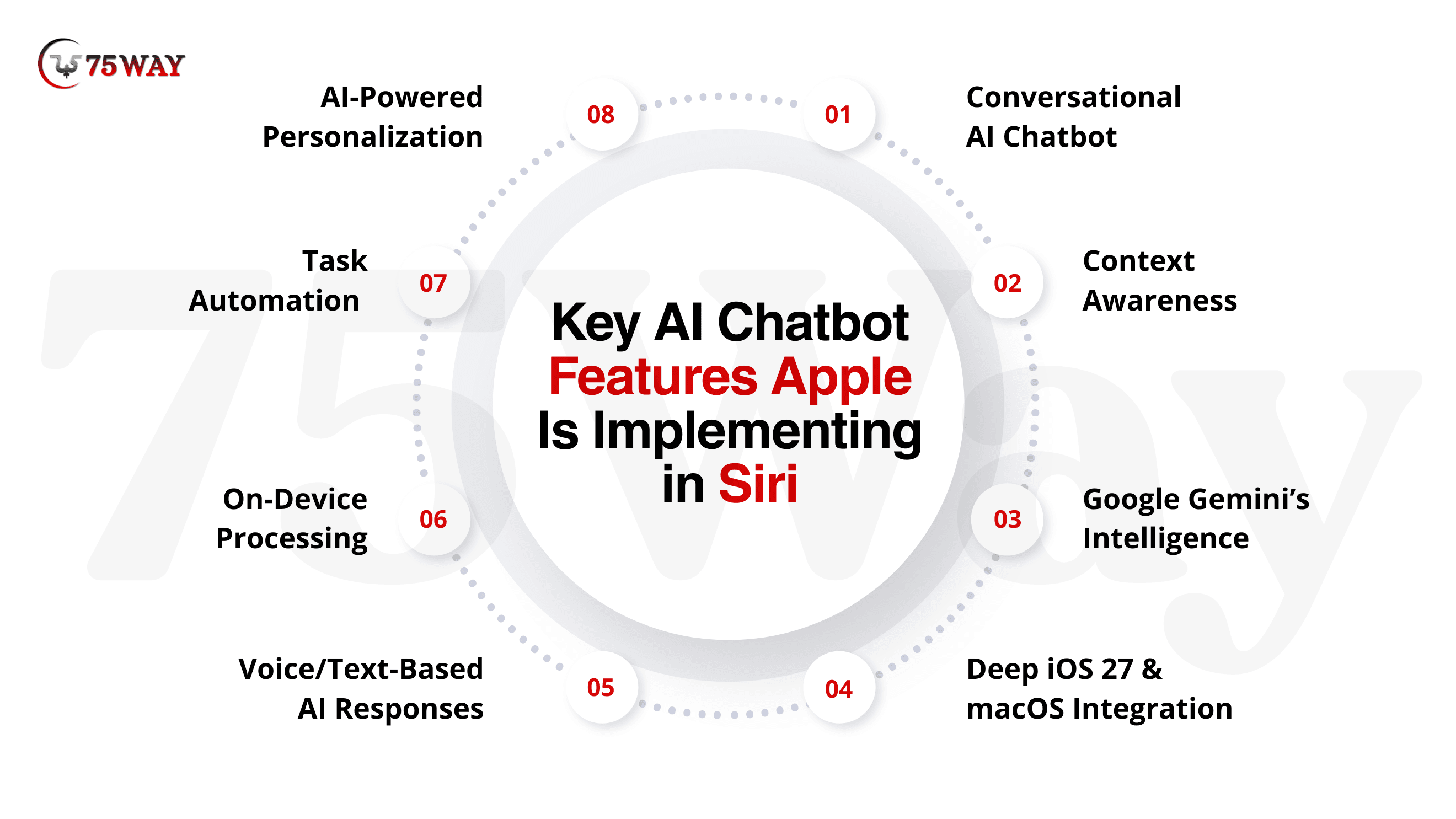
Conversational AI Chatbot: Siri will engage in natural, multi-turn conversations, similar to ChatGPT. Users can ask questions, follow-ups, or even multi-step instructions without losing context. This human-like interaction makes AI communication seamless and intuitive for daily tasks.
Context Awareness: Apple’s AI chatbot will remember conversations across apps and sessions, understanding intent in emails, messages, and reminders. This feature ensures Siri can provide relevant, precise assistance, improving productivity and reducing repeated instructions.
Google Gemini’s Intelligence: Gemini’s LLM capabilities power Siri’s reasoning and problem-solving. Apple combines this with on-device privacy and ecosystem access, giving users an AI that’s both intelligent and secure. Responses are contextual, accurate, and adaptive to user needs.
Deep OS Integration: Embedded within iOS and macOS, Siri can interact with mobile apps, notifications, files, and system features. Users experience a fully unified AI that can execute commands, retrieve information, and even automate workflows directly within the operating system.
Voice/Text-Based AI Responses: Just like Agentic AI solutions, Siri supports both voice and text input, which makes it adaptable for enterprise use, accessibility purposes, and multitasking. Users can type or speak naturally, and Siri responds appropriately across devices.
On-Device Processing: Certain requests are handled directly on the device, keeping sensitive information out of external servers and aligning with Apple’s long-standing privacy standards. This approach limits unnecessary data transfer and reduces exposure risks. For industries like healthcare, finance, and legal services, this matters a lot.
Task Automation: Siri’s evolution schedules meetings, summarizes emails, generates reports, or sets multi-step reminders automatically. For professionals and teams, AI-driven task automation translates into better time management and fewer errors, and smoother day-to-day operations without constant supervision.
AI-Powered Personalization: This upgrade makes Siri proficient at understanding users’ workflows and communication, and at prioritizing tasks. Personalized AI support helps users stay productive, reduces friction, and makes Siri feel less like a tool and more like a reliable digital assistant.
How Apple Balances Generative AI and User Privacy
Apple’s approach to AI chatbot development centers on trust as much as capability. User interactions with Siri rely heavily on on-device processing, which keeps sensitive information away from external servers. This upgrade reduces data exposure while still allowing intelligent responses. Advanced reasoning support through external models, such as Google Gemini, operates within tightly controlled boundaries to balance smart assistance with personal data protection.
A layered privacy framework deploys anonymization and aggregation rather than direct data storage. Its personal identifiers remain detached from usage patterns, which allows AI systems to improve response quality without retaining individual details. That structure limits long-term data retention and reduces the risk of unauthorized access or misuse. The result feels intentional rather than reactive.
For business and enterprise use, this privacy-first design carries real significance. Siri’s architecture allows productivity tasks without exposing confidential information. Apple positions privacy as a core product value and enables both organizations and individuals to adopt AI capabilities with confidence rather than concern.
Why AI Chatbots Are Critical for Modern Businesses in 2026?
AI chatbots and agentic AI solutions becomes necessity for businesses in 2026. Companies that fail to integrate intelligent assistants risk falling behind in customer engagement, productivity, and operational efficiency. AI chatbots offer real-time, scalable solutions that improve both internal operations and customer-facing interactions.
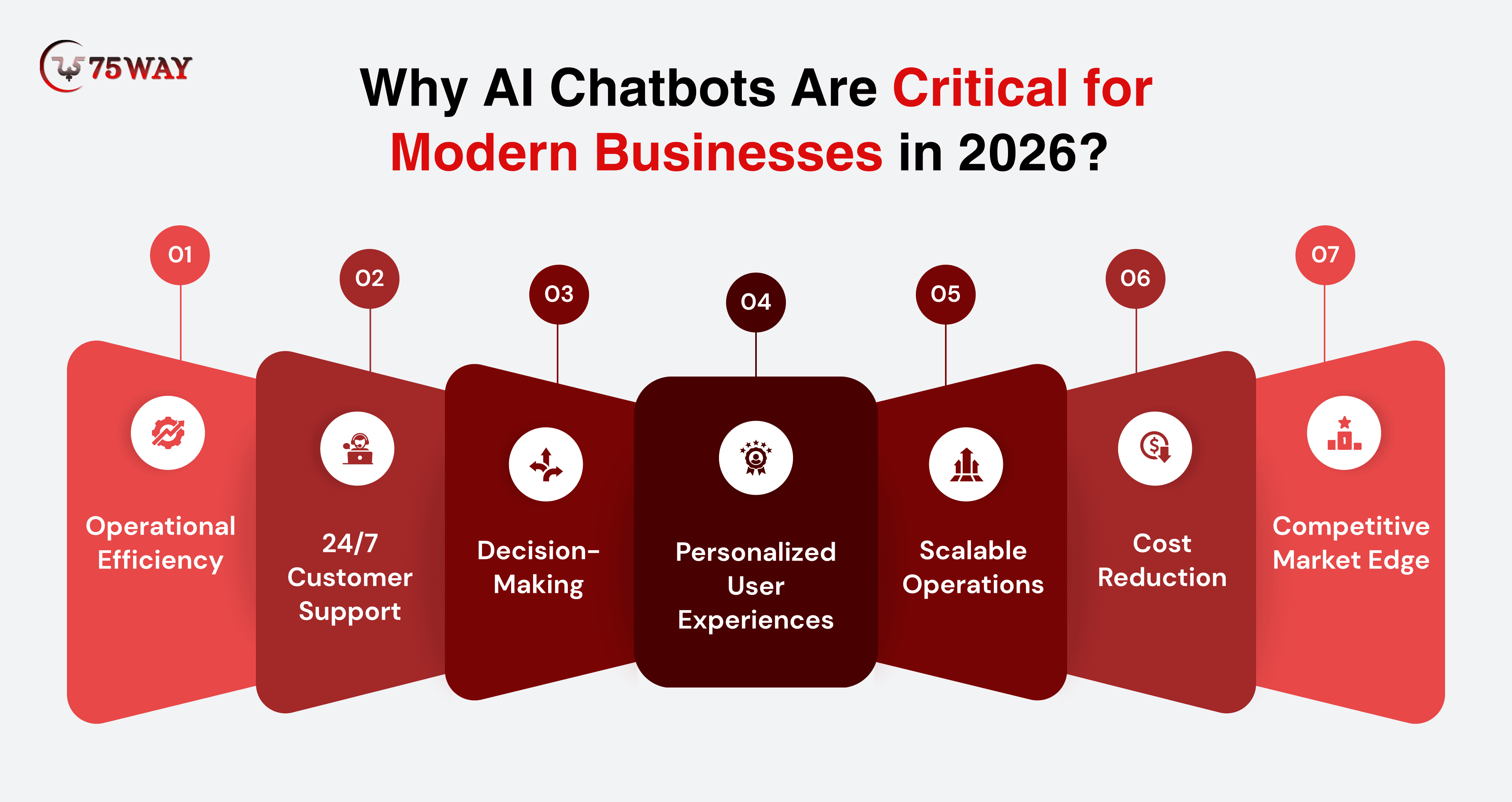
Operational Efficiency: AI-powered chatbots automate routine tasks, reducing human workload and freeing employees for high-value work. They use AI to manage scheduling, document generation, and reminders.
24/7 Customer Support: Unlike human teams, chatbots provide uninterrupted support, answering queries and resolving issues at any hour. This improves satisfaction, loyalty, and operational consistency.
Decision-Making: AI chatbots analyze data in real time and deliver advanced analytics and recommendations to guide business decisions. Founders can rely on AI for accurate, actionable information.
Personalized User Experiences: By learning from interactions, AI assistants tailor responses and services to individual customers, enhancing engagement and fostering trust. Personalized experiences increase conversions and retention.
Scalable Operations: With AI virtual assistants, businesses can handle more users without proportional increases in human resources. Artificial intelligence models scale effortlessly to meet growing demand.
Cost Reduction: These chatbots automate repetitive tasks, reduce labor costs, and improve workflow accuracy. This allows companies to allocate resources, manage budgets, and automate tasks effectively.
Competitive Market Edge: Companies that adopt AI assistants gain a clear advantage and deliver faster, smarter, and more responsive services than competitors relying on traditional systems.
Key Tech Trends Shaping AI in January 2026
Artificial intelligence trends are growing rapidly and affecting software, hardware, and digital services across industries worldwide. These emerging tech trends highlight priority areas where businesses should invest attention in the coming months to maintain relevance, competitiveness, and long-term growth in global markets.
AI & Software: Built-in AI assistants attain a stronger presence as platforms focus on native intelligence rather than add-ons. ChatGPT introduces ads, while Gemini stays ad-free, highlighting contrasting revenue paths that influence how businesses adopt and trust AI software tools.
Mobile & Hardware: Mobile devices remain the foundation for everyday AI use. Large batteries and advanced camera systems provide continuous on-device intelligence.
AI Trends: Business expectations around AI now center on real outcomes instead of experiments. Practical value, such as personalization, decision support, and performance visibility, drives adoption across industries seeking measurable returns from AI investments.
Computing: Enterprise hardware priorities favor systems built for AI workloads. Dell’s premium device strategy and AMD’s performance-focused platforms indicate growing demand for computing power that supports data-intensive AI applications at scale.
Read More: How AI Agents Automate Sales, Support & Operations in US Companies
Conclusion
Apple’s next-generation Siri represents a turning point for AI assistants. By combining Google Gemini’s intelligence with deep OS integration, conversational context, task automation, and privacy-first design, Siri becomes more than a voice assistant, but a business productivity partner. Startups and enterprises can leverage these developments to improve workflows, customer engagement, and decision-making. The startups looking to build, integrate, or optimize AI tools can partner with a reliable AI development company to achieve a competitive edge.
FAQs
When Will Apple Launch the AI-Powered Siri?
Apple is expected to introduce its AI-powered Siri with the release of iOS 27 in June 2026, according to multiple industry reports. The launch will likely happen in phases. It will start with core features and gradually expand across iPhone, iPad, and Mac devices to ensure stability and performance.
Is Siri becoming like ChatGPT?
Yes, Siri’s upgrade toward a ChatGPT-like experience, especially in conversational depth and contextual understanding. However, the approach remains different. Siri focuses on OS-level integration, voice-first interactions, and privacy controls, rather than operating as a standalone chatbot focused mainly on text-based conversations.
Is Google Gemini powering Siri?
Google’s Gemini models are expected to support Siri’s generative AI capabilities, particularly for complex reasoning and natural language responses. Apple controls how these models are used, combining Gemini’s intelligence with Apple’s interface design, privacy standards, and system-level integration across its ecosystem.
Will Siri replace ChatGPT on iPhone?
Siri is unlikely to fully replace ChatGPT on iPhone, but it will reduce the need for third-party AI apps for everyday tasks. Its built-in access, voice control, and system-wide actions give Siri an advantage for native workflows, while ChatGPT continues to serve specialized use cases.
Is Apple Building Its Own AI Model?
Yes, Apple continues to develop its own AI and machine learning models, especially for on-device processing and personalization. At the same time, partnerships with external models like Google Gemini enable Apple to scale advanced generative capabilities more quickly while maintaining control over privacy and user experience.