AI Summary
AI voice agents can handle appointment calls, understand customer requests, and schedule bookings automatically. They can connect with calendars, CRMs, booking platforms, and business systems. Advanced Voice AI agents can manage cancellations, rescheduling, reminders, and follow-ups. This guide explains features, development, technology, and costs.
Key Takeaways
- AI voice agents automate appointment scheduling across inbound and outbound customer calls.
- Voice AI agents connect callers with calendars and booking platforms seamlessly.
- Advanced features support rescheduling, cancellations, reminders, confirmations, and customer qualification.
- Development requires conversational design, speech technology, APIs, databases, and secure integrations.
- Costs depend on features, integrations, voice infrastructure, complexity, scalability, and customization.
One unanswered call can be worth $100, $500, or far more depending on what your business sells. Yet many appointment-based companies still send customers to voicemail after hours or keep them waiting while staff handle another caller, a small gap that can quietly turn into lost revenue.
An AI voice agent changes that equation by treating every incoming call as a potential booking opportunity. A voice AI agent for appointment booking can hold a natural conversation, understand the customer's request, check live availability, schedule the appointment, confirm the details, and keep the interaction moving without waiting for a receptionist.
For a sales representative or a decision-maker, though, the question is not whether voice AI automation can answer a phone call. The real question is whether it can handle enough of the booking journey accurately to reduce operational load, capture more demand, and integrate with the systems your business already depends on.
This guide breaks down the features, conversation architecture, integrations, development stages, and cost factors involved in building an AI voice agent for appointment booking, so you can evaluate the opportunity as a business investment, not just another AI experiment.
What Is An AI Voice Agent For Appointment Booking?
An AI voice agent for appointment booking is a conversational software system that can answer phone calls, understand spoken requests, check availability, schedule appointments, and communicate booking details without requiring a human receptionist.
Unlike traditional IVR systems that depend on rigid menus such as “Press 1 for appointments,” a voice AI agent can understand natural conversations. A caller can say, “I need to see a dentist sometime Thursday afternoon,” and the agent can identify the service, check available slots, ask necessary follow-up questions, and complete the booking.
For businesses, this turns the phone into an automated booking channel that can operate beyond normal business hours.
A well-designed appointment voice agent can handle tasks such as:
- Answering inbound appointment calls
- Identifying customer requirements
- Checking real-time availability
- Booking appointments
- Rescheduling appointments
- Cancelling appointments
- Confirming appointment details
- Sending reminders
- Answering common service questions
- Collecting customer information
- Updating CRM records
- Transferring complex calls to human staff
- Making outbound confirmation or reminder calls
This makes AI voice appointment booking particularly relevant for businesses where phone calls remain an important source of appointments, including healthcare practices, salons, spas, dental clinics, home-service companies, automotive businesses, professional services, and hospitality.
How Does An AI Voice Agent Book Appointments?
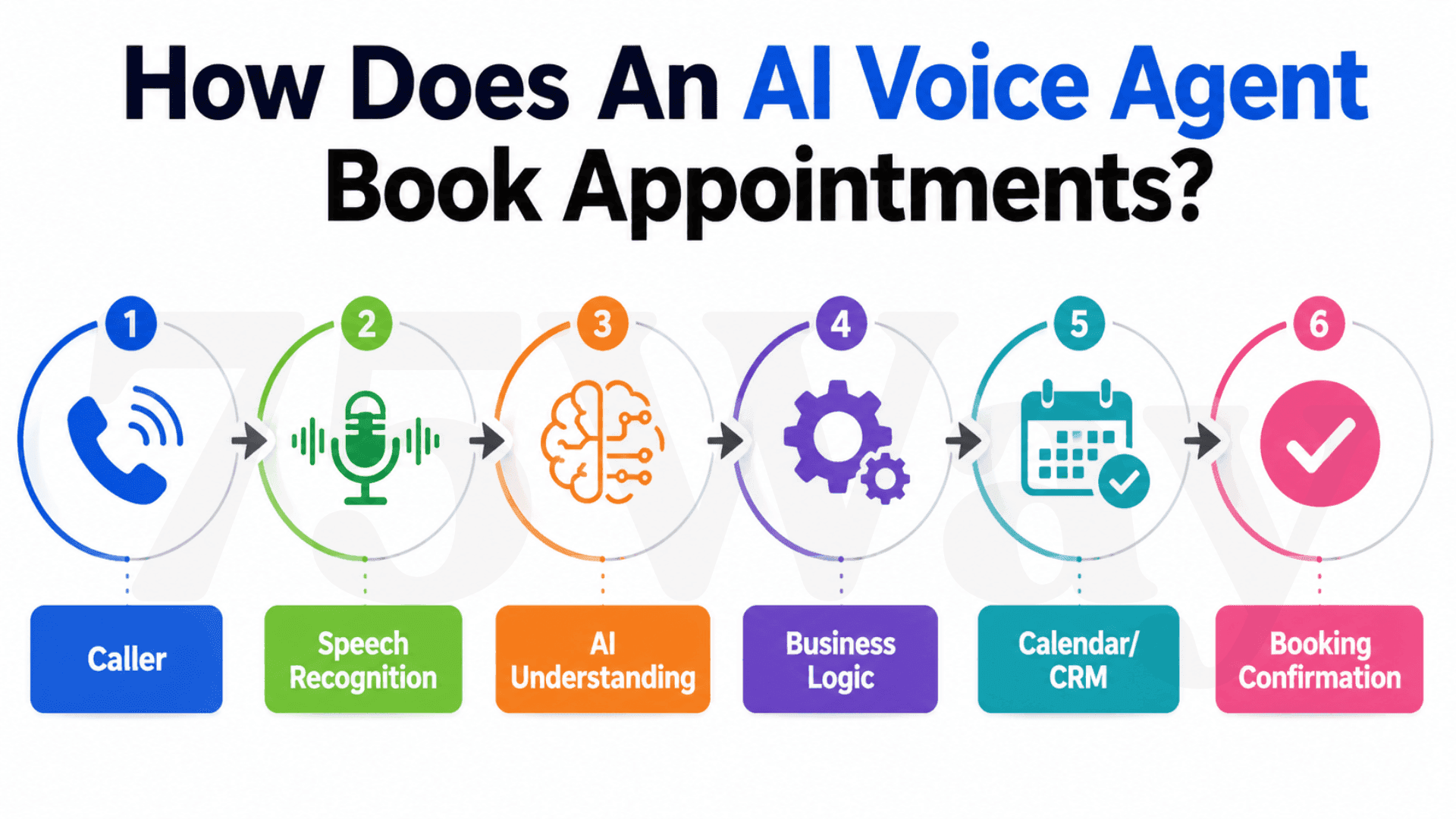
An AI appointment booking voice agent turns a phone call into an appointment workflow by listening to what the caller wants, checking real-time business information, and taking the required booking action. Instead of following a rigid script, it can handle natural conversations and clarify missing details along the way.
For example:
Customer: “Hi, I need a haircut this Saturday afternoon.”
AI Voice Agent: “Absolutely. Do you have a preferred time?”
Behind that natural conversation, several components work together:
- Speech Recognition: Converts the caller's spoken words into text that the AI can process.
- Intent Understanding: Identifies what the caller wants, such as booking, rescheduling, cancellation, pricing information, or service details.
- Conversational AI: Uses the conversational AI context to decide what information to ask for and how to respond naturally.
- Business Logic: Applies booking rules such as service duration, staff availability, working hours, deposits, cancellation policies, and minimum notice periods.
- Calendar Integration: Connects with the scheduling or booking system to retrieve available slots and create or modify appointments.
- CRM Integration: Retrieves relevant customer information and records appointment details or conversation outcomes in the connected CRM.
- Text-to-Speech: Converts the AI's response into natural-sounding speech so the caller can continue the conversation without interacting with a screen.
- Confirmation Workflow: Once the appointment is created, the system can confirm the details verbally and trigger a supported SMS, email, or messaging notification.
This makes the AI appointment booking voice agent more than an automated phone receptionist. It can understand the request, make decisions within defined rules, interact with business systems, and complete the appointment workflow during the same call.
Why Are Businesses Investing In Voice AI For Appointment Booking?
Businesses are adopting Voice AI to make appointment handling available beyond traditional front-desk hours. The technology fits naturally into booking, rescheduling, customer queries, and call management. Its broader business impact is worth examining before investing in it.
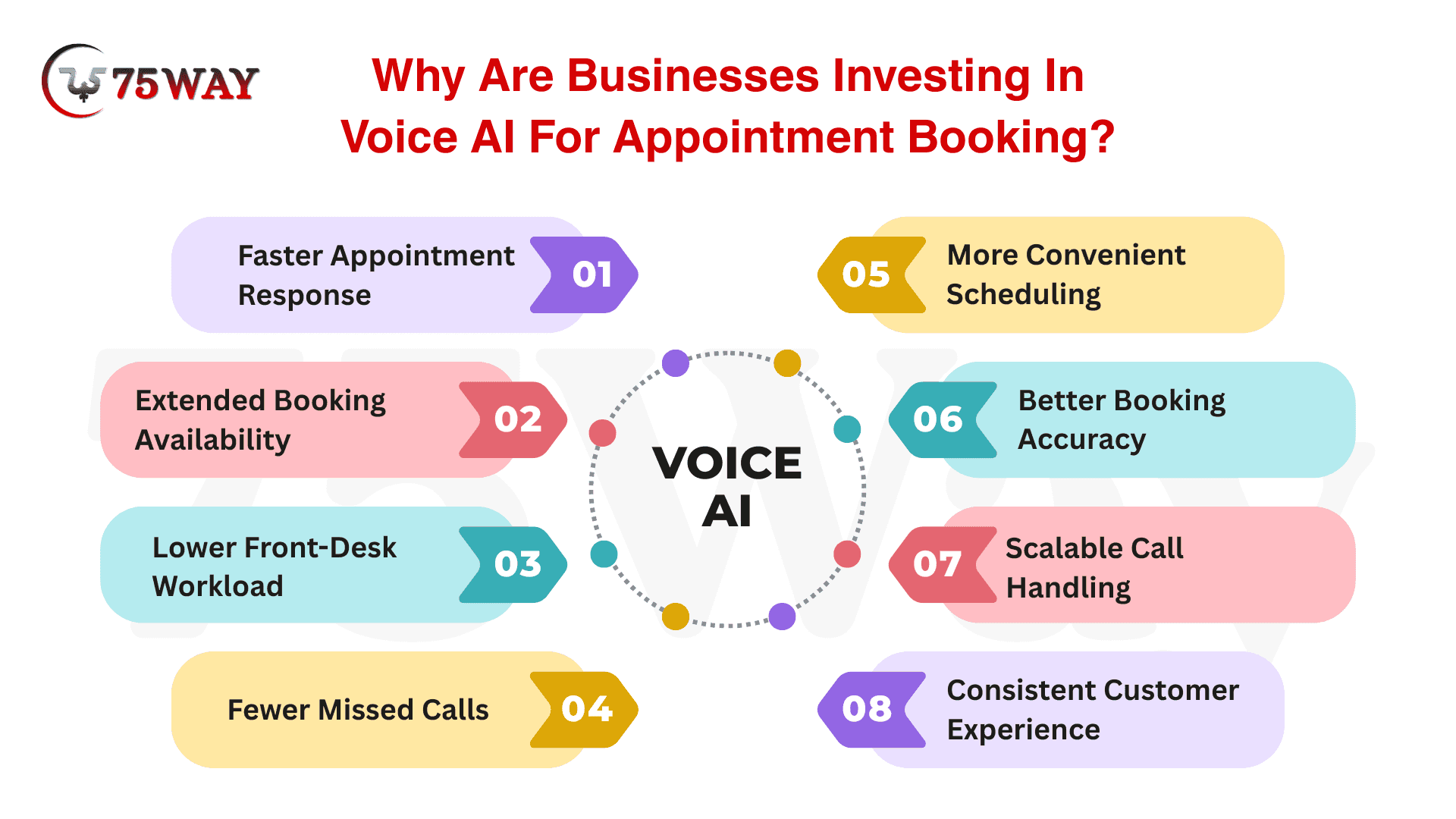
- Faster Appointment Response: A customer calling at 8 PM should not have to wait until tomorrow to book a service. An AI appointment booking voice agent can answer immediately and move the conversation toward an available slot.
That keeps the customer engaged. More importantly, the booking opportunity does not have to wait for the front desk.
- Extended Booking Availability: People often remember they need an appointment when the business is closed. Instead of asking them to call back tomorrow, an AI voice booking agent can handle the initial conversation whenever supported.
The customer gets help when they need it. The business gets another opportunity to turn that interest into a booking.
- Lower Front-Desk Workload: Imagine a receptionist answering the same questions all day: “What time do you close?” “Do you have Saturday appointments?” “Can I move my booking?”
An AI voice agent for scheduling appointments can handle these routine conversations. Staff can spend their time on customers who genuinely need human attention.
- Fewer Missed Calls: A ringing phone during a busy afternoon can easily go unanswered. For the customer, that may be enough reason to call another business.
An AI voice appointment scheduler gives those calls an immediate response. Instead of losing the conversation, the business gets a chance to continue it.
- More Convenient Scheduling: Customers rarely speak in perfectly structured booking requests. They might say, “I need something after work this Friday.”
An AI voice scheduling agent can understand the intent and ask the right follow-up questions. That feels far more natural than navigating a long automated phone menu.
- Better Booking Accuracy: Nobody wants to arrive at a salon, clinic, or service center only to discover that the appointment was recorded incorrectly.
An AI voice agent for appointment booking connected to the booking system can check availability before confirming anything. It can also follow predefined business rules. That makes the conversation more useful than simply taking a message.
- Scalable Call Handling: What happens when ten customers call within a few minutes? A small reception team can quickly become overwhelmed.
An AI appointment booking voice agent can handle routine appointment conversations at higher volumes. Businesses can therefore support growing call demand without relying entirely on additional front-desk capacity.
- Consistent Customer Experience: Customers should not receive completely different answers depending on who picks up the phone. An AI voice booking agent can work from the same approved business information every time.
Services, pricing, policies, and availability can be communicated consistently. The experience becomes easier to manage as the business grows.
AI Appointment Booking Voice Agent Development Process: Complete Roadmap
An AI appointment booking voice agent needs to fit your actual scheduling workflow, customer expectations, and business rules from the beginning. The development approach should connect voice conversations with the systems that already manage your appointments. The process for turning that concept into a reliable business solution is explained below.
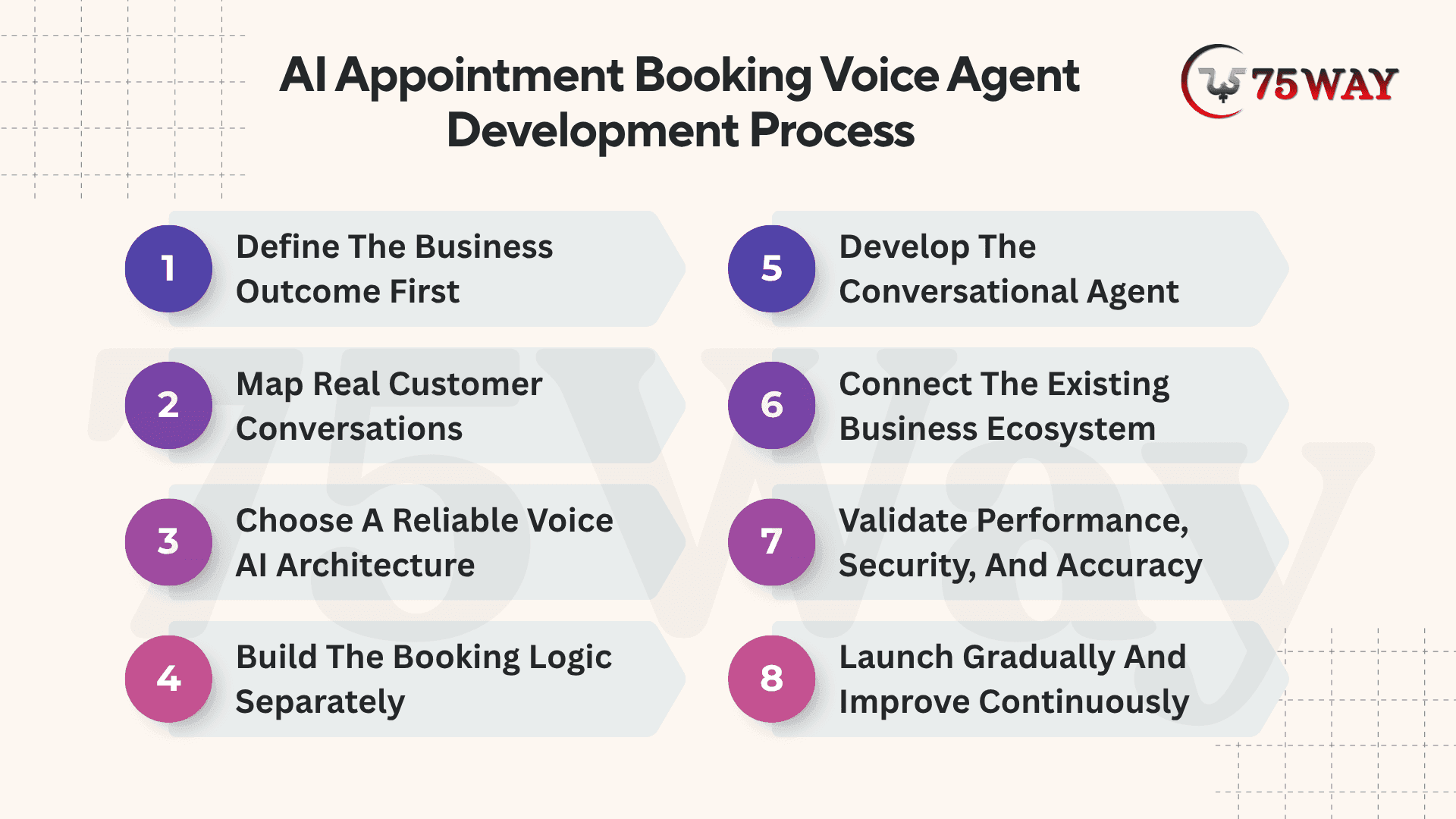
Stage 1: Define The Business Outcome First
A successful voice agent starts with a clear business objective rather than a technology decision. Identify whether the priority is increasing booked appointments, reducing missed calls, lowering front-desk workload, improving after-hours support, or handling higher call volumes.
Document the target customers, appointment types, business hours, booking rules, staff availability, locations, existing scheduling software, CRM requirements, common customer questions, human handoff conditions, and expected call volume. This gives developers a practical understanding of what the agent needs to accomplish.
For example, a dental practice may need the agent to schedule consultations, confirm existing appointments, handle cancellations, and transfer urgent calls to staff.
This stage prevents the development team from building a generic voice chatbot instead of a solution aligned with actual business operations.
Stage 2: Map Real Customer Conversations
Once the business objective is clear, map how customers actually move through an appointment conversation. The workflow should cover both the expected booking journey and situations that can interrupt it.
Map the complete journey:
Greeting → Intent Detection → Information Collection → Availability Check → Slot Selection → Confirmation → Booking → Follow-Up
Also document alternative paths, such as when the caller does not know the service name, the requested time is unavailable, the customer changes the preferred date, the customer wants to cancel, the caller asks an unrelated question, the caller requests a human, or the scheduling API becomes unavailable.
Conversation design should define what the agent can say, what information it can access, which actions it can perform, and when it must stop and escalate.
Stage 3: Choose A Reliable Voice AI Architecture
The technical architecture should be selected around the required call quality, response speed, integrations, security, and expected workload. The most advanced model is not automatically the best choice for every appointment-booking business.
A typical architecture may include:
Phone System → Speech Recognition → AI Model → Conversation Orchestrator → Business Logic → Booking API → CRM
The technology selection may cover:
- Voice infrastructure: Telephony services, speech recognition, and text-to-speech capabilities.
- AI layer: Large language models, intent recognition, context management, and response generation.
- Application layer: Backend services, databases, authentication, monitoring, and analytics.
The objective is to create an architecture that provides acceptable latency, reliability, scalability, cost control, and conversational quality for the intended workload.
Stage 4: Build The Booking Logic Separately
The scheduling engine is the operational core behind appointment automation. It should connect the voice agent with the business's calendar, CRM, booking platform, or custom scheduling database.
The engine should handle real-time availability, appointment duration, staff schedules, service types, locations, buffer periods, booking restrictions, cancellations, rescheduling, and double-booking prevention.
For example, when a caller requests Friday at 3 PM, the agent should query the scheduling system instead of assuming the time is available.
Keeping conversational AI separate from booking logic is important because the AI should not independently decide whether an appointment slot exists.
Stage 5: Develop The Conversational Agent
With the workflows and integrations established, developers can build the conversational layer around the business's approved information and operating rules.
Development can include intent recognition, context management, slot extraction, follow-up questions, response generation, interruption handling, confirmation logic, error recovery, business knowledge, human escalation, and conversation memory.
The agent should also have clear boundaries. If the system does not have access to pricing information, for example, it should not invent a price simply to keep the conversation moving.
A reliable AI voice booking agent should prioritize accurate actions over impressive-sounding conversations.
Stage 6: Connect The Existing Business Ecosystem
Appointment booking rarely operates independently from the rest of a company's technology stack. Connecting the voice agent with existing systems can turn an individual phone conversation into a complete operational workflow.
Relevant integrations may include:
- Customer systems: CRM platforms and customer databases.
- Scheduling systems: Calendars, booking software, and appointment databases.
- Communication tools: SMS, email, and customer-support platforms.
- Business services: Payment systems and analytics platforms.
After a booking, the system can update the CRM and trigger a confirmation message automatically. This makes the AI voice agent part of the existing business ecosystem rather than another disconnected application.
Stage 7: Validate Performance, Security, And Accuracy
Voice AI testing should go beyond checking whether the agent sounds natural. The system needs to understand realistic conversations, follow business rules, protect customer information, and complete the correct action.
Test situations such as different accents, background noise, fast speech, interruptions, ambiguous requests, unavailable appointments, API failures, incorrect information, cancellations, rescheduling, human transfers, long conversations, and concurrent calls.
Security testing should also cover authentication, API permissions, encryption, access controls, logging, data retention, and third-party integrations.
For healthcare, financial, or other regulated use cases, privacy and compliance requirements should be assessed according to the actual data collected and intended use.
Stage 8: Launch Gradually And Improve Continuously
A controlled rollout can provide valuable operational data before the AI voice agent handles every customer call. Start with selected workflows or a limited call volume, then expand as reliability improves.
Monitor meaningful indicators such as booking completion, successful calls, transfer frequency, abandoned calls, average call duration, failed intents, rescheduling activity, customer satisfaction, appointment conversion, and API errors.
Conversation analytics can reveal where callers become confused or where the agent needs better instructions. If customers repeatedly use terminology the system does not recognize, for example, developers can update the conversation model and knowledge base.
The improvement cycle becomes:
Launch → Monitor → Analyze Conversations → Identify Failures → Improve Workflows → Retest → Scale
A strong AI voice agent development process continues after launch. Ongoing monitoring, conversation analysis, integration maintenance, security reviews, and model optimization help maintain reliable appointment automation as customer expectations and business requirements evolve.
Must-Have Features To Build An AI Voice Agent For Appointment Scheduling
An appointment-scheduling voice agent needs more than a natural-sounding voice to handle real customer calls. It should connect conversation with scheduling, customer data, business rules, and call handling. The essential capabilities that make this possible are covered below.
1. Natural Language Understanding
The voice AI agent for appointment scheduling should understand conversational requests rather than requiring customers to follow predefined phrases.
For example, a caller might say, “Can you get me in with Dr. Smith sometime next Tuesday morning?” The system should identify the requested provider, date, time range, and appointment intent.
It should also handle different accents, speaking speeds, sentence structures, interruptions, and conversational phrasing.
2. Real-Time Appointment Scheduling
The agent should connect with the business's scheduling system and retrieve current availability before offering appointment slots.
AI voice booking agent can consider available staff, services, business hours, appointment duration, location, existing bookings, buffer periods, staff-specific schedules, and booking restrictions.
This prevents the agent from offering a slot that has already been taken.
3. Calendar Integration
Calendar integration allows the AI voice booking agent to read and update scheduling information.
Depending on the business, integrations may connect with Google Calendar, Microsoft Outlook, Apple Calendar, CRM platforms, healthcare scheduling systems, salon booking software, or custom appointment databases.
For larger businesses, the agent may need to coordinate multiple calendars simultaneously.
4. Appointment Rescheduling And Cancellation
Appointment management should not end after the initial booking.
Customers frequently call to change or cancel appointments. The AI agent can verify the customer, locate the existing appointment, check alternative availability, and update the booking.
For example:
Customer: “I can't make my appointment tomorrow. Can you move it to Friday?”
AI Agent: “Absolutely. I have 11 AM and 2 PM available on Friday. Which works better?”
This turns rescheduling into another automated workflow rather than another task for reception staff.
5. Automated Appointment Confirmation
After successfully scheduling an appointment, the agent should clearly repeat the important details.
A confirmation can include the customer name, service, provider, date, time, location, appointment duration, and cancellation policy.
The system can then trigger an SMS or email confirmation through the connected communication platform.
6. Reminder Calls And Messages
An AI voice agent can also support outbound appointment reminders.
For example:
“Hi Sarah, this is the appointment assistant from ABC Dental. I'm calling to remind you about your appointment tomorrow at 10 AM. Would you like to keep this appointment?”
Depending on the workflow, customers can confirm, reschedule, or request assistance directly during the call.
7. Caller Identification
The system can identify returning customers using approved information such as phone numbers, customer IDs, or authentication workflows.
This can reduce repetitive questions. Instead of asking an existing customer for every detail, the system can retrieve permitted information and confirm it before continuing.
Authentication should be designed carefully, particularly when appointments involve sensitive personal or health information.
8. CRM Integration
CRM integration allows appointment conversations and customer information to flow into the existing business system.
The AI-powered phone scheduling can potentially create customer records, update contact details, record appointment information, add conversation outcomes, trigger follow-up workflows, identify returning customers, and update lead status.
This gives sales and service teams greater visibility into conversations handled by the AI.
9. Intelligent Call Routing
Not every call should be automated from beginning to end.
A capable virtual AI receptionist should recognize when a caller needs human assistance and transfer the conversation accordingly.
Examples include complex complaints, billing disputes, sensitive conversations, technical problems, requests outside the agent's capabilities, or explicit requests to speak with an employee.
The system can also transfer calls to the appropriate department instead of sending every caller to the same queue.
10. Human Handoff
Human escalation should feel like part of the conversation rather than a failure.
Before transferring the call, the AI phone answering agent can provide the employee with relevant context, such as the caller's reason for contacting the business and information already collected.
This prevents customers from having to repeat the entire conversation.
11. Multilingual Voice Support
Businesses serving diverse customer populations may benefit from multilingual appointment booking.
The AI calling receptionist for small businesses can detect or allow customers to select their preferred language and continue the conversation accordingly.
Language support should cover both speech recognition and voice generation, rather than simply translating text after the conversation.
12. Voice Personalization
Businesses can customize the AI agent's voice, tone, speaking speed, greeting, brand language, response style, and business terminology.
A medical practice, luxury salon, automotive service center, and home-services company may require completely different conversational experiences.
13. Knowledge Base Integration
Customers often ask questions before booking.
For example, they may ask, “How long does the appointment take?”, “Do you offer weekend appointments?” “How much does the consultation cost?” “Where are you located?” “What should I bring?”, or “Do you have parking?”
A connected knowledge base allows the AI voice receptionist to answer approved business questions while keeping appointment scheduling within the same conversation.
14. Lead Qualification
An AI calling agent for appointment scheduling can qualify callers before creating an appointment or sending a lead to sales.
It can collect information such as the service required, customer requirements, preferred date, budget range where relevant, location, urgency, and existing customer status.
This is particularly useful for businesses where an appointment represents a high-value sales opportunity.
15. Call Analytics And Reporting
Businesses need visibility into how the AI phone agent for appointment booking is performing.
An analytics dashboard can track total calls, answered calls, completed bookings, cancelled appointments, rescheduled appointments, call duration, transfer rate, abandonment rate, customer intents, failed conversations, and peak calling periods.
These insights can reveal where the AI performs well and where conversations need improvement.
16. Appointment Availability Rules
The AI voice assistant for appointment booking should follow business-specific booking rules instead of treating every calendar slot equally.
For example, new customers may require longer appointments, certain services may require specific employees, some appointments may need preparation time, certain services may not be bookable after a specific hour, and some providers may not work on weekends.
These rules should be implemented within the business logic layer so the agent cannot accidentally bypass operational constraints.
17. Outbound Calling
Beyond inbound appointment booking, an AI-powered appointment booking agent can initiate calls for appointment reminders, confirmation requests, follow-ups, missed-call callbacks, lead follow-ups, and re-engagement campaigns.
Outbound calling should be implemented with appropriate consent, calling-hour restrictions, and applicable US telecommunications and privacy requirements.
18. Real-Time Call Transcription
Transcription can convert conversations into searchable records.
Businesses can use transcripts to identify customer questions, booking intent, common objections, failed interactions, service requests, and training opportunities.
Transcription also makes it easier to review conversations without manually listening to every recording.
19. Secure Data Handling
Security becomes particularly important when the AI voice assistant for scheduling handles customer identity, contact information, payments, or health-related appointment information.
Depending on the use case, the architecture may require encryption, authentication, authorization, secure APIs, access controls, audit logs, data retention policies, and consent management.
For healthcare use cases, additional regulatory and contractual requirements may apply, so the product architecture should be reviewed accordingly before deployment.
20. AI Guardrails
A business-facing AI voice agent for appointment scheduling should have clear boundaries.
Guardrails can define what the agent can answer, what it cannot answer, which actions require confirmation, which requests require human escalation, which information can be accessed, and which booking changes are permitted.
This is particularly important because a voice agent should not confidently invent availability, policies, prices, or customer information.
The goal is not simply to make the AI sound human. The goal is to make it dependable enough to complete real appointment workflows without creating operational problems.
Technology Stack Required To Build An AI Voice Agent For Scheduling Appointments
A voice agent may sound simple to the caller, but several technical layers are working underneath every conversation. Speech recognition, language models, voice synthesis, telephony, APIs, databases, and security need to work together smoothly. The key technologies required to build this system are outlined below.
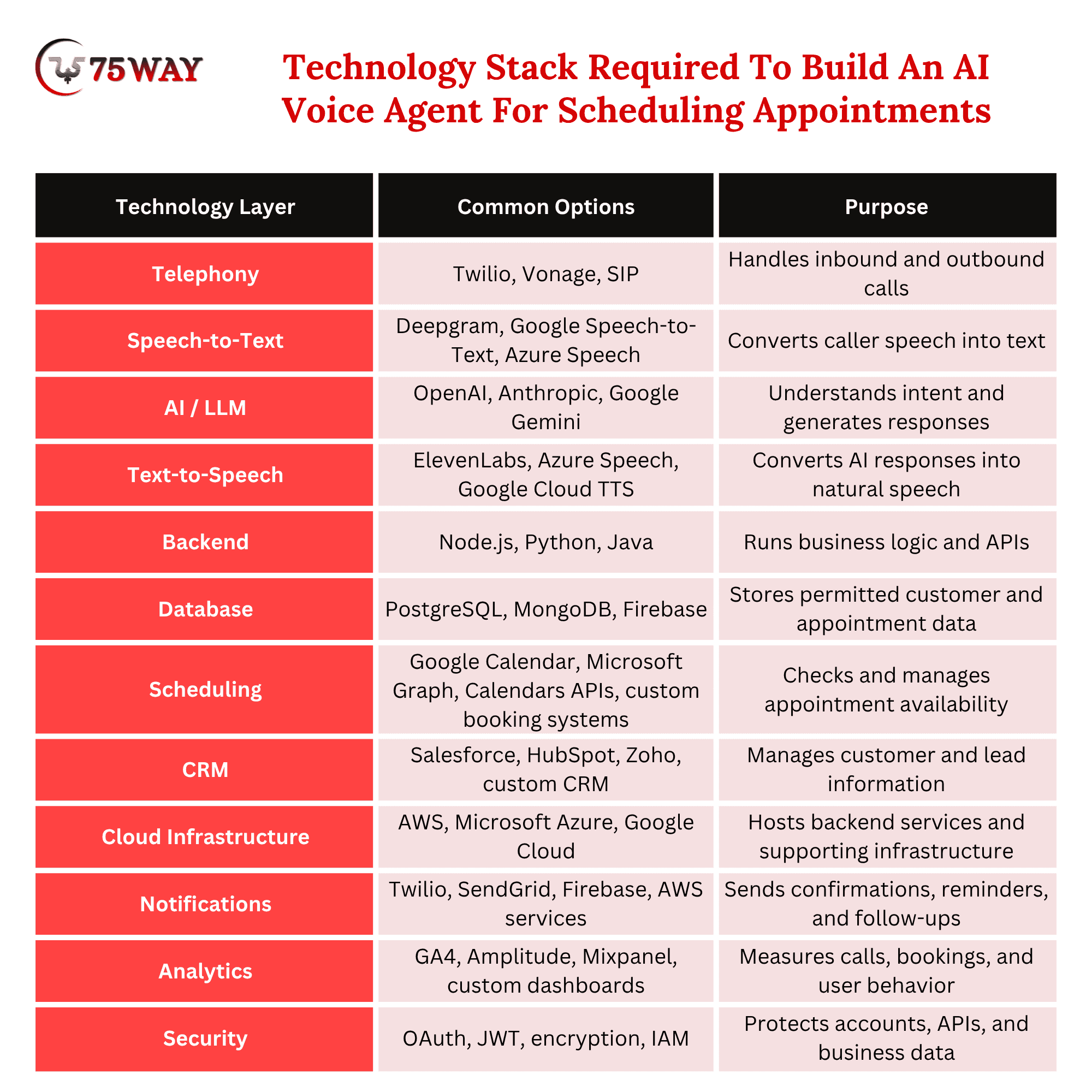
- Telephony Infrastructure
Platforms such as Twilio, Vonage, and SIP-based telephony can connect the Voice AI agent with real phone networks for inbound and outbound calls.
These services can handle phone numbers, call routing, transfers, call status, and other telephony functions, reducing the need to build telecommunications infrastructure from the ground up.
- Speech Recognition
For converting customer speech into text, developers can consider Deepgram, Google Cloud Speech-to-Text, or Azure AI Speech.
The selected solution should provide strong recognition accuracy, low latency, and reliable performance across accents, background noise, interruptions, and industry-specific terminology.
- AI And LLM Layer
The conversational intelligence can be powered by models from OpenAI, Anthropic, or Google Gemini.
This layer interprets customer requests, identifies appointment intent, maintains conversation context, asks relevant questions, and generates responses based on the business's approved information.
- Text-To-Speech
Tools such as ElevenLabs, Google Cloud Text-to-Speech, and Azure AI Speech can convert generated responses into spoken conversations.
Voice selection should consider pronunciation, latency, clarity, language support, speaking speed, and whether the voice fits the company's brand.
- Backend Development
For the backend, development teams can use Node.js, Python, Java, or similar server-side technologies.
The backend manages appointment logic, API communication, authentication, business rules, conversation state, notifications, and interactions between the AI layer and external business systems.
- Database
A database such as PostgreSQL, MongoDB, or Firebase can store application data required by the platform.
Depending on the architecture, this may include customer records, appointment metadata, agent configurations, business rules, call outcomes, and other permitted information.
- Calendar And Booking Integrations
The agent can connect with Google Calendar, Microsoft Graph, Calendly, or a company's existing booking platform to retrieve and update appointment availability.
For businesses with multiple employees, services, or locations, the integration should also accommodate scheduling rules rather than simply returning open calendar slots.
- CRM Integration
Platforms such as Salesforce, HubSpot, and Zoho CRM can connect appointment conversations with customer and lead records.
After a call, the system can update contact information, record the booking outcome, trigger follow-ups, or move a qualified lead to the appropriate sales stage.
- Cloud Infrastructure
Amazon Web Services (AWS), Microsoft Azure, and Google Cloud can provide the infrastructure required to host the backend, databases, APIs, monitoring services, and other components.
Cloud architecture should be selected according to expected call volume, reliability requirements, geographic availability, and scalability needs.
- Notifications And Messaging
After an appointment is created, services such as Twilio, SendGrid, Firebase Cloud Messaging, or Amazon SES can support confirmation messages, reminders, and follow-ups.
These integrations allow the voice conversation to trigger automated communication across SMS, email, or mobile channels.
- Analytics And Monitoring
Tools including Amplitude, Mixpanel, Google Analytics, Datadog, and custom dashboards can help businesses monitor how the AI voice agent performs.
Useful measurements include completed bookings, failed conversations, transfers, call duration, abandonment, API failures, and frequently requested appointment types.
- Security And Access Control
Technologies such as OAuth 2.0, JWT, AWS IAM, Azure Entra ID, and encryption services can help protect APIs, accounts, and application data.
The exact security architecture should depend on the type of information handled and the regulatory requirements applicable to the business.
How Much Does It Cost To Develop An AI Voice Agent For Appointment Booking?
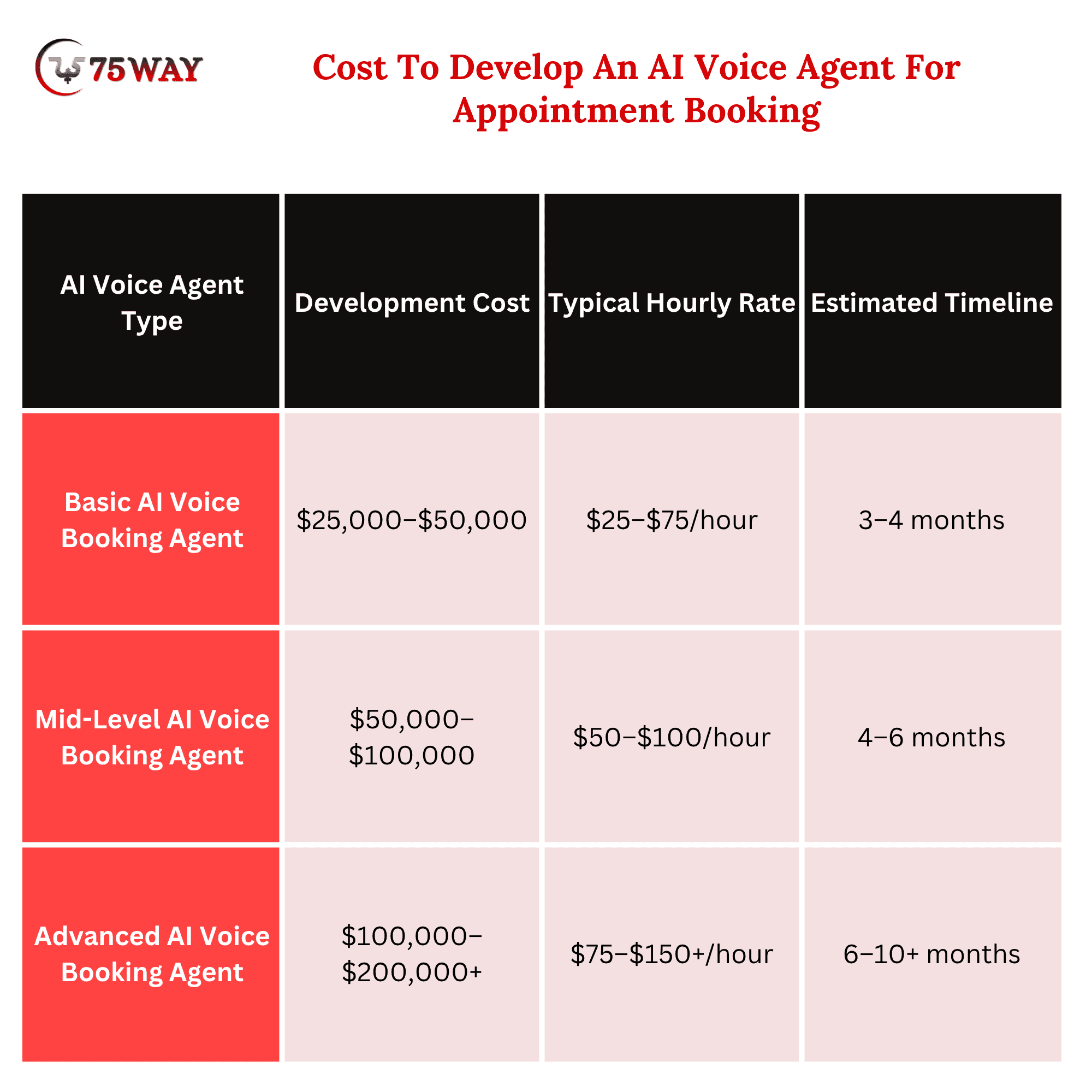
The cost to develop an AI voice agent for appointment booking can range from $25,000 to $250,000+, depending on the conversational complexity, voice technology, integrations, AI capabilities, number of workflows, security requirements, and expected call volume.
1. Basic AI Voice Booking Agent: $25,000–$50,000
A basic appointment voice agent typically handles straightforward inbound calls and common booking workflows.
The scope may include:
- AI-powered call answering
- Speech recognition
- Basic conversational flows
- Appointment availability checking
This level is suitable for startups and small businesses that want to validate whether automated voice booking can reduce receptionist workload and capture more appointments.
2. Mid-Level AI Voice Booking Agent: $50,000–$100,000
A mid-level system provides more sophisticated conversations and deeper integration with existing business software.
It can include:
- Advanced conversational AI
- Rescheduling and cancellation
- CRM integration
- Multiple appointment types
- Custom business rules
- Outbound reminder calls
This approach is better suited to businesses that already receive significant call volume and want to automate a larger portion of their appointment-management workflow.
3. Advanced AI Voice Booking Agent: $100,000–$200,000+
An advanced Voice AI platform can support complex business processes and highly customized conversations.
The development scope may include:
- Multiple AI agents
- Advanced LLM orchestration
- AI-powered personalization
- Multiple languages
- Complex CRM integrations
- Multiple calendar systems
- Enterprise dashboards
The cost can increase beyond $200,000 when the product requires enterprise-grade infrastructure, extensive integrations, custom AI workflows, complex compliance requirements, or very high concurrent call volumes.
Cost For Building AI Appointment Booking Voice Agent Based On Development Stages
The total investment is divided across several development activities rather than going entirely toward AI technology.
- Discovery & Planning: $3,000–$8,000
- Conversation & UX Design: $5,000–$15,000
- Voice AI Development: $15,000–$50,000+
- Backend & Integrations: $10,000–$40,000+
- Testing & QA: $5,000–$15,000+
- Deployment: $2,000–$7,000
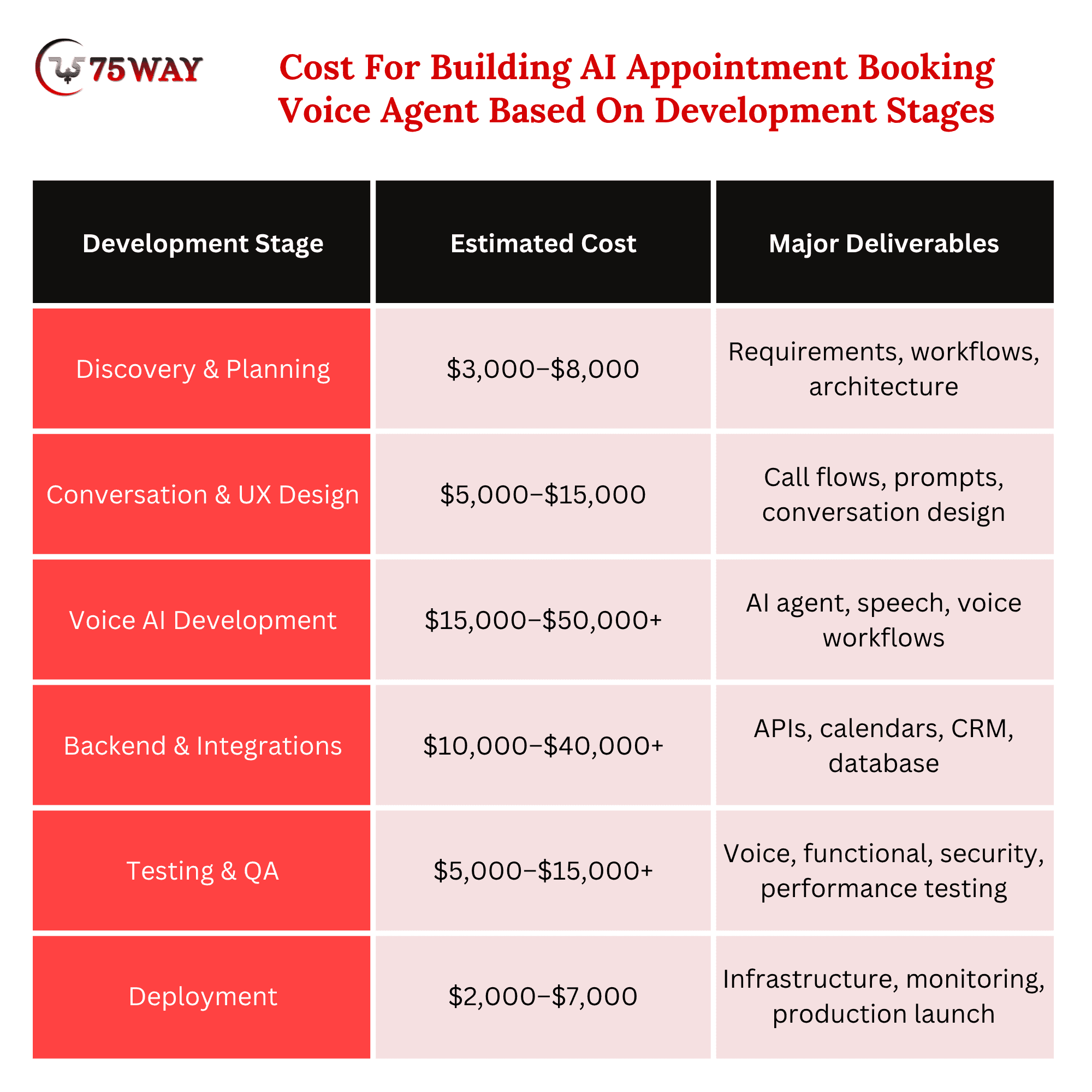
These are planning estimates rather than fixed development prices. The actual budget depends on the complexity of the product and the technology choices.
Factors That Affect The Cost To Create Voice AI Agent For Appointment Booking
A voice agent that only books appointments is a very different product from one that handles complex conversations, rescheduling, customer verification, and multiple business systems. Those differences can quickly change the development budget. The factors that influence the final cost are covered below.
- AI Model & Conversation Complexity: A simple question-and-answer agent requires less engineering than an agent that maintains long conversations, handles interruptions, remembers context, qualifies leads, and performs multiple business actions.
- Telephony Requirements: Inbound-only calling is generally simpler than a system supporting inbound calls, outbound campaigns, call transfers, recording, multiple phone numbers, and high concurrent call volumes.
- Number of Integrations: Connecting one calendar is relatively straightforward. Integrating several calendars, CRMs, booking systems, payment platforms, and business databases increases development and testing requirements.
- Voice And Language Requirements: A single English voice requires less configuration than an application supporting multiple voices, languages, accents, custom pronunciation, and region-specific conversational behavior.
- AI Personalization: Basic scripted workflows can operate with predefined business rules. Advanced personalization may require recommendation logic, customer-history analysis, retrieval systems, or additional AI orchestration.
- Security And Compliance: The cost can increase when the agent handles sensitive customer information or operates in regulated industries. Additional security controls, audits, access policies, logging, and compliance requirements may become necessary.
- Analytics And Administration: A simple application may only require basic call reporting. Enterprise platforms may need dashboards for call outcomes, conversion rates, agent performance, failed intents, customer trends, and location-level reporting.
- Location of AI Voice Agent Developer: Cost to hire an AI voice agent developer is affected by location, hourly rates and overall project costs, although experience and technical capability should be considered alongside price.
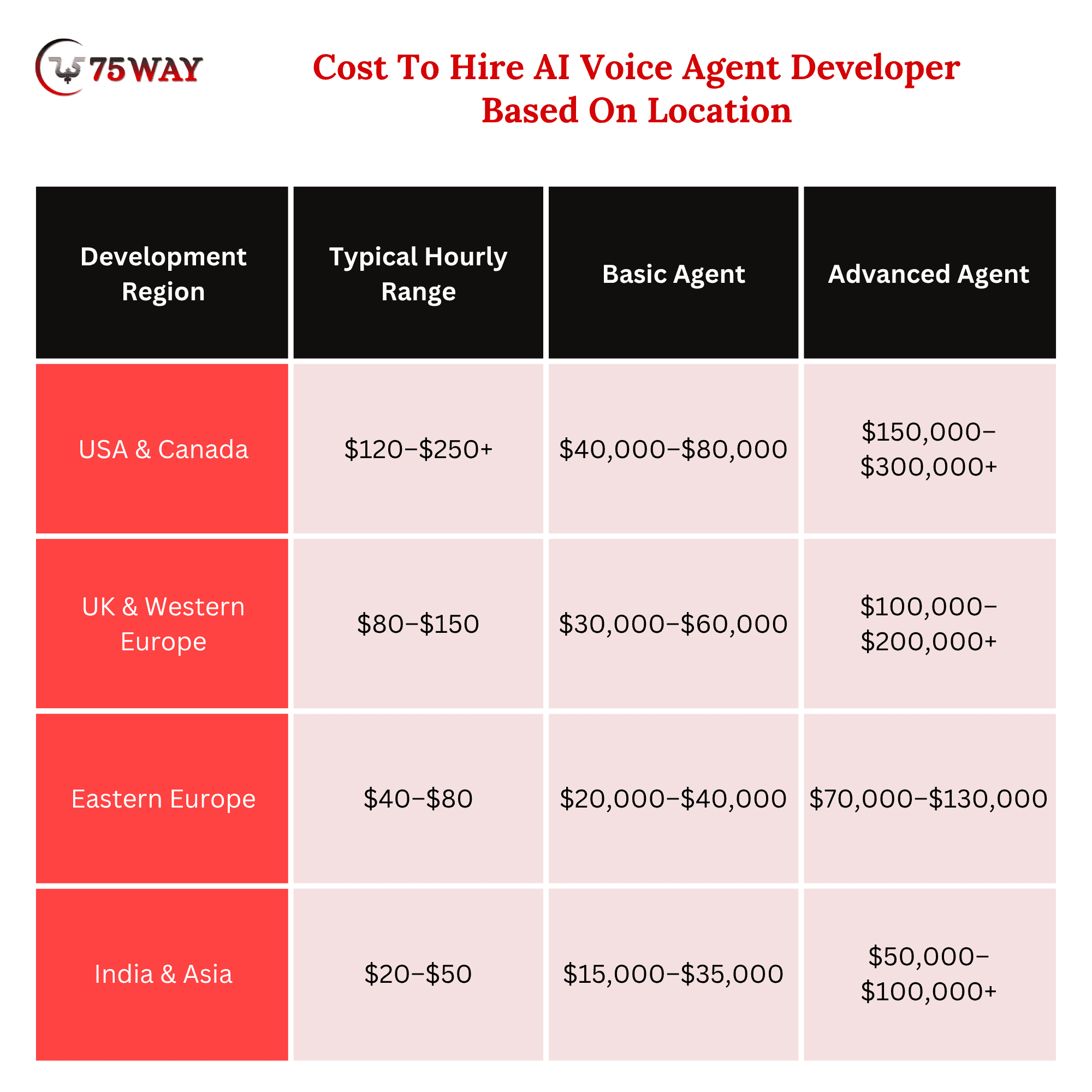
These regional ranges are broad planning benchmarks. A project's actual cost depends on team composition, contract structure, technology, integrations, scope, and post-launch support.
Ongoing Costs of AI Voice Appointment Scheduler After Launch
The initial development budget is not the complete cost of operating an AI voice appointment booking system. Businesses should also account for recurring expenses such as:
- Telephony charges
- Speech-to-text usage
- Text-to-speech usage
- LLM API usage
- Cloud hosting
- Database infrastructure
- SMS and email
- Monitoring tools
- Software subscriptions
- Security maintenance
- Technical support
- Model optimization
- Feature updates
Voice AI agent for appointment scheduling is typically usage-based, so operating costs can increase as call volume grows.
For example, an application processing 500 calls per month will have a very different AI and telephony bill from a platform processing 100,000 calls monthly.
How To Reduce Development Cost of AI Calling Agent for Appointment Scheduling
Founders do not necessarily need to reduce quality to control the initial budget. A better approach is to control scope and prioritize the workflows that directly contribute to appointment automation. A practical cost-control strategy can focus on:
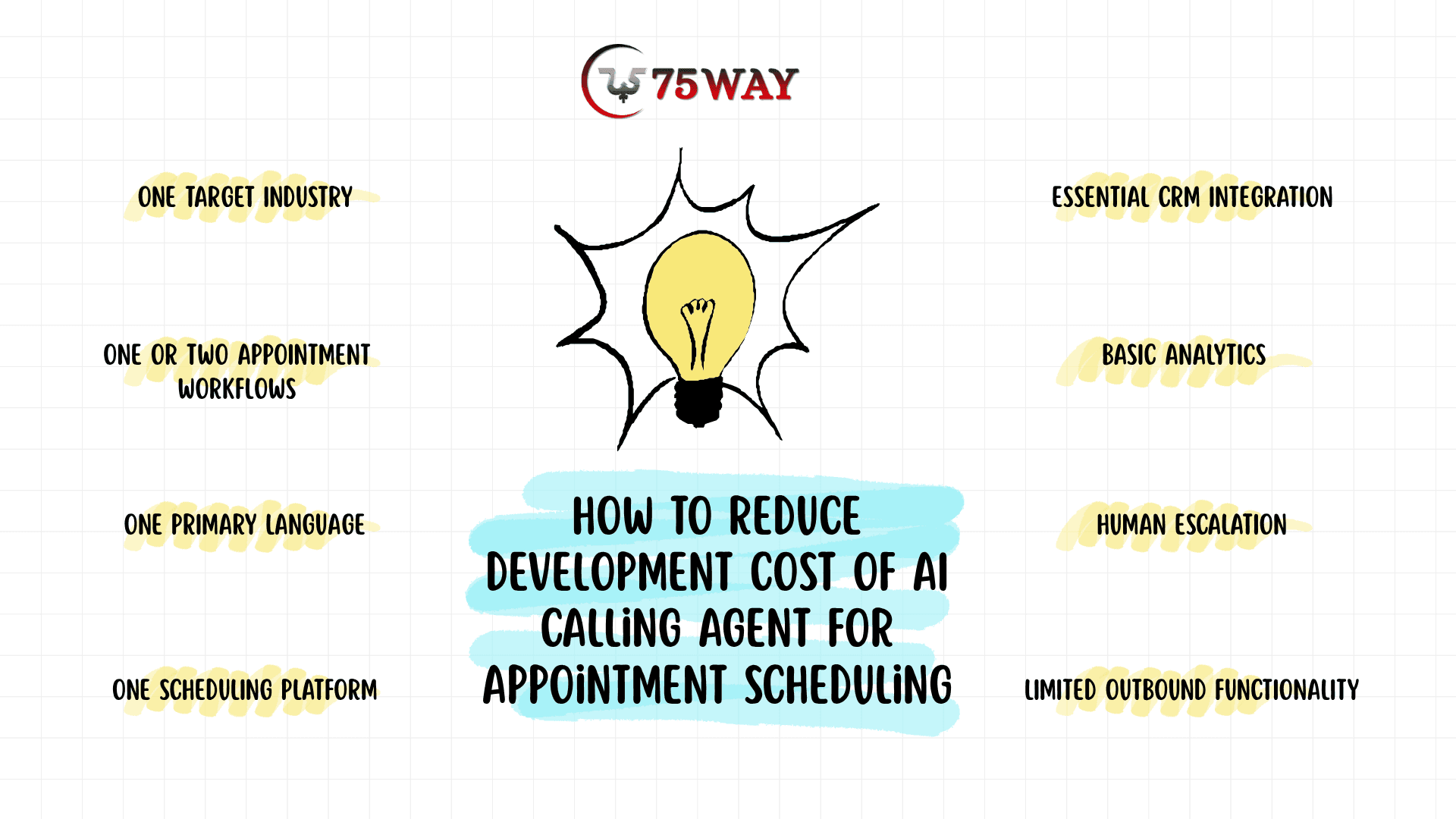
- One target industry: Build the initial agent around one business type instead of supporting multiple industries with different workflows and rules.
- One or two appointment workflows: Prioritize core actions such as booking, rescheduling, or cancellation before expanding into complex automation.
- One primary language: Launch with the language most relevant to the target audience and add multilingual support after validating demand.
- One scheduling platform: Integrate with the booking system your target customers already use instead of developing multiple integrations from day one.
- Essential CRM integration: Connect only the customer-management functions required to support booking records, lead information, and follow-ups.
- Basic analytics: Track practical metrics such as completed bookings, failed conversations, transfers, and call duration before investing in advanced reporting.
- Human escalation: Keep a reliable handoff mechanism instead of attempting to automate every possible customer situation.
- Limited outbound functionality: Begin with essential reminders or follow-ups rather than building large-scale outbound campaigns into the first release.
After measuring real customer interactions, add advanced capabilities based on actual usage patterns and business demand. This makes it easier to identify which investments are producing measurable value and which can remain part of the future roadmap.
Cost Calculator To Estimate Budget While Building AI Voice Assistant For Appointment Booking
A cost calculator helps founders estimate an initial AI voice agent development budget by breaking the project into the major cost drivers. Instead of relying on a single industry-wide figure, you can estimate the investment according to your required features, integrations, platforms, and complexity.
Estimated Development Cost Formula
Estimated Cost = Development Hours × Hourly Rate + Third-Party Integration & Infrastructure Costs
Suppose you are building a mid-level AI voice agent for appointment booking that requires approximately 800 development hours. If your development team's average rate is $75 per hour, the core development cost would be:
800 hours × $75/hour = $60,000
Now add third-party integrations and initial infrastructure, such as telephony, AI APIs, cloud services, calendar integration, CRM connectivity, and testing tools.
For example:
- Development: 800 × $75 = $60,000
- Third-party integrations & initial infrastructure:$10,000
- Estimated project cost:$70,000
Therefore:
Estimated Cost = (800 × $75) + $10,000 = $70,000
This gives the founder a more realistic starting estimate than calculating the project using development hours alone. The actual cost can change based on the number of workflows, integrations, AI models, call volume, security requirements, and development location.
What Can Change Your Estimate?
Your final development budget can move up or down based on:
- Number of AI workflows: Booking alone costs less than booking + cancellation + rescheduling + lead qualification + outbound follow-ups.
- Integrations: Connecting one calendar is simpler than integrating multiple calendars, CRMs, booking platforms, payment systems, and custom APIs.
- Call volume: Higher call volumes can require more robust telephony infrastructure, cloud resources, monitoring, and optimization.
- AI sophistication: A structured conversational agent costs less to develop than a highly personalized agent with complex reasoning and knowledge retrieval.
- Languages and voices: Supporting multiple languages, accents, voices, and custom pronunciation can increase development and testing requirements.
- Security requirements: Handling sensitive customer information may require additional authentication, encryption, access controls, audit logging, and compliance measures.
Factors To Consider Before Developing An AI Phone Answering Agent For Appointment Booking
Building an AI voice agent can automate appointment workflows, but the technology should be selected after understanding the business process it needs to support. A voice agent that works well for a small salon may require a very different architecture from one handling appointments for a multi-location healthcare organization. Before development begins, founders should evaluate the following factors.
1. Define The Primary Appointment Use Case
Start with the specific problem the Voice AI agent needs to solve.
Determine whether the system will primarily handle:
- New appointment bookings
- Rescheduling
- Cancellations
- Appointment confirmations
- Lead qualification
- Customer inquiries
- Outbound reminders
- Missed-call callbacks
Trying to automate every phone interaction from day one can unnecessarily increase development complexity. A focused initial workflow makes it easier to measure whether the product is actually improving booking operations.
2. Understand Your Call Volume
Expected call volume directly affects infrastructure and operating costs.
Consider:
- Calls per day
- Average call duration
- Peak calling periods
- Concurrent calls
- Inbound versus outbound calls
- Seasonal demand
A system handling 100 calls per week has very different infrastructure requirements from one handling thousands of simultaneous customer conversations.
Call volume should therefore be considered during architecture planning rather than after deployment.
3. Evaluate Your Existing Scheduling System
Your Voice AI agent will need access to reliable appointment availability.
Identify where appointments currently live:
- Google Calendar
- Microsoft Outlook
- Calendly
- CRM
- Industry-specific booking software
- Custom scheduling platform
- Internal database
Before development, confirm that the scheduling platform provides the APIs or integration capabilities needed to check availability and create, modify, or cancel appointments.
4. Identify Business-Specific Booking Rules
Every business has different scheduling constraints.
For example:
- Certain services require specific employees.
- New customers may need longer appointments.
- Some services require deposits.
- Certain providers may not work on weekends.
- Different locations may offer different services.
- Some appointments require preparation time.
These rules need to be represented in the business logic so the AI appointment booking agent does not simply offer the first available calendar slot.
5. Plan Human Handoff
Decide which situations should automatically move from AI to a human employee.
Potential escalation scenarios include:
- Complex customer complaints
- Sensitive requests
- Billing issues
- Requests outside the agent's permissions
- Technical problems
- Customer frustration
- Explicit requests for an employee
A clear escalation strategy prevents the AI from continuing conversations it cannot safely or accurately resolve.
6. Choose The Right AI Architecture
Not every appointment workflow needs the most sophisticated AI model.
A simpler system may use structured workflows with AI for natural-language understanding, while a more advanced platform may require an LLM-based conversational architecture with retrieval, tool calling, and multiple specialized agents.
The best architecture is usually the one that provides enough intelligence for the workflow without introducing unnecessary complexity.
7. Consider Voice Quality And Customer Experience
Customers are more likely to abandon a call if the agent speaks too slowly, responds with noticeable delays, repeatedly misunderstands them, or sounds unnatural.
Evaluate:
- Speech recognition accuracy
- Voice quality
- Response latency
- Interruption handling
- Background noise
- Accents
- Speaking speed
- Pronunciation
- Voice personality
The agent should sound professional and remain easy to understand throughout the conversation.
8. Plan Data Privacy And Security
An appointment booking agent may handle names, phone numbers, email addresses, appointment details, and potentially more sensitive information depending on the industry.
Before development, define:
- What information is collected
- Where it is stored
- Who can access it
- How long it is retained
- How it is transmitted
- Which third-party services receive it
- How customers can request deletion where applicable
If the system handles protected or regulated information, obtain appropriate legal and compliance guidance before deployment.
9. Calculate Ongoing AI And Telephony Costs
Development cost is only the initial investment.
A production Voice AI agent may generate recurring costs for:
- Phone calls
- Speech-to-text
- Text-to-speech
- LLM usage
- Cloud hosting
- Databases
- SMS
- Monitoring
- Third-party APIs
Estimate these costs using expected monthly call volume and average call duration.
A system that appears inexpensive to build can become expensive to operate if every conversation uses multiple high-cost AI services.
10. Decide Whether You Need Multilingual Support
If your customers speak multiple languages, decide this before building the conversational architecture.
Multilingual functionality can affect:
- Speech recognition
- Voice generation
- Conversation prompts
- Knowledge bases
- Appointment terminology
- Testing
- Analytics
Supporting additional languages after launch is possible, but planning for multilingual architecture from the beginning can reduce future rework.
11. Define The MVP Before Development Starts
Create a clear distinction between must-have features and future capabilities. A practical MVP might include:
Inbound calls → Intent recognition → Availability check → Booking → Confirmation → Human transfer
Advanced features such as AI personalization, outbound campaigns, multilingual conversations, wearable integrations, and complex analytics can be added after the core workflow has been validated.
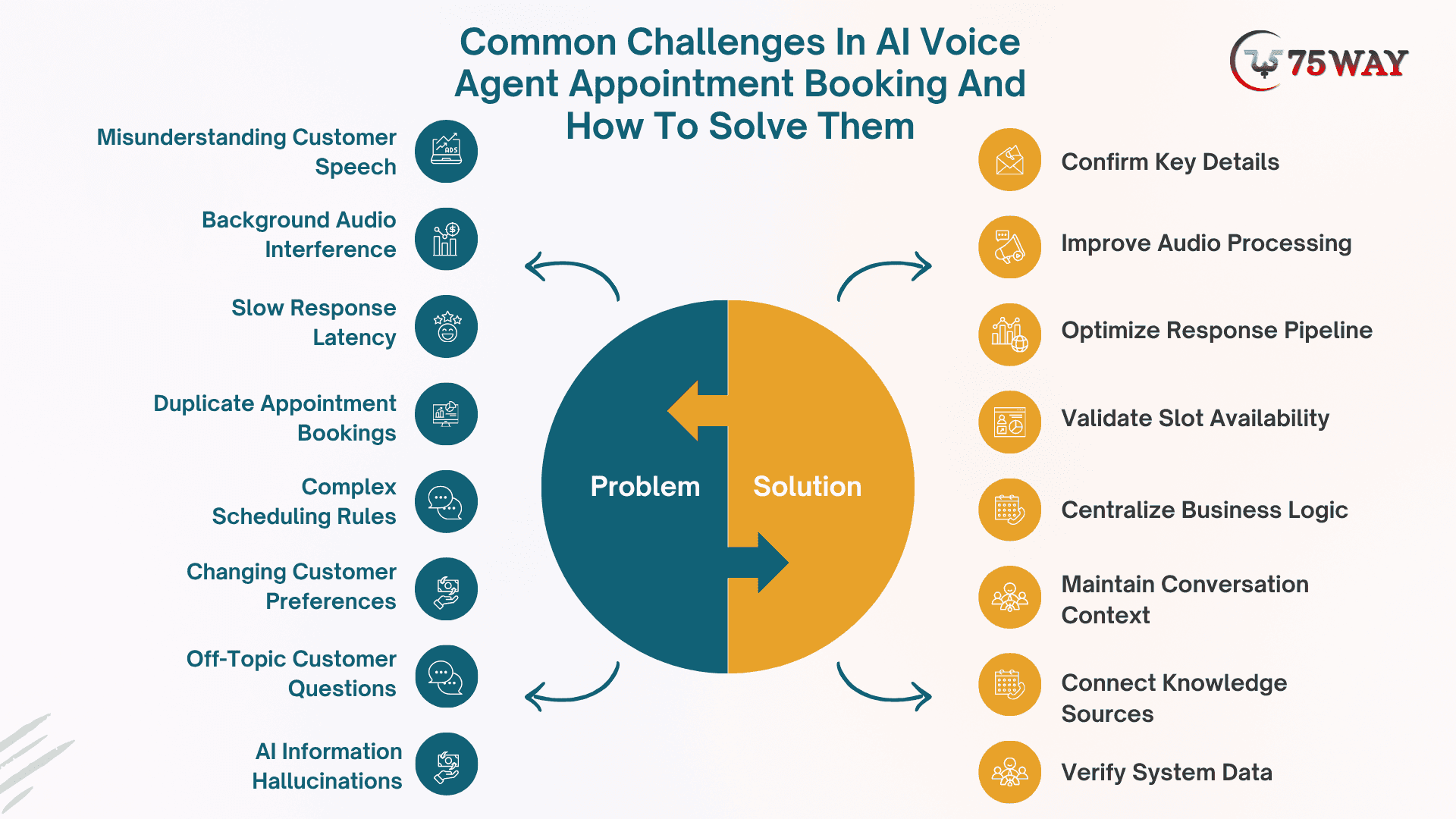
Common Challenges In AI Voice Agent Appointment Booking And How To Solve Them
An AI voice agent for appointment booking can automate repetitive calls, but voice interactions introduce challenges that do not exist in conventional chatbots or web booking forms. Speech recognition errors, interruptions, latency, scheduling conflicts, and unexpected customer requests can all affect the booking experience.
Identifying these issues during development helps businesses create a Voice AI system that is more reliable in real-world conversations.
1. Misunderstanding Customer Speech
Customers rarely speak in perfectly structured sentences. They may use slang, pause frequently, change their mind, or mention several requirements at once.
For example:
“Can I get something around Thursday afternoon, preferably with Sarah, but Friday morning works too.”
A basic system may struggle to extract all these preferences correctly.
Solution: Use robust speech recognition and intent extraction, then confirm important details before taking irreversible actions such as creating or cancelling an appointment.
2. Background Noise And Poor Call Quality
Customers may call from cars, offices, restaurants, airports, or other noisy environments. Poor audio quality can reduce transcription accuracy and cause the agent to misunderstand appointment details.
Solution: Use speech-recognition technology designed for real-world telephone audio, apply appropriate audio processing, and build clarification prompts into the conversation.
Instead of guessing, the agent should say:
“I’m sorry, I didn’t catch the date. Did you say Thursday?”
3. AI Response Latency
Long pauses make voice conversations feel unnatural. The customer may assume the call has disconnected and hang up.
Solution: Optimize the complete pipeline rather than focusing only on the LLM. Streaming speech recognition, efficient API calls, faster model selection, response streaming, and optimized backend infrastructure can help reduce perceived delay.
4. Double Bookings
A serious scheduling problem occurs when the AI offers a slot that another customer books before the conversation is completed.
Solution: Treat the scheduling platform as the source of truth and validate availability again immediately before finalizing the appointment. Where appropriate, implement temporary slot holds or transactional booking logic.
The AI should never rely on a calendar snapshot taken several minutes earlier.
5. Complex Booking Rules
Businesses may have complicated appointment requirements.
For example:
- A consultation requires 60 minutes.
- A follow-up requires 30 minutes.
- Certain services require specific employees.
- Some appointments are available only at certain locations.
- New customers require additional information.
Solution: Keep these rules in a dedicated business-logic layer rather than placing all operational rules inside the AI prompt.
This makes the system easier to maintain and reduces the risk of inconsistent decisions.
6. Customers Changing Their Minds
Voice conversations are dynamic.
A caller may initially request Tuesday, then say:
“Actually, Wednesday would be better.”
The agent needs to update the conversation state instead of continuing with the original assumption.
Solution: Design the conversation engine to maintain context and allow customers to modify previously provided information without restarting the call.
7. Customers Asking Questions Outside The Booking Flow
A caller might ask about pricing, services, operating hours, parking, cancellation policies, or other business information before deciding whether to book.
Solution: Connect the Voice AI agent to an approved knowledge base containing current business information.
For information that changes frequently, the system should retrieve current data rather than relying on outdated static responses.
8. Hallucinated Information
An AI model may sometimes generate information that sounds plausible but is not supported by the company's actual data.
For an appointment agent, this can be particularly damaging.
The system should never invent:
- Appointment availability
- Prices
- Business policies
- Staff schedules
- Customer records
- Services
- Appointment confirmations
Solution: Use controlled tool calling, retrieval, business rules, and validation for factual or transactional responses. Critical actions should depend on verified system data rather than model-generated assumptions.
Final Thoughts
An AI voice agent for appointment booking can turn routine phone conversations into an automated, always-available booking channel. From natural language understanding and real-time scheduling to CRM integration, reminders, analytics, and human handoff, each component contributes to a dependable customer experience.
The development process should begin with a focused use case, then expand through validated workflows, secure integrations, testing, and continuous optimization. With the right architecture, an appointment voice agent can reduce manual workload while creating more opportunities to capture and convert callers. To build your AI voice agent for appointment scheduling, contact a leading AI voice agent development company to turn your appointment workflow into a scalable voice automation solution.
Frequently Asked Questions (FAQs)
Can an AI Voice Agent Connect With Existing Calendars And Booking Systems?
Yes. It can integrate with platforms such as Google Calendar, Microsoft Outlook, Calendly, CRMs, and custom scheduling systems through APIs or supported integrations.
Can a Voice AI Agent Reschedule And Cancel Appointments?
Yes. With appropriate scheduling integrations and business rules, the agent can locate existing bookings, find alternative availability, reschedule appointments, and process permitted cancellations.
Can an AI Voice Agent Transfer Calls To Human Employees?
Yes. Human handoff can be configured for complex requests, customer complaints, sensitive situations, unavailable services, or callers who specifically request an employee.
Can AI Voice Agents Make Outbound Appointment Calls?
Yes. They can support outbound workflows such as appointment reminders, confirmations, missed-call callbacks, follow-ups, and lead re-engagement, subject to applicable calling and consent requirements.
Can an AI Voice Agent Support Multiple Languages?
Yes. Multilingual Voice AI agents can support multiple languages and voices when the selected speech recognition and text-to-speech technologies provide adequate language coverage and accuracy.
Can an AI Voice Agent Integrate With A CRM?
Yes. Integrations with platforms such as Salesforce, HubSpot, and Zoho can allow the system to update customer records, appointment information, lead status, and conversation outcomes.