AI Summary
Build an Instagram clone from scratch with the right features, technology, architecture, and development plan. This guide explains how to plan, design, develop, test, launch, and scale an Instagram-like application successfully.
Key Takeaways
- Instagram clone development needs scalable social features, media processing, and personalized user experiences.
- Instagram clone app development cost ranges from $30,000–$450,000+, depending on needs.
- Development starts with market research, product scope, user flows, architecture, and design.
- A scalable technology stack handles media, feeds, messaging, notifications, analytics, and security.
- Successful Instagram-like apps differentiate through niche positioning, personalization, communities, and unique experiences.
What Is An Instagram Clone App?
An Instagram clone app is a social media application built around core experiences similar to Instagram, such as profile creation, photo and video sharing, feeds, likes, comments, Stories, messaging, search, and social discovery. It does not need to reproduce every feature of Instagram. Instead, founders can select the capabilities that fit their target audience, business model, and product strategy.
The term Instagram clone can therefore describe different product scopes:
- A basic photo-sharing MVP
- A niche social networking app
- A creator-focused platform
- A short-form video and social app
- A community-based visual network
- A full-scale Instagram-like social platform
The distinction matters because the product scope directly affects development cost, architecture, timeline, infrastructure, and ongoing operating expenses.
For example, a startup validating a niche social network may only need user profiles, a personalized feed, media uploads, likes, comments, follows, notifications, and basic moderation.
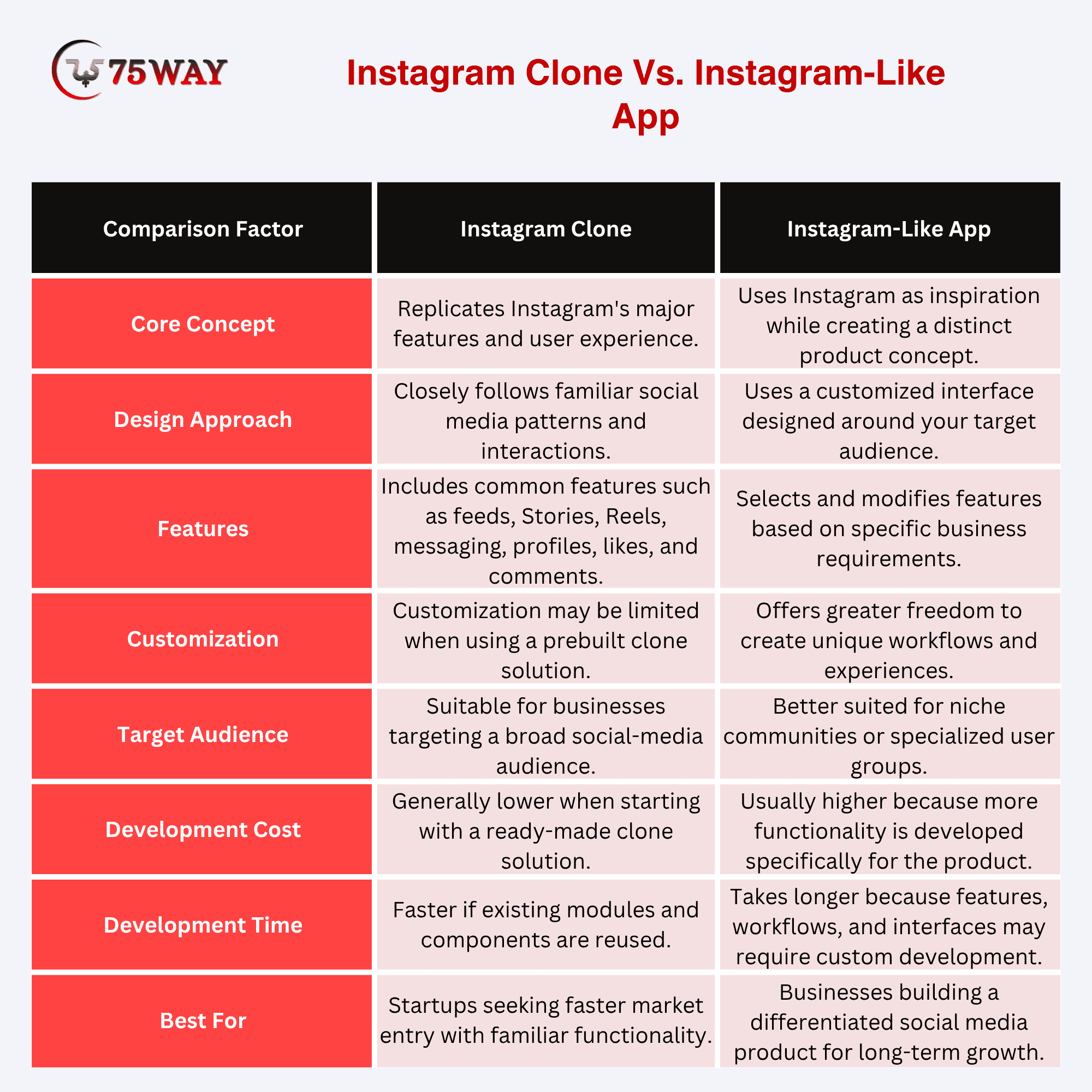
Instagram Clone Vs. Instagram-Like App: Key Differences
These terms are often used interchangeably, but there is an important product distinction. An Instagram clone generally means an application that reproduces a similar core social experience. An Instagram-like app can use similar interaction patterns while introducing a distinct value proposition, audience, or feature set.
For a new business, the second approach is usually more strategically useful.
Instead of asking:
“How can we copy Instagram?”
A better product question is:
“Which Instagram experiences solve a problem for our specific audience, and what can we do differently?”
For example, a founder could build a visual social platform specifically for photographers, independent fashion brands, local creators, food communities, travelers, or professional networks.
This creates a more defensible product than simply reproducing an existing social network.
Social Media App-Like Instagram Market Size & Revenue Growth in USA
The interesting part of building an Instagram-like app is not copying Instagram. It is identifying what the next generation of users, creators, and advertisers may want differently. The U.S. market outlook below explores how large that opportunity can become and where revenue can come from.
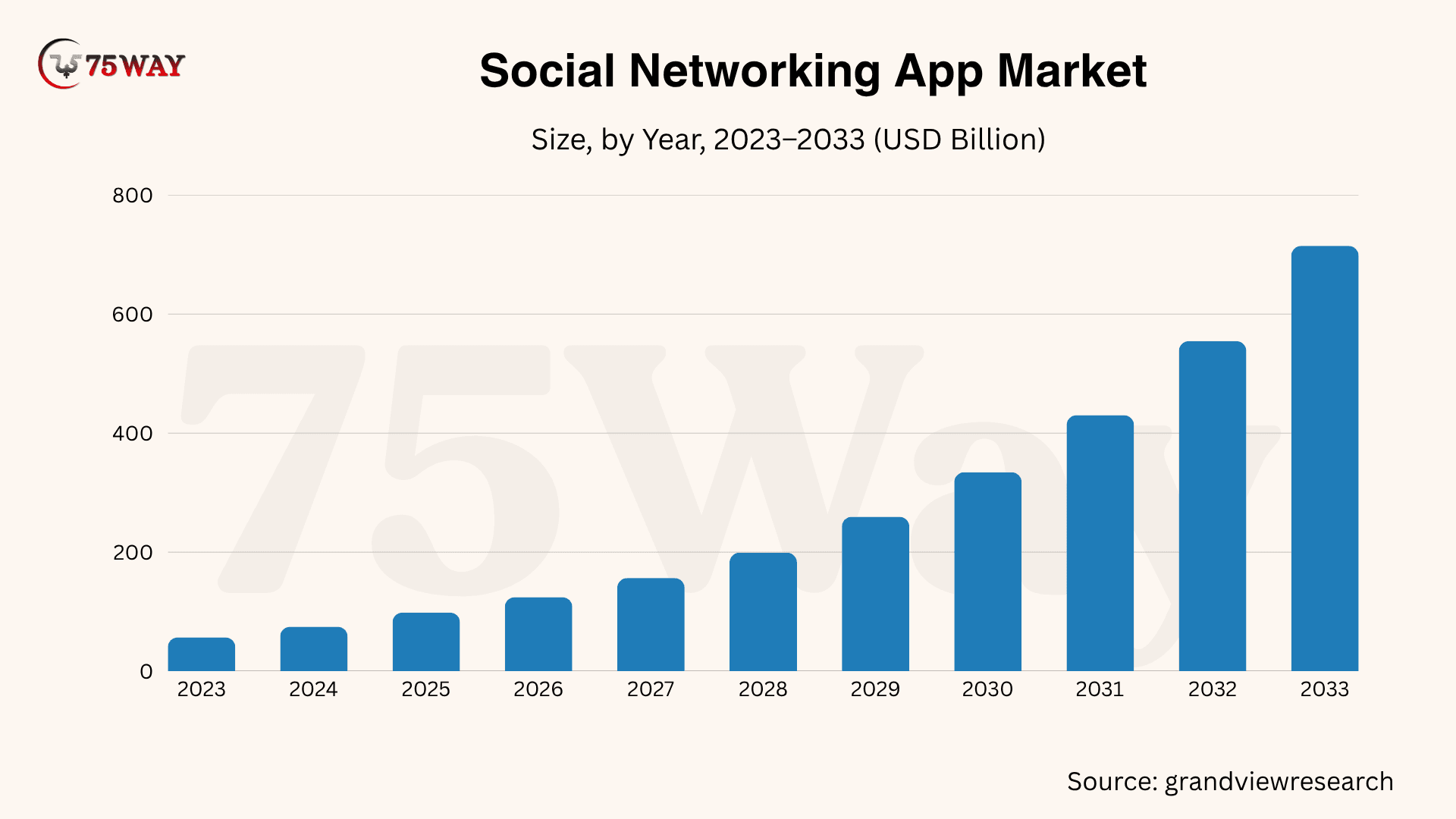
- The global social networking app market is projected to grow from $124.4 billion in 2026 to $714.6 billion by 2033, at a CAGR of 28.4%.
- Another forecast estimates the market will reach $339.76 billion by 2030, growing from $126.3 billion in 2026 at a CAGR of 28.1%.
- Instagram generated an estimated $83.6 billion in revenue, up from approximately $66.9 billion the previous year.
- The United States is among Instagram's largest markets, with approximately 170–180 million users.
- More than 60% of Instagram users are under 35, with the 25–34 age group representing the largest segment.
- Instagram has an estimated 3 billion monthly active users, including more than 2.2 billion daily active users.
Key Features To Build An Instagram Clone
The feature list for an Instagram clone should start with user behavior, not with a checklist copied from another platform. Posting, stories, messaging, discovery, creator tools, and engagement features each need to serve a clear purpose within your product. The core capabilities to consider are explained below.
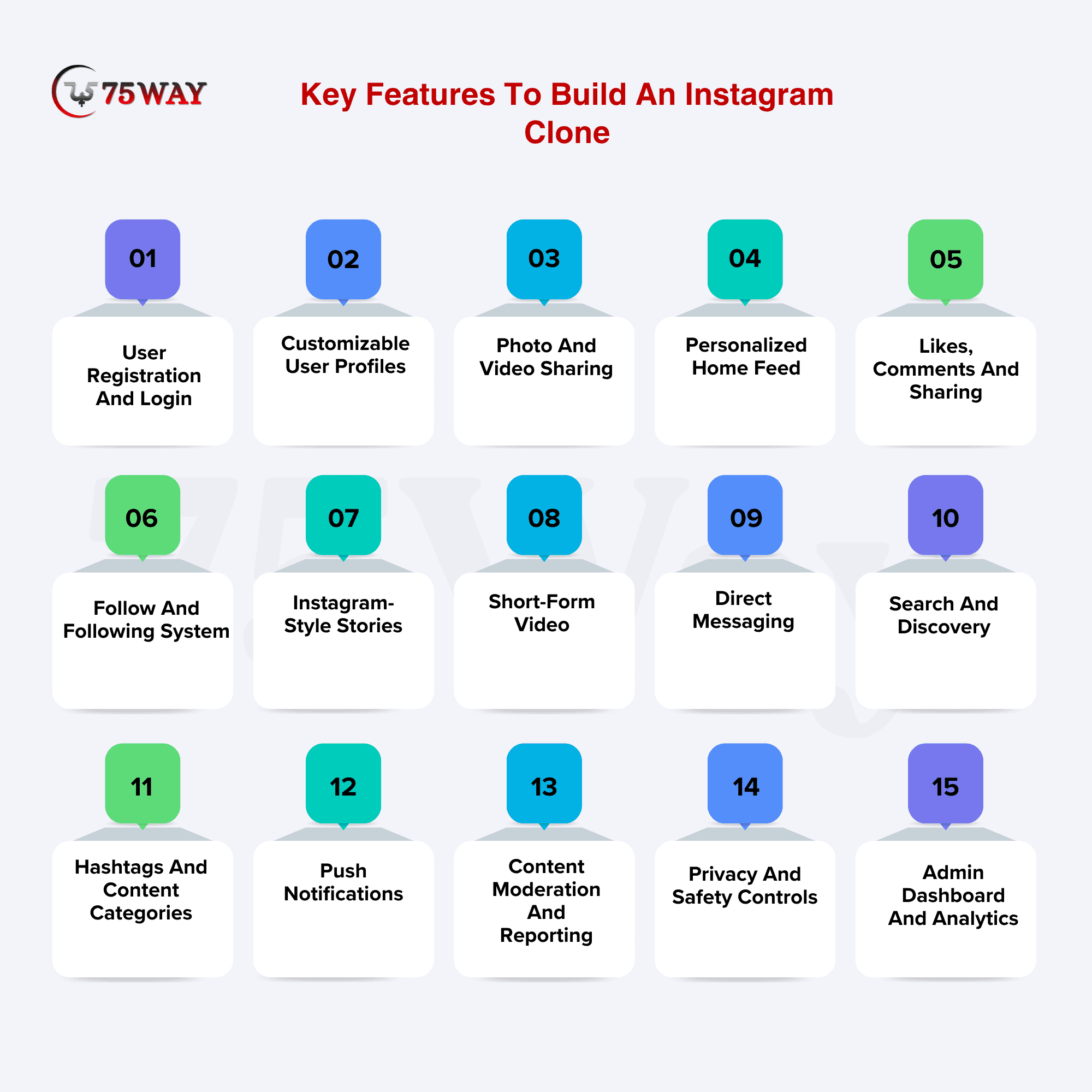
- User Registration And Login: Nobody wants to fill out a long form just to explore a new social app. Keep sign-up quick with email, phone, OTP, or social login. Secure sessions and recovery options keep account access simple and safe.
- Customizable User Profiles: A good profile should tell people who you are before they scroll through your posts. Let users add a photo, bio, links, follower details, and account type. Privacy settings can give them control over what others see.
- Photo And Video Sharing: Posting should feel as natural as taking the photo itself. Users can upload photos or videos, add captions, tags, locations, hashtags, filters, and edits before sharing. Automatic media optimization keeps posts looking good across different devices.
- Personalized Home Feed: Opening the app should immediately show content users actually care about. The feed can learn from follows, likes, comments, saves, watch time, and previous interactions. As the platform grows, smarter ranking can make every scroll more relevant.
- Likes, Comments And Sharing: Social apps come alive when people can react to what they see. Let users like posts, leave comments, reply to conversations, save content, and share interesting posts. These interactions also provide useful signals for improving recommendations.
- Follow And Following System: Users need an easy way to build their own social circle. They can follow creators, friends, brands, or communities and manage requests, followers, blocks, and restrictions. These connections also shape what appears in their feeds.
- Instagram-Style Stories: Stories give users a quick way to share moments without adding another permanent post to their profile. Support photos, videos, music, stickers, polls, questions, mentions, and audience controls. Temporary content can encourage users to open the app and share more often.
- Short-Form Video: Short videos can turn passive scrolling into a highly engaging discovery experience. Users can record, trim, edit, add music, captions, filters, and effects before publishing. A recommendation layer can then surface videos based on viewing behavior and interests.
- Direct Messaging: Sometimes a public comment is not enough, and users need a private space to continue the conversation. Support text, images, videos, emojis, message requests, and read status in the initial version. Group chats, voice messages, and reactions can be added as usage grows.
- Search And Discovery: Users should be able to find the people, creators, topics, and content they are looking for within seconds. Search can cover usernames, hashtags, locations, keywords, and categories. Autocomplete and relevant ranking can make discovery feel faster and more intuitive.
- Hashtags And Content Categories: Hashtags help users connect their posts with conversations already happening across the platform. Let users add relevant hashtags while the system organizes content into useful categories. These signals can improve both search results and personalized recommendations.
- Push Notifications: A timely notification can bring a user back when something genuinely relevant happens. Alerts can cover likes, comments, followers, messages, mentions, story interactions, and security events. Flexible notification controls should let users decide what deserves their attention.
- Content Moderation And Reporting: A growing social platform needs safeguards that protect users from spam, harassment, impersonation, inappropriate content, and other abuse. Users should have straightforward reporting options, while administrators can review flagged content and take appropriate action. AI-assisted moderation can support larger volumes when paired with suitable human oversight.
- Privacy And Safety Controls: Users should never feel that they have lost control over their account after joining a social platform. Give them options for private profiles, comment permissions, message requests, mentions, tags, blocking, restrictions, and login activity. Clear privacy controls can make the platform feel safer and more trustworthy.
- Admin Dashboard And Analytics: Behind every active social platform is an administrative layer keeping an eye on users, content, reports, engagement, and platform health. Administrators can manage accounts, moderate content, review reports, and monitor key metrics from one place. Creator and business analytics can later reveal reach, engagement, follower growth, and content performance.
Innovative Features To Include in AI-Powered Instagram-Like App Development
Copying familiar social features can give you an Instagram-like foundation, but AI can create a reason for users to experience the platform differently. The right AI features in Instagram-like app development can help creators produce content, help users discover relevant posts, and help businesses understand audience behavior. The AI-driven features that can add that differentiation are covered below.
1. AI-Powered Content Recommendations: An AI recommendation engine can analyze user behavior, including likes, follows, watch time, searches, shares, and saves, to personalize the home feed and discovery experience.
2. AI Caption Generator: Users can provide a short idea, image, or context, and AI can generate caption suggestions in different tones. Creators can edit the suggestions before publishing rather than starting every caption from scratch.
3. AI Image And Video Editing: AI-powered editing can automatically improve images and videos through background removal, object cleanup, lighting adjustments, enhancement, resizing, and other creative effects.
4. AI Content Moderation: AI can scan uploaded images, videos, comments, and text for potentially harmful or policy-violating content. Flagged content can then move into predefined moderation workflows or human review.
5. AI-Powered Visual Search: Users could search using images or natural-language descriptions rather than relying only on usernames and hashtags.
For example:
“Show me minimalist home interiors.”
The system can identify relevant visual content and return semantically related posts.
6. AI Hashtag And Content Suggestions: AI can analyze a post and suggest relevant hashtags, categories, keywords, captions, or topics. This can help creators organize content and potentially improve discovery within the platform.
7. AI Creator Assistant: A built-in AI assistant can help creators brainstorm content ideas, generate post concepts, develop captions, summarize performance data, and suggest potential content themes based on audience engagement.
8. AI-Powered Personalized Notifications: Instead of sending users every possible notification, AI can prioritize potentially relevant interactions based on user behavior and engagement patterns.
For example, the system could identify meaningful activity from frequently interacted-with creators while reducing unnecessary alerts.
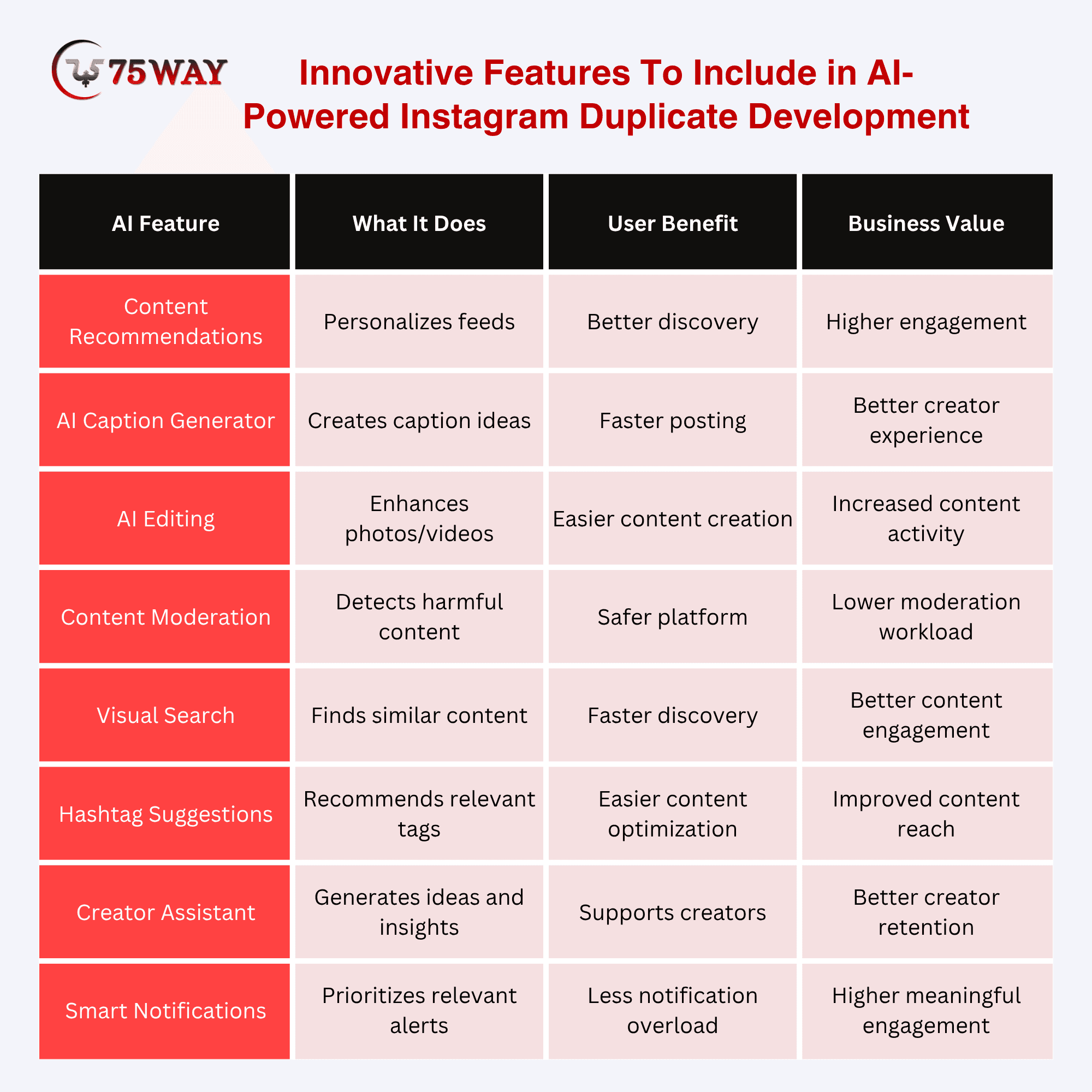
For an Instagram-like app, AI becomes most valuable when it improves a measurable part of the user experience, discovery, creation, moderation, personalization, or retention, rather than simply adding an AI label to conventional social features.
How To Build An Instagram Clone: Step-By-Step Process
An Instagram-like platform is a chain of product and technology decisions where one choice can affect everything that follows. Your audience, content model, features, architecture, AI capabilities, and scalability all need to fit together from the beginning. The connected stages below show how to approach that journey.
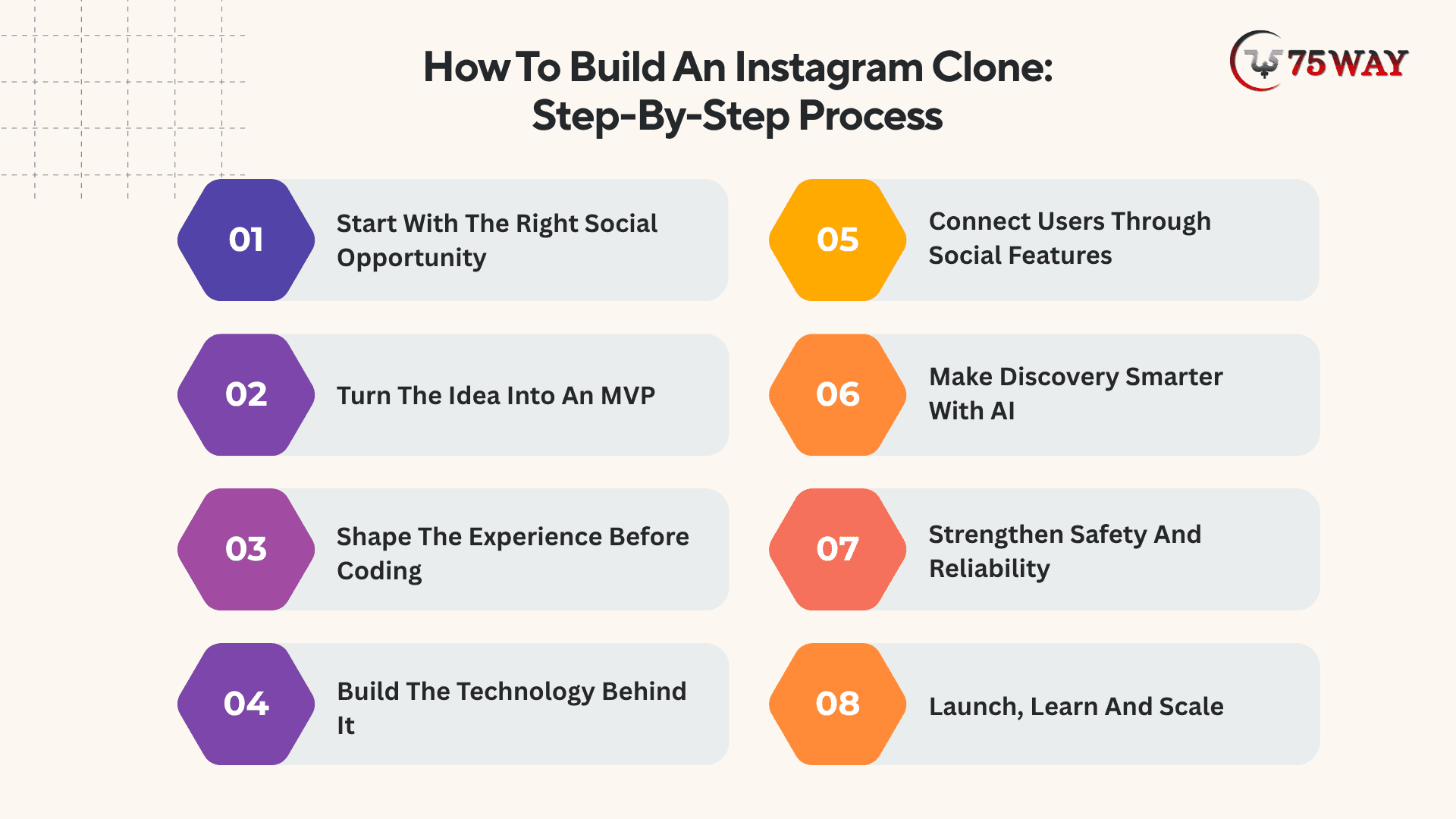
1. Start With The Right Social Opportunity
Before designing screens or writing code, identify the audience, content niche, and problem your platform will solve. These decisions become the foundation for your feature scope, user journeys, design direction, and monetization strategy.
- Research your target audience.
- Identify underserved content communities.
- Study competitor strengths and weaknesses.
- Define your platform's unique proposition.
- Validate the opportunity before development.
2. Turn The Idea Into An MVP
Once the opportunity is clear, translate it into a focused product scope. Select only the features needed to deliver that initial experience, giving developers a clear roadmap without prematurely expanding the Instagram clone app development cost.
- Define essential user journeys.
- Prioritize core social features.
- Separate MVP from advanced features.
- Estimate development requirements early.
- Create a practical product roadmap.
3. Shape The Experience Before Coding
With the feature scope established, design how users will actually move through the application. Map onboarding, content discovery, posting, engagement, profiles, and notifications before creating polished interfaces and development-ready designs.
- Map complete user journeys.
- Create wireframes for core screens.
- Design intuitive navigation structures.
- Develop distinctive visual branding.
- Validate prototypes with target users.
4. Build The Technology Behind It
Once the experience is mapped, choose technologies capable of supporting those workflows. The selected mobile framework, backend, database, cloud infrastructure, storage, and CDN should reflect expected users, media volume, performance requirements, and future scalability.
- Select suitable mobile technologies.
- Design scalable backend services.
- Configure database architecture carefully.
- Establish secure media storage.
- Prepare reliable content delivery.
5. Connect Users Through Social Features
With the technical foundation ready, build the features that turn the application into a social network. Profiles, follows, posts, feeds, likes, comments, saves, search, hashtags, and notifications should operate as connected parts of one experience.
- Develop account and profile systems.
- Connect users through following.
- Build personalized content feeds.
- Add meaningful engagement features.
- Connect notifications with interactions.
6. Make Discovery Smarter With AI
After users begin creating and interacting with content, the platform can use those signals to make discovery more relevant. AI can support recommendations, moderation, visual search, caption assistance, and creator tools without becoming the product's only differentiator.
- Analyze meaningful user interactions.
- Personalize content recommendations intelligently.
- Support scalable content moderation.
- Improve discovery through visual search.
- Assist creators with useful automation.
7. Strengthen Safety And Reliability
As social activity grows, protecting users and maintaining platform reliability becomes increasingly important. Test the complete experience across devices, network conditions, media workloads, privacy scenarios, moderation cases, and unexpected system failures before wider release.
- Test critical user journeys thoroughly.
- Validate large-media performance.
- Strengthen authentication and authorization.
- Review privacy and moderation controls.
- Simulate real-world technical failures.
8. Launch, Learn, And Scale
After testing, release the MVP to a controlled audience and observe how people actually use it. Their engagement patterns, retention, content behavior, complaints, and feature requests should determine what you improve, expand, or scale next.
- Launch with a focused audience.
- Track engagement and retention closely.
- Analyze real content behavior.
- Prioritize validated product improvements.
- Scale infrastructure alongside demand.
Technology Stack & Tools to Build The Best Instagram Clone App
The technology stack for an Instagram clone app should be selected around media volume, expected users, real-time interactions, recommendation requirements, security, and future scalability. There is no single “best” stack for every Instagram-like application. A startup MVP may need a leaner architecture, while a large social platform requires more specialized infrastructure for video, feeds, search, and real-time communication.
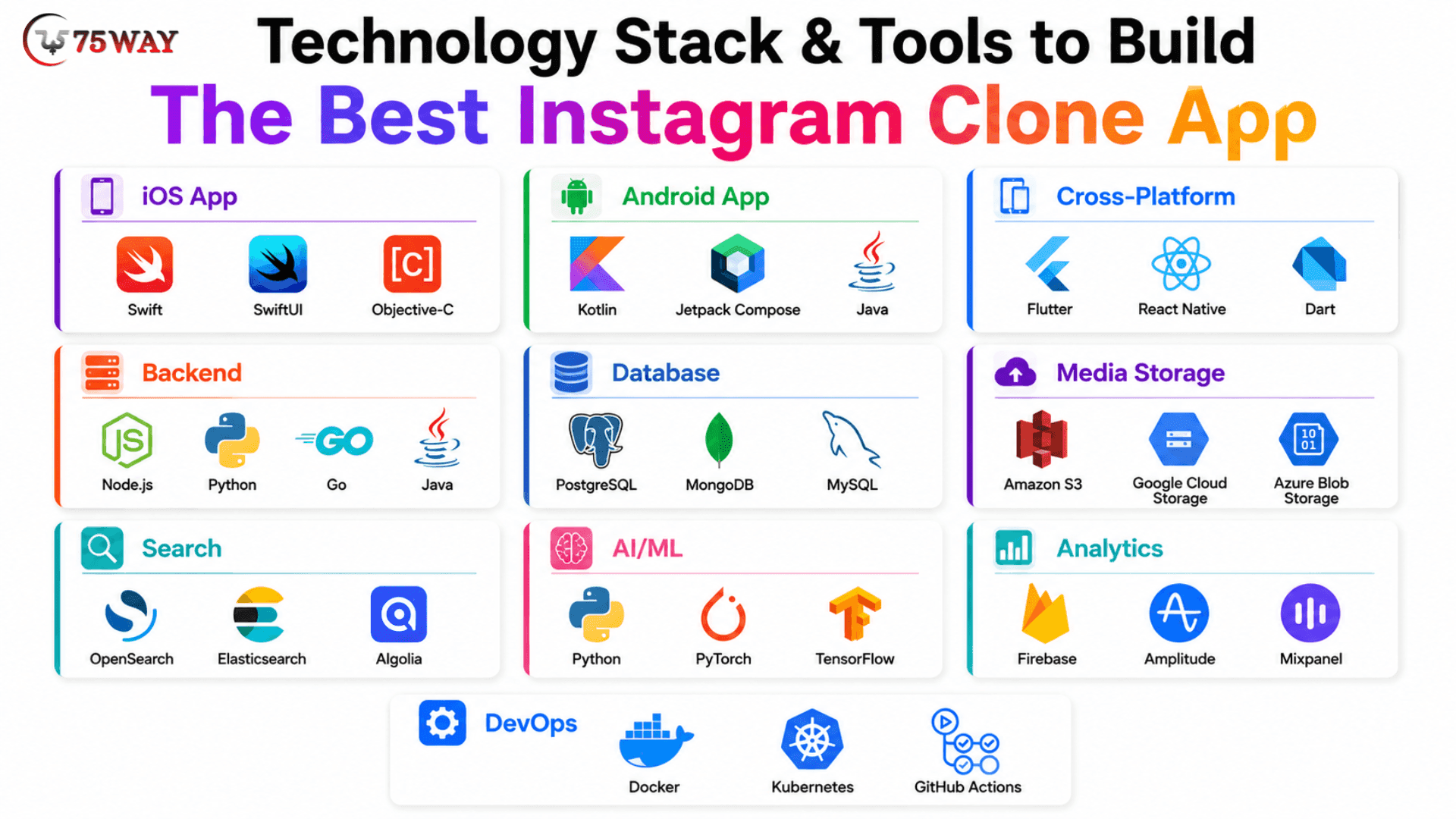
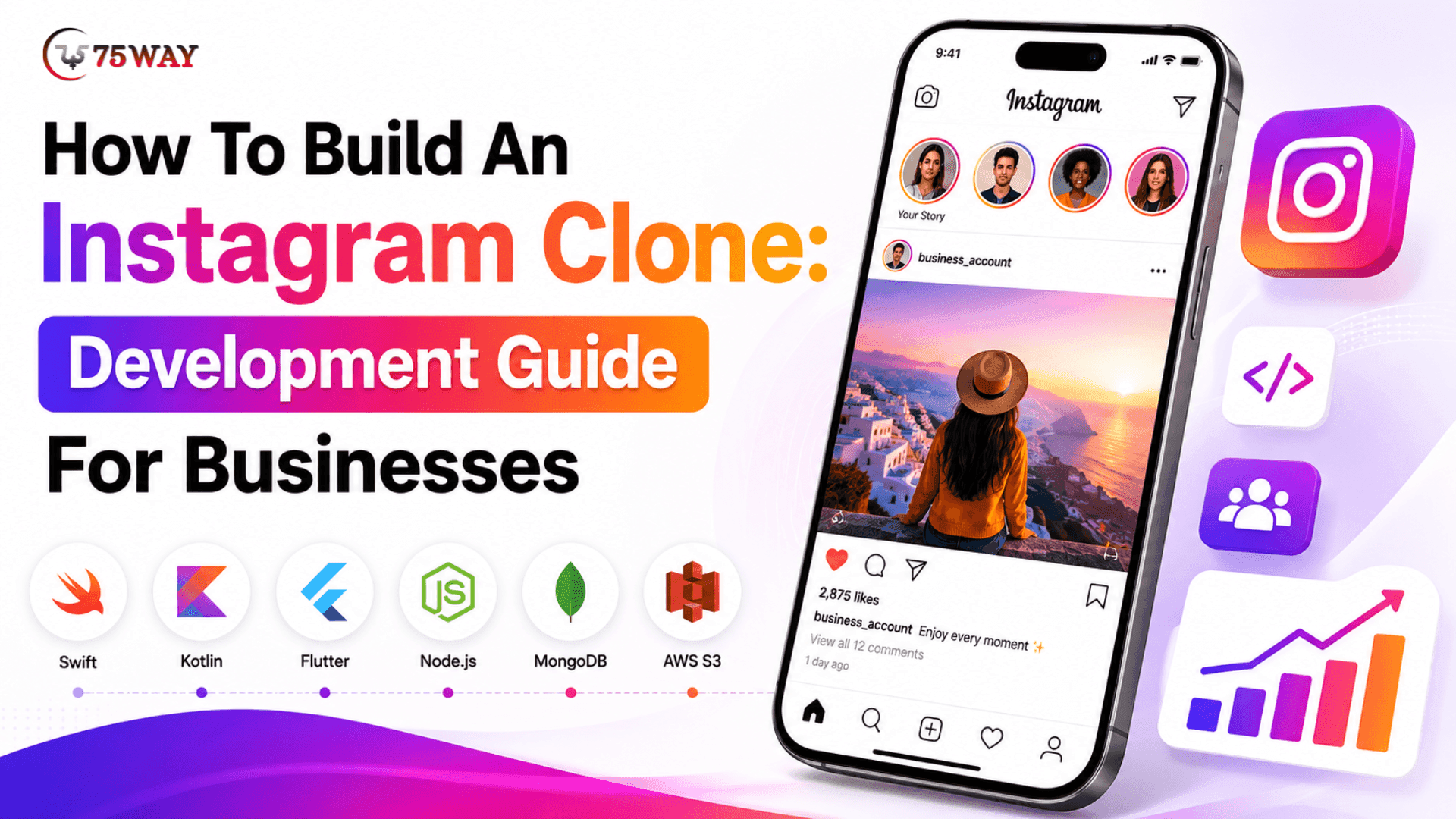
- iOS App: Swift, SwiftUI, Objective-C
Native technologies for building responsive iPhone and iPad experiences.
- Android App: Kotlin, Jetpack Compose, Java
Reliable technologies for creating modern Android applications and interfaces.
- Cross-Platform: Flutter, React Native, Dart
Useful for developing iOS and Android apps from a shared codebase.
- Backend: Node.js, Python, Go, Java
Powers APIs, authentication, user management, feeds, and core application logic.
- Database: PostgreSQL, MongoDB, MySQL
Stores user profiles, posts, relationships, engagement data, and platform records.
- Cache: Redis, Memcached
Speeds up frequently requested data and reduces database workload.
- Cloud: AWS, Google Cloud, Microsoft Azure
Provides scalable infrastructure for hosting, computing, storage, and application services.
- Media Storage: Amazon S3, Google Cloud Storage, Azure Blob Storage
Handles large volumes of photos, videos, thumbnails, and other uploaded media.
- CDN: CloudFront, Cloudflare, Fastly
Delivers images and videos quickly across different geographic locations.
- Search: OpenSearch, Elasticsearch, Algolia
Helps users discover profiles, hashtags, keywords, and other searchable content.
- Real-Time: WebSockets, Socket.IO, Firebase Realtime Database
Supports instant messaging, live updates, typing indicators, and real-time interactions.
- Notifications: Firebase Cloud Messaging, APNs, OneSignal
Keeps users updated about messages, likes, comments, follows, and other activity.
- AI/ML: Python, PyTorch, TensorFlow
Supports recommendations, moderation, personalization, image analysis, and creator-focused AI features.
- Analytics: Firebase, Amplitude, Mixpanel
Tracks engagement, retention, conversions, feature usage, and overall product performance.
- DevOps: Docker, Kubernetes, GitHub Actions
Automates deployment, infrastructure management, testing, and application delivery workflows.
How To Choose Tech Stack To Build An App Like Instagram
Your technology decisions should follow the product requirements.
For a startup MVP: Flutter/React Native + Node.js/Python + PostgreSQL + cloud storage + CDN can provide a practical foundation.
For a growing social platform: Add Redis, dedicated search, asynchronous processing, scalable media infrastructure, observability, and more specialized services as traffic increases.
For an advanced Instagram-like platform: A service-oriented architecture may become appropriate for high-volume messaging, recommendation systems, video processing, advertising, analytics, and other independent workloads.
The goal is to build an Instagram clone with enough technical capability for expected growth without overengineering the MVP. Starting with a maintainable architecture and evolving it based on actual traffic is often more cost-effective than building enterprise-scale infrastructure before product-market fit.
How Much Does It Cost To Build An Instagram Clone?
The Instagram clone app development cost ranges from $30,000 to $450,000+, depending on the product scope, number of platforms, feature complexity, media infrastructure, AI capabilities, integrations, development location, and scalability requirements.
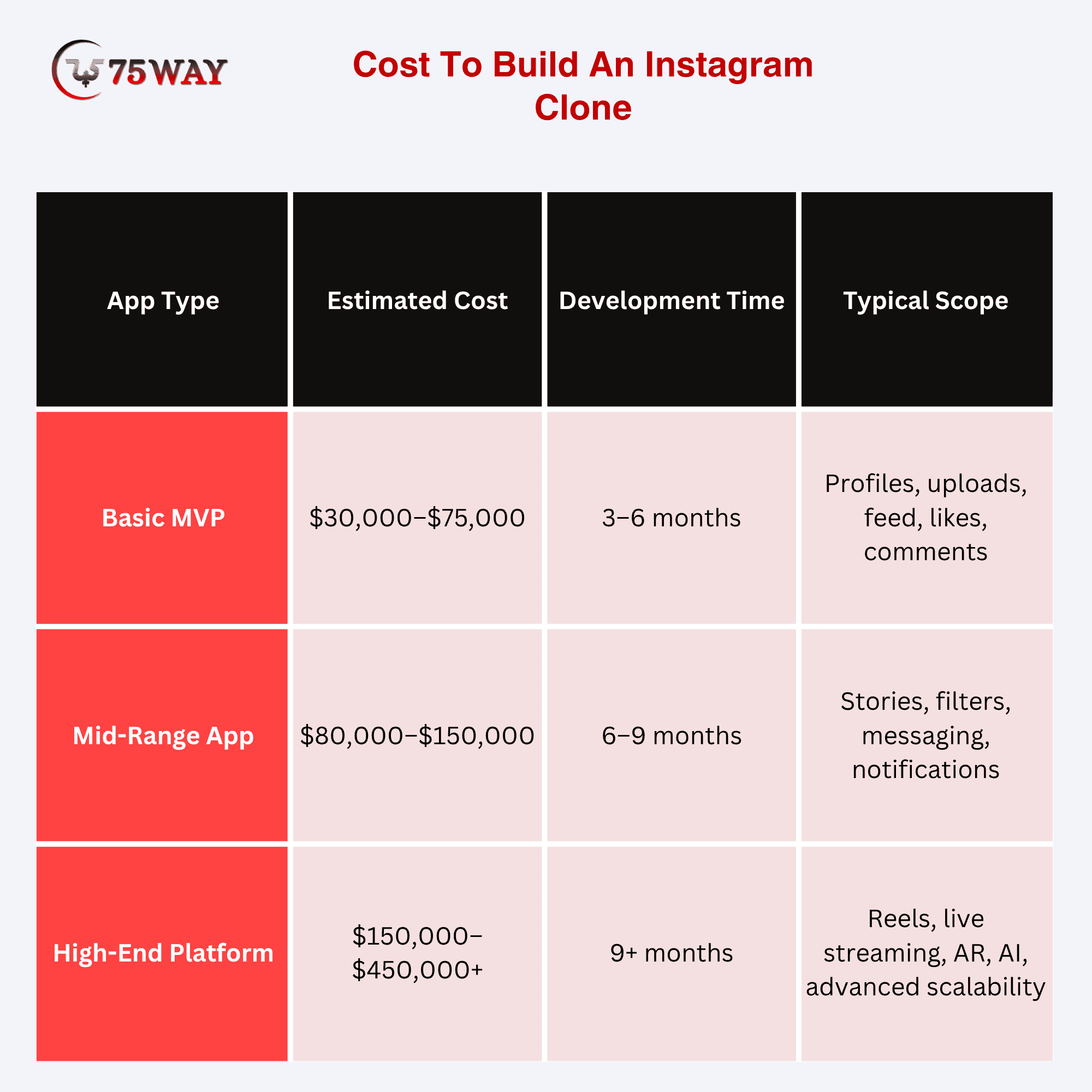
Planning Takeaway: Start with the smallest feature set that can validate your audience and engagement model before funding advanced capabilities.
Development Stage-Wise Cost To Build An App Like Instagram
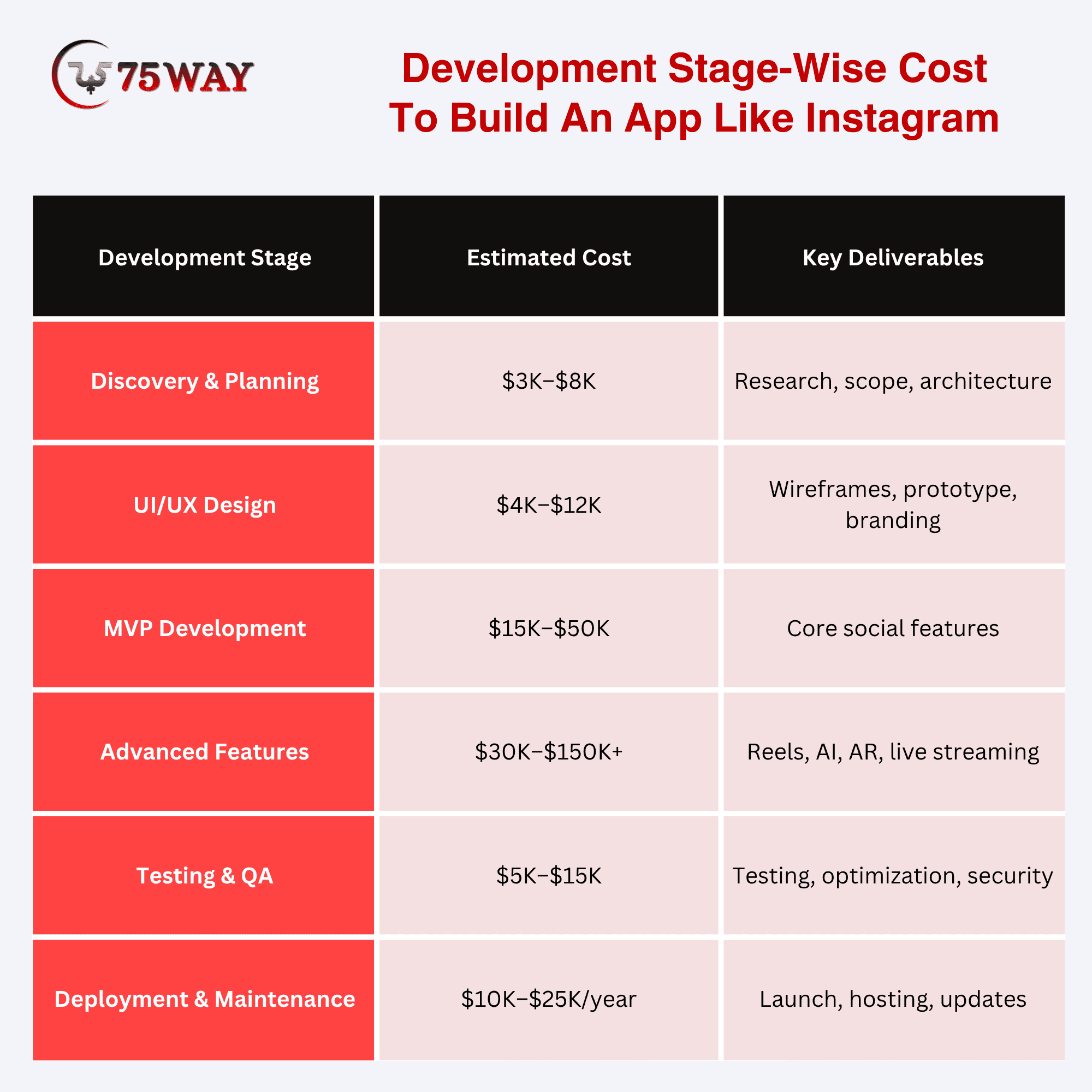
The cost to build an app like Instagram is distributed across several development stages, from initial product discovery to post-launch maintenance. Understanding each stage helps founders identify where their budget is going and decide which capabilities should be included in the MVP versus later releases.
- Discovery And Planning: $3,000–$8,000
Research, feature planning, technical architecture, user journeys, competitor analysis, and development roadmap.
- UI/UX Design: $4,000–$12,000
Wireframes, prototypes, navigation, visual identity, responsive interfaces, and engaging social interaction experiences.
- MVP Development: $15,000–$50,000
Authentication, profiles, media uploads, feeds, follows, likes, comments, search, notifications, and core backend functionality.
- Advanced Feature Integration: $30,000–$150,000+
Stories, Reels, messaging, live streaming, AR filters, AI recommendations, personalization, analytics, and advanced moderation.
- Testing And Quality Assurance: $5,000–$15,000
Functional, performance, security, compatibility, API, media, messaging, and usability testing across supported devices.
- Deployment And Maintenance: $10,000–$25,000/year
App deployment, cloud infrastructure, media storage, monitoring, security updates, bug fixes, optimization, and ongoing improvements.
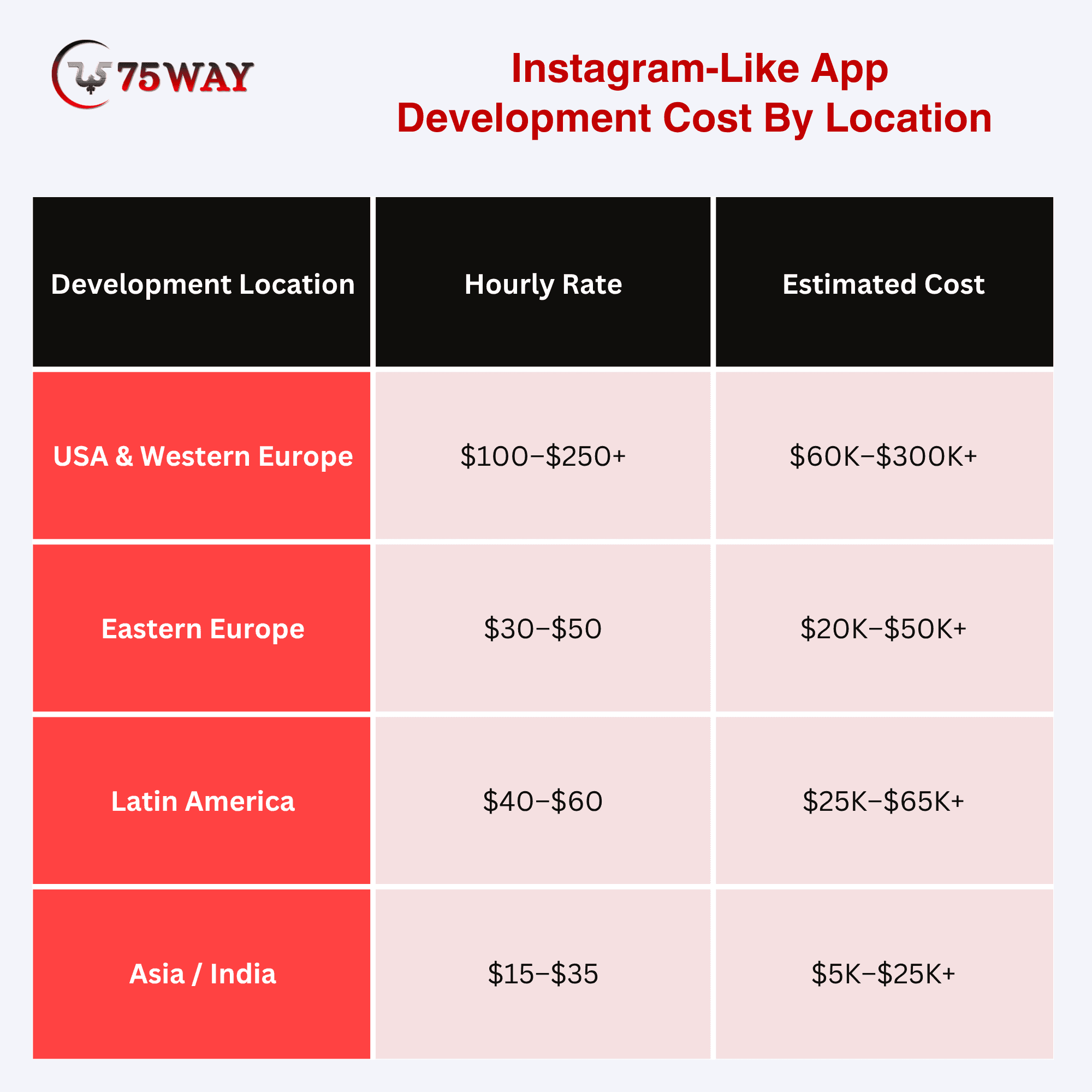
Instagram-Like App Development Cost By Location
Development rates vary significantly by region, which can change the overall cost of building an Instagram-like application even when the feature scope remains similar.
- USA & Western Europe: Higher rates typically reflect premium engineering talent, specialized expertise, and higher operating costs.
Estimated Cost: $100–$250+
- Eastern Europe: Offers a balance of technical expertise, development quality, and comparatively moderate engineering rates.
Estimated Cost: $30–$50
- Latin America: Provides competitive development costs with convenient collaboration across nearby or overlapping time zones.
Estimated Cost: $40–$60
- Asia / India: Often provides cost-effective development with access to large pools of experienced software and mobile developers.
Estimated Cost: $15–$35
Cost To Hire An Instagram Clone App Developer
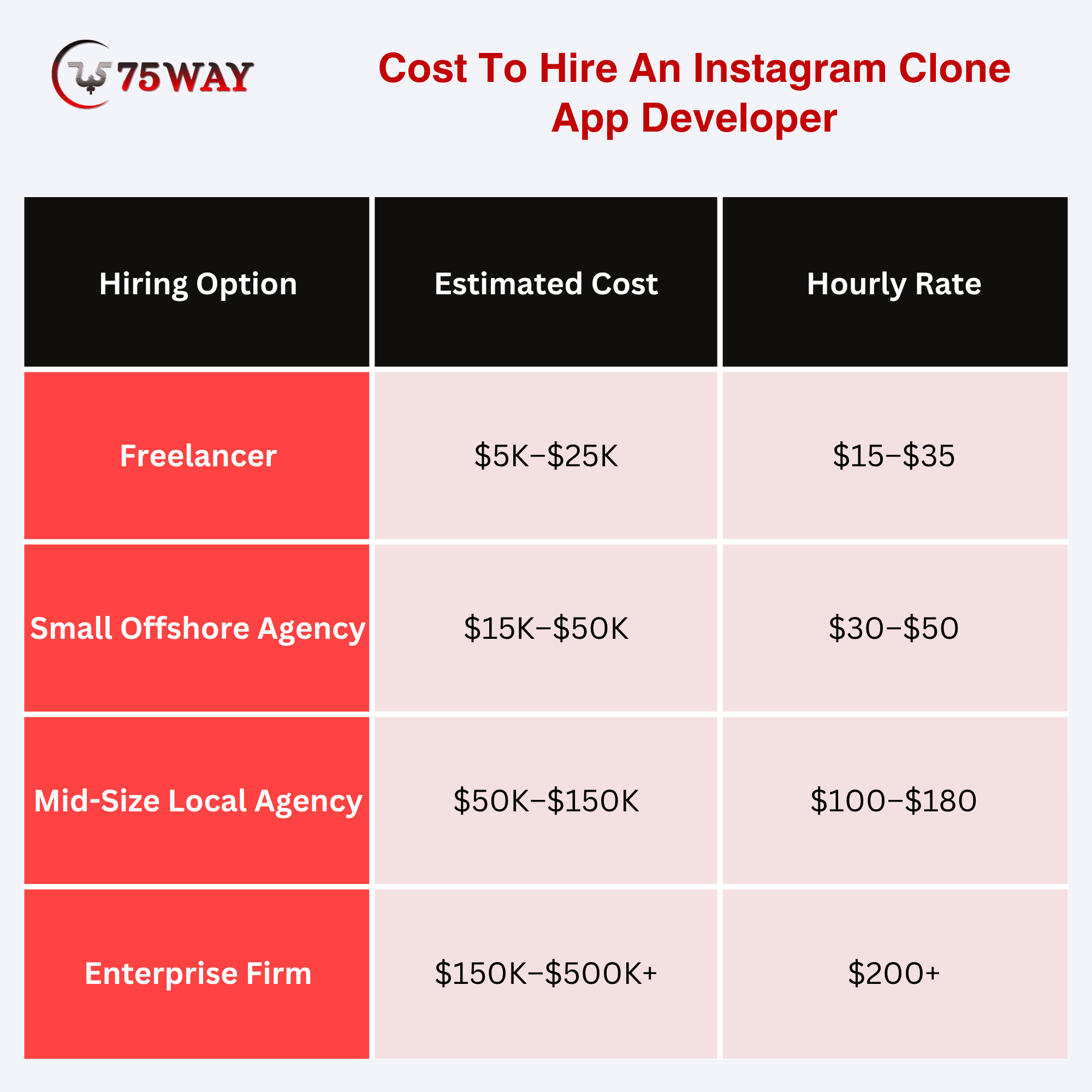
The cost of hiring developers depends on whether you choose an individual freelancer, offshore agency, local development company, or enterprise-level technology partner.
- Freelancer: Suitable for smaller projects with limited features and a tightly controlled development scope.
Estimated Cost: $5K–$25K
- Small Offshore Agency: Provides a broader development team and can handle moderately complex social app requirements.
Estimated Cost: $15K–$50K
- Mid-Size Local Agency: Offers dedicated expertise across design, development, testing, and project management for larger products.
Estimated Cost: $50K–$150K
- Enterprise Firm: Best suited for large-scale platforms requiring advanced infrastructure, extensive integrations, security, and long-term support.
Estimated Cost: $150K–$500K+
Factors Affecting The Cost To Build An instagram Clone Script
The cost to build an Instagram clone script cannot be determined by features alone. Infrastructure, platform choices, media requirements, development expertise, security, and expected user volume can significantly change the final budget.
1. Feature Complexity
A basic social feed requires less engineering than Reels, live streaming, AI recommendations, AR effects, advanced messaging, or social commerce.
2. Number of Platforms
Building for iOS and Android separately can increase development effort. Cross-platform frameworks may reduce initial costs, while native development can provide deeper platform-specific control.
3. UI/UX Complexity
Custom animations, video interactions, advanced editors, gesture-based navigation, and personalized interfaces require additional design and engineering effort.
4. Media Processing Requirements
Photo and video applications need storage, compression, transcoding, thumbnails, CDN delivery, and bandwidth management. Heavy video usage can significantly increase infrastructure costs.
5. Real-Time Functionality
Features such as messaging, typing indicators, live comments, notifications, and streaming require additional backend architecture and real-time communication infrastructure.
6. AI And Machine Learning
AI-powered recommendations, moderation, visual search, caption generation, and personalization require additional development, data pipelines, model integration, testing, and ongoing optimization.
7. Backend Architecture
A simple MVP can use a relatively straightforward backend, while a large social platform may require distributed services, caching, queues, databases, search infrastructure, monitoring, and auto-scaling.
8. Security And Privacy
Authentication, encryption, access controls, privacy settings, abuse prevention, data protection, and security testing add development effort but become essential as the platform grows.
9. Development Team Location
Developer rates vary considerably by region. However, comparing hourly rates alone can be misleading because experience with social platforms, architecture, and media infrastructure can strongly influence project outcomes.
10. Third-Party Integrations
Payment gateways, analytics platforms, authentication providers, cloud services, communication APIs, moderation tools, and other integrations can increase both development and recurring operational expenses.
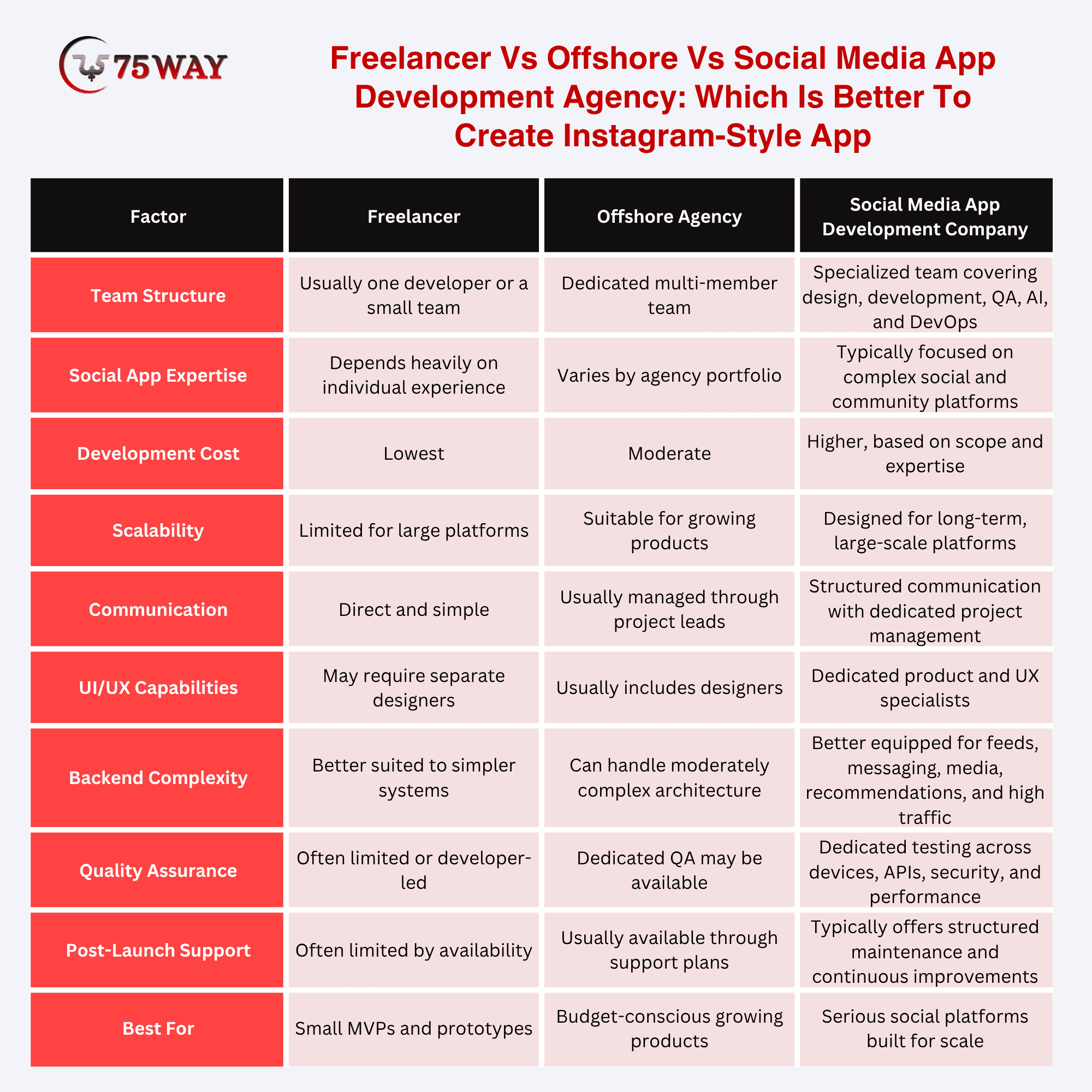
Freelancer Vs Offshore Vs Social Media App Development Agency: Which Is Better To Create Instagram-Style App?
A freelancer can be a practical choice when you are testing a small social media MVP with limited features and a controlled budget. An offshore agency offers a larger team, broader capabilities, and more development support while keeping costs relatively moderate. However, both options may require closer oversight when the product involves complex feeds, real-time messaging, media processing, AI, or large-scale infrastructure.
A specialized social media app development company is better suited for founders planning a scalable, feature-rich platform. Such a team can bring product strategy, UI/UX, backend engineering, mobile development, QA, DevOps, and post-launch support under one development process. The higher investment can be worthwhile when reliability, scalability, security, and long-term product growth are priorities.
How To Monetize An Instagram Duplicate App: Revenue Models
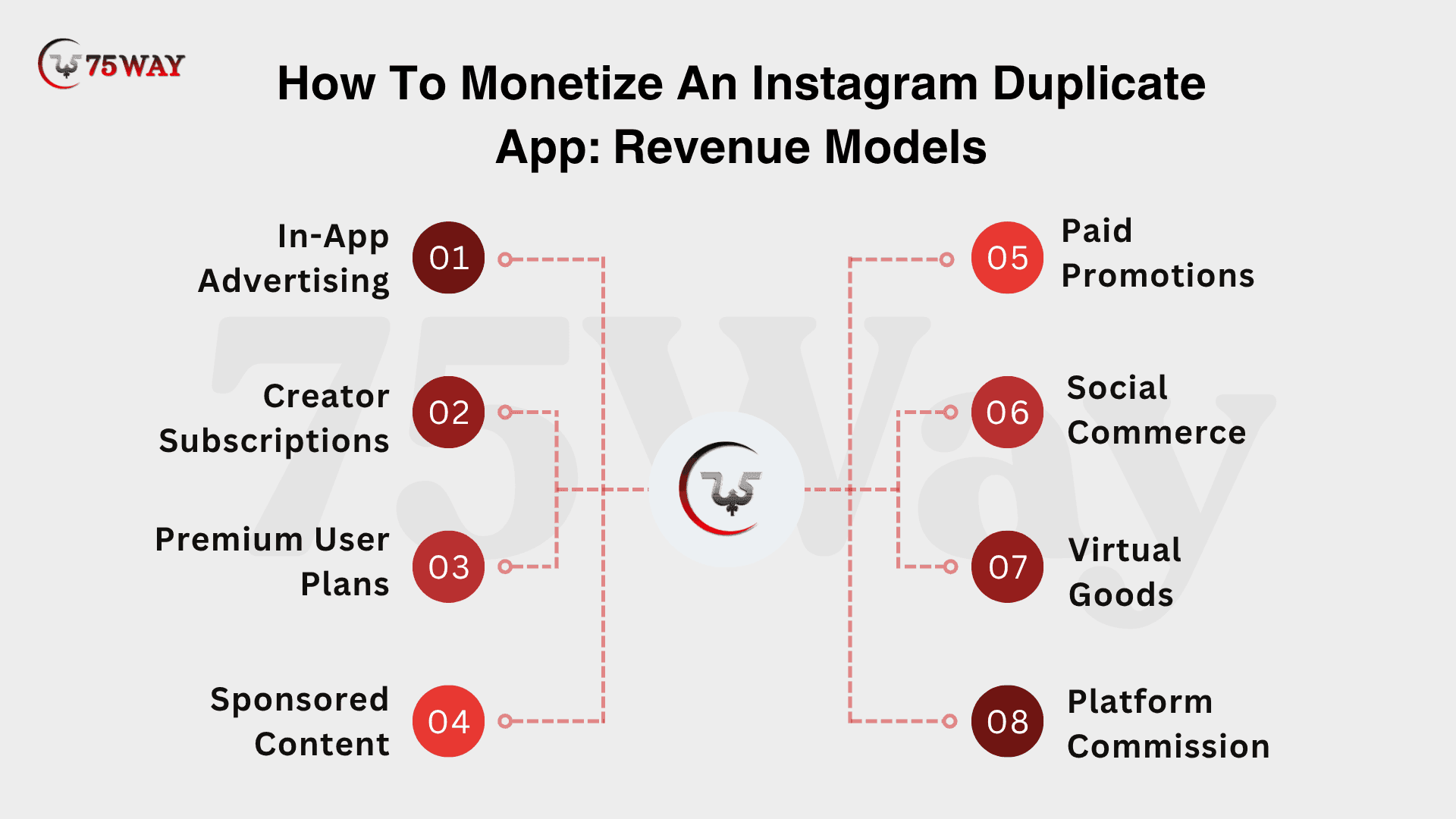
An Instagram duplicate app can generate revenue through multiple models, but the right approach depends on your audience, engagement levels, content ecosystem, and long-term positioning. Founders should avoid introducing too many monetization methods before establishing a strong user base.
1. In-App Advertising
Advertising can become one of the strongest revenue channels once your app develops a meaningful active-user base. You can offer sponsored posts, video advertisements, Stories ads, native placements, or promoted content.
Example: If your platform generates 1 million monthly ad impressions and your effective advertising revenue averages $5 per 1,000 impressions, monthly gross advertising revenue would be approximately $5,000.
2. Creator Subscriptions
Allow creators to offer exclusive content or experiences to followers through recurring subscriptions. This model can work particularly well for niche communities where users have strong relationships with specific creators.
Example: If 500 followers subscribe to a creator's premium profile at $4.99 per month, that creator generates approximately $2,495 monthly before applicable platform fees and taxes.
3. Premium User Plans
You can offer optional paid plans with additional functionality such as advanced profile customization, enhanced analytics, exclusive discovery tools, increased storage, or an ad-free experience.
Example: A platform with 2,000 premium subscribers paying $6 per month could generate approximately $12,000 in monthly subscription revenue before applicable fees.
4. Sponsored Content
Brands can pay creators or the platform to promote products, services, campaigns, or events. Your platform can provide tools for businesses to discover relevant creators and manage sponsored campaigns.
Example: A fashion brand might pay $2,500 for a creator campaign featuring several posts and Stories targeting a specific audience segment.
5. Paid Promotions
Businesses and creators can pay to increase the visibility of selected posts or campaigns. This model is particularly suitable when the platform has strong local, niche, or creator communities.
Example: A small business could spend $100 to promote a new product post to users within a selected location and demographic.
6. Social Commerce
If your target audience discovers products through visual content, you can integrate product catalogs, shopping pages, affiliate links, or in-app purchasing.
Example: A creator promotes a $50 product and earns a 10% commission on each completed purchase, generating $5 per referred sale.
7. Virtual Goods
Users can purchase digital items such as gifts, badges, reactions, or creator-support tokens and use them during social interactions.
Example: If 1,000 users purchase $10 worth of virtual credits each month, the platform processes $10,000 in monthly gross purchases before applicable fees.
8. Platform Commission
If your Instagram clone supports creators, merchants, bookings, digital products, or other transactions, the platform can retain a percentage of completed transactions.
Example: If sellers generate $100,000 in monthly transactions and your platform charges a 5% commission, the platform generates $5,000 in monthly gross commission revenue.
Which Monetization Model Should You Choose?
For an early-stage Instagram clone, avoid introducing every revenue stream immediately. Build user engagement first, identify what your audience values, and then introduce monetization around those behaviors.
A niche creator platform might prioritize subscriptions and virtual goods, while a business-focused visual network could generate more revenue through advertising, promoted content, and commerce.
The strongest monetization strategy is usually the one that grows alongside user activity rather than interrupting the core social experience.
How To Scale An Instagram Clone Mobile App?
Scaling an Instagram clone app requires more than adding additional servers. As users, posts, videos, messages, and interactions increase, the architecture must handle larger workloads without creating slow feeds, failed uploads, delayed notifications, or rising infrastructure costs.
The right approach is to build a scalable foundation early, then expand infrastructure according to actual product growth.
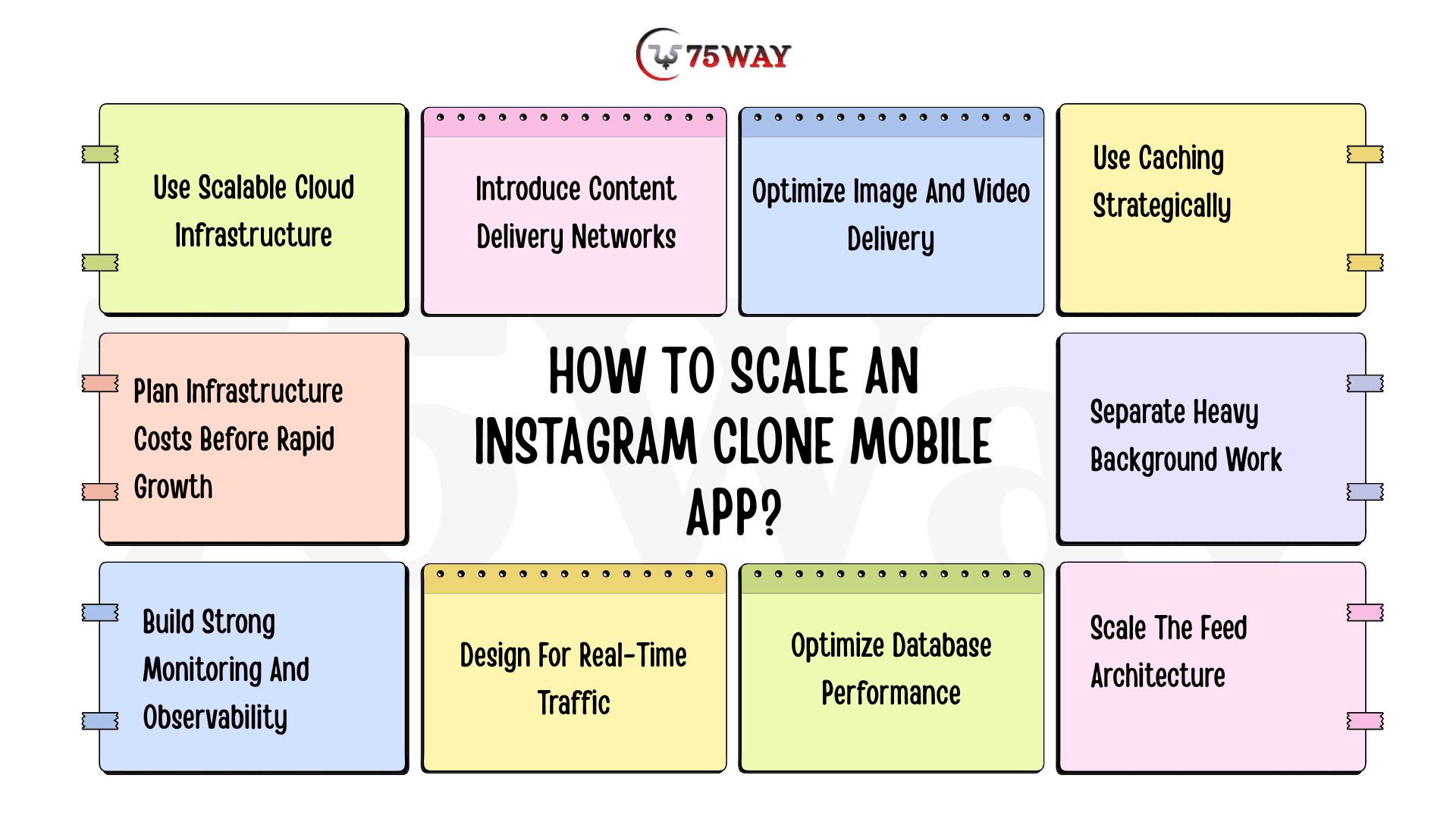
1. Use Scalable Cloud Infrastructure
Cloud infrastructure allows you to increase computing resources as traffic changes instead of maintaining fixed physical servers.
For example, a startup might initially spend $500 per month on cloud infrastructure, while a rapidly growing platform could eventually require $10,000+ per month depending on users, media traffic, storage, and processing requirements.
2. Introduce Content Delivery Networks
Images and videos should not always be delivered directly from the application server.
A CDN such as CloudFront or Cloudflare can distribute frequently requested media through geographically closer servers.
For example, if users in the United States repeatedly watch the same popular video, CDN caching can reduce repeated requests to the origin infrastructure and improve loading performance.
3. Optimize Image And Video Delivery
Media can become one of the largest infrastructure expenses for a visual social platform.
Use compression, responsive resolutions, thumbnails, modern media formats, and appropriate video transcoding to reduce unnecessary bandwidth.
For example, serving a 2 MB optimized image instead of a 10 MB original file can substantially reduce bandwidth consumption when that image receives thousands of views.
4. Use Caching Strategically
Frequently requested information can be cached rather than retrieved repeatedly from the primary database.
Redis can help cache items such as:
- Popular content
- User sessions
- Feed components
- Trending topics
- Frequently accessed profiles
This can reduce database pressure as traffic increases.
5. Separate Heavy Background Work
Tasks such as video processing, notifications, recommendation calculations, image resizing, and analytics do not always need to happen during the user's request.
Moving these operations into background queues allows the application to respond faster.
For example, after uploading a video, the user can immediately see an upload confirmation while transcoding continues asynchronously.
6. Scale The Feed Architecture
The home feed can become one of the most demanding components of an Instagram-like application.
As the user base grows, the system may need to combine:
- Follow relationships
- Recent posts
- Engagement signals
- Recommendation data
- Content ranking
- Personalization
A scalable feed architecture should avoid rebuilding enormous datasets for every request and should use appropriate caching, indexing, queues, and ranking strategies.
7. Optimize Database Performance
As users and interactions grow, inefficient queries can create bottlenecks.
Use:
- Proper indexing
- Query optimization
- Database monitoring
- Read replicas where appropriate
- Data partitioning when justified
- Connection pooling
- Caching
For example, an application processing millions of comments should not rely on unindexed queries to retrieve every interaction for every page load.
8. Design For Real-Time Traffic
Messaging, notifications, live comments, and streaming can generate sudden traffic spikes.
The architecture should support concurrent connections and graceful scaling rather than assuming a constant workload.
For example, a live event that attracts 100,000 concurrent viewers requires significantly different infrastructure planning from a platform with 10,000 daily active users.
9. Build Strong Monitoring And Observability
Scaling without visibility creates operational risk.
Monitor:
- API latency
- Error rates
- Database performance
- Server utilization
- Media processing failures
- CDN performance
- Message delivery
- Crash rates
- Infrastructure costs
Alerts should identify critical problems before they become widespread user-facing failures.
10. Plan Infrastructure Costs Before Rapid Growth
Scaling can increase revenue opportunities, but infrastructure expenses can also rise quickly.
For example, a platform with 100,000 users may have very different storage and bandwidth requirements from one with 10 million users, especially when users regularly upload high-resolution videos.
Track infrastructure cost per active user, per uploaded asset, and per completed session where practical.
Common Mistakes To Avoid When Building A Social Networking App Like Instagram
Building an Instagram clone can become expensive when product decisions are made without considering users, scalability, security, and long-term business goals. The following mistakes can help founders identify common development risks and understand how to avoid them.
1. Building Too Many Features In The MVP
Mistake: Trying to launch every Instagram-style feature, including Stories, Reels, live streaming, AR, messaging, AI, and commerce, increases development complexity before validating the core product.
How To Overcome: Start with essential social features, measure user adoption, and introduce advanced capabilities based on validated demand.
2. Ignoring Media Infrastructure Requirements
Mistake: Underestimating the technical requirements for storing, processing, compressing, and delivering large volumes of photos and videos can create performance and infrastructure challenges.
How To Overcome: Plan scalable storage, media processing, CDN delivery, caching, and bandwidth management as part of the architecture.
3. Treating Security As An Afterthought
Mistake: Delaying authentication, authorization, privacy controls, encryption, abuse prevention, and security testing can expose the platform to unnecessary risks.
How To Overcome: Integrate security throughout development with protected APIs, strong authentication, access controls, privacy settings, monitoring, and regular testing.
4. Underestimating Ongoing Operating Costs
Mistake: Focusing only on the initial development budget while overlooking cloud hosting, media storage, CDN usage, third-party services, maintenance, and technical support.
How To Overcome: Estimate recurring infrastructure and maintenance expenses alongside development costs before launching the platform.
5. Building Without Clear Differentiation
Mistake: Creating a generic Instagram replica without a strong value proposition makes it difficult to attract users from established social platforms.
How To Overcome: Define a specific audience, identify an underserved need, and develop distinctive experiences that give users a compelling reason to join.
How To Choose The Right Instagram Clone Development Company?
The reliable Instagram clone development company can directly affect your app's architecture, development cost, launch timeline, scalability, and long-term maintenance. Instead of comparing companies only by price, founders should evaluate technical expertise, social-media experience, development methodology, communication, security practices, and post-launch support.
1. Evaluate Social App Development Experience
Look for a development partner that has experience building social networking applications involving user-generated content, feeds, media uploads, messaging, notifications, and engagement systems.
2. Review Relevant Portfolio Projects
Examine previous applications for interface quality, feature complexity, technical execution, performance, and overall product experience. A portfolio can provide more useful evidence than generic claims about development expertise.
3. Assess Technical Expertise
Confirm that the team understands mobile development, backend architecture, cloud infrastructure, databases, APIs, CDN systems, media processing, real-time communication, and AI integration where required.
4. Understand Their Development Process
A reliable company should have a defined process covering discovery, planning, UI/UX, development, testing, deployment, and maintenance. Ask how requirements, milestones, testing, and change requests will be managed.
5. Compare Cost With Deliverables
Do not select a company solely because it provides the lowest quote. Compare the estimated cost against features, development hours, technology choices, testing scope, project management, integrations, and post-launch support.
6. Confirm Ownership And Documentation
Before signing a contract, clarify ownership of source code, designs, documentation, intellectual property, cloud accounts, third-party credentials, and other project assets.
What Should You Ask Before Hiring Insta-Like App Development Partner?
Before selecting an Insta-like app development partner, ask:
- Have you developed social networking applications before?
- Who will work on my project?
- What technology stack do you recommend and why?
- How will you handle media processing and CDN delivery?
- How will the architecture support future growth?
- What testing process do you follow?
- How do you protect user data?
- What is included in the quoted development cost?
- What happens when requirements change?
- What post-launch support do you provide?
A strong development partner should be able to answer these questions clearly and connect its recommendations to your business model, target audience, product scope, budget, and growth plans rather than simply selling a predefined Instagram clone package.
How Much Time Does It Take To Build An Instagram Clone?
The Instagram clone development timeline typically ranges from 3 to 12+ months, depending on the application's feature scope, platform requirements, design complexity, team size, integrations, and testing requirements. A basic MVP can reach launch faster, while advanced capabilities such as Reels, live streaming, AI recommendations, AR effects, and large-scale messaging require considerably more engineering and testing.
Basic Instagram Clone: 3–6 Months
A basic MVP can typically be developed within 3–6 months when the scope focuses on essential social functionality.
Mid-Range Instagram Clone: 6–9 Months
A mid-range product generally requires 6–9 months because additional interaction and content capabilities increase development complexity.
Advanced Instagram Clone: 9–12+ Months
A feature-rich platform can require 9–12+ months, particularly when development includes technically demanding capabilities.
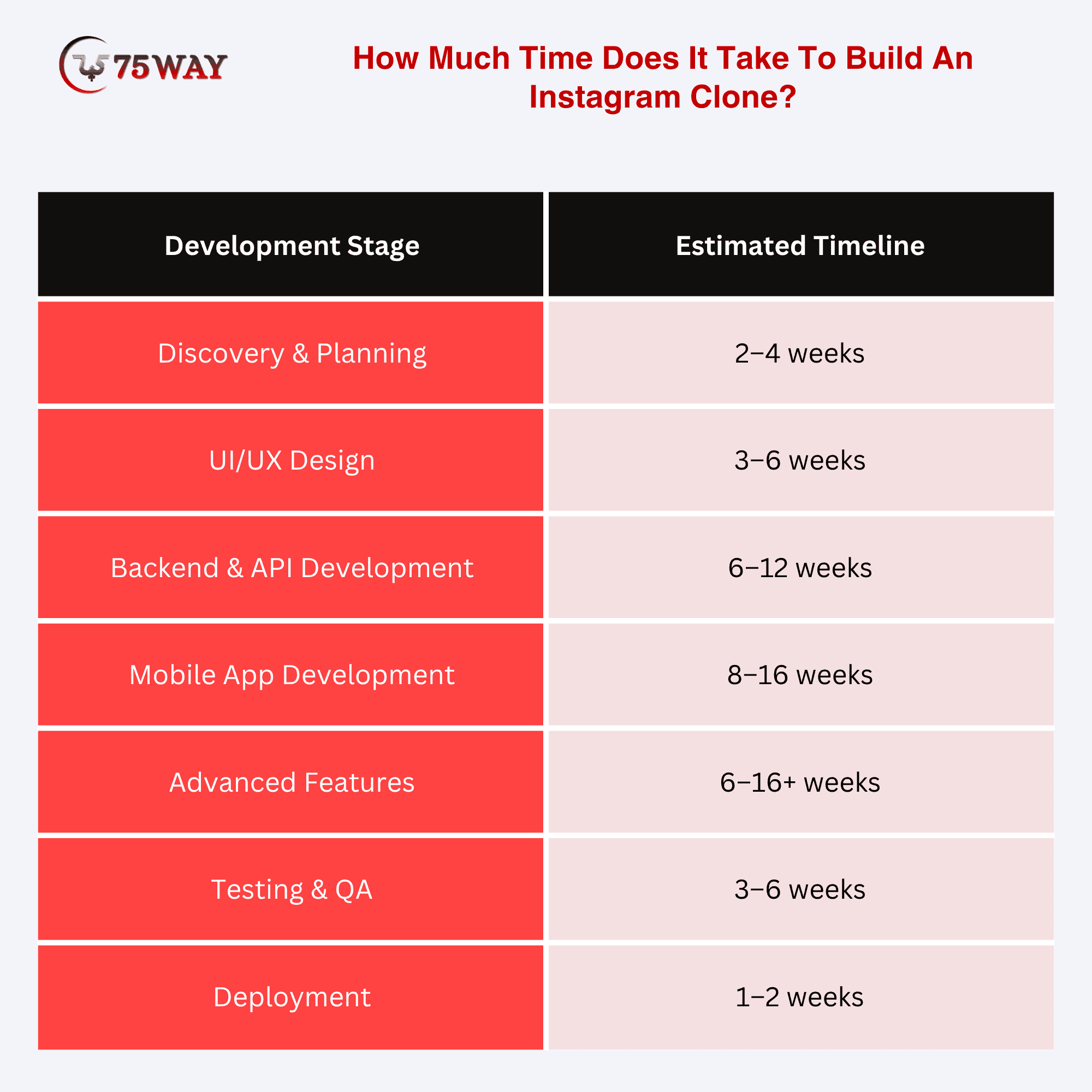
These stages can overlap when multiple specialists work simultaneously, so the total project timeline should not be calculated by simply adding every stage together.
How To Make Your Instagram Clone App Successful?
Building an Instagram clone is only the technical starting point. Long-term success depends on whether your product attracts the right users, gives them a compelling reason to return, creates meaningful interactions, and develops a sustainable business model.
- Define A Specific Target Audience
Avoid positioning the app as another general-purpose social network without a clear market. Identify a specific audience, community, interest, or use case that your platform can serve better.
- Create A Strong Value Proposition
Users already have established social platforms, so your app needs a clear reason for them to join. Your value proposition could focus on discovery, privacy, creator monetization, niche communities, content quality, or another meaningful advantage.
- Prioritize User Experience
Keep registration, content creation, discovery, and engagement simple. Fast loading, intuitive navigation, responsive interactions, and reliable media uploads can strongly influence whether users continue using the platform.
- Build A Strong Content Ecosystem
A social platform needs compelling content to encourage repeat visits. Give creators useful publishing tools, analytics, discovery opportunities, and incentives that encourage regular content creation.
- Focus On Retention
Acquiring users is only one part of growth. Track retention, engagement, session frequency, content creation, follows, comments, shares, and other behavioral signals to understand whether users are finding continuing value.
- Introduce Personalization
Use behavioral data to improve feeds, search, recommendations, notifications, and discovery. Personalization can help users find relevant content without requiring them to manually search for everything.
- Establish Strong Trust And Safety
Users need confidence that their accounts, content, and interactions are protected. Provide reporting, blocking, privacy controls, moderation workflows, secure authentication, and appropriate safeguards against abuse.
- Choose Monetization Carefully
Advertising, subscriptions, creator tools, sponsored content, virtual goods, and social commerce can generate revenue. Select monetization methods that fit your audience and avoid damaging the core user experience.
Why Prefer 75way To Build An Intuitive Instagram Clone?
Have an Instagram-like app idea but want it to feel like your product, not another copy? 75way Technologies works with startups, founders, and businesses to turn social media concepts into intuitive apps that people can easily explore, create on, and return to. From shaping the idea and designing the experience to building the backend, integrating AI, testing, and launching, we handle the development journey under one roof.
Your app can start small and grow as your audience grows. Whether you need a focused MVP for a niche community or a larger platform with Reels-style videos, messaging, recommendations, creator tools, and monetization, 75way builds around what your users actually need, not a one-size-fits-all clone.
Final Thoughts
To build an Instagram clone, you need more than familiar social features. A successful platform requires a clear niche, well-planned MVP, scalable architecture, engaging UX, reliable media infrastructure, strong security, AI capabilities where useful, and a sustainable monetization strategy. Development costs can range from $30,000 to $450,000+, depending on complexity, while advanced features can significantly increase both development and ongoing infrastructure expenses.
The smartest approach is to launch with essential features, validate user demand, measure retention and engagement, and expand based on real product insights. If you want to create an Instagram clone or a social media app like Instagram, connect with a social media app development company to launch a scalable digital product.
Frequently Asked Questions (FAQs)
Can I Build An Instagram Clone With AI Features?
Yes. AI can support personalized recommendations, content moderation, visual search, caption generation, hashtag suggestions, creator assistance, and intelligent notifications.
Can An Instagram Clone Support Reels And Live Streaming?
Yes. Short-form video and live streaming can be added, but they require additional media processing, real-time infrastructure, storage, CDN delivery, bandwidth, and performance optimization.
Can Users Migrate Their Existing Instagram Followers To My Clone App?
Direct follower migration is generally not something you should assume is available. Your product should instead provide onboarding, discovery, invitations, and sharing mechanisms to help users build their new network.
Do I Need A Recommendation Algorithm From The First Version?
Not necessarily. An MVP can begin with simpler feed-ranking logic and gradually introduce sophisticated recommendations after collecting enough behavioral data.
How Should An Instagram Clone Handle User-Generated Content?
The platform should combine reporting tools, moderation workflows, privacy controls, blocking, abuse prevention, and appropriate automated detection to manage user-generated content.