AI Summary
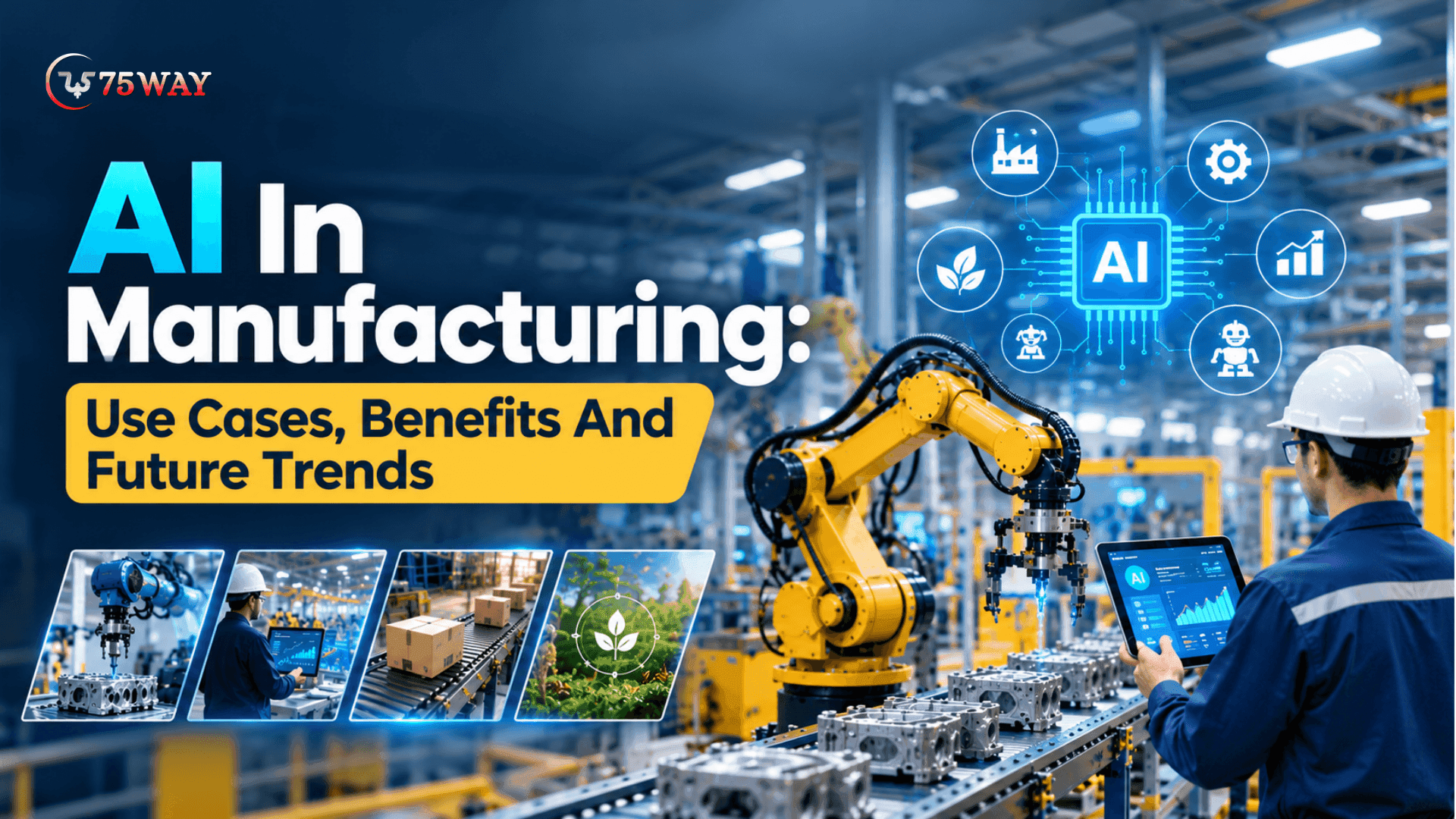
AI in manufacturing helps businesses improve production, reduce costly downtime, and make smarter operational decisions. This blog explores practical AI use cases, key business benefits, implementation opportunities, and future trends shaping the next generation of manufacturing.
Key Takeaways
- AI in manufacturing helps improve productivity, reduce waste, and optimise production workflows.
- Predictive maintenance uses machine data to identify equipment issues before failures.
- AI-powered quality inspection detects product defects and supports better quality control.
- Intelligent automation helps manufacturers improve production speed and operational decision-making.
- Future AI trends in manufacturing will reshape smart factories, supply chains, and manufacturing strategies.
A production line can look perfectly normal until one machine fails, a batch of products gets rejected, or a delayed shipment disrupts an entire schedule. For manufacturers, these problems can quickly turn into higher costs, missed deadlines, and unhappy customers.
Artificial intelligence (AI) in manufacturing offers a way to spot problems earlier, inspect products more carefully, and make production decisions using real-time data.
However, the real opportunity is not simply adding AI to a factory. It is identifying where the technology can solve expensive, recurring business problems.
From predictive maintenance and automated quality inspections to intelligent robotics and supply chain planning, AI is changing how manufacturers manage their operations. This guide explores practical AI use cases, the benefits manufacturers can gain, the challenges to consider, and the future trends worth watching.
What Is AI in Manufacturing?
AI in manufacturing refers to using technologies such as machine learning, computer vision, and generative AI to analyze production data, identify patterns, automate selected tasks, and support better decisions.
Think of a factory producing thousands of components every day. Traditional systems might alert a supervisor after a machine stops or a product fails inspection. An AI-powered system can analyze vibration readings, temperature changes, or product images to identify warning signs before they become bigger problems.
AI does not automatically replace workers, machinery, or existing manufacturing software. Instead, it can help employees make informed decisions, automate repetitive inspections, and respond to production issues with better information.
The key is choosing applications that address a real operational need rather than adopting technology simply because it is available.
AI In Manufacturing: Market Size, Growth And Future Opportunities
The AI in manufacturing market is growing as more companies explore automation, predictive maintenance, and AI-driven quality checks. This growth reflects a wider push to make factories smarter and production more reliable. The market figures and forecasts below show how the industry is expanding and where new opportunities may emerge.
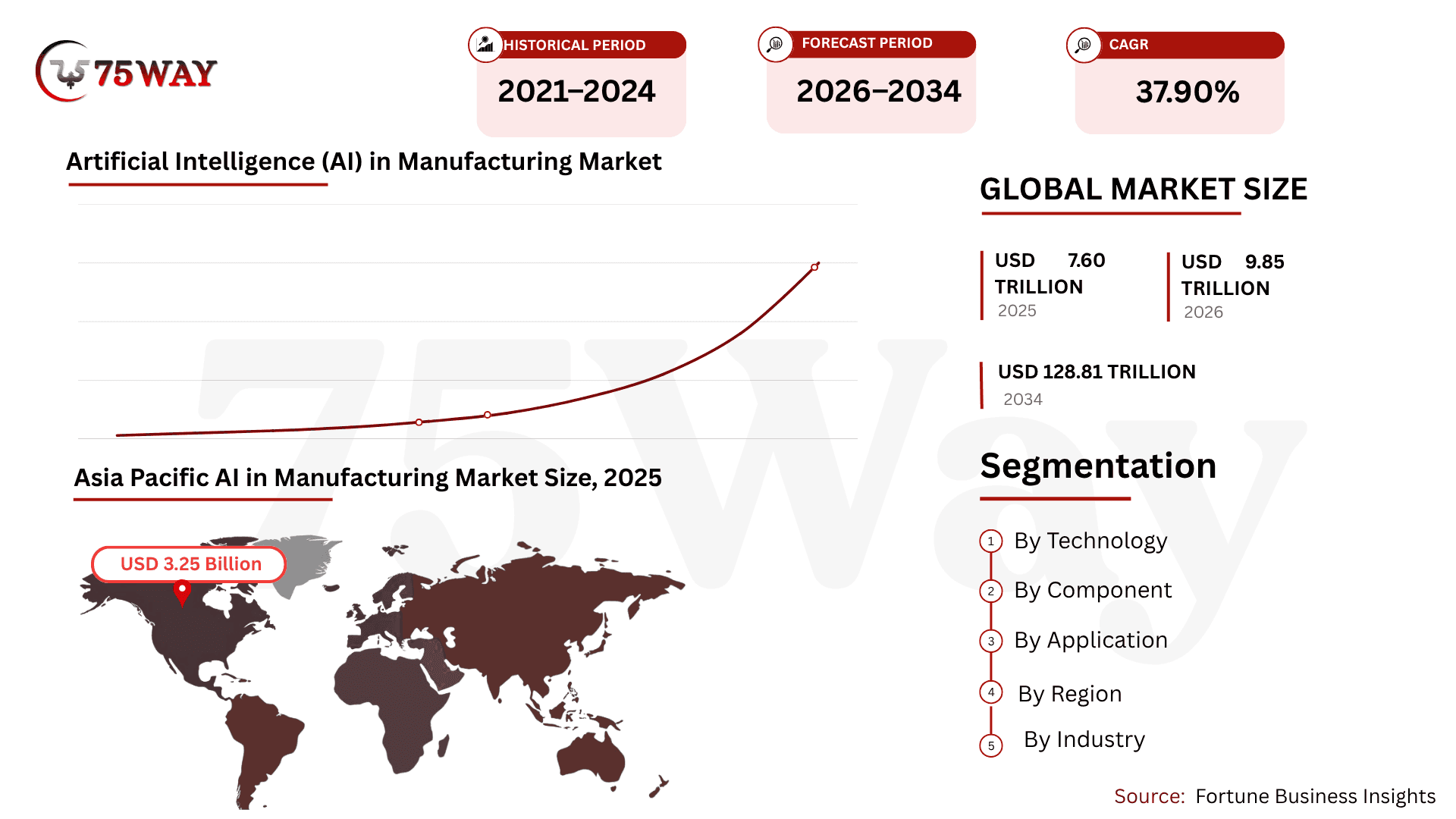
- The global Artificial Intelligence in Manufacturing Market is projected to increase from $9.85 billion in 2026 to $128.81 billion by 2034, registering a 37.90% CAGR during the forecast period.
- In October 2024, Siemens and Microsoft partnered to advance the Industrial Copilot, improving its capabilities for operating in demanding industrial environments.
- According to the Manufacturing Leadership Council, AI investments in manufacturing are expected to reach USD 16.7 billion by 2026.
- The survey found that only 28% of manufacturers had moved beyond the AI pilot stage, while 56% continued to use AI in small-scale projects.
AI In Manufacturing: Use Cases Transforming Factory Operations
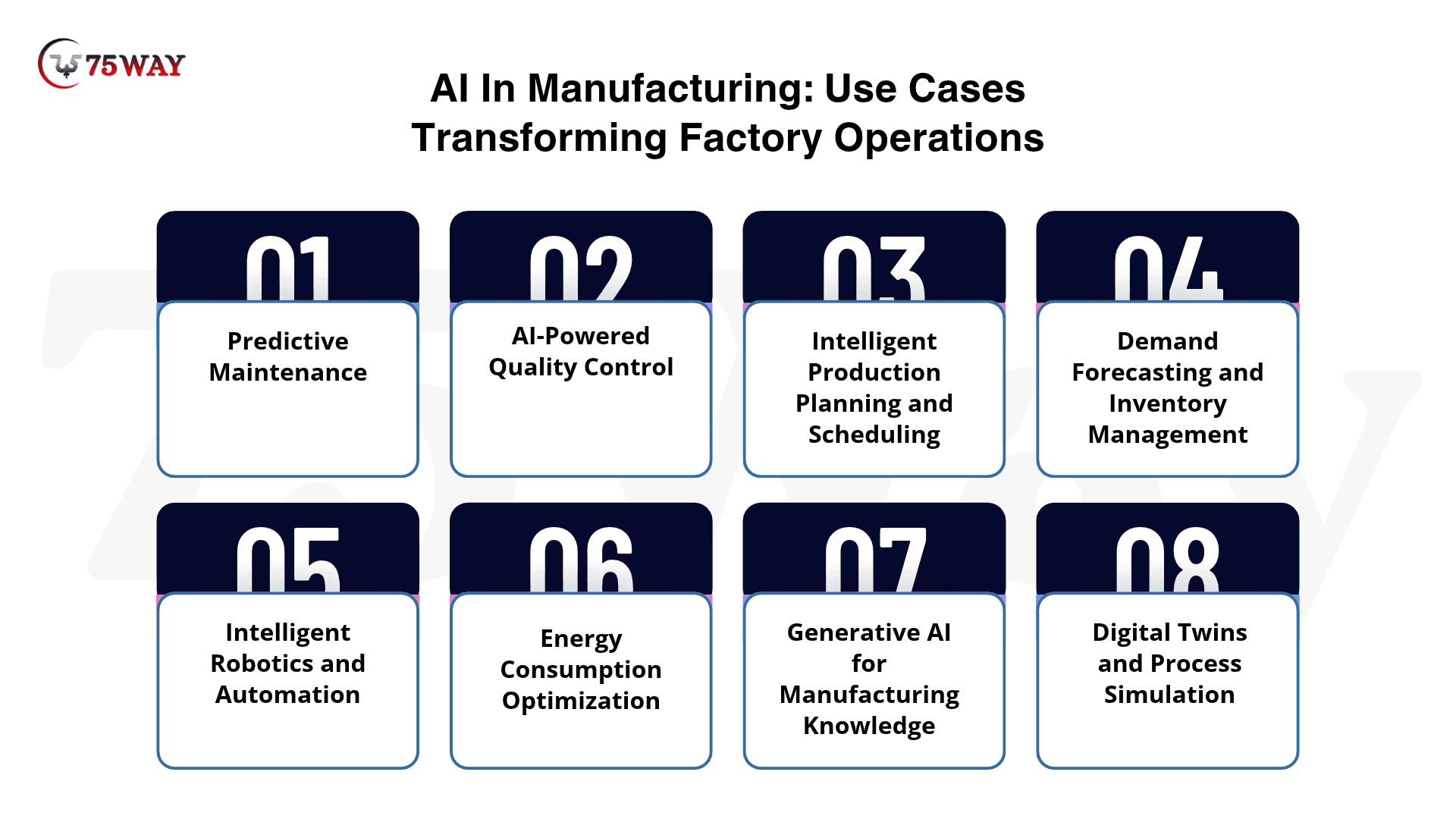
1. Predictive Maintenance
Imagine a critical production machine stops halfway through a shift. Employees wait for repairs, orders fall behind schedule, and maintenance staff scramble to find replacement parts.
Predictive maintenance aims to prevent that chain reaction.
AI systems analyze equipment data, including vibration, temperature, pressure, and operating history, to identify patterns associated with potential failures. When readings indicate an unusual condition, the system can alert maintenance teams so they can investigate before a minor issue causes an unexpected shutdown.
Business benefits:
- Reduce unexpected equipment breakdowns.
- Plan maintenance around operational requirements.
- Improve equipment availability.
- Avoid some emergency repair expenses.
Example: A metal fabrication plant uses AI to monitor a CNC machine. When its vibration pattern changes, the system flags a possible bearing problem. Technicians can inspect the component before the machine experiences a major failure.
Predictive maintenance is particularly useful for manufacturers that depend on expensive equipment or operate production lines where a single failure can disrupt multiple processes.
2. AI-Powered Quality Control
A product may look acceptable at first glance but contain a tiny crack, surface defect, or dimensional irregularity. When thousands of items move through a production line, identifying every defect manually becomes difficult.
Computer vision helps manufacturers inspect products using cameras and AI models trained to recognize defects and deviations from approved specifications.
The system can flag suspicious products for further inspection. Quality teams can then investigate recurring defects and determine whether they originate from materials, equipment settings, or production methods.
Business benefits:
- Detect defects earlier in production.
- Reduce avoidable rework and material waste.
- Support more thorough product inspections.
- Identify recurring quality problems.
Example: An appliance manufacturer uses AI vision to inspect painted refrigerator panels for scratches, dents, and uneven finishes before assembly.
AI inspection still requires suitable lighting, reliable images, properly trained models, and ongoing validation. It should support established quality procedures rather than replace necessary testing.
3. Intelligent Production Planning and Scheduling
Production planning is rarely as simple as assigning a product to a machine. Managers must balance incoming orders, material availability, equipment capacity, labor schedules, and delivery deadlines.
A schedule that works in the morning can become outdated when a supplier misses a delivery or a machine needs maintenance.
AI can analyze production constraints and changing demand to recommend scheduling adjustments. Depending on the system, it may help prioritize orders, identify bottlenecks, and allocate resources according to current operating conditions.
Business benefits:
- Identify potential production delays.
- Improve machine and labor allocation.
- Support more realistic delivery commitments.
- Reduce scheduling conflicts.
Example: A furniture manufacturer receives an urgent bulk order while handling several existing commitments. An AI-supported planning system evaluates available materials, machine capacity, and deadlines to help managers choose a feasible production sequence.
The final decision should still account for practical factors that data alone may not capture, including supplier reliability, workforce availability, and customer priorities.
4. Demand Forecasting and Inventory Management
Excess inventory ties up cash that a business could use elsewhere. On the other hand, a shortage of essential components can stop production and delay customer orders.
AI-powered forecasting systems analyze historical sales, seasonal demand, order pipelines, supplier lead times, and other relevant information to estimate future requirements.
Manufacturers can use these forecasts to plan material purchases, adjust inventory levels, and prepare for expected demand changes. As new information becomes available, forecasts can be updated to reflect changing conditions.
Business benefits:
- Improve material purchasing decisions.
- Reduce the risk of avoidable stockouts.
- Limit excess inventory.
- Support production and procurement planning.
Example: An HVAC equipment manufacturer anticipates higher demand during the warmer months. AI-supported forecasting helps its purchasing team estimate component requirements early enough to prepare for the seasonal production increase.
Forecasts are not guarantees. Manufacturers should consider supplier disruptions, unusual customer orders, and changes in market conditions before making major purchasing decisions.
5. Intelligent Robotics and Automation
Robots already perform repetitive tasks in many factories. AI can make certain robotic systems more adaptable by helping them recognize objects, interpret sensor information, and respond to changing conditions.
Depending on the application, AI-enabled robotics can support material handling, component sorting, machine tending, packaging, and assembly operations.
AI can also help coordinate automated equipment with production systems, giving manufacturers more flexibility when product types or operating requirements change.
Business benefits:
- Automate repetitive and physically demanding tasks.
- Improve material handling.
- Support flexible production processes.
- Reduce manual involvement in selected operations.
Example: A manufacturing facility uses vision-guided robots to identify components and position them correctly for assembly, even when their orientation varies.
Robotics still requires appropriate safety measures, maintenance, and supervision. Manufacturers must also evaluate whether the cost and complexity of automation are justified by the task.
6. Energy Consumption Optimization
Energy expenses can quietly reduce manufacturing margins. Equipment may operate during idle periods, compressed-air systems may leak, and heating or cooling systems may consume more power than necessary.
AI can analyze energy meters, equipment activity, production schedules, and environmental conditions to identify unusual consumption patterns.
Manufacturers can use these findings to investigate waste, adjust operating schedules, and evaluate changes that reduce energy use without compromising production requirements.
Business benefits:
- Identify unusual energy consumption.
- Reduce avoidable energy waste.
- Improve visibility into operating expenses.
- Support sustainability targets.
Example: A manufacturing facility compares electricity consumption with production output. AI identifies equipment using unusually high amounts of power while idle, prompting the operations team to investigate the cause.
The savings depend on the underlying problem and whether the recommended changes are practical. Manufacturers should measure energy use against production output to determine whether improvements are genuine.
7. Generative AI for Manufacturing Knowledge
What happens when an experienced technician retires and years of practical troubleshooting knowledge become harder to access?
Generative AI can help manufacturers organize and retrieve technical information. When connected to approved maintenance manuals, operating procedures, equipment records, and internal documentation, an AI assistant can help employees find relevant instructions and summarize troubleshooting information.
Workers may be able to ask questions in everyday language rather than search through multiple files.
Generative AI can also assist with drafting maintenance reports, preparing training materials, and summarizing production incidents.
Business benefits:
- Make technical documentation easier to access.
- Support employee training and knowledge sharing.
- Reduce time spent searching for information.
- Assist with routine documentation tasks.
Example: A technician asks an internal AI assistant about a specific machine error. The assistant retrieves the relevant approved procedure and highlights the recommended diagnostic checks.
AI-generated responses can contain errors, so employees must verify information against trusted documentation, particularly when equipment safety or product quality is involved.
8. Digital Twins and Process Simulation
Changing a production line can involve significant expense. A new layout might improve material movement, but it could also create bottlenecks elsewhere.
Digital twins help manufacturers examine these possibilities through virtual representations of physical assets, processes, or systems. When connected to operational data, these models can help teams evaluate performance and simulate selected scenarios.
AI can strengthen digital twins by identifying patterns, estimating possible outcomes, and supporting process optimization.
Business benefits:
- Evaluate production changes before implementation.
- Investigate bottlenecks and process constraints.
- Support equipment investment decisions.
- Reduce reliance on some costly physical trials.
Example: An automotive supplier simulates a proposed assembly line layout before moving equipment. The team examines whether the new arrangement could reduce material movement or create delays at a critical workstation.
Digital twins are only as useful as their underlying models and data. Manufacturers should validate assumptions before using simulations to guide expensive operational decisions.
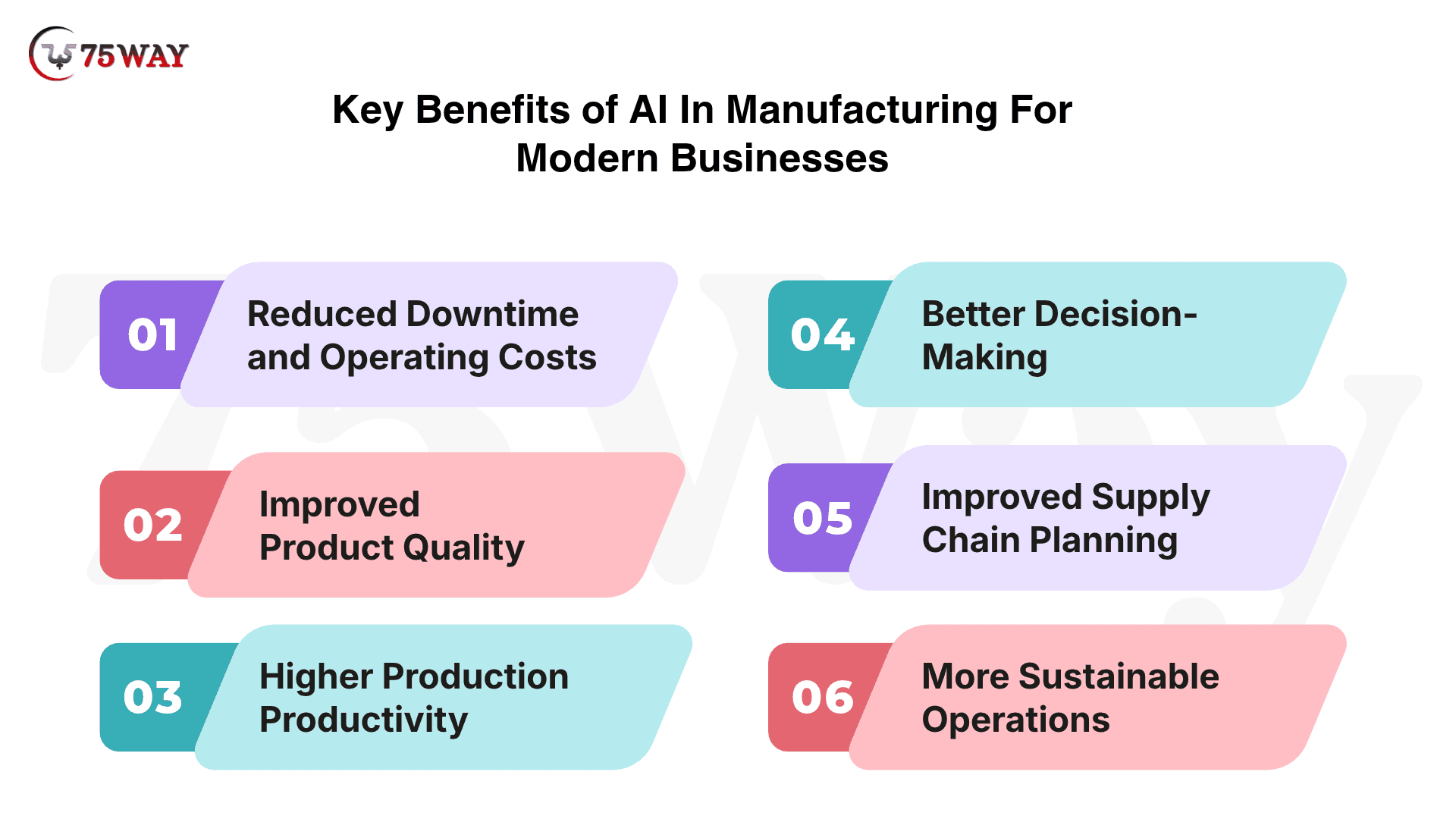
Key Benefits of AI In Manufacturing For Modern Businesses
The business value of AI is not measured by how many tools a factory uses. It is measured by whether those tools improve performance, reduce avoidable costs, or help the company respond to customer needs. Here are the main benefits manufacturers can evaluate.
- Reduced Downtime and Operating Costs
Unexpected equipment failures can lead to repair bills, lost production time, missed deadlines, and overtime expenses. Predictive maintenance helps teams identify potential issues earlier, while AI-driven process analysis can reveal waste and recurring operational problems.
The financial benefit depends on the equipment involved, the cost of implementation, and whether the business can act on the system's recommendations.
- Improved Product Quality
AI-powered inspections can identify defects earlier and help quality teams investigate recurring problems. Detecting a defect before an entire batch is completed may reduce rework, wasted materials, and customer complaints.
However, inspection systems must be tested against real production conditions to confirm that they identify defects accurately.
- Higher Production Productivity
AI can help manufacturers identify bottlenecks, adjust schedules, and automate repetitive tasks. Employees can spend less time collecting information manually and more time addressing complex production issues.
Productivity gains should be measured through actual output, cycle time, and resource use rather than assumptions about what automation might achieve.
- Better Decision-Making
Manufacturing decisions often involve information spread across production systems, inventory records, maintenance logs, and sales forecasts.
AI-powered manufacturing solutions can analyze these data sources to help managers understand current conditions, identify patterns, and compare possible actions. Human oversight remains important when decisions affect safety, product compliance, or customer commitments.
- Improved Supply Chain Planning
Supplier delays and changing demand can disrupt even well-organized production operations. AI-supported forecasting can help manufacturers identify potential inventory shortages, assess supplier lead times, and adjust purchasing plans.
Earlier warnings give procurement and operations teams more time to respond, although they cannot eliminate supply chain uncertainty.
- More Sustainable Operations
AI-driven manufacturing software can help manufacturers monitor energy consumption, identify material waste, and evaluate opportunities to use resources more carefully.
These improvements can support sustainability goals while also helping businesses manage operating costs. Results should be confirmed through measurable energy, material, and production data.
AI in Manufacturing: What Do the Numbers Tell Us?
Manufacturers have strong reasons to investigate AI, but adoption rates and expected returns should be interpreted carefully. Results vary by industry, company size, application, and the maturity of existing systems.
Research from the US National Institute of Standards and Technology (NIST) has examined AI adoption and its potential role in manufacturing. Before using any industry statistic in an investment decision, check the original report's publication date, sample, and definition of AI adoption.
Rather than relying on one headline figure, manufacturers should assess the opportunities most relevant to their own operations:
- Equipment Reliability: How much production time is lost to unplanned downtime?
- Product Quality: How much do defects, scrap, and rework cost?
- Inventory Management: How much working capital is tied up in excess stock?
- Energy Consumption: Which processes use the most energy relative to output?
- Production Planning: How frequently do scheduling changes cause delays?
These measurements establish a baseline against which AI projects can be evaluated. They also help manufacturers prioritize applications with a clear business case.
The key question is not simply whether AI adoption is growing. It is which operational problem is worth solving first.
Challenges of Implementing AI Solutions in Manufacturing Services
AI can improve factory operations, but implementation involves practical challenges. Addressing them early helps manufacturers avoid investing in technology that delivers limited value.
1. Poor Data Quality
AI systems need reliable information to produce useful results. Missing sensor readings, inconsistent maintenance logs, and disconnected production records can weaken predictions.
How to address it: Audit the data available for the selected use case. Correct obvious gaps, standardize important records, and establish procedures for maintaining data quality.
2. High Initial Investment
Implementation may require sensors, cameras, computing infrastructure, software integration, employee training, and ongoing technical support.
How to address it: Start with a focused pilot tied to a measurable business problem. Estimate total ownership costs, including integration, maintenance, and training, before expanding the project.
3. Integration With Existing Equipment
Many factories use machinery and software introduced over several years. Older systems may not support modern data connections, making it difficult to combine information across production lines.
How to address it: Evaluate equipment connectivity, available APIs, industrial communication protocols, and integration requirements before selecting an AI platform.
4. Workforce Skills and Adoption
Employees may be unfamiliar with AI tools or concerned about how automation will affect their roles. Poorly communicated changes can reduce adoption, even when the technology performs well.
How to address it: Involve operators and maintenance teams during planning. Explain how AI will support their work, provide relevant training, and create clear procedures for reviewing system recommendations.
5. Cybersecurity and Operational Safety
Connected equipment can introduce additional cybersecurity risks. Incorrect AI recommendations may also cause problems if systems influence safety-critical processes without appropriate controls.
How to address it: Apply access controls, secure system connections, monitor model performance, and retain human approval for high-risk decisions. AI recommendations must not override established safety procedures.
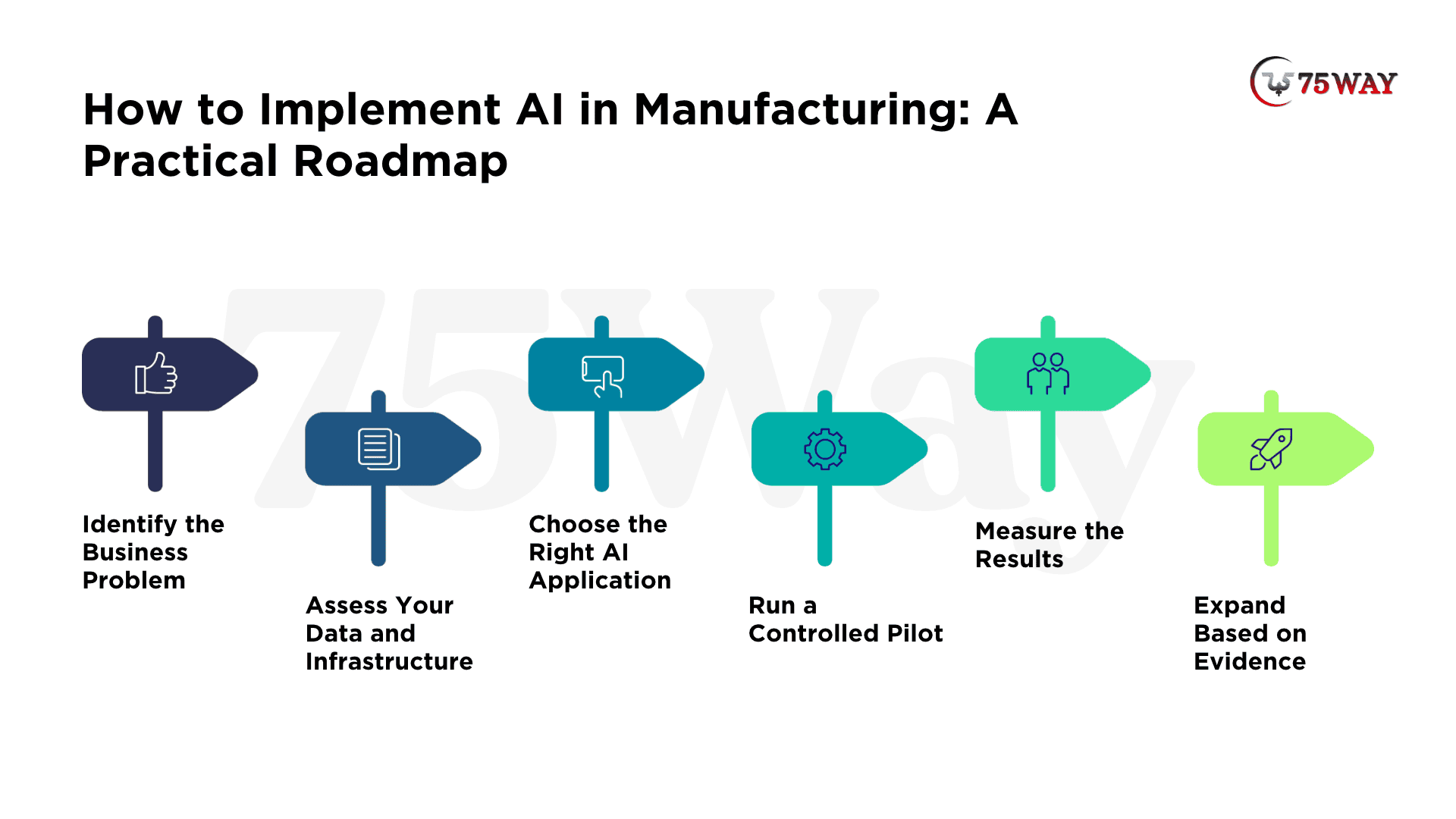
How to Implement AI in Manufacturing: A Practical Roadmap
A successful AI initiative begins with an operational problem, not a software purchase. The following steps can help manufacturers move from an initial idea to a measurable result.
Step 1: Identify the Business Problem
Select a recurring issue, such as machine downtime, high defect rates, excess inventory, or production delays.
Establish how the problem affects costs, output, delivery commitments, or customer satisfaction. A clearly defined problem makes it easier to evaluate whether AI is appropriate.
Step 2: Assess Your Data and Infrastructure
Check whether the necessary equipment readings, inspection images, production records, or inventory data are available and reliable.
Identify gaps in connectivity, data quality, and existing systems. If the required information is not available, improving data collection may need to come before AI implementation.
Step 3: Choose the Right AI Application
Match the technology to the business problem. Predictive maintenance may require machine sensors and historical failure records, while automated visual inspection may need cameras and labeled product images.
Compare available solutions based on accuracy, integration requirements, operating costs, and suitability for your production environment.
Step 4: Run a Controlled Pilot
Test the selected solution on one machine, product line, or process before deploying it across the facility.
Compare its performance with the existing method. Include employees who will use the system in daily operations and document any limitations discovered during testing.
Step 5: Measure the Results
Track the metrics that relate directly to the original problem. These may include unplanned downtime, defect rates, scrap costs, inspection time, energy use, or forecast accuracy.
Include implementation and ongoing operating expenses when evaluating the financial return. If the pilot fails to deliver meaningful improvements, investigate the cause before investing further.
Step 6: Expand Based on Evidence
If the pilot produces reliable, measurable improvements, plan the next deployment.
Standardize data practices, train additional teams, and monitor performance as production conditions change. Expanding gradually allows manufacturers to build experience without committing to a factory-wide rollout prematurely.
How Can Manufacturers Calculate AI's ROI?
Before approving an AI project, estimate the potential financial impact using a baseline and realistic assumptions.
Consider a hypothetical factory evaluating predictive maintenance:
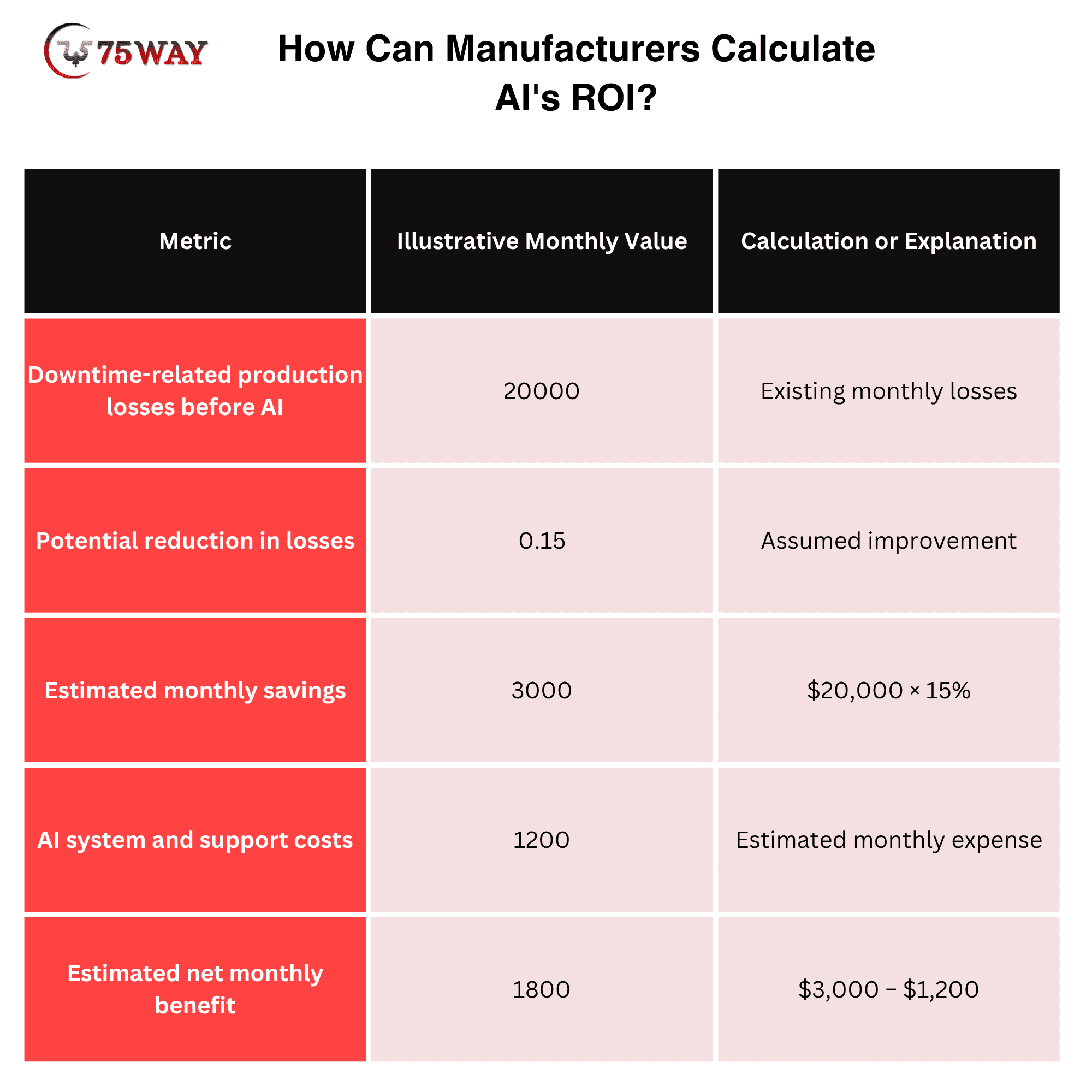
These figures are illustrative, not an industry benchmark or a guaranteed outcome. The calculation excludes initial implementation costs and any other expenses not listed.
For a complete assessment, manufacturers should calculate the payback period and evaluate whether the expected savings justify the total investment. They should also check whether the improvement lasts under normal production conditions.
This approach provides a more useful basis for decision-making than assuming AI will automatically reduce costs.
Future of AI In Manufacturing: Trends To Watch
The next phase of manufacturing AI will extend beyond automating individual tasks. Emerging applications are expected to connect production data, engineering knowledge, physical equipment, and operational decisions more closely.
Here are six trends manufacturers should watch.
1. Agentic AI for Manufacturing Operations
Agentic AI systems are designed to plan and carry out multistep tasks with varying levels of autonomy.
In manufacturing, these systems could investigate equipment alerts, review maintenance records, retrieve spare-part information, and recommend next steps. More advanced applications may coordinate tasks across maintenance, production planning, and inventory systems.
For example, when a machine generates an alert, an AI agent for manufacturing could gather relevant maintenance history and identify the approved troubleshooting procedure for a technician.
The priority will be controlling which actions the system can take independently and which require human approval. Changes affecting machinery, production settings, or safety should have appropriate permissions and safeguards.
2. Generative AI Assistants for Factory Workers
Generative AI is creating new ways for employees to access technical information and complete documentation tasks.
A technician may be able to ask an internal assistant about a machine error and receive an answer based on approved manuals and maintenance records. Production managers may use similar tools to summarize incident reports or prepare operating instructions.
As these systems develop, manufacturers will need to focus on information accuracy, access permissions, data privacy, and verification procedures.
The greatest value may come from helping employees find trusted information faster, rather than asking AI to make every decision.
3. More Capable Digital Twins
Digital twins can help manufacturers understand how physical assets and production processes behave under different conditions.
As these models connect with richer operational data and improved simulation tools, manufacturers may be able to examine more complex scenarios before changing their facilities.
Potential applications include evaluating production line layouts, estimating equipment capacity, investigating bottlenecks, and planning maintenance.
However, simulation results depend on the quality of the model and its assumptions. Businesses should validate predictions before using them to justify expensive changes.
4. AI-Powered Robotics and Autonomous Systems
AI-enabled robots are becoming more capable of recognizing objects, processing sensor information, and responding to changes in their surroundings.
Future applications may include more adaptable material handling, inspection, assembly, and machine tending. Manufacturers could use these capabilities to manage changing product requirements without redesigning every automated task from scratch.
Broader adoption will depend on equipment costs, system reliability, integration requirements, and workplace safety.
5. AI for Sustainable Manufacturing
Manufacturers increasingly need to manage energy consumption, material waste, and resource use alongside productivity and quality.
AI can help identify unusual energy patterns, improve selected process settings, and support more accurate material planning. Combined with reliable monitoring systems, these applications may help manufacturers understand where resources are being wasted.
Businesses should connect these initiatives with measurable targets, such as energy use per unit produced or the amount of material discarded during production.
6. Greater Focus on Trustworthy AI
As AI supports more important manufacturing decisions, reliability and accountability will become increasingly important.
Manufacturers will need to evaluate model accuracy, monitor performance changes, protect sensitive information, and understand when an AI system may produce unreliable recommendations.
This is particularly important in industries where product defects or incorrect operational decisions can create safety and compliance risks.
Human oversight, traceable decisions, cybersecurity controls, and regular validation will remain essential parts of responsible AI adoption.
How Can Manufacturers Prepare for AI Adoption?
Manufacturers do not need to transform every production process at once. They can build a stronger foundation by addressing the practical requirements that make AI useful.
- Review Existing Operations: Identify recurring production delays, quality problems, equipment failures, and avoidable expenses.
- Improve Data Collection: Make sure machine readings, inspection results, and production records are accessible and reliable.
- Develop Employee Skills: Train workers to interpret AI recommendations and recognize when human judgment is necessary.
- Set Measurable Targets: Define success using metrics such as downtime, defect rates, production output, or energy consumption.
- Plan For Integration: Evaluate how new AI applications will work with existing machinery and manufacturing software.
- Establish Governance: Define data access, security requirements, model monitoring, and approval procedures before deployment.
For businesses with limited resources, a small, well-defined project is often a more practical starting point than a large transformation program.
The goal is to build experience, establish measurable results, and expand when the evidence supports further investment.
Final Thoughts
AI in manufacturing offers practical opportunities to address problems that affect production costs, product quality, equipment reliability, and delivery schedules. Predictive maintenance, computer vision, intelligent robotics, and generative AI can help manufacturers improve operations when these technologies are matched to genuine business needs.
However, successful implementation requires more than selecting an AI platform. Manufacturers need reliable data, suitable infrastructure, trained employees, and clear performance targets. Starting with one operational challenge makes it easier to test the technology, calculate its value, and identify opportunities for expansion.
Ready to explore AI opportunities for your manufacturing business? Hire our AI engineers to identify a high-impact production challenge and evaluate how the right AI solution can help you improve performance and prepare for future demands.
Frequently Asked Questions (FAQs)
How Does AI Improve Manufacturing Productivity?
AI can help identify bottlenecks, reduce unplanned downtime, detect product defects, improve scheduling, and automate repetitive tasks. Actual results depend on the application, data quality, and implementation.
Can Small Manufacturing Businesses Use AI?
Yes. Small manufacturers can start with focused applications such as equipment monitoring, visual quality inspection, or demand forecasting. Existing AI-enabled software may also offer a practical alternative to custom development.
How Much Does AI Implementation Cost In Manufacturing?
Costs vary depending on the application, equipment, infrastructure, integration requirements, and level of customization. A focused pilot can help businesses estimate the investment before scaling.
Will AI Replace Manufacturing Workers?
AI may automate certain repetitive tasks, but it can also assist workers with inspection, troubleshooting, planning, and decision-making. Its workforce impact depends on the application and how the business introduces the technology.
What Is The Future of AI In Manufacturing?
Emerging trends include agentic AI, generative AI assistants, advanced robotics, connected digital twins, sustainable manufacturing, and greater emphasis on trustworthy AI systems.