Summary
AI ecommerce agents enhance online retail growth by improving customer engagement, automating support, and delivering personalized shopping experiences. This guide explains how ecommerce AI agents work in digital commerce. It covers their features, benefits, and business impact. It also explores how these systems improve customer satisfaction and sales performance.
Quick Overview
- Ecommerce AI agents improve product discovery and buyer engagement
- Automated responses reduce customer drop-offs during shopping journeys
- Personalized recommendations increase purchase probability significantly
- Cart recovery automation helps recover lost revenue opportunities
- Online stores gain higher conversions through smarter customer interactions
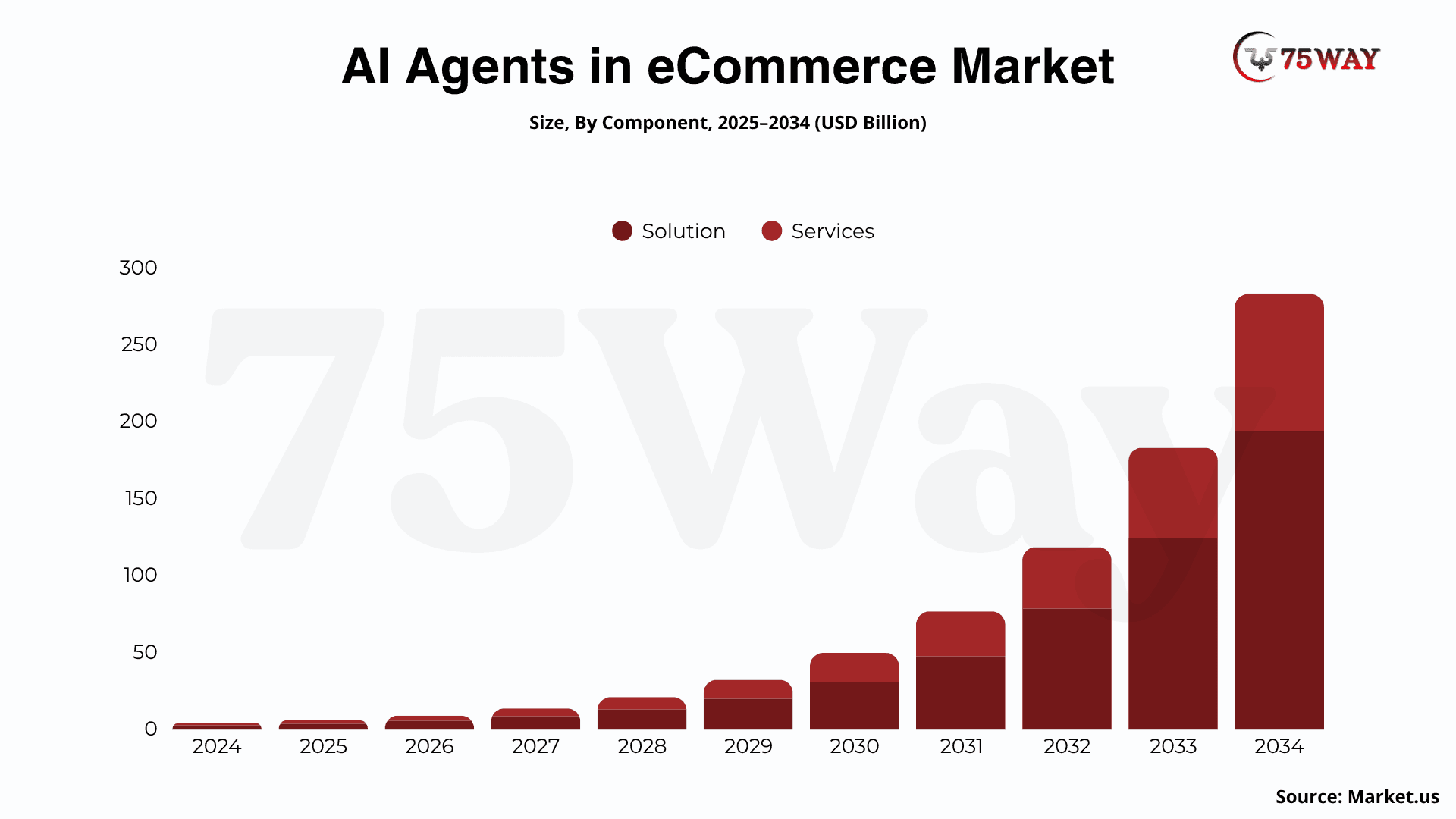
Online shopping has changed completely. Customers no longer browse slowly or patiently. They compare products across multiple websites in seconds, read reviews instantly, and abandon carts just as quickly. In fact, the AI agents in eCommerce market is expected to reach around $282.6 Billion by 2034, growing from $3.6 Billion in 2024 at a CAGR of 54.7%, showing how fast this shift is happening.
In this environment, even small delays or confusing shopping experiences can cost a sale. This is where AI in ecommerce is changing the game.
The AI agents for ecommerce act as intelligent shopping assistants that help customers find products, answer questions, recommend items, recover abandoned carts, and guide buyers through the entire purchasing journey. Instead of waiting for human support, shoppers receive instant, personalized assistance that improves engagement and reduces friction from AI-powered ecommerce apps and software. This blog explores how ecommerce AI agents help online stores increase conversions and improve customer experience across digital platforms.
What Is An AI Ecommerce Agent?
An AI ecommerce agent is a smart digital system designed to assist customers during their online shopping journey. It works like a virtual sales assistant that understands customer behavior, preferences, and intent to provide real-time support and product recommendations. The ecommerce AI agents operate across:
- Product pages
- Shopping carts
- Customer support chats
- Email interactions
- Mobile apps
- Checkout pages
They also connect with backend systems like inventory, pricing engines, and CRM tools to ensure customers always receive accurate product availability, pricing updates, and personalized suggestions. This helps create a smoother buying experience, where customers feel guided rather than confused, leading to faster decisions and higher purchase completion rates.
How Ecommerce AI Agents Boost Conversions in Online Stores?
Ecommerce AI agents help online stores increase conversions by improving customer engagement, shopping experiences, and reducing drop-offs during the buying journey. They act as intelligent assistants that guide users from product discovery to checkout. Agentic AI in ecommerce creates smoother and faster purchase decisions.
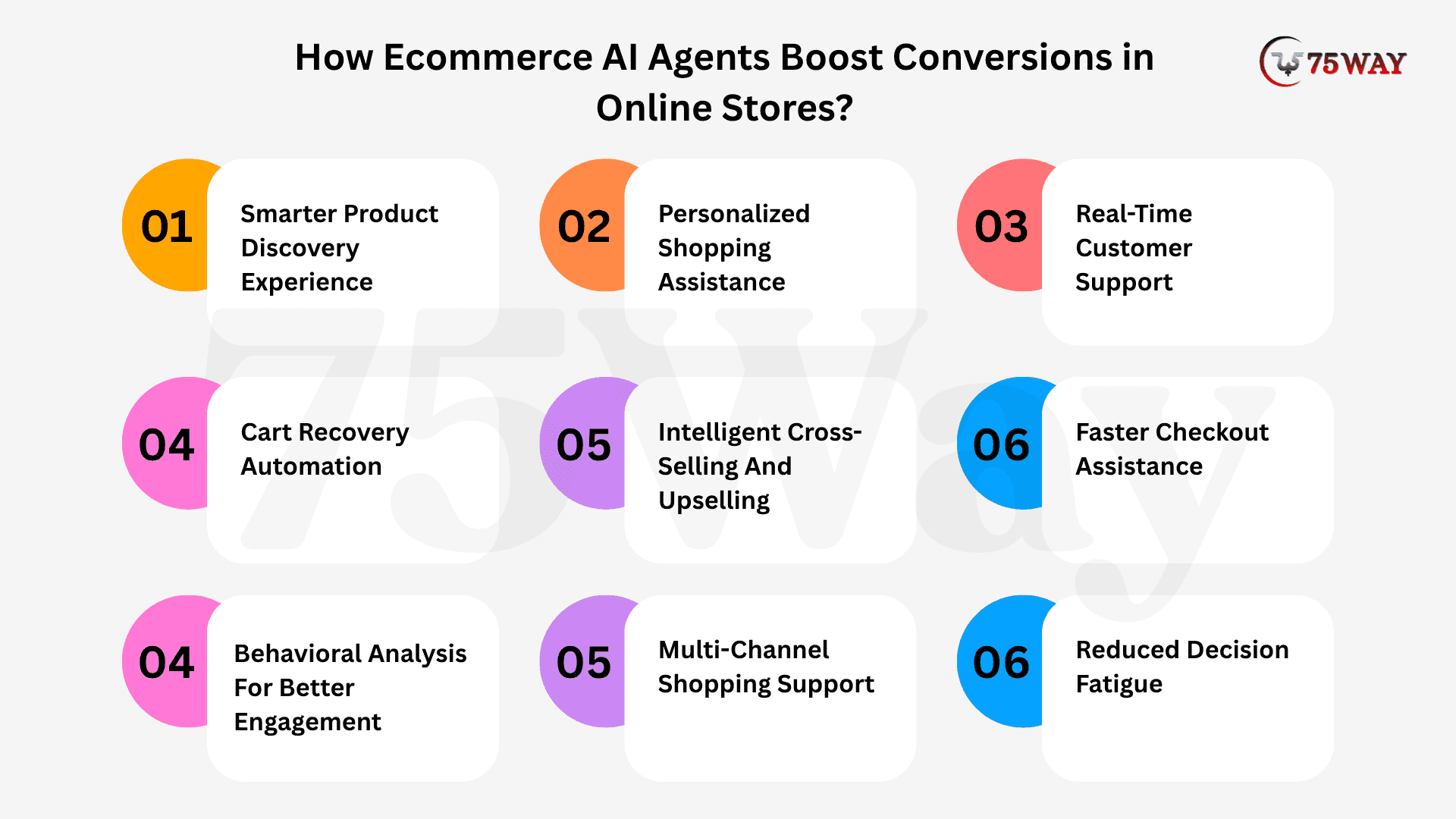
1. Smarter Product Discovery Experience
One of the biggest advantages of AI ecommerce agents is their ability to improve how customers discover products. Instead of forcing users to search manually through hundreds of items, AI systems analyze behavior and suggest relevant products instantly. They consider:
- Browsing history
- Search queries
- Time spent on pages
- Past purchases
- Cart activity
Based on this, the system recommends products that match user intent. This creates a more guided shopping experience where customers feel understood rather than overwhelmed. Better product discovery leads to faster decisions and higher conversion rates.
2. Personalized Shopping Assistance
Every customer has different needs. Some are price-focused, others prioritize quality, while some look for specific features or brands. Ecommerce AI agents personalize interactions based on these preferences. For example:
- Budget shoppers see affordable options
- Premium buyers get high-end recommendations
- Repeat customers receive tailored suggestions
- New visitors get guided product explanations
This personalization creates an emotional connection and improves engagement. When customers feel that a store understands their needs, they are more likely to complete purchases.
3. Real-Time Customer Support
Support delays are one of the biggest reasons for abandoned carts. If a customer has a question about size, delivery, compatibility, or features and does not receive an immediate answer, they often leave the site. AI ecommerce agents solve this by providing instant responses. They can answer:
- Product details
- Shipping information
- Return policies
- Size guides
- Availability status
This reduces uncertainty and builds confidence during purchase decisions. Faster support directly improves conversion rates.
4. Cart Recovery Automation
Cart abandonment is one of the biggest challenges in ecommerce. Many customers add products to their cart but leave without completing checkout. AI ecommerce agents help recover these lost sales through automated follow-ups. They:
- Send reminder messages
- Offer product discounts
- Suggest alternatives
- Highlight limited stock alerts
- Re-engage inactive users
These timely reminders bring customers back to complete purchases. Even small recovery improvements can significantly increase overall revenue.
5. Intelligent Cross-Selling And Upselling
AI ecommerce agents improve revenue by recommending additional relevant products. Instead of random suggestions, these systems analyze user behavior and purchase intent. Examples include:
- Suggesting matching accessories
- Recommending upgraded versions
- Offering bundled products
- Highlighting complementary items
This creates a more complete shopping experience while increasing average order value. Customers benefit from better recommendations, while businesses increase revenue per transaction.
6. Faster Checkout Assistance
Checkout friction often leads to abandoned carts. Complicated forms, payment confusion, or unclear steps can discourage buyers. AI ecommerce agents assist during checkout by:
- Answering last-minute questions
- Guiding payment steps
- Clarifying shipping details
- Offering reassurance
This support reduces hesitation and improves purchase completion rates.
7. Behavioral Analysis For Better Engagement
AI ecommerce agents continuously analyze customer behavior to understand intent. They track:
- Click patterns
- Scroll behavior
- Time spent on products
- Add-to-cart actions
- Exit points
This helps identify what customers want and where they lose interest. Based on this data, the system adjusts recommendations and engagement strategies in real time. Better behavioral understanding leads to smarter conversions.
8. Multi-Channel Shopping Support
Modern customers interact with ecommerce brands across multiple channels. They may start browsing on mobile, continue on desktop, and ask questions via messaging apps. AI ecommerce agents maintain consistent communication across all channels. This includes:
- Website chat
- Email support
- Mobile apps
- Social messaging
Customers receive continuous support without having to repeat themselves. This improves trust and creates a smoother shopping journey.
9. Reduced Decision Fatigue
Too many options often confuse customers. AI ecommerce agents reduce decision fatigue by narrowing choices based on preferences. Instead of showing hundreds of products, AI agents improve real-time ecommerce decision-making by highlighting the most relevant ones. This helps customers make faster and more confident decisions. Simplified and data-driven decisions improve conversion rates.
- Personalized recommendations increase engagement.
- Filters match customer purchase intent.
- Smart sorting reduces browsing confusion.
- Contextual suggestions guide faster decisions.
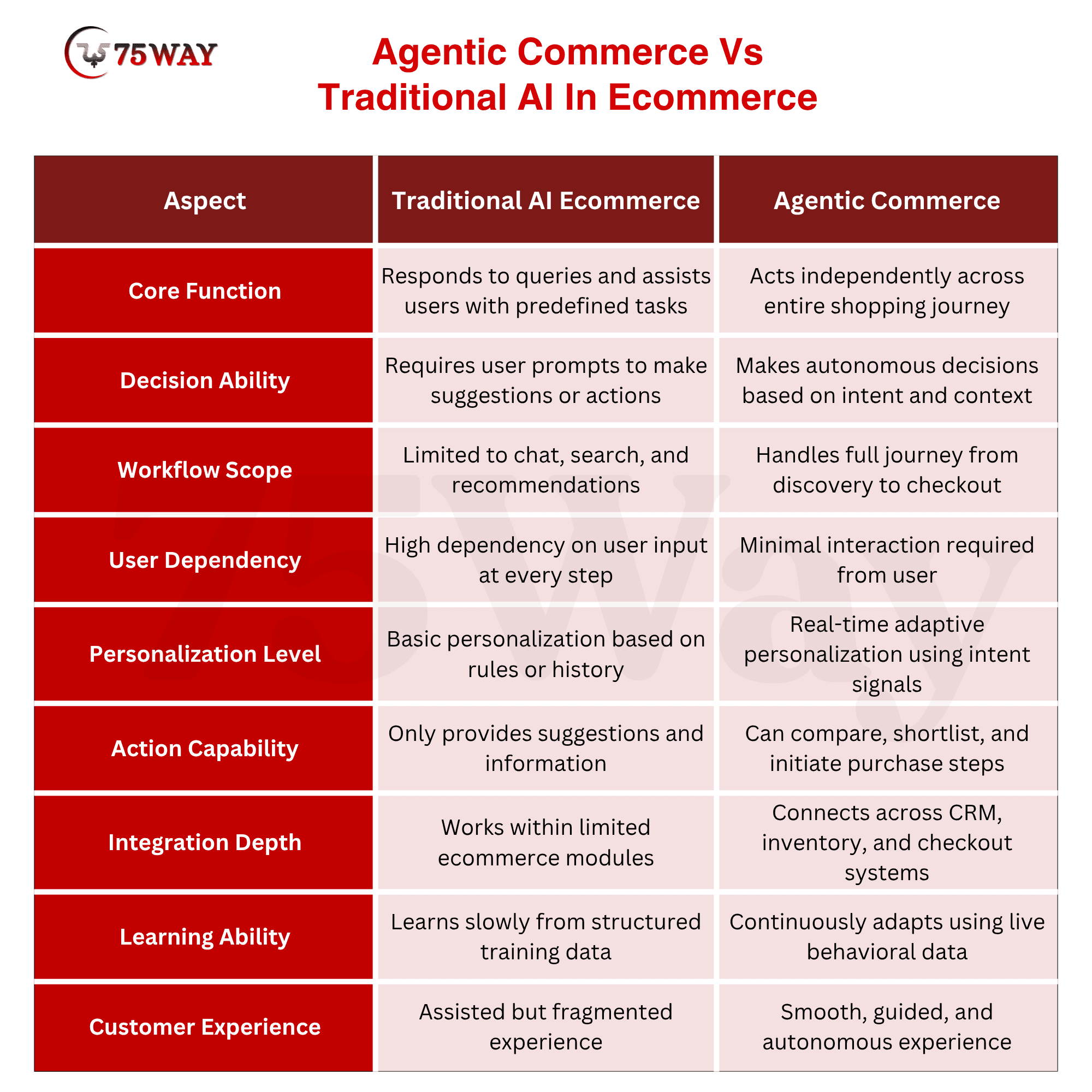
Agentic Commerce Vs Traditional AI In Ecommerce
Agentic commerce and traditional AI in ecommerce differ mainly in how they act within the shopping journey. Traditional AI works as a support system that responds to user actions. It helps with product suggestions, chat responses, and basic automation, but it still depends on user input to move forward.
Agentic commerce goes a step further by acting more independently. It can make decisions, compare options, guide users through checkout, and adjust actions based on intent signals. Instead of waiting for instructions at every step, it actively manages parts of the buying process, making the overall experience faster and more automated.
Must-Have Features of AI Agents for Retail and Ecommerce
AI agents are becoming a core part of ecommerce and retail operations because they simplify customer interactions, improve product discovery, and automate repetitive workflows. These systems help businesses respond faster, understand buyer behavior, and deliver more personalized shopping experiences across channels. The result is smoother operations and stronger sales performance.
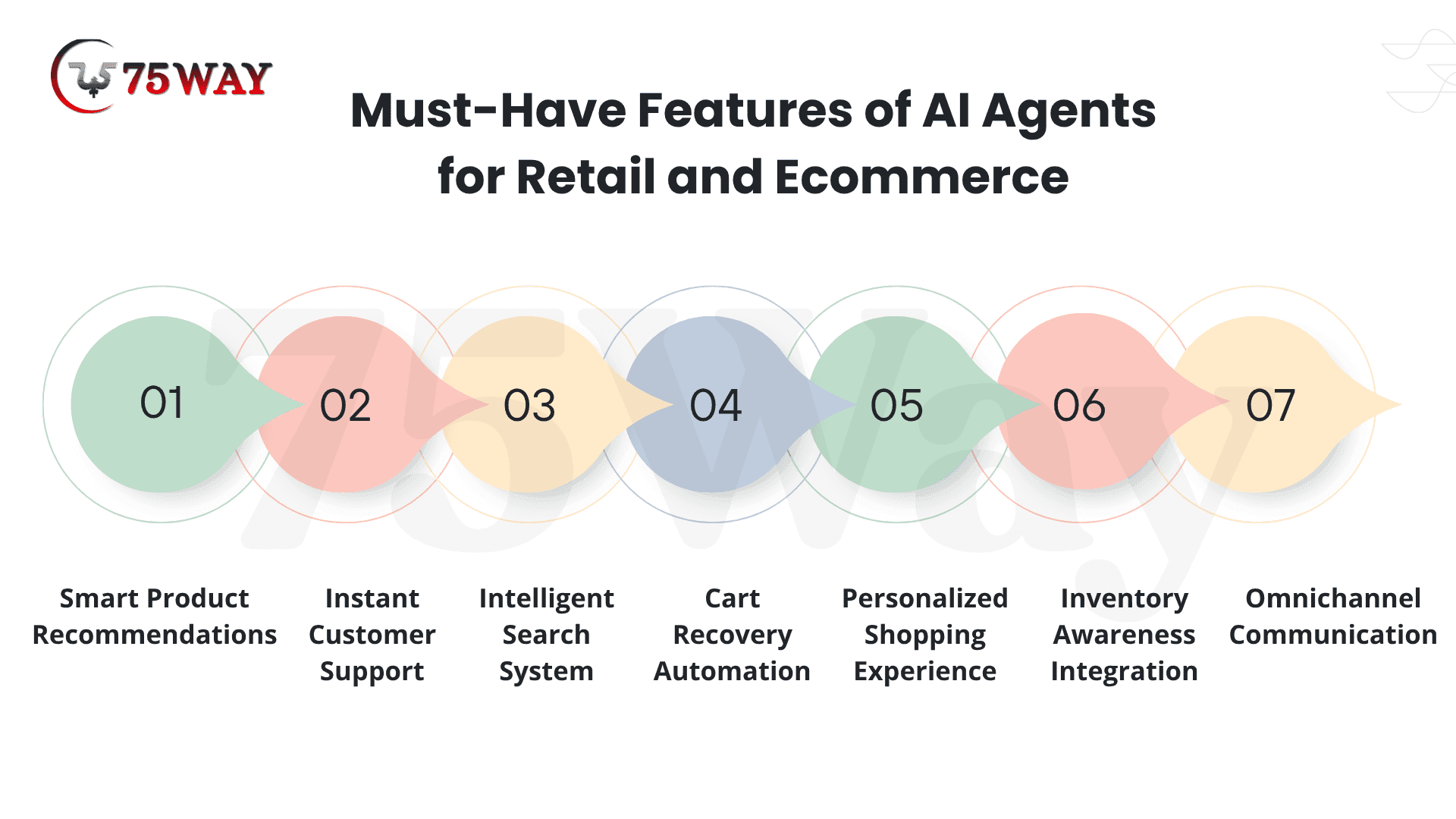
- Smart Product Recommendations: AI agents for retail analyze browsing history, preferences, and purchase behavior to suggest relevant products. Recommendations use real-time user signals and past interactions for accuracy. Product discovery becomes faster, more relevant, and conversion-focused across ecommerce platforms.
- Instant Customer Support: Ecommerce AI systems respond to customer queries immediately across chat, email, and apps. Response times are reduced by automating the handling of common questions. Customers receive continuous support, which improves satisfaction and the overall shopping experience.
- Intelligent Search System: Ecommerce AI agents improve search by understanding user intent instead of just keywords. These agentic AI ecommerce systems process context, behavior, and preferences to deliver accurate results. Users find products quickly with fewer irrelevant listings and less effort.
- Cart Recovery Automation: AI agents for e-commerce and retail identify abandoned carts and trigger timely reminders or personalized incentives. Recovery messages adjust based on user behavior and engagement signals. Businesses recover lost revenue while improving overall conversion rates.
- Personalized Shopping Experience: AI ecommerce agent creates tailored shopping journeys based on individual user data and preferences. Content, offers, and recommendations adjust dynamically for each visitor. Engagement improves as customers receive more relevant and timely experiences.
- Inventory Awareness Integration: Ecommerce AI agents connect with inventory systems to display real-time product availability. Stock updates reflect instantly across platforms and sales channels. Customer trust increases due to accurate and transparent product information.
- Omnichannel Communication: AI agents ecommerce manage customer interactions across websites, apps, and social media platforms. Communication stays consistent across all devices and touchpoints. Brands deliver a unified experience that strengthens engagement and retention.
Key Growth Benefits of Agentic AI in Ecommerce Businesses
AI ecommerce agents bring strong advantages for online stores looking to improve sales performance and customer experience. They help businesses guide buyers through the shopping journey. Agentic AI in ecommerce leads to better engagement and smoother purchase decisions. Overall, they strengthen revenue growth and customer relationships.
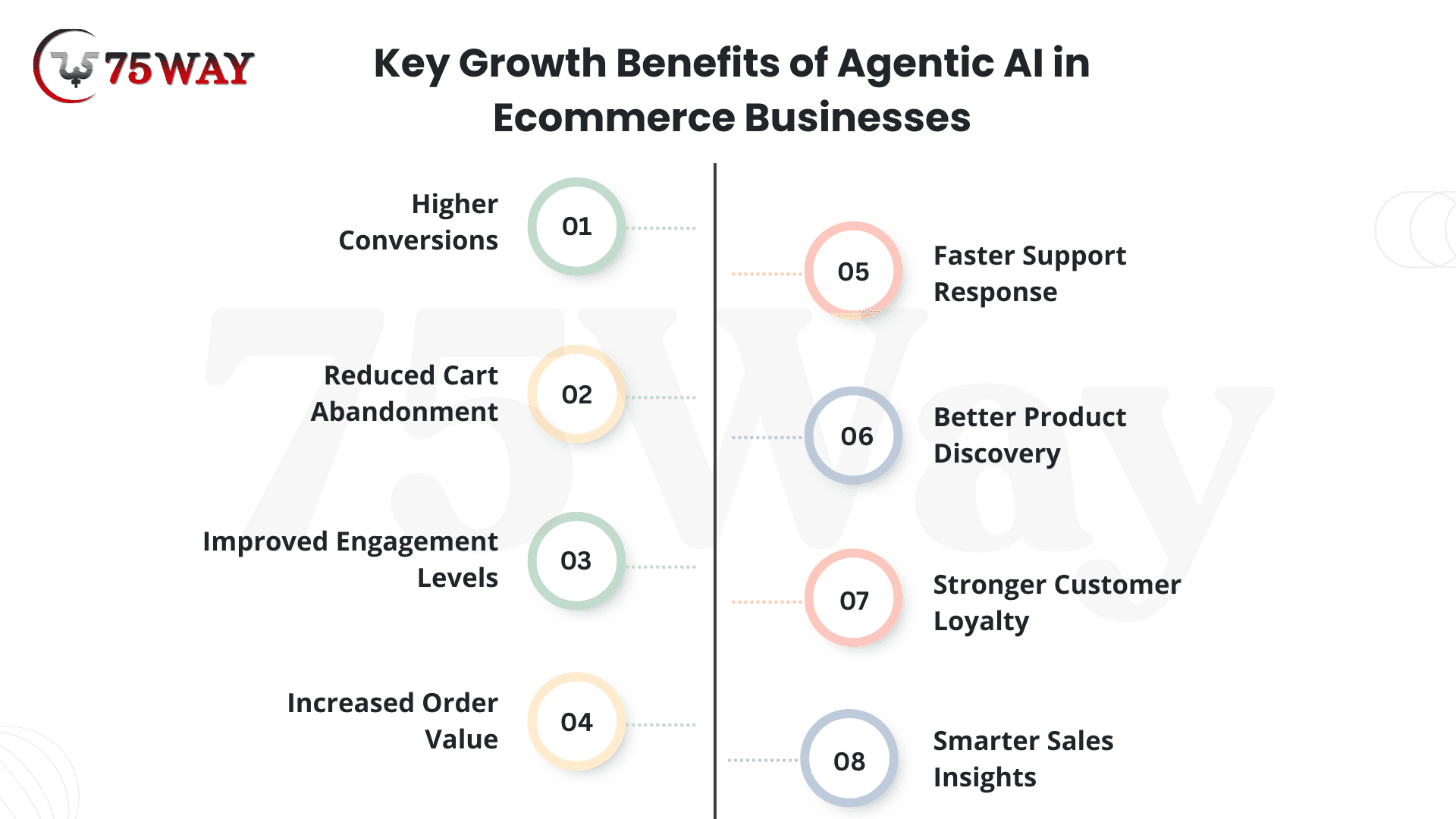
- Higher Conversions: Ecommerce AI agents guide shoppers with personalized suggestions and timely assistance. This reduces friction during buying and increases completed purchases across online stores.
- Reduced Cart Abandonment: Agentic AI in ecommerce reminders and support messages re-engage users who leave items in carts. This helps recover lost sales and improves revenue outcomes.
- Improved Engagement Levels: Customers receive relevant product guidance and instant responses with ecommerce AI assistants. This keeps users active on platforms and increases interaction throughout shopping journeys.
- Increased Order Value: Smart recommendations encourage customers to explore additional products. This leads to higher basket sizes and improved overall transaction value for businesses.
- Faster Support Response: Automated AI chatbots for ecommerce answer queries instantly across channels. This reduces waiting time and improves customer satisfaction during shopping interactions.
- Better Product Discovery: Ecommerce AI agents highlight relevant products based on user behavior. This helps customers find suitable items quickly without unnecessary browsing effort.
- Stronger Customer Loyalty: Personalized experiences build trust and repeat purchase behavior. Customers return more often because of consistent, helpful shopping experiences.
- Smarter Sales Insights: Adopting the best AI customer service agents for e-commerce helps retailers analyse customer patterns and purchase trends. This helps businesses refine strategies and improve long-term sales performance.
How To Implement An AI Agent for Ecommerce?
Adopting AI agents for ecommerce is not just about adding a tool. It is about building a connected system that improves customer experience step by step. When done properly, it helps stores automate interactions, improve conversions, and create smoother shopping journeys. The process moves in a logical flow where each stage supports the next, from defining goals to continuous optimization.
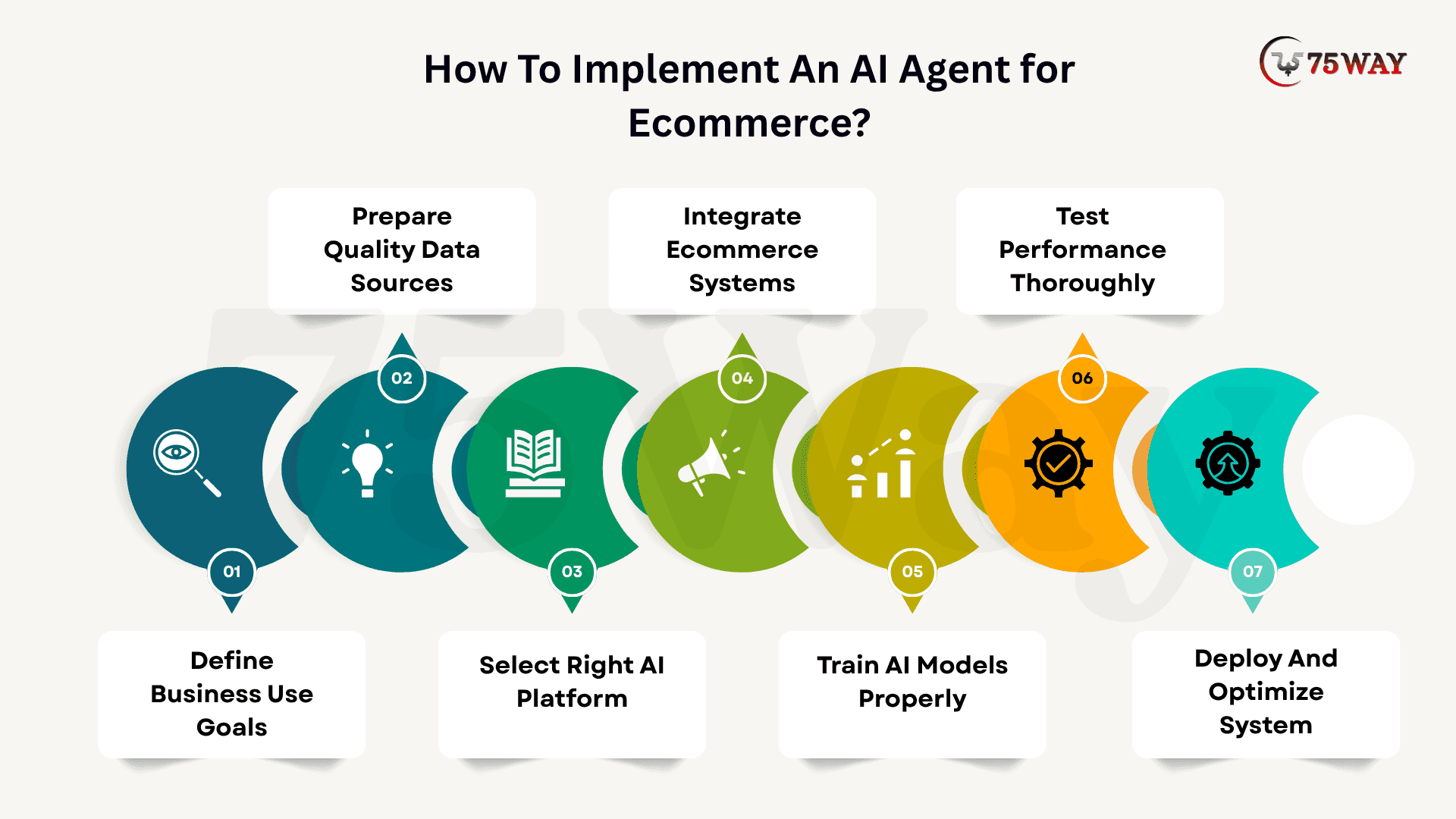
Step 1: Define Business Use Goals
The process begins by setting clear ecommerce objectives such as increasing conversions, reducing cart abandonment, or improving customer support. These goals act as the foundation for every later decision. Once goals are defined, they guide what kind of AI capabilities are needed. This clarity ensures the system is built with purpose from the start.
Step 2: Prepare Quality Data Sources
After defining goals, the next step is collecting relevant data from product catalogs, customer interactions, and purchase history. This data is cleaned and structured so the AI can understand patterns. Without accurate data, even strong systems fail to perform well. Good data preparation directly improves the quality of future predictions and suggestions.
Step 3: Select The Right AI Platform
With data ready, businesses then choose an AI platform that matches their ecommerce requirements. The platform must support integrations with stores, payment systems, and customer tools. This ensures smooth communication between all systems. A well-chosen platform becomes the base that supports all AI operations moving forward.
Step 4: Integrate Ecommerce Systems
Once the platform is selected, it is connected with ecommerce systems like websites, CRM tools, and inventory databases. This integration allows real-time data sharing across all touchpoints. As a result, product availability and customer interactions stay updated instantly. This step ensures the AI works within the full business ecosystem.
Step 5: Train AI Models Properly
After integration, AI models are trained using customer behavior data and past transactions. This helps the system understand shopping patterns and user intent. With continuous training, the AI becomes smarter over time. Better training leads to more relevant recommendations and improved customer engagement.
Step 6: Test Performance Thoroughly
Once training is complete, the system is tested across different shopping scenarios. This helps identify issues in responses, recommendations, or processing speed. Any gaps are fixed before launch to avoid real user problems. Testing ensures the system performs smoothly in real conditions.
Step 7: Deploy And Optimize System
Finally, the AI ecommerce system is launched across ecommerce channels like websites and apps. After deployment, performance is closely monitored using real customer data. Improvements are made based on preferences and outcomes. This continuous optimization keeps the system effective and aligned with business growth.
Future Trends of AI Agents Ecommerce in Businesses
The future of agentic and conversational AI in ecommerce is moving toward more intelligent and automated shopping experiences. Businesses are already shifting toward AI agents ecommerce that anticipate customer needs and simplify every stage of the buying journey. These advancements will help increase conversions and create seamless interactions across digital platforms.
- Voice-Based Shopping Assistants: Customers will interact using voice commands for product search and purchases. AI shopping assistants will provide instant responses and personalized recommendations naturally.
- Predictive Product Suggestions: Ecommerce AI agents analyze browsing patterns and purchase history. It will suggest products before customers actively search for them.
- Hyper-Personalized Storefronts: Online stores will adapt layouts based on individual user behavior. Each shopper will see a unique, tailored shopping experience.
- Visual Search Integration: Customers will upload images to find similar products instantly. AI recommendation models for ecommerce match visuals with relevant catalog items.
- Fully Automated Journeys: Entire shopping processes will run with minimal human involvement. AI in ecommerce manages discovery, engagement, checkout, and post-purchase interactions.
Final Thoughts
AI ecommerce agents are becoming essential tools for online stores aiming to improve conversion rates and customer experience. These systems simplify shopping journeys by offering personalized recommendations, instant support, and intelligent product discovery. Customers receive faster answers, clearer guidance, and more relevant product suggestions, reducing confusion and improving purchase confidence. Businesses benefit from reduced cart abandonment, higher engagement, and increased revenue per customer. At the same time, AI systems help store owners understand buyer behavior more effectively and optimize sales strategies accordingly. If you are planning to build or scale such systems, you can reach a reliable AI agent development company for ecommerce and retail to design and launch AI ecommerce solutions tailored to your goals.
Frequently Asked Questions (FAQs)
Which AI Agents Are Best For Ecommerce Support?
The best AI agents for ecommerce support are conversational AI agents, shopping assistants, and customer service automation agents. They help manage queries, track orders, and provide instant responses, improving customer satisfaction and reducing support workload.
How Do AI Agents Enhance The Shopping Experience In Ecommerce?
AI agents enhance shopping by offering personalized product recommendations, instant assistance, and smarter search results. They reduce confusion, guide customers through decisions, and make the entire buying journey faster and more seamless.
How AI Agents Help Ecommerce Brands Scale?
AI agents help ecommerce brands scale by automating customer interactions, handling large volumes of queries, and optimizing sales processes. This allows businesses to manage more customers efficiently without increasing operational costs significantly.
What Are Verified AI Agent Payments In Banking And Ecommerce?
Verified AI agent payments are secure transactions completed by AI systems with authentication layers. These agents help process payments safely while reducing fraud risks and improving transaction speed across banking and ecommerce platforms.
How Will AI Agent Payments Change The Future Of Ecommerce Transactions?
AI agent payments will make transactions faster and more automated. They will verify users, process payments instantly, and reduce manual checkout steps, improving overall shopping experience and trust in digital payments.
What Are AI Shopping Agents In Industrial Supply Ecommerce?
AI shopping agents in industrial ecommerce help businesses find, compare, and purchase bulk materials or equipment. They simplify complex procurement processes and improve order accuracy for large-scale supply chains.
How Do Conversational AI Agents Improve Ecommerce Experience?
Conversational AI agents interact with customers through chat or voice. They answer questions, recommend products, and guide users through purchasing, creating a smoother and more interactive shopping journey.
What Role Do AI Shopping Agents Play In Ecommerce Search Features?
AI shopping agents enhance search by understanding user intent instead of just keywords. They deliver more relevant product results, filter options intelligently, and improve product discovery speed.
How Does Agentic AI Help Ecommerce Customer Retention?
Agentic AI improves retention by predicting customer needs, sending personalized offers, and automating follow-ups. It keeps customers engaged even after purchase, increasing repeat buying behavior.
What Are Hyros AI Agents For Ecommerce?
Hyros AI agents for ecommerce focus on tracking customer behavior, attribution, and ad performance. They help businesses understand which marketing efforts drive sales and optimize revenue strategies.
How Will AI Agents Improve Banking And Ecommerce Integration In The Future?
AI agents will connect banking and ecommerce systems for smoother payments, instant verification, and smarter financial decisions. This integration will reduce friction and improve transaction reliability across platforms.