Summary
AI software development in 2026 is transforming enterprise operations through automation, agentic AI, and data-driven decision-making. Businesses are leveraging advanced technologies to improve efficiency, scalability, and customer experiences. By adopting key trends, building strong data foundations, and aligning AI with business goals, organizations can drive innovation, reduce costs, and achieve sustainable growth in a competitive digital landscape.
Quick Overview
- AI software development is essential for enterprise growth and digital transformation success
- Agentic AI systems enable autonomous decision making and workflow execution efficiency
- Data driven strategies improve accuracy, scalability, and overall business performance outcomes
- Enterprises must align AI initiatives with clear goals and measurable ROI metrics
- Hybrid AI development models balance traditional logic with intelligent automation systems
- Responsible AI practices ensure ethical use, compliance, and long term business trust
AI is rapidly reshaping how enterprises build, deploy, and scale digital solutions, making AI software development a core strategic priority in 2026. Organizations across industries are leveraging intelligent systems to automate processes, enhance decision-making, and deliver personalized user experiences at scale. From generative AI and autonomous agents to advanced data analytics and low-code platforms, the landscape is evolving faster than ever. Enterprises that fail to adapt risk falling behind in a highly competitive, innovation-driven market.
In this guide, we explore the key trends defining AI adoption in 2026, highlighting how businesses can harness these advancements to drive efficiency, reduce costs, and unlock new growth opportunities. Whether you're a startup or a large enterprise, understanding these trends is essential for building future-ready, scalable, and intelligent software solutions.
What is AI Software Development?
AI software development refers to the process of designing, building, and deploying intelligent applications that can learn from data, automate tasks, and make decisions with minimal human intervention. It involves technologies such as machine learning, natural language processing, computer vision, and predictive analytics to create smarter digital systems. Businesses increasingly rely on AI development solutions in software to enhance efficiency, improve customer experiences, and gain data-driven insights. From chatbots and recommendation engines to autonomous systems, AI software development enables organizations to innovate faster and stay competitive in a rapidly evolving digital landscape.
Why AI Software Development Matters in 2026?
AI software development is crucial in 2026 as businesses compete in a data-driven, automation-first world. It enables faster decision-making, reduces operational costs, and enhances customer experiences through personalization. Organizations adopting AI gain a competitive edge, improve scalability, and unlock innovation opportunities, making AI a necessity rather than an option for sustainable growth and long-term digital transformation.
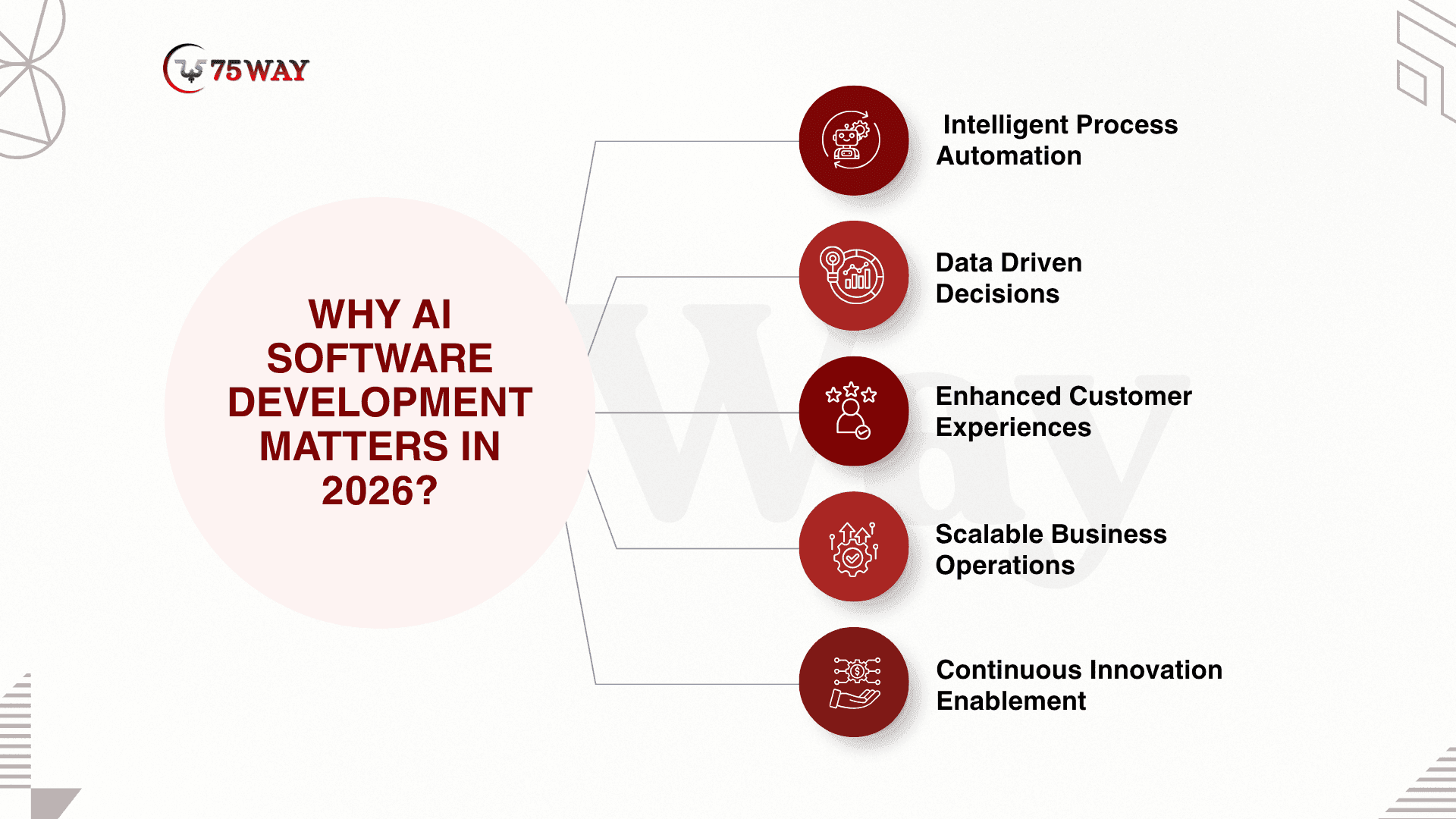
Intelligent Process Automation
AI enables businesses to automate repetitive and complex workflows with precision and speed. From customer support chatbots to backend operations, intelligent automation reduces human errors, increases productivity, and allows teams to focus on strategic, high-value tasks.
Data Driven Decisions
AI systems analyze massive datasets in real time, providing actionable insights that improve decision-making. Enterprises can predict trends, optimize operations, and make smarter business choices based on accurate data rather than assumptions or manual analysis.
Enhanced Customer Experiences
AI-driven personalization helps businesses deliver tailored content, recommendations, and services. By understanding user behavior and preferences, companies can improve customer satisfaction, increase engagement, and build long-term relationships in a highly competitive market.
Scalable Business Operations
AI software allows businesses to scale efficiently without proportional increases in resources. Cloud-based AI tools and platforms support rapid expansion, helping organizations manage growth while maintaining performance, cost efficiency, and operational consistency.
Continuous Innovation Enablement
AI fosters innovation by enabling rapid experimentation and development of new solutions. From generative AI tools to predictive systems, businesses can continuously evolve their offerings, stay ahead of competitors, and adapt to changing market demands effectively.
Top 10 AI Trends in 2026 Enterprises
AI is entering a transformative phase in 2026, where enterprises must move beyond experimentation to full-scale implementation. From autonomous agents to hyper-personalization, AI is redefining operations, customer engagement, and innovation. Staying ahead of these trends helps businesses remain competitive, improve efficiency, and unlock new revenue streams in an increasingly intelligent and automated digital ecosystem.
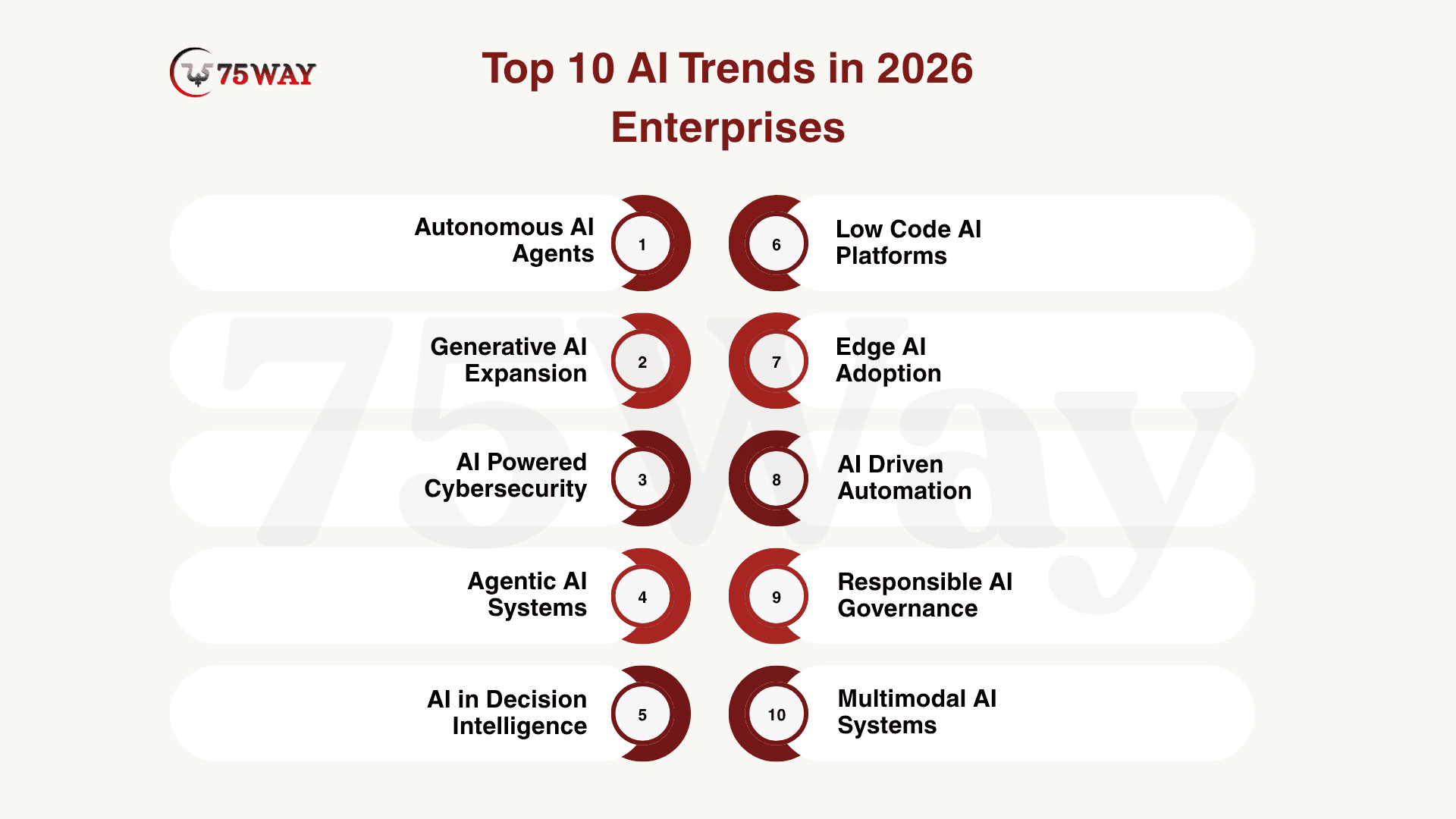
Autonomous AI Agents
Autonomous AI agents are becoming capable of handling complex tasks without human intervention. These agents can manage workflows, interact with customers, and make decisions in real time. Enterprises are using them for customer support, operations, and analytics, reducing dependency on manual processes while increasing speed, accuracy, and scalability across business functions.
Generative AI Expansion
Generative AI continues to evolve beyond text and images into code, video, and simulations. Enterprises are leveraging it for content creation, product design, and marketing automation. This trend enables faster innovation cycles, reduces development costs, and empowers teams to create high-quality outputs with minimal effort and enhanced creativity.
AI Powered Cybersecurity
Cybersecurity is being revolutionized by AI-driven threat detection and response systems. These tools can identify anomalies, predict potential attacks, and respond instantly. Enterprises benefit from improved security posture, reduced risks, and faster incident response, making AI a critical component in protecting sensitive data and digital infrastructure.
Agentic AI Systems
Agentic AI refers to intelligent systems that can autonomously plan, execute, and adapt tasks to achieve specific goals with minimal human input. These AI agents can collaborate across workflows, make contextual decisions, and continuously learn from outcomes. Enterprises use agentic AI to streamline operations, enhance productivity, and build more responsive, self-improving business processes in dynamic environments.
AI in Decision Intelligence
Decision intelligence combines AI with data analytics to support strategic decision-making. Enterprises use it to simulate outcomes, forecast trends, and optimize operations. This trend reduces uncertainty and helps leaders make informed, data-backed decisions that drive efficiency and long-term growth.
Low Code AI Platforms
Low-code and no-code AI platforms are democratizing AI development. They allow non-technical users to build and deploy AI models with minimal coding knowledge. This accelerates adoption across departments, reduces development time, and empowers businesses to innovate without heavy reliance on specialized technical teams.
Edge AI Adoption
Edge AI processes data closer to the source rather than relying on centralized cloud systems. This reduces latency, improves performance, and enhances real-time decision-making. Enterprises use edge AI in IoT devices, manufacturing, and healthcare for faster, more efficient, and secure data processing.
AI Driven Automation
AI-driven automation is expanding across industries, streamlining workflows and improving productivity. From supply chain management to HR processes, AI tools reduce manual effort, minimize errors, and optimize operations, enabling organizations to operate more efficiently and scale faster.
Responsible AI Governance
As AI adoption grows, so does the need for ethical and transparent AI systems. Enterprises are focusing on responsible AI practices, including fairness, accountability, and data privacy. This builds trust with users and ensures compliance with evolving regulations and standards.
Multimodal AI Systems
Multimodal AI integrates multiple data types such as text, images, audio, and video to deliver more comprehensive insights. Enterprises use these systems for advanced analytics, customer interactions, and automation, enabling richer experiences and more accurate decision-making across diverse applications.
How Enterprises Can Adopt AI Successfully
Enterprises can successfully adopt AI by aligning technology with business goals, investing in the right infrastructure, and fostering a data-driven culture. A clear strategy, skilled workforce, and continuous evaluation are essential for long-term success. By integrating AI thoughtfully, businesses can enhance efficiency, drive innovation, and achieve scalable, sustainable growth in an increasingly competitive digital landscape.
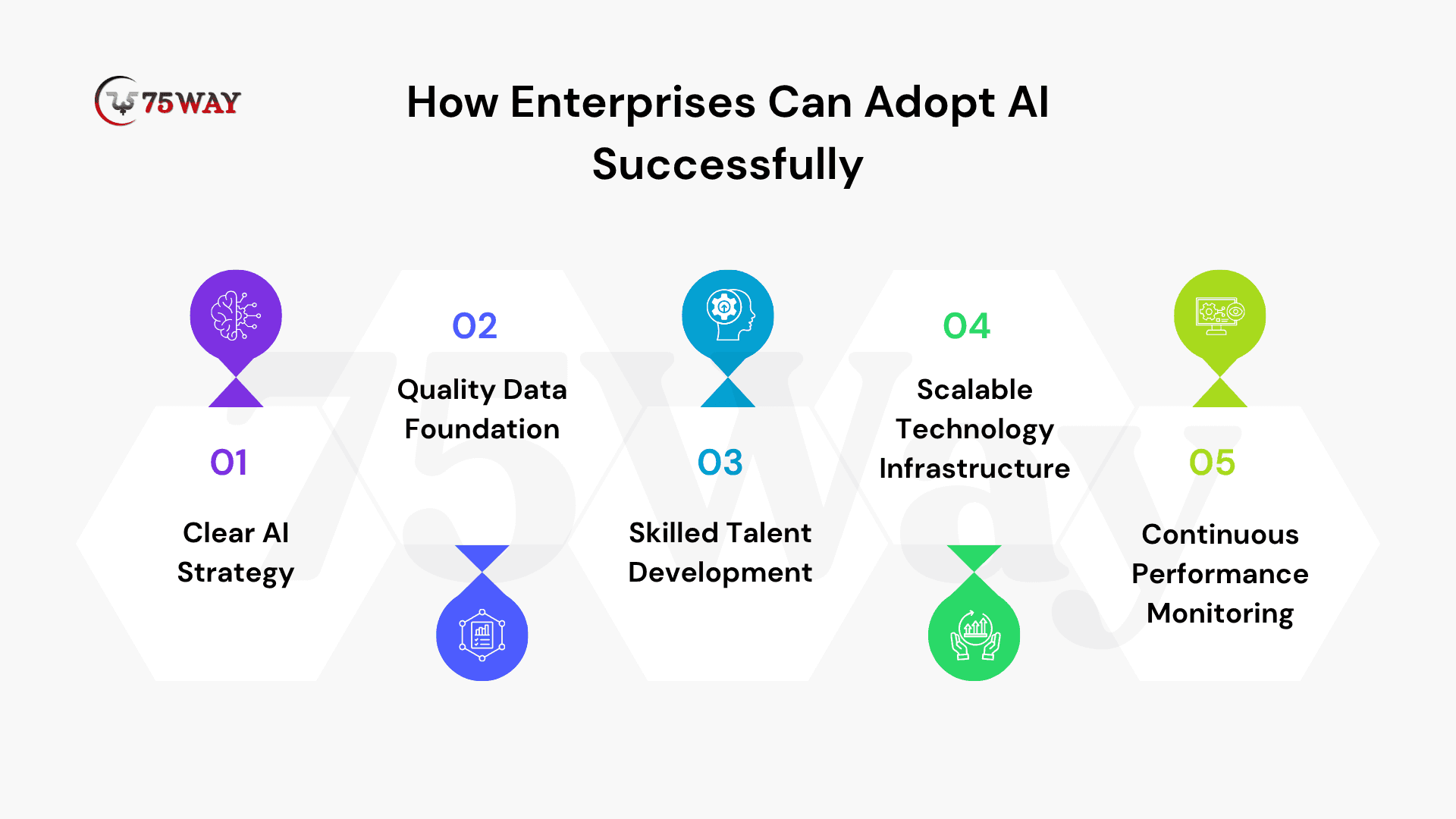
Clear AI Strategy
A well-defined AI strategy ensures alignment between business objectives and technology implementation. Enterprises must identify use cases, set measurable goals, and prioritize initiatives. This clarity helps avoid wasted resources and ensures AI projects deliver tangible value and long-term impact.
Quality Data Foundation
High-quality, structured data is the backbone of successful AI systems. Enterprises should invest in data collection, cleaning, and governance processes. Reliable data improves model accuracy, reduces bias, and ensures meaningful insights that drive better business decisions.
Skilled Talent Development
Building and nurturing AI talent is crucial for implementation success. Enterprises should train existing teams, hire experts, and encourage cross-functional collaboration. A skilled workforce ensures smooth development, deployment, and maintenance of AI-powered solutions.
Scalable Technology Infrastructure
Robust infrastructure supports the deployment and scaling of AI solutions. Cloud platforms, computing power, and integration capabilities enable enterprises to handle large datasets and complex models efficiently, ensuring performance, flexibility, and future growth.
Continuous Performance Monitoring
AI systems require ongoing evaluation and optimization. Enterprises must track performance, update models, and adapt to changing conditions. Continuous monitoring ensures accuracy, reliability, and long-term effectiveness of AI applications in real-world scenarios.
Enterprise Use Cases Shaped by Latest Tech Trends in 2026
In 2026, emerging technologies like AI, automation, and data analytics are transforming how enterprises operate and deliver value. These innovations are driving smarter workflows, improved customer engagement, and scalable business models. By adopting modern tech trends, organizations can optimize performance, reduce costs, and unlock new opportunities across industries, ensuring long-term growth and competitive advantage.
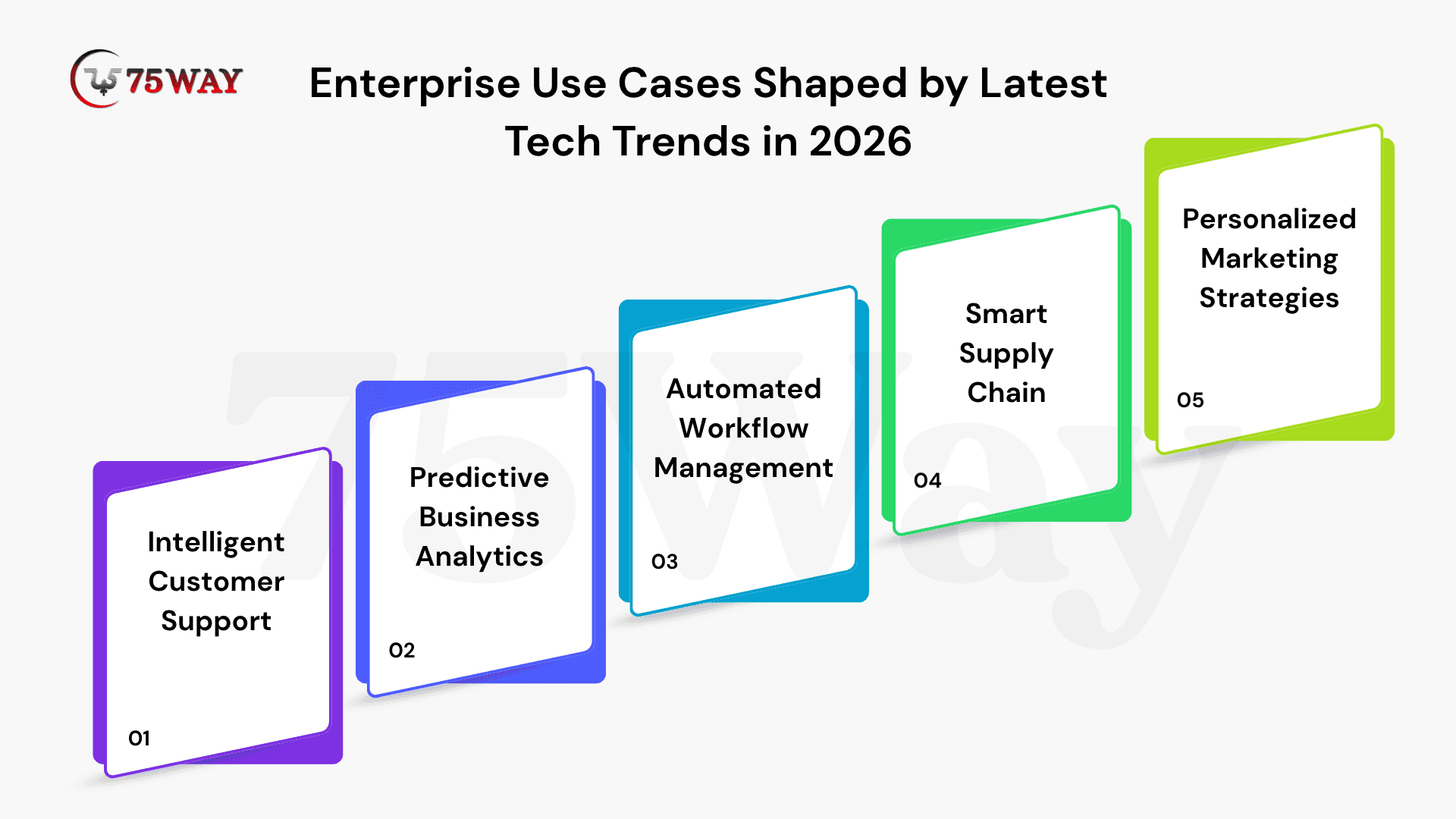
Intelligent Customer Support
AI-powered chatbots and virtual assistants are transforming customer service by providing instant, accurate, and 24/7 support. These systems handle queries, resolve issues, and personalize interactions, improving customer satisfaction while reducing operational costs and workload on human agents.
Predictive Business Analytics
Advanced analytics tools use AI to forecast trends, customer behavior, and market demands. Enterprises can make proactive decisions, optimize strategies, and reduce risks by leveraging real-time data insights, ensuring better planning and improved business outcomes.
Automated Workflow Management
Automation tools streamline repetitive and time-consuming business processes. From approvals to data entry, automated workflows enhance efficiency, minimize human error, and allow teams to focus on strategic initiatives that drive growth and innovation.
Smart Supply Chain
AI and IoT technologies enable real-time tracking, demand forecasting, and inventory optimization. Enterprises can reduce delays, improve logistics, and enhance supply chain visibility, ensuring faster delivery and better resource management.
Personalized Marketing Strategies
AI-driven marketing tools analyze customer data to create targeted campaigns and personalized messaging. This approach increases engagement, improves conversion rates, and helps businesses build stronger relationships with their audience in a competitive marketplace.
Conclusion
AI software development is no longer a future concept—it is a present-day necessity driving enterprise success in 2026. As highlighted throughout this blog, organizations that embrace AI trends, adopt the right strategies, and leverage intelligent solutions can significantly enhance efficiency, innovation, and scalability. From autonomous agents to predictive analytics, AI is reshaping every aspect of business operations. Enterprises must focus on building strong data foundations, investing in talent, and implementing responsible AI practices. By doing so, they can stay competitive, deliver exceptional customer experiences, and unlock sustainable growth in an increasingly digital and AI-powered world.
Frequently Asked Questions (FAQs)
What makes AI development different in 2026 compared to previous years?
AI development in 2026 is defined by the rise of agentic AI systems that can independently plan, reason, and execute tasks. Unlike earlier models focused on single functions, enterprises now build autonomous agents capable of managing workflows. This shift accelerates innovation and transforms how businesses design scalable, intelligent systems.
How can enterprises balance AI innovation with cost management?
Enterprises should focus on building efficient, task-specific AI models that deliver high value with lower computational costs. Prioritizing use cases with clear ROI, optimizing infrastructure, and continuously monitoring performance ensures innovation without overspending, enabling sustainable and cost-effective AI adoption.
What is the biggest mistake enterprises make when adopting AI?
The most common mistake is treating AI as only a technical upgrade rather than a business transformation. Without alignment across teams, organizations struggle to scale AI initiatives. Successful adoption requires collaboration between business leaders, developers, and governance teams to ensure measurable impact.
What is the hybrid development model in AI?
The hybrid development model combines traditional software engineering with AI capabilities. In this approach, deterministic logic handles structured tasks, while AI models manage complex, data-driven functions. This balance ensures reliability, flexibility, and better performance in modern enterprise applications.
What is core-plus-context architecture in AI systems?
Core-plus-context architecture separates stable business logic from AI-driven components. The core handles predictable operations, while AI manages contextual tasks like language processing or predictions. This structure improves maintainability, scalability, and allows independent updates to AI models without affecting core systems.
Why is incremental AI adoption important for enterprises?
Incremental adoption allows enterprises to start with small, low-risk AI use cases before scaling. This approach helps build expertise, reduce implementation risks, and validate outcomes. Over time, organizations can expand AI capabilities confidently while ensuring efficiency and alignment with business goals.