AI Summary
This guide explains essential features every modern on-demand app needs, including user experience, payments, tracking, security, AI automation, and scalability. It highlights how businesses can improve engagement, reduce operational friction, and build high-performing apps that drive growth, retention, and long-term customer satisfaction in competitive markets.
Quick Overview
- Seamless onboarding directly improves user conversion and reduces early drop-offs.
- Real-time tracking builds trust and significantly improves customer satisfaction levels.
- AI-powered features increase automation, personalization, and operational efficiency.
- Strong admin systems ensure smooth scaling and better business control.
- Security and payments determine long-term platform credibility and success.
If you have spent any time researching on-demand app development lately, you have probably noticed the same generic checklists everywhere: "add GPS, add payment gateway, add push notifications." True, but that's table stakes now. Users in 2026 expect apps to think a little, not just function.
At 75way, we have worked through enough on-demand app development scenarios (and torn apart enough competitor apps) to know that the difference between an app people tolerate and one they actually open every day usually comes down to a handful of features nobody puts on the "basic" list.
Thus, in this guide, we will define 20 must-have features for building on-demand mobile apps that genuinely move the needle, split into core functionality and the AI-driven layer that's now non-negotiable.
Why On-Demand Apps Need More Than Just "Order and Track" Anymore
Think about Uber in 2015 versus Uber today. Back then, "book a ride and see it on a map" was enough to win the market. Today, that same app predicts your destination before you type it, adjusts pricing in real time based on a dozen signals, and nudges drivers toward demand hotspots using artificial intelligence (AI), all invisible to the user, but all the reasons the experience feels effortless.
That's the bar now. Whether you're building a food delivery app, an on-demand home services platform, or a logistics tool, people compare your app to Uber, Swiggy, and Amazon, whether that's fair or not. So let's get into what actually needs to be there.
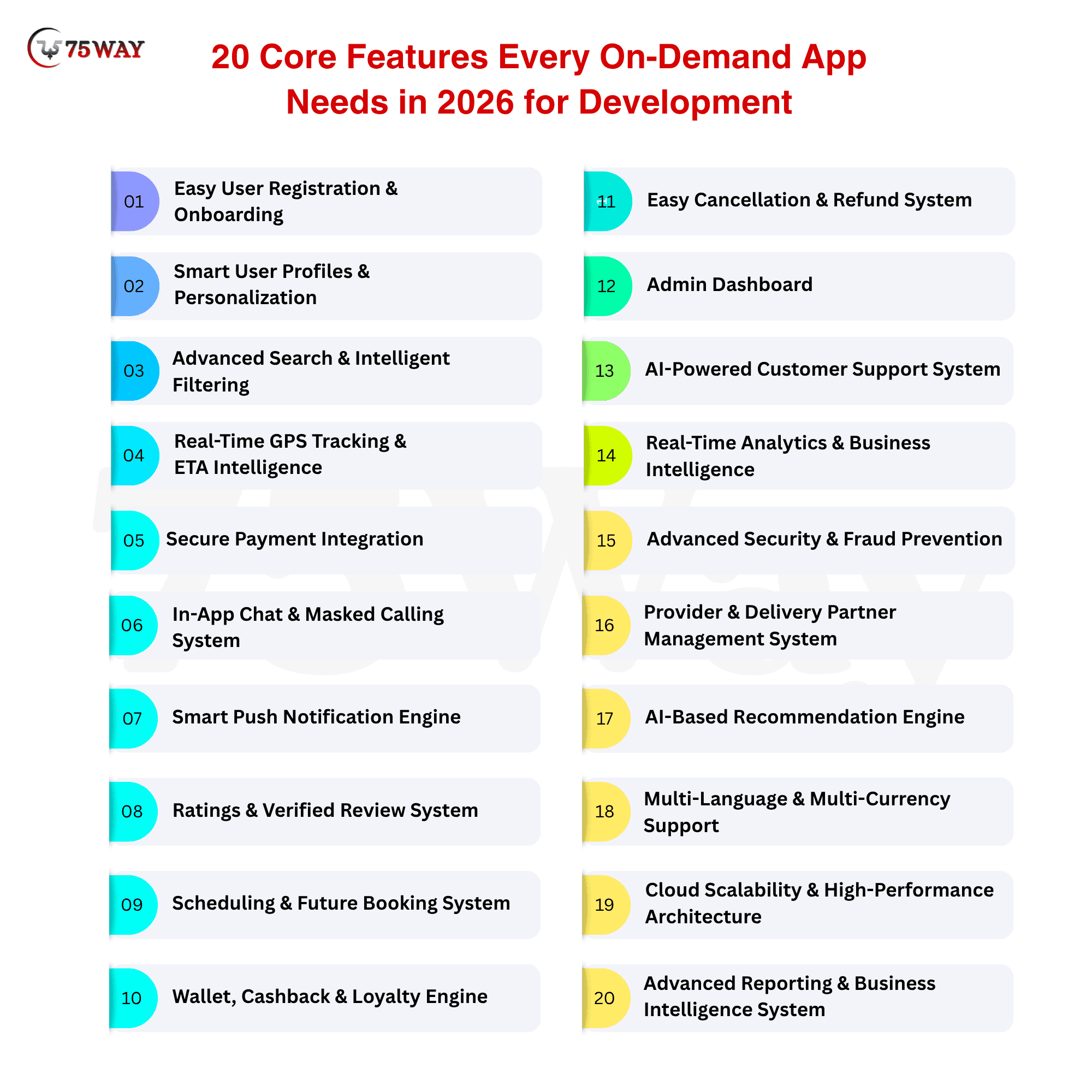
20 Core Features Every On-Demand App Needs in 2026 for Development
Customer expectations have changed faster than most businesses expected. Every successful on-demand app now relies on features that improve convenience, trust, and retention while helping companies scale operations without creating unnecessary complexity or support challenges.
1. Easy User Registration & Onboarding
First impressions can make or break an on-demand app. A lengthy registration process often discourages users before they even explore your services, resulting in lost customers and wasted marketing spend.
A seamless onboarding experience removes unnecessary steps while keeping account creation secure. Flexible sign-up options help users start ordering or booking services within minutes instead of struggling through complicated forms.
Core capabilities include:
- Mobile OTP verification
- Email registration
- Google and Apple sign-in
- Guest checkout
- Multi-factor authentication
- Automatic profile creation
Every completed registration increases the opportunity to convert a visitor into a paying customer. Faster onboarding also improves first-time user satisfaction, reduces app abandonment, and encourages repeat usage.
Expert insight: Businesses often focus on attracting new users, but registration friction quietly reduces conversions. A streamlined onboarding flow protects your acquisition budget while creating a stronger foundation for long-term customer retention.
2. Smart User Profiles & Personalization
A second impression often decides whether users stay or leave an on-demand app. Static experiences feel outdated quickly, while personalized apps create a sense of familiarity that users naturally trust.
Smart user profiles store everything that reduces friction in repeat usage. Saved addresses, order history, preferences, and payment methods remove repetitive steps and make every interaction faster.
Core capabilities include:
- Saved multiple addresses
- Order and booking history
- Personalized recommendations
- Preferred payment methods
- Loyalty and reward tracking
Personalization also plays a direct role in revenue growth. Users are far more likely to reorder when suggestions feel relevant instead of generic listings that ignore past behavior.
Expert insight: Many apps collect data but fail to use it meaningfully. Real value comes when profile data actively reduces decision time for the user.
3. Advanced Search With Intelligent Filtering
Search is often where intent turns into action or frustration. A weak search system forces users to scroll endlessly, and most of them simply don’t.
Modern on-demand apps rely on intelligent search systems that understand what users mean, not just what they type.
Instead of basic keyword matching, smart filtering improves discovery through context-aware results.
Core capabilities include:
- Predictive search suggestions
- Category-based filtering
- Price and availability filters
- Location-based results
- Voice search support
Strong search systems directly impact conversion rates because users reach what they want faster, with less effort and fewer exits.
Expert insight: Businesses often underestimate search performance, but it quietly controls revenue flow inside the entire app experience.
4. Real-Time GPS Tracking & ETA Intelligence
Uncertainty is one of the fastest ways to lose customer trust in on-demand platforms. Users want clarity, not guesses.
Real-time tracking systems remove that uncertainty by showing live movement, accurate ETAs, and continuous updates based on traffic conditions.
Modern systems don’t rely on fixed timers anymore. They adjust dynamically as routes and conditions change.
Core capabilities include:
- Live GPS location tracking
- Dynamic ETA updates
- Traffic-based route recalculation
- Delivery status milestones
- Push update synchronization
This feature significantly reduces “Where is my order?” support requests and improves perceived reliability.
Expert insight: Trust increases when users feel informed without needing to ask. Transparency often becomes a stronger retention driver than discounts.
5. Secure Payment Integration
Payment friction is one of the biggest silent killers of conversions. Users may like the service but abandon checkout if their preferred method is missing.
Modern on-demand apps support multiple secure payment options to remove that barrier completely.
The goal is not just payment completion. It is payment comfort.
Core capabilities include:
- Credit and debit cards
- UPI and instant bank transfers
- Digital wallets integration
- Buy Now Pay Later options
- Stored secure payment methods
A flexible payment system increases completed transactions and reduces cart abandonment rates significantly.
Expert insight: Expanding payment options is less about technology and more about reducing decision hesitation at checkout.
6. In-App Chat And Masked Calling System
Customer communication breaks the experience when it shifts outside the app. Most trust issues start when users are forced to share personal phone numbers or wait too long for responses.
A built-in chat and calling system keeps every interaction inside the platform while protecting privacy through number masking.
This feature connects customers, delivery partners, and service providers in real time without exposing personal contact details.
Core capabilities include:
- In-app messaging system
- Masked phone calling
- Image and file sharing
- Real-time chat notifications
- Auto-translation support (for global apps)
Faster communication directly improves resolution speed and reduces failed deliveries or service confusion.
Expert insight: Many businesses underestimate communication design, but it often decides whether a customer becomes a repeat user or a one-time complainer.
7. Smart Push Notification Engine
Notifications can either improve engagement or destroy it completely. The difference comes down to timing, relevance, and frequency.
A well-designed notification system keeps users informed without overwhelming them with unnecessary alerts.
Instead of random messages, modern apps use behavior-based triggers to send updates that actually matter.
Core capabilities include:
- Order status updates
- ETA change alerts
- Personalized offers
- Abandoned cart reminders
- Location-based promotions
Strong notification systems improve retention because users feel continuously connected to the service without opening the app repeatedly.
Expert insight: Over-notification is one of the fastest ways to increase uninstall rates. Relevance always beats volume.
8. Ratings And Verified Review System
Trust is fragile in on-demand platforms. Users rely heavily on other customers’ experiences before making decisions.
A verified review system ensures feedback is authentic and tied to real transactions instead of fake or manipulated ratings.
This improves transparency across the entire ecosystem.
Core capabilities include:
- Verified purchase tagging
- Star-based rating system
- Written review submission
- Provider response option
- Review moderation tools
Reliable reviews improve conversion rates because users feel more confident choosing highly rated services.
Expert insight: Fake reviews damage long-term credibility faster than any technical issue ever will.
9. Scheduling & Future Booking System
Not every user wants instant service. Many prefer planning ahead, especially for deliveries, appointments, or home services.
A scheduling system expands your app beyond “on-demand” into “on-your-time” flexibility.
This feature supports both customers and service providers by improving availability planning.
Core capabilities include:
- Date and time slot selection
- Recurring bookings
- Calendar synchronization
- Provider availability matching
- Reschedule and modification options
This increases order volume by capturing users who would otherwise leave due to timing limitations.
Expert insight: Apps that only support instant booking often miss a large segment of high-value planned users.
10. Wallet, Cashback, & Loyalty Engine
Retention is where most on-demand apps fail. Acquiring users is expensive, but keeping them is where profitability actually comes from.
A digital wallet combined with loyalty rewards encourages users to stay within the ecosystem instead of switching platforms.
This creates habitual usage patterns over time.
Core capabilities include:
- In-app wallet system
- Cashback rewards
- Referral bonuses
- Tier-based loyalty programs
- Subscription memberships
These systems increase repeat orders by giving users a reason to return even when competitors offer similar services.
Expert insight: Loyalty systems work best when rewards feel immediate, not delayed or complicated.
11. Easy Cancellation & Refund System
A confusing cancellation flow often creates more anger than the original problem itself. Users expect control, especially when plans change suddenly or services do not match expectations.
A modern on-demand app must offer a clear, transparent cancellation experience without hidden steps or delayed actions.
Refund handling should feel predictable and fast, not like a support struggle.
Core capabilities include:
- One-tap cancellation flow
- Instant refund initiation rules
- Transparent refund status tracking
- Partial and full refund logic
- Automated policy enforcement
This feature directly reduces negative reviews and support tickets while improving trust during high-pressure moments like failed deliveries or delays.
Expert insight: Businesses often lose customers not because of service failure, but because refund experiences feel unfair or unclear.
12. Admin Dashboard For Complete Control
A successful on-demand app is not just about users. Operational control determines whether the system scales or breaks under pressure.
An admin dashboard becomes the command center where every order, user, and provider activity is monitored and managed.
Without it, even a good app becomes difficult to operate at scale.
Core capabilities include:
- Real-time order monitoring
- User and provider management
- Commission and payout tracking
- Dispute resolution tools
- Service category control
A strong backend dashboard reduces manual work and helps teams make faster operational decisions.
Expert insight: Many startups invest heavily in UI but underinvest in admin systems, which creates scaling problems later.
13. AI-Powered Customer Support System
Customer expectations for instant responses have increased dramatically. Waiting hours for support is no longer acceptable in competitive on-demand markets.
AI-based support systems solve common queries instantly while reducing dependency on human agents.
This improves both response time and operational efficiency.
Core capabilities include:
- AI chatbot for instant replies
- Automated FAQ resolution
- Smart ticket routing
- Human escalation handling
- Multi-language support
This system reduces operational costs while improving customer satisfaction through immediate assistance.
Expert insight: AI support works best when it handles repetitive queries, freeing human teams for complex cases.
14. Real-Time Analytics & Business Intelligence
Decisions based on guesswork rarely scale. Data-driven decision-making is now a core requirement for any on-demand platform.
Real-time analytics help businesses understand user behavior, revenue patterns, and operational bottlenecks instantly.
This turns raw data into actionable insights.
Core capabilities include:
- Revenue tracking dashboards
- User behavior analytics
- Order completion rates
- Retention and churn metrics
- Service performance reports
Better visibility leads to better decisions, especially when scaling into new regions or categories.
Expert insight: Most businesses collect data but fail to act on it quickly enough to impact growth.
15. Advanced Security & Fraud Prevention
Trust is the foundation of every transaction in an on-demand ecosystem. A single security breach can damage a reputation permanently.
Modern apps require strong security layers to protect users, providers, and business data from fraud or misuse.
Security is no longer optional. It is a growth requirement.
Core capabilities include:
- End-to-end encryption
- Secure authentication systems
- Fraud detection algorithms
- Role-based access control
- Secure payment tokenization
Strong security improves user confidence and supports long-term platform credibility.
Expert insight: Security issues rarely show immediate impact, but their long-term cost is always significantly higher than the prevention investment.
16. Provider & Delivery Partner Management System
An on-demand platform is only as strong as the people delivering the service. Poor coordination between providers and customers often creates delays, missed orders, and frustrated users.
A structured provider management system brings clarity and control into daily operations. It ensures every partner is onboarded, monitored, and supported through a centralized workflow instead of manual coordination.
Core capabilities include:
- Partner onboarding and verification
- Availability and shift management
- Order assignment automation
- Performance tracking and ratings
- Earnings and payout dashboards
Operational efficiency improves when providers receive the right tasks at the right time without confusion or delays.
Expert insight: Strong provider systems reduce operational chaos more than any marketing strategy can fix.
17. AI-Based Recommendation Engine
Users rarely know everything they need. They often rely on suggestions to decide faster, especially in high-choice environments like food, groceries, or services.
A recommendation engine uses behavioral data to suggest relevant products, services, or providers based on user patterns instead of random listings.
Core capabilities include:
- Behavior-based suggestions
- Personalized product/service feeds
- “Frequently booked together” logic
- Location-aware recommendations
- AI learning from purchase history
This feature increases average order value because users discover more relevant options without searching manually.
Expert insight: Good recommendations feel invisible but powerful. They quietly guide decisions without forcing them.
18. Multi-Language & Multi-Currency Support
Expansion into new regions becomes difficult when language and payment barriers are ignored. Users expect apps to feel local, not foreign.
A multi-language and multi-currency system helps businesses scale globally while maintaining a native experience for each market.
Core capabilities include:
- Regional language support
- Currency conversion and display
- Localized content and UI adjustments
- Region-based pricing rules
- Geo-specific payment methods
This feature improves adoption in tier-2 and tier-3 markets as well as international regions.
Expert insight: Localization is not translation. It is an adaptation to user expectations in each region.
19. Cloud Scalability & High Performance Architecture
Traffic in on-demand apps is unpredictable. A sudden spike in orders can break poorly designed systems within minutes.
Cloud-based infrastructure ensures the application scales automatically without downtime or performance drops during peak demand.
Core capabilities include:
- Auto-scaling cloud infrastructure
- Load balancing across servers
- Fast API response handling
- CDN integration for speed
- High availability uptime systems
Stable performance directly impacts user trust because slow apps often lose customers permanently.
Expert insight: Scalability planning should happen before launch, not after growth begins.
20. Advanced Reporting & Business Intelligence System
Growth becomes difficult when decisions rely on assumptions instead of insights. A reporting system transforms operational data into clear business intelligence.
This allows leadership teams to understand performance trends and make faster strategic decisions.
Core capabilities include:
- Revenue and profit dashboards
- Customer retention reports
- Service category performance tracking
- Provider productivity analysis
- Predictive growth insights
This system helps identify what is working and what needs immediate improvement.
Expert insight: Businesses that review data weekly scale faster than those that review it only during problems.
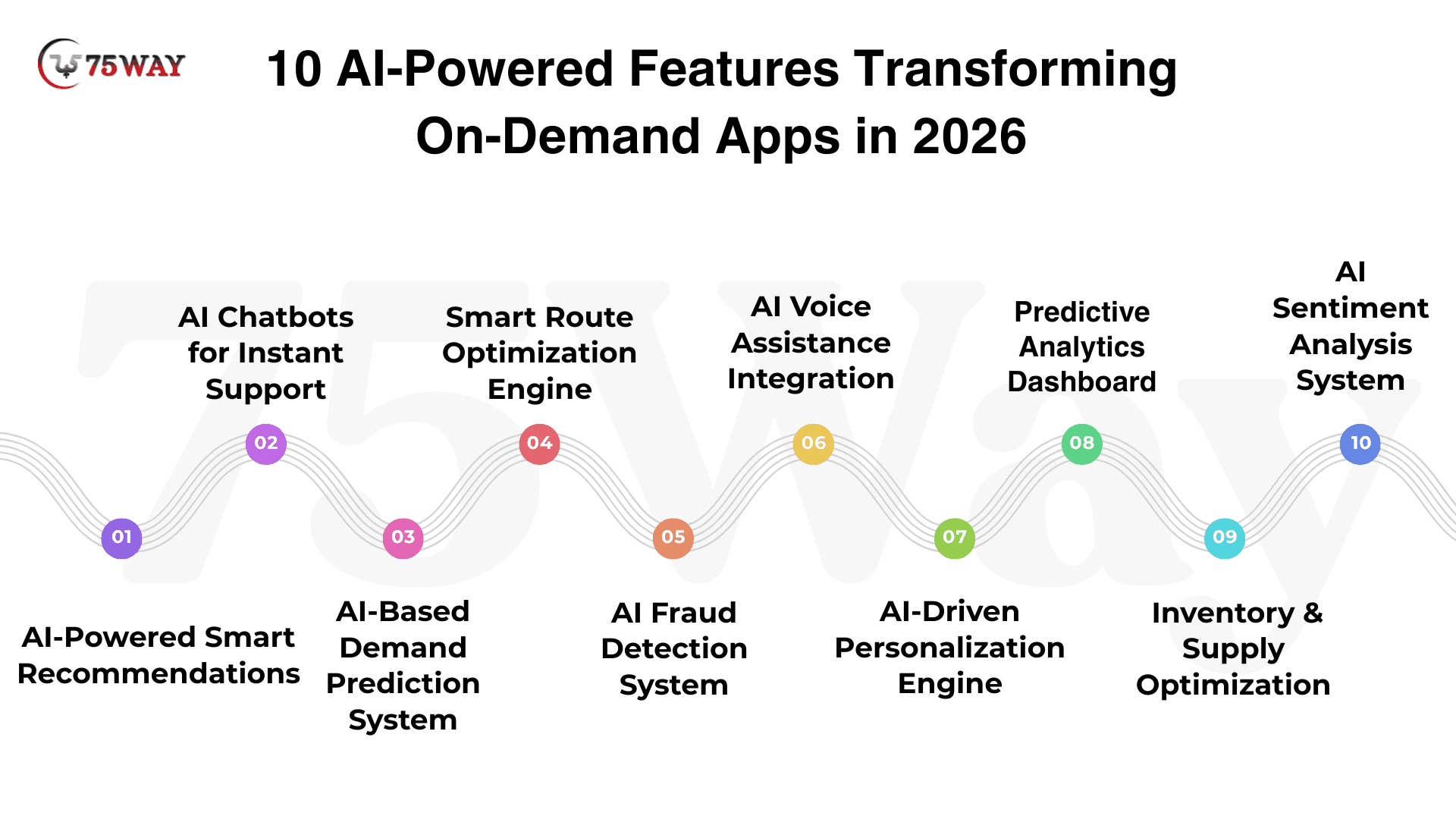
10 AI-Powered Features Transforming On-Demand Apps in 2026
AI has completely changed how on-demand apps operate today. Businesses now rely on intelligent automation, prediction systems, and personalization engines to reduce manual effort while improving speed, accuracy, and customer satisfaction across every interaction.
1. AI-Powered Smart Recommendations
AI studies user behavior and suggests relevant services or products instantly. It reduces decision time and increases conversions by showing exactly what users are most likely to need next.
- Behavior-based suggestions
- Purchase history analysis
- Real-time personalization
- Cross-sell opportunities
- Context-aware listings
- Dynamic ranking system
2. AI Chatbots For Instant Support
AI chatbots handle customer queries instantly without waiting for human agents. They improve response time, reduce support costs, and ensure users always receive immediate assistance inside the app.
- 24/7 automated responses
- Instant query resolution
- Multi-language understanding
- Smart escalation system
- Order issue handling
- FAQ automation engine
3. AI-Based Demand Prediction System
AI predicts peak demand periods using historical data and seasonal trends. It helps businesses prepare resources in advance and avoid delays during high-traffic situations.
- Historical data analysis
- Seasonal demand forecasting
- Peak time prediction
- Resource optimization alerts
- Supply-demand balancing
- Real-time adjustment insights
4. Smart Route Optimization Engine
AI calculates the fastest and most efficient delivery routes. It reduces fuel costs, improves delivery time, and enhances customer satisfaction through accurate ETA predictions.
- Traffic-based route planning
- Dynamic rerouting system
- Fuel optimization logic
- Delivery time accuracy
- Multi-stop route handling
- Live navigation updates
5. AI Fraud Detection System
AI identifies suspicious activities in real time to protect transactions and user accounts. It improves platform security by blocking fraudulent behavior before it affects operations.
- Real-time transaction monitoring
- Suspicious pattern detection
- User behavior analysis
- Payment fraud alerts
- Account risk scoring
- Automated blocking system
6. AI Voice Assistance Integration
AI voice systems allow users to place orders or get updates using voice commands. It improves accessibility and speeds up interactions for hands-free usage scenarios.
- Voice-based ordering
- Natural language processing
- Hands-free navigation
- Order status queries
- Multilingual voice support
- Smart command recognition
7. AI-Powered Personalization Engine
AI creates unique user experiences by adapting content, offers, and recommendations based on individual preferences and behavior patterns across the platform.
- User behavior tracking
- Dynamic content adjustment
- Personalized offers system
- Adaptive UI experience
- Interest-based targeting
- Real-time learning model
8. AI Predictive Analytics Dashboard
AI transforms raw data into future insights. Businesses can predict growth trends, customer churn, and operational risks before they actually happen.
- Trend forecasting system
- Churn prediction alerts
- Revenue prediction models
- Behavior pattern analysis
- KPI optimization insights
- Data-driven decision support
9. AI Inventory And Supply Optimization
AI ensures the right products and services are available at the right time. It reduces shortages and overstock situations by predicting demand accurately.
- Smart inventory tracking
- Demand-based stocking
- Waste reduction logic
- Supply chain balancing
- Automated restocking alerts
- Real-time availability updates
10. AI Sentiment Analysis System
AI analyzes user reviews, feedback, and chat messages to understand customer emotions. It helps businesses improve service quality based on real sentiment insights.
- Review sentiment scanning
- Feedback classification system
- Emotion detection model
- Service quality insights
- Complaint trend analysis
- Customer satisfaction scoring
What This Means for Your Build” Strategic Approach To Include Features in On-Demand Apps
Here's the honest part: you don't need all 20 on day one. If you're working with a provider offering mobile app development services, prioritize building an MVP with the essential features first and then scale with AI capabilities based on user demand and business growth. The smarter path is usually:
Start with the 12 core features to get a functional, trustworthy app live. Then layer in AI features in this order of ROI: AI chatbot support first (cheapest to implement, immediate cost savings), recommendations second (drives repeat orders), and dynamic pricing or demand prediction once you actually have enough order volume for the data to mean something. AI features built on thin data are just guesswork wearing a fancy label.
Wrap Up
Not every on-demand app needs every AI feature on this list, and that's worth saying out loud. A niche local on-demand laundry app probably doesn't need fraud detection at Uber's scale. Match the feature list to your actual business model and order volume, not to what sounds impressive in a pitch deck.
If you're evaluating app development partners or estimating cost, ask them specifically which of these features they've actually shipped before, not just "can you build AI features," because almost everyone will say yes to that question regardless of real experience. To get complete guidance, you can reach an expert on-demand app development agency to launch a feature-rich mobile application based on your business needs.
Frequently Asked Questions (FAQs)
What Are The Must-Have Features Of An On-Demand App?
At a minimum: real-time GPS tracking, multiple payment options, in-app chat, push notifications, ratings and reviews, a vendor/admin dashboard, scheduling, and an easy cancellation flow. These 12 core features form the baseline before any AI layer is added.
Which AI Features Should An On-Demand App Have In 2026?
The highest-ROI AI features are an AI chatbot for support, personalized recommendations, dynamic/demand-based pricing, route optimization, and fraud detection. Demand prediction and predictive matching are worth adding once you have enough order data for them to be accurate.
Do Small or Niche On-Demand Apps Need All 20 Features?
No, a small, local-only app (like a laundry or tutoring service) doesn't need fraud detection or demand prediction at Uber's scale. Match the feature set to your order volume and business model rather than building everything upfront.
How Much Does It Cost To Add AI Features To An On-Demand App?
Cost depends on which features you choose and how much historical data you already have. A basic AI chatbot is the cheapest to implement, while demand prediction and dynamic pricing models require more data engineering and typically cost more, since they need ongoing model training.
What's The Difference Between Core Features & AI Features In On-Demand Apps?
Core features (tracking, payments, chat) make the app functional. AI features (recommendations, dynamic pricing, fraud detection) make the app adaptive. They use data to improve over time instead of behaving the same way for every user.