AI Summary
This guide explores AI applications across marketing, personalization, customer support, inventory, sales, and daily ecommerce operations. It explains practical benefits, implementation considerations, challenges, and opportunities for transforming online retail through intelligent automation.
Key Takeaways
- AI automates repetitive ecommerce tasks across marketing, sales, and operations.
- Personalization helps retailers deliver more relevant shopping experiences.
- AI in ecommerce improves customer support through faster automated responses.
- Predictive analytics helps businesses manage inventory and demand.
- Strategic AI adoption in ecommerce can support ecommerce growth and profitability.
Most ecommerce brands already know how to bring shoppers to their website. The harder part is getting more value from the people who are already there, especially when thousands of customer journeys are happening at the same time.
A shopper who receives a relevant recommendation at the right moment may add another product. Someone who gets an immediate answer may complete the purchase rather than leave. A previous customer who receives the right offer at the right time may return sooner. AI automation for ecommerce can coordinate these moments at a scale that becomes difficult to manage manually.
The opportunity, therefore, is not simply to automate more tasks. It is to automate the customer and sales workflows that have a direct connection to revenue. This guide explores those opportunities and the strategies ecommerce businesses can use to maximize online retail sales with AI-powered ecommerce apps and platforms.
Why Is AI Automation Important for Ecommerce?
AI automation is becoming important for ecommerce because online retailers manage thousands of customer interactions, product decisions, marketing activities, and operational tasks every day. Manual processes can become difficult to manage as product catalogs, orders, customers, and sales channels grow.
AI in ecommerce helps retailers automate repetitive tasks and teams make decisions using real-time data. For example, an ecommerce business can use artificial intelligence to recommend relevant products, answer routine customer questions, identify abandoned carts, forecast demand, personalize promotions, and detect unusual transactions.
The bigger opportunity is not simply reducing manual work. AI automation for ecommerce can connect different parts of the ecommerce journey so businesses can respond to customers faster, understand buying behavior better, and create more personalized experiences at scale.
For growing online retailers, this can mean better use of employee time, more relevant customer interactions, fewer operational bottlenecks, and stronger opportunities to increase revenue without expanding every manual process at the same rate.
How Is AI Automation Transforming Ecommerce?
Ecommerce AI automation redefines retail by connecting customer-facing experiences with behind-the-scenes business operations. Instead of using AI for one isolated task, retailers can apply it across the entire buying journey, from attracting a potential customer to supporting them after a purchase. Here are the major areas where AI automation can create value:
- Product Discovery: Recommends relevant products based on customer behavior and preferences
- Personalization: Customizes products, offers, content, and shopping experiences
- Marketing: Automates audience segmentation, campaign optimization, and content workflows
- Sales: Identifies purchase intent and supports product recommendations
- Customer Support: Answers routine questions and assists customers around the clock
- Cart Recovery: Identifies abandoned carts and triggers personalized follow-ups
- Inventory: Forecasts demand and identifies potential stock shortages
- Pricing: Analyzes market and customer data to support pricing decisions
- Fraud Detection: Identifies unusual transaction patterns and potential risks
- Order Management: Automates updates, notifications, and selected fulfillment workflows
- Customer Retention: Identifies churn signals and creates personalized retention campaigns
- Analytics: Turns large volumes of ecommerce data into actionable insights
AI Automation Across the Ecommerce Customer Journey
AI can support customers at different stages of their relationship with an online store.
- Before Purchase: AI can analyze browsing behavior, search activity, previous purchases, and customer interests to personalize product discovery and marketing.
- During Purchase: AI can help shoppers find relevant products, answer questions, recommend complementary items, and reduce friction during the buying process.
- After Purchase: AI can automate order updates, support requests, product recommendations, review requests, and retention campaigns.
This creates a connected customer experience instead of treating marketing, sales, support, and retention as separate activities.
AI Automation Can Also Automate Internal Operations
The customer experience is only one side of ecommerce automation. AI can also support employees and management teams by analyzing sales patterns, forecasting demand, identifying operational issues, and automating repetitive administrative workflows.
For example, an ecommerce business can use AI to identify products that are likely to experience increased demand, flag unusual order activity, summarize customer feedback, or prioritize support requests.
The result is a more connected ecommerce operation where AI assists both customer-facing activities and internal decision-making.
Real-World AI Automation Use Cases For Ecommerce Businesses
AI automation can support almost every major ecommerce function, but businesses should prioritize use cases with a clear connection to revenue, customer experience, or operational savings. The strongest applications usually begin with repetitive processes and gradually expand into predictive, personalized, and decision-support workflows.
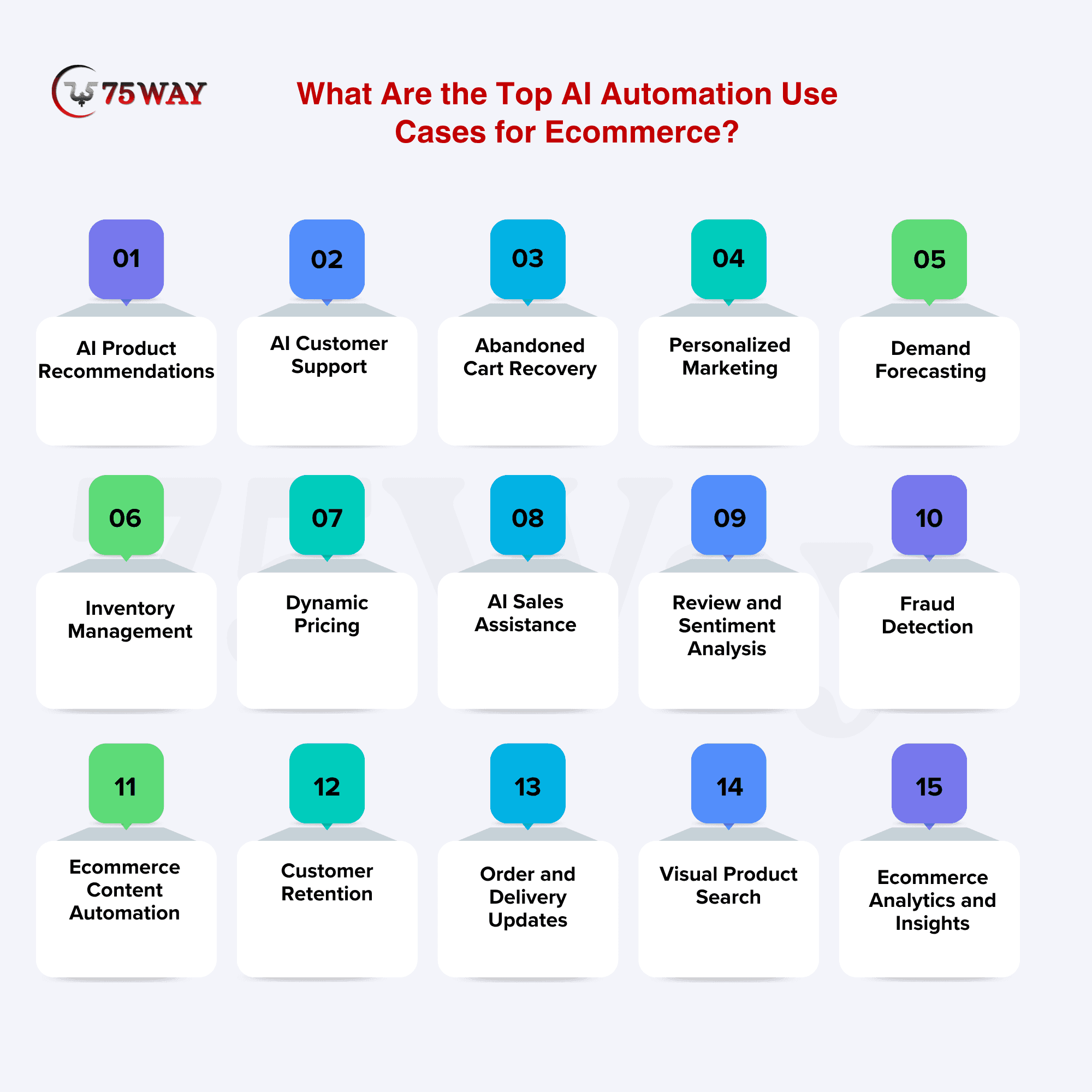
1. AI Product Recommendations
Personalized recommendation engines analyze browsing history, previous purchases, search activity, product interactions, and customer preferences to suggest relevant products.
For example, a fashion retailer might recommend clothing based on previous purchases, while an electronics store could suggest compatible accessories for a recently viewed device.
2. AI Customer Support
Intelligent chatbots and virtual assistants handle common questions about products, shipping, returns, order status, availability, and store policies.
Routine requests can be resolved automatically, while complicated issues are transferred to human support representatives with the relevant conversation context.
3. Abandoned Cart Recovery
Abandoned-cart systems identify shoppers who leave products without completing checkout and trigger personalized follow-ups based on their behavior.
The message, timing, product suggestions, and promotional incentives can be adjusted according to customer activity instead of sending the same reminder to every shopper.
4. Personalized Marketing
Machine learning models analyze purchase history, engagement, browsing behavior, interests, and customer segments to support personalized marketing campaigns.
Retailers can automate targeted emails, product promotions, recommendations, and offers based on individual customer behavior.
5. Demand Forecasting
Predictive models help retailers estimate future product demand by analyzing historical sales, seasonal patterns, promotions, customer behavior, and other relevant signals.
Better forecasts can support purchasing decisions and help businesses prepare for periods of increased demand.
6. Inventory Management
Automated inventory systems monitor stock levels and identify products that may require replenishment.
They can also highlight slow-moving products and potential stockout risks, giving retailers better visibility when making purchasing and procurement decisions.
7. Dynamic Pricing
Intelligent pricing systems evaluate factors such as demand, inventory, market conditions, competitor pricing, and customer behavior.
Retailers can use these insights to support pricing decisions while maintaining appropriate business rules and safeguards around automated price changes.
8. AI Sales Assistance
Virtual shopping assistants help customers compare products, answer questions, discover suitable options, and move closer to purchase.
This is especially valuable for stores with extensive product catalogs where shoppers may need guidance before making a decision.
9. Review and Sentiment Analysis
Natural language processing can analyze large volumes of customer reviews and feedback to identify recurring themes.
Retailers can uncover common complaints, frequently praised features, product quality concerns, and changing customer preferences without manually reviewing every comment.
10. Fraud Detection
Machine learning systems examine transaction patterns and identify unusual purchasing behavior that may indicate potential fraud.
Instead of depending entirely on fixed rules, these systems can evaluate multiple signals and flag transactions for additional review.
11. Ecommerce Content Automation
Generative AI tools can assist with product descriptions, category content, email variations, advertising copy, FAQs, and other repetitive content requirements.
Human review remains important for accuracy, brand voice, product claims, and search quality, but automation can reduce the workload involved in managing large ecommerce catalogs.
12. Customer Retention
Predictive models can identify behavioral signals associated with declining engagement or potential customer churn.
Once these signals are detected, automated workflows can trigger personalized recommendations, loyalty incentives, follow-up messages, or relevant promotional campaigns.
13. Order and Delivery Updates
Automated workflows can manage customer notifications throughout the order lifecycle, including order confirmation, shipment updates, delivery information, and post-purchase communications.
Customers receive timely information without requiring support teams to manually send routine updates.
14. Visual Product Search
Visual search technology allows shoppers to upload an image and discover visually similar products within an ecommerce catalog.
This functionality can be particularly useful for fashion, furniture, home décor, accessories, and other visually driven product categories.
15. Ecommerce Analytics and Insights
Advanced analytics systems process large volumes of ecommerce data and identify patterns that may otherwise take considerable time to discover.
Retailers can use these insights to understand customer behavior, product performance, campaign results, conversion patterns, and potential revenue opportunities.
The most effective strategy is not to automate every ecommerce process at once. Start with high-impact workflows, measure the results, and expand automation as your business gains reliable data and confidence in the technology.
Where Can AI-Driven Workflow Automation Be Used in Ecommerce?
AI automation can support almost every major ecommerce function, from attracting shoppers to managing inventory and handling post-purchase support. Instead of using separate tools for every task, retailers can connect intelligent workflows across marketing, sales, customer service, operations, and retention.
- Marketing and Personalization: Ecommerce businesses can automate customer segmentation, campaign personalization, product recommendations, targeted offers, email workflows, and content creation. Customer behavior, purchase history, browsing activity, and engagement data can help determine which products, messages, and promotions are most relevant to different shoppers.
- Product Discovery and Sales: Intelligent search, visual search, recommendation engines, and virtual shopping assistants can help customers find suitable products faster. These systems can also support upselling and cross-selling by identifying complementary products based on cart contents, previous purchases, and customer interests.
- Customer Support: Automated assistants can handle routine questions about orders, shipping, returns, product availability, payments, and store policies. More advanced systems can classify support requests, identify customer sentiment, and transfer complex issues to human representatives with relevant conversation details.
- Cart Recovery and Conversions: Behavioral analysis can identify shoppers who leave products without completing checkout. Automated workflows can then send relevant reminders or offers based on customer activity. Similar systems can analyze the conversion journey to identify friction across product pages, checkout, payments, and other stages.
- Inventory and Demand Forecasting: Predictive models can analyze sales history, seasonal trends, promotions, customer behavior, and inventory data to estimate future demand. Retailers can use these insights to plan replenishment, identify potential stockouts, and detect products that may be moving slowly.
- Pricing and Fraud Prevention: Intelligent systems can evaluate market conditions, demand signals, inventory levels, and other relevant information to support pricing decisions. Transaction monitoring can also identify unusual purchasing patterns and flag potentially risky activity for additional review.
- Order and Post-Purchase Management: Automated workflows can send order confirmations, shipping updates, delivery notifications, review requests, and product-related follow-ups. These processes keep customers informed while reducing repetitive work for internal teams.
- Retention and Customer Insights: Predictive models can identify declining engagement, potential churn, and opportunities for repeat purchases. Personalized recommendations, replenishment reminders, loyalty campaigns, and targeted offers can then encourage customers to return. Meanwhile, sentiment analysis and ecommerce analytics can reveal customer concerns, product trends, campaign performance, and potential revenue opportunities.
How to Implement AI Workflow Automation in Ecommerce & Retail?
Adding AI to an ecommerce business should not start with a long list of tools. Start with the problems that are costing your team time, frustrating customers, or limiting sales. Once those areas are clear, you can decide where automation makes sense and build from there.
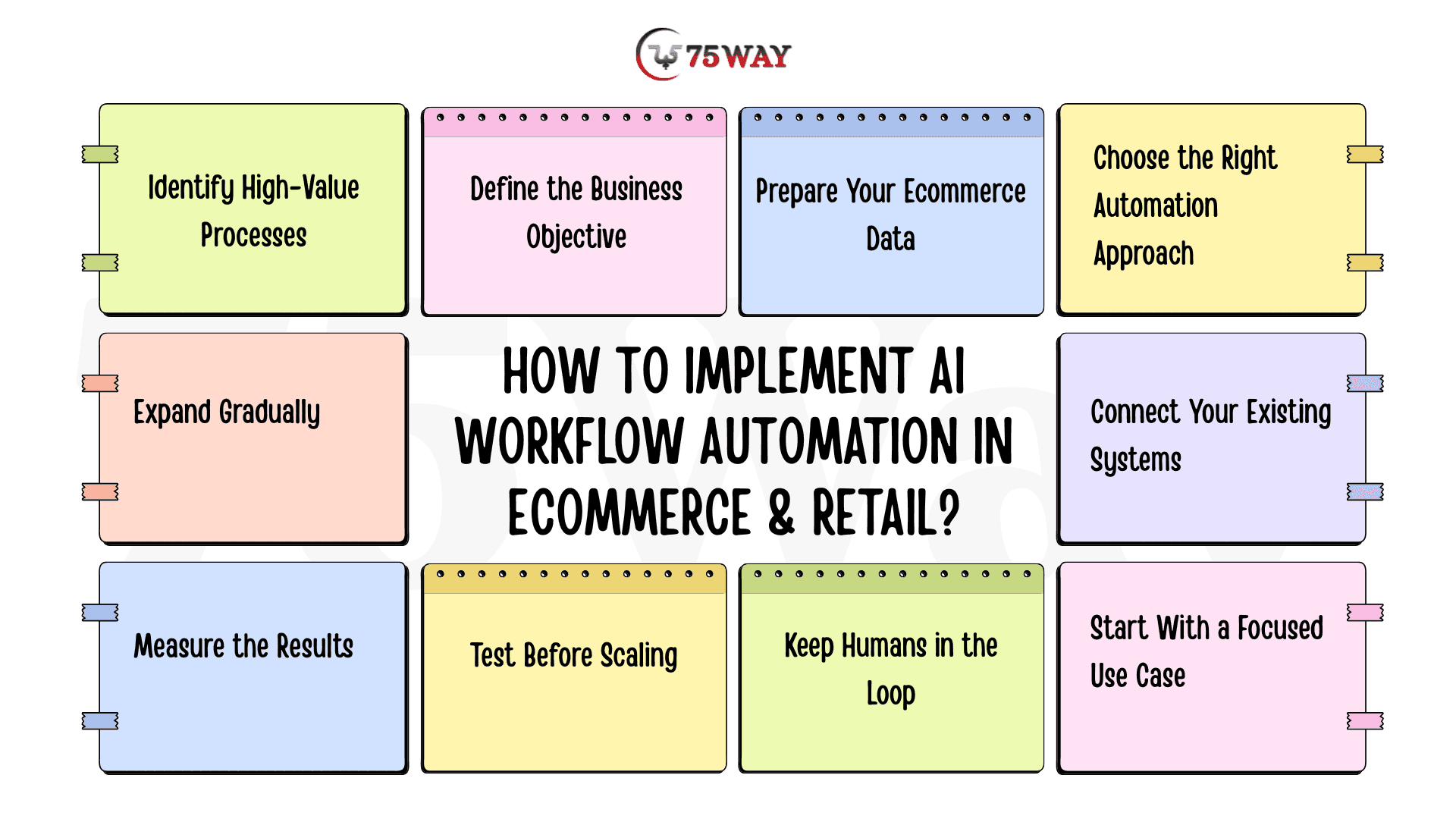
1. Identify High-Value Processes
Look at your daily operations and find tasks that are repetitive, time-consuming, or difficult to manage as order volume grows. Customer support, abandoned carts, product recommendations, inventory forecasting, and marketing workflows are common starting points.
The goal is to find processes where automation can produce a measurable improvement rather than adding technology simply because it is available.
2. Define the Business Objective
Every automation project should have a reason behind it. A retailer might want to reduce support response times, recover more abandoned carts, improve product discovery, lower inventory waste, or increase repeat purchases.
Defining the expected outcome makes it easier to select the right technology and measure whether the investment is delivering value.
3. Prepare Your Ecommerce Data
AI systems depend heavily on the quality of the information they receive. Product catalogs, customer records, transaction history, inventory information, website behavior, and support conversations may all become useful data sources.
Before implementation, review how this information is stored, whether different systems can communicate with each other, and whether the available data is accurate enough for the intended use case.
4. Choose the Right Automation Approach
Not every ecommerce problem requires a custom AI system. Some businesses may benefit from existing AI-powered ecommerce platforms, while others may need custom workflows, APIs, machine learning models, or integrations with their existing technology stack.
The right approach depends on your business model, data, technical environment, budget, and expected level of customization.
5. Connect Your Existing Systems
AI automation becomes more useful when it can access the systems already running your business. Depending on your setup, integrations may include:
- Ecommerce platforms
- CRM systems
- Payment gateways
- Inventory management
- Order management
- Marketing platforms
- Customer support software
- Analytics systems
- ERP platforms
- Shipping providers
Connecting these systems allows information to move between different parts of the business instead of creating another isolated tool.
6. Start With a Focused Use Case
Trying to automate the entire ecommerce operation at once can make implementation unnecessarily complicated.
A better starting point may be one high-impact workflow, such as an AI shopping assistant or automated customer support. Once the process is working reliably and producing measurable results, additional use cases can be introduced.
7. Keep Humans in the Loop
Automation does not mean every decision should happen without human involvement.
Refund disputes, unusual transactions, sensitive complaints, product claims, pricing decisions, and other important situations may still require human review. Establishing clear escalation rules helps prevent automation from making inappropriate decisions.
8. Test Before Scaling
Run the automation in a controlled environment before applying it across the entire customer base.
Test different customer scenarios, edge cases, incorrect inputs, system failures, and integration issues. Monitor the results and make adjustments before expanding the workflow.
9. Measure the Results
Track metrics that directly relate to the original business objective. Depending on the automation, useful measurements may include:
- Conversion rate
- Average order value
- Cart recovery rate
- Customer support response time
- Resolution rate
- Repeat purchase rate
- Inventory turnover
- Stockout frequency
- Marketing revenue
- Customer acquisition cost
- Customer lifetime value
These measurements show whether the automation is creating genuine business value.
10. Expand Gradually
Once an automation workflow has demonstrated reliable results, additional processes can be introduced. Over time, separate automations can be connected to create a broader ecommerce system that supports marketing, sales, customer service, inventory, and retention.
The most practical implementation strategy is therefore simple: find a real problem, choose an appropriate solution, test it, measure the outcome, and expand what works.
Top Advantages of Automated AI Solutions For Ecommerce Operations
Running an online store involves hundreds of small decisions every day. Which products should be promoted? Why are customers abandoning their carts? Which items might sell out next week? Which support requests need immediate attention? AI automation helps ecommerce teams answer these questions while taking care of repetitive work in the background.
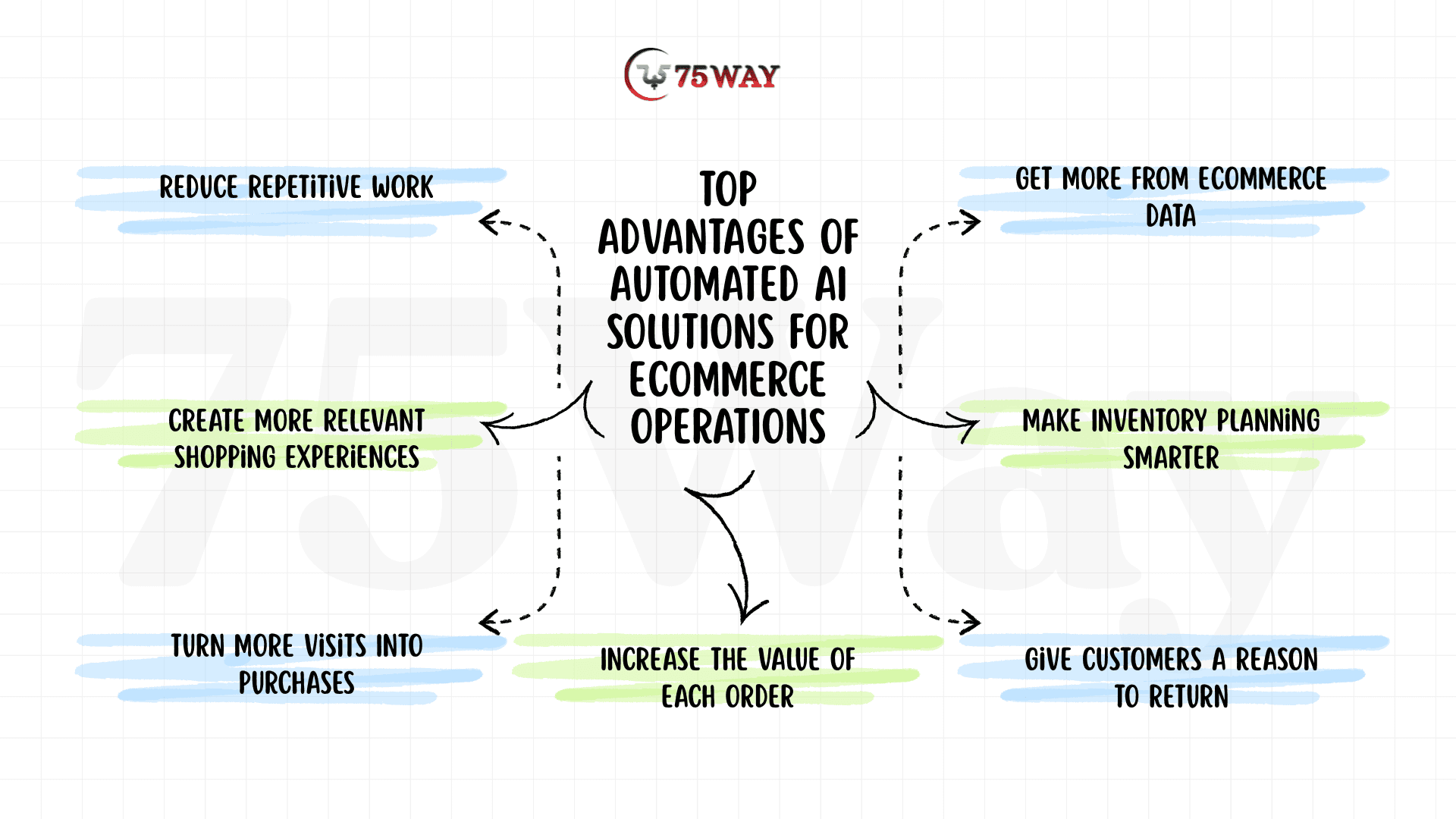
- Reduce Repetitive Work
Think about everything a store team handles repeatedly: answering “Where is my order?”, updating product information, sending follow-up emails, sorting customer requests, or preparing routine reports. These jobs may seem manageable individually, but their volume grows quickly with the business. Automation takes care of suitable repetitive tasks so employees have more time for decisions that actually need their attention.
- Create More Relevant Shopping Experiences
Customers do not all visit an online store for the same reason. One shopper may be looking for a budget-friendly option, while another is searching for premium products. Personalization helps the store respond to those differences by presenting relevant products, content, offers, and recommendations instead of giving everyone exactly the same experience.
- Turn More Visits Into Purchases
Getting visitors to an ecommerce website is only half the job. What happens after they arrive matters just as much. Intelligent search, product recommendations, shopping assistance, cart recovery, and personalized offers can help remove some of the barriers that prevent interested shoppers from completing an order.
- Increase the Value of Each Order
A customer buying one product may also need something that goes with it. A person ordering a camera could need a memory card or spare battery. Someone buying a sofa might be interested in cushions or a matching table. Automated recommendations can identify these relationships and present useful additions without relying on employees to suggest them manually.
- Give Customers a Reason to Return
The first purchase is not the end goal. Ecommerce brands want customers to come back, particularly when they sell products that people buy repeatedly. Replenishment reminders, relevant recommendations, loyalty offers, and personalized follow-ups can bring customers back at a time when another purchase actually makes sense.
- Make Inventory Planning Smarter
Few things frustrate an ecommerce business more than having customers ready to buy when the product is unavailable. Overstock creates a different problem by tying up money in products that are not moving. Predictive systems can examine sales history, seasonal demand, promotions, and other signals to help teams make better stocking decisions.
- Get More From Ecommerce Data
An online store produces a huge amount of information every day. Orders, searches, clicks, returns, reviews, support conversations, and campaign interactions all tell a story about the business. The challenge is finding useful patterns inside that volume of information. AI-powered analysis can bring those patterns forward and help teams understand what deserves attention.
How Does AI in Ecommerce Handle Growth Without Matching Every Task With More Staff?
AI allows ecommerce businesses to grow their workload without treating every new order, enquiry, or customer interaction as a new staffing requirement. Below are the key areas where this approach helps ecommerce businesses handle higher demand without proportionally expanding their teams.
- Respond to Customers Faster
Nobody enjoys waiting hours for an answer to a simple order question. Automated assistants can provide immediate responses to routine requests, while more complicated cases can move to human representatives. This creates a useful division: technology handles straightforward questions, and people step in when the situation requires judgment or empathy.
- Spot Problems Earlier
Unusual purchasing activity, sudden changes in demand, repeated product complaints, or declining customer engagement can easily get buried in everyday business activity. Automated monitoring can bring these signals to the surface sooner, giving teams an opportunity to investigate before a small issue becomes a larger business problem.
- Make Decisions With Better Context
Business owners often have plenty of data but not enough time to interpret it. AI-powered analysis can bring together information from sales, customers, marketing, products, and operations to reveal patterns worth investigating. That gives decision-makers a stronger starting point than relying solely on assumptions or isolated reports.
- Build a More Connected Retail Business
The real advantage appears when different automation systems work together. A customer's browsing activity can influence product recommendations, purchase history can shape retention campaigns, inventory levels can inform promotions, and customer feedback can reveal which products need attention.
That connection turns automation from a collection of individual tools into part of the wider ecommerce operation. For retailers, the goal is not to automate everything. It is to automate the right things so technology takes care of routine work while people remain focused on customers, strategy, and growth.
Tools & Technologies Used To Build AI Automation for Ecommerce
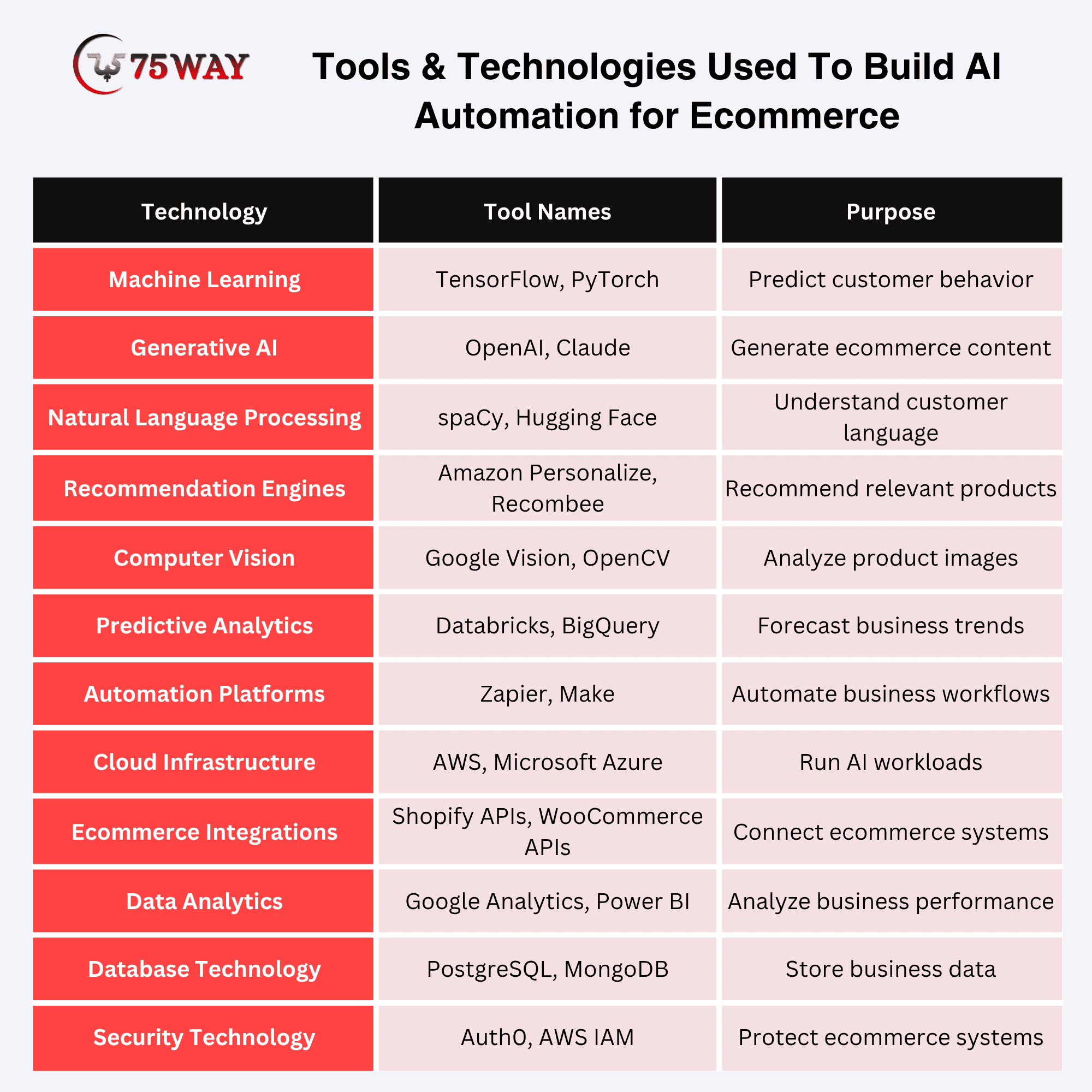
The technology behind ecommerce automation depends on what you want the system to accomplish. A product recommendation engine, customer support assistant, demand forecasting system, and automated marketing workflow may use different technologies, but they can still work together through APIs and shared business data.
- Machine Learning: Machine learning models analyze historical and real-time data to identify patterns and make predictions.
Ecommerce businesses can use them for product recommendations, demand forecasting, customer segmentation, churn prediction, fraud detection, and purchase-intent analysis.
- Generative AI: Generative AI is useful when an ecommerce business needs to create or interpret content at scale. Product descriptions, email drafts, customer responses, FAQs, marketing variations, and conversational shopping experiences are common applications.
Human review remains important when the output involves product specifications, pricing, policies, or other information where accuracy matters.
- Natural Language Processing: NLP models allow AI-powered ecommerce software to understand and respond to written customer communication. It can support chatbots, customer service automation, sentiment analysis, review analysis, and intelligent search.
For example, a customer could ask, “Which running shoes are suitable for long-distance training?” and receive results based on product information rather than having to search using exact product names.
- Recommendation Engines: Recommendation technology analyzes customer behavior and product relationships to identify items that may interest a particular shopper.
It can power sections such as “You may also like,” “Recommended for you,” and complementary product suggestions throughout an ecommerce website or application.
- Computer Vision: Computer vision allows ecommerce systems to interpret images and visual information. Ecommerce businesses can use it for visual product search, image-based recommendations, product categorization, quality inspection, and selected merchandising workflows.
A shopper could upload a picture of a chair, for example, and discover visually similar products available through the store.
- Predictive Analytics: Advanced analytics uses historical information and current signals to estimate what may happen next. Retailers can apply it to demand forecasting, customer churn, sales projections, inventory planning, and purchasing decisions.
These predictions can give business teams additional context when planning stock and marketing activities.
- APIs and Integrations: APIs allow AI-powered functionality to communicate with existing ecommerce systems. Depending on the business, integrations may connect AI workflows with ecommerce platforms, CRM software, ERP systems, payment gateways, and inventory systems.
Without these connections, an AI solution may have limited access to the information it needs.
- Cloud Infrastructure: Cloud platforms provide the computing resources required to run AI models, store data, process customer activity, and support growing ecommerce traffic.
Cloud infrastructure also makes it easier to adjust computing capacity as usage changes rather than maintaining all infrastructure on physical servers.
- Data and Analytics Infrastructure: AI automation needs reliable data pipelines, databases, analytics tools, and monitoring systems. These components help collect information from different sources and make it available for analysis or automated workflows.
Poorly organized data can limit the accuracy and usefulness of an otherwise sophisticated AI solution.
- Security and Access Controls: Ecommerce systems handle customer information, transaction details, order records, and other business data. Security therefore needs to be part of the architecture from the beginning.
Authentication, authorization, encryption, access controls, monitoring, secure APIs, and appropriate data-handling practices can help protect the systems supporting AI automation.
How These Technologies Work Together To Automate Ecommerce Workflows?
A successful ecommerce automation system rarely depends on one technology alone. A personalized shopping assistant may use generative AI and natural language processing, retrieve product information through APIs, use recommendation logic to suggest products, and rely on cloud infrastructure to serve customers.
The technology should therefore be selected according to the business problem, available data, existing ecommerce stack, security requirements, and expected scale rather than choosing tools simply because they are popular.
Challenges Businesses Consider Before Adopting AI Automation for Ecommerce & Solutions
AI automation can create meaningful improvements, but successful implementation is not as simple as adding an AI tool to an existing store. Ecommerce businesses need to consider data, integration, security, accuracy, costs, and customer expectations before expanding automation across critical processes.
1. Data Quality
AI systems learn from the information available to them. Incomplete product records, outdated customer information, duplicate entries, or inconsistent inventory data can affect the quality of automated results.
Before implementation, businesses should review their data and establish processes for keeping important information accurate.
2. Integration Complexity
An ecommerce business rarely operates from one system. The store may already use separate platforms for payments, inventory, CRM, shipping, marketing, customer support, and analytics.
Connecting these systems can require APIs, custom development, data mapping, and ongoing monitoring.
3. Customer Privacy
AI automation often involves customer information such as browsing activity, purchase history, preferences, and support conversations.
Businesses should establish clear data-handling practices and ensure their implementation follows applicable privacy requirements. Customers should also understand how their information is being used where appropriate.
4. Accuracy and Reliability
An automated system can produce an incorrect recommendation, provide outdated information, or misunderstand a customer request.
This becomes particularly important when automation handles product specifications, pricing, refunds, shipping information, or other business-critical details. Testing, monitoring, approved data sources, and human escalation paths can reduce these risks.
5. Maintaining the Human Element
Customers do not always want to communicate with an automated system. A complicated complaint or unusual request may require empathy and judgment that an automated workflow cannot provide appropriately.
Providing an easy path to human assistance helps businesses use automation without making the customer experience feel impersonal.
6. Initial Investment
AI automation may require spending on software, development, integrations, data preparation, infrastructure, security, testing, and ongoing support.
Businesses should evaluate the expected commercial outcome rather than choosing a solution based only on its technical capabilities.
7. Ongoing Maintenance
AI systems are not truly “set and forget.” Product catalogs change, customer behavior evolves, integrations receive updates, and business policies are modified.
Models, workflows, prompts, integrations, and data pipelines may therefore require regular monitoring and refinement.
8. Employee Adoption
Introducing automation can change how employees work. Teams may need training to understand new workflows, review automated outputs, handle escalations, and interpret AI-generated insights.
Early involvement from the people who will actually use the system can make adoption smoother.
9. Choosing What to Automate
Not every ecommerce task deserves automation.
A process that happens only a few times each month may not justify development effort, while a repetitive task handled thousands of times could offer a much stronger opportunity.
The best starting point is usually a workflow with significant volume, measurable pain points, and a clear business outcome.
10. Avoiding Over-Automation
More automation does not automatically mean a better ecommerce business. Removing human involvement from every customer interaction can make experiences feel generic and may create problems when situations fall outside predefined workflows.
A balanced approach uses automation where speed and scale matter while keeping people involved where judgment and relationship-building are important.
How Does AI Automation Improve Ecommerce Sales and Retail?
AI automation can influence ecommerce revenue in several ways, from helping shoppers discover products to improving retention after the sale. The important point is that sales growth does not come from AI alone. It comes from using automation to remove friction, understand customer behavior, and make the shopping experience more relevant.
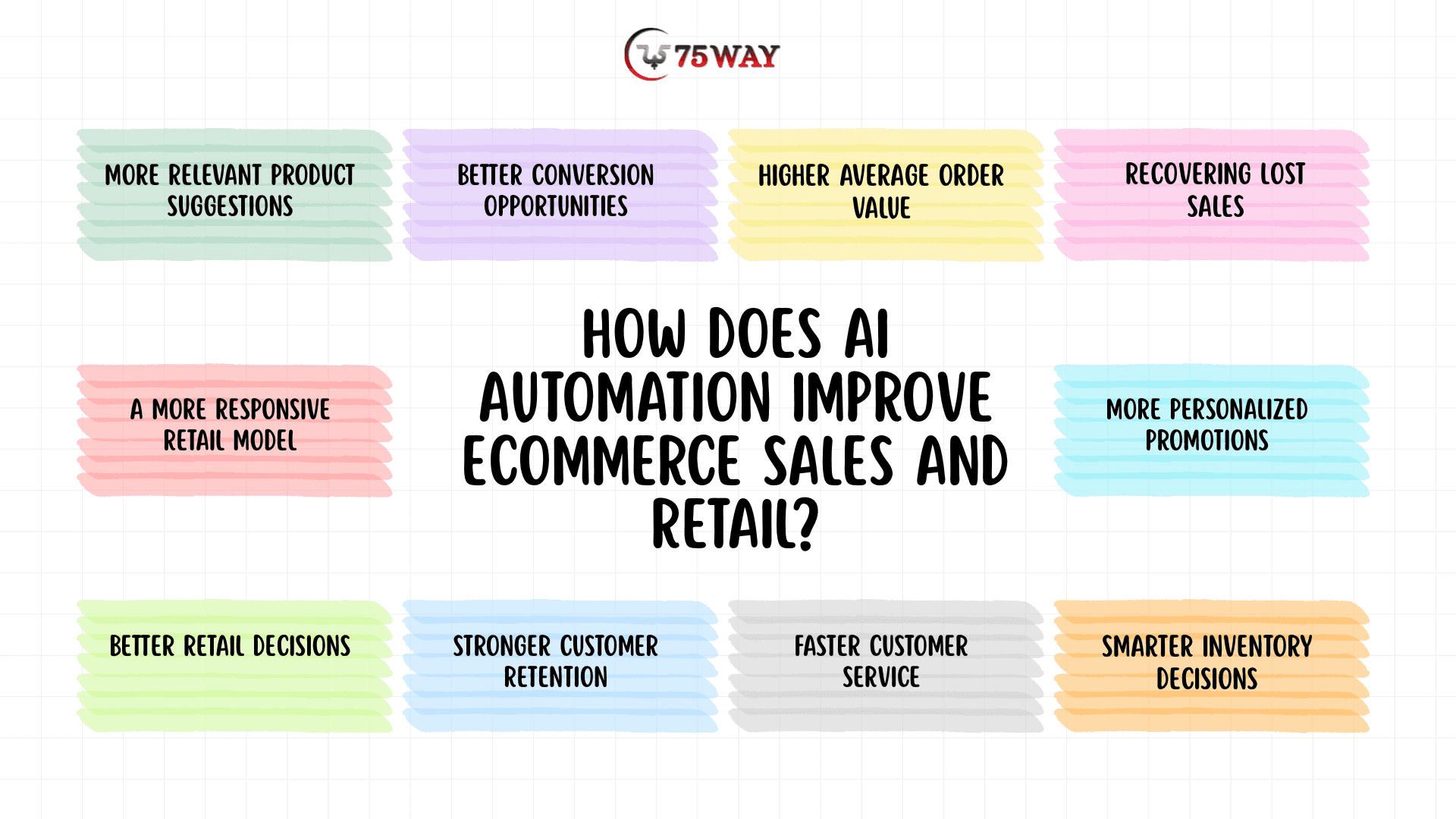
- More Relevant Product Suggestions: A shopper who sees products that match their interests is more likely to continue exploring the store. Recommendation systems can use browsing behavior, purchase history, product relationships, and other signals to surface items that make sense for each customer.
This can create more opportunities for purchases without requiring customers to search through the entire catalog.
- Better Conversion Opportunities: Some visitors arrive knowing exactly what they want. Others need comparisons, product information, or reassurance before purchasing.
Intelligent search, shopping assistants, product recommendations, and automated answers can help customers find information faster. When fewer questions remain unanswered, the path from product discovery to checkout becomes easier.
- Higher Average Order Value: Retailers can use product relationships to introduce complementary items during the shopping journey.
For example, someone purchasing a laptop may also need a mouse, laptop bag, or external storage. Showing relevant additions at the right moment can increase basket value without relying on broad, unrelated promotions.
- Recovering Lost Sales: A customer leaving a product in their cart does not necessarily mean they have rejected the purchase. They may have become distracted, encountered a question, or simply needed more time.
Automated cart-recovery workflows can identify these situations and send appropriate follow-ups. Depending on customer behavior, the message might include a reminder, product information, or a relevant incentive.
- More Personalized Promotions: Sending the same discount to every customer can reduce margins and make marketing less relevant.
Behavioral data allows retailers to create more targeted offers. A loyal customer might receive an early-access promotion, while an inactive shopper could receive a carefully selected incentive designed to encourage another visit.
- Smarter Inventory Decisions: Sales are also affected by what a retailer has available to sell. Demand forecasting can help businesses anticipate changes in product demand and plan inventory accordingly.
Better forecasting may reduce situations where popular products run out while less popular items remain overstocked.
- Faster Customer Service: A customer who cannot get a basic question answered may leave before completing a purchase. Automated support can respond to routine questions about products, shipping, payments, and returns.
When a situation becomes complicated, the conversation can move to a human representative. That combination can keep the buying journey moving without removing human support.
- Stronger Customer Retention: Retail growth is not only about finding new shoppers. Existing customers can become a valuable source of repeat revenue.
Automation can support retention through personalized recommendations, replenishment reminders, loyalty campaigns, product updates, and post-purchase communication based on customer behavior.
- Better Retail Decisions: AI automation also changes what happens behind the storefront.
Retail teams can use customer data, sales patterns, product performance, inventory information, reviews, and marketing results to identify opportunities and problems sooner. Instead of spending hours compiling information, teams can spend more time deciding what action to take.
- A More Responsive Retail Model: The real transformation happens when sales, marketing, customer service, inventory, and customer data work together.
A shopper may receive a personalized product recommendation, find answers through an automated assistant, complete a purchase, receive timely delivery updates, and later receive a relevant recommendation based on that purchase.
For retailers, this creates a more connected business model where customer needs and operational decisions can inform one another. The result is not simply a store with more automation, but a retail operation that can respond to customers with greater speed, relevance, and context.
How Much Does AI Automation for Ecommerce Cost?
The cost of AI automation for ecommerce depends on what you want to automate, how much customization is required, the systems that need integration, and the level of intelligence involved. A simple customer-support workflow will require a very different investment from a custom AI platform connected to inventory, CRM, marketing, analytics, and order management systems.
For a small ecommerce business, starting with existing AI tools and automation platforms can keep the initial investment relatively manageable. A growing retailer may need custom integrations and workflows, while an enterprise business may require a more extensive AI ecosystem with custom models, advanced analytics, security controls, and multiple system integrations.
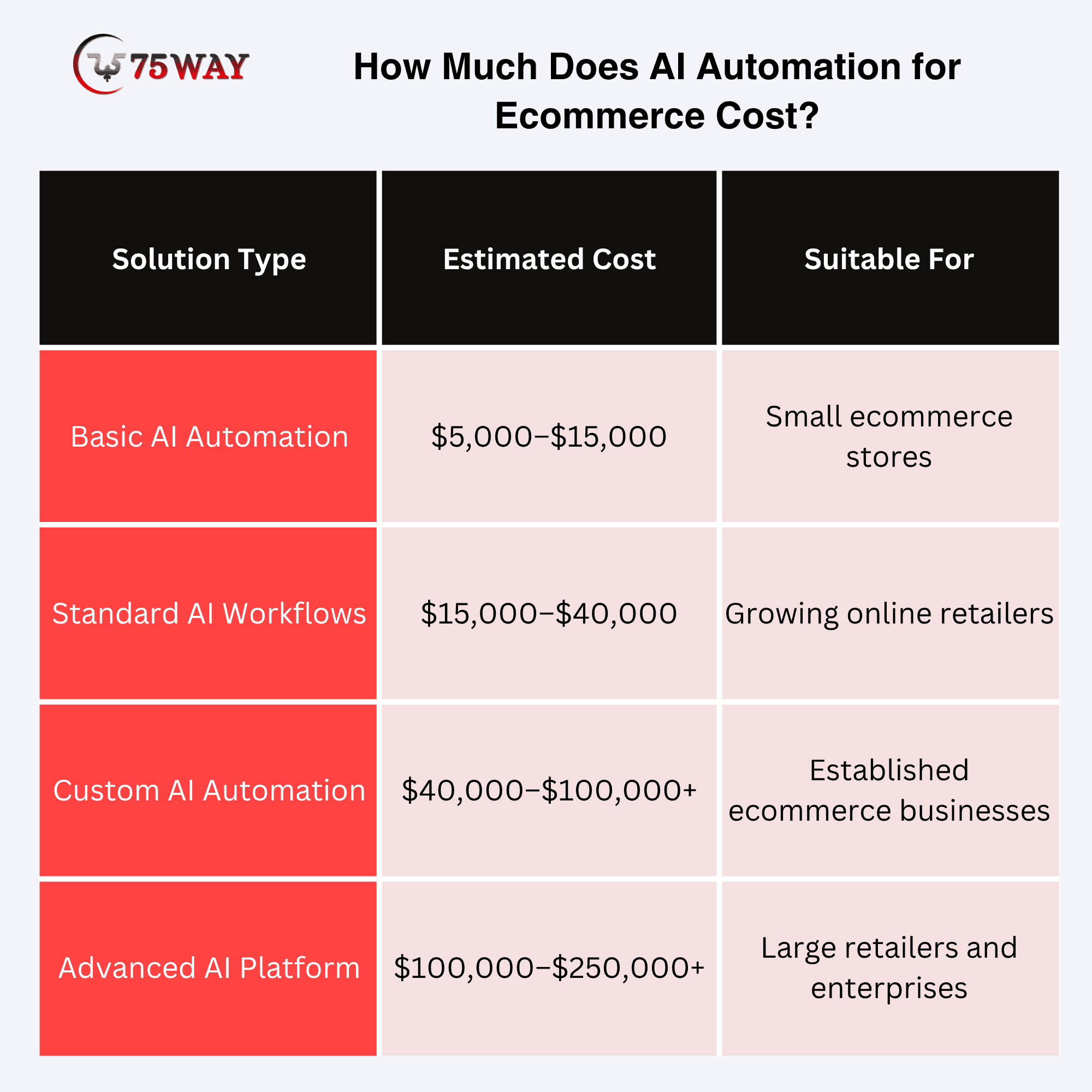
These figures are general estimates rather than fixed development quotes. The actual investment depends on the number of workflows, integrations, AI services, data requirements, user volume, security requirements, and customization involved.
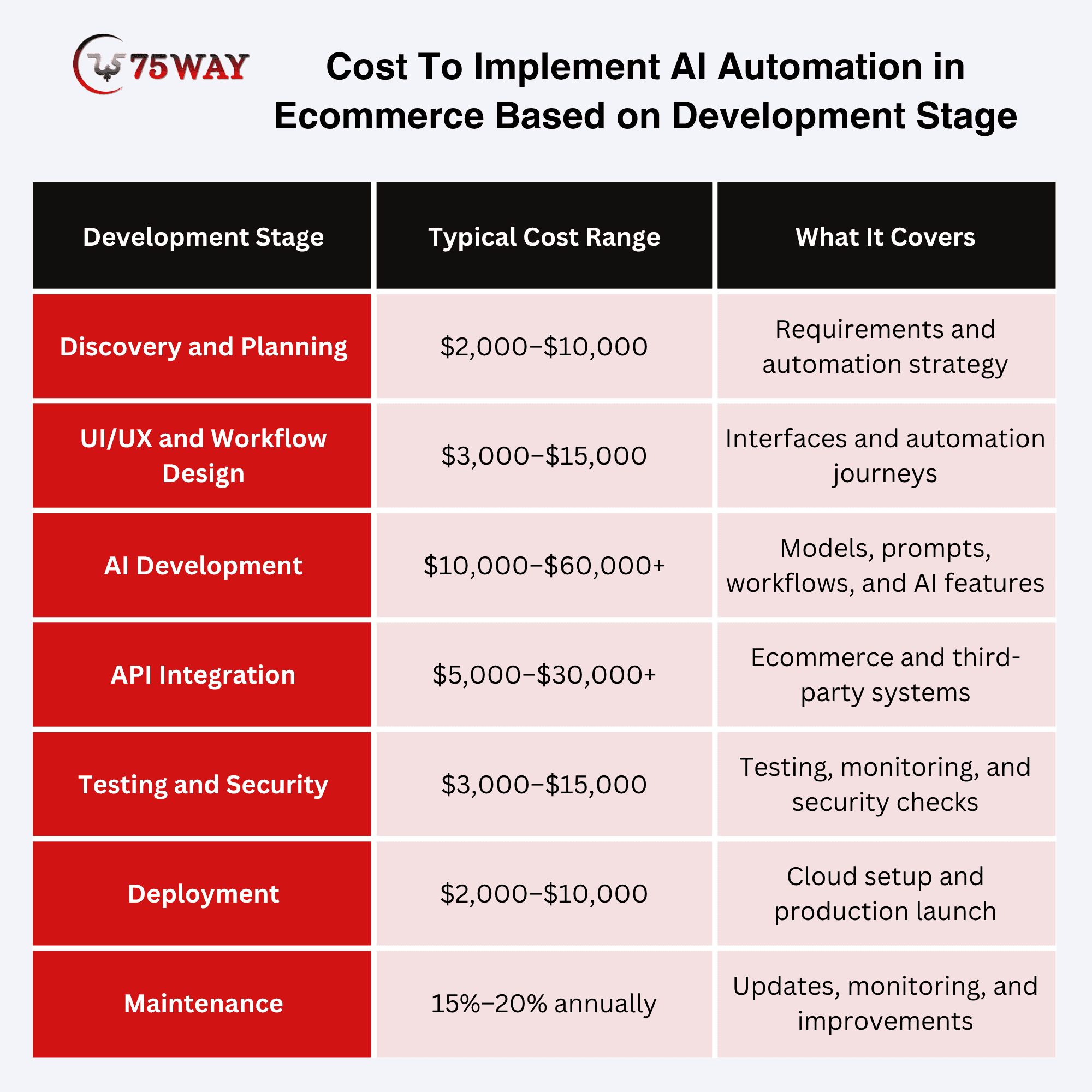
Cost To Implement AI Automation in Ecommerce Based on Development Stage
- Discovery and Planning: $2,000–$10,000
- UI/UX and Workflow Design: $3,000–$15,000
- AI Development: $10,000–$60,000+
- API Integration: $5,000–$30,000+
- Testing and Security: $3,000–$15,000
- Deployment: $2,000–$10,000
- Maintenance: 15%–20% annually
What Influences AI Ecommerce Automation Cost?
The number of processes you want to automate has a direct impact on the budget. Automating customer support alone is considerably different from building an interconnected system covering marketing, recommendations, inventory, fraud detection, customer retention, and analytics.
The type of AI technology also matters. Using an existing AI API may cost less than developing and training a custom machine learning model. Similarly, connecting established ecommerce software can be less expensive than replacing or rebuilding existing systems.
Data preparation is another consideration. If customer, product, order, and inventory data are scattered across multiple systems, additional work may be required before automation can use that information reliably.
Finally, ongoing costs should be considered alongside development. API usage, cloud infrastructure, software subscriptions, monitoring, security, model updates, and maintenance can all contribute to the long-term cost of an AI automation system.
How to Control AI Automation Costs
The best approach is usually to avoid automating everything from day one. Start with one or two high-value processes where the potential return is clear. Measure the results, improve the workflow, and then expand into additional areas.
This approach gives ecommerce businesses a chance to validate the technology before committing a larger budget and helps ensure that future investment is guided by actual business results rather than assumptions.
How to Choose an AI Automation Partner for Online Ecommerce Store?
The right AI automation partner should understand your ecommerce model, customer journey, data, and operational bottlenecks, not simply offer a list of AI tools. Before making a decision, you need to evaluate a few key factors carefully, all of which are explained in detail below.
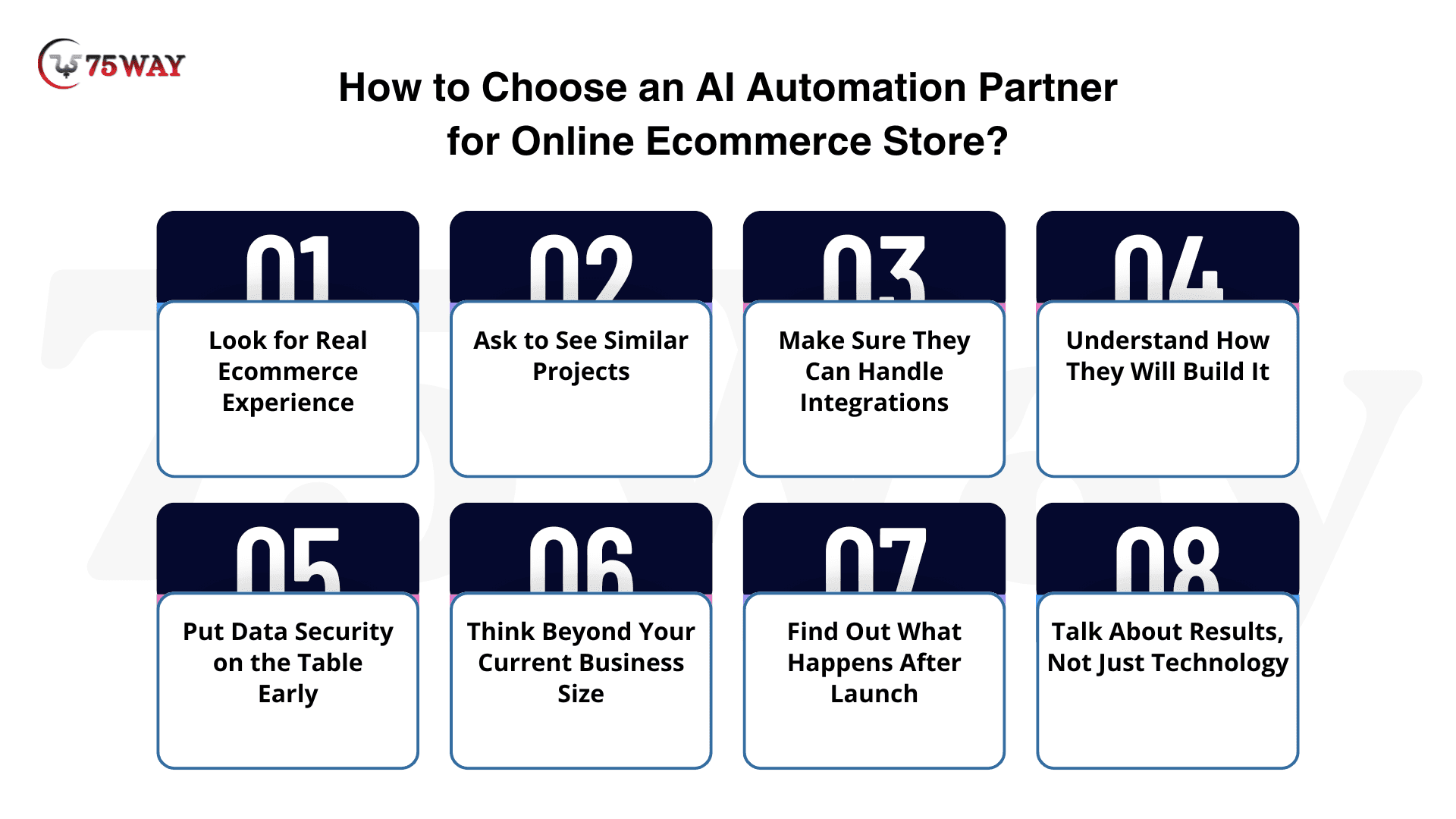
1. Look for Real Ecommerce Experience: A team may have impressive AI skills, but do they understand ecommerce? Look for experience with product catalogs, shopping carts, checkout flows, inventory, order management, customer segmentation, payments, and retention so their recommendations are based on real ecommerce challenges.
2. Ask to See Similar Projects: Past work can tell you much more than a list of technologies. Ask for examples involving AI shopping assistants, personalized recommendations, automated support, demand forecasting, marketing workflows, fraud detection, or customer analytics to see whether the team has handled problems similar to yours.
3. Make Sure They Can Handle Integrations: AI rarely works alone inside an ecommerce business. Your solution may need to connect with your ecommerce platform, CRM, ERP, payment gateway, inventory software, marketing tools, analytics systems, and third-party AI services, so integration experience matters from day one.
4. Understand How They Will Build It: You should know what happens after you sign the agreement. A good partner should be able to walk you through the journey, including requirement discovery, workflow analysis, solution planning, development, integration, testing, deployment, and improvements after launch.
5. Put Data Security on the Table Early: AI automation often works with valuable customer and business information, so security cannot be an afterthought. Discuss authentication, access permissions, encryption, data storage, API protection, monitoring, backups, and relevant privacy requirements before development begins.
6. Think Beyond Your Current Business Size: What works for 500 orders may not work for 50,000. Ask how the proposed architecture will handle more customers, products, transactions, data, integrations, and automated workflows as your ecommerce operation expands.
7. Find Out What Happens After Launch: Launching the automation is only the beginning. APIs can change, business rules can evolve, product data can grow, and customer behavior can take unexpected turns, which is why you should understand what maintenance, monitoring, troubleshooting, updates, and improvements the partner will provide afterward.
8 Talk About Results, Not Just Technology: A strong AI partner will first ask what you are trying to improve rather than immediately recommending an AI tool. Whether the goal is reducing support costs, recovering abandoned carts, improving product discovery, increasing repeat purchases, or cutting manual work, the technology should connect to a measurable business outcome.
You do not need AI everywhere. Sometimes a simple automation rule can solve a problem better than a complex AI system, and a trustworthy partner should be willing to tell you that. Look for a team that recommends technology based on your actual ecommerce needs, budget, data, and growth plans rather than selling AI for the sake of AI.
Why Hire AI Engineers From 75way for AI Automation in Ecommerce?
At 75way Technologies, we understand your ecommerce business model first and the technology second. Every store has different customers, products, workflows, and growth challenges, so we do not follow a one-size-fits-all approach. Our team studies where your business is losing time, missing sales, facing support pressure, or struggling with repetitive work.
Then, we identify practical areas where AI automation can make a difference. From personalized recommendations and shopping assistants to marketing workflows, customer support, inventory insights, and retention, we build solutions around the way your business actually operates.
Our involvement does not stop after development. We can handle workflow planning, AI implementation, third-party integrations, testing, deployment, and ongoing improvements as your requirements evolve. Whether you are looking to recover more abandoned carts, improve product discovery, reduce support workload, or create a more personalized shopping experience, 75way helps turn the idea into a working ecommerce solution with clear business objectives.
What Is the Future of AI Automation in Ecommerce?
Ecommerce is moving toward a model where shopping experiences, business operations, and customer interactions become increasingly connected. As AI technology improves, retailers will have more opportunities to understand customer intent, anticipate demand, personalize experiences, and automate decisions that once required extensive manual effort.
One major development will be more conversational shopping. Instead of searching through categories and filters, customers may describe what they need in everyday language and receive product suggestions, comparisons, and guidance within the same interaction.
Retailers are also likely to rely more heavily on predictive systems. Rather than reacting after a product sells out or a customer becomes inactive, businesses can use behavioral and sales data to identify potential changes earlier and prepare appropriate responses.
Another important area is autonomous ecommerce workflows. Marketing, customer support, inventory, pricing, and retention systems will increasingly work together rather than operating as separate tools. For example, changes in customer demand could influence inventory planning, promotional activity, and product recommendations within connected workflows.
At the same time, human oversight will remain important. Businesses will need clear rules around privacy, security, transparency, accuracy, and decision-making as automated systems become more involved in customer and operational processes.
For ecommerce businesses, the future is therefore not simply about using more AI. It is about building smarter systems that understand context, work across different business functions, and help teams make better decisions while keeping the customer experience at the center.
Conclusion
AI automation for ecommerce is no longer limited to chatbots or product recommendations. It is changing how online retailers market products, support customers, manage inventory, recover lost sales, and build stronger relationships with shoppers. A thoughtful strategy can reduce repetitive workloads while creating more relevant customer experiences and new opportunities for revenue growth. As ecommerce becomes more competitive, businesses that combine intelligent automation with human judgment can build stronger, more responsive retail operations. Ready to explore AI automation for your ecommerce business? Partner with a reliable AI ecommerce app development agency to turn your ideas into practical AI-powered solutions.
Frequently Asked Questions (FAQs)
What Ecommerce Processes Should Be Automated First?
Start with high-volume processes that consume significant staff time or directly affect revenue. Customer support, abandoned cart recovery, product recommendations, marketing workflows, and inventory monitoring are common starting points.
Can AI Automation Work With An Existing Ecommerce Website?
Yes. AI functionality can often be connected to an existing ecommerce website through APIs, plugins, webhooks, or custom integrations. The approach depends on your platform and existing technology stack.
Does AI Automation Replace Ecommerce Employees?
Not necessarily. The stronger use case is usually to handle repetitive work while employees focus on strategy, creative decisions, complex customer issues, and relationship management.
Can Small Ecommerce Businesses Use AI Automation?
Yes. Smaller retailers can begin with focused workflows such as customer support, email personalization, product recommendations, or cart recovery rather than investing in a large automation system immediately.
Can AI Automation Manage Multiple Ecommerce Channels?
Yes. With suitable integrations, automation workflows can connect information across websites, mobile apps, marketplaces, CRM platforms, marketing channels, customer support systems, and other sales channels.
Can AI Automation Work for B2B Ecommerce?
Yes. B2B businesses can use automation for product discovery, account management, quotation assistance, customer support, order processing, personalized pricing workflows, inventory insights, and repeat purchasing.