Summary
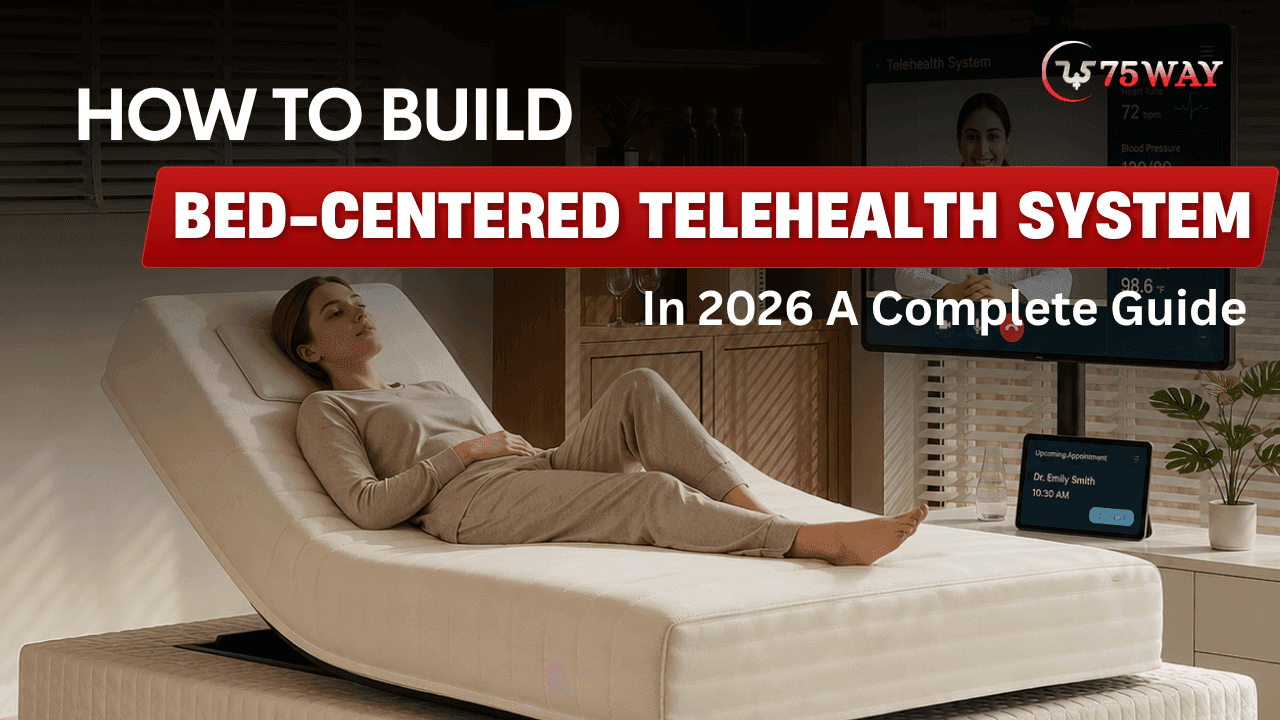
Bed-centered telehealth system development combines AI, IoT devices, and real-time monitoring to transform hospital bedside care. This guide explores architecture design to build a scalable bed-centered telehealth system, the development process, healthcare integrations, compliance requirements, technology stack, and cost structure. Hospitals and startups can leverage these systems for continuous patient monitoring, remote consultations, and improved clinical decision-making.
Quick Overview
- Bed-centered telehealth system development enhances real-time patient monitoring.
- IoT devices and AI analytics drive predictive and continuous healthcare tracking.
- HIPAA compliance remains essential for secure patient data handling systems.
- Integration with hospital EHR systems improves clinical decision workflows.
- Development requires scalable cloud infrastructure and medical-grade devices.
- Healthcare providers gain efficiency through automated bedside monitoring systems.
Healthcare delivery is undergoing a major transformation driven by digital health systems, artificial intelligence, and connected medical devices. One of the most impactful innovations in modern hospitals is the emergence of bed-centered telehealth systems, designed to provide continuous patient monitoring and real-time medical support directly at the hospital bedside.
Unlike traditional telemedicine, AI-powered analytics, virtual communication tools, and IoT sensors are being used directly in patient beds. This enables healthcare providers to monitor vital signs, track patient conditions, detect abnormalities early, and respond instantly without delays.
The modern bed-centered telehealth app development solutions typically combine wearable devices, smart hospital beds, cloud computing infrastructure, artificial intelligence models, and secure communication platforms. These systems continuously collect data such as heart rate, oxygen levels, temperature, sleep patterns, and movement. Here you might have a question, “How to develop a bed-centered telehealth system (BCTS)?”
This complete guide explains how to build a bed-centered telehealth system in 2026, covering architecture design, key features, technology stack, compliance requirements, development process, cost structure, and industry use cases for hospitals and healthcare startups.
What Is A Bed-Centered Telehealth System?
A bed-centered telehealth system is an integrated healthcare solution designed to monitor patients continuously at the hospital bed level using IoT devices, AI systems, and digital communication tools. It connects patient monitoring devices, hospital systems, and healthcare providers into one centralized digital ecosystem. Core components include:
- Smart hospital beds
- IoT health sensors
- AI analytics engines
- Telemedicine communication modules
- Cloud-based patient data systems
Why Hospitals Need Bed-Centered Telehealth Systems in 2026?
Hospitals face increasing pressure due to patient overload, staff shortages, and rising critical care demands.
- Continuous Patient Monitoring: Patients receive real-time tracking of vital health indicators without manual intervention.
- Faster Emergency Response: AI systems detect abnormalities and trigger instant alerts to medical staff.
- Reduced Nurse Workload: Automated monitoring reduces repetitive manual checking tasks.
- Better ICU Management: Critical care units benefit from predictive analytics and early warning systems.
- Improved Patient Safety: Continuous monitoring reduces risk of missed critical events.
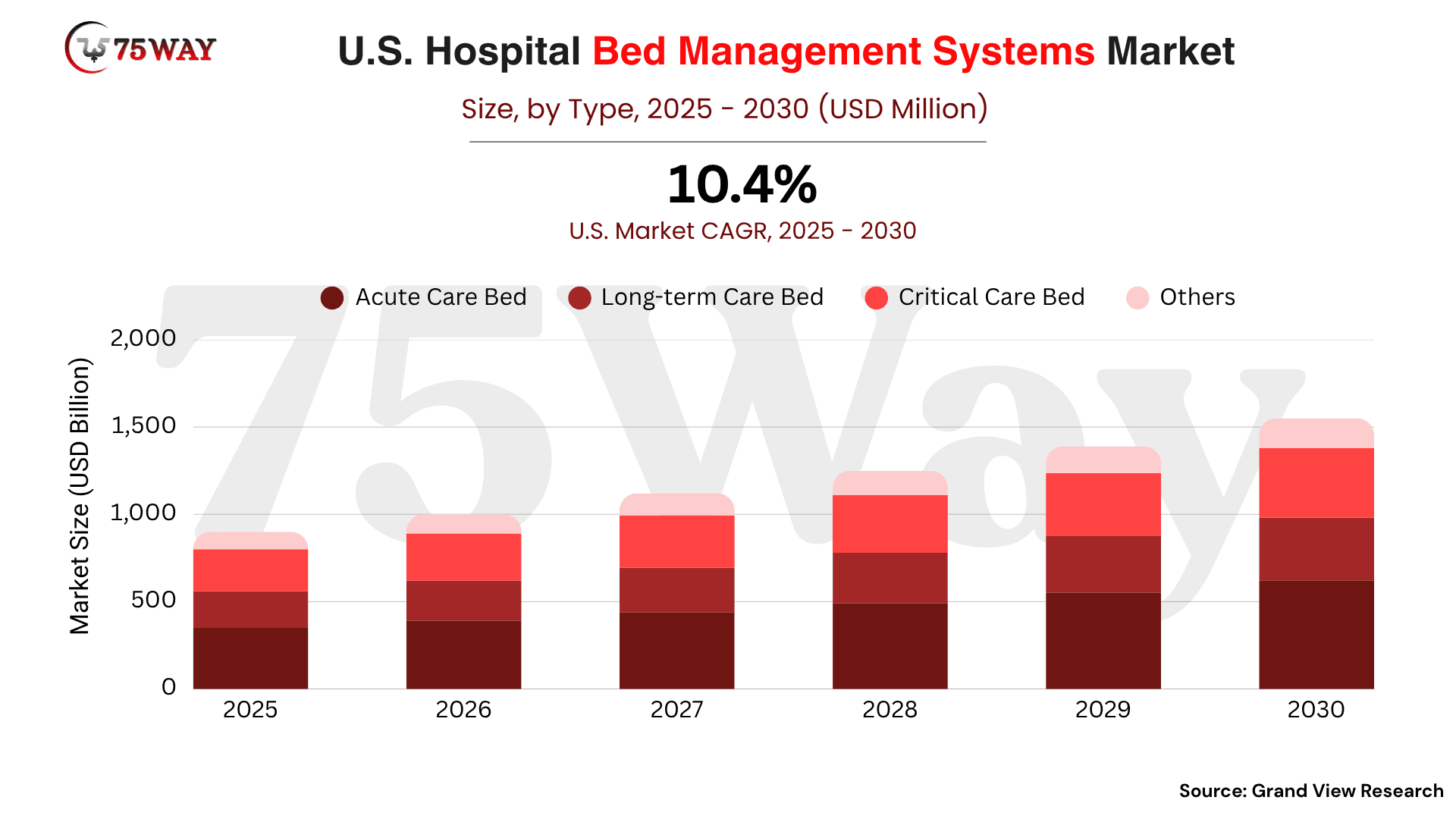
Another reasons to invest in bed-centered telehealth system development are:
- The global hospital bed management systems market was valued at USD 1.8 billion in 2022 and is expected to grow at a CAGR of 10.31%.
- The global telehealth market is projected to expand from $219.31 billion in 2026 to USD 1,272.81 billion by 2034.
- The remote patient monitoring (RPM) market is growing rapidly, with a CAGR ranging between 17.09% and 29.55% due to increasing demand for continuous chronic care monitoring.
- More than 76% of hospitals are adopting bed-centered telehealth systems to improve patient monitoring, bed management, and remote healthcare delivery.
Step-by-Step Process To Build Bed-Centered Telehealth System
Building a bed-centered telehealth system requires a structured engineering approach that combines healthcare understanding, IoT integration, AI development, and secure cloud architecture. Each step must connect smoothly with the next so hospitals can move from planning to real-time patient monitoring without disruption, ensuring safety, scalability, and clinical accuracy throughout the entire system lifecycle.
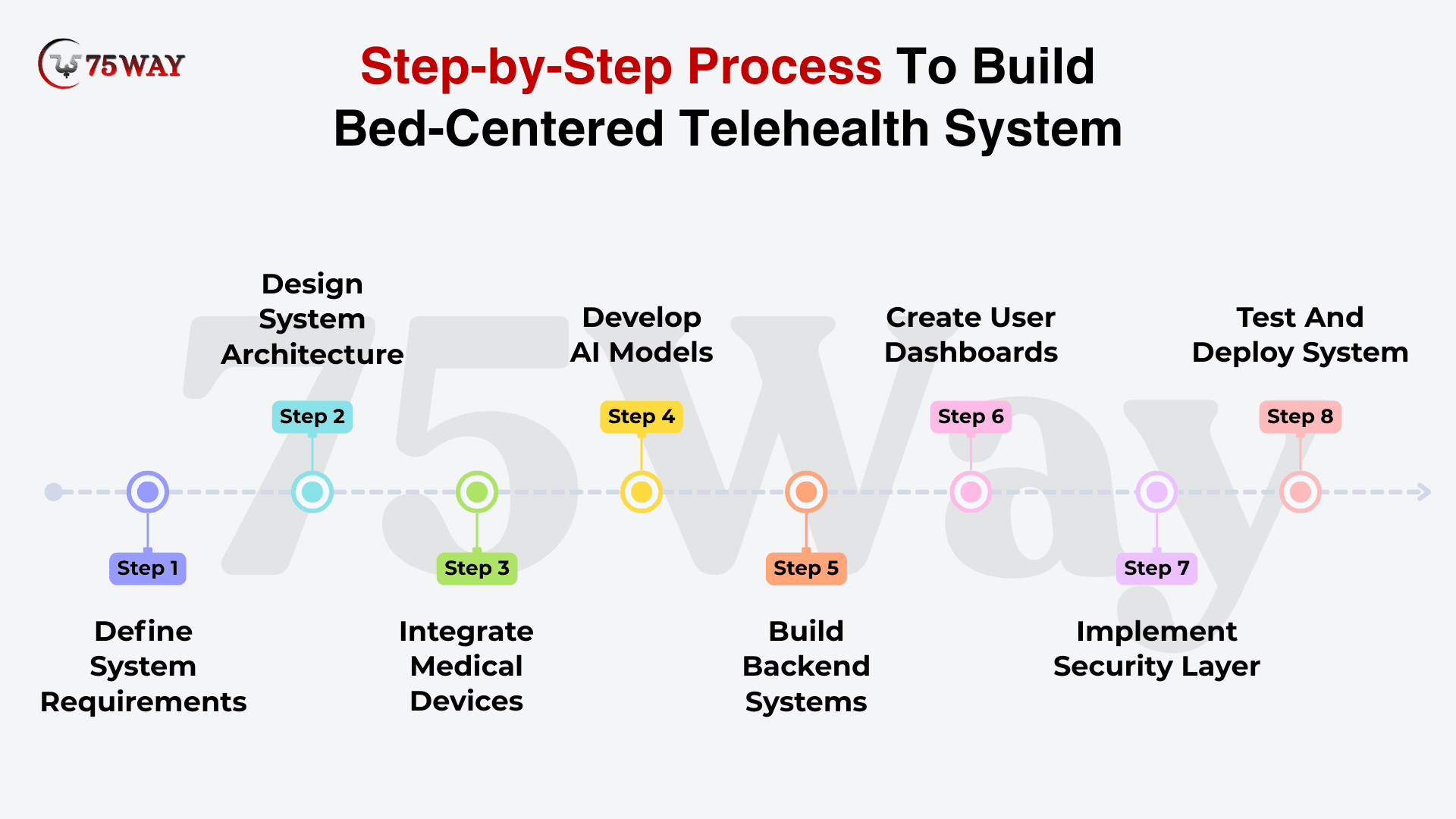
Step 1: Define System Requirements
This initial step focuses on understanding hospital needs, patient monitoring goals, and operational challenges inside clinical environments. Teams identify what vital signs must be tracked, how frequently data should be collected, and which departments will use the system. This clarity ensures every following development phase aligns with real healthcare workflows and prevents unnecessary technical complexity later in the project.
- Identify hospital workflow and care processes
- Define patient monitoring and alert requirements
- Determine required medical devices and sensor types
- Specify data frequency and real-time monitoring needs
- Map departments using the system and access levels
Step 2: Design System Architecture
After defining requirements, the next step is designing a scalable and secure system architecture that connects IoT devices, AI models, cloud infrastructure, and user applications. Engineers plan data flow between hospital beds, sensors, and dashboards carefully. This architecture ensures smooth communication between components and supports real-time processing of patient health information without delays or system failures.
- Data Flow Design: Establish structured pathways for transmitting patient data from devices to cloud systems in real time.
- Scalable Infrastructure Planning: Design architecture capable of handling increasing patient data loads and hospital expansion without performance degradation.
- Secure Communication Layer: Implement encrypted channels ensuring safe transmission of sensitive healthcare data between all connected system components.
Step 3: Integrate Medical Devices
Once architecture is finalized, developers begin integrating smart hospital beds, wearable sensors, and medical monitoring devices into the system. These devices continuously capture patient vitals such as heart rate, oxygen levels, temperature, and movement patterns. Proper integration ensures accurate real-time data transmission, forming the foundation of continuous bedside patient monitoring across healthcare environments.
- Device Compatibility Mapping: Ensure all medical devices communicate properly with system protocols and data formats without integration conflicts.
- Sensor Calibration Setup: Configure sensors accurately to capture precise vital signs like heart rate, oxygen levels, and temperature data.
- Real-Time Data Transmission: Enable continuous streaming of patient health data from devices to cloud and AI processing systems instantly.
- Interoperability Configuration: Ensure different hospital devices and systems work together seamlessly without data loss or communication gaps.
- Connectivity Testing Validation: Verify stable connections between all devices and the system under real hospital operating conditions.
Step 4: Develop AI Models
At this stage, AI and machine learning models are developed to analyze patient health data collected from integrated devices. These models detect abnormal patterns, predict patient deterioration, and generate early warning signals for healthcare providers. As more data flows into the system, models continuously improve accuracy, enabling proactive and preventive healthcare decision-making inside hospitals.
- Data Preprocessing Pipeline: Clean, normalize, and structure raw patient data from multiple devices for accurate AI model training and analysis.
- Model Training Process: Train machine learning models using historical patient data to identify health patterns and clinical risk indicators effectively.
- Real-Time Prediction Engine: Deploy AI models that continuously analyze live patient data to detect early warning signs instantly.
- Model Optimization Tuning: Improve the accuracy and performance of AI models through continuous testing, validation, and parameter adjustments over time.
Step 5: Build Backend Systems
After AI model development begins, backend systems are built to manage data processing, API communication, authentication, and secure information exchange between IoT devices, AI engines, and user dashboards. This layer acts as the central backbone of the entire bed-centered telehealth system, ensuring that every incoming patient data stream is processed, routed, and stored correctly without delays or loss.
Strong backend architecture also ensures seamless coordination between multiple hospital departments by enabling real-time data sharing and system synchronization. It handles high-volume healthcare data efficiently while maintaining stability, scalability, and consistent performance across all connected modules. This foundation is essential for enabling reliable, real-time clinical decision-making across complex hospital environments.
Step 6: Create User Dashboards
Once backend systems are functional, developers design frontend dashboards for doctors, nurses, and hospital administrators. These dashboards display real-time patient vitals, AI alerts, and system notifications in a clear and actionable format. User-friendly interfaces help medical staff make faster clinical decisions and improve overall patient monitoring efficiency within hospital environments.
- Real-Time Patient Monitoring View: Displays live patient vitals such as heart rate, oxygen levels, and temperature for continuous clinical supervision.
- AI Alert Notification Panel: Shows predictive alerts generated by AI models to help medical staff respond quickly to patient deterioration risks.
- Role-Based Access Interface: Provides customized dashboard views depending on user roles like doctor, nurse, or administrator for better workflow control.
- Data Visualization Charts: Converts raw medical data into graphs and trends for faster interpretation and improved clinical decision-making accuracy.
- Emergency Response Dashboard: Highlights critical patient conditions instantly and prioritizes urgent cases for immediate hospital intervention and action.
Step 7: Implement Security Layer
At this stage, security mechanisms such as encryption, authentication, and role-based access controls are implemented to protect sensitive patient information. HIPAA-compliant security protocols ensure that only authorized personnel can access healthcare data. This step is critical for maintaining patient trust, regulatory compliance, and long-term system reliability in real-world hospital deployments.
- Data Encryption Enforcement: Secure all patient data using advanced encryption methods during storage, transmission, and system communication processes.
- Access Control Management: Restrict system access based on user roles to ensure only authorized medical staff can view sensitive information.
- Threat Detection Monitoring: Continuously monitor system activity to identify unusual behavior, prevent breaches, and strengthen overall cybersecurity protection.
Step 8: Test And Deploy System
In the final stage, the entire system is tested under real hospital-like conditions to evaluate performance, accuracy, and stability. Developers fix bugs, optimize AI models, and ensure device connectivity works. After successful testing, the system is deployed in healthcare environments, enabling continuous patient monitoring and improving critical care response times.
- Functional Testing Validation: Verify all system features, including monitoring, alerts, and dashboards, work correctly under real usage conditions.
- Performance Load Testing: Simulate high patient data traffic to ensure system stability and responsiveness during peak hospital operations.
- Device Connectivity Testing: Confirm smooth communication between IoT devices, sensors, and backend systems without data loss or delays.
- Deployment & Monitoring Setup: Launch the system in live environments and continuously monitor performance, errors, and system reliability.
Architecture of Bed-Centered Telehealth System
A bed-centered telehealth system relies on a layered architecture that connects medical devices, real-time data streams, AI intelligence, and secure cloud infrastructure into one unified healthcare ecosystem. Each layer plays a specific role in ensuring continuous patient monitoring, fast clinical decision-making, and reliable communication between healthcare providers and patients.
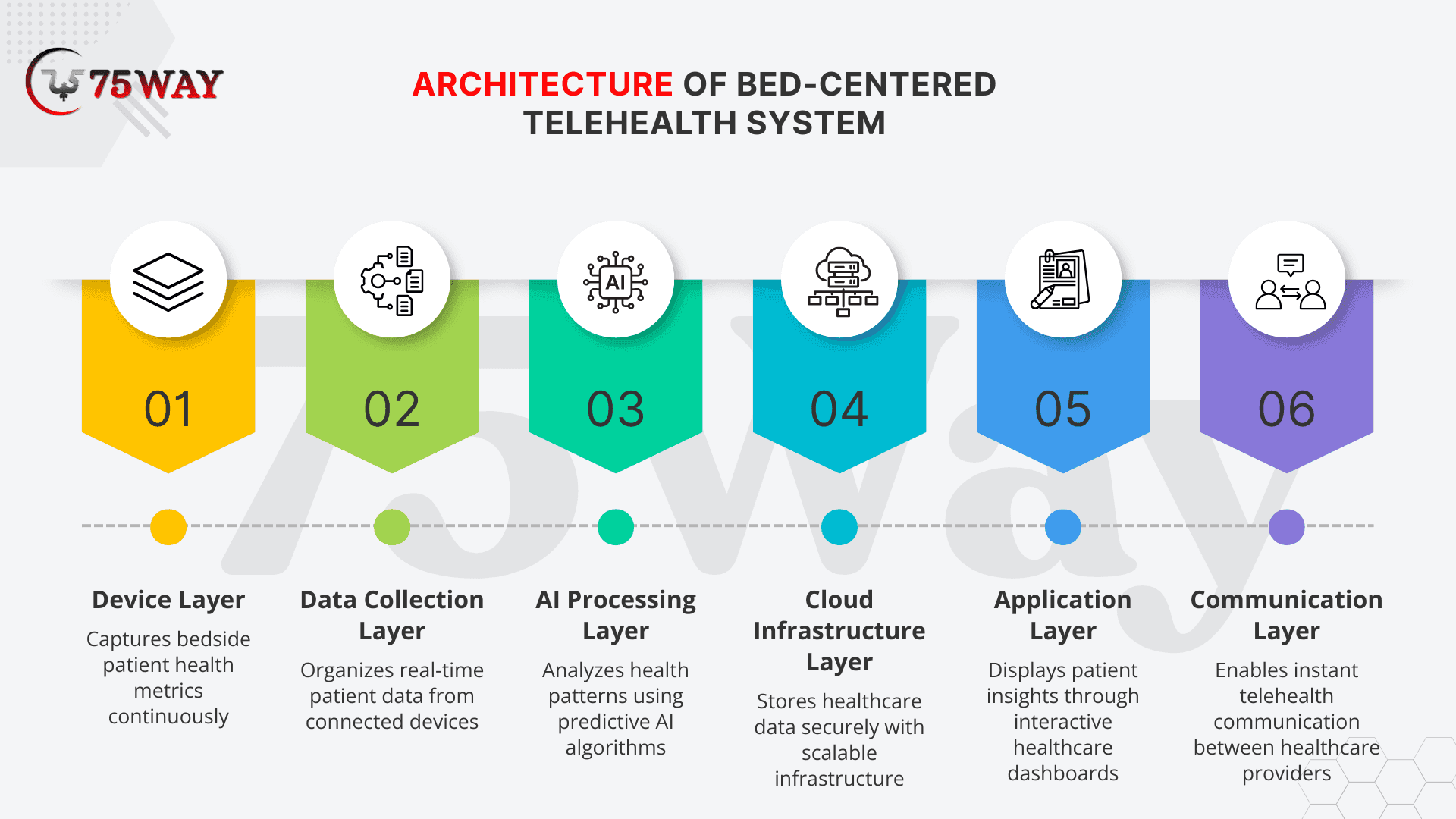
- Device Layer
The device layer includes IoT sensors, wearable health trackers, smart hospital beds, and advanced medical monitoring equipment used at the patient’s bedside. These devices continuously capture vital health metrics such as heart rate, oxygen levels, temperature, and movement patterns. All collected data is transmitted in real time to connected healthcare systems for further processing. This layer forms the foundation of continuous patient monitoring.
- Data Collection
The data collection layer gathers and organizes real-time patient health data coming from multiple connected medical devices and sensors. It ensures that incoming information is structured, cleaned, and prepared for further AI analysis without delays or data loss. This layer supports continuous data streaming from bedside systems into centralized healthcare platforms. Accurate data collection is essential for reliable clinical decision-making.
- AI Processing Layer
The AI processing layer analyzes patient health data using machine learning algorithms, predictive analytics, and pattern recognition models. It identifies early warning signs of patient deterioration and helps healthcare providers take preventive actions before emergencies occur. This layer continuously learns from historical and real-time data to improve prediction accuracy. AI intelligence enhances proactive healthcare delivery.
- Cloud Infrastructure Layer
The cloud infrastructure layer securely stores and processes large volumes of patient health data generated from bedside monitoring systems. It ensures scalability, high availability, and HIPAA-compliant data security across healthcare operations. Cloud systems also enable seamless access to patient information for authorized healthcare providers. This layer is critical for maintaining system reliability and performance.
- Application Layer
The application layer provides user-friendly dashboards and interfaces for doctors, nurses, and hospital administrators to monitor patient health status. It visualizes real-time data, alerts, and AI-generated insights in an easy-to-understand format. Healthcare professionals use this layer to make faster and more informed clinical decisions. It improves the overall usability of the telehealth system.
- Communication Layer
The communication layer enables seamless interaction between patients and healthcare providers through alerts, notifications, and teleconsultation features. It ensures that critical updates are delivered instantly to medical staff during emergencies. This layer also supports secure video consultations and messaging services. Effective communication improves response time and patient care coordination significantly.
Core Features of Bed-Centered Telehealth Apps
Bed-centered telehealth systems are transforming inpatient care by combining real-time monitoring, AI intelligence, and remote communication tools directly at the patient’s bedside. These systems help hospitals improve patient safety, reduce response time, and enable continuous clinical decision-making without unnecessary physical intervention delays.
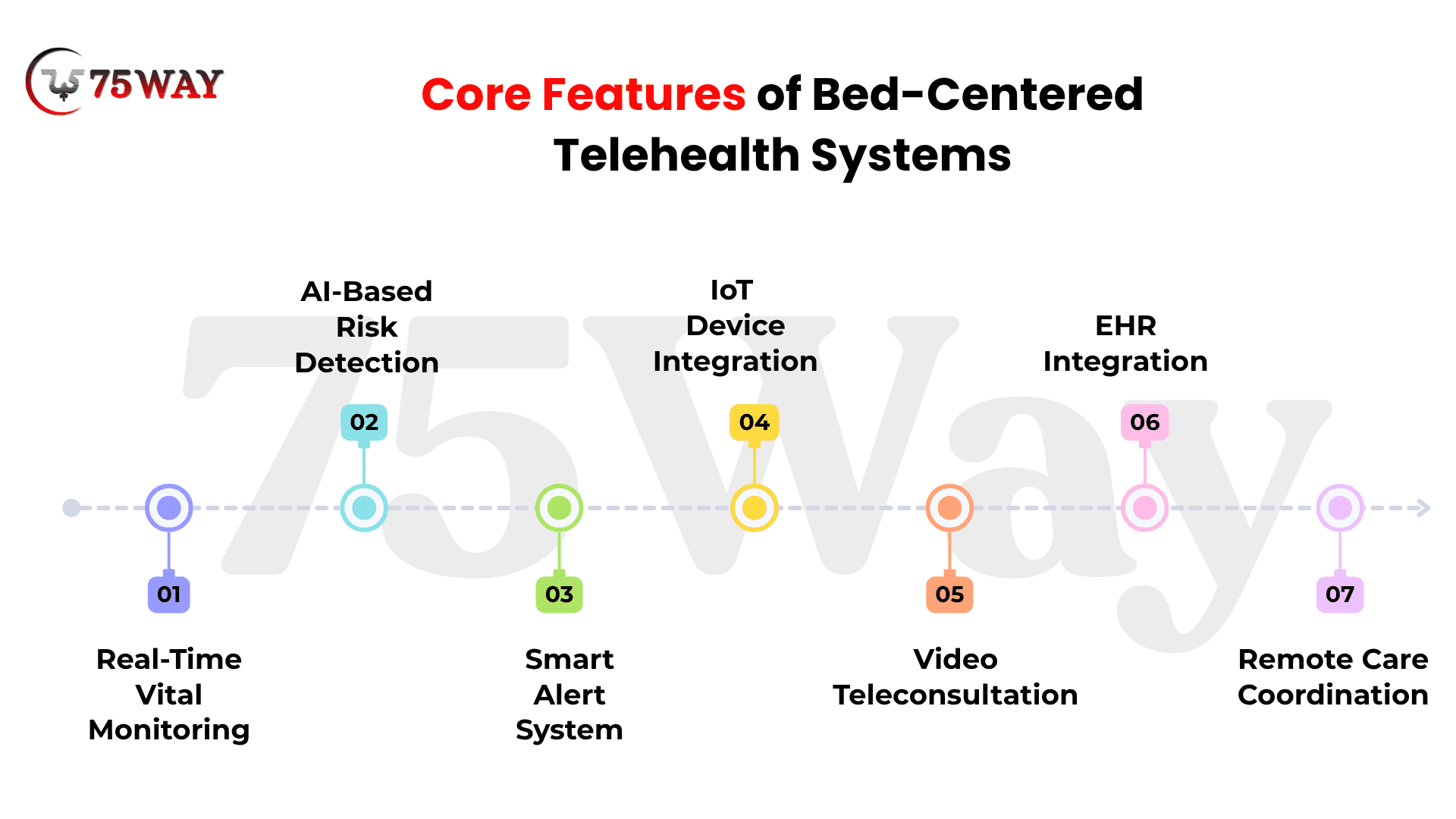
- Real-Time Vital Monitoring: Continuously tracks patient vitals like heart rate, oxygen levels, blood pressure, and temperature. This ensures clinicians can observe patient condition changes instantly without manual checks.
- AI-Based Risk Detection: Uses machine learning models to predict patient deterioration early. It analyzes patterns in vital signs to alert healthcare teams before emergencies occur.
- Smart Alert System: Sends instant notifications to doctors and nurses when abnormal health patterns are detected. This improves response speed and reduces critical care delays significantly.
- IoT Device Integration: Connects hospital beds, wearable sensors, and medical monitoring devices into one system. This enables seamless data flow across all healthcare equipment in real time.
- Video Teleconsultation: Allows doctors to communicate with patients remotely through bedside video systems. It improves consultation accessibility without requiring physical presence for every interaction.
- EHR Integration: Synchronizes patient data directly with electronic health record systems continuously. This ensures accurate, updated, and centralized patient information for better clinical decision-making.
- Remote Care Coordination: Enables healthcare teams to manage patient treatment plans collaboratively from different locations. It improves workflow efficiency and ensures consistent care delivery across hospital departments.
Technology Stack To Build Bed-Centered Telehealth Application
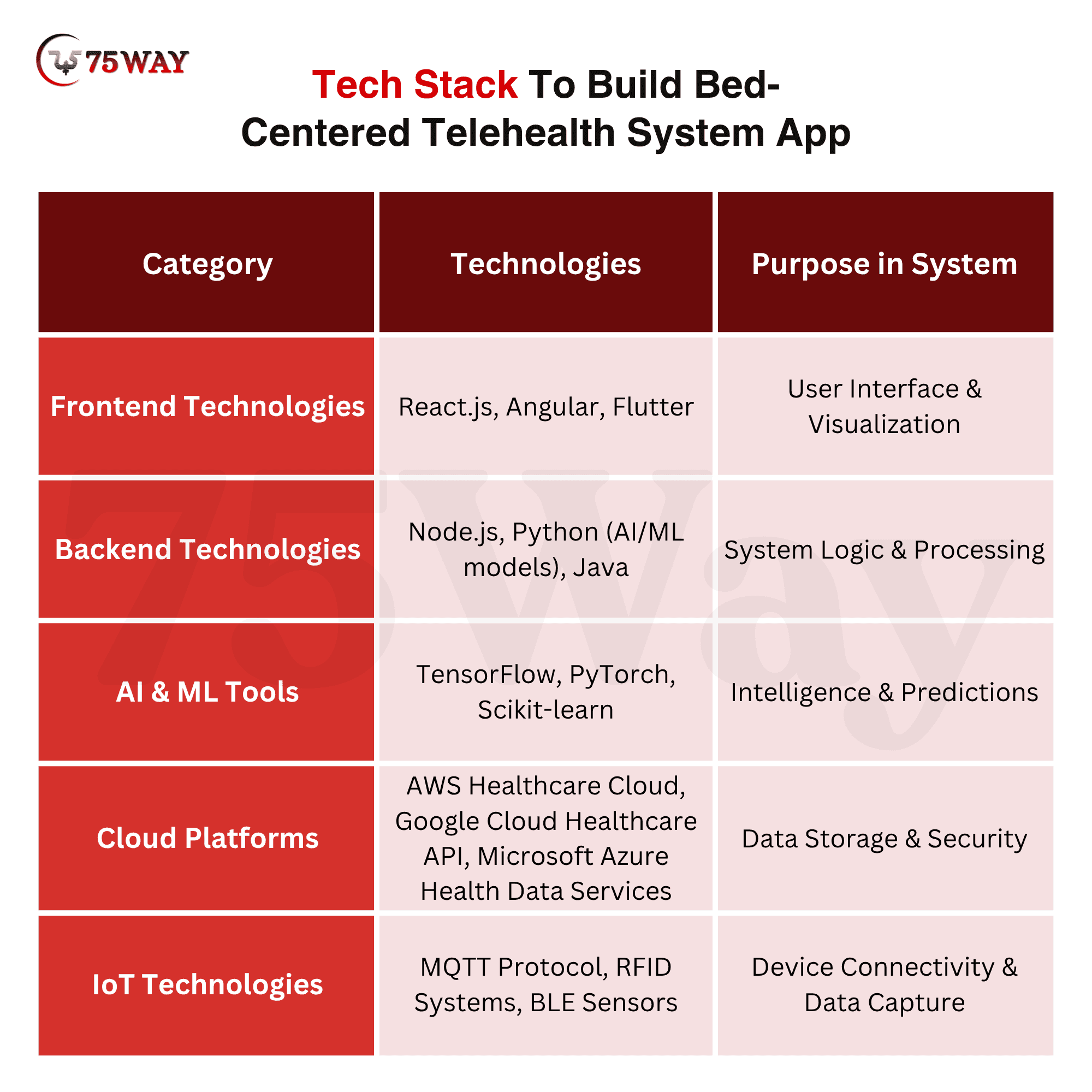
Building a bed-centered telehealth system requires a carefully structured technology stack that supports real-time monitoring, AI-driven predictions, secure cloud processing, and seamless IoT connectivity. Every layer plays a critical role in ensuring accuracy, scalability, and reliable patient care delivery in hospital environments.
- Frontend Technologies: React.js, Angular, and Flutter help build responsive dashboards for doctors, nurses, and hospital staff to monitor patient health data in real time with smooth performance across web and mobile devices.
- Backend Technologies: Node.js, Python, and Java handle backend processing, AI model execution, and secure data exchange between devices, ensuring fast, scalable, and reliable healthcare system performance.
- AI & ML Tools: TensorFlow, PyTorch, and Scikit-learn power predictive analytics, patient risk detection, and machine learning models that analyze real-time health data for early medical intervention.
- Cloud Platforms: AWS, Google Cloud Healthcare API, and Microsoft Azure provide secure, scalable infrastructure for storing and processing sensitive patient data with HIPAA-compliant healthcare-grade security systems.
- IoT Technologies: MQTT, RFID systems, and BLE sensors enable real-time data collection from medical devices, wearable sensors, and smart hospital beds for continuous patient monitoring and alert generation.
HIPAA Compliance In Building Bed-Centric Telehealth Systems
Telehealth systems handle highly sensitive patient data, so maintaining HIPAA compliance is not optional. It is a core requirement for safe and legal healthcare operations in the United States. Every digital interaction, from patient monitoring to remote consultations, must be protected through strict security frameworks, ensuring privacy, trust, and regulatory alignment across the entire healthcare ecosystem.
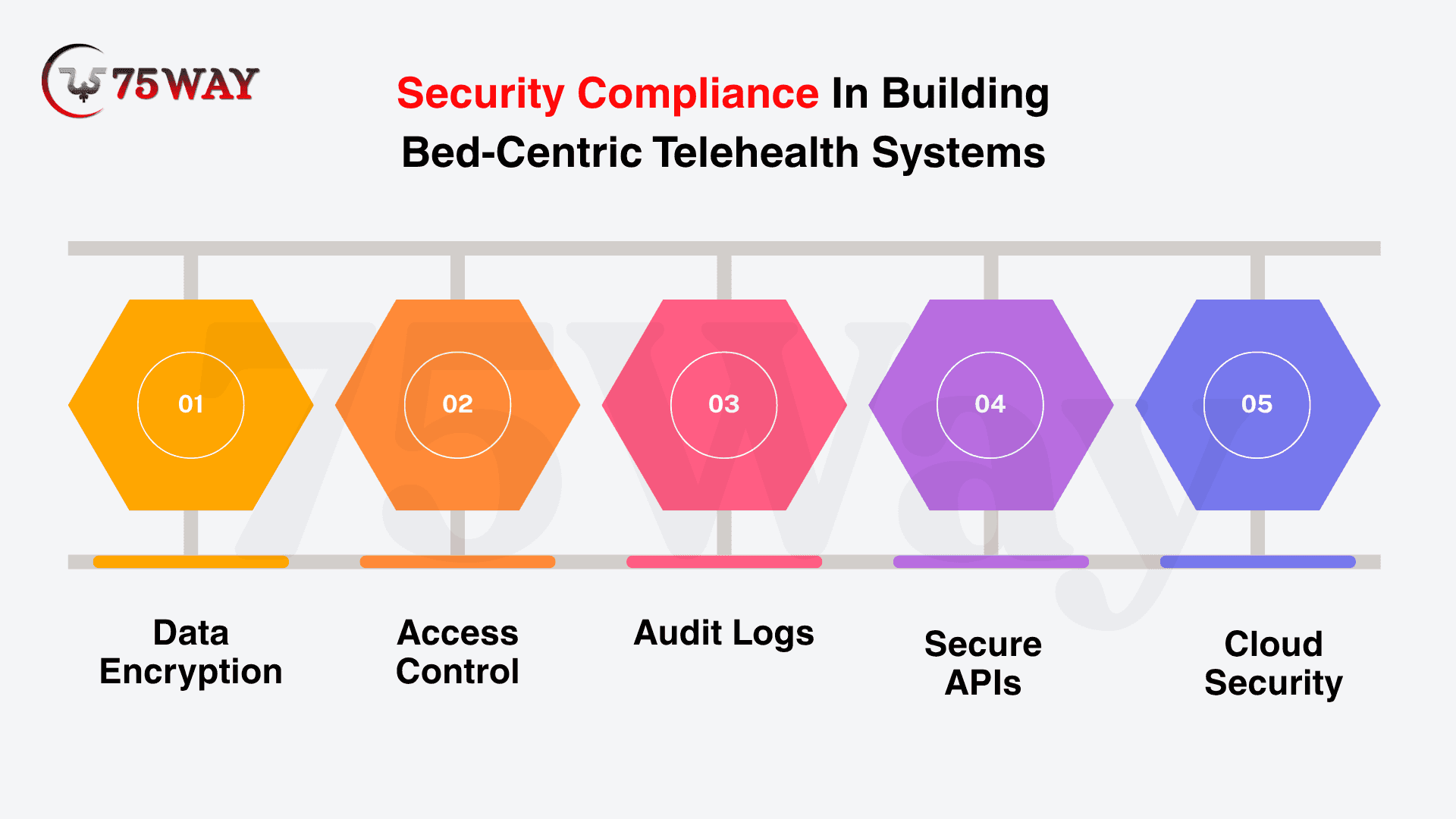
- Data Encryption: All patient data must be encrypted in transit and storage. This ensures sensitive medical information remains protected even if intercepted or accessed without permission. Strong encryption standards significantly reduce the risk of healthcare data breaches across telehealth platforms.
- Access Control: Only authorized medical staff can access patient data. Role-based restrictions ensure users only see information relevant to their responsibilities. This minimizes internal misuse and strengthens healthcare system security.
- Audit Logs: Every system activity must be tracked and recorded. Audit logs help healthcare organizations monitor access patterns and identify suspicious behavior quickly. This improves accountability and supports regulatory compliance audits.
- Secure APIs: Third-party integrations must follow compliance standards. Secure APIs prevent unauthorized data exchange between healthcare systems and external services. This ensures safe interoperability across digital healthcare platforms.
- Cloud Security: Use HIPAA-certified cloud service providers. These platforms offer built-in compliance tools, encryption, and monitoring features. Cloud security ensures scalability while maintaining strict healthcare data protection standards.
Strategic Use Cases of Bed-Centered Telehealth Systems
Bed-centered telehealth systems are transforming modern hospital care by enabling continuous monitoring, real-time alerts, and AI-driven decision support directly at the patient’s bedside. These systems are widely adopted across critical care environments where speed, accuracy, and uninterrupted patient observation are essential for improving outcomes and reducing medical risks.
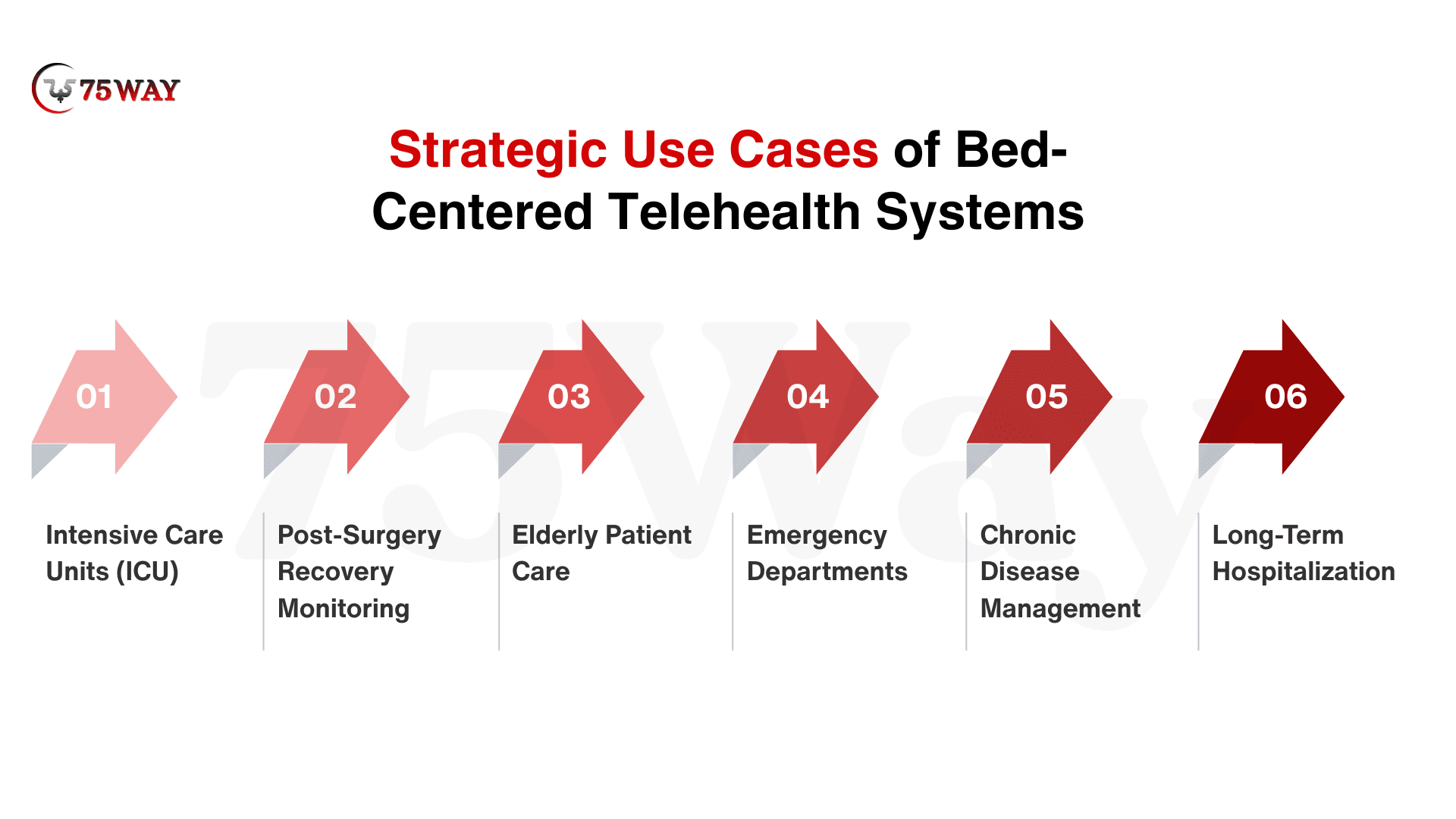
- Intensive Care Units (ICU): Enable continuous patient monitoring with AI alerts, improving critical care response speed significantly.
- Post-Surgery Recovery Monitoring: Tracks recovery vitals in real time, helping doctors detect complications early after surgical procedures.
- Elderly Patient Care: Supports continuous monitoring of aging patients, reducing hospital visits and improving safety at the bedside.
- Emergency Departments: Provides instant patient assessment and alerts, helping doctors prioritize critical emergency cases efficiently.
- Chronic Disease Management: Monitors long-term conditions like diabetes and heart disease, enabling proactive treatment adjustments continuously.
- Long-Term Hospitalization: Ensures continuous health tracking for bedridden patients, improving care quality and reducing complications risks.
What’s The Cost To Build Bed-Centered Telehealth System?
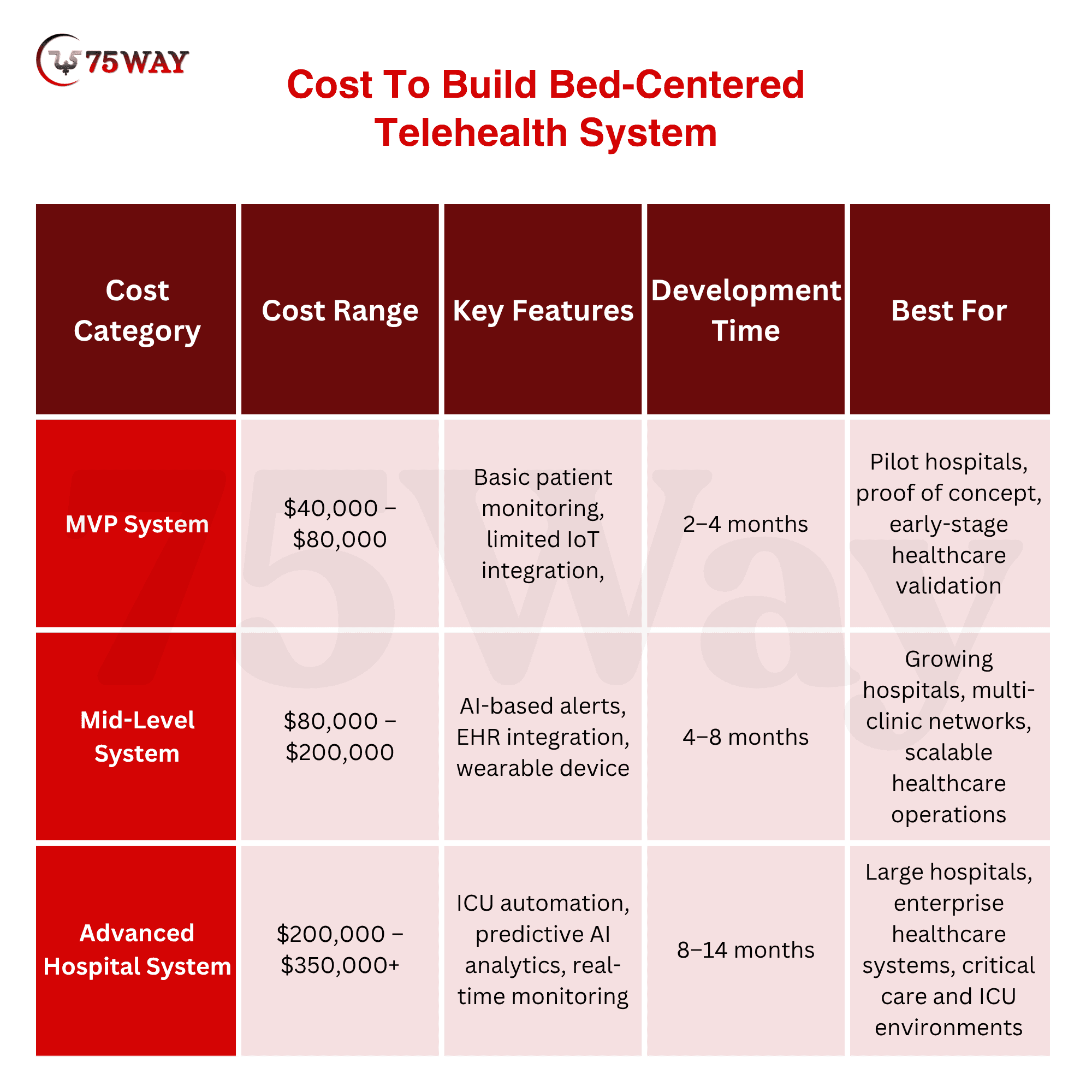
A bed-centered telehealth system development cost involves multiple cost layers, including hardware devices, software platforms, and security infrastructure. The overall investment depends on system complexity, hospital size, and the level of automation required. On average, most hospital-grade implementations range between $40,000 to $350,000+, depending on whether the system is MVP, mid-level, or fully advanced ICU automation.
- MVP System: $40,000 – $80,000
Basic monitoring, limited IoT integration, and simple dashboards for patient tracking and essential alert systems. This is ideal for pilot hospital deployments and early-stage validation environments.
- Mid-Level System: $80,000 – $200,000
Includes AI-based alerts, EHR integration, wearable device support, and teleconsultation features for improved patient engagement and operational efficiency across departments.
- Advanced Hospital System: $200,000 – $350,000+
Enterprise-grade solution with ICU automation, predictive AI analytics, real-time monitoring, and high-level security for large hospital networks and critical care units.
Cost to Build Bed-Centered Telehealth System Based On Components
- Hardware & Bedside Equipment ($5,000 – $30,000+ per room)
Patient-facing bedside tablets or articulating-arm monitors cost $500–$1,500 per unit, while integrated telehealth carts with cameras and microphones range from $5,000–$10,000+ per unit.
Additional peripherals like digital stethoscopes and vital monitoring devices add $1,000–$15,000 per station for advanced ICU setups.
- Software & Platform Infrastructure ($10,000 – $300,000+)
White-label telehealth platforms may cost $0–$5,000 upfront with subscription fees of $50–$500 per provider monthly.
A fully custom enterprise systems typically require $100,000–$300,000+ for development, depending on feature complexity and AI integration depth.
- Implementation & Integrations ($10,000 – $50,000+)
EHR integration costs range from $5,000–$30,000 per system, while infrastructure setup and HIPAA security hardening typically add another $15,000–$50,000 for ensuring compliance, scalability, and secure healthcare data exchange.
Challenges In Bed-Based Telehealth System Development
Building a bed-centered telehealth system comes with multiple technical, financial, and regulatory challenges that must be addressed carefully to ensure safe and reliable healthcare delivery. These challenges directly impact system performance, scalability, and clinical accuracy in real-world hospital environments.
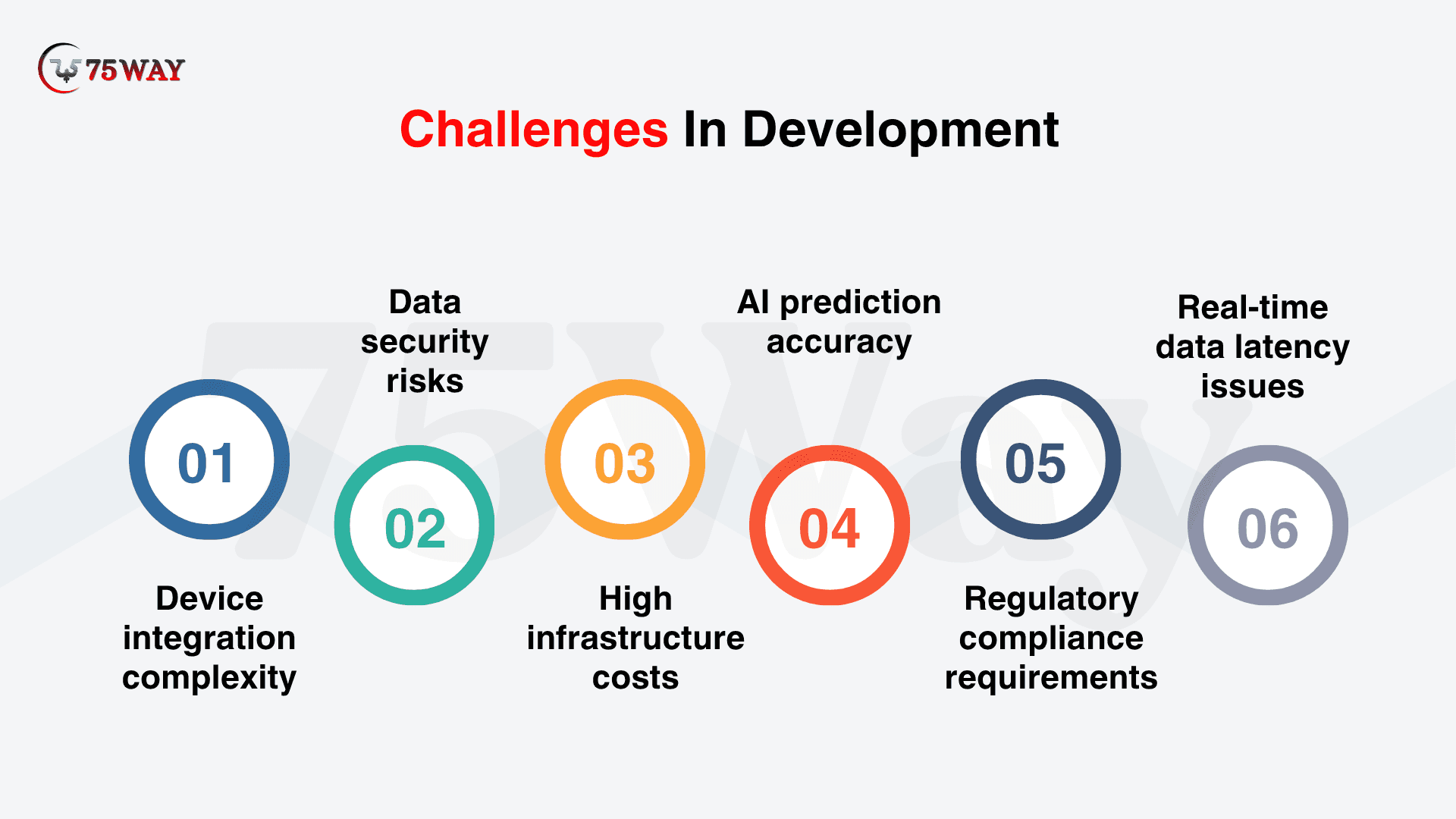
- Device Integration Complexity: Connecting multiple medical devices, sensors, and hospital systems into one platform is difficult due to different protocols and data formats.
Solution: Use standardized IoT frameworks and middleware for seamless interoperability.
- Data Security Risks: Patient data is highly sensitive and vulnerable to cyberattacks or breaches during transmission and storage.
Solution: Implement end-to-end encryption, secure APIs, and continuous threat monitoring systems.
- High Infrastructure Costs: Advanced telehealth systems require significant investment in hardware, cloud services, and integration layers.
Solution: Start with a scalable MVP architecture and gradually expand infrastructure based on hospital demand.
- AI Prediction Accuracy: Machine learning models may produce incorrect predictions due to limited or biased training data.
Solution: Continuously retrain models using diverse, real-time clinical datasets.
- Regulatory Compliance Requirements: Meeting HIPAA and other healthcare regulations can slow down development and deployment processes.
Solution: Integrate compliance checks from the initial design phase.
- Real-time data latency issues: Delays in transmitting or processing patient data can affect critical care decisions.
Solution: Use edge computing and optimized cloud architecture for faster data processing.
Future of Bed-Centered Telehealth Systems
The future of bed-centered telehealth systems is moving toward highly intelligent, fully connected hospital environments where AI, IoT, robotics, and predictive analytics work together seamlessly. Instead of relying on manual monitoring and periodic checkups, hospitals will shift to continuous, automated patient observation systems that can detect risks in real time and support faster clinical decisions.
In the coming years, smart hospital rooms will become standard, with AI-powered beds capable of tracking patient vitals, predicting deterioration, and automatically alerting medical staff without delay. Robotics and autonomous monitoring systems will reduce the workload on healthcare professionals while improving accuracy, response time, and overall patient survival outcomes across critical care environments.
Conclusion
To summarize, bed-centered telehealth systems represent a major leap forward in hospital-based healthcare innovation. By combining IoT devices, artificial intelligence, and secure cloud infrastructure, hospitals can achieve continuous monitoring, faster emergency response, and improved patient outcomes. As healthcare systems evolve, these technologies will become standard in modern hospital environments. If you are planning to build a scalable and secure solution like this, partnering with a trusted healthcare app development company can help you turn this vision into a compliant, AI-powered reality that delivers real clinical impact and long-term value.
Frequently Asked Questions (FAQs)
What Is A Bed-Centered Telehealth System Used For?
A bed-centered telehealth system is used for continuous patient monitoring in hospitals using IoT devices, AI analytics, and real-time healthcare data processing. It helps doctors track vital signs, detect emergencies early, and improve patient care outcomes without constant manual supervision inside hospital environments.
Are Bed-Centered Telehealth Systems HIPAA Compliant?
Yes, they must be HIPAA compliant when deployed in the United States. Compliance requires encryption, secure cloud storage, access control mechanisms, audit logging, and protected APIs. Hospitals must ensure all patient data handling follows strict healthcare privacy and security regulations at all times.
How Do AI Models Improve Bed-Centered Telehealth Systems?
AI models analyze patient data continuously to detect anomalies, predict health risks, and generate alerts for medical staff. Machine learning improves accuracy over time by learning from patient history, enabling proactive treatment decisions and reducing emergency response delays in critical care environments.
Which Hospitals Can Use Bed-Centered Telehealth Systems?
These systems are suitable for ICUs, emergency departments, post-surgery recovery units, long-term care facilities, and chronic disease management centers. Any hospital requiring continuous patient monitoring and real-time clinical decision support can benefit from implementing this technology.
What Are The Main Benefits For Healthcare Providers?
Healthcare providers benefit from reduced workload, faster emergency detection, improved patient safety, and better resource management. These systems automate monitoring tasks, enhance clinical accuracy, and support data-driven decision-making for doctors and nurses in real-time hospital environments.
Can Bed-Centered Telehealth Systems Integrate With Existing Hospital Systems?
Yes, they can integrate with EHR systems, hospital management software, wearable devices, and diagnostic tools. API-based architecture enables seamless data exchange, ensuring healthcare providers have a unified view of patient health records and real-time monitoring data across platforms.