AI Summary
An AI news tracking agent can automatically discover, filter, analyze, summarize, and deliver relevant AI and business news. This guide explains the development process, technologies, features, costs, and integration options for building one.
Key Takeaways
- Define news monitoring goals before designing your AI agent.
- Connect reliable sources and APIs for automated news discovery.
- Use AI to filter, classify, summarize, and rank relevant stories.
- Add memory to personalize news tracking for different users.
- Integrate alerts, dashboards, and workflows for timely business intelligence.
Being a startup founder and business leader, you might not have time to spend hours scanning news feeds to discover a development that could affect an AI strategy, investment decision, competitor, or technology roadmap.
Yet the speed of AI progress makes manual monitoring increasingly difficult, with new developments appearing across companies, markets, regulations, and enterprise technology almost every day.
An AI agent for news tracking can act as a dedicated intelligence layer, continuously watching selected sources, identifying developments that matter, and turning them into usable updates instead of another unread stream of headlines.
The real value comes from designing the news tracking AI agent development solution around business relevance rather than simply automating news collection.
This guide explains how to build an AI agent to automate AI and business news tracking, from defining the monitoring scope and connecting data sources to filtering, summarizing, prioritizing, delivering alerts, and maintaining reliable oversight as the system scales.
What Is An AI News Tracking Agent?
An AI news tracking agent is a software system that continuously monitors selected news sources, identifies relevant information, analyzes content, and delivers useful updates without requiring someone to manually search for every story.
Unlike a traditional news aggregator that mainly collects headlines and links, a business news tracking AI agent can make decisions about what to monitor, which stories matter, how different reports are related, and what information should be delivered to a specific user.
For example, a business leader could configure an agent to monitor:
- Artificial intelligence developments
- Competitor announcements
- Funding rounds
- Mergers and acquisitions
- Product launches
- Market trends
- Regulatory updates
- Technology partnerships
- Executive announcements
- Industry-specific developments
The AI market news tracking agent can then turn hundreds of daily articles into a smaller, prioritized intelligence feed.
How Does An AI Agent Automate AI And Business News Tracking?
An AI news tracking agent follows an automated workflow that collects information, processes stories, identifies relevance, and delivers useful intelligence to users. Each stage plays a specific role in turning large volumes of news into concise, actionable updates.
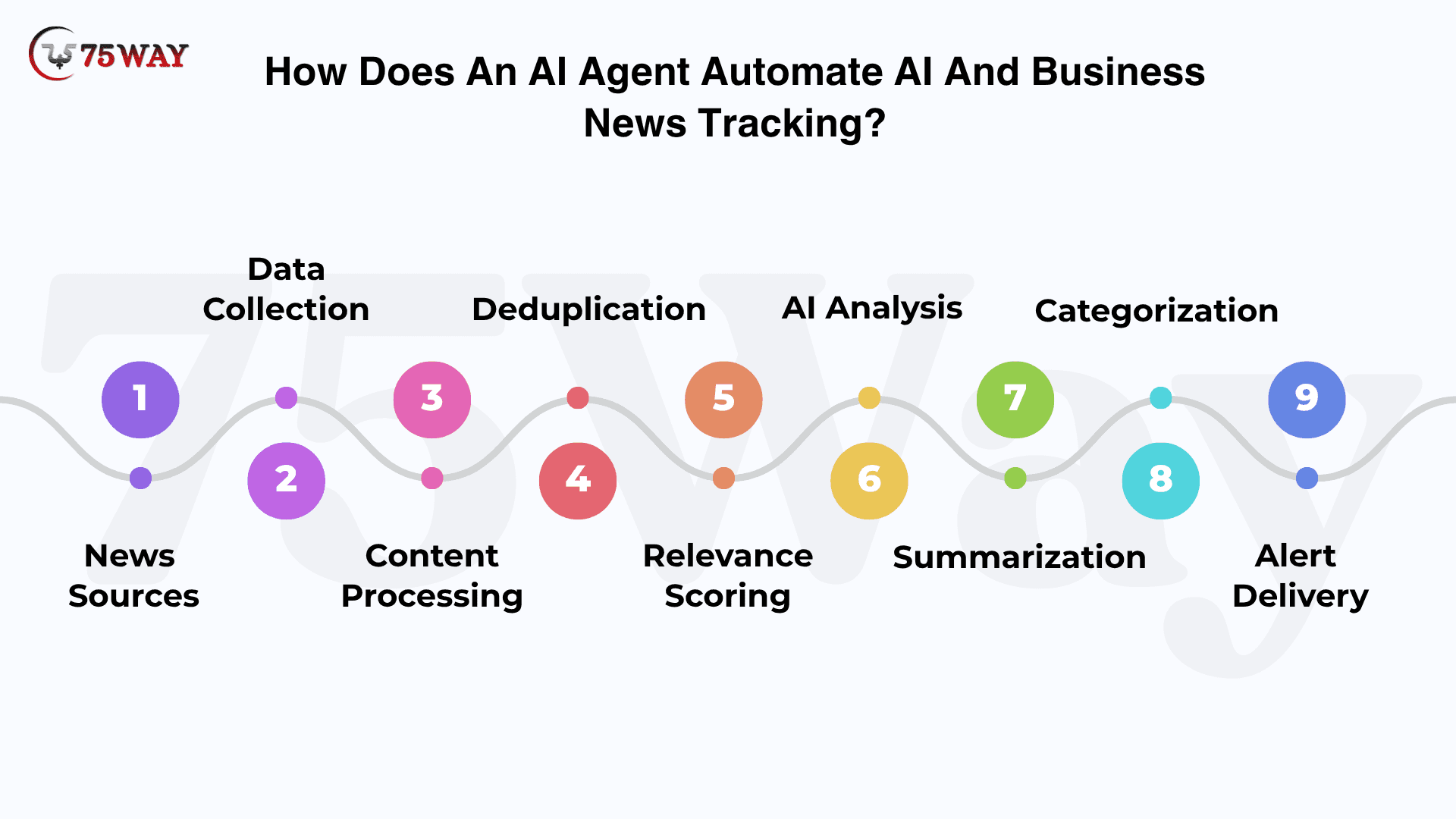
1. News Sources: The process starts by connecting the agent with news APIs, RSS feeds, company websites, industry publications, and other permitted sources. These sources continuously provide the raw information that the next stage can collect and process.
2. Data Collection: Once sources are connected, the agent automatically retrieves new headlines, articles, descriptions, publication dates, and available metadata. The collected information then moves into the processing layer for cleaning and structuring.
3. Content Processing: After collection, the system cleans and normalizes incoming content so different sources follow a usable structure. AI enterprise news monitoring agent can also extract keywords, topics, companies, people, dates, and other entities needed for deeper analysis.
4. Deduplication: With the content organized, the agent compares new stories against existing information to identify duplicate or substantially similar coverage. Related reports can then be grouped together, allowing the following stages to focus on unique developments.
5. Relevance Scoring: After removing duplicates, the agent evaluates each remaining story against user preferences, monitored companies, topics, keywords, source quality, recency, and potential business impact. Stories with higher relevance scores can then move forward for detailed AI analysis.
6. AI Analysis: Based on these relevance scores, the AI model examines important stories to identify key events, entities, technologies, and potential business implications. It can also compare related reports to provide additional context before generating the final summary.
7. Summarization: Once the important information has been analyzed, the agent converts selected stories into concise summaries containing their most meaningful details. These summaries can explain what happened, who is involved, and why the development may matter.
8. Categorization: The summarized stories are then assigned categories such as AI, funding, regulation, competitors, product launches, or market trends. This organization helps the system determine how each update should be presented and which users should receive it.
9. Alert Delivery: Finally, categorized and prioritized updates are delivered through email, Slack, Microsoft Teams, mobile notifications, or dashboards. The AI-powered news monitoring agent can send immediate alerts for high-priority developments or combine lower-priority stories into scheduled news digests.
How To Build An AI Agent For Business News Tracking?
A useful business news tracking agent should know that not every headline deserves the same level of attention. The real challenge is creating an AI system that can monitor information, recognize what matters, and deliver useful updates without adding to the noise. The approach to building an AI agent for business news tracking is discussed below.
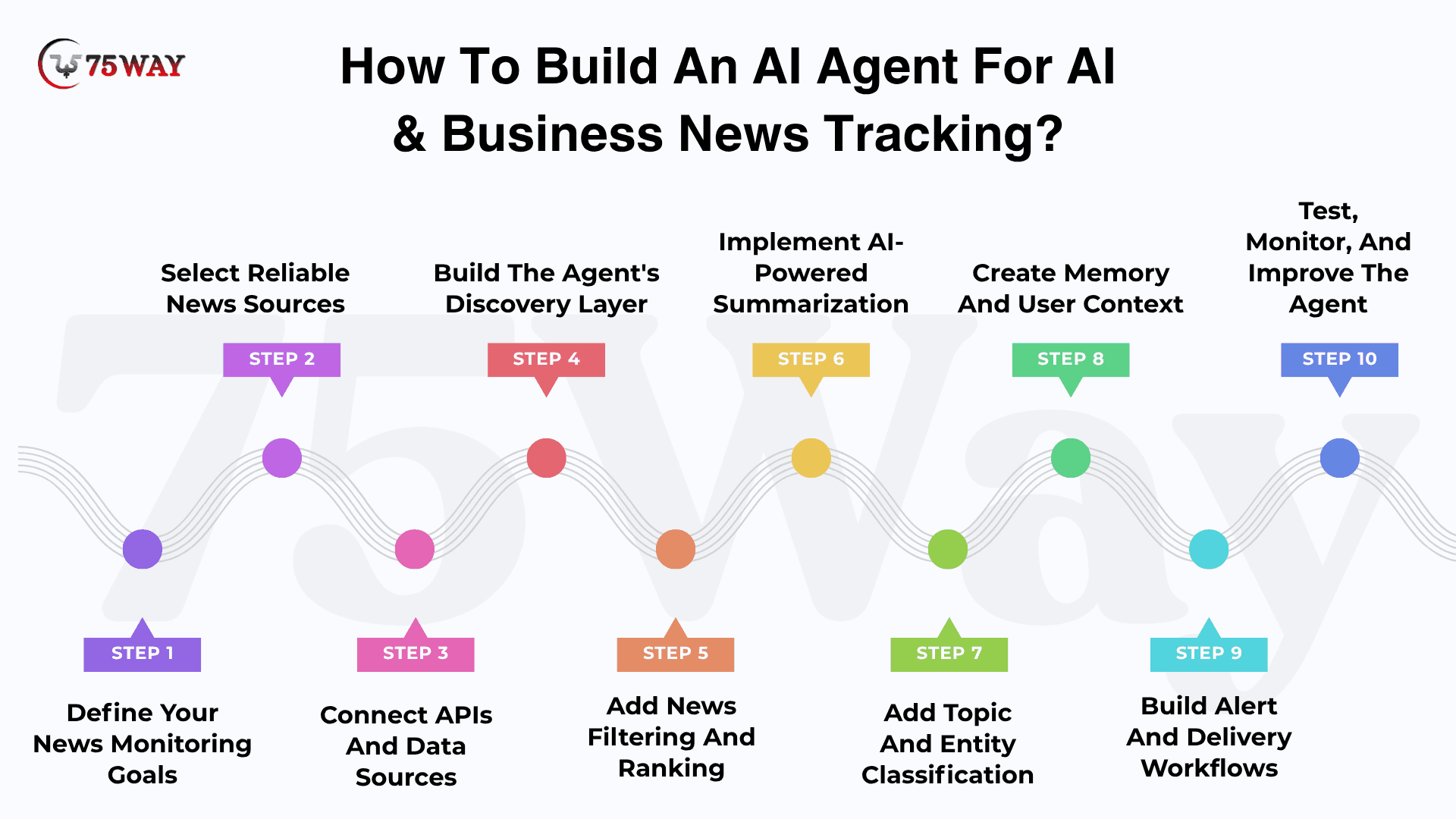
1. Define Your News Monitoring Goals
Start by determining exactly what the agent should track.
A general-purpose agent that monitors everything will quickly produce excessive and irrelevant information. Instead, define specific monitoring objectives such as competitor intelligence, AI developments, investment opportunities, market research, or executive briefings.
Determine:
- Topics to monitor
- Companies to follow
- Keywords and phrases
- Industries of interest
- Geographic requirements
- Preferred sources
- Update frequency
- Alert thresholds
- Target users
These requirements become the foundation for the agent's workflow.
2. Select Reliable News Sources
The quality of the agent depends heavily on the quality of its information sources.
Depending on your use case, sources may include news APIs, RSS feeds, company newsrooms, regulatory publications, financial data providers, industry publications, and other permitted sources.
You should evaluate each source based on reliability, coverage, update frequency, API availability, licensing, data structure, historical access, and geographic coverage.
Using multiple sources can improve coverage, but it also increases the need for duplicate detection and source validation.
3. Connect APIs And Data Sources
APIs provide a structured way to bring external information into the agent.
The AI agent development team can create connectors that collect article titles, descriptions, publication dates, URLs, authors, categories, and other available metadata.
A typical ingestion layer may look like:
Source APIs → API Connectors → Queue → Processing Service → Database
The system should also account for API limits, authentication, failed requests, unavailable sources, and changes in external data formats.
4. Build The Agent's Discovery Layer
The discovery layer determines which information enters the AI workflow.
Basic keyword matching can identify obvious stories, but an advanced system can use semantic search and entity recognition to understand related concepts.
For example, a company monitoring agent should recognize that articles mentioning a company's product, subsidiary, acquisition, or executive may be relevant even when the exact monitoring keyword is absent.
This makes the discovery process more useful than simple keyword alerts.
5. Add News Filtering And Ranking
News volume can become overwhelming, so filtering and ranking are essential.
The agent can assign relevance scores based on factors such as:
- Topic match
- Company relevance
- Source quality
- Recency
- User preferences
- Business impact
- Geographic relevance
- Keyword importance
- Historical user behavior
A ranking system can then place high-value stories at the top while reducing low-priority content.
6. Implement AI-Powered Summarization
Once relevant stories have been identified, an AI model can create concise summaries.
Instead of simply shortening an article, the agent can organize information around questions such as:
- What happened?
- Who is involved?
- Why does it matter?
- What could happen next?
- What business areas could be affected?
For decision-makers, this format can be more valuable than a generic three-sentence summary.
The system should preserve the original source and article link so users can verify important information themselves.
7. Add Topic And Entity Classification
Classification helps organize the incoming information.
An article could automatically receive labels such as AI, funding, M&A, product launch, regulation, cybersecurity, cloud, competitor, and market trend.
Entity extraction can additionally identify companies, people, products, locations, industries, and technologies mentioned in each story.
This structured information makes personalized searches, dashboards, and alerts easier to build.
8. Create Memory And User Context
An advanced AI news agent should understand individual preferences.
For example, one user may care about AI funding and competitors, while another may primarily want regulatory and cybersecurity updates.
User memory can store preferences such as:
- Favorite topics
- Companies being monitored
- Preferred sources
- Alert frequency
- Previously viewed stories
- Business interests
- Topics marked as irrelevant
The agent can then adjust future recommendations based on that context.
9. Build Alert And Delivery Workflows
The final intelligence needs to reach users through channels they already use.
Common delivery options include:
- Email alerts
- Daily news digests
- Slack notifications
- Microsoft Teams updates
- Mobile push notifications
- Web dashboards
- Internal knowledge platforms
Users should be able to control alert frequency and importance thresholds. Otherwise, excessive notifications can create the same information overload the agent was designed to solve.
10. Test, Monitor, And Improve The AI News Agent
Testing should continue after deployment.
Measure whether the agent:
- Finds relevant stories
- Misses important developments
- Removes duplicate coverage
- Produces accurate summaries
- Preserves source information
- Sends alerts at the right time
- Avoids unnecessary notifications
- Correctly understands user preferences
User feedback can become another signal for improving relevance and ranking.
AI News Tracking Agent Monitoring Capabilities For Modern Businesses
A business can follow hundreds of AI and industry updates every day and still miss the one development that matters. An AI news tracking agent helps turn that constant information flow into a more focused monitoring experience. The key monitoring capabilities that make these agents useful for modern businesses are covered below.
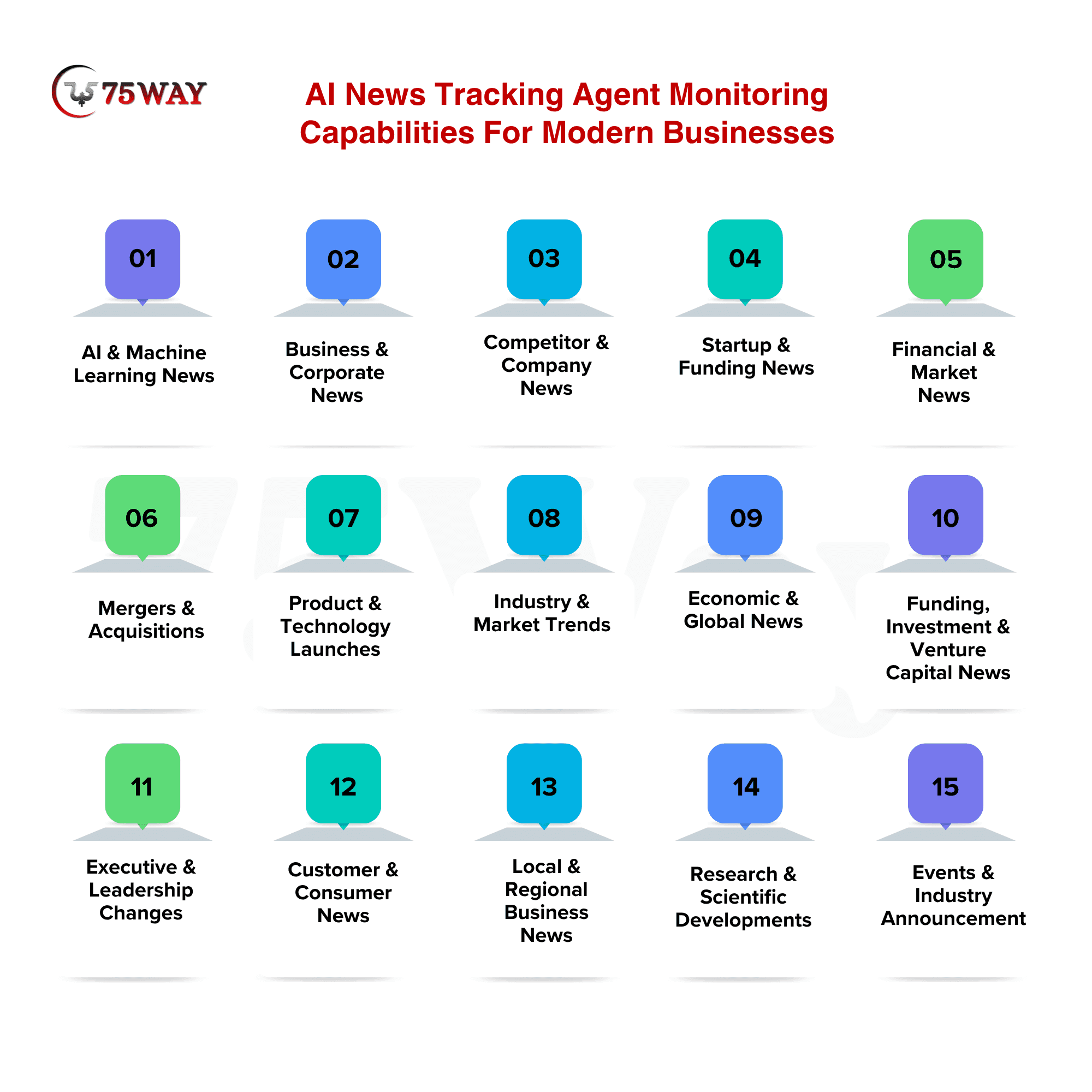
- AI & Machine Learning News
The agent can track generative AI, foundation models, LLMs, machine learning, AI agents, robotics, computer vision, NLP, AI research, model releases, AI tools, automation, and enterprise AI adoption. It can also follow announcements from AI companies, research organizations, developers, and technology platforms.
- Business & Corporate News
The agent can monitor company announcements, earnings, business expansions, new offices, leadership changes, strategic partnerships, product launches, investments, acquisitions, mergers, layoffs, and major business decisions. This gives executives a continuous view of developments that could affect their markets or competitors.
- Competitor & Company News
Businesses can create watchlists for specific competitors, customers, prospects, suppliers, or industry leaders. The agent can then track new products, pricing changes, funding, acquisitions, partnerships, hiring activity, leadership appointments, market expansion, technology adoption, and major announcements involving those companies.
- Startup & Funding News
An AI agent can monitor startup launches, funding rounds, seed investments, Series A/B/C funding, venture capital activity, acquisitions, incubator announcements, valuations, and emerging companies. This can help investment teams, founders, and business leaders identify new players entering their markets.
- Financial & Market News
The system can follow stock-market developments, company earnings, market movements, economic indicators, interest-rate decisions, investment activity, commodities, currencies, and sector-specific financial news. Users can configure the agent to prioritize information connected to their industries or monitored companies.
- Mergers & Acquisitions
The agent can specifically monitor mergers, acquisitions, takeovers, strategic investments, joint ventures, and corporate restructuring. It can also connect multiple reports about the same transaction and summarize what the deal could mean for the companies involved.
- Product & Technology Launches
Businesses can track new software releases, mobile apps, AI products, APIs, cloud services, hardware launches, platform updates, developer tools, cybersecurity products, and enterprise technologies. This is particularly useful for product and technology teams monitoring innovation within their markets.
- Industry & Market Trends
Rather than tracking individual stories alone, an AI agent can identify recurring themes across multiple articles. It can monitor consumer trends, industry growth, emerging technologies, changing customer behavior, new business models, supply-chain developments, and market disruptions.
- Economic & Global News
Businesses can monitor economic conditions, trade developments, geopolitical events, supply-chain disruptions, international business activity, inflation, employment data, and other macroeconomic developments that may influence markets.
- Funding, Investment & Venture Capital News
An agent can continuously scan for venture capital investments, private equity deals, startup funding, investor activity, new funds, strategic investments, and corporate venture capital announcements. These signals can help businesses identify where capital and innovation are moving within an industry.
- Executive & Leadership Changes
The system can monitor CEO appointments, executive departures, board changes, founder announcements, senior leadership hires, and organizational restructuring. This can be particularly valuable when tracking competitors, customers, or companies involved in strategic partnerships.
- Customer & Consumer News
Depending on the industry, the agent can monitor customer preferences, product reviews, consumer sentiment, demand changes, popular products, social trends, and major shifts in buying behavior. AI analysis can then group these signals into broader customer trends.
- Local & Regional Business News
The agent can also monitor news by city, state, country, or specific market, including local business openings, expansions, closures, investments, infrastructure developments, and regional economic activity. This can be useful for companies operating across multiple markets.
- Research & Scientific Developments
For technology-driven businesses, the agent can track research papers, scientific breakthroughs, patents, laboratory announcements, academic research, clinical developments, and emerging technical discoveries. These updates can help R&D teams identify technologies that may influence future products.
- Events & Industry Announcements
The system can monitor conferences, trade shows, product events, keynote announcements, industry awards, webinars, and major technology events. It can then summarize the developments most relevant to a user's selected topics.
Technologies Needed To Build An AI Agent For Business News Monitoring
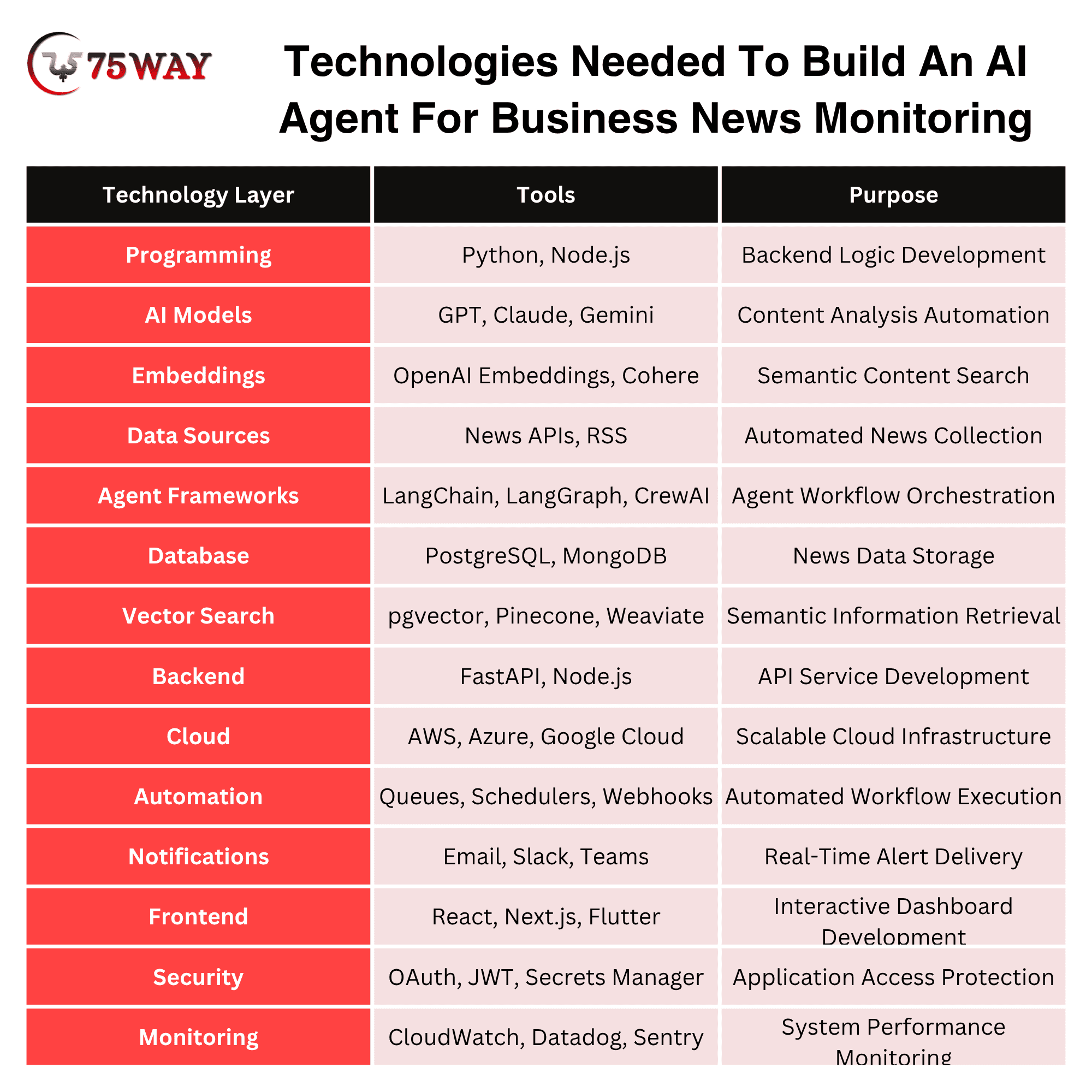
The intelligence of a news monitoring agent depends heavily on what powers it behind the interface. A well-planned technology stack can help the system handle incoming information while supporting reliable analysis and timely delivery. The key technologies required to build an AI agent for business news monitoring are covered below.
1. Programming Languages
- Python: Useful for AI development, data processing, automation, NLP pipelines, and integrating machine learning models.
- Node.js: Suitable for real-time backend services, API integrations, notification systems, and event-driven application workflows.
2. AI Models
- Large Language Models: Models such as GPT, Claude, and Gemini can analyze articles, generate summaries, classify stories, extract insights, and answer questions about collected news.
- Embedding Models: Embeddings convert news content into numerical representations, allowing the agent to identify semantically similar stories and perform intelligent searches.
- Machine Learning Models: Custom models can support relevance scoring, classification, sentiment analysis, trend detection, and personalized recommendations when the application requires specialized intelligence.
3. News Data Sources
- News APIs: APIs provide structured access to headlines, articles, metadata, publication dates, and other information from supported news providers.
- RSS Feeds: RSS can provide a lightweight way to monitor websites, publications, blogs, and company newsrooms that publish feed-based updates.
- Approved Web Sources: Permitted web data sources can expand coverage when relevant information is unavailable through APIs or feeds, subject to their access and usage requirements.
4. AI Agent Frameworks
- LangChain: Can help connect language models with tools, retrieval systems, APIs, memory, and structured workflows.
- LangGraph: Useful for designing more complex, stateful agent workflows where multiple processing steps need to operate in a controlled sequence.
- CrewAI: Can support multi-agent architectures where specialized agents handle tasks such as research, verification, summarization, and analysis.
5. Database Technologies
- PostgreSQL: A strong option for storing users, preferences, news metadata, classifications, alerts, and structured business information.
- MongoDB: A flexible alternative when the application needs to handle varied or frequently changing document structures.
The database should retain source information, timestamps, article relationships, processing status, and user interactions so the agent can build useful historical context.
6. Vector Search
- pgvector: Allows vector similarity search directly within PostgreSQL, which can simplify architecture for applications already using PostgreSQL.
- Pinecone: A dedicated vector database suitable for applications requiring scalable semantic search across large collections of news content.
- Weaviate: Can support vector search and retrieval-based AI applications where semantic discovery and contextual information retrieval are important.
7. Backend Technologies
- FastAPI: Python-based framework suitable for building APIs and AI-powered backend services.
- Node.js: Useful for API orchestration, real-time services, integrations, authentication, and notification workflows.
The backend connects the news sources, AI models, databases, agent workflows, dashboards, and external business applications into one working system.
8. Automation Technologies
- Schedulers: Automatically trigger news collection at predefined intervals.
- Message Queues: Help process large volumes of incoming news asynchronously without slowing down the entire application.
- Webhooks: Allow external applications to trigger or receive events when important news is detected.
- Workflow Automation: Can coordinate tasks such as collection, filtering, AI processing, storage, and alert delivery without requiring manual intervention.
9. Cloud Infrastructure
- AWS: Provides computing, storage, databases, queues, monitoring, and AI-related infrastructure for scalable deployments.
- Microsoft Azure: Suitable for businesses already operating within Microsoft's enterprise ecosystem and requiring cloud, security, data, and AI services.
- Google Cloud: Offers infrastructure, data processing, analytics, and AI services that can support news intelligence applications.
10. Notification Technologies
- Email: Useful for daily briefings, weekly reports, and high-priority news alerts.
- Slack: Allows teams to receive important news directly inside selected channels.
- Microsoft Teams: Useful for organizations that already use Teams for internal communication and collaboration.
- Push Notifications: Suitable for mobile applications where users need immediate alerts about high-priority developments.
11. Frontend Technologies
- React: Can be used to build interactive dashboards for browsing, filtering, and analyzing monitored news.
- Next.js: Supports modern web applications that combine frontend experiences with server-side functionality.
- Mobile Frameworks: Technologies such as Flutter or React Native can support mobile applications where users need news monitoring and alerts while away from their desktops.
12. Security And Monitoring Technologies
Security should also be considered when the agent stores user preferences, business intelligence, API credentials, or internal information. Authentication, authorization, encryption, secrets management, logging, application monitoring, and access controls can help protect the platform.
Which Technology Stack Should You Choose?
There is no single technology stack that fits every AI news tracking agent. The right combination depends on news volume, number of users, source requirements, AI model usage, response speed, personalization, security, integrations, and expected scalability.
For an MVP, a practical stack could combine Python or Node.js, an LLM, news APIs and RSS feeds, PostgreSQL with vector search, a lightweight agent workflow, cloud infrastructure, and email or Slack notifications.
As usage grows, you can add dedicated vector databases, message queues, advanced agent orchestration, real-time processing, and enterprise integrations.
Must-Have Features For Developing An AI-Powered News Tracking Agent
An AI-powered news tracking agent should do more than collect a stream of headlines and send them to your team. The right capabilities can make the system more practical for teams that need timely intelligence without constantly monitoring multiple sources. The major features for an AI-powered news tracking agent are covered below.
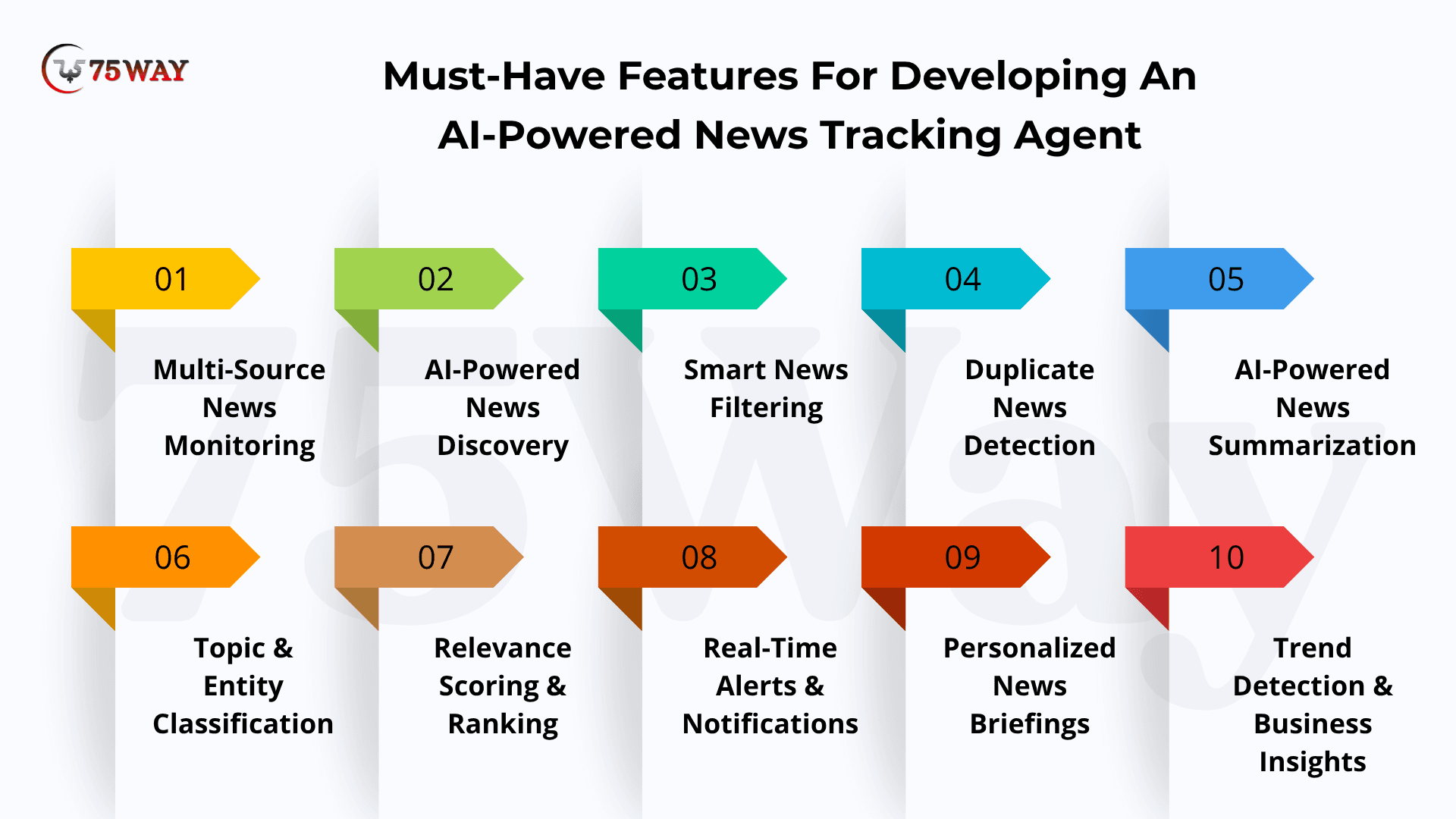
1. Multi-Source News Monitoring
Important stories rarely stay in one place. A competitor may announce a product on its website, while industry publications discuss its market impact and financial platforms report the numbers. A news tracking agent should bring these sources together so users can follow a development from multiple angles without checking every platform themselves.
2. AI-Powered News Discovery
Users cannot always predict the exact words an important story will contain. Someone tracking OpenAI, for example, may want updates about new models, partnerships, funding, leadership changes, or product launches even when those terms never appear in their original search query. AI-powered discovery helps the agent find these connected stories instead of relying only on fixed keywords.
3. Smart News Filtering
A busy executive does not need 50 notifications just because 50 articles mention a tracked company. The agent should ask a more useful question: “Is this actually worth your attention?” It can consider relevance, freshness, source quality, business impact, and user preferences before allowing a story into the final news feed.
4. Duplicate News Detection
One announcement can quickly become dozens of headlines. Without duplicate detection, users may receive ten versions of essentially the same story and mistake repetition for new information. The agent can recognize related coverage, group it together, and present the underlying development as one story while still showing important sources.
5. AI-Powered News Summarization
Reading every article from beginning to end defeats the purpose of automation. The agent can turn lengthy reports into short summaries that answer the questions users actually have: What happened? Who is involved? Why does it matter? For senior decision-makers, this makes staying informed far less time-consuming.
6. Topic & Entity Classification
News becomes easier to understand when it is organized properly. Instead of throwing every article into one endless feed, the agent can recognize companies, people, technologies, industries, and events, then place stories under categories such as AI, funding, competitors, acquisitions, regulations, product launches, and market trends.
7. Relevance Scoring & Ranking
Not every story about a tracked company deserves the same priority. A minor product update might be interesting, while a major acquisition could have immediate business implications. Relevance scoring allows the agent to rank stories according to factors such as importance, recency, source credibility, user interests, and potential business impact.
8. Real-Time Alerts & Notifications
Some news can wait for a morning briefing; some cannot. If a competitor announces a major acquisition, a new regulation affects an industry, or a tracked company launches a significant product, the agent can trigger an immediate alert through channels such as email, Slack, Teams, or mobile notifications.
9. Personalized News Briefings
A founder, investor, sales leader, and product manager may follow the same industry but look for completely different information. The agent can learn each user's preferred companies, topics, sources, and alert frequency, then create a briefing that feels personally curated rather than copied from a generic news feed.
10. Trend Detection & Business Insights
The real value of news tracking appears when the agent starts connecting the dots. For example, several competitor hires, a new funding round, a product announcement, and expansion into a new market could collectively signal a larger strategic move. By spotting these patterns across individual stories, the agent can move beyond “here is what happened” toward “here is what may be worth watching.”
How Does An Autonomous AI Agent Track & Analyze News In Real Time?
Real-time news tracking requires an automated pipeline capable of repeatedly collecting and processing new information. A simplified workflow looks like this:
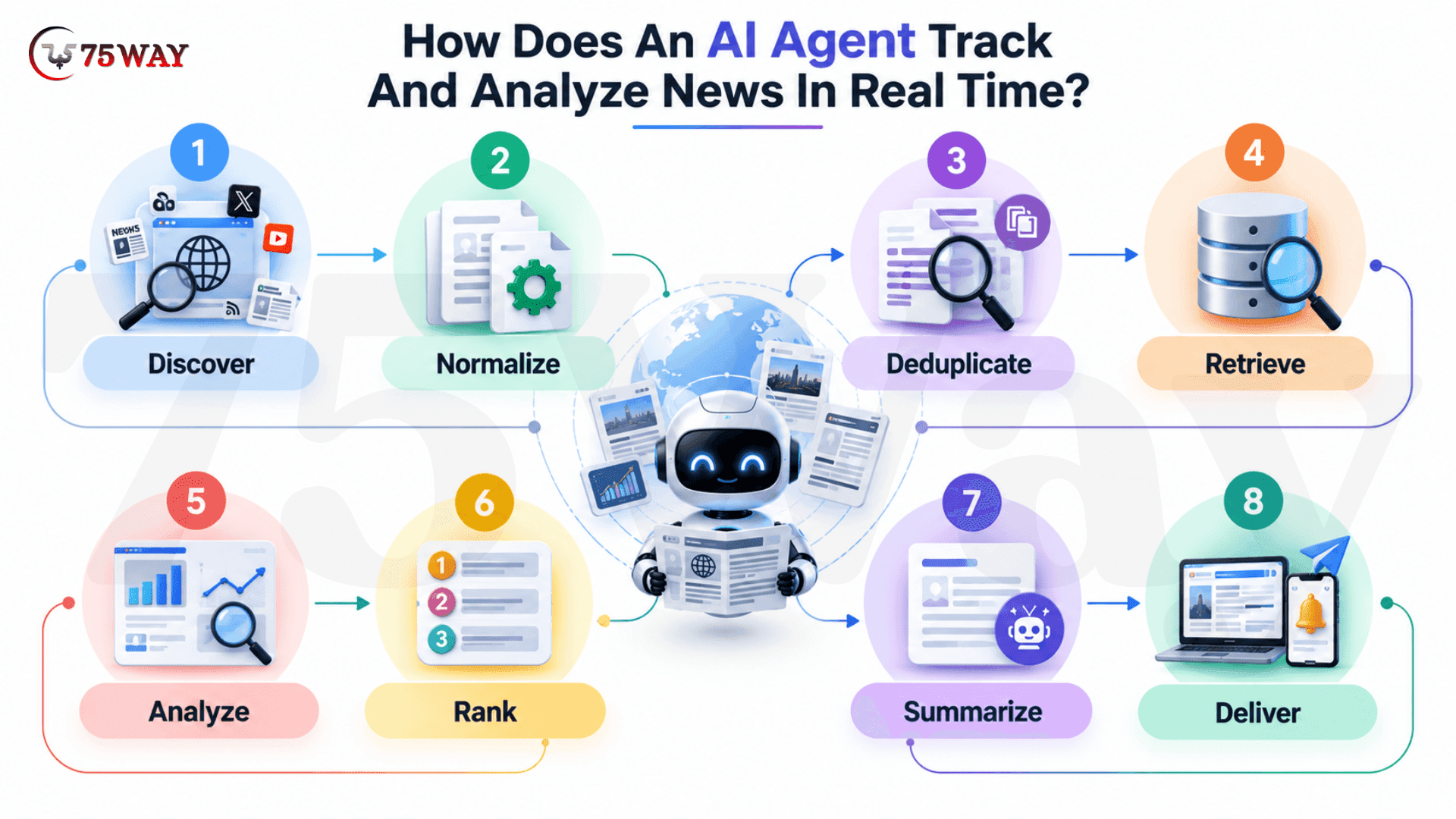
1. Discover: New articles enter through connected sources.
2. Normalize: The system cleans titles, metadata, timestamps, and content.
3. Deduplicate: Similar stories from multiple sources are grouped.
4. Retrieve: Relevant information is passed to the AI processing layer.
5. Analyze: The model identifies topics, entities, events, and key details.
6. Rank: Stories receive relevance and priority scores.
7. Summarize: Important developments are converted into concise updates.
8. Deliver: Users receive alerts or scheduled briefings.
9. Learn: Feedback improves future recommendations.
The exact definition of "real time" depends on source availability and the required processing frequency. Some businesses need immediate alerts, while others may prefer hourly or daily intelligence summaries.
How To Make The AI Corporate News Monitoring Agent Understand Which News Matters?
The corporate news monitoring AI agent should not treat every new article equally.
A stronger relevance engine combines several signals. For example, a story mentioning a monitored competitor may receive a higher score than an unrelated industry article. A regulatory announcement affecting a company's core market may receive an even higher priority.
You can establish rules around:
- Monitored companies
- Strategic keywords
- Industry categories
- Competitor names
- Product names
- Business functions
- Source credibility
- Publication recency
- Potential business impact
- User preferences
You can also introduce separate priority levels such as Critical, High, Medium, and Low to control how information is delivered.
Key Benefits of Building an AI-Powered News Tracking & Analysis Agent
Business news has value only when the right information reaches the right people at the right time. An AI-powered tracking and analysis agent can help businesses handle the growing information load without making news monitoring another time-consuming task for their teams. The practical advantages for modern organizations are explained in detail below.
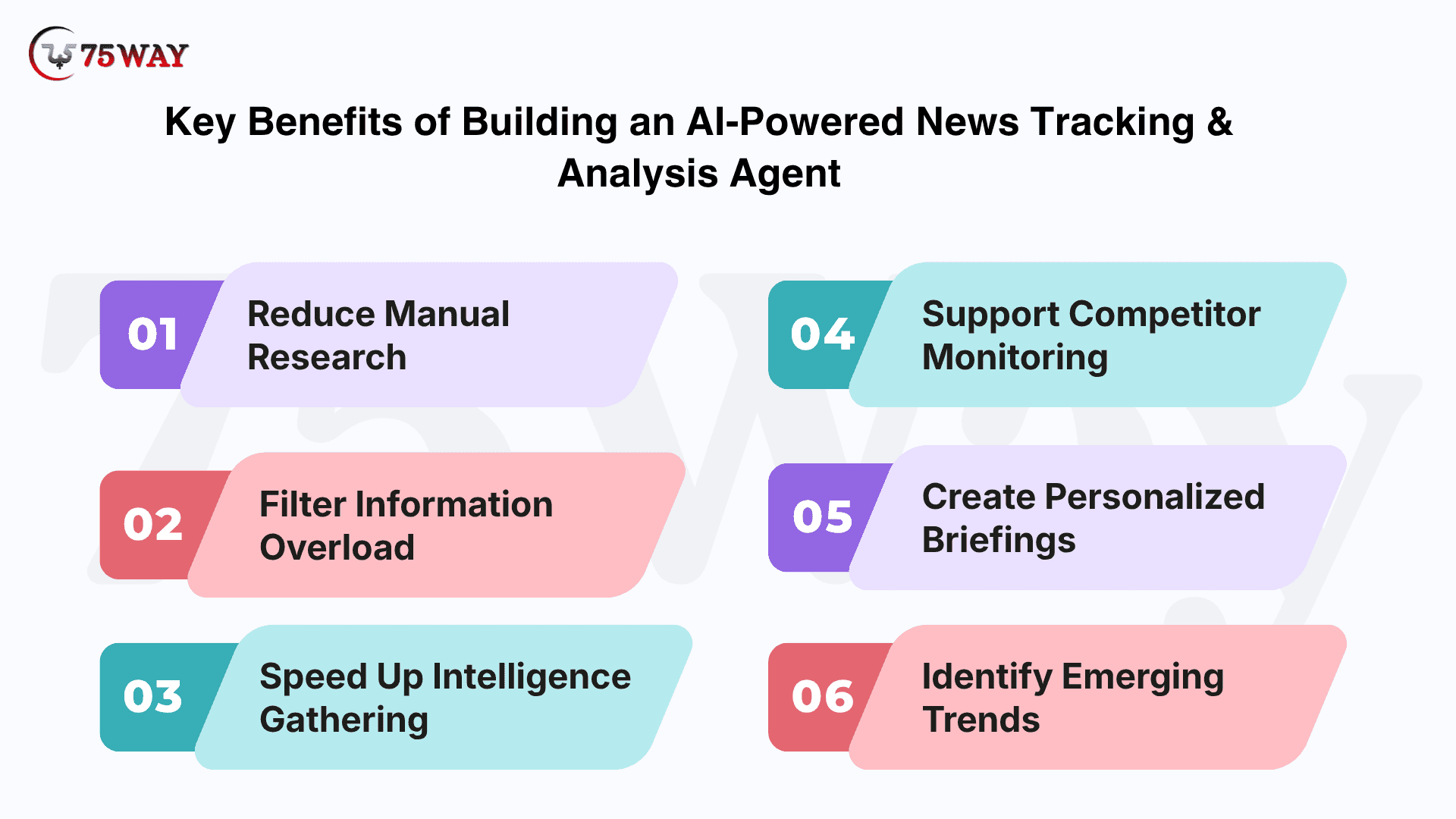
- Reduce Manual Research: Employees no longer need to repeatedly search multiple sources for routine monitoring tasks.
- Filter Information Overload: Instead of delivering every article, the agent can prioritize stories according to predefined business requirements.
- Speed Up Intelligence Gathering: Important developments can reach users shortly after they are detected rather than waiting for manual research.
- Support Competitor Monitoring: Businesses can continuously track competitor announcements, products, partnerships, investments, and market activity.
- Create Personalized Briefings: Different employees can receive different news based on their responsibilities and interests.
- Identify Emerging Trends: The agent can identify repeated themes across multiple stories and help users recognize developing market patterns.
How Much Does It Cost To Build An AI Agent For AI & Business News Tracking?
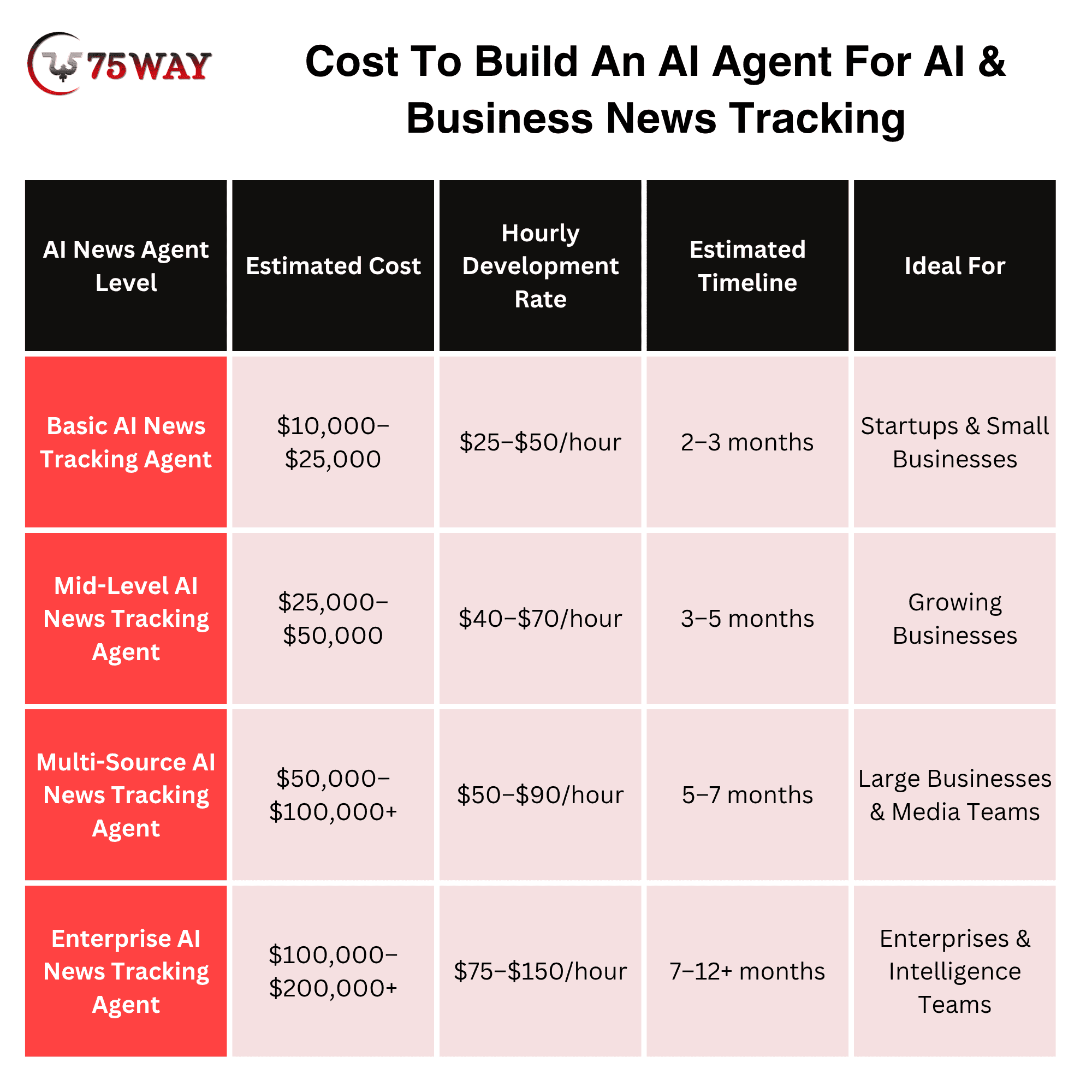
The cost of building an AI news tracking agent can range from $10,000 to $200,000+, depending on what you expect the agent to monitor, analyze, and automate. A simple system that collects and summarizes selected news sources requires far less development than an enterprise platform with real-time monitoring, personalization, advanced AI analysis, and multiple business integrations.
1. Basic AI News Tracking Agent: $10,000–$25,000
A basic agent is suitable for businesses that want to automate straightforward news collection without building a highly sophisticated intelligence platform.
2. Mid-Level AI News Tracking Agent: $25,000–$50,000
At this level, the agent starts making smarter decisions about the information it delivers. The system can use LLMs for summarization, topic classification, entity extraction, relevance scoring, duplicate detection, and personalized news filtering.
3. Multi-Source AI News Tracking Agent: $50,000–$100,000+
An advanced solution can monitor a much wider range of sources and connect information across different stories.
4. Enterprise AI News Tracking Agent: $100,000–$200,000+
Enterprise-grade platforms go beyond automated news tracking and function more like dedicated business intelligence systems.
Stage-Wise Cost for AI Business News Agent Development
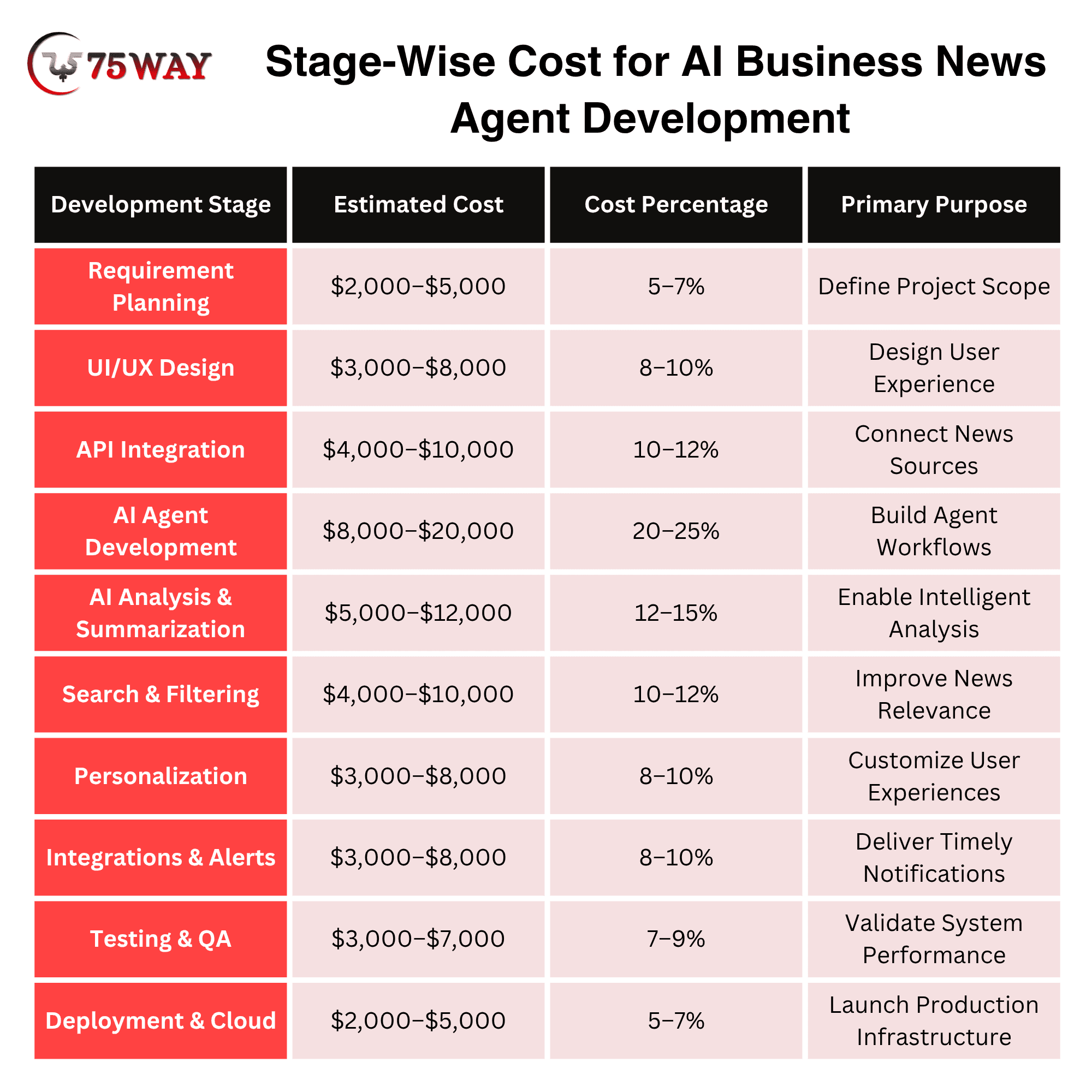
The development budget is divided across different stages, with each stage covering a specific part of the agent's journey from concept to production. While the actual cost varies by project scope, here is a practical stage-wise estimate.
1. Requirement Analysis & Planning: $2,000–$5,000
It typically includes use-case discovery, source planning, feature selection, technical architecture, and project estimation.
2. UI/UX Design & Dashboard: $3,000–$8,000
If your solution includes a dashboard, users need an intuitive place to browse news, manage topics, configure alerts, and review summaries. The cost depends on the number of screens, user roles, personalization requirements, and dashboard functionality.
3. News Source & API Integration: $4,000–$10,000
This stage covers integrating news APIs, RSS feeds, approved web sources, authentication, data normalization, rate-limit handling, and source-specific requirements.
4. AI Agent & Workflow Development: $8,000–$20,000
This is where the core agent logic is developed. The system is designed to collect information, process incoming stories, determine which content deserves deeper analysis, and move relevant information through the required workflows.
5. AI Summarization & Classification: $5,000–$12,000
Development costs depend on the models used, article volume, analysis depth, prompt design, and the number of classification requirements.
6. Search, Filtering & Relevance Engine: $4,000–$10,000
A good news agent needs to distinguish meaningful developments from articles that simply contain a tracked keyword.
7. Testing & Quality Assurance: $3,000–$7,000
AI news systems need testing across both traditional software functionality and AI-generated results. The team can evaluate summary accuracy, duplicate detection, source handling, relevance scoring, alert behavior, API failures, security, and system performance.
8. Deployment & Cloud Setup: $2,000–$5,000
Once the agent is ready, it needs a reliable production environment for continuous news collection and processing. This stage can include cloud deployment, database configuration, monitoring, logging, authentication, backups, scaling, and production optimization.
Factors Affecting Cost To Develop AI Business News Agent
Several elements can push the development budget up or down:
- Number of News Sources: More APIs, feeds, websites, and data providers increase integration and maintenance requirements.
- AI Model Usage: Advanced models and high article volumes can increase both development and ongoing processing costs.
- News Volume: Processing thousands of articles daily requires stronger data pipelines, databases, and infrastructure.
- Personalization: User-specific feeds, preferences, memory, and recommendations require additional logic and data handling.
- Real-time Processing: Immediate monitoring and alerts need faster pipelines and event-driven architecture.
- Integrations: Slack, Teams, email, CRM systems, dashboards, and internal platforms add development effort.
- Dashboard Requirements: Analytics, search, filtering, saved stories, and administrative controls increase frontend and backend work.
- Security Needs: Enterprise authentication, permissions, encryption, audit logs, and compliance measures can add substantially to the project.
- Maintenance: AI model updates, API changes, source availability, infrastructure, monitoring, and ongoing improvements create recurring costs.
AI News Monitoring Agent Development Challenges And How To Overcome Them
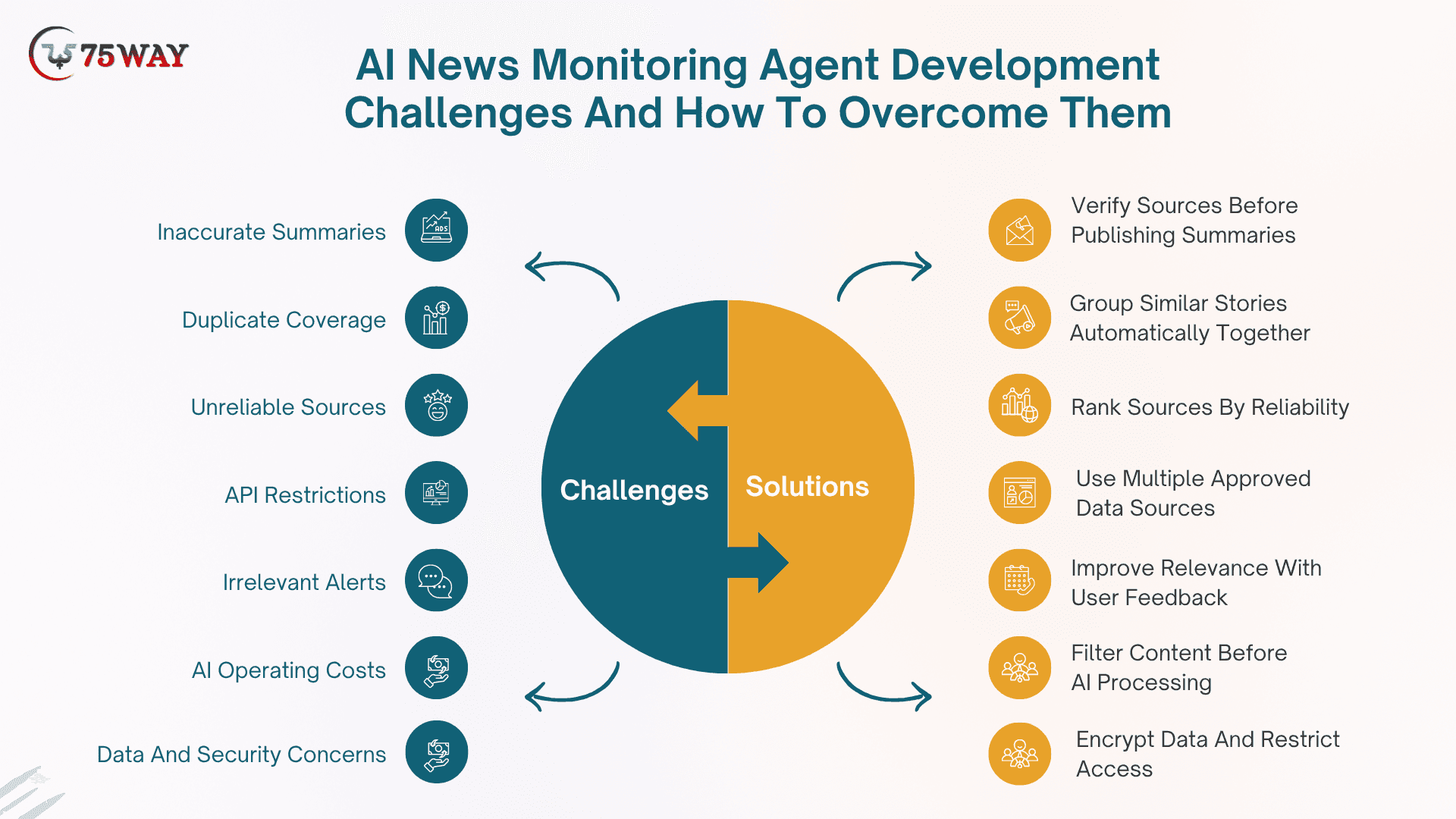
An AI news monitoring agent may look straightforward from the outside, but reliable monitoring becomes harder as information sources, updates, and business requirements grow. Here are key obstacles and practical solutions.
1. Inaccurate Summaries
AI can sometimes miss important context, misunderstand industry-specific language, or make a complicated story sound more certain than the original report. This becomes especially risky when users rely on summaries for business decisions.
Solution: Use trusted sources, retrieval-based processing, structured summarization prompts, source attribution, and confidence checks. Keep links to the original articles so users can quickly verify important claims.
2. Duplicate Coverage
A major announcement can appear across news websites, company blogs, press releases, and industry publications within minutes. Without proper handling, the agent may treat every article as a separate story and flood the user's feed.
Solution: Add semantic similarity and duplicate-detection mechanisms that compare new articles with previously processed content. Related reports can then be grouped around one event while preserving multiple sources for verification.
3. Unreliable Sources
The internet contains a mixture of authoritative reporting, opinion pieces, outdated information, and questionable sources. If the agent treats every source equally, unreliable information can quickly make its way into business briefings.
Solution: Create a source-quality layer that considers publisher reputation, domain authority, publication history, freshness, and corroboration from other trusted sources. High-impact stories can also require confirmation from multiple sources before triggering an alert.
4. API Restrictions
News APIs and other data providers may come with rate limits, usage restrictions, licensing requirements, changing pricing, or limited historical access. Depending too heavily on one provider can also create problems if its service or terms change.
Solution: Design the data layer to support multiple approved sources where possible. Add caching, request throttling, retry mechanisms, usage monitoring, and clear fallback logic so the agent can continue operating when one source becomes temporarily unavailable.
5. Irrelevant Alerts
Nobody wants an AI assistant that sends notifications every time a tracked keyword appears. Too many low-value alerts can cause users to ignore notifications altogether, including the ones that genuinely matter.
Solution: Combine keyword matching with semantic relevance, user preferences, source quality, recency, and business-impact scoring. Let users provide feedback such as “more like this” or “not relevant” so the system can gradually improve what it prioritizes.
6. AI Operating Costs
Processing every article through a large language model can become expensive when news volume grows. Sending duplicate, irrelevant, or low-value content to an AI model only increases the bill without improving the final output.
Solution: Keep expensive AI processing toward the end of the pipeline. First collect, clean, filter, and deduplicate stories, then send only worthwhile content for deeper analysis. Caching, smaller models for simple tasks, batching, and intelligent model selection can further control usage costs.
7. Data And Security Concerns
A personalized news agent may store user interests, tracked companies, internal keywords, alert preferences, and potentially sensitive business information. Poor data handling can create security and privacy risks, particularly when third-party AI and data services are involved.
Solution: Apply encryption, access controls, secure authentication, secrets management, data-retention policies, and careful third-party service evaluation. Businesses should also understand where their data is processed and avoid sending sensitive information to external services unnecessarily.
How To Improve The Accuracy of An AI News Aggregator Agent?
Accuracy should be treated as an ongoing engineering objective rather than a one-time feature. Start with reliable sources and preserve source attribution throughout the workflow. Use retrieval-based processing so the model works from available source information rather than relying only on its internal knowledge.
You can also implement:
- Source validation
- Confidence scoring
- Structured AI outputs
- Duplicate detection
- Citation preservation
- Human review for sensitive alerts
- Automated evaluation
- User feedback loops
- Prompt and workflow testing
- Monitoring for unexpected outputs
For high-stakes business decisions, the agent should support research rather than become the sole authority for making decisions.
How Can An AI Business News Tracking Agent Be Integrated Into Business Workflows?
The real value of a news agent increases when intelligence reaches existing business processes. For example, a sales team could receive alerts when a target company announces expansion. A product team could monitor competitor launches. Executives could receive a morning briefing covering only strategic developments.
Potential integrations include:
- Slack And Teams: Send high-priority news directly into selected channels.
- Email: Create personalized daily or weekly executive briefings.
- CRM Platforms: Connect relevant company or market intelligence with customer and prospect workflows.
- Business Dashboards: Display trends, competitors, topics, and historical news in one interface.
- Internal Knowledge Systems: Store analyzed news for future search and organizational research.
- Mobile Applications: Deliver push notifications when a critical event is detected.
Why Choose 75way For AI News Tracking Agent Development?
75way Technologies, as a prominent AI agent development firm, helps businesses build AI news tracking agents that collect, filter, analyze, summarize, and deliver relevant AI and business news through customized workflows. Our AI agent developers integrate news APIs, AI models, databases, semantic search, automated alerts, dashboards, and business tools to create a solution around specific monitoring requirements.
From MVP development to advanced AI news intelligence platforms, 75way can support agent architecture, AI integration, cloud deployment, testing, and post-launch improvements as your news monitoring needs grow.
Final Remarks
To summarize, an AI news tracking agent can turn a fragmented stream of AI and business information into a personalized intelligence system. The strongest solutions combine reliable data sources, intelligent filtering, AI-powered analysis, user context, relevance scoring, and automated delivery rather than simply generating article summaries.
Start with a focused monitoring use case, validate the workflow with an MVP, and then expand into competitor intelligence, trend detection, personalized briefings, and broader business automation. To build an AI agent for automated news tracking, you can hire a skilled AI development team to turn your idea into a scalable solution.
Frequently Asked Questions (FAQs)
Can AI News Analysis Agents Track News Automatically?
Yes. An AI agent can continuously collect information from connected sources, filter relevant stories, analyze content, summarize developments, and send alerts based on configured rules.
Can an AI Business News Tracking Agent Monitor Multiple News Sources?
Yes. Multiple APIs, RSS feeds, databases, and other permitted data sources can be connected through a centralized ingestion and processing pipeline.
Can AI-Powered News Tracking Agents Summarize Business News?
Yes. AI models can summarize relevant stories and organize them around key details such as what happened, who is involved, and why the development may matter.
Can an AI Agent Track Competitor News?
Yes. Businesses can configure monitoring around selected companies, products, executives, partnerships, funding activity, launches, and other publicly available developments.
How Much Does It Cost To Build An AI News Tracking Agent?
A basic solution may start around $10,000, while advanced or enterprise platforms can cost $50,000 to $200,000 or more depending on integrations, AI capabilities, data requirements, and scale.
What APIs Can Be Used For AI News Tracking?
The appropriate API depends on the required publications, geographic coverage, licensing, update frequency, historical data, and technical requirements. The development team should evaluate providers before implementation.
Can an AI News Agent Send Slack Alerts?
Yes. Slack and similar collaboration platforms can be integrated so users receive selected news alerts, summaries, or scheduled briefings within existing workflows.