AI Summary
GITEX Europe 2026 positions Berlin as the centre of Europe's AI transformation. Sovereign AI, AI factories, enterprise agents, quantum technologies, industrial automation, cybersecurity, and deep-tech investment dominate the agenda. The event connects policymakers, enterprises, startups, and investors around scalable, regulation-ready innovation built for Europe's economic competitiveness and long-term digital independence.
Quick Overview
- Sovereign AI becomes Europe's central strategy for digital competitiveness and resilience.
- Agentic AI moves beyond assistants into autonomous operational workflow management across enterprises.
- Quantum-safe cybersecurity emerges as a critical infrastructure protection priority across regulated industries.
- Industrial AI and computer vision reshape manufacturing productivity and sustainability performance.
- Deep-tech funding networks connect European scaleups with major growth-stage investors.
If you think GITEX Europe 2026 is just another technology conference, you might want to think again.
Europe is entering a completely new phase of artificial intelligence, and the conversation has moved far beyond building bigger AI solutions and models. Today, the focus is on something much bigger. That is to create trusted AI, strengthen digital sovereignty, build secure infrastructure, and ensure innovation happens within Europe's regulatory framework.
If you are planning any AI strategy and integration for the next few years, these are conversations you simply cannot afford to ignore.
That is exactly why GITEX Europe 2026 matters. Taking place on 30 June–1 July 2026 at Messe Berlin, the event brings together the people shaping Europe's AI future from policymakers and enterprise leaders to researchers, investors, startups, and technology innovators.
Whether you are building AI products, investing in emerging technologies, or exploring new business opportunities, this is where many of the decisions influencing Europe's digital economy will begin.
But which technologies will dominate the discussions? And more importantly, how will they impact businesses across Europe and beyond?
In this guide, we will walk you through the biggest trends expected to shape GITEX Europe 2026, from Sovereign AI and AI Factories to enterprise AI agents, quantum-safe cybersecurity, industrial automation, startup investment, and the infrastructure powering the next generation of intelligent systems.
Why GITEX Europe 2026 Matters More Than Previous Editions?
GITEX Europe 2026 is more than a regional tech conference. It is at the intersection of several major European priorities:
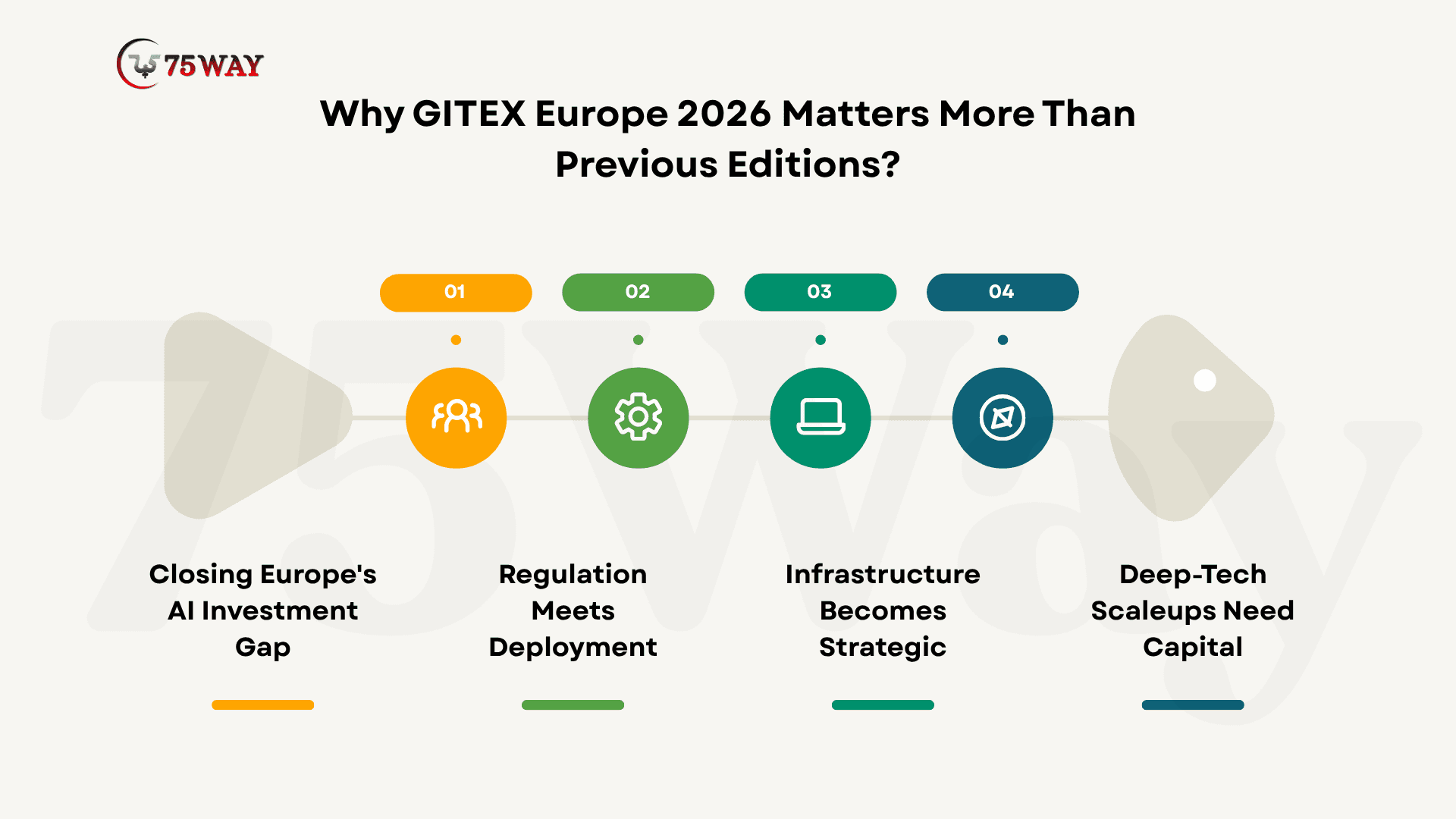
- Closing Europe's AI Investment Gap: €200B gap
European leaders have repeatedly highlighted the need to bridge an estimated €200 billion AI investment gap. Public funding, private capital, and industrial partnerships are increasingly aligned around that objective.
- Regulation Meets Deployment: AI Act + NIS2
The EU AI Act, GDPR, NIS2 and new quantum-security frameworks are forcing companies to build compliant AI systems from the ground up, instead of retrofitting governance later on.
- Infrastructure Becomes Strategic: AI Factories
Access to the GPU, data centres, cloud platforms, semiconductor supply chains and localised compute capacity is becoming increasingly important for AI competitiveness. "Europe is pumping money into these foundations.
- Deep-Tech Scaleups Need Capital: €50M+ rounds
Dedicated funding tracks will aim to connect frontier startups with investors capable of supporting growth rounds of €50m+ especially in AI, quantum, cybersecurity and advanced manufacturing.
These forces make GITEX Europe 2026 a useful signal for executives seeking to understand where European technology spending is heading.
European AI Is Entering a Transformative New Era
For much of the past decade, European organisations relied heavily on overseas cloud platforms and AI providers. That model is changing. The dominant theme at GITEX Europe 2026 is sovereign AI: the ability to develop, deploy, and govern AI systems within European legal, ethical, and infrastructure frameworks.
- Localised AI Models: Training and operating AI models on European data under European governance.
- Regional Cloud Infrastructure: Expanding domestic and European-controlled cloud capacity.
- Trusted Data Sharing: Creating secure frameworks for cross-border collaboration.
- Resilient Supply Chains: Investing in semiconductors, networking, and energy infrastructure that support long-term AI growth.
The objective is not isolation. European leaders still expect strong international partnerships. The goal is strategic autonomy in critical technologies that influence economic security and public services.
Future-Ready Trends Featured at GITEX Europe 2026
So, what will everyone actually be talking about at GITEX Europe 2026? While the event covers hundreds of technologies, a few key trends are expected to dominate conversations, keynote sessions, and business discussions. Let us take a closer look at the biggest trends shaping this year's event.
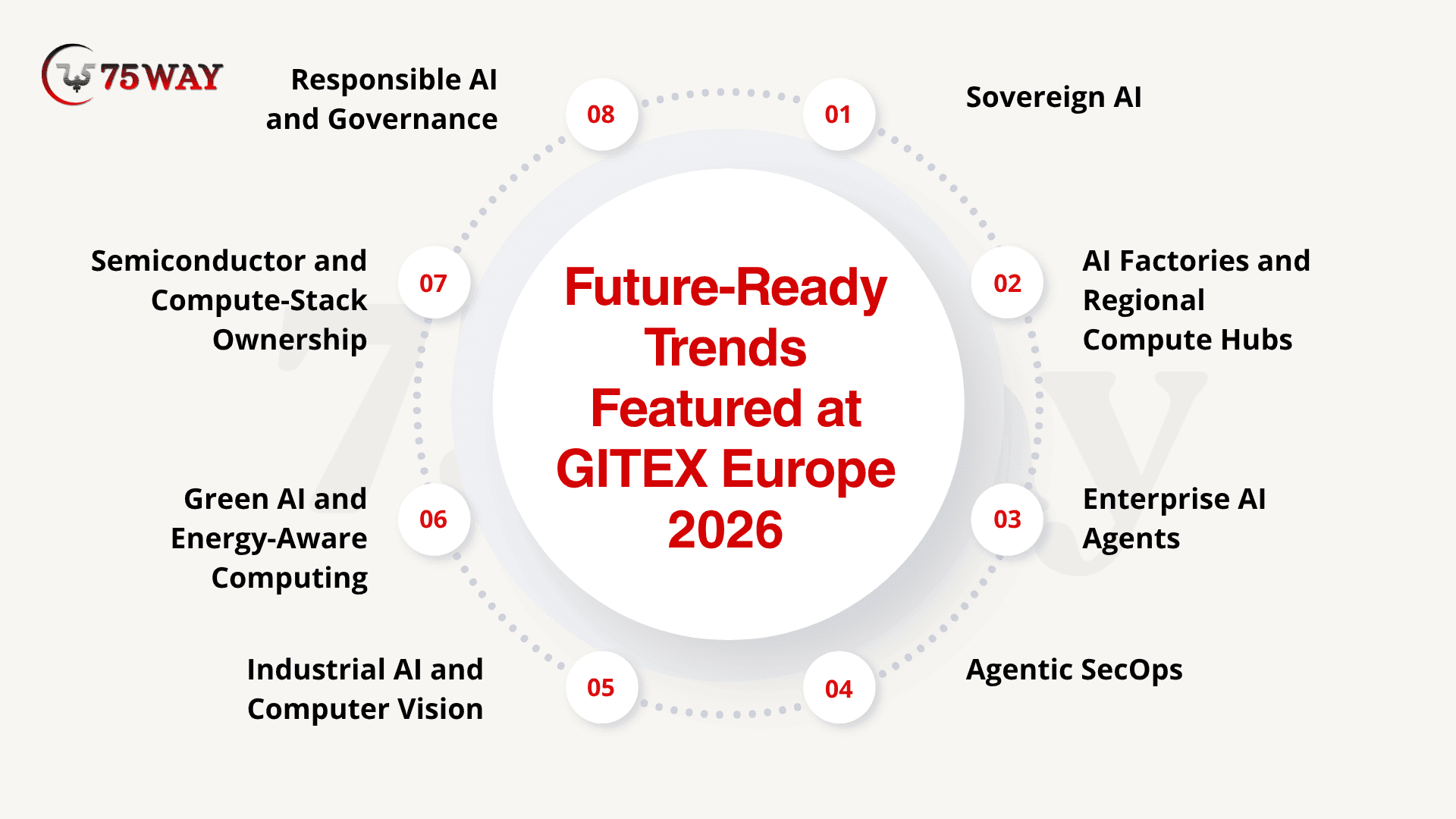
Trend 1: Sovereign AI
European enterprises are more and more looking for AI systems that keep sensitive data within the jurisdiction of the region. Sovereign AI combines on-premises infrastructure, data governance and control in line with European standards.
Business Impact: Financial institutions, healthcare providers, public-sector organisations, and critical infrastructure operators can adopt advanced AI while meeting strict regulatory obligations.
Trend 2: AI Factories And Regional Compute Hubs
AI factories are emerging as shared compute environments that offer enterprises and researchers GPU capacity, data services, model tooling, and governance frameworks.
Why it matters? The access to compute is becoming as important as access to talent. Organisations without large internal GPU clusters will increasingly rely on regional AI infrastructure partnerships.
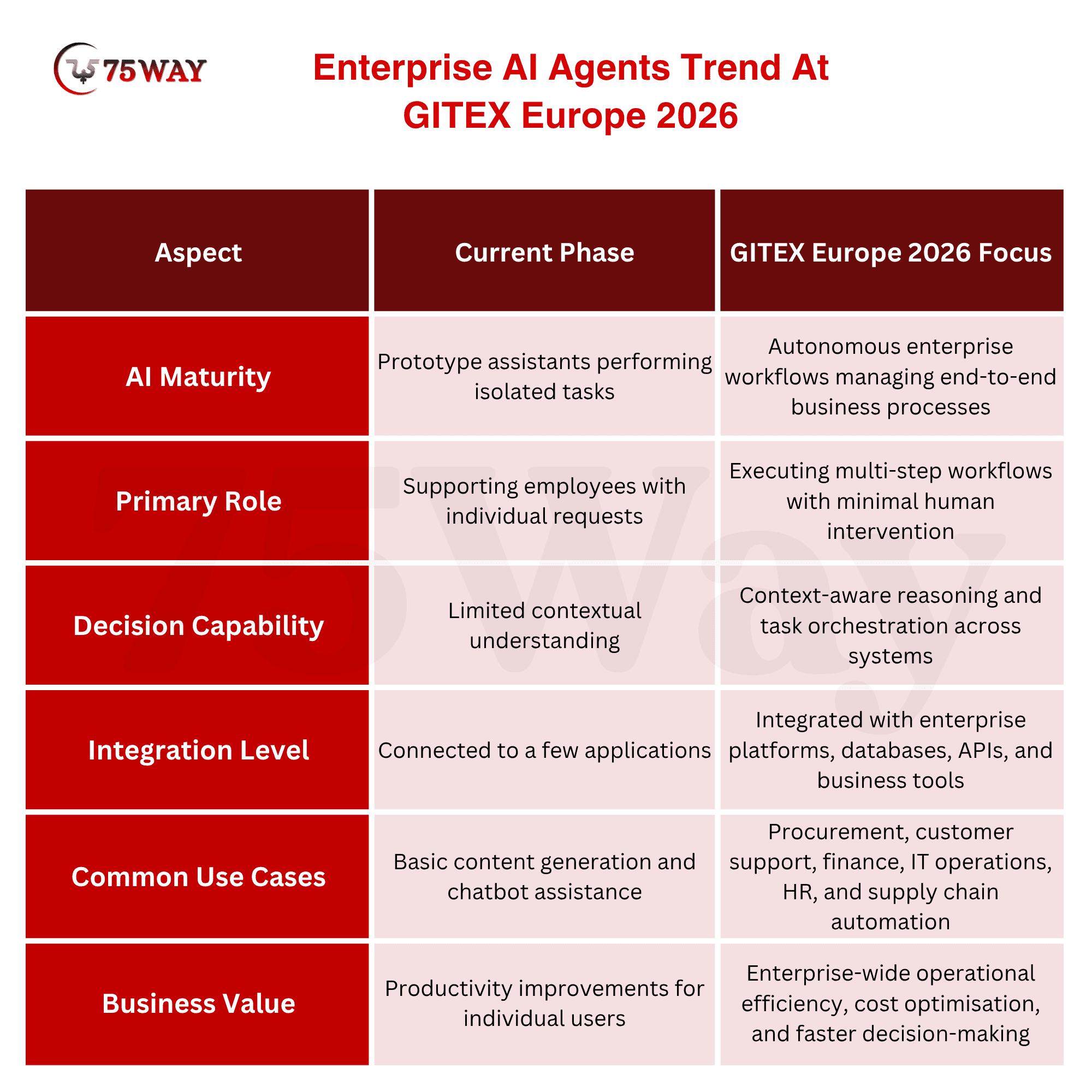
Trend 3: Enterprise AI Agents
AI agents no more act as only chat interfaces and into workflow execution. Such systems can retrieve information, interact with business applications, produce outputs, and initiate actions on multiple systems.
Trend 4: Agentic SecOps: AI-Powered Security Operations Centres
Security teams face overwhelming alert volumes. Agentic SecOps uses AI agents to investigate incidents, correlate signals, recommend actions, and automate parts of remediation.
Expected Outcome: Faster incident response and better utilisation of scarce cybersecurity talent.
Trend 5: Industrial AI And Computer Vision
Manufacturers are deploying machine learning, vision systems, and predictive analytics. These solutions assist them in reducing downtime, improving quality control, and optimising energy consumption.
Industrial Relevance: This is one of the most valuable AI applications on the continent considering the industrial competitiveness and sustainability objectives.
Trend 6: Green AI And Energy-Aware Computing
Enterprises are exploring energy-efficient architectures, workload scheduling, and carbon-aware infrastructure options as model training costs continue to rise.
Key question: Which AI workloads create enough business value to justify their compute and energy footprint?
Trend 7: Semiconductor And Compute-Stack Ownership
Enterprises are paying closer attention to chips, networking, storage, and data architectures. The conference emphasises ownership of the entire AI stack rather than dependence on a single provider.
Trend 8: Responsible AI And Governance
European organisations are integrating governance into AI programmes right from the start. Risk assessment, auditability, human oversight and documentation are becoming standard operational requirements.
Technologies Driving Europe's AI Ecosystem At GITEX AI Event Berlin in 2026
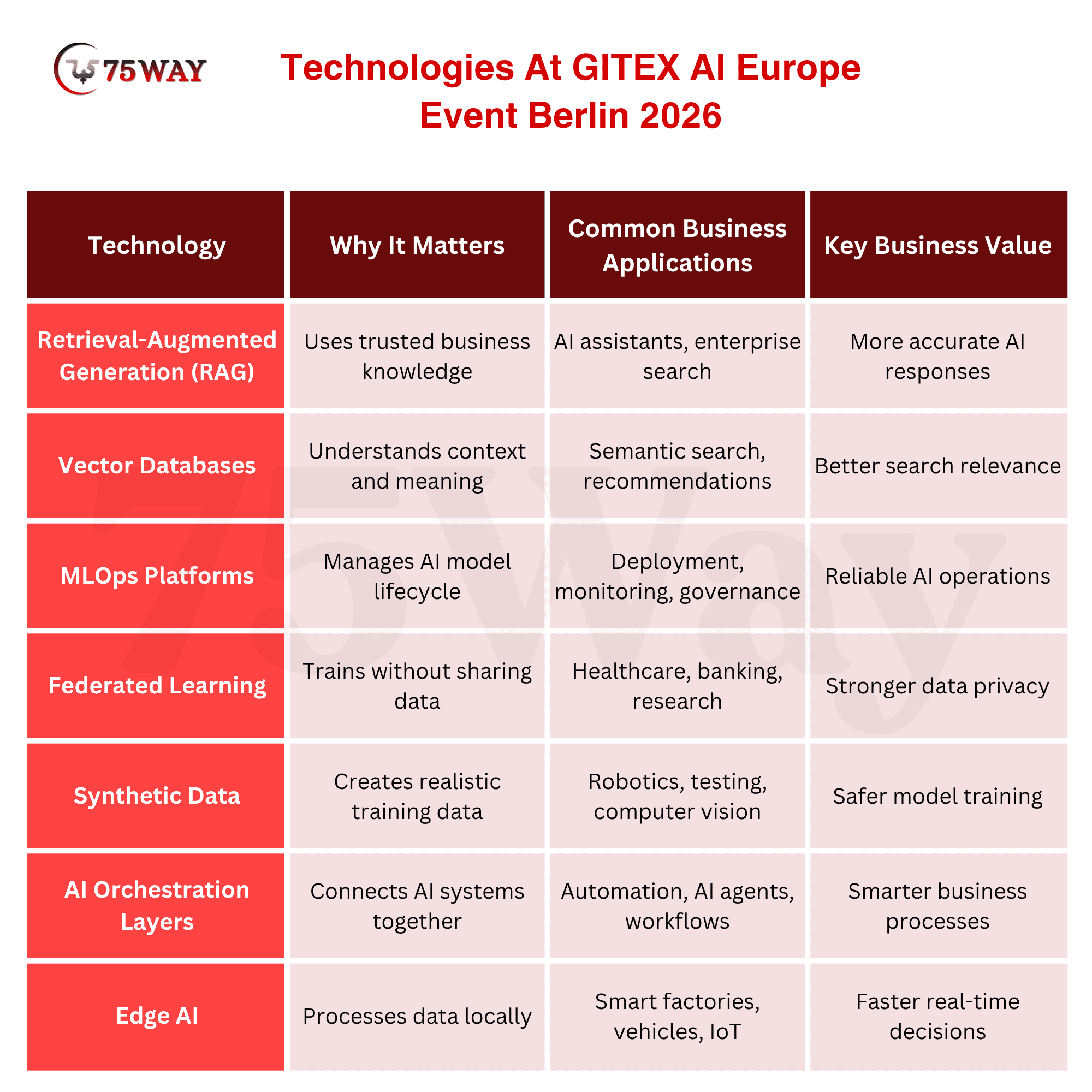
The technologies showcased at GITEX Europe 2026 extend far beyond generative AI models. The following technologies are expected to play a central role across enterprise AI discussions, product demonstrations, and industry case studies at the event.
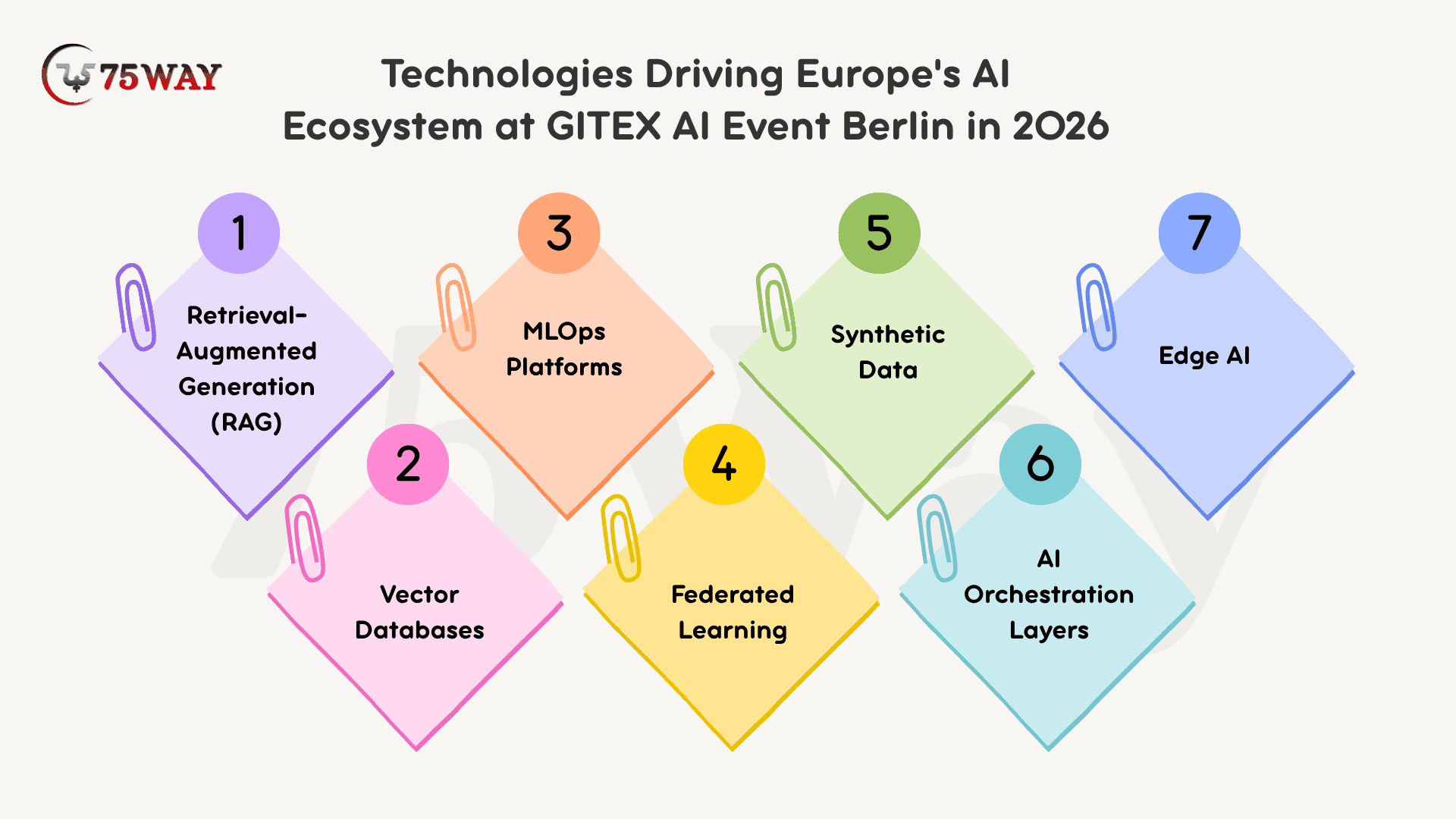
Retrieval-Augmented Generation (RAG)
One of the biggest frustrations businesses have experienced with generative AI is receiving confident answers that are simply incorrect. RAG addresses that problem by allowing AI to search trusted company documents before generating a response.
These solutions fetche up-to-date business information rather than just what was learned during training, which means its answers are far more accurate.
For teams handling customer enquiries, legal documentation, technical support, or internal knowledge, RAG transforms AI from an interesting assistant into a dependable business tool.
Vector Databases
Traditional search engines look for matching words. People, however, rarely think in exact keywords. They search by meaning, intent, and context.
Vector databases bridge that gap. They help AI recognise relationships between concepts, allowing users to find relevant information even when different terminology is used.
For example, searching for "remote working policy" can also surface documents related to hybrid work, flexible schedules, or home-office guidelines.
As enterprise knowledge continues growing, this type of intelligent search is becoming increasingly valuable.
MLOps Platforms
Building an AI model is only the beginning. The real challenge starts once that model is deployed into a live business environment.
Throughout the model lifecycle MLOps platforms help organisations track performance, deploy updates, identify problems early and maintain compliance. Without this operational layer, AI systems can slowly become less accurate as business conditions and customer behaviour change.
For enterprises planning large-scale AI adoption, MLOps is rapidly becoming as important as software DevOps has been over the past decade.
Federated Learning
Data privacy remains one of Europe's strongest competitive priorities. Many organisations simply cannot combine sensitive customer information into one central database, particularly across healthcare, financial services, and government.
Federated learning offers an alternative. Instead of moving data to the AI model, the model learns from data stored securely in different locations. Only the learning outcomes are shared, not the original information.
This approach allows organisations to collaborate on AI innovation while respecting strict privacy requirements and regulatory obligations.
Synthetic Data
Quality data has become one of the biggest obstacles to successful AI projects. Collecting large datasets can be expensive, time-consuming, and restricted by privacy legislation.
Synthetic data helps overcome those challenges by creating realistic datasets that closely resemble real-world scenarios without exposing personal information.
Businesses are already using synthetic data to train autonomous vehicles, improve computer vision systems, test robotics, and develop fraud detection models. As AI adoption expands, synthetic data is expected to become an increasingly important resource across many industries.
AI Orchestration Layers
Enterprise AI rarely depends on a single model anymore. A customer request can be a language model, a CRM platform, a payment gateway, a document repository and a few internal business applications working together.
Behind the scenes these interactions are orchestrated by AI orchestration layers. They design several AI models, enterprise systems and automation tools to make complex business processes run smoothly without human intervention all the time.
Autonomous AI agents will become more prevalent and orchestration platforms will be critical in connecting all components of the enterprise ecosystem.
Edge AI
Not every AI decision can wait for information to travel to the cloud and back. In industries, like supply china, transportation, healthcare, and energy, even a few seconds of delay can have significant operational consequences.
Edge AI solves this challenge by running intelligence directly on local devices, production equipment, sensors, or vehicles. Decisions happen where the data is created, allowing businesses to respond almost instantly while reducing network dependency and improving data privacy.
Because Europe making ongoing investments in Industry 4.0, connected infrastructure, and smart mobility, Edge AI will become a standard component of enterprise technology strategies rather than a specialist capability.
Top Themes to Watch at GITEX AI Event 2026 in Berlin
GITEX Europe 2026 will bring together governments, enterprises, researchers, startups, investors and technology providers to discuss practical innovation across critical sectors. These themes are in line with Europe’s ambitions to reinforce technological sovereignty and make progress on digital transformation in a responsible manner.
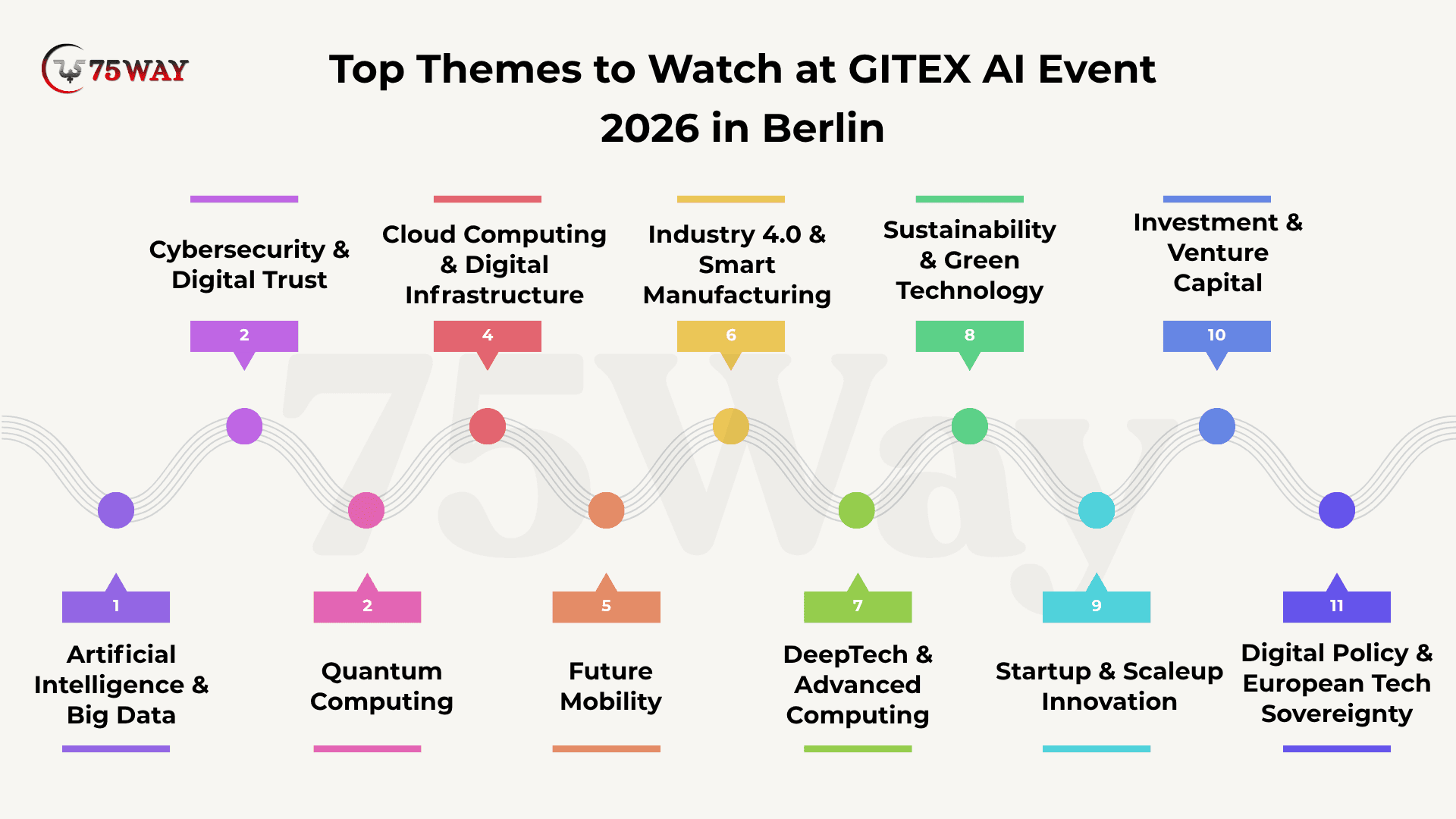
- Artificial Intelligence & Big Data: The main pillar of the event is still Artificial Intelligence, covering generative AI, enterprise AI, machine learning, industrial AI, computer vision, natural language processing and predictive analytics. The sessions focus on governance, trusted data ecosystems, measurable business outcomes, and production-ready deployments, not experimental proof-of-concepts.
- Cybersecurity & Digital Trust: As cyber threats evolve, organisations want resilience with AI-powered security operations, Zero Trust architectures, identity management, quantum-safe encryption and secure cloud platforms. Regulators’ initiatives such as NIS2 also help to provide further incentives for businesses to improve cyber defence strategies across critical infrastructure and public services.
- Quantum Computing: There is steady progress in moving quantum technologies from laboratory research to commercial exploration. GITEX Europe 2026 highlights progress in quantum computing, quantum networking and post-quantum cryptography and delves into hands-on applications in healthcare, finance, logistics, pharmaceuticals and scientific research.
- Cloud Computing & Digital Infrastructure: Enterprise AI adoption is built on cloud infrastructure. The discussions of GITEX AI Event will focus on sovereign cloud platforms, hybrid environments, edge computing, AI factories, high-performance computing, GPU infrastructure, and data sovereignty. These investments support organisations in creating compliant digital ecosystems across Europe.
- Future Mobility: The speed of moving people and goods is accelerating and much of it is AI-driven. Vehicles are becoming smarter, fleets are easier to manage and connected transport systems are improving everyday travel. Technologies such as autonomous driving and software-defined vehicles are no longer concepts. They are steadily becoming part of the future of mobility across Europe.
- Industry 4.0 & Smart Manufacturing: Manufacturing leaders are bringing AI, robotics, Industrial IoT, digital twins, predictive maintenance and computer vision into production environments. These technologies allow Europe’s manufacturing sector to achieve greater productivity, reduce operating costs, enhance quality control and develop more sustainable industrial operations.
- DeepTech & Advanced Computing: Europe continues to invest in breakthrough technologies that improve long-term competitiveness. GITEX Europe is delving into semiconductors, advanced processors, photonics, robotics, high-performance computing, autonomous systems and next-generation engineering innovations that can transform multiple industries.
- Sustainability & Green Technology: Increased alignment of technology innovation with environmental objectives. The event looks at energy-efficient AI models, smart grids, climate technologies, sustainable manufacturing, circular economy initiatives and digital solutions that help organisations to cut emissions and improve operational performance.
- Startup & Scaleup Innovation: The startup ecosystem is a major part of GITEX Europe. Through dedicated networking sessions, funding programs and the Supernova All-Stars Pitch Competition, early-stage ventures, scaleups, venture capital firms, accelerators and enterprise buyers can meet for collaboration and investment opportunities.
- Investment & Venture Capital: Growth capital is still critical to Europe’s technology ecosystem. Investors, private equity firms, government funders and corporate venture teams scout for ways to finance artificial intelligence, cybersecurity, quantum computing, robotics and other frontier technologies, helping innovators accelerate their commercial growth.
- Digital Policy & European Tech Sovereignty: Europe is leading on regulation, so GITEX Europe is different to many global technology events. Discussions include the AI Act, GDPR, NIS2, digital identity, data governance, ethical AI and sovereign digital infrastructure, showing how policy can enable innovation whilst protecting businesses and citizens.
Enterprise AI Adoption: From Pilots To Production
One of the most important themes at GITEX Europe 2026 is the shift from experimentation to production deployment.
Many organisations completed AI pilots in 2023–2025. The challenge now is scaling those initiatives across business units without creating security, compliance, or operational risks. Successful enterprise programmes usually include:
- A clear business owner for each AI initiative.
- Governance frameworks aligned with EU regulations.
- Secure integration with existing enterprise systems.
- Human oversight for high-risk decisions.
- Continuous monitoring of model performance.
- Workforce training and change management.
Executives attending GITEX Europe are likely to be looking for proven deployment patterns rather than experimental demonstrations.
Startup Innovation And Deep-Tech Funding At GITEX AI, 30 June-July 1 2026
The Supernova All-Stars Pitch Competition is more than a startup showcase. It represents Europe's effort to create stronger pathways from research to scale.
- AI infrastructure startups seeking enterprise partnerships.
- Climate-tech companies combining AI with industrial sustainability.
- Cybersecurity scaleups targeting regulated industries.
- Quantum and semiconductor ventures requiring large capital commitments.
- Investors looking for companies capable of reaching global markets from a European base.
The emphasis on €50M+ funding rounds is particularly notable because many European startups historically struggled to secure late-stage growth capital.
Practical Lessons For Business Leaders
Executives do not need to adopt every technology showcased at GITEX Europe 2026. The more useful question is: which capabilities will become competitive necessities within three years?
- Start With Governed AI: Build policies, data controls, and oversight before scaling deployment.
- Prioritise High-Value Workflows: Target procurement, customer operations, finance, and industrial processes where measurable ROI is easier to demonstrate.
- Treat Infrastructure As Strategy: Compute, data architecture, and cloud choices are no longer purely technical decisions.
- Prepare for AI-Native Cybersecurity: Attackers will use AI. Defenders must use it as well.
- Invest In Workforce Adaptation: Successful AI programmes combine technology deployment with operational training.
Meet 75way AI at GITEX AI Europe 2026 for Business Automation
Artificial intelligence is creating new opportunities across industries, but transforming ideas into production-ready solutions requires more than advanced models. It demands strategic planning, scalable development, secure architecture, and seamless integration with existing business systems. At GITEX AI Europe 2026, 75way AI will showcase practical AI solutions that help organisations accelerate digital transformation while delivering measurable business value.
Whether you're exploring AI for customer engagement, enterprise automation, healthcare, finance, manufacturing, logistics, or retail, our specialists will discuss strategies tailored to your business objectives. From AI consulting and product discovery to deployment and post-launch optimisation, we help organisations move confidently from concept to commercial success.
What You'll Get
- Custom AI Development: Build custom AI applications powered by generative AI, machine learning, computer vision, and natural language processing.
- AI Agent Development: Deploy and build autonomous AI agents and launch ready-made AI agent for customer support, sales, HR, finance, procurement, legal operations, and workflow automation.
- Enterprise AI Integration: Connect enterprise AI capabilities with existing ERP, CRM, cloud platforms, and enterprise software while maintaining security and regulatory compliance.
- AI-Powered Mobile Applications: Develop intelligent mobile apps for Android and iOS featuring conversational AI, predictive analytics, personalised recommendations, and real-time automation.
- Generative AI Solutions: Create business-ready applications using large language models, Retrieval-Augmented Generation (RAG), multimodal AI, and knowledge-based assistants.
- AI Strategy & Digital Transformation: Gain expert guidance on selecting the right technologies, defining implementation roadmaps, and identifying high-value AI use cases.
Conclusion
GITEX Europe 2026 captures a significant shift in the global AI landscape. The central question is no longer whether AI will transform business; it is who will control the infrastructure, data, security, and governance layers that make large-scale AI possible.
For business leaders, the most important takeaway is that AI adoption is evolving into a long-term operational capability. Organisations that build secure infrastructure, governed data foundations, and measurable enterprise use cases will gain advantages that extend well beyond the conference itself.
If you are planning an AI-powered mobile application, enterprise platform, or customer agent, schedule a free 30-minute strategic call with our experts and get custom roadmap.
Frequently Asked Questions (FAQs)
Is GITEX Europe 2026 Suitable For Non-Technical Business Leaders?
Yes, the event is perfect for executives, investors, policymakers, and operational leaders alongside engineers. Many sessions address AI adoption, governance, investment, workforce transformation, and strategic decision-making. That makes it highly relevant for board-level and C-suite audiences across Europe.
Why Is Sovereign AI Becoming A Competitive Advantage In Europe?
Sovereign AI allows organisations to keep sensitive data, models, and infrastructure within European legal jurisdictions. This reduces compliance complexity, improves control over strategic technology assets, strengthens resilience against geopolitical disruptions, and builds customer trust in highly regulated sectors such as finance, healthcare, energy, and government.
Can Startups Benefit From Attending Without Exhibiting?
Yes, GITEX Europe 2026 provides access to investors, enterprise buyers, technology partners, and media networks through matchmaking sessions. There are pitch competitions, workshops, and networking events at this event for strategic introductions and partnerships.
Which Skills Will Be Most Valuable After GITEX Europe 2026?
The highest demand is expected for experts in AI governance, MLOps engineers, cybersecurity architects, data platform engineers, AI product managers and those who can connect business needs to production-ready deployment of AI. Cross-functional expertise that blends technology, regulation and operations will be especially valuable.
Which Technologies Are Likely To Dominate Enterprise Investment After 2026?
We expect enterprise spending to focus on AI agents, sovereign cloud infrastructure, AI factories, cybersecurity automation, industrial computer vision, data platforms, and governance tooling. These areas contribute directly to large-scale deployment, compliance with regulation, operational efficiency and measurable business outcomes across major European industries.
Why Are AI Partnerships Becoming More Important Than Standalone Solutions?
Enterprise AI requires collaboration between cloud providers, infrastructure vendors, cybersecurity specialists, data-platform operators and application developers. Few organisations can build every layer in-house, so strategic partnerships increasingly dictate deployment speed, security posture, scalability and long-term operational sustainability across European markets.