Summary
Electric vehicle software powers battery management, fleet operations, smart charging, and energy optimization. Businesses can leverage IoT, AI, cloud, and mobile platforms to enhance efficiency, reduce costs, and provide seamless driver experiences. Scalable, secure, and intelligent EV platforms are key to staying competitive in the rapidly evolving electric mobility landscape, enabling sustainable operations and future-ready growth.
Key Takeaways
- The global EV market is expected to exceed $1 trillion by 2030.
- The cost to build basic EV software ranges between $40,000 and $80,000.
- AI and IoT optimize battery, fleet, and energy management efficiently.
- Scalable platforms connect vehicles, charging stations, apps, and cloud systems seamlessly.
- Advanced analytics deliver actionable insights, improving performance and decision-making.
- Experienced providers ensure secure, reliable, and future-ready EV software solutions
“Without smart software, your EV business won’t survive 2026.” Every startup, fleet operator, and mobility innovator faces a harsh reality: if your EV platform is not powered by secure AI-powered software, you risk being left behind.
Today’s drivers expect seamless charging, real-time updates, efficient battery management, and intelligent fleet operations. Behind every high-performing electric vehicle lies robust, intelligent EV software that ensures energy efficiency, connectivity, safety, and scalability.
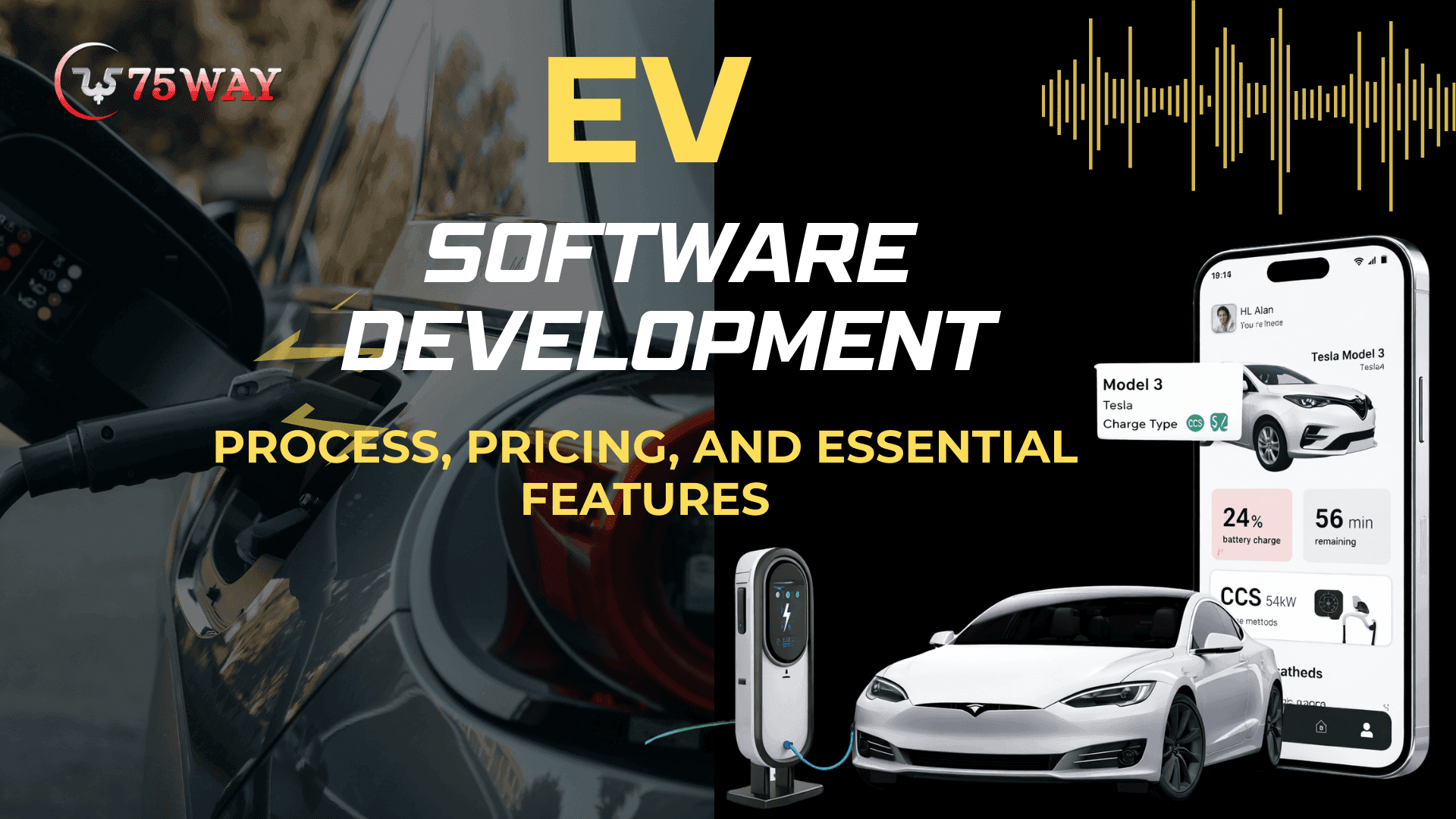
For startups, founders, and business owners entering the EV ecosystem, EV software development is no longer optional. It is the backbone of scalable electric mobility solutions. This complete guide explains everything you need to know about electric vehicle software development in 2026, including technologies, development process, use cases, costs, and how businesses can build scalable EV platforms
What is EV Software Development?
EV software development is the process of creating and maintaining digital systems that power electric vehicles, charging stations, battery management tools, and connected mobility platforms. It ensures that electric vehicles operate efficiently, safely, and intelligently by handling tasks like battery monitoring, energy optimization, and communication with cloud-based platforms. Essentially, this software forms the central “brain” of modern EVs, enabling smart operations and seamless integration across multiple components.
For businesses and startups, EV software development is a critical step in building scalable electric mobility solutions. Companies often collaborate with specialized enterprise software development firms to design EV platforms that manage charging networks, optimize fleet performance, support autonomous driving features, and deliver connected services to drivers. This integration of vehicles, infrastructure, and software not only improves operational efficiency but also enhances the overall user experience in the evolving electric mobility ecosystem
Step-By-Step Approach To Build Electric Vehicle (EV) Software
The development process of EV software involves a structured and strategic approach to offer efficiency and scalability. From understanding market needs to deploying connected systems and continuously optimizing performance, each stage of the EV software development roadmap is critical. Following a step-by-step framework allows businesses to build robust EV platforms that power vehicles, charging networks, and fleet management solutions effectively.
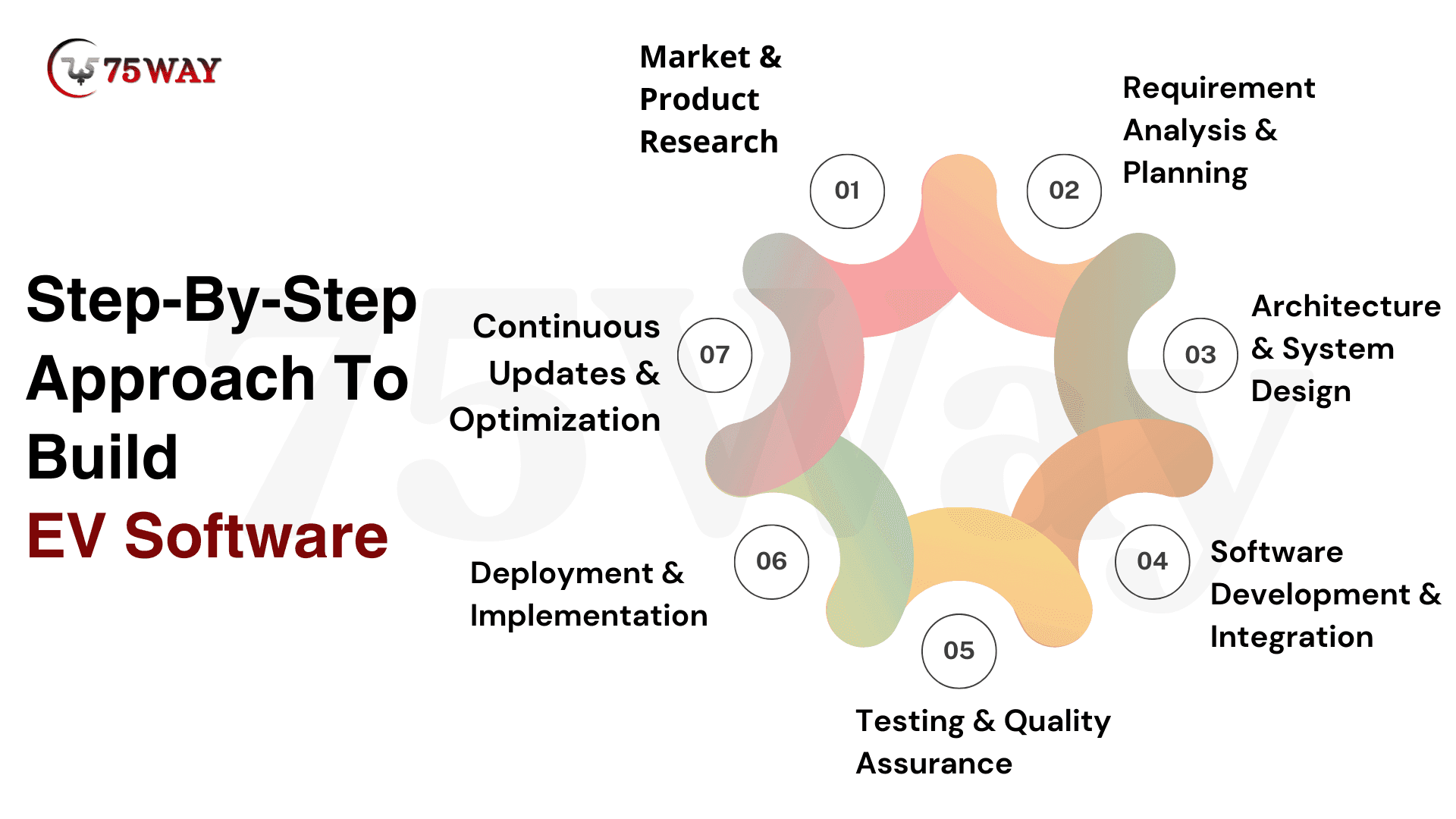
Market & Product Research: Market and product research is the foundation of EV software development, enabling businesses to align software features, technology architecture, and user experience with market demands. Understanding target audiences, competitor solutions, and emerging mobility trends ensures scalable, future-proof platforms that enhance energy efficiency, connectivity, charging management, and fleet operations while supporting innovation across EV ecosystems.
- Analyze EV users, startups, fleet operators, and business requirements for precise targeting.
- Study drivers’ expectations, app usability, and smart connectivity features thoroughly.
- Determine battery management, fleet optimization, charging networks, and telematics capabilities.
- Plan cloud infrastructure, IoT systems, and secure data management platforms.
- Benchmark existing EV platforms, mobile applications, and charging solutions worldwide.
Requirement Analysis & Planning
When you complete market and product research, requirement analysis and planning become the next crucial stage. Clear requirements help EV platforms deliver optimized battery performance, seamless fleet management, smart charging integration, and reliable technology infrastructure, creating a scalable foundation for future-ready electric mobility solutions.
- Feature Selection: Define essential software features by translating user needs into practical solutions, covering battery management, fleet optimization, telematics, connectivity, and charging functionality.
- Technical Architecture: Plan backend frameworks, cloud systems, IoT integration, and secure data flow to ensure high performance and seamless platform operation.
- Resource Allocation: Assign development teams, technologies, timelines, and budgets carefully to maintain smooth execution and efficient software delivery.
- Risk Assessment: Identify potential technical, operational, and market risks early, then design strategies that protect platform reliability, safety, and scalability.
Architecture & System Design
Once the requirement analysis and planning are completed, the architecture design is decided before building a robust EV software platform. Designing the system architecture carefully ensures that battery management, fleet optimization, smart charging, and vehicle connectivity work together smoothly. This stage provides cloud integration, data management, and security for scalable, long-term growth.
Cloud Infrastructure: Cloud platforms provide the backbone for EV data storage, real-time processing, and platform scalability. Integrating cloud systems ensures smooth communication between vehicles, chargers, and mobile apps, supporting high-performance operations.
Vehicle Connectivity: Designing vehicle connectivity layers enables seamless interaction between EVs, telematics systems, and charging networks. Reliable connectivity allows real-time monitoring, remote diagnostics, and smarter energy usage across fleets and individual vehicles.
Data Management: Efficient data management systems collect, process, and analyze massive EV datasets, including battery health, charging history, and fleet performance. Structured data pipelines support decision-making, predictive maintenance, and AI-driven optimization.
Security Frameworks: Security frameworks protect sensitive vehicle and user data while ensuring safe operation. Implementing encryption, access controls, and intrusion detection safeguards on cloud platforms, mobile apps, and connected EV systems to mitigate cyber risks.
Software Development & Integration: When the architecture design is complete, software development brings the EV platform to life. This stage transforms strategic plans into working systems that manage battery performance, fleet operations, smart charging, and vehicle connectivity. Developers implement backend services, mobile apps, IoT integration, and real-time data pipelines while ensuring reliability, scalability, and seamless performance.
Backend Services: Backend systems act as the engine of EV platforms, processing vehicle data, managing user requests, and coordinating communication with cloud servers. Robust backend services enable real-time AI-powered analytics, support multiple connected devices, and ensure smooth operations across fleets and individual vehicles.
Mobile Interfaces: Mobile applications serve as the driver and fleet operator’s main interface. Intuitive UI/UX designs for apps allow users to locate charging stations, monitor battery health, manage vehicle schedules, and access telematics insights, creating an intuitive and user-friendly EV experience.
IoT Integration: IoT systems link sensors, telematics modules, and connected devices to the software platform. Integration ensures live tracking of battery status, vehicle performance, and charging activity, providing actionable insights and supporting smart, data-driven decision-making.
Real-Time Processing: Real-time data pipelines analyze and respond instantly to vehicle and fleet activity. This capability enables predictive maintenance, optimizes charging schedules, monitors energy consumption, and supports AI-powered ride-sharing and fleet management for efficient operations.
Agile Practices: Agile EV software development process allows continuous delivery of software updates, iterative improvements, and quick integration of feedback. Following agile principles ensures flexibility, reduces errors, and enables the EV platform to scale efficiently with evolving market demands.
Testing & Quality Assurance
Once the EV software is developed, rigorous testing and quality assurance provide reliability, safety, and seamless performance. This stage validates backend services, mobile interfaces, IoT integration, and real-time processing. Thorough testing identifies and resolves functional, security, and performance issues, ensuring the platform delivers optimized battery management, efficient fleet operations, smart charging, and an exceptional user experience.
- Conduct performance testing to evaluate software speed, responsiveness, and platform efficiency under load.
- Perform security testing to protect user data, vehicle communication, and cloud infrastructure integrity.
- Execute system integration testing to ensure all components work together without conflicts.
- Validate real-time data processing for accuracy, reliability, and timely predictive maintenance alerts.
- Implement user acceptance testing to confirm the platform meets business requirements and driver expectations.
Deployment & Implementation
This stage evaluates whether the platform functions reliably and safely. This stage evaluates backend services, mobile interfaces, IoT integrations, and real-time data processing, identifying and resolving performance, functionality, and security issues. Thorough testing guarantees that battery management, fleet operations, and charging systems work seamlessly under real-world conditions.
Systematic quality assurance also focuses on integration and user experience. By validating that all components communicate effectively, process data accurately, and deliver intuitive interfaces, businesses can ensure the EV platform meets driver expectations and operational goals. Continuous testing reduces risks, enhances scalability, and builds trust in the platform’s reliability, safety, and long-term performance across fleets and individual vehicles.
Continuous Updates & Optimization
After deployment, continuous updates and optimization keep EV software reliable, efficient, and future-ready. Ongoing improvements enhance battery management, fleet performance, smart charging, and vehicle connectivity. Regular updates address security, performance, and user experience, while integrating new features and emerging technologies. Continuous optimization ensures platforms adapt to evolving mobility trends, maintain scalability, and deliver consistent, seamless experiences for drivers, fleet operators, and charging network managers.
- Feature Enhancements: Introduce new functionalities and refine existing ones to meet evolving EV user needs.
- Performance Tuning: Optimize code, processing speed, and real-time data handling for maximum platform efficiency.
- Security Patches: Regularly implement updates to prevent vulnerabilities and protect vehicle and user data.
- User Feedback Integration: Analyze driver and fleet operator feedback to improve usability, reliability, and engagement.
Why EV Software Development is Critical in 2026?
The EV industry is evolving rapidly, driven by stricter emission regulations, smart mobility innovations, and expanding charging infrastructure. Robust EV software development is essential for businesses to compete, enabling smart vehicle connectivity, efficient charging network management, battery optimization, and fleet electrification. Startups and enterprises rely on these solutions to monitor energy usage, improve performance, and deliver seamless electric mobility experiences.
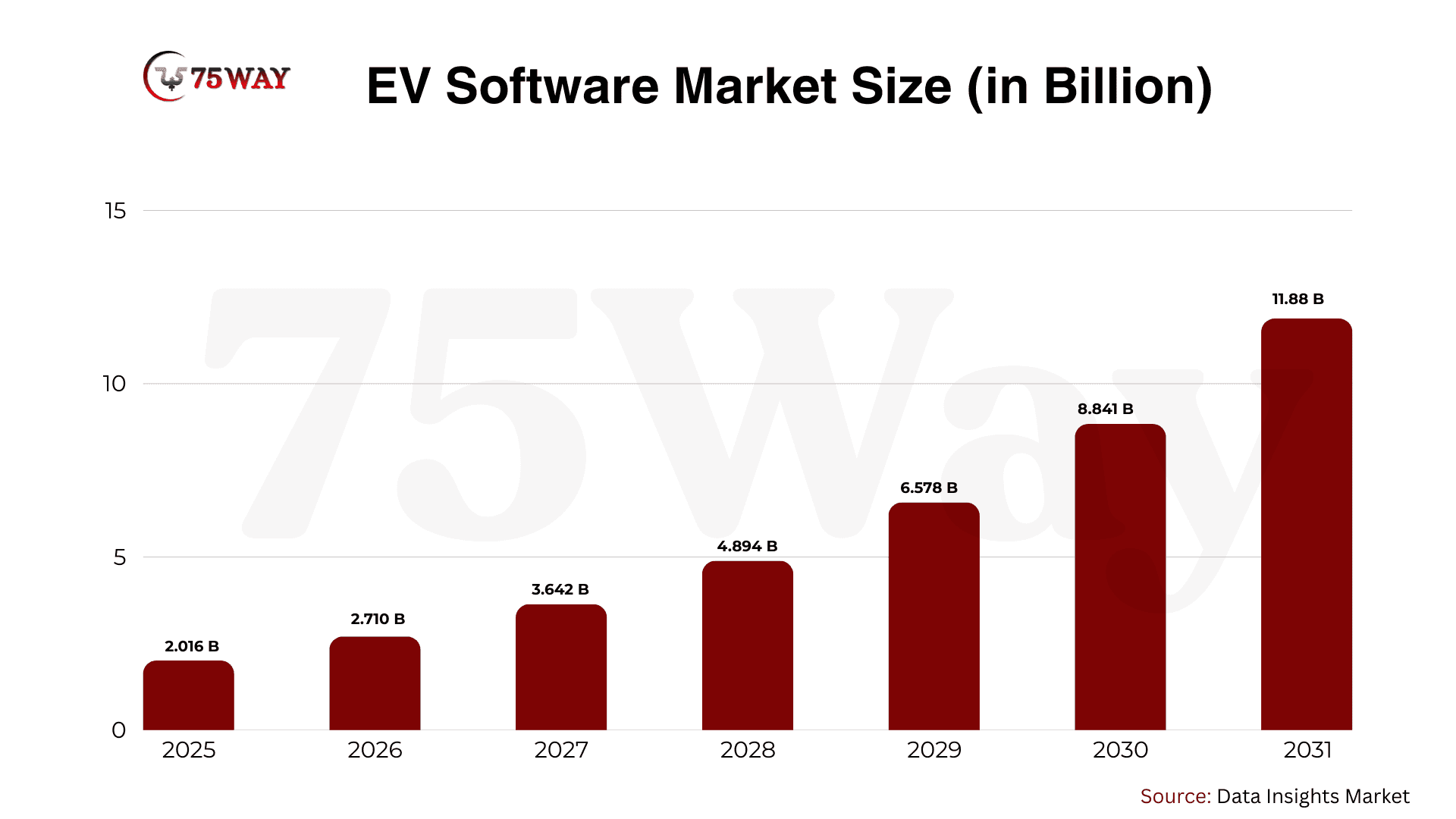
- The market, currently valued at $1.5 billion, is expected to expand at a compound annual growth rate of 34.4% over the coming years, as stated by Data Insights Market=
- The global EV charging software market is anticipated to reach $11.1 billion by 2032, advancing at a CAGR of 28.9%, according to Allied Market Research.
- The overall EV software market is forecasted to grow significantly, reaching approximately USD 76.5 billion by 2035.
Key Components of Electric Vehicle Software
Electric vehicle software is made up of multiple interconnected systems that work together to ensure safe, efficient, and intelligent operations. From battery management and fleet optimization to charging infrastructure and energy distribution, each component plays a vital role in enabling reliable performance, seamless connectivity, and a superior user experience. Understanding these key components helps businesses build scalable, future-ready EV platforms.
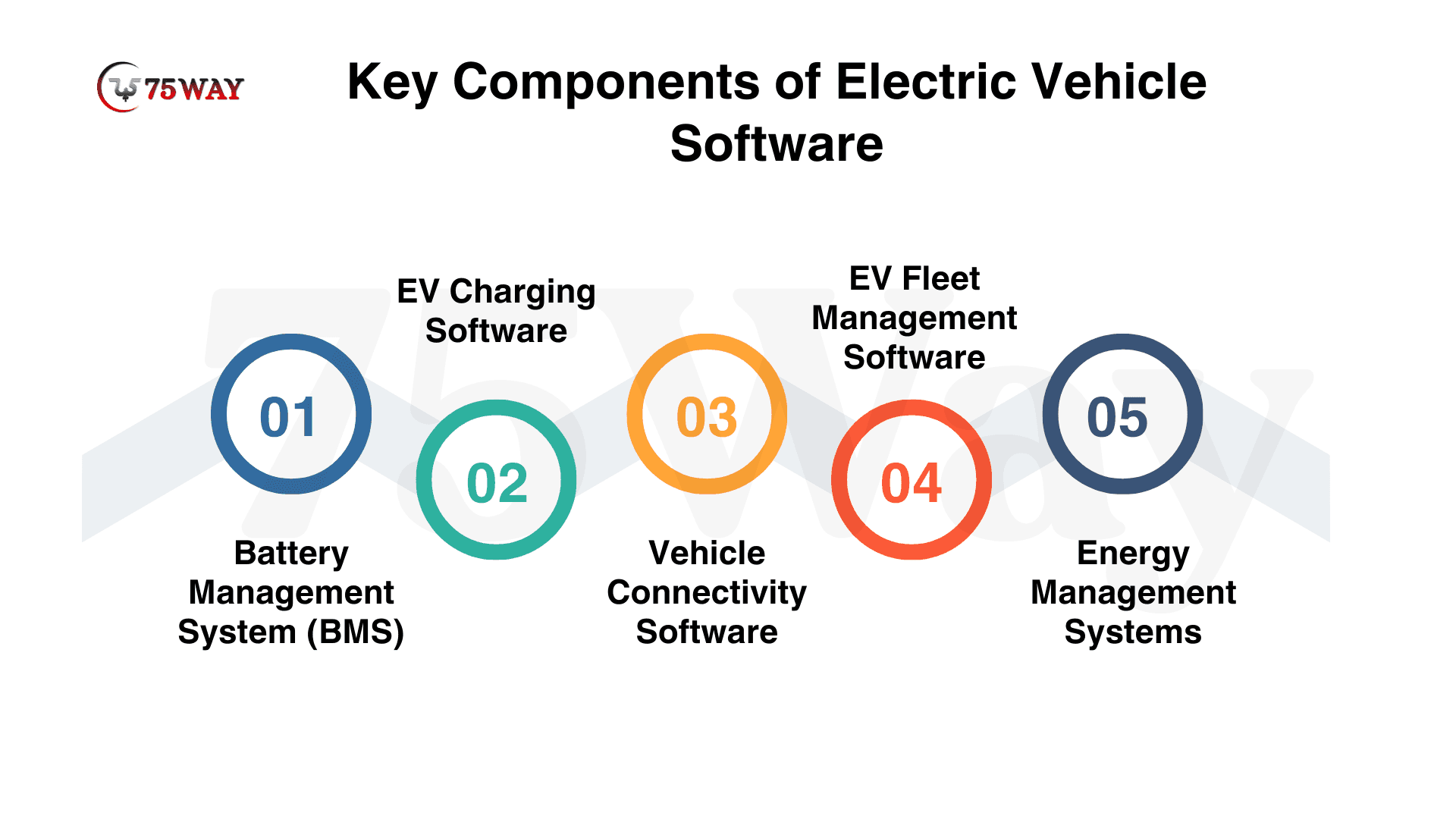
Battery Management System (BMS)
The battery management system monitors battery performance, voltage, temperature, and charging cycles to ensure safe, efficient EV operation. Core features include battery health monitoring, thermal management, charge balancing, energy optimization, and safety protection. By managing energy use and extending battery life, BMS software forms the critical foundation for reliable and high-performing electric vehicles.
EV Charging Software
EV charging software powers an intelligent charging infrastructure, enabling smooth management of charging stations. It supports charger discovery, real-time availability tracking, remote charging control, billing, and analytics. By facilitating seamless interaction between drivers and charging networks, this software enhances operational efficiency and ensures a user-friendly, scalable charging ecosystem for businesses investing in EV infrastructure.
Vehicle Connectivity Software
Vehicle connectivity software enables communication between EVs, telematics systems, and cloud platforms. It provides real-time vehicle monitoring, remote diagnostics, OTA (Over-the-Air) updates, and predictive maintenance alerts. This connectivity ensures better vehicle performance, improves driver experience, and allows businesses to manage fleet operations efficiently while integrating data-driven insights for future optimization.
EV Fleet Management Software
EV fleet management software helps companies operating electric fleets monitor vehicle locations, analyze energy consumption, schedule charging, optimize routes, and track overall performance. Logistics providers, ride-sharing platforms, and delivery services rely on this software to maintain operational efficiency, reduce downtime, and maximize energy utilization, making it essential for scalable fleet electrification and smooth daily operations.
Energy Management Systems
Energy management software optimizes the distribution of energy between vehicles, chargers, and power grids. Key features include smart charging, load balancing, renewable energy integration, and energy analytics. By intelligently managing energy flow, these systems support sustainable operations, reduce costs, and enhance the overall efficiency of EV platforms, helping businesses maintain a greener and more reliable mobility ecosystem.
The battery management system monitors battery performance, voltage, temperature, and charging cycles to ensure safe, efficient EV operation. Core features include battery health monitoring, thermal management, charge balancing, energy optimization, and safety protection. By managing energy use and extending battery life, BMS software forms the critical foundation for reliable and high-performing electric vehicles.
EV Charging Software
EV charging software powers an intelligent charging infrastructure, enabling smooth management of charging stations. It supports charger discovery, real-time availability tracking, remote charging control, billing, and analytics. By facilitating seamless interaction between drivers and charging networks, this software enhances operational efficiency and ensures a user-friendly, scalable charging ecosystem for businesses investing in EV infrastructure.
Vehicle Connectivity Software
Vehicle connectivity software enables communication between EVs, telematics systems, and cloud platforms. It provides real-time vehicle monitoring, remote diagnostics, OTA (Over-the-Air) updates, and predictive maintenance alerts. This connectivity ensures better vehicle performance, improves driver experience, and allows businesses to manage fleet operations efficiently while integrating data-driven insights for future optimization.
EV Fleet Management Software
EV fleet management software helps companies operating electric fleets monitor vehicle locations, analyze energy consumption, schedule charging, optimize routes, and track overall performance. Logistics providers, ride-sharing platforms, and delivery services rely on this software to maintain operational efficiency, reduce downtime, and maximize energy utilization, making it essential for scalable fleet electrification and smooth daily operations.
Energy Management Systems
Energy management software optimizes the distribution of energy between vehicles, chargers, and power grids. Key features include smart charging, load balancing, renewable energy integration, and energy analytics. By intelligently managing energy flow, these systems support sustainable operations, reduce costs, and enhance the overall efficiency of EV platforms, helping businesses maintain a greener and more reliable mobility ecosystem.
Types of EV Software Solutions Businesses Can Build
Electric vehicle software can take many forms, depending on the business model and target users. Startups and enterprises have the opportunity to create solutions that optimize charging networks, fleet operations, mobile experiences, energy management, and battery analytics. Each platform serves a distinct purpose, helping businesses improve operational efficiency, enhance user experience, and scale intelligently in the evolving EV ecosystem.
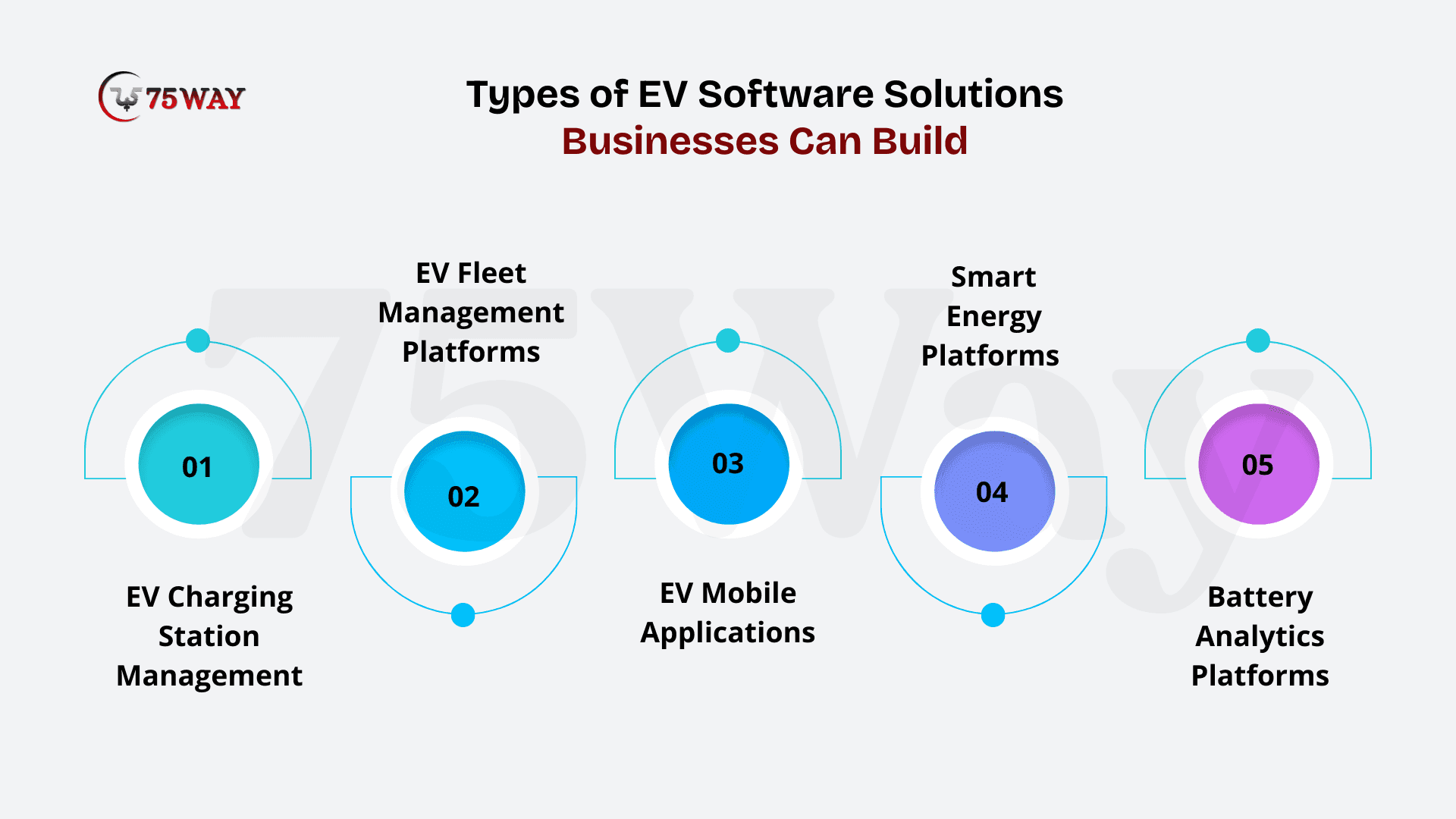
EV Charging Station Management Platforms: These platforms enable charging network operators to efficiently manage multiple charging stations. Features include real-time station monitoring, usage tracking, remote control, billing management, and maintenance alerts. By centralizing operations, businesses can ensure uptime, streamline energy distribution, and provide drivers with a seamless charging experience.
EV Fleet Management Platforms: EV fleet management software helps logistics companies and ride-sharing services oversee electric fleets. It allows tracking of vehicle location, energy consumption, charging schedules, and route optimization. By leveraging these insights, operators can reduce costs, enhance fleet efficiency, and maintain reliability across large-scale electric mobility operations.
EV Mobile Applications: EV mobile apps empower users to locate nearby chargers, schedule charging sessions, and monitor vehicle performance in real time. These applications enhance the EV user experience by providing convenience, accessibility, and transparency, while also allowing businesses to integrate analytics, notifications, and telematics data for smarter platform management.
Smart Energy Platforms: These software integrate EV charging with renewable energy sources and smart grid systems. They optimize energy allocation, support load balancing, and provide analytics for sustainable operations. By connecting vehicles, chargers, and energy networks, these platforms help businesses reduce costs and promote eco-friendly mobility solutions.
Battery Analytics Platforms: These platforms analyze battery health, performance, and lifecycle data to optimize energy efficiency and longevity. Advanced predictive algorithms and reporting tools help businesses make informed decisions, reduce downtime, and extend battery lifespan, ensuring EV fleets and individual vehicles operate at peak performance.
Robust Tech Stack to Develop EV Software
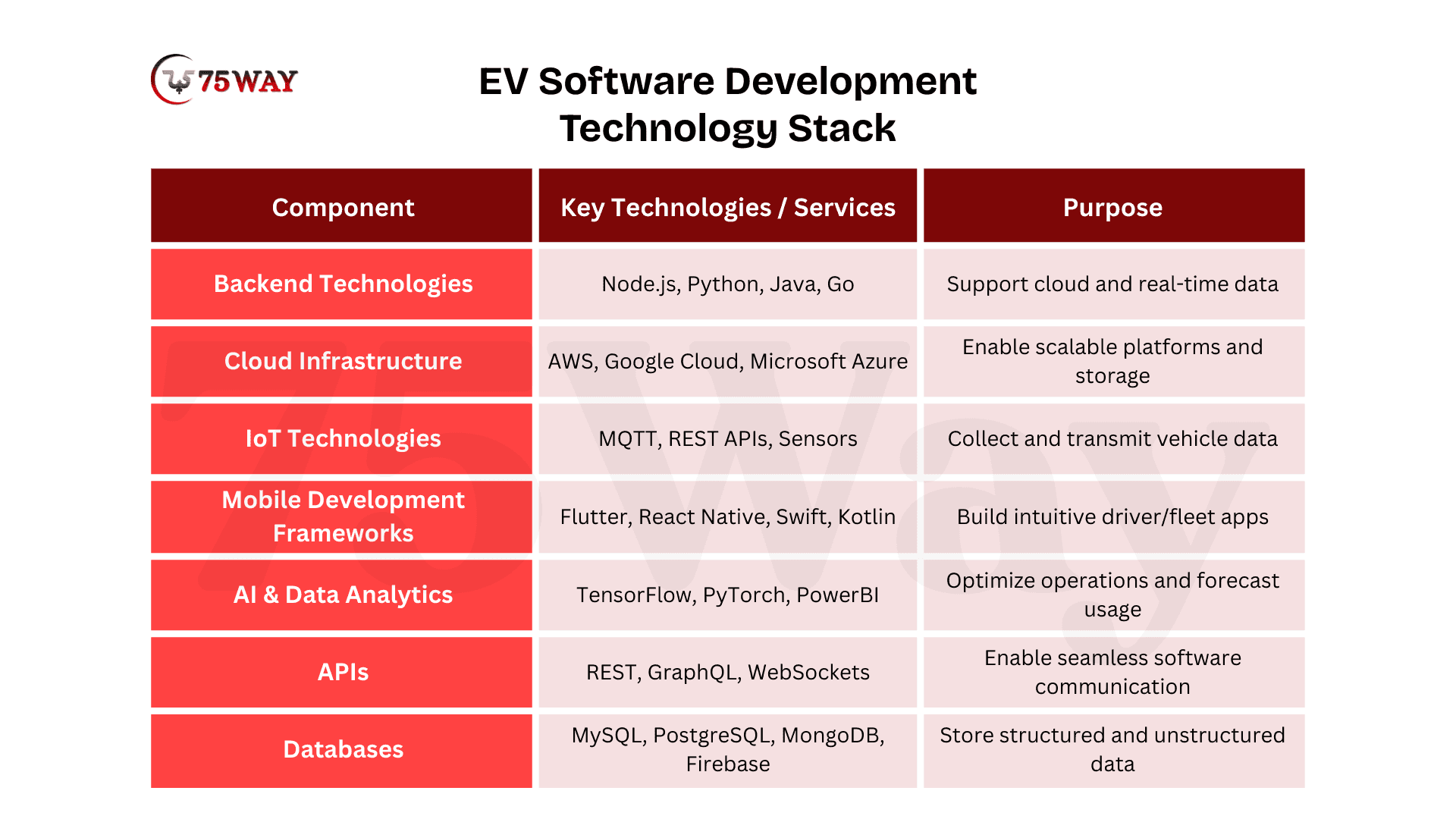
Building scalable and high-performance EV software requires a comprehensive technology ecosystem that connects vehicles, charging infrastructure, and user platforms. From backend frameworks to IoT systems, cloud platforms, and mobile applications, each technology component plays a critical role in enabling real-time monitoring, data processing, predictive insights, and seamless user experiences. Advanced AI and data analytics further enhance battery optimization, fleet management, and energy efficiency for future-ready electric mobility.
Backend Technologies: Node.js, Python, Java, and Go provide robust frameworks to support cloud-based EV platforms and real-time data processing for vehicles and charging networks.
Cloud Infrastructure: Services like AWS, Google Cloud, and Microsoft Azure enable scalable platforms, secure data storage, and advanced analytics for connected EV systems.
IoT Technologies: IoT systems collect sensor data, monitor vehicle performance, enable remote diagnostics, and support predictive maintenance for connected fleets.
Mobile Development Frameworks: Flutter, React Native, Swift, and Kotlin allow intuitive, high-performance apps for drivers and fleet operators, integrating telematics and real-time insights.
AI & Data Analytics: Machine learning algorithms analyze battery health, optimize energy consumption, and forecast fleet performance, enabling smarter decision-making and predictive EV maintenance.
APIs (Application Programming Interfaces): Enable communication between vehicles, cloud platforms, mobile apps, and IoT devices for seamless data exchange.Databases: SQL and NoSQL databases store structured and unstructured data, supporting analytics, reporting, and real-time processing for EV operations.
Challenges and Solutions While Building EV Software
EV software offers immense opportunities but comes with unique challenges that businesses must address to deliver reliable, scalable, and secure platforms. From managing complex systems to handling massive data streams and integrating diverse charging infrastructure, overcoming these hurdles ensures seamless performance, enhanced user experience, and long-term operational efficiency for EV solutions.
System Complexity: EV platforms are inherently complex, involving vehicles, charging stations, mobile applications, and cloud systems. Coordinating these components requires careful planning, modular architecture, and robust integration strategies to ensure seamless communication and consistent functionality across the entire EV ecosystem.
Cybersecurity Risks: Connected vehicles and cloud platforms are vulnerable to cyber threats, requiring advanced security measures. Implementing encryption, access controls, intrusion detection, and continuous monitoring protects user data, vehicle operations, and critical infrastructure from unauthorized access and malicious attacks
Data Management: Electric vehicles generate massive volumes of real-time data, including battery metrics, vehicle performance, and charging activity. Efficient data management involves structured databases, scalable cloud solutions, and real-time analytics to process, store, and extract actionable insights for better fleet and energy management.
Charging Infrastructure Integration: EV software must integrate with multiple charger types, standards, and protocols. Ensuring compatibility across different networks and enabling real-time monitoring and control allows businesses to deliver smooth charging experiences and optimize energy distribution across stations.
Benefits of Investing in EV Software Development
Businesses investing in EV software solutions gain several competitive advantages, from operational efficiency to enhanced user experiences. Robust software platforms optimize energy management, improve fleet performance, streamline charging networks, and provide actionable data insights. These benefits help companies scale their EV ecosystems, maintain reliability, and deliver seamless experiences for drivers, fleet operators, and charging network managers.
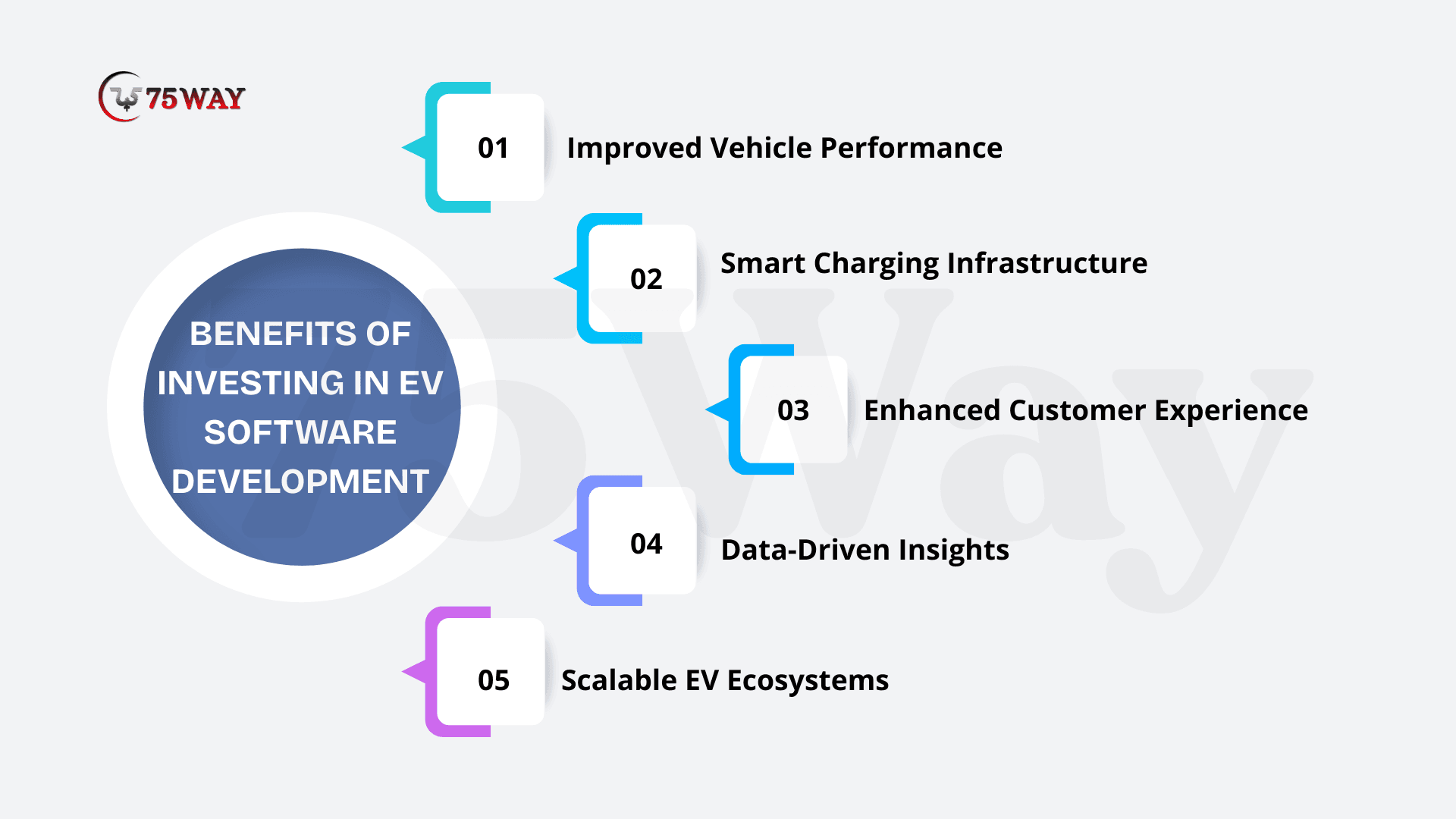
Improved Vehicle Performance: EV software solutions optimize battery efficiency, energy consumption, and overall vehicle operations. This ensures EVs maintain consistent performance, extend battery life, and operate safely across different driving conditions.
Smart Charging Infrastructure: EV charging networks become more efficient, reliable, and user-friendly. Real-time monitoring, remote control, and analytics improve station utilization while reducing downtime and operational costs.
Enhanced Customer Experience: Mobile apps and connectivity features provide drivers with seamless access to vehicle data, charging locations, and telematics insights. These features enhance convenience, engagement, and satisfaction.
Data-Driven Insights: Analytics platforms generate actionable insights into vehicle performance, energy usage, and fleet operations. Businesses can make informed decisions to optimize efficiency, reduce costs, and improve long-term planning.Scalable EV Ecosystems: Investing in software allows companies to expand platforms with new services, features, and integrations. Scalable ecosystems support fleet growth, smart energy management, and future mobility innovations.
Future Trends in Electric Vehicle Software
The EV software landscape is evolving rapidly, driven by innovations in AI, connectivity, and energy management. Emerging technologies are transforming how vehicles operate, fleets are managed, and charging networks function, enabling smarter, more efficient, and sustainable electric mobility solutions. Understanding these trends helps businesses and startups stay ahead in the competitive EV ecosystem.
AI-Powered Battery Optimization: Artificial intelligence algorithms will play a critical role in analyzing battery usage, predicting energy consumption patterns, and extending battery life. By leveraging machine learning, EV software can optimize charging schedules and improve overall vehicle efficiency, reducing operational costs while ensuring long-term reliability.
Autonomous Electric Vehicles: Future EV platforms will power autonomous driving capabilities, allowing vehicles to navigate roads, avoid obstacles, and make decisions in real time. Software-driven autonomy enhances safety, improves traffic efficiency, and opens opportunities for ride-sharing, delivery, and logistics services.
Vehicle-to-Grid (V2G) Integration: EV software will enable vehicles to interact with power grids, storing surplus energy and supplying it back when needed. V2G integration helps balance energy loads, supports renewable energy adoption, and creates additional revenue streams for fleet operators and energy providers.
Predictive Maintenance Systems: Advanced predictive analytics will detect potential vehicle issues before they occur. By monitoring performance data, EV software can schedule maintenance proactively, reduce downtime, extend component life, and improve overall fleet reliability, resulting in cost savings and operational efficiency.
Smart Charging Networks: Charging infrastructure will become fully automated and intelligent, managing energy distribution, availability, and scheduling dynamically. Smart charging networks reduce wait times, optimize energy usage, and integrate seamlessly with renewable energy sources to support sustainable and efficient EV operations.
Cost To Develop EV Software: A Complete Breakdown
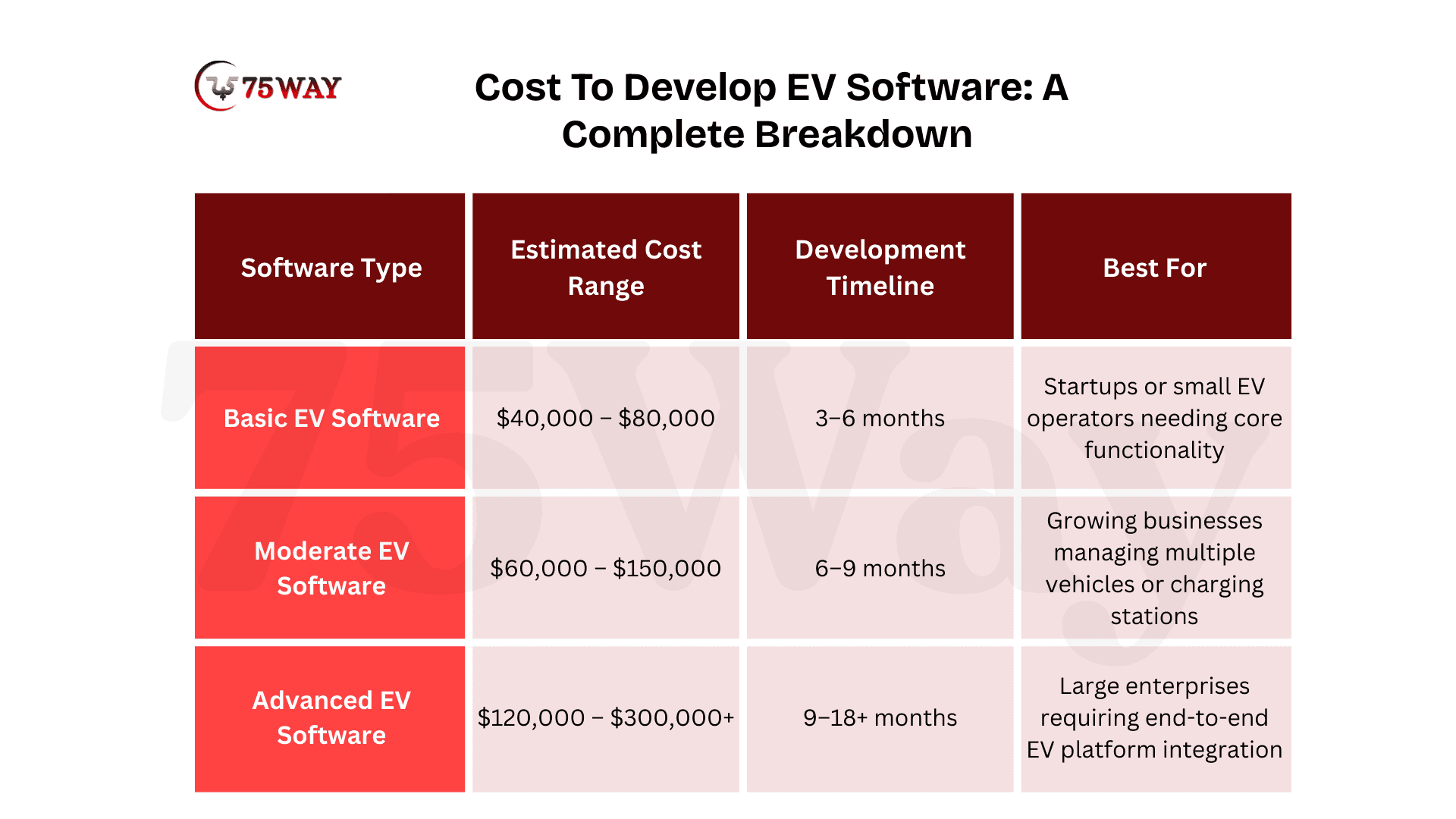
The cost of building EV software depends on complexity, features, and scale. Startups, growing businesses, and large enterprises face different investment levels, ranging from basic platforms to full-featured systems. Timelines also vary according to scope, technology stack, and integration requirements.
Basic EV Software: Basic EV software delivers essential features such as battery monitoring, vehicle tracking, and simple charging management. The cost to build basic EV software typically ranges between $40,000 and $80,000, and development usually takes about 3–6 months. This option is ideal for startups or small EV operators who require a reliable platform with core functionality without advanced integrations.
Moderate EV Software: Moderate EV software includes more sophisticated capabilities like multi-vehicle management, smart charging, and energy analytics. Building moderate EV software generally costs between $60,000 and $150,000, with a development timeline of 6–9 months. It is suitable for growing businesses that manage several vehicles or charging stations and need scalable solutions to enhance operational efficiency
Advanced EV Software: Advanced EV software provides a comprehensive EV platform, combining fleet management, mobile apps, IoT integration, and real-time analytics. The cost to develop advanced EV software ranges between $120,000 and $300,000+, with development often requiring 9–18+ months. This solution is best for large enterprises seeking end-to-end platforms for extensive EV operations, network control, and future-ready mobility services.
- The Battery Management System (BMS) development costs range from $20,000 to $50,000.
- Infotainment and Connectivity features typically cost between $30,000 and $100,000.
- Autonomous Driving Modules can range from $100,000 to $500,000+, depending on complexity.
- The EV Charging Management Platform development costs are usually $15,000 to $70,000.
- UI/UX Design for EV software generally ranges from $3,000 to $10,000.
- Backend and API Integration costs typically fall between $10,000 and $30,000.
- Implementing advanced tech stacks like IoT, AI, and Blockchain can add $100,000+ to total development costs.
How to Choose the Right EV Software Development Company?
Selecting the right software partner is crucial for building reliable, scalable, and future-ready EV platforms. Businesses must evaluate companies not only for technical expertise but also for their ability to provide ongoing support, ensure security, and deliver solutions aligned with long-term mobility goals.
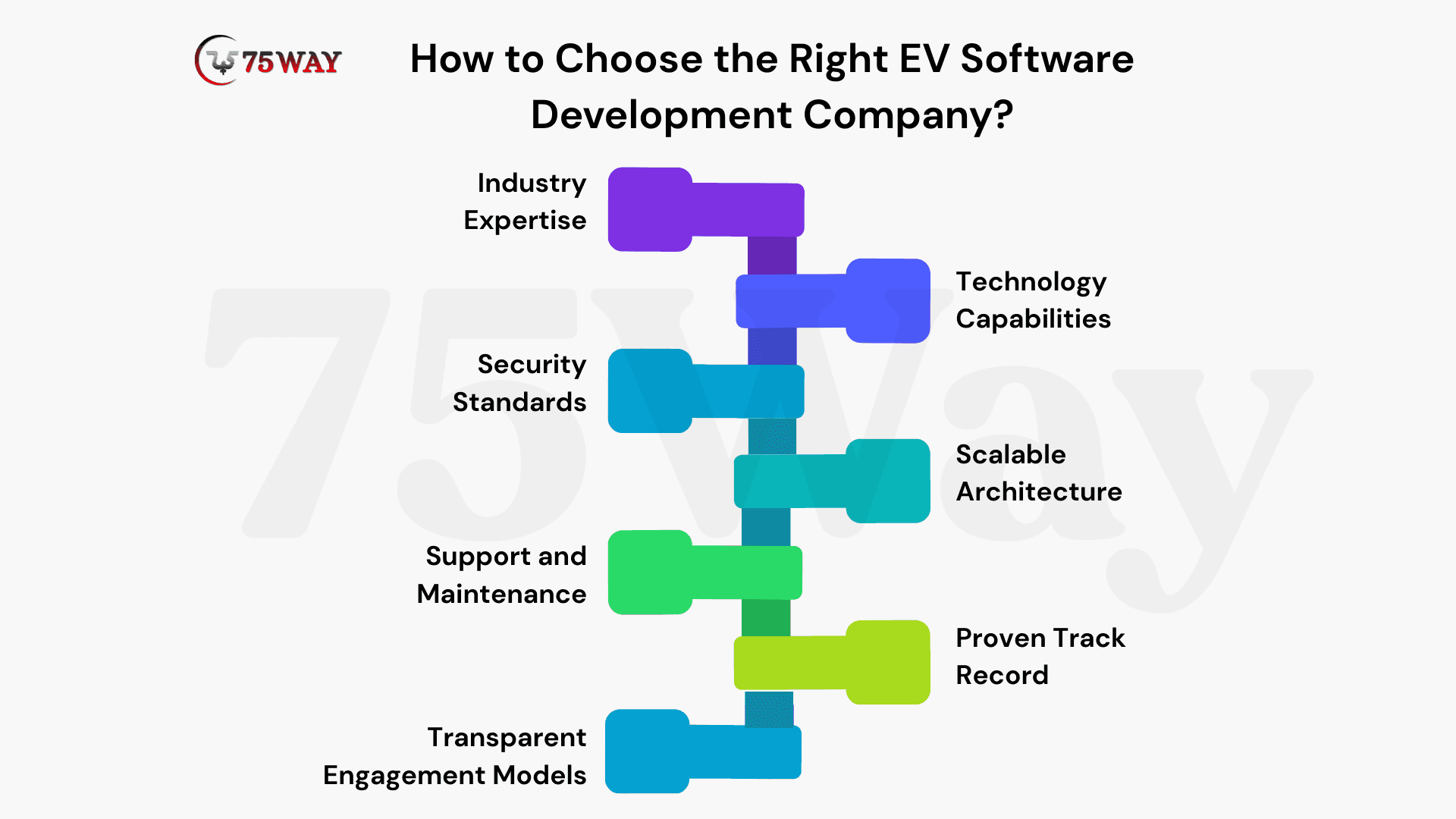
Industry Expertise: Partner with companies that have proven experience in automotive and EV software solutions. Industry knowledge ensures familiarity with vehicle telematics, charging systems, fleet operations, and regulatory compliance, reducing development risks and accelerating project delivery.
Technology Capabilities: Choose a partner skilled in IoT integration, cloud computing, mobile app development, and AI-powered analytics. Robust technical expertise ensures your EV software can handle real-time data processing, connectivity, predictive maintenance, and intelligent energy management effectively.
Security Standards: Connected EV platforms are vulnerable to cyber threats, making cybersecurity critical. Ensure your software partner follows advanced encryption protocols, access controls, and monitoring frameworks to safeguard vehicle data, cloud systems, and user information.
Scalable Architecture: The EV software platform should support future upgrades, new modules, and integrations. Scalable architecture enables businesses to expand fleets, add charging stations, integrate smart energy systems, and adopt emerging mobility technologies without major overhauls.
Proven Track Record: Look for a software partner with a proven track record of delivering successful EV and automotive projects. Case studies, client testimonials, and past deployments demonstrate their ability to handle complex integrations, meet deadlines, and provide reliable, high-quality solutions for real-world electric mobility challenges.
Transparent Engagement Models: A reliable EV software company should offer transparent engagement models with clear communication on scope, timelines, and costs. Whether it’s fixed-price, time-and-materials, or dedicated team models, transparency ensures alignment, reduces risks, and builds trust throughout the development process.
Support and Maintenance: Continuous support and timely maintenance are essential for long-term success. A reliable software partner provides bug fixes, feature updates, OTA (Over-the-Air) updates, and performance optimization to ensure seamless operations and maximum uptime.
At 75way Technologies, we bring over 10 years of expertise in delivering advanced EV software development services. We leverage cutting-edge technologies such as IoT for real-time vehicle data, artificial intelligence, agentic AI, and machine learning for predictive analytics and battery optimization, cloud platforms for seamless connectivity, mobile frameworks for driver apps, and robust databases for efficient data management. With this approach, we ensure reliable, scalable, and future-ready EV platforms for businesses.
Final Thoughts
Electric vehicle software is the backbone of modern e-mobility, powering everything from battery management and fleet operations to smart charging and energy optimization. For startups, business owners, and enterprises, investing in scalable, secure, and connected EV software platforms is no longer optional. It is essential for staying competitive in the rapidly evolving electric mobility ecosystem. Understanding the key components, technology stack, costs, and best practices ensures businesses can build future-ready, efficient, and reliable solutions. Partnering with the right e-mobility service provider can accelerate your journey, providing tailored software solutions, seamless integrations, and ongoing support to maximize performance and customer satisfaction. Whether you’re managing a fleet, developing smart charging networks, or launching mobile EV platforms, the right partner helps you unlock the full potential of electric mobility.
Frequently Asked Questions (FAQs)
How Does EV Software Improve Energy Efficiency?
EV software monitors battery usage, charging patterns, and energy consumption in real time. By optimizing how energy is used, it helps vehicles operate more efficiently, extends battery life, and reduces overall operational costs.
Can EV Software Integrate With Renewable Energy Sources?
Yes, modern EV platforms can seamlessly connect with solar, wind, and other renewable energy systems. This enables smart charging, energy storage, and distribution, supporting sustainable mobility and reducing dependency on conventional power grids.
How Does EV Software Support Fleet Management?
EV software tracks fleet vehicles’ location, energy usage, maintenance schedules, and performance metrics. This allows operators to optimize routes, reduce downtime, save costs, and maintain smooth daily operations for large or growing fleets.
What Role Does IoT Play In EV Platforms?
IoT sensors collect real-time data from vehicles, charging stations, and infrastructure. This enables remote monitoring, predictive maintenance, and automated decision-making, ensuring reliable performance and a seamless user experience.
How Secure Are Connected EV Systems?
EV software employs advanced encryption, access controls, and cybersecurity protocols to protect vehicle data, cloud systems, and mobile apps from unauthorized access, cyber attacks, or data breaches. Security is critical for both users and operators.
Can EV Software Be Scaled For Future Expansion?
Yes, well-designed EV platforms are fully scalable. Businesses can add vehicles, integrate additional charging stations, adopt new technologies, and expand services without major system overhauls, ensuring long-term growth and flexibility.