Summary
Custom AI development and ready-made AI solutions serve different business needs. Custom AI offers tailored functionality, scalability, and control, while ready-made solutions provide faster deployment and lower initial cost. This blog explores key differences, benefits, limitations, cost factors, and ideal use cases, helping businesses choose the right AI approach for growth and efficiency.
Quick Overview
- Custom AI development offers full control, scalability, and deep personalization capabilities
- Ready-made AI solutions provide quick deployment and a lower initial cost advantage
- Custom AI requires a higher investment but delivers long-term strategic value creation
- Ready-made solutions lack flexibility but are easy to implement quickly initially
- Choosing depends on business goals, budget, scalability, and innovation needs assessment
Artificial intelligence is transforming how businesses operate, automate processes, and deliver customer experiences. Organizations today face an important decision: should they invest in Custom AI development or choose ready-made AI solutions?
Both approaches offer unique advantages, but they serve different purposes. Custom AI is designed specifically for business needs, offering flexibility and long-term scalability. On the other hand, ready-made solutions provide quick deployment and lower costs, making them attractive for startups and small businesses. Understanding the differences between these two AI approaches is essential for making informed decisions that align with business goals, budget, and growth strategy.
What is Custom AI Development?
Custom AI development refers to building artificial intelligence systems from scratch based on specific business requirements. These systems are designed to solve unique challenges and integrate seamlessly with existing workflows.
It involves data engineering, model training, system design, and continuous optimization to ensure high performance and relevance for the organization using it. Custom AI is ideal for businesses that require advanced features, deep personalization, and complete control over functionality and data usage.
What are Ready-Made AI Solutions?
Ready-Made AI Solutions are pre-built artificial intelligence tools designed for general use cases. These solutions can be quickly deployed without extensive development or customization.
They are typically offered as SaaS platforms or licensed software and are suitable for standard business needs like chatbots, analytics, automation, and customer support. These solutions help businesses adopt AI quickly without heavy investment in development or technical expertise.
Key Differences Between Custom AI and Ready-Made AI Solutions
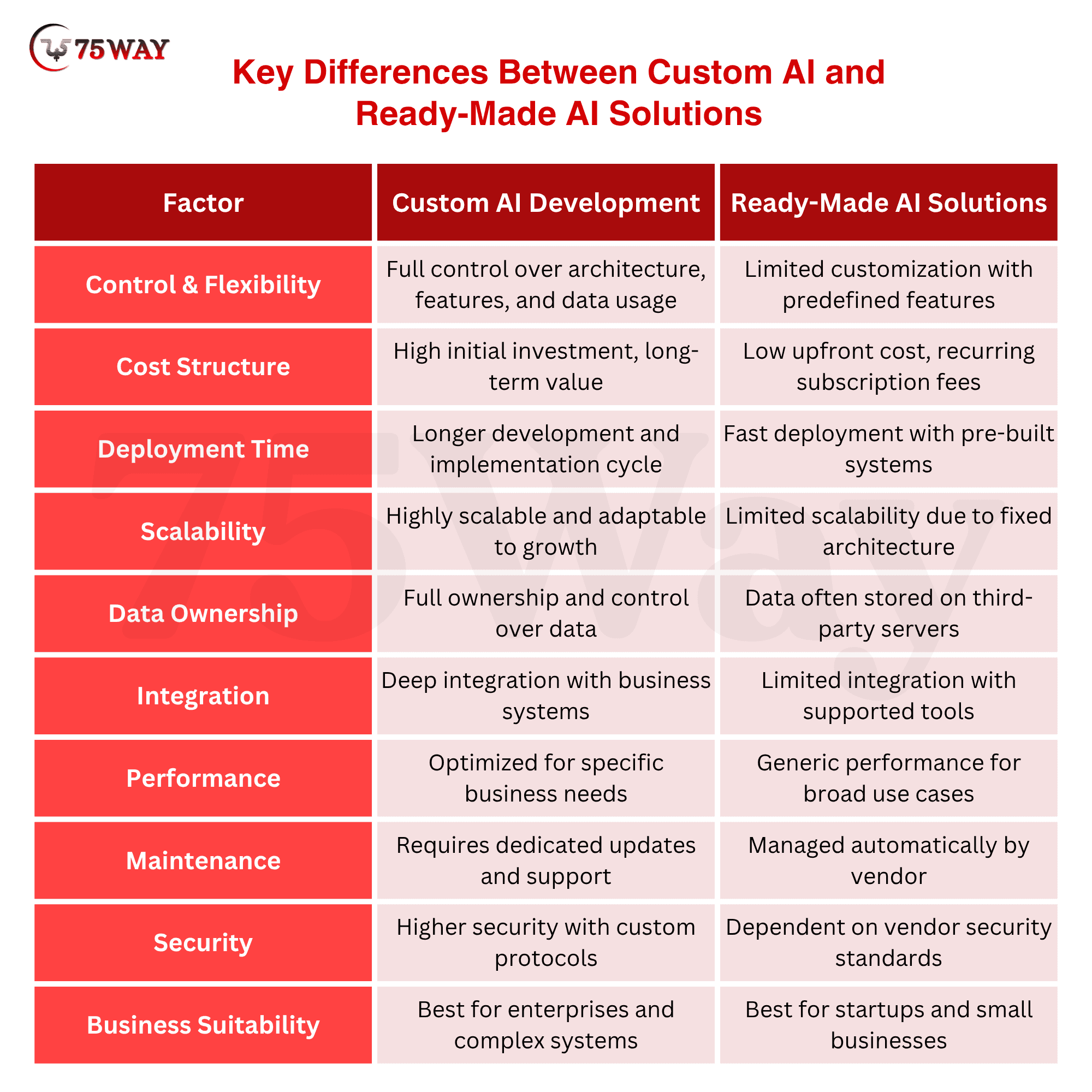
Understanding the key differences between custom AI development and ready-made AI solutions helps businesses evaluate performance, flexibility, cost, and scalability, ensuring the right artificial intelligence approach is selected based on operational needs and long-term strategic goals.
Control & Flexibility
Custom AI development provides complete control over architecture, features, and data usage, allowing businesses to build tailored systems that adapt precisely to unique operational requirements and evolving business objectives. Ready-made AI solutions offer limited customization, as they are built for general use cases and standard workflows across industries.
Cost Structure
Custom AI development involves higher upfront costs due to design, training, and integration, whereas ready-made solutions require subscription or licensing fees, making them more budget-friendly for small businesses initially overall. However, ready-made solutions may lead to recurring costs over time, while custom AI provides long-term value despite initial investment.
Deployment Time
Ready-made AI solutions can be deployed quickly since they come pre-built, while custom AI development requires longer timelines for planning, designing, training models, testing, and full system integration processes execution. This makes ready-made AI ideal for businesses needing immediate implementation and fast digital transformation results.
Scalability
Custom AI systems are highly scalable and can evolve with business growth, while ready-made solutions may have limitations in customization and scaling due to predefined architecture and vendor constraints. Scalability in custom AI ensures long-term adaptability for expanding business needs and complex operations.
Data Ownership & Security
Custom AI development ensures full data ownership and stronger security control since systems are built and hosted based on business-specific compliance requirements. Ready-made AI solutions often store data on third-party servers, which may raise privacy and compliance concerns for some industries.
Integration Capabilities
Custom AI can be seamlessly integrated with existing business systems like ERP, CRM, and internal databases for smooth workflows. Ready-made AI tools may offer limited integration options, often restricted to predefined APIs and supported platforms.
Performance Optimization
Custom AI systems are optimized for specific business goals, leading to higher accuracy and better decision-making outcomes. Ready-made AI solutions use generic models, which may not deliver the same level of precision for specialized tasks.
Maintenance & Upgrades
Custom AI requires dedicated maintenance and continuous updates managed by development teams or vendors. Ready-made AI solutions are automatically updated by providers, reducing maintenance effort but limiting control over feature changes.
Business Suitability
Custom AI is best suited for enterprises with complex workflows, large datasets, and long-term innovation strategies. Ready-made AI solutions are ideal for startups and small businesses looking for quick, affordable AI adoption.
Vendor Dependency
Custom AI reduces dependency on third-party vendors, giving businesses full independence over system evolution. Ready-made solutions create dependency on vendors for updates, pricing changes, and feature availability.
When to Choose Custom AI or Ready-Made Solutions?
Choosing between bespoke AI Development solutions and pre-built AI Solutions is not just a technical decision. It is a strategic business choice that directly impacts growth, efficiency, and long-term competitiveness. Businesses must carefully evaluate how AI will align with their vision, operations, and future expansion plans before selecting an approach.
The right option largely depends on your long-term vision, available budget, and operational complexity. Custom AI is ideal when you need deep personalization, advanced automation, and scalable systems tailored specifically to your workflows. In contrast, ready-made AI solutions work best when speed, affordability, and quick deployment are the main priorities.
It also depends on how deeply you want to integrate artificial intelligence into your business processes. If AI is a core part of your innovation strategy, custom development provides greater control and flexibility. However, if you need standard AI capabilities for immediate use, ready-made solutions offer a practical and efficient starting point.
Cost Comparison Overview
Custom AI development costs typically require a higher initial investment because it involves extensive research, data preparation, model design, development, testing, and continuous optimization. Businesses also need skilled AI engineers and infrastructure, which increases overall costs. However, this investment delivers strong long-term value through better scalability, performance, and complete customization aligned with business goals.
Ready-made AI solutions, on the other hand, are more affordable at the outset because they use subscription-based or licensing pricing models. Businesses can quickly access AI capabilities without incurring high upfront costs. However, as usage increases or business needs become more advanced, ongoing subscription costs and limitations in customization can become a challenge over time.
Final Thoughts
Both custom AI development and ready-made AI solutions are essential drivers of modern digital transformation, each serving different business needs and maturity levels. The decision ultimately depends on your organization’s size, operational complexity, budget, and long-term scalability goals. Custom AI is ideal for businesses seeking deep personalization, innovation, and a strong competitive advantage through tailored intelligence systems. It supports future growth and evolving requirements. In contrast, ready-made AI solutions are best suited for businesses that prioritize speed, affordability, and quick implementation with minimal customization. Choosing the right approach ensures better efficiency, smarter automation, and sustainable digital success.
Frequently Asked Questions (FAQs)
How Does Artificial Intelligence Improve Business Decision Making?Artificial intelligence improves decision-making by analyzing large datasets quickly, identifying patterns, and providing predictive insights. It helps businesses reduce human error, forecast trends accurately, and make data-driven decisions that enhance efficiency, profitability, and overall operational performance across departments and business functions.
Can AI Be Integrated Into Existing Business Software Systems?Yes, AI can be integrated into existing business systems such as CRM, ERP, and accounting platforms. Through APIs and middleware, AI enhances automation, data analysis, and workflow optimization without replacing current systems, ensuring smoother operations and improved productivity across organizational processes efficiently.
What Industries Benefit The Most From Artificial Intelligence?Industries like healthcare, finance, retail, manufacturing, logistics, and education benefit significantly from artificial intelligence. AI improves diagnostics, fraud detection, customer experience, supply chain optimization, and personalized learning, making operations more efficient, accurate, and scalable across diverse industrial environments and use cases effectively.
Is Artificial Intelligence Suitable For Small Businesses?Yes, artificial intelligence is suitable for small businesses as it helps automate repetitive tasks, improve customer engagement, and enhance marketing efforts. Affordable AI tools allow small businesses to compete with larger organizations by improving efficiency, reducing costs, and increasing overall productivity.
What Skills Are Required To Work With Artificial Intelligence Systems?Working with AI systems requires skills in data analysis, programming languages like Python, machine learning concepts, and problem-solving abilities. Knowledge of statistics, cloud computing, and AI frameworks also helps professionals develop, deploy, and manage intelligent systems efficiently across different applications.
How Secure Is Data Used In Artificial Intelligence Applications?Data security in AI applications depends on system design, encryption methods, and compliance standards. Well-designed AI systems ensure secure data handling through encryption, access controls, and anonymization techniques, reducing the risk of breaches while maintaining privacy and regulatory compliance across industries.