Summary
Want to build a private, uncensored AI app like Venice AI? Explore this in-depth guide to create an app similar to Venice AI from idea to deployment. You will know architecture, features, tech stack, development workflow, and monetization strategies. Moreover, founders and developers understand how private AI systems, multi-model integration, and scalable APIs come together to create powerful conversational AI platforms.
Quick Overview
- AI apps like Venice AI require modular architecture and scalable backend systems
- Multi-model integration improves intelligence and user experience
- Privacy-first design builds user trust and retention
- Average cost to build a Venice AI-like app ranges between $40,000 and $500,000 based on needs.
- Monetization depends on subscriptions and usage-based APIs
Modern AI platforms change the way people think, create, and communicate. A few years ago, building an AI assistant felt like science fiction reserved for big tech companies. Today, it feels closer than ever to something an independent team can realistically create.
AI-powered apps like Venice AI represent this advancement clearly. They combine conversational AI bot, image generation, privacy-focused design, and multi-model AI access into a single platform. But behind that smooth interface lies a complex system of infrastructure, APIs, model orchestration, and scalable architecture.
Building a mobile app like Venice AI is more than coding. You have to design an ecosystem where AI feels responsive, private, and useful across multiple tasks. But, what is Venice AI? What’s the process to create an app similar to Venice AI? Which features are required?
This guide explains a step-by-step roadmap, its development architecture, features, tech stack, workflows, and monetization for building an AI platform like Venice AI. It also highlights practical development decisions that directly impact scalability, performance, and long-term product success.
What Is Venice AI?
Venice AI is a modern generative AI platform that lets users interact with multiple AI models through a single interface to chat, write content, generate code, and create images, videos, music, and characters. At its core, Venice AI is a multi-model AI system, meaning it does not rely on a single artificial intelligence engine. Instead, it connects with several advanced AI models (such as large language models and image-generation systems) and routes user requests to the most suitable one based on the task.
Before building, it is important to understand the category of the product. In simple terms, Venice AI is not just an AI chatbot. It is a multi-layer AI platform that typically includes:
- Conversational AI interface
- Image generation capabilities
- Multiple AI model switching
- Privacy-first interaction design
- API access for developers
As seen in modern implementations, such platforms focus heavily on user control, model flexibility, and private inference systems. This means you are not building a single AI model. You are building a multi-model orchestration system.
Core Idea Behind Building Venice AI-Like Apps
To build an app like Venice AI, you must shift your thinking from “chatbot development” to “AI system engineering.” This is what separates simple AI apps from advanced platforms. Venice AI is built around three main principles:
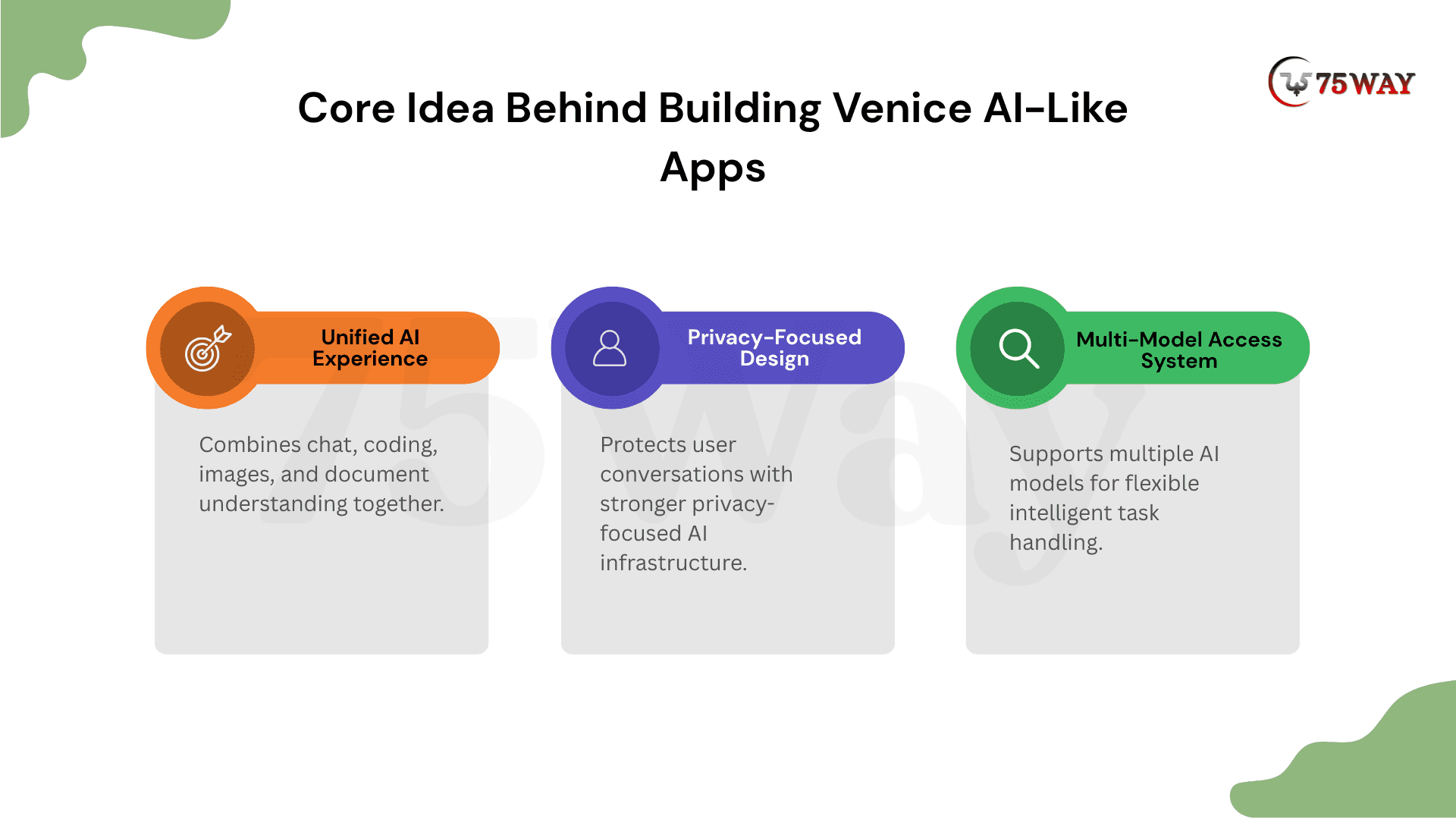
1. Unified AI Experience
It brings together different AI capabilities like:
- Conversational chat assistance
- Code generation and debugging
- Image creation from text prompts
- Document understanding and summarization
2. Privacy-Focused Design
One of its major positioning points is privacy-centric usage. According to its platform description, Venice AI emphasizes that user interactions are designed to remain private and not heavily stored or tracked in traditional centralized ways. This makes it appealing for users who want more control over their data compared to standard AI chat tools.
3. Multi-Model Access System
Instead of depending on a single AI model, Venice AI integrates multiple leading models and allows switching or routing between them depending on the task, such as reasoning, coding, or image generation.
Must-Have Features To Build An AI Platform Like Venice AI
A Venice-like AI platform requires several deeply interconnected modules that work together to create a seamless, intelligent, and scalable user experience. Each feature is not standalone; it contributes to the overall system intelligence, performance, and product usability.
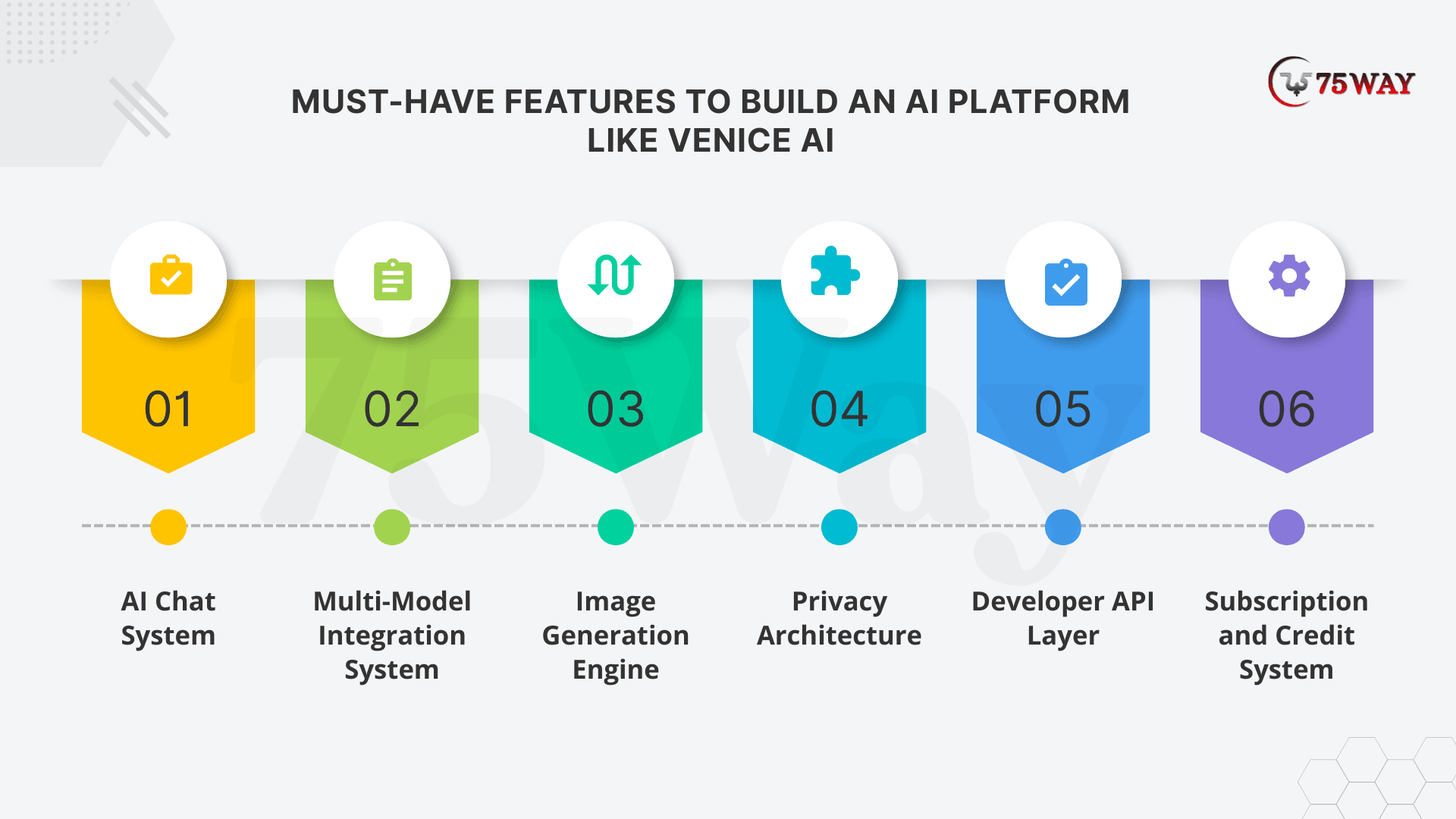
1. AI Chat System
An AI-powered chatbot is the core interaction layer of the entire platform. It enables users to communicate with the AI in a natural, conversational way while maintaining context across multiple turns and adapting responses based on intent, memory, and model selection logic.
You need:
- Real-time conversational interface
- Context memory system
- Multi-turn dialogue handling
- Prompt engineering layer
The chat system must dynamically support multiple AI models.
2. Multi-Model Integration System
This system acts as the intelligence routing engine of the platform. Instead of depending on a single AI model, it intelligently connects multiple models and selects the best-performing one based on query type, complexity, cost efficiency, and response quality requirements.
Examples include:
- Open-source LLMs
- Commercial APIs
- Specialized reasoning models
Your system should:
- Route queries intelligently
- Switch models based on task
- Optimize cost and performance
3. Image Generation Engine
The image generation engine transforms textual prompts into high-quality visual outputs, making the platform multimodal. It also enhances creativity by refining prompts, managing rendering pipelines, and handling asynchronous GPU-based or API-driven image generation workflows. You need:
- Text-to-image generation
- Prompt enhancement system
- Image rendering pipeline
- Queue-based processing system
This requires GPU-backed infrastructure or third-party APIs.
4. Privacy Architecture
The privacy architecture defines how securely and responsibly user data is handled within the system. It ensures minimal data retention, encrypted communication, and user-controlled data visibility while aligning with modern expectations of AI privacy-first platforms. As seen in Venice-style systems:
- Conversations are not stored permanently
- Data is minimized or encrypted
- User control is prioritized
To replicate this:
- Avoid long-term server logging
- Use client-side storage where possible
- Encrypt API communication
5. Developer API
This layer model extends the platform beyond end users, allowing external developers and businesses to integrate AI capabilities into their own applications. Thai stage offers scalability, extensibility, and ecosystem growth through structured API access. This allows external developers to build on your platform.
You should build:
- REST or GraphQL APIs
- Authentication system
- Rate limiting
- Billing integration
6. Subscription and Credit System
The subscription and credit system forms the commercial backbone of the platform. It manages monetization by controlling usage limits, enabling tiered access, and offering flexible payment models aligned with user consumption patterns. You can add common models:
- Monthly subscription
- Usage-based credits
- Tiered AI access plans
This ensures scalability and revenue stability.
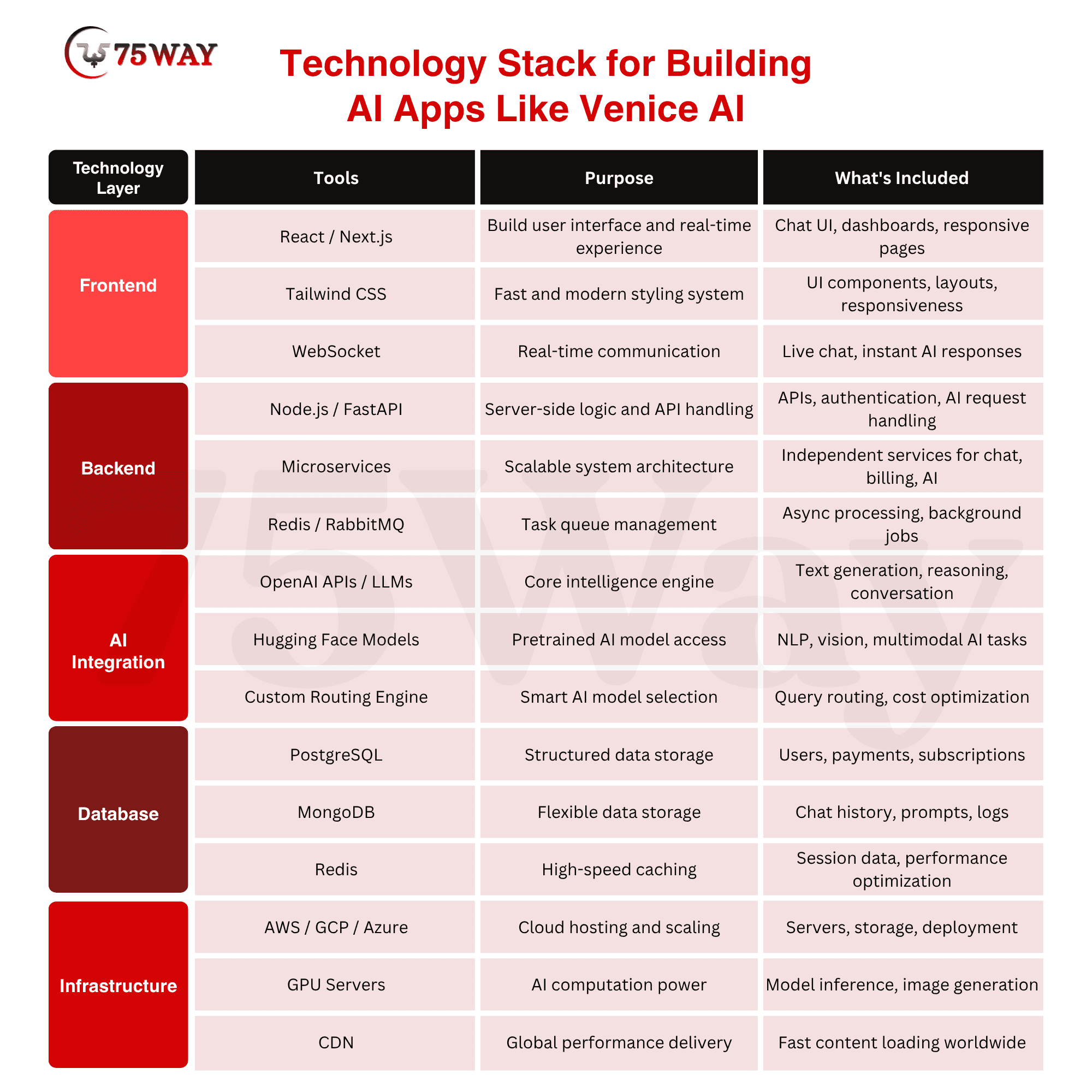
Technology Stack for Building AI Apps Like Venice AI
Below is a clear breakdown of each layer of the technology stack, explained in simple terms so you understand what each component does, why it is needed, and what it includes.
- Frontend
User-facing system built with React, Next.js, JavaScript, and Tailwind CSS, delivering fast, responsive, interactive AI application interfaces.
- Backend
Server-side logic managed using Node.js, Python FastAPI, and Express, handling APIs, authentication, processing, and system orchestration efficiently.
- AI Layer
Intelligence engine powered by OpenAI APIs, Python models, Hugging Face transformers, and custom LLM routing for optimized responses.
- Database
Data storage layer using PostgreSQL, MongoDB, and Redis, managing structured records, chat history, and high-speed caching operations.
- Infrastructure
Cloud and deployment backbone using AWS, Google Cloud, Azure, GPU servers, and CDN for global scalable performance delivery.
System Architecture For Venice AI-Like Platform Development Explained
A typical AI application like Venice AI is structured in multiple layers that work together to handle user requests efficiently and reliably. This separation allows smooth scaling, better performance control, and easier system upgrades over time. Each layer focuses on a specific responsibility within the overall workflow.
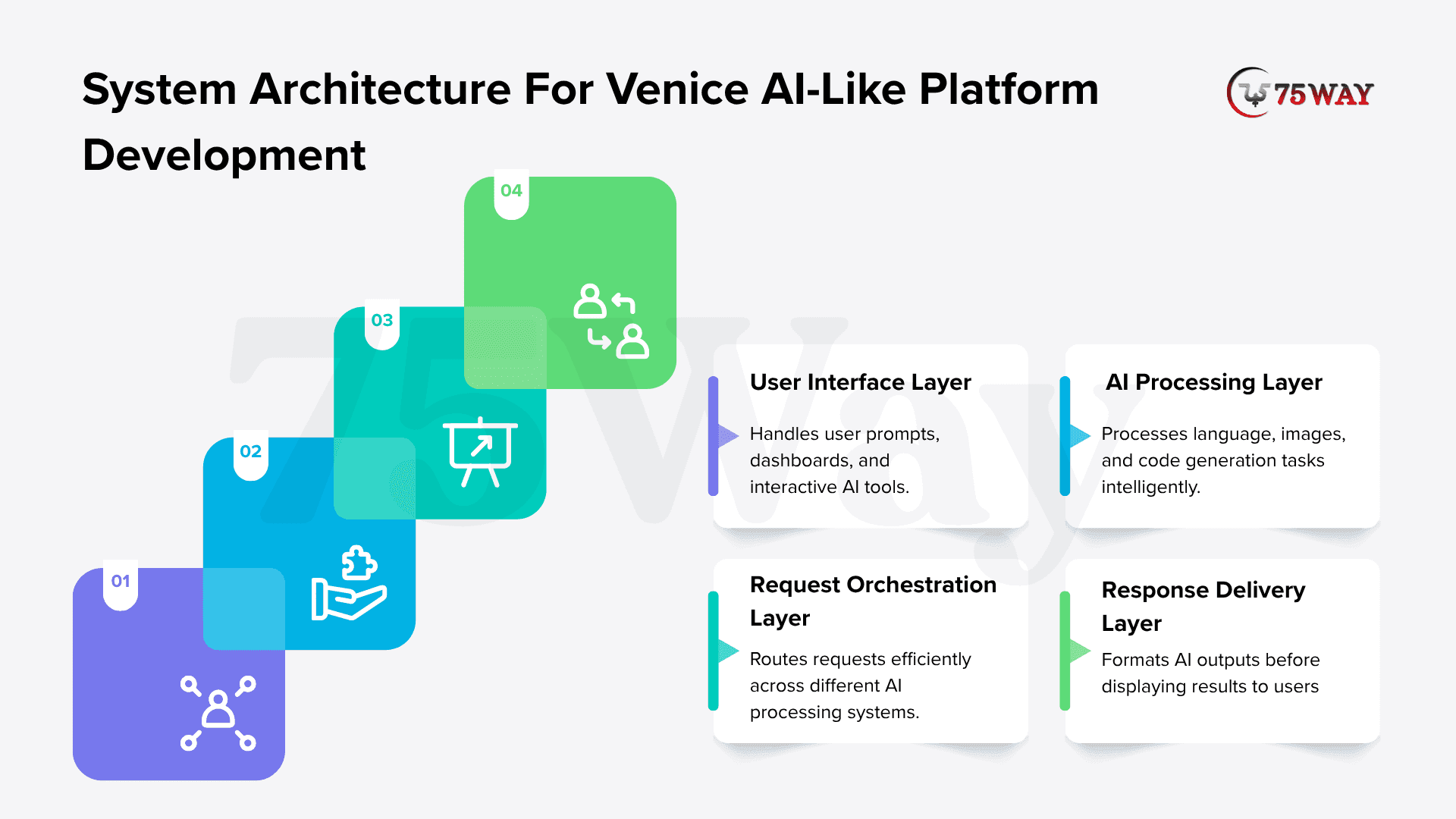
1. User Interface Layer
This layer represents the visual and interactive part of the application where users type prompts, view AI responses, and access different tools. It ensures smooth interaction across chat, image generation, and API-based dashboards. User interacts with chat, image tools, or API dashboard.
2. Request Orchestration Layer
This layer manages incoming requests and acts as a control center for routing decisions. It evaluates the request type, assigns the appropriate processing path, and balances system efficiency during execution. System decides:
- Which model to use
- Whether to call the image engine
- How to optimize cost
3. AI Processing Layer
This is where all AI-related computations take place, transforming user inputs into meaningful outputs. It handles different types of processing depending on the request, including language understanding, visual generation, and programmatic execution. Models process requests:
- LLM inference
- Image generation
- Code execution
4. Response Layer
This layer prepares the final output for delivery back to the user interface. It ensures the response is structured correctly so it can be displayed in a readable and user-friendly format. Results are formatted and returned to UI.
The entire layered architecture ensures scalability and flexibility.
Step-by-Step Process For Venice AI-Like Platform Development
Building an AI platform like Venice AI requires a structured development approach where each stage contributes to system stability, scalability, and long-term product value. The following steps reflect a real-world engineering workflow used in production-grade AI systems.
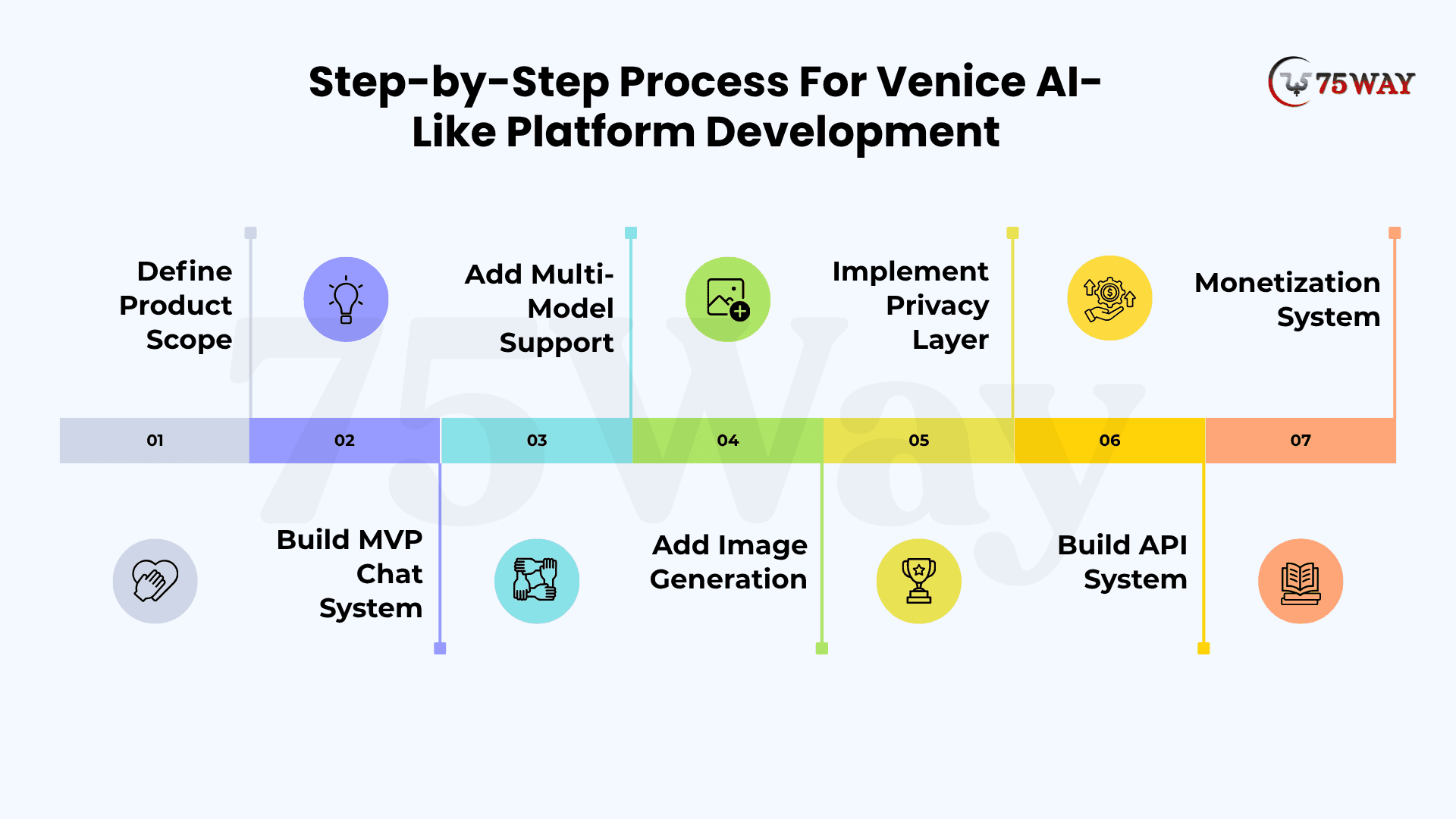
Step 1: Define Product Scope
At this stage, the goal is to clearly define what the product will do, who it will serve, and how complex the system should be at launch. This decision impacts architecture, cost, and development speed. A well-defined scope prevents unnecessary feature overload and ensures focused execution. Decide:
- Chat only or multimodal AI
- Target users (developers, creators, businesses)
- Platform type (web app, mobile app, or API-first system)
- Monetization approach (free, subscription, or usage-based model)
- Core feature priority (chat, image generation, or developer tools first)
Step 2: Build MVP Chat System
This phase focuses on creating a minimal viable product that validates core functionality. The primary objective is to enable basic AI interaction with a simple interface and backend integration. It helps test user experience before scaling into advanced features.
- Basic UI
- Single AI model integration
- Simple backend API
Step 3: Add Multi-Model Support
Once the MVP is stable, the system is enhanced to support multiple AI models. This improves flexibility, accuracy, and performance by allowing different models to handle different types of tasks through intelligent routing logic.
- Introduce model switching among different AI models
- Build routing logic to create intelligent system request routing
- Optimize performance to improve speed, accuracy, and system efficiency
- Integrate fallback mechanisms for failed model responses
- Configure cost-aware model selection for efficient API usage
- Implement latency-based model prioritization for faster responses
- Add support for open-source and commercial AI model integration
- Enable task-based model specialization for better output quality
Step 4: Add Image Generation
This stage introduces multimodal capability by enabling image creation from text prompts. It expands the platform beyond conversational AI and requires integration with image generation APIs, along with supporting infrastructure for storage and history tracking.
- Integrate Image APIs: Connect external image generation APIs for creating visuals from user text prompts
- Build A Prompt Enhancer: Improve user prompts automatically for generating higher quality, detailed, and accurate images
- Add History Storage: Store generated images and prompts for future access and user reference tracking
Step 5: Implement Privacy Layer
Privacy becomes a critical system requirement at this stage. The focus is on minimizing data retention, securing communication channels, and enforcing strict security policies to protect user interactions and maintain trust.
- Remove persistent logs
- Add encryption
- Improve security policies
Step 6: Build API System
This phase enables external developers to interact with the platform programmatically. It includes secure authentication, controlled access, and usage management to ensure stable and scalable API distribution.
- Developer Access: Allows external users and businesses to integrate AI capabilities into their own applications. It provides structured endpoints, documentation, and tools that make it easy to send requests and receive AI-generated responses programmatically.
- Authentication: Only verified users can access the API system securely. It uses methods like API keys, tokens, or OAuth to validate identity and prevent unauthorized usage of platform resources.
- Rate Limits: Control how many requests a user can make within a specific time period. This prevents system overload, ensures fair usage among developers, and maintains consistent performance across all API consumers.
Step 7: Monetization Strategies
The final stage introduces revenue mechanisms that support long-term platform sustainability. It involves designing flexible pricing models, usage tracking systems, and billing dashboards for transparent financial operations.
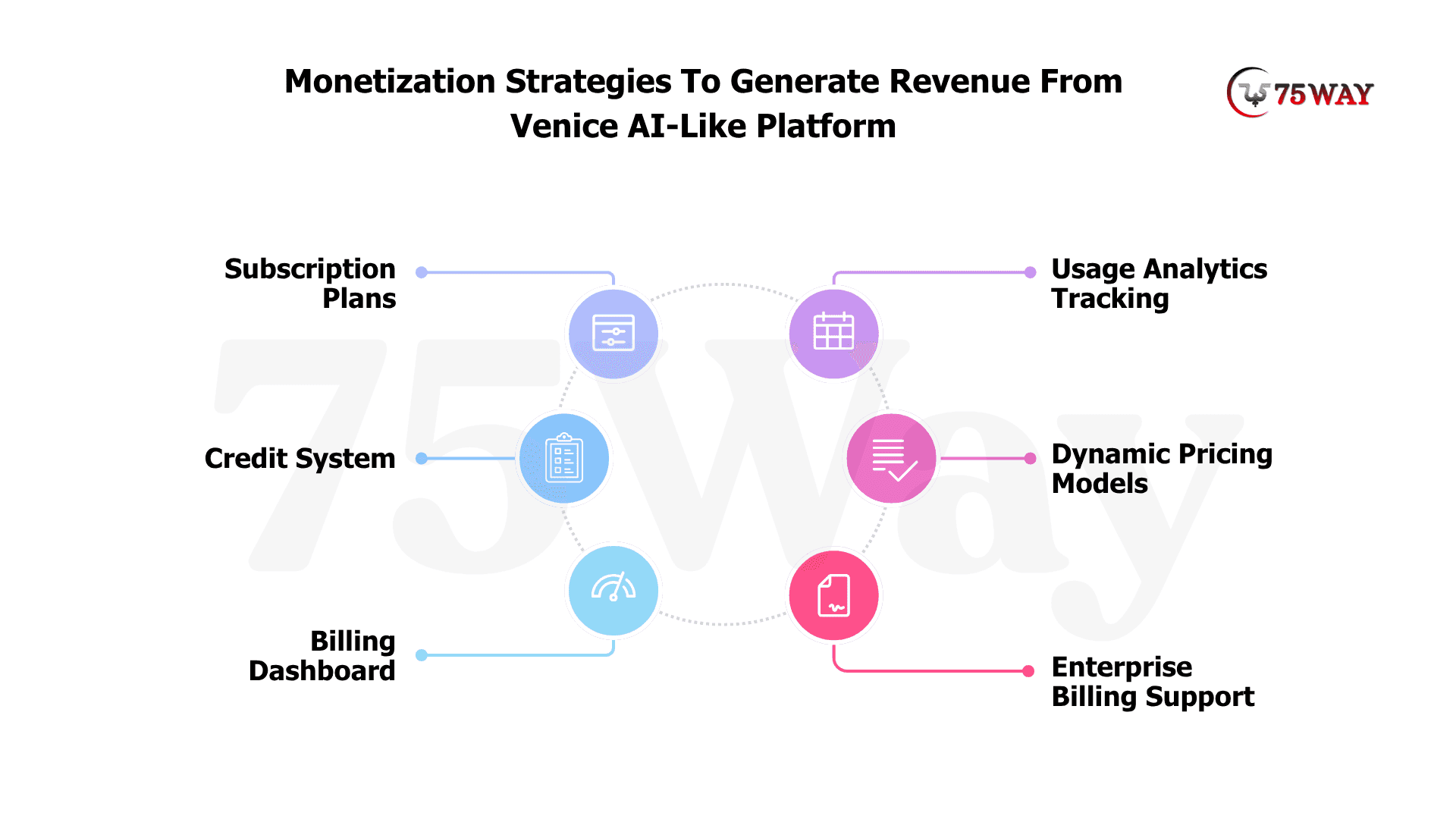
- Subscription Plans: Offer tiered monthly or yearly plans providing different AI access levels, features, and usage benefits
- Credit System: Implement usage-based credits, allowing users to consume AI services based on purchased or earned credits
- Billing Dashboard: Provide a transparent dashboard showing usage, payments, invoices, and subscription details for complete financial control
- Usage Analytics Tracking: Monitor user activity and AI consumption patterns for optimizing pricing strategies and system performance
- Dynamic Pricing Models: Adjust pricing based on demand, model usage, and computational cost variations automatically
- Enterprise Billing Support: Enable custom billing solutions for large organizations with high-volume AI usage requirements.
Advanced Features To Integrate in Venice AI-Like App
To compete with platforms like Venice AI, the product must evolve beyond basic chat functionality into a deeply interactive and intelligent ecosystem. These advanced features enhance usability, personalization, and automation. They also significantly improve user retention, engagement, and overall platform value.
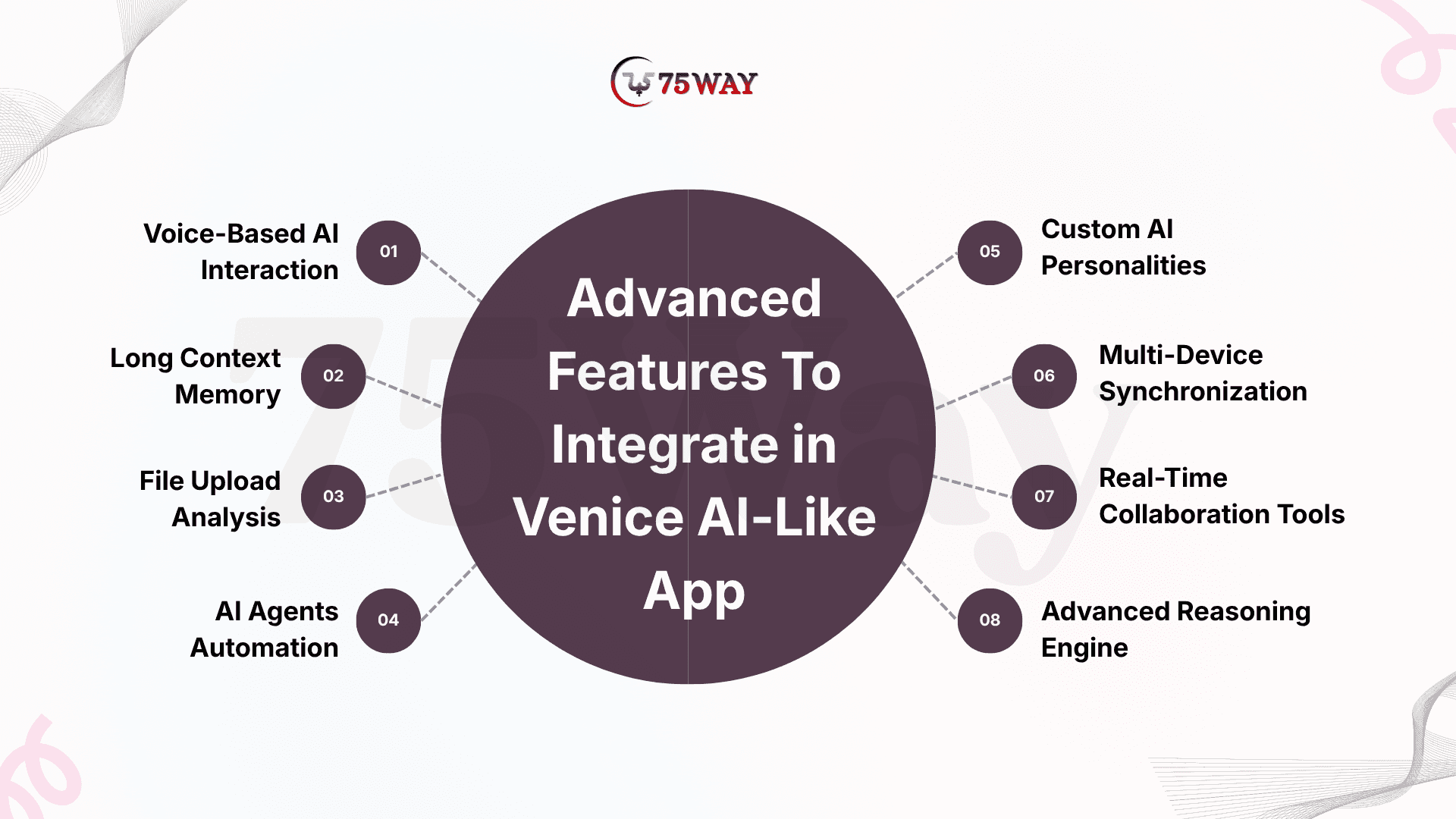
- Voice-Based AI Interaction: Enable users to communicate with AI voice agents using natural speech input and receive spoken responses. This creates hands-free accessibility and improves usability across mobile and multitasking environments. It enhances engagement by making interactions feel more human-like. Speech recognition and synthesis systems power this experience.
- Long Context Memory: Allow the AI system to remember previous conversations and maintain continuity across sessions. This improves personalization and reduces repetitive user input. It helps AI understand long-term user intent and preferences. An efficient memory architecture ensures performance does not degrade over time.
- File Upload Analysis: Let users upload documents, PDFs, spreadsheets, or images for AI-driven interpretation and insights. The system extracts meaningful information and provides summaries or analysis. It supports business, research, and productivity use cases. Secure processing ensures uploaded data is handled safely.
- AI Agents Automation: Enable autonomous AI agents that can perform multi-step tasks without constant user input. These agents can execute workflows, make decisions, and complete objectives independently. It improves productivity by reducing manual effort. Task orchestration systems manage agent behavior and execution flow.
- Custom AI Personalities: Allow users to define unique AI behavior styles, tones, and response patterns. This personalization makes interactions more engaging and aligned with user preferences. It can be used for business branding or individual experiences. Personality layers modify response generation dynamically.
- Multi-Device Synchronization: Ensure seamless AI experience across web, mobile, and desktop platforms. User data, conversations, and settings are synced in real time. This creates continuity regardless of device switching. Cloud-based architecture supports consistent performance across environments.
- Real-Time Collaboration Tools: Enable multiple users to interact with AI in shared sessions or workspaces. Teams can collaborate on content creation, brainstorming, or analysis together. It improves productivity. Access control and permissions manage collaboration.
- Advanced Reasoning Engine: Enhance AI's ability to solve complex problems, perform logical reasoning, and handle multi-step tasks. It integrates specialized models optimized for analytical thinking. This improves accuracy in decision-making scenarios. Hybrid model orchestration ensures better output quality.
Challenges in Building Apps Similar To Venice AI
Building advanced AI platforms involves significant technical, financial, and operational challenges that impact scalability, performance, and reliability. Developers must balance model costs, infrastructure complexity, data privacy, and latency optimization while ensuring seamless user experience across multiple AI systems and services. You will face:
- High infrastructure costs
- GPU dependency
- API pricing fluctuations
- Model latency issues
- Security risks
Solving these requires strong architectural planning.
What’s The Cost To Build An AI Platform Like Venice AI?
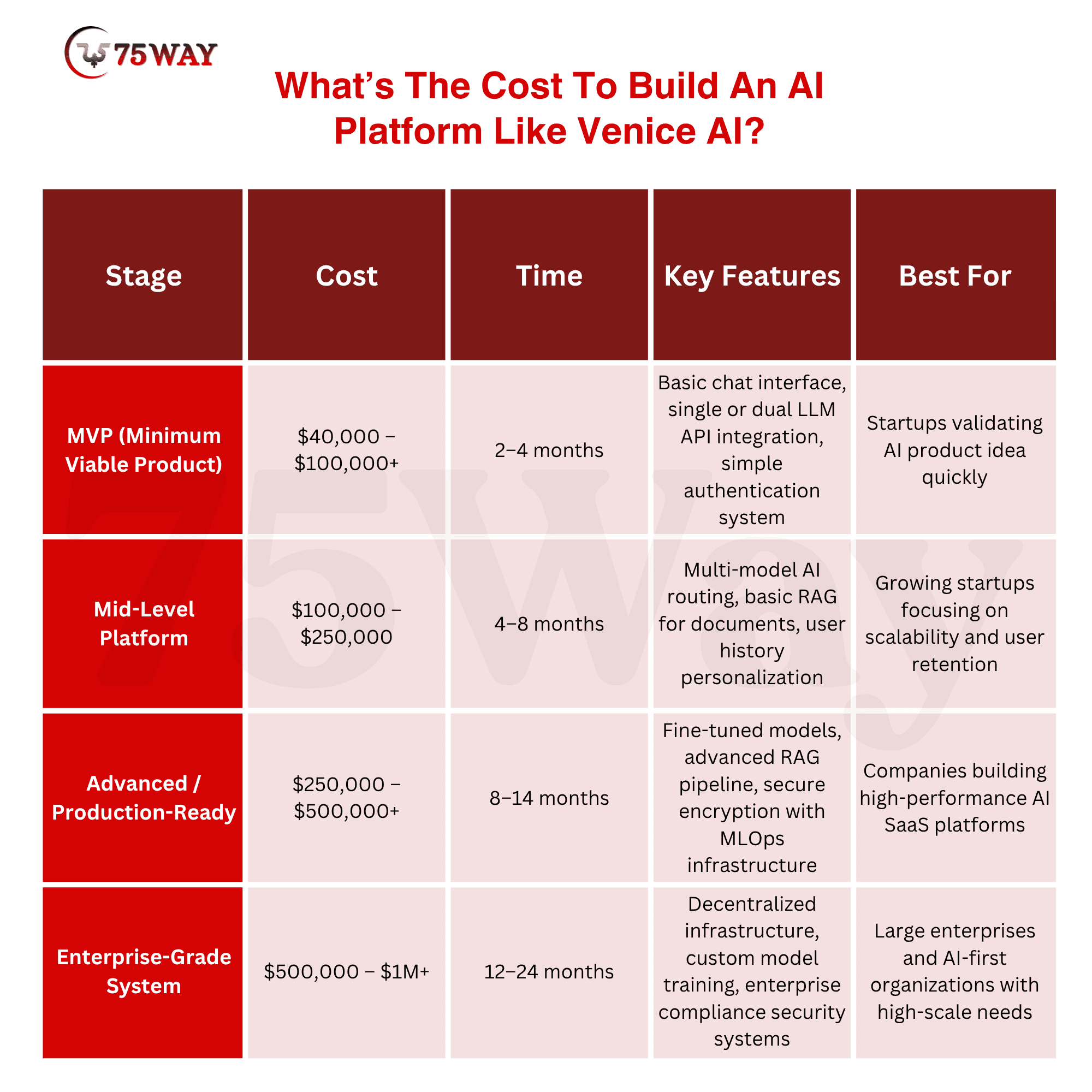
The cost of building an AI platform like Venice AI depends on feature complexity, scalability requirements, AI model usage, and infrastructure design. The average cost to build a Venice AI-like app is between $40,000 and $500,000+. This range widely based on whether you are building a basic MVP or a full enterprise-grade system with advanced AI capabilities and security layers.
- MVP (Minimum Viable Product): $40,000 – $100,000+
Focused on core functionalities to quickly launch, validate, and test the market.
- Mid-Level Platform: $100,000 – $250,000
Includes advanced features, integrations, and enhanced scalability for growing businesses.
- Advanced / Production-Ready: $250,000 – $500,000+
Built for high performance with robust architecture, security, and seamless user experience.
- Enterprise-Grade System: $500,000 – $1M+
Delivers a fully scalable, enterprise-level ecosystem with complex workflows and custom integrations.
Next-Generation Evolution of AI Platforms Like Venice AI
The future of AI applications like Venice AI is rapidly shifting toward autonomous systems, deeply personalized intelligence, and distributed computing ecosystems. These platforms will no longer function as simple tools but will evolve into intelligent infrastructures that power digital work, creativity, and decision-making across industries.
- Fully Autonomous AI Agents: AI agents will independently execute complex multi-step tasks, make decisions, and complete workflows without continuous human intervention or supervision.
- Decentralized AI Compute Systems: AI processing will shift from centralized servers to distributed networks, improving scalability, privacy, and reducing dependency on single cloud providers.
- Personalized AI Assistants: Future AI platforms will deeply adapt to individual user behavior, preferences, and workflows to deliver highly customized and context-aware experiences.
- Real-Time Multimodal Intelligence: AI assistants will process text, voice, images, and video simultaneously, enabling seamless understanding and instant responses across multiple input formats.
- AI Operating System Integration: AI platforms will evolve into core digital operating systems, managing tasks, applications, and workflows across personal and professional environments.
- Edge-Based AI Processing: More computation will occur directly on user devices, reducing latency, improving privacy, and enabling faster, real-time AI interactions without relying on the cloud.
Final Thoughts
Building an AI application like Venice AI is not just a technical challenge, but a product thinking challenge. It requires combining multiple AI models, scalable infrastructure, privacy-first design, and user-centric experience into one seamless system. When you design carefully, even a small team can create powerful AI ecosystems that rival large tech companies. The key is starting with a focused MVP, expanding gradually into multimodal capabilities, and maintaining strong backend scalability. If you are planning to build a scalable AI product, partnering with a trusted AI app development company can help you accelerate development and reduce technical risks.
Frequently Asked Questions (FAQs)
What Is Required To Build An App Like Venice AI?
You need AI model APIs, backend infrastructure, frontend interface, and scalable cloud architecture. A strong understanding of APIs, databases, and AI orchestration systems is essential.
Can A Small Team Build A Venice AI-Like Platform?
Yes, a small team can build it by starting with MVP features like chat AI, then gradually adding image generation and multi-model support.
Is It Necessary To Build Your Own AI Model?
No, most platforms integrate existing models through APIs. Building your own model is optional and resource-intensive.
How Long Does It Take To Build An AI Platform Like Venice AI?
Development time depends on complexity, but a basic MVP can take two to four months for a small, skilled team. Advanced multimodal platforms may require six to twelve months with scalable infrastructure and proper AI integration systems.
What Is The Biggest Cost Factor In Building Venice AI-Like Apps?
The highest cost usually comes from AI model usage, especially API calls and GPU-based processing for image generation and large language models. Infrastructure scaling, cloud hosting, and real-time processing also significantly impact overall operational expenses.
How Do AI Platforms Like Venice AI Handle Scalability?
They use microservices architecture, load balancing, and cloud-based infrastructure to manage increasing user demand. Caching systems, queue management, and distributed computing ensure stable performance even during high traffic and intensive AI processing workloads.