Summary
AI customer service agents reshape enterprise support systems through automation, conversational intelligence, and predictive assistance. This guide explores architecture, features, benefits, use cases, development stages, integration models, cost structure, and emerging AI trends shaping next-generation customer engagement systems across industries including SaaS, fintech, healthcare, and eCommerce.
Quick Overview
- AI agents reduce customer support workload through automation systems
- Businesses gain faster response times and improved user satisfaction
- NLP-powered systems enable human-like conversational customer interactions
- Integration with CRMs improves workflow automation and ticket handling
- AI agents lower operational costs across large support teams
Businesses across industries now expect instant responses, personalized assistance, and consistent service quality across every communication channel.
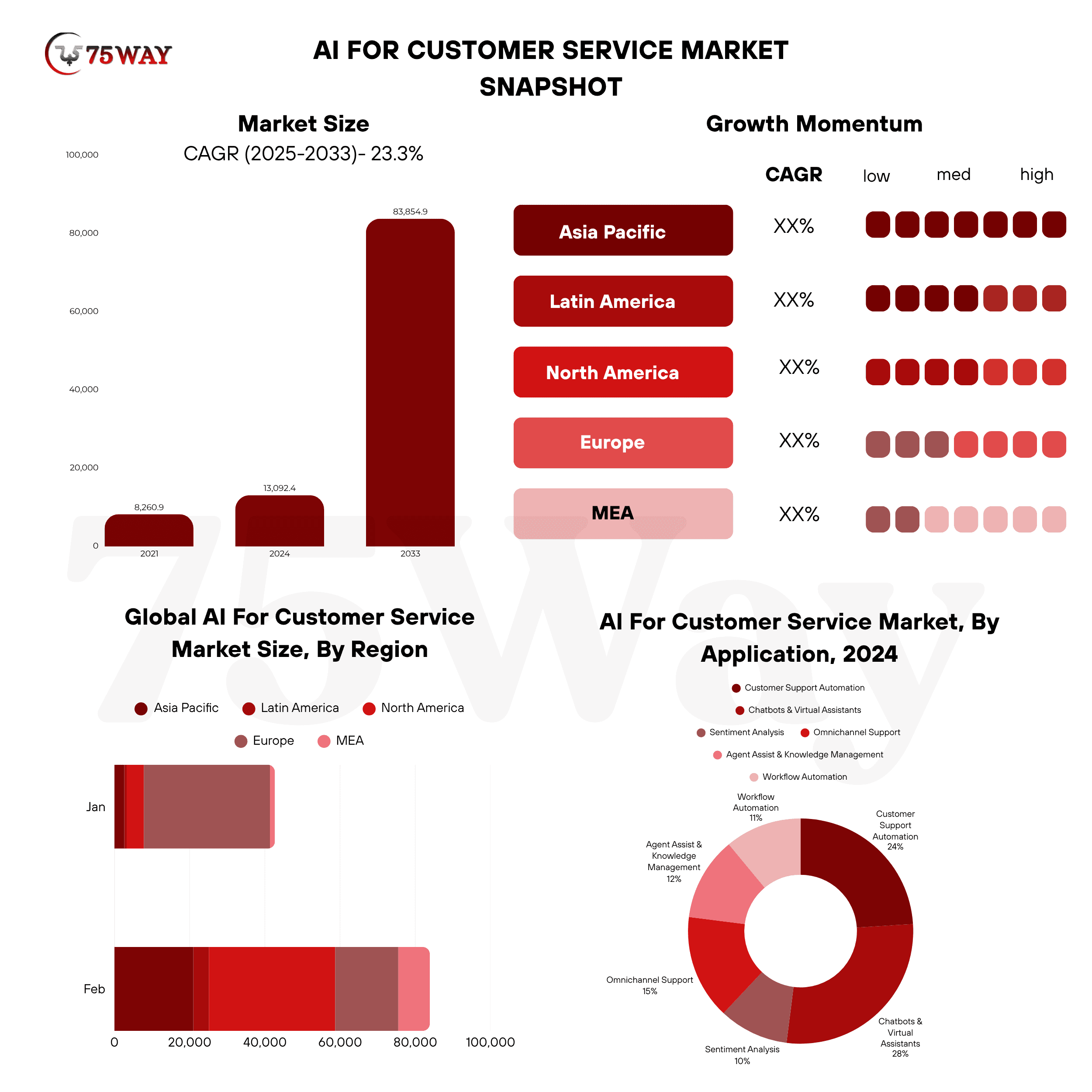
AI customer service agents represent the next evolution of this transformation. These systems combine natural language processing, machine learning, and AI automation workflows to handle customer queries without constant human intervention. In fact, the global AI for customer service market is projected to grow from USD 13,012.4 million in 2024 to USD 83,854.9 million by 2033, registering a CAGR of 23.2%.
Unlike basic chatbots, modern AI agents for customer support understand intent, context, sentiment, and historical interactions. They can resolve complex queries, escalate issues when necessary, and continuously improve through data-driven learning models.
Enterprises adopting AI-driven support systems are experiencing reduced operational costs, faster resolution times, and improved customer satisfaction scores. This guide explores AI customer service agent development, including features, benefits, architecture, technology stack, development process, integration strategies, cost structure, and future trends shaping enterprise automation systems.
What Is An AI Customer Service Agent?
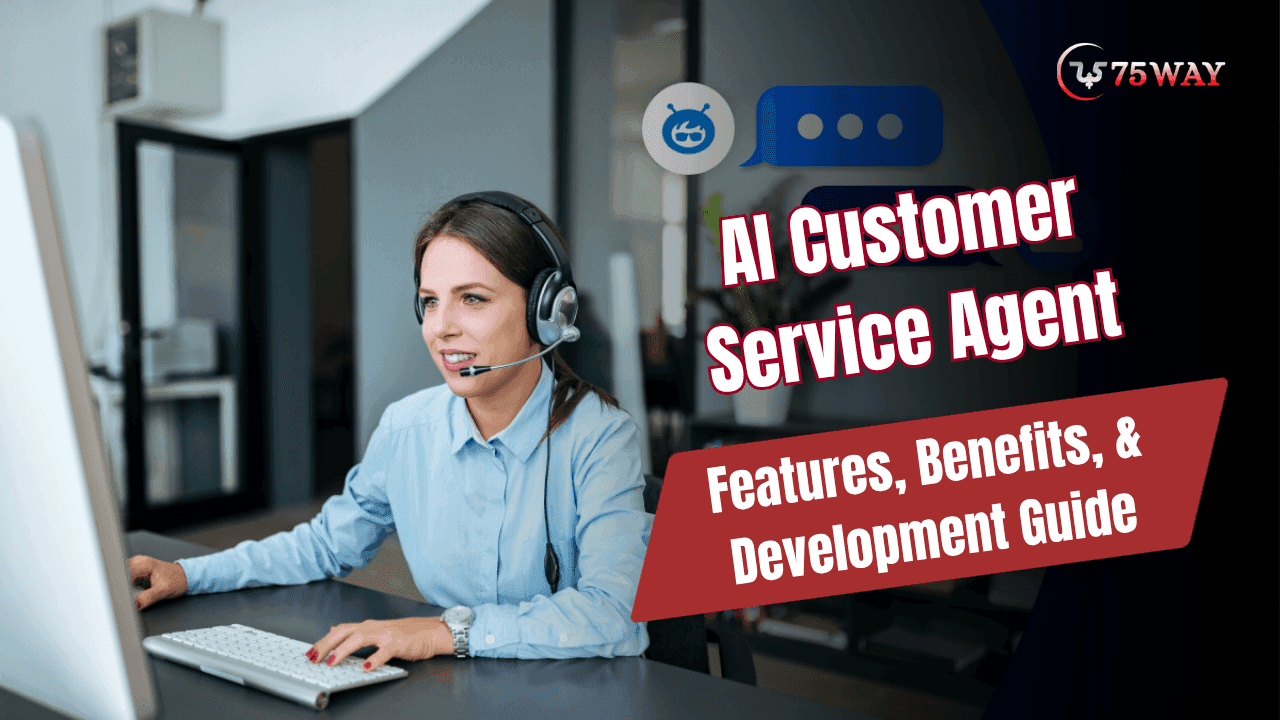
An AI customer service agent is an intelligent software system designed to handle customer interactions across chat, email, voice, and messaging platforms using artificial intelligence technologies. It acts as a virtual support representative that can understand user intent, respond in real time, and assist customers throughout their service journey.
These systems are built using natural language processing, machine learning, and automation workflows, allowing them to interpret complex queries instead of relying on fixed scripts. They can manage a wide range of tasks such as answering FAQs, resolving basic issues, guiding users through processes, and escalating cases when human assistance is required. It can:
- Understand customer queries in natural language
- Provide real-time and contextual responses
- Resolve common issues without human intervention
- Escalate complex cases to support teams
- Continuously improve from past interactions and feedback
Unlike traditional rule-based chatbots, AI customer service agents adapt to conversations and learn over time. This makes them more efficient, scalable, and capable of delivering human-like support experiences across multiple channels.
Why Businesses Are Adopting AI Customer Service Agents?
Businesses are rapidly shifting toward AI-powered customer service systems as customer expectations evolve and traditional support models struggle to keep up. AI customer service agents bridge this gap by combining automation, intelligence, and conversational capability into a single system.
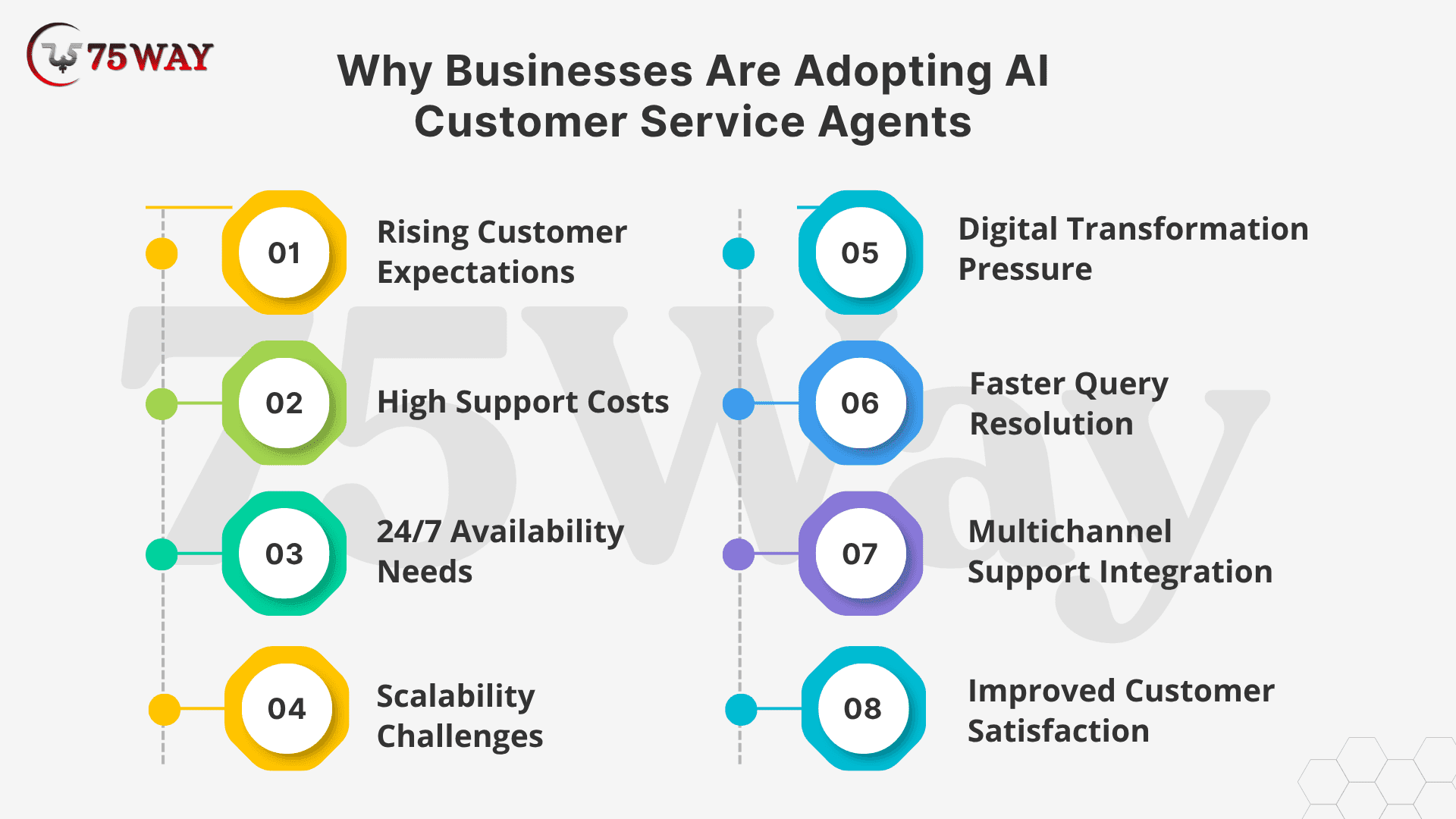
- Rising Customer Expectations: Customers now expect immediate responses across chat, email, apps, and voice channels without waiting in long queues or dealing with delayed support cycles. AI agents help businesses meet this expectation by delivering instant, context-aware replies that improve overall experience consistency.
- High Support Costs: Traditional support systems rely heavily on large teams, training processes, and infrastructure investments, which significantly increase operational expenses. AI agents reduce dependency on human agents by handling repetitive queries and routine tasks efficiently at scale.
- 24/7 Availability Needs: Modern businesses operate globally across multiple time zones, making round-the-clock support essential for customer satisfaction. AI customer service agents ensure continuous availability without breaks, shifts, or downtime, improving accessibility for users anytime.
- Scalability Challenges: During peak traffic periods or product launches, human support teams often struggle to manage sudden spikes in queries. AI systems handle unlimited concurrent conversations, ensuring stable response times even during high-demand situations.
- Digital Transformation Pressure: Enterprises are increasingly adopting AI-first strategies to modernize operations and stay competitive in a rapidly evolving digital ecosystem. Customer service automation has become a key part of this transformation journey.
- Faster Query Resolution: AI agents reduce resolution time by quickly analyzing user queries, identifying intent, and providing accurate solutions without multiple handoffs. This helps improve efficiency and reduces friction in customer interactions.
- Multichannel Support Integration: Businesses need unified support across multiple platforms such as websites, mobile apps, email, and messaging services. AI agents centralize all communication channels into a single intelligent system for consistent responses.
- Improved Customer Satisfaction: Faster responses, reduced waiting time, and accurate resolutions contribute directly to a better customer experience. Over time, this strengthens trust, retention, and brand loyalty across customer segments.
Key Features of AI Agents for Customer Service
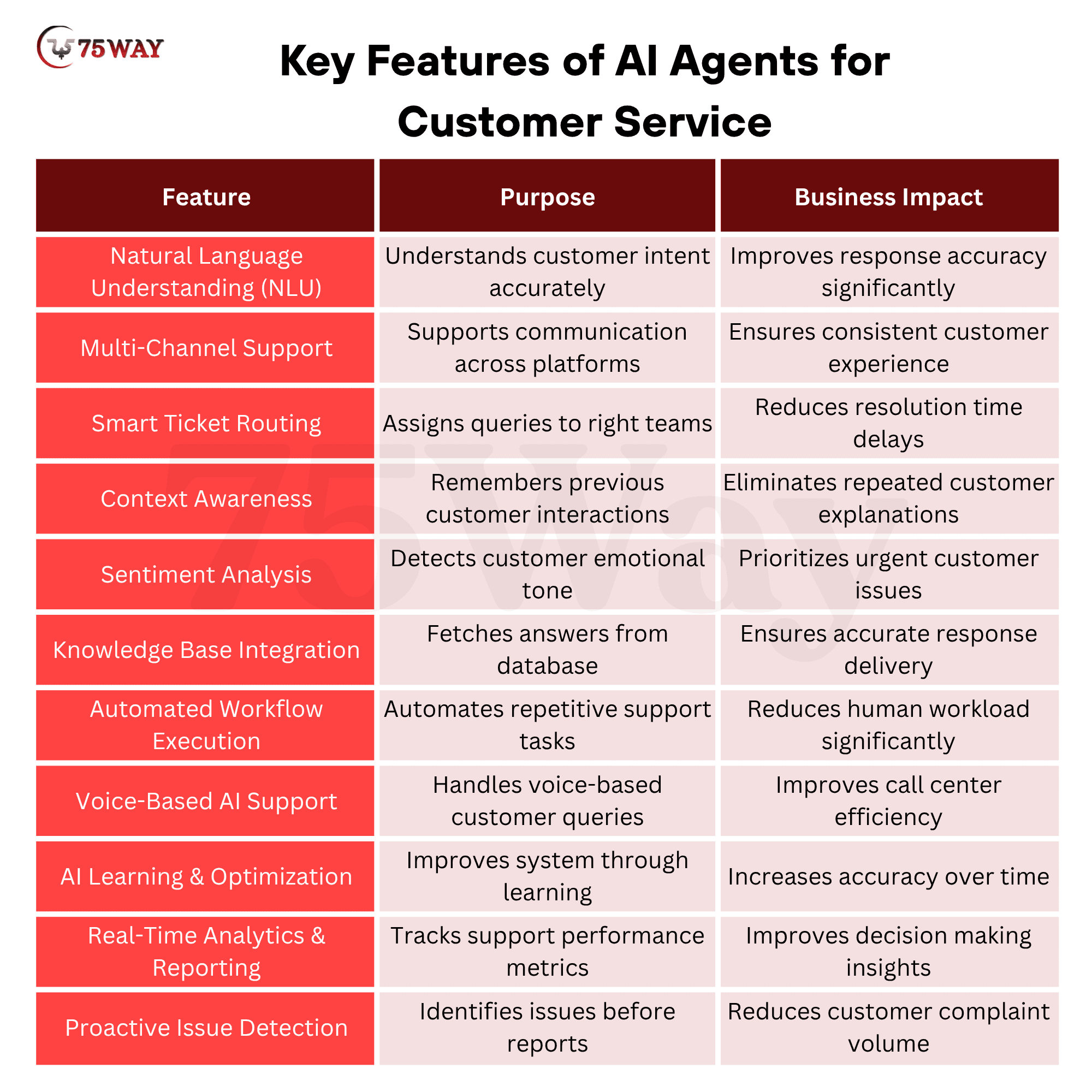
AI customer service agents combine natural language processing, automation, and machine learning to deliver intelligent and scalable customer support. These systems are designed to understand user intent, manage conversations across channels, and execute tasks with minimal human involvement.
- Natural Language Understanding (NLU): AI agents understand customer intent beyond exact words by analyzing meaning, context, and variations in language. This allows the system to handle different ways users ask the same question and still deliver accurate responses that feel more human and relevant.
- Multi-Channel Support: The system connects with multiple platforms such as websites, mobile apps, email, WhatsApp, and social media channels. This ensures customers receive a consistent support experience regardless of where they interact with the business.
- Smart Ticket Routing: Incoming customer queries are automatically analyzed and assigned to the most suitable department or support agent. This reduces manual sorting efforts and ensures faster resolution of customer issues.
- Context Awareness: The system stores and understands previous conversations to maintain continuity in support interactions. This helps customers avoid repeating information and creates a smoother, more personalized experience.
- Sentiment Analysis: AI detects emotional tone from customer messages such as frustration, satisfaction, or urgency. This helps businesses prioritize critical issues and respond in a more appropriate and sensitive manner.
- Knowledge Base Integration: The system is connected with internal documents, FAQs, and enterprise knowledge systems to fetch accurate answers. This ensures customers receive reliable information without delays or inconsistencies.
- Automated Workflow Execution: Routine customer service tasks like password resets, order tracking, and refund requests are handled automatically. This reduces dependency on human agents and speeds up resolution time.
- Voice-Based AI Support: The system supports voice interactions through speech recognition technology for handling calls and spoken queries. This improves accessibility and enables more efficient call center automation.
- AI Learning & Optimization: The system continuously improves by learning from past conversations and user interactions. Over time, this leads to better accuracy, faster responses, and improved customer satisfaction.
- Real-Time Analytics & Reporting: The system tracks customer interactions, response time, and resolution performance in real time. This helps businesses identify gaps and improve overall support efficiency.
- Proactive Issue Detection: The system identifies potential customer problems by analyzing behavior patterns and system signals. This allows businesses to resolve issues before users even report them.
What Are The Benefits of Adopting AI Customer Service Agents?
AI customer service agents are transforming how businesses manage customer interactions by improving efficiency, reducing costs, and enhancing overall service quality. These systems allow companies to deliver faster, more consistent, and scalable support experiences while reducing dependency on traditional support structures.
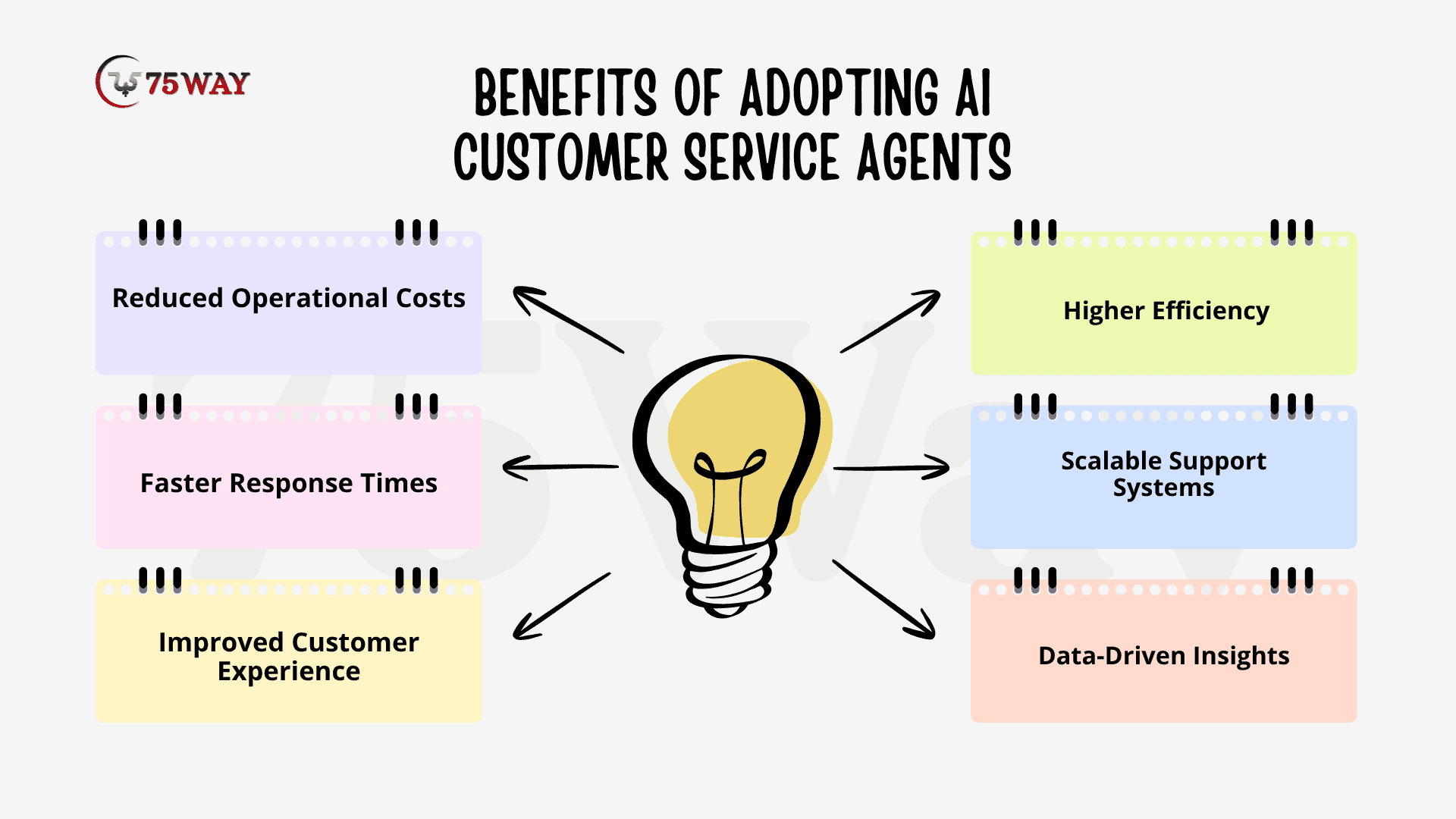
- Reduced Operational Costs: AI systems minimize the need for large customer support teams by handling repetitive and routine queries automatically. This significantly lowers staffing, training, and infrastructure expenses while maintaining service quality.
- Faster Response Times: Customer queries are addressed instantly without waiting in queues or ticket backlogs. This improves resolution speed and increases overall customer satisfaction levels.
- Improved Customer Experience: AI provides personalized and context-aware responses based on user history and behavior. This creates smoother interactions and strengthens customer engagement with the brand.
- Higher Efficiency: Human agents are freed from repetitive tasks and can focus on complex or high-priority issues. This improves overall productivity and service effectiveness across support teams.
- Scalable Support Systems: AI agents can manage thousands of conversations simultaneously without performance issues. This makes it easier for businesses to handle high traffic during peak demand periods.
- Data-Driven Insights: AI systems collect and analyze customer interaction data to identify patterns and trends. This helps businesses understand customer behavior, recurring issues, service gaps, and product improvement opportunities.
AI Customer Service Agent Architecture: Complete Working Process
A robust AI customer service system is built using multiple interconnected layers that work together to process, understand, and respond to customer queries efficiently. Each layer plays a specific role in delivering accurate, fast, and scalable support experiences.
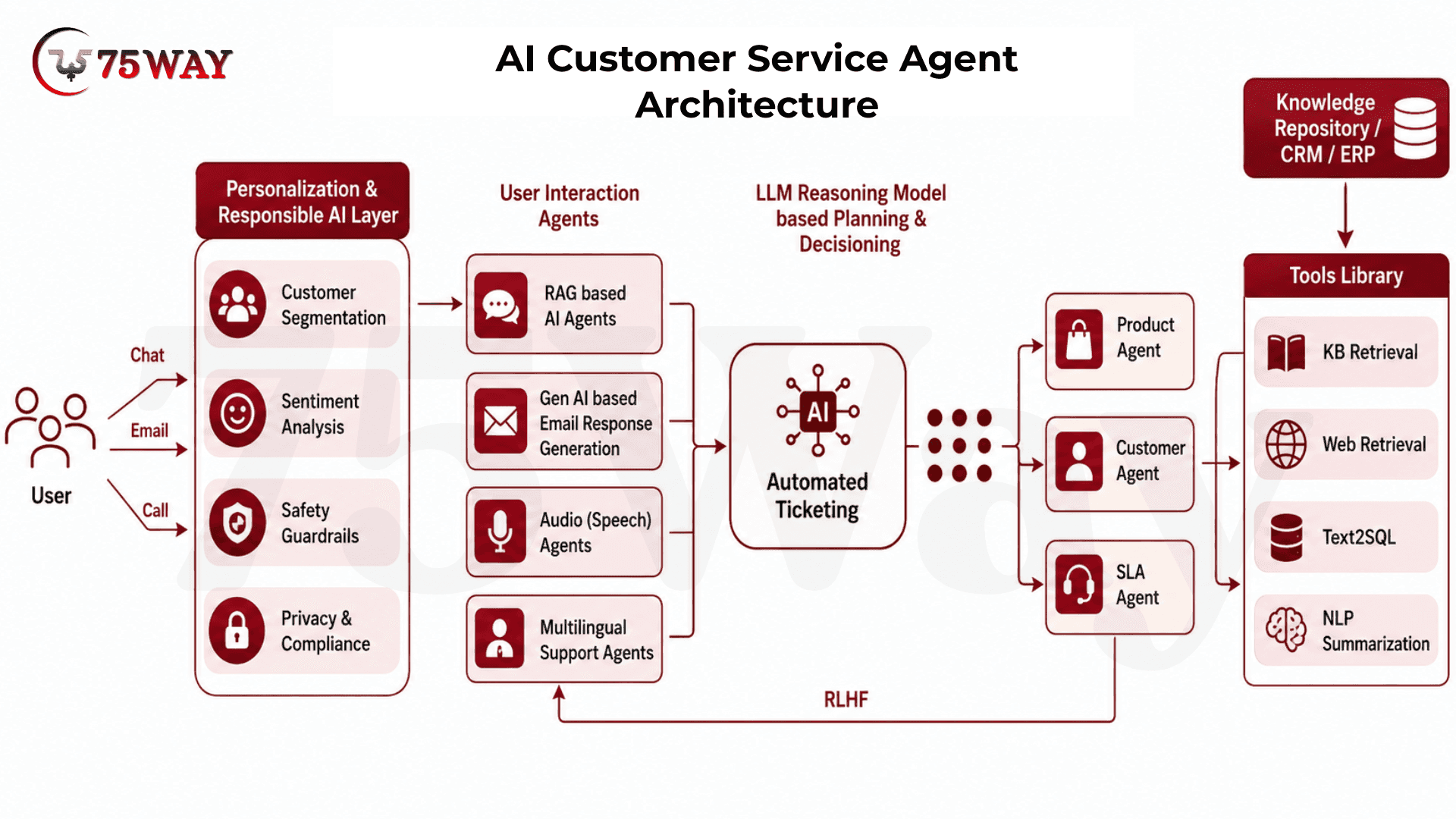
1. User Interface: This layer acts as the entry point for all customer interactions across chat widgets, mobile apps, voice interfaces, and messaging platforms. It ensures users can connect with the system through their preferred communication channel. A smooth interface improves accessibility and engagement. It also standardizes how queries are captured before processing.
2. NLP Engine: The NLP engine interprets customer input by detecting intent, extracting entities, and processing language context. It helps the system understand what the user is asking beyond simple keywords. This layer converts raw text or speech into structured data. It ensures accurate understanding of customer needs.
3. AI/ML Model: This layer uses advanced models like LLMs, classification systems, and recommendation engines to generate intelligent responses. It analyzes user intent and selects the most relevant output. The system continuously improves through learning from past interactions. It enhances decision-making and personalization.
4. Backend Processing: The backend layer manages core business logic, API calls, and workflow automation processes. It connects different system components and ensures smooth data flow. This layer handles the execution of tasks triggered by AI decisions. It keeps the entire system stable and responsive.
5. Knowledge Base System: This system stores structured information such as FAQs, product documentation, and support articles. It acts as a central source of truth for generating accurate responses. The AI retrieves relevant data from this repository during conversations. It ensures consistency and reliability in answers.
6. Integration Layer: The integration layer connects the AI system with external tools like CRM platforms, payment gateways, ticketing systems, and ERP solutions. It enables seamless data exchange across business systems. This allows automated updates and synchronized workflows. It ensures end-to-end operational connectivity.
A Step-by-Step Process To Develop AI Customer Service Agent
Building an AI customer service agent is a step-by-step engineering journey where each stage naturally depends on the previous one. It starts from understanding business needs, moves through data and model building, and ends with deployment and continuous improvement to ensure the system performs reliably in real customer environments.
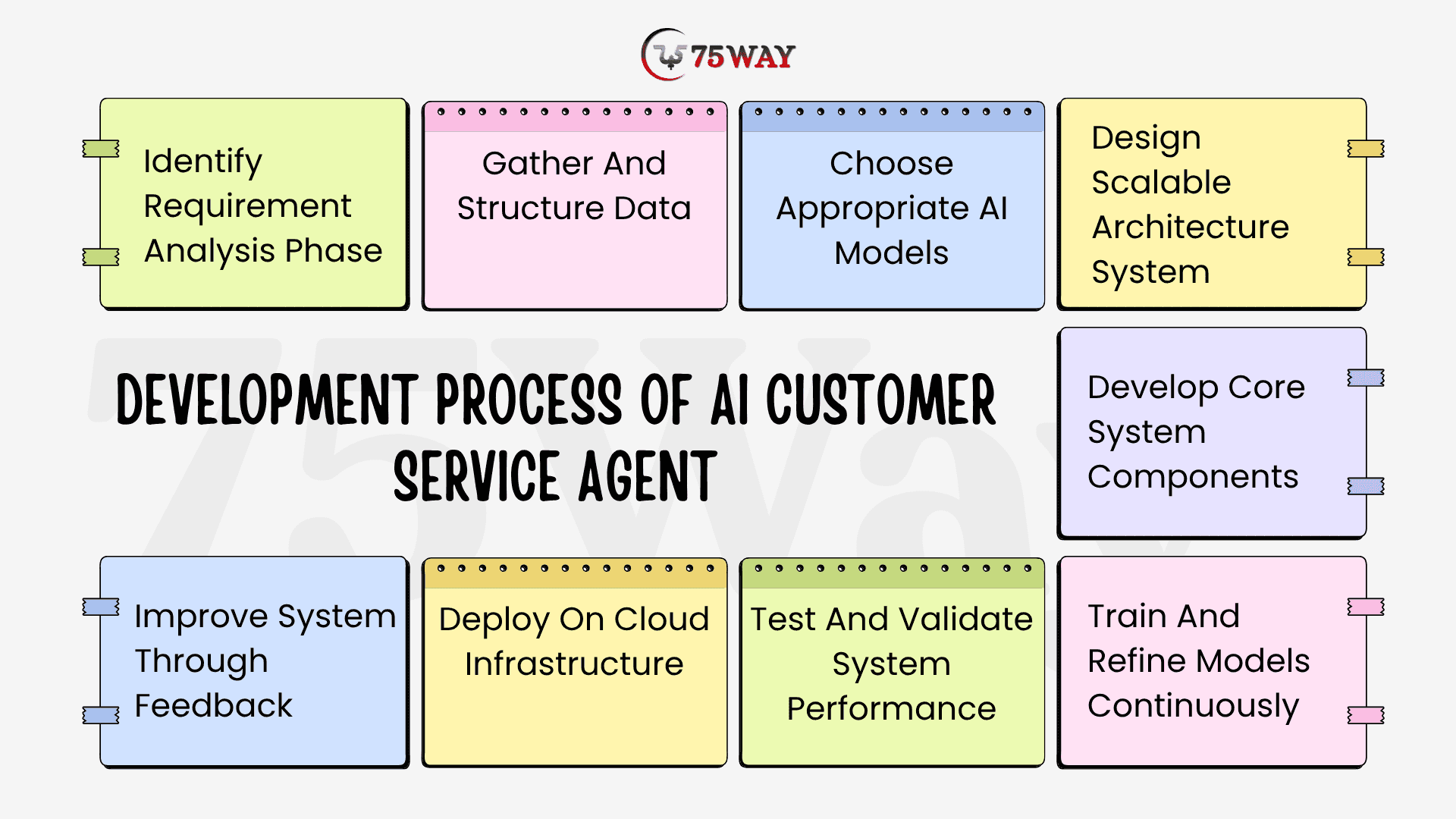
Step 1: Identify Requirement Analysis Phase
The process begins by clearly identifying business goals, customer support challenges, and expected user interactions. This step ensures everyone understands what the AI system is supposed to solve before any technical work begins. These requirements also guide how conversations should flow and what level of automation is needed across support channels.
Step 2: Gather And Structure Data
Once requirements are defined, the focus shifts to collecting real customer interaction data such as chats, emails, and support tickets. This data is then cleaned and structured so it can be effectively used for training. Without this foundation, the system cannot accurately understand real-world customer queries or patterns.
Step 3: Choose Appropriate AI Models
After data preparation, suitable AI models are selected based on complexity, language understanding needs, and expected use cases. This decision directly impacts how well the system interprets user intent. The selected models must align with the earlier requirements so the system behaves consistently across different customer scenarios.
Step 4: Design Scalable Architecture System
With models selected, system architecture is designed to connect all components, including APIs, databases, and AI modules. This structure defines how data moves through the system and how responses are generated. A well-planned architecture ensures the system remains scalable and stable as user demand increases over time.
Step 5: Develop Core System Components
Once the design is finalized, development begins by building frontend interfaces, backend systems, and AI functionalities together. These components are gradually integrated so the system starts functioning as a complete product. Each part is connected carefully to ensure smooth communication between user interactions and AI processing.
Step 6: Train And Refine Models Continuously
After development, AI models are trained using structured datasets to improve accuracy and understanding. As training progresses, the system begins to refine its responses and reduce errors. Continuous optimization ensures the agent becomes more intelligent over time and adapts better to real customer conversations.
Step 7: Test And Validate System Performance
Before deployment, the system is thoroughly tested to ensure it performs well under real-world conditions. Testing includes accuracy checks, performance evaluation, and scalability assessments. This stage ensures that all components work together smoothly and the system can handle live customer interactions without failures.
Step 8: Deploy On Cloud Infrastructure
Once testing is complete, the system is deployed on secure cloud infrastructure or enterprise servers. This makes it accessible to users across multiple platforms while ensuring stability and performance. Deployment marks the transition from development to real-world usage where the system begins handling live customer queries.
Step 9: Improve System Through Feedback
After deployment, the system continues to evolve through feedback loops and performance monitoring. Real user interactions help identify gaps and improve response quality. This continuous improvement cycle ensures the AI customer service agent stays relevant, accurate, and effective as customer expectations and business needs change over time.
Technology Stack For AI Customer Service Agent Development
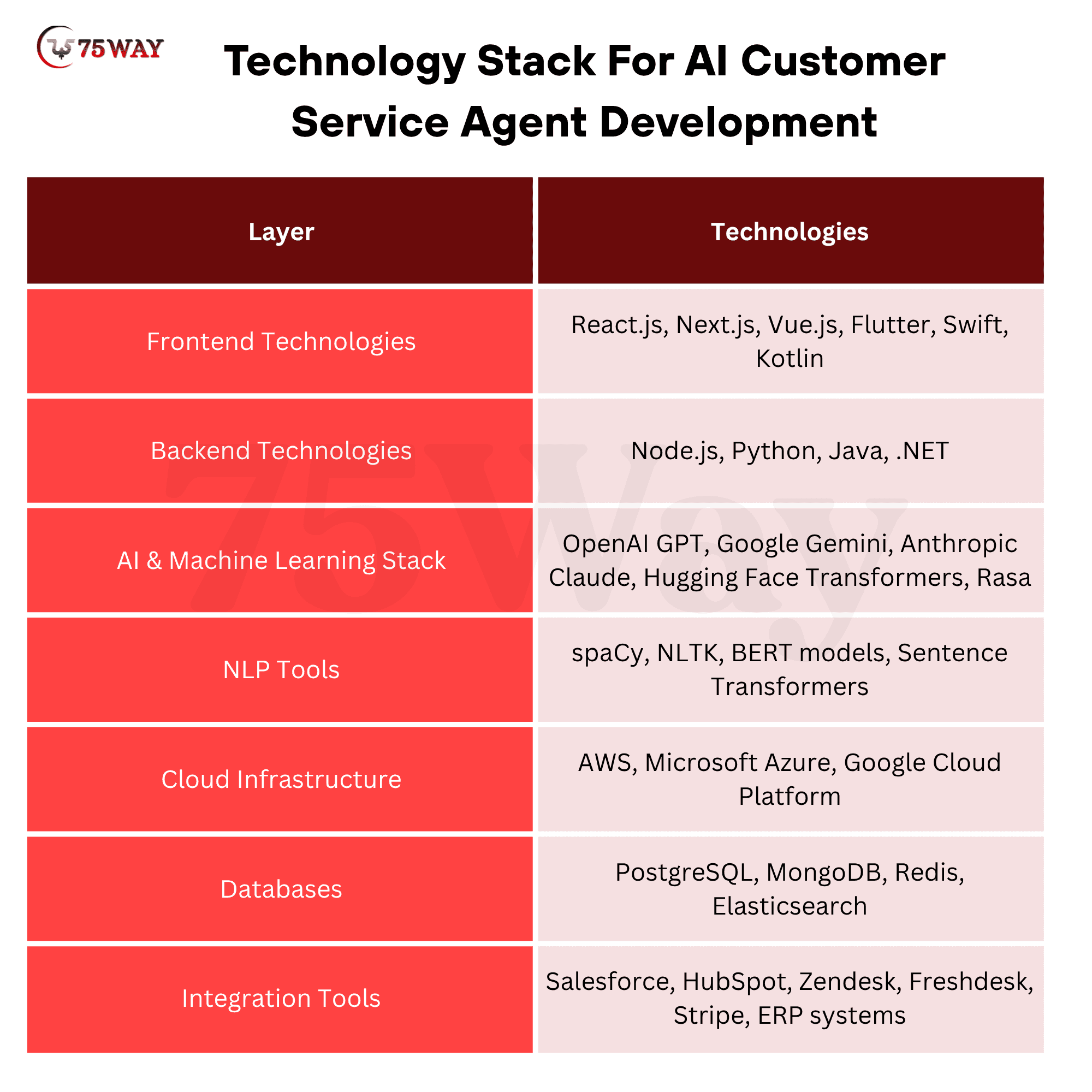
Choosing the right technology stack is essential for building an AI customer service agent that is scalable, reliable, and capable of delivering accurate real-time responses. Each layer of the system, from frontend interfaces to AI models and cloud infrastructure, works together to ensure smooth conversations, fast processing, and seamless integration with business tools.
Frontend technologies are responsible for creating user-facing conversational experiences across web and mobile platforms. Frameworks like React.js and Next.js are commonly used for building interactive chat interfaces, while Vue.js supports lightweight UI development. For mobile applications, Flutter enables cross-platform deployment, and native technologies like Swift and Kotlin ensure high-performance mobile experiences. These tools help deliver smooth, real-time interactions with minimal latency.
On the backend and intelligence side, technologies like Node.js, Python, Java, and .NET handle system logic, API communication, and large-scale request processing. AI capabilities are powered by models such as OpenAI GPT, Google Gemini, Claude, and Hugging Face Transformers, which enable natural language understanding and response generation. Supporting this, NLP tools like spaCy, BERT, and Sentence Transformers improve intent detection and semantic accuracy, while cloud platforms like AWS, Azure, and Google Cloud ensure scalability, high availability, and secure deployment across global users.
Cost To Build An AI Customer Service Agent
The cost of building an AI customer service agent depends on system complexity, AI capabilities, integrations, and infrastructure requirements. Simpler systems with basic chatbot functionality are more affordable, while enterprise-grade solutions with advanced AI, automation, and omnichannel support require significantly higher investment.
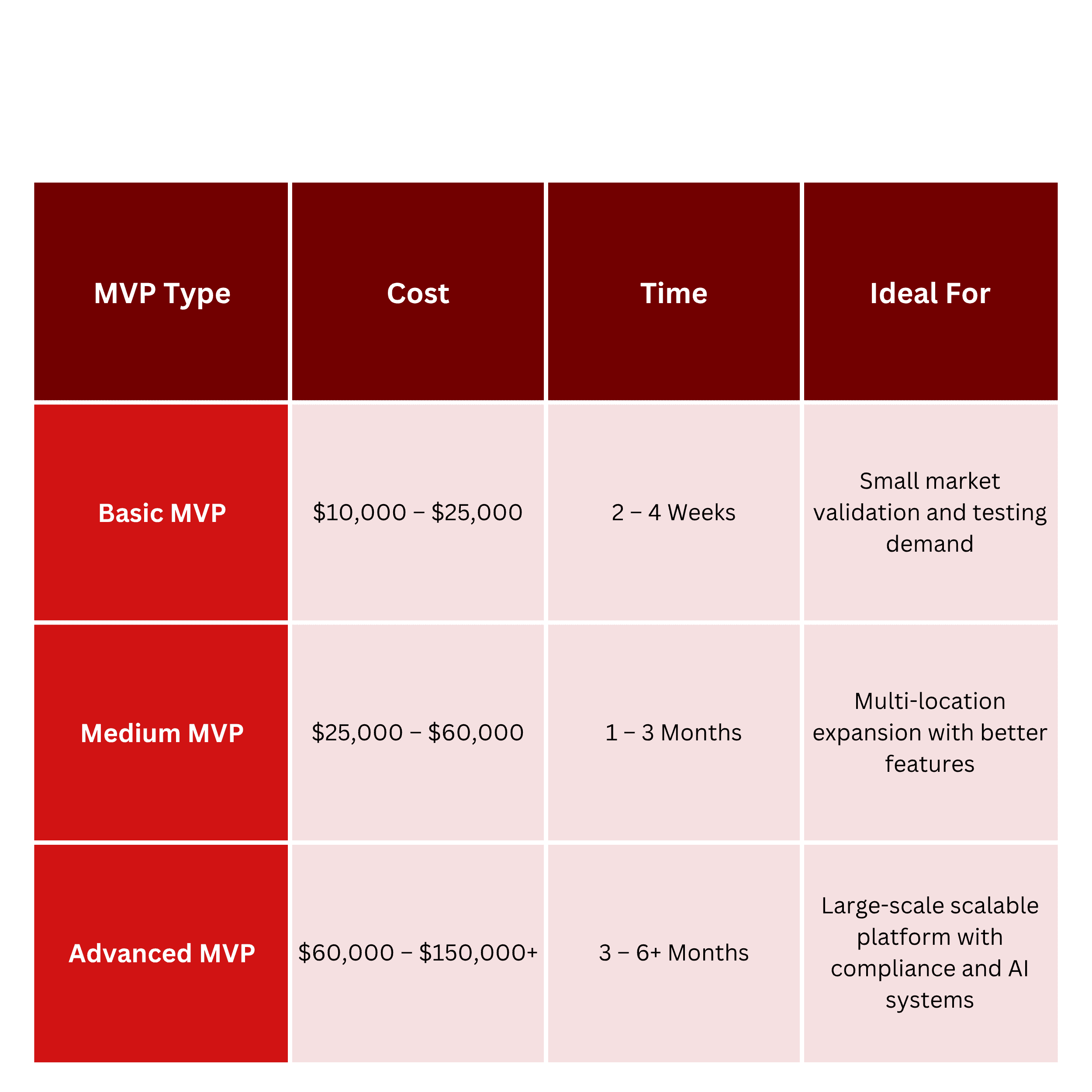
- Basic AI Customer Service Agent: It typically costs between $20,000 and $50,000 and includes features like a simple chatbot interface, FAQ-based responses, basic NLP integration, and limited automation workflows. This version is best suited for startups and MVP development where the goal is to validate the idea with minimal features.
- Mid-Level AI Customer Service Agent: It generally ranges from $50,000 to $120,000 and offers more advanced capabilities such as multi-channel support, CRM integration, AI-powered intent recognition, ticket automation, and analytics dashboards. It is ideal for growing businesses that need better efficiency and customer engagement across multiple platforms.
- Enterprise AI Customer Service Agent: This agent can cost anywhere from $120,000 to $400,000 or more, depending on scale and customization. It includes advanced LLM integration, voice-based AI support, predictive analytics, omnichannel orchestration, strict security frameworks, and large-scale deployment capabilities. This level is designed for global enterprises that require high performance, compliance, and scalability.
Cost To Build AI Customer Service Agent Based on Stages
- UI/UX Design: $5,000 – $25,000
- Backend Development: $10,000 – $80,000
- AI Model Integration: $15,000 – $120,000
- Cloud Infrastructure: $5,000 – $40,000
- Testing & QA: $5,000 – $20,000
- Maintenance (Yearly): 15%–25% of total cost
Enterprise Use Cases of AI Customer Service Agents
AI customer service agents are transforming enterprise operations by automating support, improving response times, and delivering personalized customer experiences across multiple digital channels. These systems help organizations reduce workload, enhance efficiency, and scale customer engagement without increasing operational costs.
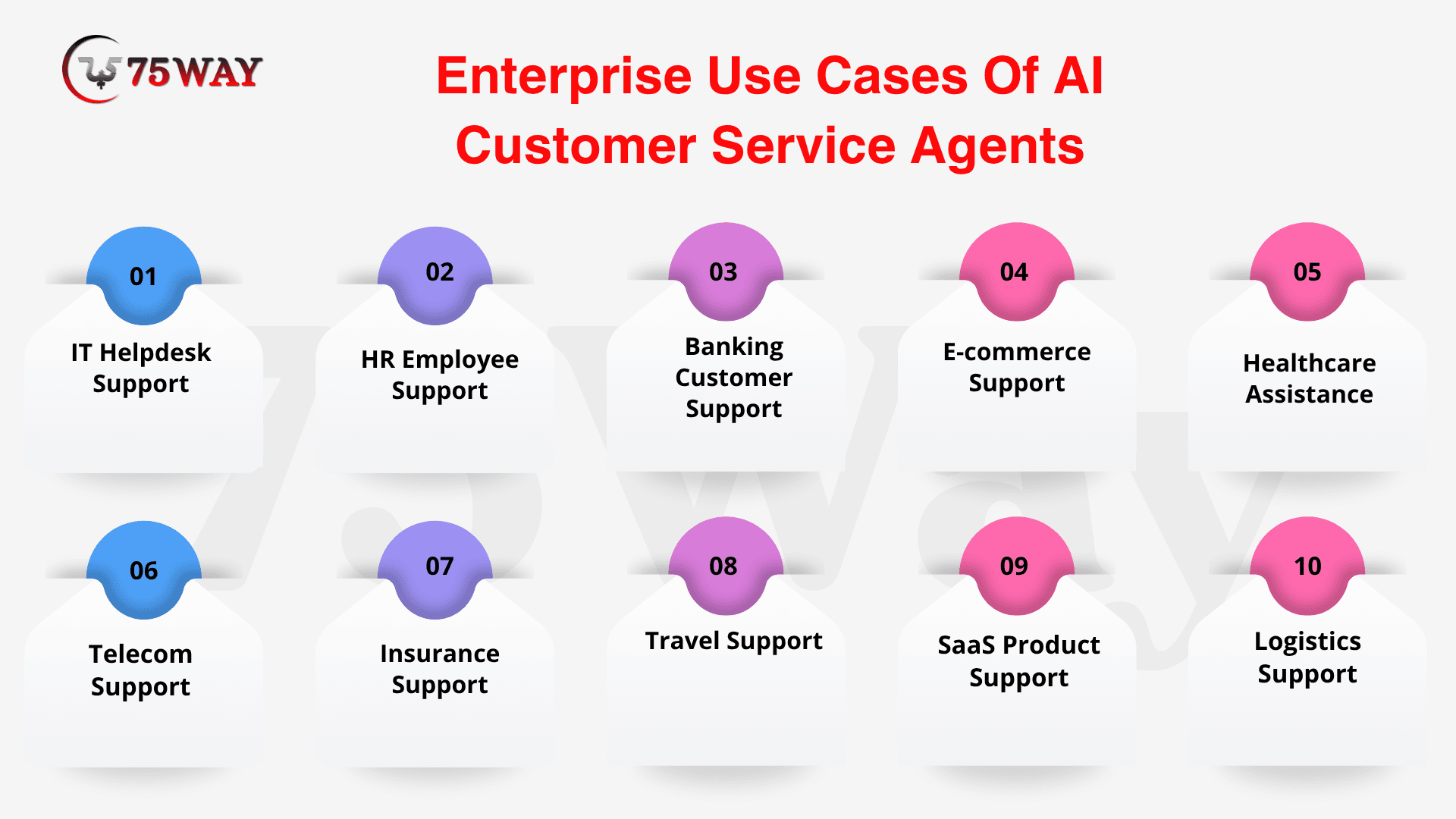
1. IT Helpdesk Support: Resolves employee IT issues such as password resets, system access, and troubleshooting requests quickly while reducing dependency on human support teams.
2. HR Employee Support: Handles HR-related queries including payroll, leave policies, onboarding details, and internal document access across enterprise systems efficiently.
3. Banking Customer Support: Assists customers with account details, transaction history, loan information, and fraud alerts through real-time digital communication channels.
4. E-commerce Support: Manages order tracking, returns, refunds, and product-related queries while improving customer satisfaction and reducing operational workload.
5. Healthcare Assistance: Supports appointment scheduling, patient inquiries, report access, and basic medical guidance within secure healthcare enterprise environments.
6. Telecom Support: Resolves network issues, billing questions, recharge services, and account activation requests for large-scale telecom customer bases.
7. Insurance Support: Provides policy information, claim status updates, premium calculations, and renewal reminders for insurance customers across digital platforms.
8. Travel Support: Handles booking modifications, cancellations, itinerary details, and travel-related assistance across airlines, hotels, and travel services.
9. SaaS Product Support: Offers onboarding guidance, feature explanations, troubleshooting help, and subscription management for enterprise SaaS users.
10. Logistics Support: Tracks shipments, delivery updates, warehouse status, and customer inquiries across supply chain and logistics operations.
Final Thoughts
AI customer service agents are transforming enterprise support systems by enabling intelligent automation, faster response times, and scalable customer engagement. Businesses adopting AI-driven solutions benefit from reduced operational costs, improved user satisfaction, and data-driven decision-making capabilities. With advancements in large language models, automation frameworks, and cloud infrastructure, these systems are becoming more powerful and accessible. Organizations that invest early in AI customer service technology gain a strong competitive advantage in digital markets. They can partner with a leading AI agent development company that specializes in building enterprise-grade conversational AI solutions powered by LLMs, automation, and secure cloud architecture.
Frequently Asked Questions (FAQs)
What Is The Difference Between AI Chatbots And AI Customer Service Agents?
AI chatbots follow predefined rules, while AI customer service agents use advanced reasoning and contextual learning. Agents understand intent, history, and sentiment. This allows them to handle complex and multi-step customer interactions more effectively.
How Do AI Customer Service Agents Handle Multiple Languages?
Modern AI agents use multilingual language models trained on diverse datasets. They detect language automatically and respond accordingly. This enables global businesses to offer seamless support across different regions without separate support teams.
How Do AI Customer Service Agents Learn Over Time?
They improve through continuous learning mechanisms such as feedback loops, retraining models, and analyzing customer interactions. Human corrections and new data inputs refine accuracy. This makes responses more precise over time.
What Kind of Businesses Need AI Customer Service Agents The Most?
Businesses with high customer interaction volumes benefit the most. This includes eCommerce platforms, fintech companies, SaaS providers, healthcare services, and telecom operators. These industries deal with repetitive queries and require scalable support systems.
What Are The Risks of Using AI In Customer Support?
Risks include inaccurate responses, data privacy concerns, and over-reliance on automation. Poor training data can reduce reliability. Proper governance, monitoring, and human oversight minimize these risks effectively.
Can AI Customer Service Agents Increase Sales?
Yes, AI agents can upsell products, recommend services, and guide users through purchase decisions. They analyze user behavior and suggest relevant offerings. This improves conversion rates and overall revenue generation.