AI Summary
Building an app like The Pattern takes more than astrology content. Founders need a clear business model, personalized experiences, useful AI, and reliable technology. This guide explains development steps, key decisions, and costs.
Key Takeaways
- The Pattern reportedly attracted 30,000 downloads in one morning alone.
- App costs range from $8,000–$150,000+, depending on scope and features.
- Choose a revenue model before defining premium features and subscriptions.
- Map onboarding, birth-chart inputs, compatibility, and daily insights.
- Treat AI as guidance support, not a substitute for astrologers.
The Pattern isn't just another app competing for space in the astrology category. Its focus on personality insights, relationship patterns, and personalized readings gives users a different reason to open the app beyond checking their daily horoscope. For an entrepreneur, that's an interesting product concept to study.
- But building an app like The Pattern raises some practical questions.
- How do you translate birth chart data into readings that feel personal?
- How do you organize thousands of possible astrological interpretations?
- And which features should be available for free versus behind a subscription?
These decisions can shape your product just as much as the app's design.
If you're considering this business idea, you need a clear picture of what goes into development before committing your budget. This guide covers the business model, core and AI-powered features, app development process, technology stack, and estimated cost of building an astrology app like The Pattern.
What Is The Pattern App, And Why Is Its Business Model Interesting?
The Pattern is a personalized self-discovery application that uses birth information and astrological interpretations to help users explore their personalities, relationships, and life cycles.
Unlike traditional horoscope applications that primarily deliver daily zodiac predictions, The Pattern organizes personalized insights around individual birth charts and relationships.
Its official product experience includes several notable capabilities:
- Your Pattern: Personalized personality insights based on birth-chart information.
- Your Transits: Astrological timing cycles covering past, present, and future periods.
- Bonds: Compatibility insights for friendships and romantic relationships.
- Romantic Transits: Personalized timing insights related to romantic connections.
- In-Depth: AI-powered conversations informed by a user's personal Pattern.
- Time Travel: Exploration of astrological influences associated with different dates.
- Shared Experiences: A space for users to explore similar experiences with others.
What Makes Its Product Strategy Different?
The important lesson for founders is that The Pattern does not rely on astrology predictions alone. It creates multiple reasons for users to return.
For example, a user might initially join to understand their personality, explore compatibility with a partner, and later return to check personalized timing insights.
This creates several engagement opportunities within one application.
For a startup, this means the opportunity is not limited to developing another horoscope app. You can create a broader self-discovery platform that combines astrology, personality insights, relationship experiences, and conversational AI.
Market Potential of Developing An App Like The Pattern
Before investing in an app like The Pattern, one important question deserves attention: is there enough market demand to support another personalized astrology platform? The opportunity depends on more than astrology's popularity. Let's examine the market factors that can shape this business opportunity.
- The Pattern gained early traction after its 2017–2018 soft launch, attracting more than 30,000 downloads in a single morning despite having no paid marketing support.
- The app generates revenue through in-app purchases, with individual items priced between $8.99 and $83.99.
- In the US App Store, The Pattern secured the 34th position among top-grossing iPhone apps in the Lifestyle category.
- During October, the app recorded estimated revenue ranging from $100,000 to $500,000.
- Reports from January 2022 highlighted a user base of 18 million profiles, alongside 50% growth in active users. Its audience had historically been predominantly female, representing approximately 75% of users in 2021.
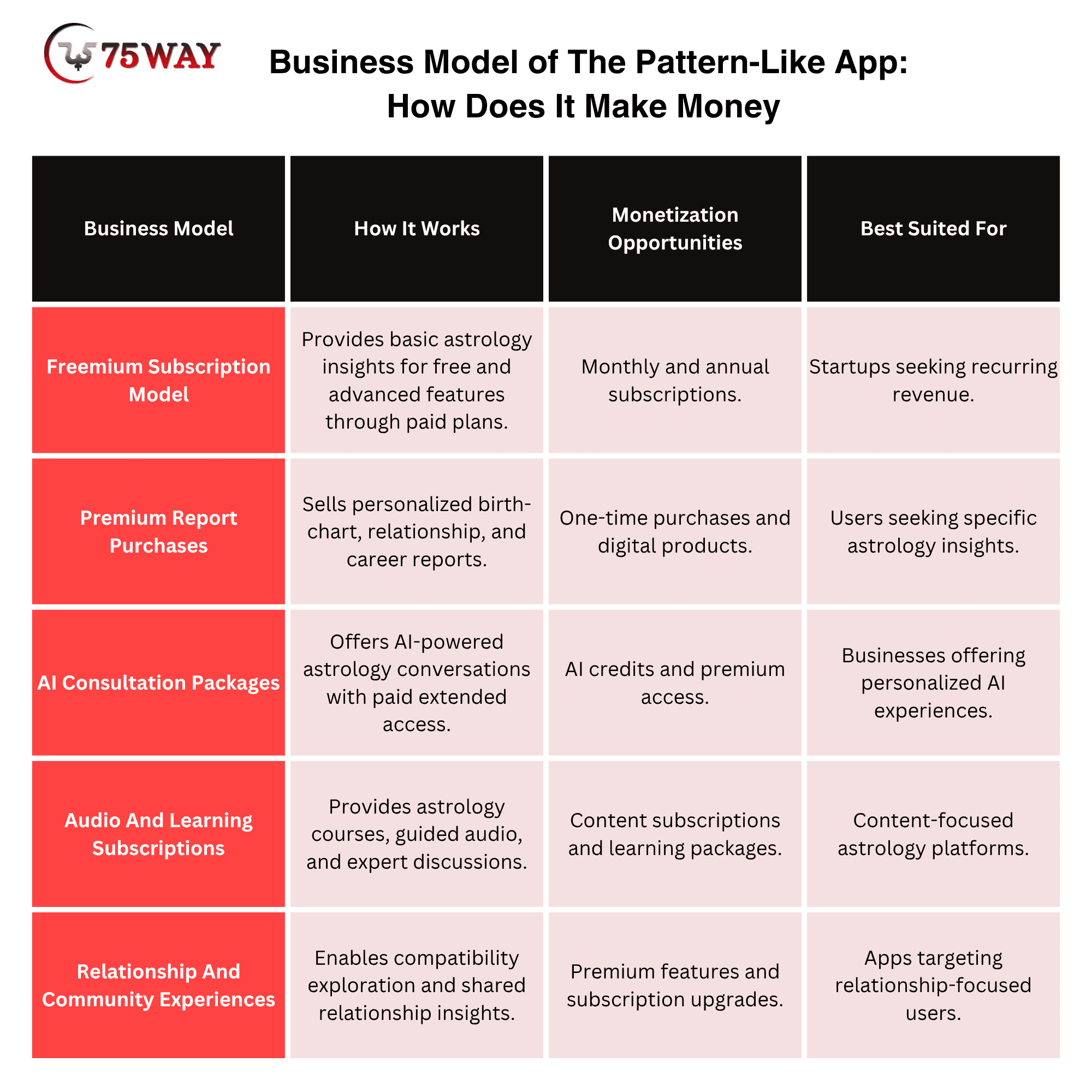
Business Model of The Pattern-Like App: How Does It Make Money
Before investing in The Pattern-like app development, founders should understand how the application can generate recurring revenue.
The Pattern provides a useful freemium reference. Its App Store listing describes free access to selected personalized updates and compatibility experiences, alongside paid Go Deeper+ subscriptions that unlock additional content and experiences.
For a new astrology startup, the following business models offer practical opportunities.
1. Freemium Subscription Model
The freemium model allows users to access basic astrology experiences without paying upfront.
You can provide basic personality insights, selected daily updates, and limited compatibility reports for free. Premium subscriptions can unlock deeper interpretations, additional reports, advanced relationship insights, and personalized AI conversations.
Revenue Opportunity: Monthly and annual subscription payments.
2. Premium Report Purchases
Some users may not want another monthly subscription but might pay for a detailed report addressing a particular question.
Your application can sell individual digital reports covering:
- Complete birth-chart analysis.
- Relationship compatibility.
- Career and professional direction.
- Personal strengths and challenges.
- Upcoming astrological cycles.
- Yearly astrology forecasts.
Revenue Opportunity: One-time purchases and personalized digital products.
3. AI Consultation Packages
An AI-powered astrology assistant can offer conversational guidance using a user's birth-chart information.
You can introduce free conversation limits and paid packages for extended sessions, specialized interpretations, or additional personalization.
Revenue Opportunity: AI consultation credits, usage-based packages, and premium access.
4. Audio And Learning Subscriptions
Astrology content does not need to remain limited to written interpretations.
You can offer guided audio sessions, astrology learning modules, recorded expert discussions, and educational content through a separate premium content library.
Revenue Opportunity: Content subscriptions and paid learning packages.
5. Relationship And Community Experiences
Compatibility experiences can encourage users to invite friends or partners.
You can build additional paid experiences around detailed relationship reports, shared insights, and specialized compatibility content.
Revenue Opportunity: Premium relationship features and subscription upgrades.
Recommended Approach: Start with a freemium subscription model supported by individual report purchases. Introduce AI consultation packages and premium content after understanding which experiences generate repeat engagement.
Step-By-Step Process To Develop An App Like The Pattern
Your idea of building an app like The Pattern may look simple at first, but the real work lies in making every reading feel personal and relevant. The astrology engine, content system, user experience, and AI integrations must work together rather than operate as separate features. Here are the practical stages to take your astrology app from concept to launch.
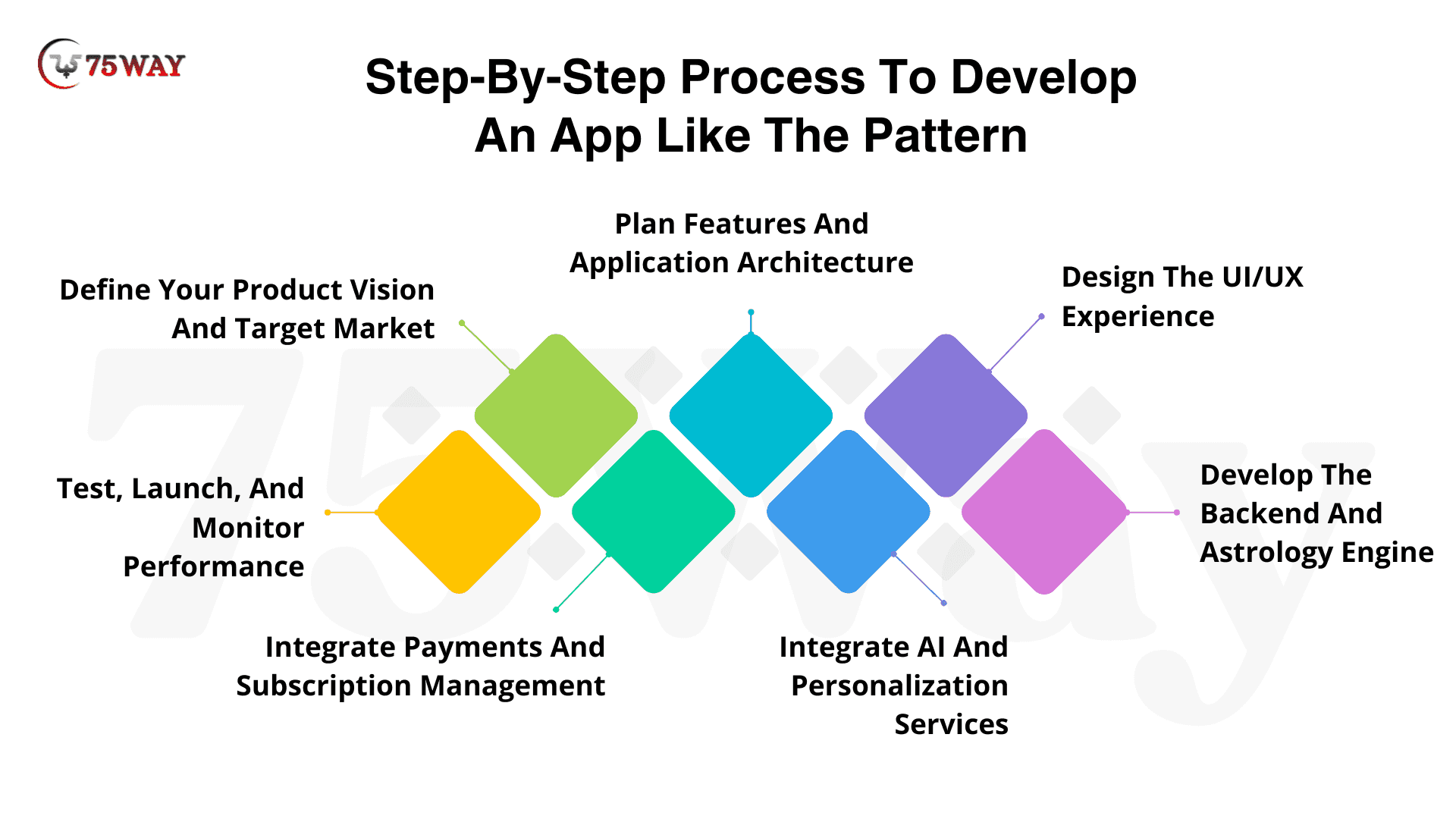
Step 1. Define Your Product Vision And Target Market
Start by deciding what kind of astrology experience your application will deliver.
Will it focus on personality analysis, relationship compatibility, daily astrological insights, or AI-powered self-discovery?
Avoid trying to include every possible astrology service in your first release. A clearly defined product direction helps control development expenses and keeps the initial experience focused.
Development Activities:
- Identify your primary customer segments.
- Research competing astrology and self-discovery applications.
- Define your unique value proposition.
- Select your initial monetization strategy.
- Prepare a minimum viable product (MVP) roadmap.
Practical Example: A startup targeting young professionals might prioritize personality insights, relationship compatibility, and conversational AI instead of launching with dozens of unrelated astrology tools.
Step 2. Plan Features And Application Architecture
Once the product direction is clear, translate business requirements into functional specifications.
Your team should define how users register, submit birth information, receive interpretations, explore relationships, and purchase premium experiences.
The architecture should also establish how the application communicates with astrology calculation services, databases, payment gateways, and AI models.
Development Activities:
- Prepare functional requirement documents.
- Define user journeys and feature dependencies.
- Plan frontend and backend architecture.
- Identify third-party APIs and integrations.
- Establish security and scalability requirements.
Step 3. Design The UI/UX Experience
The Pattern's product experience demonstrates the importance of presenting complex astrological interpretations through accessible content and intuitive navigation.
Your application should make it easy for users to understand their profiles without requiring prior astrology knowledge.
Begin with wireframes before moving into high-fidelity interface designs.
Development Activities:
- Create onboarding and registration screens.
- Design birth-chart input interfaces.
- Develop personalized insight dashboards.
- Plan compatibility and report screens.
- Create subscription and payment interfaces.
- Build interactive prototypes for usability testing.
A useful design principle is to display the most relevant insight first and allow users to explore deeper explanations when interested.
Step 4. Develop The Backend And Astrology Engine
This is where the core functionality comes together.
Developers need to build backend services that manage user profiles, birth information, chart calculations, personalized content, and application permissions.
The astrology engine should process birth date, time, and geographical coordinates to calculate relevant planetary placements.
Development Activities:
- Implement user authentication and authorization.
- Integrate an astrology calculation engine.
- Develop birth-chart generation services.
- Build transit and compatibility calculations.
- Create APIs for personalized interpretations.
- Implement database structures and content management.
Pay particular attention to time-zone conversion, daylight-saving changes, and historical time-zone information. Incorrect birth-time processing can affect chart calculations.
Step 5. Integrate AI And Personalization Services
After establishing reliable astrological calculations, introduce AI-powered experiences.
The AI layer should receive structured information from the backend rather than independently calculating astronomical positions.
For example, when a user asks about a relationship, the system can retrieve relevant compatibility data and use an AI model to explain the results in understandable language.
Development Activities:
- Connect an appropriate AI model.
- Develop structured prompts and interpretation templates.
- Implement retrieval-augmented generation where appropriate.
- Configure user-context permissions.
- Add response validation and safety controls.
- Monitor AI response quality and operating costs.
Step 6. Integrate Payments And Subscription Management
Your monetization features should be implemented before the application enters its final testing stage.
Integrate the appropriate payment infrastructure for your supported platforms and business model.
Development Activities:
- Configure subscription products.
- Implement purchase verification.
- Add free and premium access permissions.
- Develop payment history and receipts.
- Configure subscription renewal and cancellation.
- Test failed payments and refund scenarios.
Step 7. Test, Launch, And Monitor Performance
A successful launch requires more than checking whether the application opens correctly.
Your QA team should verify astrology calculations, AI responses, subscription permissions, data security, and application performance across supported devices.
Development Activities:
- Perform functional and integration testing.
- Validate birth-chart calculations against trusted references.
- Test AI response accuracy and consistency.
- Conduct security and privacy assessments.
- Perform load and performance testing.
- Complete App Store and Google Play submission checks.
After launch, monitor crashes, subscription conversions, retention, and AI operating costs. Use these findings to prioritize product improvements.
Essential Features For Building An Astrology App Like The Pattern
If your goal is to build an astrology app inspired by The Pattern, the feature list needs to reflect what makes this product concept distinctive. Birth chart analysis, personality insights, relationship compatibility, and personalized notifications are among the capabilities to consider. Here are the core features to consider that can help you plan the foundation of your app before moving into advanced functionality.
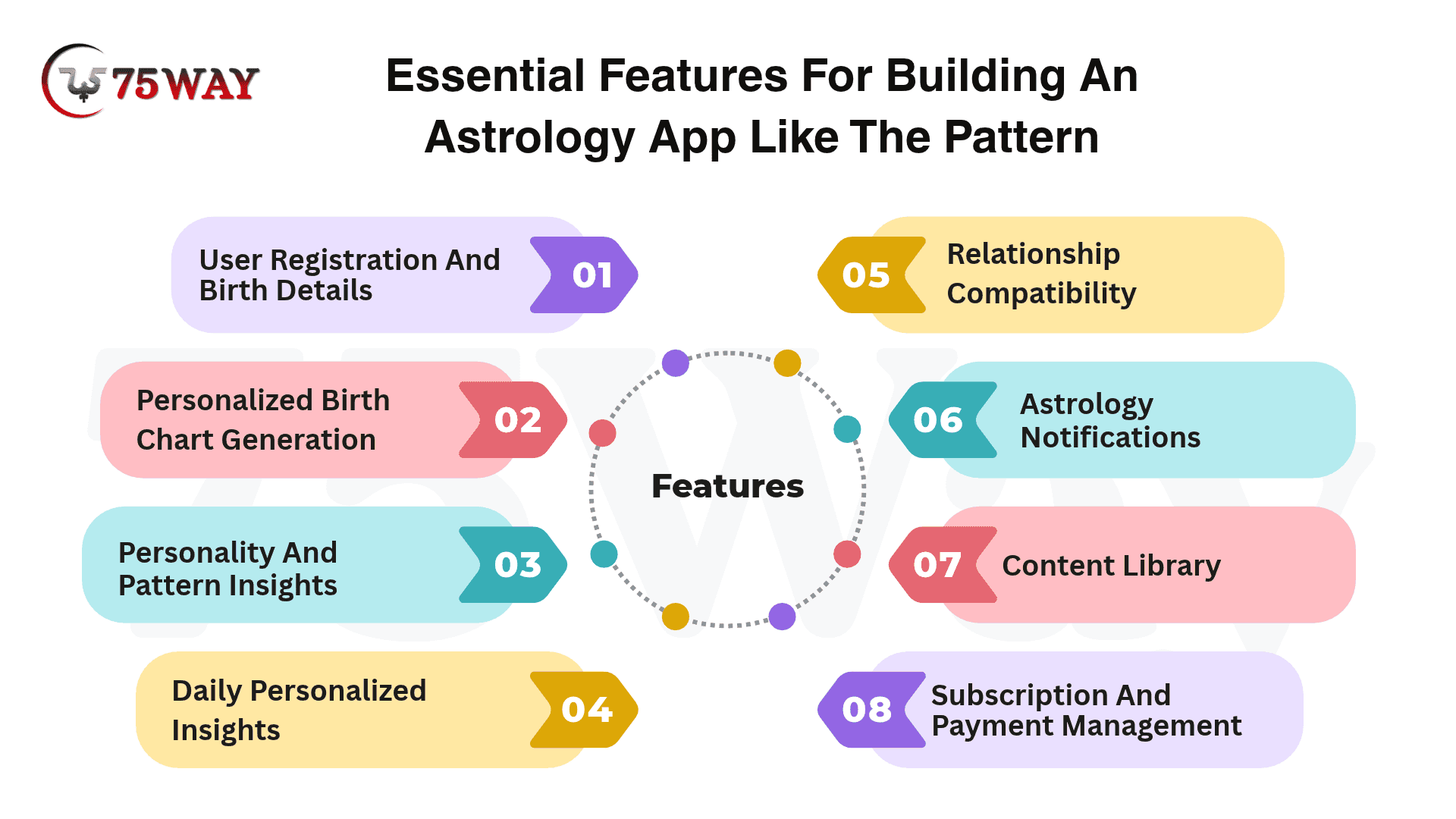
1. User Registration And Birth Details
The onboarding process should collect the information required to create an individual astrological profile.
Users can register through email, phone number, or supported social sign-in options. The application should request their date of birth, exact birth time, and birthplace.
These inputs help generate a more accurate natal chart and support personalized interpretations.
2. Personalized Birth Chart Generation
A birth-chart engine calculates planetary positions and other astrological elements using the user's birth information.
Your development team can integrate an ephemeris or astrology calculation engine to generate planetary placements, houses, aspects, and zodiac positions.
The calculated results become the foundation for personalized content throughout the application.
3. Personality And Pattern Insights
Users should receive understandable interpretations of their astrological profiles rather than complicated technical chart information.
The application can organize insights into personality traits, behavioral tendencies, emotional patterns, strengths, and personal challenges.
A structured interpretation library can provide consistent content while allowing personalization based on individual chart configurations.
4. Daily Personalized Insights
Daily content gives users a reason to revisit the application.
You can generate personalized updates using relevant transits, planetary movements, and predefined interpretation rules.
Instead of displaying identical zodiac predictions to every user, the application should select insights based on individual birth-chart information.
5. Relationship Compatibility
Relationship compatibility can become one of the strongest engagement features.
Users should be able to add another person's birth information and explore compatibility across selected relationship dimensions.
The system can compare chart placements, aspects, and relevant astrological combinations to generate personalized relationship interpretations.
6. Astrology Notifications
Push notifications can introduce users to new daily insights, upcoming astrological events, and personalized content releases.
For example, a notification might encourage users to explore a newly available transit interpretation.
Allow users to manage notification preferences to avoid unnecessary interruptions.
7. Content Library
A centralized content library helps users access their saved interpretations, educational resources, reports, and audio content.
You can organize the library into categories such as personality, relationships, career, planetary movements, and astrology education.
8. Subscription And Payment Management
Your application needs a payment system that supports premium access and recurring revenue.
Include monthly and annual subscription options, purchase history, payment confirmations, renewal management, and subscription cancellation.
For mobile applications, plan payment integration around the applicable Apple App Store and Google Play billing requirements.
Advanced AI Features Required in The Pattern Clone App Development
Basic birth chart readings can give users a starting point, but what happens when they want to ask follow-up questions or understand how different planetary placements connect? This is where AI can add a new layer to a Pattern-like astrology app. For founders, the following innovative features offer opportunities to differentiate a new product.
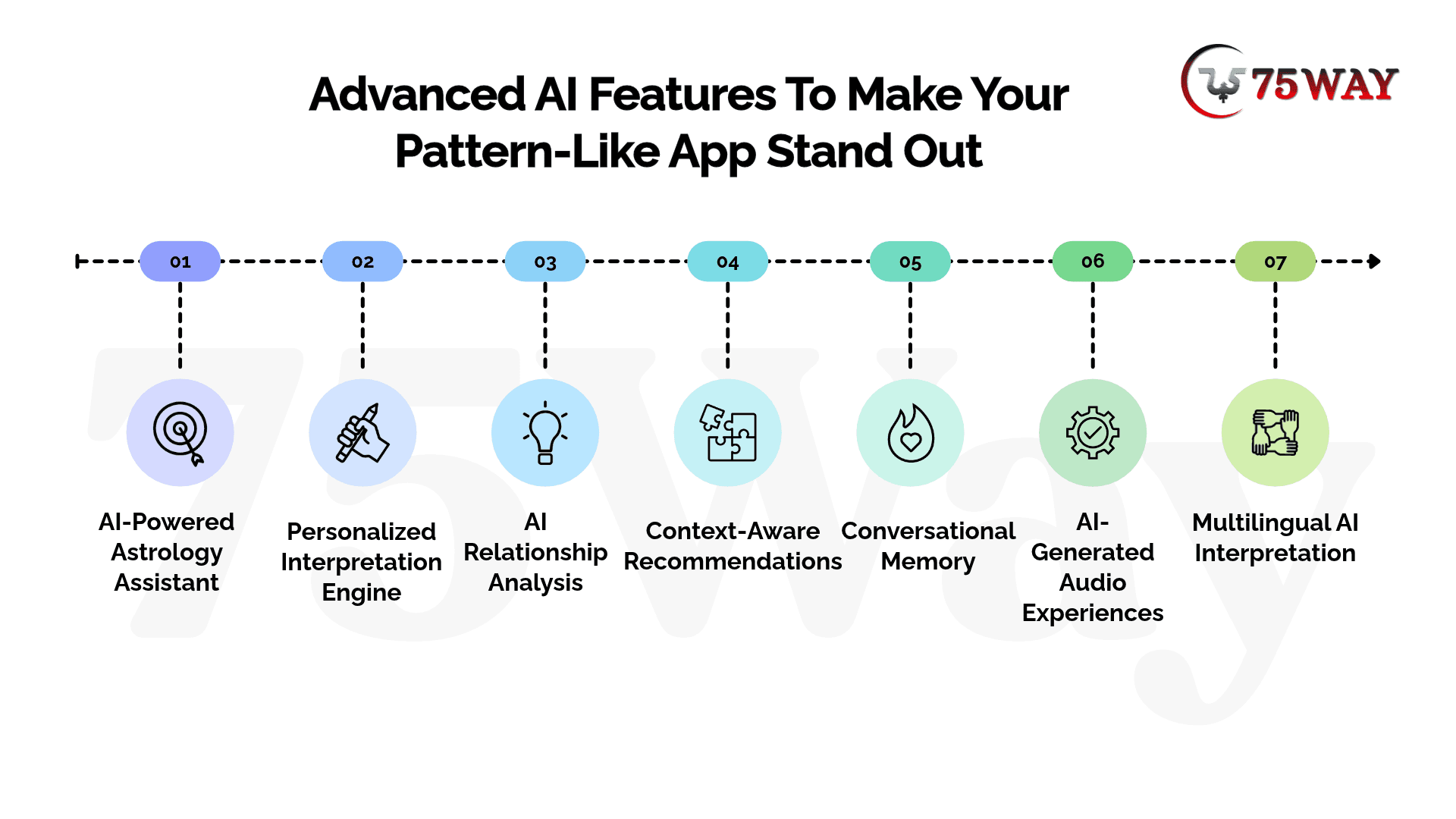
1. AI-Powered Astrology Assistant
An AI assistant can answer users' questions using their calculated birth-chart information and a controlled astrology knowledge base.
For example, users could ask questions about personality traits, relationships, or current planetary transits.
The assistant should retrieve relevant chart data before generating a response rather than inventing planetary positions.
2. Personalized Interpretation Engine
A personalization engine can select and organize interpretations according to individual chart configurations.
For instance, two users with different planetary placements should not receive identical interpretations simply because they share a sun sign.
AI astrology system can help turn structured astrological information into readable explanations that reflect each user's profile.
3. AI Relationship Analysis
An AI-powered relationship experience can explain compatibility findings in conversational language.
The system can combine two users' chart data, identify relevant astrological aspects, and generate interpretations covering communication, emotional compatibility, and relationship dynamics.
It should present these insights as reflective guidance rather than scientifically established relationship assessments.
4. Context-Aware Recommendations
Recommendation systems can suggest relevant content based on users' previous interactions and stated interests.
For example, someone frequently exploring relationship compatibility may receive suggestions for relevant relationship reports or educational content.
The recommendation engine should consider user preferences rather than relying entirely on generic engagement signals.
5. Conversational Memory
With appropriate consent and privacy controls, an AI astrology chatbot can use selected conversation context to make future interactions more relevant.
For example, if a user previously explored career-related questions, the assistant could connect a new question to that conversation.
Users should have clear controls over what conversational information is retained.
6. AI-Generated Audio Experiences
AI voice technology can transform selected personalized interpretations into audio experiences.
Users could listen to daily insights, longer astrology explanations, or guided reflection sessions instead of reading every report.
Generated audio should be reviewed for pronunciation, content accuracy, and appropriate interpretation.
7. Multilingual AI Interpretation
A multilingual interpretation system can help an astrology startup serve customers across different language preferences.
The application can translate structured interpretations while preserving astrological terminology and the intended meaning.
Human review is particularly valuable when supporting languages with specialized cultural or astrological vocabulary.
Technical Recommendation: Keep astrological calculations separate from generative AI. Use a deterministic calculation engine for planetary positions and chart configurations, then provide verified structured results to the AI interpretation layer. This reduces the risk of fabricated placements and inconsistent calculations.
Recommended Technology Stack To Build A Mobile App Like The Pattern
You don't need separate technologies for every feature when building an app like The Pattern. Flutter is a practical starting point because developers can build iOS and Android apps from one codebase, reducing duplicated development work.
For the backend, Node.js or Python can handle user accounts, birth-chart requests, subscriptions, and AI interactions, while PostgreSQL stores user profiles and related data.
The bigger cost-saving decision is how you handle astrology and AI. Instead of developing planetary calculation logic from scratch, use Swiss Ephemeris or a suitable astrology API.
Connect an AI model through its API to explain calculated results and answer user questions. Firebase can manage push notifications, while AWS or Google Cloud can host the backend.
This setup gives startups the core technology needed for an initial launch without investing in an unnecessarily complex architecture.
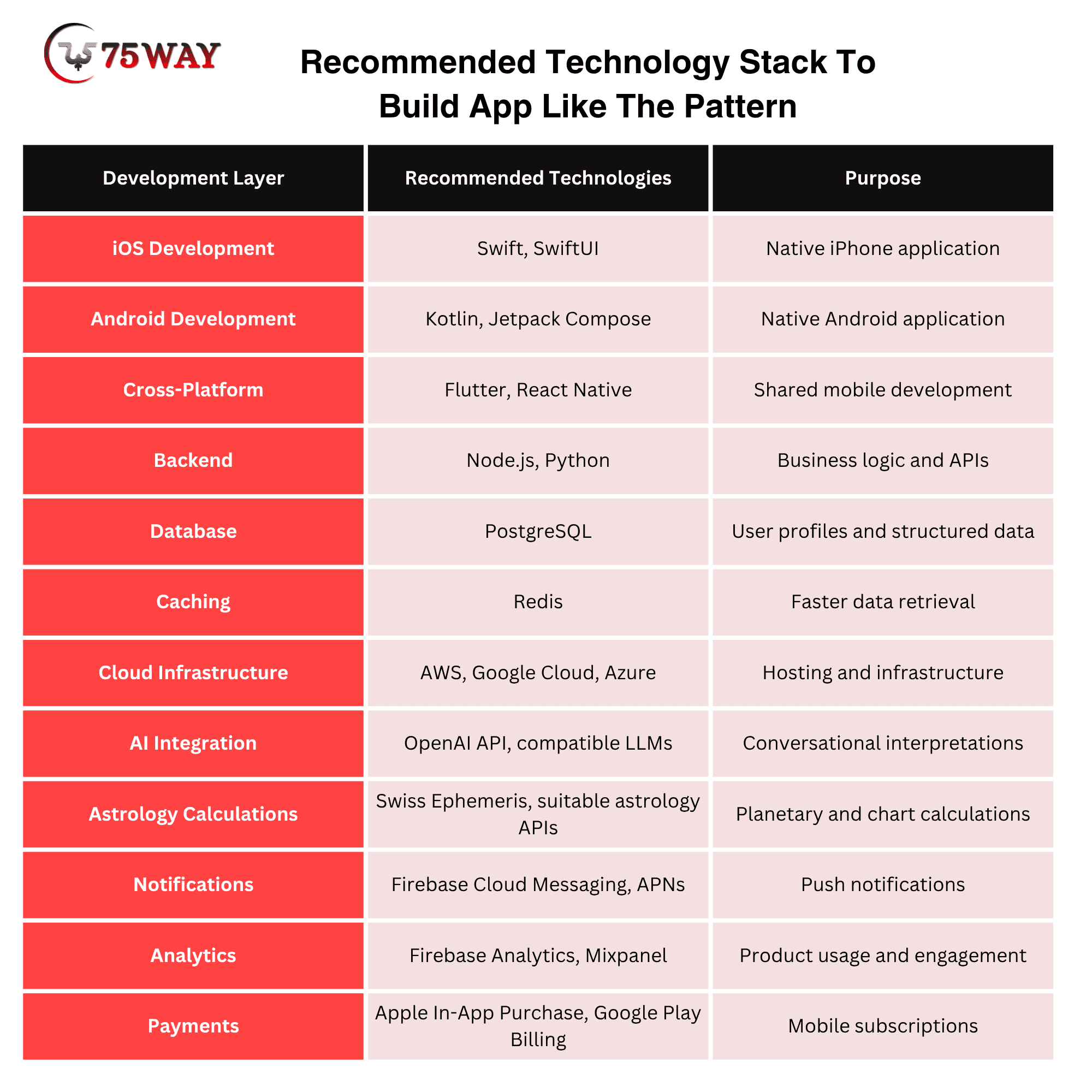
Important Architecture Decision: An LLM should not be responsible for producing raw astronomical calculations. Use a reliable ephemeris-based engine for those calculations and reserve AI for interpretation, conversational explanations, and recommendations.
This separation makes the application easier to validate, maintain, and improve.
How Much Does It Cost To Build An App Like The Pattern?
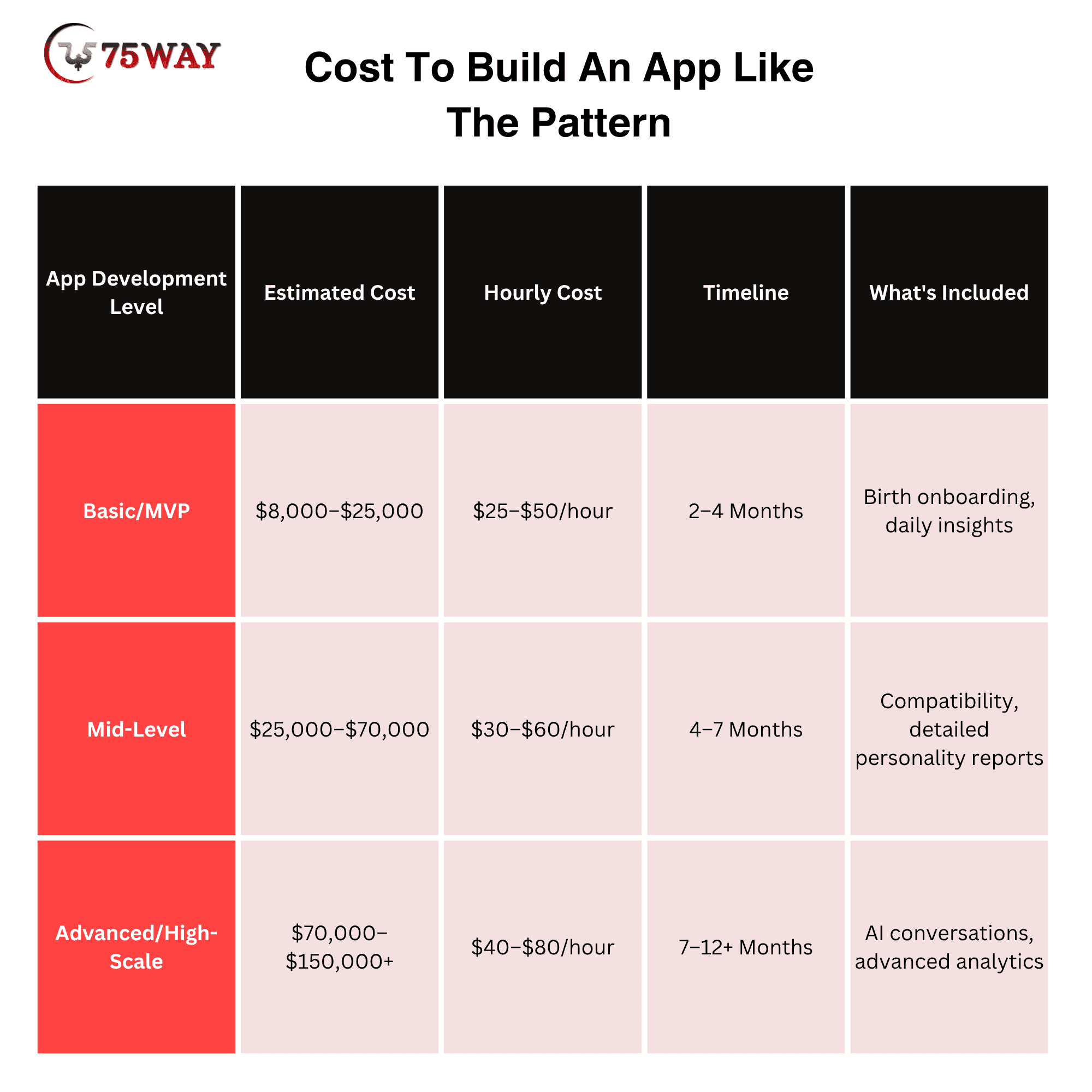
The cost to develop an app like The Pattern can range from $8,000 to $150,000+, depending on application complexity, features, platform requirements, AI integration, and development resources.
A basic astrology MVP with limited personalization will require a different investment than a production-ready application featuring relationship compatibility, advanced AI conversations, subscriptions, and scalable infrastructure. Here is a complete breakdown of The Pattern-like app development.
1. Basic/MVP The Pattern-Like App Cost: $8,000–$25,000
- Collects users' birth dates, times, and locations.
- Delivers daily astrology insights through simple personalized readings.
Timeline: 2–4 Months
Best For: Startups Testing Initial Market Demand
2. Mid-Level The Pattern-Like App Cost: $25,000–$70,000
- Offers personalized compatibility reports and relationship matching features.
- Provides detailed personality insights with subscription-based premium access.
Timeline: 4–7 Months
Best For: Growing Astrology Businesses Seeking Paid Users
3. Advanced/High-Scale The Pattern-Like App Cost: $70,000–$150,000+
- Integrates AI-powered conversations and deeper personalized interpretations.
- Supports advanced analytics, scalable infrastructure, and richer user experiences.
Timeline: 7–12+ Months
Best For: Established Businesses Targeting Large User Bases
Major Factors That Influence Development Costs
1. Number of Features: Each additional module introduces development, integration, and testing requirements. Advanced compatibility, AI conversations, and personalized recommendations increase complexity.
2. AI Integration: Model selection, prompt engineering, retrieval systems, context management, and response validation influence implementation and ongoing usage expenses.
3. Platform Selection: Developing separate native iOS and Android applications generally requires more resources than sharing code through a cross-platform framework.
4. Third-Party Integrations: Astrology APIs, payment services, analytics tools, and cloud infrastructure introduce integration and potentially recurring licensing costs.
5. UI/UX Complexity: Custom illustrations, animations, interactive charts, and personalized dashboards require additional design and development effort.
6. Security Requirements: Data encryption, access controls, privacy management, and security testing add engineering responsibilities.
How To Reduce Your The Pattern-Style Astrology App Development Cost
Spending more on development doesn't automatically make your astrology app more competitive. The bigger priority is investing in features users actually need while avoiding unnecessary complexity, expensive integrations, and premature customization. These cost-reduction strategies can help you build a Pattern-style astrology app without stretching your budget. Consider these practical approaches:
- Launch with one primary customer segment and a focused feature set.
- Use established astrology calculation libraries instead of building an ephemeris engine from scratch.
- Start with a structured interpretation library before introducing complex generative AI.
- Choose cross-platform development when native device capabilities are not essential.
- Introduce premium features after measuring actual customer demand.
- Monitor AI token usage and introduce caching for repeated requests.
A focused MVP can help you validate demand before committing to a larger development investment.
How To Make Your The Pattern-Like App Profitable After Launch
Launching an application is only the beginning. Long-term business performance depends on how effectively you convert downloads into active users and paying customers. Here are some areas founders should monitor.
1. Improve User Activation
Make the first experience valuable. Help users complete their birth profiles and discover their first personalized insights without unnecessary onboarding steps.
2. Increase Subscription Conversions
Offer a meaningful free experience before introducing premium upgrades. Explain what subscribers receive, such as detailed reports, unlimited interpretations, or advanced AI conversations.
3. Build Repeat Engagement
Release relevant daily content, new interpretation collections, and personalized notifications. Avoid sending generic reminders that provide little value.
4. Encourage Organic Referrals
Allow users to share selected personality insights and compatibility experiences with friends. Shared content can introduce new users to the application's core value.
5. Track The Right Business Metrics
Monitor these indicators after launch:
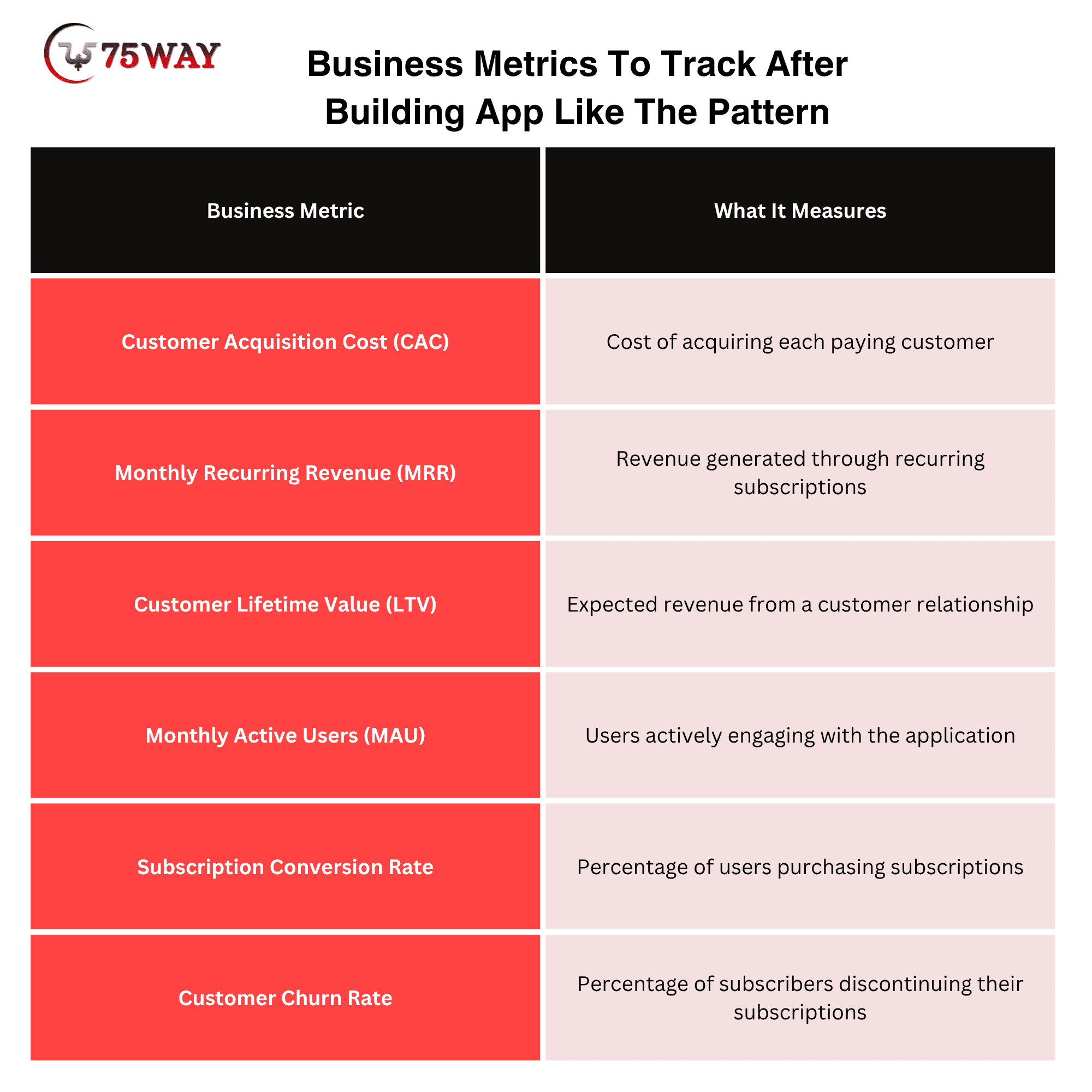
These metrics help founders identify whether the product is attracting the right audience and generating sustainable revenue.
How 75way Can Help You Build An Astrology App Similar to The Pattern
Turning an astrology application idea into a market-ready product requires decisions across business planning, UI/UX design, mobile development, backend engineering, AI integration, and quality assurance.
For startups and businesses evaluating an astrology app project, 75way Technologies can be considered a development partner for discussing the product scope, technical requirements, feature priorities, and implementation roadmap.
Before beginning development, establish the following:
- Product Requirements: Define your target audience, business objectives, and essential application features.
- Technical Architecture: Identify the appropriate mobile framework, backend infrastructure, database, and astrology calculation services.
- AI Implementation: Determine where AI can improve interpretation, personalization, and customer experiences.
- Development Roadmap: Establish development milestones, estimated costs, and launch requirements.
- Post-Launch Planning: Account for application maintenance, performance monitoring, feature enhancements, and infrastructure expenses.
A clearly defined development scope helps prevent unnecessary features from increasing your initial investment.
If you are planning an astrology or self-discovery application, discuss your idea with our astrology experts to evaluate its technical requirements and development possibilities.
Conclusion
Building an app like The Pattern requires a combination of astrology calculations, personalized experiences, AI capabilities, and a sustainable monetization strategy. The development investment can range from $8,000 to $150,000+, depending on the product's complexity, platforms, and integrations.
For founders, the smarter approach is to begin with a focused MVP, validate customer demand, and expand based on actual usage and subscription performance. The right technology architecture and development partner can also help avoid expensive technical changes as the application grows.
If you are eager to launch your own astrology app like The Pattern? You can connect with a reliable astrology mobile app development company to discuss your idea, development requirements, and project roadmap.
Frequently Asked Questions (FAQs)
Can AI Be Integrated Into An Astrology App?
Yes. AI can support personalized interpretations, conversational astrology assistants, relationship analysis, content recommendations, and multilingual experiences. However, astronomical calculations should use reliable calculation engines rather than generative AI.
How Does The Pattern App Generate Revenue?
The Pattern uses a freemium approach with optional paid subscriptions. A similar business can generate revenue through subscriptions, premium reports, AI consultation packages, and paid content.
Can I Build An Astrology App Without AI?
Yes. You can launch an astrology application using traditional calculation engines, predefined interpretation libraries, and rule-based personalization. AI can be introduced later as an additional capability.
What Is The Best Business Model For An Astrology App?
A freemium subscription model is a practical starting point. It allows users to explore basic experiences before purchasing premium reports, advanced interpretations, and additional services.