AI Summary
Building a bike taxi app involves more than booking and GPS. This guide covers process, business models, features, technology, bike booking app development costs, and monetization models. Use it to plan your launch with greater confidence.
Key Takeaways
- Global ride-hailing taxi market projections reach $412.6 billion by 2033.
- Bike taxi app development costs range from $15,000 to $300,000+.
- Understand essential features across passenger, driver, and admin applications.
- Compare white-label, custom, and hybrid development approaches before investing.
A ride across downtown shouldn't always require a car, especially when a passenger only needs to travel a few miles. In busy American cities, short-distance trips often come with traffic delays, parking hassles, and expensive ride fares. A bike taxi service offers another transportation option.
If you're considering a motorcycle booking service business, the bike taxi app development solution will become the center of your daily operations. Riders need a simple way to book trips and track drivers, while drivers need tools to accept requests, navigate routes, and monitor earnings.
On the business side, you'll need an admin dashboard to manage users, fares, payments, driver activity, and customer support. A successful launch of a motorcycle taxi app development solution also depends on choosing the right operating model, understanding local regulations, and knowing what your target customers expect.
In this guide, we'll walk through the complete bike taxi app development process, from market research and feature planning to technology selection, revenue models, and bike sharing app development costs.
Bike Taxi App Development: An Overview
Bike taxi app development involves building a digital platform that allows passengers to book motorcycle or scooter rides through a mobile application.
The ride sharing app connects passengers with available drivers, calculates fares, tracks trips, processes payments, and manages ride operations through an administrative system.
Unlike traditional taxi applications, a bike taxi platform is designed around two-wheeler transportation.
This creates different product requirements, including motorcycle-specific vehicle information, driver verification, helmet and safety workflows, pickup coordination, and local transportation regulations.
A complete bike taxi ecosystem generally includes three interconnected applications:
- Passenger App: Allows customers to register, enter pickup and destination locations, compare fares, book rides, track drivers, and make payments.
- Driver App: Helps drivers manage availability, accept ride requests, navigate to pickup locations, complete trips, and monitor earnings.
- Admin Panel: Gives business owners control over drivers, customers, bookings, pricing, payments, complaints, and operational performance.
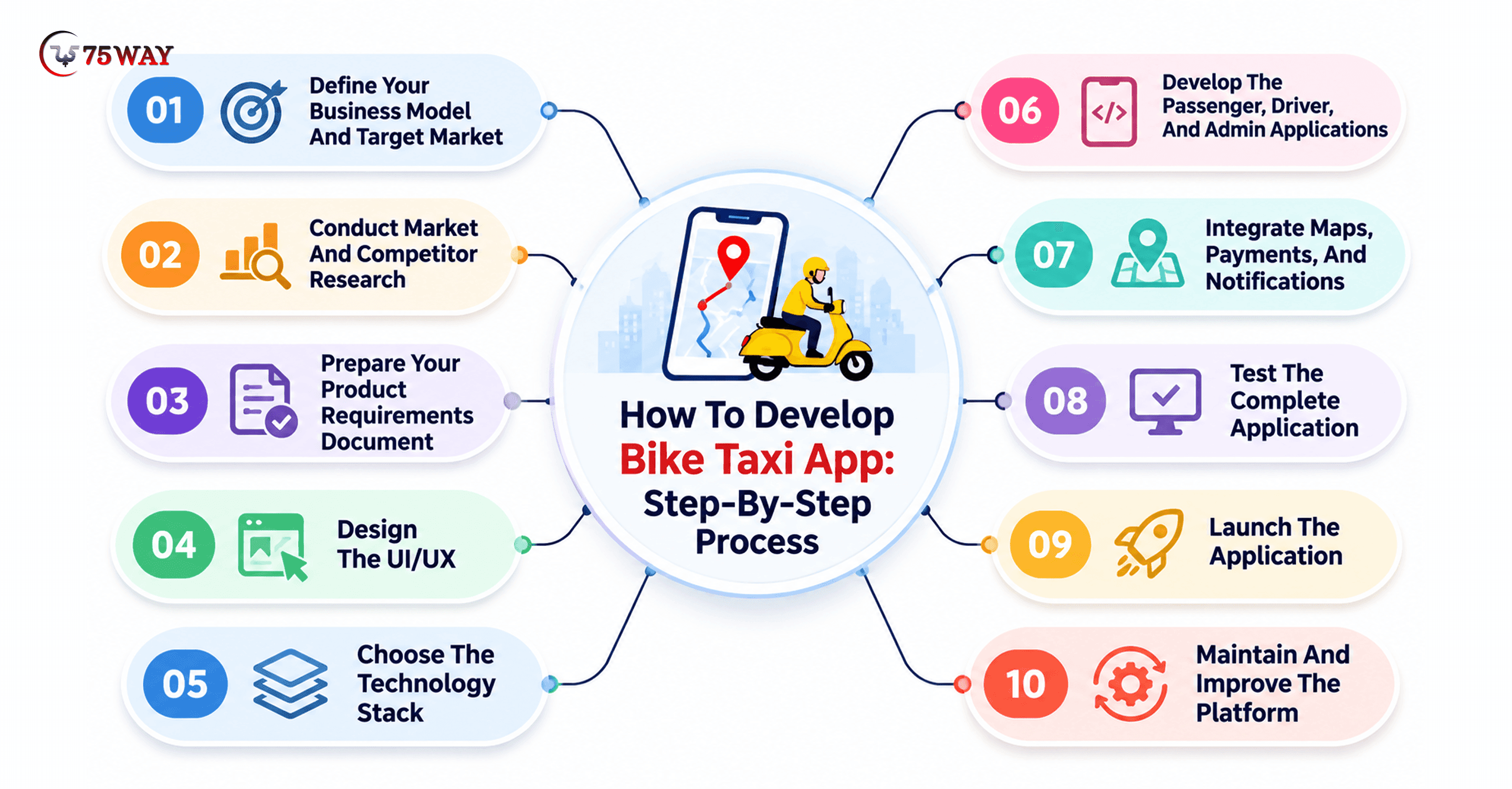
Quick Answer: Complete Process For Motorcycle Taxi App Development
Stage 1: Define Your Business Model And Target Market
Stage 2: Conduct Market And Competitor Research
Stage 3: Prepare Your Product Requirements Document
Stage 4: Design The UI/UX
Stage 5: Choose The Technology Stack
Stage 6: Develop The Passenger, Driver And Admin Applications
Stage 7: Integrate Maps, Payments, And Notifications
Stage 8: Test The Complete Application
Stage 9: Launch The Application
Stage 10: Maintain And Improve The Platform
Get Details Below.
How Does A Bike Taxi App Work?
A bike taxi application looks simple from the passenger's side, but several operations happen between booking a ride and reaching the destination. Consider a customer leaving an office and booking a motorcycle ride to a nearby transit station.
The app must coordinate the passenger's location, available drivers, estimated fare, trip assignment, navigation, and payment. The complete working process of the bike-sharing app development solution is defined below.
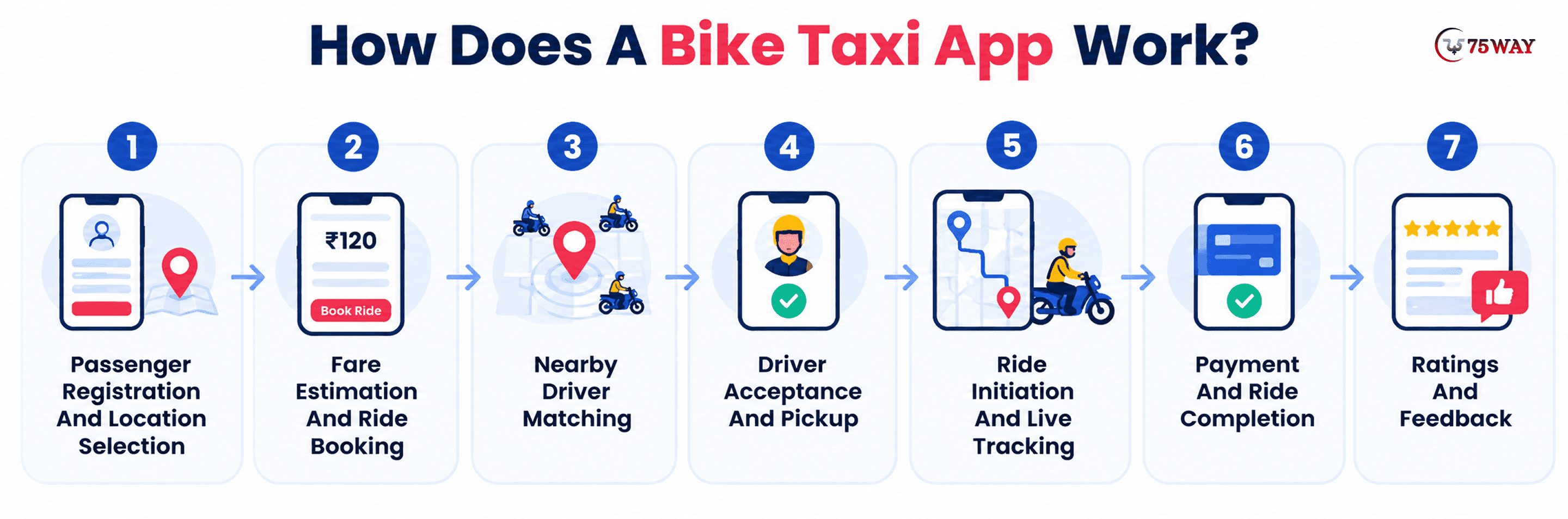
Step 1: Passenger Registration & Location Selection
The passenger downloads the application, creates an account using a phone number or email address, and grants the necessary location permissions.
After registration, the customer enters the pickup and destination addresses. The application uses a mapping service to identify the locations, calculate the approximate route, and display available ride options.
Step 2: Fare Estimation & Ride Booking
The backend calculates an estimated fare using the business's pricing rules. These may include base fares, distance, estimated duration, demand-based adjustments, and applicable additional charges.
The passenger reviews the fare and confirms the booking.
Step 3: Nearby Driver Matching
The system checks which drivers are available within the relevant service area.
It can consider several factors:
- Distance between the driver and pickup location.
- Driver availability and current trip status.
- Vehicle eligibility and service category.
- Driver acceptance history, where appropriate.
- Estimated time required to reach the passenger.
The application sends the request to a suitable driver or a selected group of drivers.
Step 4: Driver Acceptance And Pickup
Once a driver accepts the request, the passenger receives the driver's profile, vehicle information, and estimated arrival time.
The driver uses the navigation feature to reach the pickup location. Both parties can view relevant trip information through their respective applications.
Step 5: Ride Initiation & Live Tracking
The driver confirms the passenger pickup and starts the trip.
The application updates the trip status and shares location information during the journey. The backend records important ride events, including trip start, location updates, and completion.
Step 6: Payment & Ride Completion
After reaching the destination, the driver completes the ride. The application calculates the final fare according to the configured pricing rules.
The passenger pays using an available payment method, such as a card or supported digital payment service. The system records the transaction and updates the driver's earnings and the company's commission.
Step 7: Ratings & Feedback
The passenger can rate the driver and share feedback about the experience. Drivers may also receive an option to rate passengers.
The business can use this information to monitor service quality, investigate complaints, and improve driver operations.
Understanding Market Demand For Automotive Bike Taxi App Development
Not every commuter needs a car for a five-mile trip, especially when traffic makes short journeys frustrating. Bike taxi services can address this gap by offering convenient rides for everyday commutes, quick errands, and last-mile connections. Let's examine the market demand, customer segments, and business opportunities behind launching a bike taxi app in the United States.
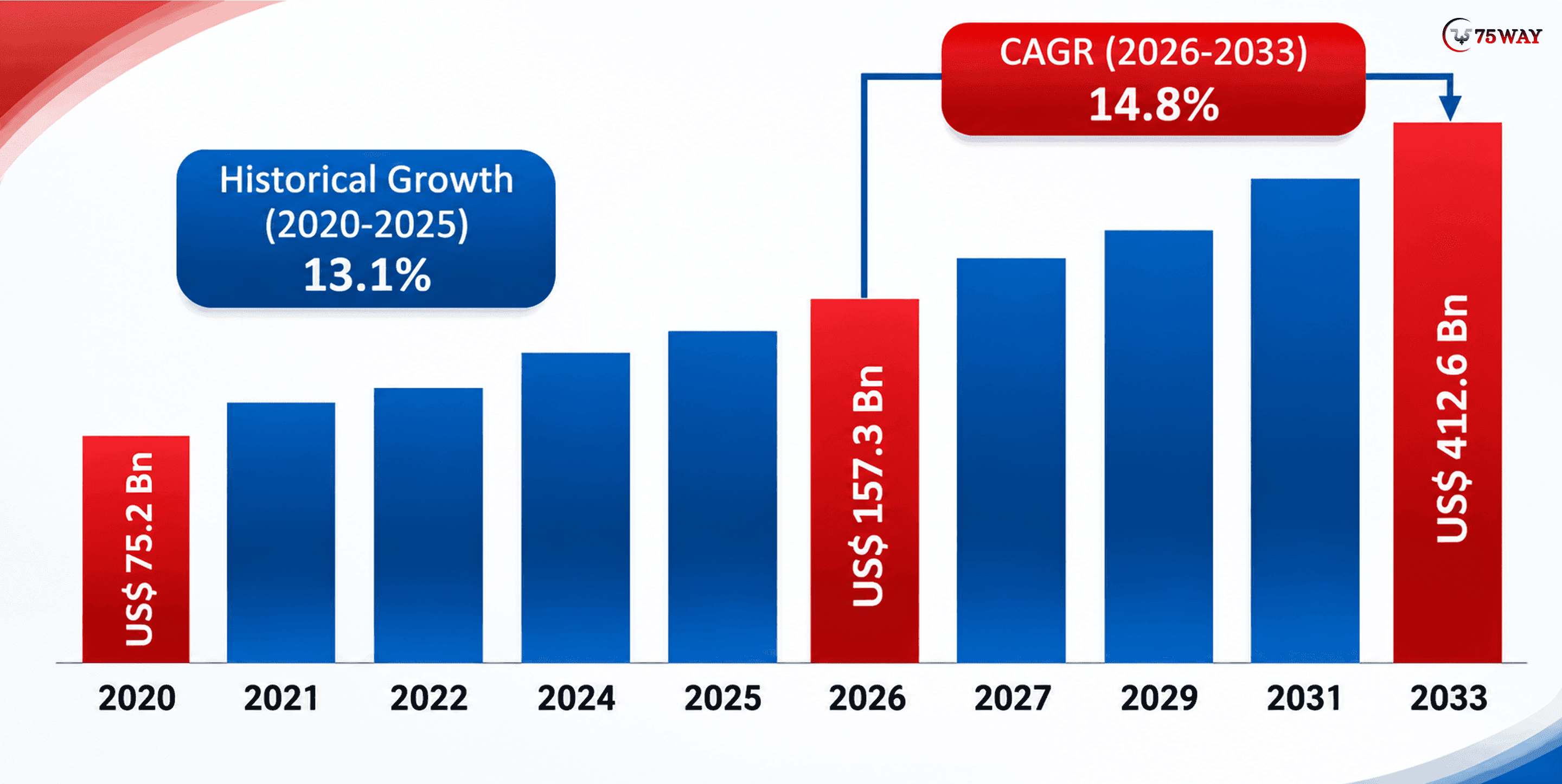
- The global ride-hailing taxi industry is forecast to expand from $157.3 billion in 2026 to $412.6 billion by 2033, registering a CAGR of 14.8%.
- By service category, e-hailing commands the largest market share at 58.3%, while micro-mobility is projected to record the fastest expansion, with an 18.5% CAGR.
- Intracity transportation accounts for 71.2% of total trips, whereas intercity ride services are expected to grow more rapidly at a 17.5% CAGR.
- The GSMA Mobile Economy Report 2024 identified 5.6 billion smartphone users worldwide, equivalent to 69% global penetration. This extensive smartphone reach creates a larger potential customer base for app-based ride-hailing platforms.
- Statista estimates that ride-hailing revenue will increase from $188.60 billion in 2026 to US$229.98 billion by 2030, representing a 5.08% CAGR.
- The global ride-hailing user base is expected to reach 2.34 billion by 2030.
- User penetration is projected to rise from 24.6% in 2026 to 28.7% by 2030.
How To Develop Bike Taxi App: Step-By-Step Process
Each bike taxi app development decision, from choosing the right app features to integrating GPS and payment systems, affects how the service works for riders and drivers. The following development steps explain how to plan, build, test, and launch your bike taxi platform.
Step 1: Define Your Business Model And Target Market
Start by identifying the transportation problem your business intends to solve.
Are you planning a local bike taxi service, a motorcycle-based commuter platform, or a larger ride-hailing business? Each model has different operational requirements.
Your initial planning should cover:
- Target customers and geographic coverage.
- Driver onboarding and eligibility requirements.
- Passenger pricing and driver compensation.
- Revenue generation and commission structure.
- Local transportation regulations.
- Competitor positioning and market demand.
- Initial launch budget and operating expenses.
For a US launch, regulatory research must come before product development commitments. Motorcycle passenger transportation requirements, commercial insurance, driver licensing, vehicle registration, and local transportation rules can vary by jurisdiction.
A business should confirm whether its intended service model is legally permitted in the locations it plans to serve.
Step 2: Conduct Market And Competitor Research
Before investing in development, study existing mobility services and identify what customers expect from a ride-hailing experience.
Look at established platforms such as Uber and Lyft, along with local transportation providers. Their products can help you understand common booking patterns, payment experiences, driver workflows, and customer expectations.
Research should focus on business gaps rather than simply copying competitor features.
For example:
- Are short-distance trips underserved in your target area?
- Are passengers experiencing difficulty finding transportation during specific hours?
- Can your service offer a better experience for a defined commuter group?
- Are there suitable drivers and vehicles available?
- Can the business acquire customers at a sustainable cost?
The answers will help define the product's actual requirements.
Step 3: Prepare Your Product Requirements Document
Once the business model is clear, document how the application should work.
A Product Requirements Document (PRD) describes the platform's functionality, user roles, workflows, business rules, and technical expectations.
For a bike taxi application, the PRD should include:
- Passenger registration and booking workflows.
- Driver onboarding and verification requirements.
- Ride request and dispatch logic.
- Fare calculation rules.
- Payment processing and refund workflows.
- Cancellation and dispute handling.
- Admin permissions and reporting.
- Safety and emergency procedures.
- Data protection and security requirements.
Consider a simple example: What happens if a passenger books a ride, the driver accepts it, but the driver never reaches the pickup location?
The PRD should define whether the booking expires, how another driver is assigned, whether the passenger is notified, and how cancellation fees are handled.
These decisions should be documented before developers begin implementation.
Step 4: Design The UI/UX
The UI/UX design team converts the documented workflows into application screens and interactive prototypes.
The objective is to make the passenger, driver, and admin experiences easy to understand.
The passenger app needs a straightforward booking flow, readable fare details, and clear ride status updates. The driver app should prioritize essential actions, especially while the driver is parked and managing a request. The admin panel should organize operational information in a way that helps managers make decisions.
The design process generally includes:
- User research and journey mapping.
- Information architecture and navigation planning.
- Wireframe creation.
- High-fidelity UI design.
- Interactive prototyping.
- Usability testing and design refinement.
Special attention should be given to accessibility, readable typography, touch targets, and clear error messages.
Step 5: Choose The Technology Stack
The technology stack determines how the application is developed, how its components communicate, and how the platform handles growing demand.
The right technology stack determines how well your bike taxi app handles bookings, GPS tracking, payments, and driver requests. Popular choices include Flutter or React Native for mobile apps, Node.js or Python for backend development, and PostgreSQL or MongoDB for database management.
For real-time tracking, you can use Google Maps API, Firebase, and WebSockets, while AWS or Google Cloud can support hosting and scalability. 75way Technologies can help you select the right combination based on your app requirements and business goals.
A possible technology stack for bike booking app development includes:
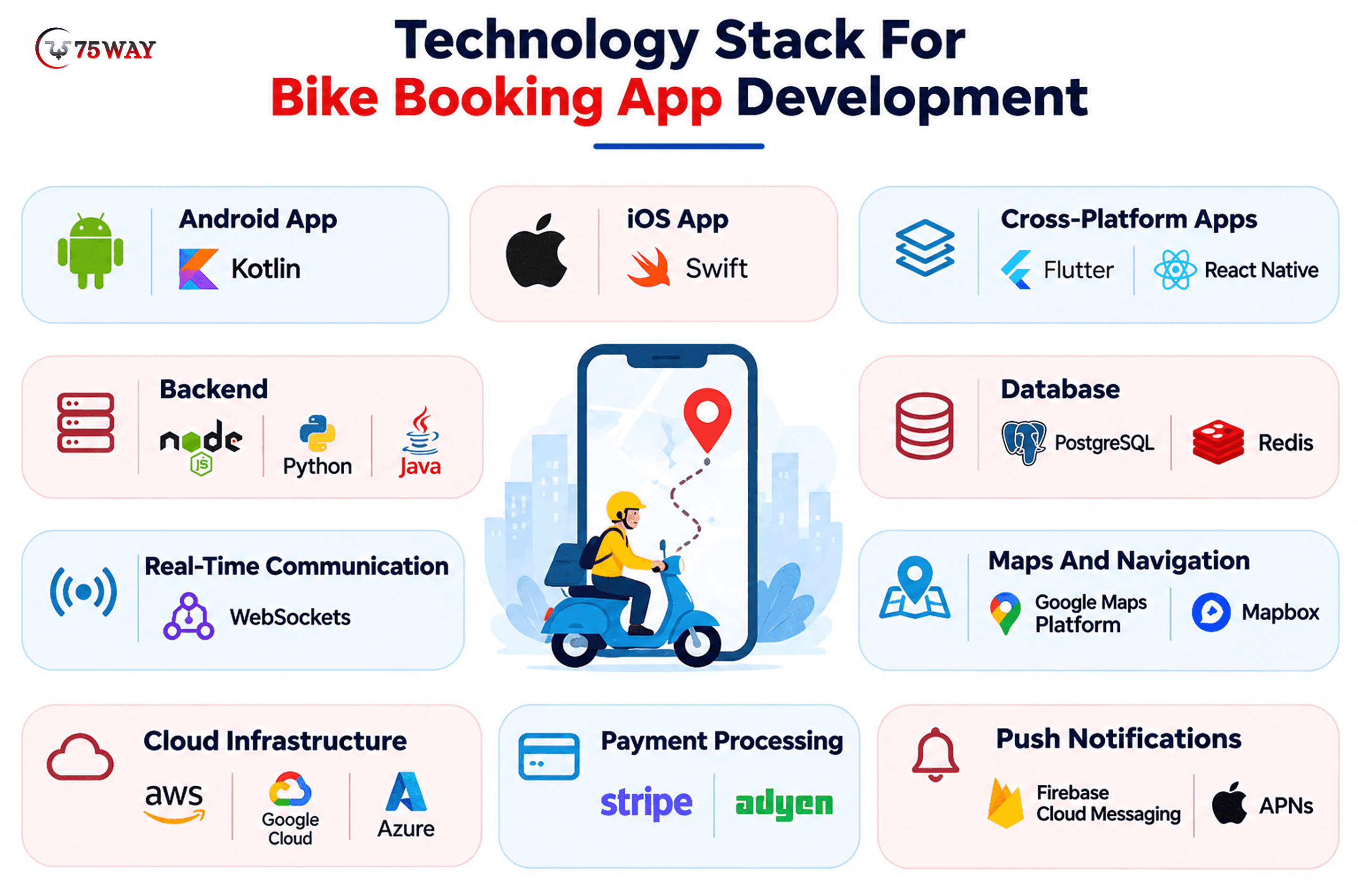
The team does not need to use every technology listed here. The right combination should support the required features without creating unnecessary complexity.
Step 6: Develop The Passenger, Driver, And Admin Applications
Development generally begins with the backend architecture and the core workflows required by all three applications.
The passenger application includes account management, location selection, booking, fare estimates, payments, and ride tracking.
The driver application includes onboarding, availability, ride requests, navigation, trip management, and earnings.
The admin panel includes user management, driver verification, booking oversight, pricing configuration, payment monitoring, and reporting.
The backend connects these applications through APIs and manages the business rules behind each operation.
Development should be divided into manageable releases, allowing the team to test important workflows before adding more advanced capabilities.
Step 7: Integrate Maps, Payments, And Notifications
Third-party integrations are essential to a working bike taxi platform.
- Maps And Location Services: A mapping provider supports address search, geocoding, route calculation, distance estimation, and location visualization.
- Payment Gateway: A payment provider handles supported payment methods, transaction authorization, refunds, and relevant payment events. Driver payouts may require separate connected-account or payout functionality.
- Push Notifications: Notifications inform passengers and drivers about booking requests, ride confirmations, cancellations, payment updates, and other important events.
These integrations should be tested against real-world conditions, including inaccurate GPS signals, payment failures, network interruptions, and delayed notifications.
Step 8: Test The Complete Application
A bike taxi application should be tested from the perspective of passengers, drivers, administrators, and the business itself.
A particularly important test is the complete ride lifecycle. The team should verify that booking, driver assignment, pickup, trip initiation, completion, payment, and settlement work together.
Step 9: Launch The Application
Before launching, configure production infrastructure, application monitoring, payment accounts, customer support workflows, and operational permissions.
Prepare the required app store listings, privacy disclosures, terms of service, and other documentation.
A controlled pilot launch in an approved service area can help the business identify operational issues before expanding.
Monitor booking completion, driver acceptance, cancellations, payment failures, customer complaints, and application crashes.
Step 10: Maintain And Improve The Platform
Launching the application is the beginning of product operations, not the end of development.
The business needs ongoing maintenance to address bugs, update integrations, improve security, support operating system changes, and manage infrastructure.
Future improvements should be based on actual usage data and customer feedback.
For example, if a significant number of passengers abandon bookings after seeing the estimated fare, the business should investigate its pricing presentation, fare structure, and customer expectations before adding unrelated features.
Scalable Architecture For Bike Booking App Development Solution
Launching your bike booking app in one city is one challenge; expanding it across multiple cities with more riders and drivers is another. Without a well-planned architecture, increased bookings can put pressure on servers, databases, and real-time tracking systems. Here's how a scalable architecture can support your app as its user base and daily operations grow.
1. Presentation Layer
This layer includes the passenger app, driver app, and admin dashboard. It handles user interactions and displays relevant information.
2. API Layer
The API layer manages communication between mobile applications, the admin panel, and backend services. It handles authentication, request validation, and access permissions.
3. Business Logic Layer
This layer manages the core operations of the platform, including:
- Driver matching and ride dispatch.
- Fare calculation and pricing rules.
- Booking creation and cancellation.
- Trip status management.
- Commission and payout calculations.
- Passenger and driver account management.
4. Real-Time Processing Layer
Real-time services process location updates, booking events, driver availability, and ride status changes.
For instance, when a driver moves toward a pickup location, the system can send updated location information to the passenger application.
5. Data Layer
The data layer stores passenger profiles, driver records, bookings, payments, trip history, and other application information.
A relational database can manage structured transactions, while caching and location-oriented data structures can support frequently accessed information.
6. Third-Party Integration Layer
This layer connects the platform with external services, including maps, payment gateways, notifications, identity verification, and analytics.
The architecture should also include monitoring, logging, backup procedures, and security controls.
75way’s recommendation: You can start with a well-structured modular backend. Move to microservices only when actual scale, team organization, or independent deployment requirements justify the additional operational complexity.
Why Are US Entrepreneurs Investing In Bike Service App Development?
The appeal of a bike taxi business comes from its potential to address transportation problems that traditional four-wheel taxis may not solve as conveniently. In congested urban areas, two-wheelers can offer flexible transportation, particularly for short-distance trips and locations with limited parking. Here are some business considerations behind this opportunity.
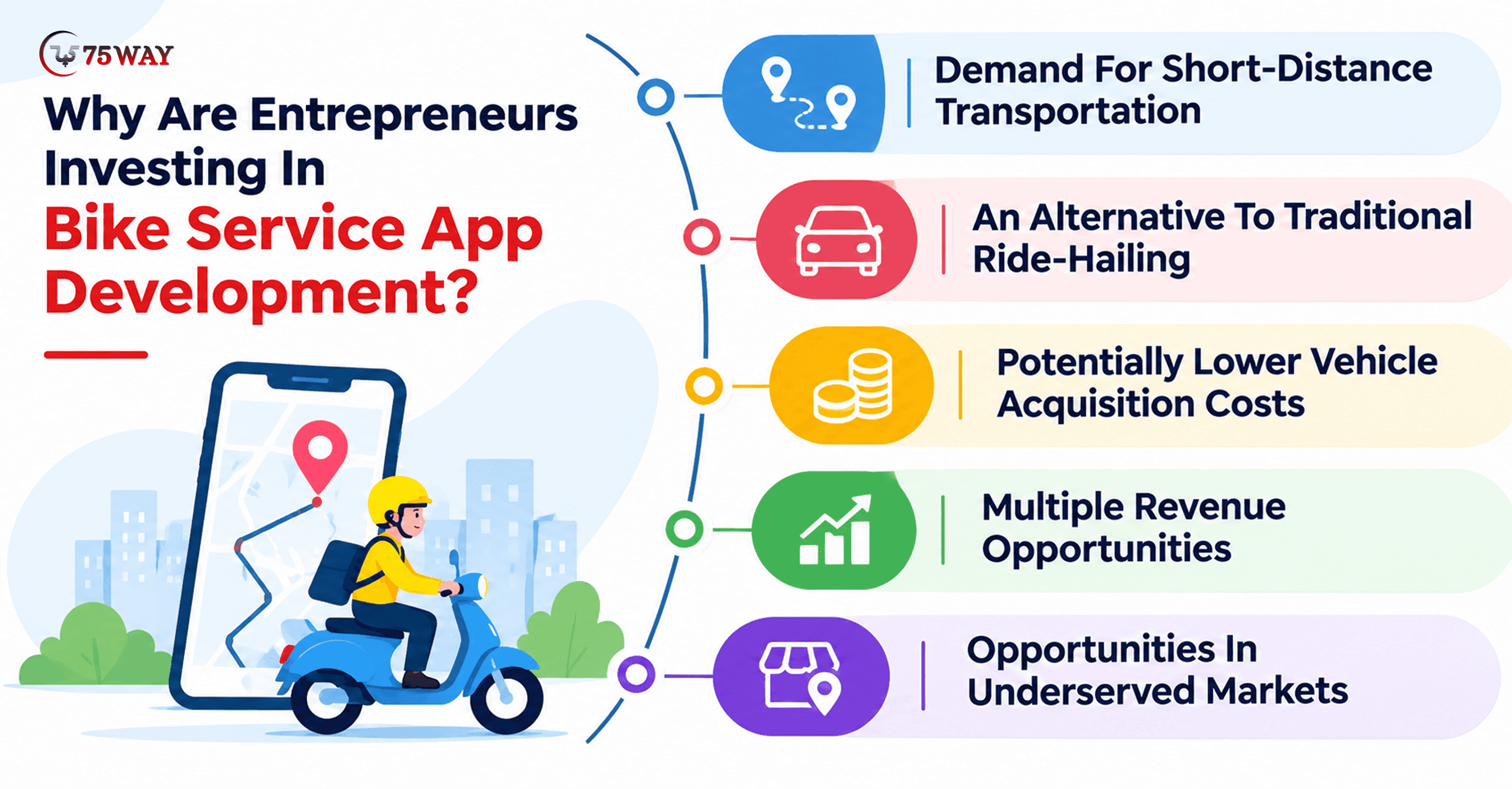
- Demand For Short-Distance Transportation
Many urban commuters need transportation for relatively short journeys, such as traveling between transit stations, offices, residential communities, and commercial areas. A bike taxi service can address these trips when suitable local regulations and operating conditions permit it.
- An Alternative To Traditional Ride-Hailing
A motorcycle-based ride option can give passengers another way to travel. Businesses can position their services around specific neighborhoods, commuter routes, university communities, or other permitted transportation markets.
- Potentially Lower Vehicle Acquisition Costs
Motorcycles and scooters generally have lower purchase prices than many passenger cars. This can make driver onboarding and fleet expansion more accessible, although insurance, maintenance, licensing, and safety costs still need careful consideration.
- Multiple Revenue Opportunities
A bike taxi platform can earn through several channels, including ride commissions, subscription plans, corporate transportation agreements, and selected promotional partnerships.
- Opportunities In Underserved Markets
Some transportation markets have limited convenient options for short-distance travel. Entrepreneurs can investigate these gaps and determine whether a locally compliant bike taxi service can serve them profitably.
Must-Have Features of Bike Ride-Sharing App Development To Make It Stand Out
A bike ride-sharing app can lose riders quickly if booking takes too long, driver locations aren't accurate, or fare details are unclear. Features like real-time GPS tracking, instant ride requests, transparent pricing, secure payments, and driver verification address these everyday concerns. Let's look at the must-have features that make a bike ride-sharing app practical for passengers, drivers, and business owners.
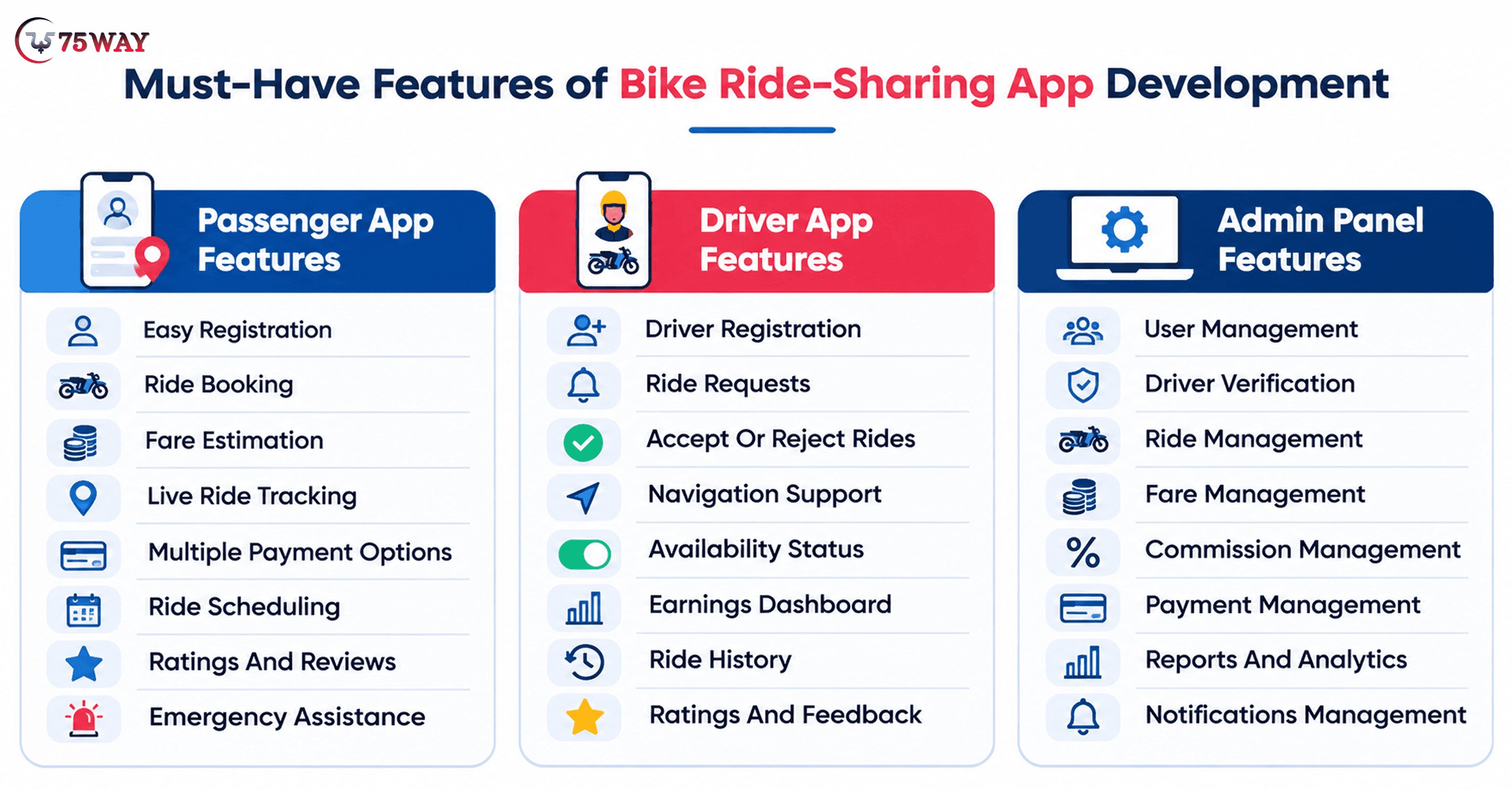
Panel 1: Passenger App Features
The passenger app should simplify ride booking, provide trip updates, and make every journey easier to manage.
- Easy Registration: Allow passengers to create accounts using their phone numbers, email addresses, or social logins.
- Ride Booking: Let users enter pickup and drop-off locations to request nearby bike taxis.
- Fare Estimation: Display estimated ride costs before booking, helping passengers make informed travel decisions.
- Live Ride Tracking: Show the driver's real-time location and estimated arrival time on maps.
- Multiple Payment Options: Support cash, credit cards, debit cards, and digital payment methods.
- Ride Scheduling: Allow passengers to book bike taxi rides for preferred future dates and times.
- Ratings & Reviews: Enable passengers to rate drivers and share feedback after completing their rides.
- Emergency Assistance: Provide access to SOS alerts and emergency contacts during active trips.
Panel 2: Driver App Features
The driver app should help drivers accept bookings, navigate routes, manage availability, and track their income.
- Driver Registration: Let drivers submit personal details, license information, and vehicle documents for verification.
- Ride Requests: Notify drivers about nearby bookings with pickup locations and estimated fares.
- Accept/Reject Rides: Allow drivers to accept or decline incoming requests based on availability.
- Navigation Support: Provide turn-by-turn directions to passenger pickup points and ride destinations.
- Availability Status: Let drivers switch between online and offline modes based on working hours.
- Earnings Dashboard: Display completed rides, daily income, commissions, and available payout balances.
- Ride History: Maintain records of completed, canceled, and ongoing trips for driver reference.
- Ratings And Feedback: Allow drivers to review passenger ratings and monitor their service performance.
3. Admin Panel Features
The admin panel gives business owners control over drivers, passengers, bookings, payments, and daily platform operations.
- User Management: View, verify, update, suspend, or manage passenger and driver accounts from one dashboard.
- Driver Verification: Review submitted documents and approve drivers before allowing them to accept bookings.
- Ride Management: Monitor active, completed, scheduled, and canceled rides across the platform.
- Fare Management: Configure base fares, per-mile rates, waiting charges, and cancellation fees.
- Commission Management: Set platform commission rates and track deductions from completed driver payments.
- Payment Management: Monitor transactions, refunds, payouts, and payment-related issues across the platform.
- Reports And Analytics: Review booking trends, revenue, cancellations, driver activity, and overall platform performance.
- Notifications Management: Send booking updates, promotional messages, service alerts, and important announcements to users.
AI-Powered Features That Can Differentiate Your Bike Sharing App Development
Basic features make the service operational. Advanced features can help a business improve dispatch decisions, understand customer behavior, and manage a larger transportation network. However, adding every available technology is rarely a sensible starting point. The better approach is to identify features that solve an actual operational problem.
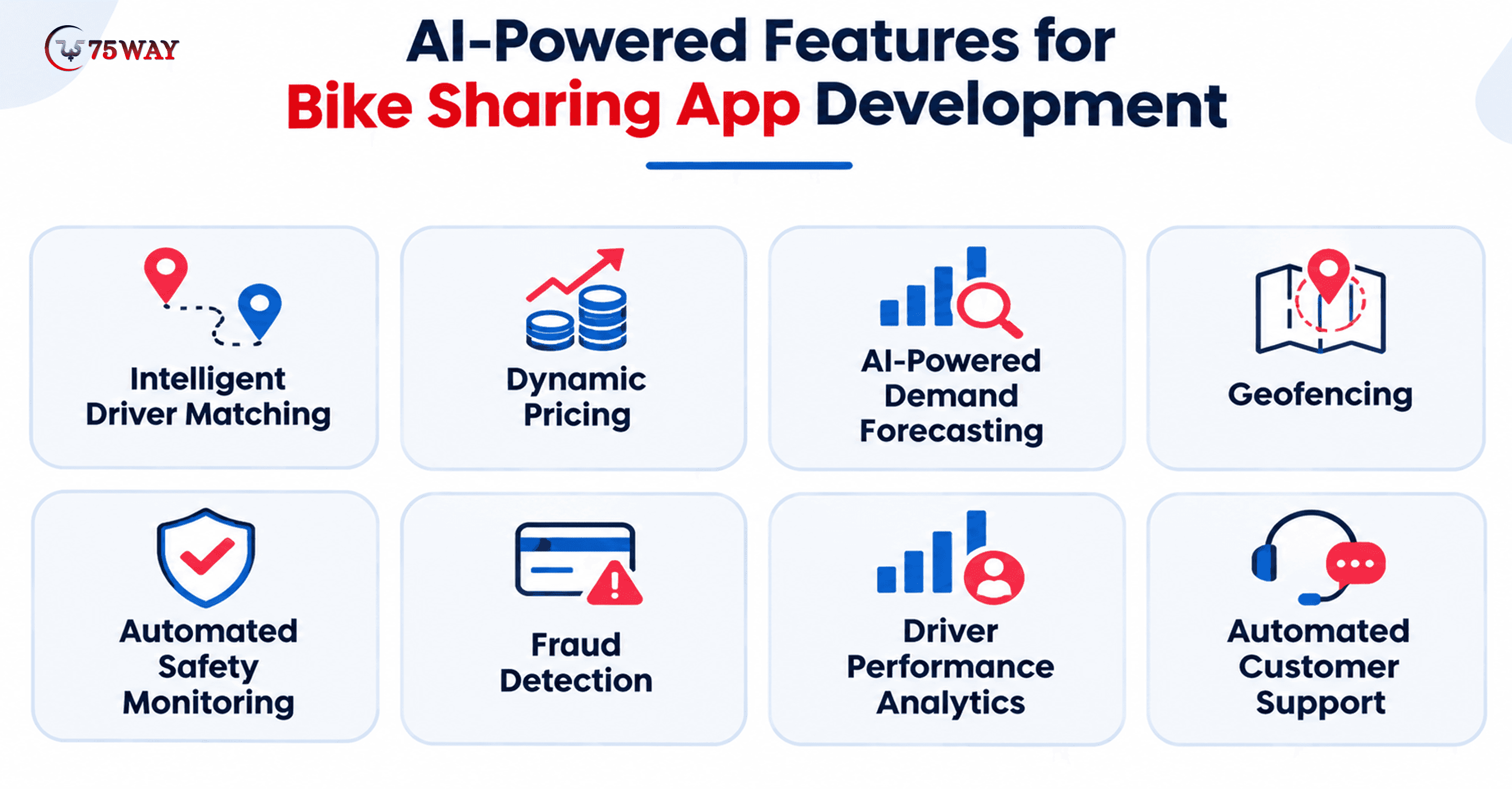
1. Intelligent Driver Matching
A basic dispatch system can assign rides based primarily on driver proximity. An advanced matching engine can consider additional factors, including estimated arrival time, driver availability, service eligibility, and location constraints.
For example, the closest driver may not always be the best assignment if road conditions make another driver's estimated arrival time shorter.
2. Dynamic Pricing
Dynamic pricing adjusts ride fares according to predefined business rules and changing market conditions.
The system may consider demand, driver availability, trip distance, time, and designated service areas. Businesses should make pricing calculations transparent and comply with applicable local consumer protection requirements.
3. AI-Powered Demand Forecasting
Predictive analytics can help operators estimate where and when ride requests are likely to increase.
For instance, historical booking data may show higher demand near a transit station during weekday commuting hours. The business can use this information to plan driver availability.
4. Geofencing
Geofencing creates virtual boundaries around selected geographical areas.
Businesses can use it to manage service availability, restrict pickups in prohibited zones, and define operating boundaries. This is particularly useful when a bike taxi business serves multiple cities or jurisdictions with different rules.
5. Automated Safety Monitoring
Safety features can include trip-sharing links, emergency assistance, unusual-trip alerts, and access to support teams.
More advanced implementations can monitor selected trip events and trigger predefined review workflows. These features should be designed carefully to avoid treating automated alerts as proof of misconduct or an emergency.
6. Fraud Detection
A platform can monitor suspicious booking and transaction patterns, repeated promotional abuse, unusual account activity, and potentially fraudulent payment attempts.
Risk-based checks can help administrators investigate unusual activity without unnecessarily blocking legitimate customers.
7. Driver Performance Analytics
Businesses can analyze driver acceptance rates, cancellation patterns, completed trips, customer feedback, and operational availability.
These insights can help identify training requirements and improve service quality.
8. Automated Customer Support
An AI-powered support assistant can answer common questions about bookings, payments, cancellations, and account information.
For sensitive situations, including accidents, safety complaints, and disputed payments, the system should provide an appropriate path to a human support representative.
What's The Exact Bike Taxi App Development Cost?
The cost of developing a bike taxi app typically ranges from $15,000 to $300,000+, depending on the platform's complexity, feature requirements, integrations, and business goals.
At 75way Technologies, our bike taxi app development costs start at $5,000, making it easier for startups and businesses to begin with a practical budget. The final cost depends on your required features, app complexity, technology stack, and platform selection.
A startup launching in one city will have different bike booking service app development requirements from an established mobility company planning a multi-city ride-hailing platform.
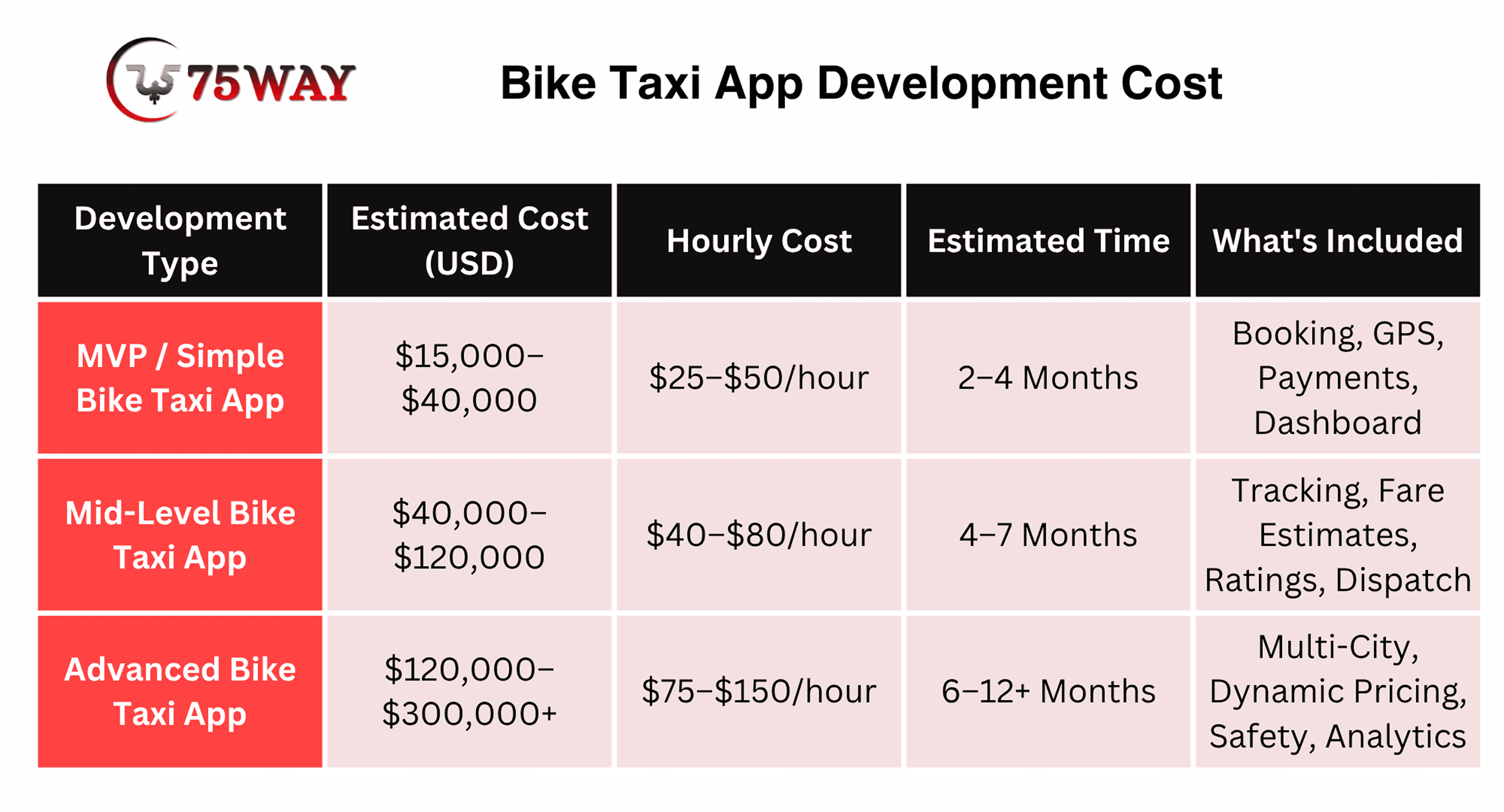
1. MVP/Simple Bike Taxi App Cost: $15,000 – $40,000
- Development Timeline: 2–4 months
- Features: Booking, GPS, payments, driver profiles, admin dashboard.
- Why Build: Validate local demand before investing in a larger platform.
Suitable For: Local startups, pilot launches.
2. Mid-Level Bike Taxi App Cost: $40,000 – $120,000
- Development Timeline: 4–7 months
- Features: Live tracking, fare estimates, ratings, payments, dispatch.
- Why Build: Expand service capabilities while improving driver and passenger experiences.
Suitable For: Growing ride-hailing businesses.
3. Advanced Bike Taxi App Cost: $120,000 – $300,000+
- Development Timeline: 6–12+ months
- Features: Multi-city operations, dynamic pricing, safety, analytics, integrations.
- Why Build: Support growing demand with automation, integrations, and operational controls.
Suitable For: Established regional mobility operators.
1What type of ride-sharing app are you planning?
Single choice2Which platforms do you want to launch on?
Single choice3Which features do you want?
Multiple choiceCost To Hire Bike Taxi App Developers in USA
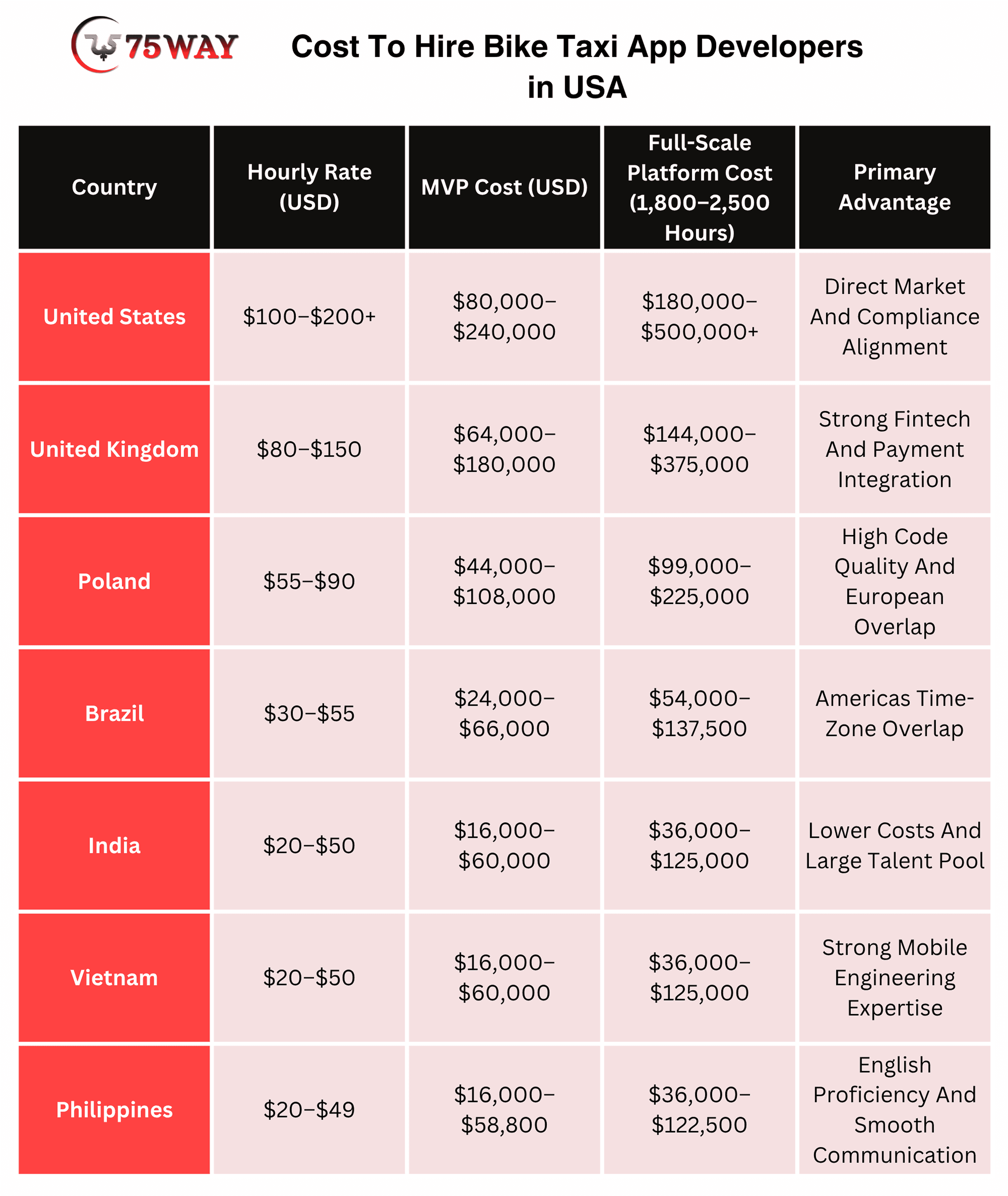
The cost of hiring bike taxi app developers can change your total budget depending on where your development team is based.
- Cost to Hire Bike Taxi App Developers in US: $100–$200+
- Cost to Hire Bike Taxi App Engineers in UK: $80–$150
- Cost to Hire Bike App Developers in Poland: $55–$90
- Cost to Hire Bike Booking App Developers in Brazil: $30–$55
- Cost to Hire Bike Taxi App Developers in India: $20–$50
- Cost to Hire Bike Taxi App Developers in Vietnam: $20–$50
- Cost to Hire Bike Taxi App Developers in the Philippines: $20–$49
For example, hiring bike booking app developers in the US may require a different budget than working with teams in India, Eastern Europe, or Southeast Asia. Let's compare developer hiring costs across popular outsourcing destinations so you can plan your budget more realistically.
Custom or White-Label Bike Taxi App Development: Which To Choose
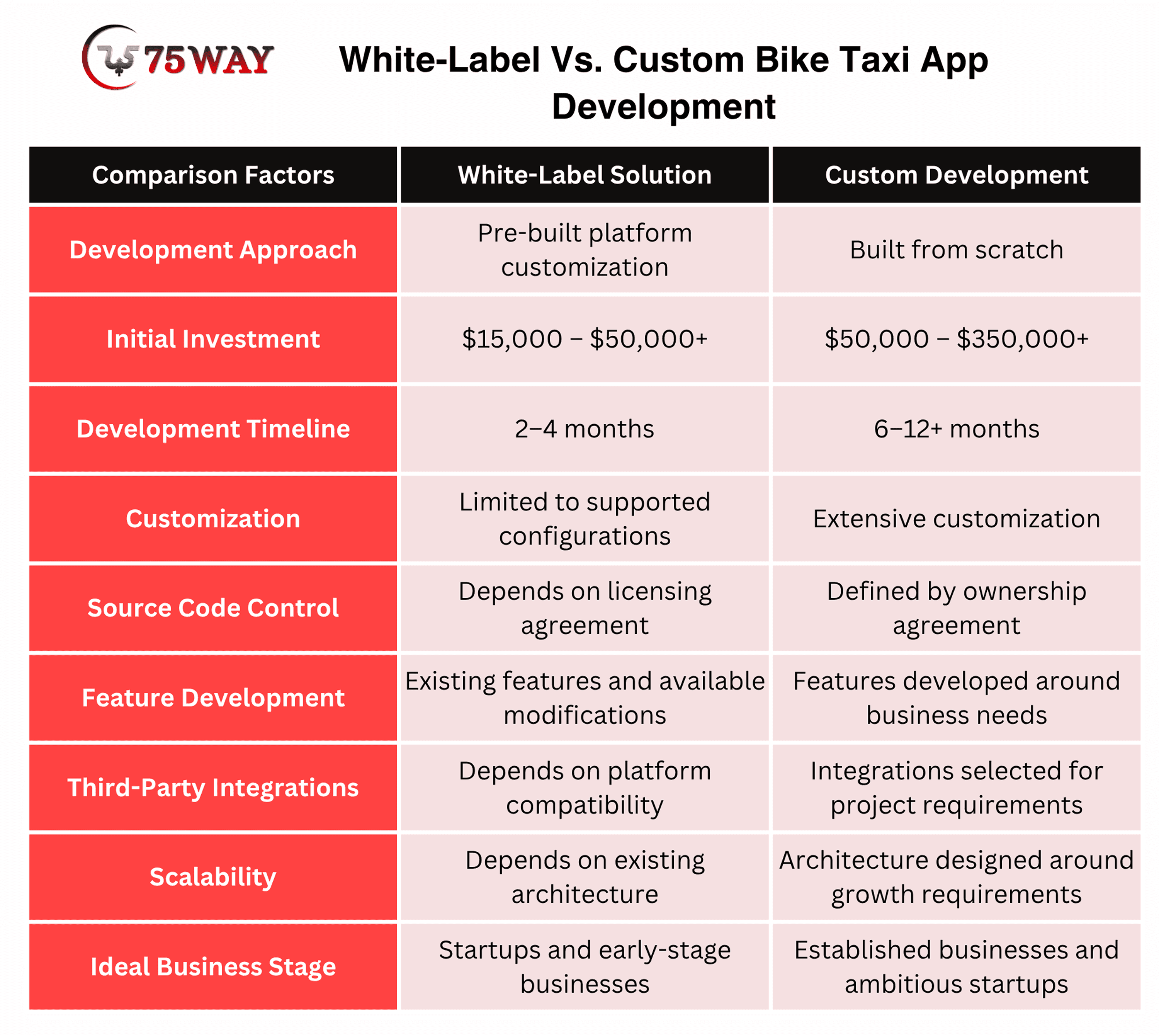
Choosing between custom and white-label bike booking app development is an important business decision. The right approach depends on how quickly you want to enter the market, how much control you need, and how much you can invest in technology.
Let's understand what each approach offers.
1. White-Label Solution Bike Taxi App Development
A white-label bike taxi solution is a pre-developed platform that businesses can purchase, brand, and launch under their own company name. It typically includes ready-made passenger, driver, and admin applications with essential ride-booking functionalities.
Instead of developing every component from scratch, you configure the existing platform to match your business requirements. This approach reduces initial development work and helps businesses enter the market sooner.
A white-label bike taxi app is like buying a ready-made house, painting it with your favorite colors, adding your nameplate, and moving in instead of building everything from the ground up.
- Estimated Development Cost: $15,000 – $50,000+
- Timeline: 2–4 months
Best For: Startups seeking faster market entry.
2. Custom Bike Taxi App Development
Custom bike taxi app development involves building the platform specifically around your business model, operational requirements, and customer expectations. The development team creates the passenger app, driver app, admin dashboard, backend, and integrations according to your specifications.
You have greater control over the application architecture, user experience, feature development, and future modifications. However, this approach requires more planning, development resources, testing, and investment.
In simple language, a custom bike ride-sharing app is like purchasing an empty plot and designing every room, floor, and facility according to your family's needs.
- Estimated Development Cost: $50,000 – $350,000+
- Timeline: 6–12+ months
Best For: Businesses requiring complete customization.
Hybrid Bike Taxi App Development
A hybrid bike taxi app combines the speed of a pre-built solution with the flexibility of custom development. Businesses start with an existing platform and customize selected components, such as booking workflows, pricing logic, user interfaces, or third-party integrations.
This reduces the effort required to build the entire application from scratch while allowing important business-specific requirements to be addressed. It is particularly useful when a company wants to launch with established functionality but retain room for future product differentiation.
- Estimated Development Cost: $50,000 – $120,000+
- Timeline: 4–8 months
Best For: Businesses balancing customization and speed.
Legal & Safety Considerations for On-Demand Bike Taxi App Development in the US
This is one area founders should investigate before spending heavily on development. The legal position can differ between states, cities, and vehicle categories. Rules for a motorcycle carrying a paying passenger should not be assumed to be identical to rules for an electric scooter, bicycle, or traditional taxi. Before launch, investigate the following.
1. Business And Transportation Permits
Determine which licenses, registrations, permits, and approvals apply to the proposed service in the target jurisdiction.
Consult the relevant state and local transportation authorities before accepting passenger bookings.
2. Driver Licensing
Verify that drivers hold the appropriate motorcycle license and meet applicable eligibility requirements.
The platform should also define how driver credentials are collected, reviewed, and renewed.
3. Commercial Insurance
Review insurance requirements for passenger transportation, commercial vehicle use, driver coverage, and potential liability.
Personal motorcycle insurance should not be assumed to cover commercial passenger rides.
4. Passenger Safety
Establish policies for helmets, passenger eligibility, vehicle condition, safe pickup locations, and emergency procedures.
Safety requirements should be reflected in driver onboarding and operational workflows.
5. Background Verification
Where legally permitted and required, implement appropriate driver identity and background verification procedures.
The business should establish clear processes for document review, record retention, and periodic checks.
6. Privacy And Data Protection
A bike taxi application collects personal information, location data, and payment-related information.
Implement appropriate privacy disclosures, access controls, data retention policies, and security measures. Review applicable federal and state privacy requirements, including California's privacy framework where relevant.
7. Payment And Consumer Protection
Clearly disclose fares, cancellation charges, refunds, fees, and payment terms.
The payment workflow should also address failed transactions, duplicate charges, disputed payments, and driver settlements.
Business advice: Obtain legal guidance for each intended launch market. A technically complete application does not automatically make the transportation business legally eligible to operate.
Common Challenges In Custom Bike Taxi App Development & Solutions
A bike taxi app has to manage several moving parts at once, from finding nearby drivers to calculating fares and tracking rides in real time. Even a small technical issue in one area can disrupt the entire booking experience. Here are the challenges businesses may encounter during custom bike taxi app development and how to tackle them.
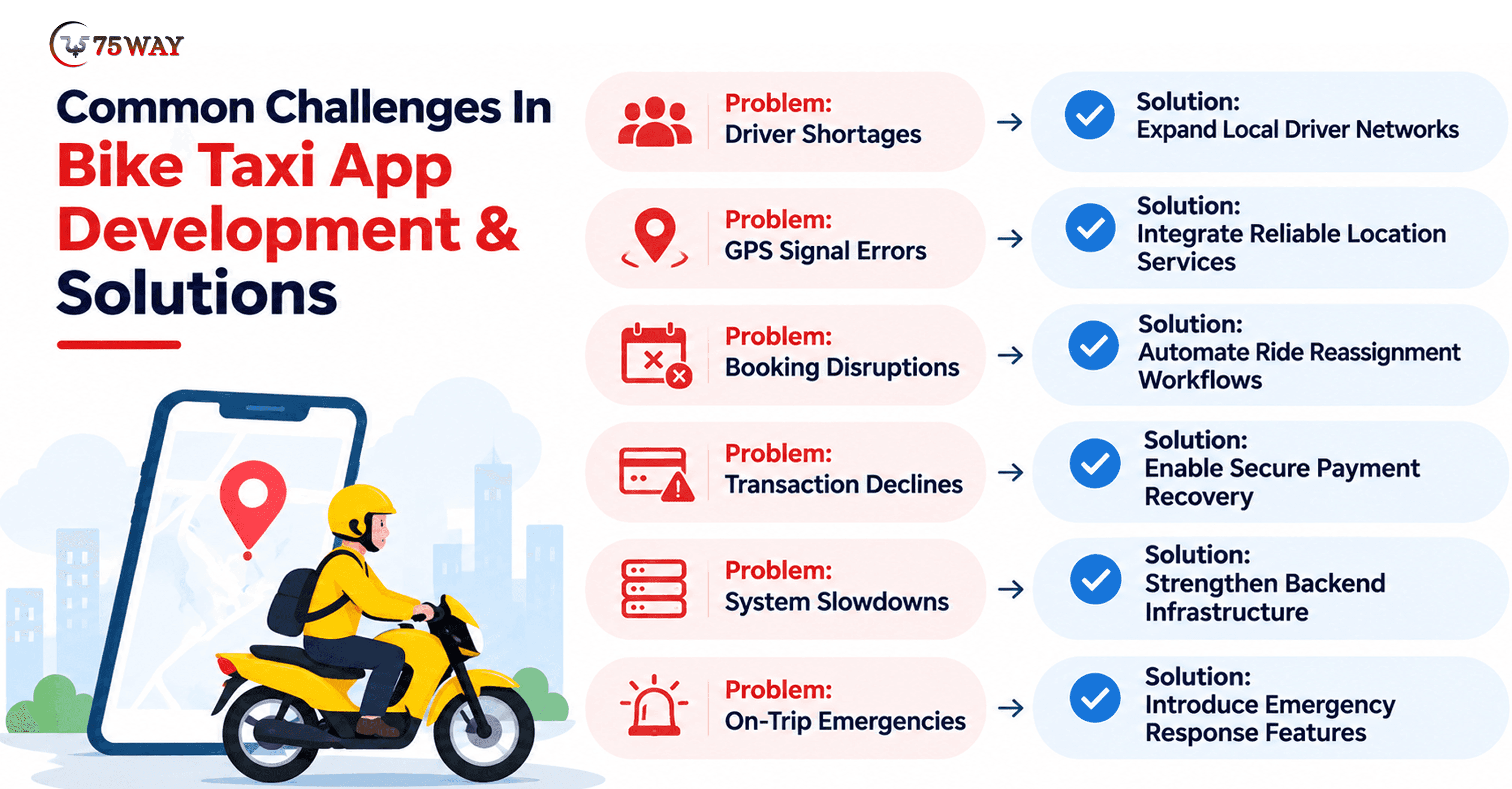
1. Driver Availability
Passengers may request rides in areas where too few drivers are available.
How To Address It: Introduce driver availability management, service-area planning, demand analysis, and appropriate driver incentives.
2. Inaccurate GPS Tracking
GPS signals can become unreliable in dense urban areas, underground parking facilities, or locations with poor connectivity.
How To Address It: Use suitable location services, location accuracy checks, update thresholds, and fallback communication options.
3. Ride Cancellation
Drivers may reject requests, passengers may change plans, and pickup delays can lead to cancellations.
How To Address It: Establish clear cancellation rules, booking expiration workflows, driver reassignment, and passenger notifications.
4. Payment Failures
Transactions can fail because of expired cards, insufficient funds, gateway issues, or network interruptions.
How To Address It: Implement payment status tracking, retry workflows where appropriate, transaction reconciliation, and clear refund procedures.
5. Platform Performance
An increase in simultaneous bookings and location updates can place pressure on backend services.
How To Address It: Monitor system performance, optimize database queries, use appropriate caching, and conduct load testing before expanding.
6. Passenger And Driver Safety
A transportation platform must be prepared to handle accidents, complaints, emergencies, and potentially unsafe situations.
How To Address It: Provide emergency assistance workflows, trip-sharing functionality, driver verification, incident reporting, and trained human support.
How To Choose The Right Bike Taxi App Development Company in USA
A successful bike taxi app starts with the right technology partner. An experienced development company can help you build a platform with reliable ride bookings, live GPS tracking, driver management, and secure payment options.
A company's portfolio, technical expertise, client feedback, and experience with ride-hailing solutions deserve careful attention. Its ability to integrate tools such as Google Maps, payment gateways, and real-time communication systems also matters.
Long-term support is equally important for app maintenance, security updates, and future upgrades. 75way Technologies, as a renowned bike taxi app development company in the USA, can help you turn your bike taxi business idea into a scalable application that matches your operational needs and growth goals.
Final Thoughts
To wrap up, bike taxi app development can create a business opportunity for entrepreneurs looking to enter the mobility industry, but the technology needs to match the market, operating model, and regulatory environment.
From passenger booking and driver matching to payment processing and real-time tracking, every component plays a role in the customer experience. The right development approach also matters.
A white-label solution can help validate a business idea, a custom platform offers greater control, and a hybrid approach can balance both requirements.
The smartest starting point is to define your target market, validate local demand, understand the applicable transportation rules, and prioritize the features your first customers actually need.
Planning to launch your own bike taxi platform? Connect with bike taxi app experts to discuss your business requirements, development approach, and technology roadmap.
Frequently Asked Questions (FAQs)
Can I Start A Bike Taxi Business With An MVP?
Yes. An MVP can help validate local demand using essential booking, driver management, GPS tracking, and payment functionality. However, regulatory compliance, insurance, and passenger safety requirements must be addressed before launch.
How Does A Bike Taxi App Assign Rides To Drivers?
The dispatch system checks available drivers and evaluates factors such as distance, estimated arrival time, service eligibility, and availability. It then sends a booking request to suitable drivers according to the configured assignment rules.
Which Payment Gateways Can Be Integrated Into A Bike Taxi App?
Payment providers such as Stripe and Adyen can support card payments and other configured payment methods. The final choice depends on supported countries, transaction requirements, business eligibility, and the platform's payment architecture.
Can A Bike Taxi App Support Multiple Cities?
Yes. A bike taxi platform can support multiple cities through configurable service areas, pricing rules, driver management, and operational settings. The business must also account for local transportation regulations and service eligibility in each location.
Is A Bike Taxi Business Legal In The US?
The legality depends on the vehicle category, passenger transportation model, and applicable state and local regulations. Businesses should verify motorcycle licensing, commercial insurance, transportation permits, and operating requirements before launching.
Can AI Be Integrated Into A Bike Taxi App?
Yes. AI can support demand forecasting, driver matching, customer support, fraud detection, and operational analytics. These capabilities should address specific business requirements and be tested before being used in important operational decisions.