AI Summary
AI sales agents help travel agencies capture leads, answer questions, recommend trips, and support bookings around the clock. They automate repetitive sales and service tasks while keeping human agents involved when needed. This guide explores their uses, benefits, integrations, costs, limitations, and implementation.
Key Takeaways
- AI sales agents for travel agencies automate lead qualification, follow-ups, and booking support.
- Agencies can provide faster customer responses without expanding teams for every inquiry.
- AI agents connect sales conversations with CRMs, booking systems, APIs, and communication channels.
- Human agents remain essential for complex, high-value, or sensitive travel requests.
- Successful implementation requires appropriate workflows, integrations, monitoring, training, and measurable performance goals.
Your sales team should be selling trips, not spending most of the day answering the same questions about destinations, packages, availability, pricing, and booking procedures. For growing travel agencies, that repetitive workload can consume valuable staff time while new inquiries continue arriving through websites, social media, and messaging channels.
An AI sales agent for travel agencies can take over these routine interactions, qualify travelers, recommend relevant options, collect trip requirements, provide instant answers, and initiate booking conversations. Human consultants can then spend more time on complex itineraries, negotiations, group travel, and customers who are closer to making a purchase.
For business owners, the bigger question is whether this improves the economics of the agency. The following guide examines how sales AI agent development solutions for travel agencies can reduce manual workload and strengthen customer service without removing the human expertise travelers still value.
What Is an AI Sales Agent for a Travel Agency?
A travel agency can lose a promising customer long before a salesperson gets the chance to speak with them. A traveler may ask about a family vacation at night, request a quote over the weekend, or send the same inquiry to several agencies at once. If the response comes hours later, the opportunity may already be gone.
An AI sales agent for a travel agency is designed to handle that first layer of the conversation. It can engage travelers through chat, understand what they want, collect trip details, answer routine questions, qualify the inquiry, recommend relevant options, and move the customer toward a booking or human-assisted sales conversation.
The important distinction is that an AI sales agent is more than a traditional FAQ chatbot. A well-designed agent can work within defined business rules, access approved information and connected systems, maintain conversation context, trigger specific workflows, and recognize when a request needs human attention.
How Does a Sales AI Agent Actually Help Travel & Hospitality Businesses?
Consider a traveler searching for a seven-day trip from New York to Italy for two adults. Instead of simply displaying a message such as “Thanks for contacting us,” an AI sales agent can begin by understanding the trip:
- When does the traveler want to leave?
- Which cities or experiences are they interested in?
- What is their approximate budget?
- Are flights, hotels, transfers, or activities required?
- Do they have flexibility with dates?
- Are there specific preferences or constraints?
The agent can then use the information collected to determine what should happen next. A qualified request might be passed to a travel consultant, routed into a CRM, connected to an approved booking workflow, or followed up automatically if the traveler is not ready to make a decision.
This is where the business value becomes more practical. The AI is not simply answering questions; it is helping move a travel inquiry through the sales process.
Tasks An AI-Powered Sales Agent Handles For Travel Companies
Depending on the agency's systems, rules, and integrations, an AI sales agent can support several parts of the customer journey.
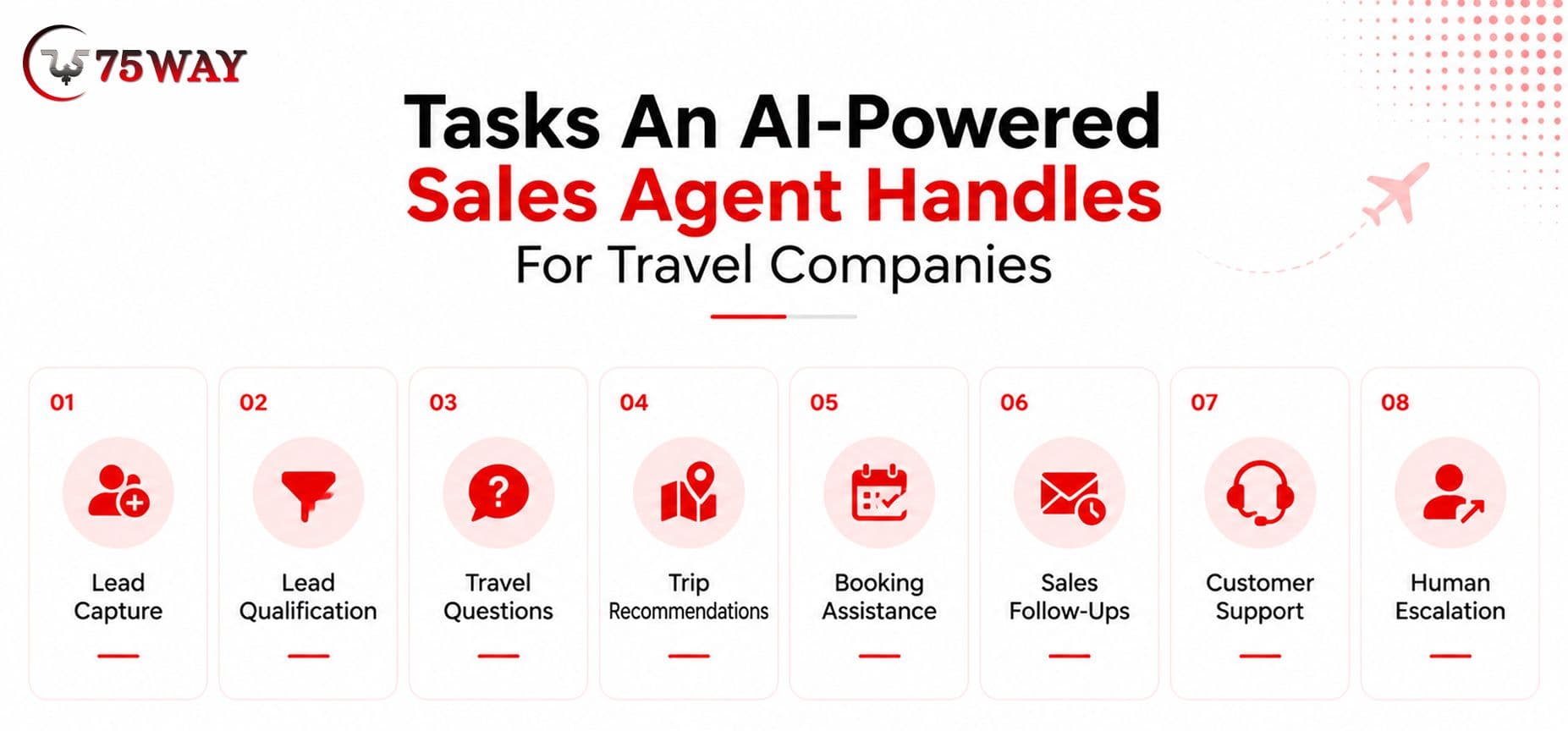
- Lead Capture: An AI travel agent collects contact details and trip requirements from website visitors or messaging conversations instead of relying on a form alone.
- Lead Qualification: The agent can identify important buying signals such as destination, dates, group size, budget, and travel preferences before a salesperson takes over.
- Travel Questions: Routine questions about destinations, packages, policies, services, and agency offerings can be answered using approved business information.
- Trip Recommendations: When connected to appropriate data sources, an agent can help narrow options based on the traveler's stated requirements rather than giving the same generic recommendation to everyone.
- Booking Assistance: The AI travel sales automation platform can guide customers through eligible booking steps or hand the conversation to a human or connected booking workflow when direct action is not appropriate.
- Sales Follow-Ups: If someone asks for options but does not book immediately, the agent can continue the conversation according to the agency's follow-up rules.
- Customer Support: After the sale, the same conversational system can help answer routine questions and direct customers to the right support channel.
- Human Escalation: Complex itineraries, exceptions, complaints, unusual requests, or high-value opportunities can be transferred to a human travel professional.
Traditional Chatbot Vs AI Sales Agent For Tour & Travel Agencies
A traditional chatbot typically follows predefined conversation paths and handles a limited set of questions. An AI sales agent is intended to manage more natural conversations and support broader sales workflows.
AI sales agents are generally more capable than traditional chatbots for tour and travel agencies because they can support broader sales conversations and workflows.
A traditional chatbot typically works with predefined questions, fixed responses, and simple decision trees. It can answer FAQs, collect basic lead details, share links, and guide visitors to specific website pages. However, its usefulness can drop when travelers ask unexpected questions, change their requirements, or need personalized assistance.
The difference is not simply chatbot versus AI. It is about what the system is actually capable of doing inside the agency's sales and service process.
For travel businesses, that distinction is important because the goal is not to add another chat window to the website. The goal is to create a system that can capture demand, understand intent, support the booking journey, and involve a human when the conversation requires judgment.
How AI Sales Agents Work for Travel Agencies
A traveler does not think in terms of “lead qualification” or “CRM workflows.” They simply want an answer: Can you plan this trip, what will it cost, and how soon can I book it?
An AI sales agent connects that conversation to the agency’s sales process. It listens to the traveler’s request, identifies the information needed, checks approved data or connected systems, and determines the next action based on the agency’s rules.
The exact workflow depends on the agency’s technology stack and the level of automation it chooses. A simple implementation may focus on capturing and qualifying inquiries, while a more advanced setup can connect conversations with CRMs, booking platforms, travel APIs, payment workflows, and support systems.
1. Capture the Traveler’s Inquiry
The conversation can begin through a website, messaging channel, email, or another supported customer touchpoint.
Instead of asking a traveler to complete a long form before receiving help, the AI agent can collect essential information conversationally, such as:
- Destination
- Travel dates
- Departure location
- Number of travelers
- Trip type
- Budget range
- Accommodation preferences
- Activities or special requirements
This gives the agency useful context before a salesperson enters the conversation.
2. Understand Intent and Qualifies the Lead
Not every inquiry has the same commercial value. Someone researching destinations six months from now requires a different response from a traveler ready to book this week.
An AI sales agent can identify signals within the conversation and categorize inquiries according to the agency’s qualification criteria. For example, it may distinguish between an early-stage information request, a quote request, and a customer who is ready to discuss booking.
This helps sales teams prioritize conversations instead of treating every incoming inquiry identically.
3. Provide Relevant Information
Once the agent understands what the traveler needs, it can provide information from approved sources and connected systems.
For example, a customer planning a family vacation may ask about suitable destinations, package details, hotel options, or available services. The agent can respond based on the information available to it rather than forcing the customer to search through multiple pages.
For travel agencies, accuracy matters more than sounding intelligent. Pricing, availability, cancellation terms, supplier information, and other time-sensitive details should come from appropriate systems or verified business sources whenever the workflow requires them.
4. Move the Customer Toward Booking
A useful sales conversation should have a next step.
Depending on the agency's setup, the AI agent may help the traveler request a quote, schedule a conversation with a travel consultant, start an eligible booking workflow, submit required information, or receive a follow-up.
The objective is not to push every traveler toward an immediate purchase. It is to remove unnecessary friction between interest and action.
5. Update Connected Business Systems
When integrated with the agency’s technology stack, the AI agent can pass relevant information into systems such as a CRM or lead-management platform.
For example, a qualified inquiry might include the traveler’s destination, dates, budget, preferences, conversation history, and requested next step.
Instead of a sales representative reading an incomplete message and starting discovery from scratch, they can receive a clearer picture of what the traveler actually wants.
6. Follow Up When the Traveler Is Not Ready
Travel decisions rarely happen in one conversation.
A traveler may request a quote today, compare options tomorrow, and return several days later. An AI sales agent can support follow-up workflows based on predefined business rules, helping agencies stay engaged without requiring employees to manually remember every pending inquiry.
The agency still controls when, how, and why follow-ups occur.
7. Hand Complex Conversations to Humans
Good automation knows when to stop.
If a traveler has a complicated itinerary, requests an exception, raises a complaint, needs assistance with a sensitive booking issue, or simply wants to speak with an agent, the conversation can be escalated.
The human representative can then take over with the relevant context rather than asking the customer to repeat everything.
Real World Use Cases of AI Sales Automation Agent For Travel Companies
The value of an AI sales agent becomes easier to understand when you stop looking at it as a piece of software and look at the conversations happening inside a travel agency every day.
A customer wants a last-minute hotel. Another wants a family vacation but has a tight budget. Someone else received a quote three days ago and has gone silent. These are different conversations, but they all require time from the sales or support team.
AI sales assistant for travel businesses can support these scenarios when the right information, workflows, and escalation rules are in place.
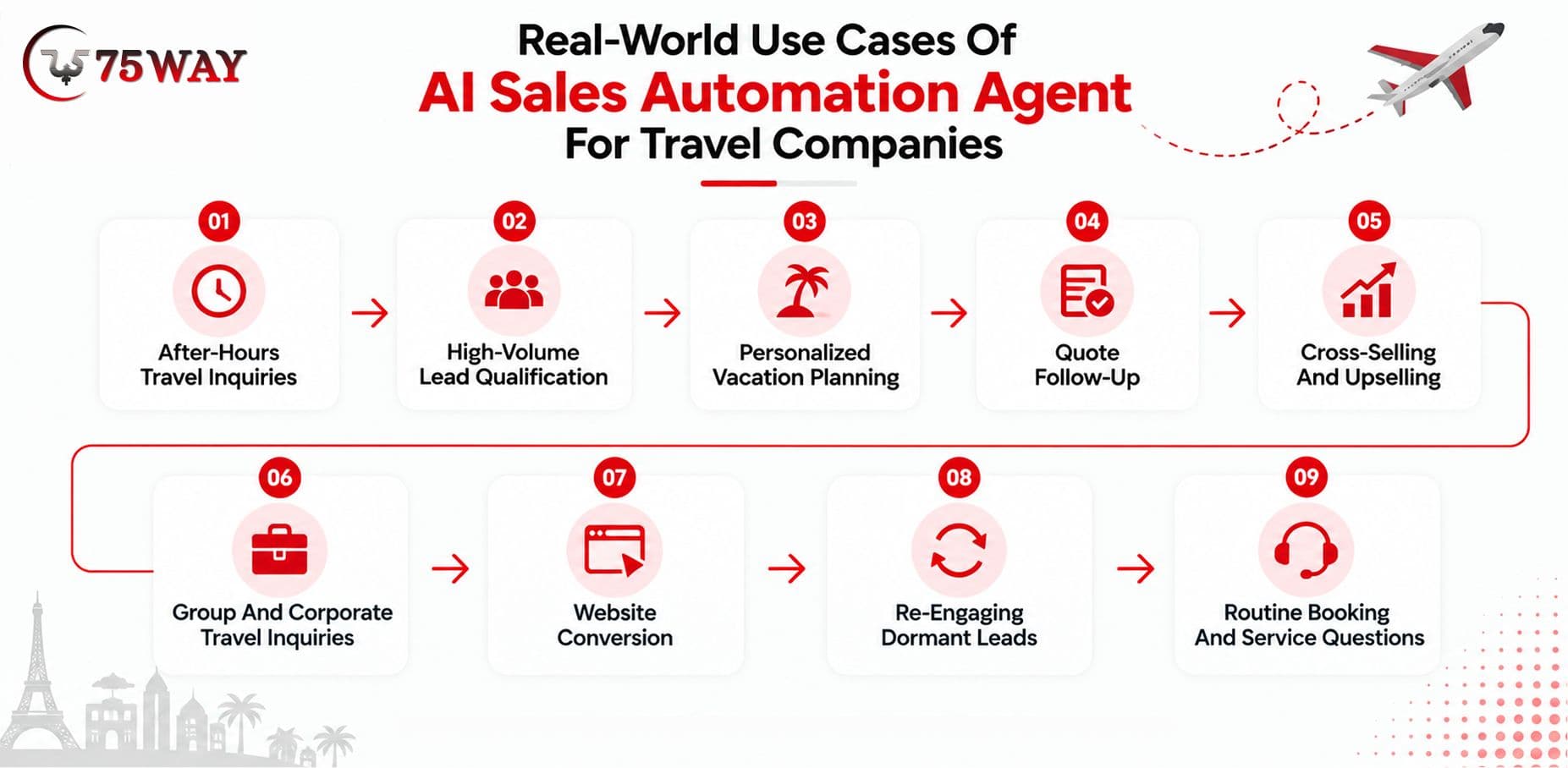
1. After-Hours Travel Inquiries
Travelers do not necessarily research trips during business hours.
An AI sales agent can respond to inquiries outside the agency's regular working hours, collect trip requirements, answer appropriate questions, and capture the opportunity for the sales team.
The benefit is not simply being available 24/7. It is ensuring that an inquiry arriving at an inconvenient time still enters a useful sales workflow instead of sitting unanswered until the next business day.
2. High-Volume Lead Qualification
Travel agencies running advertising campaigns, seasonal promotions, or destination-specific campaigns can receive large numbers of inquiries within a short period.
Having a salesperson manually ask every prospect the same initial questions can become a bottleneck.
An AI agent can collect basic requirements and apply the agency's qualification criteria before routing suitable opportunities to sales representatives.
This allows the team to spend more time on conversations that require expertise and less time gathering information that follows a predictable pattern.
3. Personalized Vacation Planning
A traveler rarely begins with a perfectly defined itinerary.
They might say, “We want a relaxing beach vacation in August, but we don't want to spend too much.”
The AI agent can ask follow-up questions about dates, travelers, budget, preferences, and priorities. Those answers create a clearer picture of what the customer is actually looking for.
From there, the agent can provide appropriate information or route the request into the agency's recommendation and sales process.
4. Quote Follow-Up
One of the easiest opportunities to overlook is the lead that already showed interest.
A customer may request a quote, open the response, compare alternatives, and postpone the decision. Without a follow-up process, the agency may lose visibility into what happens next.
AI sales agents can support structured follow-up sequences based on the agency's rules, helping keep qualified prospects engaged without requiring sales representatives to manually monitor every open opportunity.
5. Cross-Selling and Upselling
A customer's initial booking may create opportunities for additional services.
Depending on the agency's offerings, the AI agent could introduce relevant options such as airport transfers, activities, travel insurance, room upgrades, or other travel services.
The important word is relevant. Effective cross-selling should reflect the customer's trip and preferences rather than turning every conversation into a list of unrelated offers.
6. Group and Corporate Travel Inquiries
Group travel can involve more information than a typical individual booking.
An AI sales agent can collect details such as group size, travel dates, destinations, accommodation requirements, meeting needs, and other relevant preferences before routing the inquiry to a specialist.
For corporate travel, the workflow may also involve company-specific policies, approval processes, traveler information, or account requirements. These should be handled according to the agency's configured rules rather than assumed by the AI.
7. Website Conversion
A visitor who lands on a travel agency's website may not be ready to fill out a long contact form.
An AI sales agent can start a conversation and help the visitor identify what they need. A simple question about destination, dates, or trip type can turn an anonymous website visit into a qualified inquiry.
This makes conversational engagement useful not only for customer service but also for lead generation and conversion.
8. Re-Engaging Dormant Leads
Travel agencies often have older leads that never converted.
Some travelers may have postponed their plans rather than rejected the offer entirely. An AI agent can support carefully defined re-engagement campaigns, provided the agency has an appropriate basis and permissions for contacting those customers.
For example, a previous inquiry could be revisited when the traveler has indicated a future travel window or when a relevant agency campaign is launched.
9. Routine Booking and Service Questions
Customers frequently need straightforward information after initiating or completing a booking.
An AI sales or service agent can handle eligible questions using approved information and route exceptions to the appropriate team member.
This can help prevent sales staff from spending large portions of their day answering questions that do not require their expertise.
Which Use Cases Should a Travel Agency Automate First?
Not every workflow should be automated at once.
A practical starting point is usually a high-volume, repetitive, measurable process where the agency already understands the desired outcome.
For many agencies, that could be:
Lead capture → Qualification → Follow-up → Human sales handoff
Once this workflow performs reliably, the agency can consider expanding automation into booking assistance, customer support, cross-selling, and other processes.
The best AI implementation is therefore not the one with the most features. It is the one that solves a clearly defined business problem without creating new operational problems.
Top Advantages of AI Sales Automation For Tour & Travel Agencies
For a travel agency, the biggest opportunity with AI is not having a smarter chat window. It is removing friction from the moments between customer interest and completed action.
- Faster Response to New Leads: Travel shoppers can contact several agencies while comparing options. A delayed response gives competitors more time to engage the same customer.
An AI sales agent can respond as soon as an inquiry arrives, collect essential information, and determine the appropriate next step.
That does not guarantee a booking, but it can shorten the gap between “I’m interested” and “someone is helping me.”
- More Sales Capacity Without Adding the Same Workload: Sales representatives often spend time on activities that do not require their full expertise: collecting basic requirements, answering recurring questions, updating lead information, and following up with prospects.
Automating suitable parts of this work gives the existing team more capacity for higher-value conversations.
For an agency experiencing increasing inquiry volume, this can be more practical than expecting sales staff to handle every additional interaction manually.
- 24/7 Lead Engagement: A potential customer may submit an inquiry late at night, during a weekend, or while the sales team is already handling other customers.
An AI sales agent can provide an initial response and capture relevant information outside normal operating hours.
The agency can then begin the next business day with a clearer understanding of which opportunities need attention.
- Better Lead Qualification: Not every lead deserves the same immediate sales response.
AI agents can collect qualification information based on the agency's criteria, helping distinguish between general research, genuine purchase intent, and requests requiring specialist attention.
This gives sales teams more context before they invest time in a conversation.
- More Consistent Customer Experiences: Customers should not receive completely different answers simply because they contacted the agency through a different channel or at a different time.
When an AI agent uses approved information and defined business rules, it can provide a more predictable first layer of communication.
Human agents can then step in where personal judgment, negotiation, or specialized travel knowledge is needed.
- Fewer Missed Follow-Ups: A promising travel inquiry can disappear simply because nobody followed up at the right time.
AI-supported workflows can remind, trigger, or conduct appropriate follow-ups according to predefined rules.
This gives agencies a structured way to stay connected with prospects without requiring employees to manually remember every outstanding conversation.
- Better Use of Sales Teams: The strongest benefit may be less about replacing tasks and more about changing where human attention goes.
Instead of spending hours answering repetitive questions or collecting basic trip details, travel consultants can focus on complex itineraries, high-value customers, negotiations, relationship building, and situations that genuinely require their expertise.
- More Actionable Customer Data: Every conversation can reveal useful information about customer demand.
When the AI agent is connected to appropriate systems, agencies can capture details such as preferred destinations, travel dates, budgets, trip types, objections, and frequently asked questions.
Over time, these insights can help agencies identify patterns in customer demand and improve their sales and marketing decisions.
- Lower Pressure During Demand Spikes: Travel demand is not always evenly distributed.
Holiday periods, destination trends, promotional campaigns, and seasonal travel can create sudden increases in inquiries. A team sized for normal demand may struggle to respond to every conversation during these periods.
AI sales agents can provide an additional layer of capacity for suitable repetitive interactions, helping the agency manage peaks without automatically increasing its permanent staffing requirements.
- The Business Case Depends on the Workflow: AI does not automatically create value simply because an agency deploys it.
The return depends on factors such as inquiry volume, response times, conversion rates, labor costs, booking value, integration requirements, and how much of the workflow can safely be automated.
For that reason, agencies should evaluate AI sales agents against measurable business outcomes, not simply the number of conversations the system can handle.
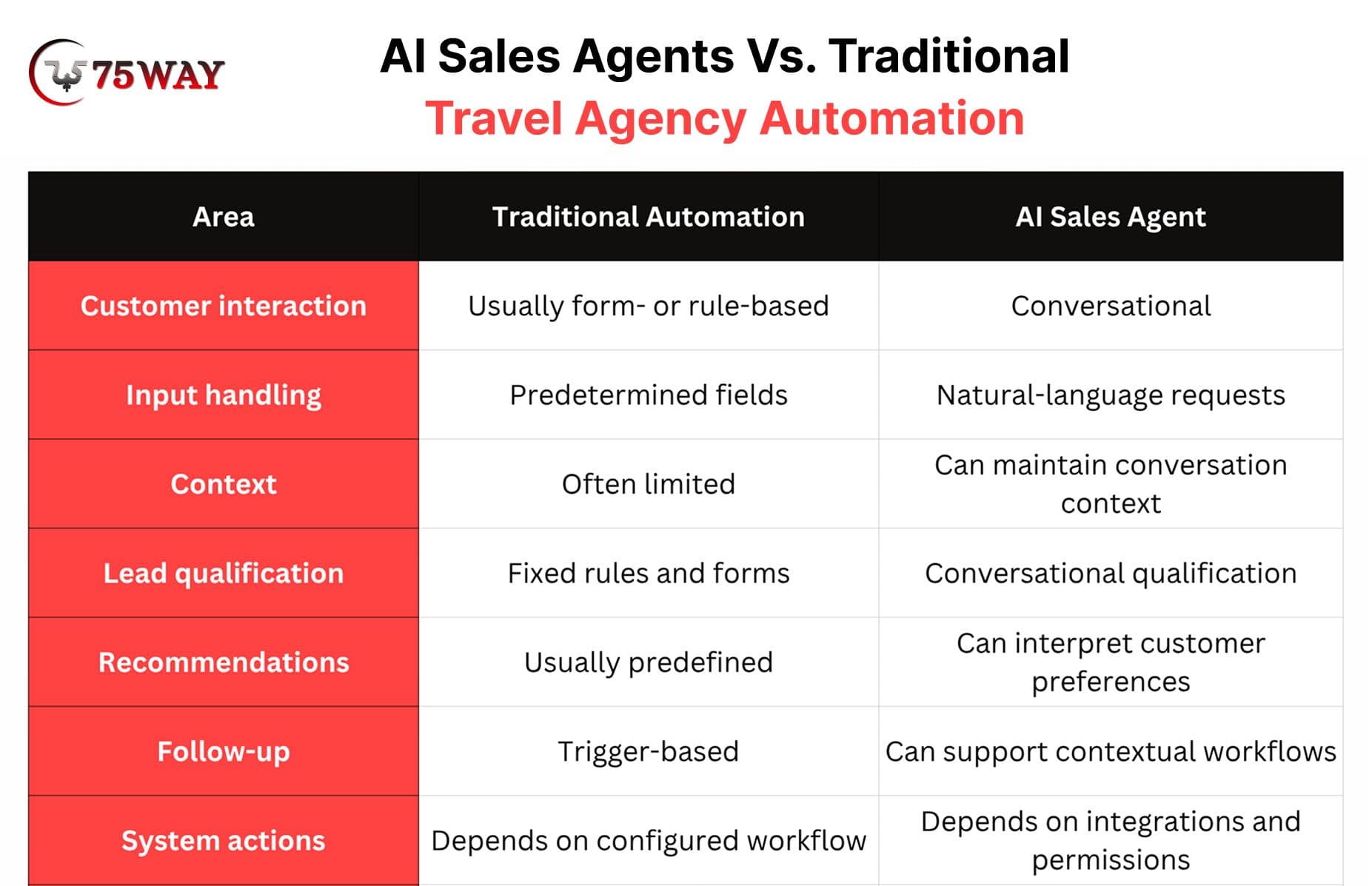
AI Sales Agents Vs. Traditional Travel Agency Automation
Travel agencies have been automating parts of their operations for years. Online booking forms, email autoresponders, CRM workflows, FAQ pages, and rule-based chatbots can already handle specific tasks.
So why add an AI sales agent?
The difference is mainly how the system handles a conversation and what happens after the customer asks a question.
Traditional automation usually follows predefined rules. An AI sales agent can interpret a broader range of natural-language requests, maintain conversational context, gather information, and determine which approved workflow should happen next.
Traditional Automation Handles Defined Paths
Consider a traveler clicking “Request a Quote” on an agency website.
A traditional workflow might open a form, collect the customer's information, send an automated confirmation, and create a CRM record.
That workflow is useful because it is predictable.
But if the traveler writes:
“We’re two couples looking for a relaxed European trip in September. We have about $6,000 per couple and would like to see two or three cities.”
A basic form cannot understand that request. Someone from the agency still needs to interpret it and determine what information is missing.
AI Sales Agents Handle More Natural Conversations
An AI sales agent can respond conversationally and ask relevant follow-up questions.
It might determine that the agency needs to know the travelers' departure airports, exact dates, preferred countries, accommodation expectations, and whether the budget includes airfare.
The agent can then collect those details and route the conversation according to the agency's workflow.
That does not mean the AI should independently make every travel decision. The agency still determines the rules, information sources, permissions, and escalation points.
Does an AI Sales Agent Replace Existing Automation?
Usually, it should not.
A strong implementation often combines AI with traditional automation rather than replacing everything with AI.
For example, the AI agent can understand a customer's request, while traditional systems handle deterministic actions such as creating a CRM record, triggering a notification, or directing the customer to a secure payment page.
This combination can be more reliable than asking an AI model to perform every task itself.
How to Build an AI Sales Agent for a Travel Agency: Comprehensive Process
Building an AI sales agent starts with the travel agency’s sales process, not with choosing an AI model. The technology should fit how your team captures inquiries, qualifies travelers, handles bookings, manages customer data, and escalates complex requests. The exact architecture will vary by agency, but the development process generally follows these steps.
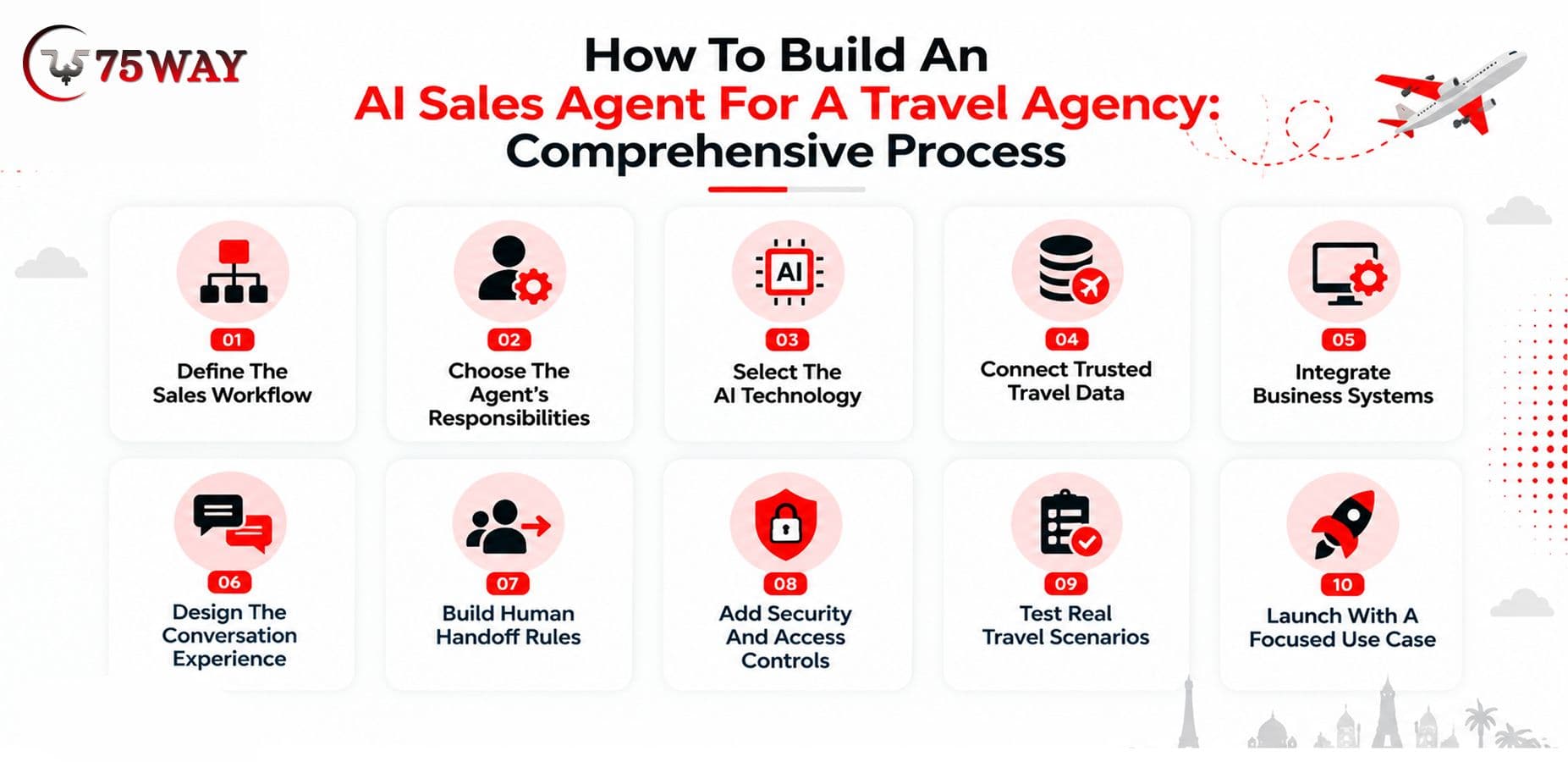
1. Define the Sales Workflow
Start by identifying where your sales team spends the most time.
Map the journey from the first customer inquiry to booking and post-booking support. Look for repetitive conversations, manual data entry, missed follow-ups, and predictable qualification steps that AI could handle.
For example:
Inquiry → Requirement collection → Qualification → Recommendation → Quote → Follow-up → Booking → Support
This workflow becomes the foundation for the agent.
2. Choose the Agent’s Responsibilities
Do not try to automate the entire agency at once.
Define exactly what the AI sales agent is allowed to handle. This could include lead capture, travel questions, qualification, recommendations, quote requests, follow-ups, or selected booking actions.
Also define what remains outside its scope.
Clear boundaries help prevent the agent from making unsupported claims or taking actions it was never designed to perform.
3. Select the AI Technology
The AI model is only one part of the system.
Depending on the use case, the solution may require natural-language processing, retrieval from approved business information, tool or API access, conversation memory, workflow orchestration, and monitoring.
The right technology should be selected according to the agency’s requirements rather than choosing a model simply because it is popular.
4. Connect Trusted Travel Data
An AI agent needs reliable information to provide useful answers.
Connect the appropriate sources for information such as agency services, destinations, packages, policies, FAQs, and other approved content.
For real-time or transactional information, the architecture may also need connections to booking platforms, GDS systems, supplier APIs, or other authorized data sources.
The agent should know the difference between information it can confidently provide and information it needs to retrieve, verify, or escalate.
5. Integrate Business Systems
Next, connect the systems that support the workflow. Depending on the agency, these may include:
- CRM
- Booking engine
- GDS
- Travel APIs
- Payment platform
- SMS or messaging channels
- Customer support platform
- Analytics tools
These integrations allow the AI agent to move beyond conversation and participate in actual business workflows.
6. Design the Conversation Experience
A traveler's conversation should feel natural, but it also needs structure.
Design prompts and conversation flows that help the agent collect the right information without overwhelming the customer.
For instance, asking for destination, dates, travelers, and budget one question at a time can feel much more natural than presenting a long list of required fields.
The conversation should always have a purpose: understand the customer, provide useful information, and move toward the appropriate next step.
7. Build Human Handoff Rules
Human escalation should be designed before launch, not added after something goes wrong. Define situations where the AI should involve a travel professional, such as:
- Complex itineraries
- Booking exceptions
- Complaints
- Refund or cancellation issues
- Sensitive customer requests
- High-value opportunities
- Requests outside the agent’s knowledge
- Uncertain or conflicting information
When a handoff occurs, the human should receive the relevant conversation context whenever the system supports it.
8. Add Security and Access Controls
An AI sales agent may interact with customer information and connected business systems, so access should be limited to what the workflow actually requires.
Use appropriate authentication, permissions, data controls, logging, and secure integrations. Sensitive actions should have additional safeguards where necessary.
The agent should not have unrestricted access simply because an integration is technically possible.
9. Test Real Travel Scenarios
Testing should go beyond asking whether the AI can answer basic questions.
Create realistic scenarios based on actual customer conversations:
Simple inquiry:“I need a hotel in Miami for three nights.”
Incomplete request:“We want to visit Europe this fall.”
Complex request:“We need flights, hotels, transfers, and activities for a family of six across three countries.”
Edge case:“Your website says one thing, but my booking confirmation says something different.”
Test whether the agent asks appropriate questions, uses the correct information, follows business rules, and escalates when necessary.
10. Launch With a Focused Use Case
A phased launch is usually easier to manage than attempting to automate every customer interaction immediately.
An agency might begin with:
Lead capture → Qualification → CRM handoff
After measuring performance, it can expand into follow-ups, recommendations, booking assistance, and customer support.
Track meaningful outcomes such as qualified leads, booking conversions, human handoffs, response times, unresolved conversations, and customer feedback.
The objective is not to prove that the AI can hold a conversation. It is to prove that the conversation contributes to a better sales or service outcome.
How Much Does It Cost to Build an AI Sales Agent for a Travel Agency?
There is no single price for building an AI sales agent for a travel agency. A basic lead-qualification agent and a production-ready system connected to booking platforms, CRMs, travel APIs, payment workflows, and customer-support tools can have very different development requirements.
The following estimates provide a general planning range. Actual costs and timelines depend on the agency’s requirements, integrations, data quality, customization, and development team.
- Basic FAQ and Lead-Capture Agent: $5,000–$15,000
- AI Qualification and Recommendation Agent: $15,000–$35,000
- CRM-Integrated Sales Agent: $30,000–$60,000
- Multi-Channel AI Sales Agent: $50,000–$100,000
- Booking-Enabled AI Sales Agent: $80,000–$180,000+
- Enterprise Travel AI Platform: $180,000–$400,000+
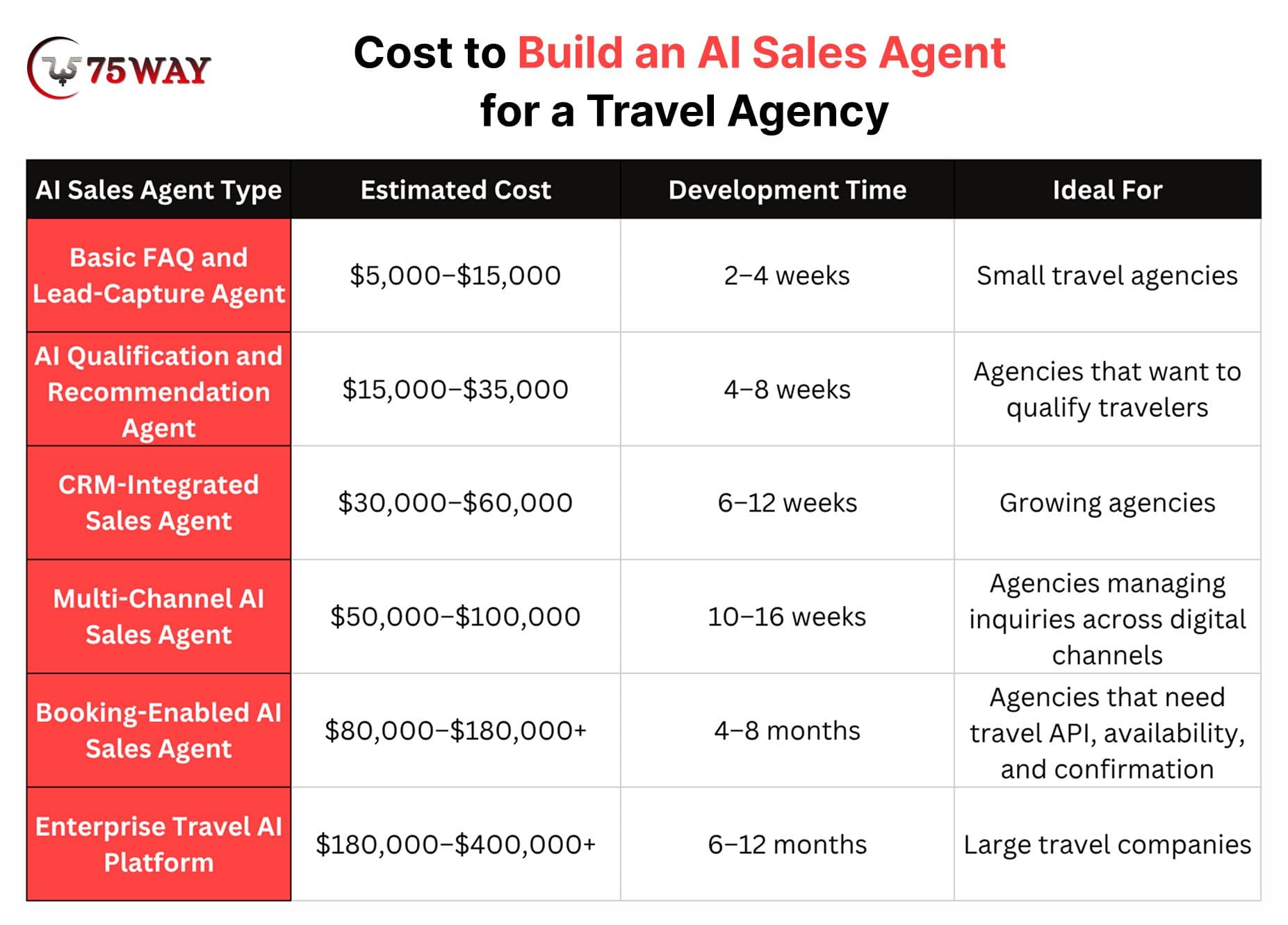
These figures generally represent initial development costs. They may not include third-party API fees, AI model usage, hosting, messaging charges, payment processing fees, or ongoing maintenance.
What Determines Travel AI Sales Agent Development Cost?
Several factors can influence the overall investment.
- Agent Complexity: An agent that answers FAQs and captures leads requires less development than one that handles multi-step sales conversations, recommendations, booking workflows, and escalations.
- AI Model and Infrastructure: The choice of AI models, hosting approach, usage volume, retrieval systems, monitoring, and supporting infrastructure can affect ongoing costs.
- Third-Party Integrations: Connecting the agent with a CRM is different from integrating multiple travel APIs, booking systems, GDS platforms, payment services, and communication channels.
- Data Requirements: The quality, structure, and availability of the agency's information can affect development work. Existing, well-organized data is generally easier to incorporate than information spread across disconnected documents and systems.
- Channels: A website-only agent has different requirements from an AI sales agent operating across web chat, email, SMS, WhatsApp, and other messaging channels.
- Customization: Custom qualification rules, recommendation logic, workflows, dashboards, user roles, and agency-specific processes can increase development scope.
- Security and Compliance Requirements: Systems handling customer information or transactional workflows may require additional security controls, access management, logging, testing, and safeguards.
- Maintenance and Optimization: AI systems require ongoing monitoring. Models, APIs, business information, travel policies, and customer expectations can change, so development does not necessarily end at launch.
This approach gives business owners a clearer picture of the total cost of ownership, rather than focusing only on the initial development quotation.
Ongoing Operating Costs To Build AI Sales Automation Agent For Travel Companies
After launch, an AI sales agent may require recurring expenses. These costs depend on usage volume, the number of connected services, and the level of support required.
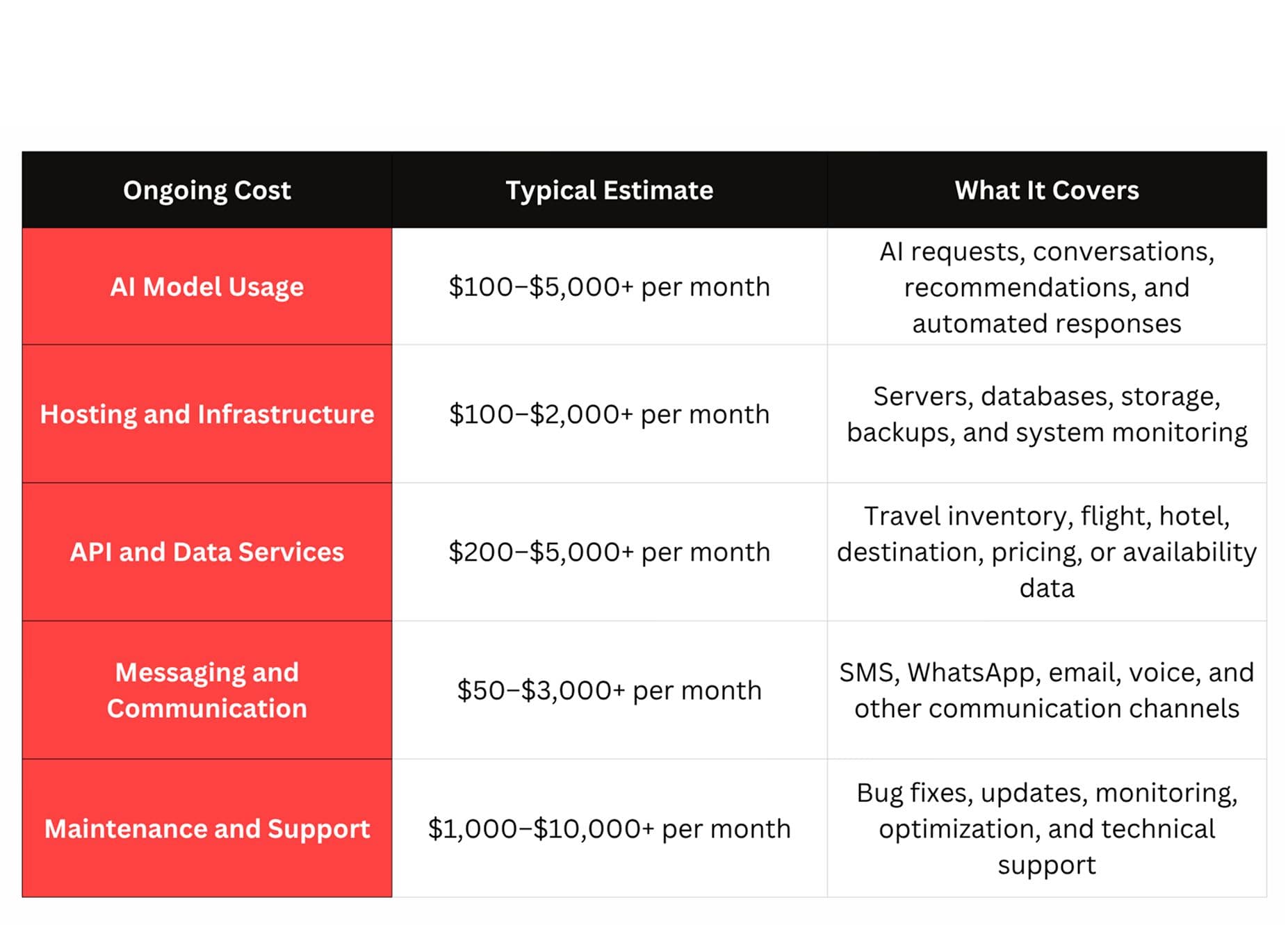
These are broad estimates. A small agency with limited traffic may spend considerably less, while a high-volume agency with real-time booking and multi-channel communication may spend much more.
Development Cost Should Be Evaluated Against Business Value
A lower development price is not automatically a better investment.
An inexpensive AI agent that cannot connect to the systems your sales team uses may create another isolated tool instead of solving the underlying problem. Conversely, building features that the agency rarely needs can unnecessarily increase the project scope.
A better approach is to identify the highest-value workflow first, estimate the potential business impact, and then build the technology around that requirement.
For example, an agency may begin with a lead-capture and qualification agent before investing in booking automation. This phased approach can reduce initial costs, shorten the launch timeline, and provide useful performance data before expanding the system.
For travel agencies, the right AI investment is not the system with the longest feature list. It is the system that solves measurable sales and customer-service problems within a realistic budget.
How to Measure the ROI of an AI Sales Agent for a Travel Agency?
An AI sales agent should not be judged by how many conversations it handles. A travel agency needs to know whether those conversations create measurable business value.
The clearest way to evaluate ROI is to compare the cost of the AI system with improvements in qualified leads, booking conversions, sales capacity, response times, and the amount of repetitive work removed from the team.
1. Start With a Baseline
Before deploying an AI sales agent, record how the current sales process performs.
Useful baseline metrics include monthly inquiries, qualified leads, average response time, quote requests, follow-up rate, customer-support volume, and human hours spent on repetitive tasks.
Without a baseline, it becomes difficult to determine whether the AI implementation actually improved performance.
2. Track More Than Lead Volume
Generating more conversations does not necessarily mean generating more revenue.
For example, an AI agent could handle thousands of customer interactions while producing very few qualified opportunities. A smaller number of well-qualified conversations may create considerably more business value.
Travel agencies should therefore track the progression from conversation to commercial outcome.
3. Key AI Sales Agent ROI Metrics
- Lead Qualification Rate: How many incoming inquiries meet the agency’s criteria
- Response Time: How quickly customers receive an initial response
- Quote Conversion Rate: How many quote requests progress toward booking
- Booking Conversion Rate: How many qualified opportunities become bookings
- Average Booking Value: Revenue generated per completed booking
- Follow-Up Rate: How consistently prospects receive appropriate follow-up
- Human Handoff Rate: How often conversations require a travel professional
- Resolution Rate: How many suitable requests are completed without escalation
- Cost Per Qualified Lead: Cost of generating a qualified sales opportunityCalculate the Financial Return
A simple ROI calculation can help establish whether the investment is producing enough value:
ROI = (Financial Gain From AI − Total AI Cost) ÷ Total AI Cost × 100
The financial gain can include additional gross profit from incremental bookings and measurable labor savings, provided those savings are genuinely realized rather than simply estimated.
For example, if automation allows a team to handle more qualified inquiries without increasing staffing costs, the additional contribution from those bookings can form part of the business case.
The calculation should also include ongoing expenses such as AI usage, hosting, APIs, messaging, maintenance, and support, not just the original development cost.
4. Measure Human-Agent Productivity
One of the easiest mistakes is evaluating AI only by customer-facing metrics.
Look at what happens to the travel team after implementation.
Are agents spending less time collecting basic trip information? Are they receiving better-qualified leads? Are fewer customers repeating the same questions? Can representatives handle more complex opportunities during the same working day?
These changes can reveal value even when the total number of bookings does not immediately increase.
5. Watch Customer Experience Metrics
Revenue is important, but poor customer experiences can undermine the value of automation.
Monitor metrics such as:
- Customer satisfaction
- Escalation rates
- Unresolved conversations
- Incorrect responses
- Abandoned conversations
- Repeat contacts
- Human takeover frequency
A successful implementation should improve the customer journey without creating additional problems for the support team.
6. Evaluate ROI Over Time
AI sales-agent performance should be reviewed after launch rather than judged from the first few weeks alone.
Customer behavior, conversation patterns, integrations, prompts, knowledge sources, and workflows may need refinement as real interactions reveal gaps.
This gives the agency a clearer view of whether performance is improving as the system becomes better aligned with its actual sales process.
How 75way Helps You Build AI Sales Agents for Travel Agencies
75way helps travel agencies build AI sales agents that fit their actual sales workflows instead of adding another standalone chatbot. We design agents around your customer journey, from lead capture and qualification to travel recommendations, follow-ups, booking assistance, and human escalation.
Depending on your requirements, the solution can connect with your existing CRM, booking platform, travel APIs, communication channels, and other business systems, creating a connected experience for both customers and sales teams.
Our approach starts by identifying the repetitive conversations and sales bottlenecks where AI can create the most practical value. From there, our team can design the conversation flow, integrate relevant data and systems, establish permissions and escalation rules, test realistic travel scenarios, and optimize the agent after launch.
Whether you need a focused lead-qualification agent or a more advanced AI sales solution for a growing travel operation, 75way helps turn the concept into a business-ready AI agent built around your requirements.
Final Thoughts
AI sales agents for travel agencies can give travel agencies a practical way to manage customer conversations without forcing every inquiry through a manual process. From capturing opportunities to supporting travelers throughout their journey, the technology can strengthen sales capacity while allowing human teams to focus on conversations that require judgment and expertise.
Whether an agency starts with lead qualification or builds a broader conversational sales infrastructure, a focused implementation can create meaningful operational and commercial value when planned around customer needs. To automate your travel sales journey, partner with a reliable AI agent development company, or adopt a ready-made AI agent from AI marketplaces like 75AI Agent Store.
Frequently Asked Questions (FAQs)
Can AI Sales Agents Maintain A Travel Agency’s Brand Voice?
Yes, AI agents can follow defined tone, terminology, messaging guidelines, and approved responses. Agencies can customize conversations to reflect their brand personality across supported customer channels.
Can An AI-Powered Sales Agent For Travel Agencies Support Multiple Languages?
Yes, multilingual AI agents can communicate with travelers in multiple supported languages. The available languages and response quality depend on the selected model, configuration, knowledge sources, and testing.
How Can Travel Agencies Improve AI Response Accuracy?
Agencies can improve accuracy by connecting reliable knowledge sources, defining response boundaries, testing realistic scenarios, and regularly reviewing conversations. Human oversight also helps identify outdated or incorrect information.
Can AI-Powered Sales Agents Scale As A Travel Agency Grows?
Yes, AI agents can support increasing conversation volumes without requiring every interaction to be handled manually. Scalability depends on infrastructure, integrations, usage limits, monitoring, and overall system architecture.
What Data Does A Travel AI Sales Agent Need To Understand Travelers?
The agent needs relevant information such as services, policies, destinations, customer requirements, and approved business knowledge. Additional data depends on the workflows, personalization, integrations, and actions required.
Can An AI Sales Agent Work With An Existing Travel Website?
Yes, many AI agents can be integrated into existing websites without rebuilding the entire platform. The implementation approach depends on the website technology, available integration methods, security requirements, and desired functionality.
Can A Ready-Made AI Agent Be Customized For A Travel Agency?
Many ready-made agents provide configuration options for workflows, knowledge, branding, and supported integrations. The available customization depends on the marketplace product and whether its architecture supports agency-specific requirements.