Summary
AI agents for HR are revolutionizing human resource management by automating recruitment, onboarding, payroll, and employee engagement processes. They enhance decision-making through data-driven insights, reduce manual workload, and improve workforce efficiency. Organizations using HR AI Agents experience faster hiring, better talent retention, and smarter operational workflows across all HR functions.
Quick Overview
- HR AI agents streamline HR operations through intelligent automation systems today
- Recruitment becomes faster, smarter, and more data-driven using AI tools
- Employee engagement improves via personalized AI-driven communication & support systems
- HR decision-making is enhanced with real-time analytics and predictive insights
- Organizations reduce operational costs while improving workforce productivity overall
Human Resource Management is undergoing a major transformation due to artificial intelligence. Traditional HR processes often involve repetitive manual tasks, delayed decision-making, and limited data utilization. AI human resource agents are changing this landscape by introducing automation, intelligence, and predictive capabilities into HR operations.
AI agents in HR serve as intelligent digital assistants that handle recruitment, employee onboarding, payroll management, performance tracking, and engagement activities. These systems analyze large datasets, identify patterns, and support HR professionals in making faster and more accurate decisions.
Modern organizations are adopting AI agent development solutions not just for efficiency but also for improving employee experience and strategic workforce planning. As businesses scale, managing human capital becomes more complex, making HR AI agents essential for sustainable workforce transformation.
This guide provides a comprehensive understanding of AI agents for HR, including their types, core functions, real-world use cases, benefits, implementation strategies, challenges, and future impact on human resource management.
What Are AI Agents in HR?
HR AI agents are autonomous digital assistants that use reasoning, memory, and automation capabilities to streamline and personalize human resource operations such as recruiting, onboarding, payroll, and employee support, often working alongside international payroll and HR software to ensure seamless global workforce management and compliance. These agents can integrate with modern HCM systems and intelligently handle repetitive HR tasks without constant human intervention. Famous HR AI agents are Lyzr Diane and OneAI, which help organizations improve speed, accuracy, and workforce efficiency.
AI agents in HR are intelligent software systems designed to perform and automate human resource tasks using machine learning, natural language processing, and predictive analytics. They function as virtual HR assistants that significantly reduce manual workload while enhancing operational precision.
These agents can interact with employees, screen candidates, schedule interviews, and analyze workforce behavior patterns. By continuously learning from organizational data, they improve decision-making quality and overall HR performance over time.
How HR AI Agent Works?
HR AI agents function by combining data processing, machine learning, and automation to execute HR tasks intelligently, continuously learning from interactions to improve decision-making, accuracy, and overall workforce management efficiency.
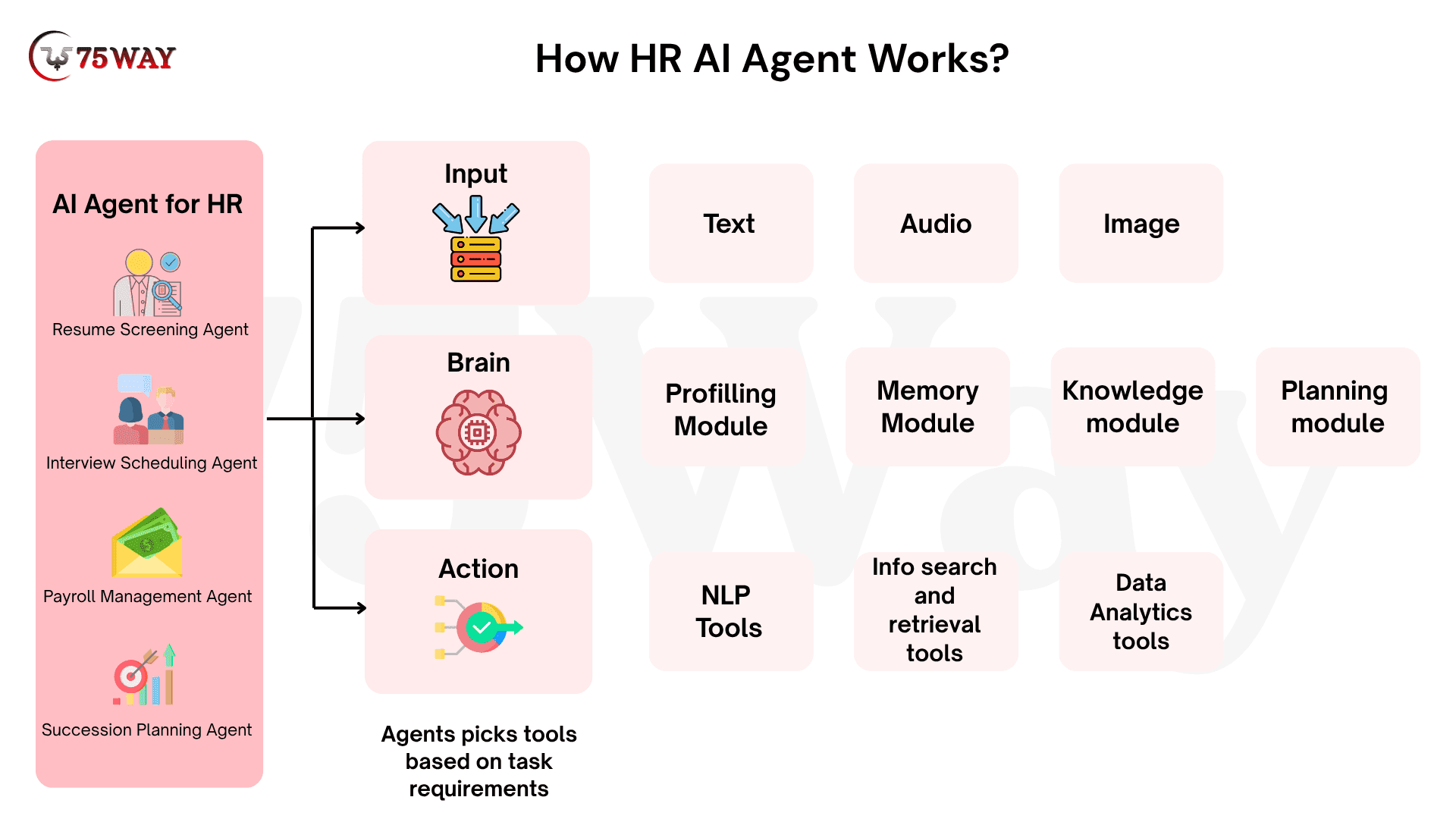
- Data Collection & Input
AI agents collect employee records, resumes, job descriptions, and HR system data from multiple integrated enterprise sources.
- Data Processing
The system cleans, structures, and analyzes HR data using machine learning models to detect patterns and workforce insights.
- Candidate Evaluation and Job Matching
AI evaluates candidate profiles against job requirements and automatically shortlists the most suitable applicants for roles.
- Recommendation Generation
The system provides actionable HR recommendations, including hiring decisions, performance insights, and workforce optimization suggestions.
- Continuous Learning & Optimization
AI agents continuously improve accuracy by learning from past HR decisions, outcomes, and evolving organizational data patterns.
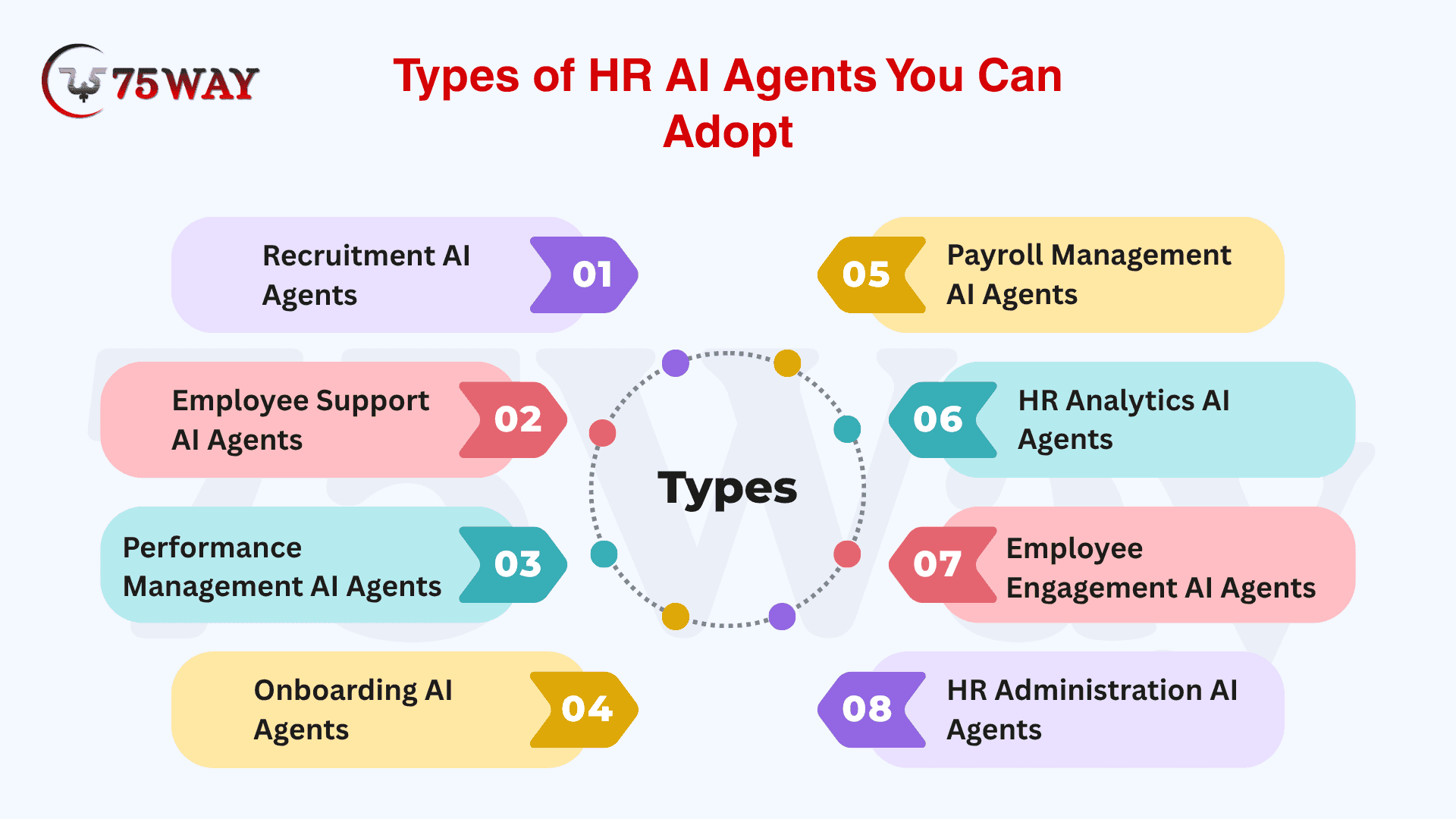
Types of HR AI Agents You Can Adopt
AI HR agents are categorized based on their functional roles and responsibilities within the organization. Each type supports specific HR processes and improves efficiency across departments.
1. Recruitment AI Agents
Recruitment AI agents automate end-to-end hiring processes, including sourcing candidates, screening resumes, and scheduling interviews and assisting with resume writing and optimisation. They analyze job requirements, match candidate skills, and significantly reduce hiring time while improving the quality of talent selection and overall recruitment efficiency across organizations.
- Resume Screening Agent
- Candidate Sourcing Agent
- Interview Scheduling Agent
- Job Posting Distribution Agent
- Resume Parsing Agent
- Job Matching Agent
2. Employee Support AI Agents
Employee support AI agents streamline internal HR communication by resolving employee queries related to policies, payroll, leave, and benefits. They deliver instant responses through intelligent chat systems, reducing HR workload and enhancing employee satisfaction, engagement, and operational responsiveness.
- Policy Query Resolution Agent
- Employee Query Resolution Agent
- Employee Feedback Reply Agent
- Payroll Assistance Agent
- Email Acknowledgement Agent
- Leave Management Agent
- Acknowledgement Email Sender Agent
- Benefits Information Agent
3. Performance Management AI Agents
Performance management AI agents monitor employee productivity, evaluate key performance indicators, and generate actionable performance insights. They help HR leaders and managers make informed decisions regarding promotions, training needs, and appraisals, ensuring continuous workforce improvement and accountability.
- Productivity Tracking Agent
- Performance Review Agent
- Engagement Insights AI Agent
- KPI Evaluation Agent
- Employee Contracts Analysis Agent
- Performance Insight Generation Agent
- Engagement Data Consolidation Agent
- Promotion Recommendation Agent
4. Onboarding AI Agents
Onboarding AI agents assist new employees during their joining process by guiding them through documentation, policies, training modules, and organizational workflows. They ensure smooth integration, reduce manual HR effort, and improve employee onboarding experience and early-stage engagement.
- Policy Guidance Agent
- Candidate Onboarding Agent
- Offer Letter Creation Agent
- Onboarding Handbook Creation Agent
- Enrollment Coordinator Agent
- Documentation Support Agent
- Training Module Agent
- Integration Assistance Agent
5. Payroll Management AI Agents
Payroll management AI agents automate salary processing, tax calculations, attendance validation, and compliance management. They ensure accurate and timely payroll execution while minimizing human errors and improving financial transparency and operational efficiency within HR departments.
- Payroll Calculation Agent
- Payroll Discrepancy Detection Agent
- Salary Data Validation Agent
- Salary Disbursement Agent
- Tax Compliance Agent
- Salary Disbursement Agent
- Attendance Verification Agent
6. HR Analytics AI Agents
HR analytics AI agents analyze workforce data to identify trends, predict attrition, and evaluate employee performance. They provide data-driven insights that help organizations optimize hiring strategies, improve retention, and enhance overall workforce planning and decision-making.
- Workforce Trend Analysis Agent
- Hiring Efficiency Analysis Agent
- Attrition Prediction Agent
- Employee Performance Analytics Agent
- Hiring Efficiency Analysis Agent
7. Employee Engagement AI Agents
Employee engagement AI agents enhance workplace interaction by analyzing feedback, measuring sentiment, and improving internal communication. They help organizations build stronger employee relationships, increase satisfaction levels, and foster a positive and productive work environment.
- Employee Offboarding Agent
- Feedback Collection Agent
- Sentiment Analysis Agent
- Internal Communication Agent
- Recognition Recommendation Agent
8. HR Administration & Compliance AI Agents
HR administration and compliance AI agents manage documentation, policy updates, and regulatory alignment across HR systems. They ensure organizations maintain compliance standards while reducing administrative workload and improving operational accuracy in HR governance.
Key Roles of AI Agents in Human Resources
AI agents play multiple critical roles in modern HR systems. They are not limited to automation but also support strategic planning and employee experience enhancement.
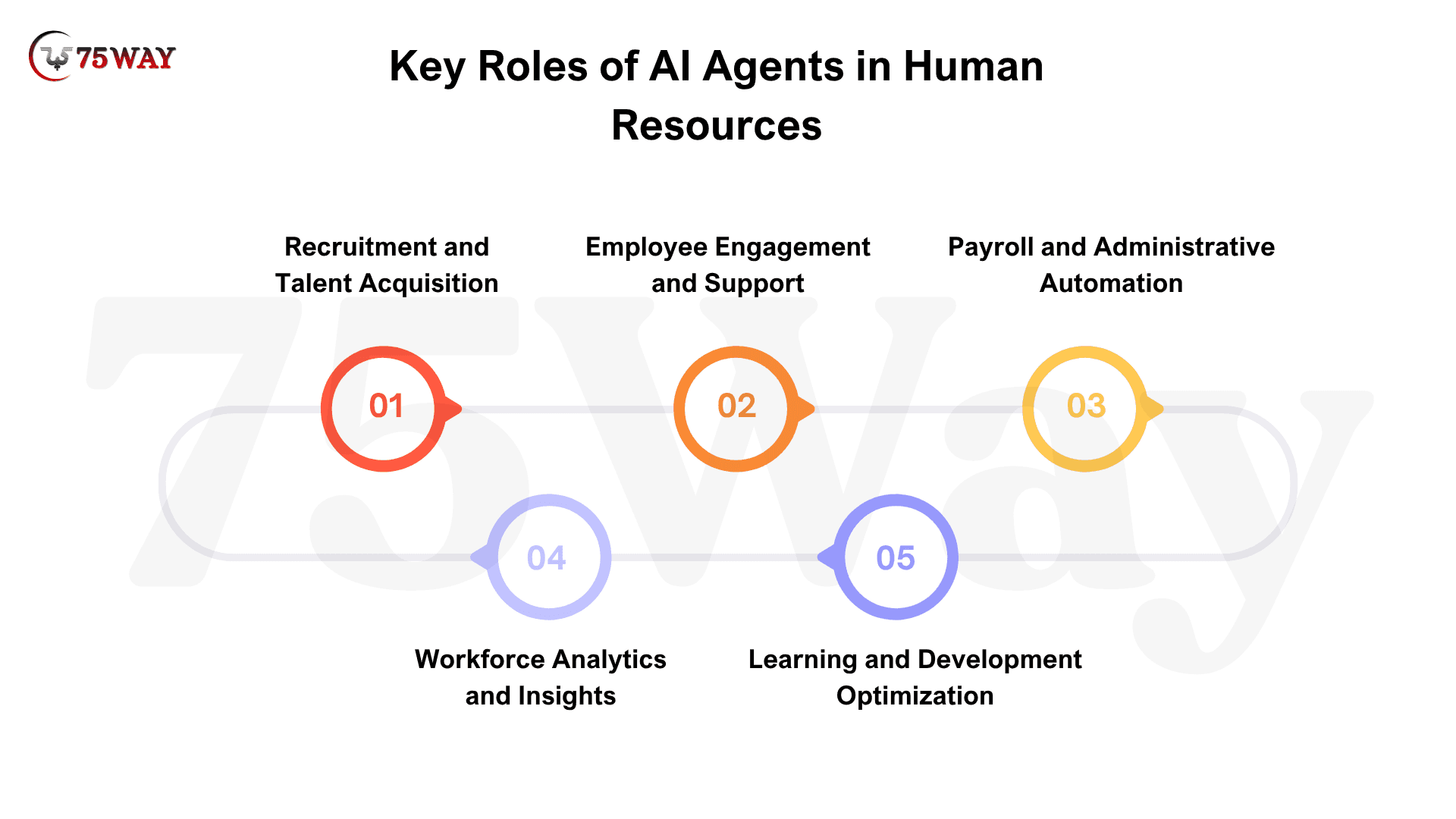
- Recruitment and Talent Acquisition: AI agents optimize recruitment by analyzing job descriptions, screening resumes, and identifying top candidates. They reduce bias and ensure faster hiring decisions.
- Employee Engagement and Support: HR AI agents improve engagement by offering personalized communication, answering queries, and providing continuous support to employees across departments.
- Payroll and Administrative Automation: AI-powered HR agents handle payroll calculations, attendance tracking, and compliance management. This reduces human error and ensures timely salary processing.
- Workforce Analytics and Insights: HRAI tools analyze employee data to identify trends in productivity, attrition risk, and workforce efficiency. These insights support strategic HR planning.
- Learning and Development Optimization: AI agents support employee growth by identifying skill gaps, recommending personalized training programs, and tracking learning progress.
Benefits of AI Agents in Human Resources (HR)
AI agents offer significant advantages to organizations by transforming traditional HR processes into intelligent, automated systems. AI-driven HR systems improve efficiency, reduce operational costs, and enhance employee satisfaction. They also enable HR teams to focus more on strategic initiatives rather than repetitive tasks.
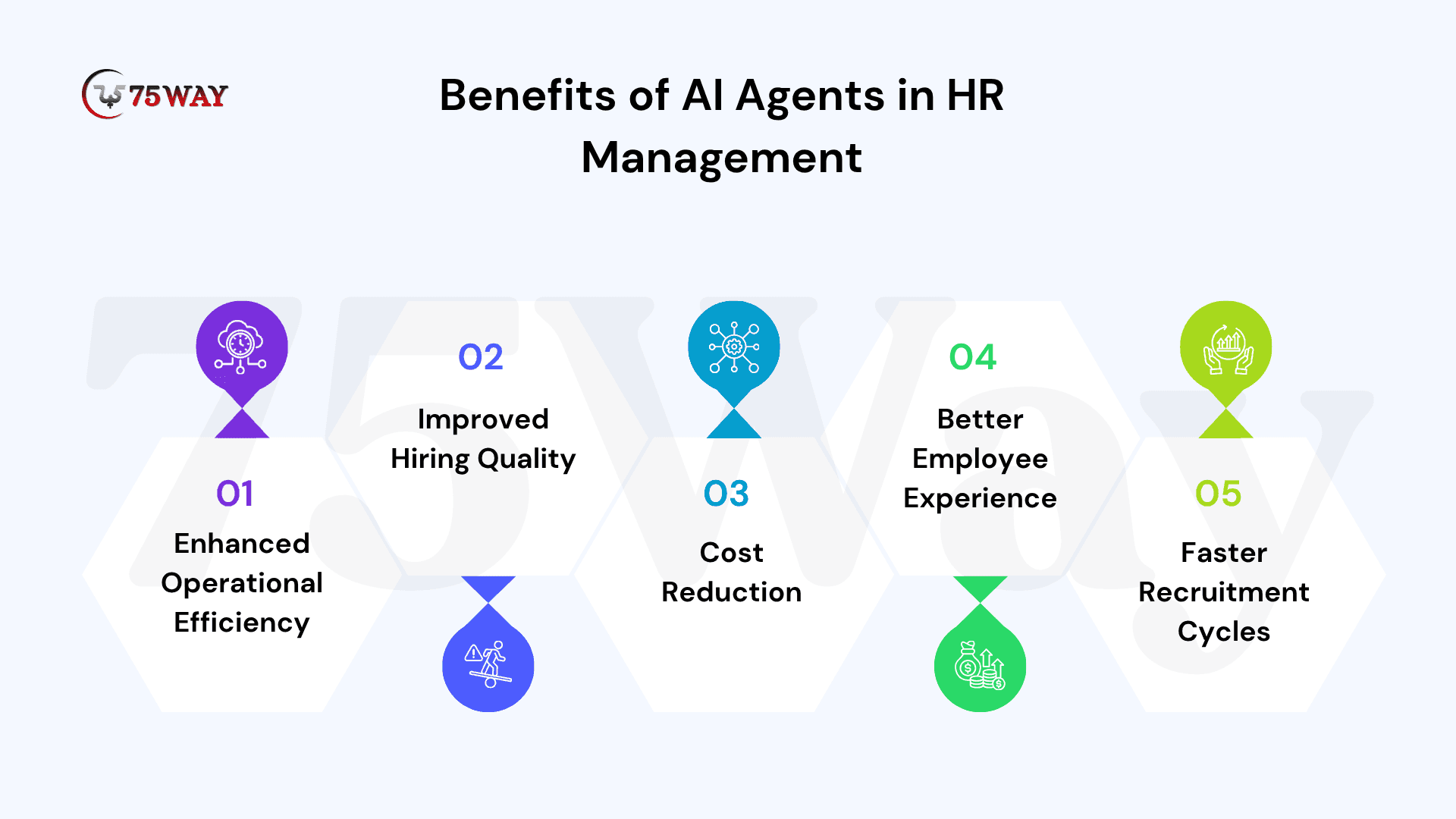
- Enhanced Operational Efficiency: These agentsautomate time-consuming HR tasks, allowing teams to complete processes faster and with fewer errors. This increases overall productivity across departments.
- Improved Hiring Quality: AI-based recruitment ensures better candidate-job matching, reducing hiring mistakes and improving employee retention rates over time.
- Cost Reduction: Organizations save significant costs by reducing manual HR workload and minimizing dependency on large HR teams for repetitive tasks.
- Better Employee Experience: HRAI agents provide instant support and personalized communication, improving employee satisfaction and engagement within the organization.
- Faster Recruitment Cycles: AI-driven human resource agents accelerate hiring processes by automating screening, shortlisting, and scheduling, significantly reducing time-to-hire.
- Data-Driven Decision Making: Human resource AI agents analyze workforce data in real time, enabling HR leaders to make faster, more accurate, and strategic decisions.
Use Cases of AI Agents in HR Management
AI agents are widely used across multiple HR functions to improve accuracy, speed, and efficiency.

- Recruitment Automation: AI tools screen resumes, shortlist candidates, and schedule interviews automatically. This reduces hiring cycles and improves talent acquisition quality.
- Employee Onboarding: Human resourcesAI agents guide new employees through onboarding processes, ensuring they understand company policies and complete required documentation efficiently.
- Performance Tracking: HRAI systems monitor employee performance continuously and generate reports that help HR managers evaluate productivity effectively.
- HR Helpdesk Automation: AI chatbots for HR handle employee queries related to payroll, leave policies, and benefits without human intervention.
- HR Helpdesk Automation: These AI agents handle employee queries related to payroll, leave policies, benefits, and compliance through intelligent chat systems.
- Payroll and Attendance Management: Automate payroll processing by tracking attendance, calculating salaries, managing deductions, and ensuring compliance.
How AI Agents Transform HR Workflow?
HR AI agents reshape workforce operations by introducing AI automation, intelligence, and predictive capabilities into every stage of human resource management.
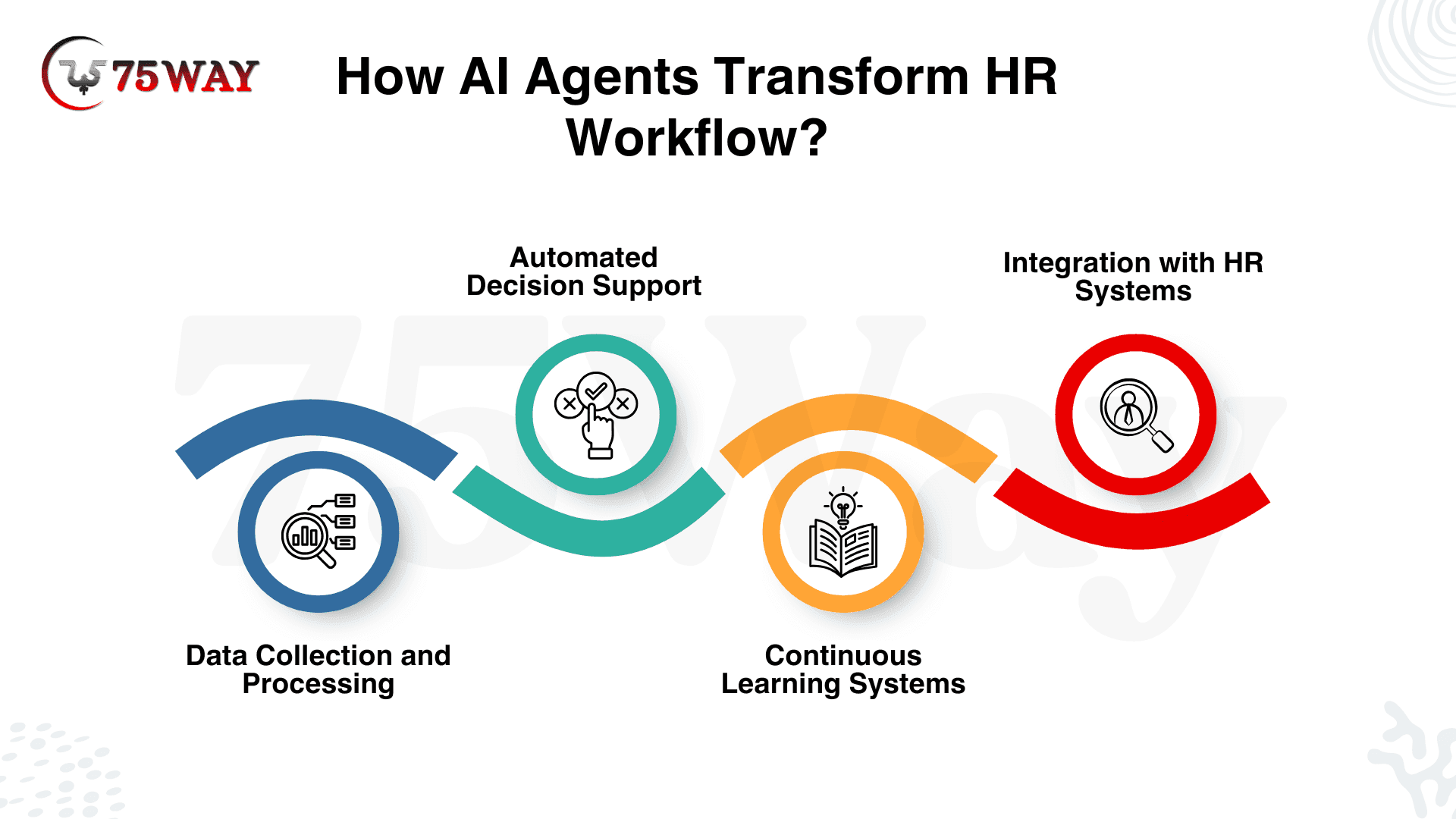
Data Collection and Processing: AI systems collect employee and candidate data from multiple sources, organizing it for better analysis and decision-making.
Automated Decision Support: AI provides recommendations for hiring, promotions, and employee training based on data insights and predictive modeling.
Continuous Learning Systems: AI agents continuously learn from HR interactions, improving their accuracy and efficiency over time.
Integration with HR Systems: AI tools integrate seamlessly with existing HR software to streamline operations and ensure smooth workflow automation.
How To Implement Human Resource (HR) AI Agents at Workplace?
A structured, strategic approach is required to deploy HR AI agent that aligns technology with organizational goals. It involves assessing current HR processes, selecting suitable AI models and tools, integrating data systems, and ensuring proper training. Continuous monitoring is essential to maximize accuracy and long-term return on investment.
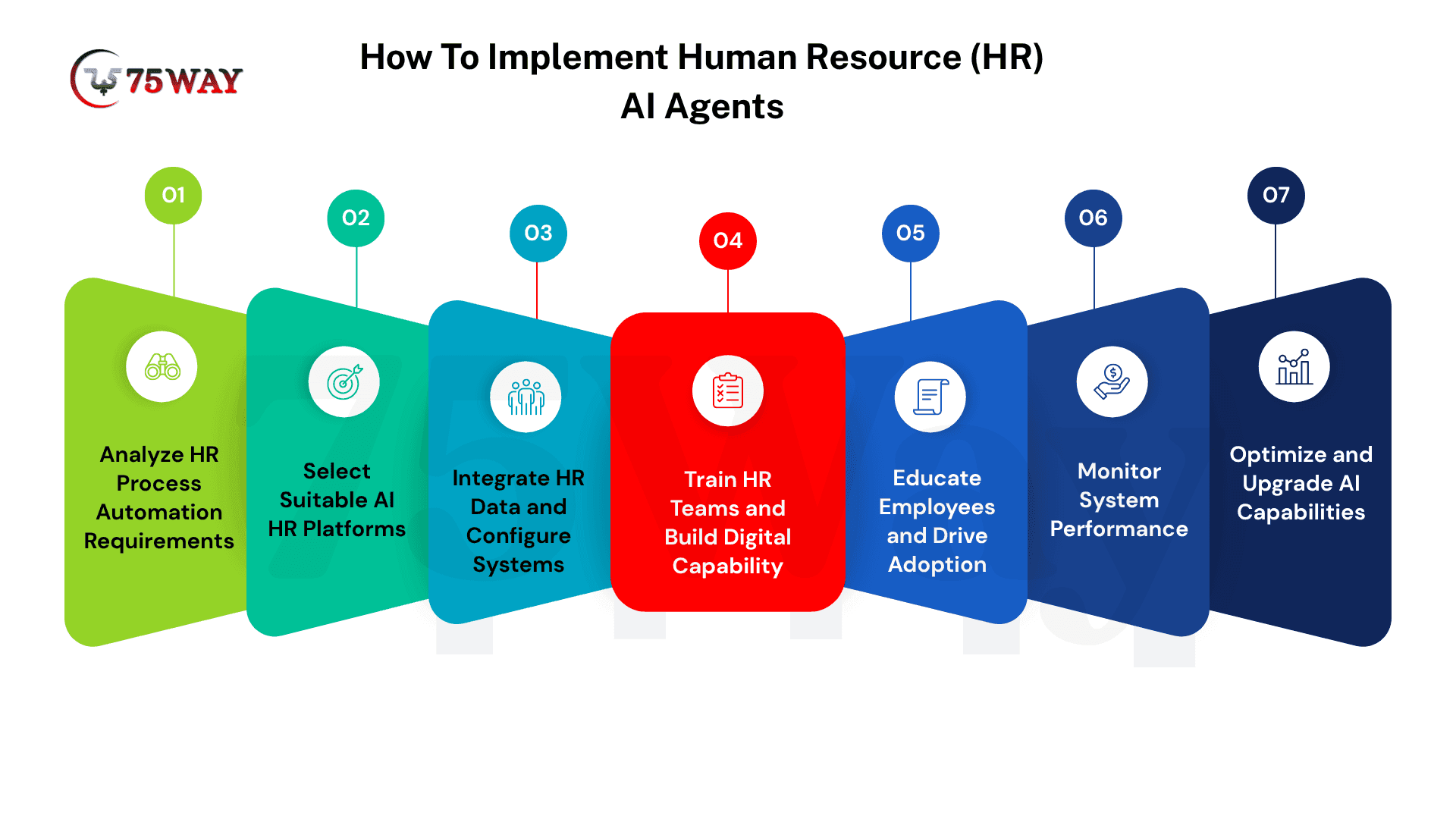
Step 1: Analyze HR Process Automation Requirements
To begin the implementation journey, organizations must first evaluate existing HR workflows to identify inefficiencies and automation opportunities. This step ensures AI agents are applied where they create maximum impact across recruitment, payroll, onboarding, and employee management processes.
Step 2: Select Suitable AI HR Platforms
After identifying automation needs, organizations should carefully choose AI tools that align with their HR structure and business goals. This ensures the selected platform supports scalability, integration, compliance, and delivers measurable improvements in HR performance.
Step 3: Integrate HR Data and Configure Systems
Once the platform is selected, organizations must connect all HR data sources into a unified system for seamless functionality. This integration enables AI agents to access accurate employee, payroll, and recruitment data for intelligent decision-making and automation.
Step 4: Train HR Teams and Build Digital Capability
After system configuration, HR teams must be trained to effectively use AI tools and interpret automated insights. This step ensures smooth collaboration between human expertise and AI systems, improving adoption and maximizing operational efficiency across HR functions.
Step 5: Educate Employees and Drive Adoption
Following internal training, organizations must inform employees about AI-powered HR processes to build trust and acceptance. This helps employees confidently interact with AI systems for queries, onboarding, and support without resistance or confusion.
Step 6: Monitor System Performance Continuously
Once AI agents are operational, organizations must continuously track their performance to ensure accuracy and efficiency. This step helps identify issues early, measure outcomes, and maintain alignment with HR goals and organizational expectations.
Step 7: Optimize and Upgrade AI Capabilities
Finally, organizations must refine and upgrade AI systems based on feedback and evolving workforce needs. Continuous optimization ensures improved decision-making, better automation accuracy, and long-term scalability of HR operations.
Challenges of Deploying AI Agents in HR
Despite its benefits, AI adoption in HR comes with certain challenges that organizations must address.
- Data Privacy Concerns: Handling sensitive employee data requires strict compliance with privacy regulations and security protocols.
- Resistance to Change: Employees and HR professionals may resist AI adoption due to fear of job replacement or unfamiliar technology.
- Implementation Costs: Initial setup and integration of AI systems can be costly for small and medium-sized organizations.
- Accuracy Limitations: AI systems depend on data quality, and poor data can lead to inaccurate predictions and decisions.
Future of AI Agents in HR
The future of HR is deeply connected with AI-driven automation and intelligent decision-making systems. AI agents will become more advanced, capable of handling complex HR tasks with minimal human intervention.
The next-gen HR systems will focus on hyper-personalization, predictive workforce planning, and autonomous decision-making. AI will also play a key role in enhancing employee well-being and organizational culture. As technology evolves, AI agents will not replace HR professionals but empower them to focus on strategic and human-centric responsibilities.
Final Thoughts
AI agents are revolutionizing human resource management by introducing intelligence, automation, and efficiency into traditional HR systems. From recruitment to employee engagement, these systems are transforming how organizations manage their workforce. Businesses that adopt AI-driven HR solutions gain a competitive advantage through faster hiring, improved employee satisfaction, and data-driven decision-making. The future of HR lies in intelligent automation, with HR AI agents at its center. Want to transform your HR operations with AI automation? Explore HR AI agents at 75AI Agent Store to build or launch pre-built HR AI agents and unlock faster hiring, smarter workflows, and next-generation workforce management.
Frequently Asked Questions (FAQs)
What Are AI Agents In Human Resource Management?
AI agents in human resource management are intelligent software systems that automate core HR functions, including recruitment, onboarding, payroll processing, employee engagement, and support services. They use machine learning and automation to improve efficiency, reduce manual workload, enhance accuracy, and enable smarter workforce management decisions across organizations.
How Do AI Agents Improve Recruitment Processes?
AI agents improve recruitment by automatically screening resumes, analyzing candidate skills, and matching profiles with job requirements. They also schedule interviews and rank applicants based on relevance. This reduces hiring time, minimizes human bias, improves candidate quality, and ensures faster, more accurate, and data-driven recruitment decisions.
Can AI Replace Human HR Professionals Completely?
No, AI cannot fully replace human HR professionals. Instead, it enhances their capabilities by handling repetitive and time-consuming tasks like data processing and screening. This allows HR teams to focus on strategic responsibilities such as decision-making, employee relations, organizational culture, and long-term workforce planning.
Is AI In HR Suitable For Small Businesses?
Yes, AI in HR is highly suitable for small businesses as it offers scalable and cost-effective solutions to automate essential HR tasks. It helps manage recruitment, payroll, onboarding, and employee records efficiently, reducing manual workload, improving accuracy, and enabling small teams to operate more productively and streamline HR processes.
How Does AI Improve Employee Experience?
AI improves employee experience by providing instant responses to HR queries, personalized communication, and 24/7 support through intelligent systems. It reduces delays in resolving payroll, leave, and policy issues while also enhancing engagement, transparency, and overall workplace satisfaction.
How Secure Is Employee Data In AI HR Systems?
AI HR systems use encryption, access controls, and compliance frameworks to protect sensitive employee data. However, security depends on proper system configuration, regular audits, and adherence to data protection standards. Organizations must ensure robust cybersecurity practices to prevent unauthorized access, breaches, and the misuse of confidential HR information.