AI Summary
Small businesses in the USA increasingly adopt AI agents to automate customer support, sales, and operations. These systems reduce workload, improve response speed, and lower costs. Strong ROI appears within months, not years. Growth becomes scalable without hiring pressure.
Quick Overview
- AI agents automate repetitive business tasks across multiple departments
- Small businesses achieve faster response times and improved customer experience
- Cost savings increase significantly compared to manual staffing models
- ROI becomes measurable within first three to six months
- Starting with one focused use case delivers strongest results first
You're running a 10-person business in the USA. Your team is stretched thin. Customer inquiries pile up overnight. Leads go cold because nobody followed up fast enough. Your sales rep spends two hours a day doing data entry instead of selling.
Every one of these problems has the same solution: an AI agent.
In 2026, AI agents are no longer science fiction or enterprise-only technology. Small businesses across the United States are deploying AI agent development solutions to handle customer support, qualify leads, process invoices, schedule appointments, and run marketing campaigns, without adding headcount.
This is your complete guide to AI agent development for small businesses: what they are, what they cost, where they deliver the highest ROI, and how to get your first one running.
What Is an AI Agent?
An AI agent is an autonomous software system that receives a goal, breaks it into steps, and completes multi-step tasks without needing a human to manage each step.
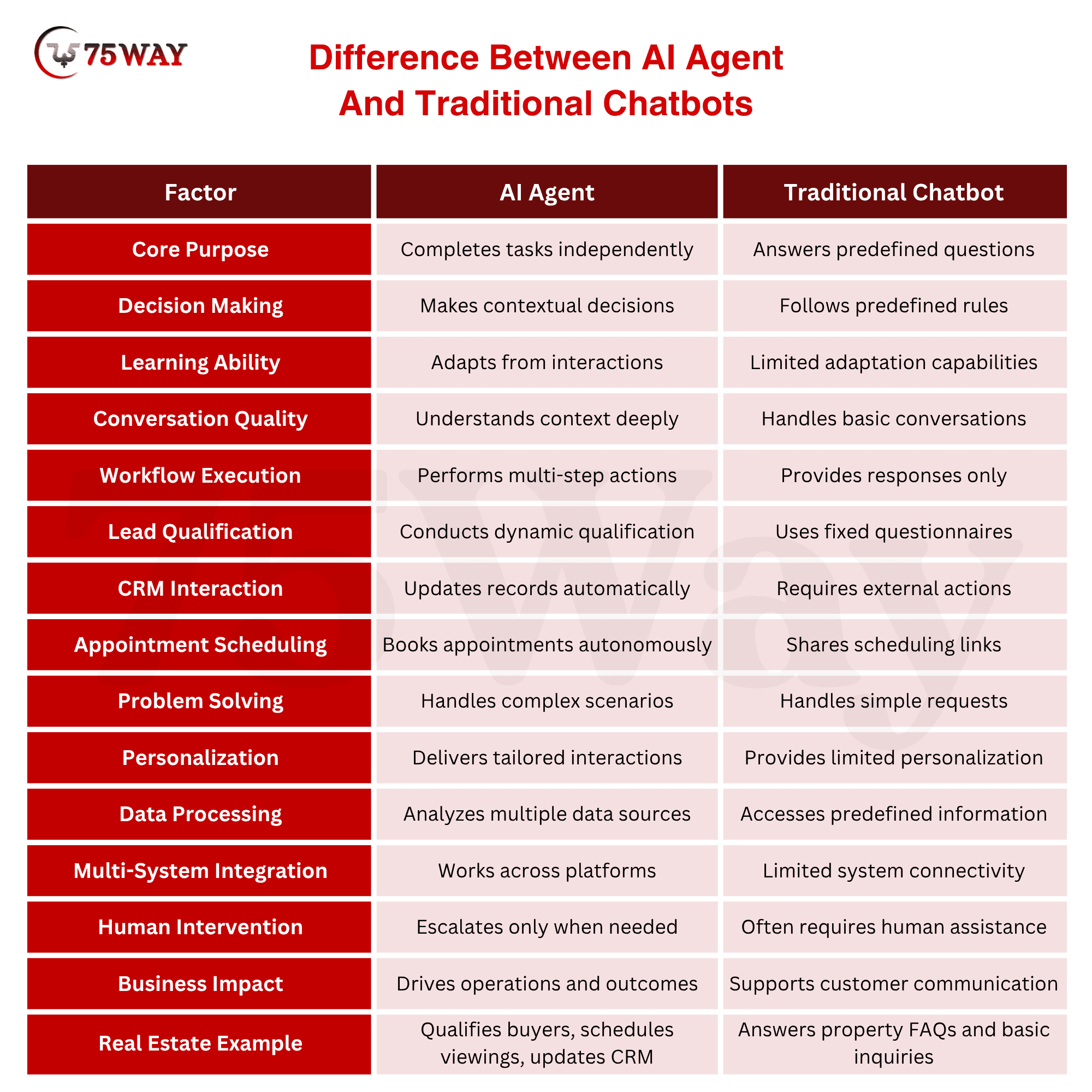
Here you might have a doubt about whether this agentic AI solution is similar to any traditional chatbot. But, the answer is no. There’s huge difference difference between an AI agent and traditional chatbots.
Think of a traditional chatbot as a receptionist who can only read from a script. An AI agent is a team member who reads your emails, decides what needs action, does the work, and tells you only when something needs your judgment.
Difference Between AI Agent And Traditional Chatbots
The AI Agent Opportunity for Small Businesses in 2026
The numbers are clear, and the timing is right: Gartner projects that 40% of small and mid-size businesses will deploy at least one AI agent by the end of 2026, up from roughly 8% at the start of 2025.
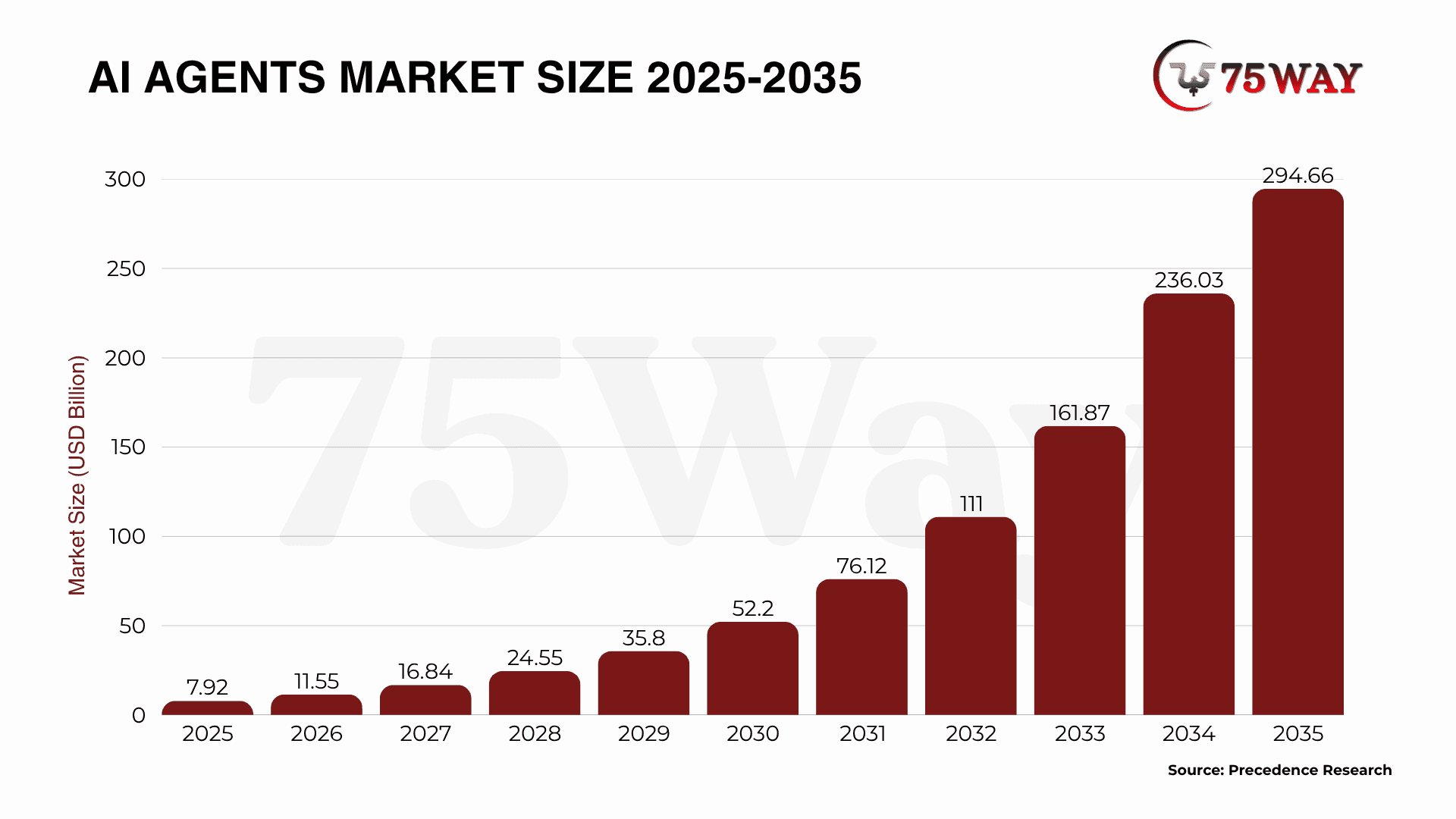
- The global AI agents market is projected to grow from $11.55 billion in 2026 to approximately $294.66 billion by 2035, registering a CAGR of 43.57%.
- AI agents for business deliver an average ROI of 171%, with 74% of executives achieving returns within the first year.
- Companies using AI agents report 55% higher operational efficiency and 35% average cost reduction.
- Customer-facing AI automation delivers 300–800% ROI, while back-office automation delivers 400–1000% ROI, with most businesses seeing payback within 30–90 days.
Three things have made this moment possible for small businesses specifically:
- No-code platforms have made agent building accessible to non-technical users
- AI model costs have dropped by over 90% since early 2024
- LLM quality has improved to the point where agents can reliably handle real business tasks
- The shift is real. Your competitors, the ones who were drowning in the same admin work as you, are now operating leaner, responding faster, and converting more leads. Not because they hired more people, but because they built agents.
8 High-Impact AI Agent Use Cases for Small Businesses
Not every business process is worth automating. The best starting points are workflows that are: high-frequency, rule-based, time-consuming, and measurable. Here are the eight use cases of AI agents delivering the strongest ROI for US small businesses in 2026:
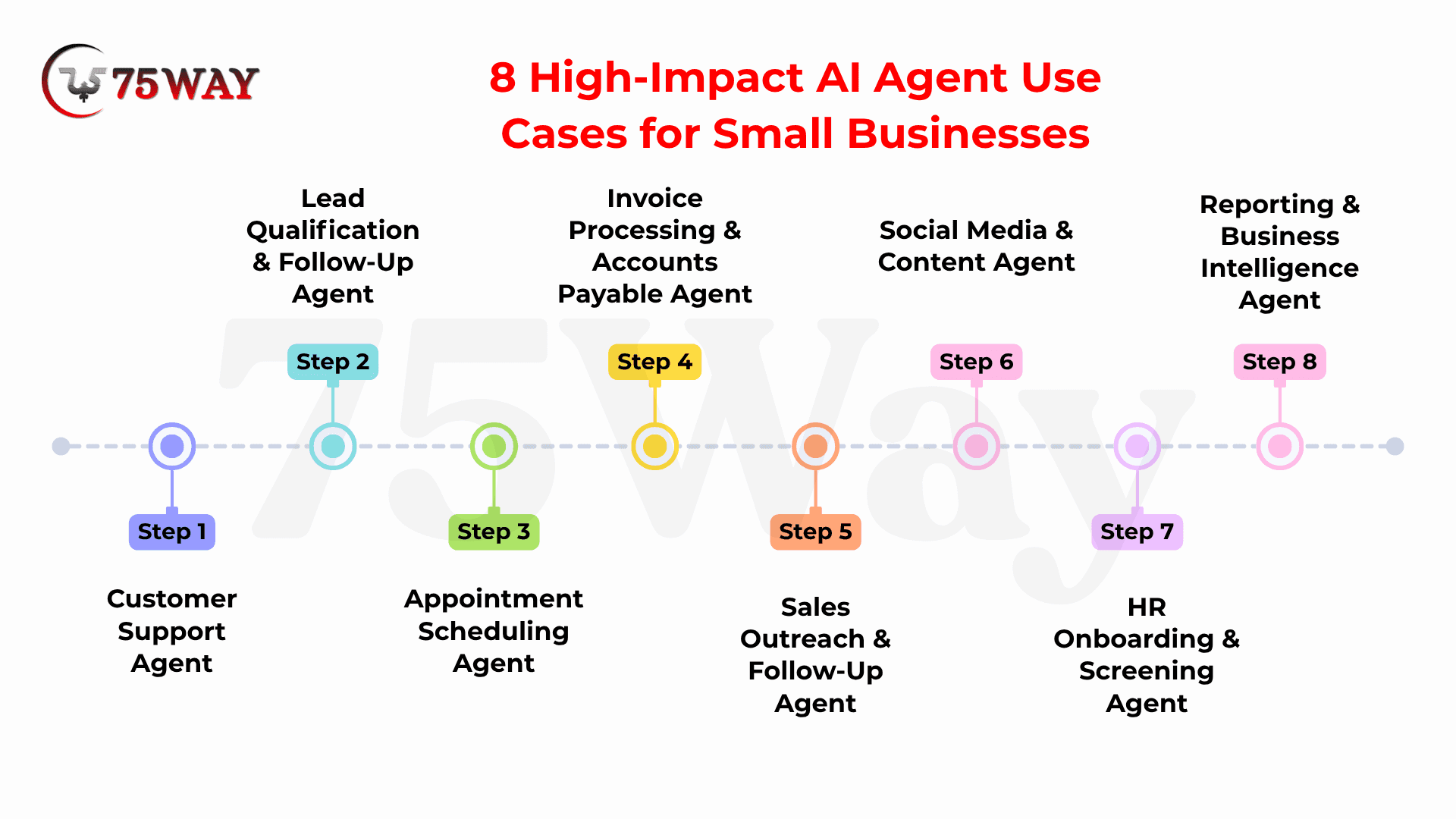
1. Customer Support Agent
AI customer support agent handles inbound inquiries 24/7, answers FAQs, checks order status, processes returns, and escalates complex cases to a human.
- Real result: Retail brands using AI agents in e-commerce stores with real-time access to platforms like Shopify routinely automate 70% or more of support within the first quarter.
- ROI benchmark: The industry benchmark for a human-handled support ticket is $6 to $12, while AI resolutions range from $0.99 to $2.00 depending on the vendor, with most organizations seeing payback within 3 to 6 months.
- Best for: eCommerce stores, SaaS companies, service businesses, clinics, restaurants
- Estimated Build Cost: $15,000 – $50,000 (custom) or $50–$500/month (off-the-shelf tools like Tidio, Intercom Fin, Zendesk AI)
2. Lead Qualification & Follow-Up Agent
Lead qualification agents monitor your contact form or inbox, extract lead details, score the lead against your criteria, draft a personalized first response, update your CRM, and notify your sales rep, all within 60 seconds of inquiry arrival. Many small businesses strengthen these workflows by using Salesforce CRM for small business, giving AI agents a centralized source of customer data for lead tracking, follow-ups, and sales pipeline management.
- Real Result: A lead qualification agent using tools like n8n + Claude + HubSpot saves 3–5 hours per week for a business receiving 20+ inbound leads.
- ROI Benchmark: Faster lead response = higher conversion. Businesses responding within 5 minutes are 9x more likely to convert a lead versus those responding in 10 minutes or more.
- Best For: Agencies, B2B service businesses, consultants, real estate, SaaS
- Estimated Build Cost: $8,000 – $25,000 (custom) or $29–$199/month (Zapier Agents, HubSpot AI)
3. Appointment Scheduling Agent
This agent leads your calendar, qualifies the meeting request, offers available slots, sends confirmations and reminders, reschedules on conflicts, all without back-and-forth email chains.
- Time Saved: 5–8 hours per week for service businesses with 20+ appointments weekly.
- Best For: Healthcare providers, law firms, consultants, salons, home service businesses
- Estimated Development Cost: $5,000 – $20,000 (custom) or $15–$99/month (Calendly AI, Reclaim.ai)
4. Invoice Processing & Accounts Payable Agent
AI billing agent for invoice process manages incoming invoices (PDF or email), extracts key data, matches to purchase orders, flags discrepancies, routes for approval, and logs into your accounting system.
- Real Result: Businesses automating invoice processing reduce processing time from 2–3 days to under 4 hours, with error rates dropping by over 80%.
- Best for: Any business processing 50+ invoices per month — retail, construction, logistics, professional services
- Estimated Development Cost: $10,000 – $40,000 (custom) or $99–$499/month (Bill.com AI, QuickBooks AI)
5. Sales Outreach & Follow-Up Agent
A cold outreach agent for sales researches prospects, personalizes outreach emails, follows up on non-responses, tracks engagement signals, and alerts your sales team when a prospect shows buying intent.
- Real Result: Companies report ROI from AI-assisted sales outreach in as little as two weeks, with Microsoft Copilot Agents reducing customer service response times by 30–50%.
- Best For: B2B companies, agencies, SaaS, staffing firms, commercial real estate
- Estimated Development Cost: $10,000 – $35,000 (custom) or $50–$500/month (Warmly, Apollo AI, Clay)
6. Social Media & Content Agent
Social media content generator agent generates on-brand social posts, schedules content, responds to comments, monitors brand mentions, and produces weekly performance reports.
- Time Saved: 8–12 hours per week for businesses managing 3+ social channels.
- Best For: Retail brands, restaurants, professional services, eCommerce
- EstimatedDevelopment Cost: $8,000 – $25,000 (custom) or $30–$200/month (Jasper AI, Buffer AI, Hootsuite)
7. HR Onboarding & Screening Agent
HR AI agent screens applicant resumes, asks pre-qualifying questions, schedules interviews, sends offer letters, collects onboarding documents, and answers new-hire FAQ automatically.
- Time Saved: HR teams save 40–60% of administrative time during hiring cycles.
- Best For: Businesses hiring 5+ employees per quarter, retail chains, restaurants, staffing agencies, healthcare clinics
- EstimatedDevelopment Cost: $15,000 – $45,000 (custom) or $100–$500/month (Greenhouse AI, Workable AI)
8. Reporting & Business Intelligence Agent
Pulls data from your CRM, POS, eCommerce platform, and ad accounts, synthesizes it into a weekly performance briefing, and surfaces anomalies that need your attention.
- Time Saved: 4–6 hours per week in manual reporting; faster decision-making through real-time alerts.
- Best For: Multi-location retailers, agencies, SaaS companies, franchise owners
- EstimatedDevelopment Cost: $20,000 – $60,000 (custom) or $50–$300/month (Notion AI, Metabase AI, Tableau)
AI Agent Development Cost for Small Businesses: 2026 Breakdown
Here's the honest landscape for AI agent development cost. The answer is somewhere between $8,000 and $400,000, depending almost entirely on complexity, but for small businesses, the relevant ranges are much narrower.
- Off-the-Shelf AI Tools: $20 – $500 per month
Platforms such as Tidio, HubSpot AI, and Zapier AI offer a quick way to introduce automation without a significant upfront investment. These solutions are ideal for businesses with common use cases, limited technical resources, and a need for rapid deployment.
- No-Code and Low-Code AI Platforms: $50 – $300 per month, plus implementation time
Platforms such as Make.com, n8n, and Voiceflow allow businesses to build more advanced automations without extensive software development. These tools provide greater flexibility while maintaining relatively low implementation costs.
- Simple Custom AI Agent: $8,000 – $30,000
A simple custom AI agent is designed around a single business objective, such as lead qualification, appointment scheduling, customer support, or inquiry handling. These solutions provide more control and flexibility than off-the-shelf alternatives.
- Medium Custom AI Agent: $30,000 – $80,000
Medium-complexity AI agents support multiple workflows and integrate with several business systems. These solutions often include advanced automation, CRM connectivity, workflow orchestration, and industry-specific capabilities.
- Custom Multi-Agent System: $80,000 – $200,000+
A multi-agent architecture uses multiple AI agents that collaborate to perform specialized tasks. One agent may qualify leads, another may schedule appointments, while others handle customer support, reporting, or workflow execution.
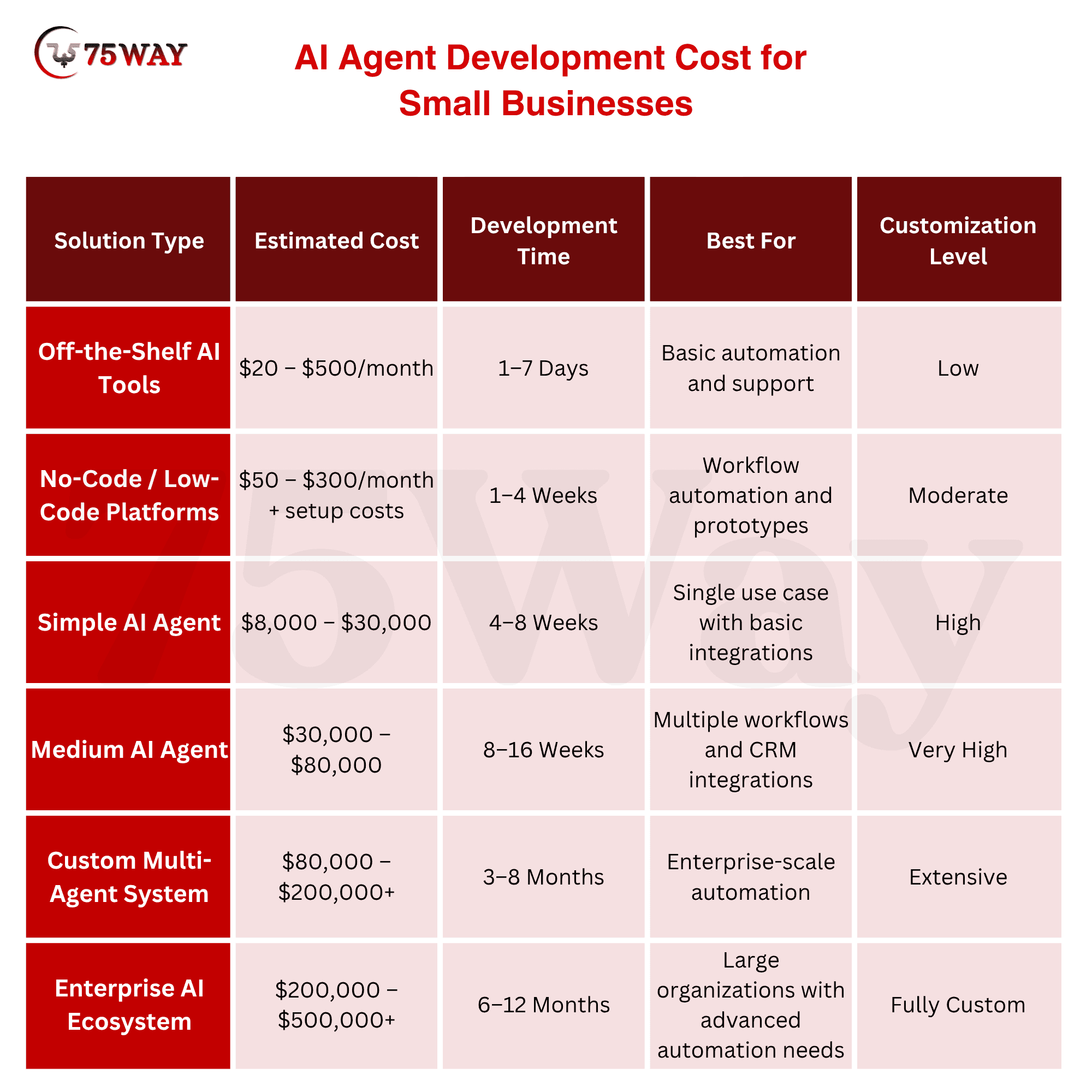
Development Cost by Agent Type in 2026
A good customer support agent handles FAQs, routes tickets, manages live chat, and escalates the tricky ones to a human.
Estimated Cost: $15,000 – $50,000 for a custom build.
Moreover, a lead qualification agent that qualifies leads, follows up, books meetings, and pulls live data from your CRM costs more due to its complexity. Industry benchmarks show cost for:
- Reactive Agents at $20k–$35k
- Intermediate Agents at $40k–$70k
- Advanced Agents at $80k–$120k
- Enterprise Multi-Agent Systems at $100k–$500k+.
Hidden Costs to Budget For
Five costs most businesses miss:
(1) API Consumption: AI agents make 5 to 20 LLM calls per task, so a $300 platform fee can carry $400 of API cost
(2) Integration Maintenance: Each connected system needs auth, and schema updates roughly quarterly
(3) Prompt Drift: AI model upgrades break carefully-tuned prompts, requiring 2 to 4 hours of rework per release
(4) Escalation Handling: 5 to 15% of cases need human review
(5) Governance: Audit logs, prompt versioning, and PII handling for regulated industries. Budget 1.5x the headline platform price for total cost of ownership.
Year-One Total Cost Estimate for a Small Business
For Year One, a small business might allocate $8,000 – $30,000 for a pilot, covering developer time, initial model inference, and infrastructure. This budget allows for building a use-case-specific agent and understanding its performance.
A realistic Year-One budget for a US small business deploying one focused AI agent:
- Custom Agent Development: $8,000 – $30,000
- LLM API Costs (OpenAI, Claude, etc.): $100 – $800/month
- Cloud Hosting / Infrastructure: $50 – $300/month
- Integration Setup (CRM, etc.): $1,000 – $5,000
- Ongoing Maintenance (quarterly): $2,000 – $5,000
So, total year one cost is $12,000 – $50,000
Should You Buy or Build Your AI Agent?
Before committing to a custom build, ask: Is there a pre-built solution available? Intercom Fin, Salesforce Einstein, Zendesk AI, and dozens of vertical-specific tools now offer near-turnkey AI agents for $50–$500/month. For customer service, HR onboarding, and basic document Q&A, these are worth evaluating seriously before commissioning a custom build. Use this decision framework:
1. Choose Off-The-Shelf If
- Your use case is common (support, scheduling, basic lead capture). You don't have proprietary data or workflows
- You want something running in days, not months
- Budget is under $500/month
2. Choose Custom Development If:
- Your workflow involves proprietary business logic
- You need deep integration with internal systems (ERP, custom CRM, industry software)
- Compliance requirements (HIPAA, PCI-DSS) dictate specific architecture
Off-the-shelf tools have failed to deliver results; you want a competitive differentiator, not a commodity tool
Is Your Process Ready for an AI Agent? (4 Questions to Ask First)
Not every workflow is worth automating. As a rule of thumb, tasks need to occur at least 500–1,000 times per month for the ROI timeline to stay within 24 months. Before building an AI agent, answer these four questions:
1. Is the process genuinely non-deterministic? If the workflow follows predictable rules at least 80% of the time, rule-based automation tools (Zapier, Make.com) are cheaper and more reliable than an AI agent.
2. Is your data clean? AI agents inherit the quality of the data they work with. If your CRM is a mess, your knowledge base is outdated, or your documents are inconsistently structured, fix the data before building the agent.
3. Does the volume justify the build cost? A customer support agent that deflects 30% of tickets generates meaningful savings at 5,000+ tickets per month. At 300 tickets per month, the business case is usually weak.
4. Is the workflow stable enough? If your underlying processes change significantly every 3–6 months, you'll spend more on updates and retraining than the agent saves.
How to Build Your First AI Agent: 90-Day Roadmap
You don't need a $100,000 budget or an internal AI team to get started. The shift is driven by three converging factors: no-code platforms have made agent building accessible to non-technical users, AI model costs have dropped by over 90% since early 2024, and the quality of AI reasoning has improved to the point where agents can reliably handle real business tasks. Here is a practical 90-day plan:
Days 1–30: Audit & Select Your First Use Case
Document every task your team does more than 10 times per week across customer service, sales, finance, HR, and operations.
- Rank by: frequency × time cost × error rate; the top 3 are your automation candidates
- Quantify the Baseline: how long does the task take today? What does it cost in staff time?
What's the error rate? Pick one. The narrower the scope, the faster and cheaper the first agent.
Best first agents for small businesses:
- Customer support FAQ agent (if you get 50+ repetitive inquiries/week)
- Lead intake and qualification agent (if leads go unanswered for more than 2 hours)
- Appointment booking agent (if scheduling takes 30+ minutes per day)
Days 31–60: Build and Test
If using off-the-shelf tools:
- Set up your tool (Tidio, Zapier Agents, or Intercom Fin)
- Connect to your CRM, inbox, or knowledge base
- Define the agent's scope — exactly which tasks does it handle, and when does it escalate?
- Test with 50–100 real interactions before going live
If building a custom agent:
- Partner with an AI development company
- Complete a discovery phase (1–2 weeks) to define scope, integrations, and success metrics
- Build the MVP agent (4–8 weeks)
- QA and user acceptance testing (1–2 weeks)
Days 61–90: Launch, Measure, Iterate
- Deploy to a small user group first, not your entire customer base
- Track: resolution rate, escalation rate, user satisfaction, time saved
- Identify the top 3 failure points and address them
- Expand to full deployment once metrics are stable
Months 4–6: Deploy your second and third agents. Connect agents where it makes sense — your support agent creates tasks that your scheduling agent fulfills.
Real ROI: What to Expect (And When)
The ROI of AI customer service compounds over time. First-year returns average 41%, climbing to 87% in year two and exceeding 124% by year three as systems learn from real interactions and teams optimize their knowledge bases.
Here is a realistic ROI timeline for a US small business:

Payback period benchmarks
- Customer support agent: 3–6 months
- Lead qualification agent: 1–3 months
- Invoice processing agent: 2–4 months
- HR screening agent: 3–6 months
5 Mistakes Small Businesses Make With AI Agents
1. Starting Too Broad
"Handle all our customer service" is not a deployable scope. "Answer the 20 most common questions about our return policy and shipping times" is.
Narrow scope = faster build, faster ROI, fewer failures.
2. Skipping the Data Audit
An AI agent is only as good as the data it can access. A knowledge base full of outdated pricing, broken links, and duplicate articles will produce an agent that confidently gives wrong answers.
3. No Human Handoff Plan
5 to 15% of cases need human review, so build that capacity in. Agents without a clear escalation path either fail silently or frustrate customers. Define: when does the agent escalate? To whom? How fast must a human respond?
4. Automating Before Optimizing
If your current process is broken, automating it just produces broken results at scale. Fix your workflow first, then automate it.
5. Treating It as a One-Time Project
The most common budgeting mistake is treating AI agent development as a one-time expense rather than an ongoing investment. AI agents degrade quietly. As business data shifts, user behavior changes, and product catalogs update, model accuracy erodes, often before anyone notices. Budget for quarterly reviews and updates.
AI Agent Technology Stack for Small Businesses (2026)
For businesses working with a development partner, here's what a well-architected small business AI agent looks like under the hood:
1. LLM Options
- OpenAI GPT-4o — Best general-purpose reasoning, widely supported
- Anthropic Claude 3.5 Sonnet — Excellent for customer-facing agents, safety-first
- Google Gemini 1.5 Pro — Strong for businesses already in the Google ecosystem
- Orchestration Frameworks:
- LangChain / LangGraph — Most popular for custom agent workflows
- n8n — Best no-code/low-code for SMB automation
- CrewAI — Multi-agent orchestration for complex workflows
2. Memory & Knowledge
- Vector databases: Pinecone, Weaviate (for knowledge retrieval)
- RAG (Retrieval-Augmented Generation) — Lets agents pull from your documents, FAQs, and CRM in real time
3. Integrations
- CRM: HubSpot, Salesforce, Zoho
- Support: Zendesk, Freshdesk, Intercom
- Communication: Slack, Gmail, Twilio
- Commerce: Shopify, WooCommerce, Stripe
- Scheduling: Calendly, Acuity, Google Calendar
Why Partner With an AI Development Company for Your Agent?
Use an implementation partner when the ROI case is strong but your team lacks time, agent architecture experience, or integration bandwidth. This is often the practical route for founders and operators who need a scoped pilot, rollout plan, and production controls before hiring a dedicated AI team.
When evaluating AI development partners for your small business agent, ask:
- Have they built agents for your specific use case? Customer support agents and lead qualification agents have very different architectures.
- Do they start with a discovery phase? Any team that starts building without understanding your workflow is a red flag.
- How do they handle prompt drift and model updates? LLM model changes can break agents silently.
- What does post-launch support look like? Agents need ongoing monitoring, not just a one-time launch.
- Can they integrate with your existing stack? HubSpot, Shopify, QuickBooks, your industry-specific software — all need clean API connections.
How 75Way Builds AI Agents for Small Businesses
At 75Way, we've built AI agents for small and mid-size businesses across the USA, from healthcare practices automating patient intake, to eCommerce brands handling 70% of support without a single additional hire, to B2B service companies qualifying and following up on leads 24/7.
What makes our approach different:
- Discovery before development. We spend the first 2 weeks mapping your actual workflows, not building to a requirements document written in a conference room. The agent we build reflects how your business actually operates.
- Narrow scope. Fast ROI. We don't promise an AI system that runs your entire company. We identify the one or two workflows where an agent will deliver measurable results within 90 days, build those first, and expand from there.
- Integration-first architecture. Every agent we build connects to your real systems: your CRM, your support desk, your email, your eCommerce platform. So it acts on real data, not a demo environment.
- Ongoing optimization. We don't hand off and disappear. Every agent we deploy includes quarterly performance reviews, prompt updates, and model upgrade management.
Our AI Agent Capabilities:
- Custom LLM-powered agents using GPT-4o, Claude 3.5, and Gemini
- RAG-based knowledge agents connected to your documentation
- CRM-integrated lead qualification and follow-up agents
- HIPAA-compliant healthcare automation agents
- Multi-agent systems for cross-department workflow automation
- No-code agent setup for businesses that want control without complexity
Final Thoughts
The competitive gap between small businesses that use AI agents and those that don't is widening in 2026, and it's widening fast. AI agents are not a future technology. They are operational infrastructure that US small businesses are deploying today to handle customer support, qualify leads, schedule appointments, process invoices, and run reports without adding headcount. The businesses seeing the strongest results share one trait: they started with one narrow, measurable use case, proved ROI, and expanded. They didn't try to automate everything at once. They picked one problem that was costing them time and money every single day, built an agent to handle it, and let the results drive the next decision. If you're a small business owner in the USA considering your first AI agent, that's exactly where to start. Partner with a reliable AI development company to get affordable AI agent development solutions. You can also bring ready-made AI agents from online AI marketplaces like 75AI Agent Store for quick launch.
Frequently Asked Questions (FAQs)
What Is An AI Agent For Small Business?
An AI agent for small business is an autonomous software system that completes multi-step business tasks, like answering customer inquiries, qualifying leads, scheduling appointments, or processing invoices, without requiring human input for each individual action. Unlike traditional chatbots that only respond to questions, AI agents take action: updating your CRM, sending emails, booking meetings, and escalating exceptions to the right team member.
How Much Does AI Agent Development Cost For A Small Business?
For small businesses in the USA, AI agent development costs range from $8,000 to $80,000 depending on complexity and integration requirements. A single-use-case agent (like a customer support FAQ bot) typically costs $8,000–$30,000. A medium-complexity agent with CRM integration and lead qualification costs $25,000–$60,000. Off-the-shelf tools like Tidio, Zapier Agents, and Intercom Fin cost $20–$500 per month and are the right starting point for common workflows.
What Is The ROI of AI Agents For Small Businesses?
Companies using AI agents report an average ROI of 171%, with 74% of businesses achieving returns within the first year. Customer-facing agents (support, lead qualification) typically pay back within 3–6 months. First-year ROI averages 41%, rising to 87% in year two and over 124% by year three as agents improve from real-world interactions.
Do I Need Technical Expertise To Use AI Agents?
Not necessarily. Off-the-shelf tools like Tidio, HubSpot AI, and Zapier Agents require zero coding to set up. No-code platforms like n8n and Make.com require some technical literacy but no software engineering background. Custom AI agent development requires a development partner, which is where a company like 75Way comes in to handle the technical complexity while you focus on defining the business requirements.
What AI Agent Use Case Should A Small Business Start With?
The best starting use case is the one with the highest combination of: frequency (happens 500+ times per month), time cost (takes 30+ minutes per day total), rule-based logic (clear decision criteria), and measurable baseline (you know exactly how long it takes and what it costs today). For most small businesses, this is either customer support FAQ handling or lead qualification and follow-up; both deliver fast, measurable ROI.
What's The Difference Between AI Agents And Chatbots?
A chatbot responds to questions from a predefined script or knowledge base. An AI agent takes autonomous action: it can read emails, update CRM records, book appointments, send follow-up messages, process documents, and escalate to a human when needed, all without being asked for each step. Think of a chatbot as read-only; an AI agent has read-and-write access to your business systems.
How Long Does It Take To Build A Custom AI Agent?
A simple, single-use-case AI agent typically takes 6–10 weeks from discovery to launch. Medium-complexity agents with multiple integrations take 10–16 weeks. Enterprise-grade multi-agent systems can take 4–8 months. Off-the-shelf tools can be set up and tested in days.
Is AI Agent Development Safe For Customer Data?
Custom AI agents can be built with enterprise-grade security, including data encryption, role-based access controls, audit logging, and compliance with regulations like HIPAA (healthcare) and PCI-DSS (payments). Off-the-shelf tools vary in their security posture, always review the vendor's data handling policies before connecting sensitive customer data.