Summary
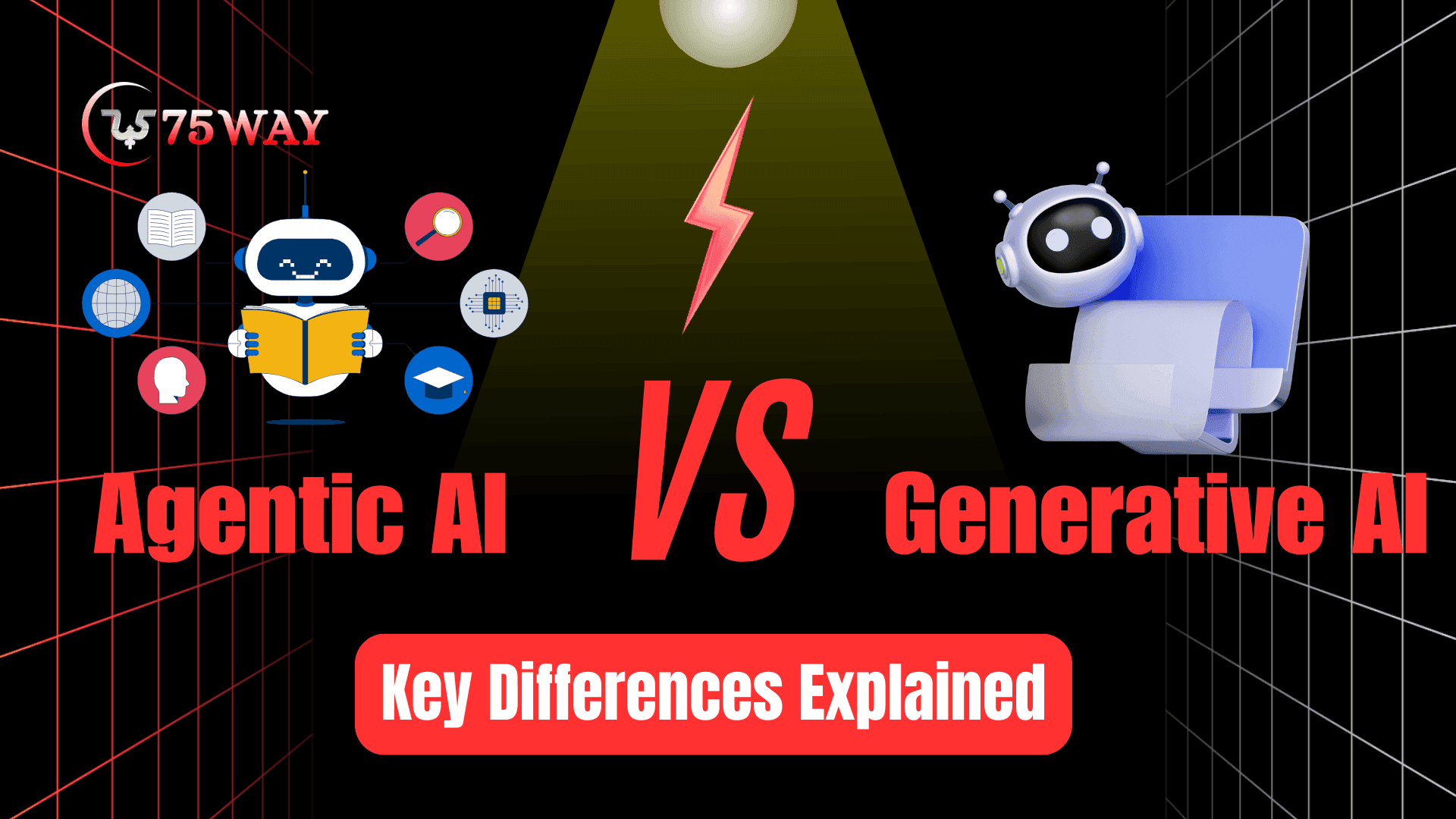
Agentic AI and Generative AI are two important types of artificial intelligence with different purposes. Generative AI focuses on creating content like text, images, and code, while Agentic AI is designed to perform tasks, make decisions, and automate workflows. Understanding their differences helps businesses choose the right AI solutions and use both technologies effectively.
Key Takeaways
- Generative AI creates content such as text, images, and code.
- Agentic AI focuses on task execution and autonomous decision-making.
- Generative AI is widely used in content creation and marketing.
- Agentic AI is commonly used for automation and workflow management.
- Both technologies can work together to improve productivity and efficiency.
The artificial intelligence landscape has bifurcated into two distinct paradigms that fundamentally reshape how machines interact with human needs. Agentic AI represents autonomous systems capable of independent decision-making and goal pursuit, whilst generative AI focuses on creating novel content text, images, code based on learned patterns. According to Thomson Reuters, this distinction isn't merely technical semantics; it defines whether AI follows instructions or takes initiative.
The confusion between these approaches stems from their common foundation in large language models and neural networks. Yet their operational philosophies diverge sharply: generative systems respond to prompts, whilst agentic systems chart their own course towards defined objectives. IBM research highlights that agentic AI can break down complex tasks, make contextual decisions, and adapt strategies without constant human guidance capabilities that extend far beyond content generation. Organisations implementing intelligent automation workflows increasingly recognise this fundamental difference shapes their entire AI strategy.
Understanding Agentic AI
Agentic AI represents a fundamental shift from reactive systems to autonomous decision-makers that can operate independently within defined parameters. Unlike Generative AI, which creates content based on patterns in training data, agentic systems pursue goals through multi-step reasoning and environmental interaction.
At its core, agentic AI functions through a perception-action loop. The system observes its environment, evaluates available options against objectives, selects appropriate actions, and learns from outcomes. This architecture enables autonomous decision making systems to handle complex workflows without constant human oversight, a capability beyond traditional AI models.
What distinguishes agentic systems is their ability to maintain context across extended operations. Where conventional AI processes individual requests in isolation, agentic AI tracks progress towards objectives, adapts strategies when obstacles arise, and orchestrates multiple tools to complete tasks. A practical scenario: an agentic system managing supply chain logistics might detect inventory shortfalls, analyse supplier options, negotiate terms, and execute orders all whilst adjusting for real-time demand fluctuations.
Exploring Generative AI
Generative AI operates on a fundamentally different premise than its agentic counterpart. Rather than pursuing goals through autonomous decision-making, generative systems excel at creating new content from learned patterns. These models respond to prompts by producing text, images, code, or other outputs based on vast training datasets.
When examining Agentic AI vs Generative AI, the distinction becomes clear: generative systems are reactive rather than proactive. A user provides input a prompt, query, and or instruction and the model generates a response within milliseconds. A user provides input a prompt, query, or instruction and the model generates a response within milliseconds. Generative AI and LLM services power many of these capabilities, enabling businesses to create content, automate interactions, and enhance decision-making. Tools like
- ChatGPT
- DALL-E
- GitHub Copilot exemplifies this paradigm.
The architecture underpinning generative AI relies on transformer models and deep learning techniques that identify statistical relationships within training data. According to IBM, these systems "generate novel content based on patterns learned from training data" but lack the capacity for multi-step reasoning or environmental interaction. They excel at pattern replication and creative synthesis whilst remaining confined to single-transaction interactions. This creates a powerful tool for content creation but one that requires human guidance for strategic application, a limitation that understanding how to build AI agents from scratch addresses directly.
Features of Agentic AI and Generative AI
Key Features of Agentic AI
Autonomous Goal Execution
Agentic AI is designed to work toward specific goals with minimal human intervention. Once a task or objective is defined, the AI agent can plan steps, make decisions, and execute actions to achieve the goal without requiring constant prompts from users.
Multi-Step Reasoning
Agentic AI systems can break complex tasks into smaller steps and solve them sequentially. This ability allows the system to analyze problems, plan strategies, evaluate results, and adjust its actions to successfully complete tasks.
Tool Usage
One of the defining features of agentic AI is its ability to interact with external tools and systems. These tools may include APIs, databases, software applications, or other digital services that help the AI gather information and perform actions more effectively.
Environment Interaction
Agentic AI can interact with its digital or physical environment to complete tasks. For example, it may monitor system data, control software workflows, or interact with connected devices to make decisions and take appropriate actions.
Key Features of Generative AI
Content Creation
Generative AI is best known for its ability to create new content based on learned patterns from large datasets. This includes generating text, images, audio, videos, and even code, making it useful for creative and productivity-related tasks. An AI humanizer can further refine AI-generated text to make it sound more natural and human-like.
Pattern Recognition
Generative AI models learn from vast amounts of data to recognize patterns, structures, and relationships. This understanding allows them to generate outputs that closely resemble human-created content. A generative ai course can help learners build a stronger understanding of these concepts and their practical applications.
Multimodal Generation
Modern generative AI systems can work with multiple types of data, such as text, images, audio, and video. This capability allows them to generate and combine different forms of media, enabling applications like creating high-quality visuals with GPT Image 2.0 and generating videos from text prompts.
Overlapping Features
Although agentic AI and generative AI serve different purposes, they can share certain capabilities. For instance, agentic AI may use generative AI to produce natural language responses, summaries, or reports while executing tasks. In many modern systems, generative AI handles communication and content generation, while agentic AI manages decision-making, planning, and action execution. Together, these technologies can create more powerful and intelligent AI solutions.
Comparison Table: Agentic AI vs. Generative AI
This framework clarifies how generative AI excels at creative and analytical tasks, whilst agentic AI handles operational complexity. Understanding these distinctions becomes essential when evaluating technical constraints and implementation challenges.
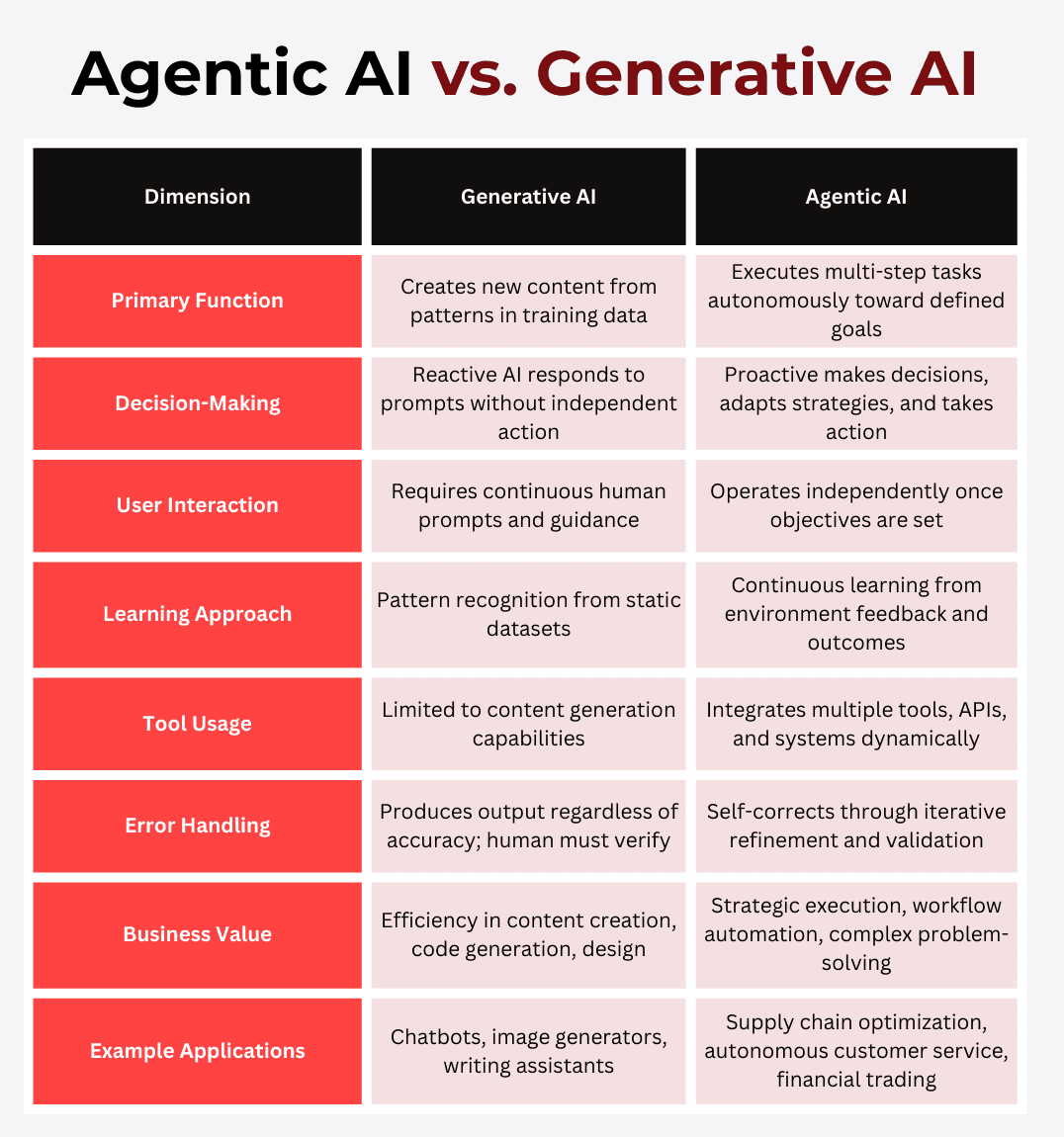
While both technologies leverage advanced machine learning, the key differences between agentic and generative AI lie in their core purpose, operational approach, and interaction model. Generative AI functions as a reactive tool, producing content text, images, code based on user prompts, whereas agentic AI operates as an autonomous decision-maker that pursues goals independently.
The autonomy gap defines their fundamental divide. Generative systems wait for instructions and deliver outputs without evaluating success or adjusting strategy. In contrast, agentic AI systems can plan multi-step workflows, make contextual decisions, and adapt their approach based on environmental feedback characteristics essential for automating complex business operations.
Their interaction models also diverge sharply. Generative AI maintains a simple input-output relationship: you provide a prompt, it returns a result, and the interaction ends. Agentic AI establishes continuous feedback loops, monitoring outcomes and refining strategies without human intervention. This distinction determines their respective applications generative tools excel at creative acceleration, whilst agentic systems tackle dynamic, goal-oriented challenges.
The distinction centres on interaction models. Generative systems respond to prompts with static outputs, whilst agentic systems engage in dynamic, multi-step workflows. According to Thomson Reuters, generative AI requires explicit user direction for each task, whereas agentic AI interprets objectives and determines the necessary sequence of actions independently. This operational independence represents the clearest dividing line between the two approaches.
1. Core Purpose
The fundamental distinction lies in their operational intent. Generative AI functions as a creative engine, designed to produce content text, images, code, or audio based on patterns learned from training data. It responds to prompts by generating outputs that match requested specifications.
Agentic AI, by contrast, operates as an autonomous problem-solver. Rather than simply creating content, it pursues defined goals through independent decision-making and action. This system evaluates situations, determines optimal approaches, and executes multi-step workflows without continuous human intervention. The distinction determines how each technology integrates into business processes and what value they ultimately deliver.
2. Autonomy and Decision Making
The autonomy gap between these technologies reveals their most striking operational difference. Generative AI operates as a reactive system, waiting for human prompts to initiate action and requiring explicit instructions for each task. It functions as a sophisticated tool that responds to queries but cannot determine when or how to act independently.
Agentic AI, in contrast, possesses decision-making capabilities that enable autonomous operation within defined parameters. These systems evaluate situations, select appropriate actions, and execute multi-step processes without constant human oversight. The technology doesn't merely wait for commands it identifies opportunities for intervention and acts accordingly.
This distinction manifests practically in how each system handles complexity. Whilst generative AI might create a customer service response when prompted, agentic AI monitors incoming queries, prioritises them by urgency, drafts contextually appropriate responses, and escalates complex issues to human agents all without manual intervention at each stage.
3. Workflow and Functionality
The operational mechanics reveal fundamentally different approaches to task completion. Generative AI follows a linear, single-step process: it receives a prompt, processes the input through its neural networks, and delivers an output. The workflow ends there no iteration, no validation, no course correction.
Agentic AI operates through multi-step reasoning chains that mirror human problem-solving patterns. A single objective might trigger dozens of intermediate actions: gathering information from multiple sources, evaluating alternative approaches, executing decisions, and adjusting based on feedback. This iterative workflow enables these systems to handle complex scenarios where the path to success isn't immediately clear.
The feedback loop makes the crucial difference. Whilst generative models treat each interaction as isolated, agentic systems continuously refine their approach based on outcomes, creating what researchers call "closed-loop operation."
Real-World Applications and Case Studies
Agentic AI in Business Automation
Agentic AI is increasingly used in businesses to automate complex workflows and operational tasks. AI agents can monitor systems, analyze data, and perform actions such as processing orders, managing inventory, or coordinating internal processes. For example, in customer service operations, an AI agent can receive a request, check relevant databases, trigger the appropriate workflow, and resolve the issue without human intervention. This automation helps organizations reduce manual work, improve efficiency, and speed up decision-making.
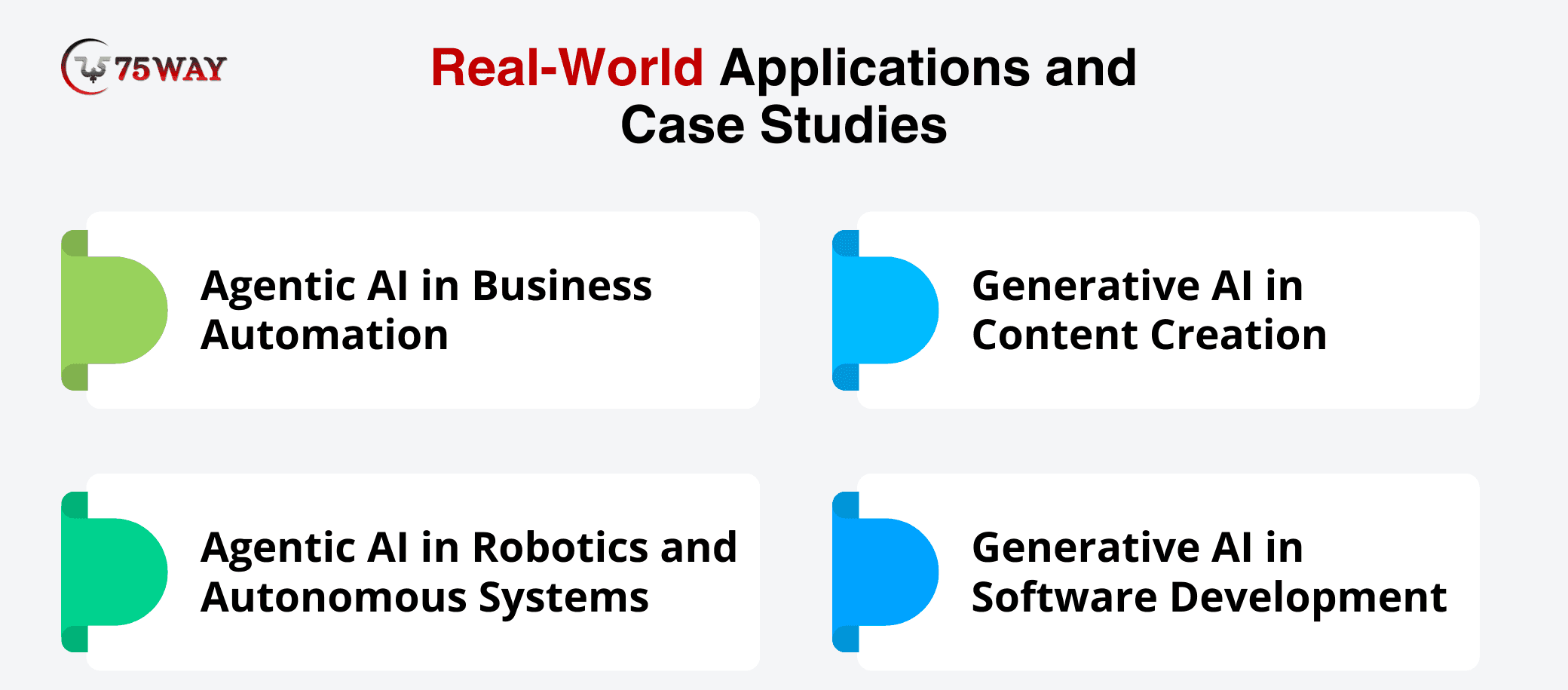
Generative AI in Content Creation
Generative AI has become a powerful tool for creating various types of digital content. Businesses use it to generate blog posts, social media updates, product descriptions, advertising copy, and even design assets like images or graphics. Marketing teams benefit from generative AI because it enables faster content production and supports personalization for different audiences. As a result, companies can maintain consistent brand messaging while scaling their marketing efforts.
Agentic AI in Robotics and Autonomous Systems
Agentic AI plays a crucial role in robotics and autonomous technologies. In these systems, AI agents analyze real-time data from sensors and make decisions to interact with the environment. For example, self-driving vehicles use AI agents to detect objects, plan routes, and make driving decisions. Similarly, robotic assistants in warehouses or healthcare environments can navigate spaces, perform tasks, and adapt to changing conditions without constant human control.
Generative AI in Software Development
Generative AI is transforming the way developers write and maintain code. AI-powered tools can generate code snippets, suggest improvements, detect bugs, and help developers understand complex programming tasks. By automating parts of the coding process, generative AI increases developer productivity and speeds up software development cycles. It also helps beginners learn programming more efficiently by providing explanations and example solutions.
Limitations and Considerations
While both agentic AI and generative AI offer powerful capabilities, they also come with several limitations and challenges. Understanding these limitations helps organizations use AI responsibly and effectively.
Limitations of Agentic AI
Complexity
Agentic AI systems are often complex to design and implement. They require advanced architectures, AI integration with multiple tools, and careful planning to ensure the system performs tasks correctly. Building and maintaining such systems can require significant technical expertise and resources.
Safety Concerns
Since agentic AI can make decisions and take actions autonomously, there is a risk of unintended consequences if the system behaves incorrectly. For example, an AI agent performing automated tasks could make errors that affect business operations or security if not properly controlled.
Need for Monitoring
Even though agentic AI can operate independently, human supervision is still essential. Continuous monitoring ensures the AI follows defined rules, avoids mistakes, and operates within safe and ethical boundaries.
Limitations of Generative AI
Hallucinations
Generative AI models sometimes produce incorrect or misleading information that appears believable. This issue, often called “AI hallucination,” occurs because the model predicts patterns rather than verifying facts. As a result, outputs may require human validation.
Bias
Generative AI systems can reflect biases present in their training data. If the data used to train the model contains cultural, social, or demographic biases, the generated content may unintentionally reinforce those biases.
Data Dependency
Generative AI relies heavily on large datasets for training. The quality and diversity of this data strongly influence the model’s performance. Poor or limited training data can reduce accuracy and reliability.
Ethical and Governance Considerations
AI Safety
Ensuring that AI systems operate safely and responsibly is a major concern. Developers must design safeguards to prevent harmful outcomes or misuse of AI technologies.
Regulation
Governments and regulatory bodies are developing policies and guidelines to control how AI technologies are used. These regulations aim to ensure accountability, protect user data, and reduce risks associated with AI systems.
Transparency
Transparency in AI systems helps build trust. Organizations should clearly communicate how AI models work, how decisions are made, and how user data is handled. Transparent AI practices make it easier to identify issues and maintain ethical standards.
Agentic AI vs. Generative AI in Cybersecurity
The cybersecurity landscape reveals stark contrasts between these AI approaches. Generative AI excels at pattern recognition and threat intelligence analyzing vast datasets to identify malware signatures, generating security reports, and creating synthetic threat scenarios for training purposes. According to Exabeam, whilst generative models can produce insights from historical attack data, they require human analysts to interpret findings and execute responses.
Agentic AI transforms this reactive model into proactive defence. Autonomous agents continuously monitor network traffic, detect anomalies in real-time, and execute immediate countermeasures without waiting for human approval. When a zero-day exploit appears, agentic systems can isolate affected systems, patch vulnerabilities, and adapt security protocols all within seconds. This autonomous decision-making proves critical when attacks unfold faster than human response times allow, bridging the gap where generative AI's analytical capabilities meet operational execution demands.
The future of agentic and generative AI
The trajectory of AI development points toward increasingly sophisticated autonomous systems that blend decision-making capabilities with creative generation. According to IBM, the convergence of these technologies will fundamentally reshape how organisations approach complex problem-solving and strategic planning.
Technological advancements on the horizon
Agentic AI systems are evolving toward true autonomous decision-making across multi-domain challenges. Future iterations will demonstrate enhanced reasoning capabilities, allowing agents to navigate ambiguous situations with minimal human oversight. Generative AI, meanwhile, continues advancing in multimodal content creation producing increasingly sophisticated combinations of text, images, and video that blur the distinction between human and machine-generated output.
The integration of quantum computing and edge AI will dramatically accelerate both technologies. Agentic systems will process environmental data in real-time, whilst generative models will create personalised content at unprecedented scale. This convergence promises to revolutionise industries from healthcare where AI agents could autonomously manage patient care pathways whilst generating personalised treatment protocols to finance, with systems that independently execute trades and produce regulatory compliance documentation.
Ethical and regulatory considerations
As these systems gain autonomy, regulatory frameworks must evolve to address accountability gaps. Who bears responsibility when an agentic AI makes an autonomous decision with negative consequences? The European Union's AI Act and similar legislation worldwide are beginning to establish guardrails, but the rapid pace of technological advancement outstrips current regulatory capacity.
Transparency remains paramount. Organisations deploying these systems must ensure explainable decision-making processes, particularly in high-stakes domains like healthcare and criminal justice. The challenge of bias amplification where generative models perpetuate societal prejudices and agentic systems act upon them demands robust testing protocols and diverse development teams.
The future success of these technologies hinges on balancing innovation with accountability, ensuring that autonomous capabilities serve humanity's broader interests.
Conclusion
Understanding the distinction between agentic and generative AI is fundamental for strategic technology adoption. As IBM emphasizes, whilst generative AI excels at content creation and pattern recognition, agentic AI introduces autonomous decision-making capabilities that transform how businesses operate. The choice between these technologies or increasingly, their integration depends on whether organisations need creative output or independent task execution. As artificial intelligence continues advancing, successful implementations will likely blend both approaches, leveraging generative AI's creative power within agentic frameworks' autonomous structures.
FAQs
1. Can generative AI systems learn from feedback?
Ans. Generative AI models can be improved through fine-tuning with new data, but they do not automatically learn from user interactions. Updates usually require human intervention to retrain the model or adjust its parameters.
2. Do agentic AI systems always require generative AI components?
Ans. No, agentic AI systems do not always require generative AI. Some systems operate using rule-based logic or traditional algorithms, although many modern implementations include generative AI for better communication and flexibility.
3. Which technology is more expensive to implement?
Ans. The cost depends on the use case. Generative AI generally has lower initial deployment costs but may involve ongoing computing expenses. Agentic AI often requires higher upfront investment due to integration, workflow design, and monitoring requirements.
4. Can generative AI be used inside agentic AI systems?
Ans. Yes, generative AI can be integrated into agentic AI systems. It helps generate responses, summaries, or content, while the agentic layer manages planning, reasoning, and decision-making to complete tasks.
5. What are common applications of generative AI?
Ans. Generative AI is widely used for creating blog posts, marketing content, images, videos, and code. It also supports applications like chatbots, design generation, and personalized marketing campaigns.
6. What is the main difference between agentic AI and generative AI?
Ans. The main difference lies in their function. Generative AI focuses on creating content based on prompts, whereas agentic AI focuses on executing tasks autonomously by making decisions and performing actions to achieve specific goals.