AI agent development refers to a procedure to build an AI agent. This process consists of several stages in which an agentic AI system is designed, built, trained, tested, and deployed.
Businesses can build an AI agent from scratch to gain control over the architecture, features, and functionalities of their AI-powered agent development solution.
Not only this, with the step-by-step approach, businesses can build custom agentic AI solutions and assign use cases according to their business requirements, challenges, goals, and specific operations. The next crucial factor to develop an AI agent is to have deep knowledge and experience in artificial intelligence models, machine learning algorithms, NLP, LLMs, and software development. The entire AI agent development consumes higher costs.
If you have no prior knowledge in building agentic AI solutions, you can start with pre-built AI agent frameworks. That is quite a cost-effective and flexible apporach. These ready-made solutions offer initial architecture for AI agents and pre-built features to execute the entire process of building AI agents smoothly. You can utilize predefined architectures, models, designs, task management solutions, and monitoring tools. These software solutions allow easy integration and deployment. But still, you want to create your own custom AI agent. We define an end-to-end approach below.
Read More: Top AI Agent Development Companies in USA in 2026
AI Agent Development Process: From Ideation To Launch
Here, we define a step-by-step approach to create and implement an AI agent.
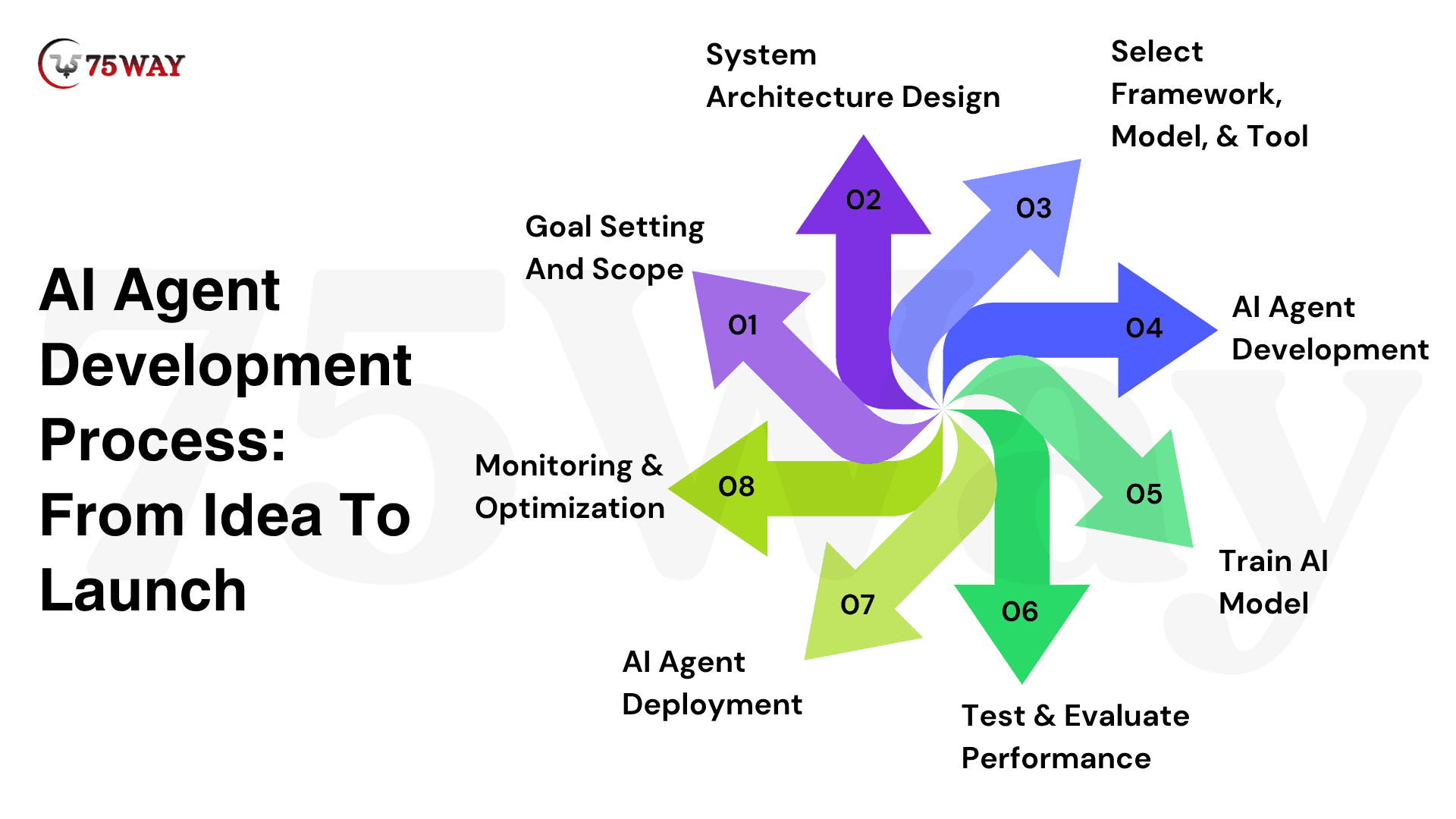
Goal Setting And Scope
The foundation of any successful AI agent begins with clearly defined goals and a well-structured scope. Without this step, even the most advanced models can become misaligned with real business needs, leading to poor performance or unnecessary complexity.
At this stage, the focus is to translate a broad idea into a precise, actionable AI problem statement. This ensures that the agent is not just technically possible, but also valuable in a real-world business context.
To define a strong scope, businesses and development teams should ask:
- What specific business problem is the AI agent expected to solve?
- Which tasks should be fully automated, and which require assistance?
- What type of data inputs will the system rely on: text, images, structured data, or user behavior, etc.?
- What decisions will the AI agent be responsible for?
- Should the system operate fully autonomously?
- Who are the end users, and in which environment will they interact?
- What are the success metrics, such as speed, accuracy, cost reduction, and user satisfaction?
- What should the AI agent not do under any circumstances?
Beyond these core questions, it is also important to define constraints such as compliance requirements, security considerations, scalability expectations, and integration needs with existing systems. A well-scoped AI agent acts like a blueprint for development. It aligns business goals with technical execution, reduces ambiguity during development, and ensures that every component of the system is purpose-driven and measurable from day one.
System Architecture Design
Once the goals and scope are clearly defined, the next step is to design the blueprint of the AI agent. This phase focuses on how data moves through the system, how decisions are made, and how the agent responds to different situations. It acts as the technical and functional map that guides development.
For simpler use cases, such as a customer support agent that tracks orders and provides real-time updates, a single-agent architecture is usually enough. In this setup, one AI system handles the entire process from understanding the query to delivering the response.
However, when the problem becomes more complex, a multi-agent architecture is often more effective. In such systems, multiple specialized agents work together, each handling a specific responsibility. For example, in healthcare or pharmaceutical research, one agent may analyze chemical compound databases, another may review and summarize scientific literature, while a generative AI agent may design new molecular structures. These agents collaborate to solve tasks that would be too complex for a single system.
The architecture also determines how workflows are structured, including handling exceptions, managing edge cases, and recovering from errors. In multi-agent environments, additional planning is required for coordination mechanisms, communication protocols, and task orchestration, ensuring that all agents work in sync without conflict or duplication.
If the AI agent is designed for direct user interaction, it is often deployed as an AI assistant interface, similar to conversational systems like ChatGPT. In such cases, the system must be designed to understand user input naturally and respond in real time.
Finally, integration plays a critical role in this phase. The agent may need to connect with external APIs, third-party plugins, enterprise databases, and live data sources. This enables tool calling capabilities, allowing the AI system to fetch real-time information, perform actions, and make dynamic decisions based on updated inputs.
Select Framework, Model, & Tool
When your design is finalized for an AI agent, the subsequent stage is to choose the precise frameworks, AI models, and tools before creating an AI-powered agent.
Afterward, businesses have to deploy programming languages, like Python or JavaScript, to create AI agents from scratch. The technology stack and scalability needs play an important role here. However, several AI developers adopt pre-built agentic frameworks to accelerate their development stage and improve reliability.
For this, businesses can opt for famous open-source frameworks, namely BeeAI, CrewAI, LangChain, LangGraph, Microsoft AutoGen, and Semantic Kernel SDK. These platforms include pre-built components that help you develop and manage AI agent workflows.
But you must select the appropriate AI model. The reason is that your model decides the performance, accuracy, and task potential of your AI agent. Further, enterprises can deploy large language models (LLMs), machine learning models, or hybrid systems based on the defined use cases of their agents to enhance the decision-making results.
In addition, AI agent development teams can integrate tools, like retrieval-augmented generation (RAG) systems and machine learning libraries like PyTorch, TensorFlow, and scikit-learn, to process data. These tools assist them in improving the learning potential and response accuracy of AI agents.
AI Agent Development
The development stage is where the actual development of the AI agent takes place. Here, the system design is converted into a working solution. To keep development manageable and reduce complexity, many organizations follow a modular approach, where each component of the agent is built independently before being integrated into a complete system. This makes the system easier to test, update, and maintain, as changes in one module have minimal impact on the others.
While building the agent, several critical factors must be considered:
- Efficiency: The AI agent should be able to process inputs quickly, make decisions in real-time, execute actions smoothly, and deliver accurate responses without delay.
- Scalability: The system must be designed to handle increasing workloads, user requests, and data volume without performance degradation as usage grows.
- Security: Strong security measures such as authentication, access control, and data encryption are essential to protect the system from unauthorized access, data leaks, and potential adversarial attacks.
Training
When you develop your AI agent, the next stage is to train your model. In this stage, the AI model learns from a training dataset of sample tasks that are related to the functionalities and tasks of the agent. It is an iterative process that aims to prepare a dataset, execute the model on this data, evaluate its performance through a loss or reward signal, and adjust the parameters of models for enhancing future predictions.
However, if we train machine learning algorithms from scratch, it consumes higher costs, time, and resources. Thus, businesses can deploy pretrained models and optimize them on datasets based on the specific task needs of their AI agents.
Test & Evaluate Performance
The evaluation phase focuses on testing and validating the AI agent to ensure its performance and stability with respect to the intended and defined objectives. This process typically uses a separate testing dataset that is different from the training data and includes a wide range of scenarios to reflect real-world conditions.
Before deployment, agents are often tested in a controlled sandbox or simulated environment. This helps identify performance gaps, security vulnerabilities, and potential ethical risks early in the development cycle, reducing the chances of failure in production.
AI agents are evaluated using multiple performance metrics. Functional metrics include task success rate, error rate, and response latency. In addition, quality and ethical metrics such as bias detection, fairness evaluation, and vulnerability to prompt injection attacks are also considered. For conversational agents, additional indicators like dialogue flow, user engagement, and satisfaction levels are used to measure effectiveness.
Based on the evaluation results, developers refine the system by debugging issues, improving logic, adjusting architecture, and optimizing overall performance.
AI Agent Deployment
AI agent deployment is the process of launching a trained and tested AI system into a live environment where it can interact with real users or applications. It involves integrating the agent with production systems, APIs, and data sources while ensuring scalability, security, and reliability. Continuous monitoring is essential to track performance, fix issues, and improve outcomes over time.
Monitoring & Optimization
The last stage involves continuous monitoring, which plays a key role in maintaining and improving agent performance over time. This ensures the system can adapt effectively to new inputs, evolving conditions, and unexpected challenges in real-world environments.
Businesses can utilize platforms such as Amazon Bedrock AgentCore and IBM® watsonx.ai® to simplify the deployment and management of AI agents. For example, watsonx.ai provides features like one-click deployment along with built-in tracing and observability tools, helping developers track performance and ensure smooth operation after launch.
How AI Agents Work? A Complete Process Explained
AI agents are smart solutions that can perceive their environment, think logically, make decisions, take actions, and continuously improve over time. Unlike traditional software that only follows fixed instructions, AI agents behave more like autonomous problem-solvers that adapt based on feedback and outcomes. The working of an AI agent is built on four interconnected architectural components that function together in a continuous loop:
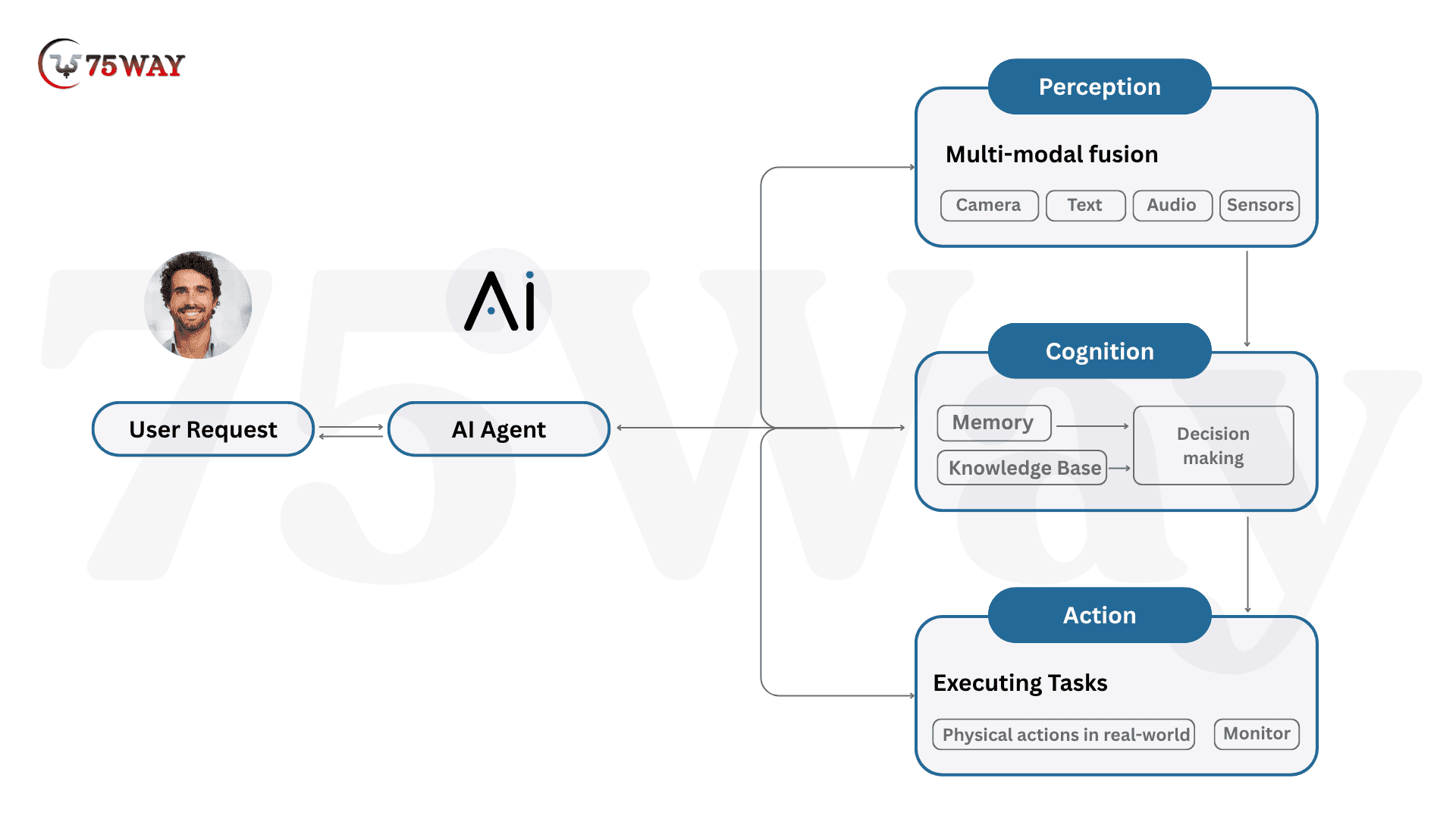
Perception Module: Understanding the Environment
The process begins with perception, where the AI agent collects raw input from its environment. This can include text, images, sensor data, user behavior, or system signals.
Once the data is received, it goes through feature extraction, where meaningful patterns are identified. After that, object recognition or data interpretation helps the system understand what is important. This step allows the AI agent to “see” and understand what is happening around it using techniques like computer vision, NLP, or data preprocessing models.
Cognitive Module: Thinking and Decision Making
After understanding the input, the AI agent moves into the cognitive stage, which acts as its “brain.” Here, the system first defines its goals or objectives, then creates possible plans or strategies to achieve them. Finally, it performs decision-making, where it evaluates different options and selects the most optimal action based on probability, logic, or learned experience.
This module is powered by algorithms like reinforcement learning, probabilistic reasoning, and large language models in modern AI systems.
Action Module: Executing Decisions
Once a decision is made, the AI agent moves into execution. The actuators convert decisions into real-world actions. These actions could include sending a response, triggering an API call, updating a system, controlling a robot, or interacting with a user interface. This is the stage where thinking becomes action, allowing the AI agent to influence its environment.
Learning Module: Continuous Improvement Loop
The final and most important component is learning. AI agents continuously improve through:
- Reinforcement learning, where they learn from rewards and penalties
- Supervised learning, where they learn from labeled datasets
- Unsupervised learning, where they discover hidden patterns in data
This feedback loop ensures that every action and outcome helps the system become smarter, more accurate, and more efficient over time.
Wrap Up
AI agent development is a way using which modern businesses build intelligent, self-operating systems that can think, decide, and act with minimal human intervention. From goal setting and architecture design to model selection, training, evaluation, deployment, and continuous optimization, each stage plays a critical role in ensuring the success of an AI-driven solution. When designed correctly, AI agents can significantly improve efficiency, reduce operational costs, and enhance decision-making across industries. However, building such systems requires deep expertise in AI, machine learning, and scalable software engineering. Partnering with a professional AI agent development company ensures businesses get reliable solutions tailored to their needs.