Summary
AI development services help businesses design, build, and deploy intelligent solutions using machine learning, NLP, computer vision, and automation. These services enable process automation, predictive insights, improved decision-making, and enhanced customer experiences. By leveraging expert teams, scalable frameworks, and cloud integration, organizations can implement AI efficiently, overcome challenges, and gain a competitive edge in their industries.
Artificial Intelligence (AI) is rapidly reshaping industries, enabling businesses to automate routine tasks, improve decision-making, and deliver personalized experiences. From predictive analytics and natural language processing to computer vision and intelligent automation, AI is driving efficiency and innovation across sectors.
However, developing AI solutions from scratch requires specialized expertise, significant investment, and access to large datasets and computing resources. Many organizations face challenges in building, deploying, and maintaining AI systems in-house due to the complexity and technical demands involved.
This is where AI development services become invaluable. These services provide businesses with expert guidance, tools, and infrastructure to design, develop, and implement AI-powered solutions efficiently. In this guide, you’ll explore what AI development services are, how they function, their types, costs, benefits, and essential factors to consider when selecting the right provider for your business needs.
What Are AI Development Services?
AI development services are professional solutions that help businesses design, build, deploy, and maintain intelligent applications and systems. These services are provided by specialized AI companies, agencies, or freelancers with expertise in technologies such as machine learning, natural language processing, and computer vision.
In simpler terms, AI development services involve creating software that can learn from data, make decisions, and automate tasks, enabling businesses to improve efficiency, enhance user experiences, and gain a competitive advantage.
How AI Development Services Work?
AI development services follow a structured process, starting with understanding business goals, collecting and preparing data, building and training models, integrating AI into applications, testing performance, and finally deploying and maintaining intelligent systems for continuous improvement.
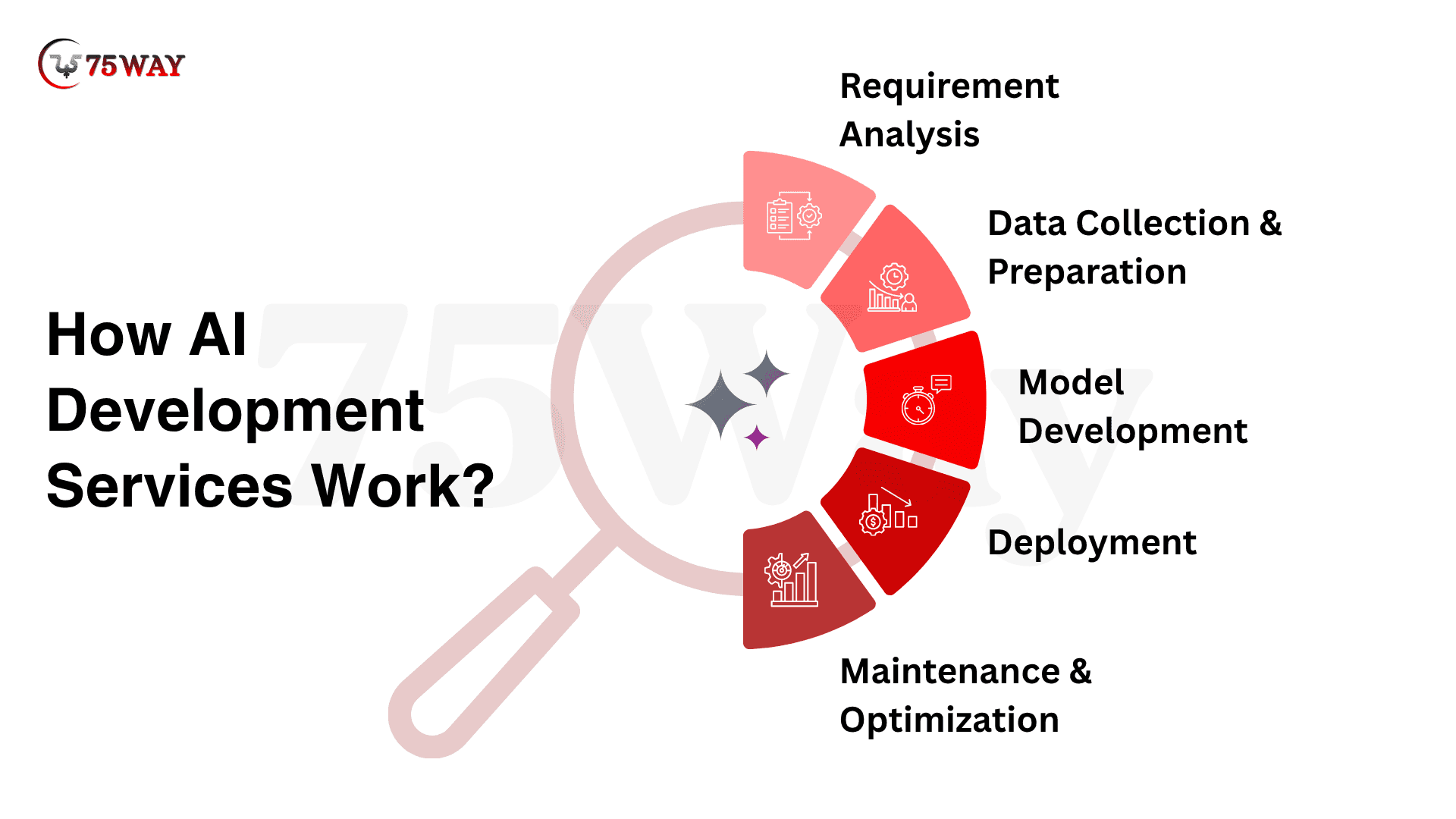
- Requirement Analysis
- Understand business goals
- Identify AI use cases
- Data Collection & Preparation
- Gather relevant data
- Clean and structure it
- Model Development
- Train AI/ML models
- Test accuracy and performance
- Deployment
- Integrate AI into apps or systems
- Maintenance & Optimization
- Monitor performance
- Update models regularly
Types of AI Development Services
AI development services include various types such as machine learning model development, natural language processing solutions, computer vision applications, robotic process automation, AI-powered chatbots, recommendation engines, and predictive analytics, all designed to help businesses automate tasks and make smarter, data-driven decisions.
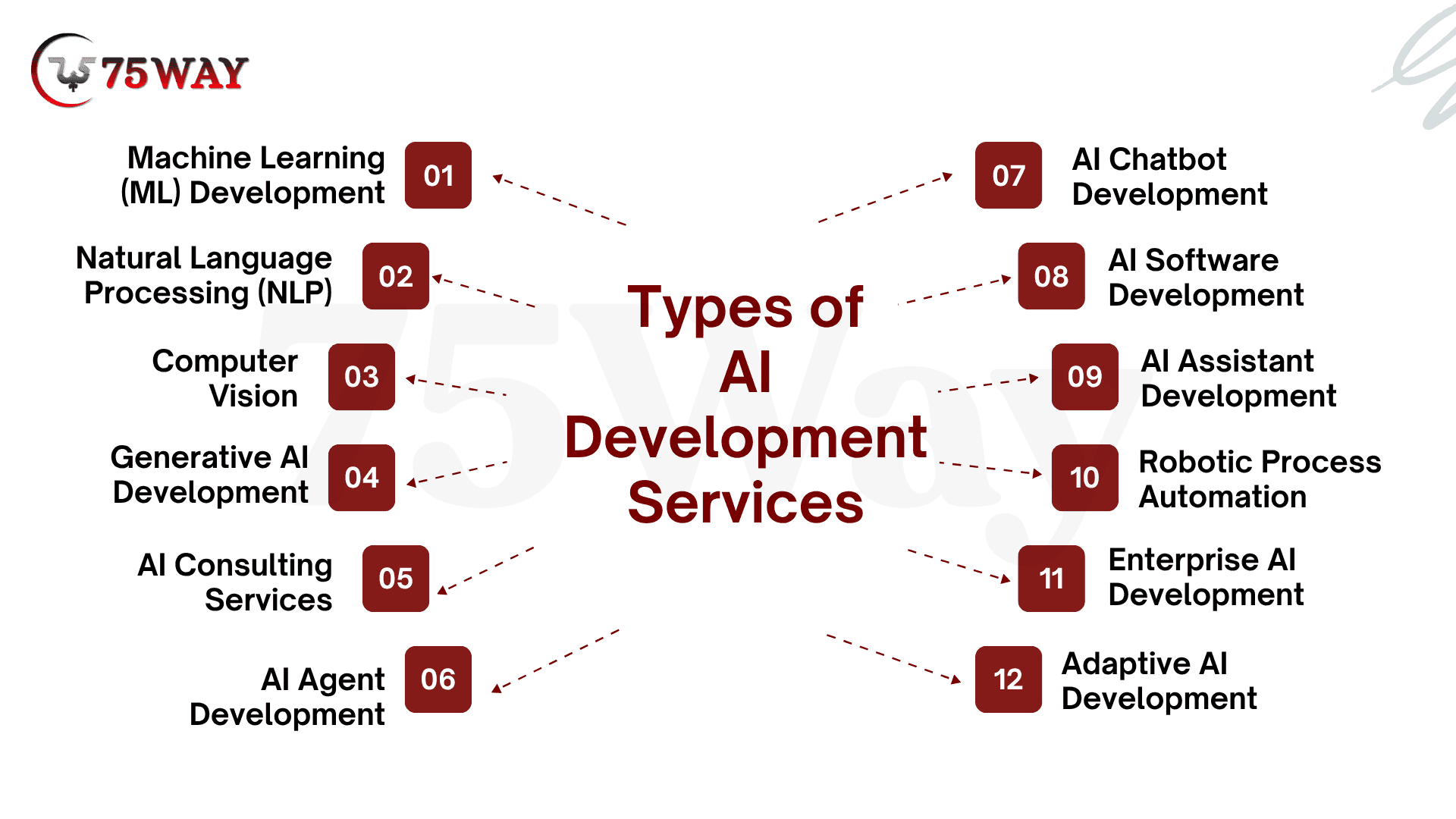
Machine Learning (ML) Development
ML development focuses on creating algorithms and models that enable systems to learn from data, identify patterns, make predictions, and continuously improve without explicit programming. It’s foundational for intelligent business applications.
- Predictive Analytics Models
- Data Pattern Recognition
- Automated Decision Making
Natural Language Processing (NLP)
NLP development enables computers to understand, interpret, and respond to human language. It powers chatbots, voice assistants, sentiment analysis, and other applications requiring language comprehension.
- Text Analysis Automation
- Voice Interaction Systems
- Sentiment Understanding AI
Computer Vision
Computer vision development allows machines to interpret and process visual data from images or videos, enabling object detection, facial recognition, image classification, and real-time visual analytics.
- Image Recognition Tools
- Object Detection Systems
- Video Analysis Automation
Generative AI Development
Generative AI focuses on creating models that can produce new content, such as text, images, audio, or code, often used for design, creative applications, and intelligent automation.
- AI Content Creation
- Design Generation Models
- Automated Text Production
AI Consulting Services
AI consulting services guide organizations in adopting AI technologies, defining strategies, selecting tools, and ensuring successful implementation.
- Strategy Planning Sessions
- Technology Selection Guidance
- Implementation Roadmaps
AI Agent Development
Develop AI-powered agents that autonomously perform tasks, assist users, and improve processes across business operations.
- Task Automation Agents
- Intelligent Workflow Systems
- Virtual Assistant Integration
AI Chatbot Development
Create conversational AI chatbots for customer support, lead generation, and engagement, offering intelligent, automated interactions.
- Customer Support Bots
- Lead Generation Chatbots
- Conversational AI Assistants
AI Software Development
Build AI-integrated software solutions that enhance business operations, decision-making, and overall efficiency.
- Intelligent Application Design
- Predictive Feature Integration
- Automation Software Solutions
AI Assistant Development
Develop AI assistants capable of helping users manage tasks, schedules, and communications efficiently.
- Personal Assistant Tools
- Task Management AI
- Virtual Assistant Services
Robotic Process Automation (RPA)
Implement AI-driven automation to streamline repetitive tasks, workflows, and operational processes.
- Workflow Automation Bots
- Task Scheduling Systems
- Process Optimization Tools
Enterprise AI Development
Design and implement AI solutions tailored for enterprise-scale applications, addressing complex business requirements.
- Large-Scale AI Systems
- Enterprise Workflow Automation
- Scalable AI Solutions
Adaptive AI Development
Create AI systems that continuously learn and adapt to changing data, user behavior, and business environments.
- Dynamic Learning Models
- Behavior Prediction Systems
- Real-Time Adaptation AI
Key Use Cases of AI Development Services
AI development services are applied across industries to automate processes, enhance decision-making, improve customer experiences, enable predictive analytics, power chatbots and virtual assistants, optimize supply chains, detect fraud, and drive innovation through intelligent insights and adaptive, data-driven solutions.
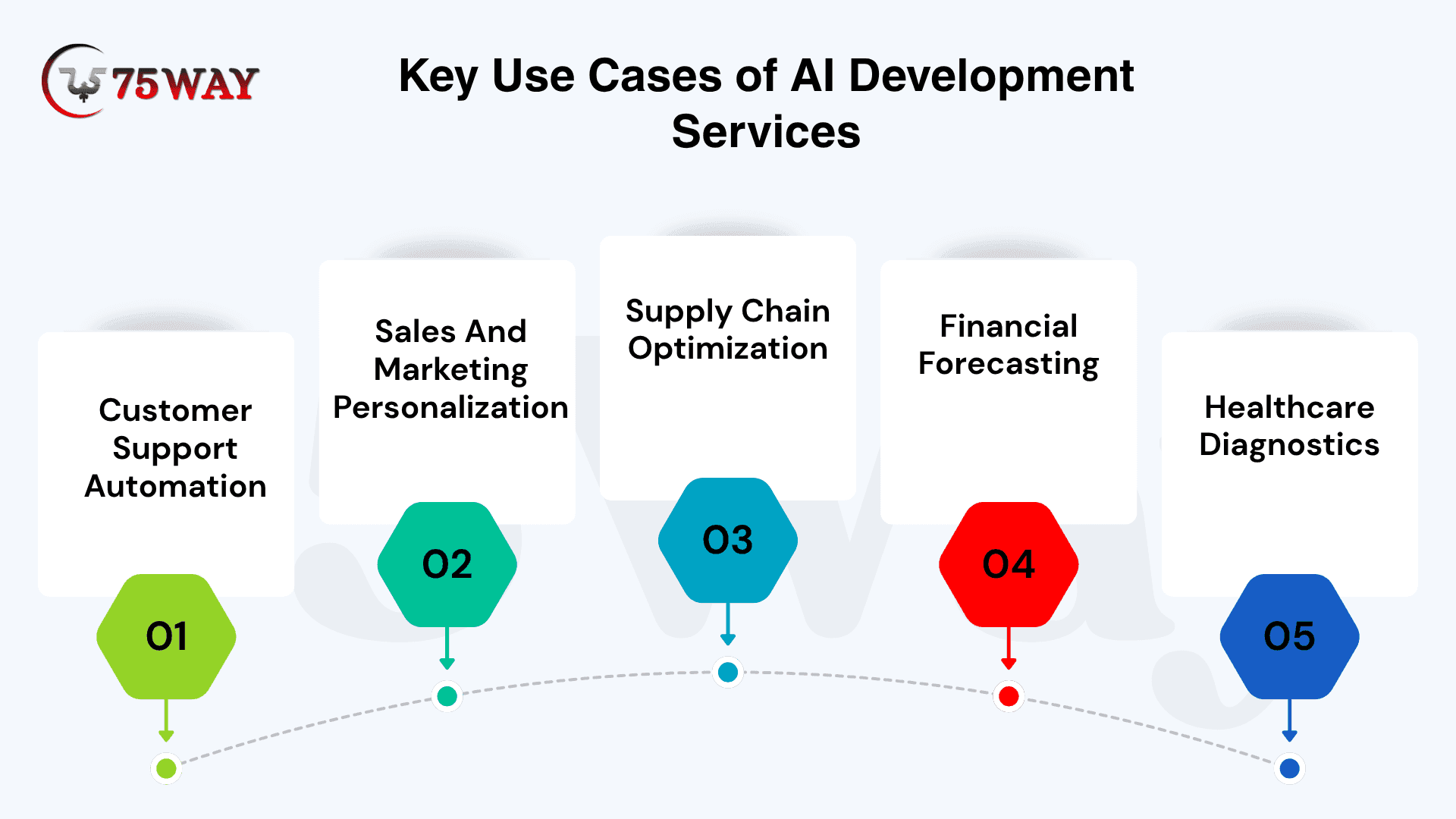
Customer Support Automation: AI automates responses to customer inquiries, reduces wait times, and improves service quality, providing fast, efficient, and consistent support.
Sales and Marketing Personalization: AI analyzes customer data to deliver targeted campaigns, personalized recommendations, and tailored marketing strategies that increase engagement and conversions.
Supply Chain Optimization: AI improves inventory management, predicts demand, reduces costs, and streamlines logistics to enhance supply chain efficiency and reliability.
Financial Forecasting: AI predicts financial trends, assesses risks, and supports informed decision-making for budgeting, investments, and strategic planning.
Healthcare Diagnostics: AI assists in detecting diseases, analyzing medical images, and recommending treatment options to improve patient care accuracy and outcomes.
Benefits of AI Development Services
AI development services help businesses automate processes, improve decision-making, enhance customer experiences, increase operational efficiency, enable predictive insights, reduce costs, boost productivity, and foster innovation by leveraging intelligent systems that learn, adapt, and provide actionable, data-driven solutions.
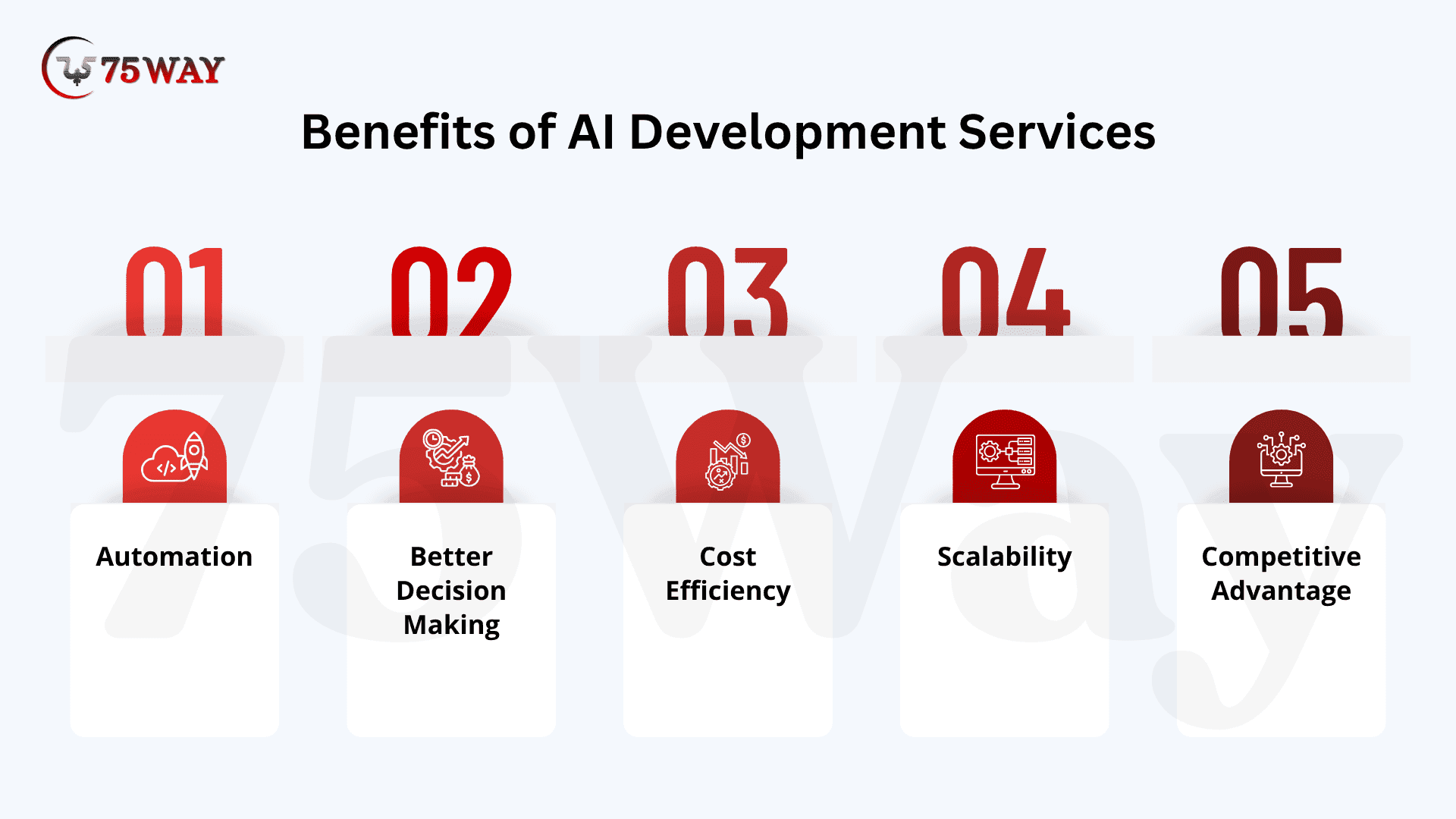
Automation: AI automates repetitive and manual tasks, saving time, reducing human error, and allowing employees to focus on strategic work.
Better Decision Making: AI provides actionable, data-driven insights, helping businesses make accurate, informed decisions and optimize operations effectively.
Cost Efficiency: AI reduces operational costs by streamlining processes, minimizing errors, and improving resource utilization over time.
Scalability: AI systems can easily scale with business growth, adapting to increasing data, users, and operational demands.
Competitive Advantage: AI adoption enables businesses to innovate faster, improve services, and stay ahead of competitors in the market.
Cost of AI Development Services in 2026
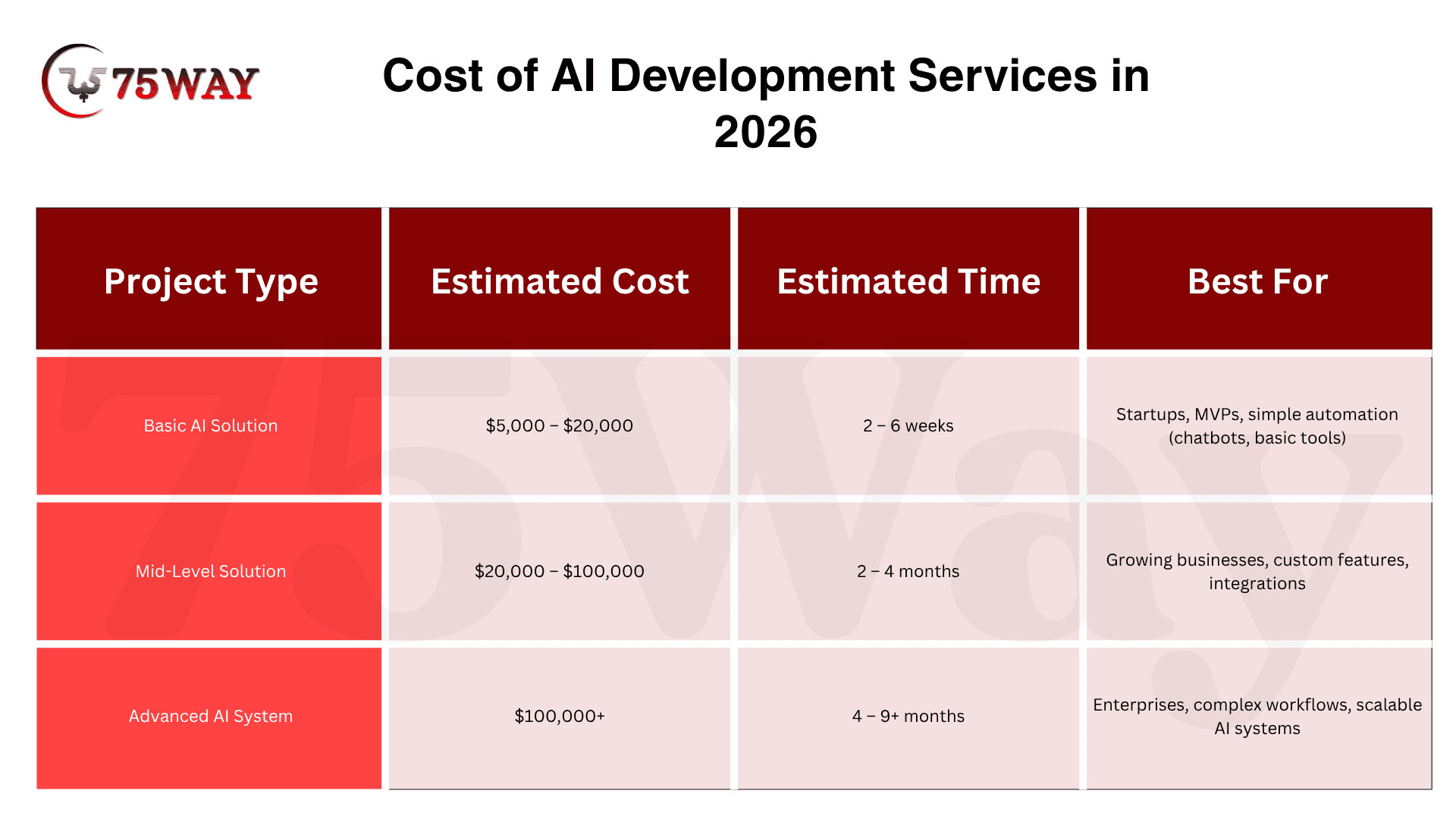
The cost of AI development services in 2026 varies based on project complexity, data requirements, team expertise, and technologies used, ranging from moderate for simple solutions to significant for advanced custom AI models, integrations, and enterprise‑level implementations.
Basic AI Solution: A basic AI solution typically costs between $5,000 and $20,000 and can be developed within 2 to 6 weeks. These solutions usually include simple AI functionalities and limited customization.
Mid-Level Solution: Mid-level AI solutions range from $20,000 to $100,000 and generally take 2 to 4 months to develop. They offer more advanced features, greater integration, and moderate customization to meet business needs.
Advanced AI System: Advanced AI systems start at $100,000 and above, requiring 4 to 9+ months for development. These are highly customized, enterprise-level solutions with complex features, scalability, and robust integrations.
Factors affecting cost:
- Data availability
- Project complexity
- Development time
- Team expertise
How to Choose the Right AI Development Company?
Selecting the right AI development company requires evaluating expertise, technology stack, past project experience, scalability, support services, pricing, and industry knowledge. Choosing a reliable partner ensures successful AI implementation, timely delivery, and solutions aligned with your business objectives.
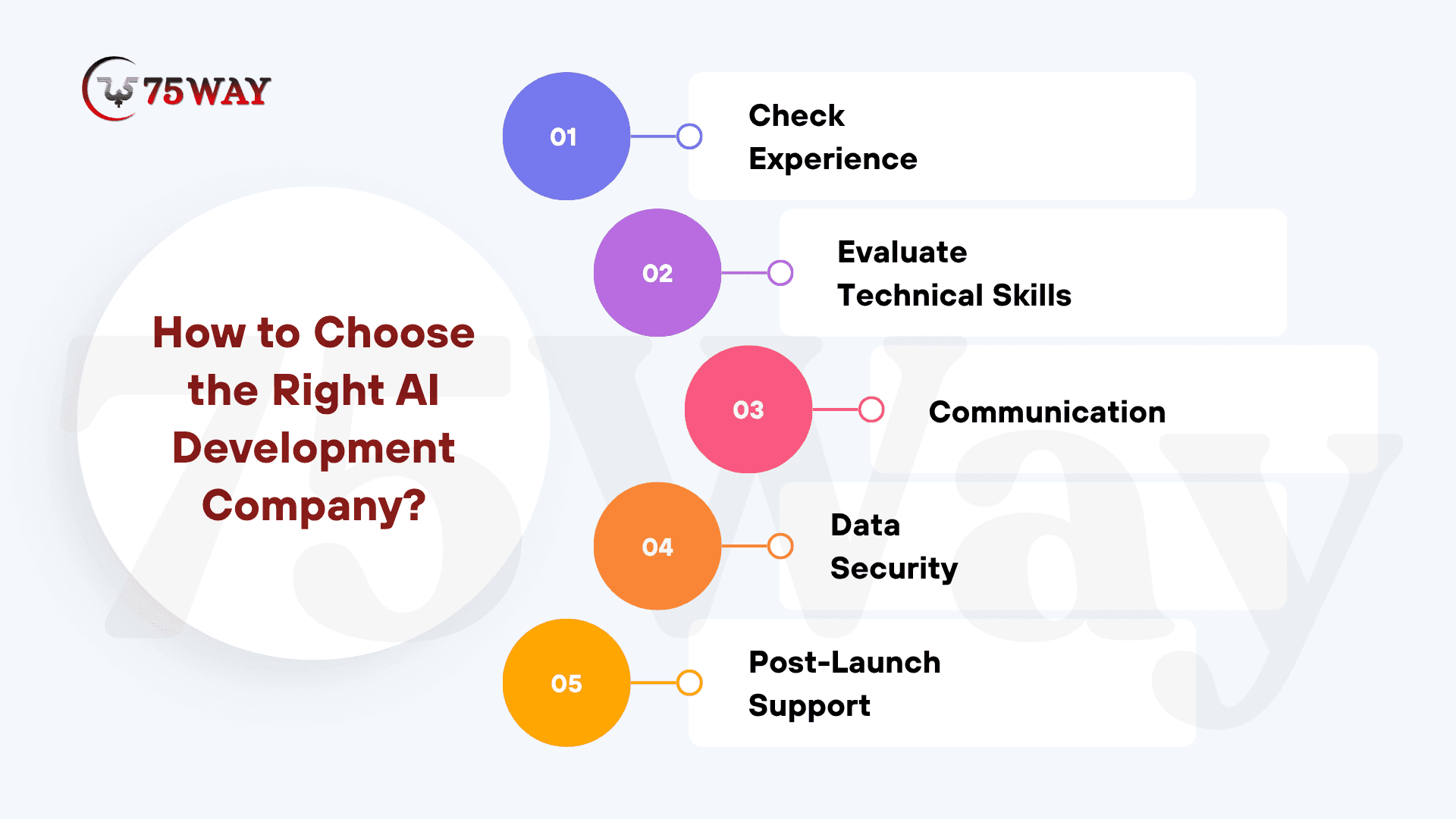
Check Experience: Choose a company with proven AI projects, detailed case studies, and successful implementations to ensure reliability and expertise.
Evaluate Technical Skills: Verify the team’s proficiency in machine learning, natural language processing, AI frameworks, and relevant tools for your project.
Communication: Select a partner with clear, consistent communication to ensure project requirements, progress updates, and expectations are properly understood.
Data Security: Ensure the company adheres to industry compliance standards, protects sensitive information, and implements robust cybersecurity measures.
Post-Launch Support: Opt for a provider offering ongoing maintenance, updates, and performance monitoring to ensure AI solutions continue functioning efficiently.
Common Challenges in AI Development
AI development faces challenges, including data quality issues, high implementation costs, talent shortages, algorithm complexity, integration with existing systems, scalability concerns, ethical considerations, and maintaining model accuracy over time, all of which can impact project success and business outcomes.
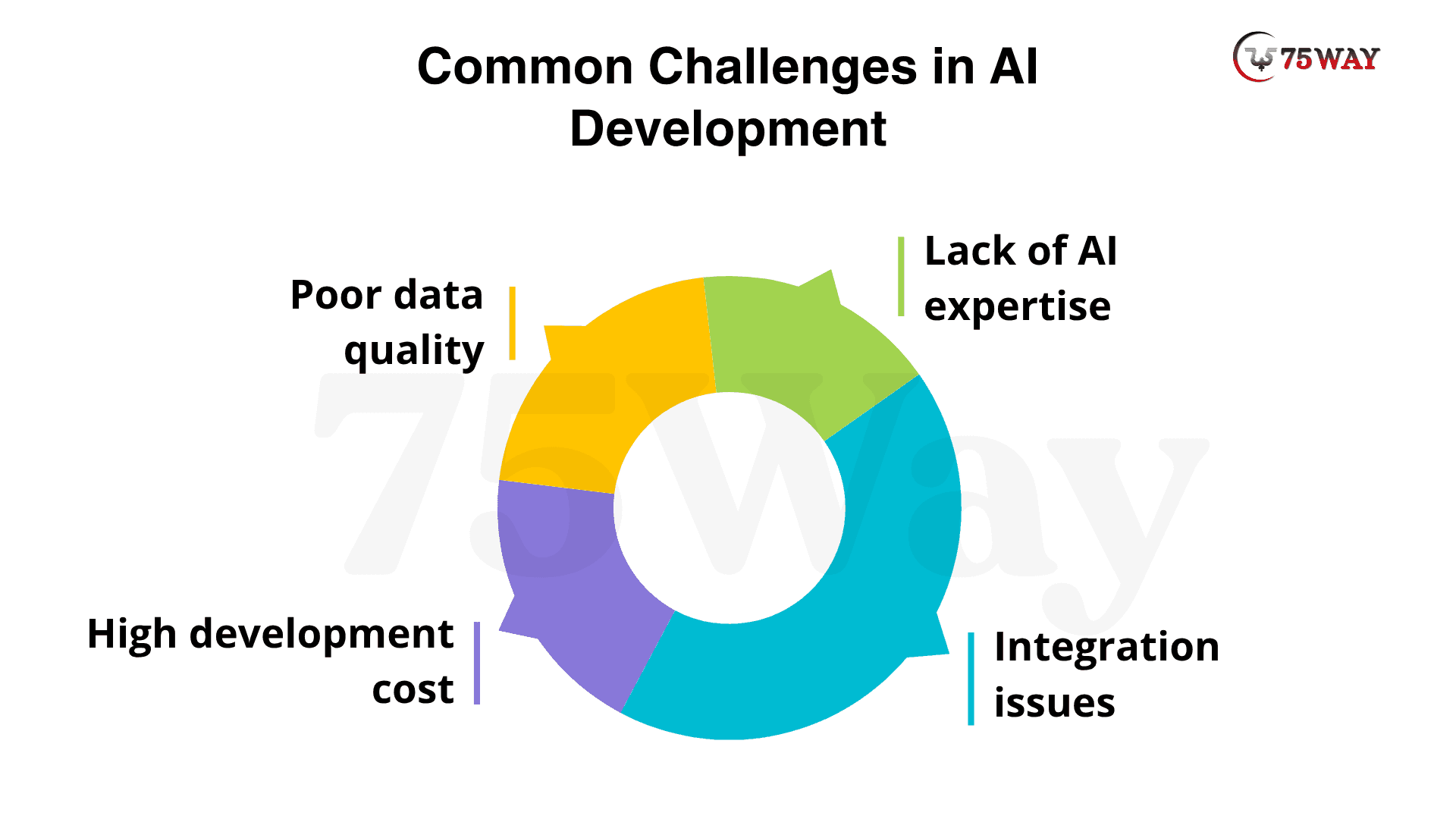
Poor Data Quality: Low-quality, incomplete, or inconsistent data can lead to inaccurate AI models and flawed predictions. Ensuring reliable performance requires collecting, cleaning, and maintaining high-quality datasets throughout development.
High Development Cost: AI projects often involve high costs for technology, infrastructure, and skilled personnel. Organizations can manage expenses by starting with minimum viable solutions, leveraging cloud platforms, and adopting scalable frameworks.
Integration Issues: Integrating AI solutions with existing software, workflows, and databases can be challenging due to compatibility issues and legacy systems. Careful system analysis and using APIs or middleware ensure smooth and seamless deployment.
Lack of AI Expertise: A shortage of skilled AI professionals, including data scientists and ML engineers, can hinder project success. Partnering with experienced consultants, training internal teams, or hiring specialized developers helps bridge the expertise gap effectively.
Future of AI Development Services
The future of AI development services involves more advanced automation, intelligent decision-making, adaptive learning systems, seamless integration across industries, ethical AI adoption, and innovative solutions that drive efficiency, personalization, and competitive advantage for businesses worldwide.
- Generative AI
- AI automation
- No-code AI tools
- AI-powered business intelligence
Final Thoughts
AI development services are transforming how businesses operate, offering automation, smarter decision-making, personalized experiences, and operational efficiency. By leveraging technologies like machine learning, NLP, computer vision, and cloud integration, organizations can stay competitive and innovate faster. Choosing the right AI solutions and development partner ensures scalable, secure, and high-performing systems that meet business goals. Embrace AI today to unlock growth, optimize processes, and drive innovation. Contact an AI development company now to start your journey.
Frequently Asked Questions (FAQs)
Who Needs AI Development Services?
Any business seeking to automate repetitive processes, enhance decision-making, or improve operational efficiency can benefit from AI development services. These services help organizations analyze data, optimize workflows, and implement intelligent systems that support growth, reduce costs, and increase productivity across various business functions.
What Industries Use AI Development Services?
AI development services are widely used across healthcare, finance, e-commerce, real estate, manufacturing, logistics, education, and retail. These industries leverage AI for process automation, predictive analytics, personalized customer experiences, fraud detection, and operational optimization, helping businesses remain competitive and innovative in their respective markets.
Can Small Businesses Afford AI Development Services?
Small businesses can leverage AI through minimal viable solutions or cloud-based AI platforms. These approaches reduce implementation complexity, shorten development timelines, and provide intelligent automation, analytics, and insights, making AI accessible even to organizations with limited resources.
What Factors Affect The Success Of AI Development?
Success depends on data quality, skilled personnel, technology selection, integration strategies, and clear business objectives. Well-defined goals, proper infrastructure, and continuous monitoring help ensure AI models deliver accurate insights, enhance operations, and align with organizational priorities.
How Can Businesses Reduce AI Development Time?
Using prebuilt AI frameworks, modular components, and cloud platforms accelerates development. These solutions streamline model training, deployment, and integration, while ensuring scalability, high performance, and faster time-to-value without extensive custom coding or infrastructure setup.
What Are Common Challenges In AI Development?
AI development often faces challenges such as poor data quality, integration issues, limited talent, and model maintenance. Addressing these with high-quality datasets, expert teams, proper planning, and ongoing monitoring helps ensure successful implementation and sustainable AI performance.